Market Minds Advisory
Rice Water Skincare Market

Rice Water Skincare Market: Four Ingredients, One Name and the Bran Nobody Contracts

Rice water is four different ingredients wearing one name, and the fermented filtrate commands five times the price of the rinse a shopper can make at home for nothing at all.

Lead Analyst

Published

September 2026

Make Smarter Decisions with Customized Research Insights

Request a free sample report and evaluate market opportunities, growth trends, and competitive dynamics relevant to your business needs.

2025 MARKET VALUE$1.4BMarket Size 2025
2036 FORECAST VALUE$4.6BBase Case , 2026 to 2036
CAGR 2026 TO 203611.4 %Bull 12.6% / Bear 10.2%
INCREMENTAL OPPORTUNITY$3.0BNet 10- year value creation
EXPANSION MULTIPLE2.94x2036 value over 2026 base
Strategic Levers
M&A Pipeline
Regional Outlook
Country Rankings
Competitive Intelligence
Segmental Deep-dive
Call-Us : 91 93563 13602

Executive Snapshot and Market Trajectory

Rice water is not an ingredient, it is four of them sharing a name. Rice bran extract, fermented filtrate, rice starch and hydrolysed protein behave completely differently on skin and in a price list, and the category's commercial story is entirely about which one is in the bottle.
Fermented rice water serums grow at 17.1%, half again the market rate of 11.4%, and they sell at roughly 5.4 times the price of a plain rice extract because fermentation produces molecules a home preparation never will. East Asia holds 32% of demand, above its usual band, which reflects a category that originated there, is formulated there and is bought there in genuine volume. That share is not a rounding artefact at all.
Concentration is low at 24% because rice water is unpatentable and the formulation is straightforward at the cheap end. The barrier sits upstream instead: stabilised rice bran must be heat-treated within hours of milling or it goes rancid, and only a handful of mills do that at cosmetic grade. Whoever holds that supply relationship holds something a marketing budget simply cannot replicate at any price whatever.
Market Definition
The rice water skincare market covers finished personal care products whose primary marketed active is derived from rice, spanning rice bran extract, fermented rice filtrate, rice starch and hydrolysed rice protein. Scope includes serums, essences, cleansers, toners, masks, moisturisers, body products and rice-based haircare and scalp treatments sold to consumers. Excluded are rice bran oil sold as a culinary product, raw rice derived ingredients supplied to formulators, oral supplements containing rice extracts, and general Asian beauty products carrying no rice derived active.
Base Year Value
$1.4B in 2025 (MMA Primary Research Dataset, August 2026)
Forecast Period
2026 to 2036, eleven discrete annual values
CAGR
11.4% base case. Bull 12.6%. Bear 10.2%.
Fastest Growth Segment
Fermented Rice Water Serums and Essences: 17.1% CAGR
Fastest Growth Country
India: 13.6% CAGR
Fastest Growth Region
South Asia and Pacific: 13.6% CAGR
Largest Region
East Asia: 32% of 2025 global value
Market Leaders
Amorepacific, Kose Corporation, Shiseido, LG Household and Health Care and Skinfood. Source: MMA Analysis, July 2026.
Primary Survey
n=3,800 procurement and R&D decision-makers, Q4 2025, six countries
Methodology
Demand-side build-up, cross-validated against public data, 47 expert interviews

Rice Water Skincare Market Forecast Scenarios

rice-water-skincare-market-size-forecast-scenario-1788169697365
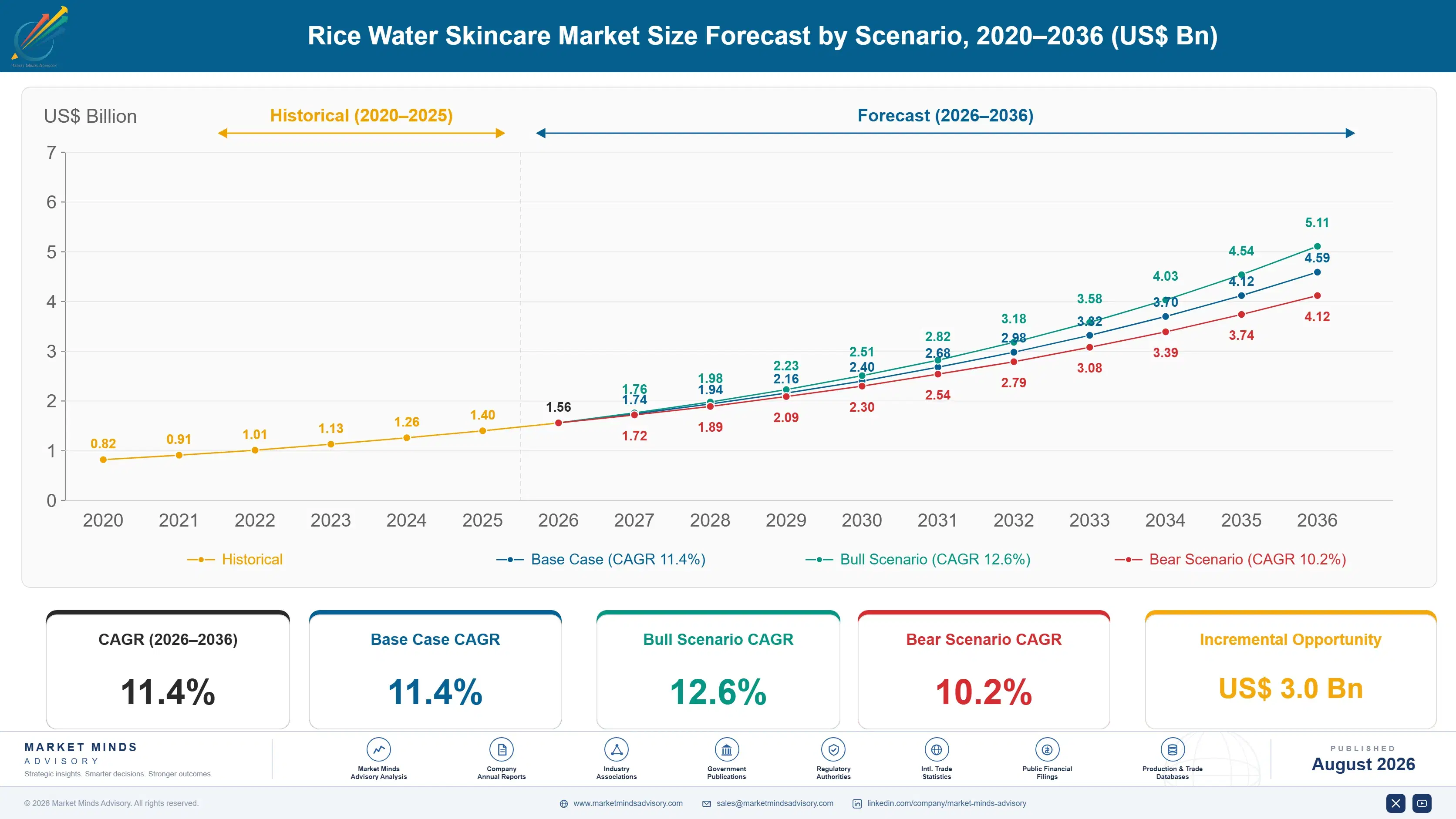
Between 2020 and 2025 the category compounded at 10.2%, and almost all of it came from a single mechanism: short video content teaching people that rice water was a traditional beauty practice. That taught the ingredient rather than any brand, which is why the growth arrived and then dispersed across hundreds of sellers. Nobody in particular captured what they had created.
The 11.4% base case rests on three mechanisms. Fermented filtrates carry clinical support that plain extracts do not, which lets a brand hold a price a home remedy cannot undercut. Rice haircare has opened a second category using the same supply chain and the same story. And East Asian formulators keep shipping new ferment strains faster than Western brands can copy them. None of the three depends on the social media interest continuing at its current level.
The bull case at 12.6% turns on a fermented rice filtrate obtaining a recognised cosmetic efficacy claim in Europe, which would move the ingredient from folklore to dermatology in one step. The bear case at 10.2% is supply: stabilised cosmetic-grade rice bran comes from few mills, and a rice harvest failure or a milling disruption reprices the whole category.

Four Ingredients, One Name

The commercial spread inside this category is extraordinary. A rice starch rinse costs almost nothing to make and competes against a preparation any shopper can produce in a kitchen. A fermented filtrate involves a controlled culture, a defined strain, weeks of processing and a molecular profile nobody makes at home, and it sells at roughly 5.4 times the price. Same shelf, same word, entirely different businesses.
TOP FIVE CONCENTRATION24%Share held by the five largest rice water skincare sellers
AVERAGE SELLING PRICEUSD 22.60Mean retail price across serum and cleanser product formats
FERMENT INGREDIENT PREMIUM5.4xPrice multiple of fermented filtrate over plain rice extract
BRAN STABILISATION WINDOW6 hoursTime from milling before bran develops rancidity without treatment
INGREDIENT COST SHARE17% of COGSRice derived actives as proportion of finished product cost
REPEAT PURCHASE RATE47%Portion of buyers returning within a single replenishment cycle
Supply is the constraint. Rice bran carries lipase that begins releasing free fatty acids within hours of milling, so bran destined for cosmetics has to be heat-stabilised immediately or it turns rancid. That requires equipment at the mill rather than at the formulator, which concentrates cosmetic-grade supply among a small number of Japanese, Indian and Thai operations. Brands buying on spot discover this at the worst possible moment.
Repeat purchase runs at 47%, which is strong for a beauty category and reflects something the ingredient does well: rice derived actives are gentle enough that sensitive-skin buyers stay. That is a more durable position than novelty interest, and it is the reason the category has outlasted every prediction of a passing trend. Brands that measured retention rather than acquisition figured this out early.
"Every brand in this category talks about tradition and almost none of them can tell you which rice derivative is actually in the bottle. The ones that can are charging five times as much and losing no customers."
Principal, Beauty Ingredients and Formulation Practice · MMA Chemicals and Materials Practice · August 2026

Market Trends

Fermentation separates the premium from the folklore

Fermented rice filtrates produced with defined yeast or bacterial strains generate amino acids, organic acids and polysaccharides that a simple rice rinse does not contain, and several have published clinical work behind them. That gives a brand something to defend a price with, in a category where the alternative is a preparation the customer can make from kitchen waste. The segment grows at 17.1% against a category rate of 11.4%, and unit prices run roughly 5.4 times the plain extract. The processing is genuinely harder, which is exactly why it holds.
Market Impact: Retains 47% of buyers
Rice haircare opened a second category entirely

Rice water hair rinsing has a documented tradition among the Yao women of Guangxi, and that story travelled through short video content faster than any skincare claim did. The result is a haircare and scalp segment growing at 14.2% that uses the same rice derived actives, the same suppliers and the same shelf position as the skincare range. Development cost is close to zero for any brand already formulating rice skincare. Most Western participants have not taken it, which is difficult to explain given the margin simply sitting there unclaimed.
Market Impact: Holds ingredient cost at 17%

Market Opportunities and Growth Drivers

Sensitive skin positioning drives unusual repeat purchase

Rice derived actives are among the gentlest materials available in cosmetic formulation, with no acid, no retinoid and no fragrance requirement, which makes them a natural home for buyers whose skin reacts to almost everything else. Repeat purchase runs at 47%, well above beauty category norms, and the mechanism is not brand loyalty but the absence of a reason to stop. That retention is worth considerably more than the acquisition growth the category attracts attention for, and it is the part nobody actually bothers to go and market at all.
Market Impact: Caps pricing on 40% of range

Rice bran valorisation turns milling waste into margin

Rice bran is a milling by-product produced in enormous volume, historically sold as animal feed at feed prices, and cosmetic-grade demand pays multiples of that. Millers in Japan, India and Thailand who installed stabilisation equipment have found a revenue line worth considerably more per tonne than the rice itself in some cases. That economics has pulled new supply into the market and kept ingredient cost at 17% of goods sold despite demand growing at double digits. Very few categories get a supply response anything like as willing as this one.
Market Impact: Spoils batches within 6 hours

Market Restraints and Challenges

Home preparation caps pricing at the low end

Millions of short videos explain how to make rice water at home from cooking waste, and that content taught the category its own ceiling. A shopper who understands that plain rice water costs nothing will not pay a premium for a bottled version of it, which compresses pricing across every product using a simple rice extract. The root cause is that the low end of this category genuinely is replicable at home. Participants are responding by moving to fermented filtrates, publishing strain and process detail, and reframing the proposition around what a kitchen cannot produce.
Market Impact: Commands 5.4x ingredient premium

Rice bran rancidity limits formulation shelf life

Unstabilised rice bran develops free fatty acids within hours of milling because lipase is released when the grain is broken, and a formulation built on poorly stabilised material will develop an off odour inside its stated shelf life. The root cause is enzymatic rather than microbial, so preservatives do nothing about it. Commercial impact is returns, complaints and destroyed batches, and it falls hardest on brands buying ingredient on price rather than on specification. Mitigation runs through qualified stabilised bran suppliers, tighter free fatty acid specifications on incoming material, and moving to fermented filtrates where the process removes the problem.
Market Impact: Grows 14.2% on shared supply
3 additional market trends, 4 additional growth drivers, and 2 additional restraints and challenges are covered in the full report. Contact sales@marketmindsadvisory.com to access the complete intelligence.

Segment CAGR and Growth Architecture

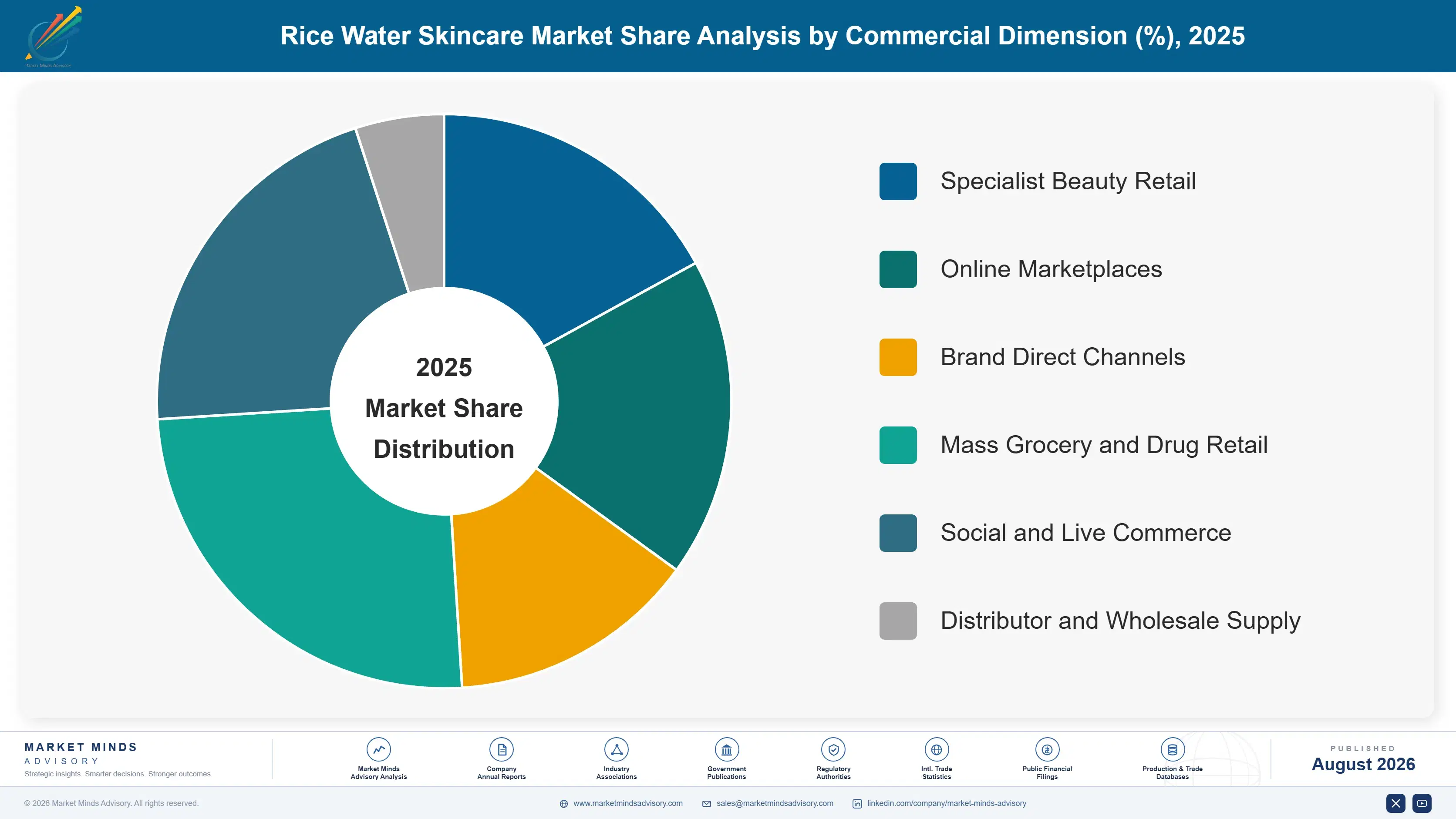
Segmentation follows finished product format, the dimension on which formulation, price point and retail buying all operate. Serums and essences carry the fermented actives and the pricing power. Cleansers, masks and body products carry volume at prices a home preparation constrains. Haircare sits alongside as a second category using an identical supply chain and identical suppliers.
rice-water-skincare-market-market-share-analysis-1788169697909

Fermented Rice Water Serums and Essences

Fermented rice water serums and essences grow at 17.1%, half again the market rate of 11.4%, and this is the only part of the category with a defensible price. A defined yeast or bacterial strain fermenting rice substrate produces amino acids, organic acids and polysaccharides that a kitchen rinse does not contain, and several filtrates carry published clinical work. Unit prices run around 5.4 times the plain extract and the buyer accepts it, because the proposition has moved from folklore to something closer to dermatology. Getting there requires fermentation capability that most Western brands buy in from Korean or Japanese formulators rather than build for themselves at all. That dependency is the quiet fact of this segment.
CAGR 17.1%

Rice Water Haircare and Scalp Treatments

Rice water haircare and scalp treatments at 14.2% arrived through a tradition rather than a laboratory. The Yao women of Guangxi have used rice water hair rinsing for generations, and short video content carried that story worldwide faster than any brand campaign could have. Commercially the segment is close to free for anybody already formulating rice skincare: same actives, same suppliers, same shelf conversation with the same retail buyer. Margins run below the fermented serums but above the cleanser range, and the buyer overlap is high enough that acquisition cost is effectively shared. Very few Western participants have entered it. That gap will not stay open for very much longer than a season.
CAGR 14.2%
Full segment breakdown across 6 segments available in the complete report.

Regional Architecture and Country Demand Map

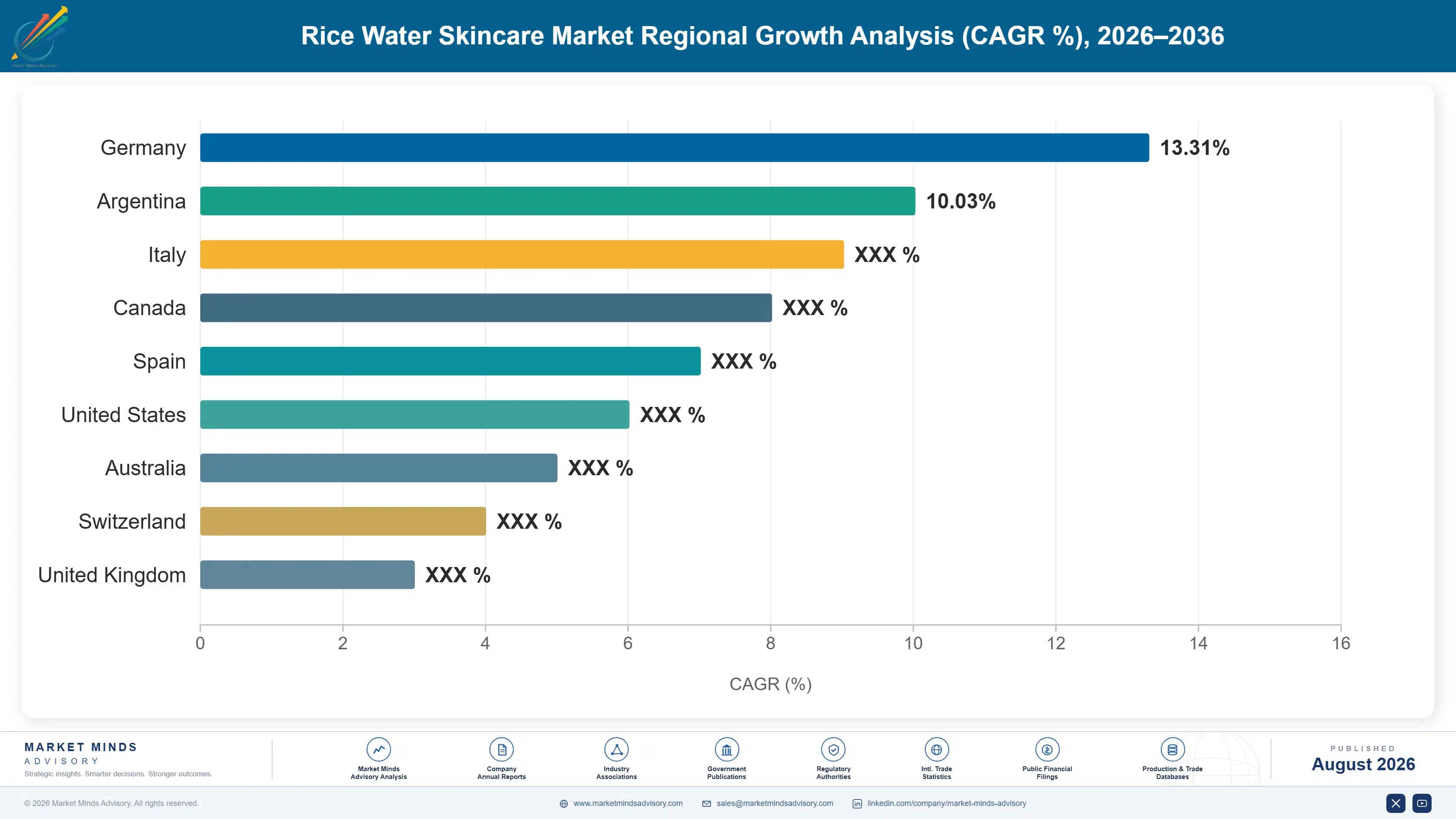
East Asia takes 32%, above the usual band, because this category originated there, is formulated there and is bought there at genuine scale. South Asia grows fastest on rice bran supply and price accessibility. Western demand follows East Asian product releases rather than leading them.

East Asia

This region takes 32%, above the usual regional band, and the justification is that the category exists because of it: rice derived skincare originated in Japanese sake brewery practice and Chinese and Korean tradition, and the formulation capability still sits here. Japanese fermentation expertise built on sake production produces filtrate strains that Western formulators buy rather than develop. Korean brands set the product release calendar that the rest of the world follows six to nine months later. Chinese demand has grown fast on domestic brands using the same heritage argument. Nowhere else combines the tradition, the supply and the consumption at this scale. The share reflects that combination rather than any modelling artefact.
Share: 32% | CAGR: 12.4% (2026 to 2036)

North America

Discovery here happened on a phone rather than at a beauty counter, which shaped the whole channel structure. Short video content taught American consumers about rice water before any major brand had a product to sell them, so marketplace and direct-to-consumer selling absorbed most of the early demand and physical retail arrived late. Sephora and Ulta listings have since followed, mostly for Korean brands rather than domestic ones. The commercial weakness is that almost every American participant buys its formulation from an East Asian contract manufacturer, which means no supply advantage and no development speed against the brands they compete with. Very few of them appear to regard that as a problem yet.
Share: 22% | CAGR: 12.0% (2026 to 2036)
Regional intelligence for 5 additional markets available in the complete report: Western Europe, South Asia and Pacific, Latin America, Middle East and Africa, Eastern Europe. Contact sales@marketmindsadvisory.com.
rice-water-skincare-market-country-cagr-analysis-1788169698436

Four Moves Beyond The Story

None of these four requires a new heritage claim, which is fortunate, because the heritage is public property and every competitor has the same one. Each takes something the business can own, the supply relationship, the ferment strain, the retention data, the adjacent category, and turns it into a position a competitor cannot copy from a video.

Contract stabilised bran supply before scaling

Cosmetic-grade stabilised rice bran comes from a small number of mills that heat-treat within hours of milling, and the rest of the world's bran goes to animal feed. Contracting annual volume with one of those operations costs perhaps 12% above spot ingredient pricing and removes a supply failure that stops production entirely rather than merely raising cost. It also buys specification control on free fatty acid content, which is the single variable that decides whether a formulation smells right at month 18. Brands buying on price discover this problem after they have shipped.
Market Impact: Secures bran supply at 12% above spot pricing

Own a ferment strain rather than buying filtrate

Most Western brands buy finished fermented filtrate from a Korean or Japanese formulator, which means their premium product is available to every competitor from the same supplier. Developing or exclusively licensing a defined strain converts a commodity input into something nobody else can put on a label. The segment grows at 17.1% and prices at 5.4 times plain extract, so the margin easily funds the work. It also generates the clinical documentation European claims regulation requires, which the shared filtrates rarely come with in any usable form at all anyway.
Market Impact: Defends the 5.4x ingredient premium against direct copying

Extend into haircare using the same supply

Rice water haircare grows at 14.2% and uses identical actives, identical suppliers and the same retail buyer conversation as the skincare range. Development cost for a brand already formulating rice skincare is close to nothing, and the buyer overlap means acquisition spending works twice. Most Western participants have not entered, leaving the segment to Korean brands and a few specialists. The category also happens to have a stronger traditional story in hair than in skin, since the Yao rice rinsing practice is documented and specific rather than general folklore alone.
Market Impact: Adds one 14.2% growth category at nearly zero cost

Sell retention to the sensitive skin buyer

Repeat purchase runs at 47% in this category, which is high for beauty, and the reason is gentleness rather than brand affection. Rice actives contain no acid, no retinoid and no required fragrance, which makes them one of the few options available to buyers whose skin reacts to almost everything. Almost nobody markets to that buyer explicitly, preferring the heritage story that every competitor also tells. Targeting sensitive skin directly reaches a customer with fewer alternatives, higher retention and considerably less price sensitivity than the trend-led buyer ever really shows.
Market Impact: Builds on an existing 47% repeat purchase rate

Who Controls the Margin Pool

CR5 stands at 24%, measured on retail and online revenue, since no participant discloses the category separately. That is low even for beauty, and the reason is that rice water cannot be owned: the ingredient is traditional, unpatentable and available to anybody. The gap between the East Asian groups and the Western brands is not one of scale but of formulation capability and supply access.
Competition runs on three things. Ferment capability decides whether a brand can hold a premium or must compete against a kitchen. Supply relationships with stabilised bran mills decide whether production continues when a harvest disappoints. Release speed decides whether a brand reaches a trend or reads about it, and the Korean formulators set that pace for everybody. Marketing spend, which usually decides beauty outcomes, decides comparatively little here.

Rankings will move on vertical integration. A participant holding contracted stabilised bran and an exclusive ferment strain competes on something a marketplace seller cannot assemble at any budget. Several East Asian groups already hold both. The pressure runs from the supply chain rather than from the brand, which is unusual in beauty and awkward for Western participants whose capability is downstream of an East Asian contract manufacturer.
rice-water-skincare-market-company-positioning-matrix-1788169698961

Competitive Moat and Risk Dimensions

AMOREPACIFIC

Moat: Ferment strain library depth

Decades of fermentation research give the group a library of characterised strains and processes that Western brands can only buy access to, as a shared contract formulation available to competitors as well. That converts the premium end of this category from an ingredient purchase into an owned asset. Building an equivalent library takes years that no marketing budget substitutes for.
AMOREPACIFIC

Risk: Domestic Chinese competition intensifying

Chinese domestic brands using the same heritage argument and increasingly capable local formulation have taken share in the group's largest export market, and they price below imported Korean product while telling a story consumers find equally credible. Rebuilding that position means competing on brand rather than on formulation advantage, which is a slower and considerably more expensive contest.
KOSE CORPORATION

Moat: Sake brewing heritage credibility

The group's rice ferment work traces to Japanese sake brewing practice, which gives it a provenance story that is specific, documented and genuinely its own rather than the generic tradition every competitor invokes. Japanese fermentation capability also produces filtrates with clinical support, which matters increasingly in regulated claim markets. That combination of heritage and evidence is unusually hard to assemble.
KOSE CORPORATION

Risk: Premium pricing limits reach

Positioning at the top of the market keeps the group away from the volume that Korean and Chinese competitors capture at accessible prices, and in a category where the low end is enormous that costs shelf presence and familiarity. Entering the accessible tier risks the premium position that the sake heritage supports, which leaves the group with an awkward choice.

Players Tracked

Prominent Players

Amorepacific
Kose Corporation
Shiseido
LG Household and Health Care
Skinfood

Other Key Players

Cosrx
Beauty of Joseon
Haruharu Wonder
Tonymoly
Able C and C
Nature Republic
Mediheal
Unilever
L'Oreal
Kao Corporation
Rohto Pharmaceutical
Kikumasamune Sake Brewing
Shanghai Jahwa
Proya Cosmetics
Yves Rocher

Recent Developments

JANUARY 2025

Amorepacific commissioned an expanded fermentation research facility

Amorepacific brought expanded fermentation research and pilot production capacity into operation in South Korea, an organic capacity expansion rather than any acquisition or joint venture. The facility develops proprietary strains for rice and botanical ferment filtrates, reducing the group's reliance on shared contract formulations available to competing brands.
Signal: Owning the strain is becoming the only durable position in an otherwise entirely unpatentable ingredient category.
JUNE 2025

Indian rice miller commissioned cosmetic-grade bran stabilisation capacity

An Indian rice milling group brought cosmetic-grade bran stabilisation capacity into operation, heat-treating bran within the window before free fatty acids develop. The investment was an organic capacity expansion serving cosmetic ingredient buyers rather than the feed market that had previously absorbed the same material at far lower prices.
Signal: Supply is arriving from the milling side rather than from anybody inside the beauty industry at all.
SEPTEMBER 2025

European claims review narrowed permitted rice water wording

A European cosmetic claims review led several retailers to require substantiation for rice water efficacy wording under Regulation 1223/2009, obliging brands to reword traditional-use language. Products carrying clinical data on fermented filtrates were unaffected, while those relying on heritage storytelling revised packaging across their European ranges.
Signal: Evidence is separating this category into two tiers that the shelf price had already reflected anyway.

The Bran Goes Off Fast

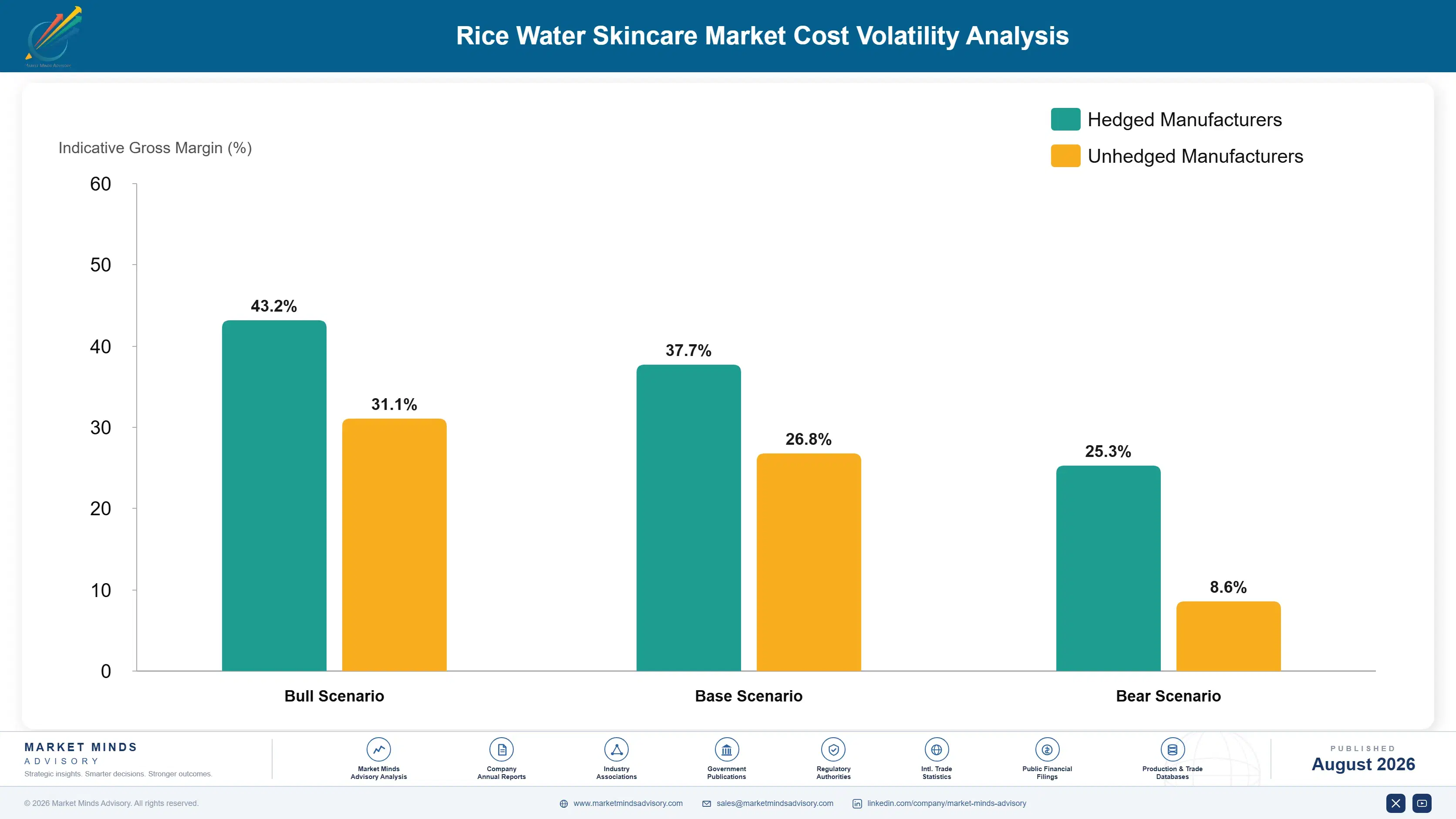
Rice derived actives account for roughly 17% of cost of goods, which is high for a cosmetic ingredient and reflects the processing rather than the raw material. Packaging adds a further 24%. Stabilised cosmetic-grade bran originates in Japan, India and Thailand; fermented filtrates come almost entirely from Korean and Japanese processors who also supply competing brands.
Rice pricing gave the category a lesson in 2023 and 2024. Indian export restrictions on non-basmati rice tightened global supply and lifted prices sharply, and the USDA Foreign Agricultural Service tracked the resulting trade disruption across the period. Bran pricing followed the grain. Brands holding annual contracts with stabilisation operators paid close to their agreed rate while spot buyers absorbed the whole move, and several of the latter repriced mid-season and lost marketplace ranking.

The disadvantage falls on whoever buys finished filtrate rather than making it. A group with its own fermentation sees process cost directly and can substitute substrate when grain prices move. A brand buying a shared contract formulation sees one price that changes without explanation, and it changes for every competitor using the same supplier at the same moment. Nobody gains an advantage from that, which is exactly the problem.
rice-water-skincare-market-cost-volatility-analysis-1788169699157

Contract stabilised bran on annual volume terms

Cosmetic-grade stabilised bran comes from few mills and the rest of the world's bran goes to feed. An annual agreement costs roughly 12% above spot and secures both volume and free fatty acid specification, which is the variable that decides whether a formulation smells right two years after filling. Spot buyers find out about that variable late.

Bring fermentation in house or license exclusively

Buying finished filtrate from a shared supplier means every competitor can list the same active. Developing a strain internally, or licensing one exclusively, converts the input into something ownable and generates the clinical documentation European claims regulation now requires. The work takes a couple of years and the premium segment margin funds it comfortably, which few participants have calculated.

Qualify bran supply from two producing countries

Japanese, Indian and Thai stabilisation operations are exposed to different harvest and policy risks, and Indian export restrictions demonstrated in 2023 that policy moves faster than any procurement cycle. Holding qualified supply from two origins costs a second specification approval and removes a single point of failure. The approval work takes months and the protection lasts indefinitely.

Portfolio Architecture for Margin Defence

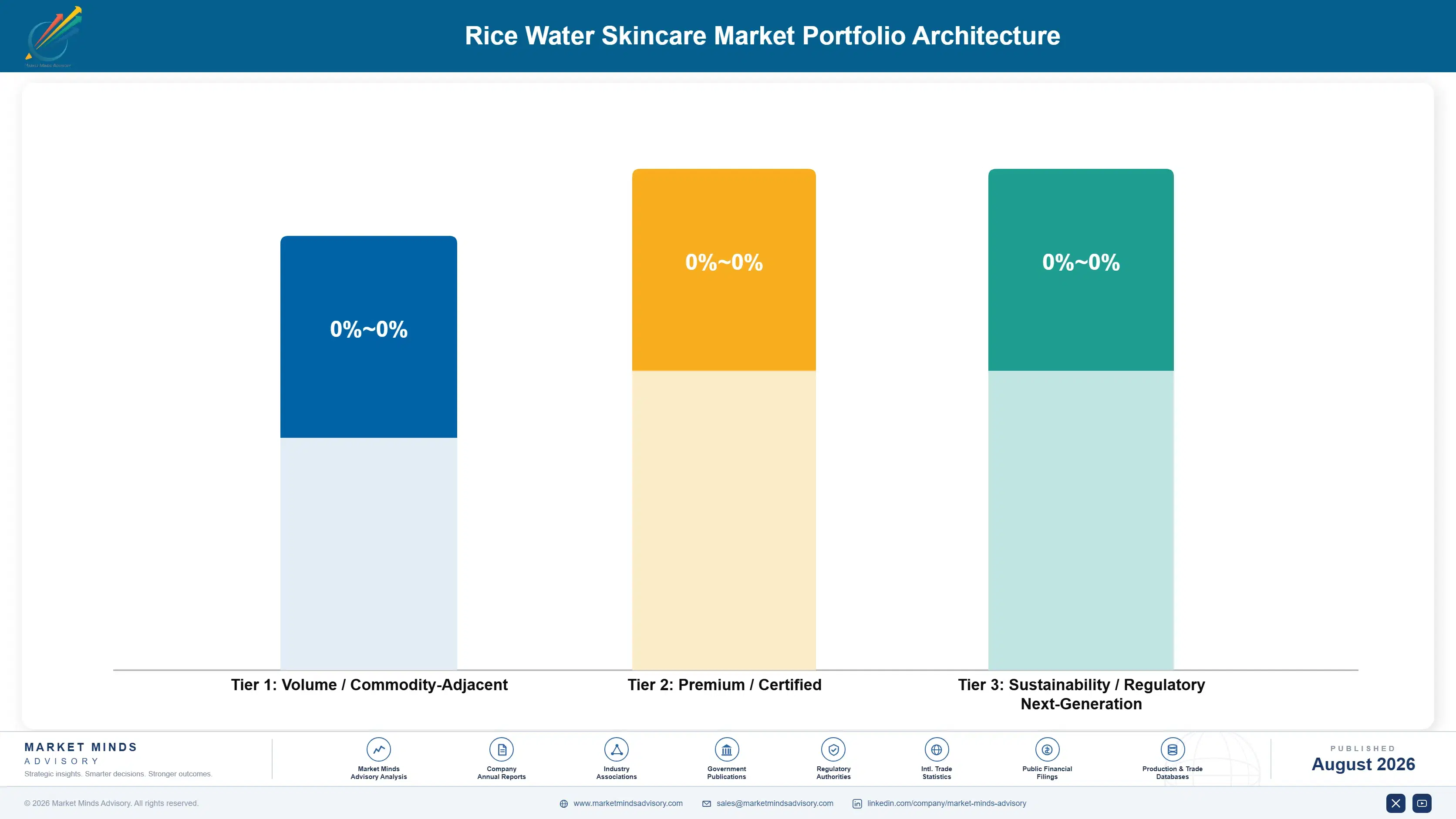
Margin architecture here follows processing depth rather than product format. A rice starch cleanser competes against a preparation the customer can make from cooking water, and it earns accordingly. A fermented filtrate serum earns something close to a pharmaceutical margin because the buyer is paying for a process rather than for an ingredient. The gap between those two positions is wider than in almost any other beauty category.
Volume and premium pull against each other through the supply chain. The accessible range consumes bran volume that makes the annual stabilisation contract worth signing, and that contract is what secures the premium range's specification control. Dropping the volume tier raises ingredient cost across everything. Running only volume leaves a business competing against a kitchen with no way to charge more, and that is not a business.

High-value pools sit in fermented filtrates, in rice haircare and in ingredient supply itself. The third is the least obvious: participants holding stabilised bran contracts or proprietary strains are selling ingredient to brands that cannot secure either, at margins the finished product rarely reaches. Several East Asian groups already run that business quietly alongside their own brands, and nobody in the West has noticed.

Volume / Commodity-Adjacent

Rice starch and plain extract cleansers, toners and body products sold through mass retail and marketplaces. Competes on price against a preparation the customer can make at home. The 9 point spread reflects the proportion sold through marketplace fulfilment rather than direct.
Gross Margin: 42 to 51%

Premium / Certified

Fermented filtrate serums and essences with defined strains and clinical data. Process rather than ingredient supports the price, and the buyer accepts a large multiple over plain extract. The 8 point spread reflects whether the filtrate is proprietary or bought from a shared contract formulator.
Gross Margin: 62 to 70%

Sustainability / Regulatory / Next-Generation

Proprietary ferment strains, upcycled bran positioning built on milling by-product valorisation, and ingredient supply sold to competing brands. Margins are high because capability is scarce rather than because volume is large. The 12 point spread separates finished product sales from ingredient supply contracts.
Gross Margin: 64 to 76%
rice-water-skincare-market-portfolio-architecture-1788169699654

High-value Sub-segments and Strategic Watch-out

Fermented Rice Water Serums

High value and high growth at 17.1%. A defined ferment strain produces molecules no home preparation contains, which supports roughly 5.4 times the plain extract price without argument. The 8 point spread reflects whether the strain is owned outright or licensed from a shared contract formulator.
Gross Margin: 68 to 76%

Rice Water Haircare and Scalp

High value with strong growth at 14.2%. It uses identical actives and suppliers to the skincare range, so development cost is close to nothing and the buyer overlap makes acquisition spending work twice. The 8 point spread reflects whether distribution runs through beauty retail or grocery.
Gross Margin: 56 to 64%

Rice Water Cleansers and Toners

The volume core. It earns modestly and competes against a kitchen preparation, but it consumes the bran volume that makes an annual stabilisation contract worth signing for the premium range. The 9 point spread reflects channel mix between marketplace and physical retail distribution channels overall.
Gross Margin: 44 to 53%

Unstabilised Bran Formulations

The strategic watch-out. Product built on bran that was not heat-treated inside the milling window develops an off odour before its stated shelf life ends, producing returns nobody can resell. The 18 point spread reflects how much reaches the customer before the problem actually appears anywhere.
Gross Margin: 40 to 58%

Why The Gentle Buyer Stays

Repeat purchase at 47% makes this a genuine annuity, which is unusual for a category that arrived through social media. The mechanism is not brand affection: rice actives are gentle enough that a buyer with reactive skin has no reason to stop, and switching to something else carries a risk they are unwilling to take. Acquisition cost therefore amortises over years rather than over a single purchase.
Stickiness varies sharply by why somebody arrived. Sensitive-skin buyers are the most durable, because their alternatives are limited. Trend-led buyers who came through video content churn fastest and go wherever the algorithm points next. Haircare buyers sit in between, repeating on a longer cycle because a hair treatment lasts longer than a serum. The three behave so differently that averaging their retention produces a number describing nobody.

Buyer profiles have shifted in a way the category has not repriced for. The first wave arrived wanting a traditional remedy and paid accessible prices for it. The current wave includes dermatology-adjacent buyers who ask which rice derivative is in the bottle, what strain fermented it, and whether there is data. That buyer pays considerably more and asks questions most brands in this category cannot answer.
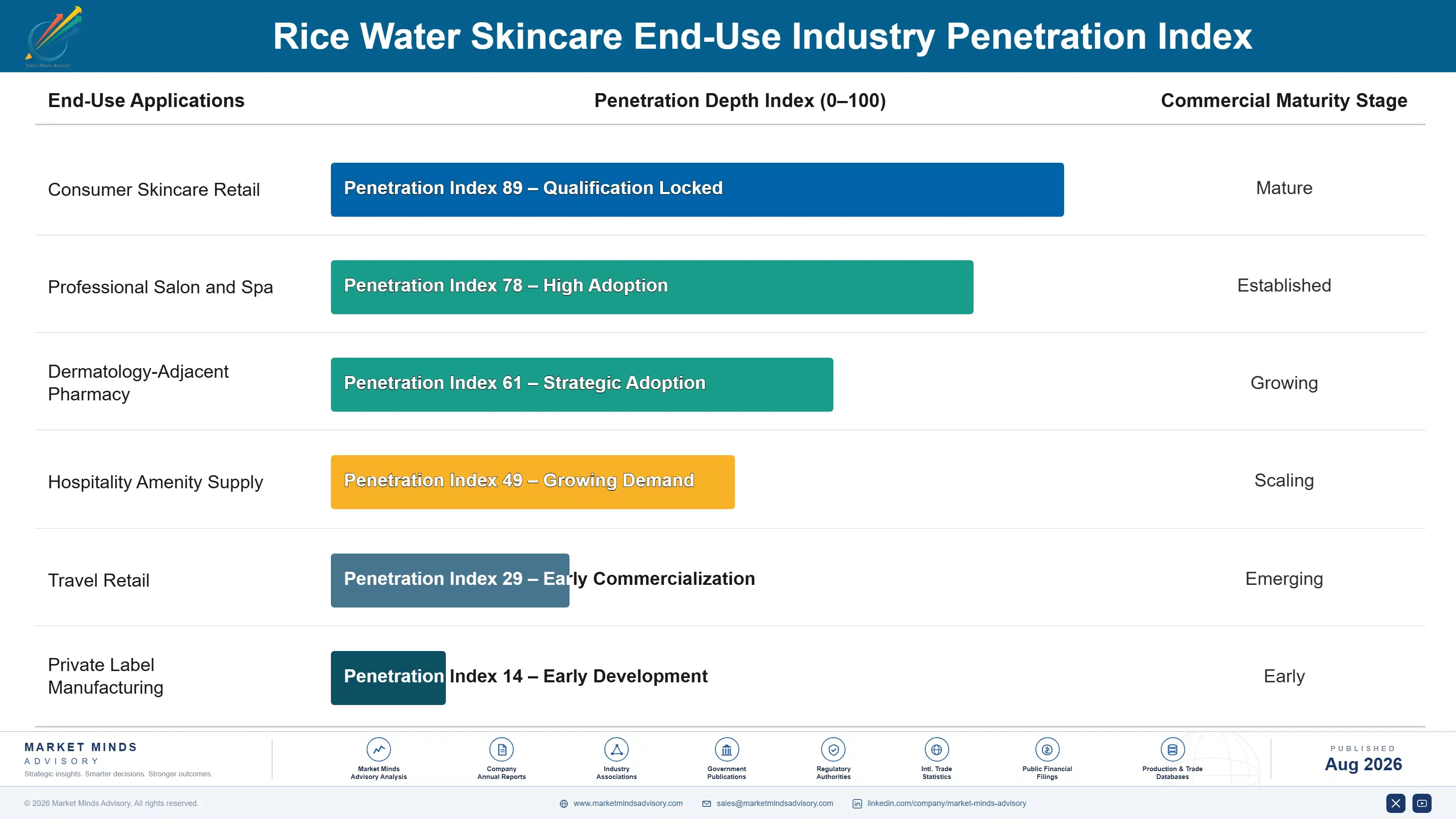
rice-water-skincare-market-end-use-penetration-index-1788169700139

Where The Premium Actually Lives

These are among the four positions where our research anticipates prominent divergence between winners and laggards over the coming forecast period. Each is grounded in the demand model, the regulatory perimeter, and the announced capacity pipeline.
01 / FERMENT STRAIN OWNERSHIP

Own the strain or rent the premium

Most Western brands buy finished fermented filtrate from a Korean or Japanese formulator, which means the premium product they built a price around is available to every competitor from the same supplier at the same terms. Developing or exclusively licensing a defined strain converts a commodity input into an asset nobody else can claim. The segment grows at 17.1% and prices at 5.4 times plain extract, so the margin funds the development work several times over in almost any case.
02 / STABILISED BRAN CONTRACTING

Contract the mill before the harvest decides for you

Cosmetic-grade rice bran must be heat-stabilised within hours of milling or lipase turns it rancid, and only a handful of mills worldwide do that at the required specification. An annual agreement costs roughly 12% above spot and secures both volume and the free fatty acid specification that decides whether product smells right two years after filling. Indian export restrictions in 2023 showed how fast policy moves relative to any procurement cycle a beauty brand could ever actually hope to run.
03 / ADJACENT CATEGORY EXTENSION

Take the haircare segment before somebody else does

Rice water haircare grows at 14.2% using identical actives, identical suppliers and the same retail buyer conversation as the skincare range already in the portfolio. Development cost for a brand already formulating rice skincare is close to nothing, and buyer overlap means acquisition spending does two jobs instead of one. Most Western participants have simply not entered, which leaves a well-documented traditional story and a growing segment sitting there entirely unclaimed for anybody at all willing to move on it.
04 / SENSITIVE SKIN POSITIONING

Market to the buyer who cannot switch

Repeat purchase runs at 47% in this category and the reason is gentleness rather than any affection for a brand, because rice actives carry no acid, no retinoid and no required fragrance. That makes them one of very few options for buyers whose skin reacts to almost everything on the shelf. Almost nobody targets that customer explicitly, preferring the heritage story every competitor also tells, which leaves the most durable buyer in this entire market almost entirely unaddressed by anybody.

Engagement Snapshot From the Field

A live engagement with an industry participant carrying material or product regulatory and market exposure ahead of a defining policy shift, showing how our research translates into a defensible multi-year portfolio strategy.
MARKET MINDS ADVISORY · CLIENT ENGAGEMENT SUMMARY
Rice Water Skincare Producer Strategic Portfolio Review and Transition Roadmap 2026·Investment Scenario on Rice Water Skincare Exposure Evaluation 2025-26
CLIENT PROFILE
A Western clean beauty brand with rice water cleansers, toners and one serum sold through specialist beauty retail and direct online across six markets, with annual revenue in the high tens of millions of dollars (client-reported, unverified by MMA). All formulation was bought from a single Korean contract manufacturer, and the brand had no direct relationship with any rice bran or ferment supplier at all.
STRATEGIC CHALLENGE
Two competitors had launched near-identical serums at lower prices, and investigation suggested all three were buying the same filtrate from the same formulator. Management wanted to know whether any defensible position existed in this category at all, and whether the answer lay in brand investment, in supply control, or in moving away from rice entirely.
MMA APPROACH
MMA traced the ingredient supply chain from finished formulation back to bran stabilisation and ferment production, identifying which inputs were shared across competitors and which were genuinely available on an exclusive basis. Forty-seven expert interviews with formulators, mill operators and retail buyers established what exclusive strain licensing would cost and what documentation European claims regulation would demand.
KEY FINDINGS
  1. The serum filtrate was a standard catalogue item at the contract manufacturer, listed openly and supplied to at least eleven other brands worldwide.
  2. Exclusive licensing of a defined ferment strain was available from two Japanese processors at a cost the serum margin covered within roughly a year.
  3. The brand's cleanser line carried the highest customer retention in the range at 54%, driven by sensitive-skin buyers nobody in the business had identified.
  4. No competitor had entered rice haircare in the brand's markets, despite identical supply requirements and a documented traditional story to build on.
CLIENT PROFILE
A Western clean beauty brand with rice water cleansers, toners and one serum sold through specialist beauty retail and direct online across six markets, with annual revenue in the high tens of millions of dollars (client-reported, unverified by MMA). All formulation was bought from a single Korean contract manufacturer, and the brand had no direct relationship with any rice bran or ferment supplier at all.
STRATEGIC CHALLENGE
Two competitors had launched near-identical serums at lower prices, and investigation suggested all three were buying the same filtrate from the same formulator. Management wanted to know whether any defensible position existed in this category at all, and whether the answer lay in brand investment, in supply control, or in moving away from rice entirely.
MMA APPROACH
MMA traced the ingredient supply chain from finished formulation back to bran stabilisation and ferment production, identifying which inputs were shared across competitors and which were genuinely available on an exclusive basis. Forty-seven expert interviews with formulators, mill operators and retail buyers established what exclusive strain licensing would cost and what documentation European claims regulation would demand.
KEY FINDINGS
  1. The serum filtrate was a standard catalogue item at the contract manufacturer, listed openly and supplied to at least eleven other brands worldwide.
  2. Exclusive licensing of a defined ferment strain was available from two Japanese processors at a cost the serum margin covered within roughly a year.
  3. The brand's cleanser line carried the highest customer retention in the range at 54%, driven by sensitive-skin buyers nobody in the business had identified.
  4. No competitor had entered rice haircare in the brand's markets, despite identical supply requirements and a documented traditional story to build on.
RECOMMENDED STRATEGY
Phase 1: Phase one: license a defined ferment strain exclusively from one Japanese processor and reformulate the serum around it before the next season. Phase 2: Phase two: reposition the cleanser line explicitly toward sensitive skin, which was already the retention driver nobody in the business had noticed. Phase 3: Phase three: launch a rice haircare range using the same suppliers, ahead of competitors who had not yet identified the segment.
OUTCOME
Within four quarters the reformulated serum had recovered its price premium and the two competing products no longer matched its ingredient listing (client-reported, unverified by MMA). Sensitive-skin repositioning lifted cleanser retention further, and the haircare launch reached three retail accounts that had previously carried only the skincare range.

Frequently Asked Questions

Foundational context covering the market sizes, CAGR, scope, country, region and competition that inform every finding below. This section is provided to cover basics and most often pre-purchase conversations, answered from the MMA Primary Research Dataset.

What is the current size of the Rice Water Skincare Market?

The global rice water skincare market was valued at USD 1.4 billion in 2025, covering all finished products whose primary active is rice derived. The 2026 figure reaches USD 1.56 billion.

How large will the Rice Water Skincare Market be by 2036?

MMA forecasts USD 4.59 billion by 2036, an increase of USD 3.03 billion over the 2026 base. That represents an expansion multiple of 2.94 times across the forecast period.

What is the CAGR for the Rice Water Skincare Market 2026 to 2036?

The base case compound annual growth rate is 11.4%, with a bull case at 12.6% and a bear case at 10.2%. Historical growth between 2020 and 2025 ran at 10.2%.

Which segment is growing fastest?

Fermented rice water serums and essences grow at 17.1%, half again the market rate of 11.4%, because fermentation produces molecules a home preparation cannot. Rice haircare follows at 14.2%.

Who are the major companies in the Rice Water Skincare Market?

Amorepacific, Kose Corporation, Shiseido, LG Household and Health Care and Skinfood lead on retail and online revenue, with combined CR5 of 24%. The remaining field is unusually fragmented.

Which country is growing fastest?

India grows fastest at 13.6%, driven by domestic rice bran stabilisation capacity and price points that reach far beyond metropolitan buyers. South Asia and Pacific leads regionally at 13.6%.

Report Segmentation Architecture

The full report scope spans multiple orthogonal segmentation dimensions, with cross-tabulated demand data provided for each dimension pair. Coverage extends further to regional breakdowns, trend trajectories, and the competitive detail needed to support segment-level decision-making.

By Product Format

  • Fermented Rice Water Serums and Essences
  • Rice Water Cleansers and Toners
  • Rice Water Moisturisers and Creams
  • Rice Water Masks and Sheet Treatments
  • Rice Water Body and Bath Products
  • Rice Water Haircare and Scalp Treatments

By End-Use Industry

  • Consumer Skincare Retail
  • Professional Salon and Spa
  • Dermatology-Adjacent Pharmacy
  • Hospitality Amenity Supply
  • Travel Retail
  • Private Label Manufacturing

By Commercial Dimension

  • Specialist Beauty Retail
  • Online Marketplaces
  • Brand Direct Channels
  • Mass Grocery and Drug Retail
  • Social and Live Commerce
  • Distributor and Wholesale Supply

By Region

  • North America
  • Western Europe
  • East Asia
  • South Asia and Pacific
  • Latin America
  • Middle East and Africa
  • Eastern Europe

Scope, Methodology, and Coverage

Every figure in this report is reproducible from documented input assumptions. The scope below maps the historical period, the forecast horizon, the segmentation dimensions, and the countries covered, alongside the underlying primary and qualitative methodology.
Historical Period
2020 to 2025
Forecast Period
2026 to 2036
Base Year
2025 (USD billions; MMA Primary Research Dataset, August 2026)
Market Definition
The rice water skincare market covers finished personal care products whose primary marketed active is derived from rice, spanning rice bran extract, fermented rice filtrate, rice starch and hydrolysed rice protein. Scope includes serums, essences, cleansers, toners, masks, moisturisers, body products and rice-based haircare and scalp treatments sold to consumers. Excluded are rice bran oil sold as a culinary product, raw rice derived ingredients supplied to formulators, oral supplements containing rice extracts, and general Asian beauty products carrying no rice derived active.
Quantitative Units
USD billion, 2025 base year, 2026 to 2036 forecast period
Segmentation Dimensions
Product format, end-use industry, commercial channel, region
Regions Covered
North America, Western Europe, East Asia, South Asia and Pacific, Latin America, Middle East and Africa, Eastern Europe
Countries Covered
United States, Canada, Germany, France, United Kingdom, Italy, Spain, Poland, China, Japan, South Korea, India, Australia, Brazil, Mexico, Saudi Arabia, United Arab Emirates, South Africa
Key Companies Profiled
20 companies across East Asian beauty groups, Western brands and ingredient formulators
Quantitative Methodology
Primary survey, n=3,800 respondents, Q4 2025, six countries; demand-side model with trade association cross-validation
Qualitative Methodology
47 expert interviews, Q4 2025; applied to validate demand model assumptions, identify emerging dynamics, and assess competitive positioning
Report Format
PDF and XLSX data workbook (Word format preview document)
Publisher
Market Minds Advisory
Report Code
MMA-2026-CHM-211
Published
August 2026
Contact
sales@marketmindsadvisory.com | www.marketmindsadvisory.com

Purchase the full Rice Water Skincare Market Report (2026 to 2036).

The full MMA report on the rice water skincare market runs to detailed format and regional models across the 2026 to 2036 forecast period, with ingredient cost benchmarks separated by derivative type. It profiles 20 companies on a consistent retail and online revenue basis, covering East Asian beauty groups, Western brands and the ingredient formulators supplying both. Stabilised bran supply is mapped by producing country alongside the ferment strains available on an exclusive basis. Regional chapters cover the seven MMA regions with country-level detail on the eighteen markets surveyed. Primary research draws on a quantitative survey of 3,800 respondents across six countries and 47 expert interviews conducted in Q4 2025.
Ingredient cost benchmarks by rice derivative type
Stabilised bran supply mapped by producing country
Ferment strain availability and exclusive licensing terms
Twenty company profiles on consistent revenue basis
Retention analysis by buyer type and product format
Seven regional chapters with eighteen country detail tables

Built For The People Who Decide

From boardroom strategy to bench-side execution, this report is read cover-to-cover by leaders shaping the next decade of their industry, turning demand scenarios, market dynamics and valuation benchmarks into decisions.
CXOs/ Presidents/ VPs/ Managers
M&A and Corporate Development
Strategy Teams and R&D Heads
Procurement and Product Directors
Regulatory and Compliance Leaders
Investor Relations and Equity Analysts