Market Minds Advisory
Rice Cake Market

Rice Cake Market: One Name Covering Two Completely Different Businesses

A diet snack with a higher glucose response than white bread shares a category name with a staple food that hardens within hours, and only one of the two is genuinely growing.

Lead Analyst

Lisa Gevelber

Published

September 2026

Make Smarter Decisions with Customized Research Insights

Request a free sample report and evaluate market opportunities, growth trends, and competitive dynamics relevant to your business needs.

2025 MARKET VALUE$3.8BMarket Size 2025
2036 FORECAST VALUE$7.4BBase Case , 2026 to 2036
CAGR 2026 TO 20366.2 %Bull 7.4% / Bear 5.0%
INCREMENTAL OPPORTUNITY$3.3BNet 10- year value creation
EXPANSION MULTIPLE1.82x2036 value over 2026 base
Strategic Levers
M&A Pipeline
Regional Outlook
Country Rankings
Competitive Intelligence
Segmental Deep-dive
Call-Us : 91 93563 13602

Executive Snapshot and Market Trajectory

Two unrelated products share this category name. A puffed rice cake is an extruded snack with a glycaemic index near 82, higher than white bread. A glutinous rice cake is a staple and celebratory food that hardens within about six hours of being made. Nothing else connects them.
The growth belongs entirely to the second of them. Korean and Japanese rice cake dishes have travelled outward on media influence rather than on any nutritional argument, and frozen and shelf-stable glutinous formats grow at 9.3%, half again the market rate of 6.2%. The United States expands fastest at 11.6%, from a base small enough to make the percentage flattering. Media exposure rather than migration is driving it.
Freezing is what made that export possible in the first place, extending storage life by around 270 days against a fresh product that is unacceptable by the following morning. The puffed snack side faces exactly the opposite problem, since consumers who now watch their own glucose response have started reading a diet product from the 1980s rather differently. The two halves move in opposite directions. Younger buyers carry no memory of the diet positioning.
Market Definition
Rice-based cake products sold as snacks, staples and prepared foods, covering puffed and extruded rice cakes, flavoured and coated puffed cakes, fresh glutinous rice cakes, frozen and shelf-stable glutinous rice cakes, mochi and filled rice confections, and savoury rice cake crackers and crisps. Measured at manufacturer selling value. Excludes rice flour sold as an ingredient, cooked rice meals, rice noodles, rice crackers made without a cake form, and rice-based breakfast cereals.
Base Year Value
$3.8B in 2025 (MMA Primary Research Dataset, August 2026)
Forecast Period
2026 to 2036, eleven discrete annual values
CAGR
6.2% base case. Bull 7.4%. Bear 5.0%.
Fastest Growth Segment
Frozen and Shelf-Stable Glutinous Rice Cakes: 9.3% CAGR
Fastest Growth Country
United States: 11.6% CAGR
Fastest Growth Region
South Asia and Pacific: 8.2% CAGR
Largest Region
East Asia: 52% of 2025 global value
Market Leaders
Quaker Oats, Lotte Wellfood, Samyang Foods, Kameda Seika, Want Want China Holdings. Source: MMA Primary Research Dataset, July 2026.
Primary Survey
n=3,800 procurement and R&D decision-makers, Q4 2025, six countries
Methodology
Demand-side build-up, cross-validated against public data, 47 expert interviews

Rice Cake Market Forecast Scenarios

rice-cake-market-size-forecast-scenario-1787594936666
Growth ran near 5.2% between 2020 and 2025, with the two halves of the category moving in opposite directions throughout. Puffed rice cake volumes were broadly flat in Western markets as diet-snack positioning aged, while Korean and Japanese rice cake products grew strongly on export demand driven by media exposure. Freezing and shelf-life technology improved enough during the period to make that export commercially practical.
Base case 6.2% rests on three mechanisms. Frozen and shelf-stable glutinous formats grow at 9.3% because they solve the retrogradation problem that confined fresh rice cake to its home market for centuries. Korean processed food exports continue expanding at roughly 18% annually, carrying rice cake products with them into markets that had never seen them. And Western consumers keep discovering the savoury applications rather than the diet snack, which reaches a younger buyer entirely.
The bull case at 7.4% assumes prepared rice cake dishes establishing themselves in mainstream Western grocery rather than remaining in Asian specialty retail, which would multiply the addressable base. The bear case at 5.0% is glucose response awareness spreading far enough to damage the puffed snack category outright, which still carries substantial volume in Western markets despite flat growth.

The Snack and the Staple

Nothing connects these two products except the words used to describe them. A puffed rice cake is extruded under heat and pressure into an airy disc, sold on calorie count, and carries a glycaemic index around 82 that puts it above white bread on glucose response. A glutinous rice cake is pounded or steamed rice eaten as a staple and at celebrations across East Asia, in dishes that are substantial rather than abstemious.
TOP FIVE CONCENTRATION22%Regional producers dominate a culturally fragmented category everywhere
PUFFED CAKE GLYCAEMIC INDEX82Blood glucose response measured against a reference food
RETROGRADATION ONSET6 hoursTime before a fresh rice cake hardens unacceptably
FROZEN SHELF LIFE EXTENSION270 daysStorage life freezing adds over the fresh product
KOREAN FOOD EXPORT GROWTH18%Annual expansion in Korean processed food shipments abroad
RICE COST SHARE44%Ingredient cost accounted for by the rice itself
The commercial energy sits entirely on the Asian side. Korean and Japanese rice cake dishes travelled outward on media exposure rather than on any nutritional proposition, with Korean processed food exports expanding around 18% annually and carrying rice cake products into markets that had no prior category for them. Consumers encountering tteok-bokki through a drama are not comparing calories with anything.
Retrogradation is the technical fact that shaped everything. Starch in a cooked glutinous rice cake recrystallises within roughly six hours, turning a soft product hard and confining fresh rice cake to same-day local consumption for most of its history. Freezing extends usable life by around 270 days, and modified starches and enzyme treatments extend it further, which is why this food can be exported at all.
"Western manufacturers keep trying to fix the puffed rice cake's health story while the actual growth is a savoury Korean street food nobody in that industry has tasted. The two products share a shelf label and absolutely nothing else, and treating them as one category has cost people real money."
Director, Asian Foods and Snack Categories Practice · MMA Food and Beverage Practice · August 2026

Market Trends

Freezing technology converting a local staple into an export product

Cooked glutinous rice cake retrogrades within about six hours, hardening into something nobody wants to eat, which confined the product to same-day local consumption for most of its history. Freezing extends usable life by around 270 days and modified starch and enzyme treatments push texture retention further still. That combination is why Korean and Japanese rice cake products can now reach export markets at all, and frozen formats grow at 9.3% against a market rate of 6.2% as a direct result. Cold chain reliability in destination markets is now the binding constraint.
Market Impact: Exports growing at 18% annually

Glucose response awareness undermining the puffed diet snack

A plain puffed rice cake carries a glycaemic index around 82, above white bread, which sits awkwardly with the diet positioning the product has carried since the 1980s. Continuous glucose monitoring has moved from diabetes management into consumer wellness, and shoppers who track their own response are reading the category differently. Manufacturers are reformulating with whole grains, legumes, added protein and fat to blunt the response, which raises cost and moves the product away from its original calorie-count proposition. That moves the product away from the calorie-count proposition it was built on.
Market Impact: Sidesteps an 82 glycaemic index

Market Opportunities and Growth Drivers

Korean food exports carrying rice cake dishes into new markets

Korean processed food exports expand around 18% annually, and rice cake products travel with them into markets that had no prior category for the food at all. The United States grows fastest anywhere at 11.6%, driven by Korean media exposure creating demand for specific dishes rather than for an ingredient. That is unusual, since consumers are seeking a prepared dish they have seen rather than browsing a category, which favours meal kits and sauced formats over plain rice cake sold loose. Plain cake sold loose leaves a preparation question most first-time buyers answer badly.
Market Impact: Hardening begins within 6 hours

Savoury applications reframing rice cake away from diet snacking

Western consumers encountering rice cake through Korean and Japanese dishes meet it as a chewy savoury component in something substantial rather than as a low-calorie substitute for bread. That reframing sidesteps the glycaemic argument entirely, because nobody eats tteok-bokki instead of lunch. It also supports considerably higher price points than the diet snack aisle sustains, and it reaches younger consumers who have no memory of the original diet positioning at all. Price points in prepared savoury formats run well above what the diet snack aisle sustains. Consumers meeting the food this way carry no memory of the earlier diet positioning.
Market Impact: Index of 82 exceeds bread

Market Restraints and Challenges

Retrogradation limiting texture quality across the supply chain

Starch recrystallisation hardens cooked glutinous rice cake within roughly six hours, and freezing arrests it rather than reversing it, so texture on reheating never quite matches fresh product. The root cause is physical chemistry in the starch itself rather than any processing shortcoming. Commercially it means exported product is judged against a fresh version most Western consumers have never tasted, which is fortunate, while Asian consumers notice immediately. Modified starches, trehalose and enzyme treatments all extend texture retention without eliminating the problem. Export consumers will notice as they become more familiar.
Market Impact: Adds 270 days of shelf life

Diet snack positioning aging badly against nutritional understanding

Puffed rice cakes were built on a calorie-count proposition that consumer nutrition thinking has moved away from, and a glycaemic index near 82 places them above white bread on glucose response. The root cause is that puffing gelatinises starch completely, making it rapidly digestible by design. Commercially it leaves a large installed volume in Western markets with no growth story attached. Reformulation with legumes, whole grains and added protein blunts the response and raises cost considerably. Large flat volume with no growth story attached is the result. Reformulation abandons the simplicity that made it cheap.
Market Impact: Glycaemic index reaching 82
4 additional market trends, 3 additional growth drivers, and 2 additional restraints and challenges are covered in the full report. Contact sales@marketmindsadvisory.com to access the complete intelligence.

Segment CAGR and Growth Architecture

Six segments are split by product form, because form determines the production process, the shelf life problem, the consumption occasion and which of the two quite separate businesses inside this category a given product actually belongs to. Flavour and filling variants sit inside each form. End-use occasion and channel are handled in the framework instead.
rice-cake-market-market-share-analysis-1787594937204

Frozen and Shelf-Stable Glutinous Rice Cakes

Growing at 9.3%, half again the market rate of 6.2%, frozen and shelf-stable formats solve the retrogradation problem that confined fresh glutinous rice cake to same-day local consumption for most of its history. Freezing adds around 270 days of usable life, and modified starch and enzyme treatments extend texture retention beyond what freezing alone achieves. This is the format carrying Korean and Japanese rice cake into export markets, frequently as part of a sauced meal kit rather than as plain cake sold loose. Cold chain reliability in destination markets is the practical constraint on how far it travels. Kits convert first purchases into second ones far more reliably than loose cake.
CAGR 9.3%

Mochi and Filled Rice Confections

At 8.2% mochi and filled confections have travelled further into Western mainstream retail than any other rice cake format, largely through frozen mochi ice cream which reaches consumers with no interest in Asian food at all. The filled format also carries a higher value per unit than plain cake, since the filling contributes both cost and perceived indulgence. Texture retention matters as much here as elsewhere, and freezing suits the product naturally because most Western consumption is of frozen dessert formats rather than fresh confection eaten within hours of making. Western consumers reach mochi ice cream through the freezer aisle rather than through any interest in Asian food, which is a distribution route no savoury format has yet matched.
CAGR 8.2%
Full segment breakdown across 6 segments available in the complete report.

Regional Architecture and Country Demand Map

East Asia holds 52% of value because rice cake is a staple and celebratory food there rather than a snack category, which places most regional shares well outside the standard band. South Asia and Pacific follows at 16%, with North America at 14% on an emerging rather than established category.

North America

Share sits at 14% against a band of 22 to 32% because rice cake is a snack niche and an emerging ethnic food here rather than a staple, and the category is small relative to American food spending generally. The United States grows fastest anywhere at 11.6% on Korean and Japanese product entering through both Asian grocery and mainstream retail. Frozen mochi ice cream has reached mainstream freezer aisles more completely than any savoury format. Puffed rice cake volume remains substantial and flat, carrying diet positioning that no longer persuades younger shoppers at all. Younger shoppers encountering the food through media carry none of that history with them. Savoury formats lag the frozen dessert route considerably.
Share: 14% | CAGR: 7.4% (2026 to 2036)

Western Europe

At 10% against a band of 18 to 26%, European value reflects a small category in a region with no rice cake tradition and limited Asian grocery density outside major cities. Puffed rice cake is the larger part here and follows the same flat trajectory seen in North America, sold on calorie count into a shrinking diet snack aisle. Italian and Dutch production of puffed cakes serves European retail extensively. Korean and Japanese formats reach specialty retail in London, Paris and Berlin without penetrating mainstream grocery. Growth at 4.6% runs below the base case throughout. Private label penetration in the puffed segment is heavy and pricing anchored by habit. Specialty retail in major cities carries Korean formats without mainstream penetration.
Share: 10% | CAGR: 4.6% (2026 to 2036)
Regional intelligence for 5 additional markets available in the complete report: East Asia, South Asia and Pacific, Latin America, Middle East and Africa, Eastern Europe. Contact sales@marketmindsadvisory.com.
rice-cake-market-country-cagr-analysis-1787594937723

Four Moves Across Two Businesses

Treating this as one category is the mistake that has cost Western manufacturers the better part of a decade. A puffed diet snack with a glycaemic index of 82 and a savoury Korean staple share a shelf label and nothing whatsoever else, and almost every commercial opportunity sits on the side most of that industry cannot pronounce.

Build the frozen format before the demand arrives

Freezing adds around 270 days of usable life to a product that hardens within six hours, which is the only reason glutinous rice cake can be exported at all. Manufacturers with frozen capability can serve markets discovering these dishes through media rather than through migration, and the United States alone grows at 11.6%. Cold chain reliability in destination markets is the constraint rather than production capacity, and building distribution ahead of demand is what separates participants who capture this. Building distribution ahead of demand is what separates the participants who capture this.
Market Impact: Extends usable shelf life by around 270 days

Sell the dish rather than the ingredient

Consumers meeting rice cake through Korean media are seeking a specific prepared dish rather than browsing a category, which makes sauced meal kits considerably easier to sell than plain cake in a bag. Kits also carry higher value per unit and remove the question of what to do with the product, which is the barrier for anyone who has never cooked it. Korean food exports growing around 18% annually are almost entirely prepared formats rather than raw components. Placement outside the Asian aisle is what turns curiosity into repeat purchase.
Market Impact: Rides an 18% annual export growth rate upward

Reformulate the puffed cake or stop defending it

A glycaemic index near 82 places puffed rice cakes above white bread on glucose response, which contradicts the diet positioning they have carried since the 1980s. Legume, whole grain, protein and fat additions blunt that response measurably and raise cost, moving the product away from calorie-count positioning toward something defensible. The alternative is managing a flat category with no growth story, which is what most Western manufacturers are currently doing without saying so. The alternative is managing a flat category for cash while pretending otherwise. Legume and protein additions raise unit cost materially against the original.
Market Impact: Addresses a glycaemic index reaching fully 82 points

Invest in texture retention beyond simple freezing

Freezing arrests retrogradation rather than reversing it, so reheated product never matches the fresh version that Asian consumers know and Western consumers have never tasted. Modified starches, trehalose and enzyme treatments extend texture retention meaningfully further. That matters most in Asian markets where the comparison is direct and the 6 hour hardening window is common knowledge, and it will matter in export markets as consumers there become more discerning. Asian consumers compare against fresh product directly and notice immediately, while export consumers have not yet learned what the food should be. That gap closes as familiarity grows.
Market Impact: Extends past the 6 hour hardening window entirely

Who Controls the Margin Pool

Participation is measured on annual rice cake production volume, and the top five hold only 22%. Fragmentation reflects a category that is culturally specific and locally produced almost everywhere, with many small Korean tteok makers and Japanese confectioners operating alongside industrial manufacturers. Quaker Oats leads the puffed segment in Western markets and Lotte Wellfood the Asian formats. The gap between them is not competitive at all, since they scarcely overlap. They scarcely compete for the same consumer at all.
Competition runs on three fronts. Freezing and texture retention capability decides which producers can export rather than serve locally. Prepared format development decides access to consumers meeting the food through media rather than through tradition. Distribution reach into mainstream rather than Asian specialty grocery decides how far Western demand can grow. Distribution reach decides how far Western demand can grow.

Pressure ahead comes from glucose response awareness weakening the puffed category and from Korean and Japanese producers scaling export capability quickly. Western manufacturers hold distribution the Asian producers lack, which is the obvious basis for partnership rather than competition. Rankings shift as frozen capability spreads and as prepared formats reach mainstream grocery shelves. Partnership rather than competition is the obvious structure.
rice-cake-market-company-positioning-matrix-1787594938240

Competitive Moat and Risk Dimensions

LOTTE WELLFOOD

Moat: Korean format export capability

Established frozen and shelf-stable production for Korean rice cake formats, combined with export distribution built across two decades, positions the company for demand arriving in markets that had no prior category for the food. Producing at industrial scale while retaining texture quality is a genuine capability that small traditional tteok makers cannot reproduce for export volumes.
LOTTE WELLFOOD

Risk: Cold chain dependence abroad

Frozen product depends entirely on cold chain reliability in destination markets, which varies considerably outside major metropolitan areas and limits how far distribution can extend. Shelf-stable formats reach further but compromise texture, which matters more as Western consumers become familiar enough with the food to notice a difference.
QUAKER OATS

Moat: Western retail distribution depth

Distribution across mainstream Western grocery is the asset Asian rice cake producers most conspicuously lack, and it reaches shelf space no specialty importer can obtain. That position holds regardless of what happens to the puffed category's health story, because the shelf relationship rather than the product is what has value.
QUAKER OATS

Risk: Diet positioning obsolescence

The puffed rice cake was built on a calorie-count proposition that consumer nutrition thinking has moved past, and a glycaemic index near 82 is awkward to defend as glucose awareness spreads. Reformulation raises cost and abandons the simplicity that made the product cheap, leaving a large flat volume with no obvious growth path.

Players Tracked

Prominent Players

Quaker Oats
Lotte Wellfood
Samyang Foods
Kameda Seika
Want Want China Holdings

Other Key Players

Nongshim
CJ CheilJedang
Pulmuone
Daesang
Ottogi
Echigo Seika
Sato Foods
Morinaga
Lundberg Family Farms
Riso Scotti
Real Foods
Element Snacks
Uni-President Enterprises
Orion Corporation
Haitai Confectionery

Recent Developments

MARCH 2026

Korean manufacturer opens frozen rice cake production for export markets

A Korean food manufacturer commissioned dedicated frozen rice cake production aimed at export rather than domestic demand, with texture retention treatments applied beyond conventional freezing. Capacity was sized against United States and Southeast Asian demand rather than against the domestic market. Domestic demand was explicitly not the driver.
Signal: Export capability is being built ahead of demand rather than in response to orders already placed
OCTOBER 2025

Mainstream grocer lists sauced rice cake meal kits outside Asian aisle

A large Western grocery chain listed sauced rice cake meal kits in its mainstream ready meal section rather than in the Asian food aisle, following demand from younger shoppers encountering the dish through media. Sales performance exceeded the retailer's own category projections. Younger shoppers accounted for most of the volume.
Signal: Placement outside the Asian aisle is what converts curiosity into a genuine repeat mainstream purchase decision
JANUARY 2026

Puffed rice cake producer launches legume-based reformulation

A puffed rice cake manufacturer launched a legume-based reformulation intended to lower glucose response against conventional rice-only products, adding protein and fibre content to the base recipe. Cost per unit rose materially against the original formulation it was designed to replace on shelf. Retail pricing was unchanged.
Signal: Reformulation abandons the low-cost simplicity that made puffed rice cakes commercially viable in the first place

Rice, Energy and Cold Chain

Rice accounts for roughly 44% of ingredient cost across both halves of the category, with glutinous varieties commanding a premium over ordinary milled rice and origin mattering considerably for texture. Energy for extrusion, steaming and freezing carries about 19%, unusually high because both production routes are thermally intensive. Packaging takes around 14%, rising for frozen formats requiring barrier materials. Cold chain distribution absorbs the balance on frozen product.
Rice prices rose sharply through 2023 and 2024 following Indian export restrictions on several rice categories and adverse weather across producing regions, per USDA reporting for the period. Glutinous varieties moved with the broader market and in some origins more sharply, given narrower production bases. Manufacturers holding annual retail pricing agreements absorbed most of it, which compressed margins across a category with limited pricing flexibility.

Exposure divides on format and on rice sourcing. Frozen producers carry energy and cold chain costs that shelf-stable and puffed producers avoid entirely, which is a meaningful disadvantage when energy prices climb. Geographically, producers close to glutinous rice growing regions in Korea, Japan, Thailand and Vietnam hold sourcing advantages that Western manufacturers importing specialist rice cannot match on cost or on consistency.
rice-cake-market-cost-volatility-analysis-1787594938435

Contract glutinous rice supply across multiple origins

Rice is around 44% of ingredient cost and glutinous varieties come from narrower production bases than ordinary milled rice, which makes single-origin sourcing genuinely risky when weather or export policy moves. Qualifying Thai, Vietnamese and Korean origins gives somewhere to go. Texture varies between origins enough that qualification requires production trials rather than a specification comparison alone.

Balance frozen and shelf-stable capability across the portfolio

Frozen production carries energy and cold chain costs that shelf-stable formats avoid entirely, and those costs move independently of rice pricing. Holding both formats lets a producer shift emphasis as energy prices change and reach markets where cold chain reliability is poor. The texture compromise in shelf-stable product is the trade being accepted for that reach.

Index retail pricing agreements to published rice references

Rice at 44% of ingredient cost moves on weather and export policy in producing countries, while retail pricing agreements typically run annually with limited adjustment. Indexing passes movement through with a defined lag. Retailers resist indexation on a low-priced staple category, which makes this a negotiating priority rather than a formality anybody concedes easily.

Portfolio Architecture for Margin Defence

Margin here separates by prepared format rather than by ingredient, which is where most of the industry's assumptions fail. Plain puffed rice cakes earn margins in the mid teens to low twenties, because private label penetration is heavy, retail pricing is anchored by decades of habit and nothing about the product supports paying more for one brand over another. Decades of retail habit anchor the price point firmly.
Frozen glutinous rice cake and filled confections do considerably better in the high twenties to high thirties, because freezing and texture retention capability are genuine barriers and the product reaches consumers seeking something specific rather than browsing a shelf. The range reflects texture quality and how far distribution extends beyond specialty retail. Reaching consumers seeking something specific is worth more than shelf browsing.

Sauced meal kits and prepared formats hold the strongest position, reaching into the mid forties, because the consumer is buying a dish they have seen rather than an ingredient they must work out how to use. Those margins reflect the removal of a preparation barrier rather than anything about the rice cake inside the pack. Nothing about the rice cake inside the pack explains the difference.

Plain Puffed Rice Cakes

Standard puffed and extruded cakes sold on calorie count through supermarket health aisles. The eight point range reflects manufacturing scale and private label exposure rather than any meaningful product difference between competing brands.
Gross Margin: 15-23%

Frozen Glutinous Cakes and Filled Confections

Frozen tteok, mochi and filled rice confections requiring texture retention capability. The twelve point range reflects texture quality after reheating and how far distribution extends beyond Asian specialty retail into mainstream grocery.
Gross Margin: 27-39%

Sauced Meal Kits and Prepared Formats

Complete sauced kits and prepared dishes built around rice cake as the central component. The eleven point range reflects brand strength and whether mainstream grocery placement was achieved outside the Asian food aisle.
Gross Margin: 36-47%
rice-cake-market-portfolio-architecture-1787594938927

High-value Sub-segments and Strategic Watch-out

Sauced Rice Cake Meal Kits

High value and the strongest growth position, since consumers seeking a dish they have seen will pay for having the preparation question answered. Mainstream grocery placement outside the Asian aisle is what converts curiosity into repeat purchase. Preparation failure is the barrier being removed. Kits answer it directly.
Gross Margin: 38-47%

Frozen Glutinous Rice Cakes

High value and the fastest growth at 9.3%, since freezing adds around 270 days to a product that hardens in six hours. Cold chain reliability in destination markets rather than production capacity is the binding constraint. Texture after reheating decides repeat purchase. Cold chain limits the reach.
Gross Margin: 29-39%

Plain Puffed Rice Cakes

The volume core and flat, carrying diet positioning that a glycaemic index near 82 makes increasingly hard to defend. Private label penetration is heavy and retail pricing anchored by decades of consumer habit. No brand supports paying more than another. Private label penetration is heavy.
Gross Margin: 15-23%

Fresh Same-Day Rice Cake

The strategic watch-out. Retrogradation within six hours confines this to local sale entirely, and the sixteen point range reflects whether a producer sells fresh at premium locally or competes with frozen product priced lower. Freezing arrests the change without reversing it at all. Local premium is the only defence.
Gross Margin: 18-34%

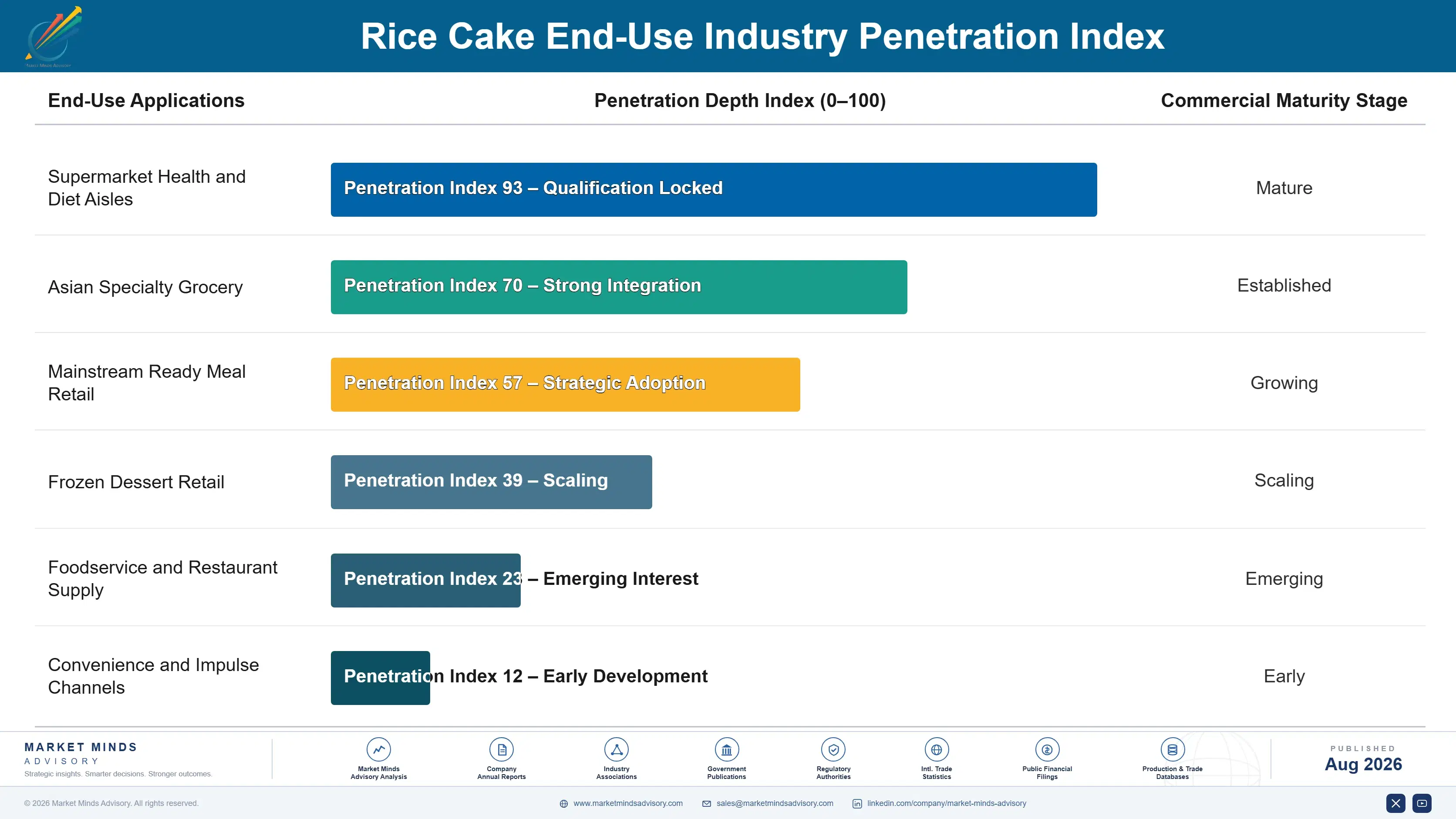
Habit Meets Discovery

Demand behaves completely differently across the two halves of this category. Puffed rice cake purchase is habitual, repeated by shoppers who have bought the same product for years and rarely reconsider it, which produces stable volume and no growth whatever. Asian rice cake demand in export markets is discovery-driven, arriving through media exposure and depending entirely on whether a first purchase converts into a second one.
Conversion is where the prepared formats earn their margin. A consumer who has seen a dish and buys plain rice cake in a bag frequently does not know what to do with it, cooks it badly and never buys again. A sauced meal kit removes that failure point entirely, which is why kits convert far better than components and why placement outside the Asian aisle matters so much.

The buyer profile differs as sharply as the products. Puffed rice cake buyers skew older and have carried the diet positioning since it was current. Asian format buyers skew considerably younger, encountered the food through media rather than family tradition, and have no attachment to the category's health story because they never knew it existed.
rice-cake-market-end-use-penetration-index-1787594939414

Where We Would Focus Effort

These are among the four positions where our research anticipates prominent divergence between winners and laggards over the coming forecast period. Each is grounded in the demand model, the regulatory perimeter, and the announced capacity pipeline.
01 / CATEGORY SEPARATION DISCIPLINE

Stop managing these as one business

A puffed diet snack with a glycaemic index near 82 and a savoury Korean staple that hardens within six hours share a shelf label and essentially nothing else about production, consumer or occasion. Managing them under one category plan produces strategy that fits neither, which is what most Western manufacturers have been doing for a decade without apparently noticing. The commercial energy sits almost entirely on the Asian side, and it is being pursued by companies from that side instead.
02 / PREPARED FORMAT PRIORITY

Sell the dish, not the bag of cake

Consumers meeting rice cake through Korean media are looking for a specific prepared dish rather than browsing a category, and a bag of plain cake leaves them with a preparation problem they usually solve badly and never repeat. Sauced meal kits remove that failure point entirely, carry considerably higher value per unit and convert first purchases into second ones far more reliably than loose product ever does. Korean food exports growing around 18% annually are overwhelmingly prepared formats rather than raw ingredient components.
03 / TEXTURE RETENTION INVESTMENT

Freezing arrests the problem without solving it

Cooked glutinous rice cake retrogrades within roughly six hours and freezing adds around 270 days of usable life while arresting rather than reversing the underlying starch change in any way. Reheated product therefore never quite matches fresh, which Asian consumers notice immediately and Western consumers have not yet learned to. Modified starches, trehalose and enzyme treatments extend texture retention considerably further, and that will matter increasingly as export consumers become more familiar with what the food is actually supposed to be.
04 / MAINSTREAM PLACEMENT PUSH

The Asian aisle is a ceiling, not a home

Rice cake products placed in the Asian food aisle reach shoppers already looking for Asian food, which is a considerably smaller group than the one encountering these dishes through media exposure and social platforms. Mainstream ready meal placement reached younger shoppers and exceeded retailer projections where it has been been tried properly by a retailer. Distribution into mainstream grocery is the asset Western manufacturers hold and Asian producers most conspicuously lack, which makes partnership the obvious structure for both sides.

Engagement Snapshot From the Field

A live engagement with an industry participant carrying material or product regulatory and market exposure ahead of a defining policy shift, showing how our research translates into a defensible multi-year portfolio strategy.
MARKET MINDS ADVISORY · CLIENT ENGAGEMENT SUMMARY
Rice Cake Producer Strategic Portfolio Review and Transition Roadmap 2026·Investment Scenario on Rice Cake Exposure Evaluation 2025-26
CLIENT PROFILE
A Western snack manufacturer producing puffed rice cakes across three plants supplying supermarket health aisles in eight countries, at annual rice cake revenue near 210 million dollars (client-reported, unverified by MMA). Volume had been flat for six years, private label competition was heavy, and the company produced no Asian rice cake formats at all in any of its plants.
STRATEGIC CHALLENGE
Management were preparing a reformulation programme to address glucose response criticism, at considerable cost, while Asian rice cake products grew rapidly in the same retailers through entirely separate suppliers. The board wanted to know whether reformulation or category entry represented the better use of what was the same limited capital budget.
MMA APPROACH
MMA sized the puffed and Asian format halves of the category separately across the client's markets, benchmarked reformulation cost against achievable glucose response improvement, assessed frozen production and cold chain requirements for Asian formats, and tested retailer appetite for mainstream placement of prepared kits. Interviews with 47 experts covered snack manufacturing, Asian food distribution and retail category management.
KEY FINDINGS
  1. The Asian format half of the category was growing several times faster than the puffed half across every market examined, and none of that growth reached the client at all.
  2. Reformulation improved measured glucose response meaningfully but raised unit cost enough to price the product out of the aisle it was designed to occupy.
  3. Retailers approached about mainstream placement of prepared rice cake kits were receptive, and two had already listed competitor products outside the Asian aisle successfully.
  4. The client's distribution into mainstream grocery was the single asset Korean producers most lacked, and several were open to partnership rather than competing for the shelf.
CLIENT PROFILE
A Western snack manufacturer producing puffed rice cakes across three plants supplying supermarket health aisles in eight countries, at annual rice cake revenue near 210 million dollars (client-reported, unverified by MMA). Volume had been flat for six years, private label competition was heavy, and the company produced no Asian rice cake formats at all in any of its plants.
STRATEGIC CHALLENGE
Management were preparing a reformulation programme to address glucose response criticism, at considerable cost, while Asian rice cake products grew rapidly in the same retailers through entirely separate suppliers. The board wanted to know whether reformulation or category entry represented the better use of what was the same limited capital budget.
MMA APPROACH
MMA sized the puffed and Asian format halves of the category separately across the client's markets, benchmarked reformulation cost against achievable glucose response improvement, assessed frozen production and cold chain requirements for Asian formats, and tested retailer appetite for mainstream placement of prepared kits. Interviews with 47 experts covered snack manufacturing, Asian food distribution and retail category management.
KEY FINDINGS
  1. The Asian format half of the category was growing several times faster than the puffed half across every market examined, and none of that growth reached the client at all.
  2. Reformulation improved measured glucose response meaningfully but raised unit cost enough to price the product out of the aisle it was designed to occupy.
  3. Retailers approached about mainstream placement of prepared rice cake kits were receptive, and two had already listed competitor products outside the Asian aisle successfully.
  4. The client's distribution into mainstream grocery was the single asset Korean producers most lacked, and several were open to partnership rather than competing for the shelf.
RECOMMENDED STRATEGY
Phase 1: Phase one: pause the reformulation programme, since improved glucose response does not survive contact with the price point the product occupies. Phase 2: Phase two: partner with a Korean producer holding frozen capability, contributing mainstream distribution rather than attempting to build production capability. Phase 3: Phase three: pursue mainstream ready meal placement for prepared kits rather than accepting the ceiling that Asian aisle listing imposes.
OUTCOME
The manufacturer signed a distribution partnership with a Korean producer during 2026 and secured mainstream ready meal listings in two retail groups (client-reported, unverified by MMA). The reformulation programme was cancelled, and puffed volume was managed for cash rather than defended. Frozen production capability was deliberately not pursued in-house.

Frequently Asked Questions

Foundational context covering the market sizes, CAGR, scope, country, region and competition that inform every finding below. This section is provided to cover basics and most often pre-purchase conversations, answered from the MMA Primary Research Dataset.

What is the current size of the Rice Cake Market?

MMA sizes it at USD 3.8 billion in 2025, rising to USD 4.04 billion in 2026. The figure covers rice-based cake products across snack, staple and prepared formats at manufacturer selling value.

How large will the Rice Cake Market be by 2036?

USD 7.37 billion by 2036, an incremental USD 3.33 billion over the 2026 base and an expansion multiple of 1.82 times. Frozen glutinous formats account for a disproportionate share.

What is the CAGR for the Rice Cake Market 2026 to 2036?

6.2% in the base case, with a bull case at 7.4% and a bear case at 5.0%. The spread turns on mainstream Western placement and on glucose response awareness.

Which segment is growing fastest?

Frozen and shelf-stable glutinous rice cakes at 9.3%, half again the market rate of 6.2%. Freezing adds around 270 days to a product that hardens within six hours.

Who are the major companies in the Rice Cake Market?

Quaker Oats, Lotte Wellfood, Samyang Foods, Kameda Seika and Want Want China Holdings lead on production volume. Fifteen further participants are profiled in the full report.

Which country is growing fastest?

The United States at 11.6%, driven by Korean media exposure creating demand for specific dishes rather than for a food category anyone was previously browsing.

Report Segmentation Architecture

The full report scope spans multiple orthogonal segmentation dimensions, with cross-tabulated demand data provided for each dimension pair. Coverage extends further to regional breakdowns, trend trajectories, and the competitive detail needed to support segment-level decision-making.

By Product Form

  • Puffed and Extruded Rice Cakes
  • Flavoured and Coated Puffed Cakes
  • Fresh Glutinous Rice Cakes
  • Frozen and Shelf-Stable Glutinous Cakes
  • Mochi and Filled Rice Confections
  • Savoury Rice Cake Crackers and Crisps

By End-Use Industry

  • Supermarket Health and Diet Aisles
  • Asian Specialty Grocery
  • Mainstream Ready Meal Retail
  • Frozen Dessert Retail
  • Foodservice and Restaurant Supply
  • Convenience and Impulse Channels

By Commercial Dimension

  • Branded Manufacturer Supply
  • Private Label Production
  • Prepared Meal Kit Formats
  • Export and Cross-Border Supply
  • Distribution Partnership Arrangements
  • Online and Direct Grocery Channels

By Region

  • North America
  • Western Europe
  • East Asia
  • South Asia and Pacific
  • Latin America
  • Middle East and Africa
  • Eastern Europe

Scope, Methodology, and Coverage

Every figure in this report is reproducible from documented input assumptions. The scope below maps the historical period, the forecast horizon, the segmentation dimensions, and the countries covered, alongside the underlying primary and qualitative methodology.
Historical Period
2020 to 2025
Forecast Period
2026 to 2036
Base Year
2025 (USD billions; MMA Primary Research Dataset, August 2026)
Market Definition
Rice-based cake products sold as snacks, staples and prepared foods worldwide, covering puffed and extruded rice cakes, flavoured and coated puffed cakes, fresh glutinous rice cakes, frozen and shelf-stable glutinous rice cakes, mochi and filled rice confections, and savoury rice cake crackers and crisps. Measured at manufacturer selling value across retail and foodservice channels. Rice flour sold as an ingredient, cooked rice meals, rice noodles, rice crackers made without a cake form, and rice-based breakfast cereals are excluded from scope.
Quantitative Units
USD billions (current prices); thousand tonnes product; USD per kilogram by product form
Segmentation Dimensions
Product form; retail and foodservice channel; commercial dimension; region
Regions Covered
North America, Western Europe, East Asia, South Asia and Pacific, Latin America, Middle East and Africa, Eastern Europe
Countries Covered
China, Japan, South Korea, Taiwan, Vietnam, Thailand, Philippines, Indonesia, India, Australia, United States, Canada, Mexico, Germany, Netherlands, Italy, United Kingdom, Poland, Brazil, South Africa
Key Companies Profiled
Quaker Oats, Lotte Wellfood, Samyang Foods, Kameda Seika, Want Want China Holdings, Nongshim, CJ CheilJedang, Pulmuone, Daesang, Ottogi, Echigo Seika, Sato Foods, Morinaga, Lundberg Family Farms, Riso Scotti, Real Foods, Element Snacks, Uni-President Enterprises, Orion Corporation, Haitai Confectionery
Quantitative Methodology
Primary survey, n=3,800 respondents, Q4 2025, six countries; demand-side model with trade association cross-validation
Qualitative Methodology
47 expert interviews, Q4 2025; applied to validate demand model assumptions, identify emerging dynamics, and assess competitive positioning
Report Format
PDF and XLSX data workbook (Word format preview document)
Publisher
Market Minds Advisory
Report Code
MMA-2026-AGR-182
Published
August 2026
Contact
sales@marketmindsadvisory.com | www.marketmindsadvisory.com

Purchase the full Rice Cake Market Report (2026 to 2036).

The full report sizes the puffed snack and Asian staple halves of this category entirely separately, because treating them as one market has produced a decade of strategy that fits neither. It sizes all six product forms independently through 2036, quantifies texture retention and shelf life economics across frozen and shelf-stable routes, and models mainstream against Asian specialty retail placement on conversion and repeat purchase. Regional chapters cover all seven regions with staple and snack consumption separated throughout. Competitive profiling covers 20 participants on a single production volume basis.
Six product forms sized independently through 2036
Puffed snack and Asian staple halves separated throughout
Texture retention economics compared across preservation routes
Mainstream against specialty placement modelled on repeat purchase
Twenty participants profiled on one consistent volume basis
Korean export growth tracked into destination market categories

Built For The People Who Decide

From boardroom strategy to bench-side execution, this report is read cover-to-cover by leaders shaping the next decade of their industry, turning demand scenarios, market dynamics and valuation benchmarks into decisions.
CXOs/ Presidents/ VPs/ Managers
M&A and Corporate Development
Strategy Teams and R&D Heads
Procurement and Product Directors
Regulatory and Compliance Leaders
Investor Relations and Equity Analysts