Market Minds Advisory
Retractable Needle Safety Syringes Market

Retractable Needle Safety Syringes Market: Legislated Demand, Reuse Prevention, and Two Very Different Buyers

Wealthy health systems buy these to stop nurses injuring themselves, and poorer ones buy them to stop syringes being used twice, which are opposite problems solved by the same spring.

Lead Analyst

Alice Ballenger

Published

September 2026

Make Smarter Decisions with Customized Research Insights

Request a free sample report and evaluate market opportunities, growth trends, and competitive dynamics relevant to your business needs.

2025 MARKET VALUE$3.2BMarket Size 2025
2036 FORECAST VALUE$7.5BBase Case , 2026 to 2036
CAGR 2026 TO 20368.0 %Bull 9.2% / Bear 6.8%
INCREMENTAL OPPORTUNITY$4.0BNet 10- year value creation
EXPANSION MULTIPLE2.16x2036 value over 2026 base
Strategic Levers
M&A Pipeline
Regional Outlook
Country Rankings
Competitive Intelligence
Segmental Deep-dive
Call-Us : 91 93563 13602

Executive Snapshot and Market Trajectory

The same retraction mechanism solves two unrelated problems. In high-income systems it stops a nurse being stuck with a contaminated needle. In low-income systems it stops the syringe being filled a second time for the next patient, which kills far more people. One spring, two industries.
Reuse prevention auto-disable syringes compound at 12.0%, a full 1.50x the market rate, on immunisation programme policy that now specifies them by default. South Asia and Pacific holds the largest share at 30%, on Indian manufacturing capacity that supplies most of the world's auto-disable volume and on immunisation programmes at enormous scale. Unit pricing near $0.06 means only fully automated producers participate at all. Policy specifies them by default, so vaccination volume decides everything there.
Concentration is high at 69%, though it splits by geography rather than by product. Becton Dickinson and the Western majors hold the legislated sharps injury markets while Hindustan Syringes and Chinese producers hold auto-disable volume. Very few compete meaningfully in both, because the price points differ by roughly forty times. Around 43% of injection volume now sits under safety legislation. Each new jurisdiction converts volume at roughly 4.2 times the price.
Market Definition
This market covers syringes incorporating a mechanism that retracts, shields or disables the needle after use, spanning manual retraction safety syringes, automatic retraction safety syringes, reuse prevention auto-disable syringes, shielded and sheathed needle syringes, and prefilled safety syringe systems. Conventional syringes without a safety mechanism, safety needles sold separately from syringes, safety intravenous catheters, blood collection devices, insulin pens and autoinjectors, and sharps disposal containers are excluded.
Base Year Value
$3.2B in 2025 (MMA Primary Research Dataset, August 2026)
Forecast Period
2026 to 2036, eleven discrete annual values
CAGR
8.0% base case. Bull 9.2%. Bear 6.8%.
Fastest Growth Segment
Reuse Prevention Auto-Disable Syringes: 12.0% CAGR
Fastest Growth Country
India: 11.4% CAGR
Fastest Growth Region
South Asia and Pacific: 10.2% CAGR
Largest Region
South Asia and Pacific: 30% of 2025 global value
Market Leaders
Becton Dickinson, Hindustan Syringes and Medical Devices, Terumo, Retractable Technologies, and Cardinal Health. Source: MMA Primary Research Dataset, July 2026.
Primary Survey
n=3,800 procurement and R&D decision-makers, Q4 2025, six countries
Methodology
Demand-side build-up, cross-validated against public data, 47 expert interviews

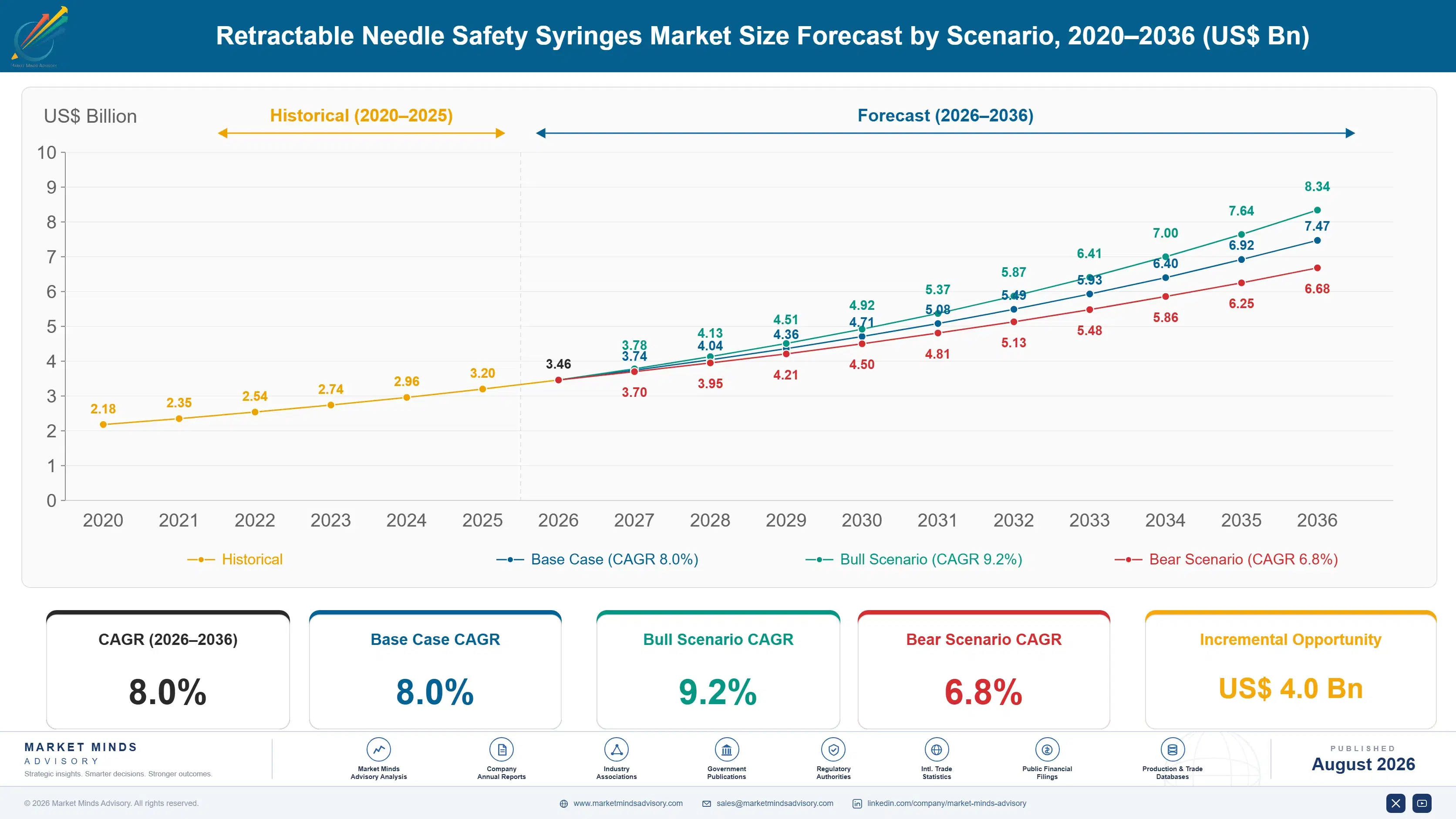
Retractable Needle Safety Syringes Market Forecast Scenarios

retractable-needle-safety-syringes-market-size-forecast-scenario-1787306535901
Growth ran near 6.8% from 2020 to 2025 and immunisation drove almost all of it. Vaccination campaigns consumed auto-disable syringes at volumes the industry had never supplied, and manufacturers expanded capacity rapidly to meet a demand that then fell back sharply. Routine sharps injury prevention volume in developed markets grew steadily throughout, largely unaffected by the campaign cycle above it.
Base case growth of 8.0% rests on three mechanisms. Immunisation policy now specifies reuse prevention syringes by default across most national programmes, which converts an option into a requirement. Sharps injury legislation continues extending into markets that previously had none, particularly across Asia and Latin America. And healthcare worker shortages make an injury that removes a nurse from duty more costly than it was. Legislative timetables are published years ahead, which makes two of the three unusually forecastable.
The bull case at 9.2% assumes safety syringe mandates extend into the large Asian markets that currently permit conventional devices, which would convert enormous volume at higher price points. The bear case at 6.8% reflects immunisation programme funding contracting as donor priorities shift, since auto-disable volume depends almost entirely on programme budgets rather than on clinical demand.

Safety Syringes: Two Problems, One Spring

Two entirely separate arguments sustain this market and they rarely meet. In high-income health systems the case is occupational: a needlestick injury costs an institution around $3,400 in testing, prophylaxis, lost time and administration, and legislation in those markets has made safety devices mandatory rather than optional. Roughly 43% of global injection volume now sits under such rules.
TOP FIVE CONCENTRATION69%Concentrated but split between developed market and programme suppliers
SAFETY DEVICE PREMIUM4.2xPrice against a conventional syringe of equivalent volume
NEEDLESTICK INJURY COST$3,400Average institutional cost of a single occupational sharps injury
AUTO-DISABLE PROGRAMME PRICE$0.06Typical unit price in donor-funded immunisation programme procurement
MANDATED MARKET COVERAGE43%Share of global injection volume covered by safety device legislation
ACTIVATION COMPLIANCE RATE82%Manual safety mechanisms actually engaged by users after injection
Elsewhere the argument is patient safety and it is far larger in consequence. Syringe reuse transmits bloodborne infection at scale in settings where supply is short and disposal uncontrolled, and auto-disable mechanisms that lock after a single use address that directly. Immunisation programmes specify them by default, at unit prices near $0.06 that bear no relation to developed market pricing at all.
The mechanisms overlap and the businesses do not. A device selling at 4.2 times a conventional syringe into a legislated hospital market and one selling at six cents into a donor-funded immunisation programme require different cost structures, different manufacturing scale and different commercial organisations. Very few participants have managed both, and those that try usually find one side subsidising the other. Interviewed manufacturers described choosing between the two as the most consequential decision available in this category.
"People describe this as one market because the engineering looks similar. It is not. Selling a four-dollar safety syringe to an American hospital and a six-cent auto-disable syringe to an immunisation programme are different industries that happen to share a spring, and the companies that forgot that lost money in both."
Principal Analyst, Injection Devices and Occupational Safety Practice · MMA Medi

Market Trends

Immunisation policy converts auto-disable from option to default

National immunisation programmes and donor-funded procurement now specify reuse prevention syringes as standard rather than as an upgrade, which removes the purchasing decision entirely and locks demand to vaccination volume. The segment compounds at 12.0% against a market rate of 8.0%, and unit pricing near $0.06 means participation depends on manufacturing scale that only a handful of producers hold. India supplies the majority of that volume, and the policy shift benefits producers with cost positions built for exactly this specification. Producers built for developed market pricing cannot approach that specification at all.
Market Impact: Each injury costing around $3,400
Sharps legislation extends into markets that previously had none

Occupational needlestick legislation began in North America and Western Europe and is now extending across Asian and Latin American markets that permitted conventional devices until recently. Roughly 43% of global injection volume sits under such rules, and each new jurisdiction converts conventional volume to safety devices at around 4.2 times the price overnight. Legislative timetables are published years in advance, which makes this the most forecastable demand shift available in any injection device category. Suppliers establishing registration and distribution ahead of implementation capture conversion that later entrants can only contest at a clear disadvantage afterward.
Market Impact: Manual compliance reaching only 82%

Market Opportunities and Growth Drivers

Injury cost exceeds the device premium many times over

A single occupational sharps injury costs an institution around $3,400 in testing, prophylaxis, lost duty time and administrative handling, before any consideration of the harm to the person involved. A safety syringe costs roughly 4.2 times a conventional device, which on any hospital's injection volume is recovered by preventing a small number of injuries annually. Healthcare worker shortages sharpen that further, since an injured nurse removed from duty is considerably harder to replace than a decade ago. Purchasing groups treat the premium as settled rather than as an argument requiring evidence each cycle.
Market Impact: Unit pricing near $0.06 each

Automatic mechanisms remove the compliance problem entirely

Manual safety devices require the user to engage the shield or retraction after injection, and roughly 82% actually do so under real clinical conditions rather than under observation. That leaves a substantial residual injury risk that the institution has already paid a premium to eliminate. Automatic mechanisms activating on completion of injection remove user compliance from the equation altogether, which is why they command further premiums and why safety committees increasingly specify them explicitly. Mechanism reliability and consistent activation force are what separate credible automatic products from those that fail under real clinical handling.
Market Impact: Fill rates falling below 300 monthl

Market Restraints and Challenges

Programme pricing supports almost no margin at all

Auto-disable syringes supplied into donor-funded immunisation programmes price near $0.06 per unit, established through pooled procurement designed explicitly to maximise doses delivered per dollar. The root cause is that any higher price means fewer children vaccinated, which is a trade no funder will make. Commercial impact is that only producers with enormous scale and very low cost bases can participate at all. Participants respond by pursuing volume across multiple programmes, automating aggressively and manufacturing where labour and power are cheapest. Nothing about that pricing is negotiable. Doses per dollar governs every decision.
Market Impact: Programme pricing sitting near $0.0

Retraction mechanisms complicate high-speed filling lines

Prefilled syringe manufacturers fill at rates measured in hundreds per minute, and a retraction mechanism adds components, tolerances and failure modes that slow validated lines considerably. The root cause is that safety features designed for manual use were never engineered around aseptic filling equipment. Commercial impact is that prefilled safety adoption lags loose syringe adoption by years despite identical clinical logic. Participants respond by designing mechanisms that add after filling, and by working with filling equipment suppliers directly. The gap is engineering rather than demand. Clinical logic is identical across both formats.
Market Impact: Legislation covering 43% of volume
4 additional market trends, 2 additional growth drivers, and 3 additional restraints and challenges are covered in the full report. Contact sales@marketmindsadvisory.com to access the complete intelligence.

Segment CAGR and Growth Architecture

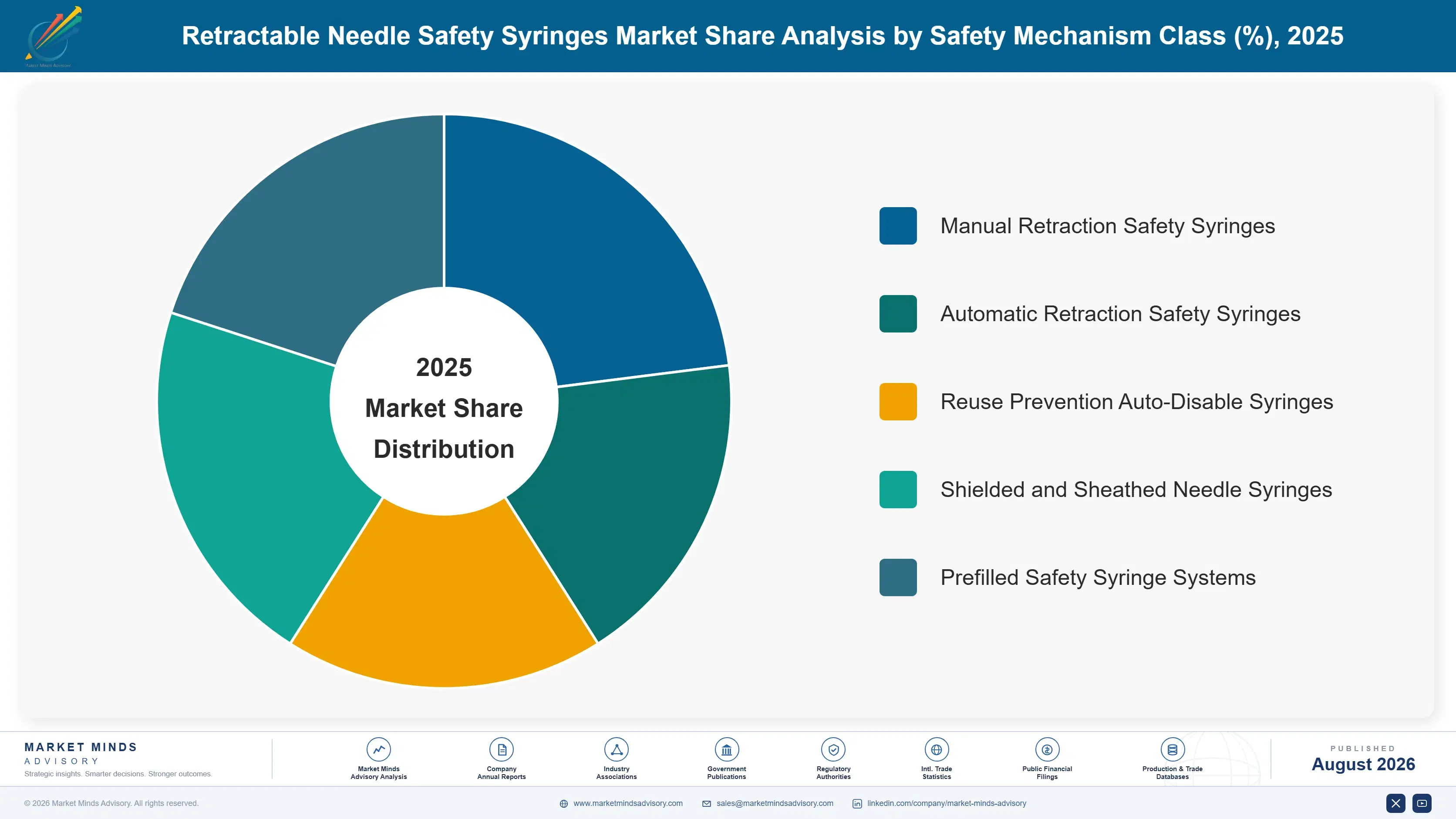
Five device classes divide this market by safety mechanism and activation method, which determines both price point and which buyer specifies them. The division separates devices sold against occupational injury cost in legislated markets from those sold against reuse transmission at programme prices, and the two barely overlap commercially. Price points differ by roughly forty times.
retractable-needle-safety-syringes-market-market-share-analysis-1787306536435

Reuse Prevention Auto-Disable Syringes

Compounding at 12.0%, a full 1.50x the market rate, these devices lock after a single use to prevent the syringe being refilled for another patient, which addresses bloodborne transmission in settings where supply is short. Immunisation programmes specify them by default rather than as an upgrade, which removes any purchasing decision and locks demand to vaccination volume. Unit pricing near $0.06 through pooled procurement means only producers with enormous scale participate, and Indian manufacturers hold the majority position on cost structures built specifically for this specification. Donor budget shifts move that volume abruptly and across every programme at once. Indian producers hold the majority position on cost structures built specifically for it.
CAGR 12.0%

Automatic Retraction Safety Syringes

Growing at 9.6%, automatic mechanisms retract the needle on completion of injection without requiring any user action, which removes the compliance gap that manual devices carry. Roughly 82% of manual safety mechanisms are actually engaged under real clinical conditions, leaving residual risk an institution has already paid to eliminate. Safety committees increasingly specify automatic activation explicitly for that reason, and pricing runs above manual equivalents accordingly. Mechanism reliability and consistent activation force are what separate credible products from those that fail in practice. At around $3,400 per occupational injury, closing the remaining compliance gap justifies the premium these devices command without any difficulty at all for an institution. Safety committees name automatic activation explicitly.
CAGR 9.6%
Full segment breakdown across 5 segments available in the complete report.

Regional Architecture and Country Demand Map

Regional distribution is decided by manufacturing scale in programme markets and by legislation in developed ones, which produces a map that reflects neither injection volume nor population directly. Where safety devices are mandated, value follows; where they are merely available, it does not. Legislation creates value; availability alone does not.

South Asia and Pacific

Thirty per cent of global value, the largest regional position, and manufacturing scale explains it. Note: this far exceeds the 7 to 12% band because Indian producers led by Hindustan Syringes supply the majority of world auto-disable volume into immunisation programmes, and India runs one of the largest national immunisation programmes anywhere. India compounds at 11.4%, faster than any country covered. Value per unit is very low at programme pricing near $0.06, so the region's share of volume exceeds its share of value by a considerable margin. Automation depth built for that specification is what makes participation viable, and it consolidates the segment around very few producers rather than many.
Share: 30% | CAGR: 10.2% (2026 to 2036)

North America

Twenty-six per cent of value on modest unit volume, which reflects legislated safety device requirements and pricing at roughly 4.2 times conventional syringes. Occupational needlestick legislation originated here and coverage is effectively complete across healthcare settings, which removed the purchasing decision entirely. Institutional focus has moved on to activation compliance, since manual mechanisms are engaged around 82% of the time in practice, and safety committees increasingly specify automatic activation. Becton Dickinson holds the deepest position through hospital contracts spanning many product categories. Single-product suppliers cannot access those multi-category agreements at all. Institutional focus has moved past conversion entirely and onto mechanism reliability, since the devices are now a specified commodity that purchasing groups differentiate on performance data rather than presence.
Share: 26% | CAGR: 7.4% (2026 to 2036)
Regional intelligence for 5 additional markets available in the complete report: East Asia, Western Europe, Latin America, Middle East and Africa, Eastern Europe. Contact sales@marketmindsadvisory.com.
retractable-needle-safety-syringes-market-country-cagr-analysis-1787306536956

Where Safety Syringe Value Actually Divides

This is two businesses wearing one name, and the commercial mistake that has cost participants most is treating it as one. Value comes from anticipating legislation, from removing the user compliance gap, and from recognising that programme volume and hospital margin cannot be pursued with the same cost structure. Treating it as one market is the expensive error.

Position ahead of published legislative timetables

Sharps injury legislation converts conventional volume to safety devices at roughly 4.2 times the price on a date published years in advance, which makes this the most forecastable demand shift in injection devices. Roughly 43% of global injection volume already sits under such rules and the boundary keeps moving through Asia and Latin America. Suppliers establishing distribution and registration ahead of implementation capture conversion that later entrants contest at a disadvantage, and the timetables are public documents anyone can read. Nothing else in this market is as predictable. The timetables are public documents anyone can read.
Market Impact: Conversion at 4.2x conventional syr

Sell automatic activation against the compliance gap

Manual safety mechanisms are engaged roughly 82% of the time under real clinical conditions rather than under observation, which leaves residual injury risk an institution has already paid a premium to remove. At around $3,400 per injury, closing that gap justifies the further premium automatic mechanisms command without difficulty. Safety committees increasingly specify automatic activation explicitly, and suppliers presenting real-world compliance data rather than laboratory performance win those specifications considerably more often. At roughly $3,400 per injury the arithmetic is straightforward, and safety committees increasingly specify automatic activation explicitly rather than accepting any compliant mechanism.
Market Impact: Compliance gap of 18% still remaini

Choose one cost structure and commit to it

A device selling at six cents into immunisation programmes and one selling at several dollars into legislated hospital markets require different manufacturing scale, automation levels and commercial organisations entirely. Participants attempting both typically find hospital margin subsidising programme volume that never reaches acceptable returns. Programme pricing near $0.06 supports only producers with enormous scale and very low cost bases, and interviewed manufacturers described the split as the single most consequential strategic choice in the category. Hospital margin subsidising programme volume is the usual outcome. Programme pricing near $0.06 supports only enormous scale.
Market Impact: Pricing differing by roughly 40x ac

Engineer safety mechanisms around filling equipment

Prefilled safety adoption lags loose syringe adoption by years because retraction mechanisms add components and tolerances that slow validated aseptic filling lines running at hundreds of units per minute. The clinical logic is identical, so the gap is engineering rather than demand. Mechanisms that attach after filling rather than complicating the barrel itself resolve it, and participants working directly with filling equipment suppliers reach prefilled programmes that mechanism-first designs cannot access at all. Adoption lags loose syringe conversion by roughly 3 years for that engineering reason alone, and no clinical argument closes it.
Market Impact: Fill rates above 300 units every si

Who Controls the Margin Pool

The top five hold 69% of the market measured on revenue from safety syringe products, the basis used throughout this section. That concentration conceals a split by geography rather than by product: Becton Dickinson, Terumo and Cardinal Health hold legislated developed markets through hospital contracts spanning many categories, while Hindustan Syringes holds auto-disable programme volume on manufacturing scale nobody else matches at that price.
Competitive activity runs along three lines. Developed market participants are pushing automatic activation mechanisms against the manual compliance gap, which supports further pricing. Programme suppliers are competing purely on manufacturing cost and pooled procurement performance, where scale decides everything. And several participants are working with filling equipment suppliers on prefilled safety designs that do not slow aseptic lines.

Pressure comes from two directions that affect different participants entirely. Programme procurement compresses prices toward manufacturing cost in the volume half of this market. Chinese producers press developed market pricing from below wherever legislation specifies a safety mechanism without specifying performance. Rankings shift on which participants hold legislated market positions when new jurisdictions convert, since those conversions are the only large price-point upgrades available.
retractable-needle-safety-syringes-market-company-positioning-matrix-1787306537477

Competitive Moat and Risk Dimensions

BECTON DICKINSON

Moat: Hospital contracts spanning categories

Safety syringes reach hospitals inside supply agreements covering catheters, infusion sets, blood collection and many other categories, which means the syringe is rarely evaluated as a standalone purchase at all. That breadth matters enormously where safety devices are legislated commodities, since a purchasing group prefers fewer suppliers handling more of the consumable base under one arrangement.
BECTON DICKINSON

Risk: Programme markets remain inaccessible

Auto-disable volume at programme pricing near $0.06 requires manufacturing scale and cost structures the company has not built and would struggle to justify building, which leaves the fastest-growing segment at 12.0% largely out of reach. That segment's growth accrues to producers with entirely different economics, and no amount of developed market strength changes the arithmetic.
HINDUSTAN SYRINGES AND MEDICAL DEVICES

Moat: Scale built for programme pricing

Manufacturing capacity and automation built specifically around auto-disable production at immunisation programme price points gives the company a cost position that developed market manufacturers cannot approach without rebuilding their operations entirely. Pooled procurement rewards exactly that, and the volumes involved reinforce the scale advantage with every programme cycle that passes.
HINDUSTAN SYRINGES AND MEDICAL DEVICES

Risk: Donor budget dependency concentrated

Programme volume depends on immunisation funding decisions made by donors and health ministries rather than on any clinical or commercial demand the company can influence. A shift in donor priorities compresses volume immediately and across every programme at once, and the low margins that scale supports leave very little buffer when volumes move against the business.

Players Tracked

Prominent Players

Becton Dickinson
Hindustan Syringes and Medical Devices
Terumo
Retractable Technologies
Cardinal Health

Other Key Players

Nipro Corporation
B. Braun
Smiths Medical
Medtronic
Gerresheimer
Schott Pharma
Baxter International
Revolutions Medical
Globe Medical Tech
Shandong Weigao
Jiangsu Kanghua
Sol-Millennium
Iscon Surgicals
Albert David
UltiMed

Recent Developments

FEBRUARY 2015

Global policy adopts reuse prevention syringes as standard

International health authorities issued guidance directing that reuse prevention syringes become standard for therapeutic injections and immunisation, replacing conventional devices in programme settings. The guidance was a policy recommendation rather than any regulation, and national programmes and donor procurement adopted it as a default specification over subsequent years.
Signal: Programme specification removed the purcha
MARCH 2021

Vaccination campaigns exhaust auto-disable syringe capacity

Global vaccination campaigns consumed auto-disable syringes at volumes the industry had never supplied, and allocation replaced ordinary procurement across most programme markets. Manufacturers expanded capacity rapidly against demand that subsequently fell well below the levels that investment had assumed. Capacity built at the peak was carried through lean years.
Signal: Programme demand is enormous and abrupt in
AUGUST 2024

Sharps legislation extends across further Asian markets

Additional Asian jurisdictions enacted occupational needlestick prevention requirements mandating safety-engineered devices in healthcare settings, following the pattern established in North America and Europe. These were legislative measures rather than any commercial development, and each converts conventional injection volume to safety devices on a published timetable.
Signal: Legislative timetables make this the singl

What Actually Costs Money Here

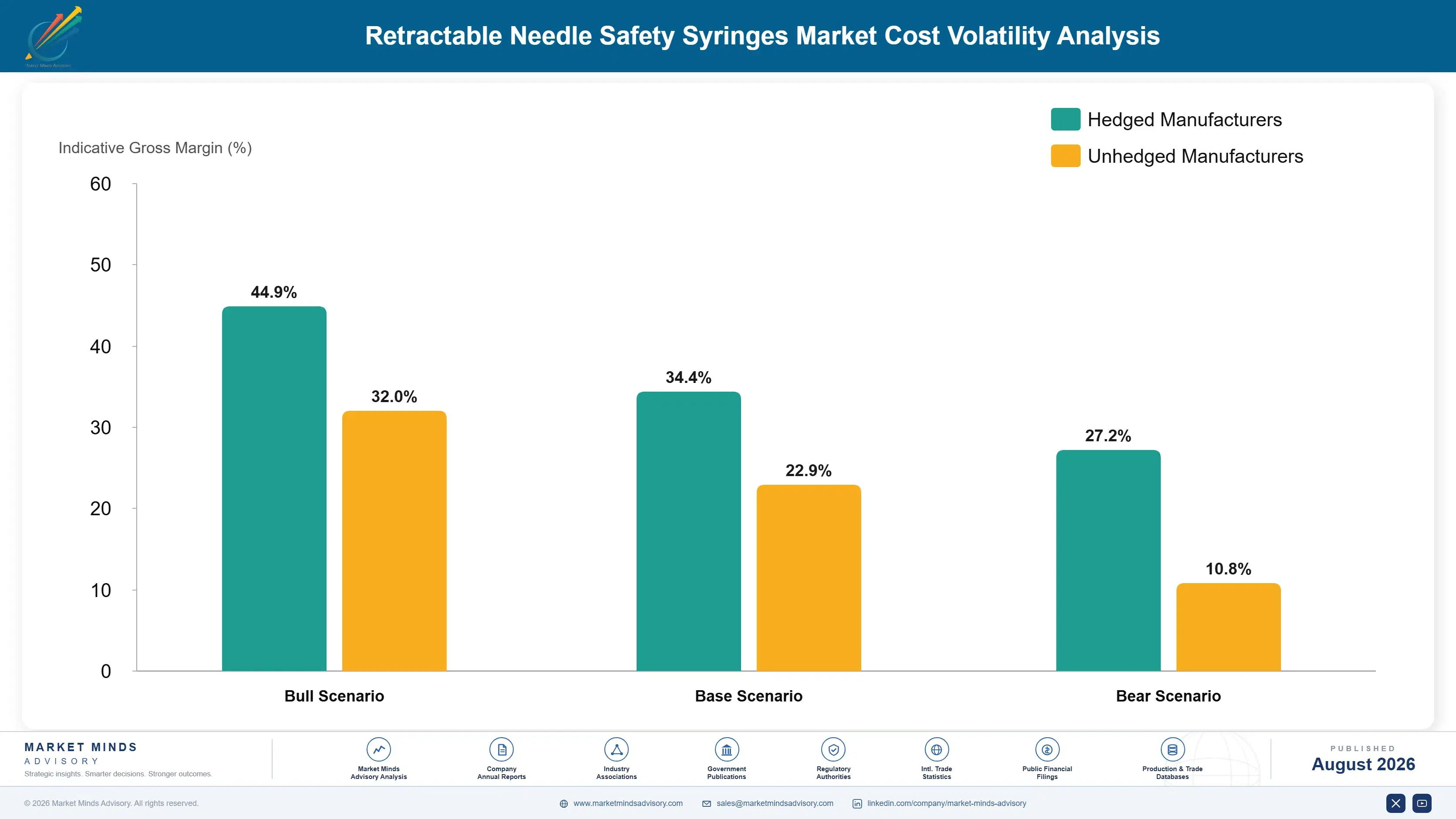
This is high-volume precision moulding with an assembly step that conventional syringes do not require. Medical-grade polypropylene, stainless needle cannula, lubricant and elastomer components account for roughly 34% of cost of goods. Injection moulding, spring or mechanism assembly and sterilisation absorb around 39%, and the assembly step is where safety syringes diverge from conventional devices in both cost and yield.
Polypropylene and needle-grade stainless pricing rose materially through 2021 and 2022, and manufacturers on programme contracts absorbed the movement entirely since pooled procurement offers no repricing mechanism. Ethylene oxide sterilisation capacity tightened under emissions scrutiny during the same period. Freight costs on a light bulky product also rose sharply, which affected programme suppliers shipping across continents more than domestic manufacturers. Programme suppliers absorbed all of it without recourse.

Exposure varies enormously by which business a participant is in. Programme suppliers at $0.06 per unit have almost no margin buffer and depend entirely on automation and scale, which makes labour cost and power pricing decisive. Developed market participants at 4.2 times conventional pricing carry comfortable margins and face different pressures around mechanism reliability and regulatory maintenance. Participants attempting both carry the worst of each without either's scale.
retractable-needle-safety-syringes-market-cost-volatility-analysis-1787306537673

Automation depth matched to programme price points

Assembly labour is the difference between viability and loss at six cents per unit, and manual or semi-automated assembly cannot reach that cost anywhere. Fully automated assembly lines require capital that only guaranteed programme volume justifies, which is why the segment consolidates around very few producers rather than many. Guaranteed volume is the precondition for the capital.

Mechanism designs that add after aseptic filling

Retraction components complicate validated filling lines running at hundreds of units per minute, which is why prefilled safety adoption lags. Designing the mechanism to attach after filling rather than complicating the barrel resolves the conflict, and it requires working with filling equipment suppliers well before the device design is fixed. Design freeze happens far too late in most programmes.

Regional manufacturing against freight and power

A syringe occupies substantial volume for very little value, so intercontinental freight is a real cost line rather than a rounding item. Manufacturing within each major consuming region removes that exposure and shortens lead times, though the automation capital required means only participants with sufficient regional volume can justify it. Regional volume decides whether it is justified.

Portfolio Architecture for Margin Defence

Margin architecture in this market splits by buyer rather than by product sophistication, which is unusual. Auto-disable syringes supplied into immunisation programmes at roughly six cents clear gross margins in the low teens and survive only on automated scale. Safety syringes sold into legislated hospital markets at 4.2 times conventional pricing clear more than four times that margin from mechanisms that are frequently no more complex.
The tension is that neither position reaches the other. Programme scale requires automation and cost discipline that developed market participants have never built, while developed market margins depend on hospital contract breadth that programme suppliers cannot assemble. Participants attempting both find hospital margin quietly subsidising programme volume, which interviewed manufacturers described as the most expensive strategic error available in this category.

High-value pools concentrate where a mechanism removes a residual risk rather than merely satisfying a rule. Automatic activation closing the 82% manual compliance gap, prefilled safety systems compatible with high-speed filling and devices meeting specifications written around performance rather than presence all sit there. Everything that merely complies with a mandate competes against manufacturers whose costs are built for six cents.

Volume / Commodity-Adjacent Tier

Auto-disable and basic manual safety syringes supplied into immunisation programmes and price-led tenders, where pooled procurement sets pricing near six cents and automated scale alone determines who can participate. Margin here is thin by design.
Gross Margin: 10-20%

Premium / Certified Tier

Manual and automatic retraction safety syringes supplied into legislated hospital markets through contracts spanning many consumable categories, protected by purchasing group relationships rather than by mechanism sophistication. Contract breadth matters more than mechanism quality.
Gross Margin: 42-56%

Sustainability / Regulatory / Next-Generation Tier

Automatic activation systems and prefilled safety configurations addressing the residual compliance gap and aseptic filling compatibility, defended by mechanism reliability data and filling equipment integration work. Reliability data decides which products get named.
Gross Margin: 52-68%
retractable-needle-safety-syringes-market-portfolio-architecture-1787306538165

High-value Sub-segments and Strategic Watch-out

Reuse Prevention Auto-Disable Syringes

The fastest growth at 12.0% and the thinnest margins anywhere here, locked to immunisation programme volume by default specification. Only producers with fully automated scale participate, and donor budget shifts move volume abruptly. Volume and value diverge sharply here. Automation depth decides participation. Few producers qualify.
Gross Margin: 10-20%

Automatic Retraction Safety Syringes

High value at 9.6%, removing the user compliance gap that manual mechanisms leave open at roughly 82% engagement. Safety committees specify automatic activation explicitly, and reliability data decides which products they name. Injury cost justifies the premium easily. Reliability data wins the specification. Failures show under handling.
Gross Margin: 52-68%

Manual Retraction Safety Syringes

The volume core at 6.4% in legislated markets, carrying hospital contract relationships that everything else reaches the institution through. Chinese producers press pricing wherever legislation specifies presence rather than performance. Conversion is largely complete in these markets. Contract breadth defends the position. Pricing pressure is constant.
Gross Margin: 42-56%

Prefilled Safety Syringe Systems

The strategic watch-out at 8.6%. Clinical logic is identical to loose syringes yet adoption lags by years, entirely because retraction mechanisms slow validated aseptic filling lines running at high speed. Filling equipment integration is the answer. Demand was never the constraint. Engineering is the barrier.
Gross Margin: 48-62%

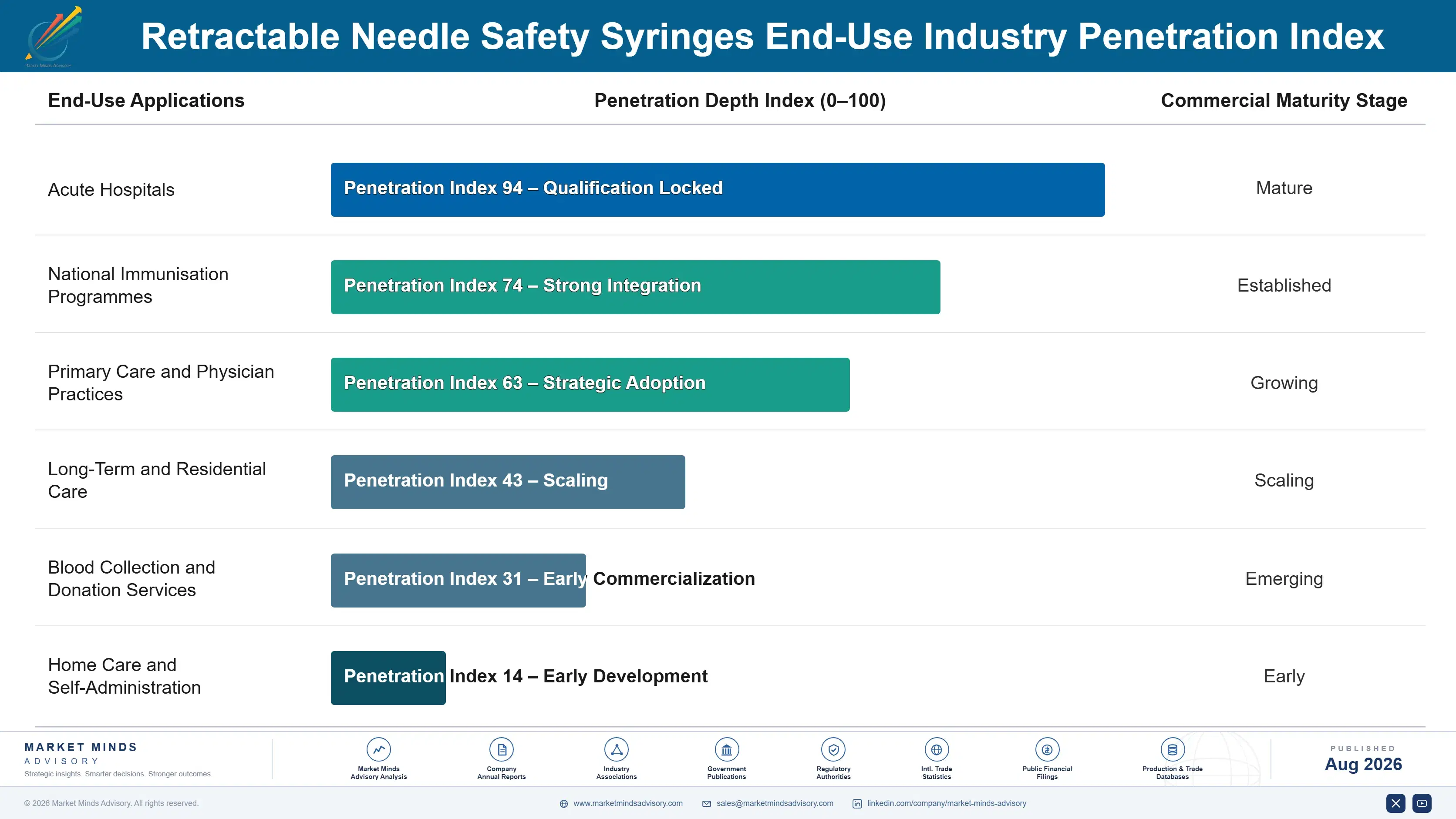
Who Mandates and Who Funds

Demand in the legislated half of this market is created by law rather than by clinical preference, which makes it unusually predictable and almost entirely insensitive to selling effort. A jurisdiction enacts a requirement, conventional volume converts to safety devices on the implementation date, and roughly 43% of global injection volume now sits under such rules. The remaining conversion opportunity is visible years ahead in published legislative timetables.
Programme demand works on an entirely different clock. Immunisation volume follows vaccination campaign schedules and donor funding decisions, both of which move abruptly and in large increments. The vaccination period demonstrated how quickly that demand can multiply and then collapse, and manufacturers that built capacity at the peak carried it through several lean years afterward without any recovery mechanism available.

The deciding function differs completely between the two. Hospital purchasing groups and safety committees specify devices in legislated markets, weighing injury cost, compliance data and contract breadth across many categories. Immunisation programmes and pooled procurement mechanisms decide the other, weighing only doses delivered per dollar. A commercial organisation built for either audience serves the other badly, which is why so few participants succeed in both.
retractable-needle-safety-syringes-market-end-use-penetration-index-1787306538655

Where Value Actually Sits

These are among the four positions where our research anticipates prominent divergence between winners and laggards over the coming forecast period. Each is grounded in the demand model, the regulatory perimeter, and the announced capacity pipeline.
01 / LEGISLATIVE TIMETABLE POSITIONING

The conversion dates are published years ahead

Sharps injury legislation converts conventional injection volume to safety devices at roughly 4.2 times the previous price, on an implementation date appearing in public documents years beforehand. Around 43% of the global injection volume already sits under such requirements today, and that boundary continues moving steadily across both Asian and Latin American markets. Suppliers that establish registration and distribution well ahead of an implementation date capture conversion volume that later entrants can only ever contest afterward from a clear disadvantage.
02 / COMPLIANCE GAP TARGETING

Eighteen per cent of mechanisms are never engaged

Manual safety devices are actually engaged only around 82% of the time under real clinical conditions rather than under direct observation, which leaves residual injury exposure that the institution has already paid a substantial premium to eliminate entirely. At around $3,400 per occupational sharps injury, closing that remaining gap easily justifies the further premium that automatic mechanisms command, without any difficulty at all. Suppliers presenting real-world compliance data rather than laboratory performance results win those specifications considerably more often than competitors do.
03 / COST STRUCTURE COMMITMENT

Six cents and four dollars are different industries

A device selling at six cents into immunisation programmes and one selling at several dollars into legislated hospital markets require entirely different manufacturing scale, automation depth and commercial organisations to serve properly. Participants that attempt to serve both typically discover hospital margin quietly subsidising programme volume that never reaches acceptable returns on its own at all. Interviewed manufacturers described choosing one cost structure and then committing fully to it as the single most consequential strategic decision available in this whole category.
04 / FILLING LINE COMPATIBILITY

Prefilled lags for engineering reasons, not clinical ones

Prefilled safety adoption trails loose syringe adoption by several years even though the clinical argument for both is genuinely identical, because retraction mechanisms add components and tolerances that measurably slow validated aseptic filling lines running at speed. Designing mechanisms that attach after filling rather than complicating the syringe barrel itself resolves that particular conflict directly and completely. Participants that work with filling equipment suppliers before fixing any device design reach prefilled programmes which mechanism-first design approaches simply cannot access at all.

Engagement Snapshot From the Field

A live engagement with an industry participant carrying material or product regulatory and market exposure ahead of a defining policy shift, showing how our research translates into a defensible multi-year portfolio strategy.
MARKET MINDS ADVISORY · CLIENT ENGAGEMENT SUMMARY
Retractable Needle Safety Syringes Producer Strategic Portfolio Review and Transition Roadmap 2026·Investment Scenario on Retractable Needle Safety Syringes Exposure Evaluation 2025-26
CLIENT PROFILE
An injection device manufacturer with annual revenue near $460 million (client-reported, unverified by MMA), producing safety syringes at European and Asian sites for both hospital markets and immunisation programme procurement. Group margin had declined for three consecutive years despite volume growth in both channels, and leadership could not identify which part of the business was responsible.
STRATEGIC CHALLENGE
Cost allocation across the two businesses used a single overhead rate applied on revenue, which obscured how much of the programme business each hospital sale was funding. Leadership needed to establish true profitability by channel, whether the programme business could reach acceptable returns with further automation, and what exiting either channel would cost commercially.
MMA APPROACH
We rebuilt channel profitability with overhead allocated on manufacturing consumption rather than revenue, separating automated programme lines from semi-automated hospital assembly. Twenty-nine hospital purchasing managers and eleven programme procurement officials were interviewed on specification criteria. We modelled full automation of programme capacity against exit and redeployment of that capacity. Exit costs were assessed for both channels.
KEY FINDINGS
  1. The programme business contributed negative margin once overhead was allocated on manufacturing consumption, and volume growth there had been making group profitability worse rather than better.
  2. Reaching viable programme economics required automation investment roughly double the client's annual capital budget, and even then returns modelled below the hospital business by a wide margin.
  3. Hospital purchasing managers specified safety devices inside multi-category supply agreements in 24 of 29 cases, which the client's single-product position could not access at all.
  4. Automatic activation products commanded premiums the client could achieve with existing tooling, and safety committees in seven interviewed institutions had already specified automatic mechanisms.
CLIENT PROFILE
An injection device manufacturer with annual revenue near $460 million (client-reported, unverified by MMA), producing safety syringes at European and Asian sites for both hospital markets and immunisation programme procurement. Group margin had declined for three consecutive years despite volume growth in both channels, and leadership could not identify which part of the business was responsible.
STRATEGIC CHALLENGE
Cost allocation across the two businesses used a single overhead rate applied on revenue, which obscured how much of the programme business each hospital sale was funding. Leadership needed to establish true profitability by channel, whether the programme business could reach acceptable returns with further automation, and what exiting either channel would cost commercially.
MMA APPROACH
We rebuilt channel profitability with overhead allocated on manufacturing consumption rather than revenue, separating automated programme lines from semi-automated hospital assembly. Twenty-nine hospital purchasing managers and eleven programme procurement officials were interviewed on specification criteria. We modelled full automation of programme capacity against exit and redeployment of that capacity. Exit costs were assessed for both channels.
KEY FINDINGS
  1. The programme business contributed negative margin once overhead was allocated on manufacturing consumption, and volume growth there had been making group profitability worse rather than better.
  2. Reaching viable programme economics required automation investment roughly double the client's annual capital budget, and even then returns modelled below the hospital business by a wide margin.
  3. Hospital purchasing managers specified safety devices inside multi-category supply agreements in 24 of 29 cases, which the client's single-product position could not access at all.
  4. Automatic activation products commanded premiums the client could achieve with existing tooling, and safety committees in seven interviewed institutions had already specified automatic mechanisms.
RECOMMENDED STRATEGY
Phase 1: Phase one: exit programme procurement rather than pursuing automation investment the capital budget cannot support at competitive scale. Scale requirements exceed available capital. Phase 2: Phase two: redeploy freed capacity toward automatic activation products, where existing tooling supports the premium and specifications already favour them. Phase 3: Phase three: pursue distribution partnerships with multi-category suppliers, since single-product positions cannot reach hospital supply agreements. Multi-category agreements govern hospital access entirely.
OUTCOME
Programme procurement participation ended within two quarters and group margin improved by roughly five points in the following year (client-reported, unverified by MMA). Automatic activation revenue grew to a quarter of the hospital business. A distribution partnership discussion opened with one multi-category supplier and continues.

Frequently Asked Questions

Foundational context covering the market sizes, CAGR, scope, country, region and competition that inform every finding below. This section is provided to cover basics and most often pre-purchase conversations, answered from the MMA Primary Research Dataset.

What is the current size of the Retractable Needle Safety Syringes Market?

The global market is valued at $3.2 billion in 2025, rising to $3.46 billion in 2026. South Asia and Pacific holds the largest share at 30%, reflecting Indian auto-disable manufacturing scale.

How large will the Retractable Needle Safety Syringes Market be by 2036?

MMA forecasts $7.47 billion by 2036, an increase of $4.01 billion over the 2026 base and an expansion multiple of 2.16x. Reuse prevention and automatic activation devices carry most of that growth.

What is the CAGR for the Retractable Needle Safety Syringes Market 2026 to 2036?

The base case compound annual growth rate is 8.0%, with a bull case at 9.2% and a bear case at 6.8%. Historical growth from 2020 to 2025 ran near 6.8%, driven almost entirely by immunisation volume.

Which segment is growing fastest?

Reuse prevention auto-disable syringes compound at 12.0%, a full 1.50x the market rate. Immunisation programmes now specify them by default, which removes the purchasing decision and locks demand to vaccination volume.

Who are the major companies in the Retractable Needle Safety Syringes Market?

Becton Dickinson, Hindustan Syringes and Medical Devices, Terumo, Retractable Technologies and Cardinal Health together hold 69% of safety syringe revenue. That concentration splits by geography rather than by product.

Which country is growing fastest?

India compounds at 11.4%, faster than any other country covered, combining auto-disable manufacturing scale with one of the largest national immunisation programmes anywhere. Value per unit remains very low at programme pricing.

Report Segmentation Architecture

The full report scope spans multiple orthogonal segmentation dimensions, with cross-tabulated demand data provided for each dimension pair. Coverage extends further to regional breakdowns, trend trajectories, and the competitive detail needed to support segment-level decision-making.

By Safety Mechanism Class

  • Manual Retraction Safety Syringes
  • Automatic Retraction Safety Syringes
  • Reuse Prevention Auto-Disable Syringes
  • Shielded and Sheathed Needle Syringes
  • Prefilled Safety Syringe Systems

By End-Use Industry

  • Acute Hospitals
  • National Immunisation Programmes
  • Primary Care and Physician Practices
  • Long-Term and Residential Care
  • Blood Collection and Donation Services
  • Home Care and Self-Administration

By Commercial Dimension

  • Hospital Supply Agreements
  • Group Purchasing Organisation Contracts
  • Pooled and Donor-Funded Procurement
  • National Tender Procurement
  • Pharmaceutical Prefilled Supply
  • Distributor and Wholesale Channels

By Region

  • South Asia and Pacific
  • North America
  • East Asia
  • Western Europe
  • Latin America
  • Middle East and Africa
  • Eastern Europe

Scope, Methodology, and Coverage

Every figure in this report is reproducible from documented input assumptions. The scope below maps the historical period, the forecast horizon, the segmentation dimensions, and the countries covered, alongside the underlying primary and qualitative methodology.
Historical Period
2020 to 2025
Forecast Period
2026 to 2036
Base Year
2025 (USD billions; MMA Primary Research Dataset, August 2026)
Market Definition
This market comprises syringes incorporating a mechanism that retracts, shields or disables the needle after use, measured at manufacturer revenue across hospital supply agreements, group purchasing organisation contracts, pooled and donor-funded procurement, national tender procurement, pharmaceutical prefilled supply, and distributor or wholesale channels. Coverage spans manual retraction safety syringes requiring user activation, automatic retraction safety syringes activating on completion of injection, reuse prevention auto-disable syringes that lock after a single use, shielded and sheathed needle syringes where a barrier covers the needle rather than retracting it, and prefilled safety syringe systems supplied with medication already filled. Conventional syringes without any safety mechanism, safety needles and hypodermic needles sold separately from syringes, safety intravenous catheters and cannulae, blood collection sets and vacuum tube holders, insulin pens, autoinjectors and on-body delivery systems, sharps disposal containers, and needle destruction devices fall outside scope.
Quantitative Units
USD millions (current prices); units shipped by mechanism class; average selling price by class and channel; legislated market coverage; activation compliance rate; programme procurement volume; injury cost per incident
Segmentation Dimensions
By Safety Mechanism Class; By End-Use Industry; By Commercial Dimension; By Region
Regions Covered
South Asia and Pacific, North America, East Asia, Western Europe, Latin America, Middle East and Africa, Eastern Europe
Countries Covered
India, Pakistan, Bangladesh, Indonesia, Australia, Philippines, China, Japan, South Korea, Taiwan, United States, Canada, Germany, France, United Kingdom, Italy, Spain, Netherlands, Sweden, Brazil, Mexico, Argentina, Colombia, Chile, Nigeria, Ethiopia, Kenya, Egypt, South Africa, Saudi Arabia, United Arab Emirates, Poland, Czechia, Hungary, Romania, Turkey, and additional markets relevant to injection device analysis
Key Companies Profiled
Becton Dickinson, Hindustan Syringes and Medical Devices, Terumo, Retractable Technologies, Cardinal Health, Nipro Corporation, B. Braun, Smiths Medical, Medtronic, Gerresheimer, Schott Pharma, Baxter International, Revolutions Medical, Globe Medical Tech, Shandong Weigao, Jiangsu Kanghua, Sol-Millennium, Iscon Surgicals, Albert David, UltiMed
Quantitative Methodology
Primary survey, n=3,800 respondents, Q4 2025, six countries; demand-side model with trade association cross-validation
Qualitative Methodology
47 expert interviews, Q4 2025; applied to validate demand model assumptions, identify emerging dynamics, and assess competitive positioning
Report Format
PDF and XLSX data workbook (Word format preview document)
Publisher
Market Minds Advisory
Report Code
MMA-2026-MED-549
Published
August 2026
Contact
sales@marketmindsadvisory.com | www.marketmindsadvisory.com

Purchase the full Retractable Needle Safety Syringes Market Report (2026 to 2036).

The full MMA report treats this as two businesses sharing one mechanism, and sizes the legislated occupational market separately from the programme-funded reuse prevention market. It covers five mechanism classes and seven regions to 2036, modelling units shipped, pricing by class and channel, legislated coverage, activation compliance and programme volumes separately. Competitive assessment covers twenty manufacturers on one consistent revenue basis. Cost exposure is traced through resin, cannula, assembly and sterilisation. Four commercial levers and a strategic verdict close the report, grounded in 47 expert interviews and a 3,800-respondent survey.
Five mechanism classes sized separately through 2036
Legislated coverage mapped with implementation timetables by jurisdiction
Programme procurement pricing benchmarked against developed market channels
Twenty manufacturers assessed on one consistent revenue basis
Channel profitability modelled with consumption-based overhead allocation
Anonymised manufacturer engagement with tested portfolio recommendations

Built For The People Who Decide

From boardroom strategy to bench-side execution, this report is read cover-to-cover by leaders shaping the next decade of their industry, turning demand scenarios, market dynamics and valuation benchmarks into decisions.
CXOs/ Presidents/ VPs/ Managers
M&A and Corporate Development
Strategy Teams and R&D Heads
Procurement and Product Directors
Regulatory and Compliance Leaders
Investor Relations and Equity Analysts