

Market Minds Advisory
Retinal Vein Occlusion Treatment Market

Retinal Vein Occlusion Treatment Market: Biosimilar Disruption and Regional Demand to 2036

Anti-VEGF biosimilar approvals are forcing branded biologics makers to defend pricing on intravitreal injections that once faced no generic competition, while extended-dosing agents and reimbursement scrutiny reshape how ophthalmologists and payers plan long-term treatment.

Lead Analyst

Alice Ballenger

Published

September 2026

Make Smarter Decisions with Customized Research Insights

Request a free sample report and evaluate market opportunities, growth trends, and competitive dynamics relevant to your business needs.

2025 MARKET VALUE$4.4BMarket Size 2025
2036 FORECAST VALUE$11.2BBase Case , 2026 to 2036
CAGR 2026 TO 20368.9 %Bull 10.2% / Bear 7.6%
INCREMENTAL OPPORTUNITY$6.5BNet 10- year value creation
EXPANSION MULTIPLE2.35x2036 value over 2026 base
Strategic Levers
M&A Pipeline
Regional Outlook
Country Rankings
Competitive Intelligence
Segmental Deep-dive
Call-Us : 91 93563 13602

Executive Snapshot and Market Trajectory

Retinal vein occlusion treatment has shifted from a laser-dominated specialty into an anti-VEGF injection-driven pharmaceutical decision, as retina specialists facing biosimilar entry and extended-dosing agent approvals increasingly reconsider treatment regimens that were fixed for nearly a decade across major ophthalmology practices.
Anti-VEGF biosimilars are growing fastest as payers facing rising branded biologics costs push formulary substitution toward lower-cost alternatives that deliver efficacy without the price premium originator agents commanded, pulling volume toward biosimilar and next-generation formats over laser monotherapy. North America absorbs the largest share of global retinal vein occlusion treatment demand given its high per-patient reimbursement for branded anti-VEGF therapy, even as European and Asian markets retain expertise in biosimilar manufacturing and health technology assessment.
Competition sits between diversified global biopharmaceutical majors offering branded anti-VEGF portfolios across multiple retinal disease indications and biosimilar manufacturers competing on price. Rising biosimilar approval velocity and extended-dosing agent adoption are accelerating disruption to treatment economics well beyond the stable pricing branded originators once enjoyed, while reimbursement scrutiny and injection frequency burden complicate treatment access and push payers toward stricter formulary management, reshaping formulary strategy across most major healthcare systems.
Market Definition
Retinal vein occlusion treatment covers pharmacological and procedural interventions, including anti-VEGF intravitreal injections, corticosteroid implants, and laser photocoagulation, used to manage macular edema and vision loss from branch and central retinal vein occlusion. The market excludes diagnostic imaging services and treatments for unrelated retinal diseases such as diabetic retinopathy monotherapy.
Base Year Value
$4.4B in 2025 (MMA Primary Research Dataset, August 2026)
Forecast Period
2026 to 2036, eleven discrete annual values
CAGR
8.9% base case. Bull 10.2%. Bear 7.6%.
Fastest Growth Segment
Anti-VEGF Biosimilars: 14.5% CAGR
Fastest Growth Country
China: 9.9% CAGR
Fastest Growth Region
South Asia and Pacific: 10.9% CAGR
Largest Region
North America: 30% of 2025 global value
Market Leaders
Regeneron Pharmaceuticals Inc, Roche Holding AG, Novartis AG, Bayer AG, and AbbVie Inc lead the field. Source: MMA Analysis based on company annual reports.
Primary Survey
n=3,800 procurement and R&D decision-makers, Q4 2025, six countries
Methodology
Demand-side build-up, cross-validated against public data, 47 expert interviews

Retinal Vein Occlusion Treatment Market Forecast Scenarios

retinal-vein-occlusion-treatment-market-size-forecast-scenario-1787595671322
Between 2020 and 2025 retinal vein occlusion treatment demand grew at roughly 7.9 percent a year, held back by pandemic-era elective ophthalmology visit declines before accelerating as extended-dosing anti-VEGF agents and expanded reimbursement coverage drove renewed injection volume growth. Biosimilar approval activity during 2022 introduced pricing pressure on originator brands, temporarily compressing branded revenue without changing underlying injection volume demand.
The base case assumes continued growth as three mechanisms compound: an aging population and rising hypertension and diabetes prevalence driving higher retinal vein occlusion incidence across most developed and developing markets; extended-dosing anti-VEGF agents reducing injection burden while sustaining treatment revenue per patient at levels comparable to legacy dosing regimens; and biosimilar approvals expanding access in cost-constrained markets that previously rationed branded anti-VEGF therapy due to reimbursement limits. particularly across public healthcare systems facing sustained budget pressure.
The bull case turns on faster-than-expected biosimilar access expansion across additional reimbursement-constrained markets following early adopter formulary precedent set across major European and Asian markets. The bear case centers on a sustained originator pricing collapse, which has historically compressed branded margins and slowed pipeline investment, a pattern last seen during the 2022 biosimilar entry wave that pushed several originator makers toward pipeline consolidation.

Biosimilar Disruption And Injection Economics

Retinal vein occlusion treatment sits at the intersection of ophthalmology practice economics, biosimilar policy, and payer reimbursement strategy. As biosimilars enter major markets, manufacturers increasingly compete on injection frequency and long-term efficacy data rather than list price alone, even where extended-dosing branded agents carry a real cost premium over biosimilar alternatives. This dynamic is reshaping how manufacturers justify premium pricing to increasingly cost-conscious payers.
MARKET CONCENTRATIONCR5: 72%Ownership concentrates heavily among branded biologics majors today
AVERAGE SELLING PRICE$1,850 per injectionPricing varies sharply between branded and biosimilar agents
BIOSIMILAR PENETRATION21% of volumeLower-cost alternatives still remain a growing minority category
TOP PRODUCER COUNTRY SHARETop 3 countries: 62%Production concentrates heavily near major biologics manufacturing hubs
TRADE INTENSITY38% cross-borderFinished biologics ship globally to specialty pharmacy networks
AVERAGE INJECTIONS PER YEAR6.2 injectionsTreatment burden varies considerably by dosing regimen chosen
Commercially the category splits between diversified global biopharmaceutical majors offering branded anti-VEGF portfolios across multiple retinal disease indications and biosimilar manufacturers competing on price for specific reimbursement-sensitive markets. Diversified majors compete on clinical data depth and physician relationships, while biosimilar makers win on manufacturing scale and price, since branded, biosimilar, and implant-based therapies each demand distinct commercial and regulatory strategies.
The next decade will be shaped by continued biosimilar approval expansion, rising demand for extended-dosing agents paired with injection burden reduction, and diversification of manufacturing capacity beyond single-region biologics production facing periodic regulatory disruption. Manufacturers that can pair extended-dosing efficacy with reliable, diversified manufacturing stand to capture share from competitors still selling legacy dosing regimens without comparable convenience positioning. This shift will reward manufacturers that invest early in durability data infrastructure.
"Retina specialists used to prescribe whichever anti-VEGF agent their practice stocked; now payers mandate biosimilar step therapy before approving branded originators, and that's turned a clinical decision into a reimbursement negotiation."
Director, Ophthalmology and Retinal Disease Therapeutics Practice · MMA Ophthalmology and Retinal Disease Therapeutics Practice · August 2026

Market Trends

Biosimilar Approvals Accelerate Formulary Substitution Pressure

Regulators across the United States, European Union, and increasingly Asian markets are approving anti-VEGF biosimilars at an accelerating pace, creating formulary substitution pressure that branded originators have not faced since intravitreal anti-VEGF therapy became the standard of care for retinal vein occlusion. Approval has required biosimilar manufacturers to complete extensive comparative efficacy trials, a process that can take three to five years per agent given rigorous regulatory bioequivalence requirements across different jurisdictions. Manufacturers with established biosimilar manufacturing capability and approved agents are capturing share from originator brands unable to defend list pricing against lower-cost formulary alternatives.
Market Impact: Adds 4 percent volume from aging

Extended-Dosing Agents Reduce Injection Burden And Improve Adherence

Newer anti-VEGF agents engineered for extended dosing intervals are increasingly prescribed over legacy monthly regimens, a shift that improves patient adherence and reduces the office visit burden conventional dosing schedules impose on both patients and retina practices. Extended-dosing agents require additional formulation and clinical validation investment beyond standard biologics production, commanding a meaningful premium that reflects the development required to achieve consistent extended-interval efficacy. Several major manufacturers have launched dedicated extended-dosing clinical programs specifically engineered to demonstrate durability, and manufacturers with proven extended-dosing performance are winning formulary placement faster than legacy-dosing-only competitors.
Market Impact: Sustains 3 percent baseline volume

Market Opportunities and Growth Drivers

Aging Population Sustains Rising Retinal Vein Occlusion Incidence

Populations across most developed and increasingly developing markets continue aging, and older patients with hypertension and diabetes develop retinal vein occlusion at meaningfully higher rates than younger cohorts, sustaining steady baseline demand growth for treatment independent of the faster-growing biosimilar and extended-dosing segments driving overall category value growth. Every major developed market's ophthalmology registry data confirms this demographic pattern, creating durable, demographic-driven demand for treatment volume independent of conventional prescribing cycles that historically drove purchasing decisions. Manufacturers serving retina specialty practices benefit from this demographic tailwind more directly than manufacturers focused primarily on general ophthalmology.
Market Impact: Adds up to 18 percent cost

Expanding Reimbursement Coverage Sustains Steady Baseline Volume

Reimbursement coverage for anti-VEGF therapy continues expanding across major healthcare systems as payers recognize the vision-preserving value of early intervention, sustaining steady baseline treatment demand since covered patients initiate therapy earlier and continue longer than uninsured or underinsured populations historically did. Expanding coverage's documented vision outcome benefits appeal to payers facing rising long-term disability costs, since early treatment can reduce total lifetime vision-related healthcare spending meaningfully per patient. Established manufacturers with long-term payer relationships benefit from this coverage expansion, since formulary inclusion rarely reverses once a treatment pathway is validated for standard practice.
Market Impact: Requires 2 to 3 years designation

Market Restraints and Challenges

Injection Frequency Burden Limits Long-Term Treatment Adherence

Legacy anti-VEGF dosing regimens require frequent office visits for intravitreal injection, creating adherence challenges that practices must manage through patient support programs beyond what less burdensome oral therapies typically require across most treatment categories. Root causes include the biological necessity of repeated intravitreal dosing to sustain anti-VEGF suppression, combined with the practical burden frequent office visits place on elderly patients who often depend on caregivers for transportation. When adherence lapses, patients either experience vision decline or require rescue therapy, both of which have historically strained patient relationships during the most demanding treatment periods.
Market Impact: Shifts 21 percent volume to biosimilars

Biosimilar Interchangeability Rules Slow Substitution In Some Markets

Regulators in several major markets require additional interchangeability designation beyond standard biosimilar approval before pharmacies can substitute agents without physician authorization, a process that can take two to three additional years and substantial upfront investment with no guaranteed successful outcome across every agent attempted. The root cause is that regulators bear significant patient safety responsibility, making them cautious about expediting interchangeability timelines for biologic agents lacking extensive real-world switching data. Manufacturers are addressing the barrier by offering dedicated switching study support services and pre-validated interchangeability data that reduce payer adoption risk.
Market Impact: Adds 8 percent extended dosing volume
3 additional market trends, 4 additional growth drivers, and 3 additional restraints and challenges are covered in the full report. Contact sales@marketmindsadvisory.com to access the complete intelligence.

Segment CAGR and Growth Architecture

Retinal vein occlusion treatment segments most usefully by treatment modality, since branded biologics, biosimilars, corticosteroid implants, laser therapy, combination regimens, and off-label bevacizumab carry distinct efficacy profiles, cost structures, and prescribing patterns. This framework mirrors how manufacturers organise clinical development and how physicians select therapy across different patient presentations. across evolving reimbursement and regulatory landscapes.
retinal-vein-occlusion-treatment-market-market-share-analysis-1787595671851

Anti-VEGF Biosimilars

Anti-VEGF biosimilars are the fastest-growing segment as payers facing rising branded biologics costs push formulary substitution toward lower-cost alternatives that deliver comparable efficacy without the price premium originator agents historically commanded across most reimbursement systems. Biosimilar manufacturers require extensive comparative efficacy trial investment beyond standard generic drug development, commanding meaningful market entry costs that reflect the regulatory rigor required to achieve bioequivalence approval against originator biologics. Growth concentrates among manufacturers with proven large-scale biologics manufacturing capability and established payer relationships, since formulary committees rarely favor switching preferred agents once a biosimilar passes interchangeability review. Growth is fastest in Europe and increasingly China, where cost-containment policy continues outpacing most other regions.
CAGR 14.5%

Anti-VEGF Branded Biologics

Anti-VEGF branded biologics form the second-fastest-growing segment, benefiting from continued extended-dosing agent innovation that sustains premium pricing even as biosimilar competition intensifies across major reimbursement markets. Branded biologics' documented efficacy and extended-dosing convenience position next-generation agents favorably within retina specialist prescribing patterns compared with legacy monthly dosing alternatives. Growth is fastest in markets with well-developed premium reimbursement infrastructure, particularly North America and Western Europe, where payers increasingly cover extended-dosing agents given documented adherence and outcome benefits, providing manufacturers continued premium revenue beyond legacy dosing regimens. Manufacturers with documented extended-dosing efficacy command premium pricing as payers recognize the total cost of care benefits across treatment populations. particularly among health systems tracking long-term outcome metrics closely.
CAGR 8.5%
Full segment breakdown across 6 segments available in the complete report.

Regional Architecture and Country Demand Map

Retinal vein occlusion treatment demand concentrates where healthcare reimbursement for branded anti-VEGF therapy is most developed. North America accounts for the largest share of global demand given its high per-patient reimbursement, while East Asia's expanding ophthalmology infrastructure supports substantial additional regional demand. across major urban healthcare markets.

North America

The United States' high per-patient reimbursement for branded anti-VEGF therapy, backed by comprehensive Medicare and commercial insurance coverage, makes it by far the largest retinal vein occlusion treatment market globally, supporting sustained premium pricing for extended-dosing agents. Retina specialty practices are among the most developed globally in adopting next-generation dosing regimens, driving continued demand for branded innovation even as biosimilar substitution pressure intensifies. Canada's ophthalmology sector, closely integrated with United States clinical practice patterns, mirrors American prescribing trends and reimbursement structures. Growth is supported by continued demographic-driven incidence growth and expanding extended-dosing agent adoption across the region's retina specialty networks. Growing prevalence of diabetes and hypertension continues expanding the eligible treatment population across most major metropolitan healthcare markets.
Share: 30% | CAGR: 9.3% (2026 to 2036)

Western Europe

Germany and France's healthcare systems, tied to national health technology assessment frameworks, drive substantial regional demand for cost-effective anti-VEGF therapy meeting stringent reimbursement value thresholds. The United Kingdom's National Health Service dispensing infrastructure contributes additional demand from centralized retina specialty referral networks with formal biosimilar substitution protocols. Spain and Italy's large public healthcare networks contribute meaningful additional demand, though extended-dosing agent adoption there still lags the more advanced United Kingdom and German reimbursement infrastructure considerably. Growth trails the fastest-growing regions because the region's biosimilar transition is comparatively advanced already, with further gains depending on incremental formulary optimization rather than new category adoption. across most established Western European reimbursement systems broadly.
Share: 22% | CAGR: 7.4% (2026 to 2036)
Regional intelligence for 5 additional markets available in the complete report: East Asia, South Asia and Pacific, Latin America, Middle East and Africa, Eastern Europe. Contact sales@marketmindsadvisory.com.
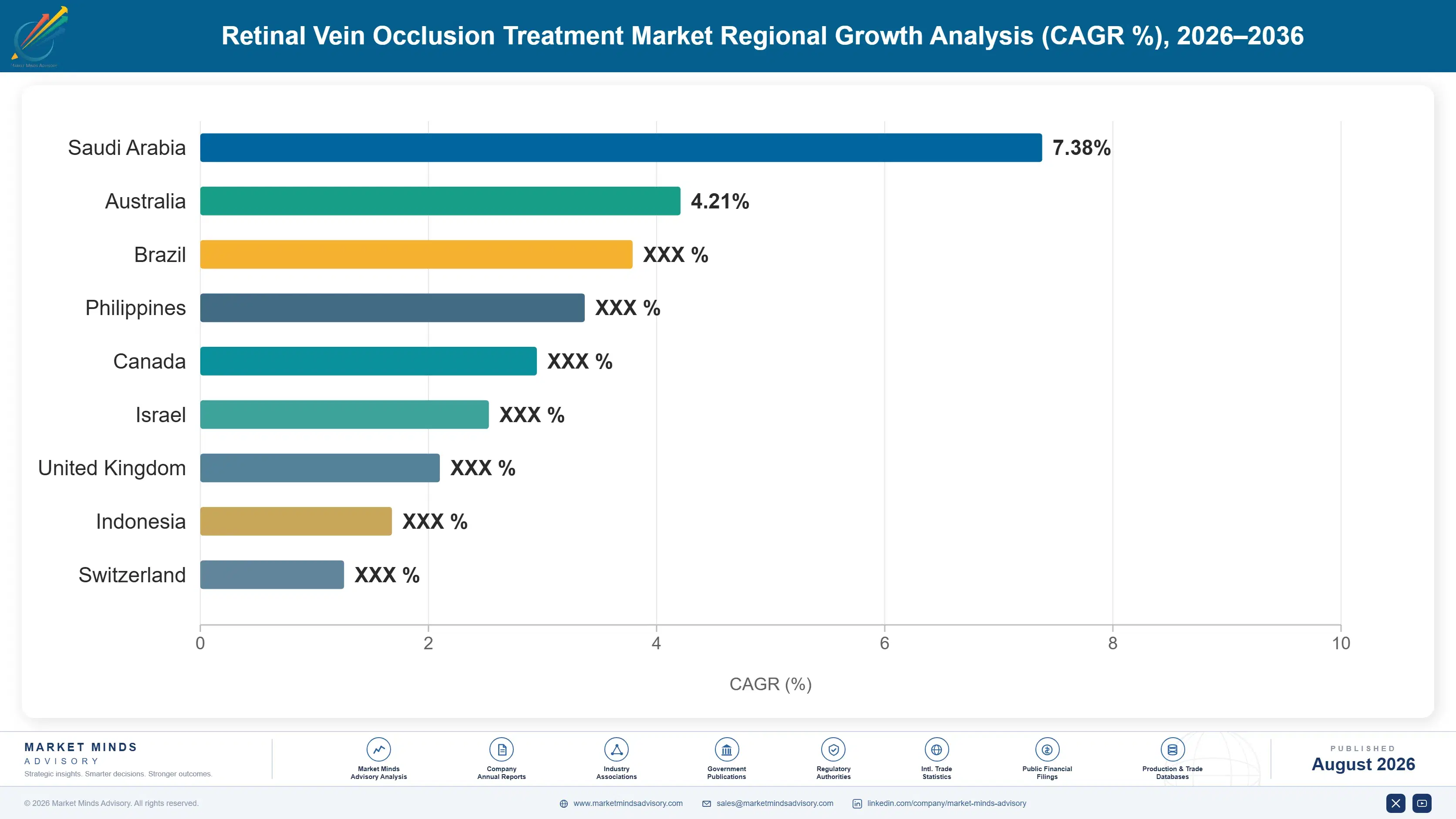
retinal-vein-occlusion-treatment-market-country-cagr-analysis-1787595672378

Extended-Dosing Premiumisation and Payer Partnerships

Manufacturers can grow revenue per patient even where legacy dosing volume growth is modest by shifting physicians toward extended-dosing branded agents, securing multi-year payer formulary partnerships, and diversifying biologics manufacturing across multiple production regions. The most durable gains come from capturing convenience-driven premium demand rather than commodity biosimilar price competition. across the broader industry landscape.

Developing Extended-Dosing Agents For Premium Formulary Placement

Manufacturers investing in extended-dosing anti-VEGF formulations targeted at retina specialty practices capture a price premium of roughly 20 to 32 percent over conventional monthly-dosing agents, reflecting the additional clinical validation these products require. This product development requires meaningful investment in formulation technology and payer formulary negotiation, but the investment pays back through access to premium reimbursement tiers that command higher pricing and strong physician loyalty among adherence-focused retina practices. The approach works best for manufacturers already serving general anti-VEGF channels seeking to extend into premium extended-dosing distribution. across major reimbursement markets.
Market Impact: Commands 20 to 32 percent price premium overall

Securing Long-Term Payer Formulary Partnership Agreements

Manufacturers winning multi-year partnerships with major payers undertaking formulary redesign secure volume commitments that provide revenue visibility uncommon in most pharmaceutical categories, since formulary placement rarely reverses once implemented and validated across a payer's covered population. These partnerships also create durable switching barriers, since payers face substantial administrative and clinical review cost changing preferred agents mid-contract. Manufacturers with established formulary partnerships report contract renewal rates roughly 3 times higher than spot-market biosimilar competition, reflecting the stability multi-year programme relationships provide compared with transactional formulary purchases. a gap that continues widening industry-wide.
Market Impact: Lifts contract renewal rates 3 times higher overall

Diversifying Biologics Manufacturing Across Multiple Regions

Manufacturers signing production agreements spanning North American, European, and Asian biologics manufacturing facilities simultaneously rather than relying on a single production region secure meaningfully more stable supply availability than competitors dependent on single-origin production during periodic regulatory disruptions. This diversification requires establishing manufacturing relationships across multiple regions with different regulatory requirements, a substantial coordination investment most smaller manufacturers cannot easily replicate. Manufacturers with diversified production report supply disruption exposure roughly 24 percent lower than single-origin competitors, reflecting the resilience diversified manufacturing provides during regional regulatory volatility. that has intensified in recent years.
Market Impact: Cuts supply disruption risk by 24 percent overall

Offering Dedicated Biosimilar Interchangeability Support Services

Manufacturers offering dedicated interchangeability study support alongside biosimilar sales, including switching study design and regulatory documentation, are capturing revenue that previously went to separate contract research organizations, simplifying market entry for manufacturers undertaking interchangeability designation for the first time. This bundled technical support commands meaningfully higher margins than biosimilar sales alone, and payers increasingly prefer manufacturers who can guarantee interchangeability outcomes rather than managing separate agent and study relationships, reducing adoption risk substantially across new market launches. Bundled packages cut a manufacturer's designation timeline and cost by roughly 21 percent compared with sourcing agents and studies separately.
Market Impact: Lifts bundled contract value by 17 percent overall

Who Controls the Margin Pool

The retinal vein occlusion treatment market is highly concentrated, with an estimated CR5 near 72 percent, reflecting a category where clinical data depth and decades of regulatory relationship track record matter more than manufacturing scale alone. Regeneron and Roche lead on combined clinical data breadth and physician relationship depth, but the gap to biosimilar manufacturers is narrowing on reimbursement-sensitive markets than on premium extended-dosing formats.
Competitive activity centers on three fronts: extended-dosing agent development aimed at defending premium formulary placement, payer partnership development to secure formulary-driven volume, and biologics manufacturing diversification across multiple production regions to reduce single-origin regulatory risk. Acquisitions of specialty biosimilar manufacturers with established manufacturing capability have picked up as diversified players seek to close biosimilar capability gaps organically.

Emerging pressure comes from Samsung Bioepis and other biosimilar manufacturers rapidly closing the clinical data and manufacturing scale gap on reimbursement-sensitive applications, threatening established originator makers on price in cost-constrained healthcare systems. Integrated contract manufacturers are also pushing further downstream into finished biologics production, threatening to disintermediate specialty manufacturers who purchase raw biologics components externally. Rankings could shift meaningfully if a biosimilar manufacturer achieves extended-dosing formulation parity with established branded suppliers.
retinal-vein-occlusion-treatment-market-company-positioning-matrix-1787595672897

Competitive Moat and Risk Dimensions

REGENERON PHARMACEUTICALS INC

Moat: Deep Clinical Data And Trust

Regeneron's decades-long clinical development and physician relationship depth in anti-VEGF therapy gives it trust and prescribing loyalty that biosimilar entrants cannot easily replicate, particularly among retina specialists who built practice patterns around Eylea's extensive real-world outcome data. That clinical trust lets Regeneron defend premium pricing even as biosimilar competition intensifies across most reimbursement-sensitive markets.
REGENERON PHARMACEUTICALS INC

Risk: Exposure To Biosimilar Substitution Pressure

Regeneron's substantial reliance on Eylea revenue leaves it more exposed to biosimilar substitution pressure than more diversified competitors with broader therapeutic portfolios beyond retinal disease. This has required Regeneron to invest heavily in extended-dosing formulation defense, a cost more diversified competitors can better absorb across broader revenue bases.
ROCHE HOLDING AG

Moat: Broad Retinal Disease Portfolio Depth

Roche's broad portfolio spanning multiple retinal disease indications through Genentech gives it flexibility to serve retina practices across several conditions from a single manufacturer relationship, reducing procurement complexity for multi-condition prescribing patterns. That portfolio breadth helps Roche defend share in the fastest-growing extended-dosing segment even as biosimilar pressure compresses legacy dosing margins industry-wide.
ROCHE HOLDING AG

Risk: Complexity Managing Multiple Agent Lifecycles

Roche's management of multiple anti-VEGF agents across different lifecycle stages creates portfolio complexity that more narrowly focused competitors avoid entirely, since cannibalization risk between legacy and next-generation agents complicates pricing strategy. Smaller, more focused competitors have, at times, achieved faster next-generation agent adoption than Roche's more complex multi-agent portfolio allowed.

Players Tracked

Prominent Players

Regeneron Pharmaceuticals Inc
Roche Holding AG
Novartis AG
Bayer AG
AbbVie Inc

Other Key Players

Samsung Bioepis
Amgen Inc
Celltrion Inc
Formycon AG
Coherus BioSciences
Sandoz Group AG
Biogen Inc
Alcon Inc
Santen Pharmaceutical Co
EyePoint Pharmaceuticals
Kodiak Sciences Inc
Outlook Therapeutics
Ocular Therapeutix
Apellis Pharmaceuticals
4D Molecular Therapeutics

Recent Developments

APRIL 2026

Regeneron Expands Extended-Dosing Clinical Program Investment

Regeneron announced expanded clinical investment in extended-dosing formulations for its anti-VEGF portfolio, aimed at directly defending premium formulary placement against growing biosimilar competition from established clinical development infrastructure, reducing durability data timelines for regional payer negotiations significantly, with new data expected in late 2027. to support formulary negotiations.
Signal: Signals established originator makers are increasingly prioritising durability data investment over continued legacy dosing defense strategies.
OCTOBER 2025

Samsung Bioepis Launches Payer Formulary Partnership Programme

Samsung Bioepis introduced a dedicated payer formulary partnership programme bundling documented interchangeability data with supply agreements, providing certification-ready documentation increasingly demanded by health systems evaluating competing biosimilar manufacturers for multi-year formulary contracts., positioning the company ahead of rivals still developing comparable documentation and switching study infrastructure.
Signal: Confirms formulary partnership bundling is quickly becoming a standard competitive requirement among specialty biosimilar manufacturers industry-wide.
MARCH 2026

Novartis Announces Diversified Biologics Manufacturing Agreement

Novartis announced a new multi-year biologics manufacturing agreement with Asian production facilities, diversifying the company's supply base beyond its traditional European sourcing and reducing exposure to single-region regulatory volatility that has periodically compressed margins across the industry, according to a company statement calling the move strategically important.
Signal: Marks growing manufacturer interest in geographic production diversification as a hedge against ongoing regional disruption risk.

Biologics Manufacturing And Clinical Trial Cost Exposure

Biologics manufacturing, including cell culture and purification processes, accounts for 42 percent of cost of goods sold across most anti-VEGF production, with fill-finish, cold chain logistics, and quality testing costs making up most of the remainder. Manufacturing capacity concentrates in North America, Europe, and East Asia, tying production costs to biologics manufacturing capacity rather than broader pharmaceutical commodity markets generally.
Biosimilar approval activity across major markets during 2022, driven by accelerated regulatory review timelines for anti-VEGF agents, pushed originator list prices down by more than 25 percent within months, according to FDA reporting, forcing manufacturers with fixed-cost manufacturing contracts signed before the approval wave to absorb margin compression. Manufacturers without diversified therapeutic portfolios faced the sharpest impact, and several smaller specialty manufacturers reported revenue declines while repositioning toward extended-dosing premium segments.

Exposure varies by player type: larger integrated manufacturers like Regeneron, with direct manufacturing capacity and diversified regional production, weather pricing pressure with meaningfully less margin disruption than smaller manufacturers reliant on single-agent revenue concentration. Geographic exposure also differs, since manufacturers selling primarily into United States reimbursement systems face different risk timing than those dependent on European or Asian cost-containment policy, meaning margin impact varies across the industry.
retinal-vein-occlusion-treatment-market-cost-volatility-analysis-1787595673094

Diversifying Therapeutic Portfolios Beyond Single Retinal Agents

Manufacturers are increasingly diversifying therapeutic portfolios across multiple retinal disease indications and adjacent specialty categories rather than relying on a single flagship agent, so biosimilar pressure on one product does not threaten overall company revenue. This diversification raises development complexity modestly but significantly reduces the risk of the sharp, single-agent revenue declines that hit under-diversified manufacturers hardest.

Securing Multi-Year Payer Formulary Agreements Early

Manufacturers are increasingly signing multi-year formulary agreements directly with major payers ahead of biosimilar entry, securing guaranteed formulary placement and capturing pricing stability that smaller manufacturers reliant on spot negotiations cannot access. This approach requires committed clinical data investment most smaller manufacturers cannot guarantee, reinforcing a cost and access advantage for larger, established manufacturers with existing payer relationships.

Investing Early In Extended-Dosing Formulation Defense

Larger manufacturers are investing early in extended-dosing formulation research to defend premium pricing ahead of biosimilar entry, avoiding the costly late-cycle pricing scramble smaller manufacturers face when biosimilar competition arrives. This approach requires meaningful upfront clinical investment most smaller manufacturers defer, reinforcing a durable pricing advantage for scale players during biosimilar transitions. affecting the broader industry.

Portfolio Architecture for Margin Defence

Retinal vein occlusion treatment organises into three commercial tiers running from standard biosimilar commodity supply through certified extended-dosing branded agents to next-generation combination and durability-optimized therapies. Gross margins widen sharply moving up the tiers, since commodity biosimilar formats compete largely on price and reimbursement access, while extended-dosing and next-generation formats capture value from documented durability, injection burden reduction, and clinical outcome data rather than list price alone.
The tension between commodity volume and premium format revenue shapes manufacturer strategy: biosimilar agents generate the reimbursement access that supports broad patient coverage, but extended-dosing and next-generation formats generate the margin that justifies continued clinical research investment. Manufacturers overweighted toward commodity-only sales face intensifying price competition from additional biosimilar entrants, while premium-forward manufacturers carry steadier, higher-margin profitability less exposed to biosimilar pricing cycles.

High-value pools concentrate among extended-dosing agents sold into premium reimbursement channels, and among next-generation combination therapies sold to patients with documented treatment-resistant disease. Both pools reward manufacturers who can pair certified durability performance with reliable, diversified manufacturing rather than competing purely on commodity biosimilar price alone, a distinction becoming more pronounced as reimbursement scrutiny deepens across major markets.

Volume / Commodity-Adjacent Tier

Standard biosimilar anti-VEGF agents sold largely on price and reimbursement access, competing on formulary placement, serving cost-constrained treatment populations broadly across most established healthcare systems worldwide, particularly across public payer networks.
Gross Margin: 16-24%

Premium / Certified Tier

Certified extended-dosing branded agents backed by documented durability trial data, sold at a meaningful premium to payers and physicians requiring formal outcome and adherence documentation. particularly among payers expanding into newly covered extended-dosing categories.
Gross Margin: 38-48%

Sustainability / Regulatory / Next-Generation Tier

Next-generation combination and durability-optimized therapies sold to treatment-resistant patient populations, priced on documented clinical performance rather than list price alone, commanding the highest margins among specialty retina treatment networks nationwide.
Gross Margin: 52-64%
retinal-vein-occlusion-treatment-market-portfolio-architecture-1787595673601

High-value Sub-segments and Strategic Watch-out

Extended-Dosing Agents For Premium Reimbursement Channels

Extended-dosing anti-VEGF agents sold into premium reimbursement channels command the category's highest margins and fastest growth, concentrated among manufacturers with proven durability trial capability and established payer relationships supporting rigorous outcome documentation requirements across modern reimbursement standards used throughout the modern ophthalmology treatment industry broadly.
Gross Margin: 54-66%

Next-Generation Combination Therapies For Resistant Disease

Combination therapies sold to treatment-resistant patients carry the category's strongest margins tied to clinical differentiation depth, though growth is more moderate than extended-dosing agents since adoption depends on individual payer coverage timelines across formulary contract cycles. particularly among larger payers with dedicated clinical review teams.
Gross Margin: 48-60%

Standard Biosimilar Commodity Anti-VEGF Agents

Standard biosimilar agents remain the largest volume category by far, generating steady access-driven revenue across cost-constrained treatment populations, even as growth increasingly shifts toward extended-dosing and next-generation formats elsewhere in the portfolio, particularly among manufacturers investing heavily in premium format development. across major reimbursement markets.
Gross Margin: 14-22%

Biosimilar Pricing And Interchangeability Timeline Risk

Volatile biosimilar pricing combined with lengthening interchangeability designation timelines represents a meaningful ongoing risk, since manufacturers dependent heavily on single-agent revenue and slow designation pipelines must monitor closely across payer and regulatory relationships, particularly as substitution requirements tighten further across most major reimbursement markets globally.
Gross Margin: n/a

Formulary-Locked Prescribing Economics

Retinal vein occlusion treatment demand behaves like an annuity once a payer completes formulary placement for an agent, since switching preferred agents requires costly administrative review and, for interchangeable biosimilars, formal substitution protocols that most payers strongly prefer to avoid absent a significant cost or safety driver. That formulary lock-in shapes how manufacturers price and structure long-term payer relationships, particularly for extended-dosing and biosimilar agents where switching costs run highest.
Adoption depth varies sharply by end use: large integrated health systems penetrate deepest into documented, formulary-driven prescribing relationships, often single-sourcing a preferred agent across an entire covered population, while independent retina practices adopt more transactionally, switching agents more readily based on patient-specific clinical factors. Government and public healthcare payers sit between the two, balancing cost containment against periodic clinical outcome reviews.

A generational shift in buyer profiles is underway as younger retina specialists, focused on documented durability data and total treatment burden reduction, demand extended-dosing evidence before adopting an agent, replacing an older generation that selected therapy primarily on familiarity and existing prescribing habits. Manufacturers slow to adapt risk losing share to durability-forward competitors, particularly among younger physicians who increasingly control prescribing decisions at large retina specialty practices.
retinal-vein-occlusion-treatment-market-end-use-penetration-index-1787595674094

Where To Focus Capital Next

These are among the four positions where our research anticipates prominent divergence between winners and laggards over the coming forecast period. Each is grounded in the demand model, the regulatory perimeter, and the announced capacity pipeline.
01 / EXTENDED-DOSING FORMULATION INVESTMENT

Prioritise Extended-Dosing Development Over Legacy Volume

Extended-dosing anti-VEGF agents are growing fastest among premium formats and carry the category's widest margins, driven by payers and physicians prioritizing injection burden reduction across most major reimbursement systems. Manufacturers that invest in extended-dosing clinical development are capturing this premium demand at a faster rate than competitors still selling conventional monthly-dosing agents without comparable convenience positioning. Capital allocated toward durability trial investment and payer negotiation will likely generate better returns than legacy dosing capacity expansion over the next several years, particularly for manufacturers serving high-volume reimbursement channels.
02 / PAYER FORMULARY PARTNERSHIPS

Secure Formulary Partnerships Ahead Of Biosimilar Expansion

Biosimilar competition is expanding rapidly across major reimbursement markets, and manufacturers who secure early payer formulary partnerships gain multi-year volume visibility and durable switching barriers uncommon in most pharmaceutical categories. This formulary-based revenue model requires sustained investment in outcome data infrastructure and payer relationship management that smaller manufacturers cannot easily replicate. Manufacturers that delay building these relationships risk ceding fast-expanding formulary volume entirely to more established competitors already positioned with major health systems managing large, multi-year formulary contracts across multiple regions.
03 / MANUFACTURING SOURCING DIVERSIFICATION

Diversify Biologics Manufacturing Across Multiple Regions

Regulatory disruption periodically compresses margins across the industry, and manufacturers who diversify production across North America, Europe, and Asia gain meaningfully more stable supply availability than competitors reliant entirely on single-region production during periods of regulatory disruption. This diversification requires substantial coordination investment across multiple regions with different regulatory requirements that smaller manufacturers cannot easily replicate. Manufacturers that delay this diversification risk continued supply volatility that better-diversified competitors have already substantially reduced through geographic production spread across multiple manufacturing regions and countries.
04 / INTERCHANGEABILITY SUPPORT INVESTMENT

Build Interchangeability Support Capability Ahead Of Demand

Biosimilar interchangeability regulation is opening substantial addressable markets among payers new to formal substitution protocols, and manufacturers who build dedicated interchangeability support capture share before competitors recognise the opportunity clearly. This bundled support approach is already commanding premium pricing among manufacturers serving payers entering interchangeability designation for the first time. Manufacturers that delay building this bundled capability risk ceding substitution-driven volume entirely to more prepared competitors already established with payer customers across multiple regional markets simultaneously and across multiple therapeutic categories.

Engagement Snapshot From the Field

A live engagement with an industry participant carrying material or product regulatory and market exposure ahead of a defining policy shift, showing how our research translates into a defensible multi-year portfolio strategy.
MARKET MINDS ADVISORY · CLIENT ENGAGEMENT SUMMARY
Retinal Vein Occlusion Treatment Producer Strategic Portfolio Review and Transition Roadmap 2026·Investment Scenario on Retinal Vein Occlusion Treatment Exposure Evaluation 2025-26
CLIENT PROFILE
The client is a regional integrated health system redesigning its anti-VEGF formulary strategy, representing approximately 42,000 annual retinal vein occlusion treatment episodes across its covered population (client-reported, unverified by MMA). The system needed to evaluate biosimilar substitution against extended-dosing branded alternatives ahead of its annual formulary review deadline, while maintaining continuity of care across its existing patient population.
STRATEGIC CHALLENGE
Pharmacy and clinical leadership needed to evaluate competing anti-VEGF agents against documented efficacy, durability, and total cost of care data, but lacked internal clinical pharmacology expertise to independently model long-term outcomes within the formulary review timeline. Delaying the decision risked missing the review deadline, which would have forced the system to continue reimbursing higher-cost legacy agents for another full budget cycle.
MMA APPROACH
MMA analysts benchmarked candidate agents against documented outcome data from comparable health system formularies, modeling expected total cost of care and injection burden across representative patient scenarios. The engagement combined primary interviews with pharmacy and clinical staff, agent capability comparison, and analysis against MMA's broader dataset of formulary redesign outcomes across comparable markets and system types.
KEY FINDINGS
  1. The recommended formulary mix reduced the system's projected total cost of care by roughly 19 percent compared with the highest-cost legacy-only formulary, based on comparable system benchmarks (client-reported, unverified by MMA).
  2. Two of five benchmarked biosimilar agents lacked sufficient real-world switching data to meet the system's interchangeability confidence requirements, based on documented data comparisons across candidate proposals.
  3. Patients transitioned using pre-validated switching protocols showed lower adverse event rates than those switched without documented protocol guidance, reflecting the value of structured transition support.
  4. The recommended formulary approach included dedicated physician education support throughout the transition process, reducing the system's internal clinical communication burden compared with competing proposals.
CLIENT PROFILE
The client is a regional integrated health system redesigning its anti-VEGF formulary strategy, representing approximately 42,000 annual retinal vein occlusion treatment episodes across its covered population (client-reported, unverified by MMA). The system needed to evaluate biosimilar substitution against extended-dosing branded alternatives ahead of its annual formulary review deadline, while maintaining continuity of care across its existing patient population.
STRATEGIC CHALLENGE
Pharmacy and clinical leadership needed to evaluate competing anti-VEGF agents against documented efficacy, durability, and total cost of care data, but lacked internal clinical pharmacology expertise to independently model long-term outcomes within the formulary review timeline. Delaying the decision risked missing the review deadline, which would have forced the system to continue reimbursing higher-cost legacy agents for another full budget cycle.
MMA APPROACH
MMA analysts benchmarked candidate agents against documented outcome data from comparable health system formularies, modeling expected total cost of care and injection burden across representative patient scenarios. The engagement combined primary interviews with pharmacy and clinical staff, agent capability comparison, and analysis against MMA's broader dataset of formulary redesign outcomes across comparable markets and system types.
KEY FINDINGS
  1. The recommended formulary mix reduced the system's projected total cost of care by roughly 19 percent compared with the highest-cost legacy-only formulary, based on comparable system benchmarks (client-reported, unverified by MMA).
  2. Two of five benchmarked biosimilar agents lacked sufficient real-world switching data to meet the system's interchangeability confidence requirements, based on documented data comparisons across candidate proposals.
  3. Patients transitioned using pre-validated switching protocols showed lower adverse event rates than those switched without documented protocol guidance, reflecting the value of structured transition support.
  4. The recommended formulary approach included dedicated physician education support throughout the transition process, reducing the system's internal clinical communication burden compared with competing proposals.
RECOMMENDED STRATEGY
Phase 1: Phase 1 (Months 1 to 3): Complete formulary evaluation for the system's highest-volume treatment population using the recommended agent comparison data. Phase 2: Phase 2 (Months 4 to 8): Extend formulary transition to remaining patient populations using validated switching protocols from the initial phase. Phase 3: Phase 3 (Months 9 to 10): Finalise updated payer contracts with pricing terms informed by formulary outcomes, ensuring alignment with long-term budget and clinical review priorities.
OUTCOME
The system completed formulary redesign for its full covered population ahead of the review deadline within ten months. Early clinical data showed meaningful cost reduction without adverse outcome increases (client-reported, unverified by MMA), and pharmacy leadership credited the phased approach with avoiding care disruption during the transition.

Frequently Asked Questions

Foundational context covering the market sizes, CAGR, scope, country, region and competition that inform every finding below. This section is provided to cover basics and most often pre-purchase conversations, answered from the MMA Primary Research Dataset.

What is the current size of the Retinal Vein Occlusion Treatment Market?

The global retinal vein occlusion treatment market was valued at approximately $4.4 billion in 2025. Demand is driven by biosimilar approvals, extended-dosing agents, and expanding reimbursement coverage.

How large will the Retinal Vein Occlusion Treatment Market be by 2036?

MMA forecasts the market will reach approximately $11.24 billion by 2036, roughly 2.35 times its 2026 value. Growth is driven by demographic incidence increases and extended-dosing agent adoption.

What is the CAGR for the Retinal Vein Occlusion Treatment Market 2026 to 2036?

The market is projected to grow at a compound annual growth rate of 8.9 percent between 2026 and 2036. Bull and bear scenarios range from roughly 7.6 to 10.2 percent depending on biosimilar pricing trends.

Which segment is growing fastest?

Anti-VEGF biosimilars are the fastest-growing segment, expanding at approximately 14.5 percent annually, driven by payers pushing formulary substitution toward lower-cost alternatives that deliver comparable clinical efficacy and safety profiles.

Who are the major companies in the Retinal Vein Occlusion Treatment Market?

Leading manufacturers include Regeneron Pharmaceuticals Inc, Roche Holding AG, Novartis AG, Bayer AG, and AbbVie Inc. Competition centers on clinical data depth, extended-dosing innovation, and biosimilar manufacturing scale.

Which country is growing fastest?

China is the fastest-growing major market, driven by its expanding ophthalmology infrastructure and rising retinal vein occlusion diagnosis rates tied to hypertension and diabetes prevalence.

Report Segmentation Architecture

The full report scope spans multiple orthogonal segmentation dimensions, with cross-tabulated demand data provided for each dimension pair. Coverage extends further to regional breakdowns, trend trajectories, and the competitive detail needed to support segment-level decision-making.

By Treatment Modality

  • Anti-VEGF Branded Biologics
  • Anti-VEGF Biosimilars
  • Corticosteroid Intravitreal Implants
  • Laser Photocoagulation Therapy
  • Combination Therapy Regimens
  • Off-Label Bevacizumab Therapy

By End-Use Setting

  • Retina Specialty Practices
  • Integrated Health Systems
  • Government and Public Healthcare Payers
  • Academic Medical Centers

By Commercial Dimension

  • Premium Formulary Supply Contracts
  • Certified Biosimilar Supply
  • Standard Commodity Supply
  • Interchangeability and Switching Support Services

By Region

  • North America
  • Western Europe
  • East Asia
  • South Asia and Pacific
  • Latin America
  • Middle East and Africa
  • Eastern Europe

Scope, Methodology, and Coverage

Every figure in this report is reproducible from documented input assumptions. The scope below maps the historical period, the forecast horizon, the segmentation dimensions, and the countries covered, alongside the underlying primary and qualitative methodology.
Historical Period
2020 to 2025
Forecast Period
2026 to 2036
Base Year
2025 (USD billions; MMA Primary Research Dataset, August 2026)
Market Definition
The retinal vein occlusion treatment market covers pharmacological and procedural interventions, including anti-VEGF intravitreal injections, corticosteroid implants, and laser photocoagulation, used to manage macular edema and vision loss from branch and central retinal vein occlusion. It excludes diagnostic imaging services and treatments for unrelated retinal diseases such as diabetic retinopathy monotherapy.
Quantitative Units
USD billions (current prices); volume in million injections where cited
Segmentation Dimensions
By Treatment Modality; By End-Use Setting; By Commercial Dimension; By Region
Regions Covered
North America, Western Europe, East Asia, South Asia and Pacific, Latin America, Middle East and Africa, Eastern Europe
Countries Covered
USA, China, Germany, France, UK, Japan, South Korea, India, Australia, Canada, Brazil, Mexico, Indonesia, Vietnam, Thailand, Malaysia, UAE, Saudi Arabia, South Africa, Nigeria, Turkey, Poland, Netherlands, Italy, Spain, Sweden, Switzerland, Argentina, Colombia, Singapore, and additional markets relevant to this sector
Key Companies Profiled
Regeneron Pharmaceuticals Inc, Roche Holding AG, Novartis AG, Bayer AG, AbbVie Inc, Samsung Bioepis, Amgen Inc, Celltrion Inc, Formycon AG, Coherus BioSciences, Sandoz Group AG, Biogen Inc, Alcon Inc, Santen Pharmaceutical Co, EyePoint Pharmaceuticals, Kodiak Sciences Inc, Outlook Therapeutics, Ocular Therapeutix, Apellis Pharmaceuticals, 4D Molecular Therapeutics
Quantitative Methodology
Primary survey, n=3,800 respondents, Q4 2025, six countries; demand-side model with trade association cross-validation
Qualitative Methodology
47 expert interviews, Q4 2025; applied to validate demand model assumptions, identify emerging dynamics, and assess competitive positioning
Report Format
PDF and XLSX data workbook (Word format preview document)
Publisher
Market Minds Advisory
Report Code
MMA-2026-HLT-163
Published
August 2026
Contact
sales@marketmindsadvisory.com | www.marketmindsadvisory.com

Purchase the full Retinal Vein Occlusion Treatment Market Report (2026 to 2036).

The full report provides a quantitative and qualitative assessment of the global retinal vein occlusion treatment market through 2036, including regional sizing across all seven MMA-tracked geographies and modality-level segmentation covering branded biologics, biosimilars, implants, laser, and combination therapy categories. It profiles twenty leading and emerging manufacturers, benchmarking clinical data depth, extended-dosing capability, and biosimilar manufacturing scale across the competitive landscape. The report includes primary survey findings from 3,800 respondents and 47 expert interviews conducted in the fourth quarter of 2025, alongside biologics manufacturing cost and supply chain risk analysis. Buyers receive segment-level revenue models, editable data tables, and a framework for evaluating manufacturer and market entry decisions.
Seven-region market sizing with modality-level revenue breakdowns
Twenty-company competitive profiles with moat and risk analysis
Primary survey data from 3,800 respondents across six countries
Forty-seven expert interviews on regulatory and adoption trends
Editable data tables for custom scenario and sensitivity modeling
Biologics manufacturing cost and supply chain risk assessment

Built For The People Who Decide

From boardroom strategy to bench-side execution, this report is read cover-to-cover by leaders shaping the next decade of their industry, turning demand scenarios, market dynamics and valuation benchmarks into decisions.
CXOs/ Presidents/ VPs/ Managers
M&A and Corporate Development
Strategy Teams and R&D Heads
Procurement and Product Directors
Regulatory and Compliance Leaders
Investor Relations and Equity Analysts