Market Minds Advisory
Retinal Laser Photocoagulation Market

Retinal Laser Photocoagulation Market: Diabetic Retinopathy and Retinal Disease Treatment Systems

Anti-VEGF injections keep capturing wet AMD and diabetic macular edema treatment share, pushing photocoagulation vendors toward navigated and micropulse platforms that target the panretinal and peripheral cases injections still cannot reach.

Lead Analyst

Alice Ballenger

Published

September 2026

Make Smarter Decisions with Customized Research Insights

Request a free sample report and evaluate market opportunities, growth trends, and competitive dynamics relevant to your business needs.

2025 MARKET VALUE$1.4BMarket Size 2025
2036 FORECAST VALUE$2.6BBase Case , 2026 to 2036
CAGR 2026 TO 20366.2 %Bull 7.4% / Bear 5.0%
INCREMENTAL OPPORTUNITY$1.2BNet 10- year value creation
EXPANSION MULTIPLE1.82x2036 value over 2026 base
Strategic Levers
M&A Pipeline
Regional Outlook
Country Rankings
Competitive Intelligence
Segmental Deep-dive
Call-Us : 91 93563 13602

Executive Snapshot and Market Trajectory

Anti-VEGF injections keep taking treatment share for wet AMD and diabetic macular edema, pushing photocoagulation vendors to reposition around panretinal and peripheral retina cases that injectable therapy genuinely cannot reach or replace across nearly every established retina practice reviewed this year and last across the industry.
Conventional continuous-wave lasers still carry the largest installed base, but navigated laser systems integrating real-time fundus imaging are expanding fastest as retina specialists chase treatment precision and reduced collateral tissue damage. Demand concentrates among high-volume retina practices and hospital ophthalmology departments managing large diabetic retinopathy populations, where throughput economics favor faster, more automated laser platforms over legacy manual delivery systems still common in smaller clinics across several established markets.
Competition splits between diversified ophthalmic device manufacturers bundling laser systems with diagnostic imaging platforms and specialist laser-only vendors competing purely on treatment precision and clinical evidence depth. Tightening reimbursement scrutiny, plus growing retina specialist interest in reduced-damage micropulse protocols, are pulling purchasing decisions toward vendors that can demonstrate measurable visual outcome preservation against documented conventional laser baselines across comparable indication categories and treated patient cohorts spanning multiple retina practice networks currently evaluating new equipment contracts.
Market Definition
The retinal laser photocoagulation market covers laser systems and associated consumables used to treat diabetic retinopathy, retinal tears, retinal vein occlusion, and related peripheral retina conditions through targeted thermal tissue coagulation. It excludes anti-VEGF injectable pharmaceuticals, vitrectomy surgical systems, and diagnostic imaging equipment sold without an integrated laser delivery component.
Base Year Value
$1.4B in 2025 (MMA Primary Research Dataset, August 2026)
Forecast Period
2026 to 2036, eleven discrete annual values
CAGR
6.2% base case. Bull 7.4%. Bear 5.0%.
Fastest Growth Segment
Navigated Retinal Laser Systems: 9.5% CAGR
Fastest Growth Country
India: 9.6% CAGR
Fastest Growth Region
South Asia and Pacific: 8.3% CAGR
Largest Region
North America: 31% of 2025 global value
Market Leaders
IRIDEX Corporation, Topcon Corporation, Carl Zeiss Meditec AG, Alcon Vision LLC, Quantel Medical (Lumibird Group). Source: MMA Analysis based on company annual reports.
Primary Survey
n=3,800 procurement and R&D decision-makers, Q4 2025, six countries
Methodology
Demand-side build-up, cross-validated against public data, 47 expert interviews

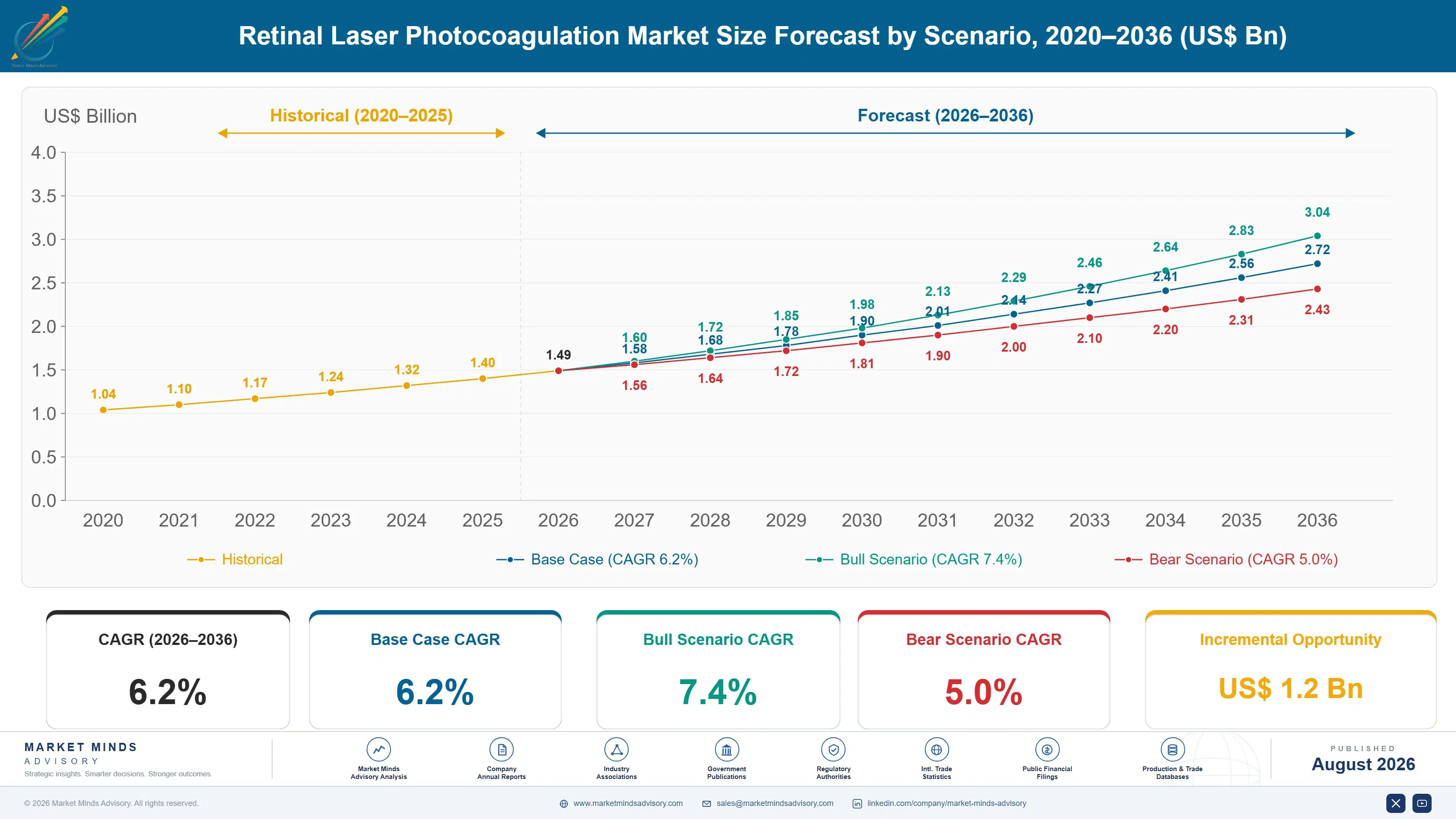
Retinal Laser Photocoagulation Market Forecast Scenarios

retinal-laser-photocoagulation-market-size-forecast-scenario-1787298767364
Growth from 2020 to 2025 compounded near 5.7%, held back by pandemic-era elective ophthalmology procedure deferrals, then recovering steadily as retina practices resumed normal diabetic retinopathy screening and treatment volumes across most established healthcare systems and their backlogged patient queues, gradually restoring pre-pandemic screening throughput across affected clinics, referral networks, and outreach programmes serving previously deferred patients.
Three mechanisms carry the base case to 6.2%. First, rising global diabetes prevalence driving expanding diabetic retinopathy screening and treatment volume across both developed and emerging healthcare markets. Second, navigated and micropulse laser adoption reaching broader clinical acceptance, which sustains premium pricing even as unit volume growth moderates. Third, expanding ophthalmology infrastructure across emerging markets, which extends laser treatment access to previously underserved diabetic populations lacking nearby specialist retina care.
The bull case at 7.4% assumes navigated laser adoption accelerates faster than current clinical training timelines suggest, pulling forward premium system conversion considerably across high-volume retina practices. The bear case at 5.0% assumes anti-VEGF injection substitution continues eroding photocoagulation volume for macular indications faster than panretinal demand can offset across affected specialty practices and their capital equipment budgets.

Injection Substitution Pressure and the Precision Laser Shift

Three forces converge on retinal laser photocoagulation budgets this year. Anti-VEGF injections keep eroding macular indication volume, diabetic retinopathy prevalence keeps climbing across aging and expanding diabetic populations, and navigated laser platforms are only now reaching the clinical training maturity retina specialists require before adopting them as first-line treatment tools across every enrolled diabetic retinopathy population and referral pathway tracked across this year's asses
MARKET CONCENTRATIONCR5 52%top five manufacturers hold a substantial combined revenue share
AVERAGE SYSTEM PRICE$25,000-65,000 per unitpricing varies considerably by platform sophistication and imaging integration
TOP PRODUCING COUNTRY SHAREUSA 28%leading share of global laser system manufacturing capacity
CAPACITY UTILISATION68-76%manufacturing facilities running below full annual production levels
TRADE INTENSITY61%share of finished laser systems crossing borders before installation
SERVICE CONTRACT REVENUE SHARE22-30%recurring maintenance income supplements original device sales revenue
The market behaves less like a standard capital equipment category and more like a specialty clinical tool wrapped around evolving treatment protocols. Vendors compete on demonstrated precision and reduced collateral damage rather than price alone, since a retina specialist adopting a new laser platform faces genuine retraining time that discourages frequent switching between competing systems absent a genuine clinical outcome failure forcing the change, particularly across large multi-location retina practices with established referral relationships.
Navigated fundus-integrated targeting, micropulse subthreshold protocols, and portable slit-lamp delivery systems are reshaping purchasing criteria across the next decade, favoring manufacturers that can prove measurable visual outcome preservation against documented conventional continuous-wave laser baselines across comparable practice types, treated indication categories, and multi-year outcome tracking studies.
"Retina specialists used to buy a laser once and run it for fifteen years. Now they compare tissue-sparing data before every capital purchase, because a burn pattern that damages more retina than necessary is a permanent patient outcome, not a settings adjustment."
Director, Ophthalmic Devices and Surgical Technology Practice · MMA Ophthalmic D

Market Trends

Navigated Laser Systems Integrate Real-Time Fundus Imaging

Several manufacturers have moved navigated laser platforms combining real-time fundus image tracking with automated treatment planning beyond early adopter clinics into mainstream high-volume retina practice deployment, allowing precise repeat treatment application to previously marked lesion sites even as the eye moves during the procedure. Early deployment data show measurably tighter treatment placement accuracy compared with manual slit-lamp aiming techniques used previously, though the systems still carry a meaningful price premium that limits adoption mainly to higher-volume academic and referral retina centers tracked in this year's primary survey data and expert interviews.
Market Impact: Adds 7% annual screening volume
Micropulse Subthreshold Protocols Gain Broader Clinical Acceptance

Retina specialty societies have published expanding clinical guidance supporting micropulse subthreshold laser protocols for macular applications, reflecting growing evidence that reduced-energy pulsed delivery achieves comparable therapeutic effect while sparing more surrounding healthy retinal tissue than conventional continuous-wave treatment. Commercial payers have followed with expanding reimbursement coverage across several jurisdictions, though documentation requirements remain strict enough that smaller independent practices increasingly rely on manufacturer-provided training programmes rather than developing protocol expertise entirely on their own, a dependency that shapes which platforms they eventually purchase and standardize around across their entire clinical staff.
Market Impact: Adds 14% new market access

Market Opportunities and Growth Drivers

Rising Global Diabetes Prevalence Expands Screening Volume

Expanding diabetic populations across major developed and emerging economies keep raising the pool of patients requiring regular diabetic retinopathy screening and, for a meaningful share, eventual laser treatment to prevent vision-threatening complications that develop silently without early intervention. Health systems managing large diabetic patient panels increasingly view expanding screening and treatment capacity as essential to managing long-term vision loss liability rather than optional clinical infrastructure, particularly across regions where diabetic retinopathy already ranks among the leading causes of preventable adult blindness and consumes outsized public health resources each and every budget year.
Market Impact: Cuts macular segment volume 20%

Expanding Ophthalmology Infrastructure Reaches Underserved Populations

Government and philanthropic investment in ophthalmology infrastructure across emerging markets is extending laser treatment access to diabetic populations that previously had no nearby specialist retina care available at all, creating substantial first-time equipment demand rather than simple replacement cycle purchasing. This shift favors manufacturers offering portable and lower-cost platforms suited to resource-constrained clinical settings over premium navigated systems designed primarily for high-volume academic centers with established capital equipment budgets and dedicated biomedical engineering support staff already familiar with premium platform maintenance requirements, servicing schedules, warranty documentation procedures, and vendor escalation contacts.
Market Impact: Slows adoption timeline 8 months

Market Restraints and Challenges

Anti-VEGF Injection Substitution Erodes Macular Treatment Volume

Anti-VEGF injectable therapy has become first-line treatment for wet age-related macular degeneration and diabetic macular edema in most developed markets, displacing laser photocoagulation from indications where it once dominated clinical practice entirely. The root cause is genuinely superior visual outcome data for injectable therapy in these specific macular indications, documented across multiple large clinical trials. This permanently caps photocoagulation volume growth in the macular segment specifically, and manufacturers are increasingly repositioning marketing and clinical evidence generation around panretinal and peripheral indications where injectable therapy offers no comparable treatment alternative for retina specialists managing these patients.
Market Impact: Improves placement accuracy 40%

Retina Specialist Training Requirements Slow Adoption

Navigated and micropulse laser platforms require meaningful retraining time before retina specialists feel confident deploying them as primary treatment tools, and the limited pool of specialists available for manufacturer-led training sessions constrains how quickly new systems penetrate established practices. The root cause traces to genuine differences in treatment technique between conventional and newer platforms that cannot be shortcut through simple equipment familiarization alone. Several manufacturers are now funding dedicated fellowship training partnerships with academic retina programmes to widen the qualified specialist pipeline over time and accelerate confident clinical adoption across newly trained retina specialists entering practice.
Market Impact: Expands covered indications 18%
3 additional market trends, 4 additional growth drivers, and 2 additional restraints and challenges are covered in the full report. Contact sales@marketmindsadvisory.com to access the complete intelligence.

Segment CAGR and Growth Architecture

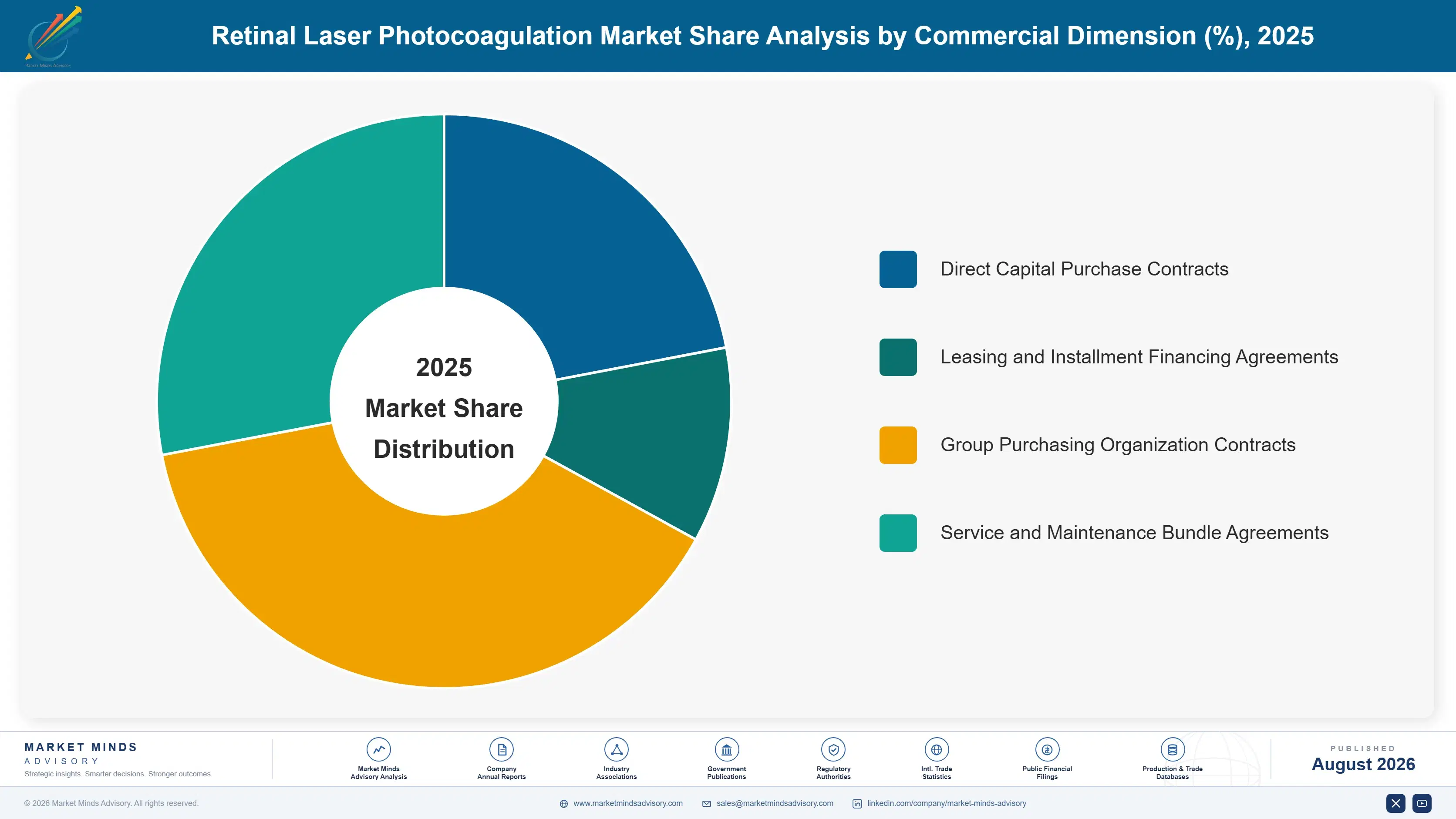
Segmentation follows laser platform and delivery technology type because clinical technique, purchase price tier, and buyer specialization differ substantially between conventional, pattern scanning, micropulse, navigated, and portable delivery categories, each carrying its own distinct training requirement, reimbursement pathway, and adoption curve across practice types, specialist experience levels, and geographic markets served across this year's coverage.
retinal-laser-photocoagulation-market-market-share-analysis-1787298767950

Navigated Retinal Laser Systems

This segment grows fastest at 9.5% as high-volume retina practices move navigated laser platforms from early adopter status into mainstream capital equipment budgets. Vendors differentiate on validated treatment placement accuracy against manual aiming baselines rather than raw system speed, since retina specialists still require documented clinical outcome evidence before shifting primary treatment technique away from familiar conventional platforms. Demand concentrates among academic and referral retina centers managing high case volumes, where precision economics and repeat-treatment efficiency clear the investment threshold fastest. Smaller independent practices typically delay navigated system adoption until per-unit pricing declines closer to conventional platform levels or manufacturer financing options expand accessibility across smaller practice budgets and their constrained annual capital allocations.
CAGR 9.5%

Micropulse and Subthreshold Laser Systems

Micropulse and subthreshold laser systems grow at 8.1% as expanding clinical guidance and payer reimbursement coverage support broader adoption of reduced-energy pulsed delivery protocols for macular applications. This segment carries the strongest tissue-sparing clinical evidence base in the portfolio, since published comparative studies increasingly document meaningfully less collateral retinal damage relative to conventional continuous-wave treatment across comparable patient cohorts. Retina practices with established micropulse protocol training hold a genuine competitive advantage over newer adopters still building clinical confidence and internal treatment guidelines around this delivery technique and its distinct energy settings, dosing parameters, and post-treatment follow-up protocols that differ meaningfully from conventional continuous-wave laser practice standards accumulated over many years of clinical use across established retina centers.
CAGR 8.1%
Full segment breakdown across 6 segments available in the complete report.

Regional Architecture and Country Demand Map

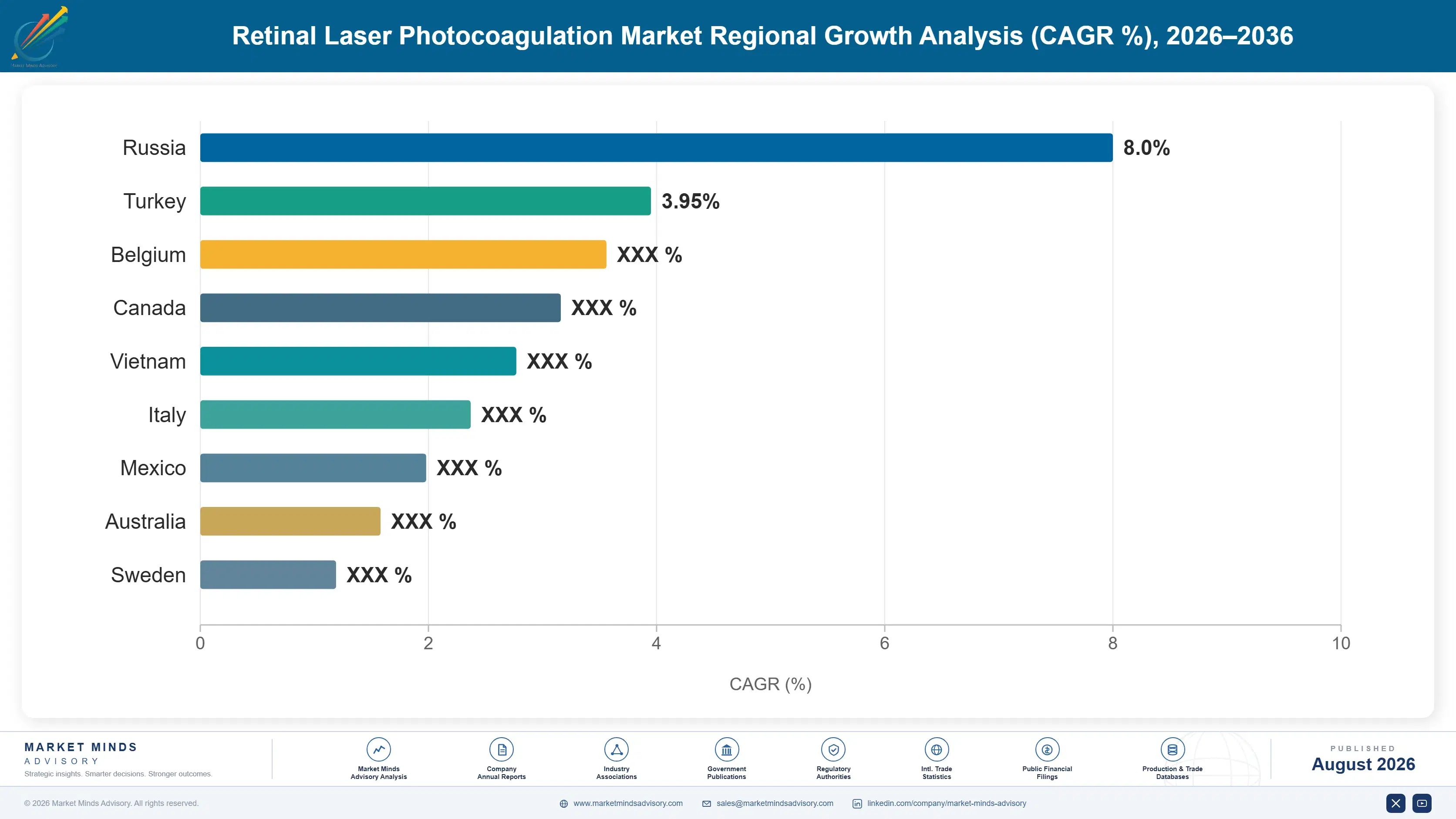
North America leads on established ophthalmology reimbursement infrastructure and concentrated device manufacturer headquarters presence, while South Asia and Pacific grows fastest as India expands diabetic retinopathy screening and treatment access this year and across the following forecast decade of coverage detailed fully in this report.

North America

The United States accounts for the largest share of regional demand because Medicare and commercial payer coverage for diabetic retinopathy screening and treatment is well established, giving retina practices clear reimbursement justification for capital equipment investment. Major device manufacturers headquartered there, including IRIDEX and Alcon, maintain deep domestic clinical trial and key opinion leader relationships that smaller international competitors struggle to replicate quickly. Canada contributes a smaller share tied to its provincial healthcare systems covering select laser treatment categories under public insurance. Growth trails the fastest-growing regions since domestic reimbursement penetration among established retina practices already sits near mature levels, leaving less incremental first-time adoption opportunity than emerging markets elsewhere.
Share: 31% | CAGR: 6.0% (2026 to 2036)

Western Europe

Germany and France anchor regional demand, with both countries maintaining well-established public healthcare coverage for diabetic retinopathy treatment across national ophthalmology referral networks. The United Kingdom contributes steady demand through the National Health Service's structured diabetic eye screening programme, one of the most systematic screening infrastructures anywhere in the world. Public healthcare budget constraints across the region push slower, more centrally coordinated equipment procurement than the practice-driven purchasing model common in the United States. Growth runs below the global average as national procurement approval processes move more cautiously than emerging Asian markets building ophthalmology infrastructure from a smaller existing base and fewer legacy procurement constraints to navigate around each budget cycle.
Share: 24% | CAGR: 5.0% (2026 to 2036)
Regional intelligence for 5 additional markets available in the complete report: East Asia, South Asia and Pacific, Latin America, Middle East and Africa, Eastern Europe. Contact sales@marketmindsadvisory.com.
retinal-laser-photocoagulation-market-country-cagr-analysis-1787298768469

Where Photocoagulation Vendors Can Expand Margin Now

Vendors selling laser hardware alone are leaving margin on the table. Four levers let established manufacturers expand revenue per practice contract without simply chasing system unit volume across an increasingly commoditised base laser tier facing mounting price pressure from newer entrants and their leaner Asian manufacturing cost structures across every established indication category and practice size.

Bundle Fundus Imaging Into Navigated Laser Contracts

Vendors selling standalone navigated laser systems leave higher-margin diagnostic imaging work to specialist competitors even when the underlying fundus image data already flows through their own targeting platform. Bundling both into a single contract raises average revenue per practice client by an estimated 18 to 26% while reducing the practice's vendor management overhead and workflow integration friction between separate laser and imaging system providers serving the same patient population. Practices increasingly prefer single-vendor accountability for their full retina treatment workflow, particularly given documented efficiency gains from integrated systems compared with managing two separate vendor relationships.
Market Impact: Raises revenue per contract 18-26% over three years

Publish Validated Tissue-Sparing Clinical Outcome Data

Vendors with multi-year validated tissue-sparing outcome data against conventional laser baselines can charge premium rates over competitors offering unproven precision claims, since retina specialists weigh documented visual field preservation heavily during platform selection decisions. Published outcome studies covering several thousand treated eyes support pricing premiums of roughly 10 to 16% above standard laser system rates across comparable indication categories. This lever rewards manufacturers that invested early in clinical outcome studies rather than those still relying on device specifications alone to win new practice contracts across comparable indication categories and practice sizes.
Market Impact: Supports a pricing premium of roughly 10-16% overall

Build Retina Fellowship Training Partnerships Early

Establishing dedicated training partnerships with academic retina fellowship programmes ahead of confirmed practice demand lets vendors build brand familiarity among newly trained specialists that competitors without comparable training infrastructure cannot easily replicate, since specialists tend to purchase systems similar to those they trained on early in their careers. Early movers captured an estimated 20% larger share of new practice contracts awarded to recently trained retina specialists over the past two years compared with vendors lacking comparable fellowship relationships and academic training program visibility across leading regional residency and fellowship programmes.
Market Impact: Captures roughly 20% more new practice contracts yearly

Expand Portable System Financing for Emerging Markets

Health systems in emerging markets increasingly need flexible financing options for portable laser systems that generalist vendors selling only through traditional capital purchase models frequently cannot accommodate given constrained hospital procurement budgets. Vendors building dedicated leasing and installment financing programmes capture incremental contract value estimated near 12% above standard cash-purchase pricing, since health systems otherwise must delay equipment acquisition entirely until capital budget cycles allow for full upfront payment, a delay that can stretch several budget years in resource-constrained public healthcare systems facing competing infrastructure priorities across multiple clinical departments.
Market Impact: Adds roughly 12% incremental contract value each year

Who Controls the Margin Pool

CR5 sits near 52%, evaluated on disclosed ophthalmic laser system revenue across public filings and segment disclosures where available. The gap between the top five diversified device manufacturers and the next tier of specialist laser vendors is substantial, since scale advantages in regulatory clearance, clinical trial infrastructure, and existing retina specialist relationships compound heavily relative to smaller entrants lacking comparable academic credibility and distribution reach.
Current competitive activity centers on three dimensions: navigated targeting platform investment, tissue-sparing clinical outcome data publication, and diagnostic imaging bundling. Large diversified device manufacturers bundle laser systems with imaging and broader ophthalmic surgical portfolios, while specialist vendors compete purely on laser precision and narrow indication depth documented across comparable retina practice deployments and their published clinical outcome studies and academic partnerships.

Emerging pressure comes from Asian manufacturers offering lower-cost conventional and portable laser platforms without comparable navigated capability, forcing established Western manufacturers to defend premium pricing through demonstrated clinical differentiation. Rankings could shift toward vendors combining validated tissue-sparing outcome data with broad fellowship training relationships over the next several practice equipment replacement cycles across major retina networks and their academic referral partnerships.
retinal-laser-photocoagulation-market-company-positioning-matrix-1787298768995

Competitive Moat and Risk Dimensions

IRIDEX CORPORATION

Moat: Deep retina specialist clinical relationships

IRIDEX's decades of accumulated retina specialist relationships and widely cited clinical evidence base for its laser platforms give it credibility that narrower newer entrants cannot easily replicate across comparable practice networks. Its established fellowship training partnerships support continued brand familiarity among newly trained specialists entering independent practice each year.
IRIDEX CORPORATION

Risk: Revenue concentration in single category

IRIDEX's revenue concentrates heavily in ophthalmic laser systems specifically, leaving it more exposed to continued anti-VEGF injection substitution pressure than diversified competitors with broader ophthalmic surgical and diagnostic imaging portfolios able to offset softness in any single product category through other revenue streams generated across adjacent equipment lines.
TOPCON CORPORATION

Moat: Integrated imaging-laser platform depth

Topcon's combined diagnostic imaging and laser treatment portfolio lets it offer integrated retina workflow solutions that laser-only competitors cannot match, capturing more of the total practice equipment budget per client relationship. Its strong Asian distribution network supports rapid regional expansion that smaller Western-focused competitors typically cannot replicate on comparable timelines.
TOPCON CORPORATION

Risk: Exposure to slowing photocoagulation demand

Topcon's laser segment faces the same macular indication substitution pressure affecting the broader category, and its diversified portfolio cannot fully offset a sustained decline in one product line without corresponding growth elsewhere in its diagnostic imaging or surgical equipment segments to compensate for that shortfall each fiscal year.

Players Tracked

Prominent Players

IRIDEX Corporation
Topcon Corporation
Carl Zeiss Meditec AG
Alcon Vision LLC
Quantel Medical (Lumibird Group)

Other Key Players

Lumenis Be Ltd.
Nidek Co., Ltd.
OD-OS GmbH
Meridian AG
A.R.C. Laser GmbH
Appasamy Associates
Valon Lasers Oy
BVI Medical
MediWorks (Shanghai) Co., Ltd.
Shanghai Conbon Optics Co., Ltd.
Escalon Medical Corp.
Keeler Ltd.
Heine Optotechnik GmbH & Co. KG
Optos plc
LKC Technologies, Inc.

Recent Developments

MAY 2025

IRIDEX launches next-generation navigated laser platform

IRIDEX launched an expanded navigated laser platform with improved fundus tracking accuracy, an organic product development effort rather than an acquisition, adding automated lesion mapping capability for panretinal treatment across multiple retina practice deployments spanning several countries and reimbursement jurisdictions this year and next fiscal cycle.
Signal: Confirms established laser manufacturers are investing in precision targeting technology to defend premium pricing structures against newer entrants.
SEPTEMBER 2024

Topcon acquires retinal imaging software developer

Topcon completed an acquisition of a retinal imaging software developer specializing in automated lesion detection algorithms, adding proprietary analysis capability to its existing diagnostic and laser platform rather than building comparable tools internally, extending its integrated retina workflow offering for high-volume practices across multiple national markets and reimbursement systems.
Signal: Signals large device manufacturers increasingly prefer acquiring imaging software expertise over slower internal development timelines and hiring.
DECEMBER 2024

Carl Zeiss Meditec forms Asian distribution joint venture

Carl Zeiss Meditec and a regional distribution partner formed a joint venture establishing expanded service and training infrastructure across Southeast Asian markets, splitting investment in regional technical support rather than either party expanding independently, targeting practices seeking faster local service response times and reduced equipment downtime across their busiest locations.
Signal: Shows established manufacturers increasingly partner regionally rather than building distribution networks entirely alone each time this cycle.

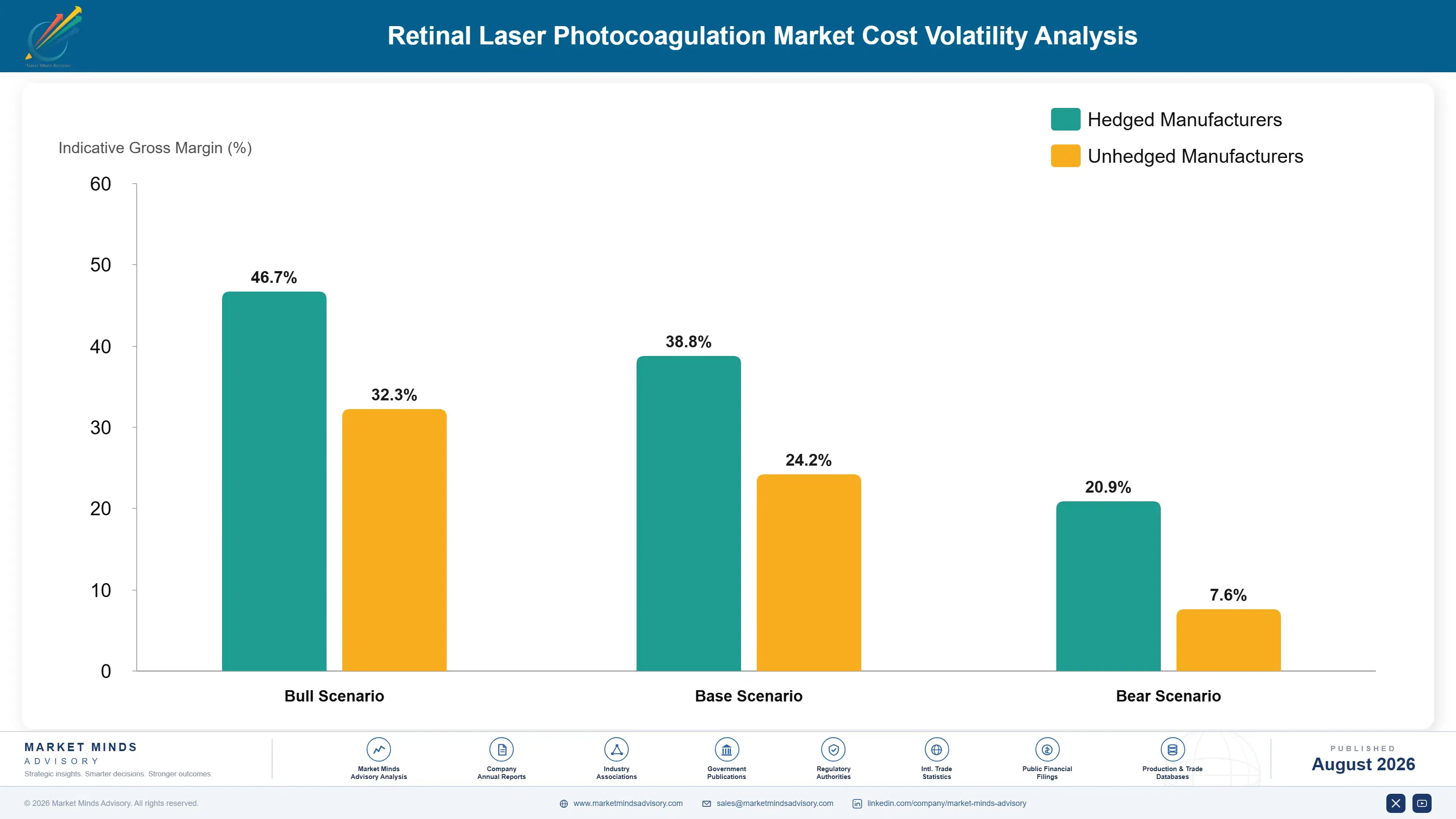
Laser Diode and Optical Component Cost Exposure

Laser diodes, precision optical assemblies, and fundus imaging sensors represent roughly 40 to 48% of system production cost, sourced primarily from specialized component suppliers concentrated across the United States, Japan, and Germany, where precision optics manufacturing capability remains limited relative to broader consumer electronics component supply chains serving less regulated end markets with lower quality certification thresholds.
The global semiconductor and laser diode shortage affecting 2021 through 2022 production cycles significantly delayed ophthalmic laser system manufacturing across the industry, compressing delivery timelines and raising component procurement cost, according to disclosures in IRIDEX's annual report covering that period. Manufacturers with diversified supplier relationships absorbed the disruption more effectively than those dependent on single-source diode contracts, pressuring margin unevenly across the competitive landscape and forcing several vendors to delay planned platform launches into subsequent quarters.

Manufacturers with component sourcing concentrated among a small number of specialized suppliers carry substantially more supply disruption exposure than those with diversified vendor relationships across multiple optical component categories. Smaller specialist manufacturers lacking sourcing diversification face a genuine competitive disadvantage against larger diversified vendors able to shift component sourcing toward whichever supplier currently offers the most favorable capacity position.
retinal-laser-photocoagulation-market-cost-volatility-analysis-1787298769196

Diversify Laser Diode Suppliers Across Multiple Regions

Manufacturers are qualifying laser diode and optical component suppliers across multiple countries rather than concentrating sourcing in a single region, reducing single-supplier disruption exposure while maintaining flexibility to shift procurement toward whichever supplier currently offers the strongest capacity position and delivery reliability for a given production run and its certification timeline, without compromising regulatory clearance documentation.

Build Strategic Component Inventory Buffers

Larger manufacturers are maintaining expanded safety-stock inventory of critical laser diodes and precision optical components specifically as insurance against future supply disruption, accepting higher near-term working capital cost in exchange for production continuity that just-in-time sourcing cannot guarantee during a genuine industry-wide shortage affecting multiple component categories at once across every affected manufacturing line.

Index Multi-Year Contracts to Component Price Benchmarks

Newer supply contracts increasingly include component price indexing clauses tied to published semiconductor and precision optics market benchmarks, passing a portion of input cost volatility through to buyers automatically rather than absorbing the full impact against fixed multi-year system pricing agreed before component markets shifted significantly against original cost assumptions and production budget forecasts.

Portfolio Architecture for Margin Defence

The portfolio splits across three tiers. Volume conventional laser hardware carries thin margin driven by component cost competition and price pressure from Asian manufacturers, premium navigated and micropulse platforms command considerably stronger margin on validated clinical outcome data and precision differentiation, and emerging integrated imaging-laser bundles command the strongest margin of all while volume remains comparatively small relative to the mature conventional hardware base tha
Volume and premium work pull manufacturers in different directions. Conventional hardware scale justifies continued production investment because it anchors practice relationships and funds regulatory clearance infrastructure, but margin expansion increasingly depends on winning higher-value navigated and micropulse platform contracts layered on top of that base relationship rather than unit volume alone across a growing practice roster spanning multiple geographies, specialty types, and fellowship training backgrounds.

High-value margin pools concentrate around navigated systems for high-volume academic retina centers and bundled imaging-laser platforms serving practices prioritizing integrated workflow efficiency enough to justify premium pricing above standard conventional hardware rates in most established ophthalmology markets with mature reimbursement infrastructure already in place.

Volume / Commodity-Adjacent Tier

Standard conventional continuous-wave laser systems priced on unit volume, competing mainly on component cost and basic clinical reliability across smaller independent practice contracts, hospital tenders, and group purchasing agreements each budget cycle.
Gross Margin: 22-32%

Premium / Certified Tier

Navigated and micropulse laser platforms requiring validated tissue-sparing outcome data commanding higher pricing across specialist high-volume retina practice categories, academic referral centers, and established fellowship training programmes with strong purchasing influence.
Gross Margin: 36-48%

Sustainability / Regulatory / Next-Generation Tier

Integrated imaging-laser bundled systems and portable emerging-market platforms, priced on documented workflow efficiency and access expansion rather than raw unit volume across long-term contracts, flexible financing arrangements, and multi-year service bundles.
Gross Margin: 34-46%
retinal-laser-photocoagulation-market-portfolio-architecture-1787298769700

High-value Sub-segments and Strategic Watch-out

Navigated Retinal Laser Systems

High value and high growth at 9.5%, the fastest category by a wide margin, as practices move navigated platforms from early adoption into mainstream capital budgets this year and its underlying survey data, expert interviews, and long-range forecasts through the full decade ahead across regions.
Gross Margin: 36-48%

Micropulse and Subthreshold Laser Systems

High value with strong growth at 8.1%, driven by expanding clinical guidance and payer reimbursement coverage supporting broader adoption of reduced-energy pulsed delivery protocols across macular treatment categories, academic centers, established fellowship programmes, and training partnerships spanning multiple countries, reimbursement systems, and specialty clinical societies.
Gross Margin: 36-48%

Conventional Continuous-Wave Photocoagulation Lasers

The volume core by unit count, growing near 4.0% as steady replacement demand sustains intake even as margin concentrates elsewhere across the broader portfolio, margin mix, and evolving reimbursement structure over the coming forecast decade and well beyond it across every major market tracked closely.
Gross Margin: 22-32%

Portable and Slit-Lamp Delivery Laser Systems

The strategic watch-out, growing slowest at roughly 5.0% and facing commoditisation as standard portable units become a bundled entry-level offer rather than a genuinely differentiated purchase decision across most emerging market accounts reviewed this year and the last full forecast cycle quite closely and carefully.
Gross Margin: 20-30%

Long Equipment Cycles Anchor Practice Relationships

Retinal laser system revenue behaves like an extended capital annuity tied to each practice's full equipment replacement cycle rather than a one-time purchase. Every new specialist hire, protocol update, and service contract renewal extends the manufacturer relationship, and switching laser platforms mid-cycle carries genuine retraining and workflow disruption risk that keeps renewal rates high across established practice relationships built over many years of clinical use.
Adoption depth varies considerably by practice type and case volume. Large academic and referral retina centers managing broad diabetic and macular disease caseloads maintain the deepest navigated and micropulse platform adoption given the clinical complexity and volume that justify premium equipment investment, while smaller independent practices are earlier in adopting comparable outcome-documented platforms and still weighing equipment cost against expected case volume. Specialty diabetic retinopathy screening programmes sit differently, adopting portable systems quickly given the high-throughput nature of their screening workflows.

A generational shift is underway in retina specialist purchasing influence. Younger specialists trained on navigated and micropulse platforms during fellowship favor manufacturers demonstrating quantified precision data over manufacturers relying purely on established reputation, gradually reshaping which platforms win new practice equipment mandates across the industry.
retinal-laser-photocoagulation-market-end-use-penetration-index-1787298770191

Where Laser Vendors Should Focus Next

These are among the four positions where our research anticipates prominent divergence between winners and laggards over the coming forecast period. Each is grounded in the demand model, the regulatory perimeter, and the announced capacity pipeline.
01 / PRECISION ANALYTICS INVESTMENT

Fund validated tissue-sparing outcome data before competitors close the gap

Vendors without production-scale validated tissue-sparing outcome data will lose ground to competitors that invested early, since retina specialists increasingly demand documented clinical evidence before shifting purchasing away from familiar conventional platforms. The window for differentiated positioning is narrowing as more vendors reach comparable navigated and micropulse maturity within the next several equipment replacement cycles. Waiting another budget cycle risks permanent competitive disadvantage against early movers who already hold demonstrable outcome evidence in front of prospective practice clients evaluating comparable vendor shortlists this cycle.
02 / FELLOWSHIP TRAINING PARTNERSHIPS

Build academic fellowship training relationships to shape future purchasing

Retina specialists tend to purchase equipment similar to what they trained on, making fellowship training partnerships a genuine long-term purchasing influence channel rather than simple goodwill spending. Building these relationships now secures brand familiarity among the next generation of independent practice purchasers before competitors establish comparable academic footholds. This matters most for vendors targeting long-term market share growth rather than immediate quarterly revenue, since fellowship influence compounds slowly over a specialist's entire career and reshapes purchasing decisions across several practice locations over time.
03 / EMERGING MARKET ACCESS STRATEGY

Expand portable system financing to capture first-time equipment demand

Emerging markets building ophthalmology infrastructure from a small existing base represent substantial first-time equipment demand that vendors offering only traditional capital purchase models cannot fully capture given constrained hospital procurement budgets. Expanding leasing and installment financing options now captures share before competitors establish comparable access programmes. Vendors that delay this investment risk losing first-mover advantage entirely to competitors already building distribution and financing relationships across these underserved markets, a gap that grows harder to close as local brand loyalty solidifies among early-adopting hospital systems.
04 / PORTFOLIO DIVERSIFICATION PLANNING

Diversify beyond macular indications as injection substitution continues

Vendors overly dependent on macular indication volume face continued erosion as anti-VEGF injection therapy expands its clinical dominance in wet AMD and diabetic macular edema treatment. Repositioning marketing and clinical evidence generation around panretinal and peripheral retina indications where injectable therapy offers no comparable alternative protects revenue against this decade-long treatment substitution trend. This matters most for vendors whose growth projections still assume stable macular segment volume rather than accounting for continued substitution pressure in coming years across most developed reimbursement markets.

Engagement Snapshot From the Field

A live engagement with an industry participant carrying material or product regulatory and market exposure ahead of a defining policy shift, showing how our research translates into a defensible multi-year portfolio strategy.
MARKET MINDS ADVISORY · CLIENT ENGAGEMENT SUMMARY
Retinal Laser Photocoagulation Producer Strategic Portfolio Review and Transition Roadmap 2026·Investment Scenario on Retinal Laser Photocoagulation Exposure Evaluation 2025-26
CLIENT PROFILE
A mid-size regional retina practice operating three clinic locations and a growing diabetic retinopathy screening programme engaged MMA while evaluating whether to modernize its aging conventional laser fleet with navigated or micropulse platforms ahead of an anticipated caseload increase. The client reported operating six conventional laser units averaging over ten years of service life (client-reported, unverified by MMA).
STRATEGIC CHALLENGE
The client's aging laser fleet faced rising service costs and limited compatibility with emerging tissue-sparing treatment protocols, yet full navigated system conversion across all three locations required capital investment beyond what near-term case volume alone could justify. Leadership needed a phased modernization plan before the next annual budget approval cycle.
MMA APPROACH
MMA benchmarked the client's case volume and payer mix against comparable regional retina practices, modeled three modernization scenarios spanning full conversion, phased conversion, and selective micropulse upgrade, and evaluated four vendor candidates against validated outcome data, training support, and disclosed pricing benchmarks drawn from comparable recent engagements across similar regional practices.
KEY FINDINGS
  1. Full immediate conversion across all three locations would require capital spending exceeding the practice's available annual equipment budget by roughly 45% overall.
  2. A phased conversion prioritizing the highest-volume location first matched the approach used by three comparable regional practices reviewed during this engagement closely.
  3. Two of four evaluated vendors offered fellowship-trained staff discounts and flexible financing options; the other two required full upfront cash payment entirely.
  4. Selective micropulse upgrades on existing compatible laser bases delivered roughly 70% of the clinical benefit at under 30% of full replacement cost.
CLIENT PROFILE
A mid-size regional retina practice operating three clinic locations and a growing diabetic retinopathy screening programme engaged MMA while evaluating whether to modernize its aging conventional laser fleet with navigated or micropulse platforms ahead of an anticipated caseload increase. The client reported operating six conventional laser units averaging over ten years of service life (client-reported, unverified by MMA).
STRATEGIC CHALLENGE
The client's aging laser fleet faced rising service costs and limited compatibility with emerging tissue-sparing treatment protocols, yet full navigated system conversion across all three locations required capital investment beyond what near-term case volume alone could justify. Leadership needed a phased modernization plan before the next annual budget approval cycle.
MMA APPROACH
MMA benchmarked the client's case volume and payer mix against comparable regional retina practices, modeled three modernization scenarios spanning full conversion, phased conversion, and selective micropulse upgrade, and evaluated four vendor candidates against validated outcome data, training support, and disclosed pricing benchmarks drawn from comparable recent engagements across similar regional practices.
KEY FINDINGS
  1. Full immediate conversion across all three locations would require capital spending exceeding the practice's available annual equipment budget by roughly 45% overall.
  2. A phased conversion prioritizing the highest-volume location first matched the approach used by three comparable regional practices reviewed during this engagement closely.
  3. Two of four evaluated vendors offered fellowship-trained staff discounts and flexible financing options; the other two required full upfront cash payment entirely.
  4. Selective micropulse upgrades on existing compatible laser bases delivered roughly 70% of the clinical benefit at under 30% of full replacement cost.
RECOMMENDED STRATEGY
Phase 1: Phase 1 (Months 1-4): Upgrade existing compatible laser units with micropulse capability at the highest-volume clinic location first this year. Phase 2: Phase 2 (Months 5-14): Replace the oldest conventional units at the second location with a financed navigated laser platform this cycle. Phase 3: Phase 3 (Months 15-24): Evaluate case volume growth achieved and plan final location conversion based on documented clinical outcome data.
OUTCOME
The client adopted the phased modernization plan and reported a 32% reduction in projected capital spending against full immediate conversion, while achieving measurable tissue-sparing treatment capability at its highest-volume location within the target window and without disrupting existing patient care or referral relationships (client-reported, unverified by MMA).

Frequently Asked Questions

Foundational context covering the market sizes, CAGR, scope, country, region and competition that inform every finding below. This section is provided to cover basics and most often pre-purchase conversations, answered from the MMA Primary Research Dataset.

What is the current size of the Retinal Laser Photocoagulation Market?

The global retinal laser photocoagulation market is valued at USD 1.35 billion in 2025, covering conventional, pattern scanning, micropulse, navigated, and portable laser system categories worldwide.

How large will the Retinal Laser Photocoagulation Market be by 2036?

The market is projected to reach USD 2.62 billion by 2036, roughly 1.82 times its 2026 value of USD 1.43 billion, driven by rising diabetes prevalence and navigated system adoption.

What is the CAGR for the Retinal Laser Photocoagulation Market 2026 to 2036?

The base case CAGR is 6.2%, with a bull case of 7.4% if navigated laser adoption accelerates faster than expected, and a bear case of 5.0% under continued injection substitution.

Which segment is growing fastest?

Navigated Retinal Laser Systems lead at a 9.5% CAGR, roughly 1.53 times the overall market rate, as high-volume retina practices move platforms into mainstream capital budgets.

Who are the major companies in the Retinal Laser Photocoagulation Market?

IRIDEX, Topcon, Carl Zeiss Meditec, Alcon, and Quantel Medical lead the market, together holding roughly 52% of ophthalmic laser system revenue generated worldwide, per company filings.

Which country is growing fastest?

India leads at a 9.6% CAGR as expanding diabetic retinopathy screening infrastructure and rising eye care network access both compound across its largest urban and rural healthcare markets.

Report Segmentation Architecture

The full report scope spans multiple orthogonal segmentation dimensions, with cross-tabulated demand data provided for each dimension pair. Coverage extends further to regional breakdowns, trend trajectories, and the competitive detail needed to support segment-level decision-making.

By Laser Platform Type

  • Conventional Continuous-Wave Photocoagulation Lasers
  • Pattern Scanning Laser Systems
  • Micropulse and Subthreshold Laser Systems
  • Navigated Retinal Laser Systems
  • Portable and Slit-Lamp Delivery Laser Systems
  • Laser Consumables and Service Contracts

By End-Use Setting

  • Academic and Referral Retina Centers
  • Independent Ophthalmology Practices
  • Hospital Ophthalmology Departments
  • Diabetic Retinopathy Screening Programmes
  • Ambulatory Surgical Centers

By Commercial Dimension

  • Direct Capital Purchase Contracts
  • Leasing and Installment Financing Agreements
  • Group Purchasing Organization Contracts
  • Service and Maintenance Bundle Agreements

By Region

  • North America
  • Western Europe
  • East Asia
  • South Asia and Pacific
  • Latin America
  • Middle East and Africa
  • Eastern Europe

Scope, Methodology, and Coverage

Every figure in this report is reproducible from documented input assumptions. The scope below maps the historical period, the forecast horizon, the segmentation dimensions, and the countries covered, alongside the underlying primary and qualitative methodology.
Historical Period
2020 to 2025
Forecast Period
2026 to 2036
Base Year
2025 (USD billions; MMA Primary Research Dataset, August 2026)
Market Definition
The retinal laser photocoagulation market covers laser systems and associated consumables used to treat diabetic retinopathy, retinal tears, retinal vein occlusion, and related peripheral retina conditions through targeted thermal tissue coagulation. It excludes anti-VEGF injectable pharmaceuticals, vitrectomy surgical systems, and diagnostic imaging equipment sold without an integrated laser delivery component.
Quantitative Units
USD billions (current prices); installed unit volume where applicable
Segmentation Dimensions
By Laser Platform Type; By End-Use Setting; By Commercial Dimension; By Region
Regions Covered
North America, Western Europe, East Asia, South Asia and Pacific, Latin America, Middle East and Africa, Eastern Europe
Countries Covered
USA, China, Germany, France, UK, Japan, South Korea, India, Australia, Canada, Brazil, Mexico, Saudi Arabia, UAE, South Africa, Nigeria, Turkey, Poland, Czech Republic, Romania, Italy, Spain, Sweden, Switzerland, Netherlands, Singapore, and additional markets relevant to this sector
Key Companies Profiled
IRIDEX Corporation, Topcon Corporation, Carl Zeiss Meditec AG, Alcon Vision LLC, Quantel Medical (Lumibird Group), Lumenis Be Ltd., Nidek Co., Ltd., OD-OS GmbH, Meridian AG, A.R.C. Laser GmbH, Appasamy Associates, Valon Lasers Oy, BVI Medical, MediWorks (Shanghai) Co., Ltd., Shanghai Conbon Optics Co., Ltd., Escalon Medical Corp., Keeler Ltd., Heine Optotechnik GmbH & Co. KG, Optos plc, LKC Technologies, Inc.
Quantitative Methodology
Primary survey, n=3,800 respondents, Q4 2025, six countries; demand-side model with trade association cross-validation
Qualitative Methodology
47 expert interviews, Q4 2025; applied to validate demand model assumptions, identify emerging dynamics, and assess competitive positioning
Report Format
PDF and XLSX data workbook (Word format preview document)
Publisher
Market Minds Advisory
Report Code
MMA-2026-MED-171
Published
August 2026
Contact
sales@marketmindsadvisory.com | www.marketmindsadvisory.com

Purchase the full Retinal Laser Photocoagulation Market Report (2026 to 2036).

The full report delivers granular sizing and forecasts across all six laser platform type segments and seven global regions through 2036. It profiles twenty companies across diversified device manufacturers and specialist laser entrants, benchmarking clinical outcome data, fellowship training reach, and financing capability in considerable detail. Analysts detail laser diode and optical component cost exposure, portfolio margin tiers, and demand architecture by practice type across major global markets and their evolving reimbursement environments. Buyers receive both the standalone report and full access to underlying data tables supporting every figure and forecast presented throughout.
Six-segment laser platform sizing and full forecasts
Seven-region global market share breakdown detail
Twenty-company detailed competitive profile benchmarking analysis
Laser diode and optical component cost exposure analysis
Portfolio margin tier benchmarking economics framework
Anonymised client engagement outcome case study

Built For The People Who Decide

From boardroom strategy to bench-side execution, this report is read cover-to-cover by leaders shaping the next decade of their industry, turning demand scenarios, market dynamics and valuation benchmarks into decisions.
CXOs/ Presidents/ VPs/ Managers
M&A and Corporate Development
Strategy Teams and R&D Heads
Procurement and Product Directors
Regulatory and Compliance Leaders
Investor Relations and Equity Analysts