Market Minds Advisory
Retail Colocation Market

Retail Colocation Market: Retail Colocation Market. Cabinet, Cage, and Interconnection Services for Small and Mid-Size Enterprises Through 2036

Enterprises retreating from hyperscale cloud cost overruns push retail colocation operators toward hybrid interconnection services as cabinet and cage leasing becomes the pragmatic middle ground between owned infrastructure and public.

Lead Analyst

Published

September 2026

Make Smarter Decisions with Customized Research Insights

Request a free sample report and evaluate market opportunities, growth trends, and competitive dynamics relevant to your business needs.

2025 MARKET VALUE$22.4BMarket Size 2025
2036 FORECAST VALUE$52.2BBase Case , 2026 to 2036
CAGR 2026 TO 20368.0 %Bull 9.2% / Bear 6.8%
INCREMENTAL OPPORTUNITY$28.0BNet 10- year value creation
EXPANSION MULTIPLE2.16x2036 value over 2026 base
Strategic Levers
M&A Pipeline
Regional Outlook
Country Rankings
Competitive Intelligence
Segmental Deep-dive
Call-Us : 91 93563 13602

Executive Snapshot and Market Trajectory.

Small and mid-size enterprises are shifting infrastructure spending toward retail colocation cabinets and cages as unpredictable hyperscale cloud costs push cost-conscious IT teams back toward a hybrid ownership model reflecting sustained enterprise investment across colocation capacity expansion programs as adoption continues expanding across small reflecting sustained enterprise investment.
Interconnection and cloud on-ramp services represent the fastest-growing category as colocation customers seek direct, low-latency connectivity to multiple public cloud providers without routing traffic over the public internet. Standard cabinet and cage leasing still accounts for the largest share of overall revenue given the broad small business customer base. North America and Western Europe account for the largest demand concentration, reflecting dense colocation facility networks and enterprise IT budget concentration reflecting sustained enterprise investment across.
Competition splits between large multi-site colocation operators with national and international facility networks and smaller regional operators serving local enterprise customers with personalized service relationships. Rising power availability constraints and evolving data sovereignty requirements both shape which operators can serve enterprise customers across multiple regulatory jurisdictions reflecting sustained enterprise investment across colocation capacity expansion programs as adoption continues expanding across small business,.
Market Definition
This report covers data center cabinet, cage, and suite leasing services along with interconnection and cross-connect offerings provided to small and mid-size enterprise customers within shared multi-tenant facilities. It excludes hyperscale wholesale colocation and single-tenant build-to-suit data center arrangements reflecting sustained.
Base Year Value
$22.4B in 2025 (MMA Primary Research Dataset, September 2026)
Forecast Period
2026 to 2036, eleven discrete annual values
CAGR
8.0% base case. Bull 9.2%. Bear 6.8%.
Fastest Growth Segment
Interconnection and Cloud On-Ramp Services: 12.5% CAGR
Fastest Growth Country
India: 11.0% CAGR
Fastest Growth Region
South Asia and Pacific: 10.5% CAGR
Largest Region
North America: 32% of 2025 global value
Market Leaders
Equinix Inc, Digital Realty Trust Inc, CyrusOne Inc, NTT Global Data Centers, Cyxtera Technologies Inc. Source: MMA Primary Research Dataset, July 2026.
Primary Survey
n=3,800 procurement and R&D decision-makers, Q4 2025, six countries
Methodology
Demand-side build-up, cross-validated against public data, 47 expert interviews

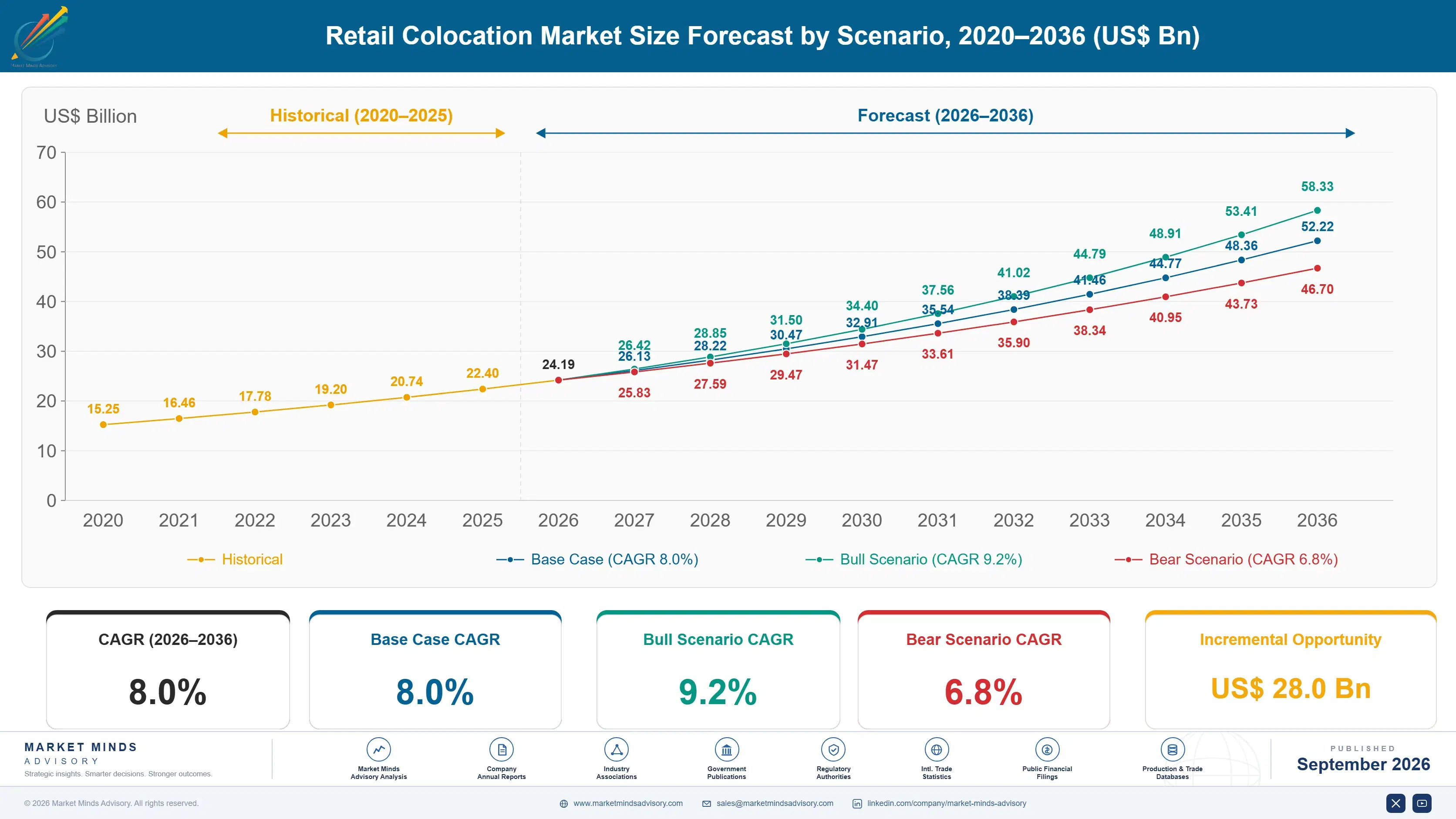
Retail Colocation Market Forecast Scenarios

retail-colocation-market-size-forecast-scenario-1789999563976
The 2020 to 2025 period saw steady growth as enterprises maintained hybrid infrastructure strategies through the pandemic, with colocation demand proving more resilient than initially expected given ongoing need for physical infrastructure hosting alongside expanding cloud adoption reflecting sustained enterprise investment across colocation capacity expansion programs as adoption continues expanding across small business, retail, and enterprise edge applications supporting.
MMA's base case assumes continued high-single-digit growth driven by three commercial mechanisms: expanding interconnection and cloud on-ramp services as enterprises pursue multi-cloud strategies requiring direct low-latency connectivity, growing repatriation of workloads from public cloud back to colocation facilities as cost predictability concerns intensify, and rising edge computing deployment requiring distributed colocation footprints closer to end users reflecting sustained enterprise investment across colocation capacity expansion programs as adoption continues expanding across small business, retail, and enterprise edge applications supporting consistent.
The bull case centers on faster-than-expected cloud cost repatriation as more enterprises reassess public cloud economics. The bear case centers on power availability constraints limiting new capacity development, with several major metropolitan markets already facing multi-year waits for grid connection approval reflecting sustained enterprise investment across colocation capacity expansion programs as adoption continues expanding across small business, retail, and enterprise edge applications.

Cloud Repatriation Fuels Renewed Colocation Demand

Retail colocation demand concentrates in standard cabinet and cage leasing today, though interconnection and cloud on-ramp services are the fastest-growing category as enterprises pursue multi-cloud connectivity. Large multi-site operators maintain the strongest enterprise relationships given broad facility network coverage across metropolitan markets reflecting sustained enterprise investment across colocation capacity expansion programs as adoption continues expanding across small business, retail, and enterprise edge applications.
MARKET CONCENTRATIONCR5 38%Fragmented across large multi-site operators and regional specialists reflecting.
AVERAGE SELLING PRICE$1,450 per kilowatt monthlyReflects power density, connectivity access, and facility location premiums.
TOP PRODUCING COUNTRY SHAREUnited States 28%Concentrated among established metropolitan colocation facility clusters reflecting sustained.
CAPACITY UTILISATION82% averageIndicates limited headroom before operators require new facility construction.
INTERCONNECTION REVENUE SHARE24% of total facility revenueReflects growing cross-connect and cloud on-ramp service monetization reflecting.
AVERAGE CONTRACT TERM3 to 5 yearsMatches typical enterprise colocation leasing and renewal planning cycles.
Operators increasingly bundle interconnection services with standard leasing, shifting revenue mix toward higher-margin cross-connect and cloud on-ramp fees that scale with customer connectivity needs rather than pure space and power consumption alone. This mirrors a broader shift across data center services from commodity space toward value-added connectivity reflecting sustained enterprise investment across colocation capacity expansion programs as adoption continues expanding across small.
Enterprises weigh colocation cost predictability against public cloud flexibility, since colocation requires upfront capital commitment but offers more predictable long-term costs than variable cloud consumption billing. The operators succeeding most combine facility reliability with flexible interconnection options that ease hybrid cloud architecture adoption reflecting sustained enterprise investment across colocation capacity expansion programs as adoption continues expanding across small business, retail, and enterprise edge applications.
"Every enterprise IT team that got burned by an unpredictable cloud bill is now rediscovering why colocation existed in the first place, just with better connectivity options."
Director, Data Center Infrastructure and Colocation Services Practice · MMA Technology: Retail Data Center Colocation Services Practice · September 2026

Market Trends

Cloud Cost Repatriation Drives Renewed Colocation Facility Demand reflecting.

Enterprises facing unpredictable and rapidly escalating public cloud bills are increasingly repatriating steady-state workloads back to colocation facilities where they can achieve more predictable long-term infrastructure costs through owned or leased hardware. Several published enterprise case studies report meaningful cost savings after moving predictable, steady-utilization workloads from public cloud back to colocation environments, while keeping variable and burst workloads on public cloud platforms. This hybrid approach has become the dominant enterprise infrastructure strategy, replacing the cloud-first mandates common just a few years earlier across most mid-size enterprise IT organizations reflecting sustained enterprise investment across colocation capacity expansion programs.
Market Impact: Adds over 5,000 new cabinet customers.

Multi-Cloud Interconnection Demand Expands Cross-Connect Revenue reflecting sustained enterprise.

Enterprises pursuing multi-cloud strategies increasingly require direct, low-latency interconnection to multiple public cloud providers simultaneously from within colocation facilities, rather than routing traffic over the public internet with its inherent latency and reliability variability. This demand has made cloud on-ramp availability a primary facility selection criterion for enterprise customers, pushing colocation operators to expand their direct cloud connectivity partnerships considerably. Operators with the broadest cloud on-ramp availability report meaningfully higher interconnection revenue per customer than facilities offering limited direct cloud connectivity options reflecting sustained enterprise investment across colocation capacity expansion programs as adoption continues expanding across small business,.
Market Impact: Expands footprint across 50 new markets.

Market Opportunities and Growth Drivers

Small Business Digital Transformation Drives New Customer Acquisition reflecting.

Small and mid-size businesses continuing digital transformation initiatives increasingly require professional-grade infrastructure hosting beyond what on-premise server rooms can reliably provide, driving new customer acquisition for retail colocation operators serving this segment. These customers typically start with single-cabinet deployments before expanding as their infrastructure needs grow, creating a durable customer acquisition funnel for operators with strong small business sales capability. This driver has proven particularly durable across secondary metropolitan markets where on-premise infrastructure reliability concerns remain high relative to primary markets with more mature managed service alternatives reflecting sustained enterprise investment across colocation capacity expansion programs as adoption.
Market Impact: Delays new capacity by 3 years.

Edge Computing Deployment Requires Distributed Facility Footprints reflecting sustained.

Enterprises deploying edge computing applications requiring low-latency processing closer to end users increasingly lease colocation space across distributed secondary and tertiary metropolitan markets rather than concentrating entirely in primary data center hubs. This distributed deployment pattern favors colocation operators with broad geographic facility networks over single-location competitors, since enterprise customers increasingly prefer consolidated contracts across multiple locations. Operators with strong secondary market presence report accelerating edge-driven leasing demand as enterprises expand their distributed infrastructure footprint nationally reflecting sustained enterprise investment across colocation capacity expansion programs as adoption continues expanding across small business, retail, and enterprise edge applications supporting.
Market Impact: Adds costs to 35 percent deployments.

Market Restraints and Challenges

Power Availability Constraints Limit New Capacity Development reflecting sustained.

Grid power availability constraints across major metropolitan markets increasingly limit colocation operators' ability to develop new capacity fast enough to meet growing enterprise demand, with several major markets already facing multi-year waits for new grid connection approval from utility providers. The root cause is that data center power demand growth, driven partly by adjacent hyperscale and AI infrastructure development, has outpaced utility grid capacity expansion in many regions considerably. The commercial impact particularly constrains smaller operators lacking the capital and relationships needed to secure scarce power allocation early. Operators are mitigating by pursuing on-site power generation and battery.
Market Impact: Cuts infrastructure costs by 30 percent.

Data Sovereignty Requirements Complicate Multi-Region Enterprise Deployments reflecting sustained.

Expanding data sovereignty and residency regulation across major markets increasingly requires enterprises to host certain data categories within specific national or regional boundaries, complicating colocation deployment strategies for enterprises operating across multiple regulatory jurisdictions simultaneously. The root cause is that different countries have adopted varying and sometimes conflicting data localization requirements, creating compliance complexity that smaller operators without multi-region facility networks cannot address alone. The commercial impact adds compliance cost and operational complexity for enterprise customers. Operators are mitigating by expanding facility networks across additional jurisdictions to offer compliant hosting options reflecting sustained enterprise investment across colocation capacity.
Market Impact: Increases interconnection revenue by 40 percent.
3 additional market trends, 4 additional growth drivers, and 3 additional restraints and challenges are covered in the full report. Contact sales@marketmindsadvisory.com to access the complete intelligence.

Segment CAGR and Growth Architecture

Retail colocation spans standard cabinet leasing, private cage suites, and interconnection services, each serving distinct enterprise infrastructure needs. Interconnection and cloud on-ramp services now grow fastest as multi-cloud adoption expands broadly reflecting sustained enterprise investment across colocation capacity expansion programs as adoption continues expanding across small business, retail, and enterprise edge applications supporting consistent leasing.
retail-colocation-market-market-share-analysis-1789999564546

Interconnection and Cloud On-Ramp Services

Interconnection and cloud on-ramp services lead all retail colocation categories at a 12.5 percent CAGR, roughly 1.56 times the overall market rate, as enterprises pursuing multi-cloud strategies increasingly require direct, low-latency connectivity to multiple public cloud providers simultaneously from within colocation facilities rather than routing traffic over the public internet with its inherent latency and reliability variability. This demand has made cloud on-ramp availability a primary facility selection criterion for enterprise customers, pushing colocation operators to expand their direct cloud connectivity partnerships considerably across facility networks. Operators with the broadest cloud on-ramp availability report meaningfully higher interconnection revenue per customer than facilities offering limited direct cloud connectivity options, reinforcing continued investment in this category reflecting sustained enterprise investment.
CAGR 12.5%

Private Cage and Suite Leasing

Private cage and suite leasing grows at 9.5 percent annually as mid-size enterprises with expanding infrastructure needs graduate from single cabinet deployments to dedicated private space offering enhanced security and customization capability beyond what shared cabinet arrangements provide. This segment particularly appeals to enterprises with strict compliance requirements around physical access control and data segregation from other tenants sharing the same facility. Operators report meaningfully higher renewal rates for cage customers compared with standard cabinet customers, reflecting the higher switching costs associated with more customized infrastructure deployments once established within a specific facility reflecting sustained enterprise investment across colocation capacity expansion programs as adoption continues expanding across small business, retail, and enterprise edge applications supporting consistent leasing growth.
CAGR 9.5%
Full segment breakdown across 7 segments available in the complete report.

Regional Architecture and Country Demand Map

North America leads given its concentration of established colocation facility networks and enterprise IT budget scale, while Western Europe follows closely on mature data center infrastructure and connectivity density reflecting sustained enterprise investment across colocation capacity expansion programs as adoption continues expanding across small reflecting sustained enterprise.

North America

The United States anchors this region through its concentration of established colocation facility networks in major metropolitan markets including Northern Virginia, Dallas, and Chicago, alongside deep enterprise IT budget scale supporting sustained leasing demand. Canada contributes additional demand tied to its own enterprise infrastructure needs. Strong small business digital transformation investment keeps demand resilient, supporting steady leasing volume even as power availability constraints limit new capacity in some markets reflecting sustained enterprise investment across colocation capacity expansion programs as adoption continues expanding across small business, retail, and enterprise edge applications supporting consistent leasing growth across colocation operator facility networks reinforcing demand visibility for operators planning capacity investment ahead reflecting sustained enterprise.
Share: 32% | CAGR: 8.0% (2026 to 2036)

Western Europe

The United Kingdom and Germany anchor regional demand through their concentration of mature colocation facility networks serving enterprise customers across London and Frankfurt data center hubs. France contributes additional demand tied to its own enterprise digital transformation programs. European growth trails other regions somewhat given stricter data sovereignty requirements that add compliance complexity and slow multi-region deployment decisions relative to less regulated markets reflecting sustained enterprise investment across colocation capacity expansion programs as adoption continues expanding across small business, retail, and enterprise edge applications supporting consistent leasing growth across colocation operator facility networks reinforcing demand visibility for operators planning capacity investment ahead reflecting sustained enterprise investment across colocation capacity expansion programs.
Share: 24% | CAGR: 6.5% (2026 to 2036)
Regional intelligence for 5 additional markets available in the complete report: East Asia, South Asia and Pacific, Latin America, Middle East and Africa, Eastern Europe. Contact sales@marketmindsadvisory.com.
retail-colocation-market-country-cagr-analysis-1789999565071

Where Operators Can Capture Additional Value reflecting.

Operators capture disproportionate value by shifting mix toward interconnection services and managed infrastructure support that command premium pricing beyond standard cabinet and cage leasing alone reflecting sustained enterprise investment across colocation capacity expansion programs as adoption continues expanding across small business, retail, and enterprise edge applications supporting consistent leasing growth across reflecting sustained enterprise investment across.

Expand Cloud On-Ramp Partnerships Across Major Cloud Providers reflecting.

Operators expanding direct cloud on-ramp partnerships across the major public cloud providers capture an estimated 28 percent higher average revenue per customer than operators with limited connectivity options, since enterprise customers pay meaningfully more for facilities offering comprehensive multi-cloud connectivity. This partnership expansion requires meaningful capital and relationship investment but positions operators favorably as interconnection demand continues growing faster than standard leasing revenue reflecting sustained enterprise investment across colocation capacity expansion programs as adoption continues expanding across small business, retail, and enterprise edge applications supporting consistent leasing growth across colocation operator facility.
Market Impact: Adds approximately 28 percent higher revenue per customer reflecting.

Offer Managed Infrastructure Support Beyond Standard Leasing reflecting sustained.

Operators offering managed infrastructure support services including remote hands, monitoring, and maintenance are generating additional revenue worth over 350 million dollars combined annually, since small business customers without dedicated on-site technical staff value operator-provided technical support considerably. This service layer generates meaningfully higher margin than pure space leasing and creates durable customer relationships that reduce churn considerably reflecting sustained enterprise investment across colocation capacity expansion programs as adoption continues expanding across small business, retail, and enterprise edge applications supporting consistent leasing growth across colocation operator facility networks reinforcing demand visibility.
Market Impact: Generated over 350 million dollars in managed services.

Develop Edge Facility Networks For Distributed Enterprise Deployments reflecting.

Operators developing distributed edge facility networks across secondary and tertiary metropolitan markets are winning multi-location enterprise contracts expanding at roughly 14 percent annually, since customers increasingly prefer consolidated contracts across a single operator's national facility network rather than managing multiple regional vendor relationships separately. This network breadth creates meaningful competitive differentiation against single-location regional operators reflecting sustained enterprise investment across colocation capacity expansion programs as adoption continues expanding across small business, retail, and enterprise edge applications supporting consistent leasing growth across colocation operator facility networks reinforcing demand visibility for operators.
Market Impact: Expanding roughly 14 percent annually industry-wide reflecting sustained.

Who Controls the Margin Pool

Market concentration sits at a moderate CR5 of 38 percent, reflecting a field fragmented across large multi-site operators and numerous regional specialists serving local enterprise customers. Equinix leads through its extensive global facility network and comprehensive cloud on-ramp partnerships, holding a meaningful gap over the nearest challenger reflecting sustained enterprise investment across colocation capacity expansion programs as adoption continues expanding.
Current competitive activity centers on interconnection service expansion as operators race to serve enterprises pursuing multi-cloud connectivity strategies. Large multi-site operators compete primarily on facility network breadth and cloud partnership comprehensiveness, while regional specialists compete on personalized service and local market relationships reflecting sustained enterprise investment across colocation capacity expansion programs as adoption continues expanding across small business, retail, and enterprise edge.

Emerging pressure comes from regional operators expanding into adjacent secondary metropolitan markets to capture edge computing demand that large operators have not yet prioritized, pressuring incumbents on geographic coverage. Ranking shifts are most likely if a major cloud provider deepens exclusive partnership arrangements with a specific colocation operator, shifting enterprise customer preference toward that vendor's facilities reflecting sustained enterprise investment across colocation capacity expansion programs as adoption continues.
retail-colocation-market-company-positioning-matrix-1789999565597

Competitive Moat and Risk Dimensions

EQUINIX INC

Moat: Global Interconnection Network Scale.

Equinix operates the largest global colocation facility network with comprehensive interconnection capability, letting enterprise customers access hundreds of network and cloud provider connections within a single facility relationship. This network density creates a compounding advantage since each additional customer and connectivity partner increases the platform's value to every other tenant reflecting sustained.
EQUINIX INC

Risk: Premium Pricing Limits.

Equinix's premium pricing positions it primarily toward enterprise customers with substantial interconnection needs, limiting its competitiveness for price-sensitive small business accounts where regional operators increasingly compete effectively on cost. Expanding downmarket without diluting its premium brand positioning remains an ongoing strategic challenge reflecting sustained enterprise investment across colocation capacity expansion.
DIGITAL REALTY TRUST INC

Moat: Real Estate Portfolio Scale.

Digital Realty Trust uses its extensive real estate portfolio and development expertise to secure prime data center sites in power-constrained markets ahead of competitors lacking comparable real estate acquisition capability. Its real estate investment trust structure also provides access to capital markets that smaller private operators cannot easily match reflecting sustained.
DIGITAL REALTY TRUST INC

Risk: Less Interconnection Density.

Digital Realty Trust has historically emphasized wholesale and larger-scale leasing relative to Equinix's interconnection-dense retail colocation focus, requiring continued investment to close this gap as interconnection services become an increasingly important revenue and differentiation driver across the retail segment specifically reflecting sustained enterprise investment across colocation capacity expansion.

Players Tracked

Prominent Players

Equinix Inc
Digital Realty Trust Inc
CyrusOne Inc
NTT Global Data Centers
Cyxtera Technologies Inc

Other Key Players

Iron Mountain Incorporated
Coresite Realty Corporation
Flexential Corp
TierPoint LLC
Cologix Inc
vXchnge Holdings Inc
365 Data Centers LLC
Colovore LLC
Databank Holdings Ltd
Evocative Data Centers
Prime Data Centers LLC
STACK Infrastructure Inc
China Telecommunications Corporation
GDS Holdings Limited
ST Telemedia Global Data Centres

Recent Developments

MARCH 2026

Equinix Inc: Capacity Expansion

Equinix announced an organic capacity expansion across several major metropolitan markets to address growing enterprise demand for interconnection and cloud on-ramp services, adding new facility space and expanding cloud provider partnership availability across its network reflecting sustained enterprise investment across colocation capacity expansion programs reflecting sustained enterprise.
Signal: Signals large operators scaling ahead of expected multi-cloud connectivity demand growth reflecting sustained enterprise reflecting sustained enterprise.
SEPTEMBER 2025

Flexential Corp: Strategic Partnership

Flexential entered a partnership agreement with a major public cloud provider to expand direct on-ramp availability across its regional facility network, strengthening its competitive position against larger operators in secondary metropolitan markets reflecting sustained enterprise investment across colocation capacity expansion programs as adoption reflecting sustained enterprise investment.
Signal: Signals regional operators securing cloud partnerships to compete with larger national operators reflecting sustained reflecting sustained enterprise.
JANUARY 2026

CyrusOne Inc: Acquisition

CyrusOne acquired a smaller regional colocation operator to expand its facility network into additional secondary metropolitan markets, strengthening its geographic coverage for enterprise customers seeking multi-location contract consolidation reflecting sustained enterprise investment across colocation capacity expansion programs as adoption continues expanding across small reflecting sustained enterprise investment.
Signal: Signals operators consolidating regional facility networks to compete on geographic coverage reflecting sustained enterprise reflecting sustained enterprise.

Power And Real Estate Cost Exposure.

Electricity costs and real estate acquisition or lease expenses represent the largest cost inputs for retail colocation operators, running an estimated 45 to 50 percent of total operating cost, sourced predominantly from regional utility providers and commercial real estate markets. Cooling infrastructure and network equipment add a smaller but meaningful additional share reflecting sustained enterprise investment across colocation capacity expansion.
Electricity pricing showed meaningful volatility during 2022 as broader energy market disruption affected industrial power costs across major markets, according to company annual report disclosures from major colocation operators. Several operators reported margin compression as power costs rose faster than they could pass through to customers under existing fixed-price lease agreements reflecting sustained enterprise investment across colocation capacity expansion programs as adoption continues expanding across small business, retail, and.

Smaller operators face a meaningful competitive disadvantage since they lack the negotiating scale to secure favorable long-term power purchase agreements, unlike Equinix and Digital Realty Trust which negotiate dedicated capacity reservations at scale. This exposure varies by geography, with operators in regions with deregulated energy markets facing greater price volatility than those in regulated utility territories reflecting sustained enterprise investment across colocation capacity expansion programs as.
retail-colocation-market-cost-volatility-analysis-1789999565794

Secure Long-Term Power Purchase Agreements Early reflecting sustained.

Leading operators increasingly negotiate long-term power purchase agreements with utility providers or renewable energy developers, locking in predictable pricing that shields margin from spot market volatility. This requires strong balance sheet capacity and early market entry but provides meaningful cost stability for long-term customer contract planning across facility networks reflecting sustained enterprise investment across colocation capacity.

Improve Cooling Efficiency To Reduce Power Consumption reflecting.

Operators are increasingly investing in advanced cooling technology including liquid cooling and hot aisle containment to reduce overall facility power consumption per unit of computing capacity delivered. This efficiency investment requires meaningful upfront capital but provides durable cost advantage as power costs continue representing a growing share of total operating expense reflecting sustained enterprise investment across.

Portfolio Architecture for Margin Defence

Portfolio economics split between commodity-adjacent standard cabinet leasing carrying moderate margins and premium interconnection or private cage services commanding substantially higher gross margins tied to connectivity value. Volume plays chase cabinet count while premium plays extract value through cross-connect and cloud on-ramp fees layered atop base leasing reflecting sustained enterprise investment across colocation capacity expansion programs as adoption continues expanding across small.
The tension between chasing cabinet volume and defending premium interconnection positioning defines strategic choices across the operator landscape. Operators pursuing mainstream small business accounts must accept moderate unit margins in exchange for customer scale, while interconnection specialists sacrifice volume for durable premium per-connection economics tied to network density reflecting sustained enterprise investment across colocation capacity expansion programs as adoption continues expanding across small.

High-value margin pools concentrate in cross-connect fees, cloud on-ramp services, and managed infrastructure support rather than in standard cabinet leasing itself, reinforcing why operators increasingly treat space and power as a platform for higher-margin connectivity value-add that compounds across the multi-year customer relationship reflecting sustained enterprise investment across colocation capacity expansion programs as adoption continues expanding across small business, retail, and.

Standard Cabinet Leasing

Mass-market single-cabinet leasing sold to small businesses at accessible price points, prioritizing customer count volume over per-cabinet margin capture reflecting sustained enterprise investment across colocation capacity expansion programs as adoption.
Gross Margin: 35-43%

Private Cage And Suite Leasing

Dedicated private space offering enhanced security and customization for mid-size enterprises, carrying durable premium pricing tied to configuration exclusivity reflecting sustained enterprise investment across colocation capacity expansion programs as adoption.
Gross Margin: 45-53%

Interconnection And Cloud On-Ramp Services

Cross-connect fees and direct cloud provider connectivity representing the fastest-growing and highest margin portion of operator revenue mix today reflecting sustained enterprise investment across colocation capacity expansion reflecting sustained enterprise.
Gross Margin: 60-70%
retail-colocation-market-portfolio-architecture-1789999566293

High-value Sub-segments and Strategic Watch-out

Multi-Cloud Interconnection Services

Small today but expanding rapidly as enterprises pursue multi-cloud strategies requiring direct connectivity, generating high-margin recurring revenue tied to connection count and bandwidth usage reflecting sustained enterprise investment across colocation capacity expansion programs as adoption continues expanding across small business, retail, and enterprise edge reflecting sustained.
Gross Margin: 62-72%

Managed Infrastructure Support Services

A substantial and steadily expanding segment as small business customers value operator-provided technical support, generating durable recurring revenue tied to ongoing service subscription renewal reflecting sustained enterprise investment across colocation capacity expansion programs as adoption continues expanding across small business, retail, and enterprise edge reflecting sustained.
Gross Margin: 48-58%

Standard Cabinet Leasing

The largest volume segment today, anchored by broad small business adoption, though margin per cabinet remains comparatively moderate relative to interconnection and cage segments across the wider portfolio reflecting sustained enterprise investment across colocation capacity expansion programs as adoption continues expanding across small business, reflecting sustained.
Gross Margin: 35-43%

Legacy Single-Region Facility Contracts

A strategic watch-out segment given accelerating enterprise preference for multi-location contract consolidation. Operators without broad facility networks must expand geographically to remain competitive reflecting sustained enterprise investment across colocation capacity expansion programs as adoption continues expanding across small business, retail, and enterprise edge applications reflecting sustained.
Gross Margin: 30-38%

Recurring Interconnection Revenue Growth reflecting.

Colocation naturally produces annuity economics through multi-year lease renewals, but operators increasingly layer interconnection and managed service fees on top to generate revenue growth beyond flat space and power billing alone, a strategy that mirrors expansion revenue models common across broader enterprise infrastructure services reflecting sustained enterprise investment across colocation capacity expansion programs as adoption continues expanding across small business,.
Adoption stickiness varies considerably by end-use vertical. Enterprises with extensive interconnection relationships show the deepest stickiness once their network architecture depends on a specific facility's connectivity network, since relocating requires rebuilding numerous cross-connects and cloud on-ramp relationships. Small business cabinet customers show shallower stickiness, occasionally switching operators based on price when contracts renew reflecting sustained enterprise investment across colocation capacity expansion programs as adoption continues expanding across small.

Generational buyer shifts are also underway. Younger IT decision makers show markedly stronger comfort with hybrid multi-cloud architectures than older cohorts, who historically favored either fully on-premise or fully cloud-based approaches. Procurement decision authority is simultaneously shifting from pure IT infrastructure teams toward broader finance and operations stakeholders evaluating total cost of ownership, changing how operators must position their value proposition reflecting sustained enterprise investment across colocation capacity expansion.
retail-colocation-market-end-use-penetration-index-1789999566785

Where MMA Sees The Opportunity reflecting.

These are among the four positions where our research anticipates prominent divergence between winners and laggards over the coming forecast period. Each is grounded in the demand model, the regulatory perimeter, and the announced capacity pipeline.
01 / INTERCONNECTION PARTNERSHIP EXPANSION.

Expand Cloud On-Ramp Partnerships Ahead Of Multi-Cloud Growth reflecting sustained.

Enterprises pursuing multi-cloud strategies increasingly select colocation facilities based on cloud on-ramp availability, making direct connectivity partnerships a primary competitive differentiator rather than a secondary consideration. Operators that delay expanding cloud partnerships risk losing enterprise accounts to competitors already offering comprehensive multi-cloud connectivity within their facilities. MMA views interconnection partnership expansion as the single highest priority investment for operators over the next three years given category growth reflecting sustained enterprise investment across colocation capacity expansion programs as adoption continues expanding across small business, retail, and enterprise.
02 / CLOUD REPATRIATION SALES.

Target Cloud Repatriation Customers With Cost Predictability Messaging reflecting sustained.

Enterprises facing unpredictable public cloud bills are increasingly repatriating steady-state workloads to colocation facilities where they achieve more predictable long-term infrastructure costs, creating a meaningful sales opportunity for operators positioning colocation specifically against cloud cost unpredictability. Operators that build dedicated sales messaging around cost predictability will capture disproportionate share of this growing repatriation trend. MMA views this positioning as more effective than generic infrastructure hosting marketing for capturing enterprise interest specifically reflecting sustained enterprise investment across colocation capacity expansion programs as adoption continues expanding across small business,.
03 / POWER CAPACITY SECURING STRATEGY.

Secure Power Capacity Early Ahead Of Grid Connection Delays.

Grid power availability constraints across major metropolitan markets increasingly limit new capacity development, with several markets already facing multi-year waits for grid connection approval from utility providers. Operators that secure power capacity commitments early, potentially including on-site generation and battery storage investment, will maintain growth capability while competitors face capacity constraints limiting their expansion. MMA views early power capacity securing as more strategically important than incremental facility amenity improvements for operators planning expansion reflecting sustained enterprise investment across colocation capacity expansion programs as adoption continues expanding across.
04 / EDGE NETWORK GEOGRAPHIC EXPANSION.

Expand Into Secondary Markets To Capture Edge Computing Demand reflecting.

Enterprises deploying edge computing applications increasingly lease colocation space across distributed secondary and tertiary metropolitan markets rather than concentrating entirely in primary data center hubs, favoring operators with broad geographic facility networks over single-location competitors. Operators that expand into secondary markets ahead of competitors will capture disproportionate share of this distributed deployment trend as enterprises consolidate contracts across single-operator networks. MMA views geographic expansion as more valuable than deepening presence in already saturated primary markets reflecting sustained enterprise investment across colocation capacity expansion programs as adoption continues expanding.

Engagement Snapshot From the Field

A live engagement with an industry participant carrying material or product regulatory and market exposure ahead of a defining policy shift, showing how our research translates into a defensible multi-year portfolio strategy.
MARKET MINDS ADVISORY · CLIENT ENGAGEMENT SUMMARY
Retail Colocation Producer Strategic Portfolio Review and Transition Roadmap 2026·Investment Scenario on Retail Colocation Exposure Evaluation 2025-26
CLIENT PROFILE
The client is a mid-size financial services firm operating across several regional offices in the United States, evaluating whether to repatriate steady-state computing workloads from public cloud to colocation facilities following two years of rapidly escalating and unpredictable cloud infrastructure bills reflecting sustained enterprise investment across colocation capacity expansion programs as adoption continues expanding across.
STRATEGIC CHALLENGE
The client needed to determine which workloads could safely migrate to colocation without sacrificing the elasticity benefits of public cloud for genuinely variable workloads, while achieving meaningful cost predictability improvement reflecting sustained enterprise investment across colocation capacity expansion programs as adoption continues expanding across small business, retail, and enterprise edge.
MMA APPROACH
MMA combined its primary enterprise infrastructure survey data with expert interviews across colocation operators and cloud repatriation consultants to benchmark workload categorization approaches and cost outcomes across comparable financial services repatriation projects reflecting sustained enterprise investment across colocation capacity expansion programs as adoption continues expanding across small business, retail, and enterprise.
KEY FINDINGS
  1. Steady-state workloads with predictable utilization patterns showed the strongest cost savings potential when moved from public cloud to colocation infrastructure reflecting sustained.
  2. Interconnection availability to the client's remaining cloud services proved essential for maintaining hybrid architecture performance and reliability reflecting sustained enterprise investment across.
  3. Private cage leasing provided the security isolation required for the client's regulatory compliance obligations around customer financial data reflecting sustained enterprise investment.
  4. Migration timeline extended longer than initially planned due to the complexity of properly categorizing workloads by variability and compliance sensitivity reflecting sustained.
CLIENT PROFILE
The client is a mid-size financial services firm operating across several regional offices in the United States, evaluating whether to repatriate steady-state computing workloads from public cloud to colocation facilities following two years of rapidly escalating and unpredictable cloud infrastructure bills reflecting sustained enterprise investment across colocation capacity expansion programs as adoption continues expanding across.
STRATEGIC CHALLENGE
The client needed to determine which workloads could safely migrate to colocation without sacrificing the elasticity benefits of public cloud for genuinely variable workloads, while achieving meaningful cost predictability improvement reflecting sustained enterprise investment across colocation capacity expansion programs as adoption continues expanding across small business, retail, and enterprise edge.
MMA APPROACH
MMA combined its primary enterprise infrastructure survey data with expert interviews across colocation operators and cloud repatriation consultants to benchmark workload categorization approaches and cost outcomes across comparable financial services repatriation projects reflecting sustained enterprise investment across colocation capacity expansion programs as adoption continues expanding across small business, retail, and enterprise.
KEY FINDINGS
  1. Steady-state workloads with predictable utilization patterns showed the strongest cost savings potential when moved from public cloud to colocation infrastructure reflecting sustained.
  2. Interconnection availability to the client's remaining cloud services proved essential for maintaining hybrid architecture performance and reliability reflecting sustained enterprise investment across.
  3. Private cage leasing provided the security isolation required for the client's regulatory compliance obligations around customer financial data reflecting sustained enterprise investment.
  4. Migration timeline extended longer than initially planned due to the complexity of properly categorizing workloads by variability and compliance sensitivity reflecting sustained.
RECOMMENDED STRATEGY
Phase 1: Phase one: categorize workloads by utilization variability and regulatory compliance sensitivity to determine repatriation candidates reflecting sustained enterprise investment across. Phase 2: Phase two: migrate steady-state workloads to a private cage with strong interconnection to remaining cloud services reflecting sustained enterprise investment. Phase 3: Phase three: monitor cost and performance outcomes before evaluating additional workload migration in subsequent phases reflecting sustained enterprise investment across.
OUTCOME
The client migrated approximately 40 percent of its infrastructure workloads to a colocation facility, reporting a 32 percent reduction in overall infrastructure costs within two quarters (client-reported, unverified by MMA), and subsequently expanded its private cage capacity to support additional workload migration reflecting sustained enterprise investment across colocation capacity expansion programs.

Frequently Asked Questions

Foundational context covering the market sizes, CAGR, scope, country, region and competition that inform every finding below. This section is provided to cover basics and most often pre-purchase conversations, answered from the MMA Primary Research Dataset.

What is the current size of the Retail Colocation Market?

The global retail colocation market is valued at 22.4 billion dollars in 2025, the base year for this report's forecast period reflecting reflecting sustained enterprise investment.

How large will the Retail Colocation Market be by 2036?

MMA projects the market will reach approximately 52.22 billion dollars by 2036, driven by cloud repatriation trends and interconnection demand growth reflecting sustained enterprise investment.

What is the CAGR for the Retail Colocation Market 2026 to 2036?

The market is forecast to grow at a compound annual growth rate of 8.0 percent between 2026 and 2036 under MMA's base case scenario reflecting sustained.

Which segment is growing fastest?

Interconnection and cloud on-ramp services lead at a 12.5 percent CAGR, roughly 1.56 times the overall market rate, driven by multi-cloud adoption reflecting sustained enterprise.

Who are the major companies in the Retail Colocation Market?

Equinix, Digital Realty Trust, CyrusOne, NTT Global Data Centers, and Cyxtera Technologies hold leading positions across facility networks reflecting sustained enterprise investment across colocation reflecting sustained.

Which country is growing fastest?

India leads at an 11.0 percent CAGR, supported by its rapidly expanding small business and enterprise digital transformation programs reflecting sustained enterprise investment reflecting sustained enterprise.

Report Segmentation Architecture

The full report scope spans multiple orthogonal segmentation dimensions, with cross-tabulated demand data provided for each dimension pair. Coverage extends further to regional breakdowns, trend trajectories, and the competitive detail needed to support segment-level decision-making.

By Product Type

  • Standard Cabinet Leasing
  • Private Cage and Suite Leasing
  • Interconnection and Cloud On-Ramp Services
  • Managed Infrastructure Support
  • Edge Colocation Facilities
  • Cross-Connect Services

By End-Use Industry

  • Small and Mid-Size Business
  • Financial Services
  • Healthcare
  • Retail and E-Commerce
  • Media and Content Delivery
  • Professional Services

By Commercial Dimension

  • Direct Enterprise Contract
  • Managed Service Provider Channel
  • Systems Integrator Channel
  • Cloud Provider Partnership Referral

By Region

  • North America
  • Western Europe
  • East Asia
  • South Asia and Pacific
  • Latin America
  • Middle East and Africa
  • Eastern Europe

Scope, Methodology, and Coverage

Every figure in this report is reproducible from documented input assumptions. The scope below maps the historical period, the forecast horizon, the segmentation dimensions, and the countries covered, alongside the underlying primary and qualitative methodology.
Historical Period
2020 to 2025
Forecast Period
2026 to 2036
Base Year
2025 (USD billions; MMA Primary Research Dataset, September 2026)
Market Definition
This report covers data center cabinet, cage, and suite leasing services along with interconnection and cross-connect offerings provided to small and mid-size enterprise customers within shared multi-tenant facilities. It excludes hyperscale wholesale colocation and single-tenant build-to-suit data center arrangements reflecting sustained.
Quantitative Units
USD billions, leased kilowatt capacity where cited
Segmentation Dimensions
Product Type, End-Use Industry, Commercial Dimension, Region
Regions Covered
North America, Western Europe, East Asia, South Asia and Pacific, Latin America, Middle East and Africa, Eastern Europe
Countries Covered
United States, United Kingdom, Germany, China, Japan, India, Brazil, Mexico, and 30 additional countries
Key Companies Profiled
20
Quantitative Methodology
Primary survey, n=3,800 respondents, Q4 2025, six countries; demand-side model with trade association cross-validation
Qualitative Methodology
47 expert interviews, Q4 2025; applied to validate demand model assumptions, identify emerging dynamics, and assess competitive positioning
Report Format
PDF and XLSX data workbook (Word format preview document)
Publisher
Market Minds Advisory
Report Code
MMA-2026-TEC-583
Published
September 2026
Contact
sales@marketmindsadvisory.com | www.marketmindsadvisory.com

Purchase the full Retail Colocation Market Report (2026 to 2036).

The full report provides comprehensive coverage of the global retail colocation market across all segments, regions, and competitive dynamics outlined in this summary. It includes detailed operator profiles, pricing benchmarks, and quantified segment-level forecasts through 2036. These findings draw on MMA's primary survey of 3,800 respondents and 47 expert interviews conducted in the fourth quarter of 2025. Subscribers receive quarterly data updates tracking power cost trends and competitive positioning shifts as the market evolves. Regional appendices break out country-level detail across thirty nine markets covered in this study.
Segment-level revenue forecasts through 2036 reflecting sustained.
Twenty operator competitive profiles and benchmarking reflecting.
Country-level market sizing across 39 countries reflecting.
Quarterly data updates through subscription access reflecting.
Primary survey data across six countries reflecting.
Expert interview transcripts and analyst commentary reflecting.

Built For The People Who Decide

From boardroom strategy to bench-side execution, this report is read cover-to-cover by leaders shaping the next decade of their industry, turning demand scenarios, market dynamics and valuation benchmarks into decisions.
CXOs/ Presidents/ VPs/ Managers
M&A and Corporate Development
Strategy Teams and R&D Heads
Procurement and Product Directors
Regulatory and Compliance Leaders
Investor Relations and Equity Analysts