Market Minds Advisory
Resveratrol Market

Resveratrol Market: A Category Held Up by Belief Rather Than by Evidence

Scientific standing has retreated for fifteen years while commercial demand kept on rising, which is a divergence worth understanding properly before anybody builds a supply position around this particular molecule.

Lead Analyst

Lisa Gevelber

Published

September 2026

Make Smarter Decisions with Customized Research Insights

Request a free sample report and evaluate market opportunities, growth trends, and competitive dynamics relevant to your business needs.

2025 MARKET VALUE$1.2BMarket Size 2025
2036 FORECAST VALUE$3.4BBase Case , 2026 to 2036
CAGR 2026 TO 20369.6 %Bull 10.8% / Bear 8.4%
INCREMENTAL OPPORTUNITY$2.0BNet 10- year value creation
EXPANSION MULTIPLE2.50x2036 value over 2026 base
Strategic Levers
M&A Pipeline
Regional Outlook
Country Rankings
Competitive Intelligence
Segmental Deep-dive
Call-Us : 91 93563 13602

Executive Snapshot and Market Trajectory

Resveratrol's scientific standing peaked around fifteen years ago and has retreated since, with roughly 38% of published human studies reporting their primary endpoint met. Commercial demand rose steadily across the same period, which is an unusual thing for an ingredient to do. Category adjacency rather than persuasion is the explanation.
What saved it commercially was repositioning rather than evidence. Around 64% of products now sell resveratrol alongside another longevity ingredient rather than on its own claims, which kept it on shelf at the cost of headline status. Micronised and solubilised grades grow fastest at 14.4%, half again the market rate of 9.6%, because absorption became the argument once efficacy stopped being one. Consumers understand absorption more readily than mechanism.
Supply is narrow and getting narrower rather than broader. Around 79% of commercial material comes from Japanese knotweed extracted in China, where environmental enforcement periodically restricts processing operations without warning. Cosmetic use takes roughly 23% of category value and rests on firmer technical ground than oral use does, since a topical application never has to survive first-pass metabolism at all. Fermentation offers a defined alternative at a narrowing premium. Cost premiums narrow yearly.
Market Definition
Resveratrol supplied as an ingredient and incorporated into finished dietary supplement, functional food, beverage and cosmetic products worldwide, covering standardised extract powder, high-purity trans-resveratrol, micronised and solubilised grades, resveratrol glucoside preparations, encapsulated and complexed grades, and cosmetic-grade derivative forms. Measured at ingredient supplier selling value. Excludes wine and grape products consumed as conventional food, pharmaceutical development programmes, and other stilbene compounds sold separately.
Base Year Value
$1.2B in 2025 (MMA Primary Research Dataset, August 2026)
Forecast Period
2026 to 2036, eleven discrete annual values
CAGR
9.6% base case. Bull 10.8%. Bear 8.4%.
Fastest Growth Segment
Micronised and Solubilised Grades: 14.4% CAGR
Fastest Growth Country
India: 13.6% CAGR
Fastest Growth Region
South Asia and Pacific: 11.8% CAGR
Largest Region
East Asia: 30% of 2025 global value
Market Leaders
Danstar Ferment, Sabinsa, DSM-Firmenich, Xi'an Sost Biotech, Shaanxi Undersun Biomedtech. Source: MMA Primary Research Dataset, July 2026.
Primary Survey
n=3,800 procurement and R&D decision-makers, Q4 2025, six countries
Methodology
Demand-side build-up, cross-validated against public data, 47 expert interviews

Resveratrol Industry in Korea Market Forecast Scenarios

resveratrol-industry-in-korea-market-size-forecast-scenario-1787594918626
Growth ran near 9.8% between 2020 and 2025, lifted early as Korean consumers bought immunity and general wellness products heavily through the pandemic period and then settling as that surge normalised. Channel mix shifted decisively toward online and live commerce, away from the home shopping television format that had carried the category. Sourcing remained overwhelmingly Chinese knotweed extract.
Base case 11.4% rests on three mechanisms. Fermentation-derived resveratrol grows at 17.1% because it removes the emodin and contaminant questions that follow knotweed extract, and Korean regulators and manufacturers both weight provenance heavily. Enhanced delivery formats keep taking share as bioavailability becomes a marketing claim rather than a scientific footnote. And Korean health functional food exports keep expanding into Southeast Asia, where Korean origin is itself the principal quality claim, with Vietnam growing at 16.8%.
The bull case at 12.6% assumes an individually approved functional claim being granted for a resveratrol preparation, which would reprice the category outright and give whoever holds it a period of exclusivity. The bear case at 10.2% is continued absence of approved claims combined with price competition from Chinese extract, leaving resveratrol as a cheap supporting ingredient in blends rather than a headline one.

Fifteen Years of Retreat, Rising Sales

Very few ingredients have grown commercially while their scientific standing fell, and resveratrol has managed it for fifteen years. The sirtuin activation mechanism that made it famous was contested, a major pharmaceutical development programme built on a resveratrol formulation was discontinued in 2010, and roughly 38% of published human studies report their primary endpoint met. Sales rose through all of it.
TOP FIVE CONCENTRATION31%Chinese extractors hold a fragmented but dominant supply base
KNOTWEED SHARE OF SUPPLY79%Commercial material derived from a single plant source
LONGEVITY STACK ATTACHMENT64%Products selling it alongside another longevity ingredient entirely
COSMETIC APPLICATION SHARE23%Category value going into topical rather than ingestible use
TRIAL ENDPOINT ACHIEVEMENT38%Published human studies reporting their primary endpoint met
PURITY PRICE SPREAD9xPrice gap between standardised extract and high purity
The explanation is category adjacency rather than persuasion. Resveratrol now travels as a companion in longevity formulations, appearing alongside nicotinamide adenine dinucleotide precursors in around 64% of products that contain it. That repositioning kept the ingredient on shelf and cost it headline status, which is a trade most suppliers would take. Absorption rather than efficacy became the argument, and micronised grades grow at 14.4% on exactly that basis.
Supply concentration is the risk nobody prices. Around 79% of commercial resveratrol comes from Japanese knotweed extracted in China, a wild-harvested and semi-cultivated plant whose processing faces periodic environmental restriction. Fermentation-derived material offers a defined alternative at a narrowing premium. Cosmetic applications take roughly 23% of category value and rest on firmer ground technically, since topical action never confronts first-pass metabolism.
"This ingredient survived its own evidence base by becoming somebody else's supporting act, and that was the right commercial decision. The question worth asking is what happens to the supporting act if regulators ever look properly at the longevity claims doing the heavy lifting in front of it."
Director, Nutraceutical Ingredients and Longevity Category Practice · MMA Healthcare and Nutraceuticals Practice · August 2026

Market Trends

Longevity stack formulations carrying resveratrol as a companion

Around 64% of products containing resveratrol now sell it alongside nicotinamide adenine dinucleotide precursors or similar longevity ingredients rather than on its own claims. That repositioning rescued the ingredient commercially after its independent scientific standing declined, and it reduced resveratrol to a supporting component in somebody else's proposition. The trade has been worth taking, since shelf presence in a growing category beats headline status in a shrinking one. It also makes category demand dependent on how regulators eventually treat longevity claims generally. Category demand now depends on how regulators eventually treat those longevity claims.
Market Impact: Takes 23% of category value
Absorption replacing efficacy as the commercial argument

With roughly 38% of human studies reporting their primary endpoint met, efficacy stopped being a defensible marketing position and bioavailability took its place. Micronised, solubilised, complexed and encapsulated grades all compete on absorption improvement rather than on outcomes, and micronised grades grow at 14.4% against a market rate of 9.6%. The argument is technically sound as far as it goes, since first-pass metabolism genuinely destroys most of an oral dose. Whether better absorption produces better outcomes remains exactly the question the evidence has not settled. First-pass metabolism genuinely destroys most of an oral dose.
Market Impact: Indian demand growing at 13.6%

Market Opportunities and Growth Drivers

Topical applications sidestepping the bioavailability problem entirely

Cosmetic use takes roughly 23% of category value and rests on considerably firmer technical ground than ingestion does, because a topical application acts locally and never confronts gut wall or hepatic metabolism. Antioxidant and photoprotective positioning in skincare is also regulated more permissively than ingestible health claims in most markets. That combination gives cosmetic-grade material a stronger story with fewer regulatory obstacles, and it remains substantially underdeveloped relative to the ingestible category by most suppliers. Ingredient suppliers have developed this route far less than the obvious advantage would suggest, which leaves the position unusually open.
Market Impact: Endpoint met in 38% of trials

Indian supplement demand expanding on manufacture and spending together

India grows fastest anywhere at 13.6%, combining rising discretionary health spending with substantial domestic supplement manufacturing capacity that keeps finished product affordable. Ayurvedic and modern supplement channels both carry longevity positioning, and Indian consumers have adopted stacked formulations quickly. Domestic extraction and formulation capability means the value captured locally is higher than in markets importing finished product. Regulatory treatment of supplement claims is comparatively permissive, which supports the positioning the category depends on. Domestic extraction and formulation capability mean more value is captured locally than in markets importing finished product, which changes the commercial shape considerably.
Market Impact: Knotweed supplies 79% of material

Market Restraints and Challenges

Inconsistent clinical evidence limiting defensible health claims

Roughly 38% of published human resveratrol studies report their primary endpoint met, which is a poor record for an ingredient studied this heavily for this long. The root cause is a combination of very low oral bioavailability and a contested mechanism, neither of which further trials have resolved. Commercially it prevents any defensible standalone claim in regulated markets and forces the companion positioning the category now depends on. Enhanced delivery formats are the response, though better absorption has not yet produced better trial outcomes. Companion positioning is the workaround the whole category now depends on.
Market Impact: Attached to 64% of products

Single botanical source concentrating supply risk in one country

Around 79% of commercial resveratrol comes from Japanese knotweed extracted in China, a wild-harvested and semi-cultivated plant whose processing faces periodic environmental enforcement. The root cause is that no other source has matched knotweed on yield and cost, so the industry never diversified. Commercially it means price and availability move on Chinese regulatory decisions rather than on demand. Fermentation-derived material provides a defined alternative and the cost premium has narrowed considerably as capacity has scaled. Availability rather than price was the binding constraint during the tightest quarters, which is a different problem entirely for a formulator.
Market Impact: Endpoints met in 38% of studies
4 additional market trends, 3 additional growth drivers, and 2 additional restraints and challenges are covered in the full report. Contact sales@marketmindsadvisory.com to access the complete intelligence.

Segment CAGR and Growth Architecture

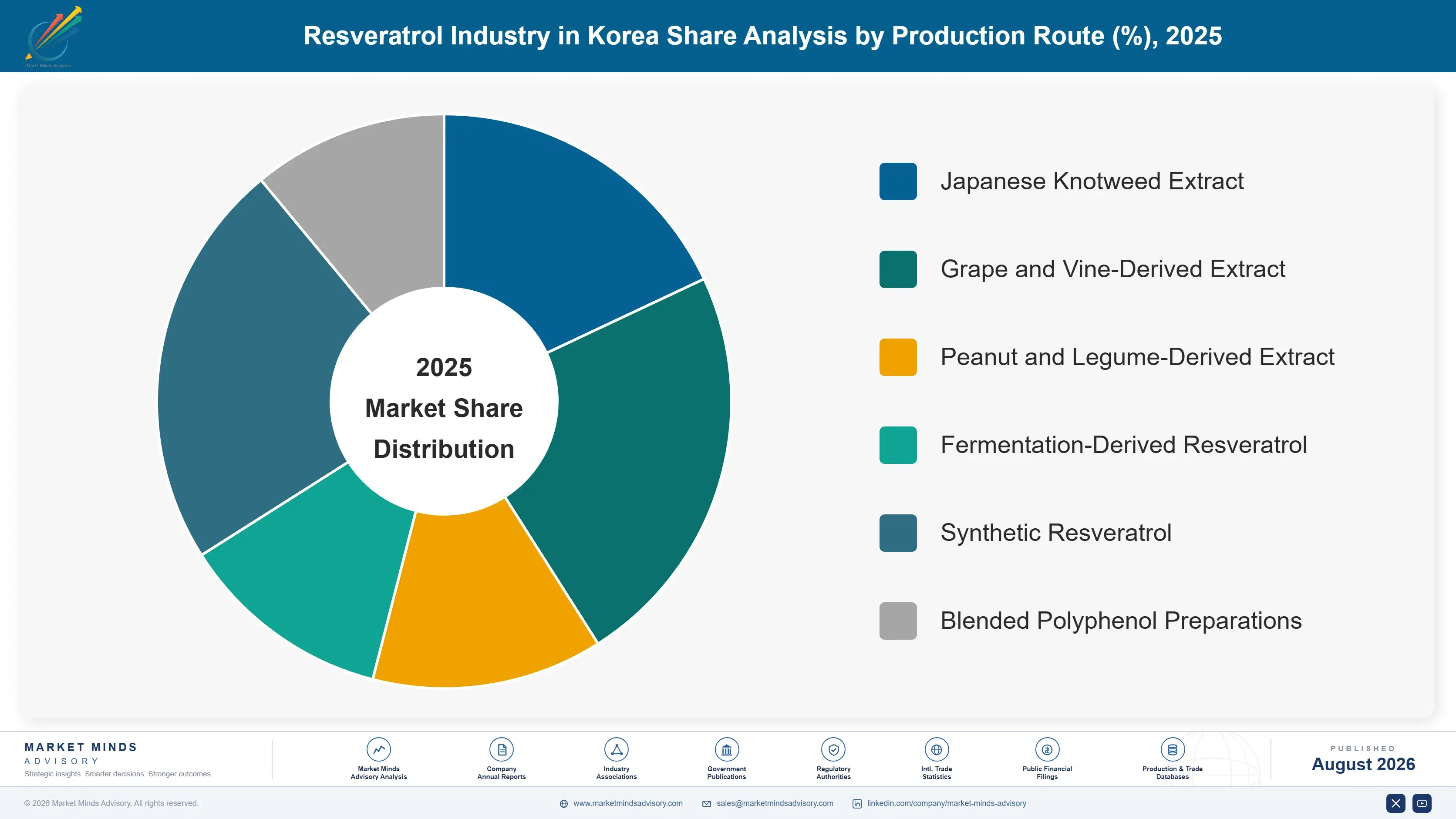
Six segments are split here by ingredient product form, because the form determines absorption behaviour, formulation compatibility, achievable price and what a brand can reasonably claim about the material it has bought. Source and purity variants sit inside each form rather than beside them. End-use application and channel are handled in the framework instead.
resveratrol-industry-in-korea-market-market-share-analysis-1787594919153

Micronised and Solubilised Grades

Growing at 14.4%, half again the market rate of 9.6%, these grades reduce particle size or improve dispersion to raise the fraction of an oral dose that dissolves and becomes available for absorption. That matters because first-pass metabolism destroys most of what does get absorbed, so anything increasing the starting quantity has a measurable effect on plasma levels. Commercially they carry the argument the category needed once efficacy claims retreated, and consumers understand absorption more readily than they understand mechanism. Whether higher plasma levels translate into better outcomes is the question fifteen years of trials have not answered. Comparative pharmacokinetic data is what a brand can actually use on packaging.
CAGR 14.4%

Encapsulated and Complexed Grades

At 12.8% liposomal, cyclodextrin-complexed and phospholipid-carrier grades protect the molecule through the gut and alter how it presents for absorption, which is a more involved intervention than particle size reduction alone. They cost considerably more and are used where a brand wants an absorption claim it can support with comparative data rather than an assertion. Formulation compatibility is the practical constraint, since carrier systems interact with other ingredients in the stacked formulations where most resveratrol now sits. Stability under storage varies between carrier types more than suppliers generally acknowledge. Suppliers rarely characterise those interactions before a brand discovers them in production, which is a gap worth closing. Cost sits well above simple particle size reduction.
CAGR 12.8%
Full segment breakdown across 6 segments available in the complete report.

Regional Architecture and Country Demand Map

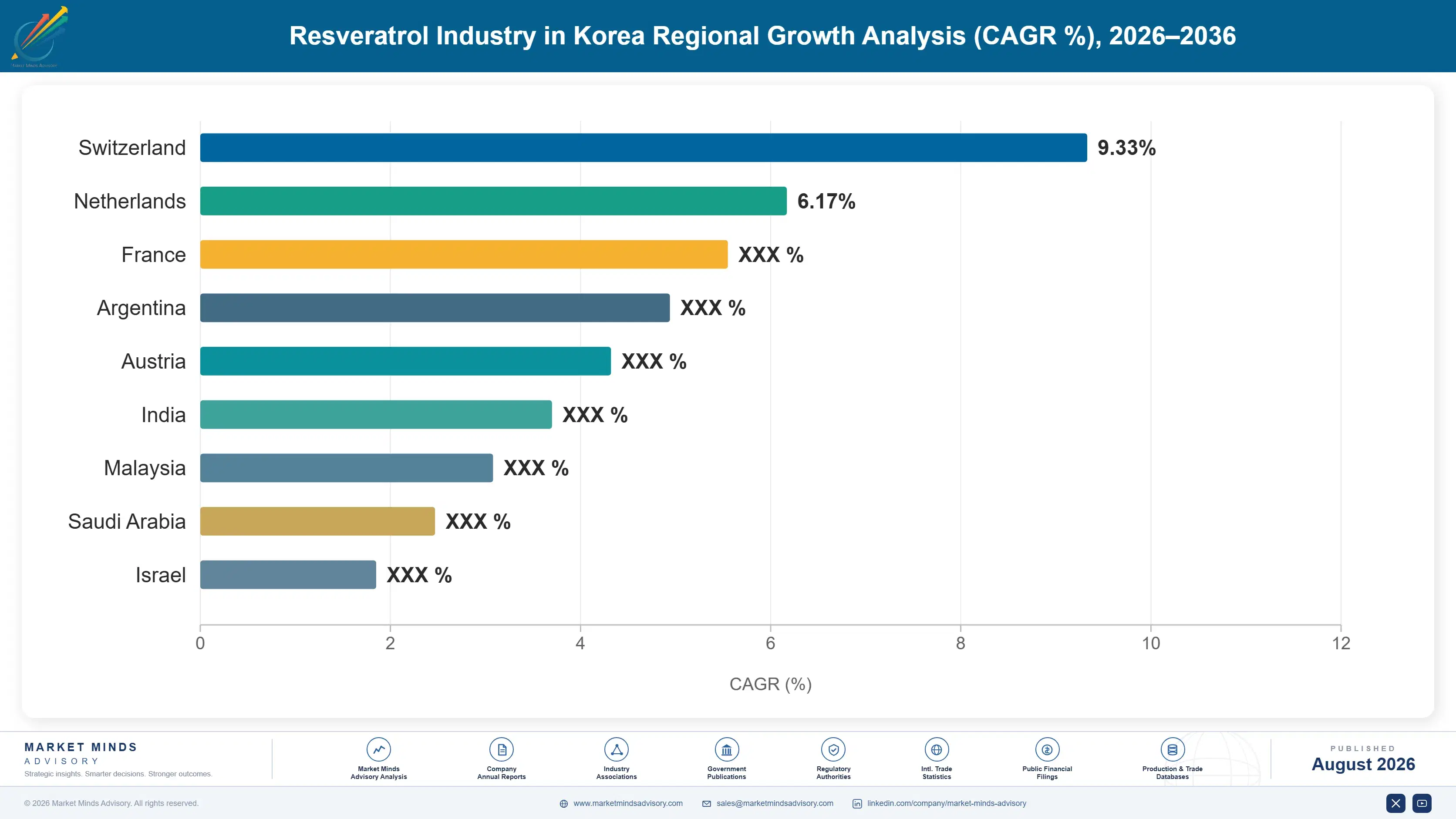
East Asia currently holds 30% of value, combining a dominant Chinese extraction supply base with substantial Japanese and Korean functional food demand behind it. North America then follows at 27% on longevity supplement spending, with Western Europe at 22% operating under considerably tighter claim regulation.

North America

Longevity supplement spending is higher here than anywhere and drives most regional demand, with resveratrol appearing as a companion ingredient in stacked formulations rather than as a standalone product. Dietary supplement regulation permits structure and function claims without pre-market approval, which is why the longevity framing developed here first and travels outward from American brands. Direct-to-consumer subscription models dominate the premium end. Cosmetic use is well established in professional skincare. Growth of 8.6% runs below the base case as the category matures and consumer scepticism grows slowly. The longevity framing developed here first and travels outward through American brand marketing rather than through any local demand. Direct-to-consumer subscription dominates the premium end here.
Share: 27% | CAGR: 8.6% (2026 to 2036)

Western Europe

Health claim regulation is considerably stricter than in North America, with permitted claims requiring authorisation that resveratrol has not obtained for the positioning it commercially depends on. Brands therefore market it descriptively or within cosmetic applications where the rules are more permissive. German, French and Italian supplement markets are substantial and increasingly served through online channels rather than pharmacy. Cosmetic use is proportionally higher here than in most regions. Growth at 8.0% runs below the base case, constrained by what may legally be said rather than by consumer interest. Cosmetic applications are proportionally higher here than in most regions, which is a direct response to what may legally be said.
Share: 22% | CAGR: 8.0% (2026 to 2036)
Regional intelligence for 5 additional markets available in the complete report: East Asia, South Asia and Pacific, Latin America, Middle East and Africa, Eastern Europe. Contact sales@marketmindsadvisory.com.
resveratrol-industry-in-korea-market-country-cagr-analysis-1787594919676

Four Moves on a Contested Ingredient

Selling resveratrol on efficacy has not worked for fifteen years and will not begin working now, with roughly 38% of published human studies meeting their primary endpoint. Every position worth holding here comes from absorption, from supply security, from topical applications or from the company the molecule keeps on somebody else's label on the shelf.

Sell absorption evidence rather than outcome claims

With around 38% of human studies reporting their endpoint met, efficacy is not a defensible position in any regulated market. Plasma level improvement from micronised, solubilised and complexed grades is measurable, reproducible and considerably easier to demonstrate, which is why those grades grow at 14.4%. Consumers understand absorption more readily than mechanism. A supplier arriving with comparative pharmacokinetic data rather than outcome assertions is offering something a brand can actually use on packaging. It is also considerably cheaper to generate than an outcome trial would be. Outcome assertions no longer survive scrutiny anywhere.
Market Impact: Serves 14.4% growth across the absorption grade range

Build the topical position that avoids the whole problem

Cosmetic use takes roughly 23% of category value and rests on firmer technical ground, since topical application acts locally and never confronts first-pass metabolism at all. Skincare claim regulation is also more permissive than ingestible health claims in most markets. That combination makes the cosmetic route both easier to defend and easier to market, and most ingredient suppliers have developed it far less than the ingestible category despite the obvious advantage. Impurity and colour specification differ from ingestible grades rather than fundamental purity, which means one production base can serve both pools and improve utilisation at the same time.
Market Impact: Grows the 23% topical share of category value

Qualify a second source before Chinese supply moves

Around 79% of commercial material comes from Japanese knotweed extracted in China, where environmental enforcement periodically restricts processing and moves prices without warning. Fermentation-derived material provides a defined alternative at a premium that has narrowed considerably as capacity scaled. Qualification work is modest against the exposure. Buyers who did it came through the last disruption paying more but continuing to ship, while single-source buyers simply went short of material. Enforcement action recurs rather than arriving once, which makes inventory buffering an expensive answer to a permanent problem. Qualification is the cheaper one by a wide margin.
Market Impact: Reduces reliance on a 79% single supply concentration

Design deliberately for the stacked longevity formulation

Around 64% of products carrying resveratrol sell it alongside another longevity ingredient, which means formulation compatibility with those ingredients matters more than standalone performance does. Carrier systems in complexed grades interact with other components in ways suppliers rarely characterise before a brand discovers it. Supplying compatibility data for the specific combinations brands actually build reaches a formulator directly, and almost no ingredient supplier does that work in advance. Formulators discover incompatibility in production, which is expensive and entirely avoidable with data supplied beforehand. Reaching the formulator directly is the point of the exercise.
Market Impact: Serves the 64% stacked formulation attachment rate directly

Who Controls the Margin Pool

Participation is measured on annual resveratrol ingredient supply volume, and the top five hold 31%. Fragmentation reflects a Chinese extraction base of many operators supplying similar standardised material, with differentiation concentrated among the few suppliers offering fermentation-derived or enhanced-delivery grades. Danstar Ferment leads on fermentation capability and Sabinsa on formulation and documentation depth. The gap to the long tail is provenance documentation rather than extraction capability. Extraction itself is not a barrier to anybody.
Competition runs on three fronts. Absorption data decides which suppliers reach brands needing a defensible packaging claim. Source documentation decides access to regulated functional food markets in Japan and Korea. Formulation compatibility decides placement in the stacked products where around 64% of resveratrol now sits, and very few suppliers characterise it in advance. Very few suppliers characterise compatibility in advance.

Pressure ahead comes from Chinese environmental enforcement moving extract supply unpredictably, and from any regulatory tightening on longevity claims removing the framing that carries the ingredient. Fermentation capacity keeps narrowing the premium against extract. Expect documentation and delivery format investment rather than acquisitions. Rankings shift as fermentation supply scales and as claim regulation develops in major markets. Fermentation capacity keeps narrowing the premium.
resveratrol-industry-in-korea-market-company-positioning-matrix-1787594920199

Competitive Moat and Risk Dimensions

DANSTAR FERMENT

Moat: Fermentation supply route control

Producing resveratrol by fermentation from defined organisms and substrates removes the botanical variability, anthraquinone content and Chinese supply concentration that follow knotweed extract everywhere. That provenance is worth a premium in regulated functional food markets where documentation matters, and it insulates customers from environmental enforcement decisions taken in another country entirely.
DANSTAR FERMENT

Risk: Extract price floor pressure

Chinese knotweed extract sets the price floor for around 79% of the market, and buyers who do not need documented provenance have no reason to pay a premium for it. The fermentation cost gap has narrowed but not closed, which leaves the position dependent on customers who value documentation over unit price.
SABINSA

Moat: Documentation and formulation depth

Long-established documentation practice, published characterisation and formulation support give brands the material they need to defend a product to a regulator or a retailer, which most Chinese extract suppliers do not provide at all. In a category where claims are contested, being the supplier who has already assembled the paperwork is worth more than a lower quotation.
SABINSA

Risk: Contested ingredient category exposure

Documentation depth is valuable only while the ingredient remains marketable, and around 64% of products depend on longevity positioning that regulators have not yet examined closely. Any tightening on those claims would remove the framing supporting the whole category, and no amount of supplier documentation compensates for a claim that may no longer be made.

Players Tracked

Prominent Players

Danstar Ferment
Sabinsa
DSM-Firmenich
Xi'an Sost Biotech
Shaanxi Undersun Biomedtech

Other Key Players

Evonik
Maypro Industries
Interquim
JF Natural
Hangzhou Great Forest Biomedical
Shaanxi Hongda Phytochemistry
Chengdu Wagott Bio-Tech
Bloomage Biotechnology
Lonza
Glanbia Nutritionals
ADM
Kaneka
Nutra Green Biotechnology
Naturalin Bio-Resources
Layn Natural Ingredients

Recent Developments

FEBRUARY 2026

Environmental enforcement restricts knotweed extraction across Chinese production region

Environmental enforcement action restricted botanical extraction operations across a Chinese production region, tightening resveratrol availability and moving prices within a single quarter. Buyers holding qualified fermentation-derived supply continued shipping while single-source purchasers went short of material. Recovery took two full quarters to complete. Prices did not fully return afterwards.
Signal: Supply concentration in one country means prices move on regulatory decisions rather than on actual demand
OCTOBER 2025

Longevity brand publishes comparative absorption data across delivery formats

A longevity supplement brand published comparative pharmacokinetic data across micronised, complexed and standard resveratrol formats, showing measurable plasma level differences between them. No outcome data accompanied the release, and none was claimed. Differences between formats were substantial and consistently reproducible across the comparison work published.
Signal: Absorption is now the marketable claim, while the outcome question stays extremely carefully unaddressed by everybody
JUNE 2025

Fermentation capacity expansion narrows premium against botanical extract

Fermentation-derived resveratrol capacity expanded further, narrowing the price premium against Chinese knotweed extract to a level several functional food manufacturers considered acceptable for the documentation advantage. Qualification programmes followed at a number of Asian manufacturers. Documentation advantage rather than performance drove those decisions. Several Asian manufacturers began qualification work.
Signal: A narrowing premium is what converts documented provenance from a stated preference into an actual purchase

Roots, Solvents and Purification

Raw knotweed root accounts for roughly 29% of extract production cost, wild-harvested and semi-cultivated across Chinese production regions with quality varying by origin and season. Extraction solvents and processing chemicals carry about 17%. Purification, particularly the chromatography needed to reach high trans-resveratrol content and remove anthraquinones, takes around 26% and rises steeply with target purity. Testing, documentation and logistics absorb the balance.
Chinese botanical extract pricing moved sharply on environmental enforcement affecting extraction operations across several production regions, per China Ministry of Commerce trade reporting for recent periods. Availability rather than price was the binding constraint during the tightest quarters. Fermentation-derived supply moved on entirely separate economics driven by capacity additions and substrate costs, which gave dual-sourced buyers a genuine hedge through the same period. Dual-sourced buyers came through materially better.

Exposure divides on purity target and on sourcing route. Producing high-purity trans-resveratrol carries purification costs rising steeply with specification, which is why the price spread between standardised extract and high purity reaches around nine times. Fermentation producers face substrate and capacity economics instead, entirely independent of harvest conditions, and their exposure falls as capacity utilisation improves rather than rising with purity.
resveratrol-industry-in-korea-market-cost-volatility-analysis-1787594920394

Qualify fermentation supply alongside botanical extract

Around 79% of material comes from Chinese knotweed extraction, where environmental enforcement moves availability without warning and without any reference to demand. Fermentation supply runs on capacity and substrate economics entirely separately from harvest conditions. Buyers holding both continued shipping through the last disruption while single-source purchasers went short, which cost them customers rather than margin.

Match purity specification to what the application requires

Purification costs rise steeply with target purity, producing a price spread of around nine times between standardised extract and high-purity material. Many formulations specify high purity out of habit rather than necessity, particularly where the product is a companion ingredient in a stack. Matching specification to actual requirement releases cost without affecting anything a consumer experiences.

Develop cosmetic-grade supply as a parallel demand pool

Topical applications take roughly 23% of category value, avoid the oral bioavailability question entirely and face more permissive claim regulation in most markets. Cosmetic specification differs from ingestible in impurity and colour requirements rather than in fundamental purity. Serving both pools from one production base improves utilisation and reduces dependence on the contested ingestible category.

Portfolio Architecture for Margin Defence

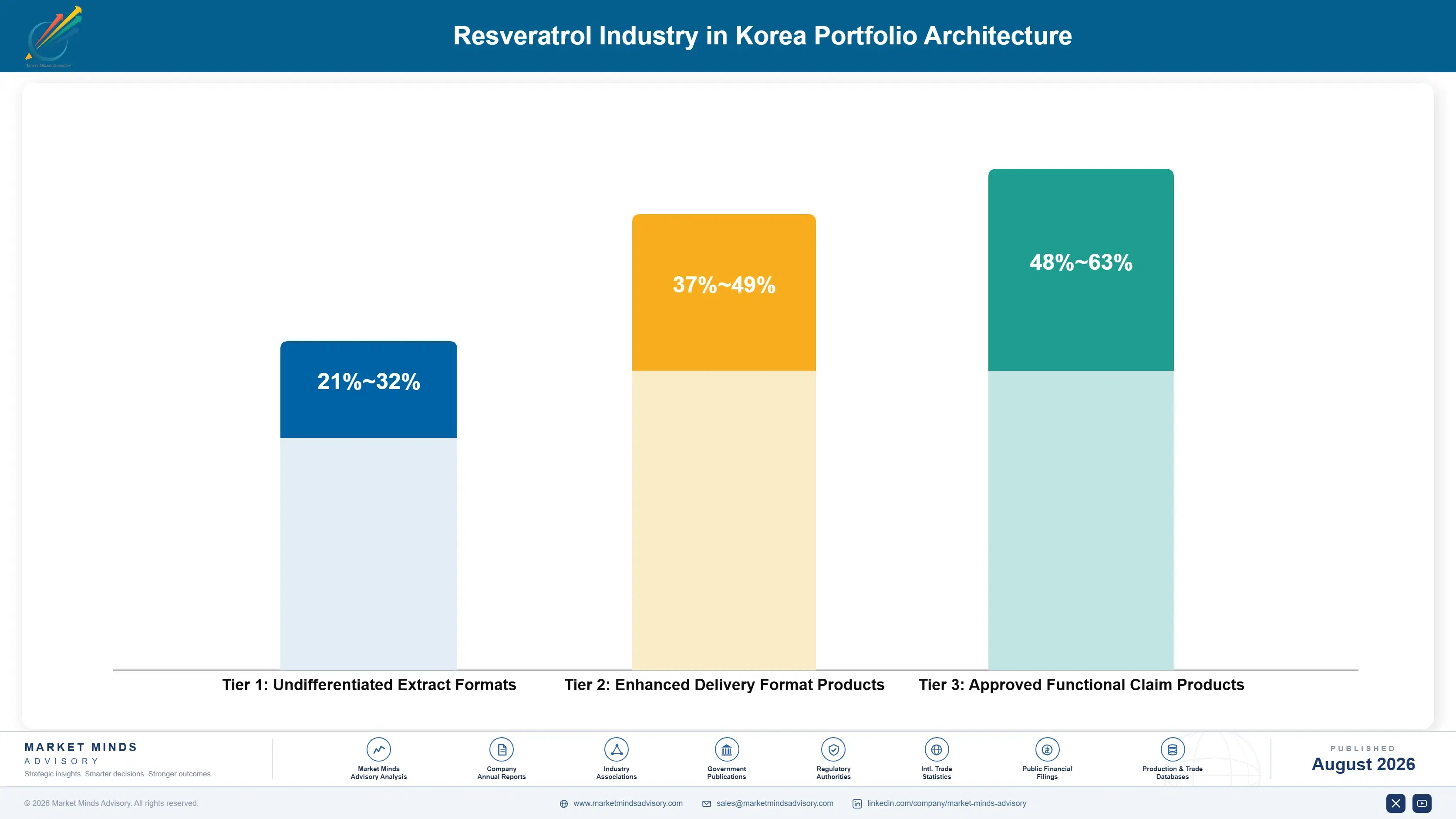
Margin here follows documentation and delivery rather than purity, which surprises suppliers who invested in purification capacity. Standardised knotweed extract earns margins in the high teens to high twenties, because many Chinese extractors produce equivalent material and buyers compare on price against a specification that every one of them meets. Availability rather than quality is what separates suppliers at this level. Nothing about the material itself supports a premium.
Enhanced delivery and documented-provenance grades do considerably better in the high thirties to high forties, because absorption data and source documentation are both things a brand can put in front of a regulator or a retailer. The range reflects how substantial the supporting data actually is rather than any difference in the underlying molecule. Regulators and retailers both respond to documentation rather than assertion.

Cosmetic-grade and formulation-supported supply holds the strongest position, reaching into the mid fifties, because topical use avoids the bioavailability question and faces more permissive claim regulation. Those margins reflect a demand pool with fewer obstacles rather than any manufacturing advantage, and most suppliers have underdeveloped it. Skincare claim rules are more permissive than ingestible ones nearly everywhere.

Standardised Knotweed Extract

Commodity extract powder supplied against standard purity specifications from Chinese production. The eleven point range reflects extraction scale and harvest position rather than product difference, since many operators produce equivalent material.
Gross Margin: 17-28%

Enhanced Delivery and Documented Grades

Micronised, complexed and fermentation-derived material supplied with absorption or provenance documentation. The twelve point range reflects how substantial the supporting data is rather than any difference in the underlying molecule.
Gross Margin: 37-49%

Cosmetic Grade and Formulation Supported

Topical-grade material supplied with formulation support into skincare and personal care applications. The twelve point range reflects formulation service depth and customer scale rather than any manufacturing advantage over ingestible grades.
Gross Margin: 44-56%
resveratrol-industry-in-korea-market-portfolio-architecture-1787594920921

High-value Sub-segments and Strategic Watch-out

Cosmetic and Topical Grade Supply

High value and structurally advantaged, since topical action avoids first-pass metabolism entirely and skincare claim regulation is more permissive than ingestible rules. Most ingredient suppliers have developed this pool far less than the ingestible one. The technical case is genuinely stronger. Suppliers have underdeveloped it.
Gross Margin: 46-56%

Enhanced Absorption Delivery Grades

High value and the fastest growth at 14.4%, since absorption became the marketable argument once efficacy claims retreated. Plasma level improvement is measurable and reproducible in a way outcome claims have never managed to be. Consumers understand it more readily too. Plasma improvement is reproducible.
Gross Margin: 38-49%

Standardised Knotweed Extract

The volume core, produced by many Chinese extractors against a specification all of them meet and compared purely on price. Availability moves on environmental enforcement rather than on anything a buyer can influence. Environmental enforcement decides availability. Buyers cannot influence availability. Enforcement decides it instead.
Gross Margin: 17-28%

Longevity Claim Dependence

The strategic watch-out. Around 64% of products depend on longevity positioning regulators have not examined closely, and the range reflects how far suppliers have built topical and documented positions independent of it. No amount of supplier documentation compensates for a claim that may no longer be made at all.
Gross Margin: 14-40%

Borrowed Belief, Repeat Purchase

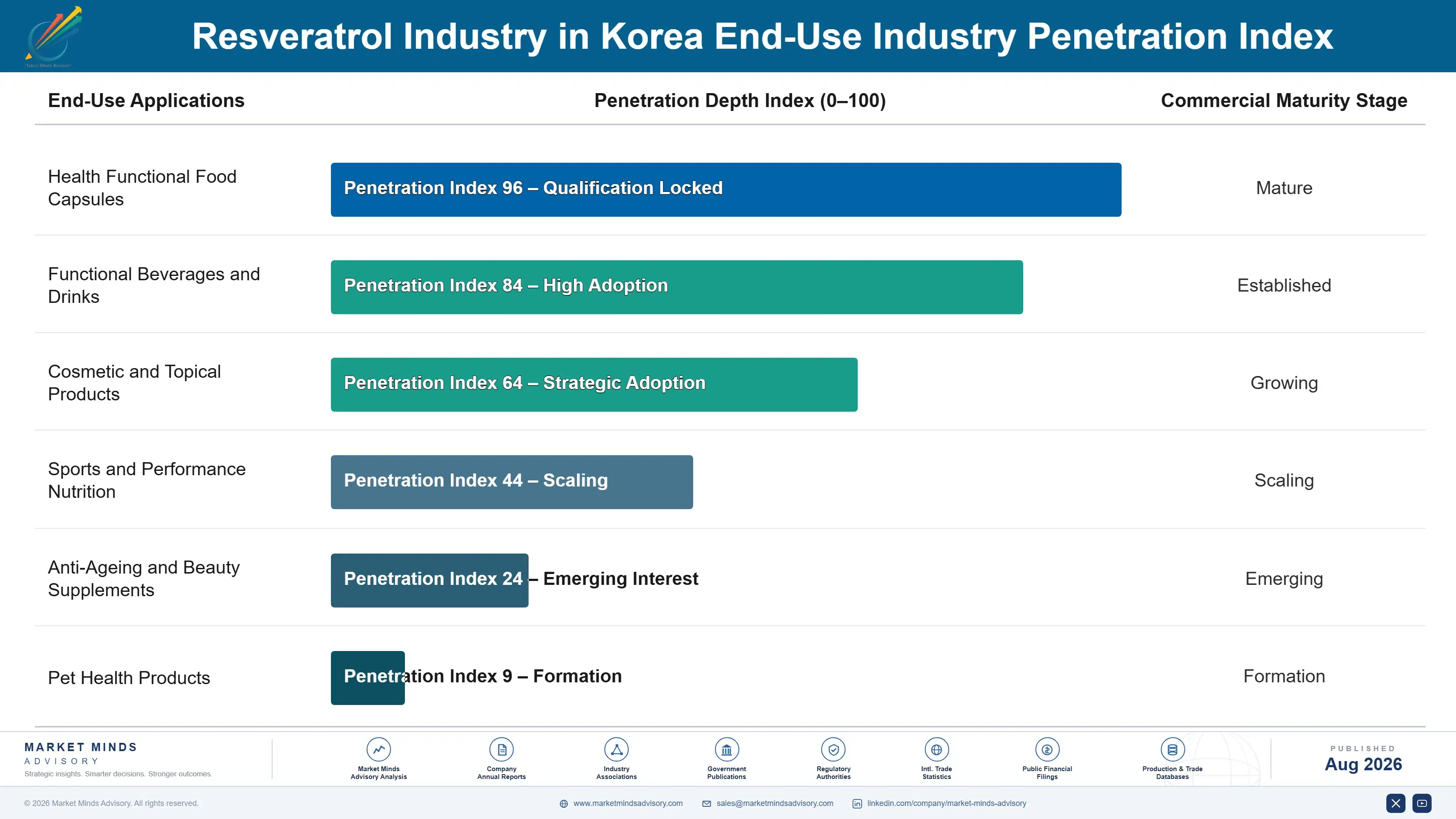
Supplement demand depends on repeat purchase rather than trial, since a daily capsule is bought monthly or abandoned. Retention rests on perceived benefit, which for resveratrol is complicated by the fact that nothing about the product announces itself and roughly 38% of trials failed to demonstrate the effect being sold. What sustains repurchase is the belief the longevity category carries, not any experience the consumer has. Belief rather than experience sustains the repurchase.
Stickiness follows the formulation rather than the ingredient. A consumer subscribed to a stacked longevity product buys resveratrol as a component of something else and never evaluates it separately, which is a considerably more durable position than being judged on its own merits would be. Standalone resveratrol products carry all the evidence risk and none of that protection, which is why so few of them remain.

The purchasing decision has moved to direct-to-consumer subscription and online research rather than retail or pharmacy recommendation. That favours brands able to argue absorption and provenance in their own words, and it concentrates demand into a smaller number of larger longevity brands whose ingredient specifications then determine what suppliers can sell. Ingredient specifications follow those brands.
resveratrol-industry-in-korea-market-end-use-penetration-index-1787594921412

Where We Would Focus Effort

These are among the four positions where our research anticipates prominent divergence between winners and laggards over the coming forecast period. Each is grounded in the demand model, the regulatory perimeter, and the announced capacity pipeline.
01 / ABSORPTION EVIDENCE BUILDING

Sell what you can actually measure

With around 38% of published human studies reporting their primary endpoint met, efficacy is not a defensible commercial position in any properly regulated market anywhere. Plasma level improvement from micronised, solubilised and complexed grades is measurable, reproducible and far easier to demonstrate convincingly, which is precisely why those grades grow at 14.4% against a market rate of 9.6%. A supplier arriving with comparative pharmacokinetic data rather than outcome assertions offers a brand something it can actually put on a package and defend afterwards.
02 / TOPICAL ROUTE DEVELOPMENT

Skin never asks about first-pass metabolism

Cosmetic applications take roughly 23% of category value and rest on considerably firmer technical ground, since topical action works locally and never confronts gut wall or hepatic metabolism at all. Skincare claim regulation is also more permissive than ingestible health claim rules across almost every major market. That combination makes the topical route both easier to defend technically and easier to market commercially, and most ingredient suppliers have developed it remarkably little by comparison by comparison with the ingestible route.
03 / SOURCE DIVERSIFICATION TIMING

One country, one plant, no alternatives qualified

Around 79% of commercial resveratrol comes from Japanese knotweed extracted in China, where environmental enforcement periodically restricts processing and moves availability without warning and without any reference to actual demand. Fermentation-derived material provides a defined alternative at a premium that has narrowed considerably as fermentation capacity scaled up globally. Qualification work is modest against that exposure, and buyers who completed it kept shipping through the last disruption while single-source purchasers simply went short of material entirely for two full quarters running.
04 / STACK COMPATIBILITY WORK

Characterise the combinations brands actually build

Around 64% of products carrying resveratrol sell it alongside another longevity ingredient, which makes compatibility with those specific components matter considerably more than any standalone performance figures ever really do. Carrier systems in complexed grades interact with other stack components in ways suppliers rarely characterise before a brand discovers the problem late during actual production runs. Supplying that compatibility data in advance reaches a formulator directly, and almost no ingredient supplier currently currently bothers to do that work at all.

Engagement Snapshot From the Field

A live engagement with an industry participant carrying material or product regulatory and market exposure ahead of a defining policy shift, showing how our research translates into a defensible multi-year portfolio strategy.
MARKET MINDS ADVISORY · CLIENT ENGAGEMENT SUMMARY
Resveratrol Producer Strategic Portfolio Review and Transition Roadmap 2026·Investment Scenario on Resveratrol Exposure Evaluation 2025-26
CLIENT PROFILE
An international botanical ingredient supplier selling standardised resveratrol extract into supplement manufacturers across four regions, at annual resveratrol revenue near 34 million dollars (client-reported, unverified by MMA). Material was sourced entirely from Chinese knotweed extractors, no fermentation supply was qualified, and cosmetic customers accounted for a negligible share of total volume across every territory served.
STRATEGIC CHALLENGE
A Chinese enforcement action had left the company short of material for two quarters while competitors with fermentation supply continued shipping, and two customers had moved permanently. Management were considering forward-buying larger extract inventories, and wanted to know whether inventory or sourcing was the actual problem they were dealing with.
MMA APPROACH
MMA assessed supply disruption frequency and duration across Chinese production regions, benchmarked fermentation qualification cost against inventory carrying cost, sized the cosmetic demand pool the client was not serving, and evaluated which grades customers were specifying against what their applications required. Interviews with 47 experts covered botanical extraction, supplement formulation and cosmetic ingredient supply.
KEY FINDINGS
  1. Enforcement-driven supply disruptions had occurred repeatedly rather than exceptionally, making inventory buffering an expensive way to manage a recurring rather than one-off problem.
  2. Fermentation qualification cost was a small fraction of the inventory carrying cost required to cover a comparable disruption, and it also opened regulated functional food markets.
  3. A substantial share of customers were specifying high-purity material for companion-ingredient applications where standardised extract would have performed identically at far lower cost.
  4. Cosmetic customers in the client's territories were being served by competitors, in a pool taking roughly a quarter of category value with more permissive claim regulation behind it.
CLIENT PROFILE
An international botanical ingredient supplier selling standardised resveratrol extract into supplement manufacturers across four regions, at annual resveratrol revenue near 34 million dollars (client-reported, unverified by MMA). Material was sourced entirely from Chinese knotweed extractors, no fermentation supply was qualified, and cosmetic customers accounted for a negligible share of total volume across every territory served.
STRATEGIC CHALLENGE
A Chinese enforcement action had left the company short of material for two quarters while competitors with fermentation supply continued shipping, and two customers had moved permanently. Management were considering forward-buying larger extract inventories, and wanted to know whether inventory or sourcing was the actual problem they were dealing with.
MMA APPROACH
MMA assessed supply disruption frequency and duration across Chinese production regions, benchmarked fermentation qualification cost against inventory carrying cost, sized the cosmetic demand pool the client was not serving, and evaluated which grades customers were specifying against what their applications required. Interviews with 47 experts covered botanical extraction, supplement formulation and cosmetic ingredient supply.
KEY FINDINGS
  1. Enforcement-driven supply disruptions had occurred repeatedly rather than exceptionally, making inventory buffering an expensive way to manage a recurring rather than one-off problem.
  2. Fermentation qualification cost was a small fraction of the inventory carrying cost required to cover a comparable disruption, and it also opened regulated functional food markets.
  3. A substantial share of customers were specifying high-purity material for companion-ingredient applications where standardised extract would have performed identically at far lower cost.
  4. Cosmetic customers in the client's territories were being served by competitors, in a pool taking roughly a quarter of category value with more permissive claim regulation behind it.
RECOMMENDED STRATEGY
Phase 1: Phase one: qualify fermentation-derived supply immediately, since disruption recurs rather than arriving once and qualification costs far less than inventory buffering. Phase 2: Phase two: review customer purity specifications against actual application requirements, releasing cost wherever high purity serves no real functional purpose. Phase 3: Phase three: build cosmetic-grade supply and formulation support, entering a pool with fewer regulatory obstacles than the ingestible category carries.
OUTCOME
The supplier qualified fermentation supply during 2026 and shipped without interruption through a subsequent enforcement period (client-reported, unverified by MMA). Cosmetic sales were established with three formulators, and planned extract inventory expansion was cancelled. Two lost customers returned during the following year, and inventory carrying cost fell substantially against the previous plan.

Frequently Asked Questions

Foundational context covering the market sizes, CAGR, scope, country, region and competition that inform every finding below. This section is provided to cover basics and most often pre-purchase conversations, answered from the MMA Primary Research Dataset.

What is the current size of the Resveratrol Market?

MMA sizes it at USD 1.24 billion in 2025, rising to USD 1.36 billion in 2026. The figure covers resveratrol ingredient supply into supplement, functional food, beverage and cosmetic applications worldwide.

How large will the Resveratrol Market be by 2036?

USD 3.40 billion by 2036, an incremental USD 2.04 billion over the 2026 base and an expansion multiple of 2.50 times. Enhanced delivery grades account for a disproportionate share.

What is the CAGR for the Resveratrol Market 2026 to 2036?

9.6% in the base case, with a bull case at 10.8% and a bear case at 8.4%. The spread turns on longevity claim regulation and on whether clinical evidence improves.

Which segment is growing fastest?

Micronised and solubilised grades at 14.4%, half again the market rate of 9.6%. Absorption became the marketable argument once efficacy claims retreated from the category.

Who are the major companies in the Resveratrol Market?

Danstar Ferment, Sabinsa, DSM-Firmenich, Xi'an Sost Biotech and Shaanxi Undersun Biomedtech lead on ingredient supply volume. Fifteen further participants are profiled in the full report.

Which country is growing fastest?

India at 13.6%, combining rising discretionary health spending with substantial domestic supplement manufacturing capacity that keeps finished product affordable for a highly price-sensitive consumer base.

Report Segmentation Architecture

The full report scope spans multiple orthogonal segmentation dimensions, with cross-tabulated demand data provided for each dimension pair. Coverage extends further to regional breakdowns, trend trajectories, and the competitive detail needed to support segment-level decision-making.

By Ingredient Product Form

  • Standardised Extract Powder
  • High-Purity Trans-Resveratrol
  • Micronised and Solubilised Grades
  • Resveratrol Glucoside Preparations
  • Encapsulated and Complexed Grades
  • Cosmetic-Grade Derivative Forms

By End-Use Industry

  • Longevity and Anti-Ageing Supplements
  • General Wellness Supplements
  • Functional Foods and Beverages
  • Skincare and Cosmetic Products
  • Sports and Performance Nutrition
  • Pet Health Products

By Commercial Dimension

  • Direct Supply to Manufacturers
  • Distributor and Trading Channels
  • Contract Formulation Supply
  • Documented Provenance Agreements
  • Private Label Ingredient Supply
  • Export and Cross-Border Supply

By Region

  • North America
  • Western Europe
  • East Asia
  • South Asia and Pacific
  • Latin America
  • Middle East and Africa
  • Eastern Europe

Scope, Methodology, and Coverage

Every figure in this report is reproducible from documented input assumptions. The scope below maps the historical period, the forecast horizon, the segmentation dimensions, and the countries covered, alongside the underlying primary and qualitative methodology.
Historical Period
2020 to 2025
Forecast Period
2026 to 2036
Base Year
2025 (USD billions; MMA Primary Research Dataset, August 2026)
Market Definition
Resveratrol supplied as an ingredient and incorporated into finished dietary supplement, functional food, beverage and cosmetic products worldwide, covering standardised extract powder, high-purity trans-resveratrol, micronised and solubilised grades, resveratrol glucoside preparations, encapsulated and complexed grades, and cosmetic-grade derivative forms. Measured at ingredient supplier selling value across all production routes and applications. Wine and grape products consumed as conventional food, pharmaceutical development programmes, and other stilbene compounds sold as separate ingredients are excluded from scope.
Quantitative Units
USD billions (current prices); tonnes resveratrol equivalent; USD per kilogram by product form
Segmentation Dimensions
Ingredient product form; end-use application; commercial dimension; region
Regions Covered
North America, Western Europe, East Asia, South Asia and Pacific, Latin America, Middle East and Africa, Eastern Europe
Countries Covered
China, Japan, South Korea, Taiwan, India, Indonesia, Australia, United States, Canada, Mexico, Germany, France, Italy, United Kingdom, Spain, Poland, Brazil, Saudi Arabia, United Arab Emirates, South Africa
Key Companies Profiled
Danstar Ferment, Sabinsa, DSM-Firmenich, Xi'an Sost Biotech, Shaanxi Undersun Biomedtech, Evonik, Maypro Industries, Interquim, JF Natural, Hangzhou Great Forest Biomedical, Shaanxi Hongda Phytochemistry, Chengdu Wagott Bio-Tech, Bloomage Biotechnology, Lonza, Glanbia Nutritionals, ADM, Kaneka, Nutra Green Biotechnology, Naturalin Bio-Resources, Layn Natural Ingredients
Quantitative Methodology
Primary survey, n=3,800 respondents, Q4 2025, six countries; demand-side model with trade association cross-validation
Qualitative Methodology
47 expert interviews, Q4 2025; applied to validate demand model assumptions, identify emerging dynamics, and assess competitive positioning
Report Format
PDF and XLSX data workbook (Word format preview document)
Publisher
Market Minds Advisory
Report Code
MMA-2026-HLT-127
Published
August 2026
Contact
sales@marketmindsadvisory.com | www.marketmindsadvisory.com

Purchase the full Resveratrol Market Report (2026 to 2036).

The full report examines why commercial demand rose while scientific standing fell, because that divergence rather than any efficacy question determines how this category should be approached. It sizes all six product forms independently through 2036, quantifies supply concentration risk across Chinese extraction regions against fermentation capacity, and separates topical from ingestible demand because the two face entirely different technical and regulatory positions. Regional chapters cover all seven regions with claim regulation assessed alongside consumption. Competitive profiling covers 20 participants on a single supply volume basis.
Six ingredient product forms sized independently through 2036
Supply concentration risk quantified against fermentation capacity growth
Topical demand separated from ingestible across every region
Claim regulation assessed alongside consumption by major market
Twenty participants profiled on one consistent supply basis
Longevity category dependence modelled under regulatory scenarios

Built For The People Who Decide

From boardroom strategy to bench-side execution, this report is read cover-to-cover by leaders shaping the next decade of their industry, turning demand scenarios, market dynamics and valuation benchmarks into decisions.
CXOs/ Presidents/ VPs/ Managers
M&A and Corporate Development
Strategy Teams and R&D Heads
Procurement and Product Directors
Regulatory and Compliance Leaders
Investor Relations and Equity Analysts