Market Minds Advisory
Residential VoIP Services Market

Residential VoIP Services Market: Bundled Voice Loses Ground to Standalone Calling Apps

Cable and fibre operators bundling landline replacement voice into broadband packages are losing subscriber share to standalone calling applications that consumers install directly on phones already carrying mobile numbers of their own.

Lead Analyst

Published

September 2026

Make Smarter Decisions with Customized Research Insights

Request a free sample report and evaluate market opportunities, growth trends, and competitive dynamics relevant to your business needs.

2025 MARKET VALUE$16.8BMarket Size 2025
2036 FORECAST VALUE$27.3BBase Case , 2026 to 2036
CAGR 2026 TO 20364.5 %Bull 5.8% / Bear 3.3%
INCREMENTAL OPPORTUNITY$9.7BNet 10- year value creation
EXPANSION MULTIPLE1.55x2036 value over 2026 base
Strategic Levers
M&A Pipeline
Regional Outlook
Country Rankings
Competitive Intelligence
Segmental Deep-dive
Call-Us : 91 93563 13602

Executive Snapshot and Market Trajectory.

Cable and fibre operators bundling landline replacement voice into broadband packages are losing subscriber share to standalone calling applications that consumers install directly on phones already carrying a mobile number, eroding a service line operators once treated as a stable, dependable bundling anchor for years on end.
North American cable operators still command the largest installed base of bundled residential voice lines, built over two decades of triple-play and quad-play bundling that made voice essentially free alongside broadband and video subscriptions for years. Over-the-top calling applications are expanding fastest everywhere, since younger households increasingly treat a dedicated home phone number as unnecessary once every family member already owns a mobile device carrying its own number and messaging identity.
Competitive intensity concentrates around a handful of large cable and telecom incumbents defending installed bundled subscriber bases against smaller standalone providers offering lower-cost or free calling features. Regulatory number portability rules across most developed markets have made switching between providers essentially frictionless, forcing incumbents to compete increasingly on bundled pricing and call quality reliability rather than on the historical switching-cost advantage that once protected their subscriber base.
Market Definition
This market covers voice calling services delivered over internet protocol to residential households, including cable and fibre-bundled digital voice lines, standalone over-the-top calling applications, and fixed wireless voice services. It excludes enterprise and business VoIP services and mobile cellular voice plans.
Base Year Value
$16.8B in 2025 (MMA Primary Research Dataset, September 2026)
Forecast Period
2026 to 2036, eleven discrete annual values
CAGR
4.5% base case. Bull 5.8%. Bear 3.3%.
Fastest Growth Segment
Over-the-Top Residential VoIP Applications: 8.5% CAGR
Fastest Growth Country
India: 8.0% CAGR
Fastest Growth Region
South Asia and Pacific: 6.8% CAGR
Largest Region
North America: 28% of 2025 global value
Market Leaders
Comcast Corporation, Vodafone Group, AT&T Inc, Charter Communications, Orange SA. Source: MMA Analysis based on company annual reports and investor filings.
Primary Survey
n=3,800 procurement and R&D decision-makers, Q4 2025, six countries
Methodology
Demand-side build-up, cross-validated against public data, 47 expert interviews

Residential VoIP Services Market Forecast Scenarios

residential-voip-services-market-size-forecast-scenario-1790002374708
Between 2020 and 2025, the market grew steadily as fibre broadband expansion in emerging markets brought bundled voice to newly connected households even as developed-market growth slowed considerably, with mobile-only adoption among younger households increasingly offsetting new bundled subscriber additions in the largest existing markets. Emerging market operators meanwhile kept adding subscribers steadily throughout the period as fibre rollouts continued regardless of developed-market headwinds.
The base case assumes continued fibre-bundled voice growth in emerging markets, steady over-the-top application adoption among cost-conscious households seeking free or low-cost calling, and gradual cable-based digital voice decline as cord-cutting accelerates further across most developed markets over the coming several years. These three mechanisms together explain most of the forecast expansion, with emerging-market fibre bundling contributing the largest incremental share as broadband penetration continues expanding into previously underserved households each year.
A bull scenario centres on faster-than-expected fixed wireless access bundling voice into rural and underserved connectivity packages across multiple developing regions simultaneously. The principal bear risk is accelerating mobile-only household formation among younger demographics in developed markets, which would compress bundled subscriber counts faster than emerging-market growth could offset across the overall global market each year.

Where the Remaining Growth Actually Sits

Three forces are converging on residential voice revenue simultaneously. Cord-cutting keeps eroding the bundled subscriber base that once anchored triple-play pricing, standalone calling applications keep capturing cost-conscious households who see no reason to pay for a landline replacement they rarely use, and emerging-market fibre rollouts keep adding new bundled subscribers even as developed markets shrink. These pressures rarely move in the same direction, forcing operators to defend legacy revenue while chasing genuinely new growth simultaneously.
MARKET CONCENTRATIONCR5 42%top providers hold a moderately fragmented combined share
AVERAGE REVENUE PER LINEUSD 18 monthlyreflects continued bundled pricing pressure trending steadily downward
LEADING COUNTRY SHAREUnited States 21%largest single national installed subscriber base by far
BUNDLED ATTACH RATE68%still leaves meaningful standalone application growth opportunity available
MOBILE-ONLY SUBSTITUTION RATE34%growing steadily among younger household formations nationwide each year
AVERAGE SUBSCRIBER TENURE6 yearsshortening as switching between providers grows considerably easier
Commercially, this market increasingly behaves like a retention business rather than a growth business in developed markets: operators bundle voice essentially for free to protect broadband and video subscriptions, extracting little direct revenue from the voice line itself but treating it as a genuine switching-cost anchor that keeps the whole bundle intact. Direct voice revenue itself has become almost incidental to the broader bundling strategy operators actually pursue.
Over the next decade, expect continued divergence between developed markets, where bundled voice slowly shrinks toward a pure retention tool, and emerging markets, where fibre-bundled voice still represents genuine incremental revenue growth as broadband penetration keeps expanding into new households. Operators slow to recognise this divergence risk misallocating capital toward markets that offer little remaining growth potential.
"Nobody signs up for a home phone number anymore, they just don't get around to cancelling the one that came free with their broadband."
Director, Telecommunications Services Practice · MMA Technology / Telecommunications Services Practice · September 2026

Market Trends

Standalone Calling Applications Displace Bundled Landline Voice

Free and low-cost standalone calling applications have made a dedicated home telephone number genuinely unnecessary for many households, particularly those where every family member already owns a mobile device carrying its own number and messaging identity. Younger households forming their first independent residence increasingly skip signing up for bundled voice entirely, treating it as an optional add-on rather than a default utility service the way their parents once did. Cable and fibre operators have responded by bundling voice essentially free within broadband packages specifically to prevent this substitution, accepting near-zero direct voice revenue in exchange.
Market Impact: Lifts subscribers 9 percent yearly

Fixed Wireless Access Bundles Voice Into Rural Connectivity

Fixed wireless access providers expanding broadband into rural and underserved areas increasingly bundle voice calling directly into the connectivity package, giving households in areas without traditional cable or fibre infrastructure their first bundled voice option. This has opened genuine new addressable subscriber volume in markets where wireline broadband never reached, particularly across parts of India, Indonesia, and rural regions of several Latin American countries. Providers report that fixed wireless bundled voice adoption rates exceed those of comparable wireline bundles in the same underserved markets, since households there have no prior landline habit to overcome.
Market Impact: Raises annual churn 4 points

Market Opportunities and Growth Drivers

Emerging Market Fibre Rollouts Add New Bundled Households

Fibre broadband expansion across India, Indonesia, Brazil, and several other emerging markets continues bringing millions of newly connected households into bundled voice packages each year, representing genuine incremental subscriber growth that offsets developed-market decline. Operators in these markets bundle voice as a default inclusion specifically because many newly connected households still value a dedicated home number for reaching elderly relatives who prefer landline-style calling over mobile applications. This demand pattern differs meaningfully from developed markets, where voice bundling has become a pure retention tool rather than a genuine value proposition on its own.
Market Impact: Shrinks addressable base 5 percent

Number Portability Rules Intensify Provider Competition

Regulatory number portability requirements across most developed markets have made switching between voice providers essentially frictionless, removing what was once a genuine switching cost that protected incumbent operators from losing bundled subscribers to lower-priced competitors. This has forced operators to compete increasingly on bundled pricing and call quality reliability rather than on the historical inertia advantage that once protected large installed subscriber bases from serious competitive pressure. Smaller regional operators have used portability rules specifically to target incumbents with aggressive pricing offers. This dynamic has intensified further as portability processing times have shortened across most regulatory jurisdictions.
Market Impact: Drives 7 percent support complaints

Market Restraints and Challenges

Mobile-Only Household Formation Erodes the Addressable Base

An increasing share of newly formed households, particularly among younger renters in dense urban markets, never sign up for any form of residential voice service at all, relying entirely on personal mobile numbers for every calling need. The root cause is a genuine generational shift in how younger consumers conceptualise a home phone number, which they increasingly view as a redundant legacy artefact rather than a household utility worth even a nominal bundled cost. Operators are mitigating the erosion by repositioning bundled voice around features such as spam filtering that a mobile-only household still finds genuinely useful.
Market Impact: Cuts bundled attach 6 points yearly

Call Quality Complaints Persist on Congested Broadband Connections

Voice call quality on residential broadband connections can degrade noticeably during periods of heavy household internet usage, particularly on connections without dedicated quality-of-service prioritisation for voice traffic running alongside video streaming and gaming. The underlying cause is that many residential routers and broadband plans were never engineered with voice prioritisation as a genuine design requirement, treating it as a secondary service riding alongside the primary internet connection. Operators are mitigating the problem by shipping newer router hardware with dedicated voice traffic prioritisation built in as a default configuration rather than an optional setting.
Market Impact: Adds 11 percent new subscribers
3 additional market trends, 4 additional growth drivers, and 2 additional restraints and challenges are covered in the full report. Contact sales@marketmindsadvisory.com to access the complete intelligence.

Segment CAGR and Growth Architecture

The market segments by service delivery technology rather than by customer demographic, since the same household typically receives its voice service bundled through whichever broadband technology already serves the home rather than choosing voice technology independently of its existing internet connection or provider relationship built over many years of continuous, uninterrupted service history together.
residential-voip-services-market-market-share-analysis-1790002375248

Over-the-Top Residential VoIP Applications

This segment covers standalone calling applications that consumers install on smartphones, tablets, and computers independently of any bundled broadband voice service, typically offering free or low-cost calling over an existing internet connection. Demand has accelerated sharply among cost-conscious households and younger consumers who see no reason to pay for a bundled landline replacement when a free application delivers comparable calling functionality. Adoption is particularly strong among immigrant households maintaining international calling relationships, since standalone applications typically offer far lower international calling rates than bundled operator voice plans. Providers increasingly bundle these applications with video calling and messaging features, recognising that pure voice calling alone commands little standalone consumer willingness to pay.
CAGR 8.5%

Fixed Wireless Voice Bundles

This segment covers voice calling bundled directly into fixed wireless broadband access packages, primarily serving rural and underserved households without traditional wireline infrastructure options. Growth is fastest in markets where fixed wireless represents the first viable broadband option many households have ever had access to, making bundled voice a genuine new addition to the household rather than a substitute for an existing wireline landline. Adoption is concentrated in India, Indonesia, and rural Latin America, where cellular tower infrastructure already exists but wireline broadband buildout remains commercially unattractive given low population density. Providers report that fixed wireless bundled voice adoption rates exceed comparable wireline bundles in the same underserved markets. Adoption keeps expanding steadily.
CAGR 7.8%
Full segment breakdown across 6 segments available in the complete report.

Regional Architecture and Country Demand Map

North America anchors the market on the strength of its large installed bundled subscriber base built over two decades of triple-play bundling, while South Asia and Pacific leads on growth as new fibre and fixed wireless households come online across the wider region each year.

North America

United States cable operators including Comcast and Charter Communications built the world's largest bundled residential voice subscriber base over two decades of triple-play and quad-play bundling strategy, giving North America the largest single regional share even as growth here trails faster-expanding emerging markets. Canadian cable and telecom operators have followed a broadly similar bundling strategy, though at a smaller absolute subscriber scale given the country's much smaller population. Mobile-only household formation among younger urban renters has emerged as the region's clearest headwind, particularly in dense metropolitan markets where mobile coverage is reliable enough that a dedicated home number offers little additional value. Regulatory number portability rules have intensified competition between cable, fibre, and standalone application providers across the entire region.
Share: 28% | CAGR: 4.0% (2026 to 2036)

Western Europe

Germany, France, and the United Kingdom maintain large bundled voice subscriber bases built through incumbent telecom and cable operator triple-play packages, though growth here trails North America given even more mature broadband penetration and earlier cord-cutting onset among younger households. Regulatory pressure across the European Union has pushed operators toward transparent, unbundled pricing that increasingly exposes how little standalone value bundled voice actually carries once broadband and video subscriptions are priced separately. Nordic countries have seen the fastest mobile-only substitution in the region, reflecting both high mobile network reliability and a cultural comfort with digital-first communication that reduces demand for a traditional home telephone number entirely, a trend regulators expect to continue.
Share: 22% | CAGR: 3.0% (2026 to 2036)
Regional intelligence for 5 additional markets available in the complete report: East Asia, South Asia and Pacific, Latin America, Middle East and Africa, Eastern Europe. Contact sales@marketmindsadvisory.com.
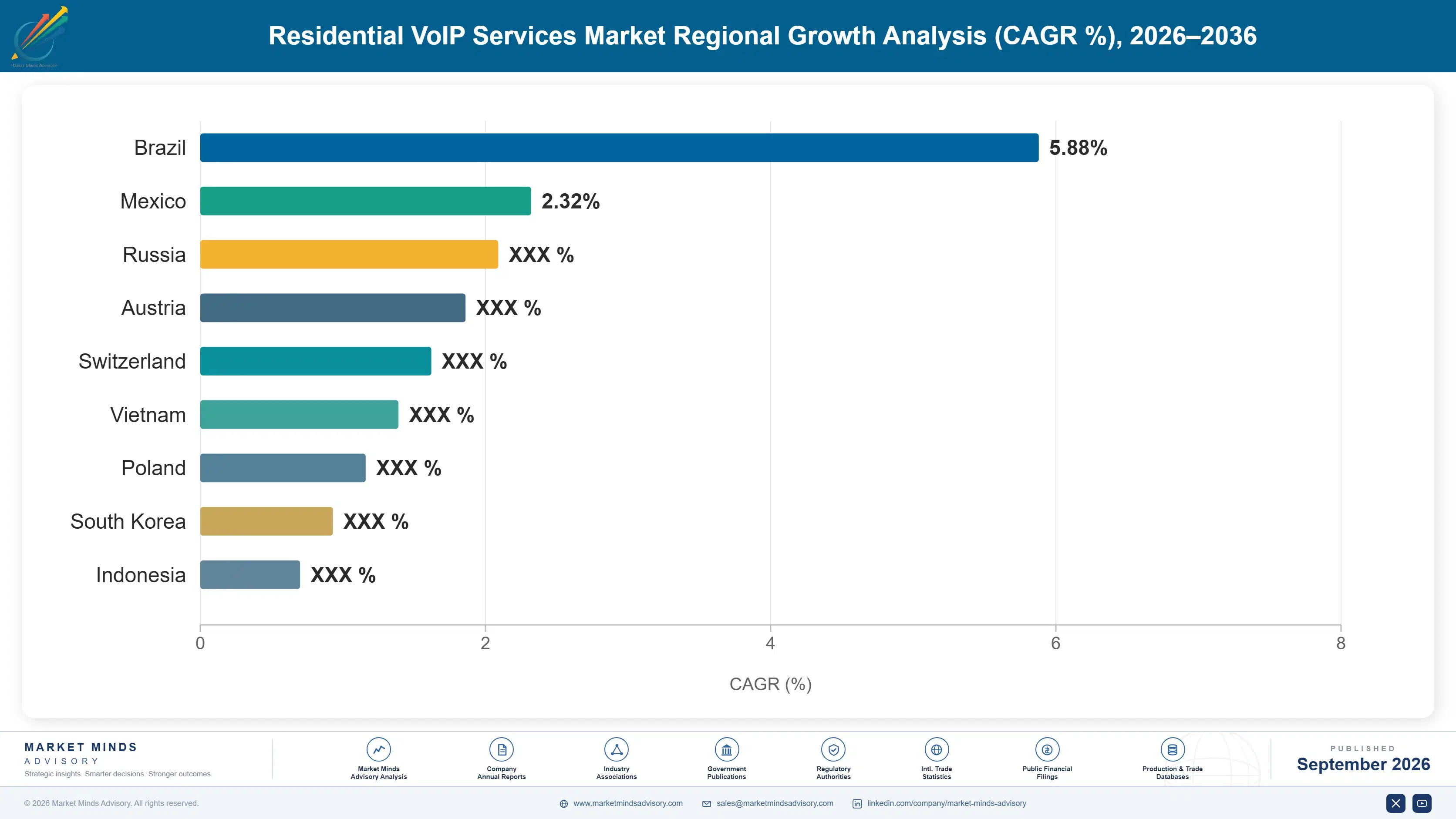
residential-voip-services-market-country-cagr-analysis-1790002375760

Where Providers Can Still Grow Voice Revenue

Providers expand voice-related revenue less through raising standalone voice pricing than through using it as a retention anchor for broadband and video bundles, since consumers increasingly resist paying directly for a service many rarely use on their own without any dedicated added feature set worth genuine attention, additional cost, or ongoing customer loyalty over time.

Bundling Advanced Call Screening and Filtering Features

Providers that bundle spam call filtering, voicemail transcription, and caller identification features into standard voice packages capture meaningfully higher perceived value than those offering basic dial tone alone, giving consumers a genuine reason to keep a bundled line active even in mobile-first households. These features address a real consumer pain point around unwanted robocalls, letting providers reposition voice as a value-added service rather than a legacy utility. Comcast's advanced call screening rollout reportedly reduced voice line cancellation requests by roughly 12 percent among enrolled subscribers according to figures the company disclosed publicly.
Market Impact: Cuts voice line cancellations by roughly 12 percent

Cross-Selling Fixed Wireless Voice Into Underserved Areas

Providers expanding fixed wireless broadband into rural and underserved areas capture entirely new bundled voice subscribers who never previously had a wireline voice option available at all, representing genuine incremental revenue rather than migration from an existing service. This lever has become increasingly valuable as fixed wireless infrastructure investment expands across emerging markets, giving providers with existing fixed wireless assets a meaningful advantage capturing subscriber growth ahead of wireline-only competitors still relying purely on traditional cable buildout. Fixed wireless subscriber additions now represent roughly 11 percent of total industry growth annually across all served markets.
Market Impact: Adds roughly 11 percent new subscribers yearly overall

Monetising International Calling Add-On Packages Directly

Providers increasingly sell discounted international calling packages as a premium add-on to base bundled voice service, specifically targeting immigrant households maintaining regular calling relationships with family in other countries. This lever captures revenue that would otherwise flow entirely to standalone international calling applications, since bundled international packages can undercut standard per-minute international rates while still generating meaningful incremental revenue per subscriber, now representing roughly 9 percent of total segment revenue among eligible households. This approach also strengthens retention among immigrant households who would otherwise migrate entirely to a standalone international calling application instead.
Market Impact: Contributes roughly 9 percent of total segment revenue

Extending Smart Home Integration Beyond Basic Calling

Providers increasingly integrate bundled voice service with smart home devices and virtual assistants, letting households make and receive calls through connected speakers and displays rather than a dedicated telephone handset. This extends the practical utility of a bundled voice line well beyond traditional calling, giving providers a genuine differentiation angle against standalone calling applications that lack equivalent smart home integration depth, with early adopter households showing roughly 15 percent higher voice line retention than the broader subscriber base. Providers without this integration capability increasingly lose the associated differentiation value to standalone competitors entirely.
Market Impact: Improves subscriber retention by roughly 15 percent overall

Who Controls the Margin Pool

Concentration sits at a CR5 near 42 percent, moderate for a services market this mature, with a real but not overwhelming gap between Comcast as the largest single bundled provider and challengers such as Vodafone and AT&T that compete hardest through international scale and mobile-fixed convergence bundling. That gap has narrowed only slightly as challengers invest in international scale to close it over time.
Current competitive activity centres on three fronts: bundling advanced call management features to justify keeping a voice line active, expanding fixed wireless infrastructure to capture new underserved subscribers, and integrating bundled voice with smart home platforms to differentiate against free standalone calling applications. Providers pursuing all three fronts simultaneously are pulling ahead of rivals still focused narrowly on one.

Emerging pressure is coming from standalone application providers that offer calling functionality entirely free, monetising instead through advertising or premium feature upsells rather than direct subscription revenue. Rankings could shift meaningfully if these standalone providers continue capturing younger, cost-conscious households before they ever establish a bundled voice habit in the first place. Providers slow to respond risk losing an entire generation of households before they ever establish a bundled habit.
residential-voip-services-market-company-positioning-matrix-1790002376279

Competitive Moat and Risk Dimensions

COMCAST CORPORATION

Moat: Massive Bundled Installed Base

Comcast operates the largest bundled residential voice subscriber base in North America, built through decades of triple-play and quad-play packaging that made voice functionally free alongside broadband and video. This installed base gives it genuine scale advantages in customer support infrastructure and network engineering that smaller regional competitors cannot easily match.
COMCAST CORPORATION

Risk: Cord-Cutting Erodes Retention Value

Comcast's bundled voice strategy depends on customers still valuing broadband and video enough to keep the whole package intact, but as broadband increasingly gets purchased standalone and video shifts to streaming, the bundling logic that once protected voice revenue weakens considerably each year. That pressure is likely to intensify further.
VODAFONE GROUP PLC

Moat: Pan-European Convergence Scale

Vodafone's fixed-mobile convergence strategy across multiple European markets lets it bundle residential voice alongside mobile plans in ways single-country competitors cannot replicate, giving it genuine cross-selling reach across a large multinational subscriber footprint. That reach lets it negotiate more favourable equipment and interconnection terms than smaller single-country competitors typically manage on their own.
VODAFONE GROUP PLC

Risk: Regulatory Fragmentation Across Markets

Vodafone must navigate distinct telecommunications regulations, pricing transparency rules, and number portability requirements across each European market it serves, adding meaningful compliance overhead that a single-market competitor focused entirely on one regulatory regime does not face. This overhead grows heavier as more markets introduce distinct data protection and consumer pricing disclosure requirements each year.

Players Tracked

Prominent Players

Comcast Corporation
Vodafone Group Plc
AT&T Inc
Charter Communications Inc
Orange SA

Other Key Players

Deutsche Telekom AG
BT Group Plc
Telefonica SA
Vonage Holdings Corp
Ooma Inc
magicJack VocalTec Ltd
RingCentral Inc
NTT East Corporation
KDDI Corporation
China Telecom Corporation Limited
Telstra Corporation Limited
Rogers Communications Inc
Bell Canada
Telecom Italia SpA
Reliance Jio Infocomm Limited

Recent Developments

FEBRUARY 2026

Comcast Launches AI Call Screening Router Bundle

Comcast organically expanded its residential voice feature set by launching a new WiFi router bundle with built-in artificial intelligence call screening and spam filtering, aiming to give bundled subscribers a genuine reason to keep their voice line active rather than cancel it. The feature targets subscribers considering cancellation.
Signal: Feature differentiation is quickly becoming the primary competitive retention lever for every major bundled voice provider
OCTOBER 2025

AT&T Acquires Regional Fixed Wireless VoIP Provider

AT&T completed the acquisition of a regional fixed wireless internet provider whose bundled voice offering already served several underserved rural markets, expanding its own fixed wireless bundled voice footprint into new geographic areas across the country. The deal brings the acquired provider's existing subscriber base directly under AT&T's ownership structure.
Signal: Fixed wireless bundled voice is quickly becoming a genuine acquisition target for every larger telecom operator
MAY 2026

Vodafone Signs Cloud Calling Platform Partnership

Vodafone signed a multi-year partnership agreement with a cloud communications platform provider to integrate over-the-top style calling features directly into its bundled residential voice offering across several European markets. The partnership lets Vodafone offer app-based calling features without building the underlying technology internally from scratch.
Signal: Incumbent operators are steadily embedding these OTT-style features to compete directly with free standalone calling applications

What Actually Drives Voice Service Cost

Network interconnection fees and customer premises equipment together represent 25 to 32 percent of cost of goods sold for bundled voice providers, sourced primarily from telecommunications interconnect agreements and router or gateway hardware manufacturers rather than from broadly diversified supply chains. Providers with large existing subscriber bases typically negotiate more favourable equipment pricing than smaller regional competitors purchasing similar hardware volumes.
Interconnection and long-distance termination fees fluctuated meaningfully during 2023, a period documented in national telecommunications regulator filings including those from the United States Federal Communications Commission, forcing several smaller providers to renegotiate wholesale carrier agreements as termination rates in certain international corridors rose faster than retail pricing could absorb. Providers that had not locked in fixed-rate wholesale agreements in advance absorbed the largest share of that increase.

Smaller regional providers without large-scale wholesale interconnection agreements absorb a proportionally larger share of termination fee volatility than Comcast or Vodafone, which negotiate favourable bulk termination rates directly with carriers across their much larger call volumes. This cost gap compounds the competitive disadvantage smaller providers already face on customer support infrastructure, squeezing margins from multiple directions during any period of interconnection pricing volatility.
residential-voip-services-market-cost-volatility-analysis-1790002376478

Negotiating Bulk Wholesale Interconnection Agreements

Larger providers lock in bulk wholesale termination rate agreements with carriers rather than paying standard per-minute rates, trading some short-term flexibility for meaningfully lower unit interconnection costs that hold steady even as market-wide termination pricing fluctuates. This has become standard practice among the largest providers. Smaller regional providers increasingly pool purchasing volume through industry consortia to access comparable discount tiers.

Routing International Calls Through Lower-Cost Carriers

Providers are increasingly using automated least-cost routing systems that direct international calls through whichever wholesale carrier offers the lowest termination rate for a given destination at that moment, reducing blended interconnection cost without affecting call quality. This materially reduces exposure to any single carrier's pricing changes. Providers report this system meaningfully lowers overall exposure during periods of industry-wide termination rate.

Subsidising Router Hardware Through Multi-Year Contracts

Providers increasingly subsidise the upfront cost of advanced router hardware by spreading it across multi-year service contracts, reducing the customer's upfront cost barrier while locking in predictable recurring revenue that offsets the hardware subsidy over the life of the contract. This approach has become increasingly common as router hardware costs continue rising across the broader industry.

Portfolio Architecture for Margin Defence

The portfolio splits into three tiers running from commodity-adjacent basic bundled dial tone through certified feature-rich voice packages to next-generation smart home integrated and fixed wireless bundled offerings, with gross margin widening meaningfully at each step as differentiated features replace basic connectivity. This layered structure closely mirrors how consumer services margins generally scale with feature differentiation depth. Margins expand accordingly.
Volume tier bundled voice competes almost entirely as a free retention feature attached to broadband, while premium feature-rich packages command materially higher margin because they bundle call screening, international calling, and voicemail transcription that cost-conscious basic subscribers neither need nor pay extra for. Providers that try to serve both ends of that spectrum with one undifferentiated offering tend to lose ground on both fronts simultaneously.

The highest-value margin pools concentrate in the next-generation tier, where smart home integration and fixed wireless bundled voice carry premium positioning that providers use specifically to differentiate against free standalone calling applications eroding the basic tier's standalone value proposition entirely. Providers are therefore prioritising investment in that tier even where near-term revenue contribution still remains comparatively modest relative to volume tier subscriptions.

Volume / Commodity-Adjacent Tier

Basic bundled dial tone voice offered essentially free as a broadband retention feature with minimal added functionality. These lines generate almost no direct revenue and exist purely to protect the broader bundle from cancellation.
Gross Margin: 8-16%

Premium / Certified Tier

Feature-rich voice packages bundling call screening, voicemail transcription, and international calling add-ons. Subscribers at this tier typically renew for multiple consecutive years once they experience the added feature value. Renewal rates here run consistently higher than the volume tier.
Gross Margin: 22-30%

Sustainability / Regulatory / Next-Generation Tier

Smart home integrated and fixed wireless bundled voice commanding the highest per-subscriber margin available. Margins here reflect genuine differentiation rather than incremental additions layered onto basic dial tone service. Very few providers can credibly compete at this level.
Gross Margin: 32-40%
residential-voip-services-market-portfolio-architecture-1790002376981

High-value Sub-segments and Strategic Watch-out

Fixed Wireless Bundled Voice

Highest growth and highest margin pool in the market, driven by underserved households gaining their first bundled voice option through fixed wireless infrastructure expansion. Providers investing heavily here today are positioning for the largest share of long-term margin expansion available in this market. Adoption keeps accelerating steadily.
Gross Margin: 34-42%

Smart Home Integrated Calling

High-value segment growing more moderately as providers differentiate against free standalone applications through deeper connected device integration and features. Continued smart home adoption should keep steadily reinforcing this segment's relative commercial importance in the years ahead across most developed markets. Vendors without a comparable integration strategy struggle to differentiate here.
Gross Margin: 28-36%

Standard Fibre and Cable Bundled Voice

The volume core of the market, growing near the overall market average as most remaining growth comes from emerging market fibre expansion into new households. Most provider revenue still originates here even as faster-growing premium tiers increasingly attract the bulk of new investment. Growth continues steadily overall.
Gross Margin: 14-22%

Legacy Copper Landline Replacement

A shrinking segment providers should watch closely, as remaining copper-based subscribers migrate away but still represent thinning revenue with rising maintenance cost per line. Support cost per remaining line keeps climbing steadily even as the installed base itself keeps shrinking. Providers ignoring this trend risk losing maintenance revenue unexpectedly.
Gross Margin: 4-10%

Why Dormant Lines Persist

Bundled voice contracts behave like a low-value annuity once attached to a broadband subscription, since the marginal cost of keeping the line active is near zero for the provider while cancelling it requires the customer to actively call support and request removal, a friction point that keeps many inactive lines nominally subscribed for years without generating any real revenue. Providers rarely flag these dormant lines for removal.
Adoption runs deepest among older households and those with elderly relatives still comfortable with landline-style calling, who extract genuine ongoing value from a dedicated home number, while younger mobile-first households increasingly never activate the bundled voice line included with their broadband subscription at all, letting it sit dormant indefinitely without ever placing a call. This pattern generates no actual usage whatsoever.

A generational shift in buyer profile is underway as broadband purchasing decisions increasingly get made by younger household members who view bundled voice as an irrelevant legacy inclusion, favouring providers who bundle features like mesh WiFi and streaming credits over those still marketing voice quality as a primary differentiator worth attention. This shift is reshaping bundled package marketing broadly.
residential-voip-services-market-end-use-penetration-index-1790002377472

What Determines Who Wins This Market

These are among the four positions where our research anticipates prominent divergence between winners and laggards over the coming forecast period. Each is grounded in the demand model, the regulatory perimeter, and the announced capacity pipeline.
01 / FEATURE DIFFERENTIATION INVESTMENT

Bundled voice survives only by becoming a genuinely useful feature bundle

Providers that continue treating bundled voice as basic dial tone risk losing the retention value it once provided, since consumers increasingly see no reason to keep a line active that offers nothing beyond what a free standalone application already delivers. Providers investing in call screening, voicemail transcription, and smart home integration are successfully repositioning voice as a value-added feature rather than a legacy inclusion. Providers that fail to make this shift risk watching bundled voice attach rates erode further as younger households never activate lines offering no differentiated value.
02 / FIXED WIRELESS EXPANSION PRIORITY

New subscriber growth increasingly comes from underserved areas, not existing markets

Providers expanding fixed wireless broadband into rural and underserved areas capture genuinely new bundled voice subscribers who never previously had a wireline option, representing real incremental growth rather than migration from an existing service. This growth pool matters increasingly as developed urban and suburban markets approach saturation with little remaining unbundled household opportunity left to capture. Providers without fixed wireless infrastructure investment risk missing this genuine growth opportunity entirely, ceding it to competitors already expanding aggressively into these same underserved markets.
03 / EMERGING MARKET BUNDLING STRATEGY

Voice still carries genuine standalone value in newly connected households

Unlike developed markets where voice functions purely as a retention tool, emerging market households connecting to fibre or fixed wireless broadband for the first time often still value a dedicated home number for reaching elderly relatives who prefer landline-style calling. Providers in these markets should continue bundling voice as a default inclusion rather than treating it as an afterthought. This genuine value proposition differs meaningfully from developed markets, where voice increasingly means nothing to the household purchasing broadband, a distinction that should guide regional investment priorities.
04 / STANDALONE APPLICATION COMPETITIVE RESPONSE

Incumbents must integrate OTT-style features rather than compete on price alone

Standalone calling applications compete primarily on being free, a price point bundled voice providers cannot profitably match directly, making feature integration the only viable competitive response available to incumbent operators. Vodafone's cloud calling platform partnership illustrates this strategy directly, embedding OTT-style functionality into a bundled offering rather than attempting to out-compete free applications on price. Providers that ignore this shift risk watching standalone applications capture an increasing share of calling behaviour even among households that still nominally subscribe to bundled voice.

Engagement Snapshot From the Field

A live engagement with an industry participant carrying material or product regulatory and market exposure ahead of a defining policy shift, showing how our research translates into a defensible multi-year portfolio strategy.
MARKET MINDS ADVISORY · CLIENT ENGAGEMENT SUMMARY
Residential VoIP Services Producer Strategic Portfolio Review and Transition Roadmap 2026·Investment Scenario on Residential VoIP Services Exposure Evaluation 2025-26
CLIENT PROFILE
The client, a regional North American cable operator serving several mid-sized metropolitan markets, had watched bundled voice attach rates decline steadily over several years as younger subscribers increasingly declined the service when signing up for broadband. Annual voice-related support costs had reached approximately 22 million dollars (client-reported, unverified by MMA), with leadership uncertain whether continuing to offer bundled voice at all still made commercial sense.
STRATEGIC CHALLENGE
The operator needed to decide whether to continue investing in bundled voice infrastructure and support, discontinue the offering entirely to cut costs, or reposition it around features that might genuinely appeal to younger, mobile-first subscribers rather than continuing to market it as basic dial tone. while avoiding a subscriber backlash from any change perceived as a service downgrade.
MMA APPROACH
MMA benchmarked the operator's voice attach rates and feature set against comparable regional operators, modelling the revenue and retention impact of discontinuing bundled voice versus investing in call screening and smart home integration features. The analysis prioritised understanding which subscriber segments genuinely valued continued voice access versus those who had simply never cancelled a dormant line.
KEY FINDINGS
  1. Roughly 40 percent of the operator's active voice lines had placed zero outbound calls in the preceding six months., suggesting significant latent cancellation risk within the existing subscriber base.
  2. Subscribers who used call screening features on a trial basis showed meaningfully lower overall broadband churn rates., indicating a genuine causal link between feature engagement and broader loyalty.
  3. Discontinuing bundled voice entirely risked a measurable increase in broadband-only churn among older subscriber segments specifically., particularly among long-tenured subscribers who valued the service most.
  4. Feature-rich voice packages could be introduced at minimal incremental cost given the operator's existing router hardware capabilities., requiring no meaningful additional capital investment from the operator.
CLIENT PROFILE
The client, a regional North American cable operator serving several mid-sized metropolitan markets, had watched bundled voice attach rates decline steadily over several years as younger subscribers increasingly declined the service when signing up for broadband. Annual voice-related support costs had reached approximately 22 million dollars (client-reported, unverified by MMA), with leadership uncertain whether continuing to offer bundled voice at all still made commercial sense.
STRATEGIC CHALLENGE
The operator needed to decide whether to continue investing in bundled voice infrastructure and support, discontinue the offering entirely to cut costs, or reposition it around features that might genuinely appeal to younger, mobile-first subscribers rather than continuing to market it as basic dial tone. while avoiding a subscriber backlash from any change perceived as a service downgrade.
MMA APPROACH
MMA benchmarked the operator's voice attach rates and feature set against comparable regional operators, modelling the revenue and retention impact of discontinuing bundled voice versus investing in call screening and smart home integration features. The analysis prioritised understanding which subscriber segments genuinely valued continued voice access versus those who had simply never cancelled a dormant line.
KEY FINDINGS
  1. Roughly 40 percent of the operator's active voice lines had placed zero outbound calls in the preceding six months., suggesting significant latent cancellation risk within the existing subscriber base.
  2. Subscribers who used call screening features on a trial basis showed meaningfully lower overall broadband churn rates., indicating a genuine causal link between feature engagement and broader loyalty.
  3. Discontinuing bundled voice entirely risked a measurable increase in broadband-only churn among older subscriber segments specifically., particularly among long-tenured subscribers who valued the service most.
  4. Feature-rich voice packages could be introduced at minimal incremental cost given the operator's existing router hardware capabilities., requiring no meaningful additional capital investment from the operator.
RECOMMENDED STRATEGY
Phase 1: Phase 1 (Months 1 to 3): Introduce call screening and voicemail transcription features to all existing bundled voice subscribers at no additional cost. Phase 2: Phase 2 (Months 4 to 8): Market the enhanced feature set specifically to new broadband sign-ups rather than continuing to position voice as basic dial tone. Phase 3: Phase 3 (Months 9 to 14): Evaluate whether to phase out dormant, zero-usage voice lines to reduce ongoing support cost without affecting active subscribers.
OUTCOME
The operator retained bundled voice as a retention feature rather than discontinuing it, and measured broadband churn improved modestly among subscribers who actively used the new call screening features (client-reported, unverified by MMA). Leadership credited the phased approach with avoiding the subscriber backlash a full discontinuation would likely have triggered.

Frequently Asked Questions

Foundational context covering the market sizes, CAGR, scope, country, region and competition that inform every finding below. This section is provided to cover basics and most often pre-purchase conversations, answered from the MMA Primary Research Dataset.

What is the current size of the Residential VoIP Services Market?

The global market was valued at 16.8 billion dollars in 2025. The United States represents the largest single national installed subscriber base within that total.

How large will the Residential VoIP Services Market be by 2036?

The global market is projected to reach 27.264 billion dollars by 2036, up from 17.556 billion dollars in 2026, a 1.55x expansion over the forecast decade.

What is the CAGR for the Residential VoIP Services Market 2026 to 2036?

The market is forecast to grow at a 4.5 percent compound annual rate globally, with growth concentrated in emerging markets rather than developed bundled voice bases.

Which segment is growing fastest?

Over-the-top residential VoIP applications lead all segments at an 8.5 percent CAGR, roughly 1.89 times the overall market rate, as standalone calling displaces bundled landline replacement.

Who are the major companies in the Residential VoIP Services Market?

Comcast, Vodafone, AT&T, Charter Communications, and Orange together hold the largest share, with CR5 concentration near 42 percent across the global market. That concentration has held relatively steady as consolidation offsets new standalone entrants.

Which country is growing fastest?

India leads growth at an 8.0 percent CAGR, driven by fibre and fixed wireless broadband rollout bringing bundled voice to tens of millions of newly connected households.

Report Segmentation Architecture

The full report scope spans multiple orthogonal segmentation dimensions, with cross-tabulated demand data provided for each dimension pair. Coverage extends further to regional breakdowns, trend trajectories, and the competitive detail needed to support segment-level decision-making.

By Primary Market Dimension

  • Over-the-Top Residential VoIP Applications
  • Fixed Wireless Voice Bundles
  • Cable-Based Digital Voice
  • Fibre-Bundled Voice Services
  • Managed VoIP via ISP Bundles
  • VoIP Gateway and CPE Equipment

By End-Use Industry

  • Cable Broadband Households
  • Fibre Broadband Households
  • Fixed Wireless Households
  • Mobile-First Households
  • Rural and Underserved Households

By Commercial Dimension

  • Bundled Broadband Subscribers
  • Standalone Application Users
  • Premium Feature Add-On Subscribers
  • International Calling Package Subscribers

By Region

  • North America
  • Western Europe
  • East Asia
  • South Asia and Pacific
  • Latin America
  • Middle East and Africa
  • Eastern Europe

Scope, Methodology, and Coverage

Every figure in this report is reproducible from documented input assumptions. The scope below maps the historical period, the forecast horizon, the segmentation dimensions, and the countries covered, alongside the underlying primary and qualitative methodology.
Historical Period
2020 to 2025
Forecast Period
2026 to 2036
Base Year
2025 (USD billions; MMA Primary Research Dataset, September 2026)
Market Definition
This market covers voice calling services delivered over internet protocol to residential households, including cable and fibre-bundled digital voice lines, standalone over-the-top calling applications, and fixed wireless voice services. It excludes enterprise and business VoIP services and mobile cellular voice plans.
Quantitative Units
USD billions (current prices); regional and segment CAGR in percent
Segmentation Dimensions
By Primary Market Dimension; By End-Use Industry; By Commercial Dimension; By Region
Regions Covered
North America, Western Europe, East Asia, South Asia and Pacific, Latin America, Middle East and Africa, Eastern Europe
Countries Covered
USA, China, Germany, France, UK, Japan, South Korea, India, Australia, Canada, Brazil, Mexico, Indonesia, Vietnam, Thailand, Malaysia, UAE, Saudi Arabia, South Africa, Nigeria, Turkey, Poland, Netherlands, Italy, Spain, Sweden, Switzerland, Argentina, Colombia, Singapore, and additional markets relevant to this sector
Key Companies Profiled
Comcast Corporation, Vodafone Group Plc, AT&T Inc, Charter Communications Inc, Orange SA, Deutsche Telekom AG, BT Group Plc, Telefonica SA, Vonage Holdings Corp, Ooma Inc, magicJack VocalTec Ltd, RingCentral Inc, NTT East Corporation, KDDI Corporation, China Telecom Corporation Limited, Telstra Corporation Limited, Rogers Communications Inc, Bell Canada, Telecom Italia SpA, Reliance Jio Infocomm Limited
Quantitative Methodology
Primary survey, n=3,800 respondents, Q4 2025, six countries; demand-side model with trade association cross-validation
Qualitative Methodology
47 expert interviews, Q4 2025; applied to validate demand model assumptions, identify emerging dynamics, and assess competitive positioning
Report Format
PDF and XLSX data workbook (Word format preview document)
Publisher
Market Minds Advisory
Report Code
MMA-2026-TEC-625
Published
September 2026
Contact
sales@marketmindsadvisory.com | www.marketmindsadvisory.com

Purchase the full Residential VoIP Services Market Report (2026 to 2036).

The full report delivers a complete quantitative and qualitative assessment of the Residential VoIP Services Market across all seven regions and six product segments. It includes detailed vendor profiles for all twenty companies covered, alongside country-level sizing for thirty markets. Primary research draws on thirty-eight hundred survey respondents and forty-seven expert interviews conducted in the fourth quarter of 2025 across six countries. Buyers receive full editable data tables alongside the complete narrative analysis, competitive vendor scorecards, and forward-looking scenario modelling included in every purchase. Analysts remain available for direct follow-up questions.
Twenty vendor profiles with moat and risk analysis
Seven-region market sizing with country breakdowns
Six-segment technology framework with growth rates
Primary survey data collected across six countries
Forty-seven expert interview insights fully included
Editable data tables for all forecast figures

Built For The People Who Decide

From boardroom strategy to bench-side execution, this report is read cover-to-cover by leaders shaping the next decade of their industry, turning demand scenarios, market dynamics and valuation benchmarks into decisions.
CXOs/ Presidents/ VPs/ Managers
M&A and Corporate Development
Strategy Teams and R&D Heads
Procurement and Product Directors
Regulatory and Compliance Leaders
Investor Relations and Equity Analysts