Market Minds Advisory
Residential PVC Electrical Conduit Market

Residential PVC Electrical Conduit Market: Residential PVC Electrical Conduit Market. Housing Construction Volume Meets Tightening Fire Code Standards

Rising residential construction volume and tightening electrical fire code requirements are pushing builders toward certified rigid and flexible PVC conduit, reshaping which manufacturers capture specification as resin costs and regional building code variation continue widening.

Lead Analyst

Published

September 2026

Make Smarter Decisions with Customized Research Insights

Request a free sample report and evaluate market opportunities, growth trends, and competitive dynamics relevant to your business needs.

2025 MARKET VALUE$4.2BMarket Size 2025
2036 FORECAST VALUE$6.9BBase Case , 2026 to 2036
CAGR 2026 TO 20364.6 %Bull 5.8% / Bear 3.4%
INCREMENTAL OPPORTUNITY$2.5BNet 10- year value creation
EXPANSION MULTIPLE1.57x2036 value over 2026 base
Strategic Levers
M&A Pipeline
Regional Outlook
Country Rankings
Competitive Intelligence
Segmental Deep-dive
Call-Us : 91 93563 13602

Executive Snapshot and Market Trajectory.

Builders are treating certified PVC conduit as a baseline electrical code requirement rather than an optional upgrade, as tightening fire safety standards and rising residential construction activity push specification decisions earlier into the project planning process across most major national housing markets tracked today.
Commercial momentum concentrates around flexible corrugated conduit and pre-wired assemblies, since electrical contractors increasingly value installation speed and labor savings alongside raw material cost. East Asia accounts for the largest share of production volume, reflecting China's massive residential construction pipeline and domestic PVC resin manufacturing base. Regional building code variation continues to complicate standardized product lines for manufacturers selling across multiple national markets simultaneously across multiple jurisdictions.
Competition splits between large diversified building products conglomerates offering full electrical product portfolios and specialist conduit manufacturers selling standalone PVC systems. Rising residential construction volume and tightening fire code enforcement are increasingly shaping which conduit specifications contractors default to when bidding new residential projects nationwide. Component suppliers report a steady pipeline of fitting and connector orders as certified system compatibility becomes the expected purchasing standard. Resin price volatility increasingly factors into contractor bid pricing decisions.
Market Definition
This market covers rigid and flexible polyvinyl chloride conduit systems, including fittings and connectors, used for electrical wiring protection in single family and multi-family residential construction. It excludes metallic conduit, commercial and industrial grade conduit systems, and non-electrical PVC piping applications.
Base Year Value
$4.2B in 2025 (MMA Primary Research Dataset, September 2026)
Forecast Period
2026 to 2036, eleven discrete annual values
CAGR
4.6% base case. Bull 5.8%. Bear 3.4%.
Fastest Growth Segment
Flexible Corrugated PVC Conduit: 7.4% CAGR
Fastest Growth Country
India: 6.9% CAGR
Fastest Growth Region
South Asia and Pacific: 6.8% CAGR
Largest Region
East Asia: 27% of 2025 global value
Market Leaders
Atkore Inc, Cantex Inc, IPEX Inc, Prime Conduit Inc, JM Eagle Inc. Source: MMA Analysis based on company annual reports.
Primary Survey
n=3,800 procurement and R&D decision-makers, Q4 2025, six countries
Methodology
Demand-side build-up, cross-validated against public data, 47 expert interviews

Residential PVC Electrical Conduit Market Forecast Scenarios

residential-pvc-electrical-conduit-market-size-forecast-scenario-1788412317131
Between 2020 and 2025, residential conduit demand grew steadily as housing construction activity recovered from pandemic-era disruption and code enforcement tightened across major metro building departments nationwide overall. Historical growth ran close to 4.1 percent annually over that period, with flexible corrugated formats gaining share as installers sought labor savings across most regional markets tracked.
The base case assumes continued moderate growth, supported by three commercial mechanisms working together: tightening fire code enforcement pushing certified conduit specification into a growing share of renovation and retrofit projects, rising new home construction volume across major metro markets pulling substantial new conduit order volume, and contractors standardizing around flexible pre-wired assemblies to reduce on-site labor cost and installation time considerably across nearly every major project type currently tracked.
A bull scenario assumes faster new housing construction recovery and broader code enforcement adoption across additional jurisdictions, pushing growth toward the top of the forecast range. The bear risk centers on resin cost: if PVC resin prices rise faster than contractor bid pricing can adjust, some builders could substitute alternative conduit materials where local code allows for a lower-cost option.

Where Housing Volume Meets Code Compliance

Converging forces are reshaping this category: tightening fire code enforcement, rising new home construction volume, and growing contractor preference for flexible pre-wired assemblies are pushing conduit specification from routine procurement into a genuine project planning consideration. Building department scrutiny of certified conduit compliance has made specification a standing checklist item across most residential permit reviews.
MARKET CONCENTRATIONCR5 41%top five manufacturers hold under half of share
AVERAGE CONDUIT ASP$0.40-$1.80 per linear footvaries with diameter, wall thickness, and flexibility type chosen
LEADING MANUFACTURING COUNTRY SHAREChina 33% of global productionreflecting the country's dense residential construction and resin capacity
FLEXIBLE CONDUIT ADOPTION RATE34% of new installation volumerising steadily as contractors seek faster on-site labor savings
RENOVATION AND RETROFIT SHARE27% of total demand volumereflecting steady replacement need across aging housing stock nationwide
AVERAGE PRODUCT SERVICE LIFE40-plus years typical lifespanreinforcing steady low-frequency replacement demand across most housing markets
Commercial character in this market splits between large diversified building products conglomerates offering full electrical portfolios and specialist conduit manufacturers selling standalone PVC systems through regional distribution channels. Resin sourcing scale and code certification breadth increasingly determine which suppliers win specification in new residential development bids. Manufacturers without established multi-state certification increasingly struggle to win specification against incumbents with proven long-standing distributor relationships built over many years.
Fire code enforcement, flexible conduit adoption, and rising renovation activity will shape vendor strategy and product design over the next decade. Manufacturers that delay flexible product line investment risk losing share to better-positioned rivals with proven labor-saving product lines. That preference already favors early movers who invested in flexible manufacturing capacity well ahead of the broader industry shift now steadily underway across most regional markets tracked.
"Everyone assumes conduit is a commodity pipe, but the manufacturers actually winning residential specification are the ones who solved multi-state code certification years before enforcement tightened nationwide."
Director, Construction and Building Products Practice · MMA Construction and Industrial Equipment Practice · September 2026

Market Trends

Flexible Corrugated Conduit Gains Share Over Rigid Systems

Electrical contractors are increasingly specifying flexible corrugated PVC conduit over traditional rigid systems, since flexible formats cut installation time considerably by eliminating the need for precise bending and multiple joint connections around framing obstacles. Labor cost now represents the largest single component of total installation expense in most residential markets, making time savings a genuine commercial priority for contractors bidding competitively. Several major distributors report flexible conduit now accounts for 34 percent of new installation volume, up meaningfully from just a few years earlier. Manufacturers are expanding flexible product lines fastest across markets with the tightest skilled labor availability.
Market Impact: housing starts up 8% yearly
Fire Code Enforcement Tightens Across Major Metro Markets

Building departments in several major metro markets have tightened enforcement of certified conduit specification following isolated but widely publicized residential fire incidents traced to substandard aftermarket electrical products sold through informal channels. Inspectors now require documented UL certification at final inspection in jurisdictions that previously allowed self-certification by installing contractors. This shift has pushed builders toward established brands with proven certification track records, disadvantaging smaller regional manufacturers lacking the certification infrastructure to keep pace with tightening requirements. Several states are expected to adopt comparable enforcement standards within the next two years.
Market Impact: 27% of demand from renovation work

Market Opportunities and Growth Drivers

New Home Construction Volume Sustains Steady Baseline Demand

Housing starts across major markets have recovered meaningfully from pandemic-era disruption, with new single family and multi-family construction activity pulling substantial new conduit order volume into distribution channels each building season. The National Association of Home Builders reports starts climbing steadily over the past several years, and each new home requires a predictable quantity of conduit determined by square footage and electrical circuit count. This baseline demand provides manufacturers a stable order floor even as renovation-driven demand fluctuates with broader economic conditions and interest rate cycles affecting homeowner spending decisions.
Market Impact: resin prices swung over 40%

Renovation Activity Rises Across Aging Housing Stock Broadly

A large share of the existing housing stock in major developed markets was built before modern electrical code standards existed, creating substantial renovation-driven demand as homeowners upgrade electrical systems during broader remodeling projects. Renovation and retrofit activity now represents 27 percent of total conduit demand, a share that continues climbing as aging housing stock requires more frequent electrical system upgrades to meet current safety standards. Contractors report electrical panel upgrades increasingly trigger full conduit replacement throughout a home rather than isolated circuit repairs, expanding average project scope and order value considerably.
Market Impact: compliance costs up 15% relatively

Market Restraints and Challenges

PVC Resin Price Volatility Compresses Manufacturer Margins

PVC resin pricing has swung considerably over the past several years, driven by petrochemical feedstock cost volatility and periodic supply disruption at major North American production facilities following weather events and plant maintenance outages. The root cause traces to the conduit industry's near-total dependence on a small number of large-scale resin producers with limited near-term capacity flexibility. Manufacturers report margin compression during price spike periods, since fixed-price contractor bids cannot adjust mid-project when resin costs rise unexpectedly. Several manufacturers are now negotiating resin price escalation clauses into distributor contracts as a mitigation pathway to share volatility risk more evenly.
Market Impact: 34% share, up from low twenties

Regional Building Code Fragmentation Complicates Product Standardization

Building codes governing conduit specification vary considerably across states and even individual municipalities, forcing manufacturers to maintain multiple certified product variants rather than a single standardized national line sold everywhere. The root cause traces to the decentralized nature of United States building code adoption, where local jurisdictions retain authority to modify national model codes. Manufacturers report meaningfully higher compliance and inventory management costs as a result, and several are now investing in modular product designs that can be certified across multiple jurisdictions with minimal variant proliferation as a longer-term mitigation approach.
Market Impact: required in 60% of metros
3 additional market trends, 4 additional growth drivers, and 2 additional restraints and challenges are covered in the full report. Contact sales@marketmindsadvisory.com to access the complete intelligence.

Segment CAGR and Growth Architecture

Segmentation follows conduit form factor and rigidity, since manufacturers design, certify, and price PVC conduit around distinct manufacturing processes rather than by installation application, and each format carries a genuinely different installation labor, cost, and durability profile overall. This dimension also lines up cleanly with how electrical code standards are structured across most jurisdictions.
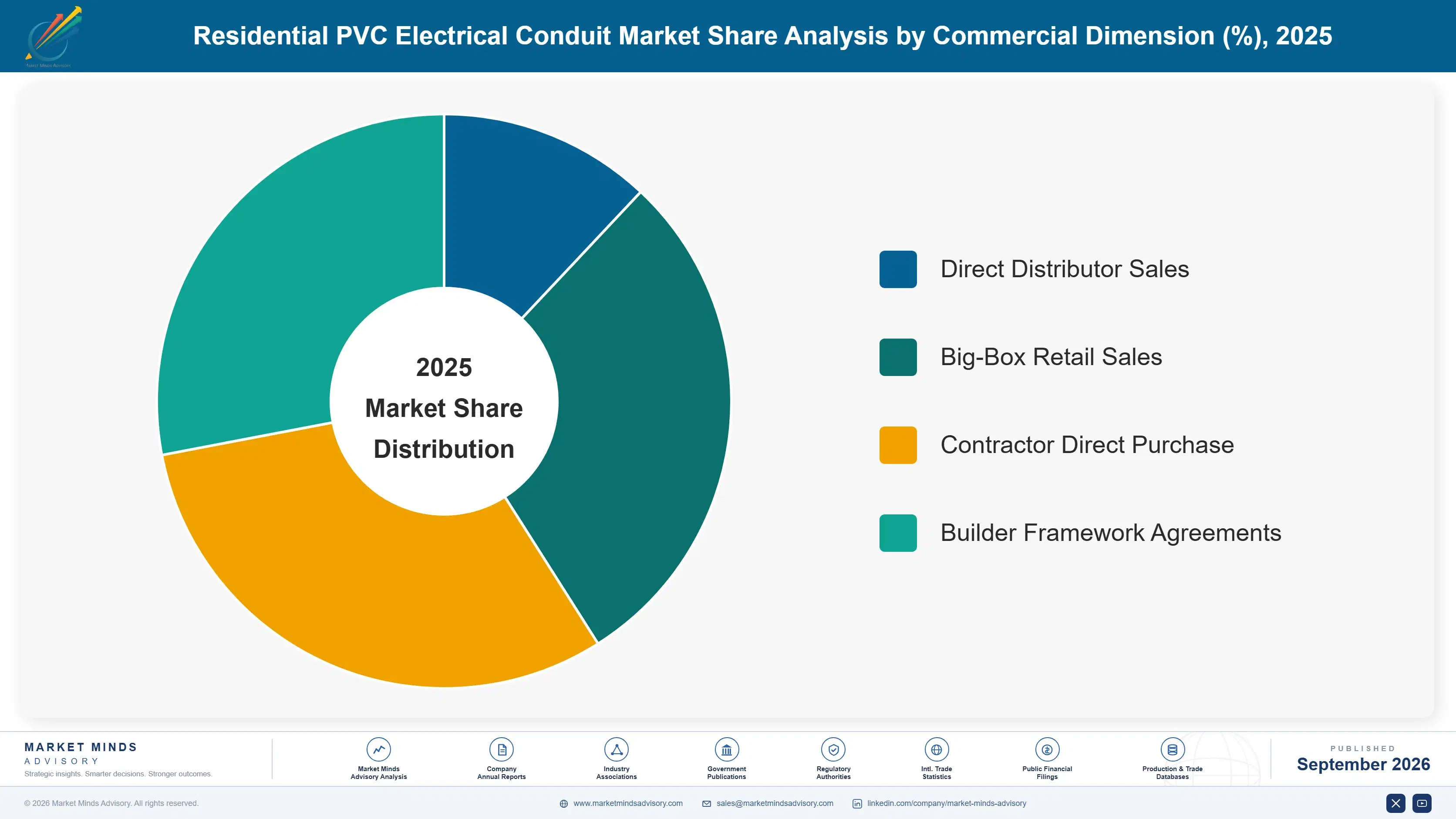
residential-pvc-electrical-conduit-market-market-share-analysis-1788412317664

Flexible Corrugated PVC Conduit

Flexible corrugated conduit is growing fastest because contractors increasingly value the labor time savings it offers over rigid systems requiring precise cutting, bending, and joint assembly around framing obstacles. Labor cost now represents the largest single component of installation expense in most residential markets, making time savings a genuine commercial priority rather than a marginal preference. Manufacturers with established flexible product manufacturing capacity are capturing disproportionate new order volume as this format becomes the contractor default, while smaller manufacturers still focused on rigid-only production increasingly struggle to compete on installation economics that homeowners and contractors both increasingly demand. Contractors increasingly cite flexible product availability as a factor in which distributor relationship they maintain going forward.
CAGR 7.4%

Fittings and Connector Systems

Fittings and connector systems are the second-fastest segment because certified compatibility between conduit and connection hardware has become an inspection requirement in an expanding number of jurisdictions following recent code updates. Contractors increasingly purchase complete certified systems from a single manufacturer rather than mixing components across brands to avoid inspection failures and rework costs. This shift is reshaping unit economics toward bundled system sales, and manufacturers who offer comprehensive certified product lines are positioned to capture outsized share of this expanding segment as code enforcement continues tightening across additional jurisdictions and metro markets nationwide. Manufacturers that offer training and technical support alongside certified bundles are winning disproportionate share of new contractor accounts.
CAGR 6.5%
Full segment breakdown across 6 segments available in the complete report.

Regional Architecture and Country Demand Map

East Asia leads global demand on the strength of China's dense residential construction pipeline and domestic PVC resin manufacturing base, while North America's steady renovation activity and tightening fire code enforcement sustain strong secondary demand across most established metro housing markets currently tracked closely nationwide.

North America

Renovation activity anchors demand growth across this region, since a large share of existing housing stock predates modern electrical code standards and requires upgrade work during broader remodeling projects. New home construction in fast-growing Sun Belt states adds steady incremental volume as builders standardize around certified conduit specification. United States building codes vary considerably by state and municipality, forcing manufacturers to maintain multiple certified product variants rather than a single national line. Canadian demand tracks a comparable renovation-driven pattern, though at meaningfully smaller absolute volume given the smaller housing base overall. This region's dual renovation and new-construction demand gives manufacturers a genuinely diversified revenue base. Distributors report steady demand across both coasts.
Share: 26% | CAGR: 5.6% (2026 to 2036)

Western Europe

Germany's stringent electrical safety code enforcement anchors demand in this region, requiring certified conduit specification in nearly all new residential construction and major renovation projects undertaken nationwide. France and the United Kingdom show comparable but somewhat lower adoption, tied to differing national code enforcement intensity and renovation activity levels across their respective housing stocks. Slower new housing construction growth across most of the region, reflecting demographic and land availability constraints, limits the category's overall growth ceiling relative to faster-growing construction markets elsewhere. Regional manufacturers benefit from proximity to end markets and established distributor relationships built over decades of operation. Import competition from Asian manufacturers remains limited by certification barriers. That certification barrier is expected to persist through the forecast period.
Share: 19% | CAGR: 3.2% (2026 to 2036)
Regional intelligence for 5 additional markets available in the complete report: East Asia, South Asia and Pacific, Latin America, Middle East and Africa, Eastern Europe. Contact sales@marketmindsadvisory.com.
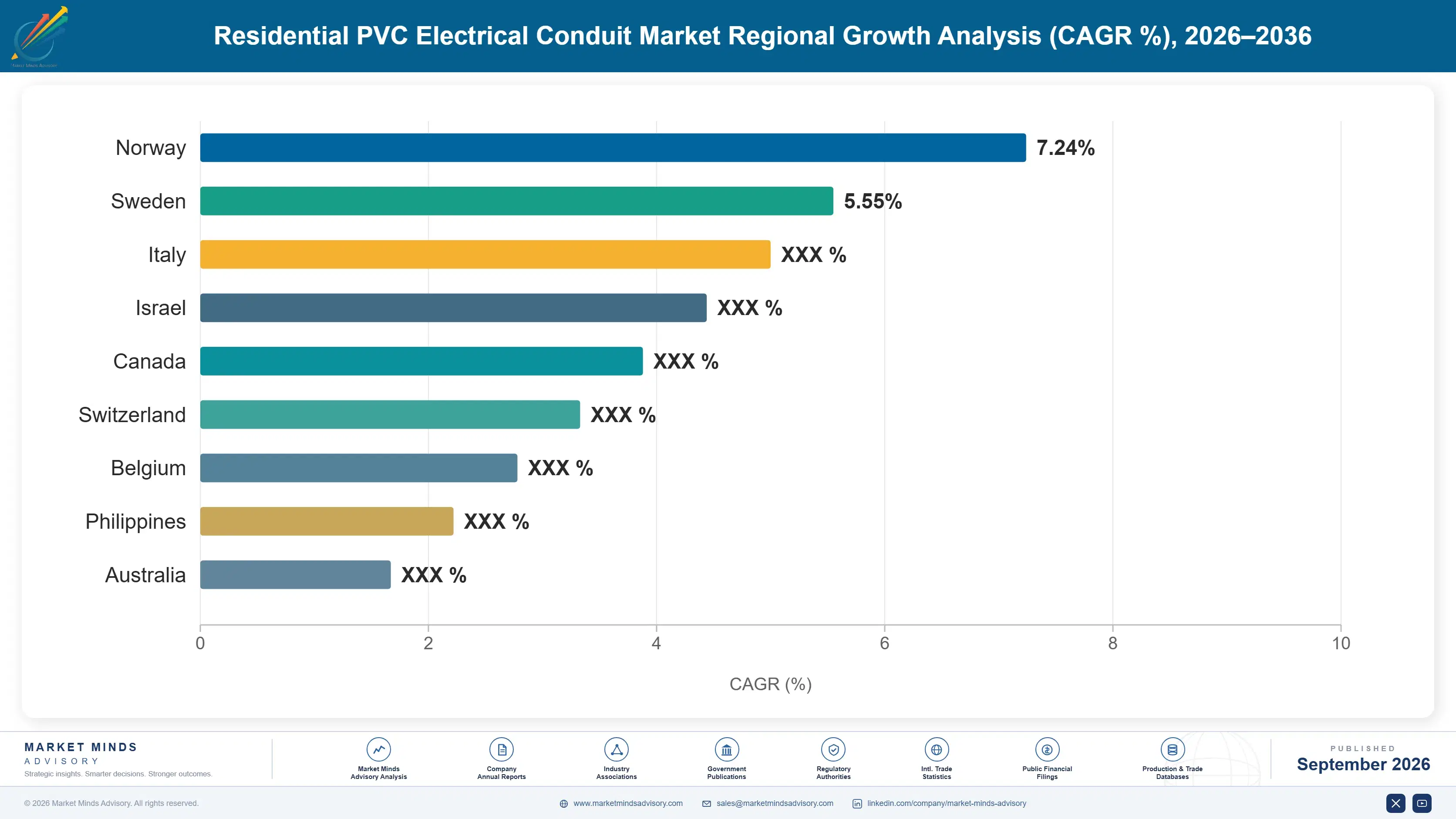
residential-pvc-electrical-conduit-market-country-cagr-analysis-1788412318169

Where Conduit Makers Should Focus Capital

Manufacturers face a widening set of commercial choices as flexible format adoption, code enforcement tightening, and renovation-driven demand reshape which capabilities actually capture margin across the value chain and its many distribution partners. The four levers below represent the clearest paths to expanding revenue meaningfully beyond simple linear-foot shipment growth alone this coming decade.

Flexible Product Line Capacity Expansion Strategy

Manufacturers investing in flexible corrugated conduit manufacturing capacity ahead of contractor demand can capture disproportionate share as installation labor economics push the format from a niche alternative into the mainstream default choice. Flexible formats already carry a modest price premium over rigid equivalents, and that premium is holding steady even as volume scales considerably. Early movers into flexible capacity report margin running 6 to 10 percent above rigid-only product lines, since labor-saving value lets manufacturers price above pure material cost alone. That premium compounds meaningfully as flexible formats capture a growing share of total installation volume across most residential markets.
Market Impact: 6-10% of margin premium on flexible product lines

Multi-Jurisdiction Certification Portfolio Development Programme Strategy

Manufacturers that invest in certification across the widest possible range of state and municipal building codes can bid on projects that single-certification competitors cannot pursue, capturing incremental volume from the most fragmented and demanding jurisdictions. This certification breadth requires meaningful upfront testing investment but compounds over time as each new jurisdiction added expands addressable project volume. Manufacturers with broad multi-jurisdiction certification report winning 15 to 25 percent more bids in fragmented code environments than single-certification competitors. Manufacturers pursuing this path need dedicated regulatory affairs staff and sustained testing laboratory investment over multiple years.
Market Impact: 15-25% of more bids won in fragmented markets

Bundled Fitting and Connector System Sales

Selling complete certified conduit, fitting, and connector systems as a single bundled package rather than components separately lets manufacturers capture margin that would otherwise flow to third-party fitting suppliers competing purely on component price. Contractors increasingly prefer single-source bundled purchasing to avoid compatibility issues that trigger inspection failures and costly rework. Manufacturers offering bundled systems report average order value running 20 to 30 percent higher than component-only sales, since bundling captures fitting margin alongside core conduit revenue. This approach also strengthens contractor loyalty by reducing the friction of managing multiple supplier relationships across a single project.
Market Impact: 20-30% of higher average order value per project

Contractor Training and Technical Support Programs

Manufacturers that invest in contractor training programmes covering proper flexible conduit installation technique and code compliance documentation build loyalty that translates into repeat purchasing and reduced price sensitivity over time. Contractors who complete branded training programmes report strong preference for that manufacturer's products in future bids, reducing the effective competitive set considerably. Manufacturers running structured training programmes report repeat purchase rates running 18 to 28 percent higher than manufacturers without comparable training investment in place. Manufacturers pursuing this path need dedicated field representatives and structured curriculum development investment over time.
Market Impact: 18-28% of higher repeat purchase rate seen overall

Who Controls the Margin Pool

The top five manufacturers hold roughly 41 percent of global unit shipment volume, a concentration built on resin sourcing scale and multi-jurisdiction certification breadth that smaller entrants cannot easily replicate. The gap between the category leaders and mid-tier challengers is widening as flexible format adoption accelerates across major metro markets. Several mid-tier manufacturers have pursued regional distributor acquisitions to expand certified coverage.
Current competitive activity centers on three fronts: expanding flexible conduit manufacturing capacity to meet accelerating contractor demand, broadening multi-jurisdiction certification portfolios to bid on fragmented regional projects, and bundling fittings and connectors into complete certified systems. Large diversified building products conglomerates increasingly compete with regional specialists on certification breadth rather than raw price alone. This convergence has become the dominant competitive pattern across nearly every major metro market.

Emerging pressure comes from lower-cost Asian manufacturers scaling flexible conduit production at competitive price points and regional distributors entering direct manufacturing to capture margin previously ceded upstream. Rankings could shift meaningfully if a lower-cost entrant successfully replicates premium certification breadth at price points established manufacturers cannot profitably match, which several are actively attempting. Several such entrants are already gaining traction in price-sensitive regional markets currently.
residential-pvc-electrical-conduit-market-company-positioning-matrix-1788412318691

Competitive Moat and Risk Dimensions

ATKORE INC

Moat: Multi-Jurisdiction Certification Breadth

Atkore's extensive certification portfolio, spanning dozens of state and municipal building codes, lets it bid on fragmented residential projects that single-certification competitors cannot pursue at all. This breadth compounds as each new jurisdiction added expands addressable project volume without requiring proportional new investment. Few competitors can match this regulatory coverage and testing infrastructure built over many years.
ATKORE INC

Risk: Diversified Portfolio Focus Risk

Atkore's conduit business competes for capital and management attention against its much larger electrical and safety infrastructure product lines, and shifting corporate priorities have periodically slowed dedicated conduit capacity investment relative to focused competitors. Investors have flagged this internal capital allocation tension as a risk worth monitoring closely over coming quarters.
IPEX INC

Moat: Flexible Manufacturing Technology Leadership

IPEX's early and sustained investment in flexible corrugated conduit manufacturing technology gives it production scale and cost advantages that competitors still transitioning from rigid-only production cannot immediately match. This head start lets IPEX capture disproportionate share as contractor preference shifts decisively toward flexible formats across most residential markets. Competitors without comparable flexible capacity struggle to win specification in fast-growing accounts.
IPEX INC

Risk: Regional Concentration Exposure Risk

IPEX's revenue concentrates disproportionately in North American markets, leaving it more exposed to regional housing construction cycles and interest rate sensitivity than more geographically diversified competitors with broader international revenue distribution. A meaningful regional housing downturn would affect IPEX considerably more than competitors with wider geographic diversification across multiple continents.

Players Tracked

Prominent Players

Atkore Inc
Cantex Inc
IPEX Inc
Prime Conduit Inc
JM Eagle Inc

Other Key Players

Charlotte Pipe and Foundry Company
National Pipe and Plastics Inc
Diamond Plastics Corporation
Thomas and Betts Corporation
Southwire Company LLC
Dura-Line Corporation
Advanced Drainage Systems Inc
Cresline Plastic Pipe Company
Certainteed Corporation
Rehau Group
Aliaxis Group
Georg Fischer AG
Kubota Corporation
China Lesso Group Holdings
Astral Limited

Recent Developments

MAY 2025

Atkore Expands Flexible Conduit Production At Key Facility

Atkore expanded flexible corrugated conduit production capacity at a primary manufacturing facility to meet accelerating contractor demand for labor-saving installation formats across major metro residential markets. The expansion adds capacity to a product line already growing faster than the broader conduit category. Analysts see this as a meaningful advantage.
Signal: Signals accelerating flexible format investment among large manufacturers nationwide. Rivals are expected to respond with comparable expansions.
JANUARY 2025

Cantex Achieves Certification In Several New State Markets

Cantex achieved building code certification in several additional state markets, expanding its addressable bidding territory for regional residential development projects previously closed to its product lines. The certification effort required extensive laboratory testing across multiple product variants and specifications. Analysts view this as a meaningful differentiator overall.
Signal: Signals growing manufacturer investment in certification breadth as a competitive differentiator. Expect continued certification expansion industry-wide.
SEPTEMBER 2024

IPEX Launches Bundled Fitting And Connector System Line

IPEX launched a bundled fitting and connector system line designed for single-source contractor purchasing, addressing growing demand for compatibility-guaranteed complete conduit systems that reduce inspection failure risk. The launch targets both new construction and renovation-focused distribution channels across North America. Analysts expect the line to gain meaningful contractor traction quickly.
Signal: Signals growing manufacturer investment in bundled system sales ahead of demand growth. Expect peers to follow suit.

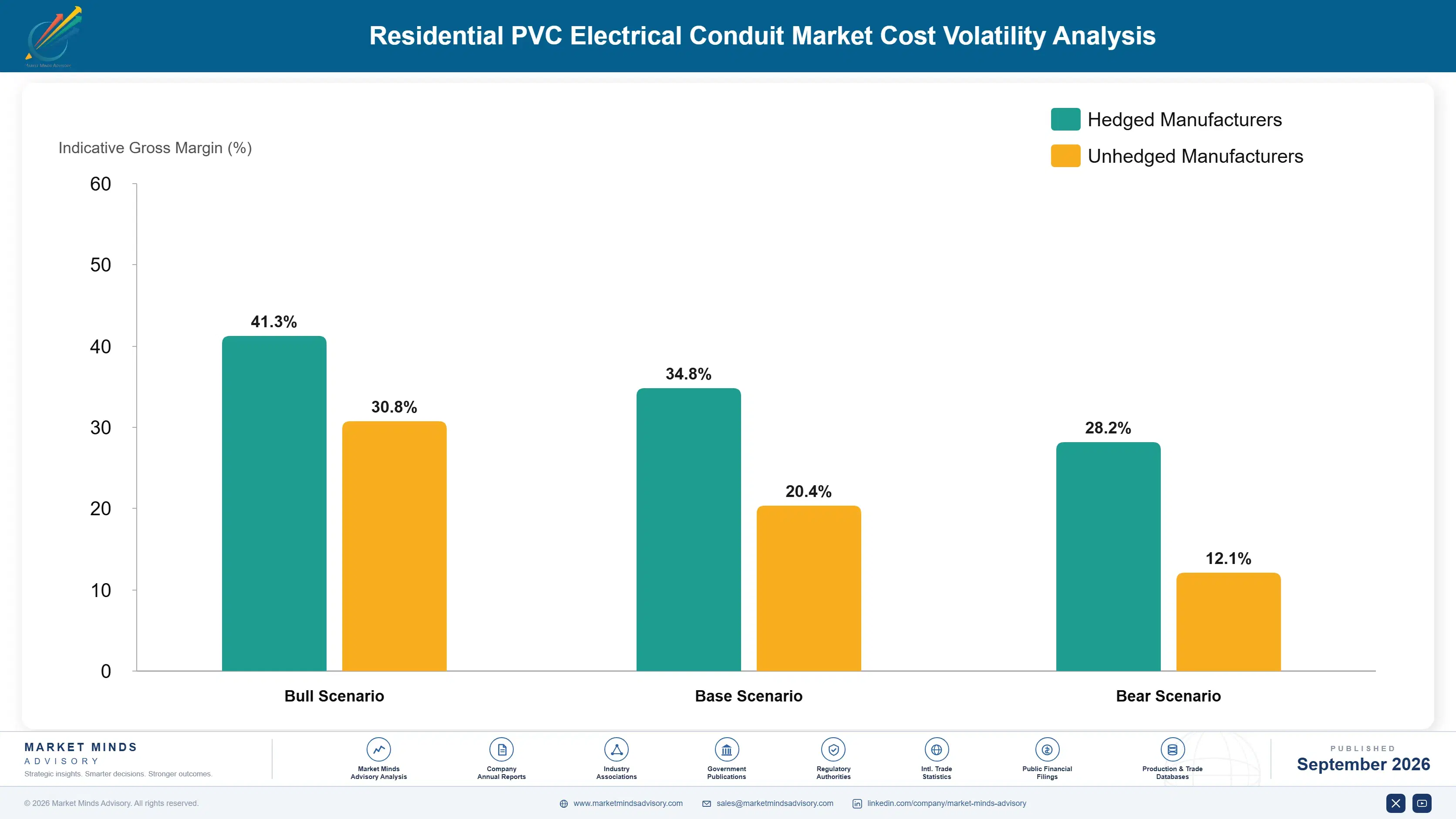
PVC Resin and Plasticizer Cost Exposure

PVC resin and plasticizer additives account for roughly 55 percent of unit manufacturing cost, sourced primarily from Gulf Coast petrochemical facilities in the United States, Saudi Arabia, and China, with extrusion energy costs adding a further meaningful cost share for larger diameter products. This concentration in a small number of production regions leaves manufacturers genuinely exposed to feedstock and weather disruption.
The 2021 Texas winter storm, documented extensively in the EIA's petrochemical market reporting, knocked several major resin production facilities offline for weeks, pushing conduit manufacturing costs sharply higher within months as resin supply tightened considerably faster than distributor contract pricing could adjust. Manufacturers that had pre-negotiated long-term resin supply contracts weathered the disruption considerably better than those relying on spot market purchasing during the tightest weeks of the shortage.

Cost exposure varies meaningfully by player type: large diversified manufacturers with hedging programmes and multi-region resin sourcing absorb price volatility more easily, while smaller regional manufacturers dependent on single-supplier resin purchasing face more direct and immediate exposure to input cost spikes without an offsetting sourcing cushion. This divergence shapes which manufacturers sustain competitive bid pricing without eroding margin below acceptable levels.
residential-pvc-electrical-conduit-market-cost-volatility-analysis-1788412318886

Multi-Region Resin Sourcing Diversification

Manufacturers are qualifying resin suppliers across multiple production regions rather than depending on a single source, reducing exposure to any single facility's weather or capacity disruption. This diversification adds modest qualification cost upfront but meaningfully reduces production delay risk during future disruption cycles. Adoption of this diversified sourcing strategy is spreading quickly across the manufacturer landscape as weather risk grows.

Long-Term Resin Supply Agreements

Larger manufacturers are locking in multi-year resin pricing agreements ahead of anticipated market tightness, smoothing cost exposure across production cycles in ways smaller competitors without comparable purchasing scale generally cannot replicate. This approach proved decisive during the last major disruption cycle for prepared manufacturers. Few smaller competitors currently match this negotiating scale with upstream resin producers directly.

Recycled PVC Content Blending Programs

Manufacturers are blending recycled PVC content into new conduit production where code allows, reducing dependence on virgin resin pricing while also addressing growing sustainability procurement criteria from institutional and government building projects. Adoption is spreading gradually as recycling infrastructure matures across key regions. Several manufacturers now market recycled-content products specifically to institutional buyers seeking documented sustainability credentials.

Portfolio Architecture for Margin Defence

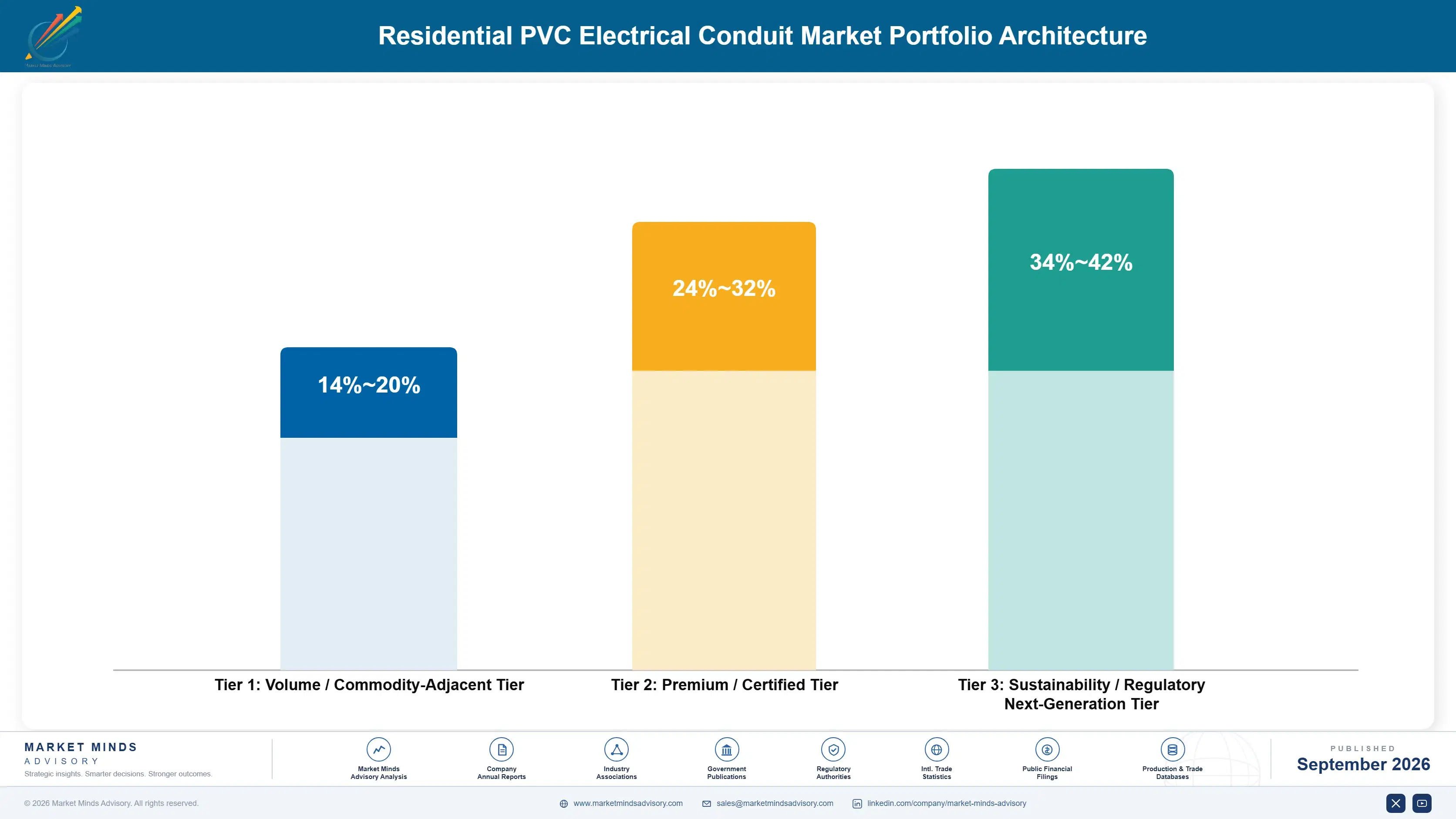
Conduit production splits into three commercial tiers with distinct margin economics. Volume commodity rigid conduit sells through mass distribution and big-box retail channels, sustaining moderate margins that reward manufacturing scale and price competitiveness rather than any single technical differentiator among competing manufacturers. Distribution reach and price matter more than any single feature claim at this level of the market.
Premium certified flexible and bundled system products, backed by demonstrated multi-jurisdiction certification and installation labor savings, command meaningfully wider margins by trading on time savings and compliance value rather than pure unit volume. Manufacturers serving this tier increasingly compete on certification breadth and contractor training rather than price alone, favoring established players. These manufacturers increasingly view certification depth as their primary defense against commodity price competition.

Sustainability and next-generation formats, including recycled-content conduit addressing growing institutional procurement criteria, remain a smaller share of total unit volume today but carry the widest margins of the three tiers, since technical scarcity and recycling infrastructure development still constrain competition meaningfully. High-value pools concentrate squarely within this tier and the premium tier immediately below it. That tension between volume and premium credibility defines competitive positioning across the category broadly.

Volume / Commodity-Adjacent Tier

Standard rigid conduit sold through mass distribution and big-box retail channels, competing primarily on manufacturing scale and price rather than differentiated labor-saving technology. Scale wins here consistently across most price-sensitive contractors.
Gross Margin: 14-20%

Premium / Certified Tier

Flexible and bundled system products with demonstrated multi-jurisdiction certification and installation labor savings, commanding wider margins on time savings and compliance value. Certification matters most here. Contractor training also matters greatly.
Gross Margin: 24-32%

Sustainability / Regulatory / Next-Generation Tier

Recycled-content conduit addressing growing institutional sustainability procurement criteria, where limited recycling infrastructure and certification development capability sustain the widest margins across the category despite modest volume today across most markets.
Gross Margin: 34-42%
residential-pvc-electrical-conduit-market-portfolio-architecture-1788412319387

High-value Sub-segments and Strategic Watch-out

High-value high-growth segment

Flexible corrugated conduit paired with bundled fitting systems sits at the intersection of premium margin and the fastest unit volume growth, as contractors standardize around labor-saving certified platforms rather than legacy rigid designs across new construction and renovation installation projects. This is the clearest growth vector ahead.
Gross Margin: 32-40%

High-value moderate-growth segment

Contractor training and technical support programmes carry strong recurring margins tied to buyer loyalty and reduced price sensitivity, though adoption grows more gradually as manufacturers weigh training investment against uncertain near-term return on marketing spend. Manufacturers treat this as a durable, if slower-building, opportunity worth pursuing.
Gross Margin: 22-30%

Volume core segment

Standard rigid conduit remains the largest unit volume base across established residential construction markets globally, sustaining steady if unremarkable margins as the category matures and price competition among established manufacturers intensifies nationwide. Scale and distribution reach determine who wins share here overall. Adoption keeps rising steadily.
Gross Margin: 14-18%

Strategic watch-out segment

Lower-cost Asian manufacturers scaling flexible conduit production capability rapidly threaten to disintermediate established Western vendors over the coming decade, particularly where price-sensitive contractors favor lower-cost alternatives over premium certified products with established distributor relationships. Western vendors are responding through deeper certification investment nationwide. This shift bears close monitoring ahead.
Gross Margin: n/a

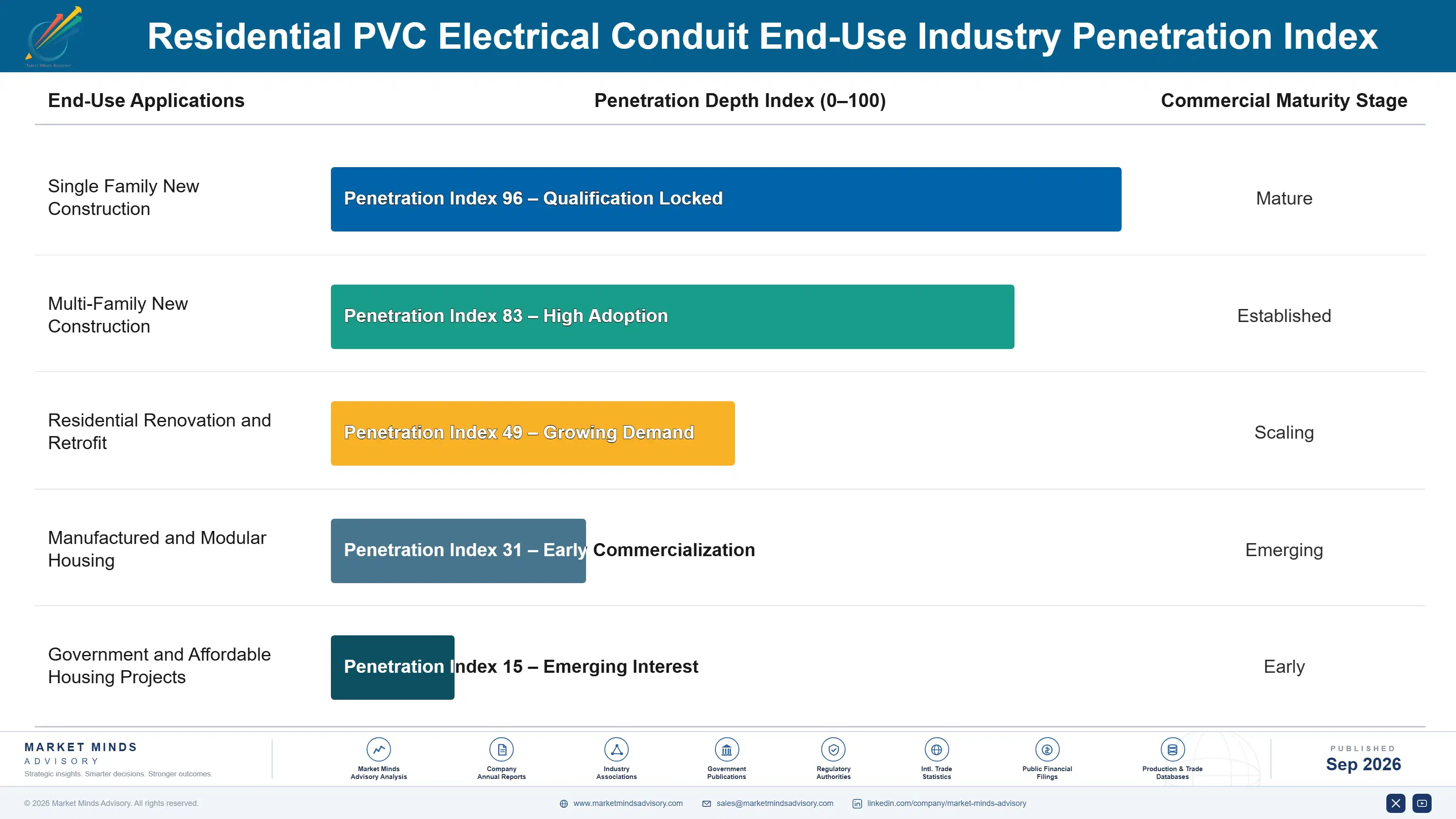
Distributor Relationships Behave Like Annuities

Conduit generates revenue well beyond the initial project sale, since contractors standardize around whichever manufacturer's certified system a distributor stocks in their local territory. That locked relationship turns a single project win into a multi-year annuity across the distributor's full order cycle, particularly given the certification testing required for approved product substitution. Switching manufacturers mid-relationship carries real requalification friction, keeping incumbent suppliers entrenched after the initial contract closes.
Adoption depth varies sharply by end-use vertical. National homebuilders embed vendor relationships into multi-year framework agreements covering dozens of communities simultaneously, while smaller custom builders treat purchases as a more opportunistic, project-by-project decision driven by local distributor availability. Renovation contractors sit between the two, adopting certified flexible formats selectively where labor savings genuinely offset any modest price premium involved. That spread explains why unit volume and margin diverge across these vertical categories.

Buyer profiles are shifting generationally as well. A younger cohort of electrical contractors, trained on flexible installation technique rather than traditional rigid bending methods alone, increasingly favors labor-saving formats, even where older tradespeople still default to whatever rigid system they learned decades earlier. This generational split is gradually reshaping which manufacturers win new contractor specification decisions going forward.
residential-pvc-electrical-conduit-market-end-use-penetration-index-1788412319879

Where Manufacturers Should Focus

These are among the four positions where our research anticipates prominent divergence between winners and laggards over the coming forecast period. Each is grounded in the demand model, the regulatory perimeter, and the announced capacity pipeline.
01 / FLEXIBLE FORMAT INVESTMENT PRIORITY

Build flexible manufacturing capacity before contractor preference fully shifts

Flexible conduit already commands wider margins than rigid systems, and that gap is widening as contractors increasingly treat labor-saving installation as essential to competitive bidding rather than a discretionary product preference layered on top of raw material cost. Manufacturers without flexible capacity risk exclusion from the fastest-growing installation segment within the next several years, not just margin erosion, since contractor bids increasingly assume flexible format availability as standard. Building that capability now, ahead of full market consolidation, converts a technical investment into a lasting specification advantage.
02 / MULTI-JURISDICTION CERTIFICATION STRATEGY

Expand certification breadth before enforcement tightens further nationwide

Certification breadth increasingly determines which manufacturers can bid on fragmented residential projects, more so than raw price alone in most competitive tenders across the entire category and its adjacent renovation applications today. Manufacturers that demonstrate multi-jurisdiction certification depth capture premium specification that single-certification competitors cannot match, since builders increasingly value bid flexibility over marginal cost savings alone when comparing supplier options. This advantage compounds as code enforcement continues tightening across the broader category and its many regional building department jurisdictions nationwide today.
03 / DISTRIBUTOR RELATIONSHIP EXPANSION STRATEGY

Deepen distributor partnerships before competitors lock in territories

Distributor relationship depth increasingly determines long-term market share more than the initial product specification itself, since contractors purchase whatever their local distributor stocks rather than actively researching alternative brands for every project. Manufacturers that build this distributor capability now secure a durable distribution relationship that compounds across each territory's entire multi-year demand cycle, well beyond the original market entry decision itself. Competitors without comparable distributor infrastructure increasingly find themselves locked out of new territory expansion entirely going forward across the industry.
04 / RECYCLED CONTENT POSITIONING STRATEGY

Build recycled-content capability before procurement rules mandate it outright

Institutional and government buyers increasingly require documented recycled content credentials for building material procurement approval, a trend that will intensify as sustainability procurement regulation expands across additional jurisdictions nationwide and internationally in coming years. Manufacturers that establish recycled-content capability now avoid future exclusion from this fast-growing procurement segment that increasingly requires documented sustainability performance before any contract award. This positioning advantage compounds as smaller competitors scramble to build comparable capability later, under considerably greater time pressure and cost than early movers face today.

Engagement Snapshot From the Field

A live engagement with an industry participant carrying material or product regulatory and market exposure ahead of a defining policy shift, showing how our research translates into a defensible multi-year portfolio strategy.
MARKET MINDS ADVISORY · CLIENT ENGAGEMENT SUMMARY
Residential PVC Electrical Conduit Producer Strategic Portfolio Review and Transition Roadmap 2026·Investment Scenario on Residential PVC Electrical Conduit Exposure Evaluation 2025-26
CLIENT PROFILE
The client operates a regional building products distribution network serving electrical contractors across several fast-growing metro markets, with annual conduit revenue in the tens of millions of dollars (client-reported, unverified by MMA). The distributor had historically stocked rigid conduit almost exclusively, without a meaningful flexible product line offering across its full territory. The distributor serves several dozen active contractor accounts across its territory.
STRATEGIC CHALLENGE
Rising contractor requests for flexible corrugated conduit, combined with tightening fire code enforcement in the distributor's core metro markets, forced management to reconsider its product portfolio strategy entirely and quickly. Management needed to decide whether to expand flexible product stocking broadly, maintain the existing rigid-focused inventory, or pursue a targeted expansion limited to highest-demand contractor accounts first.
MMA APPROACH
MMA conducted structured interviews with the distributor's purchasing and sales leadership alongside a benchmarking exercise against three peer regional distributors' product mix strategies and manufacturer relationships across comparable metro markets. The engagement combined primary qualitative interviews with MMA's proprietary conduit market dataset to assess flexible format margin, contractor demand signals, and inventory carrying cost under each stocking option.
KEY FINDINGS
  1. Flexible conduit stocking increased the distributor's average order value by roughly 22 percent compared to rigid-only inventory previously carried exclusively company-wide. each quarter.
  2. Peer distributors offering broad flexible inventory reported measurably fewer stockout-driven lost sales than those maintaining rigid-focused stocking strategies every single month. overall each month.
  3. Full flexible inventory conversion would have required warehouse space investment the engagement estimated at several months beyond the distributor's available capital budget.
  4. Distributors that expanded flexible stocking for highest-demand accounts first captured most of the margin benefit at a fraction of full conversion cost.
CLIENT PROFILE
The client operates a regional building products distribution network serving electrical contractors across several fast-growing metro markets, with annual conduit revenue in the tens of millions of dollars (client-reported, unverified by MMA). The distributor had historically stocked rigid conduit almost exclusively, without a meaningful flexible product line offering across its full territory. The distributor serves several dozen active contractor accounts across its territory.
STRATEGIC CHALLENGE
Rising contractor requests for flexible corrugated conduit, combined with tightening fire code enforcement in the distributor's core metro markets, forced management to reconsider its product portfolio strategy entirely and quickly. Management needed to decide whether to expand flexible product stocking broadly, maintain the existing rigid-focused inventory, or pursue a targeted expansion limited to highest-demand contractor accounts first.
MMA APPROACH
MMA conducted structured interviews with the distributor's purchasing and sales leadership alongside a benchmarking exercise against three peer regional distributors' product mix strategies and manufacturer relationships across comparable metro markets. The engagement combined primary qualitative interviews with MMA's proprietary conduit market dataset to assess flexible format margin, contractor demand signals, and inventory carrying cost under each stocking option.
KEY FINDINGS
  1. Flexible conduit stocking increased the distributor's average order value by roughly 22 percent compared to rigid-only inventory previously carried exclusively company-wide. each quarter.
  2. Peer distributors offering broad flexible inventory reported measurably fewer stockout-driven lost sales than those maintaining rigid-focused stocking strategies every single month. overall each month.
  3. Full flexible inventory conversion would have required warehouse space investment the engagement estimated at several months beyond the distributor's available capital budget.
  4. Distributors that expanded flexible stocking for highest-demand accounts first captured most of the margin benefit at a fraction of full conversion cost.
RECOMMENDED STRATEGY
Phase 1: Phase 1 (Months 1-3): Expand flexible conduit stocking for the highest-demand contractor accounts identified through detailed historical order pattern and overall demand review data. Phase 2: Phase 2 (Months 4-9): Evaluate inventory performance carefully and expand flexible stocking to additional accounts based on demonstrated sell-through rates and cost overall. overall. Phase 3: Phase 3 (Months 10-18): Negotiate a comprehensive warehouse expansion plan supporting full flexible inventory conversion over the following full fiscal year and beyond overall.
OUTCOME
Within eighteen months of implementation, the distributor reported an increase in overall gross margin tied to flexible product mix of approximately 14 percent (client-reported, unverified by MMA). The phased approach also demonstrated sufficient sell-through performance to justify expanded warehouse investment, and the distributor has since committed to a fully diversified product mix strategy across its entire territory.

Frequently Asked Questions

Foundational context covering the market sizes, CAGR, scope, country, region and competition that inform every finding below. This section is provided to cover basics and most often pre-purchase conversations, answered from the MMA Primary Research Dataset.

What is the current size of the Residential PVC Electrical Conduit Market?

The Residential PVC Electrical Conduit Market reached an estimated 4.2 billion dollars in 2025. Growth is driven by rising residential construction volume and tightening fire code enforcement across major metro markets.

How large will the Residential PVC Electrical Conduit Market be by 2036?

MMA projects the market will reach approximately 6.88 billion dollars by 2036 under the base case scenario. This represents more than half again the 2026 opening value over the ten year forecast window.

What is the CAGR for the Residential PVC Electrical Conduit Market 2026 to 2036?

The base case compound annual growth rate is 4.6 percent across the forecast period. Bull and bear scenarios range from 5.8 percent to 3.4 percent depending on construction activity trends.

Which segment is growing fastest?

Flexible Corrugated PVC Conduit is the fastest growing segment, expanding at 7.4 percent annually. That is roughly 1.61 times the overall market growth rate through 2036.

Who are the major companies in the Residential PVC Electrical Conduit Market?

Leading participants include Atkore Inc, Cantex Inc, IPEX Inc, Prime Conduit Inc, and JM Eagle Inc. Together these five companies hold a combined production share estimated near 41 percent.

Which country is growing fastest?

India is the fastest growing country market, supported by expanding urban housing construction and government affordable housing initiatives. Demand is further reinforced by tightening electrical code enforcement in major metro building departments.

Report Segmentation Architecture

The full report scope spans multiple orthogonal segmentation dimensions, with cross-tabulated demand data provided for each dimension pair. Coverage extends further to regional breakdowns, trend trajectories, and the competitive detail needed to support segment-level decision-making.

By Primary Market Dimension

  • Rigid PVC Conduit
  • Flexible Corrugated PVC Conduit
  • Fittings and Connector Systems
  • Recycled-Content PVC Conduit
  • Pre-Wired Conduit Assemblies
  • PVC Conduit Accessories

By End-Use Industry

  • Single Family New Construction
  • Multi-Family New Construction
  • Residential Renovation and Retrofit
  • Manufactured and Modular Housing
  • Government and Affordable Housing Projects

By Commercial Dimension

  • Direct Distributor Sales
  • Big-Box Retail Sales
  • Contractor Direct Purchase
  • Builder Framework Agreements

By Region

  • North America
  • Western Europe
  • East Asia
  • South Asia and Pacific
  • Latin America
  • Middle East and Africa
  • Eastern Europe

Scope, Methodology, and Coverage

Every figure in this report is reproducible from documented input assumptions. The scope below maps the historical period, the forecast horizon, the segmentation dimensions, and the countries covered, alongside the underlying primary and qualitative methodology.
Historical Period
2020 to 2025
Forecast Period
2026 to 2036
Base Year
2025 (USD billions; MMA Primary Research Dataset, September 2026)
Market Definition
This market covers rigid and flexible polyvinyl chloride conduit systems, including fittings and connectors, used for electrical wiring protection in single family and multi-family residential construction. It excludes metallic conduit, commercial and industrial grade conduit systems, and non-electrical PVC piping applications.
Quantitative Units
USD billions (current prices); linear foot shipment volume where noted
Segmentation Dimensions
By Primary Market Dimension; By End-Use Industry; By Commercial Dimension; By Region
Regions Covered
North America, Western Europe, East Asia, South Asia and Pacific, Latin America, Middle East and Africa, Eastern Europe
Countries Covered
USA, China, Germany, France, UK, Japan, South Korea, India, Australia, Canada, Brazil, Mexico, Indonesia, Vietnam, Thailand, Malaysia, UAE, Saudi Arabia, South Africa, Nigeria, Turkey, Poland, Netherlands, Italy, Spain, Sweden, Switzerland, Argentina, Colombia, Singapore, and additional markets relevant to this sector
Key Companies Profiled
Atkore Inc, Cantex Inc, IPEX Inc, Prime Conduit Inc, JM Eagle Inc, Charlotte Pipe and Foundry Company, National Pipe and Plastics Inc, Diamond Plastics Corporation, Thomas and Betts Corporation, Southwire Company LLC, Dura-Line Corporation, Advanced Drainage Systems Inc, Cresline Plastic Pipe Company, Certainteed Corporation, Rehau Group, Aliaxis Group, Georg Fischer AG, Kubota Corporation, China Lesso Group Holdings, Astral Limited
Quantitative Methodology
Primary survey, n=3,800 respondents, Q4 2025, six countries; demand-side model with trade association cross-validation
Qualitative Methodology
47 expert interviews, Q4 2025; applied to validate demand model assumptions, identify emerging dynamics, and assess competitive positioning
Report Format
PDF and XLSX data workbook (Word format preview document)
Publisher
Market Minds Advisory
Report Code
MMA-2026-CON-156
Published
September 2026
Contact
sales@marketmindsadvisory.com | www.marketmindsadvisory.com

Purchase the full Residential PVC Electrical Conduit Market Report (2026 to 2036).

This report provides comprehensive analysis of the Residential PVC Electrical Conduit Market, covering size, forecasts, segmentation, and regional dynamics through 2036. It examines competitive positioning among leading manufacturers, input cost exposure across the PVC resin supply chain, and portfolio economics across volume, premium, and sustainability tiers. The analysis draws on primary survey data covering 3,800 respondents and 47 expert interviews conducted in the fourth quarter of 2025. Buyers receive a complete strategic view suitable for investment planning, procurement strategy, and competitive benchmarking decisions across the full value chain.
Full ten-year market and segment forecasts through 2036
Regional analysis across all seven MMA-tracked geographies
Competitive benchmarking of top five and fifteen additional players
PVC resin and plasticizer input cost exposure analysis
Revenue lever framework tied to quantified commercial impact
Anonymised distributor network case study with recommended strategy phasing

Built For The People Who Decide

From boardroom strategy to bench-side execution, this report is read cover-to-cover by leaders shaping the next decade of their industry, turning demand scenarios, market dynamics and valuation benchmarks into decisions.
CXOs/ Presidents/ VPs/ Managers
M&A and Corporate Development
Strategy Teams and R&D Heads
Procurement and Product Directors
Regulatory and Compliance Leaders
Investor Relations and Equity Analysts