Market Minds Advisory
Residential Carpet Roll Market

Residential Carpet Roll Market: Residential Carpet Roll Market: Installed Cost, Fibre Position and the End-of-Life Bill

A category losing floor area every year to hard flooring, still winning on installed cost in rental turnover, and now carrying an end-of-life bill that regulators have started sending back to the manufacturer.

Lead Analyst

Published

September 2026

Make Smarter Decisions with Customized Research Insights

Request a free sample report and evaluate market opportunities, growth trends, and competitive dynamics relevant to your business needs.

2025 MARKET VALUE$18.6BMarket Size 2025
2036 FORECAST VALUE$27.4BBase Case , 2026 to 2036
CAGR 2026 TO 20363.6 %Bull 4.8% / Bear 2.4%
INCREMENTAL OPPORTUNITY$8.2BNet 10- year value creation
EXPANSION MULTIPLE1.42x2036 value over 2026 base
Strategic Levers
M&A Pipeline
Regional Outlook
Country Rankings
Competitive Intelligence
Segmental Deep-dive
Call-Us : 91 93563 13602

Executive Snapshot and Market Trajectory.

The honest question in this category is not how to grow it. Broadloom has been losing floor area to vinyl plank and engineered wood for a decade and will keep doing so. The commercial question is where carpet still wins, and the answer is narrower than most participants admit.
Solution-dyed polyester with recycled content grows at 5.4%, half again the market rate of 3.6%, on colourfastness and cost rather than on any environmental argument. North America holds 38% of demand, above its usual band, because wall-to-wall carpet penetration there remains far higher than anywhere else and the Dalton manufacturing cluster sits alongside it. Multifamily turnover is where the category still wins outright on installed cost against everything else in the market every time.
Concentration is high at 41%, unusual for a building product, and it reflects capital intensity: a tufting line is expensive and a fibre extrusion plant considerably more so. That protects incumbents from new entrants and does nothing about the real competitive threat, which arrives from a completely different flooring category. Landfill diversion sits at 9%, and extended producer responsibility schemes are starting to make that number somebody's problem.
Market Definition
The residential carpet roll market covers machine-made broadloom carpet manufactured in continuous roll form for wall-to-wall installation in dwellings, spanning nylon, polyester, polypropylene and wool constructions in cut-pile, loop-pile and patterned formats. Scope includes broadloom supplied with integrated underlay backing. Excluded are carpet tiles and modular squares, area rugs and mats, commercial and contract broadloom specified for non-residential use, hard floor coverings of every type, and underlay sold as a separate product.
Base Year Value
$18.6B in 2025 (MMA Primary Research Dataset, August 2026)
Forecast Period
2026 to 2036, eleven discrete annual values
CAGR
3.6% base case. Bull 4.8%. Bear 2.4%.
Fastest Growth Segment
Solution-Dyed Polyester and Recycled-Content Broadloom: 5.4% CAGR
Fastest Growth Country
India: 5.6% CAGR
Fastest Growth Region
South Asia and Pacific: 5.6% CAGR
Largest Region
North America: 38% of 2025 global value
Market Leaders
Shaw Industries, Mohawk Industries, Balta Group, The Dixie Group and Beaulieu International Group. Source: MMA Analysis, July 2026.
Primary Survey
n=3,800 procurement and R&D decision-makers, Q4 2025, six countries
Methodology
Demand-side build-up, cross-validated against public data, 47 expert interviews

Residential Carpet Roll Market Forecast Scenarios

residential-carpet-roll-market-size-forecast-scenario-1788169678099
Between 2020 and 2025 the sector compounded at 2.6%, and even that modest figure flatters what happened. Volume in square metres fell across most Western markets while average selling prices rose on fibre cost, so revenue held up better than the floor area did. Anybody reading growth from the revenue line missed a category quietly losing rooms every single year.
The 3.6% base case rests on three mechanisms that have nothing to do with reversing the hard flooring shift. Multifamily rental turnover keeps buying carpet because installed cost including labour is roughly 38% below vinyl plank. Bedrooms and stairs hold their share on acoustics and safety rather than on preference. And solution-dyed recycled polyester is taking volume from nylon at better margins for the manufacturer. None of the three requires anybody to prefer carpet again at all.
The bull case at 4.8% turns on acoustic requirements in multifamily building codes tightening, which would specify carpet into rooms that currently choose it on cost alone. The bear case at 2.4% is stewardship: extended producer responsibility schemes spreading beyond California and Europe would add an end-of-life charge to every single square metre sold anywhere at all.

Where Carpet Still Wins

Installed cost is the argument this category still wins and almost nobody makes it properly. A square metre of broadloom fitted, including underlay, gripper and labour, comes in around 38% below vinyl plank fitted over the same subfloor, because carpet forgives an uneven floor that plank requires levelling first. In a rental apartment turned every four years, that difference decides the specification without any discussion of appearance.
TOP FIVE CONCENTRATION41%Share held by the five largest broadloom carpet makers
AVERAGE SELLING PRICEUSD 14.20Mean price per square metre before installation and underlay
FIBRE COST SHARE43% of COGSFace yarn as proportion of finished broadloom production cost
INSTALLED COST ADVANTAGE38%Cost saving against vinyl plank including labour and preparation
LANDFILL DIVERSION RATE9%Portion of post-consumer carpet diverted from landfill annually
MULTIFAMILY REPLACEMENT CYCLE4 yearsMedian interval between replacements in rented residential units
Fibre is 43% of production cost, which makes this an oil-linked business wearing a home furnishing costume. Nylon 6 and 6,6 track caprolactam and adiponitrile pricing, polypropylene tracks propylene, and polyester tracks purified terephthalic acid and recycled bottle flake. Manufacturers with fibre extraction inside the group see that cost directly. Everybody else takes a quoted yarn price that moves for reasons nobody in flooring controls.
End of life is becoming a manufacturer problem rather than a municipal one. Landfill diversion sits at 9% and the chemistry explains why: nylon 6 can be depolymerised back to caprolactam economically, while polypropylene and polyester blends cannot be separated from their backing economically. Stewardship schemes in California and Europe are converting that chemistry problem into a per-square-metre charge, and the fee lands on whoever made it.
"This industry keeps trying to win back the living room and losing money doing it. The rental apartment and the staircase are not glamorous, but they are the two places where carpet wins on arithmetic rather than on taste, and arithmetic does not change its mind."
Director, Flooring and Interior Surfaces Practice · MMA Construction and Industrial Equipment Practice · August 2026

Market Trends

Solution-dyed polyester is displacing nylon on cost

Solution-dyed polyester with recycled bottle content has taken volume from nylon across residential broadloom, and the argument is colourfastness and price rather than sustainability. Colour added at extrusion rather than after tufting survives bleach, sunlight and cleaning in a way piece-dyed nylon does not, which matters enormously in rental property where a stain decides whether a floor gets replaced. Polyester also costs materially less per kilogram. The segment grows at 5.4% against a market rate of 3.6%, and the environmental story arrived afterwards as an entirely useful commercial accident indeed.
Market Impact: Saves 38% on installed cost

Producer responsibility schemes are pricing end of life

California's carpet stewardship programme places an assessment on every square yard sold and funds collection and recycling from it, and European extended producer responsibility proposals point the same way. The commercial consequence is that a manufacturer's fibre choice now carries a downstream cost, because nylon 6 depolymerises back to caprolactam while most polyester and polypropylene constructions do not separate from their backing economically. Landfill diversion sits at 9% today. Any scheme that ties the fee to recyclability rather than to weight would reprice the whole product hierarchy very nearly overnight.
Market Impact: Specifies carpet in 2 room types

Market Opportunities and Growth Drivers

Multifamily turnover buys on installed cost alone

A rental apartment is refloored roughly every four years and the decision is made by an asset manager comparing total installed cost per unit, not by anybody who will live on it. Broadloom fitted comes in around 38% below vinyl plank fitted, because carpet absorbs subfloor irregularity that plank requires levelling to correct, and the labour difference is larger than the material difference. That arithmetic has held through every design trend of the last decade and shows no sign of changing. It is the single most reliable demand pool in this category.
Market Impact: Loses 2% floor area annually

Acoustic requirements protect bedrooms and stairs

Impact sound transmission between floors is a genuine engineering problem in multifamily housing, and carpet with underlay remains the cheapest way to meet an impact insulation requirement without a floating floor assembly. Building codes across several markets specify minimum impact insulation classes for separating floors, which effectively specifies soft flooring in bedrooms and corridors. Stairs hold for a different reason entirely: they are safer underfoot and considerably easier to fit than any plank product. Neither of these positions depends on anybody choosing carpet on any aesthetic grounds at all here.
Market Impact: Adds 6 weeks to installation

Market Restraints and Challenges

Hard flooring keeps taking residential floor area

Luxury vinyl tile and engineered wood have taken living rooms, halls and bedrooms across most Western markets, and broadloom square metre volume has fallen for a decade even where revenue held. The root cause is genuine rather than fashionable: hard flooring cleans easily, suits households with pets and allergies, and photographs better in a property listing. Commercial impact is a shrinking addressable floor area that no product improvement reverses. Participants are responding by concentrating on the rooms where carpet still wins on cost or code, by moving into hard flooring themselves, and by taking the recycling position their competitors cannot.
Market Impact: Grows 5.4% on colourfastness

Fitting is a skilled trade with an ageing workforce

Carpet fitting requires a trade skill that takes years to acquire, and the workforce holding it is retiring faster than it is being replaced. The root cause is that fitting is physically hard, seasonal in parts and has attracted almost no apprenticeship investment for two decades. Commercial impact appears as lead times on installation rather than as a cost line, and a household that waits six weeks for a fitter often buys a plank product they can install themselves instead. Mitigation runs through installer training funds, roll-out systems that reduce seaming skill, and integrated underlay products that shorten fitting time.
Market Impact: Diverts only 9% from landfill
3 additional market trends, 4 additional growth drivers, and 2 additional restraints and challenges are covered in the full report. Contact sales@marketmindsadvisory.com to access the complete intelligence.

Segment CAGR and Growth Architecture

Segmentation follows broadloom construction, the dimension on which fibre cost, colourfastness and end-of-life chemistry all operate together. Nylon and polypropylene constructions carry the legacy volume at declining share. Solution-dyed polyester and wool carry the growth for opposite reasons: one wins on cost and stain performance, the other on a premium that nothing synthetic ever quite reaches.
residential-carpet-roll-market-market-share-analysis-1788169678633

Solution-Dyed Polyester and Recycled-Content Broadloom

Solution-dyed polyester with recycled bottle content grows at 5.4%, half again the market rate of 3.6%, and the growth is a cost and performance argument that happens to have an environmental story attached. Adding colour at extrusion rather than after tufting produces a fibre that survives bleach, sunlight and repeated cleaning, which decides floor replacement cycles in rental property more than any wear rating does. Polyester also costs materially less per kilogram than nylon. The catch sits at end of life: the constructions winning on cost are the ones that separate least well from their backing, and stewardship schemes tying fees to recyclability would reverse the advantage completely and quickly.
CAGR 5.4%

Wool and Natural Fibre Broadloom

Wool and natural fibre broadloom grows at 4.6% and it is the only part of this category where the buyer is not comparing against vinyl plank at all. A wool carpet buyer has already decided on carpet and is choosing quality, which removes the competitive pressure that governs every other segment. Wool holds soil release, flame performance and resilience characteristics that synthetics approximate rather than match, and it commands prices several times the polypropylene tier. Supply is the constraint rather than demand: carpet-grade coarse wool comes largely from New Zealand and the United Kingdom, and flock numbers have been falling for years. That is a supply problem no manufacturer can solve by spending money.
CAGR 4.6%
Full segment breakdown across 6 segments available in the complete report.

Regional Architecture and Country Demand Map

North America takes 38%, above the usual band, because wall-to-wall carpet penetration there is far higher than anywhere else and the Dalton cluster manufactures alongside it. East Asia sits below its band for the opposite reason entirely: hard flooring never lost any ground there at all.

North America

This region takes 38%, above the usual band, and the justification is a genuine difference in how houses are floored: American wall-to-wall carpet penetration in bedrooms and basements remains far higher than in any other market, and the habit is generational rather than fashionable. The Dalton cluster in Georgia manufactures a large share of world broadloom within a few miles of itself, giving domestic producers a freight and lead time position imports cannot match on a bulky roll product. Multifamily turnover is the most reliable demand pool anywhere in this category. Growth at 3.4% reflects volume decline offset by mix and price. Nobody should read that number as a healthy floor area figure.
Share: 38% | CAGR: 3.4% (2026 to 2036)

East Asia

The 20% share sits below the usual regional band, and the reason is that wall-to-wall carpet never established itself here in the first place. Chinese, Japanese and Korean dwellings use hard flooring with area rugs as the default, so broadloom occupies hotel and specialist residential applications rather than the general housing stock. What growth exists at 4.6% comes from higher-end apartment developments in coastal Chinese cities adopting Western interior conventions. Chinese manufacturing capacity has grown considerably faster than domestic demand, which makes the region a net exporter of a product it barely uses at home. That export capacity is the quiet competitive fact of this whole category at this point.
Share: 20% | CAGR: 4.6% (2026 to 2036)
Regional intelligence for 5 additional markets available in the complete report: Western Europe, South Asia and Pacific, Latin America, Middle East and Africa, Eastern Europe. Contact sales@marketmindsadvisory.com.
residential-carpet-roll-market-country-cagr-analysis-1788169679145

Four Moves In A Shrinking Category

None of these four tries to win back the living room, because that contest is over and this industry lost it. Each concentrates on the places where carpet still wins on arithmetic rather than on taste: rental turnover, acoustic code, the wool premium and the recycling position that competitors simply cannot occupy at any price.

Sell installed cost to multifamily asset managers

A rental apartment is refloored roughly every four years and the decision runs on total installed cost per unit rather than on appearance. Broadloom fitted comes in around 38% below vinyl plank fitted, mostly because carpet forgives a subfloor that plank requires levelling to correct. Almost nobody in this industry sells that number to asset managers directly, preferring to sell colour ranges to retailers. A portfolio owner turning several thousand units a year is a contracted volume buyer with no interest at all in design trends of any kind whatever.
Market Impact: Sells a 38% installed cost advantage to portfolios

Take the wool premium supply position

Wool broadloom grows at 4.6% and commands prices several times the polypropylene tier, and the buyer is not comparing against vinyl plank at all. The constraint is supply rather than demand: carpet-grade coarse wool comes largely from New Zealand and the United Kingdom, and flock numbers have fallen for years. Contracting multi-season wool supply directly with growers costs a premium over spot and secures a position competitors cannot buy into later. Very few manufacturers have done it, which is why the premium tier keeps running short of finished product everywhere.
Market Impact: Secures wool supply for the 4.6% growth tier

Build the recycling position before the fee arrives

Landfill diversion sits at 9% and stewardship schemes in California and Europe are converting that into a charge on every square metre sold. Nylon 6 depolymerises back to caprolactam economically while most polyester and polypropylene constructions do not separate from their backing at all. A manufacturer that establishes take-back and depolymerisation capability now holds a position competitors cannot assemble once a fee tied to recyclability lands. The investment looks premature right up until the legislation passes, which is exactly how these things have always worked out in actual practice before.
Market Impact: Lifts diversion above 9% ahead of any regulation

Fund installer training as demand protection

A household waiting 6 weeks for a fitter often buys a plank product they can install themselves, which means the installer shortage is not a cost problem but a demand loss. Carpet fitting has attracted almost no apprenticeship investment for two decades while the existing workforce retired. Funding training through retailer and merchant networks costs less than the volume being lost, and it protects the one advantage this category has against hard flooring: it must be professionally fitted, so the fitter is also a specifier in every single sale made.
Market Impact: Recovers volume lost to 6 week fitting waits

Who Controls the Margin Pool

CR5 stands at 41%, measured on production volume in square metres, since participants report flooring revenue in aggregate rather than by product. That is high for a building product and it reflects capital intensity: a tufting line is expensive and a fibre extrusion plant considerably more so. The gap between the two American leaders and everybody else is wide enough that they are competing with each other.
Competition runs on fibre position, installed cost and channel rather than on product design. Whoever extrudes their own yarn sees cost directly and can move construction when petrochemical pricing shifts. Whoever reaches multifamily asset managers directly holds the demand pool that does not shrink. Whoever holds retailer and fitter relationships controls what a household is shown. Advertising decides very little in a product bought once a decade.

Rankings will move on end-of-life capability rather than on product. A manufacturer with take-back logistics and depolymerisation capacity competes on something that becomes a legal requirement rather than a marketing claim once stewardship fees spread. Several participants have started building it and most have not. The pressure comes from regulation rather than from competitors, which this industry finds harder to respond to than a price war.
residential-carpet-roll-market-company-positioning-matrix-1788169679659

Competitive Moat and Risk Dimensions

SHAW INDUSTRIES

Moat: Fibre extrusion inside the group

Extruding its own nylon and polyester yarn gives the company direct visibility of the single largest cost line in this business and the ability to shift construction when petrochemical pricing moves. Competitors buying yarn take a quoted price they cannot forecast. Building equivalent extrusion capacity is a capital decision no flooring business would make today from a standing start.
SHAW INDUSTRIES

Risk: Concentrated in declining category

A very large share of capacity is dedicated to a product losing residential floor area every year to hard flooring, and tufting lines do not convert to plank production. Diversification has come through acquisition rather than through repurposing assets, which leaves substantial capital tied to a shrinking base. Managing decline profitably is a different discipline from managing growth.
MOHAWK INDUSTRIES

Moat: Breadth across every flooring type

Selling broadloom alongside vinyl plank, laminate, ceramic and wood means the group captures the household regardless of which surface wins the room, which is a considerably more comfortable position than defending carpet alone. Retailers prefer a supplier who fills the whole showroom. Assembling that breadth took decades of acquisition and a competitor starting now would not catch up.
MOHAWK INDUSTRIES

Risk: Internal cannibalisation across categories

The same breadth that protects group revenue means every square metre of vinyl plank sold displaces a square metre of the group's own broadloom, and internal incentives rarely resolve that cleanly. Investment decisions between a declining carpet line and a growing plank line are politically difficult in a way a single-category competitor never faces. Decline management tends to be deferred.

Players Tracked

Prominent Players

Shaw Industries
Mohawk Industries
Balta Group
The Dixie Group
Beaulieu International Group

Other Key Players

Tarkett
Interface
Milliken and Company
Engineered Floors
Victoria PLC
Headlam Group
Brintons
Ulster Carpets
Cavalier Bremworth
Godfrey Hirst
Associated Weavers
Vorwerk Teppichwerke
Condor Carpets
Betap
Oriental Weavers

Recent Developments

JANUARY 2025

California carpet stewardship assessment rose again

The California carpet stewardship programme increased the assessment charged on carpet sold in the state, with the revenue funding collection and recycling infrastructure. Manufacturers selling into California absorbed or passed on the increase, and several began publishing recyclability data on constructions for the first time in response.
Signal: End-of-life cost is quietly moving onto the manufacturer's balance sheet one jurisdiction at a time now.
MAY 2025

Shaw expanded solution-dyed polyester extrusion capacity

Shaw Industries brought additional solution-dyed polyester extrusion capacity into operation in Georgia, an organic capacity expansion rather than any acquisition or joint venture. The investment supports the fastest growing residential construction in the range and reduces reliance on purchased yarn where petrochemical pricing moved twice within a year.
Signal: Owning extrusion is becoming the deciding advantage in a category where fibre dominates the whole cost sheet.
SEPTEMBER 2025

New Zealand wool growers signed multi-season carpet supply agreements

New Zealand wool growers signed multi-season supply agreements with carpet manufacturers covering carpet-grade coarse wool, securing volume against falling national flock numbers. These were supply agreements rather than acquisitions or joint ventures, and buyers cited availability rather than price as the reason for contracting ahead.
Signal: The premium tier is now constrained by sheep numbers rather than by any shortfall in consumer demand.

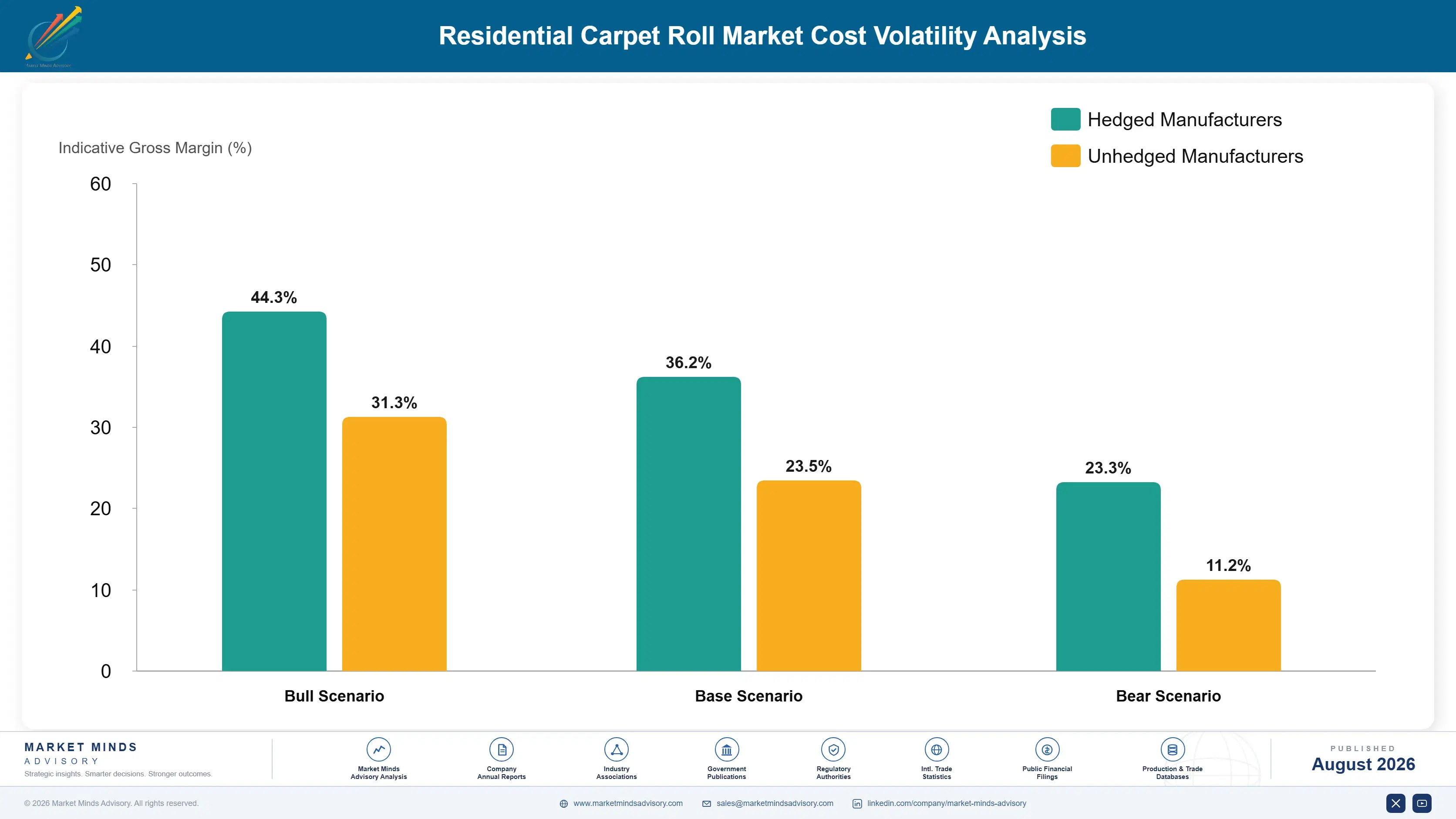
Fibre Is Nearly Half Of It

Face yarn accounts for roughly 43% of production cost, backing and latex a further 17%, and energy around 9%. Nylon originates with caprolactam and adiponitrile producers, polypropylene with propylene crackers, and polyester increasingly with recycled bottle flake collectors rather than virgin terephthalic acid. Wool comes from New Zealand and the United Kingdom, and from nowhere else in meaningful carpet-grade volume.
European energy pricing gave this industry a lesson it has not forgotten. Carpet manufacturing is energy intensive at the extrusion and finishing stages, and the International Energy Agency documented the scale of European industrial gas price movement through 2022. Several European producers curtailed output rather than run at a loss, and the capacity that came out has not all returned. Manufacturers with fibre extrusion in lower-cost energy regions took share during that period and largely kept it afterwards.

The disadvantage is vertical rather than geographic. A manufacturer extruding its own yarn sees fibre cost and can change construction when a petrochemical chain moves. A tufter buying yarn takes a quoted price it cannot forecast and sells into retail programmes fixed months earlier. Wool buyers face a different problem, since no amount of purchasing power creates sheep that do not exist.
residential-carpet-roll-market-cost-volatility-analysis-1788169679854

Extrude yarn internally or contract it annually

Fibre is 43% of production cost and it moves on petrochemical chains that have nothing to do with flooring demand. Internal extrusion is the complete answer and a large capital decision. Annual yarn contracts are the partial one, costing a premium over spot in a soft market and removing the largest unforecastable line from the cost sheet entirely.

Contract wool supply directly with grower groups

Carpet-grade coarse wool comes from New Zealand and the United Kingdom and the flocks producing it have been shrinking for years, which is a supply constraint no purchasing department resolves with better negotiation. Multi-season agreements signed directly with grower groups secure volume and give the growers a reason to keep the flock. Spot buyers will find the premium tier closed.

Design constructions that separate at end of life

Stewardship fees are moving from weight-based to recyclability-linked in several proposals, which would reprice every construction in the range. Single-polymer designs and backing systems that release from face fibre make recovery economic rather than theoretical. The development cost is modest and the timing risk runs one way only, since no proposal anywhere is moving toward charging less for unrecyclable product.

Portfolio Architecture for Margin Defence

Margin here follows fibre position rather than product tier, which is not how the showroom presents it. A polypropylene loop-pile at a low price made from internally extruded yarn can earn more than a nylon cut-pile at twice the price made from purchased yarn. Manufacturers costing on delivered margin after yarn cost movement run a completely different portfolio from those pricing off construction quality.
Volume and premium pull against each other through the extrusion line rather than the market. The polypropylene and polyester volume tiers fill extrusion capacity and make the capital worth holding, and that same capacity is what gives the premium constructions their cost position. Dropping volume raises unit cost across the whole range. Running only volume means competing on price in a category losing floor area.

High-value pools sit in wool, in multifamily contract supply and in end-of-life recovery. The third is the least developed and possibly the most defensible: a manufacturer with take-back logistics and depolymerisation capacity can process competitors' carpet for a fee once stewardship schemes make disposal somebody's obligation. That is a services business attached to a manufacturing one, and almost nobody in this industry is building it yet.

Volume / Commodity-Adjacent

Polypropylene loop-pile and entry nylon constructions sold through mass retail and rental supply programmes. Competes on installed cost against hard flooring and against near-identical product from other tufters. The 9 point spread reflects whether yarn is extruded internally or purchased.
Gross Margin: 16 to 25%

Premium / Certified

Solution-dyed polyester and branded nylon constructions with wear and stain warranties, sold through specialist flooring retail. Colourfastness and warranty support the price rather than appearance. The 9 point spread reflects channel mix between retail programmes and independent flooring merchants.
Gross Margin: 29 to 38%

Sustainability / Regulatory / Next-Generation

Wool and natural fibre broadloom, single-polymer recyclable constructions and end-of-life recovery services sold to other manufacturers. Margins are high because supply or capability is scarce rather than because volume is large. The 14 point spread separates product sales from recovery service contracts.
Gross Margin: 34 to 48%
residential-carpet-roll-market-portfolio-architecture-1788169680375

High-value Sub-segments and Strategic Watch-out

Solution-Dyed Recycled Polyester Broadloom

High value and high growth at 5.4%. Colour added at extrusion survives bleach and sunlight, which decides replacement cycles in rental property more than any wear rating does. The 8 point spread reflects whether the recycled flake supply is contracted or bought on the spot market.
Gross Margin: 31 to 39%

Wool and Natural Fibre Broadloom

High value with steady growth at 4.6%. The buyer is not comparing against vinyl plank at all, which removes the competitive pressure governing every other segment in this category. The 10 point spread reflects whether wool supply is contracted directly with growers or bought at auction.
Gross Margin: 36 to 46%

Polypropylene Loop-Pile Broadloom

The volume core. It earns very little but it fills the extrusion and tufting capacity that makes the capital worth holding for everything else in the range. The 9 point spread reflects whether yarn is extruded internally or purchased from third party yarn suppliers instead.
Gross Margin: 14 to 23%

Unrecyclable Blended Constructions

The strategic watch-out. Stewardship fees tied to recyclability rather than weight would reprice these constructions immediately, and several jurisdictions have proposals moving in exactly that direction. The 22 point spread reflects how much sells into markets with no stewardship scheme in place at all currently.
Gross Margin: 12 to 34%

Why The Floor Gets Replaced

Two different replacement clocks run in this category. An owner-occupied bedroom carpet lasts ten to fifteen years and is replaced when it looks tired or the house is sold. A rental apartment is refloored every four years because turnover demands it, regardless of condition. The second clock generates three times the volume per square metre, and it does not care what anybody thinks of carpet.
Stickiness sits with the fitter and the merchant rather than with the household. A homeowner replacing a carpet after twelve years has no recollection of the previous brand and buys what the retailer shows them, on the fitter's recommendation. Multifamily buyers are the opposite: they contract, they repeat, and switching supplier means requalifying a specification across a whole portfolio. That is where the durable revenue lives.

Buyer profiles have shifted in a way that removed the emotional argument. The previous generation chose carpet as a comfort and status decision in the main rooms. The current generation treats it as a functional choice confined to bedrooms and stairs, made on warmth, noise and safety rather than on appearance. Selling this product on aspiration now addresses a household that stopped listening years ago.
residential-carpet-roll-market-end-use-penetration-index-1788169680863

Where This Category Still Wins

These are among the four positions where our research anticipates prominent divergence between winners and laggards over the coming forecast period. Each is grounded in the demand model, the regulatory perimeter, and the announced capacity pipeline.
01 / MULTIFAMILY CONTRACT SUPPLY

Sell installed cost to portfolio owners directly

A rental apartment is refloored roughly every four years on a decision made by an asset manager comparing total installed cost per unit rather than appearance. Broadloom fitted comes in around 38% below vinyl plank fitted, mostly because carpet forgives a subfloor that plank requires levelling to correct first. Almost nobody in this industry sells that arithmetic to portfolio owners directly, preferring to sell colour ranges to retailers who sell it on to households instead, which is the wrong customer.
02 / WOOL SUPPLY CONTRACTING

Contract the wool before the flocks shrink further

Wool broadloom grows at 4.6% and commands prices several times the polypropylene tier, with a buyer who is not comparing against vinyl plank at all. The constraint is supply: carpet-grade coarse wool comes from New Zealand and the United Kingdom, and flock numbers have fallen for years with no sign of reversing. Multi-season agreements with grower groups secure a position that spot buyers will simply not be able to enter at any later point on any terms at all whatever.
03 / END OF LIFE CAPABILITY

Build recovery capacity before the fee arrives

Landfill diversion sits at 9% and stewardship schemes in California and Europe are converting that shortfall into a charge on every square metre sold in those markets. Nylon 6 depolymerises back to caprolactam economically while most polyester and polypropylene constructions do not separate from their backing at all. Establishing take-back logistics and recovery capacity now creates a services business competitors cannot assemble once the legislation actually lands, and very few participants anywhere have even started on that work at all.
04 / INSTALLER CAPACITY PROTECTION

Fund the trade or lose the sale

A household waiting 6 weeks for a fitter frequently buys a plank product they can install themselves, which makes the installer shortage a demand loss rather than a cost problem. Carpet fitting has attracted almost no apprenticeship investment for two decades while the existing workforce retired steadily. Funding training through merchant networks costs less than the volume lost, and it protects the one thing hard flooring cannot copy: a fitter who is also a specifier in every single sale made.

Engagement Snapshot From the Field

A live engagement with an industry participant carrying material or product regulatory and market exposure ahead of a defining policy shift, showing how our research translates into a defensible multi-year portfolio strategy.
MARKET MINDS ADVISORY · CLIENT ENGAGEMENT SUMMARY
Residential Carpet Roll Producer Strategic Portfolio Review and Transition Roadmap 2026·Investment Scenario on Residential Carpet Roll Exposure Evaluation 2025-26
CLIENT PROFILE
A North American broadloom manufacturer operating three tufting plants and one extrusion line, selling through independent flooring retailers and two national buying groups, with annual revenue in the low billions of dollars (client-reported, unverified by MMA). Volume had declined for four consecutive years while the business continued investing in residential retail programmes and design ranges.
STRATEGIC CHALLENGE
Management accepted that hard flooring would keep taking floor area but could not agree on what to do about it. One view held that better design and marketing would defend the retail position; another argued the business should be pointed at the segments still growing. Nobody had measured which parts of the demand base were actually stable.
MMA APPROACH
MMA rebuilt five years of volume by end use rather than by product, separating owner-occupied replacement from multifamily turnover and new build. Forty-seven expert interviews with asset managers, flooring retailers, fitters and buying group principals established what actually decided a specification in each channel and what a direct multifamily supply relationship would require to establish.
KEY FINDINGS
  1. Owner-occupied replacement volume had fallen by nearly a third across the five years while multifamily turnover volume was flat to slightly higher.
  2. Asset managers interviewed made specification decisions on installed cost per unit and had never been approached directly by any carpet manufacturer at all.
  3. Retail marketing spend had risen 40% across the period while the retail channel volume it supported fell in every single one of them.
  4. The extrusion line ran at reduced utilisation, and filling it with volume tier production would lower unit cost across the entire range materially.
CLIENT PROFILE
A North American broadloom manufacturer operating three tufting plants and one extrusion line, selling through independent flooring retailers and two national buying groups, with annual revenue in the low billions of dollars (client-reported, unverified by MMA). Volume had declined for four consecutive years while the business continued investing in residential retail programmes and design ranges.
STRATEGIC CHALLENGE
Management accepted that hard flooring would keep taking floor area but could not agree on what to do about it. One view held that better design and marketing would defend the retail position; another argued the business should be pointed at the segments still growing. Nobody had measured which parts of the demand base were actually stable.
MMA APPROACH
MMA rebuilt five years of volume by end use rather than by product, separating owner-occupied replacement from multifamily turnover and new build. Forty-seven expert interviews with asset managers, flooring retailers, fitters and buying group principals established what actually decided a specification in each channel and what a direct multifamily supply relationship would require to establish.
KEY FINDINGS
  1. Owner-occupied replacement volume had fallen by nearly a third across the five years while multifamily turnover volume was flat to slightly higher.
  2. Asset managers interviewed made specification decisions on installed cost per unit and had never been approached directly by any carpet manufacturer at all.
  3. Retail marketing spend had risen 40% across the period while the retail channel volume it supported fell in every single one of them.
  4. The extrusion line ran at reduced utilisation, and filling it with volume tier production would lower unit cost across the entire range materially.
RECOMMENDED STRATEGY
Phase 1: Phase one: build a direct multifamily sales function selling installed cost per unit to portfolio owners rather than colour ranges to retailers. Phase 2: Phase two: redirect half the residential retail marketing budget into that function and into installer training through the merchant networks. Phase 3: Phase three: fill the extrusion line with contracted multifamily volume, lowering unit cost across the premium constructions at the same time.
OUTCOME
Within six quarters the business held contracted supply relationships with four multifamily portfolio owners covering volume it had never previously seen, and extrusion utilisation rose materially (client-reported, unverified by MMA). Total volume stabilised for the first time in five years, though the retail channel continued to decline exactly as expected.

Frequently Asked Questions

Foundational context covering the market sizes, CAGR, scope, country, region and competition that inform every finding below. This section is provided to cover basics and most often pre-purchase conversations, answered from the MMA Primary Research Dataset.

What is the current size of the Residential Carpet Roll Market?

The global residential carpet roll market was valued at USD 18.6 billion in 2025, covering machine-made broadloom for wall-to-wall installation in dwellings. The 2026 figure reaches USD 19.27 billion.

How large will the Residential Carpet Roll Market be by 2036?

MMA forecasts USD 27.45 billion by 2036, an increase of USD 8.18 billion over the 2026 base. That represents an expansion multiple of 1.42 times across the forecast period.

What is the CAGR for the Residential Carpet Roll Market 2026 to 2036?

The base case compound annual growth rate is 3.6%, with a bull case at 4.8% and a bear case at 2.4%. Historical growth between 2020 and 2025 ran at 2.6%.

Which segment is growing fastest?

Solution-dyed polyester with recycled content grows at 5.4%, half again the market rate of 3.6%, on colourfastness and cost rather than sustainability. Wool broadloom follows at 4.6%.

Who are the major companies in the Residential Carpet Roll Market?

Shaw Industries, Mohawk Industries, Balta Group, The Dixie Group and Beaulieu International Group lead on production volume in square metres, with combined CR5 of 41%. Concentration is high.

Which country is growing fastest?

India grows fastest at 5.6%, from a small base and driven by hotel and higher-end residential development rather than general household adoption. South Asia and Pacific leads regionally at 5.6%.

Report Segmentation Architecture

The full report scope spans multiple orthogonal segmentation dimensions, with cross-tabulated demand data provided for each dimension pair. Coverage extends further to regional breakdowns, trend trajectories, and the competitive detail needed to support segment-level decision-making.

By Broadloom Construction

  • Nylon Cut-Pile Broadloom
  • Polypropylene Loop-Pile Broadloom
  • Solution-Dyed Polyester and Recycled-Content Broadloom
  • Wool and Natural Fibre Broadloom
  • Printed and Patterned Broadloom
  • Underlay-Integrated Broadloom Systems

By End-Use Industry

  • Owner-Occupied Replacement
  • Multifamily Rental Turnover
  • Residential New Build
  • Student and Social Housing
  • Serviced Apartments
  • Care and Retirement Housing

By Commercial Dimension

  • Independent Flooring Retail
  • National Buying Groups
  • Big-Box Home Improvement Retail
  • Builder and Developer Contracts
  • Portfolio Owner Supply Agreements
  • Private Label Manufacturing

By Region

  • North America
  • Western Europe
  • East Asia
  • South Asia and Pacific
  • Latin America
  • Middle East and Africa
  • Eastern Europe

Scope, Methodology, and Coverage

Every figure in this report is reproducible from documented input assumptions. The scope below maps the historical period, the forecast horizon, the segmentation dimensions, and the countries covered, alongside the underlying primary and qualitative methodology.
Historical Period
2020 to 2025
Forecast Period
2026 to 2036
Base Year
2025 (USD billions; MMA Primary Research Dataset, August 2026)
Market Definition
The residential carpet roll market covers machine-made broadloom carpet manufactured in continuous roll form for wall-to-wall installation in dwellings, spanning nylon, polyester, polypropylene and wool constructions in cut-pile, loop-pile and patterned formats. Scope includes broadloom supplied with integrated underlay backing. Excluded are carpet tiles and modular squares, area rugs and mats, commercial and contract broadloom specified for non-residential use, hard floor coverings of every type, and underlay sold as a separate product.
Quantitative Units
USD billion, 2025 base year, 2026 to 2036 forecast period
Segmentation Dimensions
Broadloom construction, end-use application, commercial channel, region
Regions Covered
North America, Western Europe, East Asia, South Asia and Pacific, Latin America, Middle East and Africa, Eastern Europe
Countries Covered
United States, Canada, Germany, France, United Kingdom, Belgium, Netherlands, Poland, China, Japan, South Korea, India, Australia, Brazil, Mexico, Saudi Arabia, United Arab Emirates, South Africa
Key Companies Profiled
20 companies across integrated manufacturers, regional tufters and wool specialists
Quantitative Methodology
Primary survey, n=3,800 respondents, Q4 2025, six countries; demand-side model with trade association cross-validation
Qualitative Methodology
47 expert interviews, Q4 2025; applied to validate demand model assumptions, identify emerging dynamics, and assess competitive positioning
Report Format
PDF and XLSX data workbook (Word format preview document)
Publisher
Market Minds Advisory
Report Code
MMA-2026-CON-511
Published
August 2026
Contact
sales@marketmindsadvisory.com | www.marketmindsadvisory.com

Purchase the full Residential Carpet Roll Market Report (2026 to 2036).

The full MMA report on the residential carpet roll market runs to detailed construction and regional models across the 2026 to 2036 forecast period, with fibre cost benchmarks separated by polymer chain. It profiles 20 companies on a consistent production volume basis, covering integrated manufacturers, regional tufters and the wool specialists serving the premium tier. Stewardship scheme exposure is mapped by jurisdiction alongside the recyclability of each construction type. Regional chapters cover the seven MMA regions with country-level detail on the eighteen markets surveyed. Primary research draws on a quantitative survey of 3,800 respondents across six countries and 47 expert interviews conducted in Q4 2025.
Fibre cost benchmarks separated by polymer chain
Installed cost comparison against competing hard flooring
Stewardship scheme exposure mapped by jurisdiction
Twenty company profiles on consistent production volume basis
Multifamily turnover demand sizing by regional market
Seven regional chapters with eighteen country detail tables

Built For The People Who Decide

From boardroom strategy to bench-side execution, this report is read cover-to-cover by leaders shaping the next decade of their industry, turning demand scenarios, market dynamics and valuation benchmarks into decisions.
CXOs/ Presidents/ VPs/ Managers
M&A and Corporate Development
Strategy Teams and R&D Heads
Procurement and Product Directors
Regulatory and Compliance Leaders
Investor Relations and Equity Analysts