Market Minds Advisory
Replacement Sheets Market

Replacement Sheets Market: Wash Cycles, Thread Count Theatre, and Who Actually Buys Twice

A hotel sheet is condemned after roughly 120 industrial washes while a household set lasts a decade, which means one buyer replaces on a schedule and the other replaces on a whim.

Lead Analyst

Alice Ballenger

Published

September 2026

Make Smarter Decisions with Customized Research Insights

Request a free sample report and evaluate market opportunities, growth trends, and competitive dynamics relevant to your business needs.

2025 MARKET VALUE$8.6BMarket Size 2025
2036 FORECAST VALUE$15.3BBase Case , 2026 to 2036
CAGR 2026 TO 20365.4 %Bull 6.6% / Bear 4.2%
INCREMENTAL OPPORTUNITY$6.3BNet 10- year value creation
EXPANSION MULTIPLE1.69x2036 value over 2026 base
Strategic Levers
M&A Pipeline
Regional Outlook
Country Rankings
Competitive Intelligence
Segmental Deep-dive
Call-Us : 91 93563 13602

Executive Snapshot and Market Trajectory

Two entirely different businesses share this category name. Institutional buyers replace sheets on a wash-cycle schedule they can calculate in advance, and households replace them when something looks tired. Only one of those is a forecastable market. One is a supply contract and the other is fashion.
Performance and technical fibre sheets compound at 8.1%, a full 1.50x the market rate, on cooling, moisture management and durability claims that a consumer can feel and an institution can measure. South Asia and Pacific holds the largest share at 33%, because India and Pakistan spin, weave and finish most of the world's cotton bed linen regardless of where it eventually sells. Value captured per unit there stays modest, since brand margin accrues downstream.
Concentration is very low at 26%, the most fragmented market in this series. Private label dominates institutional supply, retail brands hold the household premium, and thread count remains a marketing convention that stopped describing anything useful about durability a long time ago. Wash-cycle life is what institutional buyers actually purchase. A hospitality sheet is condemned after roughly 120 industrial wash cycles, which a purchasing manager can forecast against precisely.
Market Definition
This market covers bed sheets and flat linens purchased as replacement stock, spanning cotton and cotton-blend sheets, microfibre and polyester sheets, performance and technical fibre sheets, linen and specialty natural fibre sheets, and single-use and disposable sheets. Mattresses, pillows, duvets and comforters, pillowcases and duvet covers sold separately, mattress protectors and encasements, towels and bath linen, and rental laundry services are excluded.
Base Year Value
$8.6B in 2025 (MMA Primary Research Dataset, August 2026)
Forecast Period
2026 to 2036, eleven discrete annual values
CAGR
5.4% base case. Bull 6.6%. Bear 4.2%.
Fastest Growth Segment
Performance and Technical Fibre Sheets: 8.1% CAGR
Fastest Growth Country
India: 9.2% CAGR
Fastest Growth Region
South Asia and Pacific: 7.4% CAGR
Largest Region
South Asia and Pacific: 33% of 2025 global value
Market Leaders
Welspun Living, Trident Group, Standard Textile, Indo Count Industries, and Sferra. Source: MMA Primary Research Dataset, July 2026.
Primary Survey
n=3,800 procurement and R&D decision-makers, Q4 2025, six countries
Methodology
Demand-side build-up, cross-validated against public data, 47 expert interviews

Replacement Sheets Market Forecast Scenarios

replacement-sheets-market-size-forecast-scenario-1787306530306
Growth ran near 4.4% from 2020 to 2025 and the two halves moved in opposite directions. Household replacement spiked in 2020 and 2021 as people spent unprecedented time at home and refreshed bedding they would otherwise have kept, then fell back sharply. Institutional demand collapsed with occupancy and recovered slowly, since hotels do not replace linen that nobody is sleeping on.
Base case growth of 5.4% rests on three mechanisms. Hotel occupancy has recovered and the wash-cycle replacement clock resumed with it, which produces predictable institutional volume. Healthcare linen replacement follows bed occupancy and infection control policy rather than any discretionary decision. And performance fibres keep taking share from commodity cotton at meaningfully higher price points across both channels. None of the three depends on household replacement cycles shortening at all.
The bull case at 6.6% assumes hospitality construction across Asia and the Middle East continues at planned rates, since a new hotel buys three full sets of linen per bed before opening. The bear case at 4.2% reflects household replacement cycles lengthening as discretionary spending tightens, which is where the largest volume sits and where nothing obliges anybody to buy.

Bed Linen: Wash Cycles Versus Whims

The institutional half of this market is genuinely predictable, which is unusual for a textile category. A hospitality sheet survives roughly 120 industrial wash cycles before it fails inspection on greying, thinning or tearing, and a property holds about three sets per bed in circulation. From occupancy, laundry frequency and bed count, a purchasing manager can calculate replacement volume for the year and does exactly that.
TOP FIVE CONCENTRATION26%Extremely fragmented across mills, private label and retail brands
INSTITUTIONAL WASH LIFE120 cyclesIndustrial washes before a hospitality sheet is condemned typically
HOUSEHOLD REPLACEMENT INTERVAL6.5 yearsAverage time before a household replaces a sheet set
SETS PER INSTITUTIONAL BED3 setsLinen sets held in circulation for each bed in service
PRIVATE LABEL SHARE71%Institutional volume supplied under buyer rather than mill branding
COTTON SHARE OF COST38%Portion of finished sheet cost represented by raw fibre
The household half is not predictable at all. Average replacement runs around 6.5 years, but the distribution behind that number is enormous: some households replace every two years and others use the same sheets for two decades. Nothing wears out in a way that forces the purchase, and the decision is triggered by moving house, redecorating or an aesthetic judgement that the existing set looks tired.
Thread count sits awkwardly across both. It became the retail shorthand for quality decades ago, and mills responded by counting plied yarns as multiple threads until the number stopped describing anything about durability or feel. Institutional buyers abandoned it years ago and specify fibre, weave and tested wash life instead. Retail has not, because the number is easy to print on packaging.
"A hotel housekeeper can tell you exactly how many sheets she will condemn this year and why. Ask a household when they last bought sheets and you get a guess, usually wrong by several years. The institutional business is a supply contract and the retail business is fashion, and almost nobody runs both well."
Principal Analyst, Home Textiles and Institutional Supply Practice · MMA Chemica

Market Trends

Performance fibres displace commodity cotton in both channels

Cooling finishes, moisture-wicking constructions and abrasion-resistant blends deliver properties a consumer can feel immediately and an institution can measure in wash cycles, which is a considerably better argument than fibre origin or thread count. The segment compounds at 8.1% against a market rate of 5.4%, and pricing runs well above commodity cotton in both retail and institutional channels. Healthcare buyers in particular value fluid management and durability under high-temperature laundering, where commodity cotton fails earlier than its purchase price suggests. Retail buyers have made no comparable shift at all. The two channels reward the same product differently.
Market Impact: Roughly 3 sets bought per bed

Institutional buyers price on wash cycles, not on purchase cost

A sheet costing a third less that fails after 80 industrial washes rather than 120 is more expensive per night of service, and hospitality and healthcare purchasing functions increasingly calculate exactly that. Tested wash life has replaced thread count as the specification that matters, and suppliers that publish cycle testing win contracts against cheaper alternatives routinely. Retail buyers have made no comparable shift, which is why the same physical product is sold on entirely different arguments in the two channels. Suppliers publishing independent cycle testing win contracts against cheaper alternatives routinely.
Market Impact: Occupancy driving over 70% of volum

Market Opportunities and Growth Drivers

Hospitality construction creates initial fill demand

A new hotel purchases roughly three full linen sets per bed before it opens, which is several years of replacement volume compressed into a single order placed months ahead of the first guest. Construction pipelines across Asia and the Middle East remain substantial, and each property then joins the replacement cycle permanently afterward. India compounds at 9.2%, faster than any country covered, on domestic hospitality expansion alongside its position as a manufacturing base for everyone else. Construction pipelines are public information, which makes this the most straightforwardly targetable opportunity in the entire category for any supplier prepared to engage early.
Market Impact: Replacement interval near 6.5 years

Healthcare linen replacement follows policy rather than preference

Hospital bed linen is laundered at temperatures and chemistries that destroy fabric far faster than domestic washing, and infection control policy governs both processing and condemnation criteria. That makes healthcare replacement volume a direct function of bed occupancy and policy rather than of any purchasing preference or budget discretion. Fluid management and durability under high-temperature laundering are specified explicitly, and commodity cotton fails those criteria at costs that appear only after purchase. Commodity cotton fails those criteria at a total cost that only becomes visible after purchase, which is exactly the calculation institutional buyers have learned to run in advance.
Market Impact: Cotton at 38% of finished cost

Market Restraints and Challenges

Household replacement is entirely discretionary and deferrable

Sheets do not stop working in any way that forces a purchase, and average household replacement runs around 6.5 years with an enormous spread behind that figure. The root cause is that failure is aesthetic rather than functional, so the decision competes against every other discretionary household purchase and loses whenever budgets tighten. Commercial impact is that the largest volume segment is also the least forecastable. Participants respond by tying purchase to moving, redecorating and seasonal refresh occasions rather than to wear. Nothing about the product forces the purchase. Discretion is the whole problem here.
Market Impact: Segment compounding at 8.1% annuall

Cotton price movement passes through with a painful lag

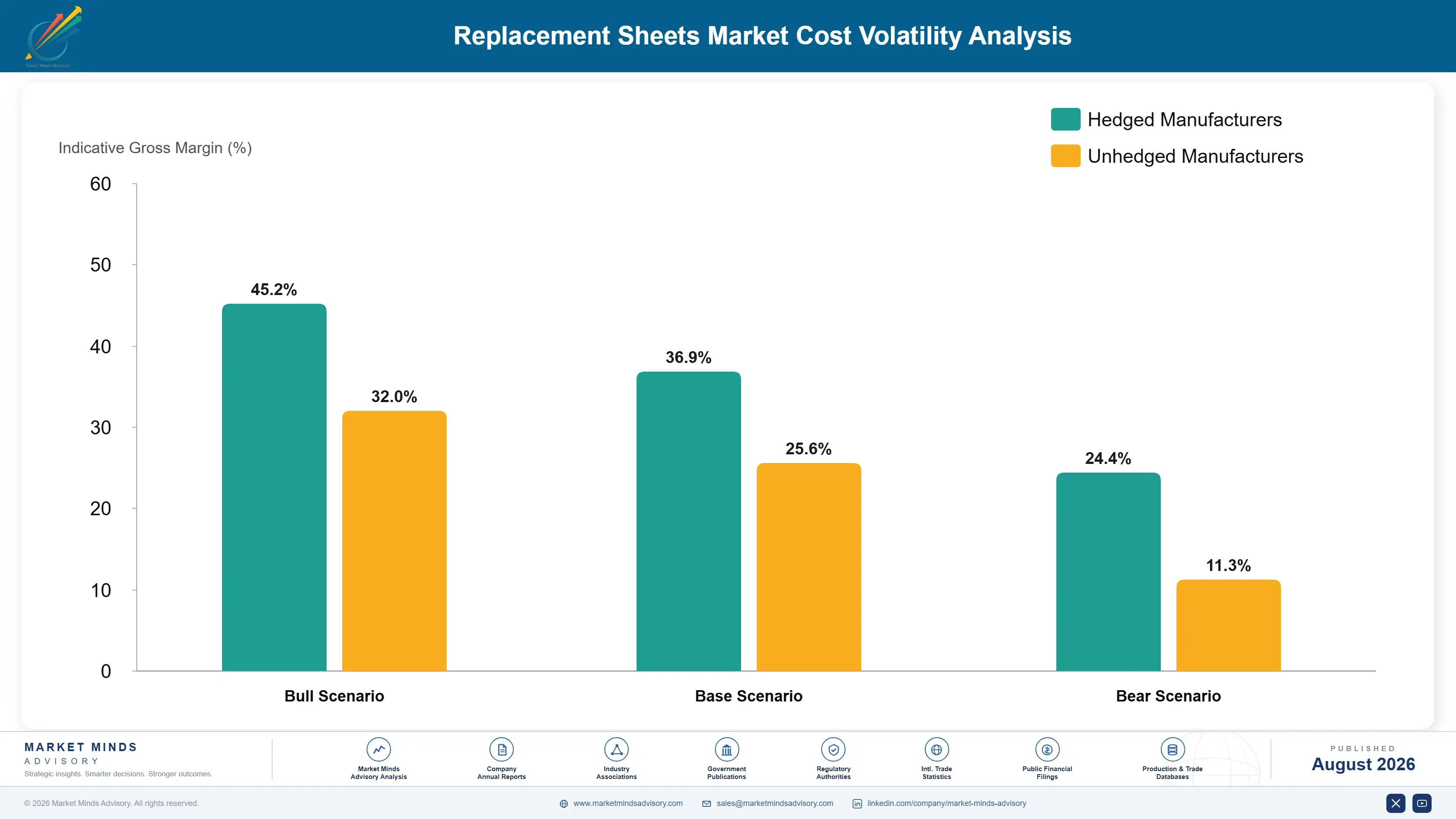
Raw fibre represents roughly 38% of finished sheet cost, and mills holding annual retail or institutional contracts absorb cotton price movement for a full cycle before repricing becomes possible. The root cause is that contract terms in this category were established when cotton was less volatile than it has become. Commercial impact is margin compression concentrated in exactly the periods when input costs rise. Participants respond with index-linked clauses, forward fibre purchasing and blend flexibility that reduces cotton exposure. Contract structure decides profitability in volatile years. Terms written for a stable market proved costly.
Market Impact: Wash life near 120 cycles specified
3 additional market trends, 4 additional growth drivers, and 2 additional restraints and challenges are covered in the full report. Contact sales@marketmindsadvisory.com to access the complete intelligence.

Segment CAGR and Growth Architecture

Five fibre and construction classes divide this market, and the division tracks how each is actually sold rather than how it is made. Two classes compete on delivered price against enormous global capacity, and three carry properties that a buyer can either feel directly or measure in wash cycles. Verifiability decides pricing power throughout this market.
replacement-sheets-market-market-share-analysis-1787306530843

Performance and Technical Fibre Sheets

Compounding at 8.1%, a full 1.50x the market rate, this class covers cooling finishes, moisture-wicking constructions, antimicrobial treatments and abrasion-resistant blends engineered for specific performance rather than for fibre provenance. Consumers can feel the difference immediately, which is rare in bed linen and worth a substantial price premium. Institutional buyers can measure it in wash cycles, which is worth more still. Healthcare purchasing values fluid management and high-temperature durability explicitly, and these constructions win specifications that commodity cotton loses on total cost per night of service. Thread count marketing cannot answer any of these claims. Healthcare specifications increasingly name these constructions explicitly, and institutional buyers reward them on total cost per night of service rather than on purchase price.
CAGR 8.1%

Microfibre and Polyester Sheets

Growing at 6.2%, microfibre and polyester constructions dominate the value end of retail and a substantial share of budget hospitality, where durability under laundering and low purchase price both matter more than natural fibre preference. Production is concentrated in China and Southeast Asia and the product is genuinely close to interchangeable between suppliers, which makes this a delivered-price contest. Consumer perception has improved as construction quality rose, though premium retail positioning remains difficult against the cultural preference for cotton in most Western markets. Cultural preference for cotton in most Western markets caps premium positioning regardless of measured performance, which is a genuine constraint no amount of construction improvement resolves. Delivered price decides every award.
CAGR 6.2%
Full segment breakdown across 5 segments available in the complete report.

Regional Architecture and Country Demand Map

Regional distribution follows manufacturing capacity rather than consumption, and the two are almost inverted. The regions that spin, weave and finish most of the world's bed linen are not the regions that pay the most for it, which makes share and profitability diverge sharply. Manufacturing share and profitability diverge sharply.

South Asia and Pacific

Thirty-three per cent of global value at 7.4% growth, the largest regional position, and manufacturing explains almost all of it. Note: this far exceeds the 7 to 12% band because India and Pakistan spin, weave and finish the majority of the world's cotton bed linen, and Welspun, Trident and Indo Count supply retail and institutional buyers across every other region from that base. India compounds at 9.2%, faster than any country covered, combining that export position with domestic hospitality construction. Value captured per unit remains modest, since brand and retail margin accrue in the destination markets. Moving into branded retail positions requires destination market presence that manufacturing scale alone does not confer.
Share: 33% | CAGR: 7.4% (2026 to 2036)

East Asia

Twenty-two per cent of value, built on microfibre and polyester production concentrated in China and on a large domestic hospitality sector. Chinese mills dominate synthetic bed linen supply into value retail worldwide, and the product is close enough to interchangeable that delivered price decides awards. Domestic hotel construction has slowed from earlier rates but the installed base is enormous and now sits in steady replacement. Japan and South Korea contribute smaller, higher-value positions with strong preferences for specific fibre and weave constructions that command genuine premiums. Performance fibre finishing capability across Chinese mills has improved considerably and now competes directly with Indian and Turkish supply. Value retail worldwide depends on that supply base.
Share: 22% | CAGR: 6.2% (2026 to 2036)
Regional intelligence for 5 additional markets available in the complete report: North America, Western Europe, Latin America, Middle East and Africa, Eastern Europe. Contact sales@marketmindsadvisory.com.
replacement-sheets-market-country-cagr-analysis-1787306531364

Where Bed Linen Value Actually Sits

Commodity cotton sheets are made by everyone and bought on delivered price, which is not a business worth defending. Value comes from institutional buyers who calculate cost per night rather than per sheet, from performance properties a buyer can verify, and from initial fill orders that arrive years before replacement does. Two of the three are commercial disciplines.

Sell cost per night, not price per sheet

A sheet costing a third less that fails after 80 wash cycles rather than 120 is more expensive per night of service, and institutional purchasing functions increasingly perform that calculation themselves. Suppliers publishing independently tested wash life win contracts against cheaper alternatives routinely, and interviewed hospitality buyers reported paying 20% to 30% premiums where cycle data was credible. The arithmetic is straightforward and rarely disputed once presented, yet most suppliers still quote unit price into tenders that would reward durability evidence. Institutional buyers run the arithmetic themselves. The arithmetic is rarely disputed once presented.
Market Impact: Premiums of 20% to 30% routinely ac

Capture the initial fill before the property opens

A new hotel buys roughly three full linen sets per bed months before its first guest arrives, which is several years of replacement volume in a single order. The property then joins the replacement cycle permanently with the supplier it started with, since housekeeping standardises on what it already holds. Engaging during construction rather than after opening captures both. Hospitality construction pipelines are public information, which makes this the most straightforwardly targetable opportunity in the entire category. Roughly 3 sets per bed arrive as one order, and the property then replaces on schedule for as long as it operates.
Market Impact: Roughly 3 sets purchased for every

Compete on properties buyers can verify themselves

Thread count stopped describing durability once mills began counting plied yarns, and consumers have gradually noticed that expensive sheets do not reliably feel better. Cooling, moisture management and abrasion resistance can all be felt or measured directly, which is why performance fibres compound at 8.1% against 5.4% for the market. Retail participants still competing on thread count are defending a claim that is losing credibility, and premium positioning built on it becomes harder to sustain each year. Consumers have gradually noticed the disconnect themselves. Expensive sheets do not reliably feel any better.
Market Impact: Performance fibres compounding at 8

Reduce cotton exposure through blend flexibility

Raw fibre represents roughly 38% of finished cost, and mills on annual contracts absorb cotton price movement for a full cycle before repricing. Blend flexibility that allows substitution between cotton, polyester and technical fibres without changing the finished specification reduces that exposure materially, and it also lets a supplier bid competitively across price points from one production base. Participants without that flexibility face margin compression in precisely the years when raw material markets move against them. Blend flexibility also lets a supplier bid competitively across several price points from one production base.
Market Impact: Cotton sitting at 38% of total fini

Who Controls the Margin Pool

The top five hold 26% of the market measured on revenue from replacement bed sheet and flat linen products, the basis used throughout this section. That is the lowest concentration in this report series and it reflects a category where manufacturing capability is widely held and barriers are minimal. Welspun, Trident and Indo Count lead on manufacturing scale from India, while Standard Textile holds institutional depth and Sferra a premium retail position.
Competitive activity runs along three lines. Indian and Pakistani mills are moving up from private label supply toward branded retail positions in destination markets, seeking the margin that currently accrues downstream. Institutional specialists are competing on tested wash life and total cost per night rather than on unit price. And performance fibre developers are pursuing both channels with properties that thread count marketing cannot answer.

Pressure comes from two directions. Retail private label continues expanding at the expense of brands, since consumers struggle to distinguish products and default to price. And Chinese synthetic supply presses the value end from below. Rankings will shift toward participants holding either verified performance claims or institutional contracts, because commodity cotton positions have no defence available to them at all.
replacement-sheets-market-company-positioning-matrix-1787306531886

Competitive Moat and Risk Dimensions

WELSPUN LIVING

Moat: Integrated scale from fibre

Vertical integration from cotton procurement through spinning, weaving, finishing and confectioning gives the company cost control across the whole chain rather than at one stage of it, which matters when raw fibre is 38% of finished cost. Scale relationships with major retailers also make it a default supplier for private label programmes requiring consistent volume across large orders.
WELSPUN LIVING

Risk: Value captured downstream elsewhere

Private label supply means brand and retail margin accrue to the customer rather than the manufacturer, and the company competes for that business against Pakistani, Chinese and Turkish mills with comparable capability. Moving into branded retail positions requires marketing capability and destination market presence that manufacturing scale does not confer, and progress there has been slower than intended.
STANDARD TEXTILE

Moat: Institutional specification depth

Long focus on healthcare and hospitality has built product engineering around wash-cycle durability, fluid management and infection control requirements that retail-oriented manufacturers do not design toward. Institutional buyers calculating cost per night rather than per sheet reward that directly, and specifications written around tested performance are considerably harder for a price-led competitor to bid against successfully.
STANDARD TEXTILE

Risk: Narrow exposure to occupancy

Institutional demand follows hospitality and healthcare occupancy closely, which the pandemic period demonstrated painfully when hotels stopped replacing linen nobody was sleeping on. That concentration produces predictable volume in normal conditions and severe exposure in abnormal ones, without the household channel that diversified manufacturers used to absorb the same shock.

Players Tracked

Prominent Players

Welspun Living
Trident Group
Standard Textile
Indo Count Industries
Sferra

Other Key Players

Himatsingka Seide
Alok Industries
Nishat Mills
Gul Ahmed Textile Mills
Sunvim Group
Luolai Home Textile
Beyond Home Textile
Hollander Sleep Products
American Textile Company
Venus Group
Bekaert Textiles
Zorlu Tekstil
Portico New York
Coyuchi
Boll and Branch

Recent Developments

MARCH 2022

Cotton prices reach multi-year highs

Cotton futures reached levels not seen for more than a decade on weather-driven supply reduction and post-pandemic demand recovery, and mills holding annual retail and institutional contracts absorbed the increase for a full cycle. This was a commodity market movement rather than any corporate or regulatory event.
Signal: Annual contract terms written for a stable
JUNE 2023

Hospitality occupancy recovery restarts replacement cycles

Hotel occupancy across major markets returned to pre-pandemic levels, restarting wash-cycle replacement clocks that had effectively stopped when properties stood empty. Institutional linen demand recovered accordingly, though the deferred replacement accumulated during closure produced a temporary surge that normalised over the following year. Deferred replacement produced a temporary surge.
Signal: Institutional demand tracks occupancy dire
FEBRUARY 2025

Retail scrutiny of thread count claims intensifies

Consumer testing organisations and retailers increased scrutiny of thread count claims, following long-standing evidence that counting plied yarns as multiple threads had rendered the figure meaningless as a quality indicator. This was a consumer information development rather than any regulatory action against manufacturers or retailers.
Signal: The retail quality shorthand is losing its

What Actually Costs Money Here

Raw fibre dominates this cost base in a way few finished goods categories match. Cotton, polyester and technical fibres account for roughly 38% of finished sheet cost, purchased on commodity markets that move independently of anything a manufacturer controls. Spinning, weaving, dyeing and finishing absorb around 29%, and energy for wet processing is the largest component within that.
Cotton prices reached multi-year highs through 2022 on weather-driven supply reduction, and mills holding annual contracts absorbed the movement for a full cycle before repricing was possible. Textile sector reporting documented that compression clearly. Energy costs for dyeing and finishing rose in parallel across European and Turkish production, which widened the cost gap against Indian and Chinese mills operating on considerably cheaper power. Power pricing now drives location decisions here.

Exposure varies most by integration and by contract structure. Vertically integrated mills control cost from fibre through finishing and can substitute between blends as prices move. Confectioners buying finished fabric carry fibre exposure without any ability to manage it. Participants on annual fixed-price contracts absorb commodity movement entirely, while those with index-linked terms pass it through, and that contractual difference decides profitability in volatile years.
replacement-sheets-market-cost-volatility-analysis-1787306532081

Index-linked terms in annual supply contracts

Fixed-price annual contracts through a cotton cycle cost mills a full year of compressed margin with no recovery available. Index adjustment clauses transfer that exposure, and institutional buyers accept them more readily than retailers because their own purchasing is calculated on cost per night rather than on shelf price points. Retailers resist the same clauses more firmly.

Blend flexibility across specification-equivalent constructions

Designing finished specifications that can be met with several fibre combinations lets a mill substitute as relative prices move without renegotiating with the customer. It requires performance testing across each variant and buyer acceptance of the approach upfront, which conservative institutional specifications sometimes prevent entirely. Conservative institutional specifications sometimes prevent the approach entirely, which limits where it can be used.

Wet processing located against energy pricing

Dyeing and finishing are energy-intensive and the cost gap between European and Asian power has widened considerably. Locating wet processing where energy is cheapest while keeping confectioning near the customer balances cost against lead time, which matters for replenishment orders that hospitality buyers need quickly. Hospitality buyers need replenishment quickly, and that requirement pulls confectioning back toward the customer.

Portfolio Architecture for Margin Defence

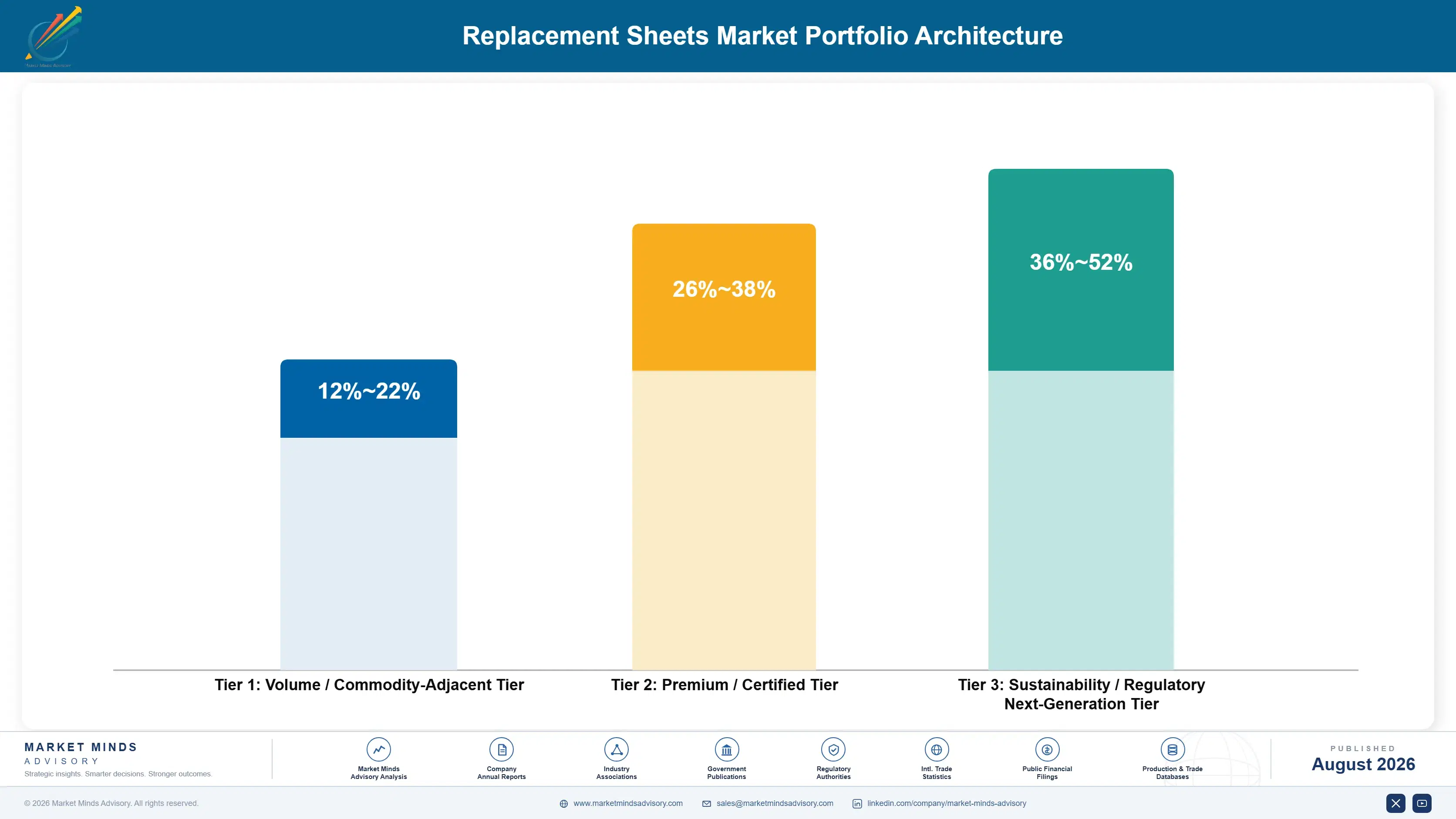
Margin architecture separates by whether the buyer can verify a claim. Commodity cotton and polyester sheets are made by hundreds of mills to comparable standards and bought on delivered price, holding gross margin in the teens. Performance constructions carrying cooling, moisture or durability properties a buyer can feel or measure clear more than twice that, from production assets that are frequently the same equipment running different inputs.
The tension is between scale and margin. Commodity volume fills mills, spreads fixed cost across the asset base and secures the retailer and institutional relationships through which everything else reaches market. It also earns almost nothing per unit and faces competition from every textile-producing country. No participant has sustained a performance-only position at meaningful scale, and commodity-only positions erode continuously. The two positions need each other more than either would prefer.

High-value pools concentrate where a property is demonstrable rather than asserted. Tested wash life for institutional buyers, cooling and moisture management for consumers, and specification-driven healthcare constructions all sit there. Everything sold on thread count competes on a number that has stopped meaning anything, against mills that can print the same figure on a considerably cheaper product.

Volume / Commodity-Adjacent Tier

Standard cotton and polyester sheets supplied as private label into value retail and budget hospitality, where products are close to interchangeable and delivered price decides every award across all channels.
Gross Margin: 12-22%

Premium / Certified Tier

Institutional constructions specified on tested wash life, fluid management and infection control performance, protected by purchasing functions that calculate cost per night of service rather than price per sheet. Specifications written around tested performance resist price-led bidding.
Gross Margin: 26-38%

Sustainability / Regulatory / Next-Generation Tier

Performance and technical fibre constructions carrying cooling, moisture management and antimicrobial properties, defended by finishing technology and by claims a buyer can verify directly rather than accept on assertion. Finishing capability is the barrier rather than weaving.
Gross Margin: 36-52%
replacement-sheets-market-portfolio-architecture-1787306532582

High-value Sub-segments and Strategic Watch-out

Performance and Technical Fibre Sheets

High value and the fastest growth at 8.1%, carrying properties consumers feel immediately and institutions measure in wash cycles. Thread count marketing cannot answer these claims, which is why premium positioning built on it keeps weakening. Both channels reward the same properties. Finishing capability is the barrier.
Gross Margin: 36-52%

Institutional Healthcare Constructions

High value at 7.4%, specified on fluid management and high-temperature durability rather than purchased on price. Replacement follows occupancy and infection control policy, which makes volume unusually predictable across the cycle. Specifications sit in procurement policy. Occupancy and policy drive the volume, not budget discretion.
Gross Margin: 28-40%

Commodity Cotton Sheets

The volume core at 3.6%, filling mills and securing the retail relationships everything else reaches market through. Also entirely undefended, with hundreds of mills producing comparable product across every textile-producing country. Scale here fills the mills that everything else runs on. No defence exists here.
Gross Margin: 12-22%

Linen and Specialty Natural Fibres

The strategic watch-out at 6.8%. Strong premium positioning in European markets and genuine consumer preference, but flax supply is narrow and processing capacity concentrated enough to constrain any rapid expansion. Flax supply constrains any rapid expansion. European preference supports genuine premiums here. Processing capacity is narrow.
Gross Margin: 32-46%

Who Replaces and On What Clock

Institutional revenue is genuinely recurring and calculable, which is rare in textiles. A hospitality property holding three sets per bed and condemning sheets at roughly 120 wash cycles generates replacement volume that a purchasing manager forecasts annually and a supplier can plan against. Healthcare follows the same logic under infection control policy. Household revenue is neither recurring nor calculable, arriving on a 6.5 year average that conceals enormous variation.
Supplier stickiness varies accordingly. Institutional accounts are sticky because housekeeping standardises on a specification and inventory mixing across generations creates visible inconsistency that guests notice. Healthcare accounts are stickier still, since specifications are written into procurement policy. Household purchasing has essentially no loyalty at all, with consumers switching between brands and retailers on price, appearance and whatever happens to be available.

The purchasing function also differs completely. Hospitality buys through procurement managers calculating cost per occupied night and holding suppliers to tested performance. Healthcare buys through group purchasing against written specification. Households buy through retail on appearance and price with no technical evaluation of any kind. A supplier addressing all three with one product story and one commercial approach serves none of them properly.
replacement-sheets-market-end-use-penetration-index-1787306533066

Where Value Actually Sits

These are among the four positions where our research anticipates prominent divergence between winners and laggards over the coming forecast period. Each is grounded in the demand model, the regulatory perimeter, and the announced capacity pipeline.
01 / COST PER NIGHT SELLING

Institutions do the arithmetic themselves already

A sheet costing a third less that fails after 80 industrial wash cycles rather than 120 is genuinely more expensive per night of service, and hospitality and healthcare purchasing functions increasingly run that calculation without prompting. Suppliers that publish independently tested wash life win contracts against materially cheaper alternatives, and interviewed buyers reported paying premiums of 20% to 30% wherever cycle data was credible. Most suppliers nonetheless still quote unit price into tenders that would have rewarded credible durability evidence instead.
02 / INITIAL FILL CAPTURE

Three sets per bed before a guest arrives

A new hotel purchases roughly three complete linen sets for every bed several months ahead of opening, which compresses several years of replacement volume into a single order placed during construction. The property then joins the replacement cycle permanently with whichever supplier it started with, because housekeeping standardises on the inventory it already holds and actively resists mixing product generations. Hospitality construction pipelines are entirely public information, which makes this the most straightforwardly targetable opportunity anywhere in the whole category.
03 / VERIFIABLE PROPERTY POSITIONING

Thread count has stopped meaning anything at all

Counting plied yarns as multiple threads rendered thread count useless as a durability or quality indicator decades ago, and consumers have gradually noticed that expensive sheets do not reliably feel any better. Cooling, moisture management and abrasion resistance can all be felt directly by a consumer or measured objectively by an institution, which is why performance fibres compound at 8.1% against 5.4% for the wider market. Premium retail positioning built on thread count therefore weakens measurably every single year that passes.
04 / FIBRE EXPOSURE MANAGEMENT

Raw cotton is nearly forty per cent of cost

Raw fibre alone represents roughly 38% of total finished sheet cost, and mills sitting on annual fixed-price contracts absorb every commodity movement for a full contract cycle before any repricing becomes possible at all. Blend flexibility permitting substitution between cotton, polyester and technical fibres without altering the finished specification at all reduces that exposure very materially indeed, and cheaply. Participants that lack any blend flexibility face margin compression precisely in the years when raw material markets are moving hardest against them.

Engagement Snapshot From the Field

A live engagement with an industry participant carrying material or product regulatory and market exposure ahead of a defining policy shift, showing how our research translates into a defensible multi-year portfolio strategy.
MARKET MINDS ADVISORY · CLIENT ENGAGEMENT SUMMARY
Replacement Sheets Producer Strategic Portfolio Review and Transition Roadmap 2026·Investment Scenario on Replacement Sheets Exposure Evaluation 2025-26
CLIENT PROFILE
An integrated home textile manufacturer with annual revenue near $580 million (client-reported, unverified by MMA), spinning, weaving and finishing bed linen at two South Asian sites for retail private label and a smaller institutional business. Retail private label margins had compressed for four consecutive years while volume grew, and leadership wanted to understand whether the institutional business justified greater investment.
STRATEGIC CHALLENGE
The company competed for private label programmes against mills with comparable capability and similar cost positions, which made every renewal a price contest it could only win by conceding margin. Leadership needed to establish whether institutional customers genuinely paid for tested durability, what evidence they required, and whether the company's finishing capability could support performance claims at all.
MMA APPROACH
We interviewed 33 hospitality and healthcare purchasing managers on specification criteria, wash-cycle evaluation and willingness to pay for tested performance. Private label renewal outcomes were analysed across three years to separate price-led from specification-led awards. We modelled institutional expansion and performance fibre entry against continued private label volume defence. Finishing capability was assessed against claims.
KEY FINDINGS
  1. Twenty-six of 33 institutional buyers calculated cost per occupied night rather than price per sheet, and 21 said they would pay a premium of at least 20% for credible tested wash life.
  2. Private label renewals had been decided on delivered price in every instance examined, and no customer had asked for durability evidence at any point during those processes.
  3. The company's existing finishing capability could support cooling and moisture management claims with modest investment, but it held no test data that any institutional buyer would accept.
  4. Healthcare specifications in the client's target markets were written around fluid management and high-temperature durability, both of which the company met without ever having claimed it.
CLIENT PROFILE
An integrated home textile manufacturer with annual revenue near $580 million (client-reported, unverified by MMA), spinning, weaving and finishing bed linen at two South Asian sites for retail private label and a smaller institutional business. Retail private label margins had compressed for four consecutive years while volume grew, and leadership wanted to understand whether the institutional business justified greater investment.
STRATEGIC CHALLENGE
The company competed for private label programmes against mills with comparable capability and similar cost positions, which made every renewal a price contest it could only win by conceding margin. Leadership needed to establish whether institutional customers genuinely paid for tested durability, what evidence they required, and whether the company's finishing capability could support performance claims at all.
MMA APPROACH
We interviewed 33 hospitality and healthcare purchasing managers on specification criteria, wash-cycle evaluation and willingness to pay for tested performance. Private label renewal outcomes were analysed across three years to separate price-led from specification-led awards. We modelled institutional expansion and performance fibre entry against continued private label volume defence. Finishing capability was assessed against claims.
KEY FINDINGS
  1. Twenty-six of 33 institutional buyers calculated cost per occupied night rather than price per sheet, and 21 said they would pay a premium of at least 20% for credible tested wash life.
  2. Private label renewals had been decided on delivered price in every instance examined, and no customer had asked for durability evidence at any point during those processes.
  3. The company's existing finishing capability could support cooling and moisture management claims with modest investment, but it held no test data that any institutional buyer would accept.
  4. Healthcare specifications in the client's target markets were written around fluid management and high-temperature durability, both of which the company met without ever having claimed it.
RECOMMENDED STRATEGY
Phase 1: Phase one: commission independent wash-cycle and performance testing, since institutional buyers require evidence the company could produce but had never generated. Phase 2: Phase two: build a dedicated institutional commercial team, because hospitality and healthcare purchasing behaves nothing like retail private label procurement. Phase 3: Phase three: enter performance fibre retail selectively, using the same test data to support consumer claims that thread count cannot answer.
OUTCOME
Independent testing was commissioned within one quarter and produced results supporting a 120-cycle claim. Institutional revenue grew by roughly 40% in the following year at margins well above private label (client-reported, unverified by MMA). Retail private label volume was allowed to decline deliberately for the first time in the company's history.

Frequently Asked Questions

Foundational context covering the market sizes, CAGR, scope, country, region and competition that inform every finding below. This section is provided to cover basics and most often pre-purchase conversations, answered from the MMA Primary Research Dataset.

What is the current size of the Replacement Sheets Market?

The global market is valued at $8.6 billion in 2025, rising to $9.06 billion in 2026. South Asia and Pacific holds the largest share at 33%, reflecting manufacturing capacity rather than consumption.

How large will the Replacement Sheets Market be by 2036?

MMA forecasts $15.33 billion by 2036, an increase of $6.27 billion over the 2026 base and an expansion multiple of 1.69x. Performance fibres and institutional demand carry most of that growth.

What is the CAGR for the Replacement Sheets Market 2026 to 2036?

The base case compound annual growth rate is 5.4%, with a bull case at 6.6% and a bear case at 4.2%. Historical growth from 2020 to 2025 ran near 4.4% with the two channels moving in opposite directions.

Which segment is growing fastest?

Performance and technical fibre sheets compound at 8.1%, a full 1.50x the market rate. They carry cooling, moisture and durability properties a consumer can feel and an institution can measure in wash cycles.

Who are the major companies in the Replacement Sheets Market?

Welspun Living, Trident Group, Standard Textile, Indo Count Industries and Sferra together hold 26% of revenue from replacement sheet products. That is the lowest concentration in this report series.

Which country is growing fastest?

India compounds at 9.2%, faster than any other country covered, combining its export manufacturing position with domestic hospitality construction. Value captured per unit remains modest because brand margin accrues downstream.

Report Segmentation Architecture

The full report scope spans multiple orthogonal segmentation dimensions, with cross-tabulated demand data provided for each dimension pair. Coverage extends further to regional breakdowns, trend trajectories, and the competitive detail needed to support segment-level decision-making.

By Fibre and Construction Class

  • Cotton and Cotton-Blend Sheets
  • Microfibre and Polyester Sheets
  • Performance and Technical Fibre Sheets
  • Linen and Specialty Natural Fibre Sheets
  • Single-Use and Disposable Sheets

By End-Use Industry

  • Hotels and Hospitality
  • Hospitals and Healthcare Facilities
  • Long-Term and Residential Care
  • Household and Residential Consumers
  • Serviced Apartments and Short-Stay Rentals
  • Cruise, Rail and Transport Accommodation

By Commercial Dimension

  • Institutional Supply Contracts
  • Group Purchasing Organisation Agreements
  • Retail Private Label Programmes
  • Branded Retail Distribution
  • Online Direct-to-Consumer Sales
  • Distributor and Wholesale Supply

By Region

  • South Asia and Pacific
  • East Asia
  • North America
  • Western Europe
  • Latin America
  • Middle East and Africa
  • Eastern Europe

Scope, Methodology, and Coverage

Every figure in this report is reproducible from documented input assumptions. The scope below maps the historical period, the forecast horizon, the segmentation dimensions, and the countries covered, alongside the underlying primary and qualitative methodology.
Historical Period
2020 to 2025
Forecast Period
2026 to 2036
Base Year
2025 (USD billions; MMA Primary Research Dataset, August 2026)
Market Definition
This market comprises bed sheets and flat linens purchased as replacement stock, measured at manufacturer revenue across institutional supply contracts, group purchasing organisation agreements, retail private label programmes, branded retail distribution, online direct-to-consumer sales, and distributor or wholesale supply. Coverage spans cotton and cotton-blend sheets across weave constructions, microfibre and polyester sheets, performance and technical fibre sheets carrying cooling, moisture management, antimicrobial or abrasion-resistant properties, linen and specialty natural fibre sheets including flax, hemp and bamboo-derived constructions, and single-use or disposable sheets used in healthcare and short-stay settings. Mattresses and mattress toppers, pillows, duvets, comforters and blankets, pillowcases and duvet covers sold independently of sheets, mattress protectors and encasements, towels, bath linen and table linen, medical drapes and surgical textiles, rental and managed laundry services, and industrial laundry equipment fall outside scope.
Quantitative Units
USD millions (current prices); units shipped by fibre class; institutional versus household split; average selling price by class; wash-cycle life; sets held per institutional bed; replacement interval
Segmentation Dimensions
By Fibre and Construction Class; By End-Use Industry; By Commercial Dimension; By Region
Regions Covered
South Asia and Pacific, East Asia, North America, Western Europe, Latin America, Middle East and Africa, Eastern Europe
Countries Covered
India, Pakistan, Bangladesh, Australia, Indonesia, Vietnam, China, Japan, South Korea, Taiwan, United States, Canada, Germany, France, Italy, United Kingdom, Spain, Belgium, Netherlands, Portugal, Brazil, Mexico, Argentina, Colombia, Chile, Saudi Arabia, United Arab Emirates, Egypt, South Africa, Poland, Romania, Turkey, Czechia, Hungary, and additional markets relevant to home and institutional textile analysis
Key Companies Profiled
Welspun Living, Trident Group, Standard Textile, Indo Count Industries, Sferra, Himatsingka Seide, Alok Industries, Nishat Mills, Gul Ahmed Textile Mills, Sunvim Group, Luolai Home Textile, Beyond Home Textile, Hollander Sleep Products, American Textile Company, Venus Group, Bekaert Textiles, Zorlu Tekstil, Portico New York, Coyuchi, Boll and Branch
Quantitative Methodology
Primary survey, n=3,800 respondents, Q4 2025, six countries; demand-side model with trade association cross-validation
Qualitative Methodology
47 expert interviews, Q4 2025; applied to validate demand model assumptions, identify emerging dynamics, and assess competitive positioning
Report Format
PDF and XLSX data workbook (Word format preview document)
Publisher
Market Minds Advisory
Report Code
MMA-2026-CHM-542
Published
August 2026
Contact
sales@marketmindsadvisory.com | www.marketmindsadvisory.com

Purchase the full Replacement Sheets Market Report (2026 to 2036).

The full MMA report separates the institutional business that replaces on a calculable wash-cycle schedule from the household business that replaces on a whim, and sizes each on its own terms. It covers five fibre and construction classes and seven regions to 2036, modelling units shipped, institutional and household split, pricing by class, wash-cycle life, sets per bed and replacement intervals separately. Competitive assessment covers twenty manufacturers on one consistent revenue basis. Cost exposure is traced through fibre, wet processing and energy. Four commercial levers and a strategic verdict close the report, grounded in 47 expert interviews and a 3,800-respondent survey.
Five fibre and construction classes sized separately through 2036
Institutional and household demand modelled on entirely separate logic
Wash-cycle purchasing behaviour benchmarked across hospitality and healthcare
Twenty manufacturers assessed on one consistent revenue basis
Cotton price exposure modelled against contract structure by participant
Anonymised manufacturer engagement with tested channel recommendations

Built For The People Who Decide

From boardroom strategy to bench-side execution, this report is read cover-to-cover by leaders shaping the next decade of their industry, turning demand scenarios, market dynamics and valuation benchmarks into decisions.
CXOs/ Presidents/ VPs/ Managers
M&A and Corporate Development
Strategy Teams and R&D Heads
Procurement and Product Directors
Regulatory and Compliance Leaders
Investor Relations and Equity Analysts