Market Minds Advisory
Renal Insufficiency Treatment Market

Renal Insufficiency Treatment Market: Drugs That Work, Patients Nobody Found

Therapy that genuinely slows kidney decline arrived after thirty years of merely managing the complications, and the binding constraint became identification rather than treatment, with most disease still undiagnosed today.

Lead Analyst

Alice Ballenger

Published

September 2026

Make Smarter Decisions with Customized Research Insights

Request a free sample report and evaluate market opportunities, growth trends, and competitive dynamics relevant to your business needs.

2025 MARKET VALUE$19.4BMarket Size 2025
2036 FORECAST VALUE$44.3BBase Case , 2026 to 2036
CAGR 2026 TO 20367.8 %Bull 9.0% / Bear 6.6%
INCREMENTAL OPPORTUNITY$23.4BNet 10- year value creation
EXPANSION MULTIPLE2.12x2036 value over 2026 base
Strategic Levers
M&A Pipeline
Regional Outlook
Country Rankings
Competitive Intelligence
Segmental Deep-dive
Call-Us : 91 93563 13602

Executive Snapshot and Market Trajectory

For three decades chronic kidney disease had no therapy that changed its course. Clinicians controlled blood pressure, treated anaemia and waited for dialysis. Trial evidence from DAPA-CKD and EMPA-KIDNEY ended that, showing progression slowed across diabetic and non-diabetic disease alike. Guidelines followed within two years. Nothing before it altered course.
The commercial problem moved immediately. Around 88% of people with kidney disease do not know they have it, while the blood and urine tests that would identify them cost about twelve dollars between them. Disease-modifying therapy currently reaches roughly 23% of diagnosed patients. The drugs work and cannot find the patients, which makes identification the binding constraint rather than therapeutic choice. Screening embedded into existing diabetes reviews works considerably better than standalone programmes do.
Payer economics point the same way and reward nobody in particular for it. Dialysis costs near eighty-nine thousand dollars per patient each year, so delaying it is worth an enormous amount, while the therapies achieving that delay face patent expiry within the decade. Non-steroidal mineralocorticoid antagonists grow fastest at 11.7%, half again the market rate of 7.8%, and China expands at 12.6%.
Market Definition
Pharmacological treatment of chronic kidney disease and its metabolic complications, covering SGLT2 inhibitors, non-steroidal mineralocorticoid receptor antagonists, anaemia therapies including erythropoiesis stimulating agents and hypoxia-inducible factor inhibitors, phosphate binders, potassium binders, and renin-angiotensin system inhibitors used in renal indications. Measured at manufacturer selling value. Excludes dialysis services, dialysis equipment and consumables, transplantation, and acute kidney injury management.
Base Year Value
$19.4B in 2025 (MMA Primary Research Dataset, August 2026)
Forecast Period
2026 to 2036, eleven discrete annual values
CAGR
7.8% base case. Bull 9.0%. Bear 6.6%.
Fastest Growth Segment
Non-Steroidal Mineralocorticoid Receptor Antagonists: 11.7% CAGR
Fastest Growth Country
China: 12.6% CAGR
Fastest Growth Region
South Asia and Pacific: 9.8% CAGR
Largest Region
North America: 30% of 2025 global value
Market Leaders
AstraZeneca, Boehringer Ingelheim, Bayer, Otsuka Pharmaceutical, CSL Vifor. Source: MMA Primary Research Dataset, July 2026.
Primary Survey
n=3,800 procurement and R&D decision-makers, Q4 2025, six countries
Methodology
Demand-side build-up, cross-validated against public data, 47 expert interviews

Renal Insufficiency Treatment Market Forecast Scenarios

renal-insufficiency-treatment-market-size-forecast-scenario-1787594863675
Growth ran near 6.4% between 2020 and 2025, driven almost entirely by uptake of newly indicated disease-modifying therapy rather than by any expansion in the treated population. Complication management, particularly phosphate binding and erythropoiesis stimulation, grew barely at all and faced generic and biosimilar pressure throughout. Diagnosis rates improved only marginally despite effort, which limited how far the evidence translated into prescriptions.
Base case 7.8% rests on three mechanisms. Guideline adoption continues pushing disease-modifying therapy into earlier disease stages where it does most good and reaches most patients. Non-steroidal mineralocorticoid antagonists expand at 11.7% into a population already established on other therapy rather than replacing it. And Chinese reimbursement expansion combined with a very large undiagnosed population supports 12.6% growth there, faster than anywhere else in the world. Volume there runs ahead of value.
The bull case at 9.0% assumes systematic screening programmes reaching primary care at scale, which would attack the 88% undiagnosed share directly and expand the treated population rather than the therapy mix. The bear case at 6.6% is patent expiry on the SGLT2 class compressing value faster than volume can offset, leaving a market treating more patients for considerably less money each.

Therapy Arrived Before Diagnosis Did

Kidney disease spent thirty years as a condition nobody could alter. Blood pressure control slowed things somewhat, complications were managed as they appeared, and patients progressed toward dialysis on a timetable set by their disease rather than their treatment. DAPA-CKD and EMPA-KIDNEY changed that, demonstrating meaningfully reduced progression to kidney failure across diabetic and non-diabetic populations, and guidelines followed within two years.
TOP FIVE CONCENTRATION56%Few companies hold disease-modifying assets in this area
UNDIAGNOSED DISEASE SHARE88%People with kidney disease unaware they have it
ANNUAL DIALYSIS COST89,000What delayed progression avoids for a payer yearly
PROGRESSION RISK REDUCTION39%Kidney failure risk reduction from disease-modifying therapy trials
SCREENING TEST COST12Blood and urine tests that identify the disease
TREATED PATIENT SHARE23%Diagnosed patients now receiving disease-modifying therapy at present
What followed was an unusual commercial situation. The therapy exists, works and is affordable, and around 88% of people with the disease have never been diagnosed with it. Estimated glomerular filtration rate and urine albumin to creatinine ratio testing costs roughly twelve dollars and is not routinely performed in most primary care settings. Disease-modifying therapy currently reaches about 23% of diagnosed patients, which is a fraction of a fraction.
Payer arithmetic is stark and oddly unhelpful to manufacturers. Dialysis runs near eighty-nine thousand dollars per patient per year, so delaying it by even a few years is worth more than almost any intervention in chronic disease. The molecules delivering that delay face patent expiry inside the decade, which means the greatest saving in nephrology will shortly be available generically while diagnosis stays the expensive part.
"Nephrology got the thing it had wanted for thirty years and discovered the bottleneck was a twelve dollar urine test nobody orders. Every commercial strategy in this category that starts with the molecule is solving a problem that was already solved."
Director, Nephrology and Chronic Disease Therapeutics Practice · MMA Healthcare and Pharmaceuticals Practice · August 2026

Market Trends

Disease-modifying evidence reshaping guidelines and earlier treatment initiation

DAPA-CKD and EMPA-KIDNEY demonstrated reduced progression to kidney failure across diabetic and non-diabetic chronic kidney disease, and guideline bodies moved unusually quickly to reflect it. Treatment initiation has shifted toward earlier disease stages where more nephrons remain to protect and the eligible population is considerably larger. That changes the commercial shape of the category from managing late-stage complications toward long-duration therapy in earlier disease, which is a much bigger patient pool treated for many more years each. The eligible population at earlier stages is considerably larger than at late stage, and treatment duration per patient is longer as well.
Market Impact: Avoids 89,000 dollars annually

Combination therapy building on existing regimens rather than replacing them

Non-steroidal mineralocorticoid receptor antagonists were studied in patients already receiving renin-angiotensin blockade, which positions them additively rather than competitively. Potassium binders sit alongside, because hyperkalaemia is what forces dose reduction or discontinuation of exactly the therapies that work. The result is a stacking regimen where each addition enables the next, growing at 11.7% and 8.8% respectively, rather than a sequence of displacements. That structure favours companies with portfolios spanning several mechanisms at once. Companies holding a single mechanism argue for one component while broader portfolios argue for the whole treatment approach, which is a materially stronger position with a prescriber.
Market Impact: Chinese demand growing at 12.6%

Market Opportunities and Growth Drivers

Payer incentives aligning around delayed dialysis initiation

Dialysis costs near eighty-nine thousand dollars per patient annually, which makes delaying initiation among the most valuable interventions available in chronic disease management anywhere. Payers and integrated health systems have begun funding screening and therapy programmes on that arithmetic rather than on drug budget considerations. The saving accrues to whoever carries the dialysis cost, which in most systems is the same payer buying the therapy, and that alignment is unusually clean by the standards of chronic disease. Health economics functions respond to it far better than formulary committees do. That is unusually clean alignment.
Market Impact: Leaves 88% undiagnosed today

Chinese reimbursement expansion reaching a very large patient population

China grows fastest anywhere at 12.6%, combining the largest chronic kidney disease population in the world with national reimbursement listings that have brought disease-modifying therapy within reach of far more patients. Hypoxia-inducible factor inhibitors for anaemia were approved and adopted there ahead of Western markets, giving Chinese nephrology practice an unusual lead in one therapeutic area. Volume-based procurement compresses pricing severely, so growth in treated patients far exceeds growth in value. The largest chronic kidney disease population in the world sits behind that growth, most of it still entirely undiagnosed and therefore untreated whatever the reimbursement position happens to be.
Market Impact: Erodes 39% risk reduction value

Market Restraints and Challenges

Undiagnosed disease limiting therapy reach far more than access does

Around 88% of people with chronic kidney disease have never been diagnosed, and disease-modifying therapy reaches roughly 23% of those who have. The root cause is that early kidney disease is asymptomatic and the tests identifying it, costing about twelve dollars, are not routinely ordered in primary care. Commercially this caps the market well below what therapeutic evidence would support. Manufacturers are funding screening programmes directly, which is unusual and reflects how completely identification has become the constraint. Screening embedded into existing diabetes reviews works considerably better than standalone programmes.
Market Impact: Cuts progression risk by 39%

Patent expiry compressing value on the most effective therapies

SGLT2 inhibitors face patent expiry within the decade, which will make the therapy that delivers the largest payer saving available at generic prices. The root cause is simply the passage of time on assets first approved for diabetes years before their renal indications emerged. Commercially it means value migrates away from the molecule toward diagnosis, adherence and combination management. Manufacturers are responding by building portfolios across several mechanisms rather than defending a single class. Duration and portfolio breadth are what offset it, since neither depends on holding price. Neither depends on holding price.
Market Impact: Antagonists growing at 11.7%
4 additional market trends, 3 additional growth drivers, and 2 additional restraints and challenges are covered in the full report. Contact sales@marketmindsadvisory.com to access the complete intelligence.

Segment CAGR and Growth Architecture

Six segments are split here by therapeutic class, because each acts on a distinct mechanism, carries its own evidence base and sits at a different point in the treatment sequence. Formulation and dosing variants sit inside each class rather than beside them. Disease stage, care setting and channel are handled in the framework instead.
renal-insufficiency-treatment-market-market-share-analysis-1787594864232

Non-Steroidal Mineralocorticoid Receptor Antagonists

Growing at 11.7%, half again the market rate of 7.8%, this class was studied in patients already receiving renin-angiotensin blockade, which positions it additively rather than as a replacement for anything. That matters commercially because the addressable population is the treated population rather than a subset waiting for a switch. Hyperkalaemia is the practical limit on dosing, which links the class directly to potassium binder use and creates a stacking regimen where one therapy enables another. Earlier disease stage initiation extends treatment duration substantially, and duration rather than price is what compounds in chronic therapy. Portfolio breadth across mechanisms decides who can argue for the regimen rather than the component.
CAGR 11.7%

Potassium Binders

At 8.8% potassium binders occupy an unusual position: they treat a side effect rather than the disease, and in doing so allow the therapies that modify the disease to be maintained at effective doses. Hyperkalaemia is the most common reason renin-angiotensin blockade and mineralocorticoid antagonists get reduced or stopped, which is exactly when their benefit disappears. That makes binder use a function of how aggressively the rest of the regimen is pursued rather than of hyperkalaemia prevalence alone. Adherence is the practical weakness, since the products are unpalatable and taken daily for years. Persistence is therefore the commercial variable rather than initiation, and it compounds across years. Portfolio breadth decides who can make that argument at all.
CAGR 8.8%
Full segment breakdown across 6 segments available in the complete report.

Regional Architecture and Country Demand Map

North America holds 30% of value on branded drug pricing rather than on disease burden, which sits largely elsewhere entirely. East Asia follows at 26% on the largest patient population anywhere in the world, with Western Europe at 19% operating under considerably tighter national pricing regimes.

North America

Value concentration here reflects branded drug pricing rather than patient numbers, which sit largely in Asia. Dialysis costs near eighty-nine thousand dollars per patient annually and are borne substantially by a single federal programme, which creates an unusually direct alignment between the payer funding therapy and the payer avoiding dialysis. That alignment has funded screening pilots in primary care that would be difficult to justify in a fragmented system. Diagnosis rates remain poor despite it. Growth of 6.8% runs below the base case as patent expiry approaches on the largest class. Initiation decisions have migrated toward primary care and endocrinology, where most commercial organisations have no established presence at all.
Share: 30% | CAGR: 6.8% (2026 to 2036)

Western Europe

Health technology assessment and reference pricing keep realised value well below North American levels for identical therapy, which makes this a large treated population at modest value per patient. National screening approaches vary considerably, with some systems incorporating kidney function testing into existing diabetes and hypertension reviews and others leaving it to clinical judgement. Nephrology guidelines were adopted quickly after the trial evidence emerged. Generic and biosimilar substitution is aggressive across complication management. Growth at 6.2% runs below the base case on pricing pressure rather than clinical caution. Treated population is large and value per patient modest. Nephrology guidelines were adopted quickly after the trial evidence emerged, and the constraint here is pricing rather than clinical caution.
Share: 19% | CAGR: 6.2% (2026 to 2036)
Regional intelligence for 5 additional markets available in the complete report: East Asia, South Asia and Pacific, Latin America, Middle East and Africa, Eastern Europe. Contact sales@marketmindsadvisory.com.
renal-insufficiency-treatment-market-country-cagr-analysis-1787594864756

Four Moves When the Drug Already Works

Commercial strategy in this category keeps starting with the molecule, which is the one part that has already been solved for everybody. Around 88% of patients are undiagnosed and a twelve dollar test would find them, so almost every remaining opportunity sits in identification, in regimen persistence, or in the payer arithmetic around dialysis.

Fund identification rather than promoting the molecule

Roughly 88% of people with chronic kidney disease have never been diagnosed and disease-modifying therapy reaches only about 23% of those who have, which means the therapeutic argument is already won and unheard. Manufacturer-funded screening in primary care, embedding kidney function testing into existing diabetes and hypertension reviews, expands the treated population rather than competing for a share of it. That is an unusual thing for a pharmaceutical company to fund and it is where the volume actually sits. It expands the category rather than reallocating it, which nothing else here does.
Market Impact: Attacks the whole 88% undiagnosed patient pool directly

Build the dialysis avoidance case for the payer directly

Dialysis runs near eighty-nine thousand dollars per patient annually, and in most systems the payer funding therapy is the payer avoiding that cost. Presenting progression delay in those terms reaches health economics and population health functions rather than formulary committees weighing drug budgets against each other. The alignment is cleaner here than in almost any other chronic disease, and remarkably few commercial teams have built the case in the form a population health director would actually use. A dialysis year at 89,000 dollars funds much testing. Very few commercial teams have built the case in that form.
Market Impact: Avoids 89,000 dollars per patient every single year

Support the regimen that enables the regimen

Hyperkalaemia is the most common reason renin-angiotensin blockade and mineralocorticoid antagonists get reduced or stopped, and benefit disappears at reduced dose. Potassium binders growing at 8.8% exist to prevent exactly that, which makes them a persistence tool rather than a separate therapy. A portfolio spanning both mechanisms can argue for maintained dosing across the whole regimen, which no single-mechanism competitor can do, and persistence is what compounds over years of chronic treatment. Persistence is what compounds across years of chronic therapy, and initiation happens only once. No single-mechanism competitor can make that case.
Market Impact: Supports 8.8% growth across the potassium binder class

Move value toward duration as pricing power decays

SGLT2 patent expiry inside the decade will make the largest payer saving in nephrology available generically, so defending price is a losing position. Earlier initiation extends treatment duration by years per patient, and duration compounds where price does not. Guideline movement toward earlier disease stages supports it clinically, and the eligible population at those stages is considerably larger. Building the earlier-stage evidence and access position now is worth more than any pricing defence available. The eligible population at earlier stages is considerably larger as well. Guideline movement toward earlier disease supports it clinically.
Market Impact: Offsets erosion of the 39% risk reduction benefit

Who Controls the Margin Pool

Participation is measured on annual manufacturer revenue in renal indications, and the top five hold 56%. Concentration reflects how few companies hold disease-modifying assets, since complication management is widely genericised and contributes volume rather than value. AstraZeneca and Boehringer Ingelheim lead through SGLT2 franchises with renal indications, with Bayer holding the mineralocorticoid antagonist position. The gap to challengers is outcome trial evidence rather than commercial reach. Complication management contributes volume rather than value.
Competition runs on three fronts. Evidence in earlier disease stages decides where guidelines place a therapy and therefore treatment duration. Portfolio breadth across mechanisms decides whether a company can argue for a whole regimen rather than one component. Identification investment decides the treated population, which is the only variable that expands the category rather than reallocating it. Identification is the only variable that grows the category.

Pressure ahead comes from SGLT2 patent expiry compressing value on the most effective class, and from Chinese volume-based procurement suppressing realised pricing across a very large population. Expect earlier-stage evidence generation and screening investment rather than acquisitions. Rankings shift as combination positioning matures and as identification programmes either expand the population or fail to.
renal-insufficiency-treatment-market-company-positioning-matrix-1787594865269

Competitive Moat and Risk Dimensions

ASTRAZENECA

Moat: Renal outcome evidence depth

DAPA-CKD established progression benefit across diabetic and non-diabetic chronic kidney disease, which put the company's asset into guidelines as a foundational therapy rather than an option within a class. Evidence generated at that scale takes years and considerable expenditure to reproduce, and a competitor arriving later argues against an established standard rather than into an open question.
ASTRAZENECA

Risk: Approaching patent expiry exposure

The renal franchise rests on a molecule facing patent expiry within the decade, after which the therapy delivering the largest payer saving in nephrology becomes available generically. Volume growth from earlier initiation and better diagnosis has to outrun price erosion, and generic entry in chronic therapy is historically rapid once it begins.
BAYER

Moat: Additive mechanism positioning

The non-steroidal mineralocorticoid antagonist was studied on top of existing renin-angiotensin blockade, which positions it additively and makes its addressable population the treated population rather than a share of it. Growing at 11.7%, the class sits in a stacking regimen where each therapy enables the next rather than displacing anything already prescribed.
BAYER

Risk: Hyperkalaemia dosing constraint

Hyperkalaemia is the practical limit on dosing and the most common reason the class is reduced or discontinued, which caps realised benefit and therefore persistence. Managing that requires potassium binder use the company does not itself supply, leaving a critical part of the regimen argument in another manufacturer's hands entirely.

Players Tracked

Prominent Players

AstraZeneca
Boehringer Ingelheim
Bayer
Otsuka Pharmaceutical
CSL Vifor

Other Key Players

Eli Lilly
Novartis
GSK
Akebia Therapeutics
FibroGen
Ardelyx
Amgen
Kyowa Kirin
Astellas Pharma
Sanofi
Teva Pharmaceutical Industries
Sun Pharmaceutical
Dr. Reddy's Laboratories
Hengrui Pharmaceuticals
Chugai Pharmaceutical

Recent Developments

FEBRUARY 2026

Health system embeds kidney function testing into diabetes review pathway

An integrated health system embedded estimated glomerular filtration rate and urine albumin testing into its routine diabetes review pathway, identifying a substantial cohort of previously undiagnosed chronic kidney disease. Therapy initiation followed for a majority of those newly identified patients. Testing was added to an existing review rather than created.
Signal: Embedding testing into an existing review beats standalone screening, which primary care will not sustain alone
SEPTEMBER 2025

Chinese reimbursement listing extends disease-modifying therapy access nationally

Chinese national reimbursement listing extended access to disease-modifying kidney therapy across a substantially larger patient population, with volume-based procurement setting prices well below levels in other major markets. Treated patient numbers rose far faster than category value did. Reimbursement listing rather than approval was the binding constraint.
Signal: Volume and value diverge sharply where procurement sets price, which reshapes how the region is assessed
JUNE 2025

Payer funds screening programme on dialysis avoidance economics

A large payer funded a primary care kidney screening programme justified explicitly on avoided dialysis costs rather than on drug budget considerations, working from annual dialysis costs near eighty-nine thousand dollars per patient. Therapy spending was accepted as a consequence rather than assessed separately. Drug budget considerations were set aside.
Signal: Population health economics rather than formulary review is where this category can actually be sold properly

Trials, Actives and Access

Outcome trial expenditure dominates the economics here, with renal endpoint studies requiring thousands of patients followed for years and accounting for the largest single element of lifetime asset cost. Active pharmaceutical ingredient and formulation costs are modest by comparison, at roughly 8% of realised value for small molecules. Market access, health technology assessment submission and field medical support absorb around 22% across major markets.
Active ingredient sourcing concentrated in Indian and Chinese manufacture across the past decade, and supply disruption during 2020 and 2021 exposed how narrow some intermediate supply had become, per national statistical office trade reporting for the period. Costs recovered without lasting damage. Trial expenditure inflation has been the more persistent pressure, with patient recruitment costs rising steadily across chronic disease studies generally. Renal endpoint trials are among the most expensive anywhere.

Exposure divides on portfolio stage and on geography. A company with assets approaching patent expiry faces access and field costs against declining realised price, while one still generating evidence carries trial expenditure ahead of any revenue. Geographically, markets using volume-based procurement or reference pricing compress realised value for identical product, which makes the same ingredient cost a very different proportion depending on where it sells.
renal-insufficiency-treatment-market-cost-volatility-analysis-1787594865464

Generate earlier-stage evidence while pricing power remains

Outcome trials in earlier disease stages extend treatment duration by years per patient, and duration compounds where price does not. Running that evidence while realised pricing still supports the expenditure is considerably easier than attempting it afterwards. Guideline movement toward earlier initiation makes the clinical case straightforward, and the eligible population at those stages is much larger.

Build portfolios spanning several renal mechanisms at once

Stacking regimens mean a company holding one mechanism argues for one component while a competitor with several argues for the whole treatment approach. Portfolio breadth also spreads patent expiry exposure across different timelines rather than concentrating it in a single year. Acquiring or licensing an additional mechanism is generally faster than developing one from the beginning.

Fund identification programmes as market expansion, not promotion

Around 88% of patients are undiagnosed and screening tests cost about twelve dollars, so identification expands the treated population rather than reallocating share within it. Manufacturer funding for screening embedded in existing diabetes and hypertension reviews reaches patients that no promotional spending will ever find. It is unusual expenditure and it is where the volume genuinely sits.

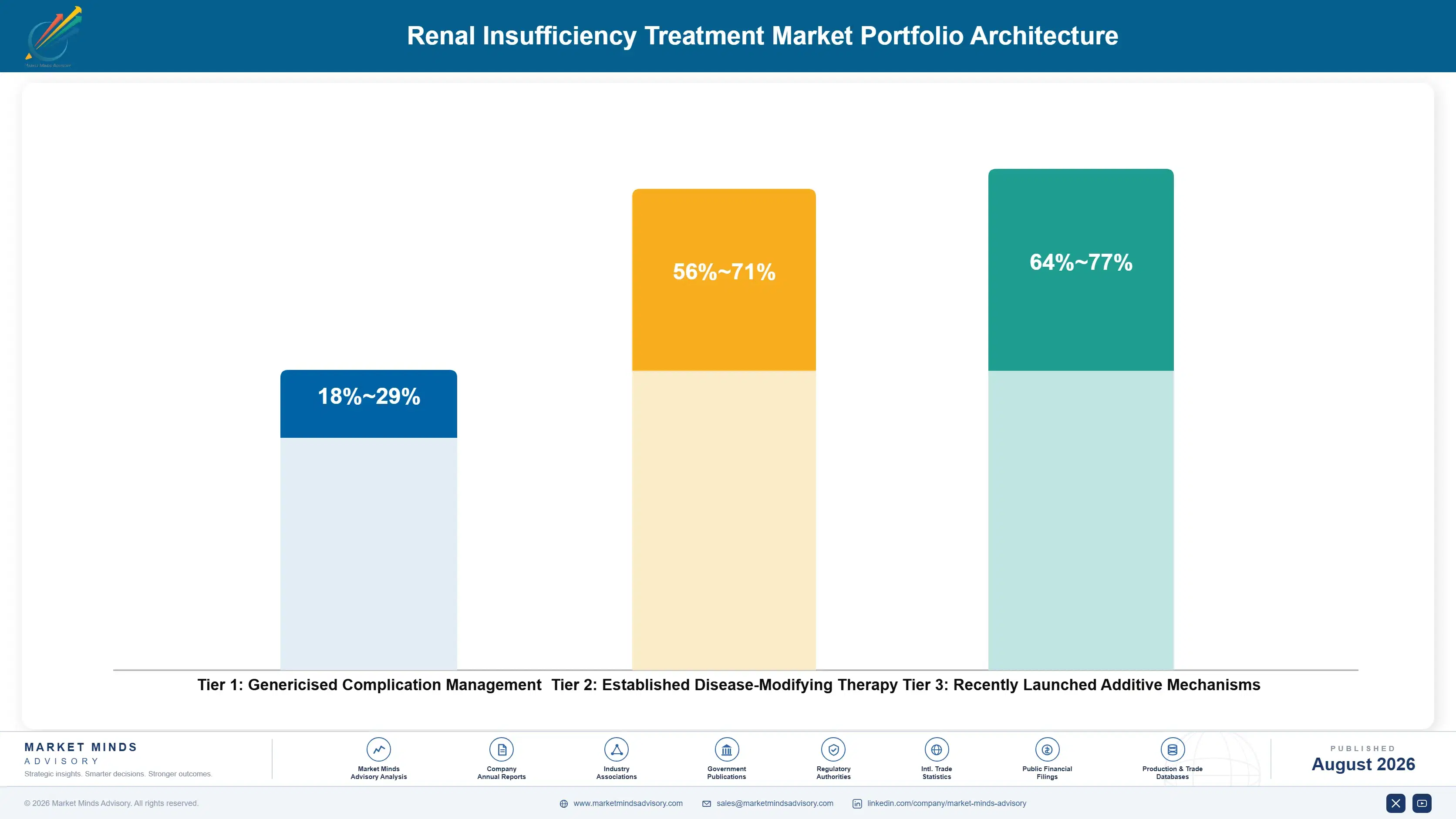
Portfolio Architecture for Margin Defence

Margin here tracks patent position and evidence depth rather than manufacturing, which costs very little on any of these molecules. Genericised complication management, covering phosphate binders, older renin-angiotensin inhibitors and erythropoiesis stimulating agents, earns margins in the high teens to high twenties, because multiple suppliers offer identical product and procurement decides on price alone. Volume is large and stable while value contribution keeps declining.
Protected disease-modifying therapy with established outcome evidence does considerably better in the high fifties to low seventies, because guideline positioning and trial data create a position no competitor reaches without repeating the expenditure. The range reflects reference pricing and procurement regime far more than it reflects any difference in the clinical evidence itself. Repeating outcome trial expenditure is what a competitor would have to do.

Recently launched additive mechanisms hold the strongest position, reaching into the mid seventies, because they sit on top of existing regimens rather than competing for the same prescription and carry full patent life ahead of them. Those margins reflect timing and positioning rather than a superior molecule, and they will follow the same path downward. Timing rather than a superior molecule explains most of the difference.

Genericised Complication Management

Phosphate binders, older renin-angiotensin inhibitors and biosimilar erythropoiesis agents. The eleven point range reflects procurement regime and manufacturing scale rather than product difference, since these are widely available identical products.
Gross Margin: 18-29%

Established Disease-Modifying Therapy

Protected therapy with outcome trial evidence and guideline positioning in chronic kidney disease. The fifteen point range reflects reference pricing and procurement regime across markets rather than any difference in the underlying clinical evidence.
Gross Margin: 56-71%

Recently Launched Additive Mechanisms

Newer classes positioned on top of existing regimens with full patent life remaining ahead. The thirteen point range reflects launch market mix and access timing rather than any superiority in the molecule itself.
Gross Margin: 64-77%
renal-insufficiency-treatment-market-portfolio-architecture-1787594865963

High-value Sub-segments and Strategic Watch-out

Additive Mechanism Therapies

High value and the fastest growth at 11.7%, since the addressable population is the treated population rather than a share of it. Stacking regimens mean these therapies add to prescriptions rather than displacing anything already being taken. Full patent life remains ahead of them. Displacement is not the mechanism.
Gross Margin: 66-77%

Persistence-Enabling Therapies

High value and growing at 8.8%, since hyperkalaemia is what forces dose reduction on the therapies that actually work. These products treat a side effect and in doing so protect the benefit of everything else in the regimen. Adherence is the practical weakness, since the products are unpalatable.
Gross Margin: 52-66%

Genericised Complication Management

The volume core, treating anaemia and mineral disorder with widely available identical products bought on price. Volume is large and stable while value contribution keeps declining as biosimilar substitution advances across markets. Biosimilar substitution keeps advancing across markets. Procurement decides on price alone here. Value contribution keeps falling.
Gross Margin: 18-29%

Patent Cliff Exposed Franchises

The strategic watch-out. SGLT2 expiry within the decade makes the largest payer saving in nephrology generic, and the range reflects how far manufacturers have built duration and portfolio breadth before it arrives. Generic entry in chronic therapy is historically rapid once it begins. Offsets take years to build.
Gross Margin: 30-68%

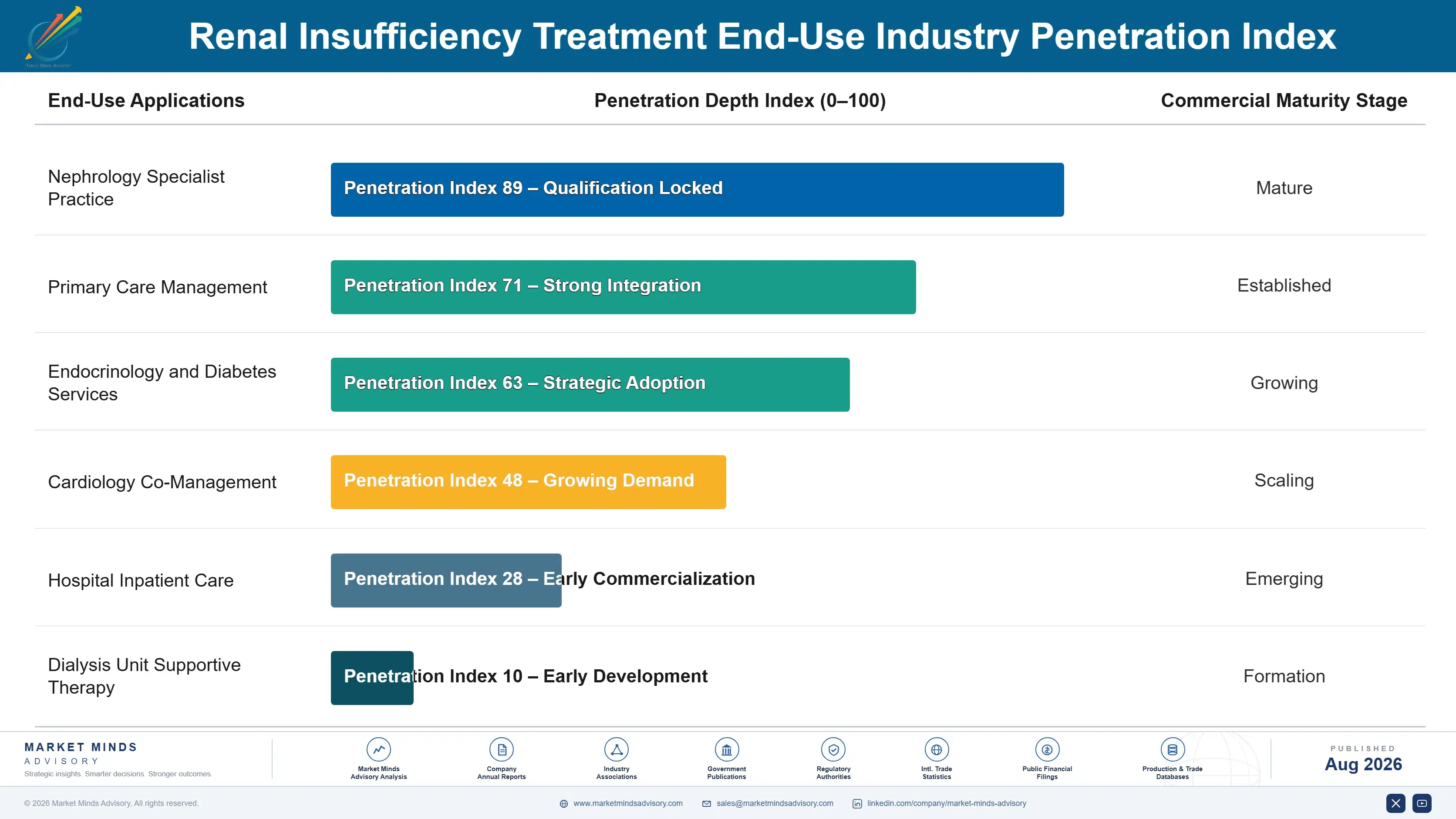
Years of Therapy, One Decision

Chronic kidney disease therapy is taken daily and indefinitely, which makes a single initiation decision worth years of consumption. Nothing about the treatment is episodic and nothing prompts reconsideration except a clinical event or a hyperkalaemia episode. That structure means the commercial contest happens once per patient, at initiation, and everything afterwards is a question of persistence rather than of competition between products.
Persistence varies sharply by mechanism and tolerability. Disease-modifying therapy in asymptomatic early disease has no felt benefit, which makes adherence entirely dependent on the patient's belief in a future they cannot perceive. Potassium binders are worse, being unpalatable and taken for years to prevent something invisible. Late-stage complication therapy sticks better, because patients feel anaemia and feel its correction directly. Late-stage complication therapy sticks considerably better.

The deciding clinician has shifted outward from nephrology. Specialists initiated and managed these therapies when they were confined to advanced disease. Earlier initiation and diabetes-linked pathways have moved the decision toward primary care and endocrinology, where kidney function is one consideration among many and the twelve dollar test that triggers everything may never be ordered at all. The test that triggers everything may never be ordered.
renal-insufficiency-treatment-market-end-use-penetration-index-1787594866450

Where We Would Focus Effort

These are among the four positions where our research anticipates prominent divergence between winners and laggards over the coming forecast period. Each is grounded in the demand model, the regulatory perimeter, and the announced capacity pipeline.
01 / PATIENT IDENTIFICATION INVESTMENT

The bottleneck is a test, not a molecule

Around 88% of people with chronic kidney disease have never been diagnosed, and disease-modifying therapy reaches only about 23% of those who have been, which means the therapeutic argument was won and then then went almost entirely unheard. Manufacturer-funded screening embedded into existing diabetes and hypertension reviews expands the treated population rather than competing for a share of it. That is unusual expenditure for a pharmaceutical company and it is precisely where the missing missing volume actually sits waiting to be found.
02 / PAYER ECONOMICS FRAMING

Sell dialysis avoidance to population health

Dialysis costs near eighty-nine thousand dollars per patient each year, and in most systems the payer funding therapy is the same payer eventually carrying that cost. Presenting progression delay in those terms reaches health economics and population health functions rather than formulary committees weighing one drug budget against another. The alignment is cleaner here than in almost any chronic disease, and remarkably few commercial teams have built the case in the form those functions would actually be able to use.
03 / REGIMEN PORTFOLIO BREADTH

Own the therapy that protects your therapy

Hyperkalaemia is the most common reason renin-angiotensin blockade and mineralocorticoid antagonists get reduced or discontinued, and the clinical benefit disappears entirely at a reduced dose. Potassium binders growing at 8.8% exist to prevent exactly that, making them a persistence tool rather than an unrelated therapy that happens to sit in the same broad category. A company spanning both mechanisms argues for the whole regimen, which no single-mechanism competitor can do at any level of commercial effort it chooses to apply.
04 / TREATMENT DURATION EXTENSION

Duration compounds where price will not

SGLT2 patent expiry inside the decade will make the largest payer saving in nephrology available at generic prices, which makes defending price a position that nobody has ever won from. Earlier initiation extends treatment duration by years per patient, and duration compounds in chronic therapy in a way that unit price simply does not. Guideline movement toward earlier disease supports it clinically, and building that evidence and access position now is worth more than any pricing defence still available to anybody.

Engagement Snapshot From the Field

A live engagement with an industry participant carrying material or product regulatory and market exposure ahead of a defining policy shift, showing how our research translates into a defensible multi-year portfolio strategy.
MARKET MINDS ADVISORY · CLIENT ENGAGEMENT SUMMARY
Renal Insufficiency Treatment Producer Strategic Portfolio Review and Transition Roadmap 2026·Investment Scenario on Renal Insufficiency Treatment Exposure Evaluation 2025-26
CLIENT PROFILE
A global pharmaceutical company holding a disease-modifying renal therapy with established outcome evidence, at renal franchise revenue near 2.1 billion dollars (client-reported, unverified by MMA). Commercial effort was directed almost entirely at nephrology specialists through conventional promotion, with no screening investment and no second renal mechanism anywhere in the portfolio to support the regimen argument.
STRATEGIC CHALLENGE
Prescription growth had slowed despite guideline positioning that should have supported far wider use, and patent expiry was approaching within the decade. Management assumed the problem was competitive share and wanted to increase promotional investment, while the board questioned whether share was the binding constraint at all, or something else entirely.
MMA APPROACH
MMA sized the diagnosed and undiagnosed populations separately, benchmarked therapy reach against diagnosed rather than prevalent patients, assessed screening programme economics against dialysis avoidance for major payers, and mapped where initiation decisions were actually being made across care settings. Interviews with 47 experts covered nephrology practice, primary care pathways and health economics assessment.
KEY FINDINGS
  1. The undiagnosed population exceeded the diagnosed population by a very wide margin, and no amount of promotional investment could reach patients who had never been tested at all.
  2. Initiation decisions had migrated substantially toward primary care and endocrinology, where the client's entire commercial organisation had no established presence or relationships whatsoever.
  3. Payer health economics functions responded strongly to dialysis avoidance modelling, while the formulary committees the client actually addressed weighed the therapy against unrelated drug budgets.
  4. The absence of a potassium management asset left the client unable to argue for maintained dosing, which competitors with broader portfolios were doing effectively in the same accounts.
CLIENT PROFILE
A global pharmaceutical company holding a disease-modifying renal therapy with established outcome evidence, at renal franchise revenue near 2.1 billion dollars (client-reported, unverified by MMA). Commercial effort was directed almost entirely at nephrology specialists through conventional promotion, with no screening investment and no second renal mechanism anywhere in the portfolio to support the regimen argument.
STRATEGIC CHALLENGE
Prescription growth had slowed despite guideline positioning that should have supported far wider use, and patent expiry was approaching within the decade. Management assumed the problem was competitive share and wanted to increase promotional investment, while the board questioned whether share was the binding constraint at all, or something else entirely.
MMA APPROACH
MMA sized the diagnosed and undiagnosed populations separately, benchmarked therapy reach against diagnosed rather than prevalent patients, assessed screening programme economics against dialysis avoidance for major payers, and mapped where initiation decisions were actually being made across care settings. Interviews with 47 experts covered nephrology practice, primary care pathways and health economics assessment.
KEY FINDINGS
  1. The undiagnosed population exceeded the diagnosed population by a very wide margin, and no amount of promotional investment could reach patients who had never been tested at all.
  2. Initiation decisions had migrated substantially toward primary care and endocrinology, where the client's entire commercial organisation had no established presence or relationships whatsoever.
  3. Payer health economics functions responded strongly to dialysis avoidance modelling, while the formulary committees the client actually addressed weighed the therapy against unrelated drug budgets.
  4. The absence of a potassium management asset left the client unable to argue for maintained dosing, which competitors with broader portfolios were doing effectively in the same accounts.
RECOMMENDED STRATEGY
Phase 1: Phase one: redirect promotional investment toward funding kidney function testing embedded within existing primary care diabetes and hypertension review pathways. Phase 2: Phase two: build health economics engagement around dialysis avoidance, reaching population health functions rather than formulary committees weighing drug budgets. Phase 3: Phase three: acquire or license a potassium management asset, since regimen persistence cannot be argued without one in the portfolio.
OUTCOME
The company redirected a substantial share of promotional budget into primary care screening partnerships during 2026 and reported newly diagnosed patient volumes well above forecast (client-reported, unverified by MMA). Health economics engagement was rebuilt around dialysis avoidance, and a potassium management licensing discussion was opened.

Frequently Asked Questions

Foundational context covering the market sizes, CAGR, scope, country, region and competition that inform every finding below. This section is provided to cover basics and most often pre-purchase conversations, answered from the MMA Primary Research Dataset.

What is the current size of the Renal Insufficiency Treatment Market?

MMA sizes it at USD 19.4 billion in 2025, rising to USD 20.91 billion in 2026. The figure covers pharmacological treatment of chronic kidney disease and its complications at manufacturer selling value.

How large will the Renal Insufficiency Treatment Market be by 2036?

USD 44.32 billion by 2036, an incremental USD 23.41 billion over the 2026 base and an expansion multiple of 2.12 times. Additive mechanisms account for a disproportionate share.

What is the CAGR for the Renal Insufficiency Treatment Market 2026 to 2036?

7.8% in the base case, with a bull case at 9.0% and a bear case at 6.6%. The spread turns on screening adoption and on the pace of patent expiry erosion.

Which segment is growing fastest?

Non-steroidal mineralocorticoid receptor antagonists at 11.7%, half again the market rate of 7.8%. They add to existing regimens rather than replacing therapy patients already take.

Who are the major companies in the Renal Insufficiency Treatment Market?

AstraZeneca, Boehringer Ingelheim, Bayer, Otsuka Pharmaceutical and CSL Vifor lead on renal indication revenue. Fifteen further participants are profiled in the full report on that basis.

Which country is growing fastest?

China at 12.6%, combining the largest chronic kidney disease population in the world with national reimbursement listings that have widened access considerably across the country.

Report Segmentation Architecture

The full report scope spans multiple orthogonal segmentation dimensions, with cross-tabulated demand data provided for each dimension pair. Coverage extends further to regional breakdowns, trend trajectories, and the competitive detail needed to support segment-level decision-making.

By Therapeutic Class

  • SGLT2 Inhibitors
  • Non-Steroidal Mineralocorticoid Receptor Antagonists
  • Anaemia Therapies
  • Phosphate Binders
  • Potassium Binders
  • Renin-Angiotensin System Inhibitors

By End-Use Industry

  • Nephrology Specialist Practice
  • Primary Care Management
  • Endocrinology and Diabetes Services
  • Cardiology Co-Management
  • Hospital Inpatient Care
  • Dialysis Unit Supportive Therapy

By Commercial Dimension

  • Branded Patent-Protected Supply
  • Generic and Biosimilar Supply
  • National Reimbursement Listings
  • Hospital Tender and Procurement
  • Retail Pharmacy Distribution
  • Patient Access and Support Programmes

By Region

  • North America
  • Western Europe
  • East Asia
  • South Asia and Pacific
  • Latin America
  • Middle East and Africa
  • Eastern Europe

Scope, Methodology, and Coverage

Every figure in this report is reproducible from documented input assumptions. The scope below maps the historical period, the forecast horizon, the segmentation dimensions, and the countries covered, alongside the underlying primary and qualitative methodology.
Historical Period
2020 to 2025
Forecast Period
2026 to 2036
Base Year
2025 (USD billions; MMA Primary Research Dataset, August 2026)
Market Definition
Pharmacological treatment of chronic kidney disease and its metabolic complications, covering SGLT2 inhibitors, non-steroidal mineralocorticoid receptor antagonists, anaemia therapies including erythropoiesis stimulating agents and hypoxia-inducible factor inhibitors, phosphate binders, potassium binders, and renin-angiotensin system inhibitors used in renal indications. Measured at manufacturer selling value across branded and generic supply. Dialysis services, dialysis equipment and consumables, kidney transplantation and immunosuppression, and acute kidney injury management are excluded from scope.
Quantitative Units
USD billions (current prices); million treated patients; USD per patient year by therapeutic class
Segmentation Dimensions
Therapeutic class; care setting; commercial dimension; region
Regions Covered
North America, Western Europe, East Asia, South Asia and Pacific, Latin America, Middle East and Africa, Eastern Europe
Countries Covered
United States, Canada, Mexico, Germany, France, United Kingdom, Italy, Spain, China, Japan, South Korea, Taiwan, India, Indonesia, Australia, Brazil, Saudi Arabia, United Arab Emirates, Poland, Russia
Key Companies Profiled
AstraZeneca, Boehringer Ingelheim, Bayer, Otsuka Pharmaceutical, CSL Vifor, Eli Lilly, Novartis, GSK, Akebia Therapeutics, FibroGen, Ardelyx, Amgen, Kyowa Kirin, Astellas Pharma, Sanofi, Teva Pharmaceutical Industries, Sun Pharmaceutical, Dr. Reddy's Laboratories, Hengrui Pharmaceuticals, Chugai Pharmaceutical
Quantitative Methodology
Primary survey, n=3,800 respondents, Q4 2025, six countries; demand-side model with trade association cross-validation
Qualitative Methodology
47 expert interviews, Q4 2025; applied to validate demand model assumptions, identify emerging dynamics, and assess competitive positioning
Report Format
PDF and XLSX data workbook (Word format preview document)
Publisher
Market Minds Advisory
Report Code
MMA-2026-HLT-124
Published
August 2026
Contact
sales@marketmindsadvisory.com | www.marketmindsadvisory.com

Purchase the full Renal Insufficiency Treatment Market Report (2026 to 2036).

The full report sizes the diagnosed and undiagnosed populations separately, because the gap between them explains more about this category than any therapeutic comparison does. It sizes all six therapeutic classes independently through 2036, models screening programme economics against dialysis avoidance for major payer types, and assesses patent expiry exposure against duration and portfolio breadth by company. Regional chapters cover all seven regions with treated patient volumes and realised value tracked separately, because the two diverge sharply under procurement pricing. Competitive profiling covers 20 participants on a single revenue basis.
Six therapeutic classes sized independently through 2036
Diagnosed and undiagnosed populations sized separately by region
Screening economics modelled against payer dialysis avoidance
Patent expiry exposure assessed against duration and breadth
Twenty participants profiled on one consistent revenue basis
Treated volumes and realised value tracked separately throughout

Built For The People Who Decide

From boardroom strategy to bench-side execution, this report is read cover-to-cover by leaders shaping the next decade of their industry, turning demand scenarios, market dynamics and valuation benchmarks into decisions.
CXOs/ Presidents/ VPs/ Managers
M&A and Corporate Development
Strategy Teams and R&D Heads
Procurement and Product Directors
Regulatory and Compliance Leaders
Investor Relations and Equity Analysts