Market Minds Advisory
Removal Strips Market

Removal Strips Market: Removal Strips Market: Technique Failure, Aftercare Economics and Where This Format Still Wins

First use fails for well over a third of buyers because the pull direction and hair length are wrong, and a failed session sends that customer to a razor permanently.

Lead Analyst

Published

September 2026

Make Smarter Decisions with Customized Research Insights

Request a free sample report and evaluate market opportunities, growth trends, and competitive dynamics relevant to your business needs.

2025 MARKET VALUE$1.9BMarket Size 2025
2036 FORECAST VALUE$3.2BBase Case , 2026 to 2036
CAGR 2026 TO 20364.8 %Bull 6.0% / Bear 3.6%
INCREMENTAL OPPORTUNITY$1.2BNet 10- year value creation
EXPANSION MULTIPLE1.60x2036 value over 2026 base
Strategic Levers
M&A Pipeline
Regional Outlook
Country Rankings
Competitive Intelligence
Segmental Deep-dive
Call-Us : 91 93563 13602

Executive Snapshot and Market Trajectory.

This category loses customers on the first use, not on price. Roughly 38% of first attempts fail because the strip is pulled upward rather than parallel to the skin, or the hair was under five millimetres. Those buyers move to razors and never return. Nobody has ever costed that loss.
Bikini and intimate area strips grow at 7.2%, half again the market rate of 4.8%, and the reason is what the alternatives cannot do there. Home light-based devices carry manufacturer restrictions on intimate use, and razors produce ingrown hairs on exactly that skin. Facial and upper lip strips follow at 6.5%. Leg strips grow slowest at 3.2%, squeezed hardest by both alternatives at once.
Geography here tracks grooming norms and hair prevalence rather than income, which is why five of seven regions sit outside their standard bands. South Asia and Pacific holds 27% and Latin America 16%, both far above band, while East Asia holds 5%, far below. Aftercare is the unexploited lever: only about 12% of packs include anything to prevent folliculitis. An antiseptic and exfoliating wipe costs cents and prevents most of it.
Market Definition
This market covers ready-to-use hair removal strips supplied pre-coated with wax or sugar-based adhesive for consumer application, spanning leg and body, facial, bikini and intimate, underarm, eyebrow and multi-area variety formats. Sizing is at retail value. Salon-supplied bulk wax, roll-on and heated wax systems, depilatory creams, epilator and light-based devices, razors, and pore or blackhead cleansing strips are excluded from this market entirely.
Base Year Value
$1.9B in 2025 (MMA Primary Research Dataset, September 2026)
Forecast Period
2026 to 2036, eleven discrete annual values
CAGR
4.8% base case. Bull 6.0%. Bear 3.6%.
Fastest Growth Segment
Bikini And Intimate Area Strips: 7.2% CAGR
Fastest Growth Country
India: 7.6% CAGR
Fastest Growth Region
South Asia and Pacific: 6.9% CAGR
Largest Region
South Asia and Pacific: 27% of 2025 global value
Market Leaders
Reckitt Benckiser, Church and Dwight, Dabur India, Godrej Consumer Products, Beiersdorf. Source: MMA Primary Research Dataset, July 2026.
Primary Survey
n=3,800 procurement and R&D decision-makers, Q4 2025, six countries
Methodology
Demand-side build-up, cross-validated against public data, 47 expert interviews

Removal Strips Market Forecast Scenarios

removal-strips-market-size-forecast-scenario-1790022267725
Growth of 3.7% between 2020 and 2025 hides a squeeze from both directions. Salon closures through 2020 and 2021 pushed many first-time users into home strips, and a large share failed on first attempt and left. Meanwhile home light-based devices took the committed users at the top of the market and razors took the price-sensitive ones at the bottom.
Three mechanisms carry the base case. Bikini and facial areas grow because light-based devices carry manufacturer restrictions there and razors perform badly, which leaves strips holding a defensible position at 7.2% and 6.5%. Indian and Brazilian demand keeps expanding on grooming norms that predate the category entirely, with India at 7.6%. Sugar-based formulations continue taking share from rosin-based waxes on sensitivity grounds, and they lift realised price without adding any volume at all.
The bull case is technique. If first-use failure at roughly 38% can be halved through packaging redesign and better instruction, retention improves enough to change the category trajectory without a single new customer. The bear case is device pricing. Home light-based devices falling below a hundred dollars would take the committed mid-market users who currently buy strips repeatedly, and those are the customers who carry the profit.

Where This Format Still Wins

The commercial problem in this category is not competitive, it is instructional. About 38% of first attempts fail, and the causes are consistent: the user pulls the strip upward instead of parallel to the skin, or attempts removal on hair shorter than five millimetres. Both are printed on the pack. Almost nobody reads a pack before opening it. The causes are consistent across every market, which makes this a design problem.
TOP FIVE CONCENTRATION44%Combined retail value share held by the five largest participants
FIRST USE FAILURE RATE38%Share of first attempts that remove little or no hair
AVERAGE PACK PRICEUSD 6.20Weighted global retail price across all application area formats
MINIMUM HAIR LENGTH5 mmGrowth required before a strip can grip reliably
AFTERCARE INCLUDED12%Packs supplying anything to prevent post removal irritation
REPEAT PURCHASE RATE41%Buyers who purchase the format again within a year
That failure is expensive in a way the industry has never costed properly. A buyer whose first session removes nothing does not try a different brand; they buy a razor and leave the category. Repeat purchase across the format sits at 41%, which is low for a consumable, and the gap between that and the trial rate is the single largest value leak anywhere in the business.
Aftercare is the second gap and it costs cents to close. Folliculitis and ingrown hairs are the main complaint after a successful session, and roughly 12% of packs include anything at all to prevent them. A post-removal wipe with a mild antiseptic and an exfoliating agent addresses most of it. Nobody has revisited the pack cost arithmetic since.
"A third of the people who buy this product get nothing off on the first attempt and never come back. The industry treats that as consumer error rather than as the most expensive design failure in the category."
Director, Personal Care and Grooming Practice · MMA Chemicals and Materials Practice · September 2026

Market Trends

Strips Retreat To Areas Devices Cannot Safely Treat

Home light-based hair removal devices carry manufacturer restrictions on intimate areas and on skin close to the eye, and razors produce ingrown hairs on exactly the skin where strips perform best. That is why bikini and intimate area strips grow at 7.2% and facial strips at 6.5% while leg formats grow at 3.2%. The category is consolidating into a defensible position rather than declining evenly. Participants still building ranges weighted toward large body areas are defending the ground the alternatives take most easily, and shelf allocation has not caught up.
Market Impact: India grows 2.8 points faster

Sugar Formulations Take Share On Sensitivity Grounds

Sugar-based adhesives adhere primarily to hair rather than to the outermost skin layer, which reduces the erythema that rosin-based waxes produce and matters most on facial and intimate application. Colophony, the rosin derivative in conventional wax strips, is a documented contact allergen requiring declaration under European cosmetic labelling rules. Sugar formats carry a price premium of roughly 40% and their share of new launches has risen sharply. Manufacturing is different enough that participants without sugar capability are buying it through contract formulators rather than building it. That decision looks correct at current volumes and expensive if the trend holds.
Market Impact: 34% bought for portability

Market Opportunities and Growth Drivers

Indian Grooming Norms Predate And Outlast The Category

Regular hair removal across Indian female populations is close to universal and has been for generations, delivered historically through salon waxing and threading rather than through any packaged product. Home strips capture the occasions where a salon visit is impractical, which is a large and growing share as urban schedules tighten. India grows at 7.6%, the fastest national market covered here. Dabur, Godrej and Veet all hold meaningful positions, and price points sit far below Western equivalents while volumes run considerably higher. Volumes run far higher than Western markets while value per pack runs much lower.
Market Impact: 38% of first attempts fail

Portability Holds The Format Against Every Alternative

A strip pack weighs almost nothing, needs no power, no heating, no water and no disposal facility, which no competing method can match. That matters for travel, for shared accommodation and for anywhere a bathroom is not private, and it is the reason the format persists against methods that are otherwise better. Roughly 34% of purchases in MMA survey work were attributed to travel or convenience occasions rather than to routine grooming. Participants selling on results alone are competing on the dimension where strips are weakest. Results are where strips lose every comparison.
Market Impact: Only 12% include aftercare

Market Restraints and Challenges

First Use Fails For More Than A Third

About 38% of first attempts remove little or no hair, and the causes are a wrong pull direction and hair shorter than five millimetres. The root cause is that both instructions live on a pack the user has already opened and discarded, and neither is intuitive: pulling upward is the instinctive motion and it is exactly wrong. Commercially the failure is permanent, since those buyers switch to razors rather than to a competitor. Participants are addressing it with instruction printed on the strip liner itself and with pull-direction arrows, which very few packs carry.
Market Impact: Bikini grows 4 points faster

Post Removal Irritation Lacks Any Packaged Answer

Folliculitis and ingrown hairs are the dominant complaint after a session that worked, and roughly 12% of packs include anything to prevent them. The root cause is a cost decision taken years ago, when adding a wipe was judged to raise pack cost without raising shelf price. The commercial impact is a repeat purchase rate of 41%, low for a consumable in daily use categories. Participants adding an antiseptic and exfoliating aftercare wipe report repeat purchase considerably above range average, at a pack cost increase of a few cents. The decision has not been revisited since.
Market Impact: Carries 40% price premium
4 additional market trends, 3 additional growth drivers, and 2 additional restraints and challenges are covered in the full report. Contact sales@marketmindsadvisory.com to access the complete intelligence.

Segment CAGR and Growth Architecture

Segmentation follows application area, the dimension on which strip size, adhesive strength, pack configuration and competing method all divide together in this category. Six application areas are assessed at retail value. Salon bulk wax, heated systems, depilatory creams, devices, razors and pore cleansing strips sit outside the defined scope. Adhesive chemistry is treated as an attribute, not a segment.
removal-strips-market-market-share-analysis-1790022268285

Bikini And Intimate Area Strips

Bikini and intimate area strips grow at 7.2%, half again the market rate of 4.8%, and what the alternatives cannot do explains all of it. Home light-based devices carry manufacturer restrictions on intimate application, and razors produce ingrown hairs and irritation on precisely that skin. Strips hold a genuinely defensible position there rather than a temporary one. Adhesive strength and strip geometry both differ from body formats, since the application requires more precision in a smaller area with more contour. Sugar-based formulations perform particularly well in this segment on sensitivity grounds, and they carry a price premium of roughly 40% that buyers here accept readily. No alternative method holds this ground comfortably.
CAGR 7.2%

Facial And Upper Lip Strips

Facial and upper lip strips grow at 6.5% for reasons that partly mirror the intimate segment and partly do not. Light-based devices restrict use near the eye, and facial razors are widely used but leave a regrowth texture many users dislike. The strips themselves are small, which makes pack economics unusually good relative to material cost. Sensitivity is the constraint rather than efficacy: facial skin reacts more visibly to rosin-based adhesives, and a reaction is immediately public in a way a leg reaction never is. That single fact is why sugar formulations have taken this segment faster than any other in the category. Pack economics here are the best in the category.
CAGR 6.5%
Full segment breakdown across 6 segments available in the complete report.

Regional Architecture and Country Demand Map

Regional shares here track grooming norms and hair prevalence rather than income, which is unusual and produces a table unlike any other consumer category. Five of the seven regions consequently sit outside their standard bands, each explained below individually. Body hair prevalence explains more of it than purchasing power does.

South Asia and Pacific

At 27% this sits far above the standard band, and the justification is that regular hair removal across Indian female populations is close to universal and has been for generations. Salon waxing and threading carry most of that demand, and home strips capture the occasions where a salon visit is impractical, which urban working schedules make increasingly common. India grows at 7.6%, the fastest national market covered here. Dabur, Godrej and Veet all hold meaningful positions at price points far below Western equivalents. Australian demand is smaller, premium-weighted and behaves much more like Western Europe than like the rest of the region. Threading remains the dominant facial method, which caps that segment locally.
Share: 27% | CAGR: 6.9% (2026 to 2036)

Western Europe

The 24% position sits inside the standard band and represents the most mature market in the category by a wide margin. Veet and Nair built the modern strip format here, and penetration among adult women is high enough that growth of 3.4% comes almost entirely from format mix rather than from new users. Sugar-based formulations have taken share faster here than anywhere else, helped by colophony allergen labelling requirements that make the sensitivity argument visible on pack. Home light-based devices have taken the committed users at the top of this market, which is why the growth rate sits lowest of the seven. Colophony labelling made the sensitivity comparison visible on pack, which is why sugar formats moved fastest here.
Share: 24% | CAGR: 3.4% (2026 to 2036)
Regional intelligence for 5 additional markets available in the complete report: North America, Latin America, Middle East and Africa, East Asia, Eastern Europe. Contact sales@marketmindsadvisory.com.
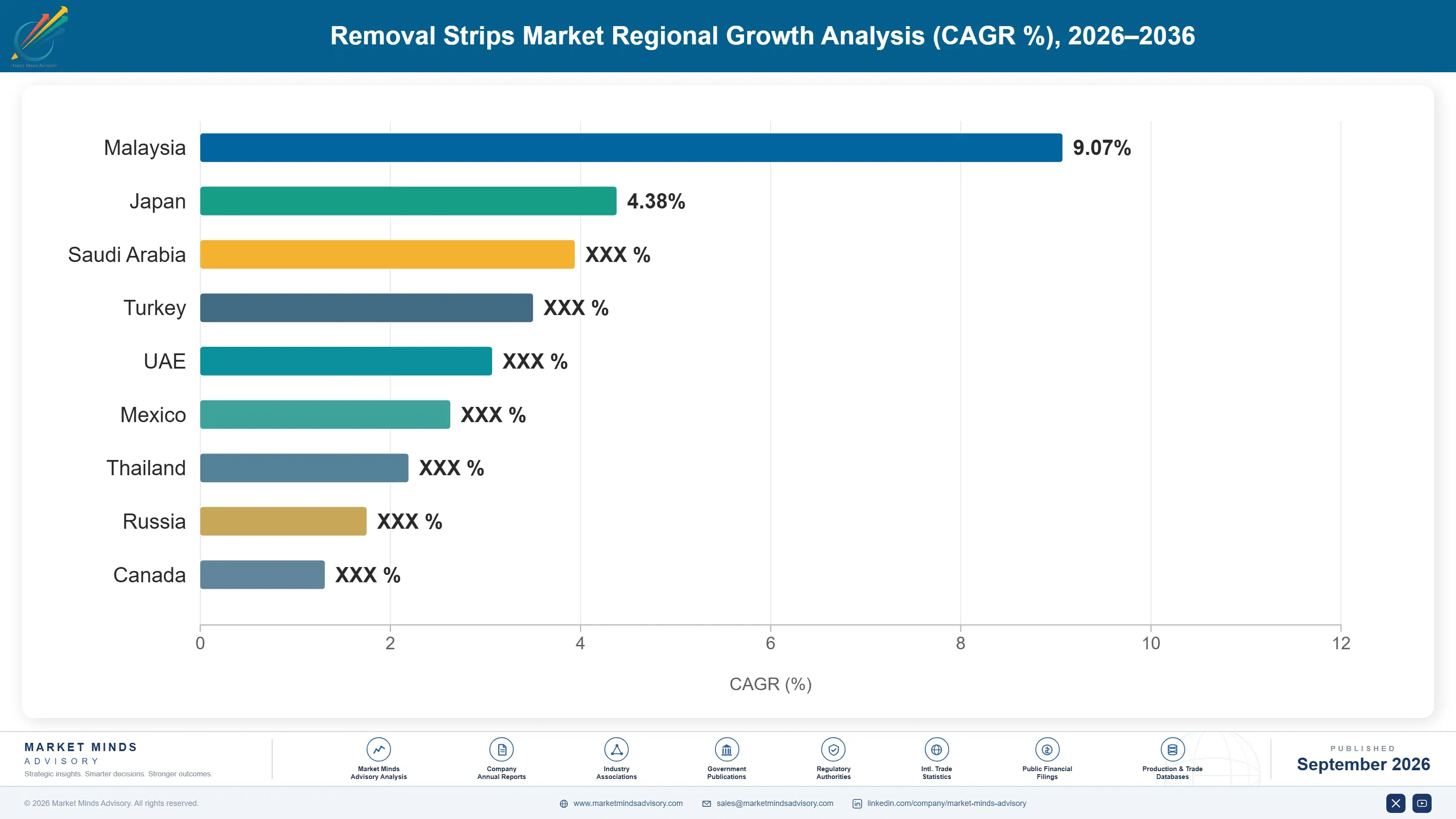
removal-strips-market-country-cagr-analysis-1790022268807

Fixing What Loses The Customer

These four address the same commercial fact from different angles: this category acquires buyers efficiently and loses more than a third of them on first use, then fails to give the survivors a reason to repurchase. Each has been executed by at least one participant, and none requires reformulation or new manufacturing capability. Three of the four are pack changes.

Print Pull Direction On The Strip Liner

About 38% of first attempts fail because the user pulls upward instead of parallel to the skin, and that instruction currently lives on a pack the buyer has already opened and thrown away. Printing a directional arrow on the release liner itself puts it in front of the user at the moment of use, at effectively no cost. Participants who have done this report first-use success improving by roughly 21 points. It is the cheapest retention intervention available in any consumer category we cover. The arrow costs nothing to print on a liner already being printed.
Market Impact: Improves first use success by roughly 21 points

Include An Aftercare Wipe In Every Pack

Folliculitis and ingrown hairs are the dominant complaint after a successful session, and around 12% of packs include anything to prevent them. A wipe carrying a mild antiseptic and a light exfoliating agent costs a few cents per pack and addresses most of the problem directly. Participants including one report repeat purchase running about 1.5 times their range average, against a repeat rate of 41% across the category. The cost was judged unjustifiable years ago on shelf price grounds, and nobody has revisited that arithmetic since. Nobody has recalculated it since retail prices moved.
Market Impact: Raises repeat purchase to roughly 1.5 times higher

Reweight The Range Toward Bikini And Facial

Bikini and intimate formats grow at 7.2% and facial at 6.5%, while leg and large body formats grow at 3.2%, because light-based devices restrict intimate and periocular use and razors perform badly on both. Most participant ranges and most retail shelf allocation remain weighted toward body formats built for a market that is being taken. Reweighting toward defensible areas requires no new manufacturing, only a change in pack mix and shelf negotiation. Participants who have moved report category shelf productivity rising by roughly 18%. Retailers allocate on historical volume rather than on growth rate.
Market Impact: Lifts category shelf productivity by roughly 18% overall

Build Sugar Formulations For Sensitive Applications

Sugar-based adhesives grip hair rather than the outermost skin layer, which reduces the visible reaction that matters most on facial and intimate application. They carry a price premium of around 40% and their share of new launches has risen sharply, particularly in markets where colophony allergen labelling makes the comparison visible on pack. Participants without sugar capability are buying it through contract formulators rather than building it, which is the correct decision at current volumes and a poor one if the trend continues. Visible reaction risk is what the buyer is paying to avoid here.
Market Impact: Commands a price premium of roughly 40% overall

Who Controls the Margin Pool

Concentration is moderate at 44% held by the top five, measured consistently on retail sales value of ready-to-use hair removal strips rather than on units, which would distort across eyebrow packs and full leg packs. The leader to challenger gap is wide in distribution reach and brand permission, where Veet and Nair carry decades of association, and narrow in manufacturing, where contract formulators supply comparable product to anyone with a purchase order.
Competition runs on three dimensions currently. Shelf position in drug and mass retail decides most volume, since this is an overwhelmingly impulse and reminder purchase. Formulation sensitivity decides the facial and intimate segments where growth is concentrated. Price decides the value tier, where local manufacturers in India, Brazil and Turkey compete effectively against international brands on cost structures those brands cannot match.

Pressure is building at both ends of the category rather than in the middle, and that is where rankings will move. Participants weighted toward leg and body formats are exposed to light-based devices and razors simultaneously. Those holding facial, bikini and sugar-based positions are defending ground neither alternative can easily take, and the shelf allocation across most retailers has not yet reflected that shift.
removal-strips-market-company-positioning-matrix-1790022269335

Competitive Moat and Risk Dimensions

RECKITT BENCKISER

Moat: Brand Permission And Distribution

Veet carries consumer association with hair removal across Europe, South Asia, Latin America and the Middle East that took decades to build, supported by distribution reach into drug, mass and pharmacy retail in each. That places the brand in front of first-time buyers more often than any competitor, which matters where trial is the main acquisition event.
RECKITT BENCKISER

Risk: Range Weighted Toward Legs

Substantial volume sits in leg and large body formats growing at 3.2%, precisely the segment that light-based devices and razors take most easily. Reweighting toward bikini and facial requires shelf renegotiation with retailers who allocate space on historical volume rather than on growth, which slows a change that the category data already justifies.
CHURCH AND DWIGHT

Moat: North American Shelf Control

Nair holds established shelf position across American and Canadian drug and mass retail, supported by a household products portfolio that gives the company genuine negotiating weight with those retailers. In a category driven by impulse and reminder purchase, shelf presence converts more directly into volume than advertising does.
CHURCH AND DWIGHT

Risk: Concentration In Razor Markets

Revenue weighting toward North America places the business in the region growing slowest apart from Western Europe, where shaving is the dominant grooming method and strips occupy a supplementary occasional position. The growth is in South Asia, Latin America and the Middle East, where the company's positions are materially weaker than the incumbents already there.

Players Tracked

Prominent Players

Reckitt Benckiser
Church and Dwight
Dabur India
Godrej Consumer Products
Beiersdorf

Other Key Players

Coty
Edgewell Personal Care
Harry's
Parissa Laboratories
American International Industries
Nad's Corporation
Australian Bodycare
Depileve
Perron Rigot
Lycon Cosmetics
Starpil Wax
Hive of Beauty
Marico
VLCC Health Care
Oriflame

Recent Developments

MARCH 2025

Reckitt Benckiser extends Veet sensitive skin strip range

The company added sugar-based formulations to its sensitive skin line across facial and bikini formats in European and Indian markets. This was internal product development involving no partnership, licensing arrangement or acquisition of external formulation technology at any point. Conventional rosin formulations continue alongside them unchanged.
Signal: Sensitivity positioning is now aimed at the two segments where the category still grows. Chemistry follows the defensible segments.
OCTOBER 2024

Church and Dwight consolidates Nair manufacturing into single site

The company concentrated North American depilatory production into one facility from two previously separate locations. This was an internal manufacturing footprint decision taken on cost grounds, with no acquisition, divestiture or external capacity partner involved in the move. Production volumes were maintained throughout the transition period.
Signal: Cost discipline is tightening across a region where this format keeps losing ground steadily to shaving.
JULY 2025

Dabur India expands Fem depilatory production capacity

The company added manufacturing capacity for hair removal products at its Indian operations, serving both domestic demand and export markets across the Gulf. This was organic capital investment funded internally, with no joint venture or contract manufacturing partner involved. Existing lines at the site continued running unaffected.
Signal: Capacity follows the regions where grooming norms rather than marketing drive the demand. Grooming norms outrank marketing spend.

What A Strip Costs To Make

The adhesive mass accounts for roughly 26% of manufacturing cost, built on gum rosin and hydrocarbon resins for conventional waxes and on sugar, water and citric acid for sugar formulations. Rosin is harvested from pine forests in China, Brazil and Indonesia and prices on an agricultural rather than a chemical cycle. The strip substrate and release liner add about 19%, with packaging and printing accounting for most of the remainder.
Gum rosin in 2021 and 2022 showed how exposed the conventional formulation is. Harvest disruption combined with labour shortage in Chinese pine tapping regions pushed prices to multi-year highs within a few quarters, and Reckitt Benckiser and Church and Dwight annual reports for that period both identify raw material inflation across personal care as requiring pricing action. Sugar formulations were unaffected, which was the first time their cost profile looked advantageous.

Exposure varies sharply by formulation and by sourcing footprint. Conventional rosin-based producers carry an agricultural exposure with no substitute at equivalent performance. Sugar-based producers buy commodity inputs available everywhere. Indian and Brazilian manufacturers producing locally for local markets avoid the freight and currency layers international brands carry on every pack, which is why domestic value brands hold their positions.
removal-strips-market-cost-volatility-analysis-1790022269532

Qualify hydrocarbon resin blends alongside gum rosin formulations

Gum rosin prices on a forestry harvest cycle unconnected to anything else in the cost structure, and no direct substitute matches its performance alone. Blending with hydrocarbon resins reduces the exposure and requires an adhesion and sensitivity retest rather than a new plant. Most producers only begin the work once a harvest year has already gone badly.

Build sugar formulation capability before it becomes mainstream

Sugar formulations use commodity inputs available in every producing region and avoid the rosin exposure completely, while carrying a price premium of around 40%. Participants currently buy the capability through contract formulators, which is correct at present volumes and becomes expensive if the format continues taking share at its current rate. The trend shows no sign of reversing.

Localise manufacturing in high volume grooming norm markets

India, Brazil and Turkey together account for a large share of unit volume and are served substantially by imported product carrying freight and currency layers. Local manufacture removes both and closes most of the gap against domestic value brands. The capital requirement is modest because strip converting equipment is neither large nor specialised. Converting equipment is neither large nor specialised.

Portfolio Architecture for Margin Defence

Margin architecture divides by application area and formulation rather than by brand, which is unusual in personal care and reflects how differently the segments compete. Leg and large body formats sold through mass and drug retail run at gross margins in the high thirties to mid forties, competing against razors on cost per use and losing that comparison on any honest calculation. Local manufacturers in India, Brazil and Turkey compete there on cost structures international brands cannot approach.
Facial, bikini and underarm formats hold gross margins in the low to high fifties. The spread reflects formulation rather than pack size: sugar-based products in these areas command around 40% more than rosin-based equivalents because visible reaction risk is what the buyer is paying to avoid. Small strip size also makes material cost a smaller share of the pack than in body formats.

The highest-value pool sits where sensitive formulation meets defensible application area, and it carries margins in the low to high sixties. Sugar-based facial and intimate formats resist both alternatives on their own terms: devices restrict those applications and razors irritate that skin. Body formats keep the converting lines running. They fund nothing else.

Volume / Commodity-Adjacent

Leg and large body area strips sold through mass and drug retail. These compete directly against razors on cost per use and against local value manufacturers on price, which leaves very little pricing latitude anywhere.
Gross Margin: 38 to 45%

Premium / Certified

Facial, bikini and underarm formats where alternatives are restricted or perform poorly. The eight-point range reflects formulation rather than pack size, since sugar-based products command a substantial premium over rosin equivalents.
Gross Margin: 52 to 60%

Sustainability / Regulatory / Next-Generation

Sugar-based sensitive formulations for facial and intimate application, with aftercare included. These resist discounting because the buyer is avoiding a visible reaction rather than choosing between comparable products on price.
Gross Margin: 60 to 67%
removal-strips-market-portfolio-architecture-1790022270038

High-value Sub-segments and Strategic Watch-out

Sugar Based Facial And Intimate Formats

High value and high growth at 7.2% and 6.5%. Sugar adhesives grip hair rather than skin, which matters where a reaction is publicly visible. They command around 40% more than rosin equivalents and buyers here accept it readily. Neither alternative method can contest this ground.
Gross Margin: 62 to 67%

Packs Including Aftercare

High value and moderate growth. Only about 12% of packs include anything to prevent folliculitis, and participants adding a wipe report repeat purchase around 1.5 times range average at a pack cost increase of a few cents. The arithmetic was rejected years ago and never revisited.
Gross Margin: 55 to 61%

Leg And Large Body Strips

Volume core, growing slowest at 3.2% and squeezed by light-based devices above and razors below. It holds shelf allocation set on historical volume and keeps converting lines running without funding anything else. Razors win the cost per use comparison and devices take the committed users above it.
Gross Margin: 38 to 44%

Rosin Based Conventional Waxes

Strategic watch-out. Colophony is a declared contact allergen under European labelling rules, which makes the sensitivity comparison visible on pack. The ten-point range reflects how differently participants have responded to that disclosure requirement. Gum rosin also prices on a forestry harvest cycle unconnected to anything else.
Gross Margin: 40 to 50%

Why Buyers Leave Early

Repeat demand here is decided almost entirely in the first session, which makes this category unusual among consumables. Roughly 38% of first attempts remove little or no hair, and those buyers do not try a different brand; they conclude the method does not work and move to a razor permanently. Repeat purchase across the format sits at 41%, and the gap between trial and that figure is the whole commercial problem.
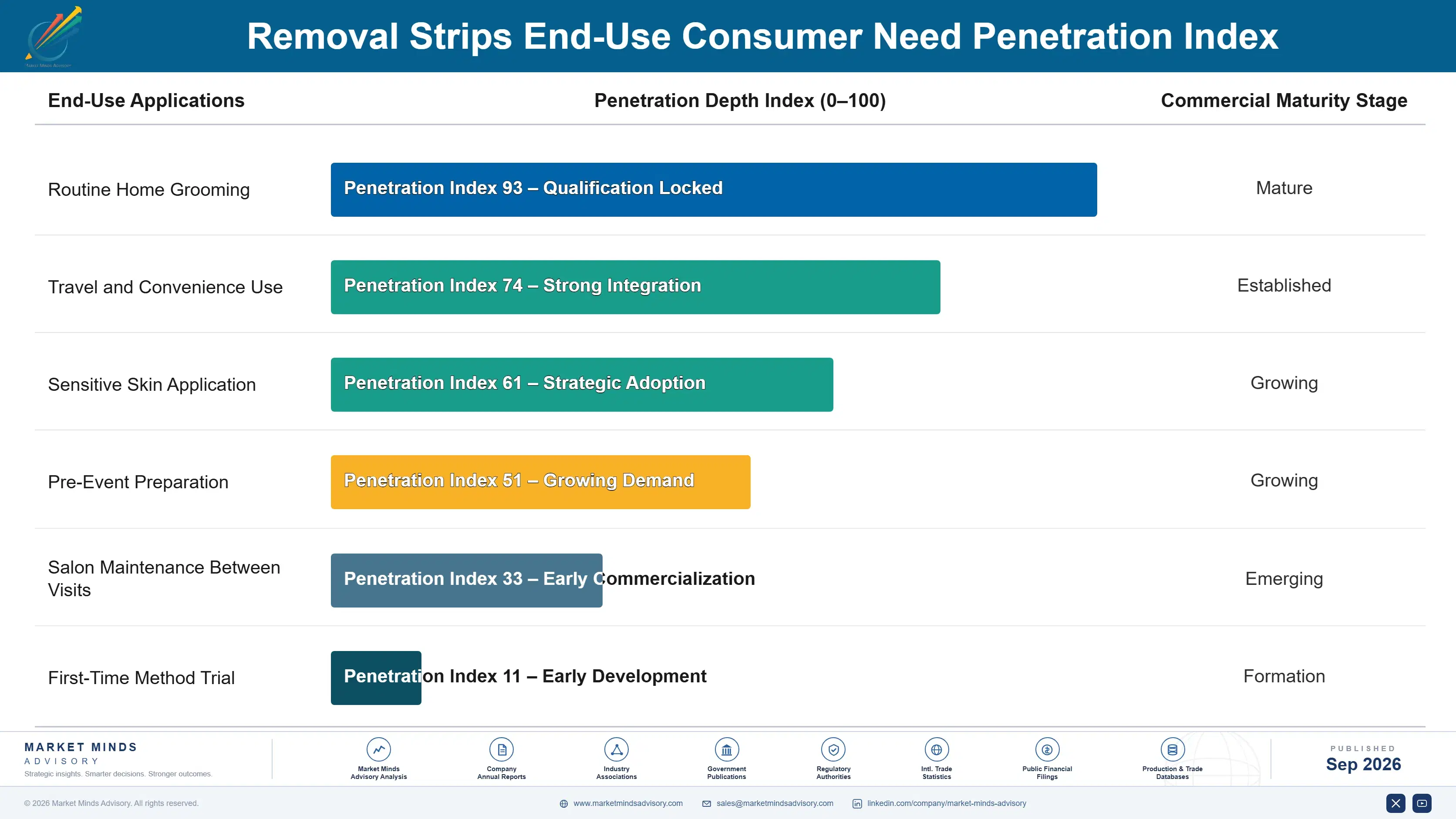
Stickiness varies sharply by application area and by why the buyer came. Users who adopted strips for facial or intimate areas, where alternatives are restricted or irritating, repurchase most reliably because no substitute is genuinely available to them. Travel and convenience buyers, roughly 34% of purchases, repurchase steadily but at low frequency. Body area users are the least loyal and the most easily taken by a razor or a device.

Buyer profiles have shifted in one direction since 2020. The cohort that entered during salon closures included a large share of first-time users who had never been shown the technique by anyone, and their failure rate was well above the category norm. Buyers entering now arrive having watched somebody demonstrate the pull direction, and they succeed more often.
removal-strips-market-end-use-penetration-index-1790022270526

Where This Category Leaks

These are among the four positions where our research anticipates prominent divergence between winners and laggards over the coming forecast period. Each is grounded in the demand model, the regulatory perimeter, and the announced capacity pipeline.
01 / FIRST SESSION SUCCESS

Put the instruction where the user actually looks

About 38% of first attempts fail because the strip is pulled upward rather than parallel to the skin, and that instruction sits on a pack the buyer has already opened and discarded. Printing a directional arrow on the release liner puts it in the user's hand at the moment of use, at effectively no cost per unit. Participants who have done it report first-use success improving by roughly 21 points, which is the cheapest retention intervention available anywhere in personal care.
02 / AFTERCARE PACK INCLUSION

Solve the complaint that follows a successful session

Folliculitis and ingrown hairs are the dominant complaint after a session that actually worked, and only about 12% of packs include anything to prevent them. A wipe carrying a mild antiseptic and a light exfoliant costs a few cents and addresses most of it directly. Participants including one report repeat purchase around 1.5 times their range average against a category rate of 41%, on an arithmetic nobody has revisited since it was first rejected years ago, and retail prices have moved considerably since anyone last checked it.
03 / RANGE WEIGHTING DISCIPLINE

Move shelf space to where alternatives cannot reach

Bikini and intimate formats grow at 7.2% and facial at 6.5% because light-based devices carry manufacturer restrictions there and razors irritate that skin badly. Leg and large body formats grow at 3.2% while holding most shelf allocation, which retailers set on historical volume rather than on growth. Participants who have renegotiated toward defensible areas report category shelf productivity rising by roughly 18%, with no new manufacturing required at all, and the evidence needed to renegotiate that allocation already exists in the segment data.
04 / SUGAR FORMULATION CAPABILITY

Own the chemistry the growth segments are choosing

Sugar-based adhesives grip hair rather than the outermost skin layer, which reduces the visible reaction that matters most on facial and intimate application. They command a price premium of around 40%, and colophony allergen labelling under European rules makes the comparison visible on pack to any shopper. Buying the capability through contract formulators is correct at current volumes and becomes an expensive dependency if the format keeps taking share at its present rate, and the formats choosing it are precisely the ones the category has left to defend.

Engagement Snapshot From the Field

A live engagement with an industry participant carrying material or product regulatory and market exposure ahead of a defining policy shift, showing how our research translates into a defensible multi-year portfolio strategy.
MARKET MINDS ADVISORY · CLIENT ENGAGEMENT SUMMARY
Removal Strips Producer Strategic Portfolio Review and Transition Roadmap 2026·Investment Scenario on Removal Strips Exposure Evaluation 2025-26
CLIENT PROFILE
A personal care company selling hair removal strips across fourteen European and Middle Eastern markets, with category revenue near USD 108 million (client-reported, unverified by MMA). Leg and large body formats accounted for roughly 64% of volume. Trial rates were strong and repeat purchase sat at 36%, below the category figure, and the brand had never established why buyers were not coming back.
STRATEGIC CHALLENGE
Marketing spend had been raised twice in three years to defend volume, and both increases produced trial without producing repeat purchase. Management treated the problem as competitive pressure from home light-based devices. Nobody had observed a first-time user attempting the product, and no complaint data had ever been coded by cause.
MMA APPROACH
MMA observed 118 first-time users attempting a first session without assistance, recording pull direction, hair length and outcome. Two years of consumer complaint records were coded by cause. Shelf allocation was audited against segment growth across 240 stores, and 44 lapsed buyers were interviewed about what they used instead. Pack contents were compared against complaint causes directly.
KEY FINDINGS
  1. Forty-one of 118 observed first-time users pulled the strip upward rather than parallel to the skin, and 39 of those sessions removed little or no hair.
  2. Of 44 lapsed buyers interviewed, 31 had moved to razors rather than to a competing strip brand, and 27 cited a failed first attempt as the reason.
  3. Post-session irritation accounted for 58% of coded complaints, and no pack in the client range included any aftercare product whatsoever. That absence had never been raised internally as a commercial question.
  4. Shelf allocation gave leg and body formats 71% of facings while those formats delivered the slowest growth in every market audited across the review.
CLIENT PROFILE
A personal care company selling hair removal strips across fourteen European and Middle Eastern markets, with category revenue near USD 108 million (client-reported, unverified by MMA). Leg and large body formats accounted for roughly 64% of volume. Trial rates were strong and repeat purchase sat at 36%, below the category figure, and the brand had never established why buyers were not coming back.
STRATEGIC CHALLENGE
Marketing spend had been raised twice in three years to defend volume, and both increases produced trial without producing repeat purchase. Management treated the problem as competitive pressure from home light-based devices. Nobody had observed a first-time user attempting the product, and no complaint data had ever been coded by cause.
MMA APPROACH
MMA observed 118 first-time users attempting a first session without assistance, recording pull direction, hair length and outcome. Two years of consumer complaint records were coded by cause. Shelf allocation was audited against segment growth across 240 stores, and 44 lapsed buyers were interviewed about what they used instead. Pack contents were compared against complaint causes directly.
KEY FINDINGS
  1. Forty-one of 118 observed first-time users pulled the strip upward rather than parallel to the skin, and 39 of those sessions removed little or no hair.
  2. Of 44 lapsed buyers interviewed, 31 had moved to razors rather than to a competing strip brand, and 27 cited a failed first attempt as the reason.
  3. Post-session irritation accounted for 58% of coded complaints, and no pack in the client range included any aftercare product whatsoever. That absence had never been raised internally as a commercial question.
  4. Shelf allocation gave leg and body formats 71% of facings while those formats delivered the slowest growth in every market audited across the review.
RECOMMENDED STRATEGY
Phase 1: Phase one: print pull direction arrows on release liners across the range before the next production run begins. The liner is already being printed. Phase 2: Phase two: add an antiseptic and exfoliating aftercare wipe to facial and bikini packs, then extend across the range. Cost is a few cents per pack. Phase 3: Phase three: renegotiate shelf allocation toward bikini and facial formats using the segment growth evidence. Use the audited growth data directly in the retailer conversation.
OUTCOME
Repeat purchase rose from 36% to 49% across three quarters (client-reported, unverified by MMA), with observed first-session success improving substantially after the liner change shipped. The planned marketing increase was cancelled once the retention data was understood, and the funds were redirected into pack changes.

Frequently Asked Questions

Foundational context covering the market sizes, CAGR, scope, country, region and competition that inform every finding below. This section is provided to cover basics and most often pre-purchase conversations, answered from the MMA Primary Research Dataset.

What is the current size of the Removal Strips Market?

The market was valued at USD 1.9 billion in 2025, rising to USD 2.0 billion in 2026. Sizing covers ready-to-use hair removal strips at retail value across six application areas.

How large will the Removal Strips Market be by 2036?

MMA forecasts USD 3.2 billion by 2036, an increase of USD 1.2 billion over the 2026 base. That represents expansion of 1.60 times across the forecast period.

What is the CAGR for the Removal Strips Market 2026 to 2036?

The base case CAGR is 4.8%, with a bull case of 6.0% and a bear case of 3.6%. Historical growth between 2020 and 2025 ran at 3.7%.

Which segment is growing fastest?

Bikini and intimate area strips grow at 7.2%, half again the market rate, because light-based devices restrict that application and razors irritate the skin. Facial strips follow at 6.5%.

Who are the major companies in the Removal Strips Market?

Reckitt Benckiser, Church and Dwight, Dabur India, Godrej Consumer Products and Beiersdorf lead on retail value, holding a combined 44%. Local manufacturers in India, Brazil and Turkey compete effectively on cost.

Which country is growing fastest?

India grows fastest at 7.6%, as urban working schedules make salon visits impractical and home strips capture occasions that salon waxing has historically served. Volume runs far ahead of value per pack there.

Report Segmentation Architecture

The full report scope spans multiple orthogonal segmentation dimensions, with cross-tabulated demand data provided for each dimension pair. Coverage extends further to regional breakdowns, trend trajectories, and the competitive detail needed to support segment-level decision-making.

By Application Area

  • Leg and Large Body Area Strips
  • Facial and Upper Lip Strips
  • Bikini and Intimate Area Strips
  • Underarm Strips
  • Eyebrow Shaping Strips
  • Multi-Area Variety Packs

By End-Use Consumer Need

  • Routine Home Grooming
  • Travel and Convenience Use
  • Sensitive Skin Application
  • Pre-Event Preparation
  • Salon Maintenance Between Visits
  • First-Time Method Trial

By Distribution Channel

  • Drug and Pharmacy Retail
  • Supermarkets and Hypermarkets
  • Beauty Specialty Retail
  • E-Commerce and Marketplace
  • Traditional Trade and Independent Retail
  • Direct Selling Networks

By Region

  • South Asia and Pacific
  • Western Europe
  • North America
  • Latin America
  • Middle East and Africa
  • East Asia
  • Eastern Europe

Scope, Methodology, and Coverage

Every figure in this report is reproducible from documented input assumptions. The scope below maps the historical period, the forecast horizon, the segmentation dimensions, and the countries covered, alongside the underlying primary and qualitative methodology.
Historical Period
2020 to 2025
Forecast Period
2026 to 2036
Base Year
2025 (USD billions; MMA Primary Research Dataset, September 2026)
Market Definition
This market covers ready-to-use hair removal strips supplied pre-coated with wax or sugar-based adhesive for consumer self-application, spanning leg and large body, facial and upper lip, bikini and intimate, underarm, eyebrow shaping and multi-area variety formats. Sizing is at retail value across pharmacy, grocery, beauty specialty, e-commerce and traditional trade channels. Salon-supplied bulk wax, roll-on and heated wax systems, depilatory creams, epilators, light-based devices, razors, threading services and pore cleansing strips are excluded throughout.
Quantitative Units
USD billions at retail value; volume in millions of packs; first use success and repeat purchase as percentages.
Segmentation Dimensions
Application area, end-use consumer need, distribution channel, and geographic region.
Regions Covered
South Asia and Pacific, Western Europe, North America, Latin America, Middle East and Africa, East Asia, Eastern Europe
Countries Covered
India, Brazil, United Kingdom, France, United States, Saudi Arabia
Key Companies Profiled
Reckitt Benckiser, Church and Dwight, Dabur India, Godrej Consumer Products, Beiersdorf, Coty, Edgewell Personal Care, Harry's, Parissa Laboratories, American International Industries, Nad's Corporation, Australian Bodycare, Depileve, Perron Rigot, Lycon Cosmetics, Starpil Wax, Hive of Beauty, Marico, VLCC Health Care, Oriflame
Quantitative Methodology
Primary survey, n=3,800 respondents, Q4 2025, six countries; demand-side model with trade association cross-validation
Qualitative Methodology
47 expert interviews, Q4 2025; applied to validate demand model assumptions, identify emerging dynamics, and assess competitive positioning
Report Format
PDF and XLSX data workbook (Word format preview document)
Publisher
Market Minds Advisory
Report Code
MMA-2026-CHM-770
Published
September 2026
Contact
sales@marketmindsadvisory.com | www.marketmindsadvisory.com

Purchase the full Removal Strips Market Report (2026 to 2036).

The full report sizes the removal strips market across six application areas, six consumer needs and six distribution channels for all seven global regions. It includes observed first-session testing recording pull direction, hair length and removal outcome across unassisted first-time users. Consumer complaint records are coded by cause and mapped against pack contents. Shelf allocation is audited against segment growth by market. Adhesive cost is decomposed separately for rosin-based and sugar-based formulations, regional grooming norms are analysed alongside hair prevalence data to explain the unusual geographic distribution, and competitive assessment covers 20 participants on a consistent retail value basis.
First session outcomes observed across unassisted new users
Complaint records coded by cause and pack
Shelf allocation audited against segment growth
Adhesive cost decomposed by formulation type
Six application areas sized through 2036
Twenty participants assessed on retail sales value

Built For The People Who Decide

From boardroom strategy to bench-side execution, this report is read cover-to-cover by leaders shaping the next decade of their industry, turning demand scenarios, market dynamics and valuation benchmarks into decisions.
CXOs/ Presidents/ VPs/ Managers
M&A and Corporate Development
Strategy Teams and R&D Heads
Procurement and Product Directors
Regulatory and Compliance Leaders
Investor Relations and Equity Analysts