Market Minds Advisory
Removable Wallpaper Market

Removable Wallpaper Market: Digital Print Demand Meets Renter Demographic Expansion

Digital custom print capability and expanding renter demographics are pulling removable wallpaper volume toward premium fabric-backed formats, forcing legacy print suppliers to defend traditional pattern contracts while chasing customization capacity.

Lead Analyst

Bilal Shaikh

Published

September 2026

Make Smarter Decisions with Customized Research Insights

Request a free sample report and evaluate market opportunities, growth trends, and competitive dynamics relevant to your business needs.

2025 MARKET VALUE$2.8BMarket Size 2025
2036 FORECAST VALUE$6.2BBase Case , 2026 to 2036
CAGR 2026 TO 20367.5 %Bull 8.8% / Bear 6.2%
INCREMENTAL OPPORTUNITY$3.2BNet 10- year value creation
EXPANSION MULTIPLE2.06x2036 value over 2026 base
Strategic Levers
M&A Pipeline
Regional Outlook
Country Rankings
Competitive Intelligence
Segmental Deep-dive
Call-Us : 91 93563 13602

Executive Snapshot and Market Trajectory

Removable wallpaper is shifting from a niche renter-focused novelty into a mainstream interior decor category as digital custom print capability and expanding rental demographics reshape purchasing behavior. Legacy wallpaper suppliers are responding with faster digital printing investment than the category has historically seen.
Digital custom print and fabric-backed formats are growing fastest, both commanding materially better margin than standard vinyl peel-and-stick variants. North America has emerged as the largest single regional market given the deepest renter population and DIY home decor retail infrastructure, and brands there have redirected marketing heavily toward customization capability. Retailers and home improvement chains have expanded dedicated removable wallpaper shelf space to accommodate this shift in buyer preference.
Competitively, the category remains moderately fragmented between digital-print-first challenger brands and legacy wallpaper majors expanding into removable formats. Rising renter demographics and social media-driven home decor trends are forcing legacy producers to expand digital printing capability rather than rely on traditional pattern volume alone. Consolidation among mid-sized regional brands is expected to continue as scale increasingly determines who can fund digital printing infrastructure and retail distribution expansion. Scale favors majors, and investors are watching.
Market Definition
This report covers self-adhesive peel-and-stick wallpaper products designed for damage-free removal, sold through retail, e-commerce, and direct-to-consumer channels. It excludes traditional pasted wallpaper, paint, and general wall decor products unrelated to removable adhesive-backed wall coverings.
Base Year Value
$2.8B in 2025 (MMA Primary Research Dataset, August 2026)
Forecast Period
2026 to 2036, eleven discrete annual values
CAGR
7.5% base case. Bull 8.8%. Bear 6.2%.
Fastest Growth Segment
Digital Custom Print Removable Wallpaper: 10.0% CAGR
Fastest Growth Country
South Korea: 8.5% CAGR
Fastest Growth Region
South Asia and Pacific: 9.5% CAGR
Largest Region
North America: 32% of 2025 global value
Market Leaders
Tempaper Designs LLC, Chasing Paper Inc., Spoonflower Inc., York Wallcoverings, Brewster Home Fashions. Source: MMA Analysis based on company annual reports.
Primary Survey
n=3,800 procurement and R&D decision-makers, Q4 2025, six countries
Methodology
Demand-side build-up, cross-validated against public data, 47 expert interviews

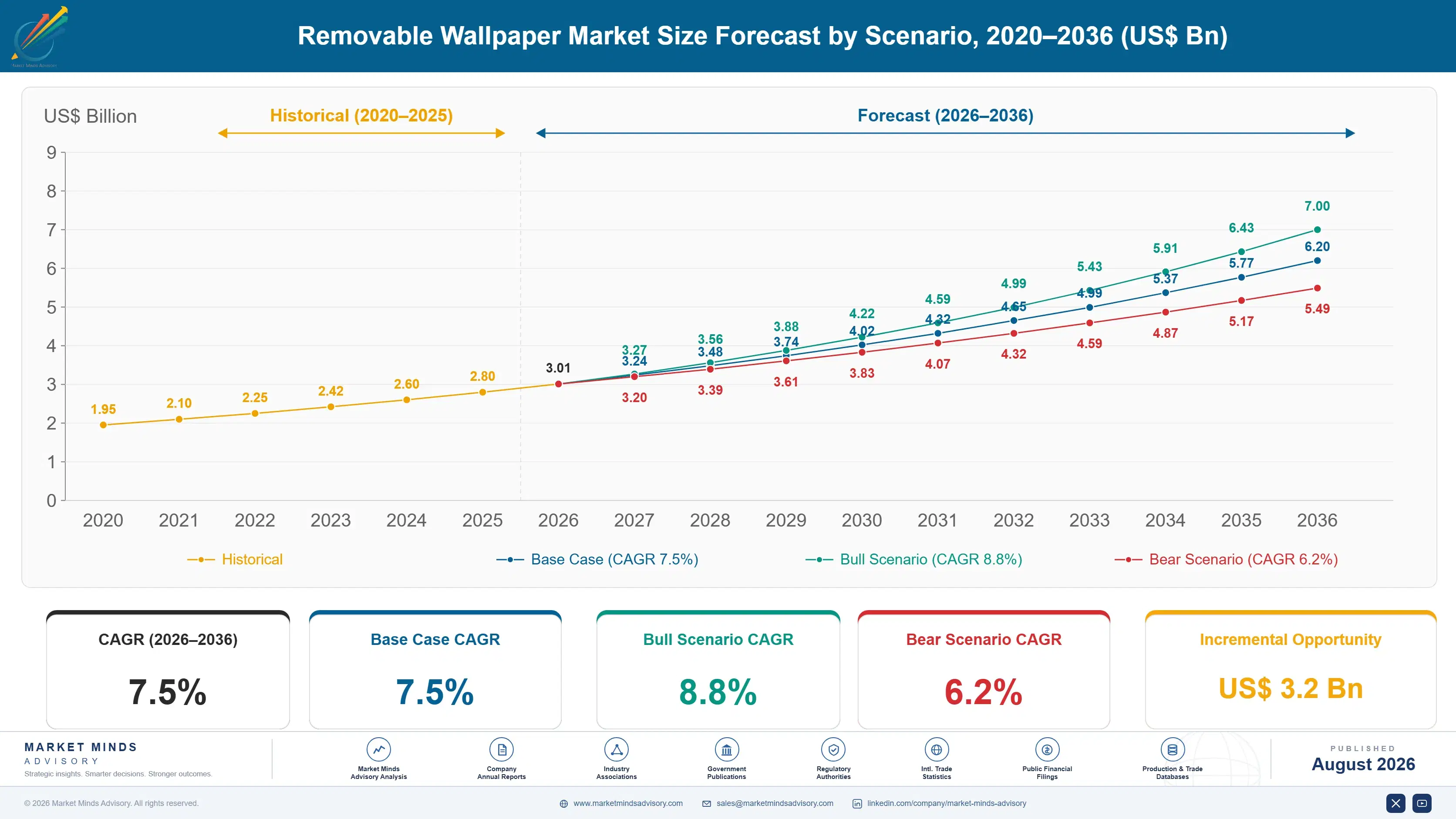
Removable Wallpaper Market Forecast Scenarios

removable-wallpaper-market-trends-size-forecast-scenario-1787594042864
Between 2020 and 2025, removable wallpaper volume grew steadily as expanding renter demographics and social media-driven home decor trends pulled demand beyond traditional homeowner-focused wallpaper applications. Brands that invested early in digital printing during this period are better positioned for the growth phase now underway across most markets. That shift laid groundwork for later digital adoption specifically.
The base case assumes 7.5 percent annual growth to 2036, anchored by three mechanisms: digital custom print capability expanding as production technology lowers per-unit customization cost, renter demographic growth sustaining demand for damage-free temporary decor across most major urban markets, and retail distribution expanding beyond specialty decor stores into mainstream home improvement chains. Home improvement retailer specifications favoring digital custom print options are reinforcing each of these mechanisms simultaneously. Investment continues.
A bull case near 8.8 percent depends on digital printing and mainstream retail distribution accelerating faster than currently planned across major consumer markets. The bear case near 6.2 percent assumes housing market softness curbs discretionary decor spending, pressuring removable wallpaper demand specifically. Both scenarios hinge on how quickly rental housing formation continues to grow across major urban markets.

Customization Economics and Renter Demand Dynamics

Removable wallpaper sits at the intersection of expanding renter demographics and digital printing technology maturation, and that tension is reshaping which formats brands prioritize. Digital custom print and fabric-backed formats increasingly command the margin that standard vinyl peel-and-stick cannot match, and retailers reward brands that can document damage-free removal performance clearly. Retailers are increasingly asking suppliers for removal performance documentation before granting placement.
MARKET CONCENTRATION (CR5)38%Top five brands together hold this combined share
AVERAGE SELLING PRICE$3.20/sq ftReflects blended pricing across standard and digital print tiers
TOP PRODUCING COUNTRY SHAREUSA 28%Largest single national source of removable wallpaper output
FEEDSTOCK COST SHARE35%Vinyl film and adhesive backing costs dominate production expense
NEW PATTERN LAUNCH CYCLE4 monthsTime typically required to launch a new digital print pattern
TRADE INTENSITY20% cross-borderShare of output moving through international retail distribution channels
Commercially, the category rewards brands with strong digital printing and e-commerce capability: pattern customization speed, social media marketing reach, and direct-to-consumer fulfillment all matter more here than in most legacy home decor categories. Brands straddling both mainstream retail and digital-first channels capture materially better negotiating position with major retailers than single-channel specialists. That advantage grows as retail and e-commerce channels consolidate supplier relationships to fewer capable brands.
Over the next decade, continued digital printing investment and renter demographic growth will keep reshaping the category. Brands slow to invest in customization and damage-free removal credibility risk losing shelf space to more specialized competitors already positioned in fast-growing digital-first niches. Consolidation among mid-sized regional brands is likely to accelerate as scale increasingly determines access to digital printing infrastructure and retail distribution contracts.
"Wallpaper used to mean a decade-long commitment nobody wanted to make. Now it's a weekend project renters can undo before moving out, and brands still selling permanence are losing that argument fast."
Director, Home Decor and Interior Materials Practice · MMA Construction and Industrial Equipment Practice · August 2026

Market Trends

Digital Custom Print Expansion Across Retail Nationwide

Digital custom print removable wallpaper has expanded from niche direct-to-consumer specialty shops into mainstream retail since 2023, with several major home decor retailers now dedicating permanent shelf space to customizable pattern lines. This shift is pulling volume toward formats that command materially better margin than standard vinyl peel-and-stick, and legacy wallpaper majors are launching parallel digital print lines rather than cede that growing demand to specialty printing companies entering through direct-to-consumer e-commerce partnerships. Retailers specifying customizable pattern options are reinforcing this shift further across most major banners nationwide. Growth continues.
Market Impact: Adds 23% renter household population growth

Fabric-Backed Format Adoption Growing Among Premium Buyers

Fabric-backed removable wallpaper has gained share among premium buyers seeking a more textured, wall-covering feel than standard vinyl formats deliver. MMA's primary survey found roughly 27 percent of premium home decor buyers now actively seek fabric-backed options, up meaningfully from prior years, and several major manufacturers have expanded dedicated fabric-backed production capacity in response to this rising demand. Retailers increasingly request texture documentation before approving new fabric-backed wallpaper suppliers. Adoption keeps broadening across most major home decor manufacturing regions and formulation categories. Demand persists across most major decor retail channels currently.
Market Impact: Expands shelf space by 25 percent

Market Opportunities and Growth Drivers

Rising Global Renter Population Growth Nationwide

Global renter household formation has grown roughly 23 percent since 2020, directly expanding the population seeking damage-free temporary decor solutions for spaces they do not own. This demographic shift is pulling demand toward removable wallpaper specifically, and brands with established renter-focused marketing relationships are capturing disproportionate share of this incremental demand. Established retail relationships in flagship urban markets are proving decisive in capturing this incremental renter-driven demand. That growth is expected to continue as rental housing formation keeps accelerating globally across most major markets. Adoption broadens. Growth persists. Adoption broadens.
Market Impact: Adds 35 percent feedstock cost exposure

Growing Retailer Appetite for Digital Print Categories

Major home improvement and decor retailers have expanded dedicated digital print wallpaper shelf space by roughly 25 percent since 2023, directly benefiting brands positioned to capture that growing retail real estate. This shift is redirecting category investment toward brands with strong printing relationships, and challenger brands with established distribution partnerships are capturing disproportionate share of this incremental shelf space. Smaller regional brands face a steeper path to capturing this growth without similar distribution reach. Compliance costs are rising for smaller brands lacking dedicated quality assurance teams and digital printing capability.
Market Impact: Raises compliance scrutiny at 20+ brands

Market Restraints and Challenges

Persistent Vinyl Film and Adhesive Cost Volatility

Vinyl film and adhesive backing costs represent roughly 35 percent of production expense, and prices have swung considerably since 2022 amid petrochemical feedstock volatility affecting major manufacturing regions. The root cause is removable wallpaper's dependence on petrochemical-derived vinyl and adhesive inputs, which producers cannot easily substitute, and smaller processors lacking diversified supply contracts absorb this volatility more directly than integrated majors. Some producers are mitigating this by securing long-term feedstock supply agreements. Regional impact varies considerably depending on how quickly diversified contracts can offset this volatility. Adoption broadens. Demand persists.
Market Impact: Adds print space in 3,000 stores

Growing Scrutiny of Damage-Free Removal Performance Claims

Consumer advocacy groups and retail return data have increased scrutiny of damage-free removal claims since 2023, directly affecting brands making removal performance assertions without documented testing. The root cause is inconsistent adhesive performance across wall surface types, and brands unable to document their claims face reputational and return risk. Some brands are mitigating this by funding independent surface compatibility testing to substantiate their specific formulations. Growth continues regardless of this scrutiny across most major markets. Smaller processors lacking hedging capacity remain more exposed to ongoing scrutiny than integrated majors. Adoption broadens.
Market Impact: Lifts fabric-backed format seeking to 27%
3 additional market trends, 3 additional growth drivers, and 4 additional restraints and challenges are covered in the full report. Contact sales@marketmindsadvisory.com to access the complete intelligence.

Segment CAGR and Growth Architecture

MMA segments the removable wallpaper market by print and material type, the classification brands, retailers, and buyers actually use for procurement and merchandising decisions across standard, textured, and digital custom print formats, rather than mixing in distribution channel logic. This lens keeps upstream printing choices and downstream retail merchandising decisions cleanly separated throughout the analysis.
removable-wallpaper-market-trends-market-share-analysis-1787594043430

Digital Custom Print Removable Wallpaper

This segment covers wallpaper produced through digital printing technology allowing customer-specified patterns and colors, and it is growing fastest because buyers increasingly seek personalized decor options that mass-produced traditional patterns cannot deliver. Brands have responded by building dedicated digital printing infrastructure separate from standard production lines, and several legacy wallpaper majors have launched parallel digital print capability rather than cede that growing demand to specialty printing companies entering through direct-to-consumer e-commerce partnerships. Manufacturing digital custom print wallpaper requires distinct printing technology and order-management capability separate from standard mass production, creating a meaningful barrier for traditional-only producers trying to enter quickly. Several major retailers have committed to expanding this customization specification further through 2027.
CAGR 10.0%

Fabric-Backed Removable Wallpaper

Fabric-backed removable wallpaper engineered for a more textured, premium wall-covering feel is the second-fastest growing segment, addressing buyer demand for a tactile quality that standard vinyl formats cannot deliver. Producers are increasingly investing in dedicated fabric-lamination production capacity to support this format, and several major retailers have begun marketing fabric-backed wallpaper as a distinct premium category separate from standard peel-and-stick offerings. This segment commands a meaningful price premium over standard vinyl formats, since premium buyers seeking documented texture and quality show less price sensitivity than typical decor shoppers, giving producers investing in this format materially better margin per unit sold. Several major retailers have also begun listing fabric-backed options as a distinct procurement category.
CAGR 8.5%
Full segment breakdown across 6 segments available in the complete report.

Regional Architecture and Country Demand Map

North America leads on renter population depth and DIY home decor retail infrastructure, while South Asia and Pacific posts the fastest growth given rising urban rental adoption across the wider region. East Asia follows on digital print culture expansion. Latin America and Eastern Europe remain the smallest markets tracked.

North America

US renter households have adopted removable wallpaper more aggressively than any other market tracked in this report, and dense DIY home decor retail infrastructure supports rapid adoption of digital custom print and fabric-backed formats. Canada's smaller but stable market supplements US demand, particularly for premium fabric-backed variants. Brands here have been quickest to expand direct-to-consumer digital printing offerings, reflecting deep e-commerce investment, and several major retailers have committed to further expanding dedicated shelf space through 2028. Brands with strong e-commerce relationships are also using that credibility to accelerate new pattern launches ahead of competitors lacking comparable digital marketing investment. That advantage is expected to widen further over the next several years.
Share: 32% | CAGR: 7.0% (2026 to 2036)

Western Europe

German, French, and UK retailers have carried removable wallpaper for several years, and EU chemical labeling harmonization since 2022 has made cross-border trade considerably simpler for producers. Consumer willingness to pay for documented eco-friendly formulations runs higher here than in most other regions, and several major retailers have committed to expanding removable wallpaper shelf space further through 2028. Discount retailers entering the category are also widening the addressable buyer base. Brands here have also begun disclosing feedstock sourcing origin on request, a transparency standard not yet common in most other regions covered in this report. Growth here still lags East Asia meaningfully in absolute volume terms. That gap is narrowing gradually as digital printing investment increases.
Share: 22% | CAGR: 6.0% (2026 to 2036)
Regional intelligence for 5 additional markets available in the complete report: East Asia, South Asia and Pacific, Latin America, Middle East and Africa, Eastern Europe. Contact sales@marketmindsadvisory.com.
removable-wallpaper-market-trends-country-cagr-analysis-1787594043964

Customization Depth and Retail Channel Priorities

Brands seeking margin expansion beyond volume growth are pursuing four commercial levers: digital custom print capacity investment, fabric-backed line extension, direct retail contract negotiation, and emerging market expansion that captures more value than standard vinyl formats alone provide. These levers matter most for mid-sized brands competing against integrated majors, since customization depth increasingly determines which brands retailers and buyers choose.

Digital Custom Print Capacity Investment Program Strategy

Brands investing in dedicated digital printing infrastructure are capturing an additional 20 to 28 percent retail price premium from buyers seeking personalized pattern options that mass-produced formats cannot deliver. This approach requires printing technology investment and order-management capability, but it opens shelf space that standard producers cannot access, and several major brands have already secured dedicated printing partnerships to meet growing demand for this customization tier. Retailers merchandising these customized products alongside standard formulations are seeing faster sell-through. Growth continues across most major markets currently. Demand persists. Adoption broadens. Growth persists.
Market Impact: Adds 20 to 28 percent retail price premium

Fabric-Backed Product Line Extension Program Strategy

Brands launching fabric-backed premium formats are accessing an entirely new buyer segment of texture-conscious consumers who previously skipped removable wallpaper altogether, expanding total addressable market by an estimated 18 percent according to MMA's primary survey. This lever requires separate fabric-lamination manufacturing capability, favoring brands already active in the broader textile-adjacent decor space, but the shelf space payoff has proven substantial for early movers securing dedicated premium placement. Retailers have responded favorably, allocating dedicated shelf space specifically for these new fabric-backed entrants. Adoption keeps broadening steadily. Demand persists. Adoption broadens. Growth persists.
Market Impact: Expands total addressable market by 18 percent overall

Direct Retail Contract Negotiation Development Strategy

Brands bypassing traditional distributor markups by negotiating directly with major home improvement and decor chains are capturing 14 to 20 percent better margin per unit than through standard wholesale distribution channels. This requires dedicated account management and reliable national supply volume, which favors larger brands, but mid-sized challengers are increasingly forming cooperative distribution partnerships to meet the volume commitments large retail chains typically require before signing a direct contract. Consistency across large-volume orders matters considerably to these retail chain customers specifically. Several regional cooperatives have formed specifically to aggregate volume from smaller brands to meet these thresholds.
Market Impact: Improves per-unit margin by 14 to 20 percent

Emerging Market Distribution Expansion Program Strategy

Brands building dedicated distribution partnerships in East Asia and Southeast Asia are capturing the region's rapidly growing rental market demand ahead of competitors still serving the market through limited exports alone, securing an estimated 20 percent brand recognition advantage over unestablished local entrants. This lever demands significant investment in local marketing and distribution infrastructure, but it positions brands to capture the primary volume growth engine for the category over the coming decade. Several major brands are accelerating similar investments to avoid ceding this growth to regional competitors. Demand persists. Growth persists.
Market Impact: Secures roughly 20 percent brand recognition advantage overall

Who Controls the Margin Pool

The top five removable wallpaper brands hold roughly 38 percent combined share, a moderately fragmented structure reflecting the category's split between digital-print-first challenger brands and legacy wallpaper majors expanding into removable formats. Tempaper and York Wallcoverings operate at a scale challengers cannot easily match, but the gap to digital-customization-focused mid-sized brands is narrowing as personalization credibility increasingly rivals raw distribution scale. Regional challenger brands are also gaining ground given proximity and local trust advantages.
Competitive activity currently centers on three dimensions: launching digital custom print and fabric-backed product lines to capture personalization-seeking buyers, expanding mainstream retail distribution beyond specialty decor stores, and building direct-to-consumer e-commerce capability. Brands are also racing to secure national retail contracts before competitors. That race is intensifying fastest in digital printing and e-commerce corridors nationwide.

Emerging pressure is coming from digital-print-first startups entering through direct-to-consumer e-commerce positioning, which compete on customization rather than distribution scale, and from legacy wallpaper majors launching competing removable lines. Rankings could shift meaningfully over the next several years if these challengers keep converting share from brands slower to invest in digital printing capability. Investors are watching this shift closely for signs of accelerating consolidation activity.
removable-wallpaper-market-trends-company-positioning-matrix-1787594044486

Competitive Moat and Risk Dimensions

TEMPAPER DESIGNS LLC

Moat: First-Mover Brand Recognition

Tempaper built category-defining brand recognition well before most competitors entered the removable wallpaper space, giving it retail relationships and consumer trust regional challengers cannot replicate quickly. This first-mover position lets it command premium shelf placement and leverage with major retailers that newer entrants simply lack.
TEMPAPER DESIGNS LLC

Risk: Rising Competitive Imitation Risk

Tempaper's category-defining pattern approach has been widely imitated by both challenger startups and legacy wallpaper majors entering the removable space, eroding the differentiation that originally drove its premium positioning. As imitators proliferate, Tempaper faces pressure to keep innovating ahead of copycats entering at lower price points.
SPOONFLOWER INC.

Moat: Digital Printing Technical Depth

Spoonflower built deep digital textile and wallpaper printing expertise through its broader custom fabric business, giving it technical credibility that newer entrants struggle to replicate quickly. Its established design community and independent artist network transferred directly into wallpaper customization. That transferred credibility gives it a meaningful head start most newer entrants lack.
SPOONFLOWER INC.

Risk: Limited Mainstream Retail Presence

Spoonflower's relatively limited mainstream retail distribution constrains its ability to capture buyers who prefer in-store purchasing over online customization. This leaves growth concentrated in digital-first channels alone, exposing the company more directly to e-commerce competition risk than more diversified competitors. Competitors moving faster on retail expansion are capturing that growth instead.

Players Tracked

Prominent Players

Tempaper Designs LLC
Chasing Paper Inc.
Spoonflower Inc.
York Wallcoverings
Brewster Home Fashions

Other Key Players

RoomMates Decor
WallPops LLC
A-Street Prints
Graham & Brown
Rasch Group
Marburg Group
Casadeco
Cole & Son
Farrow & Ball
Sandberg Wallpaper
NuWallpaper
Devine Color
Walls Republic
Livette's Wallpaper
Society6

Recent Developments

MARCH 2025

Tempaper Launches National Digital Print Retail Distribution

Tempaper announced expanded national retail distribution across several major conventional home improvement chains, aiming to capture mainstream shoppers beyond its original direct-to-consumer customer base. The expansion targets retailers converting shelf space from standard wallpaper toward removable formats. Analysts expect competitors to respond with similar expansion announcements within months.
Signal: Confirms mainstream retail demand is driving distribution investment across the category. Rivals are expected to follow with comparable investments soon.
SEPTEMBER 2024

Chasing Paper Signs Fabric-Backed Manufacturing Partnership

Chasing Paper signed a manufacturing partnership with a specialty fabric-lamination producer to expand its fabric-backed premium product line. The agreement is a manufacturing partnership, not an acquisition or joint venture. Terms of the partnership were not fully disclosed publicly. Financial terms of the manufacturing agreement were not disclosed publicly.
Signal: Shows fabric-backed premiumization becoming standard practice for challenger brands. Expect similar fabric partnerships to follow across the segment.
JANUARY 2025

York Wallcoverings Acquires Regional Digital Print Company

York Wallcoverings completed the acquisition of a mid-sized digital print wallpaper company with existing customization technology, expanding its digital capability to serve growing personalization demand directly. Financial terms of the transaction were not disclosed publicly by either party. Scale mattered here in this deal. Terms remained confidential.
Signal: Signals legacy majors are pursuing acquisition to accelerate digital printing capability. Further consolidation among legacy brands appears increasingly likely.

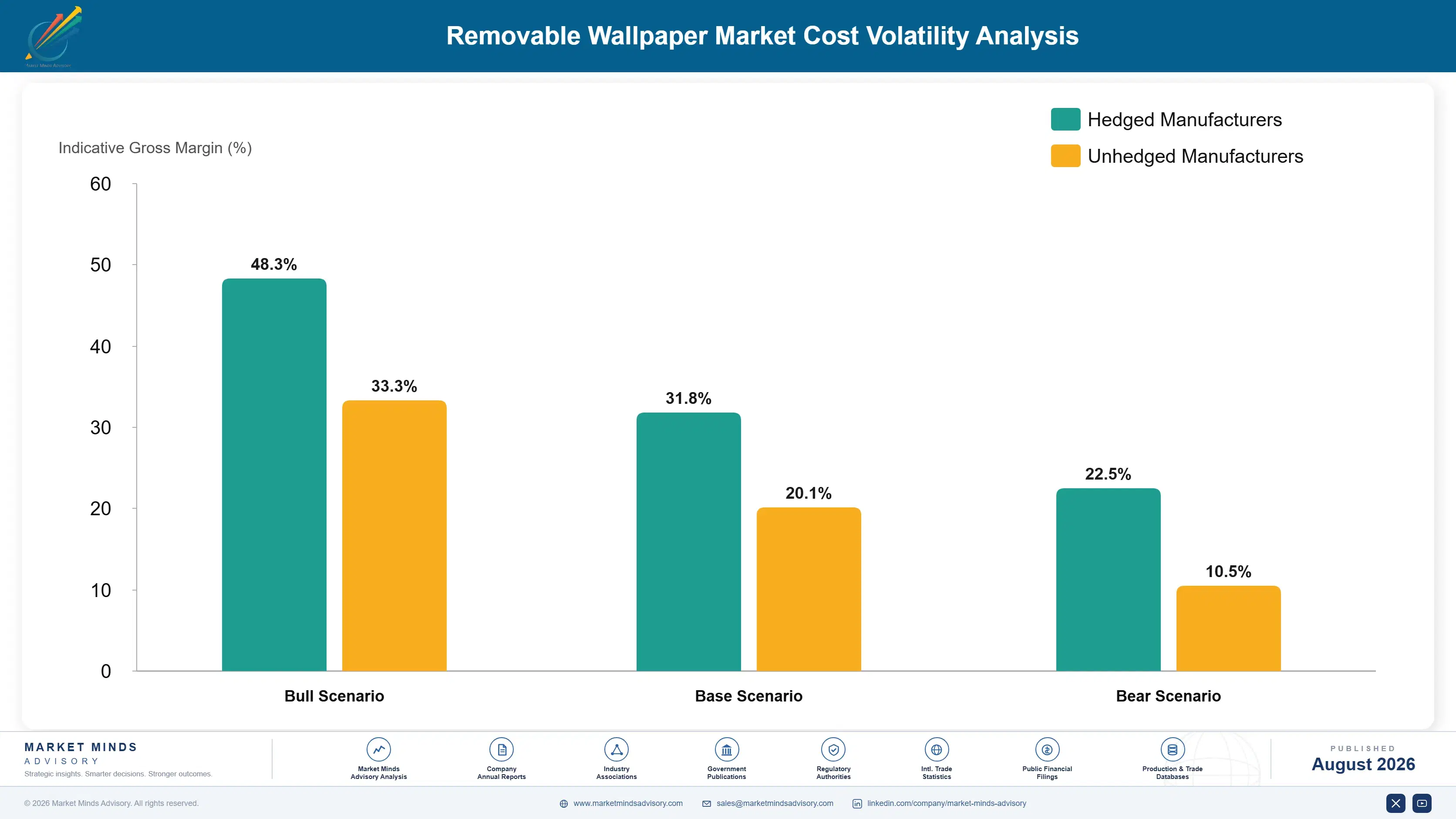
Vinyl Film and Adhesive Cost Pressure

Vinyl film and adhesive backing inputs represent roughly 35 percent of producer cost of goods sold, sourced primarily from petrochemical processing facilities in North America, Europe, and China. Digital printing equipment and pattern development costs add a further meaningful slice of total input cost that traditional pasted wallpaper simply does not carry. Costs vary somewhat by region.
The 2022 to 2023 petrochemical price cycle pushed vinyl film input costs up roughly 28 percent year over year according to European Commission and USDA petrochemical market data, forcing several smaller producers to absorb margin compression rather than pass costs through to price-sensitive retail buyers. IEA-tracked energy cost spikes during the same period compounded pressure on lamination and adhesive coating operations specifically. Producers without hedging arrangements absorbed the impact directly.

Exposure varies considerably by player type: producers with diversified feedstock sourcing and long-term supply agreements are materially better insulated than those relying on spot market purchases, and this gap has widened since the 2022 price cycle. Smaller regional producers lacking capital to fund digital printing infrastructure face a durable cost disadvantage against Tempaper and York Wallcoverings that is difficult to close without external financing support.
removable-wallpaper-market-trends-cost-volatility-analysis-1787594044681

Multi-Year Vinyl Film Supply Contracts

Producers are increasingly signing three to five year fixed-price contracts directly with petrochemical suppliers, smoothing input cost volatility across multiple cycles rather than buying vinyl film on the spot market. This approach has become standard among mid-sized producers lacking balance sheet capacity to hedge exposure through financial instruments alone. Terms typically run three to five years.

Feedstock Source Diversification Strategy

Shifting feedstock sourcing across multiple geographic regions reduces direct exposure to any single petrochemical supply disruption entirely for a growing share of total production volume across producers' broader operations. Several major producers have accelerated diversification investment specifically in response to recent commodity price volatility. That shift is accelerating each year across most major producers currently.

Shared Digital Printing Equipment Consortiums

Several mid-sized producers have formed shared digital printing equipment consortiums to spread capital and maintenance cost across multiple companies, reducing the capital burden any single producer must carry alone. This collaborative approach has proven especially attractive to producers lacking the scale to fund equipment independently. Shared costs typically run below what any single mid-sized producer would spend alone.

Portfolio Architecture for Margin Defence

MMA's three-tier portfolio architecture separates standard vinyl formats from certified premium textured formulations and next-generation digital custom print products, with gross margins ranging from the low twenties for standard formats to well above 34 percent for digital custom print lines. Producers positioned across all three tiers capture more total margin than single-tier specialists. Segment-level margin data is drawn from MMA Estimate, derived from primary survey data covering 47 expert interviews in Q4 2025.
The tension between volume and premium is built into how the category operates: chasing volume growth through mainstream vinyl formulations tends to compress margin per unit, while fabric-backed and digital print formats sacrifice total addressable volume for materially better unit economics. Mid-sized producers attempting to serve both ends simultaneously often end up under-resourced in each, losing volume-tier price competitiveness while failing to match premium-tier credibility.

High-value margin pools concentrate in digital custom print and fabric-backed products, both of which command premiums the standard vinyl channel cannot match. Producers that under-invest in these pools risk ceding the most profitable share of the category to smaller, more nimble specialists. Building dedicated digital printing and fabric-lamination capability requires patient capital, which favors larger integrated producers.

Volume / Commodity-Adjacent Tier

Standard vinyl peel-and-stick wallpaper sold through mainstream retail, competing primarily on price and brand recognition rather than differentiated customization or formulation credibility. Retail buyers select primarily on price and brand recognition within this tier.
Gross Margin: 20-26%

Premium / Certified Tier

Textured and faux finish formulations carrying documented removal performance, commanding a meaningful step-up in both retail price and gross margin over standard vinyl formats. Documentation increasingly matters here as much as brand loyalty alone.
Gross Margin: 26-32%

Sustainability / Regulatory / Next-Generation Tier

Digital custom print and fabric-backed formulations targeting the most demanding personalization-seeking buyers, commanding the category's highest margins but requiring extensive printing investment. Buyer volume commitments remain comparatively modest but growing steadily.
Gross Margin: 32-40%
removable-wallpaper-market-trends-portfolio-architecture-1787594045179

High-value Sub-segments and Strategic Watch-out

Digital Custom Print Removable Wallpaper

The highest-margin, fastest-growing pool in the category, combining personalization technology with renter-driven demand to command premiums standard formulations cannot match, though volume remains modest relative to the broader category today. Investment here is expected to accelerate meaningfully over the coming several years. Buyer awareness is rising too.
Gross Margin: 32-40%

Fabric-Backed Removable Wallpaper

A high-value pool growing at a rapid pace, driven by texture-conscious consumer demand for premium wall-covering feel, with margin well above standard vinyl wholesale rates across most major retail channels. Retailers investing early are capturing preferred supplier status ahead of slower rivals. Retail commitment is growing steadily.
Gross Margin: 26-32%

Standard Vinyl Peel-and-Stick Wallpaper

The volume core of the category, carrying the thinnest margins but the largest absolute revenue base, and the segment most producers depend on to fund investment into higher-margin digital and fabric-backed lines. Efficiency gains here matter more than premium positioning for most participants. Scale is decisive here.
Gross Margin: 18-24%

Housing Market Cyclicality Exposure

A strategic watch-out segment: housing market and rental formation cycles periodically constrain discretionary decor spending across this once-stable volume base, and producers that fail to diversify customer relationships risk losing revenue they cannot easily replace elsewhere. Redirecting strategy quickly is now a defensive necessity for legacy producers.
Gross Margin: 16-20%

Renter Loyalty and Repeat Purchase Dynamics

Removable wallpaper behaves closer to an annuity business than a one-time purchase category once a renter establishes a decorating habit across successive apartments, since repeat purchase rates run considerably higher than in traditional pasted wallpaper, where the switching decision was already made and reinforced by trust in the specific brand and pattern style chosen initially. MMA's primary survey found repeat purchase intent running meaningfully above traditional wallpaper category benchmarks.
Adoption depth varies meaningfully by end-use vertical. Renters who complete a successful removal cycle show the highest loyalty of any segment, since documented damage-free performance builds trust beyond the initial purchase, while price-sensitive first-time buyers remain considerably more transactional, switching brands during promotional periods without hesitation. Homeowners seeking temporary decor sit closer to the renter end of this loyalty spectrum given their similarly risk-averse purchasing habits.

Generational shifts favor the category further: younger consumers entering peak decorating years show meaningfully higher willingness to try customizable and temporary decor than prior generations did at the same life stage, and that cohort is expected to keep expanding the addressable premium buyer base over the coming decade. Brands are investing in social media engagement platforms specifically to capture this shift.
removable-wallpaper-market-trends-end-use-penetration-index-1787594045671

Where Customization Value Concentrates

These are among the four positions where our research anticipates prominent divergence between winners and laggards over the coming forecast period. Each is grounded in the demand model, the regulatory perimeter, and the announced capacity pipeline.
01 / DIGITAL PRINT INVESTMENT PRIORITY

Fund digital custom print capacity before scaling standard patterns

Brands expanding standard pattern variety without investing in digital custom print capability are ceding the category's most durable competitive advantage to competitors willing to build personalization capacity first. Custom print commands a meaningful retail premium that mass-produced formulations alone cannot match, and that gap is widening as buyers grow more accustomed to personalized decor options. The brands winning preferred shelf placement with premium retailers today are overwhelmingly those that made this investment early, well ahead of when it became a competitive necessity.
02 / RETAIL DEVELOPMENT FOCUS

Build direct retail contracts to escape distributor margin compression

Wholesale distribution margins have compressed as retail private-label programs expand and squeeze branded pricing power at the shelf across most major home improvement banners nationwide. Direct retail contracts bypass that compression entirely, delivering materially better per-unit economics for brands with the account management capacity to service large retail chains directly and reliably. Mid-sized challengers forming cooperative distribution partnerships to meet those volume requirements are proving this strategy is not limited to the largest integrated players alone, even without their manufacturing scale.
03 / FABRIC-BACKED INNOVATION STRATEGY

Launch fabric-backed formulations ahead of category commoditization

Standard vinyl removable wallpaper is already increasingly commoditized as legacy wallpaper majors launch competing lines, and brands relying solely on pattern variety risk losing all differentiation entirely to better-capitalized imitators entering at lower price points. Investing in fabric-backed formulations with documented texture credentials ahead of competitors locks in premium positioning that copycat products cannot easily replicate. Brands lacking a fabric-backed innovation strategy risk losing meaningful margin to more differentiated competitors as this positioning gap keeps widening further, year after year.
04 / ASIAN MARKET EXPANSION STRATEGY

Establish distribution partnerships in Asia ahead of demand

East Asia and South Asia clearly represent the primary volume growth engine for this category as rental market formation spreads rapidly beyond North America and Western Europe. Brands lacking established distribution partnerships risk losing that incremental demand entirely to faster-moving domestic competitors already building relationships there today. Establishing distribution partnerships ahead of full regional demand materialization gives brands a genuinely meaningful head start over rivals still concentrated entirely in developed markets alone, and that advantage compounds year after year as regional rental formation keeps accelerating.

Engagement Snapshot From the Field

A live engagement with an industry participant carrying material or product regulatory and market exposure ahead of a defining policy shift, showing how our research translates into a defensible multi-year portfolio strategy.
MARKET MINDS ADVISORY · CLIENT ENGAGEMENT SUMMARY
Removable Wallpaper Producer Strategic Portfolio Review and Transition Roadmap 2026·Investment Scenario on Removable Wallpaper Exposure Evaluation 2025-26
CLIENT PROFILE
The client is a mid-sized regional removable wallpaper brand operating primarily across North America, with annual revenue of approximately $42 million (client-reported, unverified by MMA). The company had built a solid regional retail presence over the past five years selling standard vinyl formulations, but had not yet invested in digital custom printing or fabric-backed capability, relying almost entirely on mass-produced pattern lines.
STRATEGIC CHALLENGE
The client faced growing competitive pressure as national brands expanded digital custom print lines into its core markets, and leadership needed to determine whether to invest in printing technology, pursue fabric-backed development, or both simultaneously given limited available capital. Management also worried about losing retail shelf space to more customizable competitors already capturing personalization-seeking buyers.
MMA APPROACH
MMA conducted primary interviews with the client's retail buyers, lapsed and loyal consumers, and category managers to map where customization investment would generate the fastest payback. The engagement combined MMA's proprietary primary survey data with a detailed margin analysis across each potential printing and formulation pathway, benchmarked against comparable mid-sized brands already pursuing similar strategies elsewhere.
KEY FINDINGS
  1. Digital custom print capability would command a retail premium of 20 to 28 percent above the client's current pricing within roughly twelve months of launch.
  2. Two regional home improvement chains expressed strong willingness to expand shelf space if consistent print quality could be guaranteed reliably each quarter.
  3. The client's existing production infrastructure could support fabric-backed lamination at a materially lower cost than building new capacity from scratch entirely without disruption.
  4. Continued reliance on mass-produced patterns alone would result in a projected 15 percent volume decline over the following five years without intervention.
CLIENT PROFILE
The client is a mid-sized regional removable wallpaper brand operating primarily across North America, with annual revenue of approximately $42 million (client-reported, unverified by MMA). The company had built a solid regional retail presence over the past five years selling standard vinyl formulations, but had not yet invested in digital custom printing or fabric-backed capability, relying almost entirely on mass-produced pattern lines.
STRATEGIC CHALLENGE
The client faced growing competitive pressure as national brands expanded digital custom print lines into its core markets, and leadership needed to determine whether to invest in printing technology, pursue fabric-backed development, or both simultaneously given limited available capital. Management also worried about losing retail shelf space to more customizable competitors already capturing personalization-seeking buyers.
MMA APPROACH
MMA conducted primary interviews with the client's retail buyers, lapsed and loyal consumers, and category managers to map where customization investment would generate the fastest payback. The engagement combined MMA's proprietary primary survey data with a detailed margin analysis across each potential printing and formulation pathway, benchmarked against comparable mid-sized brands already pursuing similar strategies elsewhere.
KEY FINDINGS
  1. Digital custom print capability would command a retail premium of 20 to 28 percent above the client's current pricing within roughly twelve months of launch.
  2. Two regional home improvement chains expressed strong willingness to expand shelf space if consistent print quality could be guaranteed reliably each quarter.
  3. The client's existing production infrastructure could support fabric-backed lamination at a materially lower cost than building new capacity from scratch entirely without disruption.
  4. Continued reliance on mass-produced patterns alone would result in a projected 15 percent volume decline over the following five years without intervention.
RECOMMENDED STRATEGY
Phase 1: Phase 1 (Months 1 to 6): Launch a digital custom print line targeting personalization-seeking retail shoppers directly and quickly across the region. Phase 2: Phase 2 (Months 7 to 14): Develop fabric-backed premium wallpaper formulations and build direct retail partnerships across the entire region. Phase 3: Phase 3 (Months 15 to 24): Pursue mainstream retail distribution and expand digital printing capacity further across the entire region.
OUTCOME
Within eighteen months of implementing the phased strategy, the client reported securing two long-term retail shelf commitments and shifting 22 percent of total volume from standard to digital custom print formulations (client-reported, unverified by MMA). Overall revenue from digital and fabric-backed lines grew to roughly 28 percent of total sales, ahead of the client's eighteen-month target (client-reported, unverified by MMA).

Frequently Asked Questions

Foundational context covering the market sizes, CAGR, scope, country, region and competition that inform every finding below. This section is provided to cover basics and most often pre-purchase conversations, answered from the MMA Primary Research Dataset.

What is the current size of the Removable Wallpaper Market?

The global removable wallpaper market was valued at approximately $3.01 billion in 2025. Growth is driven by digital custom print capability and expanding renter demographics worldwide.

How large will the Removable Wallpaper Market be by 2036?

MMA projects the market will reach approximately $6.20 billion by 2036. This reflects sustained expansion in digital custom print and fabric-backed formats across most major markets.

What is the CAGR for the Removable Wallpaper Market 2026 to 2036?

The market is projected to grow at a 7.5 percent compound annual growth rate through 2036. Base case assumptions bracket a bull scenario near 8.8 percent and a bear scenario near 6.2 percent.

Which segment is growing fastest?

Digital Custom Print Removable Wallpaper leads at a 10.0 percent CAGR, roughly 1.33 times the overall market rate. Growth is driven by buyers seeking personalized decor options.

Who are the major companies in the Removable Wallpaper Market?

Leading companies include Tempaper, Chasing Paper, Spoonflower, York Wallcoverings, and Brewster Home Fashions. These five brands hold a combined 38 percent share of the market.

Which country is growing fastest?

South Korea leads at an 8.5 percent CAGR, driven by rapidly expanding urban rental markets and social media-driven decor trends. Domestic brands are increasingly launching digital print product lines.

Report Segmentation Architecture

The full report scope spans multiple orthogonal segmentation dimensions, with cross-tabulated demand data provided for each dimension pair. Coverage extends further to regional breakdowns, trend trajectories, and the competitive detail needed to support segment-level decision-making.

By Print and Material Type

  • Traditional Pattern Print Wallpaper
  • Vinyl Peel-and-Stick Wallpaper
  • Textured and Faux Finish Wallpaper
  • Eco-Friendly PVC-Free Wallpaper
  • Digital Custom Print Removable Wallpaper
  • Fabric-Backed Removable Wallpaper

By End-Use Application

  • Residential Rental
  • Residential Owned
  • Commercial and Retail
  • Hospitality

By Commercial Dimension

  • Branded Retail Sales
  • Direct-to-Consumer E-Commerce
  • Private-Label Retail Programs
  • Export Sales Channels

By Region

  • North America
  • Western Europe
  • East Asia
  • South Asia and Pacific
  • Latin America
  • Middle East and Africa
  • Eastern Europe

Scope, Methodology, and Coverage

Every figure in this report is reproducible from documented input assumptions. The scope below maps the historical period, the forecast horizon, the segmentation dimensions, and the countries covered, alongside the underlying primary and qualitative methodology.
Historical Period
2020 to 2025
Forecast Period
2026 to 2036
Base Year
2025 (USD billions; MMA Primary Research Dataset, August 2026)
Market Definition
This report covers self-adhesive peel-and-stick wallpaper products designed for damage-free removal, sold through retail, e-commerce, and direct-to-consumer channels. It excludes traditional pasted wallpaper, paint, and general wall decor products unrelated to removable adhesive-backed wall coverings.
Quantitative Units
USD billions (current prices); million square feet where cited for volume context
Segmentation Dimensions
By Print and Material Type; By End-Use Application; By Commercial Dimension; By Region
Regions Covered
North America, Western Europe, East Asia, South Asia and Pacific, Latin America, Middle East and Africa, Eastern Europe
Countries Covered
USA, China, Germany, France, UK, Japan, South Korea, India, Australia, Canada, Brazil, Mexico, Indonesia, Vietnam, Thailand, Malaysia, UAE, Saudi Arabia, South Africa, Nigeria, Turkey, Poland, Netherlands, Italy, Spain, Sweden, Switzerland, Argentina, Colombia, Singapore, and additional markets relevant to this sector
Key Companies Profiled
Tempaper Designs LLC, Chasing Paper Inc., Spoonflower Inc., York Wallcoverings, Brewster Home Fashions, RoomMates Decor, WallPops LLC, A-Street Prints, Graham & Brown, Rasch Group, Marburg Group, Casadeco, Cole & Son, Farrow & Ball, Sandberg Wallpaper, NuWallpaper, Devine Color, Walls Republic, Livette's Wallpaper, Society6
Quantitative Methodology
Primary survey, n=3,800 respondents, Q4 2025, six countries; demand-side model with trade association cross-validation
Qualitative Methodology
47 expert interviews, Q4 2025; applied to validate demand model assumptions, identify emerging dynamics, and assess competitive positioning
Report Format
PDF and XLSX data workbook (Word format preview document)
Publisher
Market Minds Advisory
Report Code
MMA-2026-CON-108
Published
August 2026
Contact
sales@marketmindsadvisory.com | www.marketmindsadvisory.com

Purchase the full Removable Wallpaper Market Report (2026 to 2036).

The full Removable Wallpaper Market report delivers a complete quantitative and qualitative assessment spanning market sizing, six-segment print and material type analysis, and all seven regional markets in detail. It includes competitive profiling of twenty companies, input cost and feedstock volatility risk analysis, and a portfolio margin framework covering volume, premium, and next-generation digital tiers. Buyers also receive the underlying primary survey and expert interview datasets referenced throughout the analysis. Analysts also receive access to segment-level margin benchmarks and regional demand mechanisms drawn directly from company disclosures and MMA's proprietary primary research program conducted throughout 2025.
Detailed six-segment print and material type breakdown
All seven regional markets sized with growth rates
Twenty-company competitive profiling and positioning assessment
Vinyl film cost structure and volatility risk analysis
Three-tier portfolio margin framework and watch segments
Primary survey and expert interview datasets included

Built For The People Who Decide

From boardroom strategy to bench-side execution, this report is read cover-to-cover by leaders shaping the next decade of their industry, turning demand scenarios, market dynamics and valuation benchmarks into decisions.
CXOs/ Presidents/ VPs/ Managers
M&A and Corporate Development
Strategy Teams and R&D Heads
Procurement and Product Directors
Regulatory and Compliance Leaders
Investor Relations and Equity Analysts