Market Minds Advisory
Remote Patient Monitoring Devices Market

Remote Patient Monitoring Devices Market: Connected Cardiac, Metabolic, and Respiratory Monitoring Technology

CMS reimbursement codes turned remote monitoring into a recurring billing line just as AI-enabled analytics platforms start flagging deterioration before a patient ever calls, reshaping how chronic disease gets managed at home.

Lead Analyst

Alice Ballenger

Published

September 2026

Make Smarter Decisions with Customized Research Insights

Request a free sample report and evaluate market opportunities, growth trends, and competitive dynamics relevant to your business needs.

2025 MARKET VALUE$32.5BMarket Size 2025
2036 FORECAST VALUE$104.5BBase Case , 2026 to 2036
CAGR 2026 TO 203611.2 %Bull 12.5% / Bear 9.9%
INCREMENTAL OPPORTUNITY$68.3BNet 10- year value creation
EXPANSION MULTIPLE2.89x2036 value over 2026 base
Strategic Levers
M&A Pipeline
Regional Outlook
Country Rankings
Competitive Intelligence
Segmental Deep-dive
Call-Us : 91 93563 13602

Executive Snapshot and Market Trajectory

CMS billing codes for remote physiologic monitoring turned a niche hospital pilot activity into a recurring revenue line, pulling device manufacturers and analytics vendors deeper into the chronic disease management business than most anticipated even three years ago across nearly every major provider network and payer category.
Cardiac and glucose monitoring devices still carry the largest share of revenue, but AI-enabled predictive analytics platforms are expanding fastest as providers chase earlier deterioration detection ahead of costly hospital readmissions. Demand concentrates among health systems managing large heart failure and diabetes populations, where per-patient reimbursement economics clear the investment threshold fastest across comparable provider networks reviewed this year and last across several major reimbursement jurisdictions.
Competition splits between diversified medical device manufacturers bundling monitoring hardware with clinical software and specialist analytics vendors selling narrower AI-driven deterioration prediction tools. Tightening reimbursement documentation requirements, plus growing payer interest in outcomes-linked contracts, are pulling investment toward vendors that can demonstrate measurable readmission reduction against comparable standard-of-care baselines across large managed populations spanning multiple chronic disease categories and provider network types currently under review for next-cycle contract renewal and expansion decisions.
Market Definition
The remote patient monitoring devices market covers connected hardware and associated analytics platforms used to track cardiac, metabolic, respiratory, and general vital sign parameters outside clinical settings for chronic disease management and post-acute recovery. It excludes consumer fitness wearables lacking clinical-grade regulatory clearance, telehealth video consultation platforms, and hospital-based bedside monitoring equipment.
Base Year Value
$32.5B in 2025 (MMA Primary Research Dataset, August 2026)
Forecast Period
2026 to 2036, eleven discrete annual values
CAGR
11.2% base case. Bull 12.5%. Bear 9.9%.
Fastest Growth Segment
AI-Enabled Predictive Analytics and Monitoring Platforms: 16.5% CAGR
Fastest Growth Country
India: 14.2% CAGR
Fastest Growth Region
South Asia and Pacific: 13.0% CAGR
Largest Region
North America: 32% of 2025 global value
Market Leaders
Royal Philips N.V., Medtronic plc, Abbott Laboratories, GE HealthCare Technologies Inc., Boston Scientific Corporation. Source: MMA Analysis based on company annual reports.
Primary Survey
n=3,800 procurement and R&D decision-makers, Q4 2025, six countries
Methodology
Demand-side build-up, cross-validated against public data, 47 expert interviews

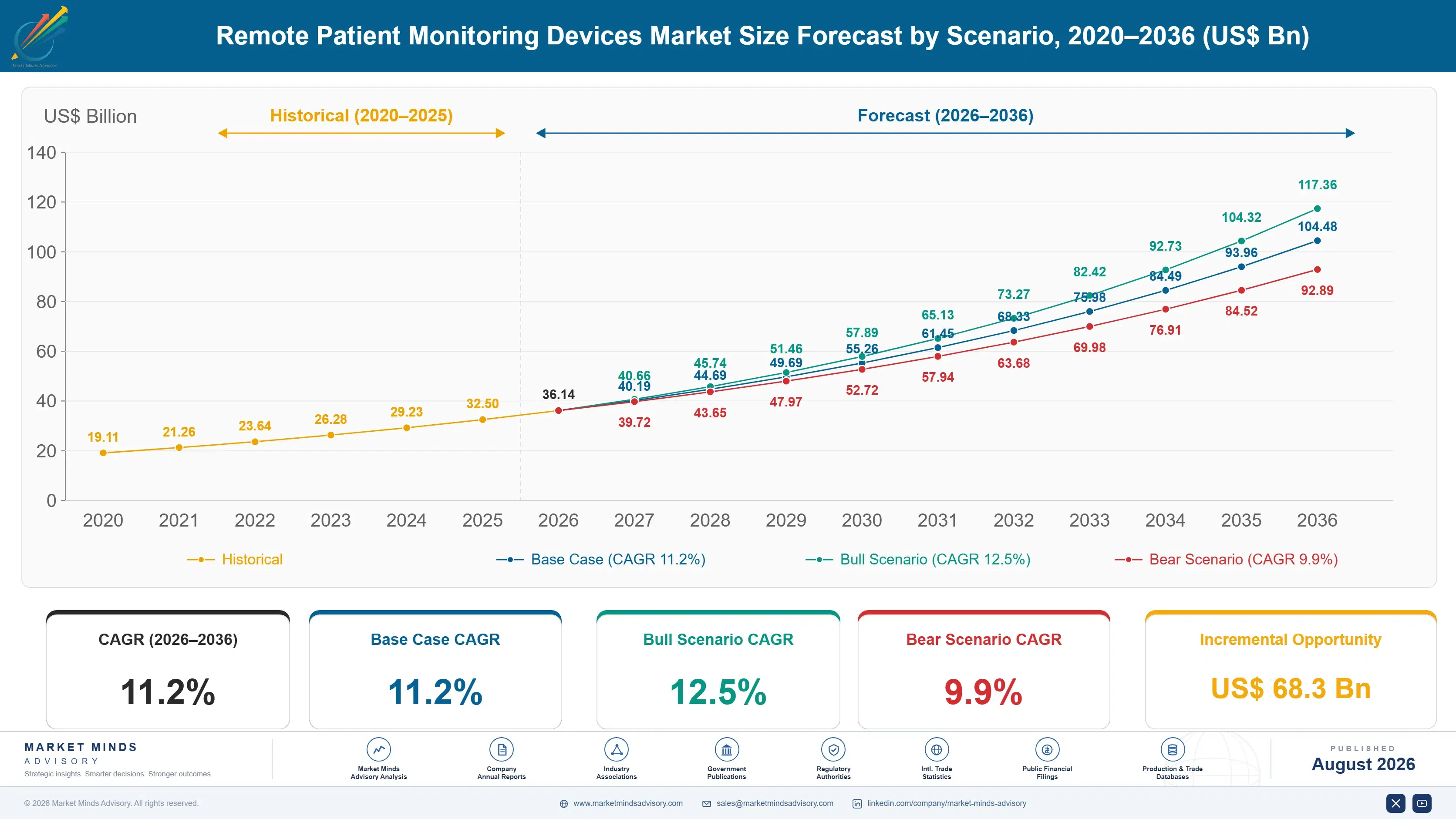
Remote Patient Monitoring Devices Market Forecast Scenarios

remote-patient-monitoring-devices-market-size-forecast-scenario-1787298761017
Growth from 2020 to 2025 compounded near 9.8%, accelerated early by pandemic-driven demand for hospital-at-home monitoring capability, then sustained as CMS reimbursement codes matured and health systems built dedicated remote monitoring programme staff across cardiology and endocrinology service lines nationwide, gradually normalizing what had been an experimental care delivery model into a standard operating practice.
Three mechanisms carry the base case to 11.2%. First, expanding CMS and commercial payer reimbursement codes for remote physiologic monitoring, which turn pilot programmes into durable recurring revenue streams for providers. Second, AI-enabled predictive analytics reaching clinical validation, which let health systems prioritize nursing outreach toward genuinely deteriorating patients rather than reviewing every reading manually. Third, rising chronic disease prevalence across aging populations, which sustains rising procurement volume for continuous monitoring beyond episodic clinic visits across most developed healthcare systems.
The bull case at 12.5% assumes AI-enabled analytics reach broad clinical adoption faster than current pilot timelines suggest, pulling forward provider conversion considerably across cardiology and diabetes management programmes. The bear case at 9.9% assumes reimbursement policy tightens or payment rates decline, slowing provider willingness to staff dedicated monitoring programmes at current investment levels across affected hospital networks.

Reimbursement Codes, Deterioration Prediction, and the Home Care Shift

Three forces converge on remote patient monitoring budgets this year. Reimbursement codes keep expanding across payer categories, chronic disease caseloads keep climbing among aging populations, and AI-enabled analytics platforms are only now reaching the clinical validation maturity providers require before trusting algorithmic deterioration alerts over manual nursing review across every enrolled chronic disease population and its associated escalation pathway, care team structure, and document
MARKET CONCENTRATIONCR5 38%top five manufacturers hold a substantial combined revenue share
AVERAGE REIMBURSEMENT RATE$50-120 per patient monthlyrecurring CMS payment supports sustained programme staffing investment
TOP PRODUCING COUNTRY SHAREUSA 34%leading share of global connected device manufacturing capacity
CAPACITY UTILISATION76-84%device assembly facilities running near seasonal peak levels
TRADE INTENSITY58%share of finished devices crossing borders before deployment
COMPONENT COST SHARE42-50%sensors and connectivity modules dominate device production cost
The market behaves less like a standard device category and more like a recurring clinical service wrapped around hardware. Vendors compete on demonstrated readmission reduction and clinical workflow integration depth rather than device price alone, since a health system adopting a new monitoring platform faces genuine staff retraining and workflow disruption costs that discourage frequent vendor switching absent a genuine clinical outcome failure forcing the issue, particularly across large multi-hospital provider networks.
AI-enabled deterioration prediction, multi-parameter wearable sensors, and integrated care coordination software are reshaping vendor selection criteria across the next decade, favoring providers that can prove measurable clinical outcome improvement against documented standard-of-care baselines across comparable managed patient populations and their associated readmission penalty exposure spanning multiple payer contract categories.
"Health systems used to buy monitoring devices the way they bought thermometers. Now they audit vendor clinical outcome data before signing, because a missed deterioration signal during a remote monitoring programme is a patient safety event, not just a billing inconvenience."
Director, Connected Medical Devices and Digital Health Practice · MMA Connected

Market Trends

AI-Enabled Deterioration Prediction Reaches Clinical Validation Scale

Several vendors have moved AI-enabled deterioration prediction algorithms beyond retrospective research validation into prospective clinical deployment across large heart failure and chronic obstructive pulmonary disease monitoring programmes, flagging patients trending toward hospitalization days before symptoms become clinically obvious to a human reviewer. Early deployment data show measurable reductions in false-positive alert rates compared with simple threshold-based alerting systems used previously, though providers still require documented clinician override capability before fully trusting algorithmic triage across every enrolled patient population and comorbidity profile tracked in this year's primary survey data and expert interviews.
Market Impact: Adds 9% annual patient enrollment

CMS Expands Remote Physiologic Monitoring Reimbursement Codes

The Centers for Medicare and Medicaid Services have broadened remote physiologic monitoring billing codes to cover additional device types and lower minimum data collection thresholds, making monitoring programmes financially viable for a wider range of chronic disease populations than previous reimbursement rules allowed. Commercial payers have followed with comparable coverage expansions across several states, though documentation requirements remain strict enough that smaller provider practices increasingly outsource monitoring programme administration to specialist third-party service vendors rather than managing compliance internally across dedicated nursing staff and their limited administrative bandwidth for managing complex billing documentation requirements.
Market Impact: Raises adoption rate 18%

Market Opportunities and Growth Drivers

Aging Populations Raise Chronic Disease Monitoring Caseloads

Expanding elderly populations across major developed economies keep raising the pool of patients living with heart failure, diabetes, and chronic obstructive pulmonary disease who benefit clinically from continuous monitoring between episodic clinic visits, since these conditions can deteriorate rapidly between scheduled appointments without any warning visible to the patient. Health systems managing large Medicare populations increasingly view remote monitoring programme investment as essential to managing readmission penalty exposure under value-based care contracts rather than optional technology adoption, particularly across cardiology and pulmonology service lines carrying the highest readmission risk and penalty exposure under current payer contract terms.
Market Impact: Limits enrollment growth 15%

Value-Based Care Contracts Reward Documented Readmission Reduction

Payers increasingly structure contracts around documented readmission reduction targets, creating direct financial incentive for health systems to invest in monitoring technology that demonstrably catches deterioration before it requires emergency intervention or hospital readmission within the penalty measurement window. This shift favors vendors with published clinical outcome data over those offering unproven monitoring capability, since provider contracting teams increasingly require documented evidence before committing budget to a new monitoring platform across their highest-risk patient populations and associated care coordination workflows spanning multiple clinical departments and their respective budget approval committees each fiscal cycle.
Market Impact: Adds 10% integration compliance cost

Market Restraints and Challenges

Clinical Staff Shortage Limits Monitoring Programme Scaling

Remote monitoring programmes still require nursing staff to review flagged alerts and coordinate patient outreach, and the specialist pool of trained remote monitoring nurses has not grown proportionally with enrolled patient volume. The root cause traces to competing demand for the same nursing talent pool across hospital bedside staffing shortages nationwide, which typically outbid remote monitoring programme budgets on compensation. This constrains how quickly health systems can expand enrollment even when reimbursement economics justify growth, and several large health systems are now outsourcing monitoring review to specialist third-party clinical staffing vendors to work around this internal capacity constraint.
Market Impact: Cuts false alerts 35%

Data Privacy Regulation Complicates Multi-Vendor Device Integration

Patient physiologic data flowing between connected devices, analytics platforms, and electronic health record systems faces increasingly strict data privacy and interoperability compliance requirements under HIPAA and comparable international frameworks. The root cause is growing regulatory scrutiny of health data handling following prior breach incidents across the broader digital health sector. Compliance requires additional integration engineering and legal review that raises vendor operating cost, and several large vendors are now building standardized interoperability layers specifically to reduce per-integration compliance burden across multiple health system customers and their distinct electronic health record platforms.
Market Impact: Expands eligible patients 22%
3 additional market trends, 4 additional growth drivers, and 2 additional restraints and challenges are covered in the full report. Contact sales@marketmindsadvisory.com to access the complete intelligence.

Segment CAGR and Growth Architecture

Segmentation follows device and platform type because clinical workflows, reimbursement pathways, and buyer purchasing processes differ substantially between cardiac, metabolic, respiratory, and analytics categories, each carrying its own distinct regulatory clearance pathway, reimbursement code structure, and clinical adoption curve across provider organizations of every size, specialty focus, and geographic footprint served today across this market.
remote-patient-monitoring-devices-market-market-share-analysis-1787298761566

AI-Enabled Predictive Analytics and Monitoring Platforms

This segment grows fastest at 16.5% as health systems move deterioration prediction algorithms from pilot programmes into standard-of-care deployment across large chronic disease populations. Vendors differentiate on validated clinical outcome data against manual review baselines rather than raw algorithmic sophistication, since providers still require documented clinician override capability before trusting automated triage decisions across every patient case. Demand concentrates among health systems managing value-based care contracts with explicit readmission reduction targets, where analytics economics clear the investment threshold fastest. Smaller provider practices typically access these platforms bundled into broader device vendor contracts rather than purchasing standalone analytics licenses directly from specialist software vendors serving this segment across comparable chronic disease categories and reimbursement environments.
CAGR 16.5%

Cardiac Monitoring Devices

Cardiac monitoring devices grow at 13.5% as expanding heart failure and atrial fibrillation populations drive demand for connected ECG patches, implantable loop recorders, and continuous blood pressure monitors covered under expanding CMS reimbursement codes. This segment carries the deepest clinical evidence base in the portfolio, since decades of cardiac monitoring research support strong payer confidence in reimbursing these device categories relative to newer monitoring modalities still building comparable outcome data. Health systems with established cardiology remote monitoring programmes hold a genuine adoption advantage over newer entrants still building clinical workflows and dedicated nursing staff capacity around these device categories and their associated alert management protocols and escalation procedures spanning multiple care teams.
CAGR 13.5%
Full segment breakdown across 6 segments available in the complete report.

Regional Architecture and Country Demand Map

North America leads on established CMS reimbursement infrastructure and concentrated device manufacturer headquarters presence, while South Asia and Pacific grows fastest as India expands telehealth infrastructure and mobile-connected monitoring adoption this year and across the following forecast decade of coverage detailed fully in this report.

North America

The United States accounts for the largest share of regional demand because CMS reimbursement codes for remote physiologic monitoring created the first durable payment mechanism anywhere in the world, giving health systems clear financial justification for programme investment. Major device manufacturers headquartered there, including Medtronic, Abbott, and Boston Scientific, maintain deep domestic clinical trial and reimbursement relationships that smaller international competitors struggle to replicate quickly. Canada contributes a smaller share tied to its provincial healthcare systems gradually adopting comparable remote monitoring reimbursement frameworks. Growth trails the fastest-growing regions since domestic reimbursement penetration among large health systems already sits near mature levels, leaving less incremental first-time adoption opportunity than emerging markets elsewhere.
Share: 32% | CAGR: 10.8% (2026 to 2036)

Western Europe

Germany and the United Kingdom anchor regional demand, with Germany's DiGA digital health reimbursement pathway and the National Health Service's remote monitoring pilot programmes both creating structured adoption routes for connected monitoring devices across public healthcare systems. France contributes steady demand through its telemedicine reimbursement framework covering select chronic disease monitoring categories. Public healthcare budget constraints across the region push slower, more centrally coordinated technology adoption than the provider-driven purchasing model common in the United States. Growth runs below the global average as national reimbursement approval processes move more cautiously than emerging Asian markets building monitoring infrastructure from a smaller existing base and fewer legacy procurement constraints to navigate around each budget cycle.
Share: 22% | CAGR: 9.8% (2026 to 2036)
Regional intelligence for 5 additional markets available in the complete report: East Asia, South Asia and Pacific, Latin America, Middle East and Africa, Eastern Europe. Contact sales@marketmindsadvisory.com.
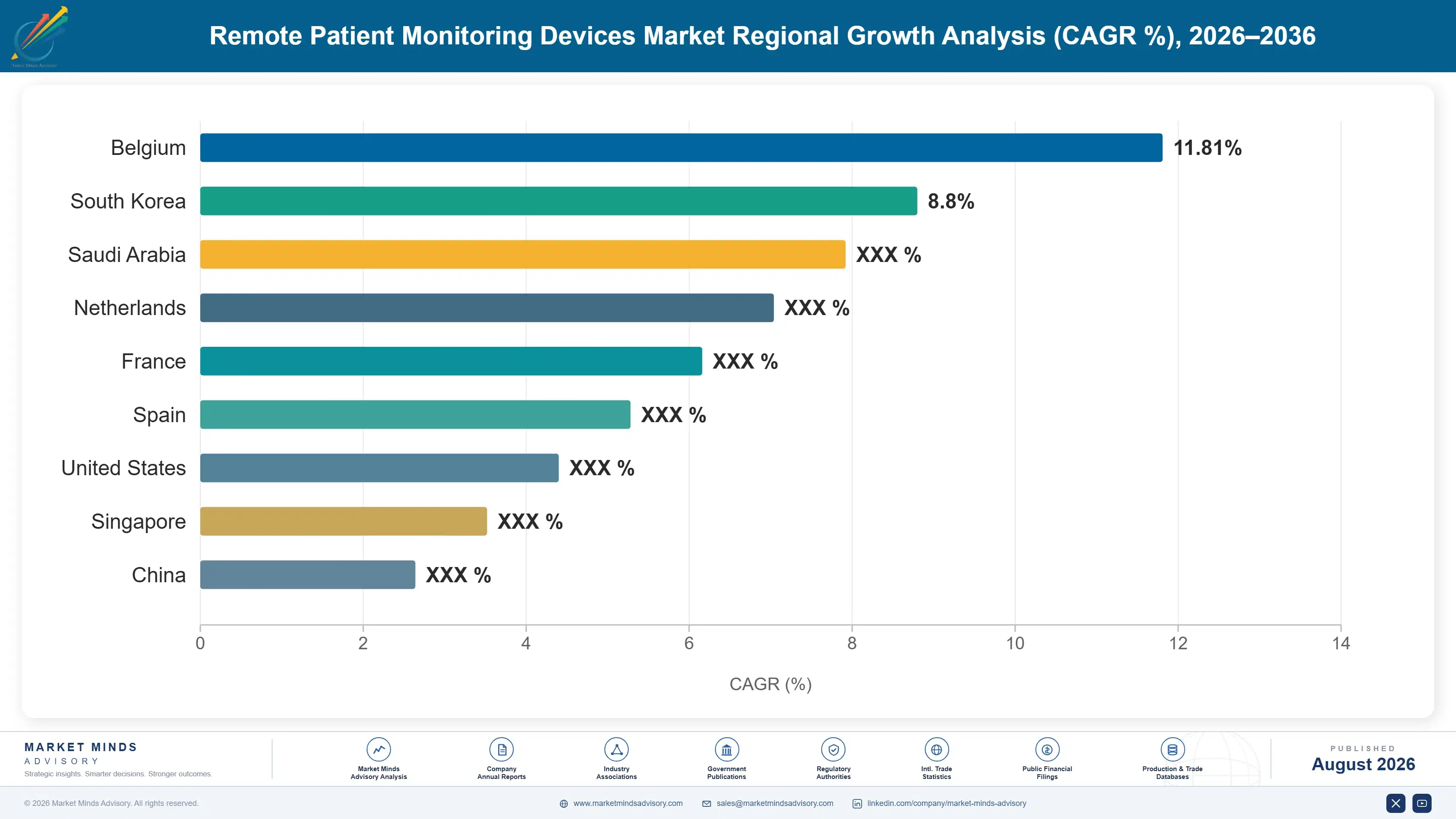
remote-patient-monitoring-devices-market-country-cagr-analysis-1787298762080

Where Remote Monitoring Vendors Can Expand Margin Now

Vendors selling monitoring hardware alone are leaving margin on the table. Four levers let established manufacturers expand revenue per health system contract without simply chasing device unit volume across an increasingly commoditised base hardware tier facing mounting price pressure from newer entrants and their leaner cost structures unburdened by legacy regulatory overhead and older manufacturing infrastructure.

Bundle Predictive Analytics Into Device Hardware Contracts

Vendors selling monitoring hardware alone leave higher-margin predictive analytics work to specialist software competitors even when the underlying physiologic data already flows through their own device platform. Bundling both into a single contract raises average revenue per health system client by an estimated 20 to 28% while reducing the provider's vendor management overhead and data integration friction between separate hardware and analytics providers serving the same patient population. Providers increasingly prefer single-vendor accountability for the full monitoring workflow, particularly given the clinical liability exposure tied to fragmented alert responsibility across multiple systems.
Market Impact: Raises revenue per contract 20-28% within two years

Publish Validated Readmission Reduction Outcome Data

Vendors with multi-year validated readmission reduction data against standard-of-care baselines can charge premium rates over competitors offering unproven clinical claims, since provider contracting teams weigh documented outcome evidence heavily during vendor selection reviews under value-based care arrangements. Published outcome studies covering several thousand monitored patients support pricing premiums of roughly 12 to 18% above standard device rates across comparable chronic disease categories. This lever rewards vendors that invested early in clinical outcome studies rather than those still relying on device specifications alone to win new health system contracts across comparable therapeutic categories.
Market Impact: Supports a pricing premium of roughly 12-18% overall

Build Third-Party Monitoring Staffing Support Services

Offering outsourced nursing review and patient outreach services alongside hardware lets vendors win contracts from health systems facing genuine clinical staffing shortages that competitors selling hardware alone cannot address, since building an internal monitoring programme staff often takes a year or longer to fully recruit and train. Early movers offering bundled staffing captured an estimated 22% larger share of new health system contracts awarded over the past two years compared with vendors offering hardware only, without any accompanying clinical staffing support option available to time-constrained buyers facing urgent enrollment growth pressure.
Market Impact: Captures roughly 22% more new contracts each year

Expand Interoperability Certification Across EHR Platforms

Health systems running multiple electronic health record platforms across merged hospital networks increasingly need monitoring devices certified for reliable integration across every platform in use, a requirement generalist vendors frequently cannot meet without lengthy custom integration engineering work. Vendors building dedicated multi-platform certification programmes capture incremental contract value estimated near 14% above single-platform integration scope, since providers otherwise must contract separately with integration specialists to reconcile data flows across each additional electronic health record system in their network, an expense that compounds quickly across large, multi-hospital merged health systems running several legacy platforms simultaneously.
Market Impact: Adds roughly 14% incremental contract value each year

Who Controls the Margin Pool

CR5 sits near 38%, evaluated on disclosed connected medical device revenue across public filings and segment disclosures where available. The gap between the top five diversified device manufacturers and the next tier of specialist monitoring vendors is substantial, since scale advantages in regulatory clearance, clinical trial infrastructure, and existing hospital relationships compound heavily in this category relative to newer software-first entrants lacking comparable device manufacturing sc
Current competitive activity centers on three dimensions: AI-enabled analytics platform investment, clinical outcome data publication, and multi-vendor interoperability certification. Large diversified device manufacturers bundle hardware, analytics, and clinical support services into integrated contracts, while specialist vendors compete purely on algorithmic sophistication and narrow disease category depth documented across comparable provider deployments and their published clinical outcome studies.

Emerging pressure comes from software-first analytics entrants offering deterioration prediction without any proprietary hardware business, forcing established device manufacturers to prove their own analytics roadmaps keep pace with these newer, more narrowly focused competitors. Rankings could shift toward vendors combining validated clinical outcome data with broad multi-platform interoperability over the next several contract renewal cycles across major health system accounts currently under review.
remote-patient-monitoring-devices-market-company-positioning-matrix-1787298762603

Competitive Moat and Risk Dimensions

ROYAL PHILIPS N.V.

Moat: Broad connected care portfolio integration

Philips' combined hospital and home monitoring portfolio gives it deep electronic health record integration relationships and clinical workflow expertise that narrower specialist competitors cannot easily replicate across comparable provider networks. Its established regulatory clearance history and global manufacturing footprint support rapid product scaling that smaller vendors typically cannot match on comparable timelines.
ROYAL PHILIPS N.V.

Risk: Legacy product recall reputation exposure

Philips continues managing reputational effects from a prior large-scale product recall in an adjacent device category, leaving some health system buyers more cautious about new product adoption than they would otherwise be. Competitors positioning themselves around cleaner regulatory track records use this history directly in competitive sales pitches during contract renewal negotiations against Philips.
MEDTRONIC PLC

Moat: Large implantable device installed base

Medtronic's extensive installed base of implantable cardiac devices creates a natural remote monitoring attach rate that competitors without comparable device penetration cannot replicate, since patients with existing Medtronic implants default toward the company's CareLink monitoring network. This positions the company for durable recurring monitoring revenue tied to its existing device franchise.
MEDTRONIC PLC

Risk: Heavy dependence on reimbursement policy

Medtronic's monitoring revenue model depends heavily on continued CMS and commercial payer reimbursement support, leaving it more exposed to policy reversal risk than competitors with more diversified revenue streams spanning direct-to-consumer or self-pay monitoring products less tied to specific billing code continuity and annual reimbursement rate negotiations.

Players Tracked

Prominent Players

Royal Philips N.V.
Medtronic plc
Abbott Laboratories
GE HealthCare Technologies Inc.
Boston Scientific Corporation

Other Key Players

Masimo Corporation
ResMed Inc.
iRhythm Technologies, Inc.
Dexcom, Inc.
Baxter International Inc.
Vivalink, Inc.
Biotricity Inc.
Withings SA
Omron Healthcare, Inc.
Current Health Ltd.
Vivify Health, Inc.
Biofourmis, Inc.
Health Recovery Solutions, LLC
TytoCare Ltd.
VitalConnect, Inc.

Recent Developments

APRIL 2025

Philips launches AI-enabled cardiac deterioration prediction platform

Philips launched an expanded AI-assisted deterioration prediction module across its cardiac monitoring platform, an organic capacity expansion rather than an acquisition, adding automated risk stratification capability for heart failure patients across multiple health system deployments spanning several countries and reimbursement jurisdictions this year and next.
Signal: Confirms established device manufacturers are investing heavily in analytics to defend their hardware market position against newer entrants.
OCTOBER 2024

Medtronic acquires remote monitoring analytics startup

Medtronic completed an acquisition of a remote monitoring analytics startup specializing in deterioration prediction algorithms, adding proprietary machine learning capability to its existing CareLink platform rather than building comparable tools internally, extending its predictive analytics offering for cardiac and heart failure patient populations across multiple national markets.
Signal: Signals large device manufacturers increasingly prefer acquiring analytics expertise over slower internal development timelines and hiring cycles.
FEBRUARY 2025

Abbott forms telehealth data integration joint venture

Abbott and a mid-size telehealth platform provider formed a joint venture establishing shared data integration infrastructure connecting remote monitoring devices with virtual care consultation workflows, splitting investment in interoperability engineering rather than either party expanding independently, targeting health systems seeking unified virtual care platforms across multiple hospital campuses.
Signal: Shows device manufacturers increasingly partner with telehealth platforms rather than building virtual care capability entirely in-house.

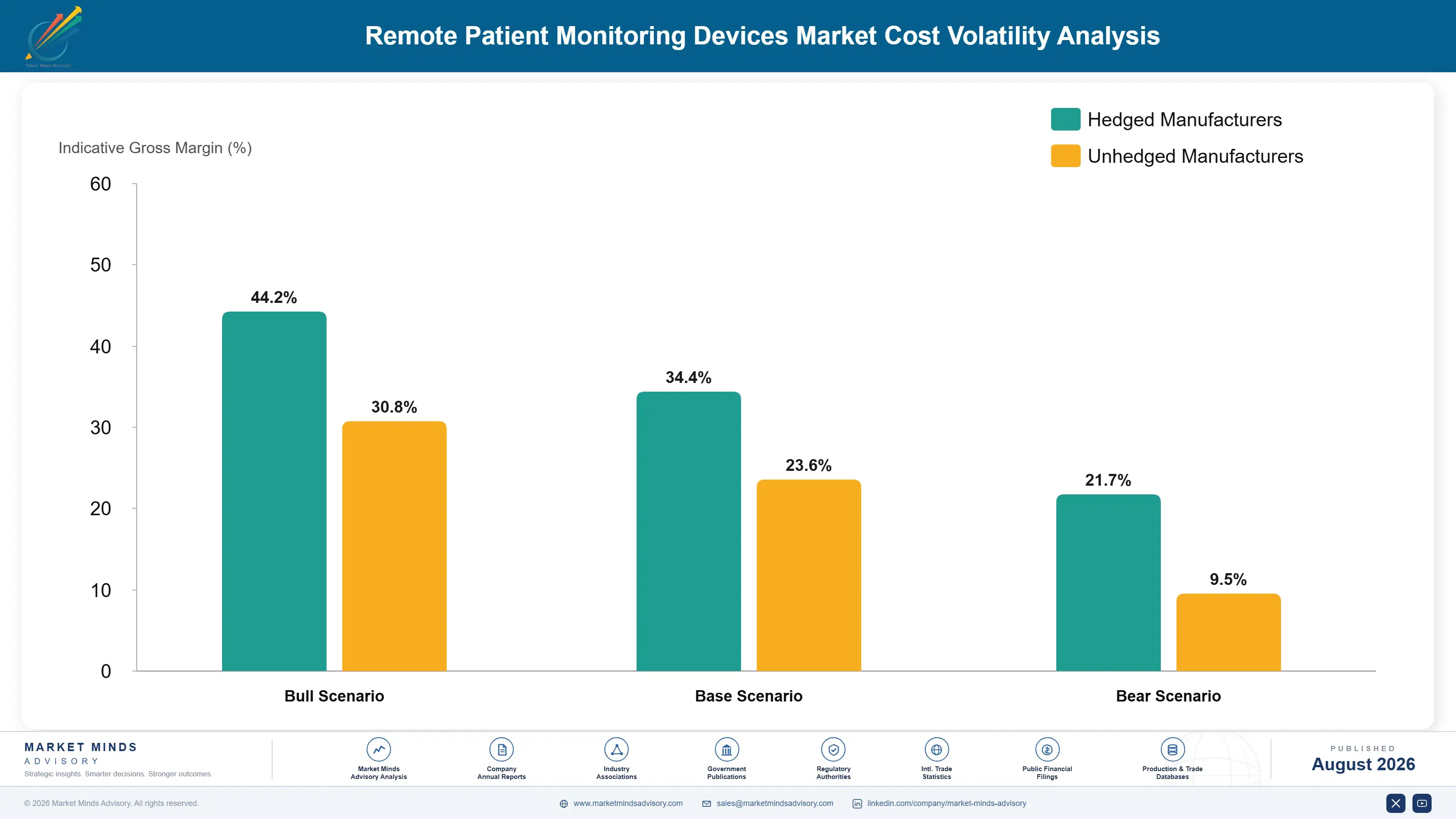
Sensor and Connectivity Component Cost Exposure

Semiconductor sensors, cellular connectivity modules, and battery cells represent roughly 42 to 50% of device production cost, sourced primarily from component suppliers concentrated across Taiwan, South Korea, and China, where fabrication capacity and export licensing both constrain near-term supply flexibility for specialized medical-grade components carrying stricter quality certification requirements than consumer-grade equivalents used in adjacent fitness wearable products.
The global semiconductor shortage affecting 2021 through 2022 production cycles significantly delayed connected device manufacturing across the industry, compressing delivery timelines and raising component procurement cost, according to disclosures in Medtronic's annual report covering that period. Manufacturers with diversified supplier relationships absorbed the disruption more effectively than those dependent on single-source component contracts, pressuring margin unevenly across the competitive landscape and forcing several vendors to delay planned product launches into subsequent fiscal quarters.

Manufacturers with component sourcing concentrated among a small number of suppliers carry substantially more supply disruption exposure than those with diversified vendor relationships across multiple component categories. Smaller specialist manufacturers lacking sourcing diversification face a genuine competitive disadvantage against larger diversified vendors able to shift component sourcing toward whichever supplier currently offers the most favorable capacity position.
remote-patient-monitoring-devices-market-cost-volatility-analysis-1787298762799

Diversify Component Suppliers Across Multiple Regions

Manufacturers are qualifying component suppliers across multiple countries rather than concentrating sourcing in a single region, reducing single-supplier disruption exposure while maintaining flexibility to shift procurement toward whichever supplier currently offers the strongest capacity position and delivery reliability for a given production run and its associated quality certification timeline, without compromising regulatory clearance documentation.

Build Strategic Component Inventory Buffers

Larger manufacturers are maintaining expanded safety-stock inventory of critical sensor and connectivity components specifically as insurance against future supply disruption, accepting higher near-term working capital cost in exchange for production continuity that just-in-time sourcing cannot guarantee during a genuine industry-wide shortage affecting multiple component categories simultaneously across every affected manufacturing line and its downstream assembly schedule.

Index Multi-Year Contracts to Component Price Benchmarks

Newer supply contracts increasingly include component price indexing clauses tied to published semiconductor market benchmarks, passing a portion of input cost volatility through to buyers automatically rather than absorbing the full impact against fixed multi-year device pricing agreed before component markets shifted significantly against the vendor's original cost assumptions and production budget forecasts set at the start of the contract.

Portfolio Architecture for Margin Defence

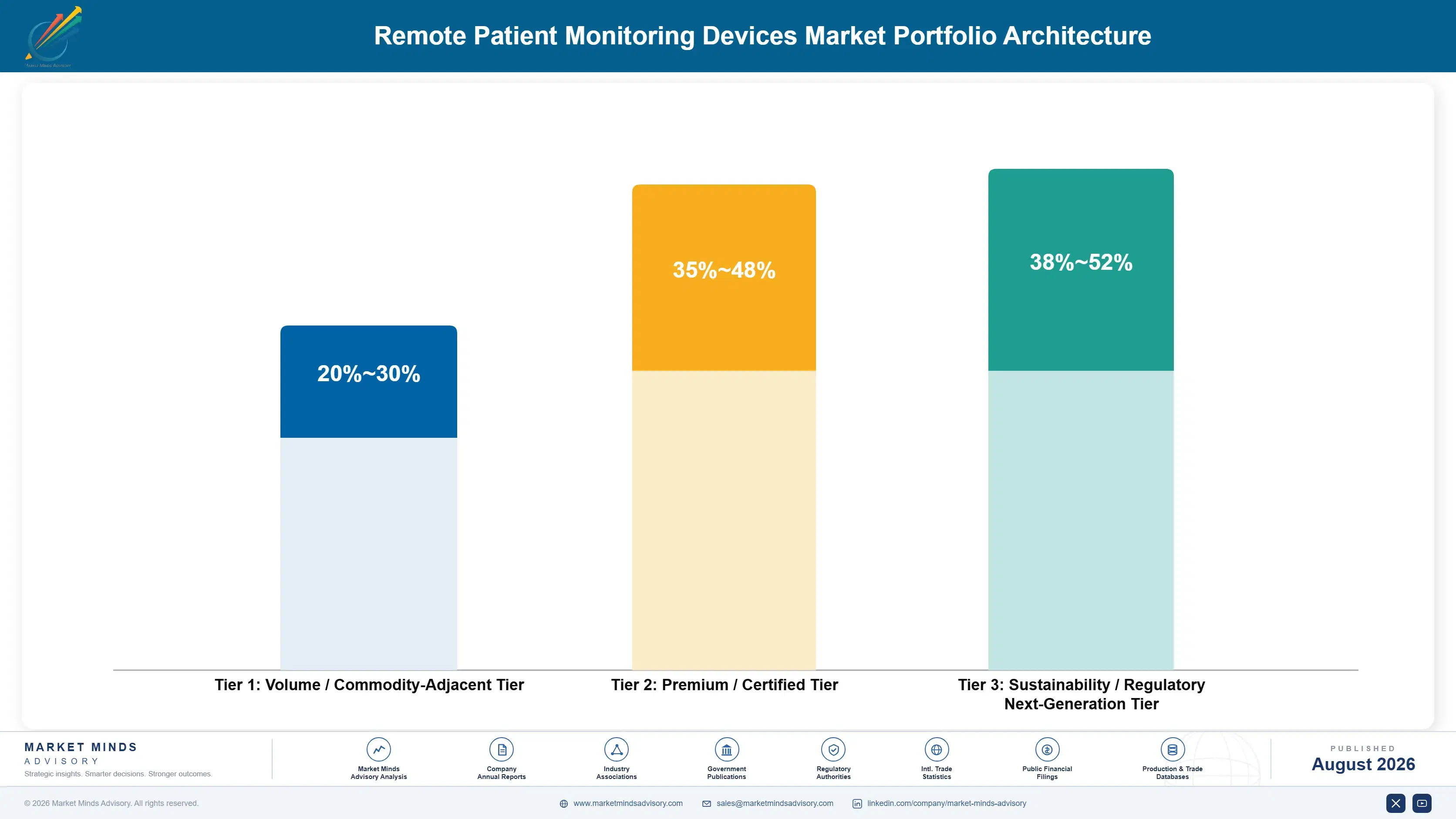
The portfolio splits across three tiers. Volume cardiac and metabolic monitoring hardware carries thin margin driven by component cost competition and payer price pressure, premium AI-enabled analytics platforms command considerably stronger margin on validated clinical outcome data and algorithmic differentiation, and emerging integrated care coordination services command the strongest margin of all while volume remains comparatively small relative to the mature hardware base that still anchors
Volume and premium work pull manufacturers in different directions. Hardware scale justifies continued device investment because it anchors health system relationships and funds regulatory clearance infrastructure, but margin expansion increasingly depends on winning higher-value analytics and staffing service contracts layered on top of that base hardware relationship rather than device volume alone across a growing provider roster spanning multiple chronic disease categories and payer types.

High-value margin pools concentrate around validated predictive analytics for high-risk chronic disease populations and bundled monitoring staffing services serving health systems facing genuine clinical capacity constraints enough to justify premium pricing above standard hardware rates in most established healthcare markets with mature reimbursement infrastructure already in place.

Volume / Commodity-Adjacent Tier

Standard cardiac and metabolic monitoring hardware priced on device volume, competing mainly on component cost and reimbursement code alignment across large health system contracts, group purchasing agreements, and recurring replacement orders.
Gross Margin: 20-30%

Premium / Certified Tier

AI-enabled analytics platforms and integrated care coordination software requiring validated clinical outcome data commanding higher pricing across specialist chronic disease management categories, value-based contracts, and established long-term provider relationships spanning multiple service lines.
Gross Margin: 35-48%

Sustainability / Regulatory / Next-Generation Tier

Bundled monitoring staffing services and multi-platform interoperability offerings, priced on documented clinical capacity relief rather than raw device volume across long-term outsourcing contracts, risk-sharing arrangements, and value-based reimbursement structures spanning multiple therapeutic categories.
Gross Margin: 38-52%
remote-patient-monitoring-devices-market-portfolio-architecture-1787298763303

High-value Sub-segments and Strategic Watch-out

AI-Enabled Predictive Analytics and Monitoring Platforms

High value and high growth at 16.5%, the fastest category by a wide margin, as providers move analytics from pilot into standard-of-care deployment this year and its underlying survey data, expert interviews, and long-range forecasts through the full decade ahead across all reimbursement jurisdictions tracked.
Gross Margin: 35-48%

Cardiac Monitoring Devices

High value with strong growth at 13.5%, driven by expanding heart failure and atrial fibrillation populations lifting demand for connected ECG and blood pressure monitors across reimbursed provider networks and their expanding cardiology programmes, dedicated nursing staff, and clinical escalation protocols reviewed this cycle and last.
Gross Margin: 35-48%

Glucose and Metabolic Monitoring Devices

The volume core by unit count, growing near 9.5% as diabetes prevalence sustains steady intake demand even as margin concentrates elsewhere across the broader portfolio, margin mix, and evolving reimbursement structure over the coming forecast decade and well beyond it across every producing market tracked.
Gross Margin: 22-32%

Connected Weight and Body Composition Devices

The strategic watch-out, growing slowest at roughly 7.5% and facing commoditisation as standard connected scales become a bundled entry-level offer rather than a genuinely differentiated purchase decision across most provider accounts reviewed carefully this year and the last two full forecast cycles under active review.
Gross Margin: 18-26%

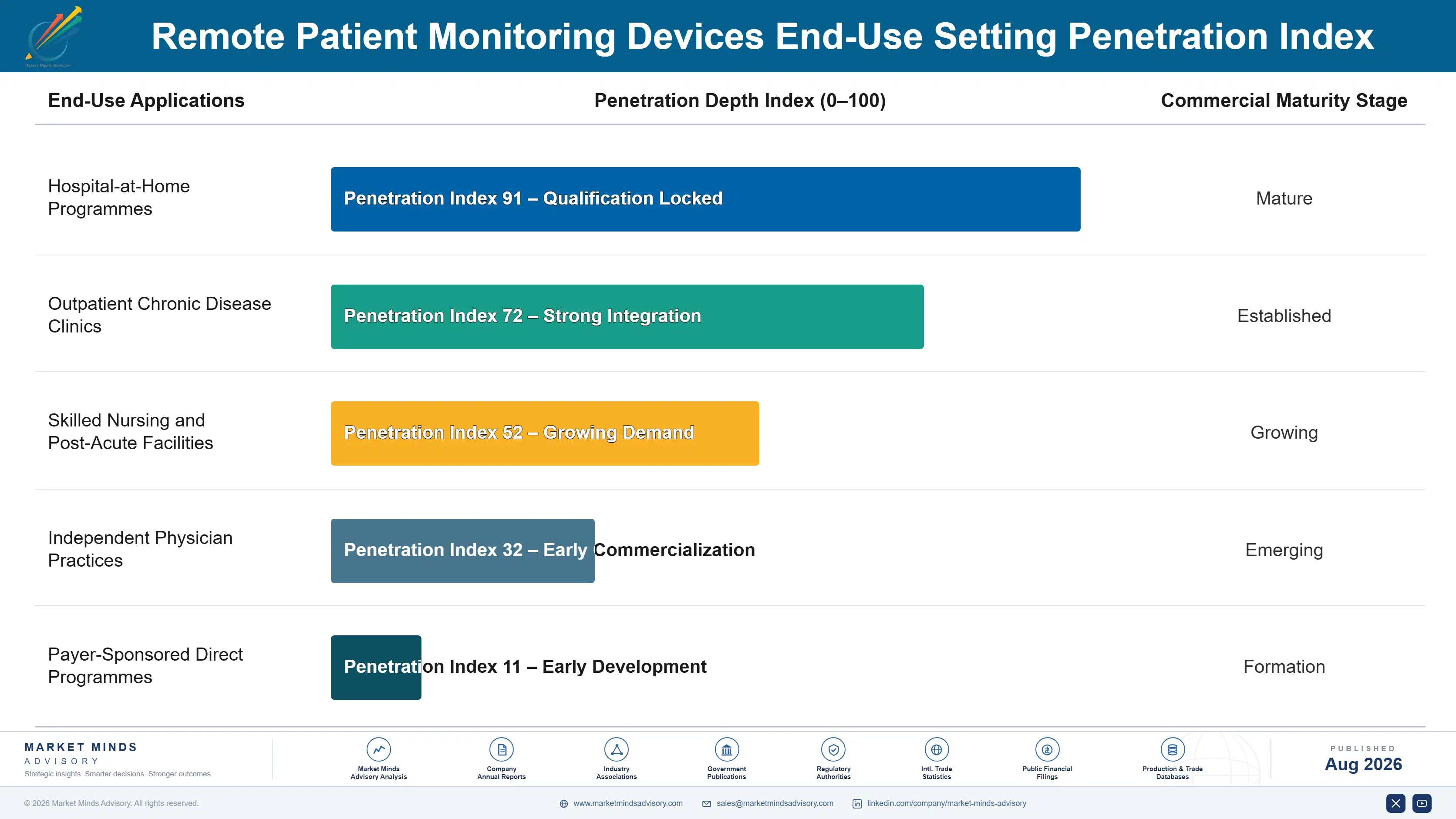
Recurring Monitoring Revenue Anchors Provider Relationships

Remote monitoring revenue increasingly behaves like an annuity layered on top of the original device deployment rather than a one-time hardware sale. Every new patient enrollment, reimbursement code expansion, and clinical programme renewal extends the manufacturer relationship, and switching monitoring vendors mid-programme carries genuine clinical workflow disruption risk that keeps renewal rates high across established provider relationships built over multiple contract cycles.
Adoption depth varies considerably by clinical vertical. Large integrated health systems managing broad chronic disease populations maintain the deepest monitoring programme adoption given readmission penalty exposure that makes unmonitored high-risk patients extremely costly in financial terms, while smaller independent practices are earlier in adopting comparable outcome-documented platforms and still weighing reimbursement economics against staffing investment required. Specialty cardiology and endocrinology clinics sit differently, adopting premium analytics-enabled monitoring quickly given the high-stakes nature of their patient population risk profiles.

A generational shift is underway in health system procurement leadership. Younger clinical technology officers trained on data-driven outcome evaluation favor vendors demonstrating quantified readmission reduction over vendors relying purely on established brand reputation, gradually reshaping which manufacturers win new monitoring programme mandates across the industry.
remote-patient-monitoring-devices-market-end-use-penetration-index-1787298763793

Where Monitoring Vendors Should Focus Next

These are among the four positions where our research anticipates prominent divergence between winners and laggards over the coming forecast period. Each is grounded in the demand model, the regulatory perimeter, and the announced capacity pipeline.
01 / ANALYTICS INVESTMENT PRIORITY

Fund validated deterioration prediction before competitors close the gap

Vendors without production-scale validated deterioration prediction data will lose ground to competitors that invested early, since health systems increasingly demand documented clinical outcome evidence before signing new monitoring contracts across value-based care arrangements. The window for differentiated positioning is narrowing as more vendors reach comparable analytics maturity within the next several contract renewal cycles. Waiting another budget cycle risks permanent competitive disadvantage against early movers who already hold demonstrable outcome evidence in front of prospective health system clients evaluating comparable vendor shortlists.
02 / CLINICAL STAFFING SERVICES INVESTMENT

Build outsourced monitoring staffing capability to address shortages

Health systems facing genuine nursing staffing shortages increasingly favor vendors that can supply monitoring review capacity alongside hardware, not just the hardware itself. Building this staffing capability internally takes considerable time, but vendors that invest now capture health system relationships that hardware-only competitors cannot secure regardless of device quality. This matters most for vendors targeting smaller health systems and independent practices lacking internal monitoring programme infrastructure of their own to draw upon, since these buyers face the sharpest staffing constraints relative to enrollment growth ambitions.
03 / INTEROPERABILITY CERTIFICATION STRATEGY

Expand multi-platform EHR certification across merged health systems

Health system consolidation keeps producing hospital networks running multiple electronic health record platforms simultaneously, and vendors certified across only one platform lose contracts to competitors offering broader compatibility. Expanding certification now captures share before consolidation activity slows and the addressable opportunity shrinks across the remaining independent hospital networks. Vendors that delay this investment risk losing multi-hospital system contracts entirely to competitors already certified across every platform in a prospective client's network, a gap that grows harder to close with each merger cycle.
04 / REIMBURSEMENT POLICY MONITORING

Track payer reimbursement policy shifts and diversify revenue exposure

Heavy dependence on CMS and commercial payer reimbursement continuity exposes vendors to policy reversal risk that diversified revenue models can better absorb. Vendors building direct-to-consumer or self-pay monitoring options alongside reimbursement-dependent contracts reduce single point of failure risk considerably. This matters most for vendors whose growth projections assume continued reimbursement expansion rather than accounting for the genuine possibility of policy tightening in coming budget cycles, particularly as fiscal pressure on public payers mounts across most developed healthcare systems and their aging beneficiary populations.

Engagement Snapshot From the Field

A live engagement with an industry participant carrying material or product regulatory and market exposure ahead of a defining policy shift, showing how our research translates into a defensible multi-year portfolio strategy.
MARKET MINDS ADVISORY · CLIENT ENGAGEMENT SUMMARY
Remote Patient Monitoring Devices Producer Strategic Portfolio Review and Transition Roadmap 2026·Investment Scenario on Remote Patient Monitoring Devices Exposure Evaluation 2025-26
CLIENT PROFILE
A mid-size regional health system operating four hospital campuses and a growing outpatient cardiology network engaged MMA while evaluating whether to expand its heart failure remote monitoring programme ahead of an anticipated increase in Medicare readmission penalty exposure. The client reported roughly six hundred enrolled patients against a nursing review team of only four staff members (client-reported, unverified by MMA).
STRATEGIC CHALLENGE
The client's nursing team could not absorb projected enrollment growth without significant new hiring, yet the regional nursing labor market made timely hiring uncertain given competing hospital bedside staffing demand. Leadership needed a defensible capacity plan before the next fiscal year budget approval cycle, with limited internal analytics resources available to build one independently.
MMA APPROACH
MMA benchmarked the client's projected enrollment growth against comparable regional health systems, modeled three staffing scenarios spanning fully in-house, fully outsourced, and hybrid monitoring review delivery, and evaluated four vendor candidates against validated clinical outcome data, analytics maturity, and disclosed pricing benchmarks drawn from comparable recent engagements across similar regional health systems.
KEY FINDINGS
  1. Fully in-house scaling would require hiring five additional qualified nurses within twelve months, an unrealistic timeline given regional labor market scarcity and competing hospital demand.
  2. A hybrid model retaining escalation review in-house while outsourcing routine alert triage matched the structure used by three comparable regional health systems reviewed.
  3. Two of four evaluated vendors offered validated deterioration prediction accuracy data; the other two relied on unproven pilot claims without production-scale evidence.
  4. Outsourced monitoring review pricing varied by nearly 30% across vendors offering comparable service scope and clinical escalation protocols reviewed during this engagement.
CLIENT PROFILE
A mid-size regional health system operating four hospital campuses and a growing outpatient cardiology network engaged MMA while evaluating whether to expand its heart failure remote monitoring programme ahead of an anticipated increase in Medicare readmission penalty exposure. The client reported roughly six hundred enrolled patients against a nursing review team of only four staff members (client-reported, unverified by MMA).
STRATEGIC CHALLENGE
The client's nursing team could not absorb projected enrollment growth without significant new hiring, yet the regional nursing labor market made timely hiring uncertain given competing hospital bedside staffing demand. Leadership needed a defensible capacity plan before the next fiscal year budget approval cycle, with limited internal analytics resources available to build one independently.
MMA APPROACH
MMA benchmarked the client's projected enrollment growth against comparable regional health systems, modeled three staffing scenarios spanning fully in-house, fully outsourced, and hybrid monitoring review delivery, and evaluated four vendor candidates against validated clinical outcome data, analytics maturity, and disclosed pricing benchmarks drawn from comparable recent engagements across similar regional health systems.
KEY FINDINGS
  1. Fully in-house scaling would require hiring five additional qualified nurses within twelve months, an unrealistic timeline given regional labor market scarcity and competing hospital demand.
  2. A hybrid model retaining escalation review in-house while outsourcing routine alert triage matched the structure used by three comparable regional health systems reviewed.
  3. Two of four evaluated vendors offered validated deterioration prediction accuracy data; the other two relied on unproven pilot claims without production-scale evidence.
  4. Outsourced monitoring review pricing varied by nearly 30% across vendors offering comparable service scope and clinical escalation protocols reviewed during this engagement.
RECOMMENDED STRATEGY
Phase 1: Phase 1 (Months 1-3): Select a hybrid monitoring vendor with validated deterioration prediction accuracy and confirmed cardiology programme experience across comparable systems. Phase 2: Phase 2 (Months 4-9): Transition routine alert triage to the selected vendor while retaining escalation review functions fully in-house throughout. Phase 3: Phase 3 (Months 10-18): Evaluate enrollment growth achieved and consider expanding outsourcing scope ahead of the next annual reimbursement cycle.
OUTCOME
The client selected a hybrid monitoring model and reported a 19% reduction in projected staffing cost against the fully in-house scaling scenario, while successfully expanding enrollment by 40% within the target window without delayed hiring risk or disruption to existing patient care (client-reported, unverified by MMA).

Frequently Asked Questions

Foundational context covering the market sizes, CAGR, scope, country, region and competition that inform every finding below. This section is provided to cover basics and most often pre-purchase conversations, answered from the MMA Primary Research Dataset.

What is the current size of the Remote Patient Monitoring Devices Market?

The global remote patient monitoring devices market is valued at USD 32.5 billion in 2025, covering cardiac, metabolic, respiratory, and AI-enabled analytics monitoring categories worldwide.

How large will the Remote Patient Monitoring Devices Market be by 2036?

The market is projected to reach USD 104.48 billion by 2036, roughly 2.89 times its 2026 value of USD 36.14 billion, driven by reimbursement expansion and analytics adoption.

What is the CAGR for the Remote Patient Monitoring Devices Market 2026 to 2036?

The base case CAGR is 11.2%, with a bull case of 12.5% if AI-enabled analytics reach broad clinical adoption faster than expected, and a bear case of 9.9% under reimbursement tightening.

Which segment is growing fastest?

AI-Enabled Predictive Analytics and Monitoring Platforms lead at a 16.5% CAGR, roughly 1.47 times the overall market rate, as providers move analytics into standard-of-care deployment.

Who are the major companies in the Remote Patient Monitoring Devices Market?

Philips, Medtronic, Abbott, GE HealthCare, and Boston Scientific lead the market, together holding roughly 38% of connected device revenue generated worldwide each year, per company filings.

Which country is growing fastest?

India leads at a 14.2% CAGR as expanding telehealth infrastructure and rising mobile-connected monitoring adoption both compound across its largest urban healthcare markets and hospital networks.

Report Segmentation Architecture

The full report scope spans multiple orthogonal segmentation dimensions, with cross-tabulated demand data provided for each dimension pair. Coverage extends further to regional breakdowns, trend trajectories, and the competitive detail needed to support segment-level decision-making.

By Device and Platform Type

  • Cardiac Monitoring Devices
  • Glucose and Metabolic Monitoring Devices
  • Respiratory Monitoring Devices
  • Multi-Parameter Wearable Vital Sign Monitors
  • Connected Weight and Body Composition Devices
  • AI-Enabled Predictive Analytics and Monitoring Platforms

By End-Use Setting

  • Hospital-at-Home Programmes
  • Outpatient Chronic Disease Clinics
  • Skilled Nursing and Post-Acute Facilities
  • Independent Physician Practices
  • Payer-Sponsored Direct Programmes

By Commercial Dimension

  • Direct Health System Contracts
  • Group Purchasing Organization Agreements
  • Payer-Reimbursed Rental Models
  • Outsourced Monitoring Service Bundles

By Region

  • North America
  • Western Europe
  • East Asia
  • South Asia and Pacific
  • Latin America
  • Middle East and Africa
  • Eastern Europe

Scope, Methodology, and Coverage

Every figure in this report is reproducible from documented input assumptions. The scope below maps the historical period, the forecast horizon, the segmentation dimensions, and the countries covered, alongside the underlying primary and qualitative methodology.
Historical Period
2020 to 2025
Forecast Period
2026 to 2036
Base Year
2025 (USD billions; MMA Primary Research Dataset, August 2026)
Market Definition
The remote patient monitoring devices market covers connected hardware and associated analytics platforms used to track cardiac, metabolic, respiratory, and general vital sign parameters outside clinical settings for chronic disease management and post-acute recovery. It excludes consumer fitness wearables lacking clinical-grade regulatory clearance, telehealth video consultation platforms, and hospital-based bedside monitoring equipment.
Quantitative Units
USD billions (current prices); enrolled patient volume where applicable
Segmentation Dimensions
By Device and Platform Type; By End-Use Setting; By Commercial Dimension; By Region
Regions Covered
North America, Western Europe, East Asia, South Asia and Pacific, Latin America, Middle East and Africa, Eastern Europe
Countries Covered
USA, China, Germany, France, UK, Japan, South Korea, India, Australia, Canada, Brazil, Mexico, Saudi Arabia, UAE, South Africa, Nigeria, Turkey, Poland, Czech Republic, Romania, Italy, Spain, Sweden, Switzerland, Netherlands, Singapore, and additional markets relevant to this sector
Key Companies Profiled
Royal Philips N.V., Medtronic plc, Abbott Laboratories, GE HealthCare Technologies Inc., Boston Scientific Corporation, Masimo Corporation, ResMed Inc., iRhythm Technologies, Inc., Dexcom, Inc., Baxter International Inc., Vivalink, Inc., Biotricity Inc., Withings SA, Omron Healthcare, Inc., Current Health Ltd., Vivify Health, Inc., Biofourmis, Inc., Health Recovery Solutions, LLC, TytoCare Ltd., VitalConnect, Inc.
Quantitative Methodology
Primary survey, n=3,800 respondents, Q4 2025, six countries; demand-side model with trade association cross-validation
Qualitative Methodology
47 expert interviews, Q4 2025; applied to validate demand model assumptions, identify emerging dynamics, and assess competitive positioning
Report Format
PDF and XLSX data workbook (Word format preview document)
Publisher
Market Minds Advisory
Report Code
MMA-2026-MED-170
Published
August 2026
Contact
sales@marketmindsadvisory.com | www.marketmindsadvisory.com

Purchase the full Remote Patient Monitoring Devices Market Report (2026 to 2036).

The full report delivers granular sizing and forecasts across all six device and platform type segments and seven global regions through 2036. It profiles twenty companies across diversified device manufacturers and specialist analytics entrants, benchmarking clinical outcome data, interoperability certification depth, and staffing service capability in considerable detail. Analysts detail sensor and connectivity component cost exposure, portfolio margin tiers, and demand architecture by clinical vertical across major global markets and their evolving reimbursement environments. Buyers receive both the standalone report and full access to underlying data tables supporting every figure and forecast presented throughout.
Six-segment device and platform sizing and full forecasts
Seven-region global market share breakdown detail
Twenty-company detailed competitive profile benchmarking analysis
Sensor and connectivity component cost exposure analysis
Portfolio margin tier benchmarking economics framework
Anonymised client engagement outcome case study

Built For The People Who Decide

From boardroom strategy to bench-side execution, this report is read cover-to-cover by leaders shaping the next decade of their industry, turning demand scenarios, market dynamics and valuation benchmarks into decisions.
CXOs/ Presidents/ VPs/ Managers
M&A and Corporate Development
Strategy Teams and R&D Heads
Procurement and Product Directors
Regulatory and Compliance Leaders
Investor Relations and Equity Analysts