Market Minds Advisory
Remote Home Monitoring Systems Market

Remote Home Monitoring Systems Market: Remote Home Monitoring Systems Market. Aging-in-Place, Fall Detection, and Insurance-Linked Sensor Platforms Through 2036

Aging populations and rising home care costs push insurers and health systems toward subsidized remote monitoring platforms as fall detection and vital sign sensors become reimbursable alternatives to reflecting sustained consumer and.

Lead Analyst

Published

September 2026

Make Smarter Decisions with Customized Research Insights

Request a free sample report and evaluate market opportunities, growth trends, and competitive dynamics relevant to your business needs.

2025 MARKET VALUE$7.8BMarket Size 2025
2036 FORECAST VALUE$27.1BBase Case , 2026 to 2036
CAGR 2026 TO 203612.0 %Bull 13.3% / Bear 10.7%
INCREMENTAL OPPORTUNITY$18.4BNet 10- year value creation
EXPANSION MULTIPLE3.11x2036 value over 2026 base
Strategic Levers
M&A Pipeline
Regional Outlook
Country Rankings
Competitive Intelligence
Segmental Deep-dive
Call-Us : 91 93563 13602

Executive Snapshot and Market Trajectory.

Aging populations and rising in-person home care costs are pushing insurers and health systems toward subsidized remote monitoring platforms as reimbursable alternatives to costly caregiver visits for older adults living independently reflecting sustained consumer and payer investment across aging-in-place monitoring programs as adoption continues expanding.
Insurance-linked vital sign monitoring platforms represent the fastest-growing category as payers recognize remote monitoring reduces hospital readmission costs meaningfully compared with unmonitored discharge. Fall detection and basic safety monitoring still account for the largest share of overall unit volume given broad consumer adoption beyond insurance-subsidized channels. East Asia and North America account for the largest demand concentration, reflecting acute demographic aging pressure and established payer reimbursement infrastructure reflecting sustained consumer and payer investment across aging-in-place.
Competition splits between established medical alert device manufacturers with decades of senior care customer relationships and newer connected health technology firms building comprehensive sensor platforms integrated with health system data infrastructure. Rising data privacy regulation around health monitoring information and evolving insurance reimbursement coding both shape which vendors can scale across payer and consumer channels simultaneously reflecting sustained consumer and payer investment across aging-in-place monitoring programs.
Market Definition
This report covers hardware sensors and connected platforms that monitor activity, vital signs, falls, and safety conditions within a home environment for aging-in-place, chronic condition management, and general home security applications. It excludes standard home security systems without health monitoring functionality and hospital-based patient monitoring equipment.
Base Year Value
$7.8B in 2025 (MMA Primary Research Dataset, September 2026)
Forecast Period
2026 to 2036, eleven discrete annual values
CAGR
12.0% base case. Bull 13.3%. Bear 10.7%.
Fastest Growth Segment
Insurance-Linked Vital Sign Monitoring Platforms: 16.5% CAGR
Fastest Growth Country
Japan: 13.5% CAGR
Fastest Growth Region
South Asia and Pacific: 14.0% CAGR
Largest Region
East Asia: 33% of 2025 global value
Market Leaders
Philips Lifeline, Medical Guardian LLC, ADT Inc, Best Buy Health Inc, Alarm.com Holdings Inc. Source: MMA Primary Research Dataset, July 2026.
Primary Survey
n=3,800 procurement and R&D decision-makers, Q4 2025, six countries
Methodology
Demand-side build-up, cross-validated against public data, 47 expert interviews

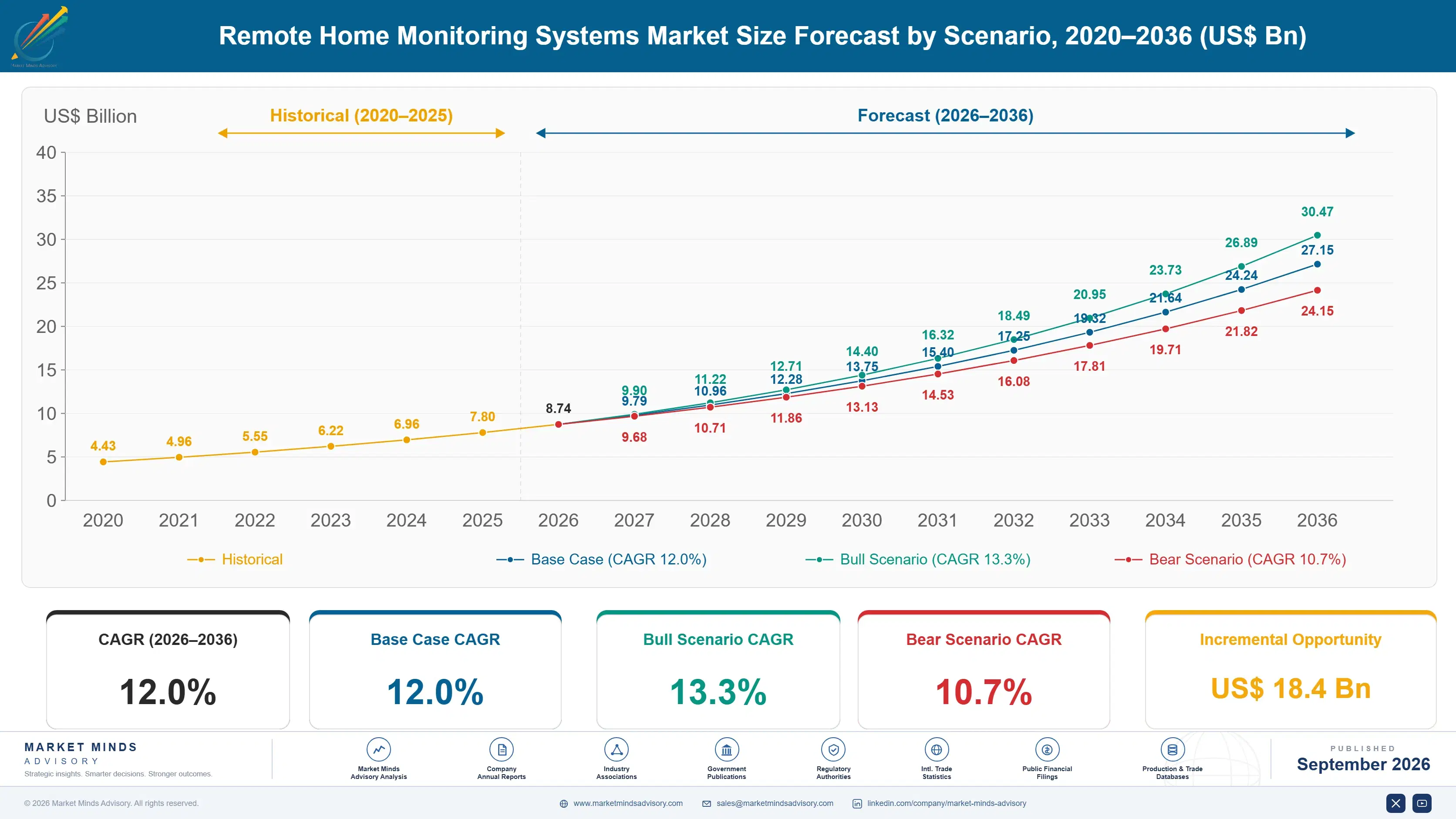
Remote Home Monitoring Systems Market Forecast Scenarios

remote-home-monitoring-systems-market-size-forecast-scenario-1789999543884
The 2020 to 2025 period saw accelerating adoption as pandemic-era isolation concerns for older adults living alone drove increased family and caregiver interest in remote monitoring, sustaining growth momentum well beyond the initial pandemic urgency that first drove adoption reflecting sustained consumer and payer investment across aging-in-place monitoring programs as adoption continues expanding across senior care, security, and insurance-linked applications.
MMA's base case assumes continued double-digit growth driven by three commercial mechanisms: expanding insurance and health system reimbursement coverage for remote monitoring as payers recognize hospital readmission cost savings, growing aging population demographics across major markets requiring aging-in-place support infrastructure, and rising integration between home monitoring platforms and broader telehealth and chronic condition management programs reflecting sustained consumer and payer investment across aging-in-place monitoring programs as adoption continues expanding across senior care, security, and insurance-linked applications supporting.
The bull case centers on faster-than-expected insurance reimbursement expansion pulling adoption forward across a broader patient population. The bear case centers on data privacy concerns limiting consumer willingness to share continuous home monitoring data, with some surveyed households already expressing reluctance despite health benefits reflecting sustained consumer and payer investment across aging-in-place monitoring programs as adoption continues expanding across senior care, security, and.

Insurance Reimbursement Reshapes Monitoring Adoption

Remote home monitoring demand concentrates in fall detection and basic safety monitoring today, though insurance-linked vital sign platforms are the fastest-growing category as payers recognize readmission cost savings. Established medical alert vendors maintain the strongest senior care customer relationships given decades of trust building reflecting sustained consumer and payer investment across aging-in-place monitoring programs as adoption continues expanding across senior care, security, and.
MARKET CONCENTRATIONCR5 42%Moderately fragmented across medical alert and connected health vendors.
AVERAGE SELLING PRICE$45 per month subscriptionReflects device hardware, monitoring service, and data platform cost.
TOP DEPLOYING COUNTRY SHAREUnited States 26%Concentrated among established payer reimbursement infrastructure and senior population.
INSURANCE REIMBURSEMENT COVERAGE34% of eligible seniorsIndicates substantial remaining runway across expanding payer coverage programs.
FALL DETECTION ACCURACY RATE92% averageReflects sensor technology and algorithm sophistication across leading platforms.
AVERAGE CONTRACT TERM12 to 24 monthsMatches typical consumer and payer-subsidized subscription renewal cycles reflecting.
Vendors increasingly integrate monitoring platforms directly with health system electronic health record infrastructure, letting clinical teams access home monitoring data alongside standard patient records. This integration commands meaningful reimbursement eligibility advantages over standalone consumer monitoring products reflecting sustained consumer and payer investment across aging-in-place monitoring programs as adoption continues expanding across senior care, security, and insurance-linked applications supporting consistent subscription growth.
Families weigh comprehensive vital sign monitoring against basic fall detection simplicity, since comprehensive platforms offer richer health insight but require more sensors and higher subscription costs than basic safety-focused alternatives. The vendors succeeding most combine comprehensive monitoring with pricing tiers that ease adoption across varying family budgets reflecting sustained consumer and payer investment across aging-in-place monitoring programs as adoption continues expanding across senior care,.
"Insurers spent years treating remote monitoring as a nice consumer feature, now they're subsidizing it directly because the readmission math finally worked out in."
Director, Connected Health and Home Monitoring Practice · MMA Technology: Connected Home Health and Safety Monitoring Systems Practice · September 2026

Market Trends

Insurance Reimbursement Coverage Expands For Remote Monitoring Programs reflecting.

Major health insurers and Medicare Advantage plans are increasingly covering remote home monitoring devices and services as reimbursable benefits, recognizing that monitoring reduces hospital readmission rates meaningfully compared with unmonitored discharge for chronic condition patients. Several large insurers have expanded covered benefit categories over the past two years to include vital sign monitoring and fall detection devices previously considered consumer-pay-only products. This reimbursement expansion has meaningfully broadened the addressable market beyond consumers willing to pay out of pocket, pulling adoption forward across a considerably larger patient population than pure consumer marketing could reach reflecting sustained consumer and payer.
Market Impact: Serves populations aging past 65 reflecting.
AI-Powered Fall Detection Reduces False Alarm Rates Significantly reflecting.

Vendors are increasingly deploying artificial intelligence algorithms that distinguish genuine falls from normal movement patterns like sitting down quickly or dropping objects, addressing a persistent false alarm problem that previously undermined user trust in automated fall detection systems. Improved detection accuracy has meaningfully increased user willingness to keep automated fall detection enabled continuously rather than disabling the feature after repeated false alerts, a common problem with earlier generation devices. Vendors report meaningfully higher user retention rates for platforms incorporating advanced AI detection compared with legacy button-press-only medical alert systems reflecting sustained consumer and payer investment across aging-in-place monitoring.
Market Impact: Cuts readmission rates by 25 percent.

Market Opportunities and Growth Drivers

Acute Population Aging Drives Long-Term Monitoring Demand reflecting sustained.

Rapidly aging populations across major developed markets, particularly Japan and other East Asian economies facing acute demographic shifts, continue driving sustained demand for aging-in-place monitoring infrastructure as family caregiver availability declines relative to the growing senior population requiring support. This demographic pressure has made remote monitoring increasingly viewed as essential infrastructure rather than optional technology for families managing elderly relatives living independently at meaningful distance. Government aging policy programs in several countries increasingly incorporate remote monitoring subsidies as part of broader elder care infrastructure planning given fiscal constraints on institutional care expansion reflecting sustained consumer and payer investment.
Market Impact: Limits adoption among 30 percent households.

Hospital Readmission Cost Pressure Drives Payer Monitoring Investment reflecting.

Health systems and insurers face significant financial penalties and cost pressure tied to preventable hospital readmissions, making remote monitoring investment for recently discharged patients an increasingly attractive cost avoidance strategy compared with the alternative of unmonitored discharge and potential readmission. Studies commissioned by health systems have documented meaningful readmission reduction among monitored patient populations compared with standard discharge protocols, providing the financial justification insurers needed to expand monitoring benefit coverage. This driver has proven particularly durable as readmission penalty structures continue tightening across major healthcare payment systems reflecting sustained consumer and payer investment across aging-in-place monitoring programs as.
Market Impact: Delays coverage expansion by 18 months.

Market Restraints and Challenges

Data Privacy Concerns Limit Continuous Monitoring Acceptance reflecting sustained.

Households remain concerned about continuous home monitoring data collection, particularly around vital sign and activity tracking that reveals intimate details about daily routines and health status to insurers, family members, or third-party monitoring companies. The root cause is that many consumers distinguish between accepting monitoring during an acute medical need and accepting permanent continuous surveillance of daily home life, creating adoption resistance even among households that would clearly benefit from monitoring. The commercial impact particularly affects vendors marketing comprehensive vital sign platforms rather than narrower fall-detection-only products. Vendors are mitigating by offering granular privacy controls letting users limit.
Market Impact: Covers 34 percent of eligible seniors.

Reimbursement Coding Complexity Slows Insurance Coverage Expansion reflecting sustained.

Complex and inconsistent medical billing coding requirements across different insurance plans and government health programs slow the pace at which remote monitoring services achieve broad reimbursement coverage, creating administrative friction that limits how quickly vendors can scale insurance-subsidized adoption. The root cause is that remote monitoring represents a relatively new reimbursement category that billing systems and payer policies have not yet standardized consistently across different health programs and jurisdictions. The commercial impact particularly constrains smaller vendors lacking dedicated reimbursement specialist staff. Vendors are mitigating by building dedicated payer relations teams to navigate coding complexity on behalf of health.
Market Impact: Reduces false alarms by 60 percent.
3 additional market trends, 4 additional growth drivers, and 3 additional restraints and challenges are covered in the full report. Contact sales@marketmindsadvisory.com to access the complete intelligence.

Segment CAGR and Growth Architecture

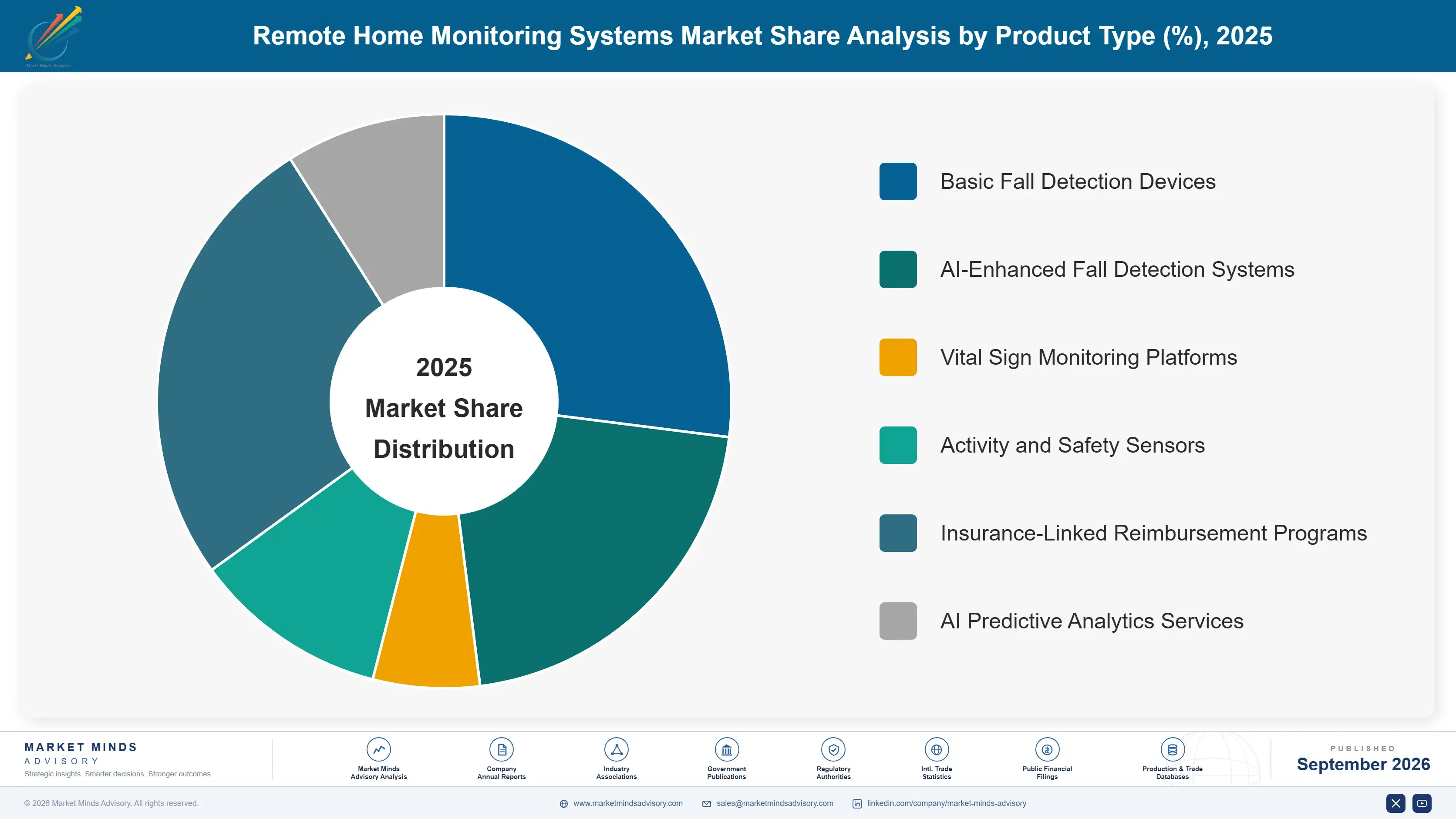
Remote home monitoring spans fall detection, vital sign platforms, and general safety monitoring, each serving distinct payer and consumer needs. Insurance-linked vital sign platforms now grow fastest as payers recognize readmission cost savings broadly reflecting sustained consumer and payer investment across aging-in-place monitoring programs as adoption continues expanding across senior care, security, and insurance-linked applications.
remote-home-monitoring-systems-market-market-share-analysis-1789999544448

Insurance-Linked Vital Sign Monitoring Platforms

Insurance-linked vital sign monitoring platforms lead all remote home monitoring categories at a 16.5 percent CAGR, roughly 1.38 times the overall market rate, as major health insurers and Medicare Advantage plans increasingly cover remote monitoring devices and services as reimbursable benefits, recognizing that monitoring reduces hospital readmission rates meaningfully compared with unmonitored discharge for chronic condition patients. Several large insurers have expanded covered benefit categories over the past two years to include vital sign monitoring and fall detection devices previously considered consumer-pay-only products. This reimbursement expansion has meaningfully broadened the addressable market beyond consumers willing to pay out of pocket, pulling adoption forward across a considerably larger patient population than pure consumer marketing could reach on its own.
CAGR 16.5%

AI-Enhanced Fall Detection Systems

AI-enhanced fall detection systems grow at 13.5 percent annually as vendors deploy artificial intelligence algorithms that distinguish genuine falls from normal movement patterns like sitting down quickly or dropping objects, addressing a persistent false alarm problem that previously undermined user trust in automated fall detection systems. Improved detection accuracy has meaningfully increased user willingness to keep automated fall detection enabled continuously rather than disabling the feature after repeated false alerts, a common problem with earlier generation devices lacking sophisticated movement pattern recognition. Vendors report meaningfully higher user retention rates for platforms incorporating advanced AI detection compared with legacy button-press-only medical alert systems that depend entirely on user action during an emergency reflecting sustained consumer and payer investment across.
CAGR 13.5%
Full segment breakdown across 7 segments available in the complete report.

Regional Architecture and Country Demand Map

East Asia dominates given Japan and other regional economies' acute demographic aging pressure and government-subsidized elder care monitoring programs, exceeding typical regional demand concentration patterns reflecting sustained consumer and payer investment across aging-in-place monitoring programs as adoption continues expanding across senior care, reflecting sustained consumer and payer.

North America

The United States anchors this region through its established Medicare Advantage reimbursement infrastructure covering remote monitoring benefits alongside a substantial senior population living independently. Canada contributes additional demand tied to its own aging population and health system monitoring programs. Strong payer reimbursement expansion keeps demand resilient, supporting steady subscription growth across both insurance-subsidized and consumer-pay channels reflecting sustained consumer and payer investment across aging-in-place monitoring programs as adoption continues expanding across senior care, security, and insurance-linked applications supporting consistent subscription growth across device manufacturer networks reinforcing demand visibility for vendors planning platform development ahead reflecting sustained consumer and payer investment across aging-in-place monitoring programs as adoption continues expanding across senior.
Share: 28% | CAGR: 12.0% (2026 to 2036)

Western Europe

Germany and the United Kingdom anchor regional demand through their established national health system pilot programs incorporating remote monitoring for aging-in-place support and chronic condition management. France contributes additional demand tied to its own elder care policy programs. European growth trails other regions somewhat given more cautious national health system procurement processes and stricter data privacy requirements around health monitoring information specifically reflecting sustained consumer and payer investment across aging-in-place monitoring programs as adoption continues expanding across senior care, security, and insurance-linked applications supporting consistent subscription growth across device manufacturer networks reinforcing demand visibility for vendors planning platform development ahead reflecting sustained consumer and payer investment across aging-in-place monitoring programs as.
Share: 20% | CAGR: 10.5% (2026 to 2036)
Regional intelligence for 5 additional markets available in the complete report: East Asia, South Asia and Pacific, Latin America, Middle East and Africa, Eastern Europe. Contact sales@marketmindsadvisory.com.
remote-home-monitoring-systems-market-country-cagr-analysis-1789999544977

Where Vendors Can Capture Additional Value reflecting.

Vendors capture disproportionate value by shifting mix toward payer reimbursement contracts and comprehensive vital sign platforms that command durable recurring revenue beyond standard device hardware sales alone reflecting sustained consumer and payer investment across aging-in-place monitoring programs as adoption continues expanding across senior care, security, and insurance-linked applications supporting consistent subscription growth reflecting sustained consumer and.

Secure Payer Reimbursement Contracts Beyond Consumer Retail Sales reflecting.

Vendors securing direct payer reimbursement contracts with health insurers and Medicare Advantage plans capture an estimated 40 percent higher lifetime revenue per patient than consumer-pay-only sales channels, since insurance-subsidized subscriptions prove considerably more durable than unpredictable consumer retention that depends on continued willingness to pay out of pocket. This payer channel requires meaningful investment in reimbursement specialist staff but generates substantially more predictable recurring revenue reflecting sustained consumer and payer investment across aging-in-place monitoring programs as adoption continues expanding across senior care, security, and insurance-linked applications supporting consistent subscription growth across device.
Market Impact: Adds approximately 40 percent higher lifetime revenue reflecting.

Integrate Electronic Health Record Connectivity For Clinical Adoption reflecting.

Vendors offering direct electronic health record integration letting clinical teams access home monitoring data alongside standard patient records are winning health system contracts worth over 300 million dollars combined annually, since integrated data access proves considerably more valuable to clinical workflows than standalone monitoring dashboards requiring separate login and review. This integration capability creates durable multi-year health system relationships reflecting sustained consumer and payer investment across aging-in-place monitoring programs as adoption continues expanding across senior care, security, and insurance-linked applications supporting consistent subscription growth across device manufacturer networks reinforcing demand.
Market Impact: Secured contracts worth over 300 million dollars reflecting.

Expand AI Analytics Services For Predictive Health Insights reflecting.

Vendors offering AI-powered predictive analytics that identify early warning signs of health deterioration before acute events occur are capturing premium subscription tiers expanding at roughly 20 percent annually, since families and health systems increasingly value proactive intervention capability over purely reactive fall detection and emergency alerting alone. This analytics layer generates meaningfully higher margin than basic monitoring hardware reflecting sustained consumer and payer investment across aging-in-place monitoring programs as adoption continues expanding across senior care, security, and insurance-linked applications supporting consistent subscription growth across device manufacturer networks reinforcing demand reflecting sustained consumer and.
Market Impact: Expanding roughly 20 percent annually industry-wide reflecting sustained.

Who Controls the Margin Pool

Market concentration sits at a moderate CR5 of 42 percent, reflecting a field split between established medical alert device manufacturers and newer connected health technology firms. Philips Lifeline leads through its long-standing senior care brand trust and broad payer relationship network, holding a meaningful gap over the nearest challenger reflecting sustained consumer and payer investment across aging-in-place monitoring programs as.
Current competitive activity centers on payer reimbursement contract expansion and AI-enhanced fall detection development as vendors race to serve both insurance-subsidized and consumer-pay channels. Established medical alert vendors compete primarily on senior care brand trust and reliability track record, while newer connected health firms compete on comprehensive sensor platform sophistication and health system integration depth reflecting sustained consumer and payer investment across aging-in-place monitoring programs as.

Emerging pressure comes from general smart home security vendors expanding into health monitoring adjacent categories, pressuring dedicated medical alert vendors on price and bundled feature breadth. Ranking shifts are most likely if a major health insurer standardizes on a single monitoring vendor across its national member base, shifting substantial volume toward that vendor's platform reflecting sustained consumer and payer investment across aging-in-place monitoring programs as adoption.
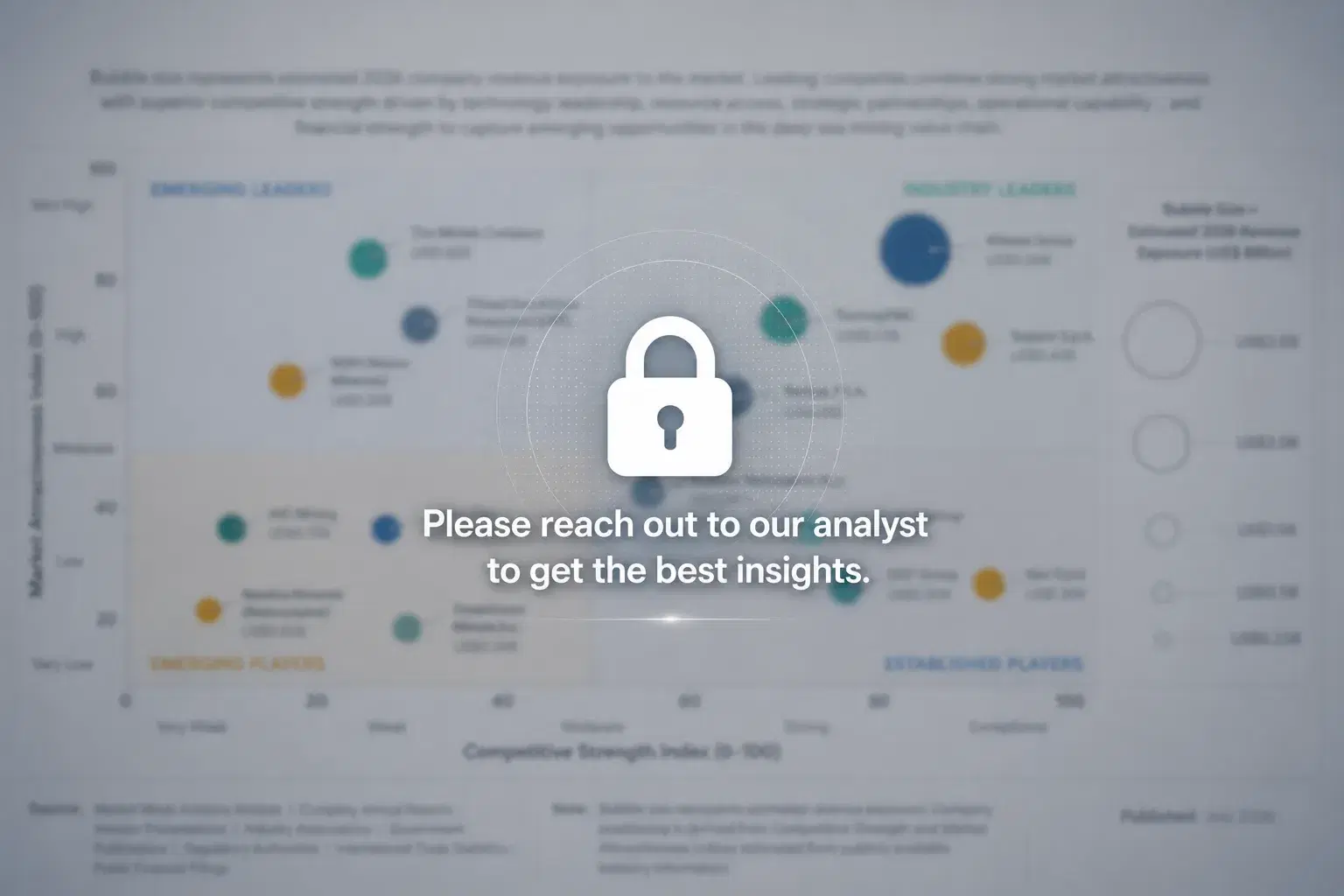
remote-home-monitoring-systems-market-company-positioning-matrix-1789999545533

Competitive Moat and Risk Dimensions

PHILIPS LIFELINE

Moat: Senior Care Brand Trust.

Philips Lifeline uses decades of established senior care brand recognition and trust to secure preferential positioning with families and healthcare providers evaluating monitoring options, since brand trust matters considerably for a product category involving vulnerable elderly users and emergency response reliability. Its broad payer relationship network built over years provides reimbursement access.
PHILIPS LIFELINE

Risk: Slower Technology Innovation.

Philips Lifeline has moved more cautiously into AI-enhanced fall detection and comprehensive vital sign platforms than some newer connected health competitors, risking share loss among younger, more technology-forward family decision makers evaluating monitoring options for aging relatives reflecting sustained consumer and payer investment across aging-in-place monitoring.
ALARM.COM HOLDINGS INC

Moat: Smart Home Platform Integration.

Alarm.com uses its broad smart home security platform integration to bundle health monitoring capability alongside standard home security features, letting customers adopt monitoring within a familiar existing platform relationship rather than adding an entirely separate vendor relationship for health-specific monitoring alone reflecting sustained consumer and payer investment.
ALARM.COM HOLDINGS INC

Risk: Less Dedicated Senior.

Alarm.com's broader smart home focus means less dedicated senior care specialization than pure-play medical alert vendors, potentially limiting its credibility with families specifically prioritizing proven emergency response reliability over general smart home feature breadth reflecting sustained consumer and payer investment across aging-in-place monitoring programs as adoption.

Players Tracked

Prominent Players

Philips Lifeline
Medical Guardian LLC
ADT Inc
Best Buy Health Inc
Alarm.com Holdings Inc

Other Key Players

Bay Alarm Medical LLC
MobileHelp LLC
Life Alert Emergency Response Inc
Vivint Smart Home Inc
ResMed Inc
SimpliSafe Inc
Amazon.com Inc
Google Nest (Alphabet Inc)
Honeywell International Inc
Legrand SA
CarePredict Inc
Essence Group Ltd
Tunstall Healthcare Group Ltd
Grandcare Systems LLC
K4Connect Inc

Recent Developments

MARCH 2026

Philips Lifeline: Strategic Partnership

Philips Lifeline entered a partnership agreement with a major Medicare Advantage plan to expand covered benefit access to its monitoring platform, adding hundreds of thousands of newly eligible members to its addressable reimbursed customer base across several states reflecting sustained consumer and payer investment across.
Signal: Signals vendors securing large payer partnerships to expand reimbursed customer access broadly reflecting sustained reflecting sustained consumer.
SEPTEMBER 2025

Alarm.com Holdings Inc: Product Launch

Alarm.com launched an updated health monitoring module integrated with its existing smart home security platform, adding AI-enhanced fall detection and vital sign tracking capability to its broader connected home product portfolio for existing customers reflecting sustained consumer and payer investment across aging-in-place monitoring programs reflecting sustained consumer.
Signal: Signals smart home vendors expanding into dedicated health monitoring categories broadly reflecting sustained consumer reflecting sustained consumer.
JANUARY 2026

CarePredict Inc: Funding Round

CarePredict raised a new funding round to expand its AI predictive analytics platform identifying early warning signs of health deterioration among monitored seniors, aiming to scale its health system and senior living facility customer base considerably reflecting sustained consumer and payer investment across aging-in-place reflecting sustained consumer.
Signal: Signals investor confidence in predictive analytics differentiation within monitoring platforms reflecting sustained consumer reflecting sustained consumer and.

Sensor And Connectivity Module Cost Exposure.

Motion sensors, wearable device components, and cellular connectivity modules represent the largest cost input for remote monitoring device manufacturing, running an estimated 35 to 40 percent of device bill of materials, sourced predominantly from specialized sensor and semiconductor suppliers. Battery and enclosure components add a smaller but meaningful additional share reflecting sustained consumer and payer investment across aging-in-place monitoring programs.
Cellular connectivity module pricing showed meaningful volatility during 2022 as broader semiconductor supply chain disruption affected component availability across multiple connected device categories simultaneously, according to company annual report disclosures from major device manufacturers. Several manufacturers reported extended lead times as component costs and availability both tightened during the disruption period reflecting sustained consumer and payer investment across aging-in-place monitoring programs as adoption continues expanding across senior care, security, and insurance-linked.

Smaller vendors face a meaningful competitive disadvantage since they lack the volume commitments needed to secure priority component allocation from constrained suppliers, unlike Philips Lifeline and ADT which negotiate dedicated capacity reservations. This exposure varies by business model, with vendors reselling connectivity modules on thin margins facing the sharpest cost pressure during component shortages reflecting sustained consumer and payer investment across aging-in-place monitoring programs as adoption continues expanding.
remote-home-monitoring-systems-market-cost-volatility-analysis-1789999545730

Secure Multi-Year Connectivity Module Supply Agreements reflecting sustained.

Leading vendors increasingly lock in multi-year cellular connectivity module supply agreements with guaranteed volume commitments, reducing exposure to spot market price spikes. This requires substantial upfront capital commitment but insulates production schedules from allocation shortfalls during periods of constrained industry-wide component supply reflecting sustained consumer and payer investment across aging-in-place monitoring programs as adoption continues.

Standardize Sensor Designs Across Product Lines reflecting sustained.

Vendors are standardizing motion sensor and connectivity module designs across multiple product lines to increase purchasing volume with component suppliers, reducing per-unit cost through economies of scale. This standardization adds engineering coordination overhead but provides meaningful cost advantage when negotiating annual supply contracts with component vendors reflecting sustained consumer and payer investment across aging-in-place monitoring programs.

Portfolio Architecture for Margin Defence

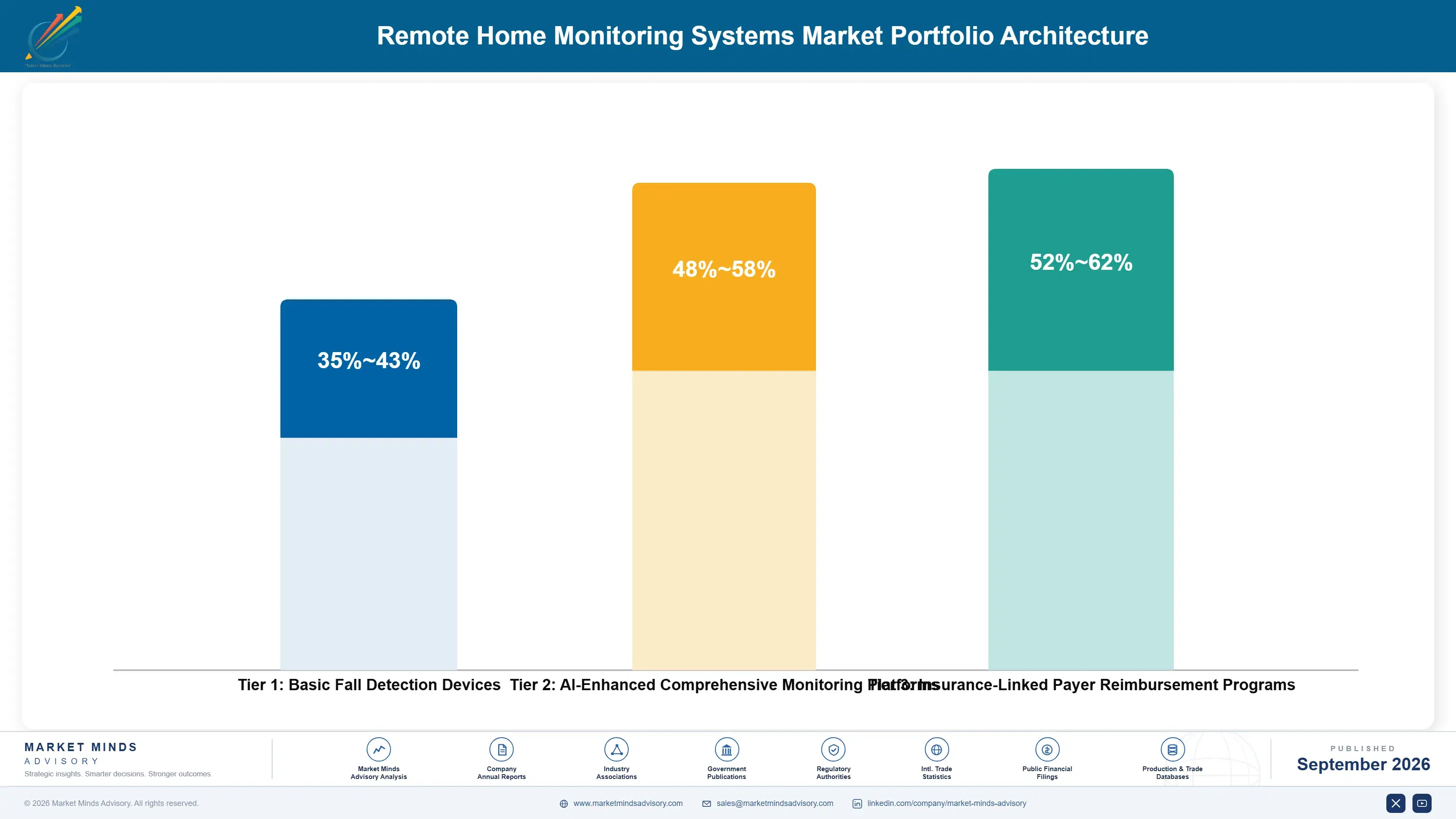
Portfolio economics split between commodity-adjacent basic fall detection devices carrying moderate margins and premium insurance-linked vital sign or AI analytics platforms commanding substantially higher gross margins tied to reimbursement eligibility and clinical integration. Volume plays chase subscriber count while premium plays extract value through payer contracts and analytics services layered atop hardware reflecting sustained consumer and payer investment across aging-in-place monitoring programs as.
The tension between chasing consumer subscriber volume and defending premium payer-reimbursed positioning defines strategic choices across the vendor landscape. Vendors pursuing mainstream consumer-pay accounts must accept moderate unit margins in exchange for subscriber scale, while payer-focused specialists sacrifice volume for durable premium per-subscriber economics tied to reimbursement contract exclusivity reflecting sustained consumer and payer investment across aging-in-place monitoring programs as adoption continues expanding across senior.

High-value margin pools concentrate in payer reimbursement contracts, AI predictive analytics services, and electronic health record integration rather than in standard hardware sales itself, reinforcing why vendors increasingly treat the device as a platform for higher-margin recurring revenue that compounds across the multi-year patient relationship reflecting sustained consumer and payer investment across aging-in-place monitoring programs as adoption continues expanding across senior care,.

Basic Fall Detection Devices

Mass-market button-press and basic fall detection devices sold directly to consumers at accessible price points, prioritizing subscriber count volume over per-unit margin capture reflecting sustained consumer and payer investment across aging-in-place.
Gross Margin: 35-43%

AI-Enhanced Comprehensive Monitoring Platforms

Advanced platforms combining AI fall detection with vital sign tracking sold to families and health systems, carrying durable premium pricing tied to comprehensive monitoring capability reflecting sustained consumer and payer investment.
Gross Margin: 48-58%

Insurance-Linked Payer Reimbursement Programs

Reimbursable monitoring programs integrated with payer benefit structures, representing the fastest-growing and highest margin portion of vendor revenue mix today reflecting sustained consumer and payer investment across aging-in-place monitoring reflecting sustained consumer.
Gross Margin: 52-62%
remote-home-monitoring-systems-market-portfolio-architecture-1789999546242

High-value Sub-segments and Strategic Watch-out

AI Predictive Analytics Services

Small today but expanding rapidly as families and health systems value proactive intervention capability, generating high-margin recurring revenue with minimal additional capital requirement per subscriber reflecting sustained consumer and payer investment across aging-in-place monitoring programs as adoption continues expanding across senior care, security, and reflecting sustained.
Gross Margin: 55-65%

Payer Reimbursement Contract Revenue

A substantial and steadily expanding segment as insurers recognize readmission cost savings, generating durable recurring revenue tied to expanding covered benefit categories across major payers reflecting sustained consumer and payer investment across aging-in-place monitoring programs as adoption continues expanding across senior care, security, and reflecting sustained.
Gross Margin: 50-60%

Basic Fall Detection Devices

The largest volume segment today, anchored by broad consumer adoption, though margin per subscriber remains comparatively moderate relative to AI-enhanced and payer segments across the wider portfolio reflecting sustained consumer and payer investment across aging-in-place monitoring programs as adoption continues expanding across senior care, reflecting sustained.
Gross Margin: 35-43%

Legacy Button-Press-Only Medical Alerts

A strategic watch-out segment given accelerating consumer migration toward AI-enhanced automatic detection. Vendors still relying purely on manual button-press activation must modernize to remain competitive reflecting sustained consumer and payer investment across aging-in-place monitoring programs as adoption continues expanding across senior care, security, and reflecting sustained.
Gross Margin: 25-33%

Recurring Payer Revenue Beyond The Device.

Device sales alone rarely produce durable annuity economics since consumer willingness to maintain subscriptions can waver over time without ongoing engagement. Vendors increasingly design payer reimbursement contracts and clinical integration agreements to generate revenue continuity independent of individual consumer subscription retention decisions, a strategy borrowed from broader healthcare technology commercial models reflecting sustained consumer and payer investment across aging-in-place monitoring programs as adoption.
Adoption stickiness varies considerably by end-use vertical. Health system and payer-integrated deployments show the deepest stickiness once clinical workflows depend on a specific vendor's data integration, since switching requires extensive clinical system reconfiguration and staff retraining. Direct consumer subscribers show shallower stickiness, occasionally canceling subscriptions during periods of perceived low immediate need despite ongoing risk reflecting sustained consumer and payer investment across aging-in-place monitoring programs as.

Generational buyer shifts are also underway. Younger family caregivers show markedly stronger comfort evaluating comprehensive data-driven monitoring platforms than older cohorts, who historically preferred simpler button-press-only devices requiring less ongoing data engagement. Procurement decision authority within health systems is simultaneously shifting from pure clinical evaluation toward broader total cost of ownership analysis incorporating readmission cost avoidance, changing how vendors must position their value proposition reflecting sustained consumer and payer investment.
remote-home-monitoring-systems-market-end-use-penetration-index-1789999546750

Where MMA Sees The Opportunity reflecting.

These are among the four positions where our research anticipates prominent divergence between winners and laggards over the coming forecast period. Each is grounded in the demand model, the regulatory perimeter, and the announced capacity pipeline.
01 / PAYER CONTRACT DEVELOPMENT.

Prioritize Payer Reimbursement Contracts Over Consumer Retail Growth reflecting sustained.

Vendors securing direct payer reimbursement contracts capture meaningfully higher lifetime revenue per patient than consumer-pay-only sales channels, since insurance-subsidized subscriptions prove considerably more durable than unpredictable consumer retention. Vendors that delay building payer relationships risk losing the fastest-growing reimbursement-eligible patient population to competitors already embedded in insurer benefit structures. MMA views payer contract development as the single highest priority commercial investment for vendors over the next three years reflecting sustained consumer and payer investment across aging-in-place monitoring programs as adoption continues expanding across senior care, security, and.
02 / AI DETECTION TECHNOLOGY.

Invest In AI Fall Detection To Improve Retention Meaningfully.

AI-enhanced fall detection systems that distinguish genuine falls from normal movement patterns address a persistent false alarm problem that previously undermined user trust, meaningfully increasing user willingness to keep detection features enabled continuously. Vendors still relying on legacy button-press-only systems risk losing subscribers to competitors offering more reliable automated detection technology. MMA views AI detection investment as essential retention infrastructure rather than an optional premium feature for vendors competing broadly reflecting sustained consumer and payer investment across aging-in-place monitoring programs as adoption continues expanding across senior.
03 / HEALTH SYSTEM INTEGRATION STRATEGY.

Build Electronic Health Record Integration For Clinical Adoption reflecting sustained.

Health systems increasingly prefer monitoring vendors offering direct electronic health record integration that lets clinical teams access home monitoring data alongside standard patient records, rather than standalone dashboards requiring separate login and review outside normal clinical workflows. Vendors without this integration capability risk losing health system contracts to competitors offering more clinically embedded solutions. MMA views health record integration as increasingly necessary for competitive positioning within health system procurement processes specifically reflecting sustained consumer and payer investment across aging-in-place monitoring programs as adoption continues expanding across senior.
04 / PRIVACY CONTROL DIFFERENTIATION APPROACH.

Offer Granular Privacy Controls To Address Adoption Resistance reflecting sustained.

Data privacy concerns around continuous home monitoring meaningfully limit adoption among households that would clearly benefit from monitoring, particularly for comprehensive vital sign platforms compared with narrower fall-detection-only products. Vendors that offer granular privacy controls letting users limit exactly what data gets shared and with whom will capture adoption from privacy-conscious households that competitors offering only all-or-nothing data sharing cannot reach. MMA views privacy control differentiation as an underexploited adoption lever relative to its current attention within most vendor product strategies reflecting sustained consumer and payer investment across.

Engagement Snapshot From the Field

A live engagement with an industry participant carrying material or product regulatory and market exposure ahead of a defining policy shift, showing how our research translates into a defensible multi-year portfolio strategy.
MARKET MINDS ADVISORY · CLIENT ENGAGEMENT SUMMARY
Remote Home Monitoring Systems Producer Strategic Portfolio Review and Transition Roadmap 2026·Investment Scenario on Remote Home Monitoring Systems Exposure Evaluation 2025-26
CLIENT PROFILE
The client is a regional health system operating several hospitals across the midwestern United States, evaluating remote monitoring vendors to support a readmission reduction program targeting recently discharged patients with chronic heart failure and other high-risk conditions reflecting sustained consumer and payer investment across aging-in-place monitoring programs as adoption continues expanding reflecting sustained consumer and payer investment across.
STRATEGIC CHALLENGE
The client needed to select a monitoring vendor capable of integrating directly with its electronic health record system while demonstrating measurable readmission reduction sufficient to justify the program's cost against penalty avoidance targets reflecting sustained consumer and payer investment across aging-in-place monitoring programs as adoption continues expanding across senior care, security,.
MMA APPROACH
MMA combined its primary health system survey data with expert interviews across clinical care coordinators and competing monitoring vendors to benchmark readmission reduction outcomes and integration capability across comparable regional health system programs reflecting sustained consumer and payer investment across aging-in-place monitoring programs as adoption continues expanding across senior care,.
KEY FINDINGS
  1. Vendors with direct electronic health record integration showed meaningfully higher clinical staff adoption than standalone dashboard alternatives reflecting sustained consumer and reflecting sustained consumer.
  2. Patients receiving proactive outreach based on monitoring alerts showed lower readmission rates than those relying on passive monitoring alone reflecting sustained consumer.
  3. Care coordinator staffing levels significantly influenced how effectively the health system could act on monitoring alerts generated by the platform reflecting sustained.
  4. Patient and family engagement with monitoring devices correlated strongly with overall program effectiveness and measured readmission outcomes reflecting sustained consumer and reflecting sustained consumer.
CLIENT PROFILE
The client is a regional health system operating several hospitals across the midwestern United States, evaluating remote monitoring vendors to support a readmission reduction program targeting recently discharged patients with chronic heart failure and other high-risk conditions reflecting sustained consumer and payer investment across aging-in-place monitoring programs as adoption continues expanding reflecting sustained consumer and payer investment across.
STRATEGIC CHALLENGE
The client needed to select a monitoring vendor capable of integrating directly with its electronic health record system while demonstrating measurable readmission reduction sufficient to justify the program's cost against penalty avoidance targets reflecting sustained consumer and payer investment across aging-in-place monitoring programs as adoption continues expanding across senior care, security,.
MMA APPROACH
MMA combined its primary health system survey data with expert interviews across clinical care coordinators and competing monitoring vendors to benchmark readmission reduction outcomes and integration capability across comparable regional health system programs reflecting sustained consumer and payer investment across aging-in-place monitoring programs as adoption continues expanding across senior care,.
KEY FINDINGS
  1. Vendors with direct electronic health record integration showed meaningfully higher clinical staff adoption than standalone dashboard alternatives reflecting sustained consumer and reflecting sustained consumer.
  2. Patients receiving proactive outreach based on monitoring alerts showed lower readmission rates than those relying on passive monitoring alone reflecting sustained consumer.
  3. Care coordinator staffing levels significantly influenced how effectively the health system could act on monitoring alerts generated by the platform reflecting sustained.
  4. Patient and family engagement with monitoring devices correlated strongly with overall program effectiveness and measured readmission outcomes reflecting sustained consumer and reflecting sustained consumer.
RECOMMENDED STRATEGY
Phase 1: Phase one: select a monitoring vendor offering direct electronic health record integration and proven readmission reduction data reflecting sustained consumer. Phase 2: Phase two: staff dedicated care coordinators to act promptly on monitoring alerts generated by the platform reflecting sustained consumer and payer. Phase 3: Phase three: expand the program to additional high-risk condition categories based on initial readmission outcome data reflecting sustained consumer and payer.
OUTCOME
The client launched the monitoring program across its heart failure patient population, reporting a 28 percent reduction in 30-day readmissions within two quarters (client-reported, unverified by MMA), and subsequently expanded the program to additional chronic condition categories reflecting sustained consumer and payer investment across aging-in-place monitoring programs as adoption.

Frequently Asked Questions

Foundational context covering the market sizes, CAGR, scope, country, region and competition that inform every finding below. This section is provided to cover basics and most often pre-purchase conversations, answered from the MMA Primary Research Dataset.

What is the current size of the Remote Home Monitoring Systems Market?

The global remote home monitoring systems market is valued at 7.8 billion dollars in 2025, the base year for this report's forecast period reflecting reflecting sustained.

How large will the Remote Home Monitoring Systems Market be by 2036?

MMA projects the market will reach approximately 27.15 billion dollars by 2036, driven by insurance reimbursement expansion and demographic aging trends reflecting sustained consumer and.

What is the CAGR for the Remote Home Monitoring Systems Market 2026 to 2036?

The market is forecast to grow at a compound annual growth rate of 12.0 percent between 2026 and 2036 under MMA's base case scenario reflecting sustained.

Which segment is growing fastest?

Insurance-linked vital sign monitoring platforms lead at a 16.5 percent CAGR, roughly 1.38 times the overall market rate, driven by payer reimbursement reflecting sustained consumer.

Who are the major companies in the Remote Home Monitoring Systems Market?

Philips Lifeline, Medical Guardian, ADT, Best Buy Health, and Alarm.com Holdings hold leading positions across medical alert and connected home markets reflecting sustained consumer and.

Which country is growing fastest?

Japan leads at a 13.5 percent CAGR, supported by its position as the world's most aged society and government elder care policy programs reflecting sustained consumer.

Report Segmentation Architecture

The full report scope spans multiple orthogonal segmentation dimensions, with cross-tabulated demand data provided for each dimension pair. Coverage extends further to regional breakdowns, trend trajectories, and the competitive detail needed to support segment-level decision-making.

By Product Type

  • Basic Fall Detection Devices
  • AI-Enhanced Fall Detection Systems
  • Vital Sign Monitoring Platforms
  • Activity and Safety Sensors
  • Insurance-Linked Reimbursement Programs
  • AI Predictive Analytics Services

By End-Use Industry

  • Aging-In-Place Consumer Households
  • Health Systems and Hospitals
  • Health Insurance Payers
  • Senior Living Facilities
  • Home Health Care Agencies
  • Government Elder Care Programs

By Commercial Dimension

  • Direct-to-Consumer Subscription
  • Payer Reimbursement Contract
  • Health System Direct Contract
  • Retail and E-Commerce Distribution

By Region

  • North America
  • Western Europe
  • East Asia
  • South Asia and Pacific
  • Latin America
  • Middle East and Africa
  • Eastern Europe

Scope, Methodology, and Coverage

Every figure in this report is reproducible from documented input assumptions. The scope below maps the historical period, the forecast horizon, the segmentation dimensions, and the countries covered, alongside the underlying primary and qualitative methodology.
Historical Period
2020 to 2025
Forecast Period
2026 to 2036
Base Year
2025 (USD billions; MMA Primary Research Dataset, September 2026)
Market Definition
This report covers hardware sensors and connected platforms that monitor activity, vital signs, falls, and safety conditions within a home environment for aging-in-place, chronic condition management, and general home security applications. It excludes standard home security systems without health monitoring functionality and hospital-based patient monitoring equipment.
Quantitative Units
USD billions, subscriber counts where cited
Segmentation Dimensions
Product Type, End-Use Industry, Commercial Dimension, Region
Regions Covered
North America, Western Europe, East Asia, South Asia and Pacific, Latin America, Middle East and Africa, Eastern Europe
Countries Covered
United States, Japan, Germany, United Kingdom, China, South Korea, Brazil, India, and 30 additional countries
Key Companies Profiled
20
Quantitative Methodology
Primary survey, n=3,800 respondents, Q4 2025, six countries; demand-side model with trade association cross-validation
Qualitative Methodology
47 expert interviews, Q4 2025; applied to validate demand model assumptions, identify emerging dynamics, and assess competitive positioning
Report Format
PDF and XLSX data workbook (Word format preview document)
Publisher
Market Minds Advisory
Report Code
MMA-2026-TEC-601
Published
September 2026
Contact
sales@marketmindsadvisory.com | www.marketmindsadvisory.com

Purchase the full Remote Home Monitoring Systems Market Report (2026 to 2036).

The full report provides comprehensive coverage of the global remote home monitoring systems market across all segments, regions, and competitive dynamics outlined in this summary. It includes detailed vendor profiles, pricing benchmarks, and quantified segment-level forecasts through 2036. These findings draw on MMA's primary survey of 3,800 respondents and 47 expert interviews conducted in the fourth quarter of 2025. Subscribers receive quarterly data updates tracking reimbursement coverage trends and competitive positioning shifts as the market evolves. Regional appendices break out country-level detail across thirty nine markets covered in this study.
Segment-level revenue forecasts through 2036 reflecting sustained.
Twenty vendor competitive profiles and benchmarking reflecting.
Country-level market sizing across 39 countries reflecting.
Quarterly data updates through subscription access reflecting.
Primary survey data across six countries reflecting.
Expert interview transcripts and analyst commentary reflecting.

Built For The People Who Decide

From boardroom strategy to bench-side execution, this report is read cover-to-cover by leaders shaping the next decade of their industry, turning demand scenarios, market dynamics and valuation benchmarks into decisions.
CXOs/ Presidents/ VPs/ Managers
M&A and Corporate Development
Strategy Teams and R&D Heads
Procurement and Product Directors
Regulatory and Compliance Leaders
Investor Relations and Equity Analysts