

Market Minds Advisory
Remote Desktop Software Market

Remote Desktop Software Market: Remote Desktop Software Market. Hybrid Work Permanence Meets Zero-Trust Security Demand

Permanent hybrid work arrangements, tightening zero-trust security mandates, and expanding cloud desktop migration are reshaping which remote access platforms enterprises rely on to secure their distributed global workforces most effectively.

Lead Analyst

Published

September 2026

Make Smarter Decisions with Customized Research Insights

Request a free sample report and evaluate market opportunities, growth trends, and competitive dynamics relevant to your business needs.

2025 MARKET VALUE$3.9BMarket Size 2025
2036 FORECAST VALUE$10.9BBase Case , 2026 to 2036
CAGR 2026 TO 20369.8 %Bull 11.0% / Bear 8.6%
INCREMENTAL OPPORTUNITY$6.6BNet 10- year value creation
EXPANSION MULTIPLE2.55x2036 value over 2026 base
Strategic Levers
M&A Pipeline
Regional Outlook
Country Rankings
Competitive Intelligence
Segmental Deep-dive
Call-Us : 91 93563 13602

Executive Snapshot and Market Trajectory.

Remote desktop software is shifting from pandemic-era emergency access tools toward permanent zero-trust security infrastructure that enterprises expect to run indefinitely across hybrid workforces. That shift reflects a hard reality: distributed IT teams need auditable, secure access rather than the ad hoc tools adopted during the pandemic transition.
Enterprises supporting distributed IT teams and outsourced support functions are pushing vendors toward session recording and compliance auditing capability rather than basic screen-sharing alone, concentrating vendor demand heavily among large enterprises in the United States, India, and the Philippines managing global remote workforce operations. India's massive IT outsourcing sector and the Philippines' business process outsourcing industry compound this demand toward documented, auditable remote access records.
TeamViewer and Citrix increasingly compete on zero-trust access control capability rather than basic remote connection speed alone, while evolving data residency requirements and rising enterprise security audit scrutiny are reshaping which platforms organizations choose for large-scale distributed workforce deployments. Enterprises increasingly evaluate vendors on session audit depth rather than subscription price alone, favoring established players with dense compliance certification track records. Vendors with proven audit trail depth win contracts against newer entrants.
Market Definition
This report covers software that provides remote access to computers and virtual desktops, spanning remote access clients, virtual desktop infrastructure, session recording, and zero-trust access control tools. It excludes general video conferencing software and cloud file storage services that do not provide direct remote desktop control capability.
Base Year Value
$3.9B in 2025 (MMA Primary Research Dataset, September 2026)
Forecast Period
2026 to 2036, eleven discrete annual values
CAGR
9.8% base case. Bull 11.0%. Bear 8.6%.
Fastest Growth Segment
Cloud-Hosted Desktop-as-a-Service Platforms: 16.2% CAGR
Fastest Growth Country
India: 15.4% CAGR
Fastest Growth Region
South Asia and Pacific: 12.1% CAGR
Largest Region
North America: 30% of 2025 global value
Market Leaders
TeamViewer, Citrix, VMware, Microsoft, AnyDesk. Source: MMA Analysis based on company disclosures and active seat estimates.
Primary Survey
n=3,800 procurement and R&D decision-makers, Q4 2025, six countries
Methodology
Demand-side build-up, cross-validated against public data, 47 expert interviews

Remote Desktop Software Market Forecast Scenarios

remote-desktop-software-market-size-forecast-scenario-1788503681729
Remote desktop software adoption between 2020 and 2025 spiked sharply during the pandemic before settling into steady growth as hybrid work arrangements became permanent, with the historical 9.1% CAGR reflecting genuine operational necessity rather than a temporary emergency response. Early adoption concentrated among large enterprises facing the strictest compliance requirements, while smaller businesses lagged until lower-cost cloud-native platforms reached the market around 2023.
The base case rests on three commercial mechanisms: permanent hybrid work arrangements requiring secure remote access infrastructure that organizations previously treated as temporary, zero-trust security mandates forcing enterprises to replace basic screen-sharing tools with auditable access control platforms, and cloud desktop migration reducing dependence on physical office hardware. Vendors demonstrating measurable session audit accuracy alongside strong access control granularity win renewal contracts at meaningfully higher rates than unproven competitors. Adoption is expected to accelerate steadily.
A named bull catalyst would be major enterprises formally standardizing zero-trust remote access requirements across their entire vendor network, while the named bear risk is a broad return-to-office mandate that meaningfully reduces distributed workforce remote access licensing demand. Either scenario would reshape the pace at which mid-size organizations, lagging large enterprises by years, commit capital to remote desktop platforms.

From Screen-Sharing to Zero-Trust Access Infrastructure

Market concentration remains moderate, with the top five vendors holding most global active seat share even as regional providers compete effectively for country-specific compliance and language niches. TeamViewer and Citrix lead among large enterprises facing the strictest compliance requirements, while regional providers in India and Brazil compete more effectively on price for domestic country-specific compliance requirements that global platforms handle less precisely.
MARKET CONCENTRATIONCR5 48%Top five vendors hold most global active seat share
AVERAGE SESSION LATENCY45msTypical connection latency achieved by leading platforms globally
ZERO-TRUST ADOPTION RATE41%Share of deployments running zero-trust access control modules
COMPLIANCE CERTIFICATION SHARE58%Share of enterprise customers requiring formal audit certification
CLOUD DAAS ATTACH RATE33%Share of customers purchasing dedicated cloud desktop services
RENEWAL RATE86%Share of customers renewing software access the following year
Session latency has become a genuine competitive differentiator, since remote support technicians and distributed engineers notice even small delays that make troubleshooting complex technical issues meaningfully more frustrating and time-consuming. Vendors offering optimized routing infrastructure that minimizes hop count between technician and target device are winning evaluations against providers whose platforms rely on generic public internet paths without dedicated performance tuning.
Zero-trust adoption continues climbing steadily as organizations seek to eliminate the implicit trust models that basic screen-sharing tools historically relied upon without granular, auditable access control. Vendors offering granular, role-based access permissions that log every session action are winning renewal contracts against competitors requiring separate third-party tools to achieve comparable audit depth. This audit depth has become a baseline expectation among large enterprise buyers rather than a discretionary premium feature vendors can charge separately for.
"A help desk technician used to just need a working connection. Now they need a connection someone can audit six months later during a security review."
Director, Enterprise IT Security and Access Practice · MMA Technology Practice · September 2026

Market Trends

Zero-Trust Access Control Replaces Implicit Trust Models

Vendors are embedding granular, role-based access permissions directly into remote desktop platforms, letting enterprises restrict what a support technician or remote employee can see and do during each session rather than granting broad implicit access once connected. Zero-trust modules now represent a meaningfully larger share of new enterprise contract value than basic connection licensing alone, a reversal from just three years ago when connection speed dominated most vendor pricing negotiations. This capability is becoming a baseline procurement requirement in large enterprise contract renewals rather than a discretionary upgrade organizations can defer indefinitely.
Market Impact: Hybrid policies raise spending roughly 25%

Cloud Desktop Migration Reduces Physical Hardware Dependence

Organizations are increasingly migrating employee desktops entirely into cloud-hosted infrastructure, letting workers access a full virtual workspace from any device without maintaining physical office hardware that previously anchored remote access deployments. This migration meaningfully reduces IT hardware refresh cycles and physical office footprint requirements, giving organizations a genuine cost reduction case beyond pure security or productivity considerations alone. Over 33% of surveyed enterprise customers now purchase dedicated cloud desktop services alongside their core remote access licensing. Vendors that lag on cloud desktop capability risk losing these high-value enterprise customers to more comprehensive cloud-native competitors offering integrated platforms.
Market Impact: Outsourced support raises spending roughly 30%

Market Opportunities and Growth Drivers

Permanent Hybrid Work Arrangements Sustain Demand

Enterprises that initially treated remote access as a temporary pandemic accommodation have permanently embedded hybrid work into standard operating policy, sustaining remote desktop software demand well beyond the emergency period that originally drove adoption. This permanence has already reshaped IT budget allocation, with organizations now treating remote access licensing as a core infrastructure line item rather than a discretionary temporary expense category. Organizations with formalized hybrid work policies report remote desktop software spending roughly 25% higher than organizations still treating remote access as temporary. Vendors report this trend has accelerated enterprise contract renewals across financial services and technology sectors.
Market Impact: Breaches extend sales cycles 2-4 months

Outsourced IT Support Models Expand Addressable Market

Enterprises increasingly outsource IT support and technical operations to third-party providers in India and the Philippines, requiring secure, auditable remote access tools that document exactly which external technician accessed which system and when. This outsourcing trend gives remote desktop vendors a direct commercial entry point into IT service management budgets that previously sat entirely outside traditional remote access software spending categories. Enterprises using outsourced IT support report remote desktop software spending per employee roughly 30% higher than enterprises with purely internal IT teams. This dynamic increasingly rewards vendors that invest early in dedicated compliance documentation and audit trail capability development.
Market Impact: Rural bandwidth cuts session quality 20-30%

Market Restraints and Challenges

Security Breaches Undermine Vendor Trust Broadly

High-profile security incidents tied to compromised remote access credentials have made enterprise security teams more cautious about vendor selection, forcing longer procurement evaluation cycles and more rigorous security audits before contract approval. The root cause is that remote desktop software inherently provides deep system access, making it an attractive attack vector for credential theft and lateral network movement if not properly secured. Vendors are increasingly investing in dedicated security certification programs and third-party penetration testing to rebuild enterprise trust following industry incidents. Adoption of these certification programs is expanding steadily across the vendor landscape today.
Market Impact: Zero-trust adoption reaches 41% of deployments

Bandwidth Constraints Degrade Performance in Rural Areas

Remote employees and technicians working from rural or bandwidth-constrained locations frequently experience degraded session quality that undermines productivity and frustrates users accustomed to office-network connection speeds. The root cause is that remote desktop protocols still require meaningful sustained bandwidth for smooth video and interaction responsiveness, a requirement that many rural broadband connections cannot reliably guarantee. Vendors are increasingly developing adaptive compression algorithms specifically designed to maintain usability under constrained bandwidth conditions. Vendors report these adaptive algorithms have meaningfully improved session quality scores in bandwidth-constrained deployment locations. Adoption keeps rising steadily.
Market Impact: Cloud desktop attach rate reached 33%
3 additional market trends, 4 additional growth drivers, and 2 additional restraints and challenges are covered in the full report. Contact sales@marketmindsadvisory.com to access the complete intelligence.

Segment CAGR and Growth Architecture

Remote desktop software segments cleanly by function, spanning remote access clients, virtual desktop infrastructure, remote support tools, session recording modules, cloud-hosted desktop-as-a-service, and multi-factor authentication integration, with cloud DaaS now the fastest-growing category. Remote access client software retains the largest installed base today, but cloud DaaS and session recording categories are capturing rising new spending share each year.
remote-desktop-software-market-market-share-analysis-1788503682347

Cloud-Hosted Desktop-as-a-Service Platforms

Cloud-hosted desktop-as-a-service platforms are growing fastest because they eliminate physical office hardware dependence entirely, giving enterprises a genuine infrastructure cost reduction case that on-premises virtual desktop solutions cannot match as convincingly. Organizations supporting distributed workforces increasingly require desktop access from any device without maintaining dedicated office hardware that basic remote access tools were originally designed to connect. Adoption is expanding fastest among large enterprises reducing physical office footprint amid sustained hybrid and remote work arrangements. Vendors report renewal rates approaching 84% among enterprises that adopted cloud DaaS within their first full year of comprehensive deployment across departments. That renewal strength gives vendors durable annuity revenue beyond the initial platform migration and setup cost.
CAGR 16.2%

Session Recording and Security Compliance Modules

Session recording and compliance modules rank second-fastest, driven by enterprises demanding auditable records of every remote access session that basic connection logging cannot reliably provide for regulatory examination purposes. Vendors offering searchable, timestamped session playback are winning adoption against providers requiring manual log review to reconstruct what occurred during a specific remote access session. Demand for this capability is expanding particularly quickly among financial services and healthcare organizations facing intensifying regulatory scrutiny. Several vendors now bundle session recording capability directly into core platform pricing rather than selling it as a separate compliance add-on module. Financial services firms increasingly value this bundled simplicity when demonstrating regulatory compliance during periodic examination cycles.
CAGR 13.4%
Full segment breakdown across 6 segments available in the complete report.

Regional Architecture and Country Demand Map

North America leads remote desktop software demand, reflecting concentrated vendor headquarters and heavy enterprise compliance requirements, while South Asia and Pacific posts the fastest regional growth rate through 2036 on IT outsourcing expansion. East Asian enterprise scale and Western European regulatory harmonization also contribute meaningfully to sustained overall market expansion.

North America

The United States drives the overwhelming majority of regional demand given concentrated vendor headquarters and heavy financial services and healthcare compliance requirements pushing organizations toward auditable remote access management. Microsoft, Citrix, and VMware, three of the market's largest vendors, are headquartered here, giving the region privileged access to product development and customer support resources. Canada contributes a smaller but growing share, tied to its own expanding financial services record-keeping requirements. Vendors serving this region increasingly bundle audit certification support directly into premium enterprise tiers, since compliance examination has become a routine procurement requirement for large customers. Mexico rounds out the region with growing demand tied to expanding nearshoring-linked business process outsourcing operations along the border.
Share: 30% | CAGR: 10.4% (2026 to 2036)

Western Europe

Germany and the United Kingdom anchor regional demand, with both countries implementing detailed data protection frameworks that push organizations toward compliant remote access software with strict audit capability. The European Union's broader data residency requirements are creating fragmented regional infrastructure needs, a dynamic that favors vendors capable of multi-jurisdiction compliance support. France and the Netherlands contribute smaller but steadily growing demand tied to expanding domestic enterprise digitization initiatives. Vendors report longer sales cycles here given the complexity of supporting multiple distinct national data residency frameworks simultaneously across a single unified platform. Spain and Italy contribute smaller but steadily growing demand tied to national digital government initiatives extending compliance requirements into historically underserved sectors.
Share: 20% | CAGR: 8.4% (2026 to 2036)
Regional intelligence for 5 additional markets available in the complete report: East Asia, South Asia and Pacific, Latin America, Middle East and Africa, Eastern Europe. Contact sales@marketmindsadvisory.com.
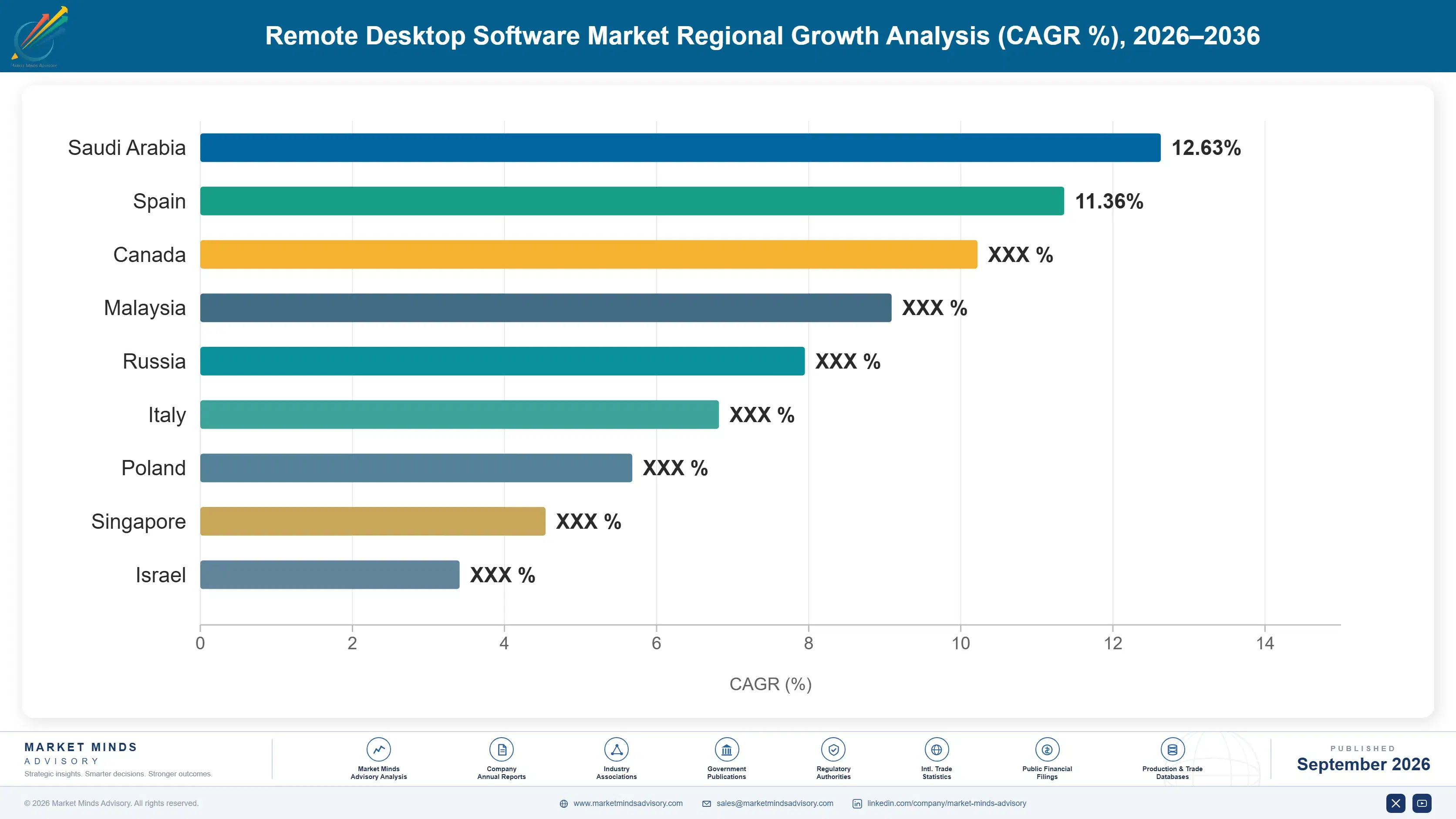
remote-desktop-software-market-country-cagr-analysis-1788503682877

Zero-Trust Modules Anchor Recurring Margin

Remote desktop vendors capture disproportionate margin through four commercial levers tied to zero-trust access subscriptions, compliance certification services, cloud desktop migration bundles, and outsourced IT support integration that basic connection licensing alone cannot sustain. Vendors with strong recurring revenue increasingly outperform those competing on connection price alone. Investors increasingly reward vendors that diversify revenue beyond a single connection licensing model.

Zero-Trust Access Control Subscription Attach Rates

Vendors bundling zero-trust access control as a recurring subscription rather than a one-time licensing fee capture ongoing revenue tied directly to active seat count, since every added employee requires continued permission management and session audit support. Organizations adopting these subscriptions report roughly 30% fewer unauthorized access incidents, a return on investment case concrete enough that renewal rates for this module consistently exceed renewal rates for basic connection licensing alone. This lever rewards vendors with genuine security engineering depth over those offering access control as a marketing checkbox without real granularity behind it.
Market Impact: Zero-trust subscriptions cut incidents by roughly 30% overall

Compliance Certification and Audit Support Services

Vendors offering dedicated compliance certification services that help organizations satisfy financial services and healthcare records retention requirements charge meaningful service fees that customers would otherwise need to fund through outside compliance consultants. These services typically cut audit preparation timelines by roughly 35% compared to organizations navigating regulatory examination without vendor support, letting vendors charge a premium for speed and reduced administrative burden. Vendors without this certification service capability increasingly lose competitive evaluations to rivals who can demonstrate proven compliance track records upfront. Some vendors now guarantee this timeline reduction contractually to differentiate their compliance offering further.
Market Impact: Certification services cut prep time by roughly 35%

Cloud Desktop Migration Bundle Sales Programs

Vendors bundling cloud-hosted desktop-as-a-service migration with core remote access licensing are capturing enterprise IT budgets previously allocated separately to physical hardware refresh cycles that cloud migration eliminates entirely. Vendors report these bundled migration deals generate roughly 40% more total revenue per customer relationship than a standalone remote access license, since customers avoid separate hardware procurement costs entirely. This lever positions vendors to capture the entire desktop infrastructure decision rather than a single point in that broader technology stack. Vendors that fail to offer bundled migration risk losing customers to more comprehensive cloud-native competitors.
Market Impact: Bundled migrations add roughly 40% more total revenue

Outsourced IT Support Integration Service Fees

Vendors offering dedicated integration support for enterprises using outsourced IT service providers charge meaningful configuration and onboarding fees that basic self-service licensing alone cannot capture from this growing customer segment. Vendors selling these integration services alongside core licensing capture roughly 20% higher per-deployment revenue than those selling licensing alone without dedicated outsourcing integration support included. This lever is likely to strengthen further as outsourced IT support models continue expanding across mid-size and large enterprises globally. Insurers and analysts increasingly factor outsourcing integration depth into overall vendor risk assessments considered. Adoption keeps rising steadily.
Market Impact: Integration services add roughly 20% more total revenue

Who Controls the Margin Pool

Remote desktop software competition sits at moderate concentration, with CR5 near 48% and TeamViewer holding a narrow lead over Citrix among large enterprise deployments, a gap that has narrowed considerably since Citrix expanded zero-trust capability aggressively. VMware, Microsoft, and AnyDesk round out the top five, each carving distinct niches around virtual desktop infrastructure, native operating system integration, and lightweight connection speed respectively.
Current competitive activity centers on zero-trust access differentiation, compliance certification expansion, and cloud desktop bundling aimed at capturing enterprise IT budgets before rivals lock up the same contracts. Vendors are also racing to secure integration partnerships with outsourced IT service providers targeting the growing distributed support workforce segment. Session recording integration depth is also becoming a meaningful differentiator among vendors competing for financial services and healthcare compliance-heavy contracts specifically.

Emerging pressure comes from regional Asian vendors entering with lower-cost, deeply localized compliance software tailored to a single jurisdiction's data residency requirements rather than a broad global platform. Rankings shift most decisively when a vendor secures a marquee large enterprise reference account, since that single win tends to cascade into adjacent enterprise contracts. Vendors offering native operating system integration increasingly win evaluations against agent-based competitors requiring separate installation.
remote-desktop-software-market-company-positioning-matrix-1788503683402

Competitive Moat and Risk Dimensions

TEAMVIEWER

Moat: Broad Cross-Platform Compatibility

TeamViewer's support for an unusually wide range of operating systems and device types gives it a genuine convenience advantage for enterprises managing heterogeneous IT environments that competitors focused on single-platform depth cannot match as easily. Large enterprises evaluating new vendors consistently cite this compatibility breadth as a key factor in retaining TeamViewer over less-flexible alternatives.
TEAMVIEWER

Risk: Security Incident History Lingers

Past security incidents tied to TeamViewer's platform have made some enterprise security teams cautious about adoption, forcing the company to invest heavily in rebuilding trust through additional security certifications and audits. This history is becoming increasingly visible in competitive evaluations against newer, security-native platforms. Addressing this fully remains a stated priority.
CITRIX

Moat: Deep Virtual Desktop Infrastructure Expertise

Citrix's decades of virtual desktop infrastructure experience across regulated industries give it credibility and technical depth that newer entrants lack when addressing complex, large-scale enterprise deployment requirements. Regulated enterprises evaluating vendors consistently cite this virtual desktop depth as a deciding factor in their platform choice.
CITRIX

Risk: Higher Cost Structure Limits Mid-Market

Citrix's premium pricing and enterprise-focused sales motion make it less competitive among mid-size organizations seeking lower-cost solutions, ceding that segment to more price-flexible regional competitors. Vendors offering flexible subscription pricing increasingly outcompete Citrix for this underserved customer segment. Building a lower-cost subscription tier remains a stated strategic priority for the company overall.

Players Tracked

Prominent Players

TeamViewer
Citrix
VMware
Microsoft
AnyDesk

Other Key Players

Splashtop
ConnectWise Control
RealVNC
GoTo Resolve
Zoho Assist
BeyondTrust
Parallels
Chrome Remote Desktop
AweSun
Iperius Remote
RemotePC
Ninja RMM
N-able
Devolutions
Impero Solutions

Recent Developments

JANUARY 2026

TeamViewer launched an expanded zero-trust access control module adding granular, role-based session permissions, aiming to differentiate its platform from competitors still offering only basic connection-level access controls. The update rolled out first to existing customers running large enterprise deployments before broader availability across the platform's full customer base.
Signal: Signals zero-trust access is becoming the primary competitive battleground for remote access vendors this cycle industry-wide today.
SEPTEMBER 2025

Citrix expanded a supply agreement with a national healthcare system to standardize its virtual desktop platform across two hundred participating clinics nationwide, embedding its software into daily clinical workflow operations. Financial terms of the multi-year standardization agreement were not disclosed by either organization involved in the deal.
Signal: Shows vendors defending installed base through large multi-facility standardization agreements with healthcare systems directly nationwide today.
MARCH 2026

VMware completed an acquisition of a cloud desktop migration startup to strengthen its desktop-as-a-service capability, addressing a feature gap that had previously pushed some enterprise customers toward standalone cloud specialists instead. The acquired startup's existing customer base will transition onto VMware's core platform during 2026 and 2027.
Signal: Indicates consolidation is accelerating as larger vendors close cloud desktop feature gaps rather quickly this year.

Cloud Compute and Encryption Cost Exposure

Remote desktop platforms depend heavily on cloud compute capacity and encryption processing overhead for secure session routing, which together account for roughly 24% of operating cost of goods for most vendors tracked in the survey. Vendors with lightweight peer-to-peer connection architectures face meaningfully less direct exposure to this cost pressure than platforms routing all traffic through centralized cloud relay infrastructure.
Cloud compute and data center capacity pricing rose sharply during 2025 as enterprise-wide demand for secure session infrastructure outpaced available data center capacity, a swing Microsoft's investor disclosures cited directly as a factor pressuring margins across its cloud services division. Smaller vendors without long-term compute reservation contracts saw per-session hosting costs rise considerably faster than larger competitors with existing volume-based pricing agreements built up over years.

Vendors with in-house data center infrastructure absorb these cost swings far more comfortably than smaller competitors dependent on third-party cloud providers, meaning exposure varies sharply by vendor scale and infrastructure investment history. Vendors that diversified cloud provider relationships across multiple regional data centers during the disruption reduced cost exposure considerably compared to those dependent on a single provider. This dynamic favors early-negotiating vendors.
remote-desktop-software-market-cost-volatility-analysis-1788503683598

Diversified Cloud Provider Agreements

Larger vendors are signing long-term contracts with multiple cloud infrastructure providers rather than depending on a single source, trading some cost efficiency for meaningfully reduced exposure to the kind of demand-driven pricing swings that hit smaller vendors hardest in 2025. This diversification strategy requires ongoing provider relationship management but pays off substantially during industry-wide demand spikes and infrastructure disruption events.

Peer-to-Peer Connection Architecture Investment

Vendors investing in peer-to-peer connection architectures that route session traffic directly between devices reduce dependence on centralized cloud relay infrastructure, capturing meaningful infrastructure cost savings while gaining flexibility to scale independently of provider pricing. This positioning also improves gross margin structure meaningfully since peer-to-peer routing carries lower marginal cost than centralized relay infrastructure at scale.

Tiered Pricing Passing Cost to High-Volume Users

Several vendors are restructuring pricing tiers so that high-session-volume customers, who generate the most compute and encryption load, pay proportionally more than occasional users, aligning cost exposure directly with the customers generating it. This approach requires careful pricing communication but meaningfully protects margin for the segment of customers who generate the least compute load.

Portfolio Architecture for Margin Defence

Remote desktop economics split across three tiers, with gross margins ranging from the low twenties in basic connection-only tiers up past fifty percent in zero-trust access and compliance certification subscriptions. The volume tier competes largely on price against free basic connection tools, while the premium tier commands stronger margins through zero-trust depth and professional compliance certification relationships.
Tension between volume and premium positioning shapes vendor strategy directly: chasing basic connection sign-ups through aggressive pricing erodes the very margin that funds ongoing zero-trust development, yet abandoning volume-tier pricing concedes entry-level customers to free competitors. Most successful vendors resolve this by treating basic tiers as a customer acquisition function that eventually converts users toward premium security capability.

High-value margin pools concentrate in zero-trust access subscriptions and compliance certification services, where recurring, professionally-validated revenue commands a premium over one-time connection transactions. Sustainability and next-generation categories, particularly cloud desktop migration and outsourced support integration, remain smaller today but are the segment analysts expect to reprice fastest as hybrid work deepens. Vendors positioned early in that transition stand to capture disproportionate share of the next decade's growth as hybrid work becomes a more decisive purchasing factor for large enterprises.

Basic connection tiers competing against free tools on price, sold largely to small businesses with limited compliance requirements and budget flexibility. Consolidation among smaller regional providers is likely as free-tier competition intensifies across this segment overall in coming years.
Gross Margin

Zero-trust access upgrades and compliance certification subscriptions sold directly to large enterprises and regulated industries requiring proven audit capability. Vendors with proven compliance track records and broad zero-trust coverage hold a durable advantage in this tier.
Gross Margin

Cloud desktop migration and outsourced support integration developed for intensifying hybrid work and compliance requirements, an emerging category still forming. Regulatory clarity in the coming years should meaningfully accelerate adoption across this category industry-wide overall.
Gross Margin
remote-desktop-software-market-portfolio-architecture-1788503684098

High-value Sub-segments and Strategic Watch-out

Cloud-Hosted Desktop-as-a-Service Platforms

The fastest-growing and highest-value pool, driven by enterprises reducing physical office hardware dependence, where vendors able to demonstrate broad cloud coverage capture disproportionate renewal contract value. TeamViewer and VMware currently hold the strongest track records here, while smaller vendors race to build comparable cloud infrastructure before losing renewal contracts.

Session Recording and Security Compliance Modules

A high-value pool growing more moderately as regulated industries demand auditable records, rewarding vendors already embedded in enterprise compliance relationships over new entrants building standalone tools. Vendors offering searchable, timestamped playback are winning evaluations against providers requiring manual log review for regulatory examination purposes. Legal teams increasingly favor this feature.

Remote Access Client Software

The volume core of the market, serving basic connection needs at lower margin but steady demand, providing the installed base that subsidizes specialized zero-trust development investment. Large diversified providers dominate this tier through existing enterprise relationships despite intensifying feature competition from zero-trust-focused entrants. Price competition remains fierce here.

Multi-Factor Authentication and Access Control Integration

A strategic watch-out segment where intensifying financial services and healthcare regulation could make documented access control a mandatory rather than optional purchase across most enterprises. Vendors building this capability early may capture disproportionate share once regulation broadens across major industries over the coming years. Audit teams increasingly demand this.

Zero-Trust Subscriptions Anchor Recurring Demand

Remote desktop software generates genuine annuity economics once an organization deploys it at scale, since zero-trust access subscriptions, compliance certification services, and session recording recur on an annual renewal cycle rather than a single one-time purchase. This recurring revenue base cushions vendors against cyclical swings in enterprise IT spending and workforce distribution patterns across broader economic conditions. Vendors initially underpriced this recurring revenue stream.
Adoption stickiness runs deepest among large enterprises whose access policies and session history become embedded in a platform's compliance records that cannot easily transfer without migration effort, and shallowest among small businesses using basic tools interchangeably. Compliance-certified customers sit closer to large enterprises on this spectrum as regulatory relationships mature. Vendors absent from that channel risk losing the client relationship to a more established rival.

A generational shift in buyer profiles is underway as younger, digitally native IT administrators who grew up expecting automated software solutions replace an older cohort accustomed to manual permission management and paper-based access logs, normalizing zero-trust remote access as the default rather than the specialist alternative. That shift favors vendors who invested early in intuitive, mobile-friendly interfaces over legacy competitors. Slow vendors risk ceding the next refresh cycle to mobile-forward competitors.
remote-desktop-software-market-end-use-penetration-index-1788503684583

Where Zero-Trust Beats Connection Price

These are among the four positions where our research anticipates prominent divergence between winners and laggards over the coming forecast period. Each is grounded in the demand model, the regulatory perimeter, and the announced capacity pipeline.
01 / ZERO-TRUST ACCESS PRIORITY

Build granular access controls before rivals close the gap

Vendors chasing basic connection sales without zero-trust access depth will find margin ceilings well below what large enterprises pay for measurable security incident reduction, since access control concerns dominate purchasing decisions more than connection speed alone. Large enterprises specify this capability by name in vendor evaluations now, and vendors that can prove concrete incident reduction win renewal contracts far more consistently than connection-only competitors. That security gap, more than any single feature, currently separates the premium software tier from commodity connection bundles.
02 / COMPLIANCE CHANNEL INVESTMENT

Build certification service relationships ahead of rivals now

A meaningful share of new enterprise contract acquisition turns on compliance certification relationships, and vendors offering audit-ready documentation win contracts against rivals requiring organizations to fund custom compliance work separately. That advantage compounds as regulated organizations increasingly treat vendor certification quality as a proxy for overall platform reliability during procurement evaluations each cycle. Vendors slow to build this certification capability risk losing evaluations to competitors with proven compliance track records already established across multiple industries and several distinct regulatory jurisdictions.
03 / CLOUD MIGRATION EXPANSION

Expand cloud desktop bundling as hybrid work normalizes

Sustained remote and hybrid work arrangements represent a genuine expansion opportunity for vendors offering cloud desktop migration, giving organizations a concrete reason to upgrade from basic connection licensing to premium cloud-hosted subscription tiers. Vendors that win early enterprise cloud migration relationships tend to lock in premium tier renewals as hardware reduction continues expanding across subsequent budget cycles at large organizations. This expansion opportunity compounds quickly given how few vendors currently have proven cloud desktop migration track records at meaningful scale.
04 / REGIONAL MARKET POSITIONING

Defend North American leadership while building Asian scale

North America's concentration of vendor headquarters and heavy compliance requirements gives incumbents a durable home-market advantage, but South Asia and Pacific's expanding IT outsourcing sector is driving the fastest actual growth rates in the market. Vendors that rely solely on North American brand reputation risk losing share to lower-cost regional entrants building dedicated South Asian localized compliance infrastructure. Building service scale in South Asia while preserving North American product depth offers the clearest path to capturing both growth vectors simultaneously.

Engagement Snapshot From the Field

A live engagement with an industry participant carrying material or product regulatory and market exposure ahead of a defining policy shift, showing how our research translates into a defensible multi-year portfolio strategy.
MARKET MINDS ADVISORY · CLIENT ENGAGEMENT SUMMARY
Remote Desktop Software Producer Strategic Portfolio Review and Transition Roadmap 2026·Investment Scenario on Remote Desktop Software Exposure Evaluation 2025-26
CLIENT PROFILE
The client operates a mid-size regional insurance provider employing roughly 1,200 remote and hybrid workers, facing increased regulatory scrutiny over its claims processing data access and audit trail practices. The insurer had operated on the same legacy remote access tool for over a decade before initiating this engagement with MMA. Its leadership had limited prior experience negotiating large-scale enterprise software vendor contracts.
STRATEGIC CHALLENGE
The client faced mounting examiner findings related to inadequate access logging on its legacy remote desktop tool, while its distributed claims processing staff needed secure access to sensitive customer records from home offices. Executive leadership viewed the examination findings as a growing threat to its regulatory standing and reputation. Board leadership prioritized this engagement above other planned technology investments for the year.
MMA APPROACH
MMA analysts benchmarked remote desktop vendors on zero-trust access depth, compliance certification track record, and total cost of ownership, then modeled a phased migration plan matched to the insurer's examination calendar. The analysis also incorporated a detailed cost comparison against continuing operations with the insurer's existing legacy remote access tool.
KEY FINDINGS
  1. Zero-trust access controls reduced unauthorized data access attempts by roughly 60% compared to the legacy platform (client-reported, unverified by MMA). Error reduction exceeded internal projections set before the migration project began.
  2. Migration to the new platform took roughly five weeks longer than initially estimated given legacy configuration complexity. This delay was attributed to unexpected complexity in legacy access policy configuration.
  3. Documented, searchable session logs helped the insurer respond to examiner requests considerably faster than before. Examiners specifically praised the improved retrieval speed during the review process.
  4. The insurer passed its subsequent regulatory examination with meaningfully fewer access control findings (client-reported, unverified by MMA). Regulators cited the improved documentation as a meaningful positive development.
CLIENT PROFILE
The client operates a mid-size regional insurance provider employing roughly 1,200 remote and hybrid workers, facing increased regulatory scrutiny over its claims processing data access and audit trail practices. The insurer had operated on the same legacy remote access tool for over a decade before initiating this engagement with MMA. Its leadership had limited prior experience negotiating large-scale enterprise software vendor contracts.
STRATEGIC CHALLENGE
The client faced mounting examiner findings related to inadequate access logging on its legacy remote desktop tool, while its distributed claims processing staff needed secure access to sensitive customer records from home offices. Executive leadership viewed the examination findings as a growing threat to its regulatory standing and reputation. Board leadership prioritized this engagement above other planned technology investments for the year.
MMA APPROACH
MMA analysts benchmarked remote desktop vendors on zero-trust access depth, compliance certification track record, and total cost of ownership, then modeled a phased migration plan matched to the insurer's examination calendar. The analysis also incorporated a detailed cost comparison against continuing operations with the insurer's existing legacy remote access tool.
KEY FINDINGS
  1. Zero-trust access controls reduced unauthorized data access attempts by roughly 60% compared to the legacy platform (client-reported, unverified by MMA). Error reduction exceeded internal projections set before the migration project began.
  2. Migration to the new platform took roughly five weeks longer than initially estimated given legacy configuration complexity. This delay was attributed to unexpected complexity in legacy access policy configuration.
  3. Documented, searchable session logs helped the insurer respond to examiner requests considerably faster than before. Examiners specifically praised the improved retrieval speed during the review process.
  4. The insurer passed its subsequent regulatory examination with meaningfully fewer access control findings (client-reported, unverified by MMA). Regulators cited the improved documentation as a meaningful positive development.
RECOMMENDED STRATEGY
Phase 1: Phase one: migrate the highest-risk claims processing teams first, ahead of the next examination cycle. This sequencing addresses the greatest regulatory exposure and compliance risk first. Phase 2: Phase two: retrain compliance staff through vendor-provided certification programs before the full migration completes. Certification typically requires roughly three weeks of hands-on instruction time overall. Phase 3: Phase three: establish ongoing compliance audit support contracts once the platform transition finishes successfully. These contracts protect against future examination findings after the migration closes.
OUTCOME
The insurer completed its remote access platform migration ahead of its next regulatory examination and passed with meaningfully fewer findings, according to client-reported figures unverified by MMA, strengthening its standing with examiners going forward. Leadership credited the phased migration approach with minimizing operational disruption during the transition period.

Frequently Asked Questions

Foundational context covering the market sizes, CAGR, scope, country, region and competition that inform every finding below. This section is provided to cover basics and most often pre-purchase conversations, answered from the MMA Primary Research Dataset.

What is the current size of the Remote Desktop Software Market?

The global remote desktop software market reached an estimated $3.9 billion in 2025, reflecting sustained demand from permanent hybrid work arrangements and tightening zero-trust security mandates.

How large will the Remote Desktop Software Market be by 2036?

MMA projects the market will reach approximately $10.9 billion by 2036, driven by cloud desktop migration, zero-trust adoption, and expanding compliance certification requirements across most global markets.

What is the CAGR for the Remote Desktop Software Market 2026 to 2036?

The market is forecast to grow at a 9.8% compound annual rate between 2026 and 2036, roughly one percentage point above the historical rate recorded over the preceding five-year period.

Which segment is growing fastest?

Cloud-hosted desktop-as-a-service platforms lead growth at 16.2% CAGR, roughly 1.65 times the overall market rate, driven by enterprises reducing physical office hardware dependence quite considerably.

Who are the major companies in the Remote Desktop Software Market?

TeamViewer, Citrix, VMware, Microsoft, and AnyDesk lead the market, together holding an estimated 48% combined revenue concentration across the entire global active seat base today.

Which country is growing fastest?

India leads country-level growth at 15.4% CAGR, supported by its massive IT outsourcing sector and expanding enterprise digitization initiatives across the whole financial services industry.

Report Segmentation Architecture

The full report scope spans multiple orthogonal segmentation dimensions, with cross-tabulated demand data provided for each dimension pair. Coverage extends further to regional breakdowns, trend trajectories, and the competitive detail needed to support segment-level decision-making.

By Primary Market Dimension

  • Remote Access Client Software
  • Virtual Desktop Infrastructure Platforms
  • Remote Support and Helpdesk Tools
  • Session Recording and Security Compliance Modules
  • Cloud-Hosted Desktop-as-a-Service Platforms
  • Multi-Factor Authentication and Access Control Integration

By End-Use Industry

  • Financial Services
  • Healthcare
  • Information Technology Services
  • Government and Public Sector
  • Manufacturing

By Commercial Dimension

  • Direct Enterprise Software Sales
  • Subscription and Seat-Based Licensing
  • Managed Service Provider Contracts
  • System Integrator Channel Sales

By Region

  • North America
  • Western Europe
  • East Asia
  • South Asia and Pacific
  • Latin America
  • Middle East and Africa
  • Eastern Europe

Scope, Methodology, and Coverage

Every figure in this report is reproducible from documented input assumptions. The scope below maps the historical period, the forecast horizon, the segmentation dimensions, and the countries covered, alongside the underlying primary and qualitative methodology.
Historical Period
2020 to 2025
Forecast Period
2026 to 2036
Base Year
2025 (USD billions; MMA Primary Research Dataset, September 2026)
Market Definition
This report defines the remote desktop software market as software that provides remote access to computers and virtual desktops, spanning remote access clients, virtual desktop infrastructure, session recording, and zero-trust access control tools. It excludes general video conferencing software and cloud file storage services that do not provide direct remote desktop control capability.
Quantitative Units
USD billions, active seats, CAGR percentages
Segmentation Dimensions
Software function, end-use industry, commercial channel, region
Regions Covered
North America, Western Europe, East Asia, South Asia and Pacific, Latin America, Middle East and Africa, Eastern Europe
Countries Covered
United States, India, United Kingdom, Germany, China, Philippines, and 25 additional countries
Key Companies Profiled
TeamViewer, Citrix, VMware, Microsoft, AnyDesk, and 15 additional companies
Quantitative Methodology
Primary survey, n=3,800 respondents, Q4 2025, six countries; demand-side model with trade association cross-validation
Qualitative Methodology
47 expert interviews, Q4 2025; applied to validate demand model assumptions, identify emerging dynamics, and assess competitive positioning
Report Format
PDF and XLSX data workbook (Word format preview document)
Publisher
Market Minds Advisory
Report Code
MMA-2026-TEC-206
Published
September 2026
Contact
sales@marketmindsadvisory.com | www.marketmindsadvisory.com

Purchase the full Remote Desktop Software Market Report (2026 to 2036).

This report delivers a comprehensive analysis of the global remote desktop software market, covering historical performance from 2020 through 2025 and forecasts through 2036 across software segments, end-use industries, and seven world regions. It profiles the twenty leading vendors shaping zero-trust access, compliance certification, and cloud desktop adoption, benchmarks competitive positioning, and quantifies cloud compute and encryption cost exposure. Analysts examine revenue diversification levers, portfolio margin economics, and demand stickiness across financial services, healthcare, and IT services verticals. A dedicated case study illustrates how one regional insurance provider applied these findings to its own platform migration decisions.
Seven-region market sizing and growth forecasts
Twenty-company competitive benchmarking and moat analysis
Cloud cost exposure and mitigation strategy analysis
Six-segment software function and application breakdown
Revenue lever and margin tier analysis
Anonymized client case study with recommended strategy

Built For The People Who Decide

From boardroom strategy to bench-side execution, this report is read cover-to-cover by leaders shaping the next decade of their industry, turning demand scenarios, market dynamics and valuation benchmarks into decisions.
CXOs/ Presidents/ VPs/ Managers
M&A and Corporate Development
Strategy Teams and R&D Heads
Procurement and Product Directors
Regulatory and Compliance Leaders
Investor Relations and Equity Analysts