Market Minds Advisory
Refurbished Dental Equipment Market

Refurbished Dental Equipment Market: Certified Pre-Owned Equipment Enters Mainstream Practice Buying

New dental practice formation is increasingly funded through certified pre-owned equipment purchases, as graduating dentists and emerging market clinics stretch limited startup capital across chairs, imaging systems, and sterilization equipment worldwide.

Lead Analyst

Alice Ballenger

Published

September 2026

Make Smarter Decisions with Customized Research Insights

Request a free sample report and evaluate market opportunities, growth trends, and competitive dynamics relevant to your business needs.

2025 MARKET VALUE$1.0BMarket Size 2025
2036 FORECAST VALUE$2.1BBase Case , 2026 to 2036
CAGR 2026 TO 20366.8 %Bull 8.1% / Bear 5.5%
INCREMENTAL OPPORTUNITY$1.0BNet 10- year value creation
EXPANSION MULTIPLE1.93x2036 value over 2026 base
Strategic Levers
M&A Pipeline
Regional Outlook
Country Rankings
Competitive Intelligence
Segmental Deep-dive
Call-Us : 91 93563 13602

Executive Snapshot and Market Trajectory

New dental practice formation worldwide is increasingly funded through certified pre-owned equipment purchases, as graduating dentists and emerging market clinics stretch limited startup capital across chairs, imaging systems, sterilization equipment, and handpieces rather than buying new equipment across most cost-sensitive markets and regions worldwide.
Independent dental practices and emerging market clinics now drive purchasing volume, favoring certified refurbished chairs, digital imaging systems, and CAD/CAM equipment over new purchases as startup capital constraints push buyers toward proven, lower-cost alternatives across most cost-sensitive markets worldwide. North America and East Asia together account for the largest share of transaction volume, with steady equipment turnover from upgrading United States practices and rapidly expanding new clinic formation across China anchoring supply and demand.
A fragmented group of specialized dealers and equipment distributors competes on refurbishment quality and warranty coverage rather than price alone, spanning both dedicated resellers and manufacturer-affiliated certified pre-owned programs across most regional markets. Regulatory and warranty standardization timing for refurbished digital imaging equipment is reshaping competitive rankings meaningfully, rewarding dealers that moved fastest to build trusted certification processes across major device markets and independent practice networks worldwide.
Market Definition
The Refurbished Dental Equipment Market covers previously owned dental chairs, delivery units, imaging systems, sterilization equipment, and handpieces that have been inspected, reconditioned, and resold with warranty coverage. It excludes new equipment sales, dental consumables and disposables, and equipment sold without inspection or warranty as scrap or parts-only condition.
Base Year Value
$1.0B in 2025 (MMA Primary Research Dataset, August 2026)
Forecast Period
2026 to 2036, eleven discrete annual values
CAGR
6.8% base case. Bull 8.1%. Bear 5.5%.
Fastest Growth Segment
Refurbished CAD/CAM and Digital Imaging Systems: 13.0% CAGR
Fastest Growth Country
India: 11.0% CAGR
Fastest Growth Region
South Asia and Pacific: 9.0% CAGR
Largest Region
North America: 28% of 2025 global value
Market Leaders
Henry Schein, Patterson Dental, A-dec, Dentsply Sirona, DentalEZ Group. Source: MMA Analysis, July 2026.
Primary Survey
n=3,800 procurement and R&D decision-makers, Q4 2025, six countries
Methodology
Demand-side build-up, cross-validated against public data, 47 expert interviews

Refurbished Dental Equipment Market Forecast Scenarios

refurbished-dental-equipment-market-size-forecast-scenario-1787306581538
Global refurbished dental equipment revenue grew steadily between 2020 and 2025 as new practice formation accelerated among graduating dentists facing high student loan debt levels and new clinic openings expanded across emerging markets and cost-sensitive regions worldwide, lifting the historical growth rate above five percent annually across most established secondary equipment markets and dealer networks.
The base case assumes continued growth in independent practice formation funded partly through certified pre-owned equipment purchases, expanding refurbishment infrastructure investment across East Asian markets, and rising digital imaging equipment turnover tied to practice upgrade cycles among established dental clinics. These three mechanisms together support base-case growth near the middle of the forecast band through 2036, with refurbished digital equipment capturing an increasing share of new transaction volume across most developed and expanding markets.
A bull scenario assumes accelerated new practice formation alongside expanded certified pre-owned warranty programs across several emerging markets, pushing growth toward the top of the forecast band through the decade. A bear scenario assumes slower equipment turnover from established practices and continued preference for financing new equipment purchases, holding growth closer to the forecast floor instead.

Certified Pre-Owned Equipment Enters Mainstream Practice Buying

The refurbished dental equipment market is moving from an informal secondhand trade toward a structured certified pre-owned category, as dealers build standardized inspection, reconditioning, and warranty processes that give buyers confidence comparable to new equipment purchases across most transaction types and channels. New practice owners and dental service organizations increasingly treat refurbished equipment as a legitimate capital planning option rather than a fallback for the budget-con
MARKET CONCENTRATION32%Combined revenue share held by top five equipment dealers
AVERAGE REFURBISHMENT DISCOUNT42% below new priceBlended savings across chairs, imaging, and sterilization equipment
TOP SOURCING COUNTRYUSA, 26% shareShare of global refurbished equipment supply sourced from one country
DIGITAL EQUIPMENT PENETRATION24% of transactionsShare of refurbished sales now involving digital imaging systems
CERTIFIED WARRANTY COVERAGE58% of dealersShare of dealers offering formal warranty on refurbished equipment
REFURBISHMENT CYCLE TIME6 weeksTypical time from equipment intake to certified resale readiness
Commercial character is defined by dealer margin on acquisition, reconditioning, and resale rather than manufacturer reagent or service contract revenue, so profitability depends heavily on sourcing quality used equipment and reconditioning it efficiently at scale across most regional markets. Independent dealers and manufacturer-affiliated certified pre-owned programs increasingly compete for the same supply of equipment coming off upgrading practices nationwide.
Warranty standardization and inspection certification timing for refurbished digital imaging equipment is reshaping competitive rankings meaningfully, rewarding dealers that moved fastest to build trusted certification processes while new practice formation keeps expanding the addressable buyer population steadily as dental school graduates face mounting startup capital constraints across most developed and emerging markets, independent practice networks, and dental service organizations worldwide.
"Buying certified refurbished isn't settling anymore, it's how half the new practices in this country actually open their doors."
Director, Dental and Medical Equipment Practice · MMA Secondary Medical and Dent

Market Trends

Certified Pre-Owned Programs Formalize Secondary Equipment Trade

Manufacturer-affiliated and independent dealers are building formal certified pre-owned programs with standardized multi-point inspection checklists, reconditioning protocols, and warranty coverage that closely mirror how the automotive industry structured its own used vehicle certification decades earlier. This formalization is reducing buyer hesitancy that historically limited refurbished equipment to only the most price-sensitive purchasers, expanding the addressable buyer population meaningfully. Roughly 24 percent of refurbished transactions in leading markets now involve digital imaging equipment, up from a much smaller share five years earlier, and dealers are racing to expand reconditioning capacity to meet accelerating demand across major device markets worldwide.
Market Impact: New practice openings grow 9 percen

Dental School Debt Levels Drive New Practice Equipment Choices

Rising dental school tuition and student loan debt levels are pushing newly graduating dentists to prioritize capital efficiency when equipping their first independent practice, making refurbished equipment purchases increasingly central to practice launch financial planning. Financial advisors specializing in dental practice startups now routinely model refurbished equipment scenarios alongside new equipment financing when helping graduates plan their first practice budget. This financing shift is expected to add substantial incremental transaction volume globally over the forecast period, sustaining demand growth even where established practice equipment turnover holds steady across most developed dental markets.
Market Impact: 35 percent of inventory from trade-

Market Opportunities and Growth Drivers

New Independent Practice Formation Fuels Equipment Demand

New dental school graduates and experienced dentists leaving group practices to start independent clinics are driving equipment demand steadily, since every new practice requires a full equipment complement from chairs through sterilization systems. Startup capital constraints push a meaningful share of these new practice owners toward refurbished equipment for at least their initial equipment purchase, rather than financing an entirely new equipment package from day one. New independent practice openings have grown to roughly 9 percent annually in several major markets, directly expanding the addressable buyer population for refurbished equipment dealers across most developed dental markets.
Market Impact: Digital equipment depreciates 22 pe

Equipment Upgrade Cycles Among Established Practices Feed Supply

Established practices upgrading to newer digital imaging and CAD/CAM technology generate a steady supply of functional used equipment entering the secondary market, since most upgraded equipment remains fully operational despite no longer meeting the upgrading practice's specific clinical needs. This upgrade cycle supply feeds dealer inventory without requiring dealers to source equipment from closing practices alone, supporting consistent refurbished equipment availability. Roughly 35 percent of refurbished equipment inventory in leading markets now originates from practice upgrade trade-ins, up from a smaller share five years earlier, directly supporting dealer sourcing economics.
Market Impact: 18 percent of buyers choose new

Market Restraints and Challenges

Rapid Digital Technology Obsolescence Shortens Resale Window

Digital imaging and CAD/CAM equipment technology advances quickly enough that units traded in after only a few years of service can already lag several generations behind current offerings, compressing the window during which refurbished digital equipment commands strong resale value. The root cause is the underlying software and sensor technology improvement pace, which outstrips the mechanical durability of the equipment itself in many digital categories. Dealers are exploring software upgrade paths and modular hardware components to extend usable resale life, but digital equipment resale value still depreciates roughly 22 percent faster than mechanical equipment categories on average.
Market Impact: Digital equipment reaches 24 percen

Inconsistent Certification Standards Create Buyer Trust Gaps

Refurbishment quality and inspection thoroughness vary meaningfully across dealers, since no single industry-wide certification standard exists to guarantee consistent reconditioning quality across the fragmented dealer landscape and independent reseller network. The root cause is the absence of a unified accreditation body comparable to those governing other refurbished medical equipment categories, leaving buyers to rely on individual dealer reputation rather than standardized guarantees. Industry associations are developing voluntary certification frameworks to address this gap, but buyer trust concerns still cause roughly 18 percent of prospective purchasers to choose new equipment instead.
Market Impact: Adds roughly 10 percent incremental
4 additional market trends, 4 additional growth drivers, and 4 additional restraints and challenges are covered in the full report. Contact sales@marketmindsadvisory.com to access the complete intelligence.

Segment CAGR and Growth Architecture

Segmentation follows equipment category and technology type, the dimension that most directly determines refurbishment complexity, resale value retention, and buyer purchasing criteria across independent practices, group practices, and expanding dental service organizations worldwide today and consistently. This lens captures where transaction value is shifting fastest during the ongoing formalization of certified pre-owned equipment trade.
refurbished-dental-equipment-market-market-share-analysis-1787306582133

Refurbished CAD/CAM and Digital Imaging Systems

Refurbished CAD/CAM and digital imaging systems are the fastest-growing product category, expanding at roughly 13 percent annually as certified pre-owned programs extend into digital equipment categories previously considered too technically complex for reliable refurbishment. Adoption is concentrated among cost-conscious new practice owners first, with established practices following as digital equipment trade-in supply grows and reconditioning quality improves over time. Dealers are racing to build technical expertise and software validation processes specific to digital equipment, while buyers increasingly treat certified digital refurbishment as comparable in reliability to mechanical equipment categories. Clinical practice adoption data continues expanding confidence in refurbished digital equipment reliability, further widening the addressable buyer population for this segment specifically.
CAGR 13.0%

Refurbished Dental Chairs and Delivery Units

Refurbished dental chairs and delivery units form the second-fastest-growing category at roughly 9 percent annually, driven by steady equipment turnover from upgrading practices and the mechanical durability that makes chairs and delivery units well suited to multiple refurbishment cycles over their service life. These core operatory components represent the largest single equipment expenditure for a new practice, making refurbished purchasing particularly attractive for startup capital planning. New practice owners increasingly view refurbished chairs and delivery units as a practical entry point into certified pre-owned purchasing before considering more complex digital equipment categories. Growth trails digital imaging systems because chair and delivery unit technology evolves more slowly, extending useful service life and moderating replacement-driven transaction volume.
CAGR 9.0%
Full segment breakdown across 6 segments available in the complete report.

Regional Architecture and Country Demand Map

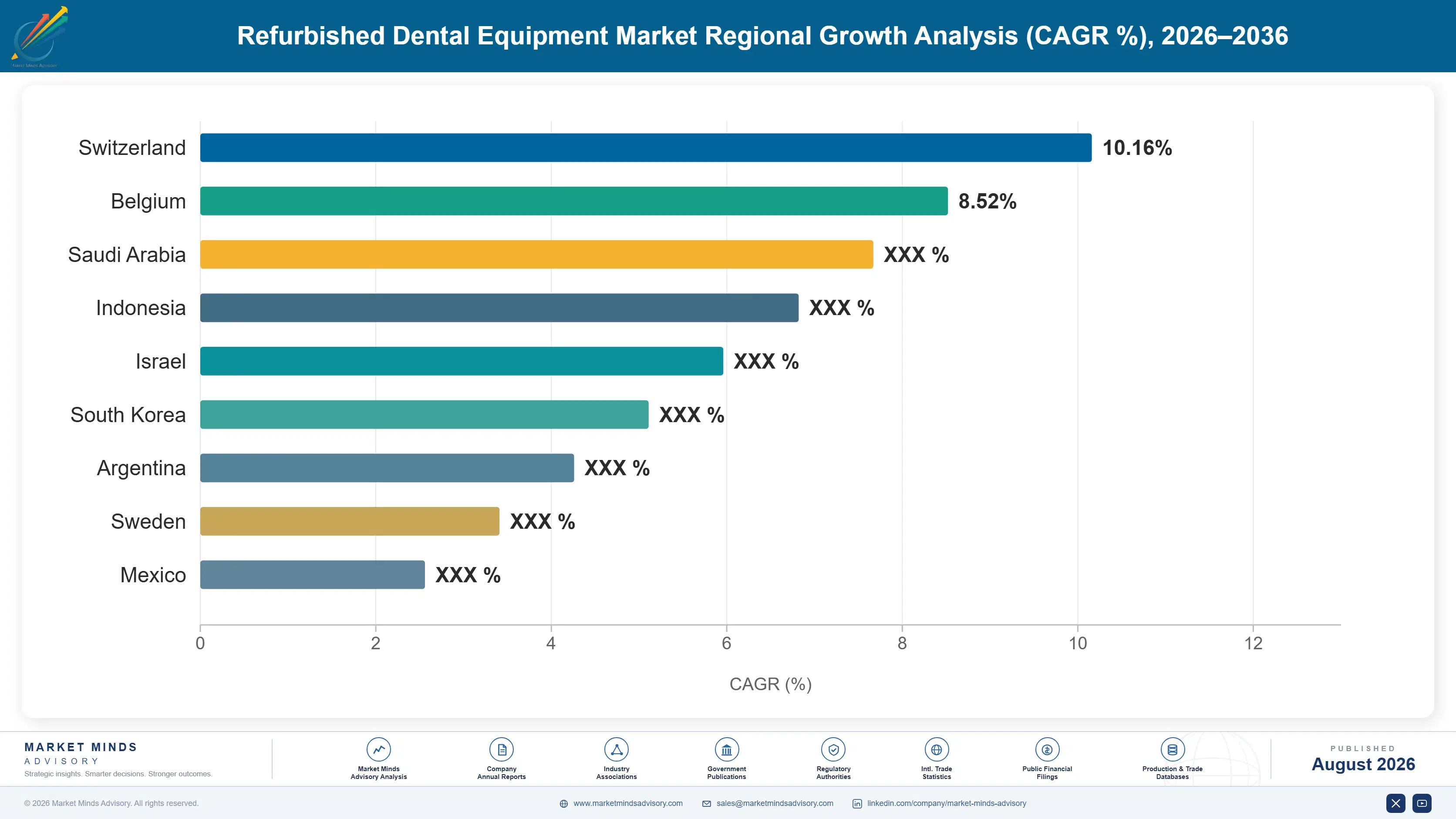
Transaction volume concentrates in markets with high equipment turnover from upgrading practices and steady new practice formation, with North America and East Asia together accounting for more than half of global revenue, while adoption elsewhere tracks startup capital constraints and dealer network expansion closely across the decade.

North America

North America takes the largest regional share, anchored by the United States, where high equipment turnover from established practices upgrading to newer technology generates steady refurbished equipment supply that dedicated dealer networks efficiently recondition and resell. Dense independent practice formation, particularly among recent dental school graduates carrying substantial student loan debt, supports strong buyer demand for certified pre-owned equipment across most metropolitan and rural markets alike. Established certified pre-owned programs run by major distributors and manufacturer-affiliated dealers give the United States market a maturity that few other regions have reached in refurbishment standardization. Canada contributes steady incremental volume, though its smaller dealer network keeps equipment availability somewhat more limited than the dominant United States market.
Share: 28% | CAGR: 7.5% (2026 to 2036)

Western Europe

Western Europe combines a large installed base of dental equipment with somewhat slower certified pre-owned market formalization than North America, reflecting fragmented national dealer networks in Germany, France, and the United Kingdom that have not yet consolidated around unified certification standards across most of the region and its various dealer segments. Germany's large practice network anchors regional refurbished equipment supply, while the United Kingdom's independent dealer landscape remains fragmented across many small regional resellers rather than a few dominant certified programs with national reach. Nordic countries maintain comparatively strong equipment turnover rates tied to well-funded practice upgrade cycles, supporting steady refurbished equipment availability across most of the region consistently and reliably every year.
Share: 20% | CAGR: 5.3% (2026 to 2036)
Regional intelligence for 5 additional markets available in the complete report: East Asia, South Asia and Pacific, Latin America, Middle East and Africa, Eastern Europe. Contact sales@marketmindsadvisory.com.
refurbished-dental-equipment-market-country-cagr-analysis-1787306582681

Certification Trust Capture and Trade-In Sourcing Depth

Dealer revenue growth in this market depends heavily on building trusted certification programs that reduce buyer hesitancy while securing reliable trade-in equipment sourcing from upgrading practices and closing clinics nationwide. These four levers describe where transaction margin is concentrating fastest as the certified pre-owned category continues formalizing across most regional markets and dealer networks.

Certified Warranty Program Trust Building Strategy

Building a standardized multi-point inspection and warranty program lets dealers charge premium pricing relative to uncertified secondhand sales, since buyers increasingly value documented equipment condition and repair coverage over unverified private-party transactions conducted entirely without formal guarantees. Dealers offering the strongest warranty terms and most transparent inspection documentation are capturing disproportionate buyer trust and repeat referral business from practice consultants and dental school career services offices. Warranty-backed transactions now command roughly 28 percent higher average sale price than uncertified equivalent equipment, directly rewarding dealers who invest in formal certification infrastructure.
Market Impact: Warranty-backed transactions comman

Practice Upgrade Trade-In Sourcing Relationship Strategy

Establishing direct trade-in relationships with equipment distributors and manufacturers selling new equipment lets dealers secure first access to functional used equipment before it reaches open secondary markets, improving inventory quality and acquisition cost simultaneously across most sourcing channels. Dealers with established trade-in sourcing relationships capture equipment at meaningfully lower acquisition cost than those competing for inventory through open broker channels. Trade-in sourced inventory now accounts for roughly 38 percent of total dealer inventory among leading refurbishers, up meaningfully from a smaller share three years earlier, directly improving dealer margin economics.
Market Impact: Trade-in sourced inventory now reac

New Practice Financing Partnership Growth Strategy

Partnering with practice startup lenders and dental school financial planning programs to position refurbished equipment as a standard financing option lets dealers capture new practice equipment purchases earlier in the planning process, well before graduates commit to new equipment financing alternatives instead. Dealers with established lender partnerships convert practice startup inquiries into equipment sales meaningfully faster than those relying on organic buyer discovery alone. Financing-partnered transactions have grown to roughly 31 percent of new practice equipment sales among leading dealers, directly correlating with faster sales cycles and stronger customer acquisition economics.
Market Impact: Financing-partnered transactions re

Emerging Market Dealer Network Expansion Strategy

Establishing dealer partnerships in emerging markets ahead of competitors builds first-mover advantage in equipment sourcing and resale relationships, since many emerging market dental sectors are building formal certified pre-owned infrastructure for the first time rather than expanding existing dealer networks. Dealers investing in local reconditioning capacity and certification training tailored to specific national dental practice standards capture a disproportionate share of new market equipment relationships. Emerging market transaction volume is growing roughly 14 percent annually, outpacing mature market growth meaningfully as new practice formation accelerates across these developing dental markets.
Market Impact: Emerging market volume grows roughl

Who Controls the Margin Pool

The top five dealers by revenue share hold roughly 32 percent combined, a low concentration level reflecting the highly fragmented nature of the secondary equipment dealer landscape across most regional markets and dealer segments worldwide. Henry Schein and Patterson Dental lead through combined certified pre-owned program scale and established distributor relationships, with a moderate gap separating them from smaller independent regional dealers.
Current competitive activity centers on three dimensions: building standardized inspection and warranty certification programs, securing direct trade-in sourcing relationships with practices upgrading equipment, and expanding digital equipment refurbishment technical capability and specialized staff expertise across most regional dealer networks nationwide. Certification program credibility increasingly separates trusted dealers from smaller regional resellers still operating without formal warranty infrastructure and documentation.

Emerging pressure comes from independent regional dealers offering lower prices without formal certification overhead, gradually winning price-sensitive buyer segments outside the established leaders' core certified pre-owned programs and distribution networks. Rankings could shift meaningfully if a challenger secures a major trade-in sourcing partnership with a large distributor or manufacturer, since inventory quality and acquisition cost compound quickly once a dealer builds meaningful sourcing scale.
refurbished-dental-equipment-market-company-positioning-matrix-1787306583211

Competitive Moat and Risk Dimensions

HENRY SCHEIN

Moat: Broadest Certified Program Scale

Henry Schein's massive distributor relationships across new equipment sales give it a captive pipeline of trade-in inventory from upgrading practices that independent regional dealers without comparable distribution relationships cannot replicate easily. This trade-in sourcing advantage lets Henry Schein maintain consistently strong inventory quality across thousands of dealer and distributor relationships nationwide.
HENRY SCHEIN

Risk: Lower Margin Versus Specialists

Henry Schein's certified pre-owned business operates within a much larger new equipment distribution operation, potentially receiving less focused management attention and margin optimization than dedicated refurbishment specialists who compete entirely within the secondary equipment category and its specific operating economics, sourcing relationships, and customer relationships.
PATTERSON DENTAL

Moat: Deep New Practice Relationships

Patterson Dental has invested heavily in relationships with dental school career services offices and new practice consultants, building a pipeline of new practice equipment buyers that newer certified pre-owned entrants without comparable institutional relationships struggle to match quickly regardless of pricing competitiveness or equipment inventory quality.
PATTERSON DENTAL

Risk: Regional Dealer Price Competition

Patterson Dental's certified pre-owned pricing carries meaningful overhead tied to its formal certification and warranty infrastructure, potentially losing price-sensitive buyers to smaller independent regional dealers offering comparable equipment without the same certification cost structure built directly into the final sale price, terms, and service guarantees.

Players Tracked

Prominent Players

Henry Schein
Patterson Dental
A-dec
Dentsply Sirona
DentalEZ Group

Other Key Players

Superior Dental Equipment
US Dental Depot
Integrity Dental Equipment
National Dental Equipment
Pro Refurb Dental Equipment
Second Life Dental Equipment
Dental Equipment Depot
Global Dental Equipment Exchange
Crescent Dental Manufacturing
Summit Dental Systems
Pearson Dental Supply
Med One Group
Belmont Equipment
Midmark Corporation
Planmeca

Recent Developments

MARCH 2025

Henry Schein Expands Certified Pre-Owned Digital Equipment Coverage

Henry Schein expanded its certified pre-owned equipment warranty program to cover digital imaging systems for the first time, broadening validated equipment categories previously limited to mechanical chairs and delivery units. The expansion lets Henry Schein compete more directly with specialized digital refurbishment dealers for cost-conscious practice purchasing decisions.
Signal: Signals Henry Schein closing the digital e
SEPTEMBER 2024

Patterson Dental Signs Regional Trade-In Sourcing Agreement

Patterson Dental signed a multi-year trade-in sourcing agreement with a regional distributor covering equipment coming off practices upgrading to newer technology across a large metropolitan territory. The agreement guarantees inventory access and reflects the growing importance of secured sourcing relationships over open broker market purchasing.
Signal: Signals growing dealer preference for secu
JANUARY 2025

A-dec Acquires Regional Certified Pre-Owned Dealer Network

A-dec completed the acquisition of a regional certified pre-owned equipment dealer network, adding established reconditioning facilities and technician expertise to strengthen its secondary market presence against larger distributor-affiliated programs nationwide. The acquisition accelerates A-dec's refurbishment roadmap, reducing dependence on third-party dealer relationships for equipment resale.
Signal: Signals continued industry consolidation a

Skilled Labor and Replacement Parts Exposure

Skilled reconditioning labor accounts for roughly 32 percent of cost of goods sold for refurbished dental equipment, reflecting the technician expertise required for multi-point inspection and repair, while replacement parts and components account for a comparable share, sourced mainly from original equipment manufacturers and specialized aftermarket parts suppliers across the United States, Germany, and Japan serving multiple equipment categories.
Skilled technician labor availability tightened moderately during 2023 as broader medical device servicing demand competed with dental equipment refurbishment shops for limited qualified technicians, according to industry labor market survey data and trade association reporting from multiple regional sources. Several dealers absorbed longer reconditioning turnaround times temporarily while expanding technician training programs, before labor availability eased and dealers adjusted production scheduling protocols roughly 4 percent to prioritize highest-value equipment categories.

Smaller independent dealers without long-term technician training pipelines face the steepest exposure, since they typically compete for available skilled labor in the same regional market as larger distributor-affiliated programs with more resources to invest in training and development. This gap widens further for dealers dependent on single-source original equipment manufacturer parts suppliers facing periodic allocation constraints.
refurbished-dental-equipment-market-cost-volatility-analysis-1787306583408

Technician Training Pipeline Investment

Larger dealers invest in structured technician apprenticeship and certification training programs, insulating a meaningful share of reconditioning capacity from regional skilled labor market tightness that smaller competitors cannot easily avoid. This approach requires scale and capital investment that smaller independent dealers typically lack, reinforcing a durable capacity advantage for established category leaders over time.

Dual Sourcing Across Parts Suppliers

Qualifying replacement parts suppliers across more than one manufacturer relationship reduces exposure to any single allocation constraint, discontinued part line, or shipping delay affecting one supply corridor at a time. Dealers pursuing dual sourcing report smoother reconditioning scheduling during high-demand periods, avoiding sudden turnaround delays tied to concentrated single-supplier dependence on any one source.

Regional Reconditioning Facility Expansion

Some larger dealers are opening additional regional reconditioning facilities rather than centralizing all refurbishment work at a single location, reducing labor market concentration exposure for companies with sufficiently high and geographically distributed transaction volume. This shift requires meaningful capital investment that smaller dealers cannot easily justify, though it can meaningfully reduce turnaround time per unit.

Portfolio Architecture for Margin Defence

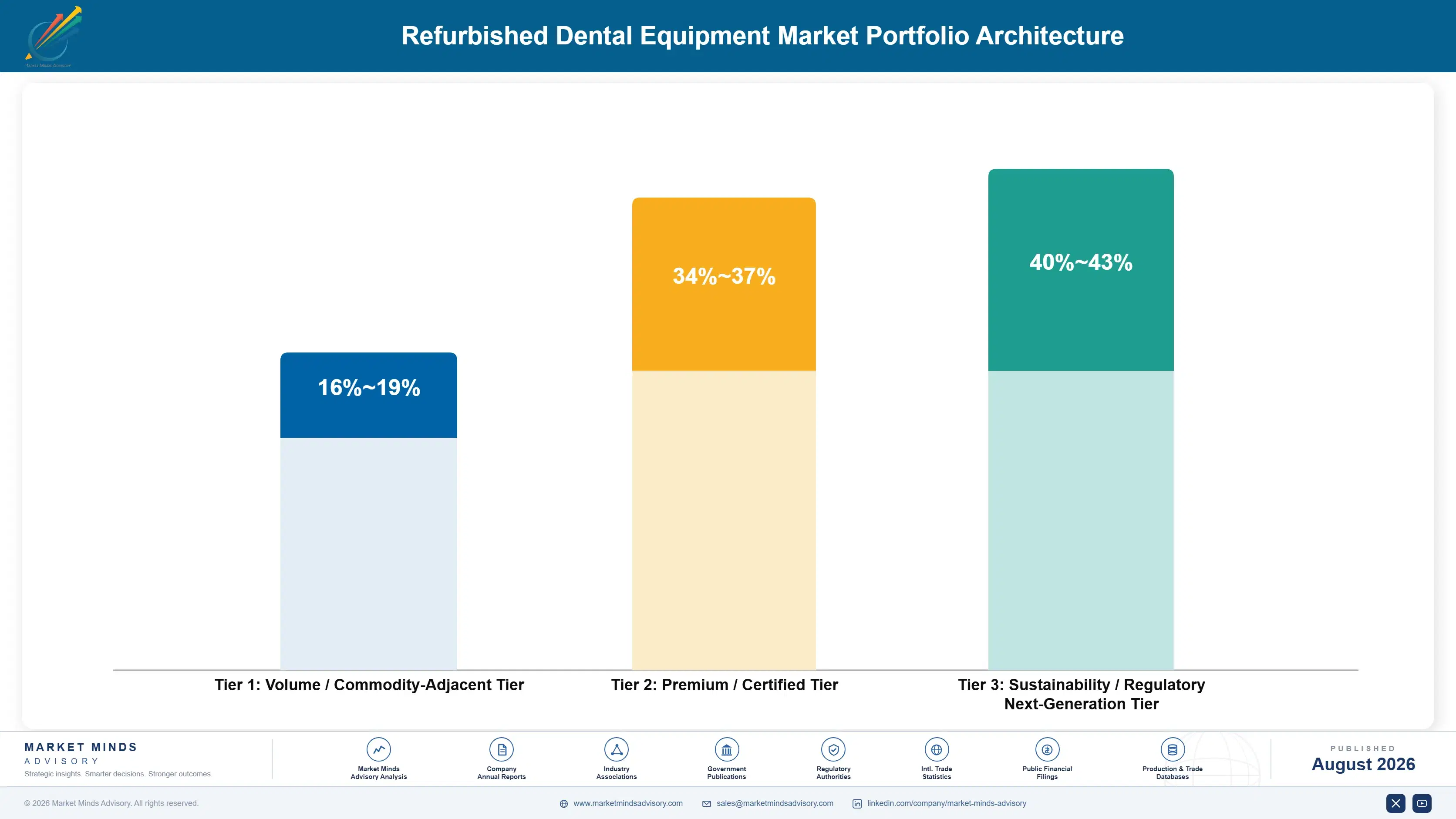
Portfolio economics in this category split cleanly across three tiers defined by equipment complexity, certification depth, and buyer segment rather than by any single dealer differentiator. Volume-tier mechanical equipment carries moderate margins in a mature, competitive segment, while premium and next-generation digital and certified programs command meaningfully higher gross margin as buyers pay for reliability documentation and warranty coverage rather than raw equipment cost alone.
The volume-premium tension plays out most visibly between price-sensitive independent buyers, who remain anchored to uncertified secondhand economics, and new practice owners and dental service organizations, whose purchasing decisions increasingly favor certified pre-owned programs regardless of premium pricing over informal alternatives. Dealers straddling both tiers manage distinct sourcing strategies, inspection investment, and warranty models for each buyer segment simultaneously.

High-value margin pools concentrate in certified digital imaging and CAD/CAM equipment sold directly into new practice and dental service organization accounts, where warranty confidence and technical support commitments justify dedicated reconditioning investment. Next-generation combination equipment packages, bundling chairs, imaging, and sterilization into a single certified transaction, remain a smaller but closely watched pool as buyers increasingly value simplified single-vendor purchasing over piecemeal equipment sourcing.

Volume / Commodity-Adjacent Tier

Uncertified secondhand equipment sold primarily through informal channels to extremely price-sensitive buyers prioritizing lowest possible upfront cost over warranty coverage or documented inspection history across most independent solo practitioner transactions.
Gross Margin: 16-19%

Premium / Certified Tier

Certified pre-owned chairs, delivery units, and mechanical equipment sold to new practice owners and independent clinics prioritizing warranty coverage, documented inspection quality, and proven reliability over uncertified informal secondhand alternatives.
Gross Margin: 34-37%

Sustainability / Regulatory / Next-Generation Tier

Certified digital imaging, CAD/CAM systems, and expanding combination equipment packages engineered for dental service organizations and multi-location practices pursuing standardized purchasing and comprehensive warranty coverage across their entire equipment fleets.
Gross Margin: 40-43%
refurbished-dental-equipment-market-portfolio-architecture-1787306583907

High-value Sub-segments and Strategic Watch-out

Certified Digital Imaging and CAD/CAM Equipment

Certified digital imaging and CAD/CAM equipment sold under warranty-backed dealer programs combine high growth with strong margin, as certification investment and reconditioning technical expertise let dealers price above uncertified secondhand equipment consistently across most new practice accounts and dental service organization purchasing programs nationwide and internationally.
Gross Margin: 38-41%

Combination Equipment Packages

Combination equipment packages bundling chairs, imaging, and sterilization into a single certified transaction offer strong margin with moderate volume growth, benefiting from simplified purchasing convenience and dealer relationships that deepen account penetration over successive equipment replacement cycles and evolving practice expansion plans across most developed markets nationwide.
Gross Margin: 36-39%

Certified Mechanical Equipment

Certified mechanical equipment including chairs and delivery units remains the volume core of the category, generating steady margin revenue from new practice owners and independent clinics not yet purchasing digital equipment given cost constraints and slower technology adoption timelines across several developed and emerging markets.
Gross Margin: 32-35%

Uncertified Informal Secondhand Equipment

Uncertified informal secondhand equipment warrants close monitoring as growing certification standardization could reshape buyer purchasing patterns quickly if industry associations succeed in establishing unified accreditation standards that shift demand decisively toward certified programs across most regional dealer markets and independent broker networks nationwide and internationally.
Gross Margin: 15-18%

Trade-In Supply Behind Every Certified Sale

Demand in this category behaves like a two-sided marketplace rather than a simple linear sale, since every transaction requires matching upgrading-practice trade-in supply with new-practice buyer demand, generating dealer revenue tied to both sourcing efficiency and resale execution rather than a single transaction type. Dealer economics favor companies that can sustain reliable trade-in sourcing relationships and buyer trust simultaneously rather than those competing purely on either sourcing c
Adoption depth varies meaningfully by vertical: new independent practice owners convert to certified pre-owned purchasing fastest given startup capital constraints and limited brand loyalty, established practices lag as familiarity with existing equipment vendors slows switching, and dental service organizations increasingly cross-adopt certified pre-owned purchasing originally used for single-practice equipment into standardized multi-location fleet procurement programs.

A generational shift is underway as newer practice owners, trained during dental school to evaluate total cost of ownership rather than brand prestige alone, default to considering certified pre-owned equipment at practice launch rather than assuming new equipment financing as the only credible option. This preference is increasingly influencing dealer sales strategy and equipment marketing as competition for cost-conscious new practice buyers intensifies steadily across most major markets.
refurbished-dental-equipment-market-end-use-penetration-index-1787306584406

Where Value Concentrates Through 2036

These are among the four positions where our research anticipates prominent divergence between winners and laggards over the coming forecast period. Each is grounded in the demand model, the regulatory perimeter, and the announced capacity pipeline.
01 / CERTIFICATION TRUST PRIORITY

Build standardized warranty programs that reduce buyer hesitancy fastest

Building a standardized multi-point inspection and warranty program is the single clearest growth vector in this category, and dealers competing purely on price without certification infrastructure risk losing buyer trust to competitors investing in formal warranty coverage. New practice owners and dental service organizations are the buyers actually driving specification change, and they have shown strong willingness to pay a premium for documented equipment condition and repair guarantees. Capital directed toward certification infrastructure will compound faster than spending preserving legacy uncertified secondhand sales models indefinitely.
02 / TRADE-IN SOURCING DEPTH

Secure direct trade-in relationships with distributors and upgrading practices

Reliable trade-in equipment sourcing directly determines inventory quality and acquisition cost, and dealers with established distributor and manufacturer relationships convert equipment upgrade cycles into inventory fastest across their target sourcing markets. Trade-in sourced inventory already accounts for a meaningfully growing share of total dealer inventory among leading refurbishers, and that share is likely to keep climbing steadily as practice upgrade cycles continue across most developed dental markets. Dealers without secured sourcing relationships will struggle increasingly to compete on inventory quality and acquisition cost.
03 / NEW PRACTICE FINANCING PARTNERSHIP

Partner with lenders and dental schools to capture practice startup purchases

New practice equipment purchasing decisions are increasingly shaped by financing options presented early in the startup planning process, and dealers with established lender and dental school partnerships capture buyer attention before graduates commit to alternative financing paths. Financing-partnered transactions already account for a meaningfully growing share of new practice equipment sales among leading dealers, directly correlating with faster sales cycles and stronger customer acquisition economics across most markets. Dealers without financing partnerships will struggle increasingly to reach buyers early in their decision process.
04 / DIGITAL EQUIPMENT TECHNICAL CAPABILITY

Build technical expertise to certify increasingly complex digital equipment

Digital imaging and CAD/CAM equipment refurbishment requires specialized technical expertise well beyond mechanical equipment reconditioning, and dealers investing early in this capability capture the fastest-growing segment of certified pre-owned demand ahead of slower-moving competitors. Buyers increasingly treat certified digital refurbishment as comparable in reliability to mechanical equipment categories, rewarding dealers who can credibly demonstrate technical competence in this more complex product category and its evolving software requirements. This discipline separates dealers building durable digital equipment credibility from those competing only in commoditized mechanical equipment categories.

Engagement Snapshot From the Field

A live engagement with an industry participant carrying material or product regulatory and market exposure ahead of a defining policy shift, showing how our research translates into a defensible multi-year portfolio strategy.
MARKET MINDS ADVISORY · CLIENT ENGAGEMENT SUMMARY
Refurbished Dental Equipment Producer Strategic Portfolio Review and Transition Roadmap 2026·Investment Scenario on Refurbished Dental Equipment Exposure Evaluation 2025-26
CLIENT PROFILE
The client is a regional dental practice startup advisory firm serving several dozen graduating dentists annually as they plan and launch independent practices across a multi-state metropolitan area. The firm had historically recommended new equipment financing by default, without a structured framework for evaluating when certified pre-owned equipment might better serve a given graduate's startup capital constraints and practice growth plans.
STRATEGIC CHALLENGE
Leadership needed to develop a structured decision framework helping advisory clients evaluate certified pre-owned versus new equipment purchasing across different practice types and financing situations, given wide variation in graduate debt levels and practice growth ambitions. Advisors lacked confidence recommending refurbished equipment given uncertainty about long-term reliability and resale value implications.
MMA APPROACH
MMA conducted a total cost of ownership analysis comparing certified pre-owned and new equipment across representative practice scenarios, combined with a dealer certification quality assessment across the three leading certified pre-owned programs serving the region. The analysis modeled financing cost, warranty coverage value, and long-term reliability data under different practice type and growth scenarios.
KEY FINDINGS
  1. Certified pre-owned equipment delivered meaningfully lower total cost of ownership for solo practice startups with conservative growth plans and limited initial patient volume.
  2. Practices anticipating rapid growth and multi-chair expansion within three years showed a stronger case for new equipment financing despite higher upfront cost.
  3. Dealer certification quality varied significantly across the three programs assessed, with warranty terms and inspection documentation differing meaningfully across each provider evaluated.
  4. Advisory clients who considered certified pre-owned equipment reported meaningfully lower first-year debt service burden than those who financed entirely new equipment purchases.
CLIENT PROFILE
The client is a regional dental practice startup advisory firm serving several dozen graduating dentists annually as they plan and launch independent practices across a multi-state metropolitan area. The firm had historically recommended new equipment financing by default, without a structured framework for evaluating when certified pre-owned equipment might better serve a given graduate's startup capital constraints and practice growth plans.
STRATEGIC CHALLENGE
Leadership needed to develop a structured decision framework helping advisory clients evaluate certified pre-owned versus new equipment purchasing across different practice types and financing situations, given wide variation in graduate debt levels and practice growth ambitions. Advisors lacked confidence recommending refurbished equipment given uncertainty about long-term reliability and resale value implications.
MMA APPROACH
MMA conducted a total cost of ownership analysis comparing certified pre-owned and new equipment across representative practice scenarios, combined with a dealer certification quality assessment across the three leading certified pre-owned programs serving the region. The analysis modeled financing cost, warranty coverage value, and long-term reliability data under different practice type and growth scenarios.
KEY FINDINGS
  1. Certified pre-owned equipment delivered meaningfully lower total cost of ownership for solo practice startups with conservative growth plans and limited initial patient volume.
  2. Practices anticipating rapid growth and multi-chair expansion within three years showed a stronger case for new equipment financing despite higher upfront cost.
  3. Dealer certification quality varied significantly across the three programs assessed, with warranty terms and inspection documentation differing meaningfully across each provider evaluated.
  4. Advisory clients who considered certified pre-owned equipment reported meaningfully lower first-year debt service burden than those who financed entirely new equipment purchases.
RECOMMENDED STRATEGY
Phase 1: Phase 1 (Months 1 to 2): Develop the total cost of ownership framework and dealer certification quality assessment criteria carefully. Phase 2: Phase 2 (Months 3 to 4): Train advisory staff thoroughly on framework application across representative practice startup scenarios and cases. Phase 3: Phase 3 (Months 5 to 12): Apply the framework across the entire advisory client cohort and closely track startup outcomes.
OUTCOME
The advisory firm implemented the structured decision framework across its full client cohort within the recommended timeline, reporting that 41 percent of advised graduates chose certified pre-owned equipment for at least part of their initial purchase, reducing average first-year debt service meaningfully (client-reported, unverified by MMA). Advisor confidence in recommending refurbished equipment improved measurably per survey feedback.

Frequently Asked Questions

Foundational context covering the market sizes, CAGR, scope, country, region and competition that inform every finding below. This section is provided to cover basics and most often pre-purchase conversations, answered from the MMA Primary Research Dataset.

What is the current size of the Refurbished Dental Equipment Market?

The global Refurbished Dental Equipment Market is valued at approximately 1.0 billion dollars in 2025. This figure spans chairs, delivery units, imaging systems, sterilization equipment, and handpieces worldwide.

How large will the Refurbished Dental Equipment Market be by 2036?

The market is projected to reach approximately 2.06 billion dollars by 2036. This represents cumulative growth driven primarily by new practice formation and expanding certified pre-owned programs.

What is the CAGR for the Refurbished Dental Equipment Market 2026 to 2036?

The market is forecast to grow at a compound annual growth rate of 6.8 percent between 2026 and 2036. Base-case growth reflects steady new practice formation tempered by certification trust gaps.

Which segment is growing fastest?

Refurbished CAD/CAM and digital imaging systems are the fastest-growing segment, expanding at roughly 13 percent annually, nearly twice the overall market rate. Growth is concentrated among cost-conscious new practice owners.

Who are the major companies in the Refurbished Dental Equipment Market?

Leading companies include Henry Schein, Patterson Dental, A-dec, Dentsply Sirona, and DentalEZ Group. These five companies hold roughly 32 percent of global revenue share combined.

Which country is growing fastest?

India is among the fastest-growing national markets, supported by expanding new dental clinic formation and rising dental college graduate numbers nationwide. Growth here outpaces most established Western markets meaningfully.

Report Segmentation Architecture

The full report scope spans multiple orthogonal segmentation dimensions, with cross-tabulated demand data provided for each dimension pair. Coverage extends further to regional breakdowns, trend trajectories, and the competitive detail needed to support segment-level decision-making.

By Primary Market Dimension

  • Refurbished CAD/CAM and Digital Imaging Systems
  • Refurbished Dental Chairs and Delivery Units
  • Refurbished Autoclaves and Sterilization Equipment
  • Refurbished Handpieces and Instruments
  • Refurbished Dental X-Ray and Panoramic Units
  • Refurbished Dental Lab Equipment

By End-Use Industry

  • Independent Solo Practices
  • Group Dental Practices
  • Dental Service Organizations
  • Dental Teaching and Training Institutions
  • Mobile and Community Dental Clinics

By Commercial Dimension

  • Direct Dealer Sales
  • Manufacturer-Affiliated Certified Programs
  • Independent Broker Channels
  • Trade-In and Consignment Sales

By Region

  • North America
  • Western Europe
  • East Asia
  • South Asia and Pacific
  • Latin America
  • Middle East and Africa
  • Eastern Europe

Scope, Methodology, and Coverage

Every figure in this report is reproducible from documented input assumptions. The scope below maps the historical period, the forecast horizon, the segmentation dimensions, and the countries covered, alongside the underlying primary and qualitative methodology.
Historical Period
2020 to 2025
Forecast Period
2026 to 2036
Base Year
2025 (USD billions; MMA Primary Research Dataset, August 2026)
Market Definition
The Refurbished Dental Equipment Market covers previously owned dental chairs, delivery units, imaging systems, sterilization equipment, and handpieces that have been inspected, reconditioned, and resold with warranty coverage. It excludes new equipment sales, dental consumables and disposables, and equipment sold without inspection or warranty as scrap or parts-only condition.
Quantitative Units
USD billions (current prices); transaction volume in thousands of units
Segmentation Dimensions
By Equipment Category and Technology Type; By End-Use Industry; By Commercial Dimension; By Region
Regions Covered
North America, Western Europe, East Asia, South Asia and Pacific, Latin America, Middle East and Africa, Eastern Europe
Countries Covered
USA, China, Germany, France, UK, Japan, South Korea, India, Australia, Canada, Brazil, Mexico, Indonesia, Vietnam, Thailand, Malaysia, UAE, Saudi Arabia, South Africa, Nigeria, Turkey, Poland, Netherlands, Italy, Spain, Sweden, Switzerland, Argentina, Colombia, Singapore, and additional markets relevant to this sector
Key Companies Profiled
Henry Schein, Patterson Dental, A-dec, Dentsply Sirona, DentalEZ Group, Superior Dental Equipment, US Dental Depot, Integrity Dental Equipment, National Dental Equipment, Pro Refurb Dental Equipment, Second Life Dental Equipment, Dental Equipment Depot, Global Dental Equipment Exchange, Crescent Dental Manufacturing, Summit Dental Systems, Pearson Dental Supply, Med One Group, Belmont Equipment, Midmark Corporation, Planmeca
Quantitative Methodology
Primary survey, n=3,800 respondents, Q4 2025, six countries; demand-side model with trade association cross-validation
Qualitative Methodology
47 expert interviews, Q4 2025; applied to validate demand model assumptions, identify emerging dynamics, and assess competitive positioning
Report Format
PDF and XLSX data workbook (Word format preview document)
Publisher
Market Minds Advisory
Report Code
MMA-2026-MED-538
Published
August 2026
Contact
sales@marketmindsadvisory.com | www.marketmindsadvisory.com

Purchase the full Refurbished Dental Equipment Market Report (2026 to 2036).

This report delivers a full quantitative and qualitative assessment of the global Refurbished Dental Equipment Market, covering historical performance from 2020 through 2025 and forecasts through 2036 across base, bull, and bear scenarios. It profiles twenty companies spanning chairs, delivery units, imaging systems, and sterilization equipment, benchmarked on a consistent revenue basis. Regional analysis spans all seven major world regions, with detailed demand mechanisms specific to each. The report also includes segmentation analysis, input cost exposure assessment, competitive positioning, and an anonymized client case study illustrating practical financing advisory decision-making.
Ten-year historical and forecast market sizing
Equipment category segmentation with growth rates
Seven-region demand mapping and competitive benchmarking
Twenty-company competitive profiling and moat analysis
Input cost exposure and mitigation strategy assessment
Anonymized client case study and strategic verdict

Built For The People Who Decide

From boardroom strategy to bench-side execution, this report is read cover-to-cover by leaders shaping the next decade of their industry, turning demand scenarios, market dynamics and valuation benchmarks into decisions.
CXOs/ Presidents/ VPs/ Managers
M&A and Corporate Development
Strategy Teams and R&D Heads
Procurement and Product Directors
Regulatory and Compliance Leaders
Investor Relations and Equity Analysts