Market Minds Advisory
Refractor Type Optical Telephoto Lens Market

Refractor Type Optical Telephoto Lens Market: Refractor Type Optical Telephoto Lens Market. Precision Glass Meets Embedded Computation

Camera makers race to pair traditional glass-element refractor designs with computational autofocus as content creators, broadcasters, and security integrators demand sharper reach, faster tracking, and lighter mounts without sacrificing optical purity.

Lead Analyst

Published

September 2026

Make Smarter Decisions with Customized Research Insights

Request a free sample report and evaluate market opportunities, growth trends, and competitive dynamics relevant to your business needs.

2025 MARKET VALUE$1.6BMarket Size 2025
2036 FORECAST VALUE$3.4BBase Case , 2026 to 2036
CAGR 2026 TO 20367.0 %Bull 8.3% / Bear 5.8%
INCREMENTAL OPPORTUNITY$1.7BNet 10- year value creation
EXPANSION MULTIPLE1.97x2036 value over 2026 base
Strategic Levers
M&A Pipeline
Regional Outlook
Country Rankings
Competitive Intelligence
Segmental Deep-dive
Call-Us : 91 93563 13602

Executive Snapshot and Market Trajectory.

Refractor telephoto optics remain the reach-and-resolution backbone for professional imaging, but the fastest revenue growth now comes from lenses bundling AI-driven autofocus and stabilization modules rather than glass elements alone, forcing legacy manufacturers to rebuild entire product lines around embedded computation and sensor fusion. Component suppliers are adjusting roadmaps accordingly.
Demand splits along three commercial tracks: content creators upgrading to mirrorless-native super-telephoto glass, broadcasters replacing aging cinema zoom inventories ahead of major sporting calendars, and security integrators specifying long-throw lenses for perimeter surveillance. Japan supplies roughly a third of global output, anchored by five vertically integrated manufacturers that control glass grinding, coating, and mount tooling in-house, a concentration that has held for over four decades and shows no sign of loosening.
Competitive intensity concentrates around five Japanese optical groups that hold six in ten dollars of the category, while South Korean and Chinese challengers undercut on price for entry mounts. Export licensing tied to dual-use optics classifications complicates shipments of longer focal lengths to destinations, and computational lens firmware sits under the same cybersecurity disclosure rules as networked security hardware, adding compliance cost smaller workshops absorb poorly.
Market Definition
This report covers refractor-type optical telephoto lenses, glass-element long-focal-length optics of 100mm equivalent or greater used in photography, cinema and broadcast production, surveillance, and astronomical imaging. It excludes catadioptric and mirror-lens designs, smartphone periscope modules, and standalone image-processing software sold apart from a physical lens assembly.
Base Year Value
$1.6B in 2025 (MMA Primary Research Dataset, September 2026)
Forecast Period
2026 to 2036, eleven discrete annual values
CAGR
7.0% base case. Bull 8.3%. Bear 5.8%.
Fastest Growth Segment
AI-Driven Autofocus and Stabilization Telephoto Systems: 10.0% CAGR
Fastest Growth Country
China: 9.0% CAGR
Fastest Growth Region
South Asia and Pacific: 9.0% CAGR
Largest Region
East Asia: 34% of 2025 global value
Market Leaders
Canon, Nikon, Sony, Sigma, and Tamron. Source: MMA Primary Research Dataset, July 2026.
Primary Survey
n=3,800 procurement and R&D decision-makers, Q4 2025, six countries
Methodology
Demand-side build-up, cross-validated against public data, 47 expert interviews

Refractor Type Optical Telephoto Lens Market Forecast Scenarios

refractor-type-optical-telephoto-lens-market-size-forecast-scenario-1789984648514
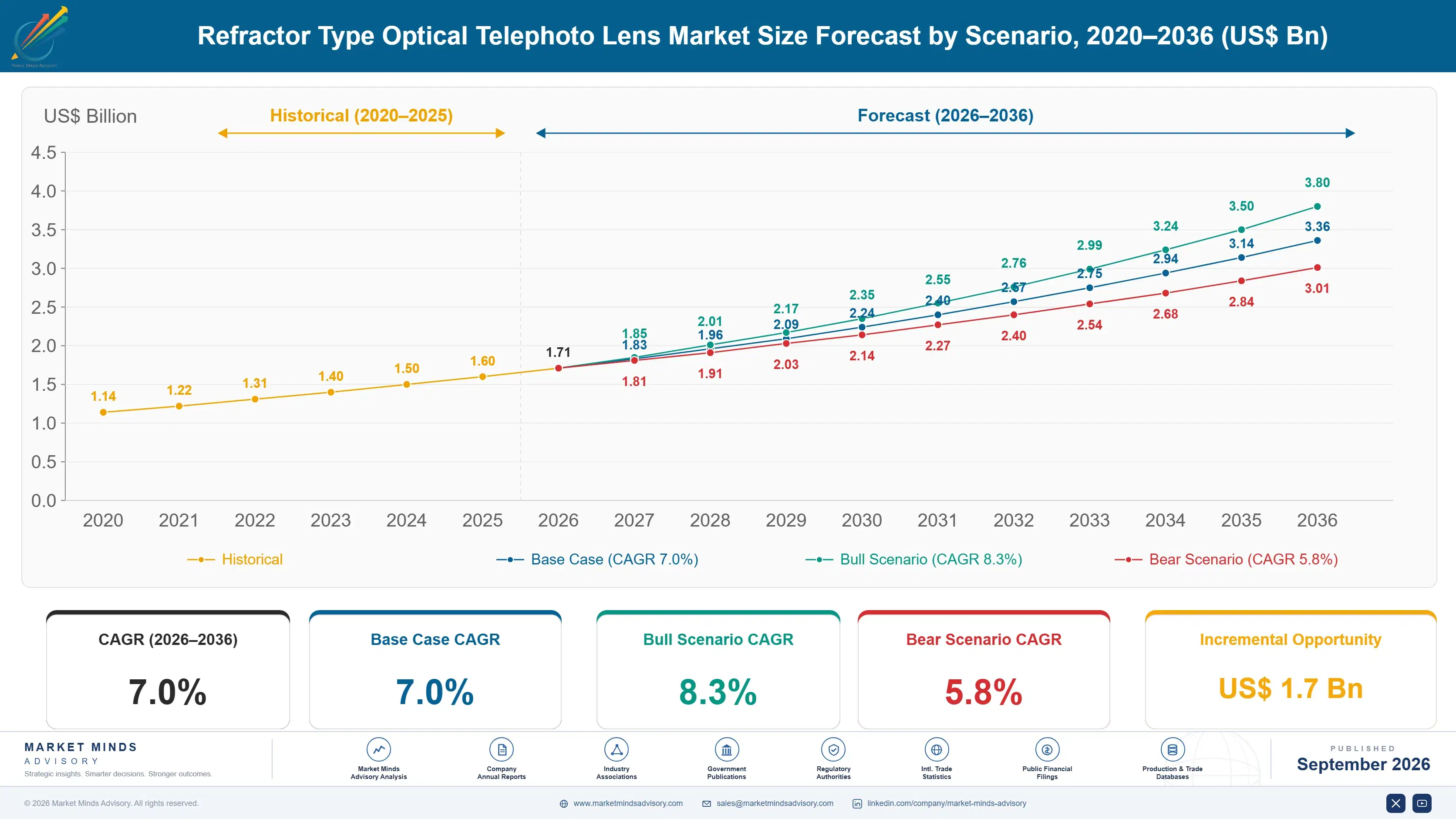
Between 2020 and 2025 the category grew at roughly 6.4% a year, recovering unevenly as pandemic-era production stoppages at Japanese optical plants delayed shipments even as remote content creation pulled demand forward. Camera body upgrade cycles lengthened, but lens attach rates held up because creators kept investing in glass even when swapping bodies less often. Inventory levels normalized only by 2023.
The base case assumes 7.0% annual growth through 2036, driven by three mechanisms operating together: mirrorless mount migration that forces re-purchase of lenses incompatible with older DSLR mounts, live sports and esports broadcasting contracts that specify longer super-telephoto reach for remote-operated camera rigs, and municipal and critical-infrastructure security programs standardizing on long-throw perimeter lenses paired with analytics software. None of the three depends on the others, which makes the forecast durable rather than a single-catalyst story.
The bull case centers on generative-AI-assisted computational photography making longer lenses more forgiving to handhold, pulling forward upgrades among enthusiasts who previously stayed on shorter zooms. The bear case turns on tighter export controls over dual-use optical coatings, which could delay shipments of the longest focal lengths into several Middle Eastern and Southeast Asian markets and compress near-term unit growth as pricing holds.

Where Telephoto Lens Demand Concentrates

The refractor telephoto lens category sits at the intersection of optical craftsmanship and embedded electronics, and pricing increasingly reflects the computation bundled into the barrel rather than the glass alone. A lens that once competed purely on aperture and resolution now competes on autofocus tracking speed, in-lens stabilization range, and firmware update cadence, features that used to live entirely in the camera body.
MARKET CONCENTRATION (CR5)62%Five manufacturers control the overwhelming majority of shipments
AVERAGE SELLING PRICE$740Premium optics command prices far above consumer zoom lenses
TOP PRODUCING COUNTRY SHARE34%Japan supplies the largest share of global lens output
CAPACITY UTILIZATION78%Precision grinding lines run near practical operating ceiling levels
TRADE INTENSITY58%Most finished lenses cross borders before reaching final buyers
OPTICAL GLASS COST SHARE31% of COGSSpecialty glass elements remain the costliest bill of materials
Manufacturing remains capital intensive and geographically narrow. Grinding and polishing tolerances for long-focal-length elements measure in fractions of a wavelength, which keeps the supplier base small and gives incumbents pricing power that newer entrants in China and South Korea have struggled to erode despite years of investment in coating technology and automated assembly lines at scale.
Demand is bifurcating between a shrinking pool of dedicated photography enthusiasts and a growing base of institutional buyers, broadcasters, security integrators, and research observatories, who purchase in fleet quantities and negotiate service contracts rather than one-off sales. That shift favors manufacturers with established distribution and calibration networks over boutique glass houses that depend on individual collectors, even when the boutique makers hold stronger reputations among purists.
"The lens business used to sell precision glass. Now it sells a software-defined imaging system that happens to include glass, and the manufacturers who haven't rebuilt their R&D around that fact are losing share every product cycle."
Practice Lead, Imaging and Optical Systems · MMA Technology / Imaging and Optical Systems Practice · September 2026

Market Trends

Computational Autofocus Modules Replace Pure Mechanical Focusing

Lens makers now embed dedicated processors and phase-detection arrays directly inside telephoto barrels instead of relying solely on camera-body autofocus. Canon's and Sony's latest super-telephoto primes carry onboard motors that track subjects through thirty frames per second of continuous focus adjustment, a specification unthinkable in mechanical-only designs five years ago. Sports and wildlife shooters, who once tolerated missed frames during fast action, now expect near-perfect keeper rates on every outing. That expectation pulls replacement demand forward among professionals who would otherwise keep older lenses in service for another two or three years, compressing upgrade cycles across the professional segment.
Market Impact: Adds 300 million in broadcast spend
Mirrorless Mount Migration Forces Full Lens Line Replacement

Camera bodies moved to mirrorless mounts faster than lens libraries did, leaving a large installed base of DSLR-mount telephoto glass that either needs an adapter or outright replacement to reach full autofocus performance. Nikon retired new DSLR development entirely, and Canon has slowed EF-mount lens output to a trickle, pushing loyal users toward native RF and Z-mount purchases. Adapters recover eighty percent of autofocus speed at best, not enough for wildlife and sports shooters who depend on split-second tracking. Manufacturers are pricing native replacements at a premium over the mounts they displace, betting that professional buyers will absorb the cost.
Market Impact: Adds 9 percent institutional demand

Market Opportunities and Growth Drivers

Live Sports Broadcasting Contracts Specify Longer Reach

Major sports broadcasters are rewriting camera specification sheets to require longer native focal lengths for remote-operated rigs positioned at stadium roof trusses and sideline towers, reducing the number of operator-manned positions needed per venue. A single robotic camera fitted with an eight hundred millimeter refractor lens can now cover ground that previously required three shorter lenses and three camera operators. Broadcast rights holders covering the next four-year Olympic and World Cup cycle have already committed to upgrading core inventories, and that commitment cascades down to regional sports networks a season later.
Market Impact: Caps output growth near 4 percent

Security Agencies Standardize Long-Throw Perimeter Lenses

Airports, ports, and border agencies are standardizing on long-throw refractor lenses paired with video analytics that can identify a face or license plate from several hundred meters away, a capability regulators increasingly write into procurement specifications for critical infrastructure. The approach replaces older short-focal-length camera arrays that required many more mounting points to cover the same perimeter, cutting installation labor even though the per-unit lens cost is higher. Twelve national border agencies issued long-throw lens tenders in the past eighteen months, and integrators expect that number to double as replacement cycles catch up with newer analytics standards.
Market Impact: Delays 6 to 10 week shipments

Market Restraints and Challenges

Precision Glass Grinding Capacity Cannot Scale Quickly

Grinding and polishing tolerances for long-focal-length elements are measured in fractions of a wavelength, and the machinists capable of running that equipment take years to train, so capacity cannot expand the way electronics assembly can. The root cause is that few institutions teach classical optical grinding anymore, since most optics graduates now specialize in semiconductor lithography instead. That leaves five manufacturers holding most of the qualified workforce, capping industry output near seventy-eight percent utilization even during demand spikes. Some manufacturers are exploring university optics partnerships to widen the talent pool, though those efforts take years to produce a qualified grinder.
Market Impact: Adds 4 points to upgrade rate

Export Controls On Dual-Use Optical Coatings Delay Shipments

Anti-reflective and thermal-stable coatings used on the longest refractor lenses fall under dual-use export classifications in several jurisdictions because the same coating chemistry appears in targeting optics, and that overlap triggers licensing review on ordinary commercial shipments. The root cause is that export control lists have not been updated to distinguish civilian broadcast and wildlife lenses from military-adjacent designs using near-identical glass. Shipment delays of six to ten weeks are now common for orders above six hundred millimeters heading to a handful of destinations, pushing buyers toward domestic alternatives even when image quality is lower.
Market Impact: Drives 12 percent unit replacement
3 additional market trends, 4 additional growth drivers, and 2 additional restraints and challenges are covered in the full report. Contact sales@marketmindsadvisory.com to access the complete intelligence.

Segment CAGR and Growth Architecture

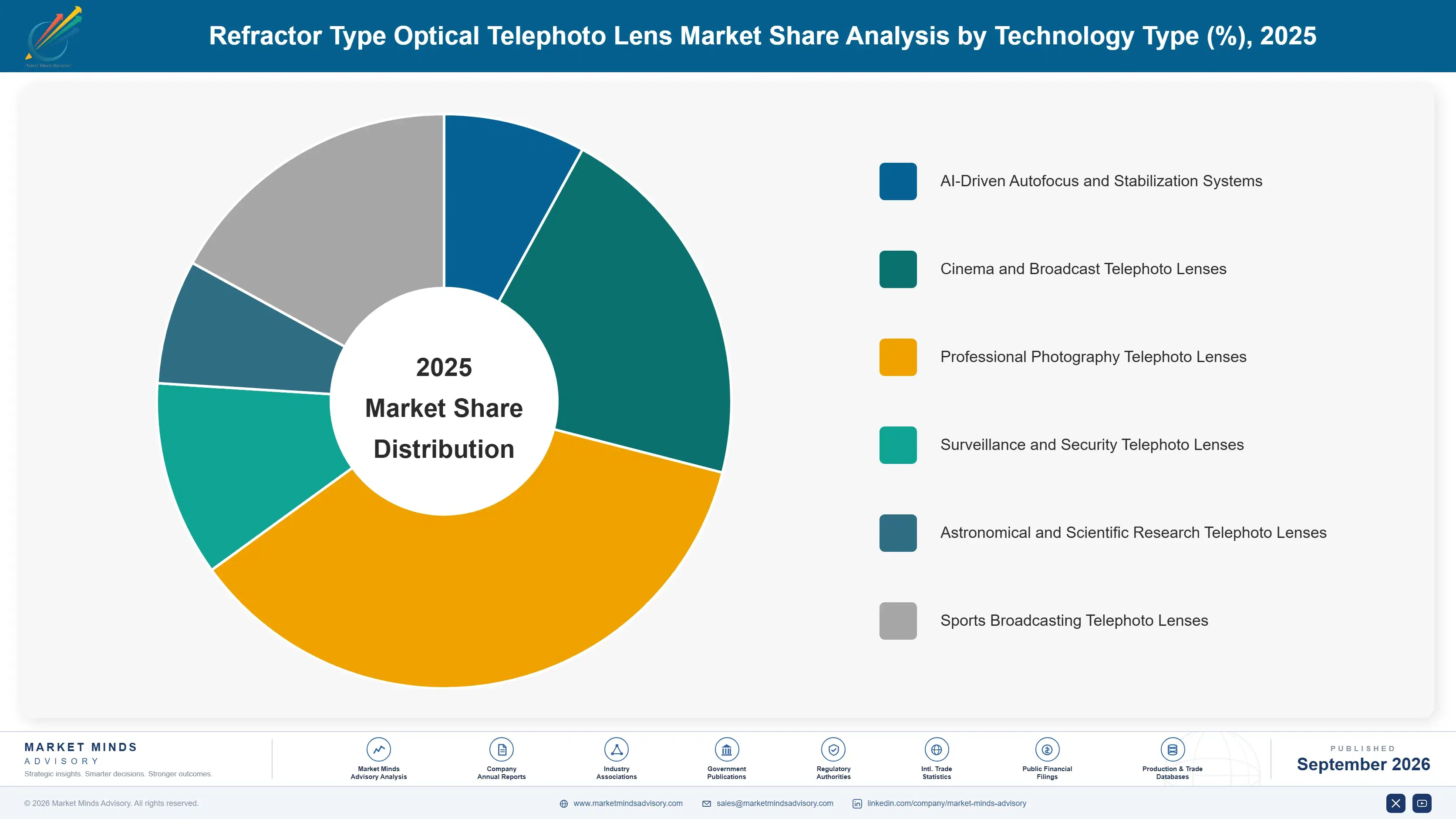
Segments split by underlying optical and electronic technology rather than by end-use, since the same physical lens often serves photography, broadcast, and security buyers interchangeably, and technology content is what actually separates pricing tiers and growth rates across the category, far more than any single downstream application ever does on its own across a full product generation.
refractor-type-optical-telephoto-lens-market-market-share-analysis-1789984649062

AI-Driven Autofocus and Stabilization Telephoto Systems

This segment covers telephoto lenses built around embedded processors, phase-detection arrays, and in-lens stabilization motors that operate largely independent of the camera body. Growth outpaces the category because professional buyers now treat autofocus tracking speed as the primary purchase criterion, ahead of raw aperture or resolution specifications that dominated buying decisions a decade ago. Canon, Sony, and Nikon have each released flagship super-telephoto primes in this class over the past two years, and attach rates for accompanying firmware subscription services are rising alongside hardware sales. Broadcast and wildlife photography buyers show the strongest willingness to pay a premium, often thirty to forty percent above mechanically focused equivalents, because missed frames carry a direct commercial cost in both markets.
CAGR 10.0%

Cinema and Broadcast Telephoto Lenses

Cinema and broadcast lenses are engineered for parfocal zoom consistency, color matching across an entire set, and remote-controlled operation on cranes, drones, and stadium-mounted robotic rigs rather than handheld use. Demand accelerates as streaming platforms commission more live sports and event programming, each requiring dedicated long-glass inventories that broadcast equipment houses rent out across multiple productions per season. Rental economics favor manufacturers who can guarantee color and focus consistency across a fleet of a hundred or more lenses, which has concentrated purchasing among production-house consortiums rather than individual buyers. Cooke Optics and Fujifilm's cinema divisions compete closely with the major Japanese still-photography houses here, since the buyer base and specification requirements barely overlap with consumer photography at all.
CAGR 8.5%
Full segment breakdown across 6 segments available in the complete report.

Regional Architecture and Country Demand Map

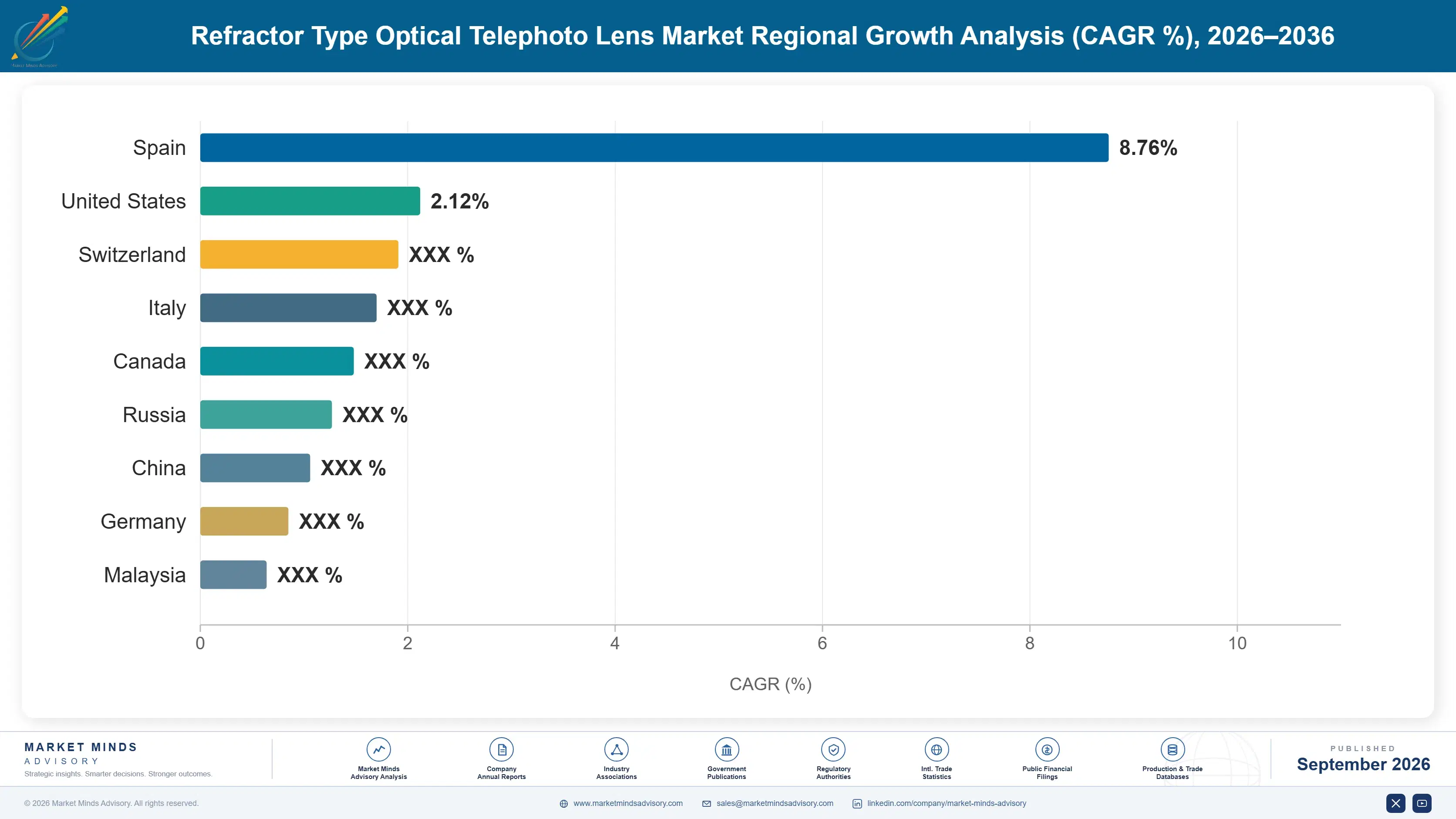
East Asia leads on the strength of Japan's manufacturing base, while North America and Western Europe carry the largest concentrations of professional and institutional buyers purchasing that output across broadcast, security, and photography channels worldwide, with Asia-Pacific challengers steadily closing the manufacturing quality gap year over year.

North America

Broadcast rights holders and federal security agencies anchor North American demand, with sports networks and border agencies together accounting for a growing share of institutional lens purchases each budget cycle. Professional photographers and content creators add a second, steadier layer of demand, concentrated around major media markets in California, New York, and Georgia where production activity clusters. Replacement cycles here run faster than in most regions because production houses depreciate equipment aggressively and rotate inventory to stay ahead of rental competitors. Currency strength against the yen has periodically made Japanese-made glass cheaper for American buyers, pulling purchases forward whenever the exchange rate turns favorable, a pattern regional distributors now plan promotional calendars around.
Share: 24% | CAGR: 8.0% (2026 to 2036)

Western Europe

Public broadcasters across Germany, France, and the United Kingdom maintain some of the oldest cinema and broadcast lens inventories in the world, and regulatory pressure to reduce equipment waste is extending refurbishment programs rather than accelerating outright replacement. Wildlife and nature documentary production, concentrated among British and German production houses, sustains steady demand for premium long-focal-length glass regardless of broader budget cycles. Security procurement moves more slowly here than in North America because tender processes for critical infrastructure require multi-year competitive bidding across most member states. Growth trails the category average as a result of both the slower replacement culture and a maturing installed base that already covers most major venues and agencies across the region.
Share: 20% | CAGR: 5.5% (2026 to 2036)
Regional intelligence for 5 additional markets available in the complete report: East Asia, South Asia and Pacific, Latin America, Middle East and Africa, Eastern Europe. Contact sales@marketmindsadvisory.com.
refractor-type-optical-telephoto-lens-market-country-cagr-analysis-1789984649604

Where Telephoto Lens Margins Actually Build

Margin expansion concentrates around firmware and service attach rather than glass itself, since optical manufacturing costs are largely fixed while software, calibration, and fleet-service contracts carry far higher incremental margin for manufacturers willing to build the supporting infrastructure ahead of their rivals across every major institutional and broadcast buyer segment they currently and eventually serve worldwide.

Firmware Subscription Attach on Flagship Lens Bodies

Manufacturers are bundling paid firmware update tiers that enable faster autofocus tracking modes and expanded stabilization ranges after the initial hardware sale, converting a one-time purchase into a recurring revenue stream. Early adopters report attach rates near 22% among professional buyers who value staying current with tracking algorithm improvements more than casual users do. The approach mirrors software monetization models more common in adjacent electronics categories, and it gives manufacturers a channel to fund continued algorithm development without raising hardware list prices, which professional buyers resist far more than incremental subscription fees.
Market Impact: Adds 22 percent recurring firmware attach rate annually

Fleet Calibration and Service Contracts for Institutional Buyers

Broadcasters and security integrators who operate dozens of lenses across a production or installation increasingly prefer annual calibration and maintenance contracts over ad hoc repair, since downtime during a live broadcast or security incident carries reputational cost far beyond the repair bill itself. Manufacturers offering guaranteed forty-eight-hour turnaround and loaner equipment during service windows can price these contracts at 15% to 18% of original equipment value annually, a margin well above typical hardware gross margin. Building the regional service network needed to honor those turnaround guarantees is the main barrier keeping smaller manufacturers out of this revenue pool.
Market Impact: Adds 15 to 18 percent annual contract value

Rental Fleet Partnerships With Broadcast Equipment Houses

Rather than selling directly to individual production companies, manufacturers are placing discounted fleet inventory with major rental houses in exchange for preferred placement and data on usage patterns that inform future product development. This channel now represents close to 30% of cinema and broadcast lens unit volume, up from a much smaller share five years ago, as production budgets shift toward renting rather than owning depreciating equipment. Manufacturers gain a lower-cost distribution channel and faster market feedback this way, though at a lower per-unit margin than direct institutional sales typically deliver.
Market Impact: Adds 30 percent of rental channel unit volume

Trade-In Programs That Capture Mount Migration Demand

Structured trade-in programs that credit older DSLR-mount lenses toward native mirrorless replacements are accelerating the mount migration cycle while capturing used inventory that manufacturers resell through certified refurbished channels at healthy margin. Canon and Nikon both report trade-in participation above 30% among buyers upgrading flagship telephoto glass, higher than either company anticipated when the programs launched. The refurbished channel additionally opens a lower price point that pulls in enthusiast buyers who would otherwise wait years longer to purchase new, expanding the addressable buyer pool without discounting new units at all.
Market Impact: Captures 30 percent of all flagship lens trade-ins

Who Controls the Margin Pool

Five Japanese manufacturers control roughly sixty-two percent of global refractor telephoto lens revenue, a concentration built on decades of vertically integrated glass grinding and coating capability that challengers have not matched. Canon and Nikon sit clearly ahead of Sony, Sigma, and Tamron on flagship super-telephoto share, though the gap has narrowed as Sony's mirrorless-native lineup gained ground quickly.
Current competitive activity plays out across three fronts: firmware-driven autofocus performance races among the top three manufacturers, aggressive price competition from Sigma and Tamron targeting enthusiasts priced out of flagship glass, and expanding service and rental partnerships aimed at locking in institutional broadcast and security accounts before rivals can. All participants are evaluated here on a shipment-volume basis, since that is the metric consistently disclosed across annual reports and investor materials.

Chinese and South Korean entrants are the clearest source of emerging pressure, investing heavily in coating technology and autofocus firmware even though optical-grinding tolerances remain their hardest barrier to close. Rankings could shift first in the entry and mid-range mirrorless segment, where price sensitivity is highest and brand loyalty is weakest, before any real threat reaches the flagship professional tier that still anchors the five incumbents' profitability.
refractor-type-optical-telephoto-lens-market-company-positioning-matrix-1789984650127

Competitive Moat and Risk Dimensions

CANON INC

Moat: Integrated Glass and Firmware

Canon controls glass melting, grinding, coating, and autofocus firmware development entirely in-house, letting it tune optical and electronic performance together rather than integrating third-party components. That vertical control also lets Canon protect margin during raw material price swings by absorbing cost internally rather than renegotiating supplier contracts under pressure.
CANON INC

Risk: Mirrorless Transition Execution Risk

Canon's large installed base of EF-mount DSLR lens owners represents both an asset and a liability, since slowing new EF development to focus resources on RF mount risks alienating loyal professional customers who feel pushed toward expensive native replacements faster than they wanted. Missteps in trade-in pricing could send buyers toward Sony instead.
NIKON CORPORATION

Moat: Astronomical and Scientific Credibility

Nikon's decades of supplying optics to scientific and astronomical institutions give it credibility in extreme-precision applications that translates into trust among professional buyers generally. That reputation supports premium pricing on flagship glass even when specifications look similar to rivals, because buyers weight track record heavily in a category where failure during a paid assignment is costly.
NIKON CORPORATION

Risk: Smaller Scale Than Rival Groups

Nikon's camera and lens division is smaller in scale than Canon's or Sony's combined electronics and imaging operations, limiting the research budget available to match rivals' pace of computational autofocus innovation. That gap has occasionally left Nikon a product cycle behind on headline tracking specifications, a pattern professional buyers notice quickly given how review outlets benchmark autofocus performance.

Players Tracked

Prominent Players

Canon Inc
Nikon Corporation
Sony Group Corporation
Sigma Corporation
Tamron Co Ltd

Other Key Players

Fujifilm Holdings Corporation
Panasonic Holdings Corporation
OM Digital Solutions Corporation
Leica Camera AG
Carl Zeiss AG
Jos Schneider Optische Werke GmbH
Cooke Optics Ltd
Thales Angenieux SAS
Kowa Company Ltd
Venus Optics
Meike Photographic Equipment Co Ltd
Samyang Optics Co Ltd
Irix doo
Tokina Co Ltd
Vazen Lens Co Ltd

Recent Developments

MARCH 2026

Canon Expands RF-Mount Super-Telephoto Lineup

Canon added two new RF-mount super-telephoto primes with onboard stabilization motors rated for higher continuous shooting rates, targeting broadcast and wildlife professionals still using older EF-mount equivalents. The launch included an expanded trade-in credit specifically for EF-mount telephoto glass to accelerate the mount transition among loyal customers.
Signal: Signals an accelerating industrywide push by every major rival to retire EF-mount telephoto inventory entirely and permanently over time
NOVEMBER 2025

Sony and Broadcast Equipment House Sign Fleet Supply Agreement

Sony signed a multi-year fleet supply agreement with a major European broadcast equipment rental house, placing discounted long-glass inventory across the rental fleet in exchange for detailed usage data and preferred placement in upcoming sports broadcast equipment tenders across several member states this coming cycle.
Signal: Signals rental-channel partnerships becoming a core manufacturer distribution strategy going forward across the entire broadcast region
JUNE 2026

Tamron Opens New Coating Facility in Vietnam

Tamron opened an additional anti-reflective coating facility outside Japan for the first time, an organic capacity expansion intended to reduce shipment lead times to Southeast Asian security and broadcast buyers while easing pressure on its domestic coating lines during peak seasonal demand periods each year.
Signal: Signals manufacturers actively diversifying their coating capacity beyond Japan's borders for long-term supply chain resilience purposes

What Drives Refractor Lens Production Cost

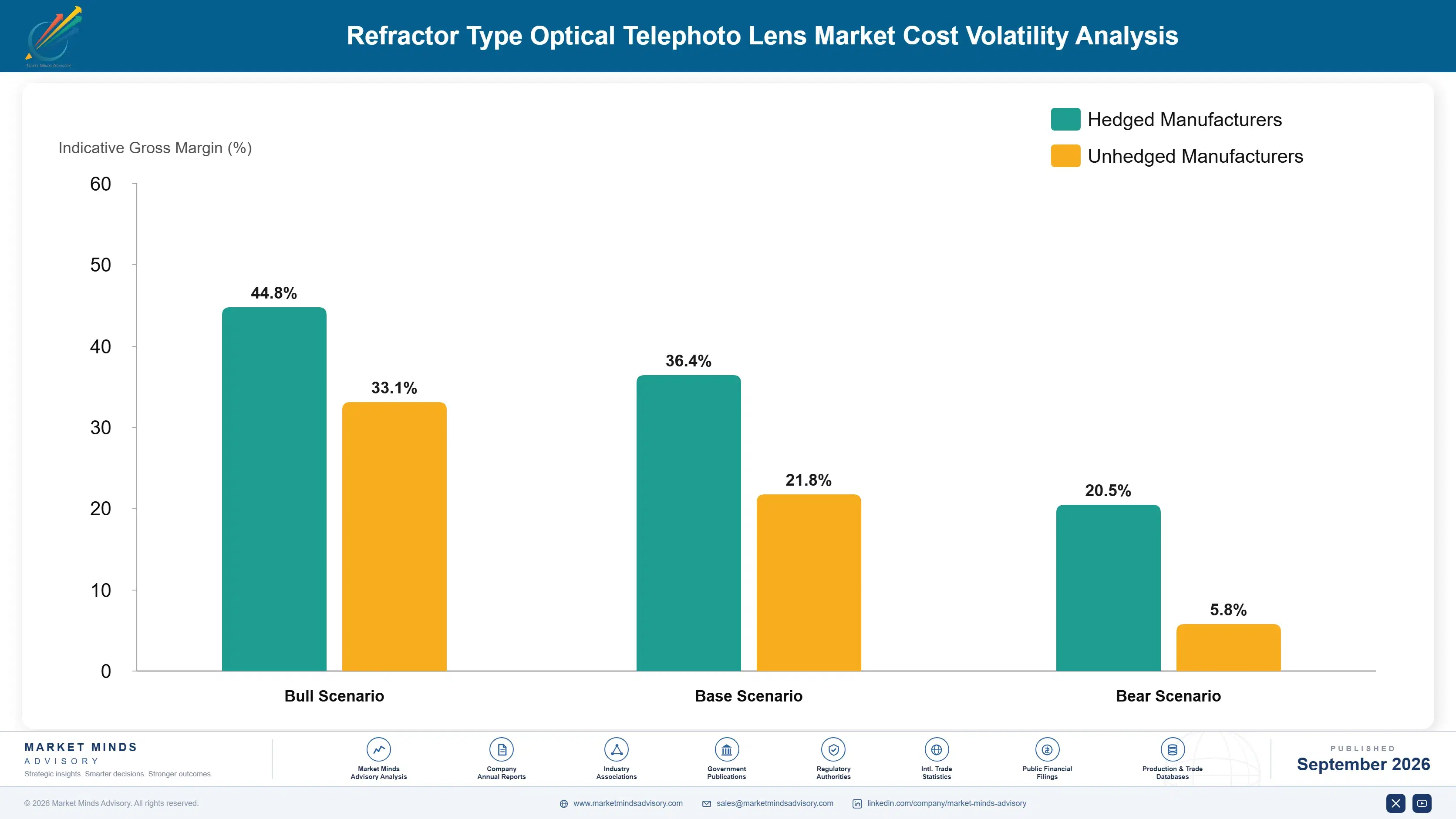
Specialty optical glass elements account for roughly 31% of finished lens cost, sourced primarily from a small number of Japanese and German glass melters whose rare-earth-doped formulations are difficult to substitute without redesigning the entire optical path. Precision machining and coating labor make up a further quarter of cost, concentrated in the same countries that supply the raw glass.
Rare-earth oxide prices used in high-refractive-index glass formulations spiked sharply during 2023 after China tightened export licensing on several rare-earth categories, a move documented in China MIIT's public export data for that year. Lens manufacturers absorbed several months of margin compression before passing roughly half the increase through to flagship lens pricing, and spot prices have not fully returned to pre-2023 levels even as licensing eased.

Vertically integrated manufacturers who melt their own glass, namely Canon and Nikon, weathered the spike far better than smaller houses like Sigma and Tamron, who buy finished glass blanks on the open market and had far less negotiating leverage with rare-earth suppliers during the shortage. That gap in cost exposure is pushing smaller manufacturers to explore long-term supply contracts and alternative chemistries that reduce rare-earth content.
refractor-type-optical-telephoto-lens-market-cost-volatility-analysis-1789984650325

Long-Term Glass Supply Contracts With Price Collars

Several manufacturers have signed multi-year glass blank supply contracts with price collars that cap upside exposure to rare-earth price swings in exchange for committed volume, trading some purchasing flexibility for cost predictability that helps with multi-year product roadmap planning, pricing stability, and steadier margin forecasting across future product generations. Several buyers have welcomed the added planning certainty this arrangement provides.

Alternative Low-Rare-Earth Glass Chemistries

Research and development teams are testing reformulated optical glass with reduced rare-earth oxide content that sacrifices a small amount of chromatic correction for meaningfully lower material cost, a trade-off increasingly acceptable for consumer and entry-level mirrorless lenses even as flagship professional glass still requires the more expensive higher-performance formulation for now. Field trials are expanding across several additional lens lines.

Domestic Rare-Earth Recycling From Retired Lenses

Manufacturers are piloting recovery programs that extract rare-earth content from trade-in and end-of-life lenses rather than relying entirely on freshly mined material, a nascent effort that currently covers a small share of total input needs but reduces exposure to any single country's export policy as recovery volumes scale up over the coming years. Pilot results look encouraging to manufacturers.

Portfolio Architecture for Margin Defence

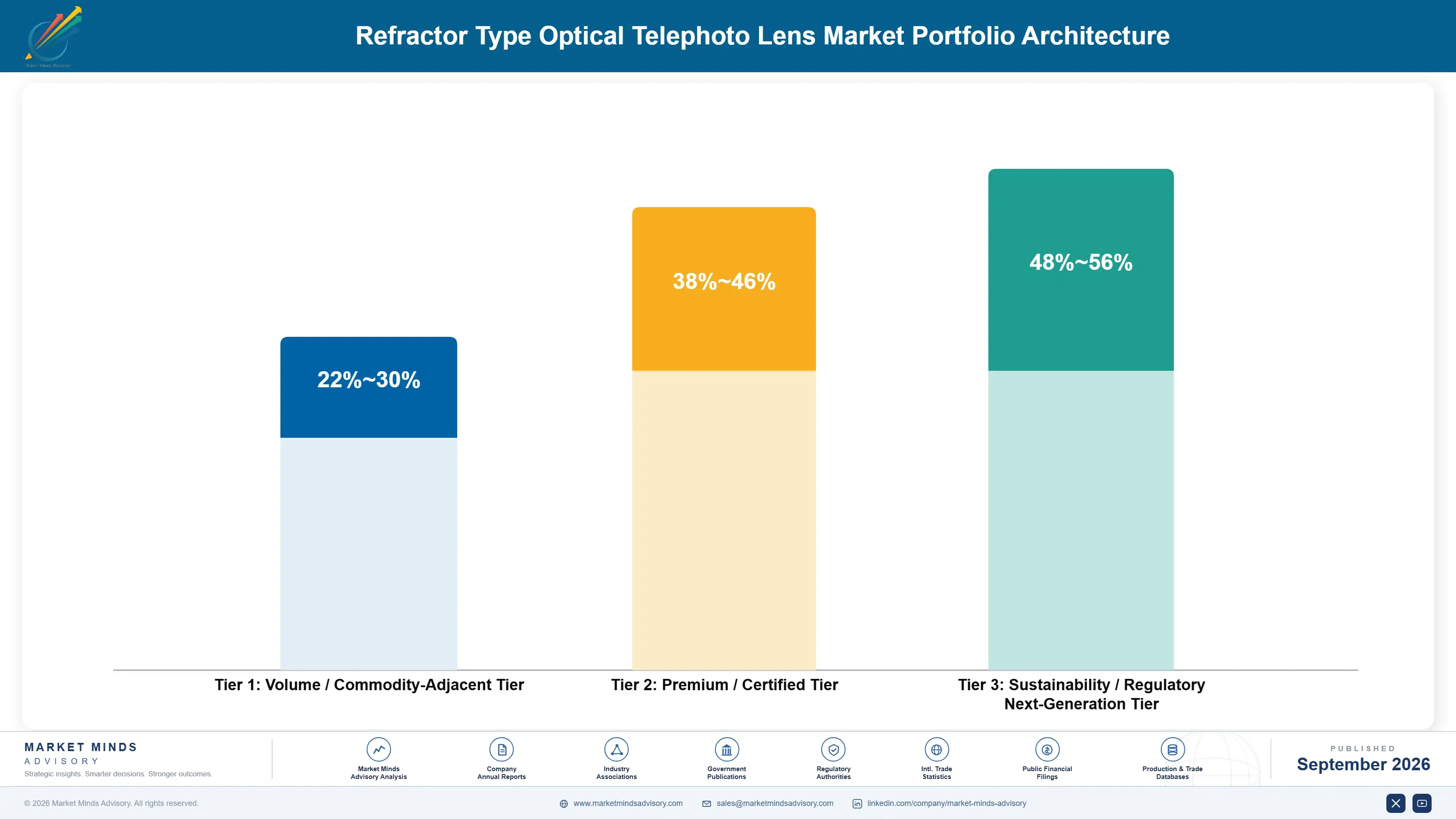
Portfolio economics split cleanly into three tiers running from commodity-adjacent zoom lenses through certified professional primes to next-generation computational optics carrying the richest margin. Volume tier products compete almost entirely on price against Chinese and Korean challengers, while premium and next-generation tiers retain pricing power tied to brand trust, measured optical performance, and years of accumulated service reputation. That gap has held steady for over a decade.
The tension between volume and premium tiers shows up clearest among enthusiast buyers, who want flagship-level autofocus performance at consumer-tier prices and are increasingly served by mid-range lenses borrowing algorithms originally developed for flagship glass a product cycle earlier. Manufacturers manage that tension by staggering feature trickle-down carefully to protect flagship margin for as long as commercially possible without losing enthusiast buyers to cheaper rivals entirely. Institutional buyers rarely feel this tension at all.

High-value margin pools concentrate in the next-generation computational tier and in institutional service contracts layered on top of premium hardware sales, both of which the five incumbent Japanese manufacturers currently dominate almost entirely, leaving little room for smaller rivals to compete on margin alone. Smaller houses instead compete on niche specialization.

Volume / Commodity-Adjacent Tier

Entry zoom and prime telephoto lenses competing mainly on price against Chinese and Korean manufacturers, targeting budget-conscious hobbyist buyers who prioritize reach over refinement and rarely upgrade often. Replacement cycles here run longest of the three tiers, further limiting available margin upside.
Gross Margin: 22-30%

Premium / Certified Tier

Professional-grade primes and zooms with established brand reputations, weatherproofing, and manufacturer-certified service support networks trusted across major broadcast, security, and photography markets worldwide. This tier anchors most manufacturer profitability during any given fiscal year.
Gross Margin: 38-46%

Sustainability / Regulatory / Next-Generation Tier

Computational autofocus and stabilization systems paired with firmware subscription and recycled rare-earth glass content, commanding the richest margin across the entire manufacturer product portfolio available today. Adoption here is still climbing steeply among institutional buyers each year.
Gross Margin: 48-56%
refractor-type-optical-telephoto-lens-market-portfolio-architecture-1789984650830

High-value Sub-segments and Strategic Watch-out

AI-Driven Autofocus and Stabilization Systems

This segment combines the fastest unit growth in the category with the richest gross margin, since firmware attach and computational features carry minimal incremental hardware cost once developed, making it the clearest priority for manufacturer research budgets over the next several years. Adoption is already climbing quickly.
Gross Margin: 48-56%

Cinema and Broadcast Fleet Service Contracts

Institutional service and calibration contracts attached to broadcast and cinema lens fleets combine strong margin with moderate but steady growth tied to production budget cycles, offering a more predictable revenue base than hardware sales alone across any given broadcast calendar. Broadcast calendars keep this pipeline reasonably predictable year over year.
Gross Margin: 40-48%

Consumer and Enthusiast Zoom Telephoto Lenses

The largest unit volume pool remains consumer and enthusiast zoom lenses, where growth is modest and margin is thin, but scale keeps this segment commercially essential for funding research and development invested elsewhere in the portfolio. Scale here remains essential to funding development elsewhere in the portfolio.
Gross Margin: 22-30%

Export-Restricted Long Focal Length Security Lenses

Long-throw security lenses above six hundred millimeters carry strong margin but face growing export licensing friction that could slow growth sharply if dual-use classification rules tighten further across additional destination markets over the coming years. Tightening rules could compress this segment's growth trajectory meaningfully within a few years.
Gross Margin: 40-50%

Why Telephoto Lens Purchases Compound

Telephoto lens purchases behave more like annuity assets than one-off transactions, since firmware subscriptions, calibration contracts, and rental fleet placements all generate ongoing revenue against a single hardware sale for years afterward. Manufacturers that build out service infrastructure early capture disproportionate lifetime value per unit sold compared to rivals selling hardware alone. Manufacturers who ignore this shift risk ceding lifetime value to faster-moving rivals.
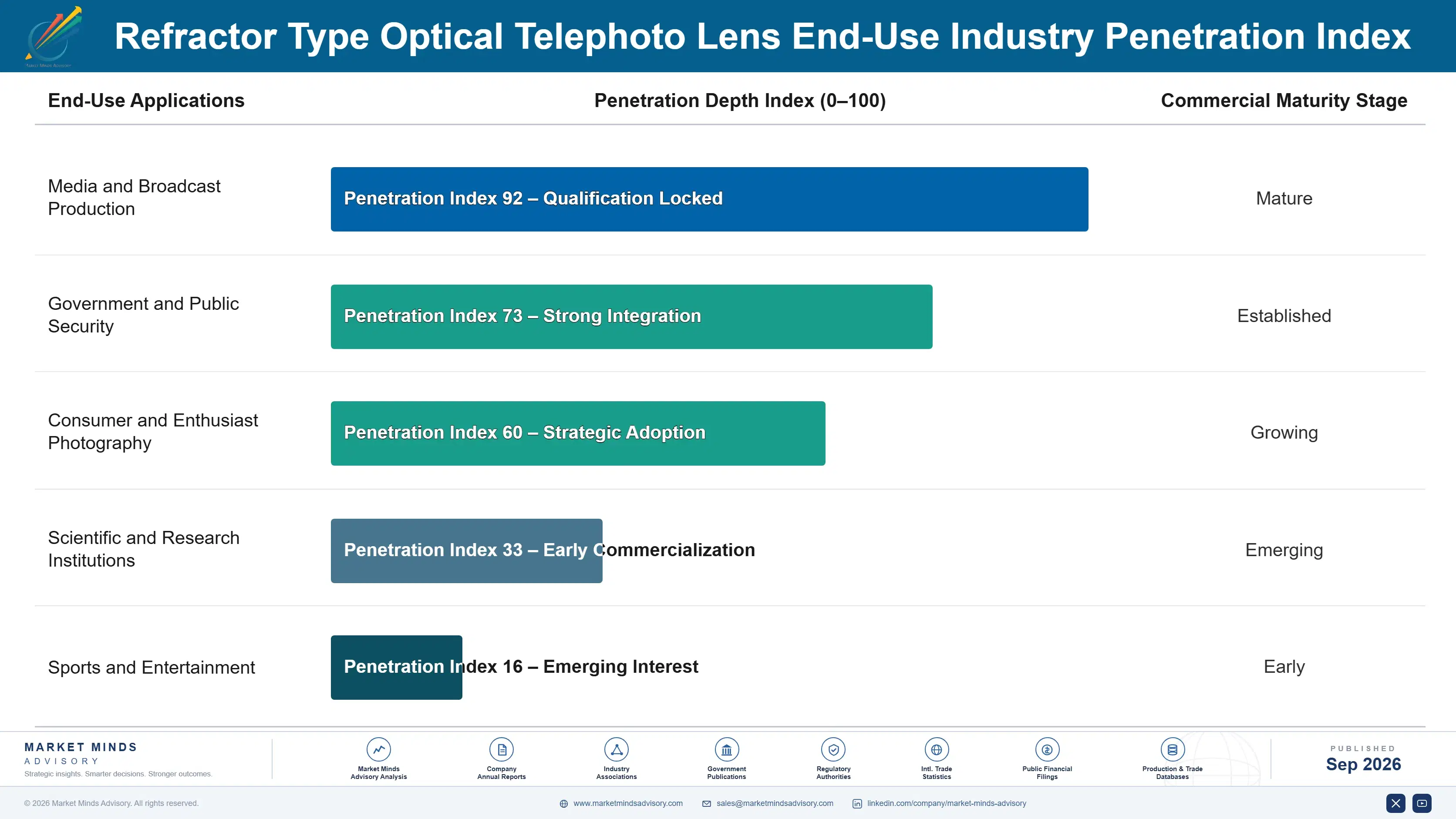
Adoption depth varies sharply by vertical. Broadcast and security buyers integrate lenses into multi-year capital programs with dedicated maintenance budgets, producing deep, sticky relationships that survive individual product cycles. Enthusiast photographers, by contrast, purchase more opportunistically around specific events or upgrade cycles, making that buyer segment far more price-sensitive and brand-switchable than institutional accounts locked into service contracts. Manufacturers courting institutional accounts design fleet-management tools around that stickier pattern.

A generational shift is also underway as younger content creators who grew up shooting on mirrorless bodies skip DSLR-mount glass entirely, buying native mirrorless telephoto lenses as their first serious purchase rather than migrating later, which is reshaping which mount family manufacturers prioritize. Manufacturers slow to court this younger cohort risk losing an entire generation of future flagship buyers to rivals who move faster.
refractor-type-optical-telephoto-lens-market-end-use-penetration-index-1789984651327

Where To Place Telephoto Lens Bets

These are among the four positions where our research anticipates prominent divergence between winners and laggards over the coming forecast period. Each is grounded in the demand model, the regulatory perimeter, and the announced capacity pipeline.
01 / FIRMWARE MONETIZATION PRIORITY

Build recurring software revenue before rivals lock in institutional accounts

Manufacturers still selling telephoto lenses as pure hardware are leaving durable margin on the table while Canon and Sony expand paid firmware tiers and fleet service contracts across their installed base. The window to build comparable recurring revenue infrastructure is narrowing as institutional buyers standardize on whichever platform offers it first and resist switching once calibration contracts are signed. Smaller manufacturers should prioritize firmware and service partnerships now, even at short-term integration cost, rather than compete on hardware specifications alone.
02 / MOUNT TRANSITION TIMING

Accelerate native mirrorless lens development ahead of DSLR retirement

The installed base of DSLR-mount telephoto glass is shrinking faster than most manufacturers planned for, and buyers frustrated by adapter performance are increasingly willing to switch brands entirely rather than wait for a native replacement. Manufacturers still allocating meaningful research budget to DSLR-mount refreshes risk missing the professional upgrade wave now underway across sports, wildlife, and broadcast segments, ceding ground to faster-moving rivals. Reallocating budget toward native mirrorless flagship glass ahead of competitors is the clearer path to capturing that migration before it fully plays out.
03 / INSTITUTIONAL CHANNEL INVESTMENT

Build dedicated broadcast and security sales teams distinct from consumer channels

Institutional buyers evaluate telephoto lenses on service reliability, fleet calibration turnaround, and long-term supply commitments, criteria that consumer-facing retail channels are poorly structured to sell against in the first place. Manufacturers who build dedicated institutional sales and service teams capture multi-year contracts that consumer-channel competitors cannot easily match or underbid, locking in recurring revenue well beyond the initial sale. That investment pays back over several contract renewal cycles rather than a single transaction, exactly the durability institutional buyers pay a premium for.
04 / SUPPLY CHAIN RESILIENCE PLANNING

Diversify rare-earth glass sourcing before the next price shock arrives

The 2023 rare-earth price spike demonstrated how exposed manufacturers without vertically integrated glass melting are to a single country's export licensing decisions, and that exposure has not disappeared even as prices partly normalized since then. Manufacturers should pursue long-term supply contracts, alternative low-rare-earth chemistries, and recycling pilots simultaneously rather than betting on any single mitigation working alone to close the gap. Waiting for the next shortage to start diversifying will repeat the same margin compression smaller manufacturers absorbed in 2023.

Engagement Snapshot From the Field

A live engagement with an industry participant carrying material or product regulatory and market exposure ahead of a defining policy shift, showing how our research translates into a defensible multi-year portfolio strategy.
MARKET MINDS ADVISORY · CLIENT ENGAGEMENT SUMMARY
Refractor Type Optical Telephoto Lens Producer Strategic Portfolio Review and Transition Roadmap 2026·Investment Scenario on Refractor Type Optical Telephoto Lens Exposure Evaluation 2025-26
CLIENT PROFILE
The client operates a mid-sized broadcast equipment rental fleet serving national sports and entertainment networks across a single large national market, with roughly four hundred telephoto and cinema lenses in active rotation across several regional depots. Revenue grew steadily but margin had compressed as aging DSLR-mount inventory required more frequent repair and drew fewer rental bookings from productions increasingly specifying mirrorless-native equipment for their crews.
STRATEGIC CHALLENGE
Management needed to decide how quickly to retire DSLR-mount telephoto inventory and reinvest in native mirrorless glass without stranding capital in equipment still generating rental income, while also evaluating whether to build in-house calibration capability or continue outsourcing maintenance to manufacturer service centers that were increasingly slow to turn around repairs during peak sports seasons.
MMA APPROACH
MMA benchmarked the client's fleet composition and utilization data against manufacturer trade-in program terms and regional rental demand patterns gathered through primary interviews with production houses. The engagement modeled three replacement pacing scenarios against projected rental booking loss from aging inventory, and separately assessed the breakeven utilization needed to justify an in-house calibration lab.
KEY FINDINGS
  1. Productions increasingly refused to book DSLR-mount cinema lenses outright, citing crew unfamiliarity with mirrorless-native controls during time-sensitive live broadcast shoots each season.
  2. Manufacturer trade-in credit covered roughly forty percent of native replacement cost (client-reported, unverified by MMA), better than management originally assumed going in.
  3. An in-house calibration lab reached breakeven at just under sixty percent fleet utilization, comfortably below the client's current operating level at the time.
  4. Regional competitors who delayed replacement lost measurable booking share to the client within a single broadcast season, faster than management had expected.
CLIENT PROFILE
The client operates a mid-sized broadcast equipment rental fleet serving national sports and entertainment networks across a single large national market, with roughly four hundred telephoto and cinema lenses in active rotation across several regional depots. Revenue grew steadily but margin had compressed as aging DSLR-mount inventory required more frequent repair and drew fewer rental bookings from productions increasingly specifying mirrorless-native equipment for their crews.
STRATEGIC CHALLENGE
Management needed to decide how quickly to retire DSLR-mount telephoto inventory and reinvest in native mirrorless glass without stranding capital in equipment still generating rental income, while also evaluating whether to build in-house calibration capability or continue outsourcing maintenance to manufacturer service centers that were increasingly slow to turn around repairs during peak sports seasons.
MMA APPROACH
MMA benchmarked the client's fleet composition and utilization data against manufacturer trade-in program terms and regional rental demand patterns gathered through primary interviews with production houses. The engagement modeled three replacement pacing scenarios against projected rental booking loss from aging inventory, and separately assessed the breakeven utilization needed to justify an in-house calibration lab.
KEY FINDINGS
  1. Productions increasingly refused to book DSLR-mount cinema lenses outright, citing crew unfamiliarity with mirrorless-native controls during time-sensitive live broadcast shoots each season.
  2. Manufacturer trade-in credit covered roughly forty percent of native replacement cost (client-reported, unverified by MMA), better than management originally assumed going in.
  3. An in-house calibration lab reached breakeven at just under sixty percent fleet utilization, comfortably below the client's current operating level at the time.
  4. Regional competitors who delayed replacement lost measurable booking share to the client within a single broadcast season, faster than management had expected.
RECOMMENDED STRATEGY
Phase 1: Phase 1 (Months 1 to 3): Retire the lowest-utilization quarter of DSLR-mount inventory and apply trade-in credit toward native replacements. Phase 2: Phase 2 (Months 4 to 9): Build in-house calibration capability sized to current fleet utilization rather than projected future scale. Phase 3: Phase 3 (Months 10 to 18): Complete DSLR-mount retirement and renegotiate production booking rates reflecting the upgraded native fleet capability.
OUTCOME
Within eighteen months the client reported rental booking volume up roughly eighteen percent year over year alongside a meaningful reduction in average repair turnaround time (client-reported, unverified by MMA), attributing both improvements to the faster-than-planned mirrorless transition and the in-house calibration lab reaching profitable utilization sooner than modeled.

Frequently Asked Questions

Foundational context covering the market sizes, CAGR, scope, country, region and competition that inform every finding below. This section is provided to cover basics and most often pre-purchase conversations, answered from the MMA Primary Research Dataset.

What is the current size of the Refractor Type Optical Telephoto Lens Market?

The market is valued at 1.6 billion dollars in 2025. It is projected to reach 1.7 billion dollars in 2026 as mirrorless mount migration accelerates.

How large will the Refractor Type Optical Telephoto Lens Market be by 2036?

The market is projected to reach roughly 3.4 billion dollars by 2036. That represents nearly double the 2026 value over the full ten-year forecast window.

What is the CAGR for the Refractor Type Optical Telephoto Lens Market 2026 to 2036?

The base case CAGR is 7.0% annually through 2036. Bull and bear scenarios range from 5.8% to 8.3% depending on export policy and computational adoption pace.

Which segment is growing fastest?

AI-driven autofocus and stabilization telephoto systems lead at a 10.0% CAGR, well ahead of every other segment. That pace is roughly 1.43 times the overall market's average annual growth rate.

Who are the major companies in the Refractor Type Optical Telephoto Lens Market?

Canon, Nikon, Sony, Sigma, and Tamron lead the category by shipment volume. Together these top five manufacturers hold roughly sixty-two percent of global lens shipments worldwide.

Which country is growing fastest?

China leads country-level growth at a 9.0% CAGR, ahead of every other national market tracked. Government-backed smart-city surveillance procurement programs are the primary driver behind that accelerating pace.

Report Segmentation Architecture

The full report scope spans multiple orthogonal segmentation dimensions, with cross-tabulated demand data provided for each dimension pair. Coverage extends further to regional breakdowns, trend trajectories, and the competitive detail needed to support segment-level decision-making.

By Technology Type

  • AI-Driven Autofocus and Stabilization Systems
  • Cinema and Broadcast Telephoto Lenses
  • Professional Photography Telephoto Lenses
  • Surveillance and Security Telephoto Lenses
  • Astronomical and Scientific Research Telephoto Lenses
  • Sports Broadcasting Telephoto Lenses

By End-Use Industry

  • Media and Broadcast Production
  • Government and Public Security
  • Consumer and Enthusiast Photography
  • Scientific and Research Institutions
  • Sports and Entertainment

By Commercial Dimension

  • Direct Institutional Sales
  • Rental Fleet Channel
  • Retail and Distributor Channel
  • Service and Calibration Contracts

By Region

  • North America
  • Western Europe
  • East Asia
  • South Asia and Pacific
  • Latin America
  • Middle East and Africa
  • Eastern Europe

Scope, Methodology, and Coverage

Every figure in this report is reproducible from documented input assumptions. The scope below maps the historical period, the forecast horizon, the segmentation dimensions, and the countries covered, alongside the underlying primary and qualitative methodology.
Historical Period
2020 to 2025
Forecast Period
2026 to 2036
Base Year
2025 (USD billions; MMA Primary Research Dataset, September 2026)
Market Definition
This report covers refractor-type optical telephoto lenses, glass-element long-focal-length optics of 100mm equivalent or greater used in photography, cinema and broadcast production, surveillance, and astronomical imaging. It excludes catadioptric and mirror-lens designs, smartphone periscope modules, and standalone image-processing software sold apart from a physical lens assembly.
Quantitative Units
USD billions (current prices); unit shipments where applicable
Segmentation Dimensions
By Technology Type; By End-Use Industry; By Commercial Dimension; By Region
Regions Covered
North America, Western Europe, East Asia, South Asia and Pacific, Latin America, Middle East and Africa, Eastern Europe
Countries Covered
USA, China, Germany, France, UK, Japan, South Korea, India, Australia, Canada, Brazil, Mexico, Indonesia, Vietnam, Thailand, Malaysia, UAE, Saudi Arabia, South Africa, Nigeria, Turkey, Poland, Netherlands, Italy, Spain, Sweden, Switzerland, Argentina, Colombia, Singapore, and additional markets relevant to this sector
Key Companies Profiled
Canon Inc, Nikon Corporation, Sony Group Corporation, Sigma Corporation, Tamron Co Ltd, Fujifilm Holdings Corporation, Panasonic Holdings Corporation, OM Digital Solutions Corporation, Leica Camera AG, Carl Zeiss AG, Jos Schneider Optische Werke GmbH, Cooke Optics Ltd, Thales Angenieux SAS, Kowa Company Ltd, Venus Optics, Meike Photographic Equipment Co Ltd, Samyang Optics Co Ltd, Irix doo, Tokina Co Ltd, Vazen Lens Co Ltd
Quantitative Methodology
Primary survey, n=3,800 respondents, Q4 2025, six countries; demand-side model with trade association cross-validation
Qualitative Methodology
47 expert interviews, Q4 2025; applied to validate demand model assumptions, identify emerging dynamics, and assess competitive positioning
Report Format
PDF and XLSX data workbook (Word format preview document)
Publisher
Market Minds Advisory
Report Code
MMA-2026-TEC-594
Published
September 2026
Contact
sales@marketmindsadvisory.com | www.marketmindsadvisory.com

Purchase the full Refractor Type Optical Telephoto Lens Market Report (2026 to 2036).

The full report delivers a complete quantitative and qualitative assessment of the refractor type optical telephoto lens market through 2036, including segment-level sizing across all six technology categories and country-level detail across thirty markets. It profiles twenty manufacturers with comparative positioning on autofocus capability, service infrastructure, and export exposure. Analysts also model three forecast scenarios against rare-earth supply risk and mount-migration timing. Buyers receive the underlying data tables, primary survey results from 3,800 respondents, and 47 expert interviews supporting every forecast assumption in the report.
Segment-level sizing across six technology categories
Country-level data across thirty covered markets
Comparative competitive profiles of twenty manufacturers
Primary survey results from 3,800 respondents
Expert interview transcripts from 47 professionals
Five-year revenue lever and margin analysis

Built For The People Who Decide

From boardroom strategy to bench-side execution, this report is read cover-to-cover by leaders shaping the next decade of their industry, turning demand scenarios, market dynamics and valuation benchmarks into decisions.
CXOs/ Presidents/ VPs/ Managers
M&A and Corporate Development
Strategy Teams and R&D Heads
Procurement and Product Directors
Regulatory and Compliance Leaders
Investor Relations and Equity Analysts