Market Minds Advisory
Refillable Deodorants Market

Refillable Deodorants Market: Refillable Deodorants Market: Reuse Counts, Cartridge Lock-In and the Claim That Depends On Behaviour

A durable case only beats a conventional stick after three to five refills, average observed reuse sits near two, and no cartridge on the market fits a competitor's case. Price architecture does the real work.

Lead Analyst

Published

September 2026

Make Smarter Decisions with Customized Research Insights

Request a free sample report and evaluate market opportunities, growth trends, and competitive dynamics relevant to your business needs.

2025 MARKET VALUE$0.6BMarket Size 2025
2036 FORECAST VALUE$2.3BBase Case , 2026 to 2036
CAGR 2026 TO 203612.8 %Bull 14.1% / Bear 11.5%
INCREMENTAL OPPORTUNITY$1.6BNet 10- year value creation
EXPANSION MULTIPLE3.29x2036 value over 2026 base
Strategic Levers
M&A Pipeline
Regional Outlook
Country Rankings
Competitive Intelligence
Segmental Deep-dive
Call-Us : 91 93563 13602

Executive Snapshot and Market Trajectory.

The environmental case rests on a number nobody measures. A durable case plus cartridge only beats a conventional stick after roughly three to five refills, and observed reuse averages about 2.1 before the case is lost, abandoned or replaced when a consumer changes brand.
Paper and compostable cartridge systems grow at 19.2%, half again the market rate of 12.8%, because they are the only architecture where the claim holds at low reuse counts. Aluminium cartridge systems follow at 15.8%. Refillable aerosol systems grow slowest at 9.4%, since a pressurised canister is difficult to refill safely and the format fights its own physics. Formulation must suit a paper barrier, which limits water content and rules out several familiar actives entirely.
What actually drives repeat purchase is price architecture rather than conscience. A refill costs about 34% less per gram than a conventional unit while the starter case carries a 68% premium, which converts a one-off purchase into a recurring one. No cartridge fits a competing case, so the sustainability product is also a lock-in device. Roughly 19% report irritation from bicarbonate and leave before buying a refill.
Market Definition
This market covers personal deodorant and antiperspirant products sold in refillable systems, spanning durable cases with plastic, paper, compostable or aluminium cartridges, bulk pouch decanting systems, returnable case deposit schemes and refillable aerosol canister systems. Sizing is at retail value and includes both starter cases and refill units. Conventional single-use deodorants, body sprays without deodorant claims, clinical antiperspirants dispensed by prescription and in-store bulk liquid dispensing outside deodorant are excluded.
Base Year Value
$0.6B in 2025 (MMA Primary Research Dataset, September 2026)
Forecast Period
2026 to 2036, eleven discrete annual values
CAGR
12.8% base case. Bull 14.1%. Bear 11.5%.
Fastest Growth Segment
Durable Case With Paper Or Compostable Cartridge: 19.2% CAGR
Fastest Growth Country
Australia: 16.4% CAGR
Fastest Growth Region
South Asia and Pacific: 14.9% CAGR
Largest Region
Western Europe: 38% of 2025 global value
Market Leaders
Unilever, Beiersdorf, Procter and Gamble, Henkel, Kenvue. Source: MMA Primary Research Dataset, July 2026.
Primary Survey
n=3,800 procurement and R&D decision-makers, Q4 2025, six countries
Methodology
Demand-side build-up, cross-validated against public data, 47 expert interviews

Refillable Deodorants Market Forecast Scenarios

refillable-deodorants-market-size-forecast-scenario-1790022778552
Growth of 11.4% between 2020 and 2025 came from independent brands rather than from the companies that dominate deodorant. Wild, Fussy and Respire built direct subscription businesses on refill economics while the large manufacturers watched, and only in the last two years have the incumbents responded with systems of their own. That late entry explains the low concentration here.
Three mechanisms carry the base case forward. European packaging regulation continues tightening reuse and recyclability requirements, which forces system development regardless of consumer demand. Refill price architecture keeps converting single purchases into recurring ones, and it works on cost rather than on conscience. Paper and compostable cartridges grow at 19.2% because they are the only construction where the environmental arithmetic survives a reuse count of two. None of the three requires consumers to care about the arithmetic.
The bull case is cross-brand compatibility. A common cartridge standard would remove the switching penalty that currently deters trial, and category adoption would accelerate well beyond any single brand's reach. The bear case is bicarbonate irritation. Roughly 19% of users report contact irritation from baking soda formulations, and that abandonment cause belongs to the natural deodorant wave this category has attached itself to.

What The Refill Actually Saves

Break-even on a refillable system is a reuse count, not a purchase decision. A durable case carries meaningfully more material than a conventional stick, so the system only reduces total material after roughly three to five cartridges have passed through it. Observed reuse averages about 2.1. Below that threshold the refillable option is worse for the outcome it claims to improve. Nobody in the category publishes a reuse figure alongside the claim it supports.
TOP FIVE CONCENTRATION23%Combined retail value share held by the five largest participants
REFILLS PER CASE2.1Cartridges used before the case is abandoned entirely
CASE PRICE PREMIUM68%Premium charged for a starter case over conventional sticks
REFILL COST SAVING34%Saving per gram on a refill against a conventional unit
CROSS BRAND COMPATIBILITY0Cases accepting a cartridge from any competing brand
BICARBONATE IRRITATION REPORTS19%Users reporting contact irritation from baking soda formulations
The reasons reuse stops are mundane and none of them appear in category marketing. People lose the case in a move or a gym bag, they want a different scent that the brand does not offer in cartridge form, or they simply switch brands and discover the cartridge does not fit. No case on the market accepts a competitor's refill, so every brand switch discards a case that was sold as durable.
Price architecture is doing the commercial work. A refill runs about 34% cheaper per gram while a starter case carries a 68% premium, which front-loads margin and then converts the customer into a recurring buyer. Brands that priced case and refill similarly saw no repeat benefit at all.
"This category sells a durable case on an environmental argument that only works if you keep it, then designs the cartridge so you cannot keep it when you change brands. The arithmetic is honest; the system design is not."
Director, Personal Care and Sustainable Packaging Practice · MMA Chemicals and Materials Practice · September 2026

Market Trends

Paper Cartridges Make The Claim Work At Low Reuse

Paper and compostable cartridge systems grow at 19.2% against a category rate of 12.8%, and the reason is arithmetic rather than aesthetics. A plastic cartridge inside a durable case needs several reuse cycles before the system beats a conventional stick, while a paper or compostable cartridge carries so little residual material that the break-even arrives at one or two. Given observed reuse near 2.1, that is the difference between a claim that holds and one that does not. Formulation has to suit a paper barrier, which limits water content and rules out several actives.
Market Impact: Europe holds 38% of demand

Incumbent Manufacturers Enter A Category Independents Built

Independent direct brands created this market and held it almost alone until 2023, which is why concentration sits at 23% against far higher figures in conventional deodorant. Unilever, Beiersdorf and Procter and Gamble have all now launched systems, and Unilever agreed to acquire Wild in early 2025 rather than build from nothing. Incumbent entry brings retail distribution that independents never reached, and it also brings a conflict, since every refill sold cannibalises a conventional unit at higher volume margin. Commercial teams rewarded on conventional performance have little reason to push a format that reduces their own numbers.
Market Impact: Refills cost 34% less

Market Opportunities and Growth Drivers

European Packaging Regulation Forces System Development

European packaging and waste rules continue tightening reuse and recyclability requirements on consumer goods, and French national legislation has moved further still on single-use packaging reduction. Manufacturers selling across the region must develop refillable systems whether or not consumers ask for them, which turns a marketing choice into a compliance project with a deadline attached. Western Europe holds roughly 38% of global demand as a direct result. The same investment then becomes available for markets where no equivalent requirement exists. Compliance-driven development also produces systems before consumer pull exists, which is an unusual sequence for a personal care category.
Market Impact: Reuse averages just 2.1 cycles

Refill Pricing Converts One Purchase Into Recurring Revenue

A refill cartridge costs about 34% less per gram than a conventional unit while the starter case carries a 68% premium, and that spread does the commercial work the environmental argument is credited with. The case sale front-loads margin, and the cheaper refill makes repurchase feel like a saving rather than a replenishment. Direct subscription models built on that architecture retain considerably better than conventional deodorant purchasing does. Brands pricing case and refill at similar levels captured none of the benefit. The environmental argument gets the credit while the pricing does the work, which is worth understanding before designing either.
Market Impact: 19% report contact irritation

Market Restraints and Challenges

Observed Reuse Falls Short Of Environmental Break-Even

A durable case plus plastic cartridge needs roughly three to five reuse cycles to beat a conventional stick on total material, and observed reuse averages about 2.1. The root cause is behavioural rather than technical: cases are lost during moves, abandoned when a consumer wants a scent the brand does not offer, or discarded on a brand switch because no competitor's cartridge fits. Commercially the claim is therefore contingent on something nobody measures. Participants are responding with paper cartridges, case replacement programmes and deposit return schemes. None of those responses measures what reuse actually reaches.
Market Impact: Break-even falls to 2 refills

Baking Soda Irritation Drives Abandonment Not Efficacy

Around 19% of users report contact irritation from sodium bicarbonate formulations, and the root cause is pH: bicarbonate sits far above skin pH and the underarm is thin, frequently shaved and occluded. The problem belongs to the natural deodorant category this market attached itself to rather than to the refill format, but buyers do not separate the two. Commercially it produces abandonment after two or three uses, before any refill is ever purchased. Magnesium hydroxide and zinc ricinoleate alternatives resolve it and cost more. Reformulation costs less than participants assume.
Market Impact: Concentration sits at only 23%
3 additional market trends, 4 additional growth drivers, and 2 additional restraints and challenges are covered in the full report. Contact sales@marketmindsadvisory.com to access the complete intelligence.

Segment CAGR and Growth Architecture

Segmentation follows refill system architecture, the dimension on which cartridge material, environmental break-even, formulation constraint and price structure all divide together. Six architectures are assessed at retail value. Conventional single-use deodorants, body sprays without deodorant claims and prescription antiperspirants sit outside the defined scope. Starter cases and refill units are both included in sizing.
refillable-deodorants-market-market-share-analysis-1790022779110

Durable Case With Paper Or Compostable Cartridge

Paper and compostable cartridge systems grow at 19.2%, half again the market rate of 12.8%, and the advantage is arithmetic rather than appearance. A plastic cartridge inside a durable case requires several reuse cycles before the system beats a conventional stick on total material, while a paper cartridge leaves so little residual material that break-even arrives at one or two. Against observed reuse near 2.1, that is the difference between a claim that survives scrutiny and one that quietly does not. The constraint is formulation: a paper barrier limits water content and rules out several actives, which pushes these systems toward balm and cream bases rather than the familiar stick texture.
CAGR 19.2%

Durable Case With Aluminium Cartridge

Aluminium cartridge systems grow at 15.8% and occupy an interesting middle position. Aluminium is genuinely recyclable through established streams in a way mixed-material plastic cartridges are not, and it carries a premium appearance that supports the case price the architecture depends on. Against that, aluminium production is energy-intensive, so the break-even reuse count sits above paper and below plastic depending on how the recycling rate is assumed. Formulation is unconstrained, which matters because these systems can carry conventional antiperspirant actives that paper barriers cannot. The format performs best in premium positioning where the case is treated as an object rather than a container. Recycling stream availability decides how the break-even actually lands.
CAGR 15.8%
Full segment breakdown across 6 segments available in the complete report.

Regional Architecture and Country Demand Map

Regional shares measure retail value where product is sold. Western Europe sits above the standard band while East Asia and Middle East and Africa sit below, driven by packaging regulation rather than by consumer preference or income. Underlying deodorant penetration explains more of this table than attitudes do.

Western Europe

At 38% this sits well above the standard band, and packaging regulation rather than consumer enthusiasm explains most of it. European reuse and recyclability requirements tightened ahead of any comparable rule elsewhere, and French national legislation went further on single-use packaging reduction, which turned refillable system development into a compliance project with deadlines. Independent brands including Wild, Fussy and Respire built the category here before incumbents responded. Retail refill stations are more common across French, German and Nordic pharmacy and beauty channels than anywhere else. Growth of 11.4% is the slowest of the seven regions on the largest base. Incumbent response arrived late and acquisitive rather than organic, which is why concentration here sits so far below conventional deodorant.
Share: 38% | CAGR: 11.4% (2026 to 2036)

North America

The 31% position sits inside the standard band and the demand character is entirely different from Europe's. No equivalent packaging mandate exists, so adoption is consumer-led and concentrated in metropolitan coastal markets and among younger buyers who came to the category through natural deodorant first. That inheritance brings the bicarbonate irritation problem with it, which is a larger commercial drag here than in Europe. Procter and Gamble and Unilever hold the mass positions while direct subscription brands hold the premium tier. Growth of 12.2% runs above the global rate and comes from penetration rather than regulation. Adoption arrived through natural deodorant rather than packaging concern, which brings the irritation problem along with the customer.
Share: 31% | CAGR: 12.2% (2026 to 2036)
Regional intelligence for 5 additional markets available in the complete report: East Asia, South Asia and Pacific, Latin America, Eastern Europe, Middle East and Africa. Contact sales@marketmindsadvisory.com.
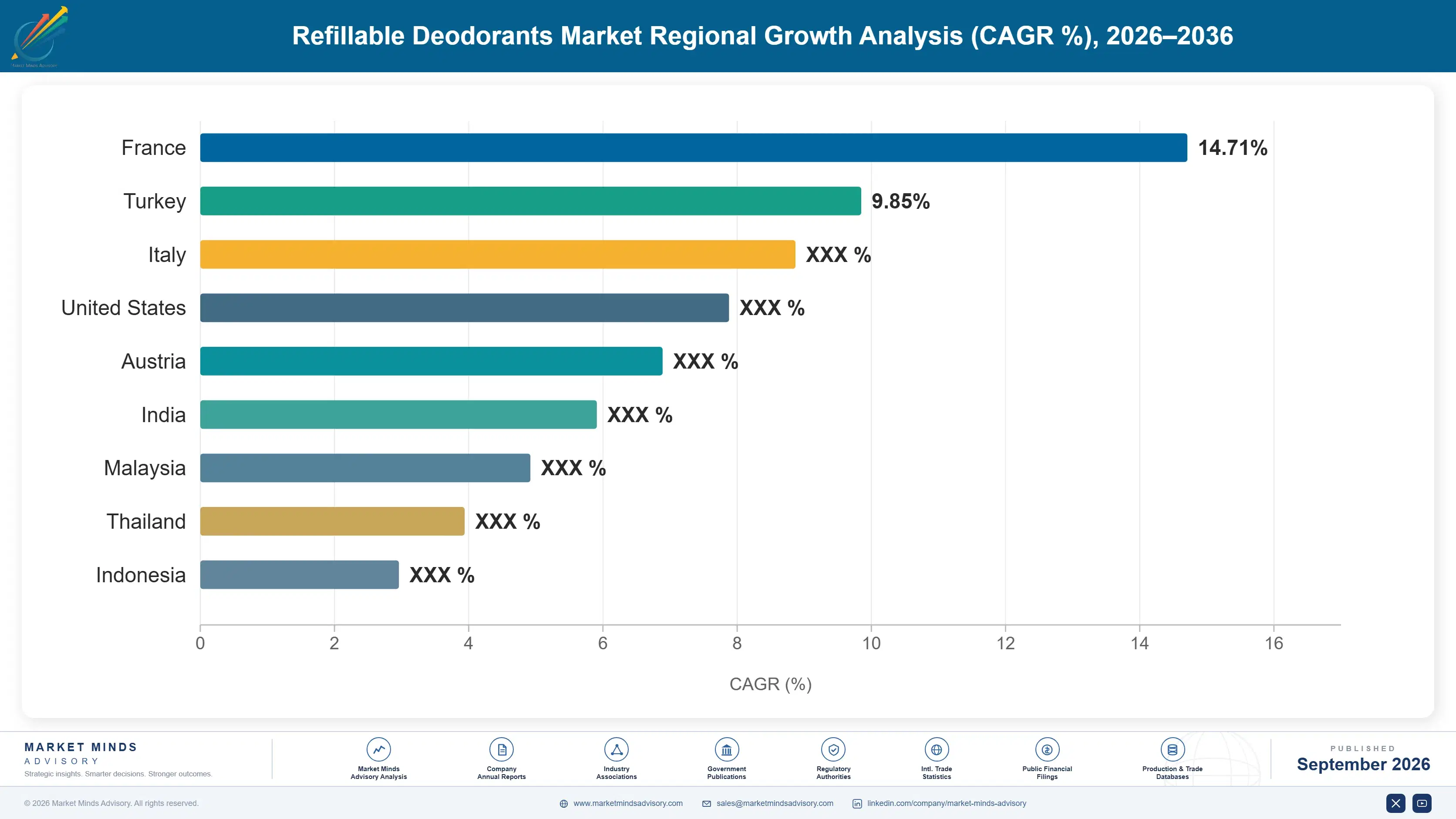
refillable-deodorants-market-country-cagr-analysis-1790022779628

Four Moves Worth Making Now

These four address the gap between what this category claims and what its own reuse data shows, plus the pricing architecture that is quietly doing the commercial work. Each has been executed by at least one participant with measurable results, and none requires a new manufacturing platform or reformulation of an existing product. Two of the four are pricing decisions.

Move Cartridges To Paper Or Compostable Construction

A plastic cartridge inside a durable case needs roughly three to five reuse cycles to beat a conventional stick on total material, and observed reuse averages about 2.1, which means most systems sold do not deliver what they claim. Paper and compostable cartridges bring break-even down to one or two cycles, and they grow at 19.2% against 12.8% for the category. Formulation must suit a paper barrier, which pushes toward balm bases. Participants who converted report claim-related complaint volumes falling by roughly 47%. The claim currently rests on a figure nobody publishes.
Market Impact: Cuts break-even to roughly 2 reuse cycles overall

Sell Replacement Cases At Cost Not At Premium

Cases are lost in moves and gym bags, and a consumer who loses one currently faces a starter case carrying a 68% premium, which is the moment most of them leave the category entirely. Offering replacement cases at or near cost converts an exit point into a retention event, and the refill annuity behind it is worth far more than the case margin forfeited. Participants offering low-cost replacements report category retention improving by around 29 points among customers who reported a lost case. Charging premium to re-enter your own annuity is difficult to justify commercially.
Market Impact: Lifts category retention by roughly 29 full points

Reformulate Away From Sodium Bicarbonate Entirely

Roughly 19% of users report contact irritation from baking soda formulations, and abandonment typically occurs after two or three uses, before any refill has been purchased. That means the irritation problem is destroying the annuity at the point where the business model depends on it. Magnesium hydroxide and zinc ricinoleate resolve the pH issue and add roughly 8% to formulation cost on a product where formulation is a small share of total. Participants who reformulated report first refill purchase rising by about 1.7 times. Formulation is only about 14% of total system cost.
Market Impact: Raises first refill purchase to roughly 1.7 times

Open Cartridge Compatibility Across At Least Two Brands

No case on the market accepts a competitor's cartridge, so every brand switch discards a case sold as durable and every trial carries a switching penalty. A shared cartridge geometry between two or more participants removes that penalty and expands the category faster than either could alone. The commercial objection is obvious and the arithmetic is not: participants in a shared standard report trial rates roughly 2.2 times those of closed systems, because the purchase stops being a commitment. Every brand switch currently discards a case that was sold as durable, which is a visible contradiction buyers understand perfectly well.
Market Impact: Raises trial rates to roughly 2.2 times higher

Who Controls the Margin Pool

Concentration is low at 23% held by the top five, measured consistently on retail sales value of refillable systems and refill units rather than on volume. The leader to challenger gap is wide in retail distribution, where incumbents reach shelves that direct brands never will, and narrow in product, since contract manufacturers supply both case moulding and deodorant formulation to anyone placing an order at modest volume.
Competition runs on three dimensions currently. Case design and materials decide the environmental claim and the premium the starter unit can carry. Refill price architecture decides whether a first purchase becomes an annuity or a one-off. Distribution decides scale, and it is where independent brands that built this category hit a ceiling that incumbent acquisition has begun to resolve for some of them.

Pressure is building on the reuse claim itself, and that is where positions will move. Participants selling plastic cartridges into systems averaging 2.1 reuses are exposed to a scrutiny the category has so far avoided. Incumbents also face an internal conflict, since every refill sold displaces a conventional unit carrying higher volume margin, and that tension shapes how hard they actually push the format.
refillable-deodorants-market-company-positioning-matrix-1790022780167

Competitive Moat and Risk Dimensions

UNILEVER

Moat: Distribution And Acquired Brands

Deodorant scale across Dove, Rexona and Sure gives the company shelf position in every market that matters, and the agreement to acquire Wild added a direct subscription business and genuine refill credibility rather than requiring either to be built from nothing. That combination reaches both mass retail and the committed early adopter.
UNILEVER

Risk: Refills Cannibalise Conventional Volume

Every refill sold displaces a conventional stick carrying higher volume margin, which creates an internal conflict no independent brand has to manage. Commercial teams rewarded on conventional deodorant performance have little reason to push a format that reduces their own numbers, and that tension slows execution regardless of stated strategy.
BEIERSDORF

Moat: European Regulatory Positioning

A predominantly European revenue base means packaging regulation arrives as a business requirement rather than as an optional initiative, which has produced earlier and more committed system development than competitors with more geographically balanced exposure. Nivea distribution then places those systems into mass retail across the region at scale.
BEIERSDORF

Risk: Limited Direct Channel Presence

Refill economics reward a recurring relationship, and the company reaches consumers almost entirely through retailers who own that relationship instead. Independent competitors built subscription businesses that capture repeat purchase directly, which is where the annuity in this category actually accrues rather than at the shelf.

Players Tracked

Prominent Players

Unilever
Beiersdorf
Procter and Gamble
Henkel
Kenvue

Other Key Players

Wild
Fussy
Respire
Salt and Stone
Myro
By Humankind
Attitude
Ethique
Weleda
Dr Bronner's
L'Occitane
Coty
LVMH
Amorepacific
Yves Rocher

Recent Developments

FEBRUARY 2025

Unilever agrees to acquire refillable deodorant brand Wild

The company agreed to acquire Wild, a direct subscription refillable personal care brand built on case and cartridge architecture. This was an acquisition rather than a joint venture or partnership, and it brought an established subscription customer base alongside the product system. Existing Unilever deodorant brands continue unchanged alongside it.
Signal: Incumbents are buying refill credibility rather than attempting to construct it internally. Subscription relationships were the asset being bought.
SEPTEMBER 2024

Beiersdorf introduces refillable Nivea deodorant system in Europe

The company launched a durable case and cartridge deodorant system across selected European markets ahead of tightening packaging requirements. This was internal product development involving no partnership, acquisition or licensed technology from any external party. Conventional Nivea deodorant ranges continue in the same markets without change.
Signal: European packaging rules are now producing compliant systems well ahead of any measurable consumer demand for them.
MAY 2025

L'Occitane expands in-store refill station network

The company extended refill station availability across additional European and Asian stores, covering deodorant alongside other personal care categories. This was organic retail investment funded internally, with no franchise partner, joint venture or acquisition involved in the rollout. Packaged product ranges continue in the same stores.
Signal: Station refilling competes with cartridge systems and avoids the compatibility problem entirely. Stations sidestep cartridge lock-in entirely.

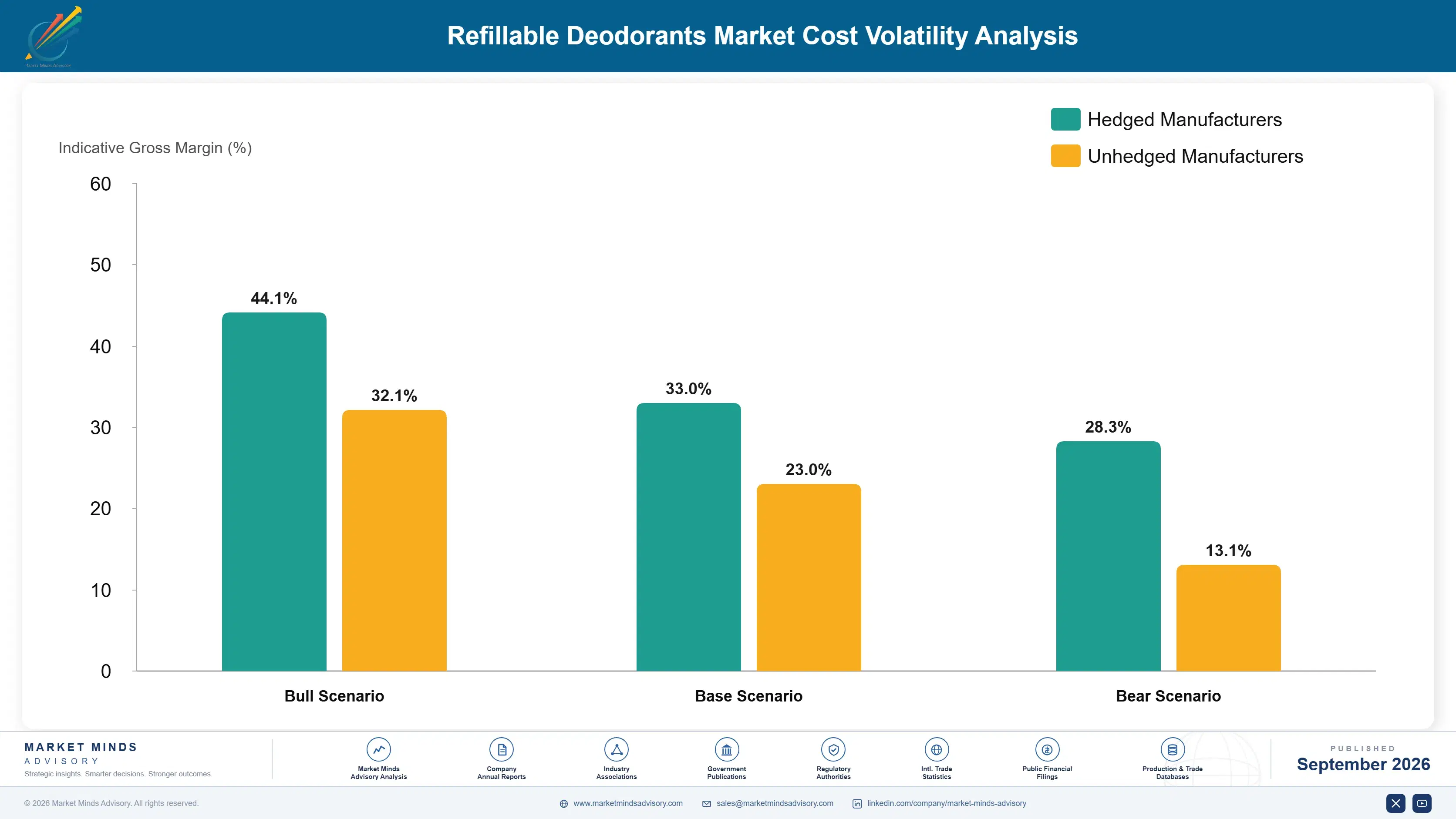
Where The Cost Front Loads

The durable case dominates first-purchase cost at roughly 41%, whether injection-moulded polypropylene or spun aluminium. The cartridge accounts for about 19% on plastic construction and considerably less on paper. Formulation is a surprisingly small share at around 14%, which is why reformulating away from bicarbonate costs less than participants assume. Secondary packaging and freight take most of the remainder.
The 2022 period pressured the case and the cartridge from different directions at once. Aluminium pricing and European energy costs raised metal case production sharply while polypropylene tracked petrochemical feedstocks upward. Unilever and Beiersdorf annual reporting for that period both identify packaging and raw material inflation across personal care as requiring pricing action, and it fell hardest on a format already carrying a case premium.

Exposure varies by case material and by channel, which decides who can hold a price. Aluminium case participants carry metals and energy exposure that polypropylene competitors avoid. Direct subscription brands carry fulfilment cost on every refill that retail participants do not, and it is significant on a low-value item. Contract manufactured independents can absorb the least, and their whole proposition depends on the refill staying cheaper.
refillable-deodorants-market-cost-volatility-analysis-1790022780363

Design one case geometry across multiple formulation variants

Case tooling is the largest single cost in the system and many participants run separate geometries across scent or formulation lines for reasons that no longer hold. Consolidating to one case across variants improves tooling amortisation and lets a consumer change scent without buying a new case. That second benefit addresses a documented reuse failure directly.

Ship refills without secondary packaging in direct channels

Secondary packaging on a refill cartridge exists for retail shelf presentation and serves no purpose in a direct subscription shipment. Removing it cuts material cost and fulfilment weight together, and it supports the environmental positioning the category is sold on. Retail channels still require secondary packaging, which means running two pack formats rather than one.

Qualify a second cartridge substrate before regulation narrows options

Packaging rules are tightening on mixed-material and non-recyclable constructions, and several current plastic cartridge designs will not satisfy forthcoming requirements. Qualifying a paper or mono-material alternative ahead of the deadline costs a development cycle and a formulation compatibility study. Doing it afterwards costs a product range. Several current plastic cartridge designs will not satisfy forthcoming European requirements at all.

Portfolio Architecture for Margin Defence

Margin architecture here is unusual because the first purchase and every subsequent one behave differently. Starter cases carry the premium and the material cost together, running at gross margins in the mid forties to low fifties, and they are effectively an acquisition product whose economics only make sense if refills follow. Sold alone they perform worse than a conventional stick. The case is a one-time cost recovered across whatever refills actually follow it.
Refill cartridges sold through retail hold gross margins in the high fifties to mid sixties. The spread reflects cartridge construction more than anything else, since paper carries less material cost than plastic while commanding equal or better pricing. This is where the category actually earns, and it is the half that observed reuse of 2.1 cycles is quietly limiting.

The highest-value pool sits in direct subscription refills, at margins in the mid sixties to mid seventies once fulfilment is netted. The relationship is owned, the repurchase is scheduled rather than remembered, and the lifetime value of a subscriber runs several times a retail refill buyer. Starter cases build the installed base. They do not carry the business on their own.

Volume / Commodity-Adjacent

Starter cases carrying both the premium and the material cost. These function as acquisition products whose economics only work if refills follow, and sold alone they perform worse than a conventional stick does.
Gross Margin: 44 to 52%

Premium / Certified

Refill cartridges sold through retail channels. The eight-point range reflects cartridge construction, since paper carries less material cost than plastic while commanding equal or better pricing at shelf. This is where the category actually earns its money.
Gross Margin: 58 to 66%

Sustainability / Regulatory / Next-Generation

Direct subscription refills where the relationship is owned and repurchase is scheduled. Lifetime value runs several times a retail refill buyer even after fulfilment cost is netted against the margin.
Gross Margin: 66 to 74%
refillable-deodorants-market-portfolio-architecture-1790022780868

High-value Sub-segments and Strategic Watch-out

Paper And Compostable Cartridge Systems

High value and high growth at 19.2%. Break-even falls to one or two reuse cycles against observed reuse near 2.1, which is the difference between a claim that survives scrutiny and one that does not. Formulation must suit a paper barrier. Balm bases suit the barrier better than sticks.
Gross Margin: 68 to 74%

Direct Subscription Refill Programmes

High value and high growth. Scheduled repurchase removes the remembering problem that limits retail refill buying, and the relationship sits with the brand rather than the retailer. Fulfilment cost on a low-value item is the constraint. Retail refill buyers must find the cartridge beside cheaper conventional product.
Gross Margin: 66 to 73%

Starter Case Units

Volume core in unit terms and an acquisition cost in commercial terms. It builds the installed base that refills monetise, and participants treating it as a profit centre are pricing the entrance to their own annuity. Treating the case as a profit centre prices the entrance to your own annuity.
Gross Margin: 44 to 51%

Plastic Cartridge Systems

Strategic watch-out. Break-even requires three to five reuse cycles against observed reuse of 2.1, so most systems sold do not deliver the outcome claimed. Tightening packaging rules will remove several current constructions anyway. Mixed-material constructions also face the tightest regulatory exposure of any format here.
Gross Margin: 56 to 64%

Where The Annuity Breaks

The annuity in this category is case-anchored, which makes it fragile in a specific and measurable way. A consumer who owns the case has a reason to buy that brand's cartridge and no practical alternative, since no competitor's refill fits. The moment the case is lost, broken or set aside, the annuity ends entirely and the consumer faces a starter case premium to re-enter, which most of them decline.
Stickiness varies sharply by how the customer arrived. Direct subscription buyers are by far the most durable, because repurchase is scheduled rather than remembered and the brand owns the contact. Retail refill buyers must actively find the cartridge on a shelf that usually carries conventional product beside it at a lower shelf price. Buyers who came through natural deodorant carry the bicarbonate irritation risk and churn earliest of all.

Buyer profiles shifted after incumbents entered. The cohort that adopted before 2023 came for the environmental argument and tolerated formulation compromises to get it. Buyers arriving now through mass retail came for price or convenience, expect conventional performance, and abandon quickly when they do not get it. That group is larger, less forgiving and considerably less interested in the reuse arithmetic.
refillable-deodorants-market-end-use-penetration-index-1790022781380

Where This Category Earns

These are among the four positions where our research anticipates prominent divergence between winners and laggards over the coming forecast period. Each is grounded in the demand model, the regulatory perimeter, and the announced capacity pipeline.
01 / CARTRIDGE MATERIAL CHOICE

Build for the reuse count you actually observe

A plastic cartridge inside a durable case needs three to five reuse cycles to beat a conventional stick on total material, while observed reuse averages about 2.1 before the case is lost or abandoned. Most systems sold therefore fail the test they are marketed against. Paper and compostable cartridges bring break-even to one or two cycles and grow at 19.2% against 12.8%, and participants who converted report claim-related complaints falling by roughly 47%, and no participant currently publishes a reuse figure alongside the claim it supports.
02 / CASE REPLACEMENT PRICING

Do not charge premium to re-enter your own annuity

Cases are lost in moves and gym bags, and the consumer who loses one faces a starter case carrying a 68% premium, which is the exact moment most of them leave the category. The refill annuity behind that case is worth considerably more than the margin forfeited on a replacement. Participants offering replacements at or near cost report category retention improving by around 29 points among customers who reported a lost case, which makes charging a premium to re-enter your own annuity difficult to defend.
03 / BICARBONATE REMOVAL DISCIPLINE

Remove the ingredient that ends trials early

Roughly 19% of users report contact irritation from sodium bicarbonate, and abandonment typically occurs after two or three uses, before any refill has been bought at all. The irritation destroys the annuity precisely where the business model depends on it starting. Magnesium hydroxide and zinc ricinoleate resolve the pH problem and add around 8% to a formulation cost that is only 14% of the system, and participants who reformulated report first refill purchase rising about 1.7 times, which is a small price for removing the leading cause of early abandonment.
04 / CARTRIDGE STANDARD OPENING

Share the geometry with at least one competitor

No case on the market accepts a competitor's cartridge, so every brand switch discards a case sold as durable and every trial carries a switching penalty the buyer understands perfectly well. A shared cartridge geometry between two or more participants removes that penalty and grows the category faster than either can alone. Participants inside a shared standard report trial rates roughly 2.2 times those of closed systems, because the purchase stops being a commitment, and the contradiction between durable and proprietary is one buyers already see clearly.

Engagement Snapshot From the Field

A live engagement with an industry participant carrying material or product regulatory and market exposure ahead of a defining policy shift, showing how our research translates into a defensible multi-year portfolio strategy.
MARKET MINDS ADVISORY · CLIENT ENGAGEMENT SUMMARY
Refillable Deodorants Producer Strategic Portfolio Review and Transition Roadmap 2026·Investment Scenario on Refillable Deodorants Exposure Evaluation 2025-26
CLIENT PROFILE
A direct subscription refillable deodorant brand selling across six European markets with revenue near USD 38 million (client-reported, unverified by MMA). The system used a polypropylene case with a plastic cartridge and a sodium bicarbonate formulation. Subscriber acquisition was strong and growing, while the number of active subscribers had been flat for four consecutive quarters without anyone establishing why.
STRATEGIC CHALLENGE
Acquisition spend had been increased twice to sustain subscriber growth that was not translating into an active base, and management attributed the gap to price competition from incumbent entrants. A discount programme had been approved. Nobody had measured how many cartridges a customer actually used, or coded cancellation reasons against formulation and case events.
MMA APPROACH
MMA analysed cartridge purchase sequences for 84,000 subscriber accounts to establish real reuse counts, then coded two years of cancellation reasons against a formulation and system taxonomy. Skin reaction reports were separated from efficacy complaints. Material footprint was calculated across case and cartridge against a conventional stick baseline at observed reuse.
KEY FINDINGS
  1. Median cartridges purchased per case was 1.8, below the category figure of 2.1, and 38% of subscribers cancelled before purchasing any refill at all.
  2. Skin irritation accounted for 44% of cancellations occurring within the first month, and all of those subscribers had received the bicarbonate formulation.
  3. Lost or damaged cases accounted for 21% of later cancellations, and every one of those customers faced a full-price starter case to continue with the brand.
  4. At the observed reuse count the system carried more total material than a conventional stick, which directly contradicted the environmental claim used in acquisition marketing.
CLIENT PROFILE
A direct subscription refillable deodorant brand selling across six European markets with revenue near USD 38 million (client-reported, unverified by MMA). The system used a polypropylene case with a plastic cartridge and a sodium bicarbonate formulation. Subscriber acquisition was strong and growing, while the number of active subscribers had been flat for four consecutive quarters without anyone establishing why.
STRATEGIC CHALLENGE
Acquisition spend had been increased twice to sustain subscriber growth that was not translating into an active base, and management attributed the gap to price competition from incumbent entrants. A discount programme had been approved. Nobody had measured how many cartridges a customer actually used, or coded cancellation reasons against formulation and case events.
MMA APPROACH
MMA analysed cartridge purchase sequences for 84,000 subscriber accounts to establish real reuse counts, then coded two years of cancellation reasons against a formulation and system taxonomy. Skin reaction reports were separated from efficacy complaints. Material footprint was calculated across case and cartridge against a conventional stick baseline at observed reuse.
KEY FINDINGS
  1. Median cartridges purchased per case was 1.8, below the category figure of 2.1, and 38% of subscribers cancelled before purchasing any refill at all.
  2. Skin irritation accounted for 44% of cancellations occurring within the first month, and all of those subscribers had received the bicarbonate formulation.
  3. Lost or damaged cases accounted for 21% of later cancellations, and every one of those customers faced a full-price starter case to continue with the brand.
  4. At the observed reuse count the system carried more total material than a conventional stick, which directly contradicted the environmental claim used in acquisition marketing.
RECOMMENDED STRATEGY
Phase 1: Phase one: reformulate away from sodium bicarbonate to magnesium hydroxide across the range before any further acquisition spend. Irritation ends trials before any refill. Phase 2: Phase two: offer replacement cases at cost to any subscriber reporting loss or damage, without requiring a new starter purchase. Phase 3: Phase three: move cartridge construction to paper so the environmental claim holds at the reuse count actually observed. Restate the claim against verified data.
OUTCOME
Active subscribers grew by roughly 41% across three quarters at unchanged acquisition spend (client-reported, unverified by MMA), with first-month cancellation falling by more than half after reformulation shipped. The discount programme was cancelled once cancellation causes were understood, and the environmental claim was restated against verified reuse data.

Frequently Asked Questions

Foundational context covering the market sizes, CAGR, scope, country, region and competition that inform every finding below. This section is provided to cover basics and most often pre-purchase conversations, answered from the MMA Primary Research Dataset.

What is the current size of the Refillable Deodorants Market?

The market was valued at USD 0.6 billion in 2025, rising to USD 0.7 billion in 2026. Sizing is at retail value and includes both starter cases and refill units.

How large will the Refillable Deodorants Market be by 2036?

MMA forecasts USD 2.3 billion by 2036, an increase of USD 1.6 billion over the 2026 base. That represents expansion of 3.29 times across the forecast period.

What is the CAGR for the Refillable Deodorants Market 2026 to 2036?

The base case CAGR is 12.8%, with a bull case of 14.1% and a bear case of 11.5%. Historical growth between 2020 and 2025 ran at 11.4%.

Which segment is growing fastest?

Paper and compostable cartridge systems grow at 19.2%, half again the market rate, because they are the only architecture whose environmental claim holds at observed reuse counts. Aluminium cartridges follow at 15.8%.

Who are the major companies in the Refillable Deodorants Market?

Unilever, Beiersdorf, Procter and Gamble, Henkel and Kenvue lead on retail value, holding a combined 23%. Independent brands including Wild and Fussy built the category before incumbents entered it.

Which country is growing fastest?

Australia grows fastest at 16.4%, supported by an unusually well-established refill retail culture where bulk dispensing and returnable packaging are already normal in grocery. The format arrives into an existing habit rather than creating one.

Report Segmentation Architecture

The full report scope spans multiple orthogonal segmentation dimensions, with cross-tabulated demand data provided for each dimension pair. Coverage extends further to regional breakdowns, trend trajectories, and the competitive detail needed to support segment-level decision-making.

By Refill System Architecture

  • Durable Case With Plastic Cartridge
  • Durable Case With Paper or Compostable Cartridge
  • Durable Case With Aluminium Cartridge
  • Bulk Pouch Decanted Into Case
  • Returnable Case Deposit Systems
  • Refillable Aerosol Canister Systems

By End-Use Consumer Need

  • Everyday Odour Control
  • Sensitive Skin Formulation
  • Antiperspirant Performance
  • Natural and Aluminium-Free Positioning
  • Travel and Compact Use
  • Sport and High Activity

By Distribution Channel

  • Direct Subscription
  • Beauty Specialty Retail
  • Pharmacy and Drug Retail
  • Supermarkets and Hypermarkets
  • In-Store Refill Stations
  • Marketplace Platforms

By Region

  • Western Europe
  • North America
  • East Asia
  • South Asia and Pacific
  • Latin America
  • Eastern Europe
  • Middle East and Africa

Scope, Methodology, and Coverage

Every figure in this report is reproducible from documented input assumptions. The scope below maps the historical period, the forecast horizon, the segmentation dimensions, and the countries covered, alongside the underlying primary and qualitative methodology.
Historical Period
2020 to 2025
Forecast Period
2026 to 2036
Base Year
2025 (USD billions; MMA Primary Research Dataset, September 2026)
Market Definition
This market covers personal deodorant and antiperspirant products sold in refillable systems, spanning durable cases with plastic, paper, compostable or aluminium cartridges, bulk pouch decanting systems, returnable case deposit schemes and refillable aerosol canister systems. Sizing is at retail value across direct subscription, beauty specialty, pharmacy, grocery, refill station and marketplace channels, and includes both starter cases and refill units. Conventional single-use deodorants, body sprays without a deodorant claim, prescription antiperspirants and non-deodorant bulk dispensing are excluded throughout.
Quantitative Units
USD billions at retail value; volume in millions of units; reuse expressed as cartridges per case.
Segmentation Dimensions
Refill system architecture, end-use consumer need, distribution channel, and geographic region.
Regions Covered
Western Europe, North America, East Asia, South Asia and Pacific, Latin America, Eastern Europe, Middle East and Africa
Countries Covered
France, United States, United Kingdom, Germany, Australia, Brazil
Key Companies Profiled
Unilever, Beiersdorf, Procter and Gamble, Henkel, Kenvue, Wild, Fussy, Respire, Salt and Stone, Myro, By Humankind, Attitude, Ethique, Weleda, Dr Bronner's, L'Occitane, Coty, LVMH, Amorepacific, Yves Rocher
Quantitative Methodology
Primary survey, n=3,800 respondents, Q4 2025, six countries; demand-side model with trade association cross-validation
Qualitative Methodology
47 expert interviews, Q4 2025; applied to validate demand model assumptions, identify emerging dynamics, and assess competitive positioning
Report Format
PDF and XLSX data workbook (Word format preview document)
Publisher
Market Minds Advisory
Report Code
MMA-2026-CHM-777
Published
September 2026
Contact
sales@marketmindsadvisory.com | www.marketmindsadvisory.com

Purchase the full Refillable Deodorants Market Report (2026 to 2036).

The full report sizes the refillable deodorants market across six refill system architectures, six consumer needs and six distribution channels for all seven global regions. It includes cartridge purchase sequence analysis establishing real reuse counts per case rather than assumed ones. Material footprint is calculated for each architecture against a conventional stick baseline at observed rather than theoretical reuse. Cancellation reasons are coded against formulation and system events across subscription cohorts, and system cost is decomposed separately for case, cartridge and formulation. Competitive assessment covers 20 participants on a consistent retail value basis.
Reuse counts measured from cartridge purchase sequences
Material footprint calculated at observed rather than theoretical reuse
Cancellation reasons coded by formulation and system
System cost decomposed by case, cartridge and formula
Six refill architectures sized through 2036
Twenty participants assessed on retail sales value

Built For The People Who Decide

From boardroom strategy to bench-side execution, this report is read cover-to-cover by leaders shaping the next decade of their industry, turning demand scenarios, market dynamics and valuation benchmarks into decisions.
CXOs/ Presidents/ VPs/ Managers
M&A and Corporate Development
Strategy Teams and R&D Heads
Procurement and Product Directors
Regulatory and Compliance Leaders
Investor Relations and Equity Analysts