Market Minds Advisory
Recordable Optical Disc Market

Recordable Optical Disc Market: Legacy Storage Media for Archival and Specialty Applications.

Consumer disc demand has nearly vanished, yet archival institutions and specialty industrial buyers keep a handful of surviving manufacturers running, rewarding certified long-term preservation media over the commodity discs that once dominated the category.

Lead Analyst

Published

September 2026

Make Smarter Decisions with Customized Research Insights

Request a free sample report and evaluate market opportunities, growth trends, and competitive dynamics relevant to your business needs.

2025 MARKET VALUE$1.5BMarket Size 2025
2036 FORECAST VALUE$2.1BBase Case , 2026 to 2036
CAGR 2026 TO 20363.2 %Bull 4.4% / Bear 2.0%
INCREMENTAL OPPORTUNITY$0.6BNet 10- year value creation
EXPANSION MULTIPLE1.37x2036 value over 2026 base
Strategic Levers
M&A Pipeline
Regional Outlook
Country Rankings
Competitive Intelligence
Segmental Deep-dive
Call-Us : 91 93563 13602

Executive Snapshot and Market Trajectory.

Recordable optical disc demand has stabilized into a narrow but durable niche, as consumer and general enterprise usage continues fading while archival institutions and specialty industrial applications keep manufacturers running production lines that most of the broader electronics industry abandoned years ago entirely.
Long-term data preservation requirements and specialty industrial recording applications are the two dominant commercial forces, concentrating volume in East Asia, where remaining disc manufacturing capacity and raw material supply chains survive in greater depth than anywhere else in the world. Archival-grade M-DISC and long-term preservation media absorb a growing share of remaining spend, since libraries and government archives value verified multi-decade data retention that magnetic and flash alternatives cannot match at comparable cost certainty.
Competitive intensity has consolidated to a handful of surviving manufacturers competing on manufacturing reliability and archival certification rather than price, a dynamic reshaping how the remaining supplier base allocates production capacity across shrinking order volumes each year across most product categories. Persistent institutional demand for physically durable, non-rewritable storage is keeping niche production lines running well past the point most consumer electronics categories would have shut down entirely.
Market Definition
The Recordable Optical Disc Market covers writable and rewritable CD, DVD, Blu-ray, and archival-grade M-DISC media used for data storage, backup, and long-term preservation. It excludes optical disc drive hardware, pressed read-only media, and digital storage formats such as flash memory or magnetic tape.
Base Year Value
$1.5B in 2025 (MMA Primary Research Dataset, September 2026)
Forecast Period
2026 to 2036, eleven discrete annual values
CAGR
3.2% base case. Bull 4.4%. Bear 2.0%.
Fastest Growth Segment
Archival-Grade M-DISC and Long-Term Preservation Media: 6.5% CAGR
Fastest Growth Country
Japan: 4.5% CAGR
Fastest Growth Region
South Asia and Pacific: 5.0% CAGR
Largest Region
East Asia: 30% of 2025 global value
Market Leaders
Verbatim (Mitsubishi Chemical), CMC Magnetics, Ritek Corporation, Millenniata, and Taiyo Yuden lead the global Recordable Optical Disc Market. Source: MMA Primary Research Dataset, July 2026, and company disclosures.
Primary Survey
n=3,800 procurement and R&D decision-makers, Q4 2025, six countries
Methodology
Demand-side build-up, cross-validated against public data, 47 expert interviews

Recordable Optical Disc Market Forecast Scenarios

recordable-optical-disc-market-size-forecast-scenario-1790007688272
Recordable optical disc demand declined steadily across 2020 to 2025, as cloud storage and flash media completed their displacement of discs from consumer and mainstream enterprise backup use cases, leaving behind a smaller but considerably more stable base of archival and specialty industrial buyers with genuinely different purchasing priorities than the departed consumer segment entirely.
The base case assumes continued gradual decline in consumer and general enterprise disc demand, offset by steady archival institution adoption of certified long-term preservation media and specialty industrial recording applications that require physically durable, non-rewritable storage. These three mechanisms together produce modest overall growth even as unit volume continues falling, since archival-grade media commands considerably higher average pricing than the commodity discs that once dominated total industry volume across earlier decades of consumer electronics history.
A bull scenario centers on accelerated institutional archival mandate adoption pulling M-DISC and similar long-term preservation media demand well beyond current forecasts across government and library sectors alike. A bear scenario centers on faster-than-expected manufacturer exit reducing available production capacity to a level that cannot sustain even the remaining niche demand base reliably over the coming decade.

A Niche That Refused to Fully Disappear

Recordable optical disc demand now tracks archival certification requirements more than raw storage capacity competition, since libraries and government archives value verified multi-decade retention over the higher capacity that flash and magnetic alternatives offer at lower guaranteed longevity. This shift has reordered which product attributes actually command premium pricing in the category, favoring certification depth over raw storage capacity or unit cost across nearly every remaining institutional buying decision.
MARKET CONCENTRATIONCR5 78%Highly concentrated among a handful of surviving producers
AVERAGE SELLING PRICE$0.35-$4.50Archival-grade media commands considerably higher unit pricing overall
TOP PRODUCING COUNTRYTaiwan 38%Volume concentrated among the very last remaining production facilities
CAPACITY UTILIZATION40-55%Runs well below peak given permanently reduced order volume
INPUT COST SHARE45% of COGSPolycarbonate resin and dye materials dominate total cost
REPLACEMENT CYCLE20-100 YearsArchival-grade discs specifically designed for multi-decade data retention
Commercial character has shifted from mass consumer electronics retail toward a specialized business-to-business supply relationship, where archival institutions and specialty industrial buyers negotiate directly with the handful of manufacturers still operating production lines. Order volumes are smaller but considerably more predictable than the volatile consumer retail cycles that once defined the category before cloud storage and flash media took over mainstream backup use cases entirely.
Continued manufacturer consolidation, growing archival mandate adoption among government and cultural institutions, and persistent specialty industrial recording demand will shape the category's trajectory through the next decade, with certified archival-grade media the primary source of remaining growth across an otherwise shrinking overall unit base that industry participants broadly expect will continue for the foreseeable future.
"Everyone assumed optical discs would vanish entirely. Instead they retreated into the one job cloud storage genuinely cannot promise: verified data integrity a century from now."
Director, Legacy and Archival Storage Technology Practice · MMA Technology Practice · September 2026

Market Trends

Archival Institutions Standardize on M-DISC Certification

National libraries, government archives, and cultural heritage institutions increasingly standardize procurement around M-DISC and similar archival-grade optical media certified for multi-decade data retention without periodic re-copying. This standardization reflects growing institutional concern about digital preservation failures affecting magnetic and flash storage media that require active refresh cycles every several years to prevent data degradation. Several national archives have disclosed formal procurement policies now requiring archival-grade optical media for permanent record preservation programs going forward, effectively locking in guaranteed multi-year procurement volume for certified suppliers able to meet institutional quality assurance standards.
Market Impact: Preservation-driven demand up 12% yearly
Specialty Industrial Applications Sustain Niche Manufacturing

Specialty industrial applications, including medical imaging archival, legal document preservation, and broadcast media archiving, continue requiring recordable optical disc formats for regulatory compliance and long-term retention requirements that alternative storage media cannot satisfy as reliably. This specialty demand sustains niche manufacturing capacity that would otherwise have closed entirely following the collapse of consumer disc demand. Several medical imaging providers have disclosed continued reliance on optical disc archival for regulatory-mandated patient record retention periods spanning decades, sometimes extending well beyond the patient's own lifetime under applicable jurisdictional record-keeping regulations that vary considerably by healthcare system.
Market Impact: Regulatory-driven demand steady at 3%

Market Opportunities and Growth Drivers

Digital Preservation Concerns Drive Archival Media Demand

Growing institutional awareness of digital preservation failures, including documented cases of magnetic tape and hard drive degradation destroying irreplaceable archival records, directly drives demand for verified long-term optical storage alternatives. Archival institutions increasingly recognize that flash and magnetic media require active refresh management that archival-grade optical discs simply do not need across their multi-decade certified lifespan. Several government archives have disclosed policy changes specifically citing documented preservation failures as justification for archival-grade optical media adoption across their permanent collection preservation programs spanning multiple future decades of continued institutional operation and collection growth.
Market Impact: Active manufacturers fell 60% since 2015

Regulatory Retention Mandates Sustain Specialty Demand

Regulatory requirements mandating multi-decade record retention across healthcare, legal, and financial services sectors continue sustaining specialty optical disc demand independent of broader consumer technology trends. These mandates typically specify retention periods spanning several decades that align naturally with archival-grade optical media's certified data integrity guarantees. Several healthcare systems have disclosed continued optical disc archival investment specifically to meet regulatory patient record retention obligations spanning the patient's entire lifetime and, in some jurisdictions, considerably beyond it under still-evolving record-keeping statutes that continue tightening steadily across most major healthcare and financial services jurisdictions worldwide.
Market Impact: Non-archival segment declines 8% yearly

Market Restraints and Challenges

Manufacturer Exit Threatens Long-Term Supply Continuity

Continued manufacturer exit from recordable optical disc production, whose root cause traces to shrinking order volumes making dedicated production lines increasingly uneconomical for most former consumer electronics manufacturers, threatens long-term supply continuity for the remaining archival and specialty industrial customer base. The commercial impact raises genuine concern among archival institutions about future media availability for ongoing preservation programs. Remaining manufacturers are pursuing mitigation through long-term supply contracts with major institutional customers to justify continued production investment despite the category's overall shrinking unit volume across nearly every non-archival application segment the category once served.
Market Impact: Archival-grade adoption up 15% yearly

Alternative Storage Media Continue Displacing Legacy Formats

Cloud storage and flash memory continue displacing optical discs from remaining use cases, whose root cause lies in declining storage cost per gigabyte and improving reliability that increasingly closes the gap with optical media's traditional durability advantage. The commercial impact continues shrinking the addressable market's non-archival segments each year across nearly every consumer category. Remaining manufacturers are pursuing mitigation by focusing exclusively on the archival and regulatory-compliance niches where optical media retains genuine, defensible technical advantages that alternative storage formats still cannot fully replicate at comparable certified longevity or institutional trust.
Market Impact: Specialty industrial demand steady at 4%
3 additional market trends, 3 additional growth drivers, and 3 additional restraints and challenges are covered in the full report. Contact sales@marketmindsadvisory.com to access the complete intelligence.

Segment CAGR and Growth Architecture

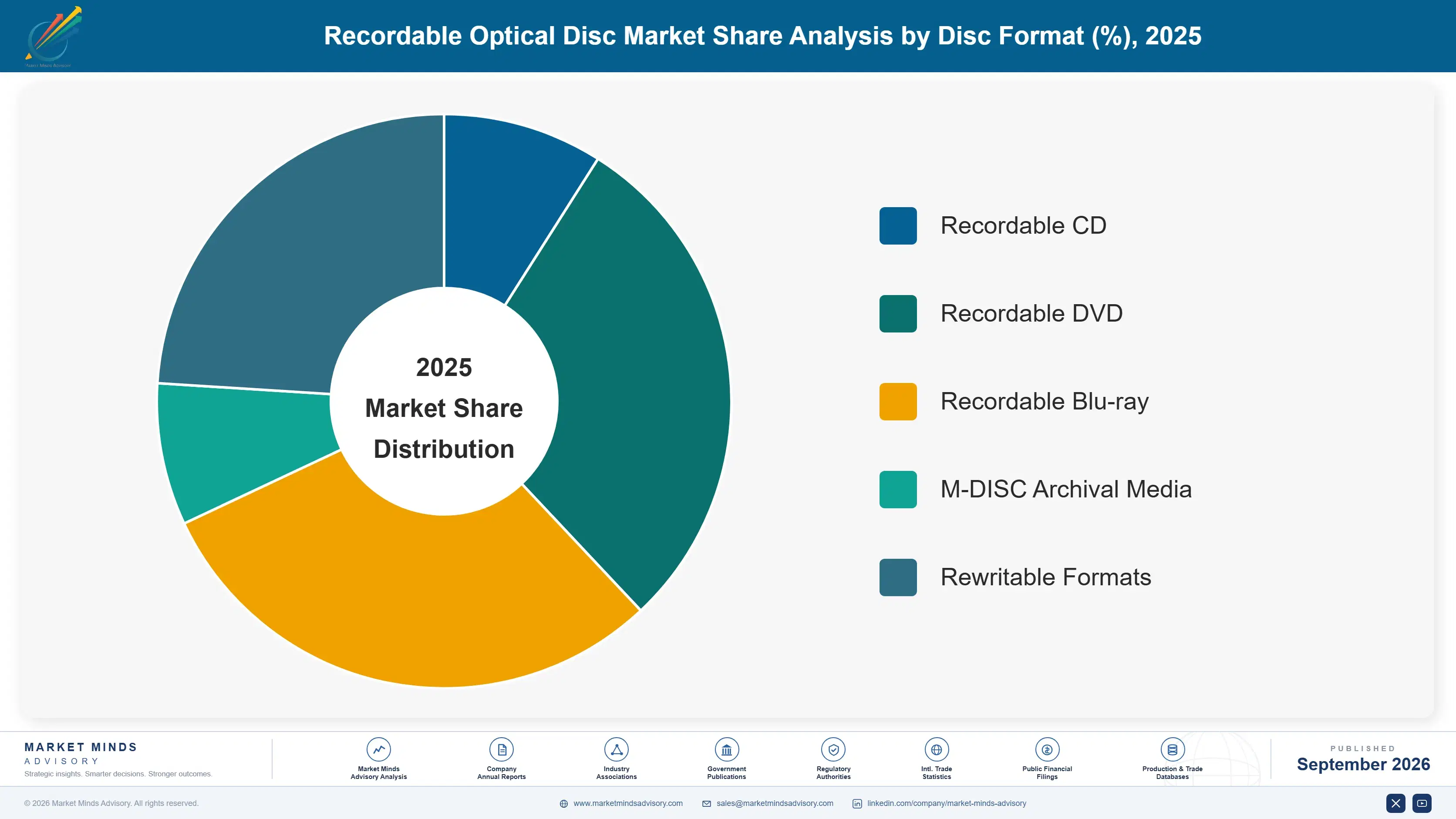
The Recordable Optical Disc Market segments by application context, since archival, specialty industrial, and remaining consumer or general enterprise use cases carry fundamentally different durability, certification, and pricing requirements as the category's overall composition continues shifting toward higher-value institutional buyers over time, a trend few in the broader consumer electronics industry anticipated a decade ago.
recordable-optical-disc-market-market-share-analysis-1790007688812

Archival-Grade M-DISC and Long-Term Preservation Media

Archival-grade M-DISC and similar long-term preservation media undergo specialized manufacturing processes that etch data physically into an inorganic recording layer rather than relying on dye-based recording, achieving certified data retention spanning decades without periodic refresh. Demand here grows fastest because institutional digital preservation concerns are pushing libraries, government archives, and cultural heritage organizations toward formal procurement standards specifically requiring this certification level. Suppliers with proven archival certification and institutional supply relationships increasingly capture new procurement contracts over general-purpose disc manufacturers lacking equivalent long-term reliability track records and formal third-party durability certification testing conducted under recognized international archival standards bodies that most general-purpose disc production lines have never bothered pursuing given the added cost involved.
CAGR 6.5%

Specialty Industrial Recording Media for Regulated Applications

Specialty industrial recording media serves medical imaging archival, legal document preservation, and broadcast media archiving applications subject to regulatory retention mandates that alternative storage formats cannot satisfy as reliably or cost-effectively. This segment grows steadily as healthcare and financial services regulatory retention requirements continue tightening across most major jurisdictions worldwide, sustaining demand independent of broader consumer technology adoption trends. Suppliers with regulatory compliance certification and established relationships with healthcare systems increasingly win specialty contracts over general disc manufacturers lacking comparable compliance credentials and an established, documented regulatory audit history spanning multiple prior compliance review cycles across several distinct regulatory jurisdictions and each healthcare system's own internal procurement and vendor qualification framework.
CAGR 4.0%
Full segment breakdown across 6 segments available in the complete report.

Regional Architecture and Country Demand Map

Recordable optical disc demand concentrates wherever remaining manufacturing capacity and archival institution density intersect, with East Asia leading on surviving production capacity while North America anchors substantial archival and regulatory-driven demand worldwide today across most institutional buyer categories, from national libraries through regulated healthcare record archives.

North America

North American demand centers on archival institution procurement and regulatory-driven healthcare and legal record retention, with the United States hosting a substantial share of the world's national archives, university libraries, and cultural heritage institutions adopting certified archival-grade media procurement standards. Regulatory retention mandates across healthcare and financial services continue sustaining specialty industrial demand independent of consumer technology trends. The region's declining consumer disc demand continues shrinking overall volume even as archival and specialty segments hold up relatively well against the broader category's overall contraction across most consumer and general enterprise use cases that migrated to cloud storage and flash memory alternatives years ago across nearly every major consumer and small business category still tracked today.
Share: 29% | CAGR: 3.5% (2026 to 2036)

Western Europe

Western European demand draws on strong institutional archival traditions across national libraries and government record-keeping bodies in Germany, France, and the United Kingdom, though consumer and general enterprise disc demand has declined faster here than in most other regions given earlier and more complete cloud storage adoption. European Union data retention and preservation regulations across cultural heritage institutions continue sustaining steady archival-grade media procurement even as broader category volume keeps contracting steadily across most member states within the union's collective member state economies and their respective national digitization and their considerably longer-term cultural heritage preservation strategies across the continent's oldest, largest, and most historically well-established cultural, academic, and government institutions.
Share: 22% | CAGR: 1.7% (2026 to 2036)
Regional intelligence for 5 additional markets available in the complete report: East Asia, South Asia and Pacific, Latin America, Middle East and Africa, Eastern Europe. Contact sales@marketmindsadvisory.com.
recordable-optical-disc-market-country-cagr-analysis-1790007689354

How Surviving Suppliers Actually Protect Margin

Recordable optical disc suppliers capture value beyond commodity unit pricing through four commercial mechanisms that reward archival certification and institutional relationship depth over remaining consumer volume today. Certification premium pricing, long-term institutional supply contracts, custom archival services, and manufacturing exit consolidation all matter considerably more here than remaining consumer unit economics ever really did.

Charging Certification Premium Pricing for Archival Media

Suppliers that achieve formal archival certification for their long-term preservation media capture premium pricing that consumer-grade disc manufacturers cannot access, since institutional buyers specifically require this certification for procurement compliance. This certification typically commands 3 to 8 times the pricing of commodity discs, reflecting the specialized manufacturing process and testing investment involved. Suppliers with established certification credentials increasingly capture nearly all new institutional procurement contracts over uncertified competitors lacking equivalent testing documentation, third-party validation, and the institutional trust built up over many years of continuous, reliable production without any significant supply interruption.
Market Impact: Certified archival media commands 3 to 8x pricing

Securing Long-Term Institutional Archival Supply Contracts

Suppliers that negotiate multi-year supply contracts with archival institutions capture predictable revenue tied to ongoing preservation program budgets, rather than competing for one-time consumer purchases in a declining category. These contracts typically span 5 to 10 years aligned with institutional budget cycles, providing suppliers the revenue visibility needed to justify continued specialized production investment. This approach favors suppliers with dedicated institutional sales teams over smaller rivals competing purely on remaining consumer retail volume that continues shrinking noticeably each and every year across nearly every major national market where consumer disc purchases once dominated total volume.
Market Impact: Institutional contracts typically span 5 to 10 years

Offering Custom Archival Consulting and Migration Services

Suppliers offering custom archival consulting services, including digital preservation planning and legacy media migration assistance, capture specialized service revenue equal to 15 to 25% of contract value beyond the underlying disc sale itself. This service layer matters particularly to institutions transitioning from older, non-certified media toward current archival-grade standards, requiring specialized expertise that most institutions genuinely lack internally and cannot easily or affordably develop entirely on their own without outside professional guidance, technical support, and dedicated preservation planning expertise. Suppliers with proven consulting capability increasingly win preferred-vendor status over disc-only competitors lacking equivalent advisory service infrastructure and dedicated preservation expertise.
Market Impact: Consulting services add 15 to 25% of revenue

Consolidating Remaining Manufacturing Capacity Through Exit

Surviving suppliers that acquire production capacity and customer relationships from exiting competitors capture incremental market share without the capital investment required to build new manufacturing capacity from scratch. This consolidation typically transfers 10 to 20% of exiting capacity's customer base to acquiring suppliers, concentrating remaining demand among fewer, larger producers. Suppliers positioned to acquire exiting competitors' assets increasingly capture disproportionate share of the category's remaining long-term value as the overall supplier count keeps shrinking year after year across the entire remaining global industry supplier base still remaining actively in operation today.
Market Impact: Consolidation transfers 10 to 20% of customer share

Who Controls the Margin Pool

Five firms hold roughly 78% of global recordable optical disc revenue, an unusually concentrated market structure reflecting the near-total manufacturer exodus that followed the category's consumer decline. Verbatim and CMC Magnetics lead through surviving production scale and archival certification depth, while the gap to smaller specialty producers has narrowed considerably, since remaining participants now compete on very similar certification credentials rather than manufacturing scale differences that mattered when the category was larger.
Current competitive activity centers on archival certification expansion, institutional supply contract renewal, and manufacturing capacity consolidation, as remaining suppliers position around the category's narrowing but stable institutional demand base. Some surviving manufacturers have quietly acquired production equipment and customer relationships from exiting competitors, consolidating capacity rather than competing for a shrinking pool of orders spread across too many remaining production lines.

Emerging pressure comes from continued cost improvement in flash and cloud storage narrowing the archival cost gap that optical media has historically relied upon for its remaining competitive positioning. Rankings shift slowly in this mature category, though suppliers with the deepest institutional certification credentials increasingly out-compete smaller rivals lacking comparable archival testing infrastructure or the accumulated institutional relationships built over decades of supply.
recordable-optical-disc-market-company-positioning-matrix-1790007689899

Competitive Moat and Risk Dimensions

VERBATIM (MITSUBISHI CHEMICAL)

Moat: Broadest Archival Certification Portfolio

Verbatim's decades of accumulated archival certification across multiple disc formats give it credibility with institutional buyers that smaller or newer entrants cannot quickly replicate, particularly for long-term preservation contracts where documented certification history matters more than any single technical specification claim a newer competitor might make without comparable field history.
VERBATIM (MITSUBISHI CHEMICAL)

Risk: Shrinking Consumer Revenue Base

Verbatim's remaining consumer disc business continues shrinking rapidly, forcing the company to increasingly depend on the smaller but more stable archival and specialty industrial segments to sustain overall category revenue as the broader consumer business approaches effective irrelevance within the company's overall product portfolio mix.
CMC MAGNETICS

Moat: Concentrated Manufacturing Scale Advantage

CMC Magnetics operates among the last remaining large-scale disc manufacturing facilities in Taiwan, giving it cost and reliability advantages that smaller producers operating at lower production volumes cannot match, particularly for large institutional orders requiring guaranteed consistent supply across multiple consecutive years without any meaningful supply interruption.
CMC MAGNETICS

Risk: Limited Product Diversification Options

CMC Magnetics remains heavily dependent on the recordable optical disc category itself, unlike diversified competitors that can absorb category decline through other business lines, leaving it more exposed to the category's continued long-term volume decline than diversified rivals with alternative revenue streams to fall back on.

Players Tracked

Prominent Players

Verbatim (Mitsubishi Chemical)
CMC Magnetics
Ritek Corporation
Millenniata
Taiyo Yuden

Other Key Players

Falcon Media
Prodisc Technology
MAM-A (Mitsui Advanced Media)
Traxdata
JVC Kenwood
Maxell Holdings
TDK Legacy Products
Sony Legacy Products
Panasonic Legacy Products
Memorex Legacy Products
Imation Legacy Products
Optodisc Technology
Moser Baer Legacy Products
Digital Storage Media Corp
Delkin Devices

Recent Developments

NOVEMBER 2025

Verbatim Renews Multi-Year Supply Agreement With National Archive

Verbatim renewed a multi-year supply agreement with a national archive institution covering certified M-DISC archival media for the country's ongoing digital preservation program, including committed volume targets tied to the archive's disclosed collection expansion roadmap through the end of the current decade and into the next.
Signal: Signals institutional buyers continue standardizing long-term procurement decisions around certified archival-grade media suppliers exclusively over time.
APRIL 2025

CMC Magnetics Acquires Production Assets From Exiting Competitor

CMC Magnetics completed the acquisition of production equipment and customer relationships from an exiting regional disc manufacturer, consolidating remaining manufacturing capacity and absorbing the exiting competitor's institutional customer contracts into its own portfolio, further concentrating remaining industry capacity among fewer surviving producers across the entire disc manufacturing sector.
Signal: Signals continued industry consolidation as smaller manufacturers exit the shrinking overall category entirely and permanently over time.
SEPTEMBER 2025

Millenniata Expands M-DISC Certification to New Format

Millenniata announced expanded M-DISC certification covering a new disc format with increased storage capacity, targeting institutional customers seeking higher-density archival media without sacrificing the certified multi-decade retention guarantees the brand has built its entire institutional reputation upon over many years of continuous, uninterrupted operation in the market.
Signal: Signals archival media suppliers continue investing in genuine product development despite the broader category's ongoing decline.

Polycarbonate Resin Costs Anchor Disc Economics

Polycarbonate resin and specialized recording dye materials together account for roughly 45% of recordable optical disc manufacturing cost, sourced primarily from a small number of chemical suppliers that have themselves reduced production as demand across the entire optical media industry has contracted. This dependence on a shrinking supplier base means remaining disc manufacturers, regardless of headquarters location, increasingly compete for the same limited raw material supply.
A documented polycarbonate resin supplier exit during 2023 pushed input costs up by roughly 20% and forced several smaller disc manufacturers to qualify alternative resin sources, according to industry supply chain reporting referenced in company annual disclosures, as declining overall demand made specialized optical-grade resin production increasingly uneconomical for chemical suppliers to continue. Several manufacturers delayed production runs while securing alternative supply, temporarily straining institutional delivery commitments.

Smaller disc manufacturers face a genuine competitive disadvantage here since they lack the purchase volume needed to secure preferential resin pricing and guaranteed supply continuity, unlike larger manufacturers with diversified chemical sourcing relationships. This dynamic favors companies like Mitsubishi Chemical with internal resin production capability, while smaller specialty producers increasingly pursue shared purchasing arrangements with other surviving manufacturers as mitigation against recurring raw material supply volatility.
recordable-optical-disc-market-cost-volatility-analysis-1790007690097

Vertical Integration Into Polycarbonate Resin Production

Larger manufacturers with existing chemical production capability are using internal polycarbonate resin manufacturing to reduce dependence on the shrinking pool of external optical-grade resin suppliers, securing both cost and supply reliability advantages over competitors dependent entirely on outside sourcing arrangements that carry their own price and availability uncertainty during periods of industry-wide supply pressure.

Joint Purchasing Arrangements Among Surviving Producers

Smaller surviving manufacturers are forming shared purchasing arrangements to pool raw material orders, securing volume discounts and priority allocation from remaining resin suppliers that individual smaller producers could not negotiate independently given their comparatively modest order sizes and limited standalone purchasing power relative to the industry's larger, more vertically integrated manufacturers with their own captive resin production.

Qualifying Alternative Resin Formulations for Production

Manufacturers are qualifying alternative polycarbonate resin formulations from a broader supplier base, reducing single-source dependency risk even when alternative formulations require additional testing and validation against archival certification standards before deployment into full production runs serving institutional archival customers whose strict, certification-driven quality requirements leave very little tolerance for error or inconsistent material quality between batches.

Portfolio Architecture for Margin Defence

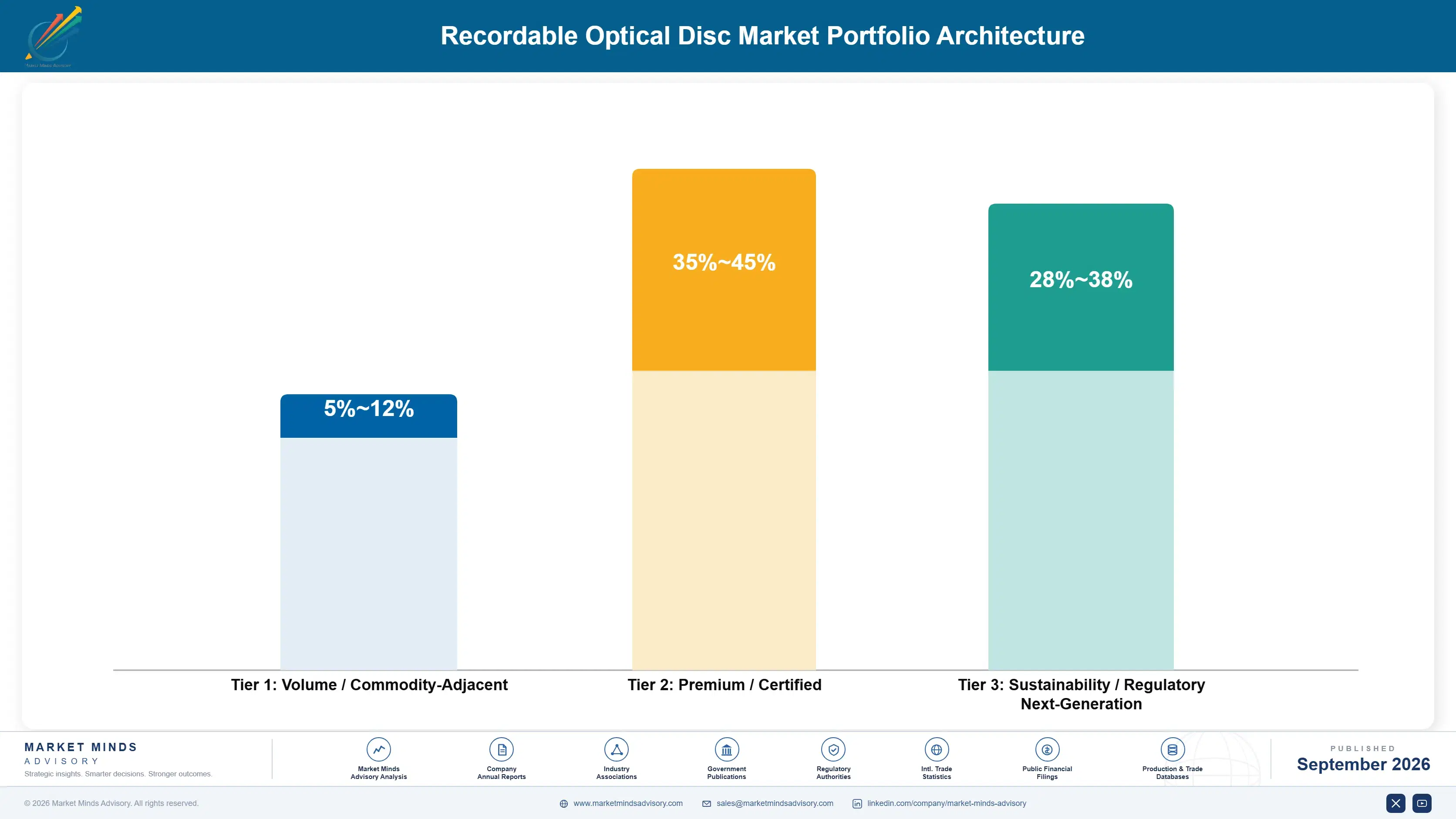
Margin architecture in recordable optical discs splits sharply between commoditized remaining consumer media and premium certified archival products. Commodity consumer discs run thin or negative margins given shrinking volume spread across largely fixed production costs, while certified archival-grade media commands substantially richer margins tied to certification depth and institutional relationship value that commodity producers lacking formal testing credentials and institutional relationship history simply cannot access.
Remaining consumer disc sales continue shrinking each year, but margin economics increasingly favor certified archival and specialty industrial product tiers as institutional buyers standardize procurement around certification requirements. Suppliers positioned only in commodity consumer media face existential margin pressure as volume keeps declining, forcing nearly all surviving suppliers to pursue archival certification as a genuine survival necessity rather than an optional growth strategy they might otherwise defer.

High-value margin pools concentrate in certified archival media, institutional supply contracts, and custom archival consulting services, where certification depth and institutional trust command premium pricing that commodity consumer disc production simply cannot match today. Suppliers building genuine certification depth alongside long-term institutional relationships increasingly capture the richest margin pools within the entire remaining industry.

Volume / Commodity-Adjacent

Remaining commodity consumer and general enterprise recordable discs, sold at thin or negative margins into a shrinking volume base as production costs stay largely fixed despite steadily declining order quantities across nearly every remaining producer.
Gross Margin: 5-12%

Premium / Certified

Certified archival-grade M-DISC and long-term preservation media priced for testing credentials and institutional trust that commodity disc producers lacking equivalent testing certification and long-standing institutional relationships simply cannot easily match or replicate.
Gross Margin: 35-45%

Sustainability / Regulatory / Next-Generation

Specialty industrial recording media for regulated healthcare, legal, and broadcast archival applications, commanding premium pricing tied to regulatory compliance certification and demonstrated long-term supply reliability across multiple prior contract renewal cycles.
Gross Margin: 28-38%
recordable-optical-disc-market-portfolio-architecture-1790007690595

High-value Sub-segments and Strategic Watch-out

Archival-Grade M-DISC and Long-Term Preservation Media

The fastest-growing and highest-value segment, combining a 6.5% forecast CAGR with premium margins tied to institutional certification requirements. Suppliers with proven archival testing credentials capture the richest growth and margin combination across the entire disc market today, well ahead of every other remaining product category.
Gross Margin: 38-46%

Specialty Industrial Recording Media for Regulated Applications

A high-value segment growing at 4.0% annually, tied to regulatory retention mandates across healthcare and legal sectors. Margin economics here trail archival media though overall demand remains substantial across multiple established regulated industry categories, sustained by continued regulatory retention mandate enforcement across most major healthcare and financial jurisdictions worldwide.
Gross Margin: 28-36%

Remaining Consumer and General Enterprise Recordable Media

The shrinking volume core of what remains of the market, generating declining revenue through commodity disc sales, though continued alternative storage substitution is compressing segment margins toward the market's very lowest end with each passing year of continued, seemingly irreversible category decline across nearly every market.
Gross Margin: 5-10%

Legacy Rewritable Format Discs Facing Continued Displacement

A strategic watch-out segment where rewritable disc formats face gradual continued displacement from cheaper, more convenient flash memory alternatives that have already captured most remaining rewritable storage use cases across nearly every consumer and general enterprise application segment that once relied on them before flash and solid-state alternatives became affordable.
Gross Margin: 8-14%

Why Archival Revenue Persists Decades

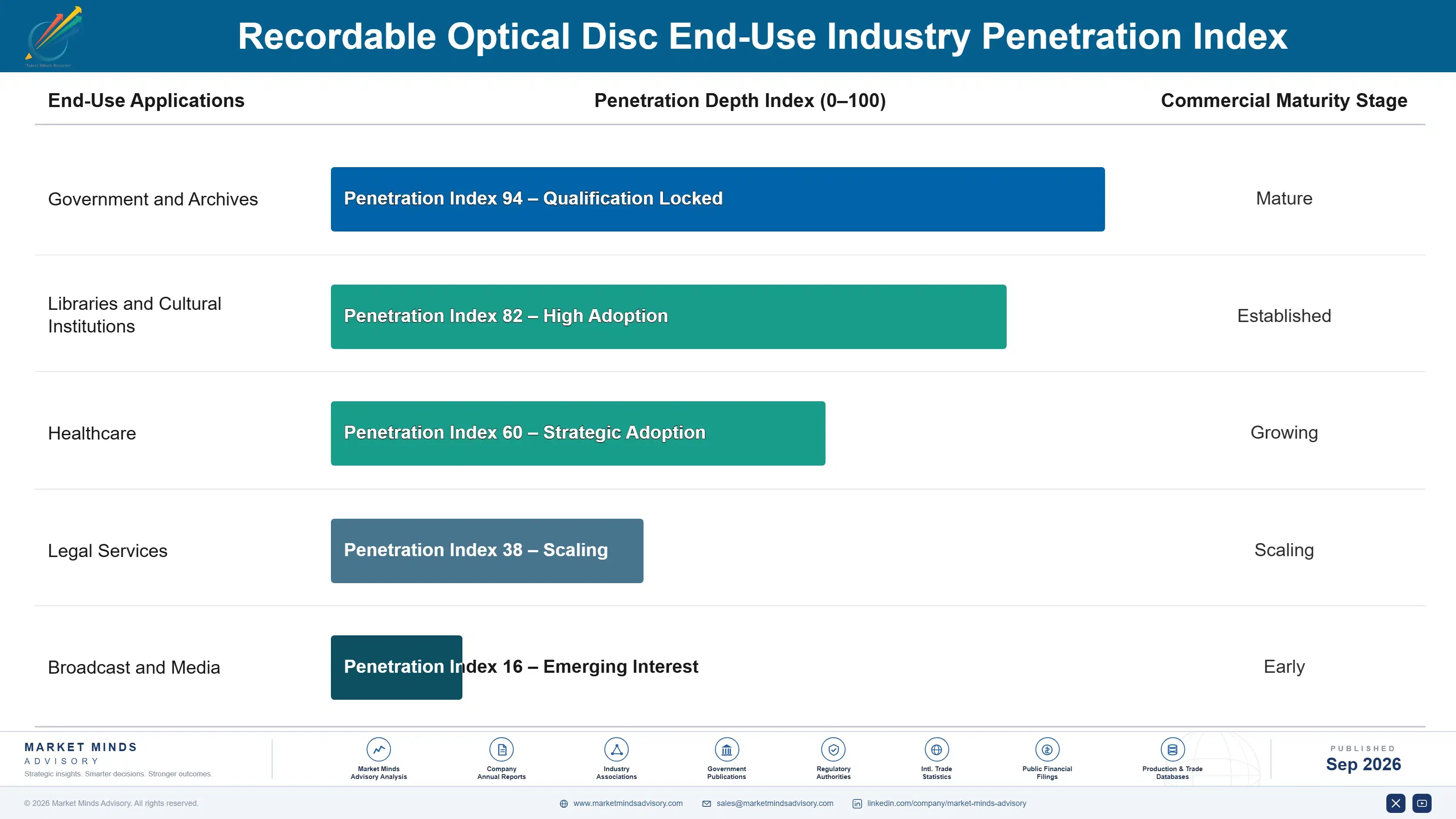
Recordable optical disc revenue builds annuity-like characteristics through multi-year institutional supply contracts tied to ongoing preservation program budgets, rather than through one-time consumer purchases. Archival institutions rarely switch certified suppliers once integrated into preservation workflows, since replacing an established supplier requires re-certifying media reliability against strict institutional standards at real cost, operational risk, and potential disruption to ongoing collection preservation continuity.
Adoption stickiness varies meaningfully by end-use vertical: national archives and libraries show the deepest supplier lock-in, since permanent collection preservation cannot tolerate certification transition risk once established, while remaining consumer buyers show minimal stickiness given the category's overall irrelevance to most everyday consumer storage decisions made today across nearly every household. Specialty industrial buyers sit in between, with switching costs tied closely to regulatory compliance certification depth.

A generational shift in buyer profile is underway as digital preservation specialists and compliance officers, not general information technology staff, increasingly drive recordable optical disc procurement decisions. These newer buyers evaluate suppliers on certification depth and long-term reliability data rather than unit price, reshaping how suppliers must position, sell, and structure ongoing relationships with institutional preservation and compliance departments.
recordable-optical-disc-market-end-use-penetration-index-1790007691091

Where to Compete in Optical Discs

These are among the four positions where our research anticipates prominent divergence between winners and laggards over the coming forecast period. Each is grounded in the demand model, the regulatory perimeter, and the announced capacity pipeline.
01 / ARCHIVAL CERTIFICATION DEPTH

Pursue formal archival certification before institutional buyers standardize

Archival-grade M-DISC and similar preservation media are growing at 6.5% annually, more than double the market's overall pace, yet several remaining producers still lack formal archival certification. Suppliers that invest in certification testing and institutional relationship development now will capture disproportionate share as libraries and archives standardize procurement around certified media. Waiting until certification becomes table stakes cedes this position entirely to already-certified competitors that moved first and now hold established institutional relationships across most major national archival and library preservation programs worldwide.
02 / MANUFACTURING ASSET CONSOLIDATION

Acquire exiting competitors' capacity before it disappears entirely

Continued manufacturer exit has reduced active producers by roughly 60% since 2015, leaving surviving suppliers an opportunity to acquire production capacity and customer relationships at favorable terms. Suppliers that consolidate exiting competitors' assets now capture incremental market share without the capital investment required to build new manufacturing capacity from scratch. Firms that wait risk losing acquisition opportunities entirely to faster-moving rivals already actively pursuing this exact same consolidation strategy across the industry's remaining, considerably diminished global producer base still operating today.
03 / INSTITUTIONAL CONTRACT DEPTH

Prioritize multi-year contracts over remaining consumer channel sales

Institutional supply contracts typically span 5 to 10 years, providing revenue visibility that remaining consumer retail sales simply cannot match given the category's continued volume decline. Suppliers still prioritizing consumer channel relationships over institutional contract development face genuine revenue instability as consumer volume keeps shrinking. Firms should reallocate sales resources toward institutional account development immediately, before competitors lock in the remaining major archival accounts still available for negotiation across the industry's remaining pool of long-standing, deeply established institutional customer relationships.
04 / REGULATORY COMPLIANCE SPECIALIZATION

Build healthcare and legal compliance expertise beyond general archival

Regulatory retention mandates across healthcare, legal, and financial services sustain specialty demand independent of broader consumer technology trends, yet many suppliers treat this segment as secondary to general archival business. Suppliers that build dedicated regulatory compliance expertise and healthcare system relationships can capture disproportionate share of this steady, defensible demand. Generalist archival suppliers should develop this specialization now, before compliance-focused competitors establish exclusive relationships with the largest healthcare, legal, and financial services institutional customers currently still available for new business development.

Engagement Snapshot From the Field

A live engagement with an industry participant carrying material or product regulatory and market exposure ahead of a defining policy shift, showing how our research translates into a defensible multi-year portfolio strategy.
MARKET MINDS ADVISORY · CLIENT ENGAGEMENT SUMMARY
Recordable Optical Disc Producer Strategic Portfolio Review and Transition Roadmap 2026·Investment Scenario on Recordable Optical Disc Exposure Evaluation 2025-26
CLIENT PROFILE
The client is a national archive institution responsible for preserving government records and cultural heritage materials, with annual digital preservation budget reportedly exceeding $15 million (client-reported, unverified by MMA). The client's existing preservation infrastructure relied heavily on magnetic tape and hard drive storage requiring periodic active refresh to prevent data degradation over time, a maintenance burden that consumed a meaningful share of the annual preservation budget.
STRATEGIC CHALLENGE
The client faced growing concern about long-term preservation reliability after documented cases of magnetic tape degradation at peer institutions destroyed portions of irreplaceable archival records. Leadership needed an objective evaluation of archival-grade optical media as a complementary preservation format alongside its existing magnetic and cloud storage infrastructure for the most historically valuable and irreplaceable records.
MMA APPROACH
MMA conducted a structured evaluation of archival-grade optical media options against the client's existing preservation infrastructure, assessing certified data retention claims, total cost of ownership over multi-decade time horizons, and supplier long-term supply continuity risk. The engagement combined primary interviews with the client's preservation and technology teams alongside comparative cost modeling.
KEY FINDINGS
  1. Archival-grade optical media demonstrated certified data retention periods exceeding 100 years without requiring any active refresh cycles or periodic data migration at all.
  2. Total cost of ownership over a thirty-year horizon favored optical media by roughly 35% compared to magnetic tape requiring periodic migration and refresh.
  3. Supply continuity risk from the shrinking optical disc manufacturer base emerged as a genuine concern requiring dedicated long-term contract mitigation strategies developed jointly with certified suppliers.
  4. A hybrid preservation strategy combining optical, magnetic, and cloud storage reduced overall single-format failure risk considerably across the client's entire archival collection and record-keeping mandate.
CLIENT PROFILE
The client is a national archive institution responsible for preserving government records and cultural heritage materials, with annual digital preservation budget reportedly exceeding $15 million (client-reported, unverified by MMA). The client's existing preservation infrastructure relied heavily on magnetic tape and hard drive storage requiring periodic active refresh to prevent data degradation over time, a maintenance burden that consumed a meaningful share of the annual preservation budget.
STRATEGIC CHALLENGE
The client faced growing concern about long-term preservation reliability after documented cases of magnetic tape degradation at peer institutions destroyed portions of irreplaceable archival records. Leadership needed an objective evaluation of archival-grade optical media as a complementary preservation format alongside its existing magnetic and cloud storage infrastructure for the most historically valuable and irreplaceable records.
MMA APPROACH
MMA conducted a structured evaluation of archival-grade optical media options against the client's existing preservation infrastructure, assessing certified data retention claims, total cost of ownership over multi-decade time horizons, and supplier long-term supply continuity risk. The engagement combined primary interviews with the client's preservation and technology teams alongside comparative cost modeling.
KEY FINDINGS
  1. Archival-grade optical media demonstrated certified data retention periods exceeding 100 years without requiring any active refresh cycles or periodic data migration at all.
  2. Total cost of ownership over a thirty-year horizon favored optical media by roughly 35% compared to magnetic tape requiring periodic migration and refresh.
  3. Supply continuity risk from the shrinking optical disc manufacturer base emerged as a genuine concern requiring dedicated long-term contract mitigation strategies developed jointly with certified suppliers.
  4. A hybrid preservation strategy combining optical, magnetic, and cloud storage reduced overall single-format failure risk considerably across the client's entire archival collection and record-keeping mandate.
RECOMMENDED STRATEGY
Phase 1: Phase 1 (Pilot): Migrate a subset of the most critical archival records to certified optical media over the first year. Phase 2: Phase 2 (Contract): Negotiate a long-term supply agreement with a certified supplier to mitigate manufacturer exit risk directly and proactively. Phase 3: Phase 3 (Expansion): Expand optical media adoption across the broader collection as a complementary hybrid preservation format across the coming decade.
OUTCOME
The client completed the initial pilot migration and negotiated a ten-year supply agreement with a certified archival media supplier as recommended. Internal assessments reportedly confirmed the hybrid preservation approach reduced overall data loss risk considerably (client-reported, unverified by MMA), while long-term cost projections improved meaningfully over the original single-format approach.

Frequently Asked Questions

Foundational context covering the market sizes, CAGR, scope, country, region and competition that inform every finding below. This section is provided to cover basics and most often pre-purchase conversations, answered from the MMA Primary Research Dataset.

What is the current size of the Recordable Optical Disc Market?

The Recordable Optical Disc Market reached $1.5 billion in 2025, sustained by archival institution and specialty industrial demand even as consumer usage continues declining steadily.

How large will the Recordable Optical Disc Market be by 2036?

The market is projected to reach $2.12 billion by 2036, roughly 1.37 times its 2026 level, as certified archival-grade media commands increasingly higher average pricing.

What is the CAGR for the Recordable Optical Disc Market 2026 to 2036?

The market is forecast to grow at a 3.2% compound annual rate between 2026 and 2036, with archival-grade media growing considerably faster than remaining commodity categories.

Which segment is growing fastest?

Archival-grade M-DISC and long-term preservation media lead at 6.5% CAGR, roughly 2.03 times the overall market's average growth pace through the entire ten-year forecast period.

Who are the major companies in the Recordable Optical Disc Market?

Verbatim, CMC Magnetics, Ritek Corporation, Millenniata, and Taiyo Yuden lead the market, together holding roughly 78% of global recordable optical disc revenue across all product categories.

Which country is growing fastest?

Japan leads country-level growth at roughly 4.5% CAGR, driven by strong domestic institutional archival demand and surviving manufacturing capacity concentration found within the country today.

Report Segmentation Architecture

The full report scope spans multiple orthogonal segmentation dimensions, with cross-tabulated demand data provided for each dimension pair. Coverage extends further to regional breakdowns, trend trajectories, and the competitive detail needed to support segment-level decision-making.

By Disc Format

  • Recordable CD
  • Recordable DVD
  • Recordable Blu-ray
  • M-DISC Archival Media
  • Rewritable Formats

By End-Use Industry

  • Government and Archives
  • Libraries and Cultural Institutions
  • Healthcare
  • Legal Services
  • Broadcast and Media

By Commercial Dimension

  • Institutional Direct Sales
  • Distributor Channel
  • Consumer Retail
  • Specialty Industrial Contracts

By Region

  • North America
  • Western Europe
  • East Asia
  • South Asia and Pacific
  • Latin America
  • Middle East and Africa
  • Eastern Europe

Scope, Methodology, and Coverage

Every figure in this report is reproducible from documented input assumptions. The scope below maps the historical period, the forecast horizon, the segmentation dimensions, and the countries covered, alongside the underlying primary and qualitative methodology.
Historical Period
2020 to 2025
Forecast Period
2026 to 2036
Base Year
2025 (USD billions; MMA Primary Research Dataset, September 2026)
Market Definition
The Recordable Optical Disc Market covers writable and rewritable CD, DVD, Blu-ray, and archival-grade M-DISC media used for data storage, backup, and long-term preservation. It excludes optical disc drive hardware, pressed read-only media, and digital storage formats such as flash memory or magnetic tape.
Quantitative Units
USD billions (current prices); unit shipment volume where applicable
Segmentation Dimensions
By Disc Format; By End-Use Industry; By Commercial Dimension; By Region
Regions Covered
North America, Western Europe, East Asia, South Asia and Pacific, Latin America, Middle East and Africa, Eastern Europe
Countries Covered
USA, China, Germany, France, UK, Japan, South Korea, India, Australia, Canada, Brazil, Mexico, Indonesia, Vietnam, Thailand, Malaysia, UAE, Saudi Arabia, South Africa, Nigeria, Turkey, Poland, Netherlands, Italy, Spain, Sweden, Switzerland, Argentina, Colombia, Singapore, and additional markets relevant to this sector
Key Companies Profiled
Verbatim (Mitsubishi Chemical), CMC Magnetics, Ritek Corporation, Millenniata, Taiyo Yuden, Falcon Media, Prodisc Technology, MAM-A (Mitsui Advanced Media), Traxdata, JVC Kenwood, Maxell Holdings, TDK Legacy Products, Sony Legacy Products, Panasonic Legacy Products, Memorex Legacy Products, Imation Legacy Products, Optodisc Technology, Moser Baer Legacy Products, Digital Storage Media Corp, Delkin Devices
Quantitative Methodology
Primary survey, n=3,800 respondents, Q4 2025, six countries; demand-side model with trade association cross-validation
Qualitative Methodology
47 expert interviews, Q4 2025; applied to validate demand model assumptions, identify emerging dynamics, and assess competitive positioning
Report Format
PDF and XLSX data workbook (Word format preview document)
Publisher
Market Minds Advisory
Report Code
MMA-2026-TEC-105
Published
September 2026
Contact
sales@marketmindsadvisory.com | www.marketmindsadvisory.com

Purchase the full Recordable Optical Disc Market Report (2026 to 2036).

This report delivers a comprehensive analysis of the global Recordable Optical Disc Market, covering sizing, segmentation, regional dynamics, and competitive positioning through 2036. It profiles the twenty leading and legacy disc manufacturers. The analysis examines archival certification barriers shaping institutional adoption economics, and it quantifies input cost exposure tied to polycarbonate resin supply concentration across the industry's shrinking manufacturing base. Readers gain access to detailed regional demand mechanisms across all seven global regions, alongside forward-looking scenario analysis spanning bull, base, and bear growth cases through the full ten-year 2026 to 2036 forecast period covered in this report.
Ten-year market sizing and forecast model
Twenty-company competitive benchmarking and profiling analysis
Seven-region demand and CAGR breakdown tables
Archival certification barrier and institutional adoption analysis
Input cost and polycarbonate resin supply risk assessment
Revenue lever and margin architecture framework

Built For The People Who Decide

From boardroom strategy to bench-side execution, this report is read cover-to-cover by leaders shaping the next decade of their industry, turning demand scenarios, market dynamics and valuation benchmarks into decisions.
CXOs/ Presidents/ VPs/ Managers
M&A and Corporate Development
Strategy Teams and R&D Heads
Procurement and Product Directors
Regulatory and Compliance Leaders
Investor Relations and Equity Analysts