Market Minds Advisory
Global Reclaimed Rubber Market

Global Reclaimed Rubber Market: The Only Route That Puts Tyres Back Into Tyres

Scrap supply is effectively unlimited and demand for recycled content is intense, yet the ceiling on this market is set by polymer chemistry nobody has solved in forty years of trying hard.

Lead Analyst

Bilal Shaikh

Published

September 2026

Make Smarter Decisions with Customized Research Insights

Request a free sample report and evaluate market opportunities, growth trends, and competitive dynamics relevant to your business needs.

2025 MARKET VALUE$1.6BMarket Size 2025
2036 FORECAST VALUE$3.5BBase Case , 2026 to 2036
CAGR 2026 TO 20367.2 %Bull 8.4% / Bear 6.0%
INCREMENTAL OPPORTUNITY$1.8BNet 10- year value creation
EXPANSION MULTIPLE2.01x2036 value over 2026 base
Strategic Levers
M&A Pipeline
Regional Outlook
Country Rankings
Competitive Intelligence
Segmental Deep-dive
Call-Us : 91 93563 13602

Executive Snapshot and Market Trajectory

Neither supply nor demand limits this market. Scrap tyres arrive in effectively unlimited quantity and recycled content commitments are intense. The binding constraint is polymer chemistry: devulcanisation breaks crosslinks and damages main chains at the same time, and nobody has properly separated the two. Forty years narrowed it.
That sets a hard ceiling on loading. Around 20% substitution works in undemanding compounds, and a passenger tyre tread tolerates perhaps 2%, which is why a material priced roughly 48% below virgin natural rubber still cannot take the volume its economics alone would suggest. Butyl reclaim grows fastest at 10.8%, half again the market rate of 7.2%, on clean feedstock. Feedstock quality is the whole differentiator.
What has changed is who is buying and why. Recycled content targets convert a cost-driven substitution into a compliance obligation, and a compliance buyer pays a premium where a cost buyer demanded a discount. India holds 34% of value as the dominant producing country and grows fastest at 10.4%, with a supply base so fragmented the top five hold only 19%. Documentation is becoming a qualification requirement rather than a differentiator.
Market Definition
Rubber recovered from scrap tyres and rubber goods and processed through devulcanisation into a compoundable material, covering whole tyre reclaim, butyl, EPDM, natural rubber, nitrile and specialty reclaim grades. Measured at producer selling value. Excludes ground crumb rubber sold without devulcanisation, tyre-derived fuel, pyrolysis carbon black and oil, retreading materials, and virgin synthetic or natural rubber.
Base Year Value
$1.6B in 2025 (MMA Primary Research Dataset, August 2026)
Forecast Period
2026 to 2036, eleven discrete annual values
CAGR
7.2% base case. Bull 8.4%. Bear 6.0%.
Fastest Growth Segment
Butyl Reclaim: 10.8% CAGR
Fastest Growth Country
India: 10.4% CAGR
Fastest Growth Region
South Asia and Pacific: 9.4% CAGR
Largest Region
South Asia and Pacific: 34% of 2025 global value
Market Leaders
GRP Limited, Rubber Resources, Sanshin Chemical Industry, J. Allcock and Sons, Swani Rubber Industries. Source: MMA Primary Research Dataset, July 2026.
Primary Survey
n=3,800 procurement and R&D decision-makers, Q4 2025, six countries
Methodology
Demand-side build-up, cross-validated against public data, 47 expert interviews

Global Reclaimed Rubber Market Forecast Scenarios

reclaimed-rubber-market-trends-size-forecast-scenario-1787594784271
Growth ran near 5.8% between 2020 and 2025, tracking tyre and rubber goods production with a lag and rising through the later years as recycled content commitments moved from voluntary statement to procurement specification. Natural rubber pricing was volatile throughout, which mattered because reclaim has historically been bought as a cost substitution and its demand rose whenever virgin prices climbed. That relationship weakened as compliance buying grew.
Base case 7.2% rests on three mechanisms. Recycled content targets in vehicle and tyre regulation convert substitution from a cost decision into a compliance obligation that survives cheap virgin rubber. Butyl reclaim demand grows on inner liner and inner tube recycled content at 10.8%, well ahead of the category. And Indian producers keep expanding capacity as the world's dominant supply base, growing at 10.4% domestically alongside an export business that already serves compounders worldwide.
The bull case at 8.4% assumes a devulcanisation route reaching genuine main-chain preservation at commercial scale, which would lift the substitution ceiling and change the addressable volume outright. The bear case at 6.0% is sustained low virgin rubber pricing combined with recycled content targets that count crumb and pyrolysis routes equally, which would remove reclaim's particular advantage entirely.

A Ceiling Set by Broken Chains

Vulcanisation creates sulphur crosslinks between polymer chains and makes rubber permanently useful. Reversing it is the whole problem. Every commercial devulcanisation route breaks crosslinks and main chains together, which recovers a compoundable material with molecular weight and mechanical properties below the original. Forty years of mechanochemical, thermal, ultrasonic and microwave development have narrowed that damage without eliminating it.
TOP FIVE CONCENTRATION19%Hundreds of small reclaimers across a fragmented supply base
MAXIMUM SUBSTITUTION RATE20%Compound loading before mechanical properties fall below specification
TREAD COMPOUND LOADING2%Reclaim content acceptable inside a passenger tyre tread
VIRGIN PRICE DISCOUNT48%Reclaim price against the natural rubber it replaces
SCRAP TYRE RECOVERY RATE71%End of life tyres collected across surveyed national markets
PROCESS CHEMICAL COST SHARE17%Production cost sitting in reclaiming agents and process aids
That chemistry sets the commercial ceiling directly. Around 20% loading works in undemanding compounds like mats, mudflaps and hoses, while a passenger tyre tread tolerates perhaps 2% before performance falls outside specification. Reclaim sells at roughly 48% below the natural rubber it substitutes, and even at that discount it cannot take the volume the price alone would justify, because the buyer is protecting a product warranty rather than a margin.
The demand side changed shape recently and the industry has been slow to price it. Recycled content targets in vehicle and tyre regulation turn substitution from an optional cost saving into a compliance requirement, which inverts the negotiation completely. A cost buyer demands a discount for accepting recovered material. A compliance buyer needs a documented recycled content figure and will pay for one, and very few reclaimers have adjusted to that.
"This industry spent decades apologising for its product and discounting it accordingly. Recycled content rules handed reclaimers a buyer who legally needs what they make, and most of them are still quoting against natural rubber prices as though nothing whatsoever had changed."
Director, Circular Materials and Polymer Recovery Practice · MMA Chemicals and Materials Practice · August 2026

Market Trends

Recycled content rules converting substitution into a compliance purchase

European vehicle regulation and tyre industry recycled content commitments have moved recovered rubber from an optional cost saving into a documented requirement, which inverts the commercial relationship entirely. A cost buyer demands a discount for accepting recovered material; a compliance buyer needs a verified recycled content figure and will pay for one. Very few reclaimers have adjusted pricing or documentation to reflect that, and most still quote against natural rubber at roughly 48% below it. The buyer who legally needs the material is being handed a discount nobody asked for.
Market Impact: Indian demand growing at 10.4%
Butyl reclaim growing on inner liner and stopper recovery

Butyl is expensive, air-impermeable and used where that property is essential, which makes recovered butyl considerably more valuable than mixed tyre reclaim. Inner liner and inner tube recycled content commitments drive most of the demand, with pharmaceutical stopper and closure waste providing a clean, well-characterised feedstock stream that mixed scrap can never match. Butyl reclaim grows at 10.8%, half again the market rate of 7.2%, and the constraint is feedstock collection rather than any shortage of buyers wanting the material. Producers securing dedicated feedstock hold positions competitors cannot bid away from them.
Market Impact: Collection reaching 71% of tyres

Market Opportunities and Growth Drivers

Indian production capacity anchoring global reclaim supply

India produces more reclaimed rubber than any other country by a wide margin and exports substantially, supported by scrap tyre availability, established process knowledge and labour economics that suit a batch process. Domestic demand grows fastest anywhere at 10.4% as Indian tyre and rubber goods manufacture expands behind it. The supply base is extremely fragmented, with hundreds of producers and the top five holding only 19% globally. Buyers seeking consistent quality across large volumes find that fragmentation a genuine problem rather than a pricing opportunity. Consistency matters more than price to any buyer qualifying material into a specification.
Market Impact: Caps loading near 20% substitution

Scrap tyre collection rates supporting predictable feedstock availability

End of life tyre collection now runs near 71% across surveyed markets, supported by producer responsibility schemes that fund collection whether or not a recovery route exists for the material. That gives reclaimers a feedstock stream priced by disposal economics rather than by material demand, which is an unusual and favourable position. Competing routes including tyre-derived fuel and pyrolysis draw on the same stream, so availability is secure while the price is set by whichever route bids hardest at any moment. Producers holding contracted supply are insulated from that bidding entirely.
Market Impact: Top five hold only 19%

Market Restraints and Challenges

Devulcanisation chemistry capping achievable substitution in real compounds

Every commercial devulcanisation route breaks polymer main chains alongside the sulphur crosslinks it targets, recovering material with molecular weight and mechanical properties below the original. The root cause is that crosslink and main chain bond energies are close enough that no process yet separates them cleanly. Commercially this caps loading near 20% in undemanding compounds and around 2% in passenger tyre tread, regardless of price. Mechanochemical, ultrasonic, microwave and biological routes are all being pursued toward genuine main-chain preservation. A commercially proven route would change the addressable volume outright rather than incrementally.
Market Impact: Priced 48% below virgin rubber

Supply fragmentation undermining quality consistency at scale

Hundreds of producers operate globally with the top five holding only 19%, and batch-to-batch variation across a fragmented base is a genuine obstacle for a compounder qualifying a material into a specification. The root cause is low capital intensity, which lets small operators enter but not invest in process control. Commercially it deters large buyers who need consistency more than they need a low price. Larger producers are investing in testing and batch traceability, which is exactly what compliance documentation now requires anyway. One investment therefore answers the quality objection and the compliance requirement together.
Market Impact: Expanding at 10.8% each year
3 additional market trends, 4 additional growth drivers, and 2 additional restraints and challenges are covered in the full report. Contact sales@marketmindsadvisory.com to access the complete intelligence.

Segment CAGR and Growth Architecture

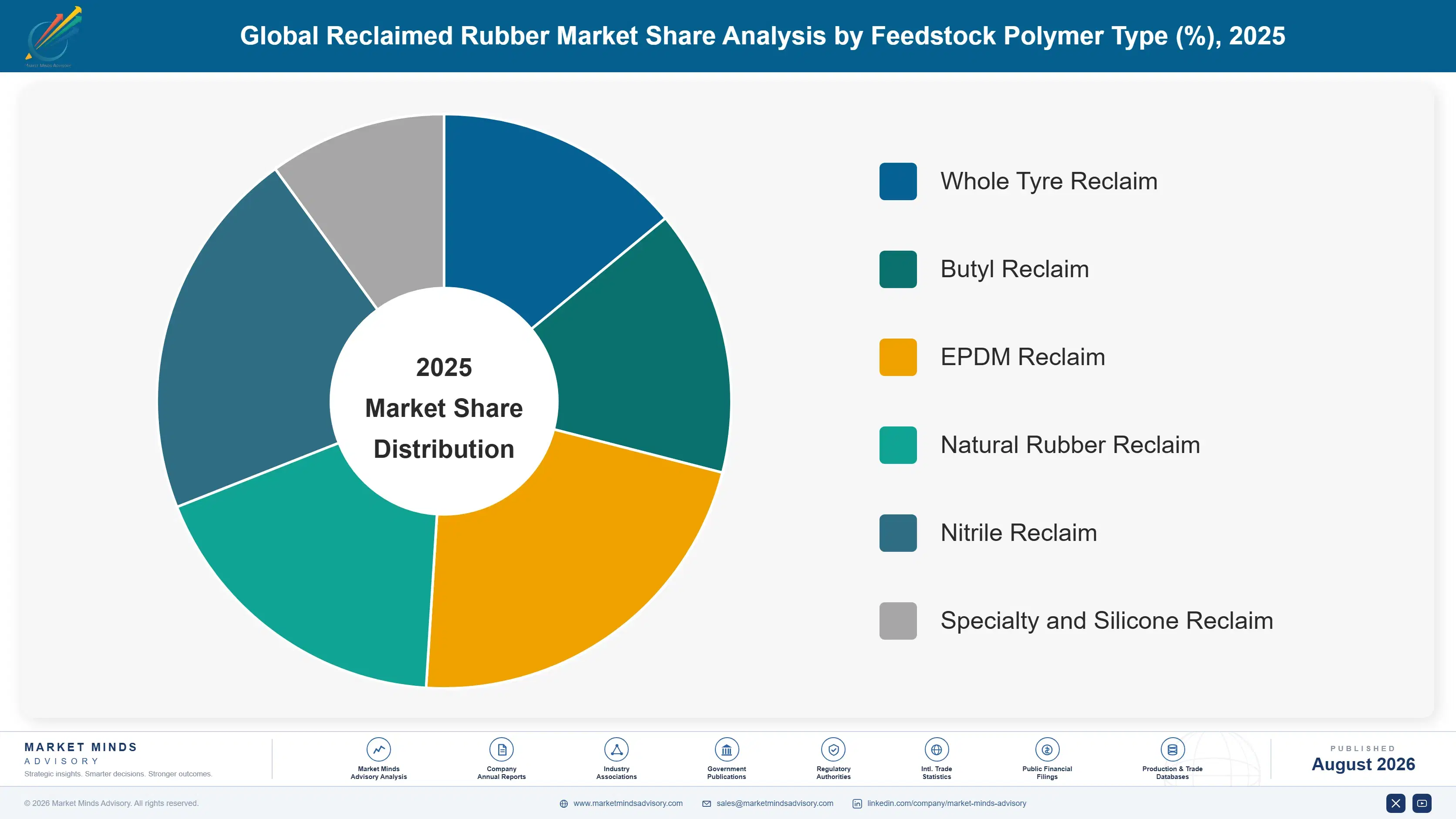
Six segments split by feedstock polymer type, because the polymer entering the process determines what comes out, what it can be compounded into and what a buyer will pay for it. Devulcanisation route and particle grade variants sit inside each polymer type rather than beside them. End-use industry and channel are handled in the framework instead.
reclaimed-rubber-market-trends-market-share-analysis-1787594784830

Butyl Reclaim

Growing at 10.8%, half again the market rate of 7.2%, butyl reclaim is worth considerably more than mixed tyre material because butyl is expensive in virgin form and used specifically where air impermeability matters. Inner liner and inner tube recycled content commitments drive most demand. Feedstock quality is the differentiator, since pharmaceutical stopper and closure waste arrives clean and well characterised while mixed tyre-derived butyl carries contamination that limits what it can serve. Collection rather than processing capacity is the binding constraint, and producers securing dedicated feedstock streams hold positions that competitors cannot bid away from them. Buyers with inner liner recycled content targets have no obvious alternative source available.
CAGR 10.8%

EPDM Reclaim

At 8.6% EPDM reclaim benefits from a favourable coincidence: automotive sealing and roofing membrane compounds are mechanically less demanding than tyre compounds, so higher loading is tolerable, while both end uses carry recycled content pressure from vehicle and building regulation. Roofing membrane removal generates large, clean, single-polymer waste streams that are far easier to process than mixed scrap. The material substitutes well into weatherstrip, hose and membrane compounds where the original performance requirement was never as severe. Automotive sealing recycled content targets are the demand driver most likely to tighten further. Loading tolerance here is considerably higher than any tyre compound permits, which converts the technical ceiling from a constraint into an irrelevance for this end use.
CAGR 8.6%
Full segment breakdown across 6 segments available in the complete report.

Regional Architecture and Country Demand Map

South Asia and Pacific holds 34% of value, since India produces more reclaimed rubber than any other country by a wide margin. East Asia follows at 24% on Chinese tyre and rubber goods manufacture, with Western Europe at 15% where regulation rather than volume drives demand.

North America

Share sits at 13% against a band of 22 to 32% because reclaim production is concentrated in low-cost batch processing geographies and North American capacity is limited relative to consumption. Scrap tyre collection is well developed, with most volume flowing to tyre-derived fuel and civil engineering applications rather than into devulcanisation at all. Consumption concentrates in industrial rubber goods rather than tyres, where compounders accept higher loadings than tyre specifications permit anywhere. Imported material from India and Southeast Asia serves much of the demand. Growth at 6.6% runs below the base case on limited regulatory forcing. Industrial goods compounders accept higher loadings than tyre specifications permit. Fuel and civil engineering routes take most collected scrap.
Share: 13% | CAGR: 6.6% (2026 to 2036)

Western Europe

At 15% against a band of 18 to 26%, European value reflects regulation rather than production, since almost no reclaim capacity remains in the region while recycled content requirements are the strictest anywhere. End of life vehicle rules and tyre industry commitments make documented recycled content a procurement condition rather than an aspiration. That creates a compliance buyer who needs verified material and will pay for documentation, which is exactly what a fragmented import supply base struggles to provide. Dutch and German specialty reclaim operations hold technical positions in butyl and EPDM grades. A fragmented import base struggles to supply the documentation buyers now require. Specialty operators hold technical positions in butyl and EPDM.
Share: 15% | CAGR: 6.0% (2026 to 2036)
Regional intelligence for 5 additional markets available in the complete report: East Asia, South Asia and Pacific, Latin America, Middle East and Africa, Eastern Europe. Contact sales@marketmindsadvisory.com.
reclaimed-rubber-market-trends-country-cagr-analysis-1787594785348

Four Moves on a Compliance Buyer

Quoting reclaim at a discount to natural rubber made complete sense when the buyer was saving money and taking a performance risk in order to do it. It makes very little sense against a buyer carrying a recycled content obligation who needs documented material and has no alternative source that satisfies the requirement at all.

Price against the compliance obligation, not virgin rubber

Reclaim sells at roughly 48% below the natural rubber it substitutes, a discount that reflected performance risk in a cost-driven purchase. Recycled content rules have created a buyer who legally requires documented recovered material and cannot meet the obligation with virgin rubber at any price. Quoting that buyer against a natural rubber index surrenders the entire value of the position. Very few reclaimers have restructured pricing to reflect what the material now does for the customer rather than what it costs to make. The obligation is the value, and it is not reflected in a virgin index anywhere.
Market Impact: Recovers part of a 48% pricing discount today

Build batch traceability that compliance documentation actually requires

Hundreds of producers operate with the top five holding only 19%, and batch variation across that base is exactly what deters a large buyer qualifying material into a specification. Recycled content compliance requires verified content figures and chain of custody, which most small reclaimers cannot supply at all. Investment in testing and traceability solves the quality objection and the documentation requirement with one programme, and it separates a producer from a fragmented field that competes only on price. It also converts a fragmented field's weakness into a defensible position. Small reclaimers cannot supply verified figures at all.
Market Impact: Separates from a 19% concentrated supplier base entirely

Contract clean single-polymer feedstock streams directly

Butyl reclaim grows at 10.8% and EPDM at 8.6% precisely because clean single-polymer waste, from pharmaceutical stoppers and roofing membrane removal, processes into material worth far more than mixed tyre reclaim. Collection rather than processing capacity is the binding constraint in both. A producer contracting those streams directly holds a position competitors cannot bid away, and the feedstock arrives characterised rather than needing sorting and testing on arrival. It also insulates against cement kilns bidding scrap upward whenever energy costs climb. Feedstock arrives characterised rather than needing sorting on arrival.
Market Impact: Serves 10.8% growth across the butyl grades alone

Target compounds where the ceiling is not binding

Loading caps near 20% in undemanding compounds and around 2% in passenger tyre tread, so chasing tyre tread volume means competing for the application where the material is least useful. Mats, mudflaps, hoses, weatherstrip and roofing membrane all tolerate far higher loading, and several carry recycled content pressure of their own. Selling where the ceiling does not bind converts a technical limitation into an irrelevance, which is a better position than arguing about it with a tyre compounder. Several of those applications now carry recycled content pressure of their own.
Market Impact: Targets 20% loading applications instead of tyre treads

Who Controls the Margin Pool

Participation is measured on annual reclaimed rubber production volume, and the top five hold only 19%. Fragmentation reflects low capital intensity, which lets small operators enter a batch process without the scale to invest in process control afterwards. GRP Limited leads on volume and on the consistency that larger buyers require. The gap to the long tail is quality control and documentation rather than any difference in the devulcanisation process itself. Consistency rather than price decides the largest accounts.
Competition runs on three fronts. Quality consistency decides access to large compounders qualifying material into a specification. Documentation and traceability decide access to compliance buyers, who need verified content figures rather than a competitive price. Feedstock access decides the premium grades, since clean single-polymer streams process into material worth several times mixed tyre reclaim.

Pressure ahead comes from competing recovery routes bidding for the same scrap and from recycled content rules that may count pyrolysis and crumb equally. Chinese environmental enforcement has already closed many smaller operations and raised process standards. Expect investment in traceability rather than acquisitions. Rankings shift as compliance documentation becomes a qualification requirement rather than a differentiator. Feedstock contracting is becoming the durable advantage.
reclaimed-rubber-market-trends-company-positioning-matrix-1787594785873

Competitive Moat and Risk Dimensions

GRP LIMITED

Moat: Scale with consistent output quality

Operating at a scale unusual in this industry lets the company invest in process control and testing that hundreds of smaller reclaimers cannot fund, which is exactly what a compounder qualifying material into a specification requires. Batch consistency is worth more to a large buyer than a lower price from a producer whose output varies.
GRP LIMITED

Risk: Feedstock competition from alternative routes

Tyre-derived fuel, pyrolysis and civil engineering applications all bid for the same scrap stream, and feedstock price is set by whichever route bids hardest at any given moment rather than by material demand. A producer without contracted supply carries that exposure directly, and rising energy prices lift the fuel route's bid regardless of what reclaim demand happens to be doing.
RUBBER RESOURCES

Moat: Specialty butyl and EPDM position

Focusing on butyl and EPDM rather than mixed tyre reclaim puts the company in the segments growing at 10.8% and 8.6%, where clean single-polymer feedstock produces material worth several times commodity reclaim. European location also suits compliance buyers who value documentation and proximity within the same trading bloc.
RUBBER RESOURCES

Risk: Feedstock collection scale limits

Clean single-polymer waste streams from pharmaceutical stoppers and roofing membrane removal are limited in volume and collection is the binding constraint rather than processing capacity. Growing beyond the available stream means either accepting mixed feedstock that undermines the quality position or competing for contracts against buyers with deeper pockets.

Players Tracked

Prominent Players

GRP Limited
Rubber Resources
Sanshin Chemical Industry
J. Allcock and Sons
Swani Rubber Industries

Other Key Players

Balaji Rubber Industries
Star Polymers
U.S. Rubber Reclaiming
Huxar Reclamation
Rolex Reclaim
Nordai
Tyrec
Levgum
Tinna Rubber and Infrastructure
Kargro Group
Vikas Ecotech
Genan Holding
Klean Industries
Rubber Reclaim Industries
Continental Rubber Reclaim

Recent Developments

MAY 2026

Tyre manufacturer sets verified recycled content requirement for rubber suppliers

A large tyre manufacturer required verified recycled content documentation and chain of custody from all recovered rubber suppliers, rather than accepting self-declared figures as it had previously. Several smaller reclaimers were unable to meet the documentation requirement at all. Qualification was withdrawn from suppliers unable to provide it.
Signal: Documentation is now becoming a qualification requirement rather than a differentiator between competing reclaim suppliers anywhere
OCTOBER 2025

Roofing membrane recycler contracts single-polymer EPDM feedstock stream

A reclaim producer contracted a dedicated EPDM feedstock stream from commercial roofing membrane removal contractors, securing clean single-polymer waste that processes into material worth several times mixed tyre reclaim. The arrangement covers multiple years of collected volume. Collection logistics were contracted alongside the material supply itself.
Signal: Feedstock contracting rather than processing capacity is now what decides competitive position in the premium grades
FEBRUARY 2026

Devulcanisation developer reports improved main-chain retention at pilot scale

A technology developer reported improved polymer main-chain retention from a modified devulcanisation route at pilot scale, claiming mechanical properties closer to virgin material than conventional reclaim achieves. Independent verification at commercial scale has not yet been published anywhere. Pilot output was characterised against conventional reclaim on the same feedstock.
Signal: Genuine main-chain preservation would lift the substitution ceiling that has bounded this industry for four decades

Scrap, Reclaiming Agents and Steam

Scrap feedstock accounts for roughly 38% of production cost, priced by competition between recovery routes rather than by material demand, and sourced through collection schemes and tyre dealers. Reclaiming agents, oils and process chemicals carry about 17%. Process energy for heating and mechanical work takes around 21%, which makes energy price a direct input rather than an overhead. Labour and effluent treatment absorb the balance.
Industrial energy costs rose sharply through 2022 and stayed elevated, per IEA reporting for the period, which raised both processing cost and the price cement kilns would pay for the same scrap the reclaimers wanted. That double effect squeezed producers from two directions at once, which is unusual and was largely unanticipated. Indian producers were less exposed than European operations on both counts throughout the period.

Exposure divides on feedstock contracting and on energy position. A producer with contracted scrap supply carries none of the bidding exposure that spot buyers face when fuel routes bid harder, and that gap widens whenever energy prices climb. Geographically, Indian and Southeast Asian producers hold materially better cost positions on both energy and labour, which is why production concentrated there rather than near the compounders consuming the output.
reclaimed-rubber-market-trends-cost-volatility-analysis-1787594786071

Contract scrap feedstock ahead of competing recovery routes

Scrap is roughly 38% of cost and priced by whichever recovery route bids hardest, which means a spot buyer loses material to cement kilns whenever energy prices climb. Multi-year collection contracts remove that exposure. Producers holding contracted supply during the last energy spike kept running while spot buyers went short, which cost them customers rather than margin.

Shift the portfolio toward clean single-polymer feedstock

Butyl and EPDM streams from pharmaceutical stoppers and roofing membrane removal process into material worth several times mixed tyre reclaim, and they arrive characterised rather than needing extensive sorting. Collection is the constraint rather than processing capacity. Contracting those streams directly secures both a better product and a feedstock position competitors cannot bid away easily.

Site processing where energy and labour costs are lowest

Energy is around 21% of cost and the process is labour-intensive by nature, which is precisely why production concentrated in India rather than near the compounders consuming the output. Reclaim ships economically over long distances, unlike many recovered materials. Siting decisions dominate cost position in a way that process efficiency improvements rarely manage to match.

Portfolio Architecture for Margin Defence

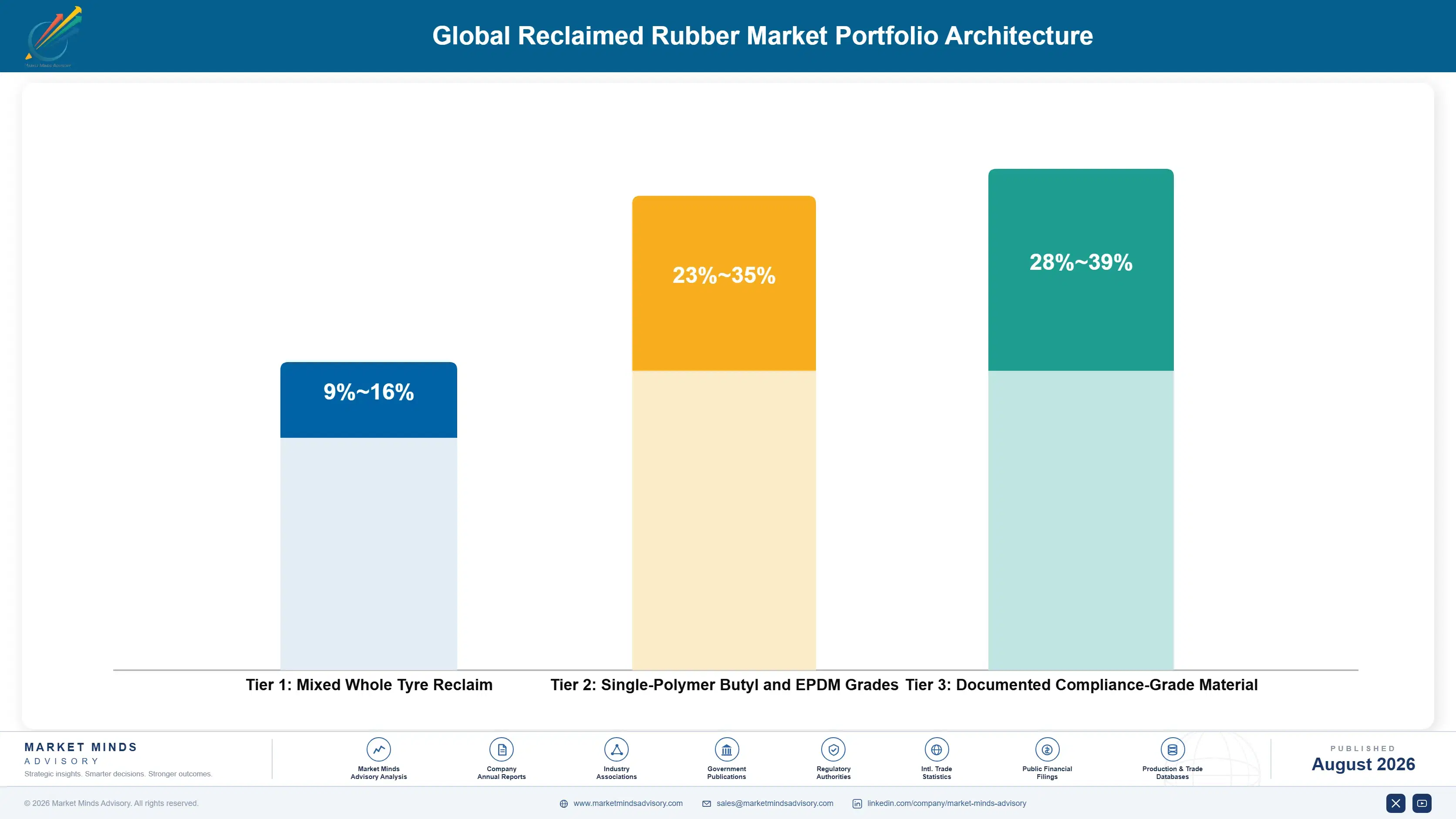
Margin here follows feedstock purity far more closely than it follows processing sophistication, which is the opposite of what most recycling businesses look like. Mixed whole tyre reclaim earns margins in the low teens, because hundreds of producers make an equivalent product from an equivalent input and buyers compare it against a natural rubber index every time they order. Loading limits apply identically whoever supplied the material.
Single-polymer grades from characterised waste streams do considerably better in the mid twenties to mid thirties, because butyl and EPDM from clean sources produce material worth several times commodity reclaim and the feedstock itself is contracted rather than bid for. The range reflects feedstock security above all, since collection rather than processing decides who can serve the volume. Collection logistics rather than plant capacity decide who can grow here.

Documented compliance-grade material holds the strongest position, reaching into the high thirties, because a buyer with a recycled content obligation needs verified figures and chain of custody that most of the fragmented supply base cannot produce. Those margins reflect testing and traceability investment rather than any difference in the devulcanisation route used. Verification is what the compliance buyer is actually paying for.

Mixed Whole Tyre Reclaim

Commodity reclaim from mixed scrap tyre feedstock sold against a natural rubber index. The seven point range reflects feedstock buying position and energy cost rather than any product difference between producers.
Gross Margin: 9-16%

Single-Polymer Butyl and EPDM Grades

Reclaim from clean characterised waste streams including pharmaceutical stoppers and roofing membrane. The twelve point range reflects feedstock security, since collection rather than processing decides who can serve the volume.
Gross Margin: 23-35%

Documented Compliance-Grade Material

Reclaim supplied with verified recycled content figures and chain of custody documentation. The eleven point range reflects testing and traceability investment rather than any difference in the devulcanisation route employed.
Gross Margin: 28-39%
reclaimed-rubber-market-trends-portfolio-architecture-1787594786582

High-value Sub-segments and Strategic Watch-out

Documented Compliance-Grade Reclaim

High value and growing fastest in commercial terms, since a buyer with a recycled content obligation needs verified figures that most of the fragmented supply base cannot produce at all. Documentation is becoming a qualification requirement rather than a differentiator. Suppliers unable to verify are losing qualification.
Gross Margin: 30-39%

Butyl and EPDM Single-Polymer Grades

High value and growing at 10.8% and 8.6% respectively, on clean feedstock that processes into material worth several times mixed reclaim. Collection rather than processing capacity is the binding constraint in both grades. Pharmaceutical stopper and roofing membrane waste arrives characterised rather than needing sorting on arrival.
Gross Margin: 23-35%

Mixed Whole Tyre Reclaim

The volume core, sold against a natural rubber index by hundreds of producers making an equivalent product. Loading caps near 20% in undemanding compounds and around 2% in passenger tyre tread regardless of price. Hundreds of producers compete on an index nobody controls. Consistency rather than price wins qualification.
Gross Margin: 9-16%

Spot Feedstock Exposure

The strategic watch-out. Cement kilns and pyrolysis bid for the same scrap, and the fourteen point range reflects the gap between producers holding contracted supply and those buying whatever the market leaves them. Energy prices lift the fuel route's bid regardless of reclaim demand. Contracted supply is the answer.
Gross Margin: 4-18%

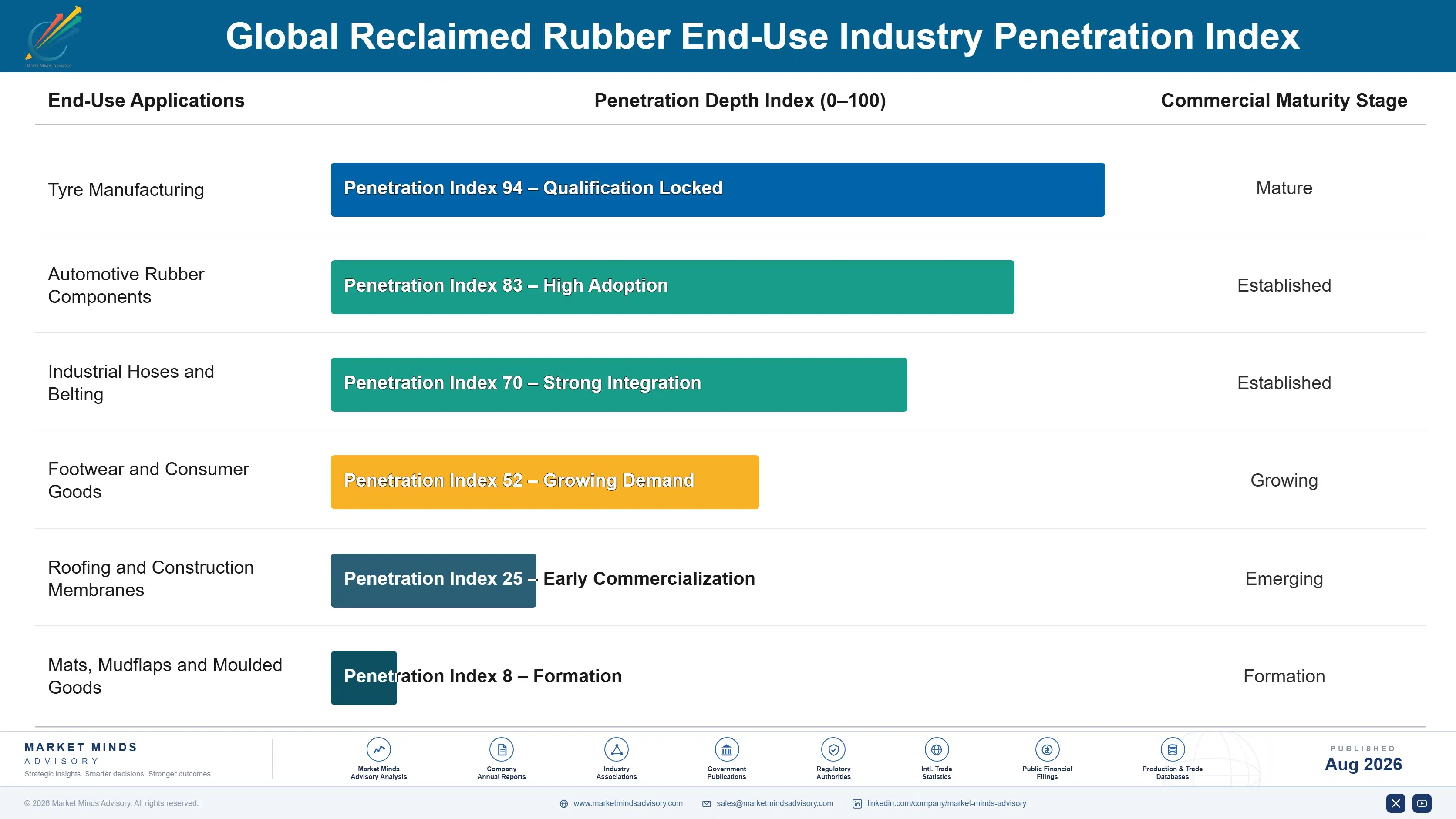
Qualified Once, Consumed Continuously

Consumption repeats with every batch a compounder mixes, tying volume to their own production rather than to a purchasing decision made periodically. A reclaim grade qualified into a compound formulation runs for as long as that product is made, since requalifying means retesting mechanical properties across the whole compound. That is a genuine barrier, and it is why quality consistency matters more to a large buyer than price does at the point of qualification.
Stickiness follows documentation and consistency rather than any contractual arrangement. A producer supplying verified recycled content figures into a compliance-driven specification is difficult to replace, because an alternative supplier must reproduce the documentation as well as the material. Commodity mixed reclaim switches at every order against a natural rubber index, since the product is genuinely interchangeable and the buyer knows it.

The buyer has changed function rather than merely changing mind. Purchasing decided reclaim on price against virgin rubber for decades, and in commodity grades still does. Recycled content obligations pulled sustainability and compliance functions into the decision, and those buyers ask about verification and chain of custody before they ask about price, which is an entirely different conversation.
reclaimed-rubber-market-trends-end-use-penetration-index-1787594787068

Where We Would Focus Effort

These are among the four positions where our research anticipates prominent divergence between winners and laggards over the coming forecast period. Each is grounded in the demand model, the regulatory perimeter, and the announced capacity pipeline.
01 / COMPLIANCE VALUE PRICING

Stop quoting against a natural rubber index

Reclaim sells at roughly 48% below the natural rubber it substitutes, a discount that made sense when the buyer was saving money and taking a performance risk to do it. Recycled content rules created a buyer who legally requires documented recovered material and cannot satisfy that obligation with virgin rubber at any price at all. Quoting that buyer against a virgin index surrenders the entire value of the position, and almost nobody in this industry has restructured pricing to reflect it.
02 / TRACEABILITY CAPABILITY INVESTMENT

Documentation solves the quality objection too

Hundreds of producers operate with the top five holding only 19%, and batch variation across that base is exactly what deters a large compounder qualifying material into a specification it must then live with. Recycled content compliance separately requires verified content figures and chain of custody that most small reclaimers cannot supply at all, whatever their material quality. One investment in testing and traceability answers both problems at once and separates a producer from a field competing purely on price against a virgin index.
03 / FEEDSTOCK STREAM CONTRACTING

Clean single-polymer waste is the whole premium

Butyl grows at 10.8% and EPDM at 8.6% because pharmaceutical stopper and roofing membrane waste arrives clean, characterised and single-polymer, processing into material worth several times mixed tyre reclaim. Collection rather than processing capacity is the binding constraint in both cases, which makes collection logistics the real capability rather than the plant itself. A producer contracting those streams directly holds a position competitors cannot bid away, and it insulates against cement kilns bidding scrap prices upward whenever industrial energy costs climb anywhere.
04 / APPLICATION CEILING AVOIDANCE

Sell where the loading limit does not bind

Devulcanisation caps loading near 20% in undemanding compounds and around 2% in passenger tyre tread, so pursuing tread volume means competing hardest for the application where the material is least useful to anybody. Mats, mudflaps, hoses, weatherstrip and roofing membrane tolerate far higher loading and several now carry recycled content pressure of their own from building and vehicle rules. Selling where the ceiling does not bind turns a technical limitation into an irrelevance rather than an argument with a tyre compounder who will not move.

Engagement Snapshot From the Field

A live engagement with an industry participant carrying material or product regulatory and market exposure ahead of a defining policy shift, showing how our research translates into a defensible multi-year portfolio strategy.
MARKET MINDS ADVISORY · CLIENT ENGAGEMENT SUMMARY
Global Reclaimed Rubber Producer Strategic Portfolio Review and Transition Roadmap 2026·Investment Scenario on Global Reclaimed Rubber Exposure Evaluation 2025-26
CLIENT PROFILE
An Indian reclaimed rubber producer operating three plants and exporting roughly two thirds of output, with annual revenue near 68 million dollars (client-reported, unverified by MMA). Almost all volume was mixed whole tyre reclaim sold against a natural rubber index, with no single-polymer grades, no recycled content documentation and no contracted feedstock supply arrangements anywhere in its collection geography.
STRATEGIC CHALLENGE
European customers had begun requesting verified recycled content documentation the company could not provide, while a competitor with similar capacity reported considerably higher realised prices. Management assumed the difference was product quality, and the board wanted to understand whether documentation or grade mix explained it before committing capital to processing upgrades.
MMA APPROACH
MMA benchmarked realised prices against grade mix and documentation status across comparable producers, sized the compliance-driven demand pool separately from cost-driven demand, assessed single-polymer feedstock availability in the client's collection geography, and costed testing and traceability capability. Interviews with 47 experts covered rubber compounding, recycled content regulation and scrap collection.
KEY FINDINGS
  1. Realised price differences against the competitor were almost entirely attributable to documentation and grade mix rather than to any measurable difference in material quality or process capability.
  2. Compliance-driven European buyers were paying materially above index for verified material, while the client continued quoting the same customers against a natural rubber benchmark.
  3. Single-polymer butyl feedstock was available in the client's collection geography but was being bought by nobody, since local producers had never pursued characterised waste streams.
  4. Testing and traceability capability cost a small fraction of the processing upgrade management had been considering, and addressed the quality objection at the same time.
CLIENT PROFILE
An Indian reclaimed rubber producer operating three plants and exporting roughly two thirds of output, with annual revenue near 68 million dollars (client-reported, unverified by MMA). Almost all volume was mixed whole tyre reclaim sold against a natural rubber index, with no single-polymer grades, no recycled content documentation and no contracted feedstock supply arrangements anywhere in its collection geography.
STRATEGIC CHALLENGE
European customers had begun requesting verified recycled content documentation the company could not provide, while a competitor with similar capacity reported considerably higher realised prices. Management assumed the difference was product quality, and the board wanted to understand whether documentation or grade mix explained it before committing capital to processing upgrades.
MMA APPROACH
MMA benchmarked realised prices against grade mix and documentation status across comparable producers, sized the compliance-driven demand pool separately from cost-driven demand, assessed single-polymer feedstock availability in the client's collection geography, and costed testing and traceability capability. Interviews with 47 experts covered rubber compounding, recycled content regulation and scrap collection.
KEY FINDINGS
  1. Realised price differences against the competitor were almost entirely attributable to documentation and grade mix rather than to any measurable difference in material quality or process capability.
  2. Compliance-driven European buyers were paying materially above index for verified material, while the client continued quoting the same customers against a natural rubber benchmark.
  3. Single-polymer butyl feedstock was available in the client's collection geography but was being bought by nobody, since local producers had never pursued characterised waste streams.
  4. Testing and traceability capability cost a small fraction of the processing upgrade management had been considering, and addressed the quality objection at the same time.
RECOMMENDED STRATEGY
Phase 1: Phase one: build testing and chain of custody capability, since it answers both the documentation requirement and the quality consistency objection at once. Phase 2: Phase two: reprice compliance-driven accounts against the obligation they carry rather than against a natural rubber index they no longer have any alternative to. Phase 3: Phase three: contract single-polymer butyl feedstock locally, ahead of competitors who have not yet recognised the value in characterised waste streams.
OUTCOME
The producer established traceability during 2026 and reported realised prices above index on documented volume for the first time (client-reported, unverified by MMA). A butyl feedstock contract was secured locally, and the planned processing upgrade was deferred as unnecessary. Realised margin improved without any additional processing investment at all.

Frequently Asked Questions

Foundational context covering the market sizes, CAGR, scope, country, region and competition that inform every finding below. This section is provided to cover basics and most often pre-purchase conversations, answered from the MMA Primary Research Dataset.

What is the current size of the Global Reclaimed Rubber Market?

MMA sizes it at USD 1.62 billion in 2025, rising to USD 1.74 billion in 2026. The figure covers devulcanised rubber recovered from scrap tyres and rubber goods at producer selling value.

How large will the Global Reclaimed Rubber Market be by 2036?

USD 3.49 billion by 2036, an incremental USD 1.75 billion over the 2026 base and an expansion multiple of 2.01 times. Single-polymer grades account for a disproportionate share.

What is the CAGR for the Global Reclaimed Rubber Market 2026 to 2036?

7.2% in the base case, with a bull case at 8.4% and a bear case at 6.0%. The spread turns on devulcanisation progress and on how recycled content rules treat competing routes.

Which segment is growing fastest?

Butyl reclaim at 10.8%, half again the market rate of 7.2%. Clean stopper and inner liner feedstock produces material worth several times mixed tyre reclaim.

Who are the major companies in the Global Reclaimed Rubber Market?

GRP Limited, Rubber Resources, Sanshin Chemical Industry, Allcock and Swani Rubber Industries lead on production volume. Fifteen further participants are profiled in the full report on that basis.

Which country is growing fastest?

India at 10.4%, as domestic tyre and rubber goods manufacture expands behind an export business that already makes it the largest producing country in the world.

Report Segmentation Architecture

The full report scope spans multiple orthogonal segmentation dimensions, with cross-tabulated demand data provided for each dimension pair. Coverage extends further to regional breakdowns, trend trajectories, and the competitive detail needed to support segment-level decision-making.

By Feedstock Polymer Type

  • Whole Tyre Reclaim
  • Butyl Reclaim
  • EPDM Reclaim
  • Natural Rubber Reclaim
  • Nitrile Reclaim
  • Specialty and Silicone Reclaim

By End-Use Industry

  • Tyre Manufacturing
  • Automotive Rubber Components
  • Industrial Hoses and Belting
  • Footwear and Consumer Goods
  • Roofing and Construction Membranes
  • Mats, Mudflaps and Moulded Goods

By Commercial Dimension

  • Direct Supply to Compounders
  • Distributor and Trading Channels
  • Contracted Feedstock Partnerships
  • Compliance-Documented Supply Agreements
  • Toll Processing Arrangements
  • Export and Cross-Border Supply

By Region

  • North America
  • Western Europe
  • East Asia
  • South Asia and Pacific
  • Latin America
  • Middle East and Africa
  • Eastern Europe

Scope, Methodology, and Coverage

Every figure in this report is reproducible from documented input assumptions. The scope below maps the historical period, the forecast horizon, the segmentation dimensions, and the countries covered, alongside the underlying primary and qualitative methodology.
Historical Period
2020 to 2025
Forecast Period
2026 to 2036
Base Year
2025 (USD billions; MMA Primary Research Dataset, August 2026)
Market Definition
Rubber recovered from scrap tyres and rubber goods and processed through devulcanisation into a compoundable material, covering whole tyre reclaim, butyl, EPDM, natural rubber, nitrile and specialty reclaim grades. Measured at producer selling value across all end-use industries and processing routes. Ground crumb rubber sold without devulcanisation, tyre-derived fuel, pyrolysis carbon black and oil, retreading materials, and virgin synthetic or natural rubber are excluded from scope.
Quantitative Units
USD billions (current prices); thousand tonnes reclaimed rubber; USD per tonne by polymer grade
Segmentation Dimensions
Feedstock polymer type; end-use industry; commercial dimension; region
Regions Covered
North America, Western Europe, East Asia, South Asia and Pacific, Latin America, Middle East and Africa, Eastern Europe
Countries Covered
India, China, Vietnam, Thailand, Indonesia, Japan, South Korea, Australia, United States, Canada, Mexico, Germany, Netherlands, Italy, France, Poland, Romania, Turkey, South Africa, Brazil
Key Companies Profiled
GRP Limited, Rubber Resources, Sanshin Chemical Industry, J. Allcock and Sons, Swani Rubber Industries, Balaji Rubber Industries, Star Polymers, U.S. Rubber Reclaiming, Huxar Reclamation, Rolex Reclaim, Nordai, Tyrec, Levgum, Tinna Rubber and Infrastructure, Kargro Group, Vikas Ecotech, Genan Holding, Klean Industries, Rubber Reclaim Industries, Continental Rubber Reclaim
Quantitative Methodology
Primary survey, n=3,800 respondents, Q4 2025, six countries; demand-side model with trade association cross-validation
Qualitative Methodology
47 expert interviews, Q4 2025; applied to validate demand model assumptions, identify emerging dynamics, and assess competitive positioning
Report Format
PDF and XLSX data workbook (Word format preview document)
Publisher
Market Minds Advisory
Report Code
MMA-2026-CHM-132
Published
August 2026
Contact
sales@marketmindsadvisory.com | www.marketmindsadvisory.com

Purchase the full Global Reclaimed Rubber Market Report (2026 to 2036).

The full report separates compliance-driven demand from cost-driven substitution and prices each accordingly, which is the distinction this industry has been slowest to make. It sizes all six polymer grades independently through 2036, quantifies achievable loading by compound type against the technical ceiling, and models feedstock competition between reclaim, pyrolysis and fuel routes under varying energy prices. Regional chapters cover all seven regions, following production geography and regulatory forcing separately because the two rarely coincide. Competitive profiling covers 20 participants on a single production volume basis.
Six polymer grades sized independently through 2036
Compliance demand separated from cost-driven substitution
Loading ceilings quantified by compound and application
Feedstock competition modelled against energy price scenarios
Twenty participants profiled on one consistent volume basis
Documentation requirements mapped across major buying regions

Built For The People Who Decide

From boardroom strategy to bench-side execution, this report is read cover-to-cover by leaders shaping the next decade of their industry, turning demand scenarios, market dynamics and valuation benchmarks into decisions.
CXOs/ Presidents/ VPs/ Managers
M&A and Corporate Development
Strategy Teams and R&D Heads
Procurement and Product Directors
Regulatory and Compliance Leaders
Investor Relations and Equity Analysts