Market Minds Advisory
Reactive Hot Melt Adhesive Market

Reactive Hot Melt Adhesive Market: Setting Like a Hot Melt, Curing Like a Structural Bond

A product that grips in seconds and then cures permanently, taking share from two different adhesive families at once, while quietly losing around 9% of every drum to the moisture that cures it.

Lead Analyst

Bilal Shaikh

Published

September 2026

Make Smarter Decisions with Customized Research Insights

Request a free sample report and evaluate market opportunities, growth trends, and competitive dynamics relevant to your business needs.

2025 MARKET VALUE$2.9BMarket Size 2025
2036 FORECAST VALUE$5.8BBase Case , 2026 to 2036
CAGR 2026 TO 20366.6 %Bull 7.8% / Bear 5.4%
INCREMENTAL OPPORTUNITY$2.7BNet 10- year value creation
EXPANSION MULTIPLE1.90x2036 value over 2026 base
Strategic Levers
M&A Pipeline
Regional Outlook
Country Rankings
Competitive Intelligence
Segmental Deep-dive
Call-Us : 91 93563 13602

Executive Snapshot and Market Trajectory

Reactive hot melts do two incompatible things well. They set on cooling in seconds, so a line runs without clamping, and they then cure with atmospheric moisture into a thermoset roughly 4.8 times stronger than a conventional hot melt bond. One drum, two adhesive families. The chemistry cuts both ways.
That combination lets the product attack two adhesive families at once rather than one. It takes performance work from conventional hot melts and takes speed and compliance work from solvent and two-component systems, running around 34% faster than a two-component line. Furniture and profile wrapping consume the largest volumes, which puts East Asia at 30% of value on manufacturing concentration alone. Furniture manufacture keeps migrating outward from China. Regional formulators are closing the gap.
The regulatory story is isocyanate rather than performance. European rules requiring trained users wherever free monomeric diisocyanate exceeds 0.1% have forced reformulation across the whole category, and low-monomer and monomer-free grades now grow at 9.9%, half again the market rate of 6.6%. Vietnam expands fastest anywhere at 11.2% as furniture manufacture continues shifting there from China. Suppliers lacking low-monomer depth are being written out.
Market Definition
Adhesives applied molten that subsequently cure through chemical reaction into a thermoset bond, covering standard-monomer polyurethane reactive grades, low-monomer and monomer-free polyurethane, reactive polyolefin, silane-modified, reactive polyamide and ultraviolet-curable reactive hot melts. Measured at formulator selling value. Excludes non-reactive thermoplastic hot melts, solvent-borne and waterborne adhesives, two-component structural adhesives, pressure-sensitive tapes and dispensing equipment.
Base Year Value
$2.9B in 2025 (MMA Primary Research Dataset, August 2026)
Forecast Period
2026 to 2036, eleven discrete annual values
CAGR
6.6% base case. Bull 7.8%. Bear 5.4%.
Fastest Growth Segment
Low-Monomer and Monomer-Free PUR: 9.9% CAGR
Fastest Growth Country
Vietnam: 11.2% CAGR
Fastest Growth Region
South Asia and Pacific: 8.8% CAGR
Largest Region
East Asia: 30% of 2025 global value
Market Leaders
Henkel, H.B. Fuller, Sika, Bostik, Jowat. Source: MMA Primary Research Dataset, July 2026.
Primary Survey
n=3,800 procurement and R&D decision-makers, Q4 2025, six countries
Methodology
Demand-side build-up, cross-validated against public data, 47 expert interviews

Reactive Hot Melt Adhesive Market Forecast Scenarios

reactive-hot-melt-adhesive-market-size-forecast-scenario-1787594764804
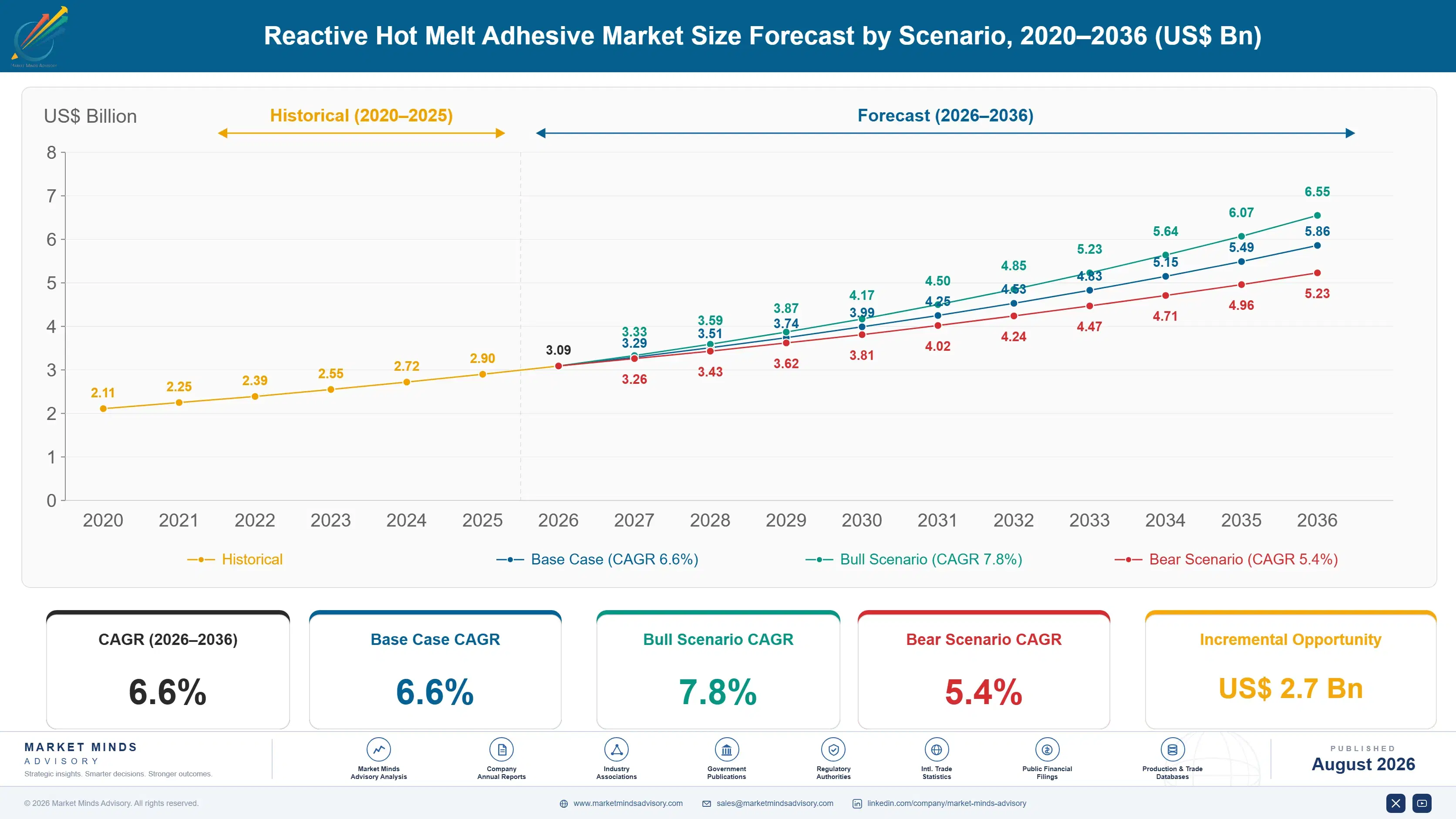
Growth ran near 5.6% between 2020 and 2025, held back in the early part by furniture and automotive production disruption and then accelerating as European diisocyanate rules forced reformulation across the category. Isocyanate raw material pricing was volatile throughout, moving on plant outages rather than on demand. Low-monomer grade development consumed a disproportionate share of technical resource across the industry during the period, which slowed other product work considerably.
Base case 6.6% rests on three mechanisms. Low-monomer and monomer-free reformulation continues spreading beyond Europe as multinational manufacturers standardise specifications globally rather than maintaining regional variants. Furniture and profile wrapping manufacture keeps shifting toward Vietnam and Southeast Asia, growing at 11.2% in Vietnam alone. And reactive polyolefin chemistry keeps taking work in applications where isocyanate handling is unwelcome regardless of what any regulation formally requires anybody to do about it.
The bull case at 7.8% assumes automotive interior lamination adopts reactive systems more broadly as vehicle interiors move toward larger bonded assemblies. The bear case at 5.4% is isocyanate regulation tightening beyond training requirements into use restriction, which would strand formulation investment and push converters toward waterborne systems that are slower but simpler to defend.

Two Adhesives in One Drum

The commercial logic here is that one product replaces two categories. A conventional hot melt sets fast and stays thermoplastic, which means it softens under heat and creeps under load. A two-component structural adhesive cures hard but needs mixing, pot life management and clamping time. Reactive hot melts set on cooling and then cure with moisture, giving roughly 4.8 times the bond strength while running about 34% faster than a two-component line.
TOP FIVE CONCENTRATION52%Formulation know-how narrows the credible supplier field considerably
FREE MONOMER THRESHOLD0.1%Regulatory limit that triggers mandatory user training requirements
BOND STRENGTH MULTIPLE4.8xCured strength against a conventional hot melt bond
LINE SPEED ADVANTAGE34%Throughput gain against comparable two-component adhesive systems used
DRUM WASTE RATE9%Adhesive lost to drum skinning and equipment purging
PREPOLYMER COST SHARE44%Formulated cost accounted for by the reactive prepolymer
The catch is that the curing mechanism is also the handling problem. Atmospheric moisture cures the adhesive whether or not it is on the substrate, so a part-used drum skins over, dispensing equipment must be purged rather than left standing, and around 9% of material is lost to those two causes across a typical operation. That waste is why dedicated melt and dispense equipment attaches to almost every serious conversion.
Regulation reshaped the formulation landscape rather than the demand. European rules require trained users wherever free monomeric diisocyanate exceeds 0.1%, which turned a routine industrial purchase into a compliance obligation for every converter. Suppliers responded with low-monomer and monomer-free grades, and multinational manufacturers have begun standardising on those specifications globally rather than maintaining a European variant separately.
"Converters talk about reactive hot melts as an adhesive decision and it is really an equipment and housekeeping decision. The formulation differences between the serious suppliers are narrower than anyone admits, and the 9% you lose in the drum swamps the price difference you spent three months negotiating."
Director, Adhesives and Industrial Bonding Practice · MMA Chemicals and Materials Practice · August 2026

Market Trends

Diisocyanate rules driving low-monomer reformulation across the category

European rules requiring trained users wherever free monomeric diisocyanate exceeds 0.1% turned a routine adhesive purchase into a compliance obligation for every converter handling the product. Suppliers responded with low-monomer and monomer-free grades, and those now grow at 9.9% against a market rate of 6.6%. The more significant development is that multinational manufacturers have started specifying those grades globally rather than maintaining separate European formulations, which exports a European rule into markets that never adopted it and reshapes supply far beyond the regulated territory. Suppliers without low-monomer depth are being written out of those specifications entirely.
Market Impact: Runs lines 34% faster

Reactive polyolefin gaining where isocyanate handling is unwelcome

Reactive polyolefin chemistry cures through silane grafting rather than isocyanate reaction, which removes the handling and training question entirely rather than reducing it. It grows at 8.2% on that basis, taking work in electronics, textile lamination and food-contact-adjacent applications where converters would rather not answer isocyanate questions at all. Performance is not identical, with lower cured strength on some substrates and different open time behaviour, so this is substitution at the margin rather than wholesale replacement of polyurethane systems. Handling discipline and equipment requirements transfer directly between the two chemistries.
Market Impact: Vietnamese demand growing 11.2%

Market Opportunities and Growth Drivers

Line speed advantage displacing two-component structural systems

A two-component structural adhesive requires mixing, pot life management and clamping while it develops handling strength, which idles a production line and ties up floor space with parts in fixtures. Reactive hot melts grip on cooling within seconds and cure afterwards, running around 34% faster on comparable work. That throughput difference dwarfs any adhesive price comparison across a year of production, and it is the argument that wins conversions when a supplier bothers to build it for a specific line. It reaches a production manager rather than a purchasing function measured on discounts.
Market Impact: Loses 9% of purchased material

Furniture manufacturing migration toward Southeast Asian production

Profile wrapping and edge banding consume the largest volumes in this category, and furniture manufacture continues shifting from China toward Vietnam, Indonesia and Malaysia on labour cost and trade access. Vietnam grows fastest anywhere at 11.2% on that migration. Reactive hot melt edge banding produces the invisible joint that premium furniture specification now expects, which pulls the product into factories that previously ran conventional systems. New plants specify reactive from commissioning rather than converting later. Local technical service capability decides who wins that work. Specifying during plant design rather than after start-up is the cleaner route.
Market Impact: Applies above 0.1% free monomer

Market Restraints and Challenges

Moisture sensitivity imposing waste and equipment discipline on converters

The atmospheric moisture that cures the adhesive works equally well on material sitting in a part-used drum or standing in a dispensing line, and around 9% of purchased material is lost to skinning and purging across a typical operation. The root cause is intrinsic to the chemistry rather than a formulation shortcoming anybody can fix. Commercially it raises effective cost well above list price and deters converters running short or intermittent production. Dedicated sealed melt and dispense equipment is the mitigation, and it requires capital most small converters resist. Leasing arrangements are how suppliers reach converters resisting that capital.
Market Impact: Threshold set at 0.1% monomer

Isocyanate regulation creating compliance obligations at every user site

Rules requiring trained users wherever free monomeric diisocyanate exceeds 0.1% place an obligation on the converter rather than on the supplier, which makes an adhesive purchase a health and safety matter for a factory manager. The root cause is genuine respiratory sensitisation risk from monomeric diisocyanates. Commercially it slows adoption among smaller converters without safety infrastructure and pushes some toward alternative chemistries entirely. Low-monomer and monomer-free grades are the mitigation, and they carry a price premium that partly offsets the compliance saving. Reactive polyolefin removes the question entirely rather than managing it downward.
Market Impact: Growing at 8.2% each year
4 additional market trends, 3 additional growth drivers, and 2 additional restraints and challenges are covered in the full report. Contact sales@marketmindsadvisory.com to access the complete intelligence.

Segment CAGR and Growth Architecture

Six segments are split here by adhesive cure chemistry, because chemistry determines the cure mechanism, the regulatory treatment, the achievable bond strength and which substrates a product can actually serve. Application format and viscosity grade variants sit inside each chemistry rather than beside them. End-use industry and channel are handled in the framework instead.
reactive-hot-melt-adhesive-market-market-share-analysis-1787594765364

Low-Monomer and Monomer-Free PUR

Growing at 9.9%, half again the market rate of 6.6%, these grades hold free monomeric diisocyanate below the 0.1% threshold that triggers mandatory user training under European rules, which removes a compliance obligation from the converter's site rather than merely reducing it. Reformulation was technically demanding, since removing free monomer affects viscosity, open time and green strength together. The commercially important development is that multinational manufacturers now specify these grades globally rather than maintaining regional variants, which exports the requirement well beyond Europe. Pricing carries a premium that partly offsets the compliance saving, and converters pay it because the alternative is a training programme. Suppliers without formulation depth here are steadily being written out.
CAGR 9.9%

Reactive Polyolefin Hot Melts

At 8.2% reactive polyolefin cures through silane grafting rather than isocyanate reaction, which removes the diisocyanate question entirely instead of managing it down to a threshold. That suits electronics, textile lamination and applications adjacent to food contact where converters would rather not answer the question at all. Cured strength is lower than polyurethane on several substrates and open time behaves differently, so this substitutes at the margin rather than replacing polyurethane wholesale. Moisture sensitivity is comparable, meaning the handling discipline and equipment requirements transfer directly, which makes conversion from one chemistry to the other straightforward for a converter already set up. Electronics assemblers in particular prefer removing the question to managing it.
CAGR 8.2%
Full segment breakdown across 6 segments available in the complete report.

Regional Architecture and Country Demand Map

East Asia holds 30% of value on furniture, electronics and automotive manufacturing concentration rather than on any regulatory driver at all here. Western Europe follows at 23%, where the diisocyanate rules first originated, with North America at 22% on furniture and on transportation equipment demand.

North America

Furniture, transportation interiors and electronics assembly carry most regional demand, with no federal equivalent of the European diisocyanate training requirement in place. That absence has slowed low-monomer adoption relative to Europe, though multinational manufacturers standardising specifications globally are pulling those grades in regardless of what regulation requires locally. Mexican furniture and automotive interior manufacture adds meaningful volume served largely from American formulating capacity. Converter scale here is larger on average than in Europe, which makes dedicated dispensing equipment easier to justify. Growth of 5.8% runs below the base case on mature end-use demand. Leased dispensing programmes have found less traction here as a result. Multinational specifications are pulling low-monomer grades in anyway.
Share: 22% | CAGR: 5.8% (2026 to 2036)

Western Europe

European rules on free monomeric diisocyanate above 0.1% originated here and reshaped the category, turning an adhesive purchase into a site compliance obligation for every converter. German and Italian furniture and profile wrapping demand is substantial, and Italian machinery builders influence specification across export markets through the equipment they supply. Formulators here led low-monomer development and hold technical positions competitors elsewhere are still building. Automotive interior lamination adds high-specification volume. Growth at 5.0% sits below the base case, since regulation drove a mix shift rather than any increase in underlying volume. Corporate specification standardisation is now exporting those requirements outward. Volume growth is modest and the mix shift is what matters here.
Share: 23% | CAGR: 5.0% (2026 to 2036)
Regional intelligence for 5 additional markets available in the complete report: East Asia, South Asia and Pacific, Latin America, Middle East and Africa, Eastern Europe. Contact sales@marketmindsadvisory.com.
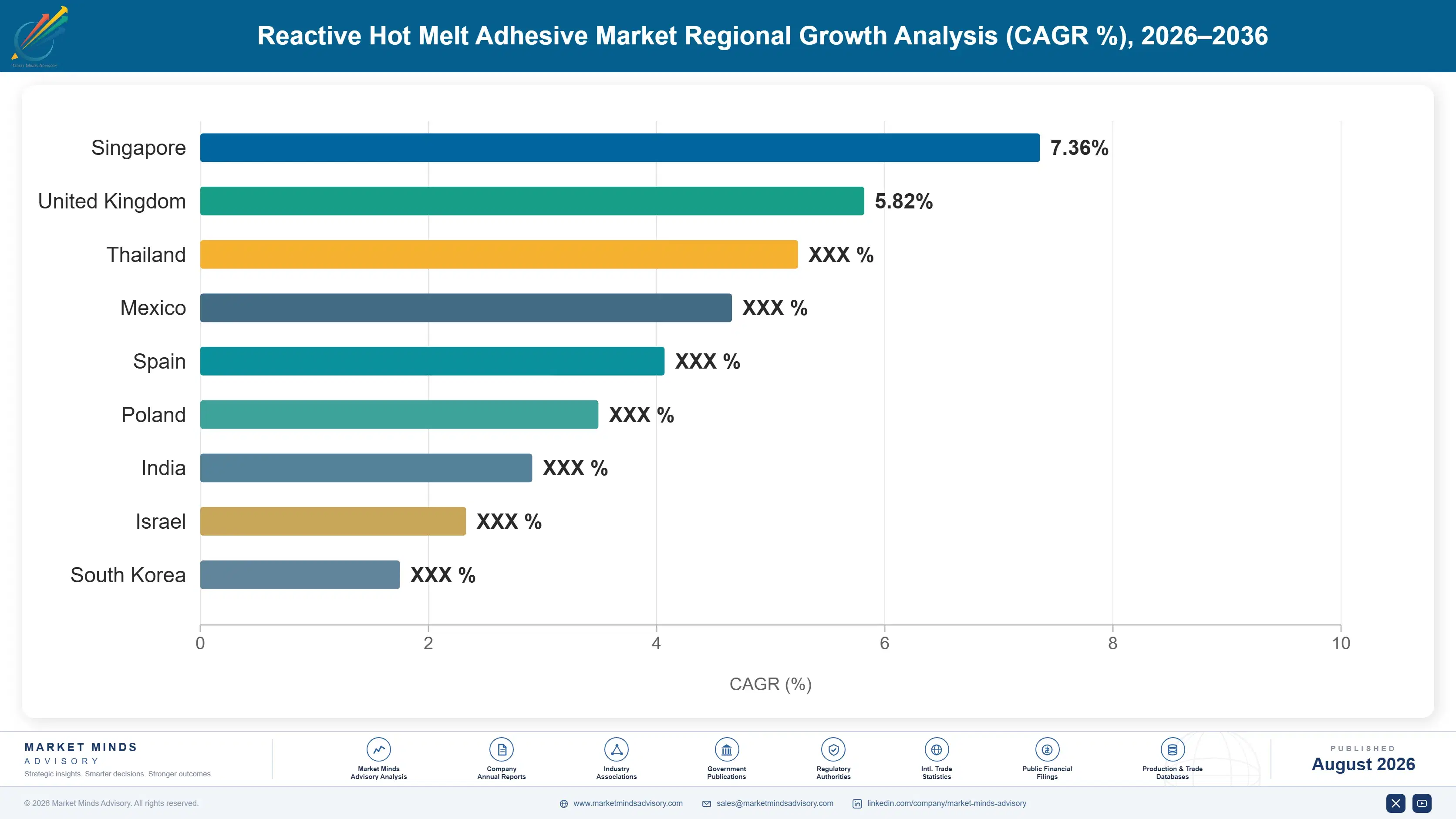
reactive-hot-melt-adhesive-market-country-cagr-analysis-1787594765892

Four Moves Beyond Price Per Kilogram

Negotiating price per kilogram on an adhesive that quietly loses around 9% of every single drum to skinning and purging is arguing about entirely the wrong number. Line throughput, waste rate and compliance obligation all sit outside the adhesive price, and every one of them is larger than the discount anybody is fighting over.

Quantify line throughput against two-component alternatives

Reactive hot melts grip on cooling within seconds and run around 34% faster than a two-component line that needs mixing, pot life management and clamping time. Across a year of production that throughput difference dwarfs any adhesive price comparison, and it reaches a production manager rather than a purchasing function. Building the calculation for a specific line takes a day of work and almost nobody does it, which leaves the strongest argument in the category sitting unused most of the time. It also reaches a buyer measured on output rather than on procurement savings.
Market Impact: Delivers a 34% line speed advantage on conversion

Sell sealed dispensing equipment alongside the adhesive

Around 9% of purchased material is lost to drum skinning and equipment purging, which raises effective cost well above list price and often exceeds the margin a converter negotiated away. Sealed melt and dispense systems recover most of that, and they attach the adhesive supply to an installed asset rather than an annual tender. Small converters resist the capital, which makes leasing arrangements the practical route. The waste arithmetic makes the case without any need to argue about adhesive price. Effective cost rather than list price is what the argument actually rests on.
Market Impact: Recovers most of the 9% material loss annually

Standardise customers on low-monomer grades globally

European rules apply above 0.1% free monomeric diisocyanate and place the training obligation on the converter, not the supplier. Multinational manufacturers standardising on low-monomer grades worldwide avoid maintaining regional formulations and remove a site compliance burden everywhere at once. Those grades grow at 9.9% on exactly that logic. A supplier proposing global standardisation reaches a corporate specification function rather than a plant buyer, which is a considerably more durable position to hold. Corporate functions compare formulations across a dozen plants at once rather than one. Very few suppliers ever reach them.
Market Impact: Serves 9.9% growth across the whole compliance range

Follow furniture manufacturing into Southeast Asian capacity

Vietnam grows fastest anywhere at 11.2% as furniture production shifts from China, and new plants specify adhesive systems at commissioning rather than converting an established line later. Specifying into a plant being built is far easier than displacing an incumbent afterwards, and the position then lasts as long as the line runs. Local technical service capability decides who wins that work, since a converter commissioning a new operation needs support on site rather than a datasheet. Displacing an incumbent afterwards costs considerably more than specifying at design stage. The position then lasts as long as that line runs.
Market Impact: Enters a market now growing at 11.2% annually

Who Controls the Margin Pool

Participation is measured on annual reactive hot melt production volume, and the top five hold 52%. Concentration reflects formulation know-how and technical service capability rather than manufacturing scale, since blending capacity is not itself difficult to build. Henkel leads on breadth across chemistries and end-uses, with H.B. Fuller and Sika holding strong positions in specific applications. The gap to challengers is low-monomer formulation depth rather than production capacity. Regional formulators hold real positions in standard grades.
Competition runs on three fronts. Low-monomer capability decides access to multinational specifications now standardising globally. Technical service decides conversions, since a converter changing adhesive is changing a process rather than a purchase. Equipment attachment decides durability, because an adhesive tied to an installed dispensing system faces a far weaker annual tender than one supplied in drums alone.

Pressure ahead comes from Chinese and Southeast Asian formulators moving upward through the specification range as furniture manufacture concentrates near them. Reactive polyolefin also erodes polyurethane share where isocyanate questions are unwelcome. Expect technical service investment and equipment programmes rather than acquisitions. Rankings shift as low-monomer specifications spread beyond Europe and as regional formulators close the capability gap. Technical service depth is what separates them.
reactive-hot-melt-adhesive-market-company-positioning-matrix-1787594766416

Competitive Moat and Risk Dimensions

HENKEL

Moat: Breadth across chemistries and applications

The company formulates across polyurethane, polyolefin and specialty reactive chemistries and serves furniture, automotive, electronics and packaging converters from the same technical organisation, which means a customer changing application or chemistry stays inside one supplier relationship. That breadth also supports the global specification standardisation multinational manufacturers are now pursuing.
HENKEL

Risk: Exposure to regional formulator advance

Standard-grade volume in Asia is increasingly served by regional formulators competing on price near where furniture manufacture has concentrated, and those suppliers are moving upward through the specification range steadily. Defending volume there means either matching prices that do not support a global technical organisation or conceding the base that funds it.
H.B. FULLER

Moat: Converter technical service depth

The company invests heavily in application engineering at converter sites, which matters disproportionately in a category where changing adhesive means changing a process rather than a purchase order. A converter that has been through a successful line conversion with a supplier rarely tenders that business seriously again, because the risk of disruption outweighs any plausible price saving.
H.B. FULLER

Risk: Furniture end-market concentration

Profile wrapping and edge banding represent the largest single demand pool and that manufacturing base is migrating from China toward Southeast Asia faster than technical service capability can follow it. Serving a customer that has relocated requires rebuilding local presence, and competitors already positioned in those markets start the relationship ahead.

Players Tracked

Prominent Players

Henkel
H.B. Fuller
Sika
Bostik
Jowat

Other Key Players

3M
Avery Dennison
Dow
Beardow Adams
Kleiberit
Tex Year Industries
Wacker Chemie
Huntsman
Covestro
Evonik
Sekisui Chemical
Toyo Ink
Nanpao Resins
Guangdong HTL
Adhesive Research

Recent Developments

APRIL 2026

Furniture manufacturer standardises low-monomer adhesive across global plants

A multinational furniture manufacturer standardised low-monomer polyurethane reactive adhesive across its entire plant network, including facilities in markets with no equivalent diisocyanate training requirement. The decision avoided maintaining separate regional formulations and specifications across the group. Standard-monomer grades were withdrawn from the group specification entirely.
Signal: European rules are being exported through corporate specification rather than through any regulatory adoption abroad at all
SEPTEMBER 2025

Supplier launches leased sealed dispensing programme for smaller converters

An adhesive formulator launched a leased sealed melt and dispensing programme aimed at smaller converters resisting capital investment, targeting the material lost to drum skinning and equipment purging. Adhesive supply was contracted alongside the equipment across the lease term. Waste recovery rather than adhesive price framed the commercial proposal.
Signal: Equipment attachment converts an annual adhesive tender into a relationship lasting the life of the lease
JANUARY 2026

Vietnamese furniture plant specifies reactive systems from commissioning

A large furniture manufacturing facility commissioned in Vietnam specified reactive hot melt edge banding and profile wrapping from the outset rather than running conventional systems and converting later. Supplier selection was completed during plant design rather than after start-up. Technical service presence in the market decided the supplier choice.
Signal: Specifying into a plant still under construction is far easier than displacing an incumbent supplier afterwards

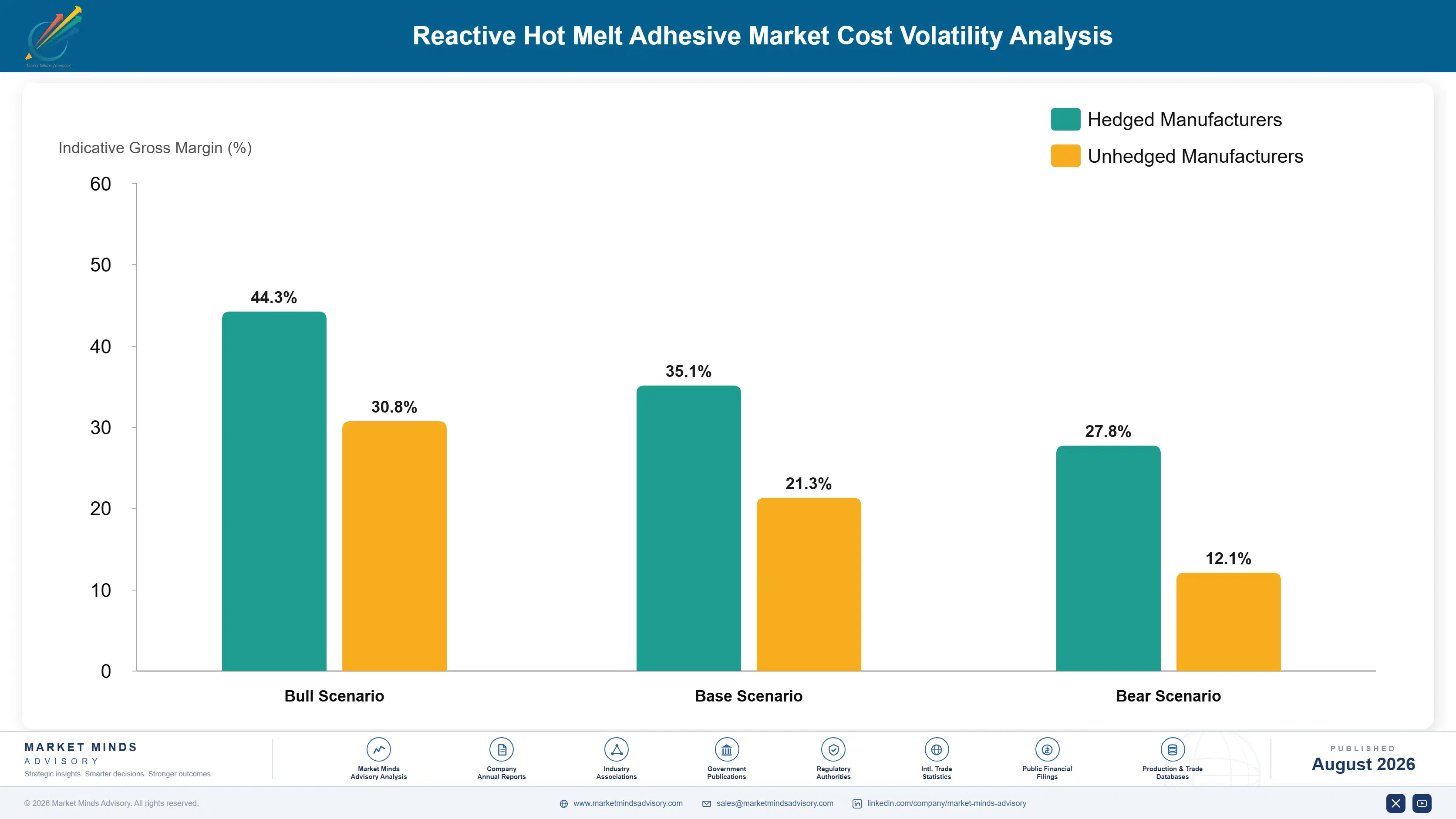
Prepolymer, Polyol and Sealed Drums

The reactive prepolymer accounts for roughly 44% of formulated cost, built from diphenylmethane diisocyanate and polyester or polyether polyols sourced from a concentrated group of petrochemical producers. Tackifiers and thermoplastic resins carry about 21%, additives and catalysts around 8%, and moisture-barrier packaging takes approximately 9%, which is unusually high because the product cannot be shipped in ordinary drums at all.
Diisocyanate pricing moved sharply through 2021 and 2022 on plant outages rather than on demand, per EIA petrochemical price reporting for the period, and supply allocation rather than price was the binding constraint for several quarters. Formulators on annual converter contracts absorbed most of it. Polyol pricing moved on a partly separate cycle driven by propylene oxide availability, so the two principal exposures diverged rather than compounding.

Exposure divides on chemistry mix and on contract structure. A formulator weighted toward polyurethane carries isocyanate exposure across almost half its cost base, while reactive polyolefin grades draw on entirely different feedstocks and behave independently. Low-monomer grades cost more to produce and carry additional processing exposure, though the price premium they command generally covers it. Small formulators without allocation agreements fared worst during the outage period.
reactive-hot-melt-adhesive-market-cost-volatility-analysis-1787594766611

Hold allocation agreements with isocyanate producers directly

The reactive prepolymer is roughly 44% of formulated cost and diisocyanate supply comes from a concentrated producer group where allocation rather than price binds during an outage. Direct agreements secure volume when spot buyers simply cannot obtain material. Small formulators without those arrangements lost customers rather than margin during the last disruption, which is a considerably worse outcome.

Run polyurethane and polyolefin chemistries in parallel

Reactive polyolefin draws on entirely different feedstocks from polyurethane and moves on an unrelated cycle, so a formulator running both can shift emphasis as one deteriorates. Development and qualification cost for two chemistries is the obstacle. It also positions the supplier for converters removing isocyanate handling from their sites for reasons that have nothing to do with price.

Price low-monomer grades on compliance value, not production cost

Low-monomer grades cost more to produce and remove a site training obligation that a converter would otherwise carry indefinitely. Pricing against production cost surrenders that value entirely. Converters comparing a premium against the cost of running a training programme for every operator handling the product reach the answer quickly when somebody presents both numbers together.

Portfolio Architecture for Margin Defence

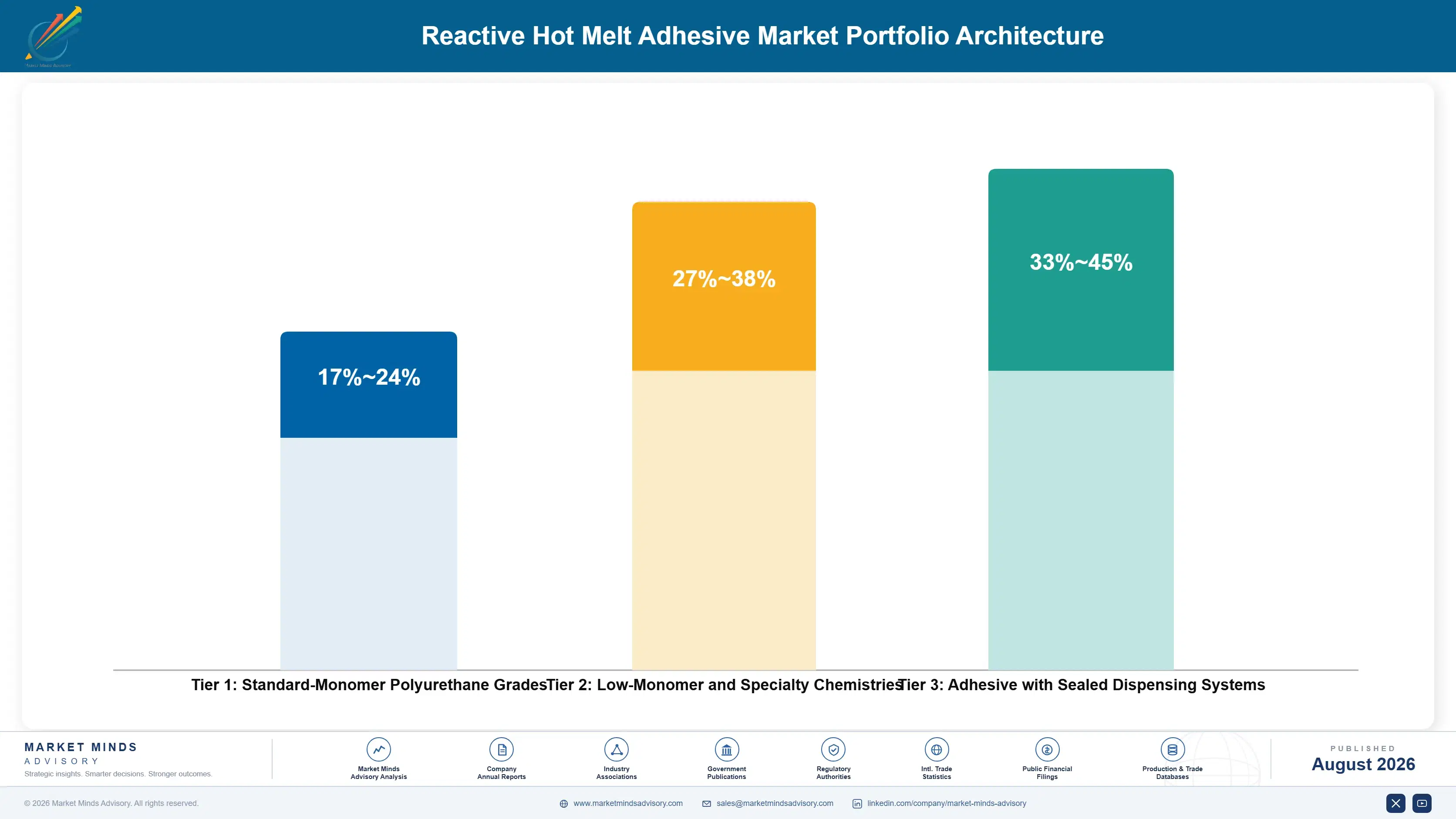
Margin here tracks how much of the customer's problem the supplier actually took on. Standard-monomer polyurethane grades supplied in drums against a published specification earn margins in the high teens to low twenties, because several credible formulators make an equivalent product and the converter tenders it annually on price per kilogram. Regional formulators compete credibly at this level and increasingly win on it.
Low-monomer, monomer-free and specialty chemistries do considerably better in the high twenties to high thirties, because they remove a compliance obligation or an isocyanate question from the converter's site rather than simply bonding two substrates together. The range reflects formulation depth and whether the supplier reached the corporate specification function or only the plant buyer. Corporate functions compare across a dozen plants rather than one.

Adhesive supplied with sealed dispensing equipment holds the strongest position, reaching into the mid forties, because it addresses the 9% lost to skinning and purging and ties supply to an installed asset. Those margins reflect a relationship that survives the annual tender rather than any difference in what is inside the drum. The relationship then survives a tender that drum supply alone never would.

Standard-Monomer Polyurethane Grades

Conventional polyurethane reactive grades supplied in drums against published specifications. The seven point range reflects formulating scale and freight position rather than product difference, since several suppliers offer equivalent performance.
Gross Margin: 17-24%

Low-Monomer and Specialty Chemistries

Low-monomer, monomer-free, polyolefin and silane-modified grades that remove compliance or handling obligations from a site. The eleven point range reflects formulation depth and whether corporate specification functions were reached rather than plant buyers.
Gross Margin: 27-38%

Adhesive with Sealed Dispensing Systems

Adhesive supplied alongside leased or installed sealed melt and dispense equipment. The twelve point range reflects how completely the waste problem is solved and whether the equipment relationship is genuinely contracted.
Gross Margin: 33-45%
reactive-hot-melt-adhesive-market-portfolio-architecture-1787594767110

High-value Sub-segments and Strategic Watch-out

Equipment-Attached Adhesive Supply

High value and growing, since sealed dispensing recovers most of the 9% lost to skinning and purging while tying supply to an installed asset. The relationship survives an annual tender that drum supply alone never does. Leasing reaches converters resisting the capital outlay. Retention rates run far above drum supply.
Gross Margin: 35-45%

Low-Monomer and Monomer-Free Grades

High value and the fastest growth at 9.9%, driven by the 0.1% free monomer threshold that places a training obligation on the converter. Multinational manufacturers now standardise these grades globally regardless of local rules. Formulation depth rather than blending capacity decides who can serve this.
Gross Margin: 29-38%

Standard Polyurethane Reactive Grades

The volume core, tendered annually on price per kilogram where several credible formulators offer equivalent performance. Regional Asian formulators are moving upward through this range as furniture manufacture concentrates near them. Freight economics limit how far any formulator can defend a position. Annual tenders keep the pressure constant.
Gross Margin: 17-24%

Isocyanate-Dependent Portfolio Weight

The strategic watch-out. Regulation tightening beyond training into use restriction would strand formulation investment, and the fourteen point range reflects how differently suppliers are positioned across alternative chemistries. Use restriction rather than training obligation is the scenario that would strand formulation investment across the whole category.
Gross Margin: 16-30%

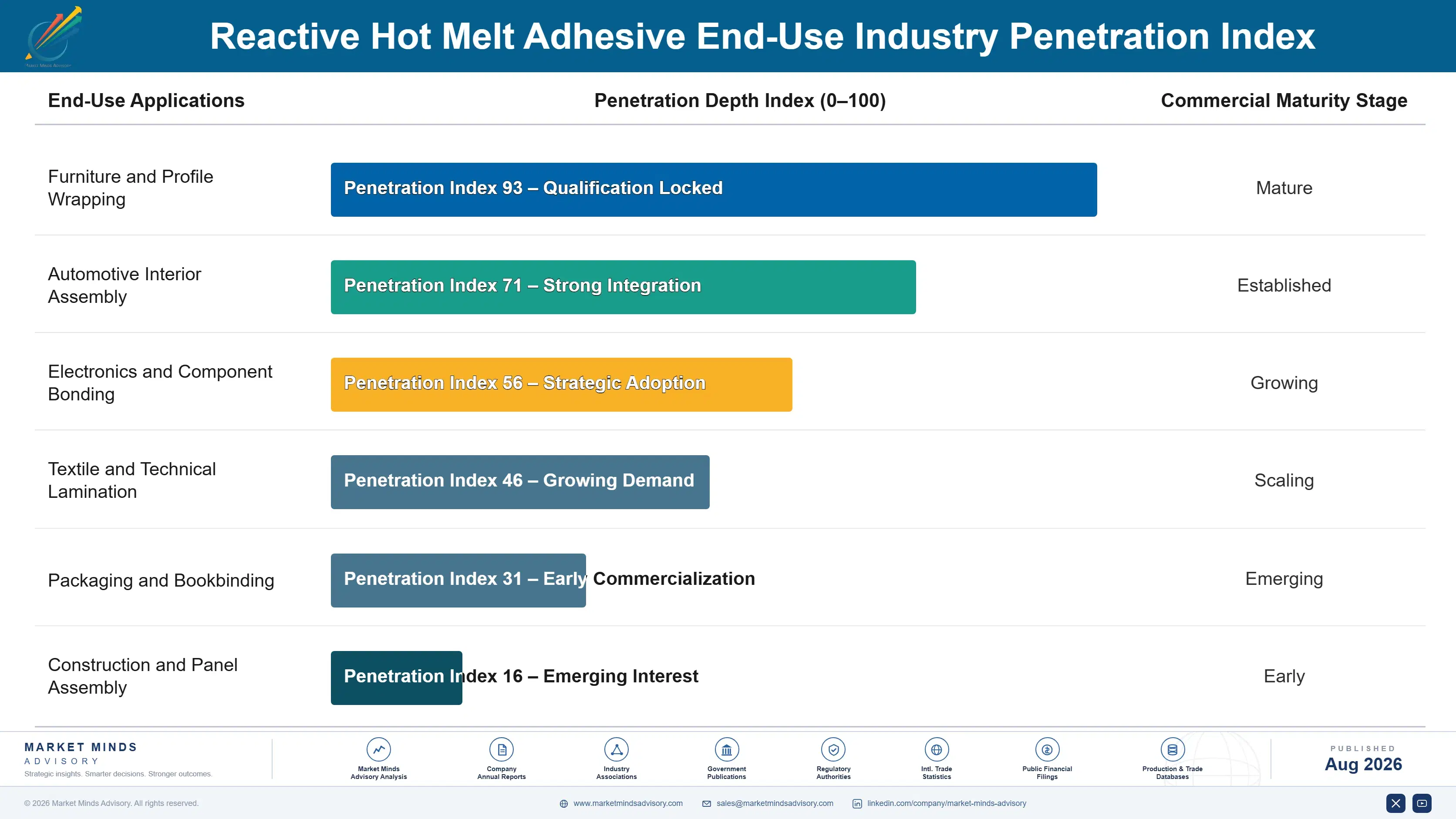
Changing Adhesive Means Changing Process

Consumption repeats with every metre a converter runs, which ties volume to their own production schedule rather than to any purchasing decision made periodically. A qualified adhesive runs continuously on a line for as long as the product is made, and the supplier holding that position collects steadily without competing for it again. What matters commercially is that switching is a process change rather than a purchase change, which raises the barrier considerably.
Stickiness varies with how much of the operation the supplier touches. An adhesive tied to installed sealed dispensing equipment is close to immovable, because displacing it means displacing the asset and reopening the waste problem the equipment solved. A converter who has completed a successful line conversion with a supplier rarely tenders that business seriously again. Drum supply against a published specification switches far more readily on price.

The specifying voice has been moving upward inside customer organisations. Plant buyers historically decided adhesive on price per kilogram, and many still do. Diisocyanate rules pulled site safety functions into the decision, and global specification standardisation has now pulled in corporate technical functions who compare formulations across a dozen plants rather than one.
reactive-hot-melt-adhesive-market-end-use-penetration-index-1787594767598

Where We Would Focus Effort

These are among the four positions where our research anticipates prominent divergence between winners and laggards over the coming forecast period. Each is grounded in the demand model, the regulatory perimeter, and the announced capacity pipeline.
01 / THROUGHPUT ARGUMENT BUILDING

Sell the line rate, not the kilogram price

Reactive hot melts grip on cooling within seconds and run around 34% faster than two-component systems requiring mixing, pot life management and clamping time on the floor. Across a year of production that throughput difference dwarfs any adhesive price comparison and reaches a production manager rather than a purchasing function that measures success in discounts. Building the calculation for a specific line takes about a day of work, and almost nobody in this industry bothers to do it properly for a customer.
02 / WASTE RECOVERY SELLING

The drum loses more than you discounted

Around 9% of purchased material is lost to drum skinning and equipment purging, which raises effective cost well above list and frequently exceeds whatever margin a converter negotiated away across three years of annual tenders. Sealed melt and dispense systems recover most of that while tying adhesive supply to an installed asset rather than an annual purchase decision. Small converters resist the capital, which makes leasing the practical route and turns a price conversation into an equipment one instead of a discount.
03 / GLOBAL SPECIFICATION ACCESS

Reach the corporate function, not the plant buyer

European rules apply above 0.1% free monomeric diisocyanate and place the training obligation on the converter rather than the supplier, which turned an adhesive into a site compliance matter. Multinational manufacturers standardising low-monomer grades worldwide avoid maintaining regional formulations and remove that site burden everywhere at once rather than market by market. A supplier proposing global standardisation reaches a corporate specification function, which is a far more durable position than any individual plant relationship negotiated annually on price per kilogram.
04 / SOUTHEAST ASIAN POSITIONING

Specify into the plant while it is still drawings

Vietnam grows fastest anywhere at 11.2% as furniture manufacture continues shifting from China on labour cost and trade access considerations. New plants commissioned there specify adhesive systems during design rather than converting an established line afterwards, which is a fundamentally easier position to win and to hold afterwards. Local technical service capability decides who gets that work, because a converter commissioning a new operation needs engineers on site rather than a datasheet and a price list emailed from another continent.

Engagement Snapshot From the Field

A live engagement with an industry participant carrying material or product regulatory and market exposure ahead of a defining policy shift, showing how our research translates into a defensible multi-year portfolio strategy.
MARKET MINDS ADVISORY · CLIENT ENGAGEMENT SUMMARY
Reactive Hot Melt Adhesive Producer Strategic Portfolio Review and Transition Roadmap 2026·Investment Scenario on Reactive Hot Melt Adhesive Exposure Evaluation 2025-26
CLIENT PROFILE
A European adhesive formulator producing reactive polyurethane hot melts for furniture and profile wrapping converters, with annual revenue near 140 million euros (client-reported, unverified by MMA). Supply was almost entirely in drums on annual contracts negotiated by plant purchasing functions, and the company sold no dispensing equipment and had no technical presence anywhere in Southeast Asia.
STRATEGIC CHALLENGE
Two large furniture customers had relocated production to Vietnam and the business had followed neither, while margin on remaining European volume compressed through successive annual tenders. Management needed to decide between defending European share on price, building Southeast Asian presence, or changing the commercial model entirely, and had no basis for choosing between the three.
MMA APPROACH
MMA quantified converter waste rates across the client's customer base, benchmarked equipment-attached supply models against drum supply on retention and margin, assessed the cost of Southeast Asian technical service presence, and tested whether corporate specification functions were reachable at the client's multinational accounts. Interviews with 47 experts covered adhesive formulation, furniture manufacturing and converter operations.
KEY FINDINGS
  1. Measured waste from skinning and purging across the client's customer base exceeded the total margin conceded across three years of annual tender negotiations, by a considerable distance.
  2. Customers supplied with sealed dispensing equipment at competitors showed retention rates far above drum-only accounts, and had not tendered the adhesive at all during the observed period.
  3. Corporate specification functions at two multinational accounts were actively standardising low-monomer grades globally, and neither had ever been contacted by the client's commercial organisation.
  4. Southeast Asian technical service presence was affordable at modest scale, but only genuinely worthwhile if established before plant commissioning rather than afterwards.
CLIENT PROFILE
A European adhesive formulator producing reactive polyurethane hot melts for furniture and profile wrapping converters, with annual revenue near 140 million euros (client-reported, unverified by MMA). Supply was almost entirely in drums on annual contracts negotiated by plant purchasing functions, and the company sold no dispensing equipment and had no technical presence anywhere in Southeast Asia.
STRATEGIC CHALLENGE
Two large furniture customers had relocated production to Vietnam and the business had followed neither, while margin on remaining European volume compressed through successive annual tenders. Management needed to decide between defending European share on price, building Southeast Asian presence, or changing the commercial model entirely, and had no basis for choosing between the three.
MMA APPROACH
MMA quantified converter waste rates across the client's customer base, benchmarked equipment-attached supply models against drum supply on retention and margin, assessed the cost of Southeast Asian technical service presence, and tested whether corporate specification functions were reachable at the client's multinational accounts. Interviews with 47 experts covered adhesive formulation, furniture manufacturing and converter operations.
KEY FINDINGS
  1. Measured waste from skinning and purging across the client's customer base exceeded the total margin conceded across three years of annual tender negotiations, by a considerable distance.
  2. Customers supplied with sealed dispensing equipment at competitors showed retention rates far above drum-only accounts, and had not tendered the adhesive at all during the observed period.
  3. Corporate specification functions at two multinational accounts were actively standardising low-monomer grades globally, and neither had ever been contacted by the client's commercial organisation.
  4. Southeast Asian technical service presence was affordable at modest scale, but only genuinely worthwhile if established before plant commissioning rather than afterwards.
RECOMMENDED STRATEGY
Phase 1: Phase one: launch a leased sealed dispensing programme, since waste recovery exceeds the margin being conceded annually at tender across the entire customer base. Phase 2: Phase two: approach corporate specification functions at multinational accounts directly, ahead of the global low-monomer standardisation programmes already under way. Phase 3: Phase three: establish Vietnamese technical service presence sized to support plant commissioning work rather than to serve existing regional volume.
OUTCOME
The formulator launched leased dispensing during 2026 and reported both improved retention and higher realised margin on converted accounts (client-reported, unverified by MMA). Two multinational corporate specifications were secured, and a small Vietnamese technical presence was established ahead of two customer plant commissionings. Drum-only accounts continued to compress.

Frequently Asked Questions

Foundational context covering the market sizes, CAGR, scope, country, region and competition that inform every finding below. This section is provided to cover basics and most often pre-purchase conversations, answered from the MMA Primary Research Dataset.

What is the current size of the Reactive Hot Melt Adhesive Market?

MMA sizes it at USD 2.86 billion in 2025, rising to USD 3.05 billion in 2026. The figure covers adhesives applied molten that cure chemically into a thermoset, at formulator selling value.

How large will the Reactive Hot Melt Adhesive Market be by 2036?

USD 5.78 billion by 2036, an incremental USD 2.73 billion over the 2026 base and an expansion multiple of 1.90 times. Low-monomer grades account for a disproportionate share.

What is the CAGR for the Reactive Hot Melt Adhesive Market 2026 to 2036?

6.6% in the base case, with a bull case at 7.8% and a bear case at 5.4%. The spread turns on automotive adoption and on whether isocyanate regulation tightens further.

Which segment is growing fastest?

Low-monomer and monomer-free polyurethane grades at 9.9%, half again the market rate of 6.6%. They sit below the 0.1% threshold that triggers mandatory user training requirements.

Who are the major companies in the Reactive Hot Melt Adhesive Market?

Henkel, Fuller, Sika, Bostik and Jowat lead on annual reactive hot melt production volume. Fifteen further participants are profiled in the full report on that same basis.

Which country is growing fastest?

Vietnam at 11.2%, as furniture manufacture continues shifting there from China and newly commissioned plants specify reactive adhesive systems from the plant design stage onward.

Report Segmentation Architecture

The full report scope spans multiple orthogonal segmentation dimensions, with cross-tabulated demand data provided for each dimension pair. Coverage extends further to regional breakdowns, trend trajectories, and the competitive detail needed to support segment-level decision-making.

By Cure Chemistry

  • Standard-Monomer Polyurethane Reactive
  • Low-Monomer and Monomer-Free Polyurethane
  • Reactive Polyolefin Hot Melts
  • Silane-Modified Reactive Hot Melts
  • Reactive Polyamide Hot Melts
  • Ultraviolet-Curable Reactive Hot Melts

By End-Use Industry

  • Furniture and Profile Wrapping
  • Automotive Interior Assembly
  • Electronics and Component Bonding
  • Textile and Technical Lamination
  • Packaging and Bookbinding
  • Construction and Panel Assembly

By Commercial Dimension

  • Direct Supply to Converters
  • Equipment-Attached Supply Programmes
  • Distributor and Stockist Channels
  • Global Specification Agreements
  • Toll and Private Label Formulation
  • Export and Cross-Border Supply

By Region

  • North America
  • Western Europe
  • East Asia
  • South Asia and Pacific
  • Latin America
  • Middle East and Africa
  • Eastern Europe

Scope, Methodology, and Coverage

Every figure in this report is reproducible from documented input assumptions. The scope below maps the historical period, the forecast horizon, the segmentation dimensions, and the countries covered, alongside the underlying primary and qualitative methodology.
Historical Period
2020 to 2025
Forecast Period
2026 to 2036
Base Year
2025 (USD billions; MMA Primary Research Dataset, August 2026)
Market Definition
Adhesives applied in a molten state that subsequently cure through chemical reaction into a thermoset bond, covering standard-monomer polyurethane reactive grades, low-monomer and monomer-free polyurethane, reactive polyolefin, silane-modified, reactive polyamide and ultraviolet-curable reactive hot melts. Measured at formulator selling value across all end-use industries. Non-reactive thermoplastic hot melts, solvent-borne and waterborne adhesives, two-component structural adhesives, pressure-sensitive tapes and the dispensing equipment itself are excluded from scope.
Quantitative Units
USD billions (current prices); thousand tonnes formulated adhesive; USD per kilogram by chemistry
Segmentation Dimensions
Cure chemistry; end-use industry; commercial dimension; region
Regions Covered
North America, Western Europe, East Asia, South Asia and Pacific, Latin America, Middle East and Africa, Eastern Europe
Countries Covered
China, Japan, South Korea, Taiwan, Vietnam, Indonesia, Malaysia, India, Australia, United States, Canada, Mexico, Germany, Italy, France, Spain, Poland, Turkey, Brazil, South Africa
Key Companies Profiled
Henkel, H.B. Fuller, Sika, Bostik, Jowat, 3M, Avery Dennison, Dow, Beardow Adams, Kleiberit, Tex Year Industries, Wacker Chemie, Huntsman, Covestro, Evonik, Sekisui Chemical, Toyo Ink, Nanpao Resins, Guangdong HTL, Adhesive Research
Quantitative Methodology
Primary survey, n=3,800 respondents, Q4 2025, six countries; demand-side model with trade association cross-validation
Qualitative Methodology
47 expert interviews, Q4 2025; applied to validate demand model assumptions, identify emerging dynamics, and assess competitive positioning
Report Format
PDF and XLSX data workbook (Word format preview document)
Publisher
Market Minds Advisory
Report Code
MMA-2026-CHM-131
Published
August 2026
Contact
sales@marketmindsadvisory.com | www.marketmindsadvisory.com

Purchase the full Reactive Hot Melt Adhesive Market Report (2026 to 2036).

The full report costs the adhesive as the converter actually experiences it, including the material lost to skinning and purging that routinely exceeds negotiated discounts. It sizes all six cure chemistries independently through 2036, maps diisocyanate compliance obligations against reformulation progress by supplier, and models equipment-attached supply against drum supply on retention and realised margin. Regional chapters cover all seven regions, following converter manufacturing location rather than end-market consumption. Competitive profiling covers 20 participants on a single production volume basis, with formulation capability assessed alongside commercial position.
Six cure chemistries sized independently through 2036
Converter waste quantified against negotiated price discounts
Diisocyanate compliance mapped against supplier reformulation progress
Equipment-attached supply modelled against drum-only retention
Twenty participants profiled on one consistent volume basis
Furniture manufacturing migration tracked across Southeast Asian markets

Built For The People Who Decide

From boardroom strategy to bench-side execution, this report is read cover-to-cover by leaders shaping the next decade of their industry, turning demand scenarios, market dynamics and valuation benchmarks into decisions.
CXOs/ Presidents/ VPs/ Managers
M&A and Corporate Development
Strategy Teams and R&D Heads
Procurement and Product Directors
Regulatory and Compliance Leaders
Investor Relations and Equity Analysts