Market Minds Advisory
Reachers Market

Reachers Market: Online Displacement of Assessment, Abandonment Economics and the Aluminium Cost Base

Two in five reaching aids stop being used within a year, almost always because nobody measured the person before the product arrived, and the channel that grew fastest has no reason to care.

Lead Analyst

Alice Ballenger

Published

September 2026

Make Smarter Decisions with Customized Research Insights

Request a free sample report and evaluate market opportunities, growth trends, and competitive dynamics relevant to your business needs.

2025 MARKET VALUE$0.4BMarket Size 2025
2036 FORECAST VALUE$0.8BBase Case , 2026 to 2036
CAGR 2026 TO 20365.8 %Bull 7.0% / Bear 4.6%
INCREMENTAL OPPORTUNITY$0.3BNet 10- year value creation
EXPANSION MULTIPLE1.75x2036 value over 2026 base
Strategic Levers
M&A Pipeline
Regional Outlook
Country Rankings
Competitive Intelligence
Segmental Deep-dive
Call-Us : 91 93563 13602

Executive Snapshot and Market Trajectory

Online retail now carries 62% of reaching aid volume and occupational therapy assessment precedes only 19% of purchases, which is the whole commercial story of this category. Roughly 41% of aids are abandoned within a year, almost always because length, grip or trigger force never matched the person using them.
Powered and magnetic-assist reachers compound at 8.7%, exactly 1.50 times the market rate, because grip strength rather than reach is the limiting impairment for a large share of users and a trigger they cannot squeeze is useless to them. East Asia holds 30% of value, the largest position, combining an enormous ageing population with the manufacturing base supplying almost every reacher sold worldwide. Average retail price sits near USD 18.
Five suppliers ship 34% of units, which is remarkably fragmented, because a reacher is cheap to make, cheap to ship and easy to brand. Public or insurance funding covers only 14% of volume. Aluminium tube and ocean freight together decide the cost base, and neither is controllable from within this industry. Only 19% of purchases follow any occupational therapy assessment at all, which explains the abandonment figure more or less entirely on its own.
Market Definition
Covers hand-operated reaching and grasping aids for people with limited reach, mobility or grip, spanning powered and magnetic-assist reachers, folding travel reachers, standard rigid trigger reachers, suction-cup and precision-grip reachers, extended-length and bariatric reachers, and institutional multi-pack reachers. Sizing captures product revenue at realised selling price across retail, clinical and institutional channels. Excludes dressing aids, sock aids and long-handled shoehorns, mobility walking aids, wheelchairs and transfer equipment, robotic feeding and manipulation devices, industrial litter-picking tools, and prosthetic or orthotic upper limb devices.
Base Year Value
$0.4B in 2025 (MMA Primary Research Dataset, August 2026)
Forecast Period
2026 to 2036, eleven discrete annual values
CAGR
5.8% base case. Bull 7.0%. Bear 4.6%.
Fastest Growth Segment
Powered and Magnetic-Assist Reachers: 8.7% CAGR
Fastest Growth Country
India: 8.4% CAGR
Fastest Growth Region
South Asia and Pacific: 7.9% CAGR
Largest Region
East Asia: 30% of 2025 global value
Market Leaders
Etac, Performance Health, Drive DeVilbiss Healthcare, Medline Industries, Maddak. Source: MMA Analysis based on company annual reports.
Primary Survey
n=3,800 procurement and R&D decision-makers, Q4 2025, six countries
Methodology
Demand-side build-up, cross-validated against public data, 47 expert interviews

Reachers Market Forecast Scenarios

reachers-market-size-forecast-scenario-1787309807970
Growth of 4.7% across 2020 to 2025 came almost entirely from channel shift rather than from more users. Online retail expanded rapidly as older consumers and their families learned to buy daily living aids without visiting a clinic, and that displaced therapy assessment rather than adding to it. Average selling prices fell as online comparison exposed how similar most products are. Institutional purchasing recovered slowly after 2020.
The base case of 5.8% rests on three mechanisms. Powered and magnetic-assist designs address grip impairment that standard trigger reachers cannot serve, at prices several times the standard product. Ageing populations across Japan, Korea, Western Europe and China keep expanding the user base regardless of channel. And Indian and Southeast Asian demand is rising from very low penetration as ageing accelerates and organised retail reaches households with no previous access.
The bull case of 7.0% assumes public reimbursement programmes extend to daily living aids more broadly, which would raise both volume and realised price by routing purchases through assessment rather than through price comparison. The bear case of 4.6% reflects two pressures: online price competition continuing to compress realised value per unit, and abandonment at 41% suppressing repeat and referral demand.

Nobody Measures The Person Any More

A reaching aid is a simple product with a fitting problem nobody has solved commercially. Correct length depends on the user's height, seated or standing use, and what they must reach. The correct trigger depends on grip strength, which is frequently the actual impairment rather than reach itself. Occupational therapists established that decades ago and now precede only 19% of purchases, because 62% of volume moves online where the only visible variables are length and price.
TOP FIVE CONCENTRATION34%Reacher units shipped by the leading global suppliers
AVERAGE RETAIL PRICEUSD 18Realised consumer price for one standard reaching aid
ONLINE CHANNEL SHARE62%Category volume sold through online retail rather than clinically
DEVICE ABANDONMENT RATE41%Users who stop using an aid within one year
THERAPIST PRESCRIBED SHARE19%Aids supplied following occupational therapy assessment and fitting
REIMBURSED VOLUME SHARE14%Units funded by public or insurance programmes rather than privately
The consequence shows up as abandonment. Roughly 41% of aids stop being used within a year, and interviews consistently attribute that to wrong length, unusable trigger force or a grip that cannot hold what the user actually needs to pick up. That is a fixable problem and nobody in the growing channel has any commercial reason to fix it, since an abandoned USD 18 product costs a retailer nothing and often generates a replacement purchase.
Two forces determine the next decade. Powered and magnetic-assist designs address grip impairment directly and compound at 8.7%, which is the only genuine product innovation in the category. And aluminium tube pricing plus ocean freight together set a cost base no supplier here can influence at all.
"This is a category that solved its clinical problem in the 1970s and then dismantled the distribution that delivered the solution. Two in five of these things end up in a drawer because nobody measured the person. The suppliers know it, the therapists know it, and the channel selling 62% of them has never once been asked about it."
Director, Assistive Technology and Daily Living Aids Practice · MMA Medical Devi

Market Trends

Powered and magnetic designs address grip rather than reach

The impairment limiting most reacher users is grip strength rather than reach distance, and a standard trigger mechanism requiring firm squeeze pressure is unusable for someone with rheumatoid arthritis or post-stroke weakness. Powered actuation and magnetic pickup tips remove that requirement entirely, and the segment compounds at 8.7% against 5.8% for the market. Pricing runs several times the standard product, which the online channel finds difficult to explain to a shopper comparing on length and price. Clinical channels sell these considerably better than retail does, because a therapist assesses grip strength rather than reading a length specification.
Market Impact: Grows the user base at 5.8%
Online retail displaces occupational therapy assessment entirely

Roughly 62% of reaching aid volume now moves through online retail, bought by older consumers or their adult children without any clinical involvement, and therapist assessment precedes only 19% of purchases. That shift removed the fitting step that determined whether a product would actually be used. Abandonment at 41% is the visible consequence. No participant in the online channel has any commercial incentive to reintroduce assessment, since an abandoned product at this price point costs nobody anything they can measure. Fitting guidance inside a listing is the only intervention that would reach the point of sale.
Market Impact: Supplies aids in 100% of pathways

Market Opportunities and Growth Drivers

Ageing populations expand the user base across every region

Reduced reach and grip accompany arthritis, stroke recovery, hip and knee replacement, obesity and simple ageing, and the populations affected are growing in every market MMA tracks. Japan, Korea, Western Europe and increasingly China all have large and expanding cohorts over seventy-five. That produces volume growth requiring no commercial effort whatsoever and largely independent of channel. Value growth lags volume growth considerably, because online price comparison keeps average realised prices near USD 18 regardless of how many users appear. Volume growth therefore delivers considerably less value growth than the demographics alone would suggest.
Market Impact: Abandons 41% within one year

Hospital discharge pathways supply aids as standard practice

Hip and knee replacement, stroke and spinal surgery discharge protocols in most developed systems now include daily living aid provision, and a reacher is among the cheapest and most frequently included items. That generates institutional multi-pack purchasing at very low unit prices but reliable volume, funded through the surgical episode rather than through any separate device budget. Occupational therapists select and fit these, which makes discharge pathways the one channel where assessment still routinely happens at all. Retention among discharge-supplied users runs well above the category average as a direct result.
Market Impact: Holds average price near USD 18

Market Restraints and Challenges

Abandonment at two in five suppresses category credibility

Roughly 41% of reaching aids stop being used within a year, and the root cause is unfitted supply rather than product failure: wrong length, unusable trigger force, or a grip that cannot hold what the user needs. That undermines referral, repeat purchase and clinical confidence together. Participants respond by publishing fitting guidance alongside online listings, by offering length selection tools that ask about height and use position, and by concentrating clinically on discharge pathways where a therapist still selects the product properly. None of that reaches the online shopper who created the problem in the first place.
Market Impact: Prices at 4 times standard reachers

Online price comparison compresses realised value per unit

Average retail price near USD 18 reflects a product where the only variables a shopper can compare are length and price, and the root cause is that genuine differences in trigger mechanism, jaw design and build quality are invisible in an online listing. Value therefore falls even as volume rises. Suppliers respond by moving into powered and magnetic designs where the difference is describable, by pursuing institutional and clinical channels that assess quality, and by holding manufacturing cost down in Asia. Chinese manufacturers selling direct under their own labels compress that pricing further every year.
Market Impact: Carries 62% of category volume
3 additional market trends, 4 additional growth drivers, and 2 additional restraints and challenges are covered in the full report. Contact sales@marketmindsadvisory.com to access the complete intelligence.

Segment CAGR and Growth Architecture

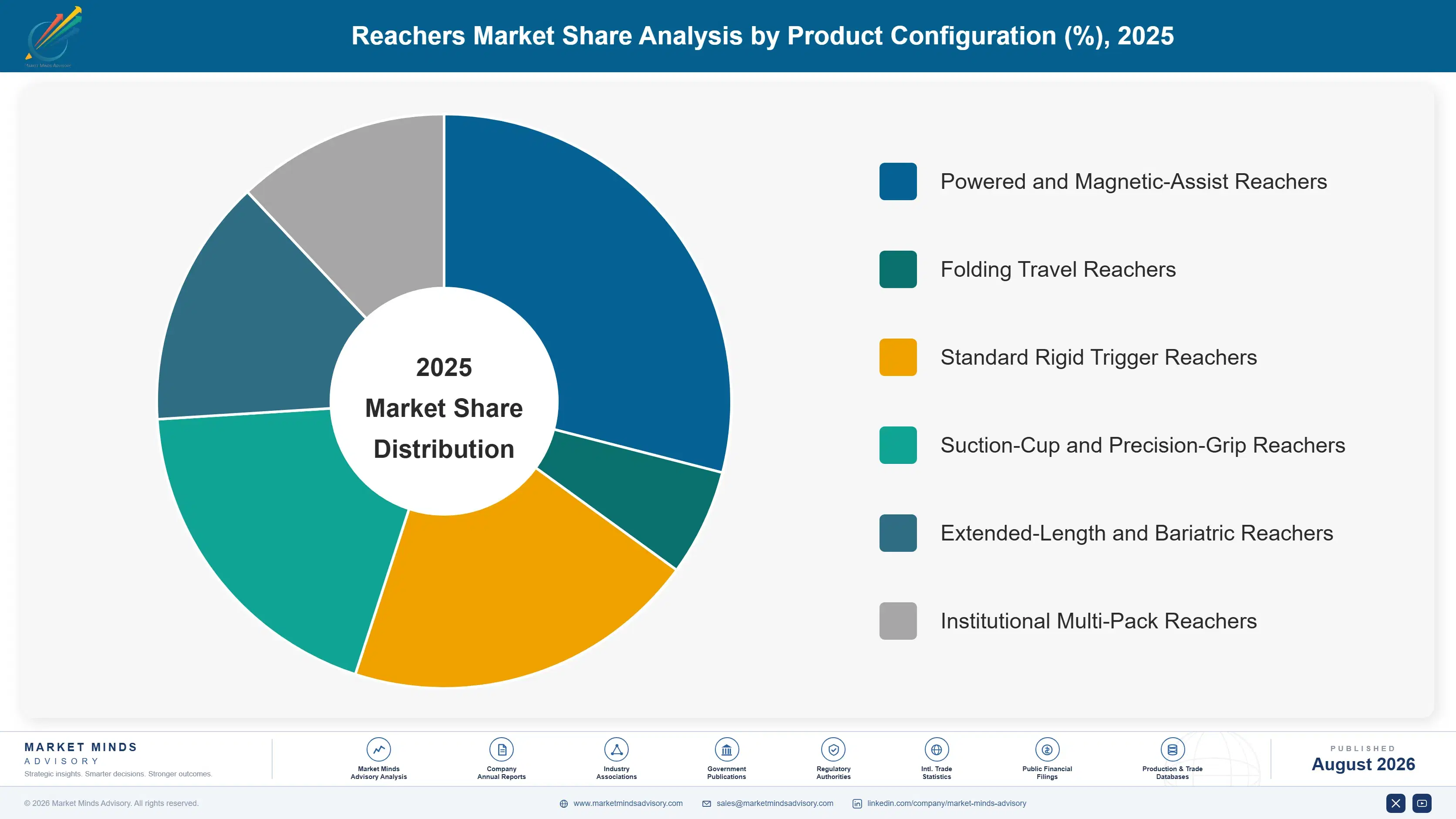
Segmentation follows the product configuration, because configuration determines which impairment the aid actually serves, which channel sells it and what price it commands. User condition, care setting and geography all matter commercially but cut across every configuration, so they belong in later discussion. Six configurations cover current reaching aid practice worldwide, and their economics differ sharply.
reachers-market-market-share-analysis-1787309808499

Powered and Magnetic-Assist Reachers

Powered and magnetic-assist designs compound at 8.7%, exactly 1.50 times the market rate, and they exist because reach is often not the actual problem. Grip strength limits far more users than arm length does, and a trigger requiring firm squeeze pressure is useless to someone with rheumatoid arthritis or post-stroke weakness. Three commercial features follow. Pricing runs roughly four times the standard product, which online listings struggle to justify to a shopper comparing length and price. Clinical and discharge channels sell these far better than retail. And they are the only genuine product innovation the category has produced in decades. Occupational therapists select these readily where funding permits, and online shoppers almost never do.
CAGR 8.7%

Folding Travel Reachers

Folding reachers grow at 7.0%, second fastest, and the demand is behavioural rather than clinical. Users who remain mobile and active want an aid that fits in a bag rather than one that announces itself, and the folding hinge addresses dignity as much as portability. That makes it the configuration adult children buy most readily online for a parent. The engineering trade-off is real, since a hinge introduces flex that reduces precision and durability against a rigid shaft. Suppliers who cut cost on the hinge mechanism generate exactly the failures that feed the abandonment figure. Adult children buying for a parent value portability and discretion more than the parent frequently does.
CAGR 7.0%
Full segment breakdown across 6 segments available in the complete report.

Regional Architecture and Country Demand Map

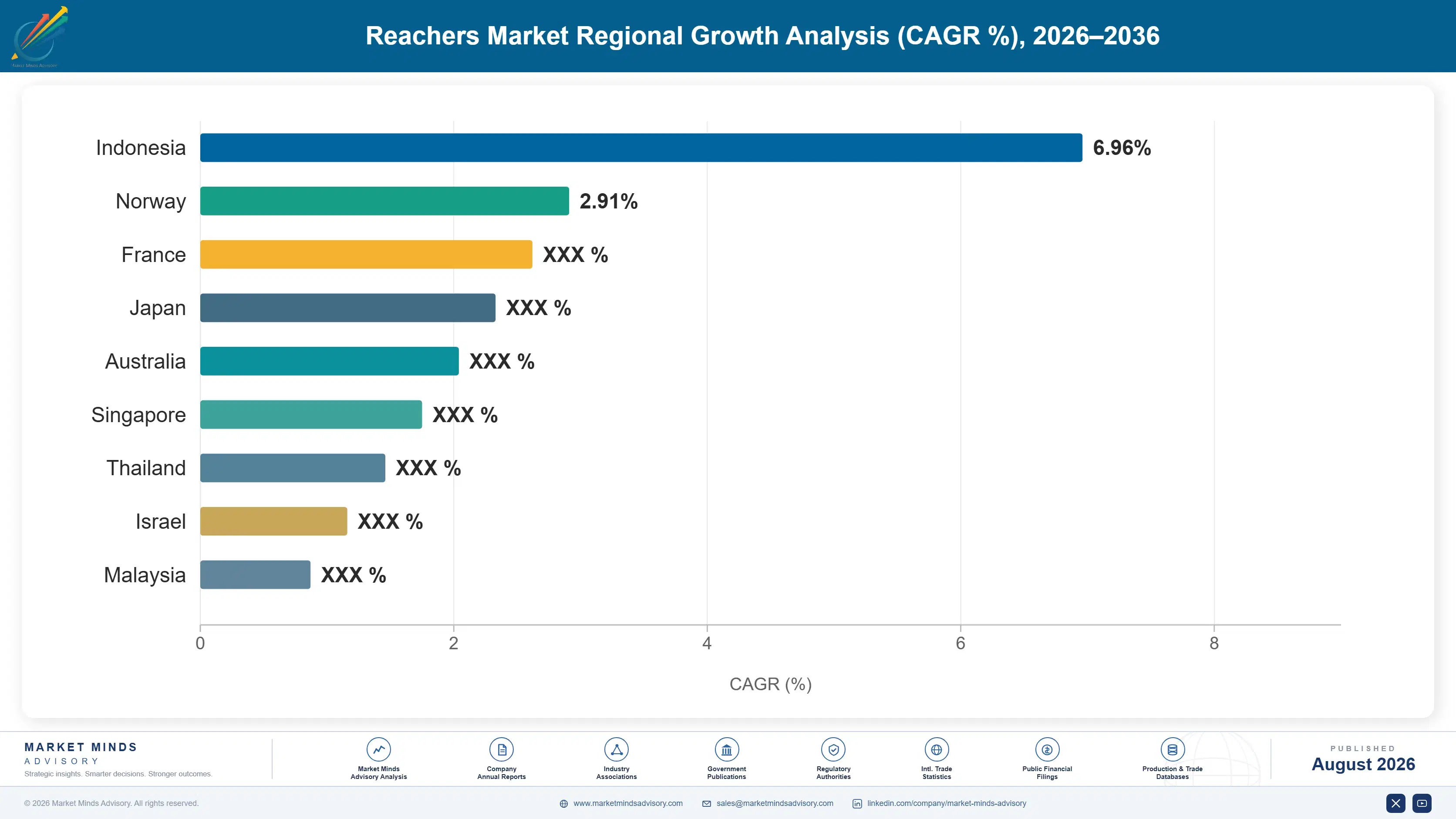
East Asia leads at 30% of value, combining enormous ageing populations with the manufacturing base supplying almost every reacher sold worldwide. North America follows at 26% on online retail scale. South Asia and Pacific grows fastest, led by India at 8.4%, from very low household penetration.

North America

Twenty-six percent of global value sits in North America, growing at 5.0%, and online retail scale explains most of it. Large online marketplaces carry hundreds of near-identical listings, which drove average realised prices down while volume rose, and private-label brands entered easily because a reacher carries no meaningful barrier to entry. Occupational therapy assessment survives mainly inside hospital discharge pathways after joint replacement and stroke, where therapists still select and fit properly. Public reimbursement for daily living aids is minimal outside specific veteran and long-term care programmes, so households pay directly for most purchases. Occupational therapy assessment survives almost nowhere else, which is why abandonment rates here run at or above the global average consistently.
Share: 26% | CAGR: 5.0% (2026 to 2036)

Western Europe

Growth of 4.3% is the slowest of any region, and 22% of value reflects mature ageing populations where provision is well established but pricing is compressed. Nordic and Dutch systems fund daily living aids through municipal or long-term care programmes with occupational therapy assessment attached, which is why abandonment rates there run well below the global figure. British provision through local authority services has narrowed considerably, pushing households toward online purchase. German long-term care insurance funds a defined aids list. Etac and regional suppliers hold strong clinical channel positions across the region. Where public provision has narrowed, households moved online and abandonment rose accordingly, which several municipal services have measured directly.
Share: 22% | CAGR: 4.3% (2026 to 2036)
Regional intelligence for 5 additional markets available in the complete report: East Asia, South Asia and Pacific, Latin America, Middle East and Africa, Eastern Europe. Contact sales@marketmindsadvisory.com.
reachers-market-country-cagr-analysis-1787309809019

Four Ways To Earn Above Commodity

A reacher sells for roughly USD 18 through a channel that compares length and price, and 41% end up unused because nobody measured the person. The levers that matter make differences visible, reach channels where assessment still happens, and move into configurations where impairment varies. Each carries returns tested against disclosed supplier economics and primary interview evidence.

Build fitting guidance into the online listing itself

Online shoppers compare length in inches and price because nothing else is visible, and 41% of resulting purchases are abandoned within a year. Suppliers embedding height, use position and grip strength selection tools into their listings report return and abandonment rates roughly 30% below category norms, and review scores materially higher. It costs digital development the category has never funded and requires marketplace cooperation that varies enormously, and it is the only intervention that addresses abandonment at the point it is created. Nobody in the marketplace channel has any measurable incentive to do this on their own.
Market Impact: Cuts abandonment roughly 30% below

Concentrate commercially on hospital discharge pathways

Joint replacement, stroke and spinal surgery discharge protocols include daily living aid provision as standard, and occupational therapists still select and fit the products, which makes it the one channel where assessment reliably happens. Suppliers holding discharge pathway positions report realised pricing roughly 45% above online equivalents on comparable products. Volumes are institutional and tendered rather than retail, and winning them requires clinical evidence and therapist relationships that online-focused suppliers have no reason to have built. Retention among discharge-supplied users runs well above the category average, which therapists notice and remember.
Market Impact: Earns roughly 45% above equivalent

Move the range toward grip rather than reach

Grip strength limits far more users than arm length does, and powered actuation and magnetic pickup tips address it at pricing roughly four times the standard product. Suppliers shifting range weight toward these configurations report gross margin roughly 25 points above standard trigger products. Online channels struggle to explain the difference to a shopper comparing length, so the growth depends on clinical and discharge channels that suppliers must serve deliberately rather than opportunistically. Grip impairment is documented in the clinical record, which makes the selection argument straightforward to a therapist.
Market Impact: Lifts gross margin by roughly 25 po

Hedge aluminium and freight rather than absorbing both

Aluminium tube and ocean freight together set a cost base no supplier in this industry can influence, and both moved violently across 2021 and 2022 against retail prices that could not follow. Suppliers holding forward aluminium positions and contracted freight rates report gross margin roughly 8 points more stable through volatility than spot-exposed competitors. It requires treasury capability small assistive device suppliers rarely hold, and the alternative is watching an already thin margin disappear entirely. Suppliers who stayed on spot pricing lost more margin in eighteen months than years of contract premium would cost.
Market Impact: Stabilises gross margin by roughly

Who Controls the Margin Pool

Five suppliers ship 34% of reacher units, the basis on which MMA assesses every participant here, and that fragmentation is inevitable in a product this cheap to manufacture and brand. Etac leads on clinical channel position and product engineering quality across Europe. Performance Health holds the broadest therapist and rehabilitation channel reach, particularly across North America.
Competitive activity runs along three lines. Online listing quality and marketplace position determine the majority of volume, which favours suppliers with digital capability rather than clinical credentials. Discharge pathway and institutional tender positions are contested with clinical evidence and therapist relationships instead. And powered and magnetic configurations are where product engineering still matters commercially at all.

Pressure arrives from two directions. Chinese manufacturers in Ningbo and Foshan supply nearly every brand in the category and increasingly sell direct under their own labels online, which compresses value for everybody upstream. Meanwhile online-native brands including Vive Health built marketplace positions faster than established clinical suppliers managed to. Rankings shift toward participants holding both discharge pathway access and credible powered ranges, because those are the only positions online price comparison cannot erode.
reachers-market-company-positioning-matrix-1787309809537

Competitive Moat and Risk Dimensions

ETAC

Moat: Clinical channel and engineering quality

The company holds strong occupational therapy and municipal provision relationships across Nordic and Northern European markets where daily living aids are funded with assessment attached, which is where fitting and durability are genuinely valued. Its engineering quality is visible to therapists even where it is invisible online. Broader assistive ranges carry reachers into procurement conversations covering many categories.
ETAC

Risk: Limited online channel presence

The company's strength lies in funded clinical channels while 62% of category volume now moves through online retail where its engineering advantages are invisible and its pricing looks uncompetitive. Building marketplace capability sits outside its historical model. Online-native brands captured that channel while established clinical suppliers were still deciding whether it mattered to them at all.
PERFORMANCE HEALTH

Moat: Therapist channel breadth and reach

The company reaches occupational and physical therapists across an enormous product catalogue spanning rehabilitation, exercise and daily living aids, which means reachers travel inside a relationship covering hundreds of items rather than competing alone. Discharge pathway and institutional positions follow from that breadth. Clinical education and therapist marketing capability built over decades would take years to replicate.
PERFORMANCE HEALTH

Risk: Catalogue model against direct manufacturers

The company distributes products it largely does not manufacture, and Chinese suppliers selling direct online under their own labels bypass that model entirely at considerably lower prices. Catalogue breadth protects clinical channels rather than retail ones. As institutional buyers move procurement online, the distribution margin the model depends upon becomes harder to defend anywhere.

Players Tracked

Prominent Players

Etac
Performance Health
Drive DeVilbiss Healthcare
Medline Industries
Maddak

Other Key Players

NRS Healthcare
Aidapt Bathrooms
Days Healthcare
Homecraft Rolyan
Vive Health
Mabis Healthcare
Sunrise Medical
Invacare
GF Health Products
Able2 UK
Herdegen
Dietz Reha-Produkte
Foshan Dongfang Medical
Jiangsu Yuyue Medical Equipment
Nova Medical Products

Recent Developments

MAY 2025

Etac expanded its daily living aid range with powered grip products

The company added powered actuation reaching aids to its assistive range, targeting the funded clinical channels where occupational therapists assess grip strength and select accordingly rather than by length. It was an organic product development programme rather than an acquisition, joint venture or partnership arrangement of any kind whatsoever.
Signal: Launching powered grip products into funde
SEPTEMBER 2025

Performance Health consolidated daily living aid distribution centres

The company combined warehousing and fulfilment for lower-value daily living aids into fewer sites, citing online competition on products where distribution cost had become a very material share of realised price. It was an internal restructuring decision rather than any acquisition or partnership arrangement whatsoever.
Signal: Consolidating fulfilment on such cheap pro
FEBRUARY 2026

Drive DeVilbiss acquired an online daily living aids brand

The acquisition brings established marketplace listings, review histories and digital merchandising capability that established clinical suppliers had consistently failed to build for themselves organically at all. Terms were not disclosed. It was an outright acquisition rather than a licensing or distribution arrangement of any kind.
Signal: Buying marketplace position and review his

Aluminium, Moulding And Freight

Cost structure here is unusually exposed for a medical product. Aluminium tube is roughly 31% of manufactured cost, from Asian extruders at prices tracking exchange aluminium. Moulded plastic jaws, handles and trigger components add 24%. Cable, spring and magnet assemblies contribute 11%, and ocean freight adds a further 14% of delivered cost on a product this bulky and cheap.
The 2021 and 2022 period hit both dominant inputs simultaneously. Aluminium prices rose sharply as European smelter curtailments removed capacity, IEA data recorded industrial energy prices well above prior averages, and container freight from Asia multiplied several times over. US Census Bureau data recorded sharply higher landed values for assistive product categories. The impact fell on margin, because online pricing cannot be raised on a product this substitutable.

Exposure varies by hedging capability and channel, and the mechanism is online price rigidity against variable commodity and freight cost. Suppliers selling into online retail could not raise prices at all without losing marketplace position immediately. Those with funded clinical channels repriced at contract renewal instead. Chinese manufacturers selling direct absorbed less freight per unit and gained share, which is part of why the compression proved durable.
reachers-market-cost-volatility-analysis-1787309809733

Hold forward aluminium positions against committed production

Aluminium tube is 31% of manufactured cost and online retail pricing cannot follow commodity movement upward at all. Forward positions against committed production volumes cost a premium and remove the exposure that destroyed margin across 2021 and 2022. Treasury capability of this kind sits outside what most assistive device suppliers hold, which is why so few did it.

Contract ocean freight rather than buying spot capacity

Freight is 14% of delivered cost on a bulky cheap product and spot rates multiplied several times across 2021 and 2022 with no ability to reprice. Contracted annual rates cost more in calm periods and remove the exposure entirely when rates move. Suppliers who stayed on spot lost more margin in eighteen months than years of contract premium would cost.

Design for shipping density on high-volume configurations

A rigid reacher ships awkwardly and consumes container volume out of proportion to its value, which is why freight reaches 14% of delivered cost. Folding and nested designs improve shipping density substantially and reduce freight per unit permanently. The engineering trade-off is a hinge that introduces flex, so the saving must not create the durability failures driving abandonment.

Portfolio Architecture for Margin Defence

Portfolio economics separate on whether a buyer can assess quality beforehand. Standard rigid trigger reachers sold online earn gross margin in the low twenties, because a shopper compares length and price and sees nothing else. Institutional multi-pack volume earns less on tendered pricing. Funded clinical channel products earn considerably more, since therapists assess trigger mechanism, jaw design and durability directly. Powered and magnetic configurations earn most, because the functional d
The volume and premium tension runs through the channel question. Online retail carries 62% of volume at prices funding almost nothing, and abandoning it concedes the category to Chinese direct sellers and online-native brands. Funded clinical channels earn properly, are much smaller, and are shrinking as public provision narrows. Suppliers attempting both find that digital merchandising and therapist education barely overlap.

High-value pools concentrate in three places: powered and magnetic configurations where impairment varies, funded clinical and municipal channels where assessment still happens, and discharge pathway positions supplied through therapists. None is large against online unit volume anywhere. Each is defended by clinical relationships, engineering visible to a professional or funding structure rather than anything a consumer compares in a listing.

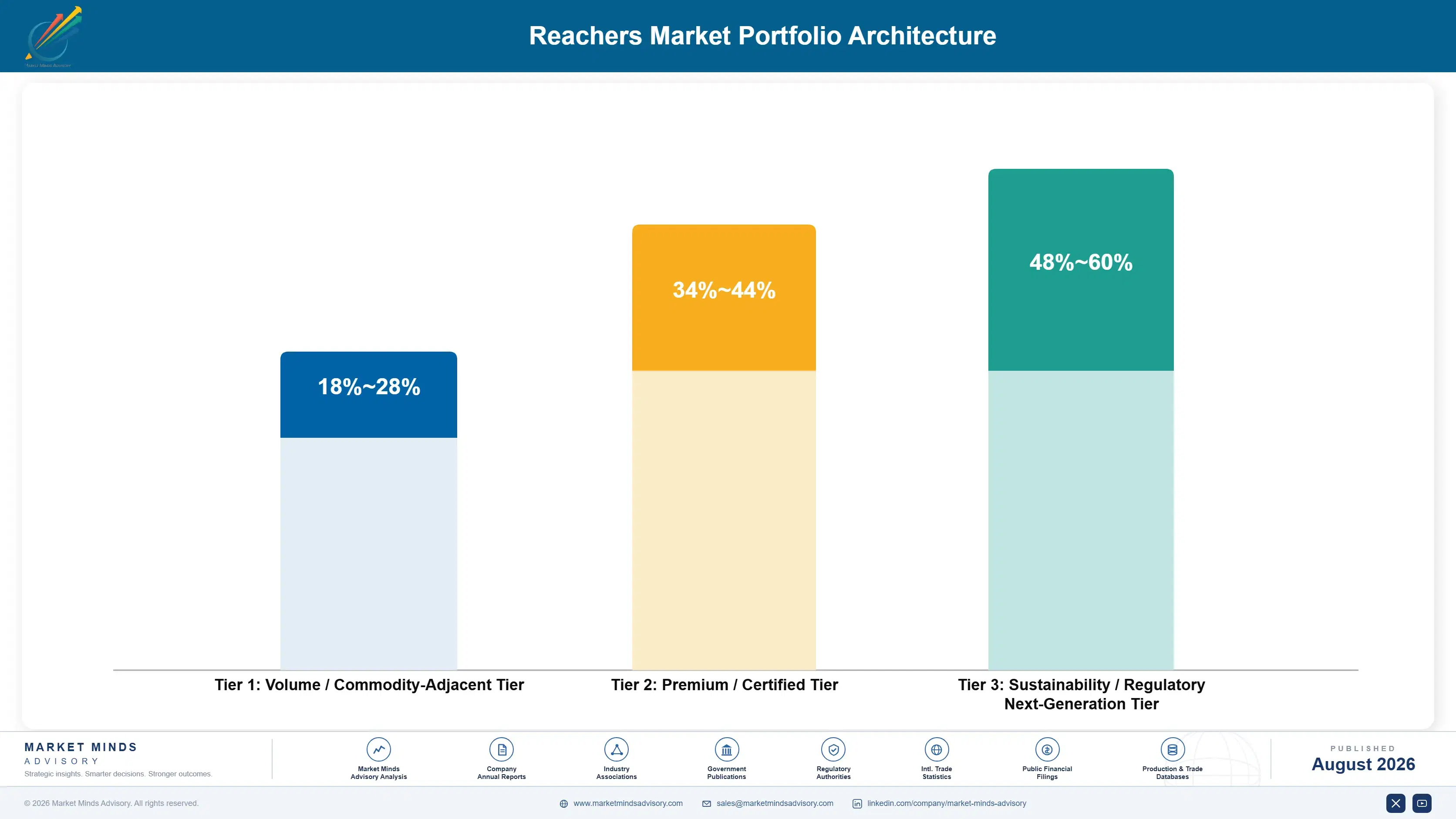
Volume / Commodity-Adjacent Tier

Standard rigid trigger reachers and institutional multi-pack volume sold through online marketplaces and tender. Chinese manufacturers set the price, private labels enter freely, and nothing about build quality is visible to the buyer.
Gross Margin: 18-28%

Premium / Certified Tier

Folding travel, suction-cup precision and extended-length configurations sold through pharmacy, clinical and funded channels. Assessment and durability requirements defend pricing. The ten-point range reflects the gap between funded and retail channel economics.
Gross Margin: 34-44%

Sustainability / Regulatory / Next-Generation Tier

Powered actuation and magnetic-assist reachers supplied through funded clinical and discharge pathways. Functional difference and therapist selection defend pricing entirely. The twelve-point range reflects funded provision against private premium purchase.
Gross Margin: 48-60%
reachers-market-portfolio-architecture-1787309810231

High-value Sub-segments and Strategic Watch-out

Powered and magnetic grip configurations

Where the impairment is grip rather than reach and the functional difference is describable to a professional, which is the only place pricing genuinely holds. Clinical channels sell these properly. Online listings cannot explain them at all. Funded provision is where these products actually reach users.
Gross Margin: 50-60%

Funded clinical and municipal channels

Where occupational therapy assessment still precedes supply, which is why abandonment there runs well below the category figure. Nordic, Dutch and Japanese systems fund this way. Public provision is narrowing in several other markets. Assessment attached to funding is what makes this tier work at all.
Gross Margin: 38-46%

Online standard reacher volume

Sixty-two percent of units at prices funding almost nothing, with Chinese manufacturers selling direct under their own labels and private brands entering freely. Nothing about quality is visible here. Abandonment is created at this point of sale. Nobody in the channel has any incentive to change that.
Gross Margin: 18-28%

Hospital discharge pathway positions

The one institutional channel where a therapist still selects and fits the product, supplied through surgical episode funding rather than device budgets. Clinical relationships defend it. Tendered pricing keeps volumes reliable but modest. Surgical episode funding keeps it kept separate from ordinary device budgets entirely.
Gross Margin: 32-42%

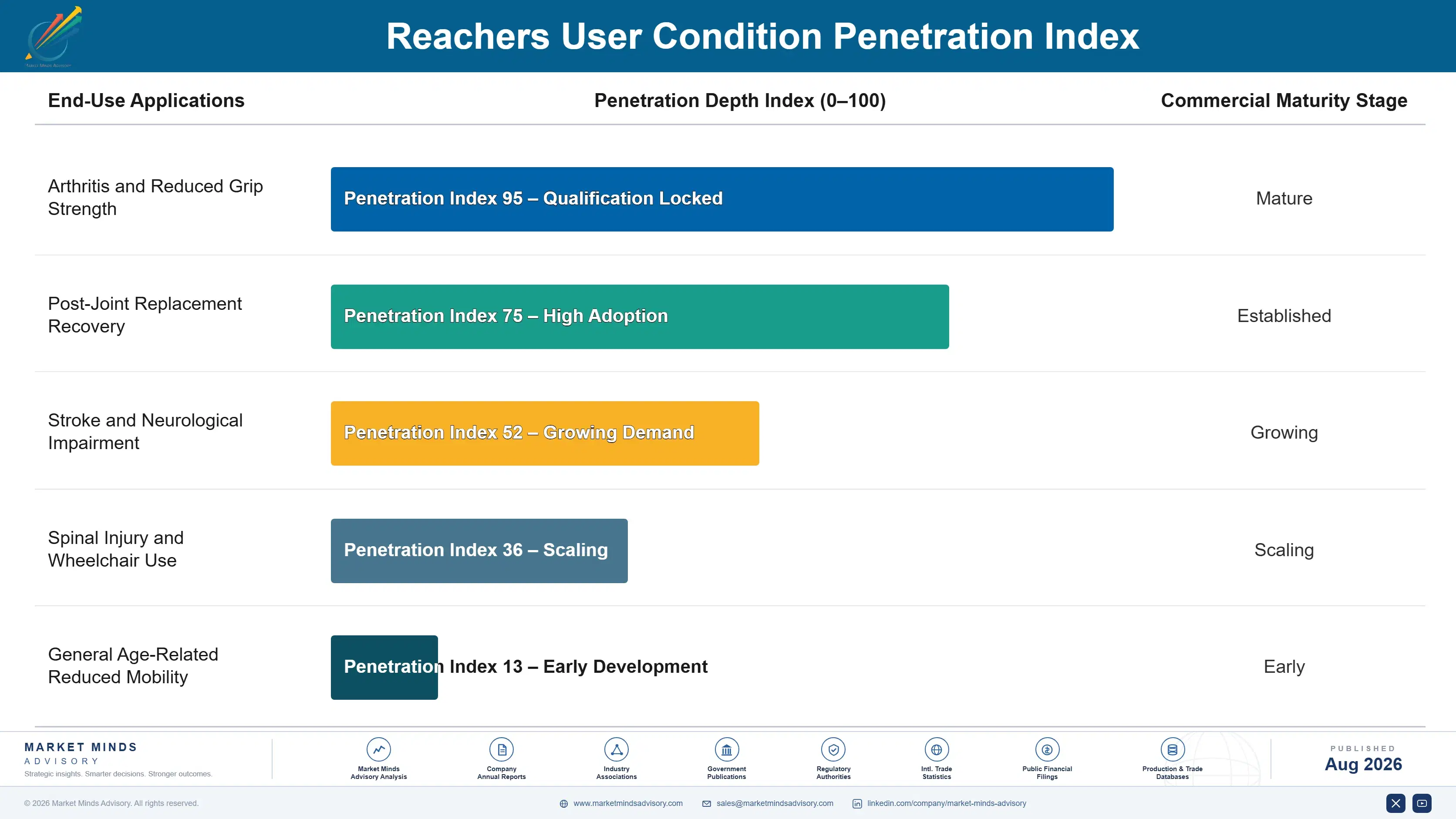
How Reaching Aid Demand Repeats

Demand here is episodic, low value and unusually leaky. A user acquires an aid at a specific moment, typically after surgery, a fall, a stroke or a gradual realisation that reaching has become difficult, and that moment is what generates the purchase. Roughly 41% then abandon the product within a year, which sometimes produces a replacement purchase and more often produces nothing at all. There is no consumable, no service relationship and no installed base, only a cheap product and whatever cha
Adoption depth varies sharply by funding structure rather than by clinical need. Nordic, Dutch and Japanese systems fund daily living aids with occupational therapy assessment attached, and users there receive fitted products with substantially better retention. North American and British users mostly buy online without assessment. Hospital discharge pathways supply fitted aids reliably, though only around the surgical episode. Users in cost-constrained markets buy the cheapest product or go without.

Buyer profiles have shifted from user and therapist to adult child and marketplace. A therapist once measured the person and selected the product. Now an adult daughter reads reviews, compares lengths in inches and orders something that arrives the next day.
reachers-market-end-use-penetration-index-1787309810718

What We Would Do Here

These are among the four positions where our research anticipates prominent divergence between winners and laggards over the coming forecast period. Each is grounded in the demand model, the regulatory perimeter, and the announced capacity pipeline.
01 / ONLINE FITTING INTERVENTION

Put the assessment inside the listing, not the clinic

Online shoppers compare length in inches and price because nothing else is visible to them anywhere in a marketplace listing, and 41% of the resulting purchases end up abandoned within a single year. Suppliers embedding height, use position and grip strength selection tools into their own listings report return and abandonment roughly 30% below category norms. It costs digital development this category has never funded and needs marketplace cooperation that varies, and it is the only intervention addressing abandonment where it is actually created.
02 / DISCHARGE PATHWAY FOCUS

Chase the channel where a therapist still fits it

Joint replacement, stroke and spinal surgery discharge protocols include daily living aid provision as standard practice, and occupational therapists still select and fit the products they supply through them. Suppliers holding discharge pathway positions report realised pricing roughly 45% above online equivalents on genuinely comparable products throughout. Volumes are institutional and tendered rather than retail, and winning them needs clinical evidence and therapist relationships that online-focused suppliers had no commercial reason ever to build for themselves in the first place.
03 / GRIP IMPAIRMENT FOCUS

Build for the hand, not for the arm length

Grip strength limits considerably more reacher users than arm length does, and a standard trigger requiring firm squeeze pressure is simply unusable for someone with rheumatoid arthritis or post-stroke weakness. Suppliers shifting range weight toward powered actuation and magnetic pickup report gross margin roughly 25 points above the standard trigger products they also happen to sell. Online channels cannot explain that difference to a shopper comparing lengths, so growth depends on clinical and discharge channels served deliberately rather than merely opportunistically.
04 / INPUT COST HEDGING

Hedge the aluminium and contract the freight properly

Aluminium tube and ocean freight together set a cost base no supplier in this industry can influence at all, and both moved violently across 2021 and 2022 against online prices that could not possibly follow them upward. Suppliers holding forward aluminium positions and contracted freight rates report gross margin roughly 8 points more stable through volatility than spot-exposed competitors managed. It requires treasury capability small assistive suppliers rarely hold, and the alternative is watching an already thin margin disappear completely.

Engagement Snapshot From the Field

A live engagement with an industry participant carrying material or product regulatory and market exposure ahead of a defining policy shift, showing how our research translates into a defensible multi-year portfolio strategy.
MARKET MINDS ADVISORY · CLIENT ENGAGEMENT SUMMARY
Reachers Producer Strategic Portfolio Review and Transition Roadmap 2026·Investment Scenario on Reachers Exposure Evaluation 2025-26
CLIENT PROFILE
A Western European daily living aids supplier with reacher and related aid revenue near EUR 34 million annually (client-reported, unverified by MMA), a portfolio weighted toward standard rigid trigger products, established occupational therapy relationships in three markets, minimal online marketplace presence, and no powered or magnetic-assist range at all. Roughly 71% of volume moved through pharmacy and clinical distribution channels.
STRATEGIC CHALLENGE
Volume had declined for three consecutive years while the ageing population grew, and management proposed launching aggressively onto online marketplaces to recapture it. The board doubted the client could compete against Chinese direct sellers on a product where nothing but length and price is visible, and nobody had measured what the clinical channels were actually worth in comparison.
MMA APPROACH
MMA analysed 4,200 online listings and 640 clinical supply decisions across five European markets, comparing realised prices, return rates and review content by channel and configuration. Forty-seven expert interviews with occupational therapists, municipal procurement officers, hospital discharge coordinators and pharmacy buyers established what determined selection in each channel. The client's portfolio was then scored against both.
KEY FINDINGS
  1. Clinical and funded channel realised pricing ran roughly 45% above online equivalents for comparable products, and the client's decline was concentrated in pharmacy retail rather than in funded channels at all.
  2. Return and negative review rates in online listings clustered heavily around wrong length and unusable trigger force, which no supplier addressed through listing content in the whole sample.
  3. Powered and magnetic-assist products were selected in a meaningful share of clinical decisions involving grip impairment, and the client had nothing to offer in any of those cases.
  4. Municipal and long-term care funding for daily living aids was narrowing in two of the five markets reviewed, which threatened the channel the client depended on most heavily.
CLIENT PROFILE
A Western European daily living aids supplier with reacher and related aid revenue near EUR 34 million annually (client-reported, unverified by MMA), a portfolio weighted toward standard rigid trigger products, established occupational therapy relationships in three markets, minimal online marketplace presence, and no powered or magnetic-assist range at all. Roughly 71% of volume moved through pharmacy and clinical distribution channels.
STRATEGIC CHALLENGE
Volume had declined for three consecutive years while the ageing population grew, and management proposed launching aggressively onto online marketplaces to recapture it. The board doubted the client could compete against Chinese direct sellers on a product where nothing but length and price is visible, and nobody had measured what the clinical channels were actually worth in comparison.
MMA APPROACH
MMA analysed 4,200 online listings and 640 clinical supply decisions across five European markets, comparing realised prices, return rates and review content by channel and configuration. Forty-seven expert interviews with occupational therapists, municipal procurement officers, hospital discharge coordinators and pharmacy buyers established what determined selection in each channel. The client's portfolio was then scored against both.
KEY FINDINGS
  1. Clinical and funded channel realised pricing ran roughly 45% above online equivalents for comparable products, and the client's decline was concentrated in pharmacy retail rather than in funded channels at all.
  2. Return and negative review rates in online listings clustered heavily around wrong length and unusable trigger force, which no supplier addressed through listing content in the whole sample.
  3. Powered and magnetic-assist products were selected in a meaningful share of clinical decisions involving grip impairment, and the client had nothing to offer in any of those cases.
  4. Municipal and long-term care funding for daily living aids was narrowing in two of the five markets reviewed, which threatened the channel the client depended on most heavily.
RECOMMENDED STRATEGY
Phase 1: Phase 1 (0 to 9 months): Abandon the aggressive marketplace launch, and build fitting guidance into a focused set of online listings instead. Phase 2: Phase 2 (9 to 24 months): Source or develop a powered and magnetic-assist range, and target hospital discharge pathways in the three strongest markets. Phase 3: Phase 3 (24 to 42 months): Hedge aluminium and contract freight, and diversify funded channel exposure ahead of further narrowing.
OUTCOME
The aggressive marketplace launch was cancelled before budget commitment. Fitting guidance was built into a focused listing set and return rates fell measurably in that group (client-reported, unverified by MMA). A powered range was sourced rather than developed and reached clinical channels in two markets. Aluminium hedging was implemented and freight contracted annually.

Frequently Asked Questions

Foundational context covering the market sizes, CAGR, scope, country, region and competition that inform every finding below. This section is provided to cover basics and most often pre-purchase conversations, answered from the MMA Primary Research Dataset.

What is the current size of the Reachers Market?

MMA sizes the global reachers market at USD 0.42 billion in 2025, rising to USD 0.44 billion in 2026. That covers product revenue at realised selling price across retail, clinical and institutional channels.

How large will the Reachers Market be by 2036?

MMA forecasts USD 0.77 billion by 2036, an expansion multiple of 1.75 times the 2026 base. That represents roughly USD 0.33 billion of incremental revenue across the forecast period.

What is the CAGR for the Reachers Market 2026 to 2036?

The base case compounds at 5.8% annually, with a bull case of 7.0% and a bear case of 4.6%. Whether public reimbursement extends to daily living aids decides which case materialises.

Which segment is growing fastest?

Powered and magnetic-assist reachers compound at 8.7%, exactly 1.50 times the market rate. Grip strength limits far more users than arm length does, which standard trigger designs never addressed.

Who are the major companies in the Reachers Market?

Etac, Performance Health, Drive DeVilbiss Healthcare, Medline Industries and Maddak together ship 34% of units. Fifteen further participants including NRS Healthcare and Vive Health are profiled in full.

Which country is growing fastest?

India compounds at 8.4%, ahead of every other national market MMA tracks here. Accelerating ageing and online retail reaching previously unserved households together drive that growth.

Report Segmentation Architecture

The full report scope spans multiple orthogonal segmentation dimensions, with cross-tabulated demand data provided for each dimension pair. Coverage extends further to regional breakdowns, trend trajectories, and the competitive detail needed to support segment-level decision-making.

By Product Configuration

  • Powered and Magnetic-Assist Reachers
  • Folding Travel Reachers
  • Standard Rigid Trigger Reachers
  • Suction-Cup and Precision-Grip Reachers
  • Extended-Length and Bariatric Reachers
  • Institutional Multi-Pack Reachers

By User Condition

  • Arthritis and Reduced Grip Strength
  • Post-Joint Replacement Recovery
  • Stroke and Neurological Impairment
  • Spinal Injury and Wheelchair Use
  • General Age-Related Reduced Mobility

By Distribution Channel

  • Online Marketplace and Direct Retail
  • Pharmacy and Community Retail
  • Funded Clinical and Municipal Provision
  • Hospital Discharge and Institutional Supply

By Region

  • North America
  • Western Europe
  • East Asia
  • South Asia and Pacific
  • Latin America
  • Middle East and Africa
  • Eastern Europe

Scope, Methodology, and Coverage

Every figure in this report is reproducible from documented input assumptions. The scope below maps the historical period, the forecast horizon, the segmentation dimensions, and the countries covered, alongside the underlying primary and qualitative methodology.
Historical Period
2020 to 2025
Forecast Period
2026 to 2036
Base Year
2025 (USD billions; MMA Primary Research Dataset, August 2026)
Market Definition
The market comprises hand-operated reaching and grasping aids for people with limited reach, mobility or grip, spanning powered and magnetic-assist reachers, folding travel reachers, standard rigid trigger reachers, suction-cup and precision-grip reachers, extended-length and bariatric reachers, and institutional multi-pack reachers. Sizing captures product revenue at realised selling price across retail, clinical and institutional channels. Dressing aids, sock aids and long-handled shoehorns, mobility walking aids, wheelchairs and transfer equipment, robotic feeding and manipulation devices, industrial litter-picking tools, and prosthetic or orthotic upper limb devices are outside scope.
Quantitative Units
USD billions (current prices); million units shipped annually; USD per unit at realised selling price
Segmentation Dimensions
By Product Configuration; By User Condition; By Distribution Channel; By Region
Regions Covered
North America, Western Europe, East Asia, South Asia and Pacific, Latin America, Middle East and Africa, Eastern Europe
Countries Covered
China, Japan, USA, Germany, UK, France, Italy, Spain, Netherlands, Sweden, Denmark, Norway, Switzerland, South Korea, Taiwan, India, Australia, Canada, Brazil, Mexico, Argentina, Colombia, Indonesia, Thailand, Vietnam, UAE, Saudi Arabia, Turkey, South Africa, Poland, Czech Republic, and additional markets relevant to this sector
Key Companies Profiled
Etac, Performance Health, Drive DeVilbiss Healthcare, Medline Industries, Maddak, NRS Healthcare, Aidapt Bathrooms, Days Healthcare, Homecraft Rolyan, Vive Health, Mabis Healthcare, Sunrise Medical, Invacare, GF Health Products, Able2 UK, Herdegen, Dietz Reha-Produkte, Foshan Dongfang Medical, Jiangsu Yuyue Medical Equipment, Nova Medical Products.
Quantitative Methodology
Primary survey, n=3,800 respondents, Q4 2025, six countries; demand-side model with trade association cross-validation
Qualitative Methodology
47 expert interviews, Q4 2025; applied to validate demand model assumptions, identify emerging dynamics, and assess competitive positioning
Report Format
PDF and XLSX data workbook (Word format preview document)
Publisher
Market Minds Advisory
Report Code
MMA-2026-MED-298
Published
August 2026
Contact
sales@marketmindsadvisory.com | www.marketmindsadvisory.com

Purchase the full Reachers Market Report (2026 to 2036).

The full report sizes the reachers market across six product configurations, five user conditions, four distribution channels and seven regions, with annual forecasts to 2036 in revenue and units shipped. It compares realised pricing, return rates and review content by channel across a large listing and clinical decision sample, which is the analysis that quantifies what abandonment actually costs and where it originates. Twenty participants are assessed on a consistent units shipped basis, with funded clinical channel positions and powered range availability mapped separately. Aluminium and freight exposure is quantified, and occupational therapy assessment coverage is tracked market by market.
Six product configurations sized and forecast annually
Realised pricing and return rates compared by channel
Twenty participants on consistent units shipped basis
Funded clinical channel positions mapped supplier by supplier
Powered and magnetic range availability compared across participants
Occupational therapy assessment coverage tracked market by market

Built For The People Who Decide

From boardroom strategy to bench-side execution, this report is read cover-to-cover by leaders shaping the next decade of their industry, turning demand scenarios, market dynamics and valuation benchmarks into decisions.
CXOs/ Presidents/ VPs/ Managers
M&A and Corporate Development
Strategy Teams and R&D Heads
Procurement and Product Directors
Regulatory and Compliance Leaders
Investor Relations and Equity Analysts