Market Minds Advisory
Rapid Antigen Testing Market

Rapid Antigen Testing Market: A Category Built for One Pandemic Learning to Live Without It

Manufacturing capacity built for billions of pandemic tests now sits mostly idle, and the survivors are the ones who found something else to test for that people still actually care about.

Lead Analyst

Alice Ballenger

Published

September 2026

Make Smarter Decisions with Customized Research Insights

Request a free sample report and evaluate market opportunities, growth trends, and competitive dynamics relevant to your business needs.

2025 MARKET VALUE$6.8BMarket Size 2025
2036 FORECAST VALUE$11.6BBase Case , 2026 to 2036
CAGR 2026 TO 20365.0 %Bull 6.3% / Bear 3.7%
INCREMENTAL OPPORTUNITY$4.5BNet 10- year value creation
EXPANSION MULTIPLE1.63x2036 value over 2026 base
Strategic Levers
M&A Pipeline
Regional Outlook
Country Rankings
Competitive Intelligence
Segmental Deep-dive
Call-Us : 91 93563 13602

Executive Snapshot and Market Trajectory

No diagnostic category has ever expanded and contracted as violently as this one. Pandemic demand built manufacturing capacity for billions of units, and the collapse afterwards left an industry with far more production than any endemic use case could absorb.
Multiplex respiratory panels compound at 7.5%, exactly 1.50 times the market, because testing for one virus is worth far less to a clinician than distinguishing between four. North America holds 29% of spend on reimbursement and retail channel depth. Capacity utilisation across the sector sits near 34%. Marginal cost per test sits near USD 0.34 at full loading and far above it at a third, which is why single-target pricing has fallen below sustainable levels.
Five manufacturers hold 47%. Positions rest on distribution channels and regulatory clearances established during the pandemic rather than on assay chemistry, which is broadly commoditised and made in dozens of factories with too little to make. Around 41% of units now reach consumers directly through retail, a channel that barely existed before 2020. That distribution asset is the other durable legacy of the pandemic, and it requires no reimbursement negotiation.
Market Definition
The market covers lateral flow and rapid immunoassay tests detecting antigens at or near the point of care, spanning respiratory single-target tests, multiplex respiratory panels, sexually transmitted infection antigen tests, tropical and vector-borne disease tests, gastrointestinal and stool antigen tests, and veterinary and food safety antigen tests. Molecular and nucleic acid amplification tests, antibody and serology assays, laboratory-based immunoassay platforms, and clinical chemistry testing are excluded.
Base Year Value
$6.8B in 2025 (MMA Primary Research Dataset, August 2026)
Forecast Period
2026 to 2036, eleven discrete annual values
CAGR
5.0% base case. Bull 6.3%. Bear 3.7%.
Fastest Growth Segment
Multiplex Respiratory Panels: 7.5% CAGR
Fastest Growth Country
India: 8.0% CAGR
Fastest Growth Region
South Asia and Pacific: 7.1% CAGR
Largest Region
North America: 29% of 2025 global value
Market Leaders
Abbott, Roche Diagnostics, Quidel Ortho, Becton Dickinson, SD Biosensor. Source: MMA Analysis based on company annual reports.
Primary Survey
n=3,800 procurement and R&D decision-makers, Q4 2025, six countries
Methodology
Demand-side build-up, cross-validated against public data, 47 expert interviews

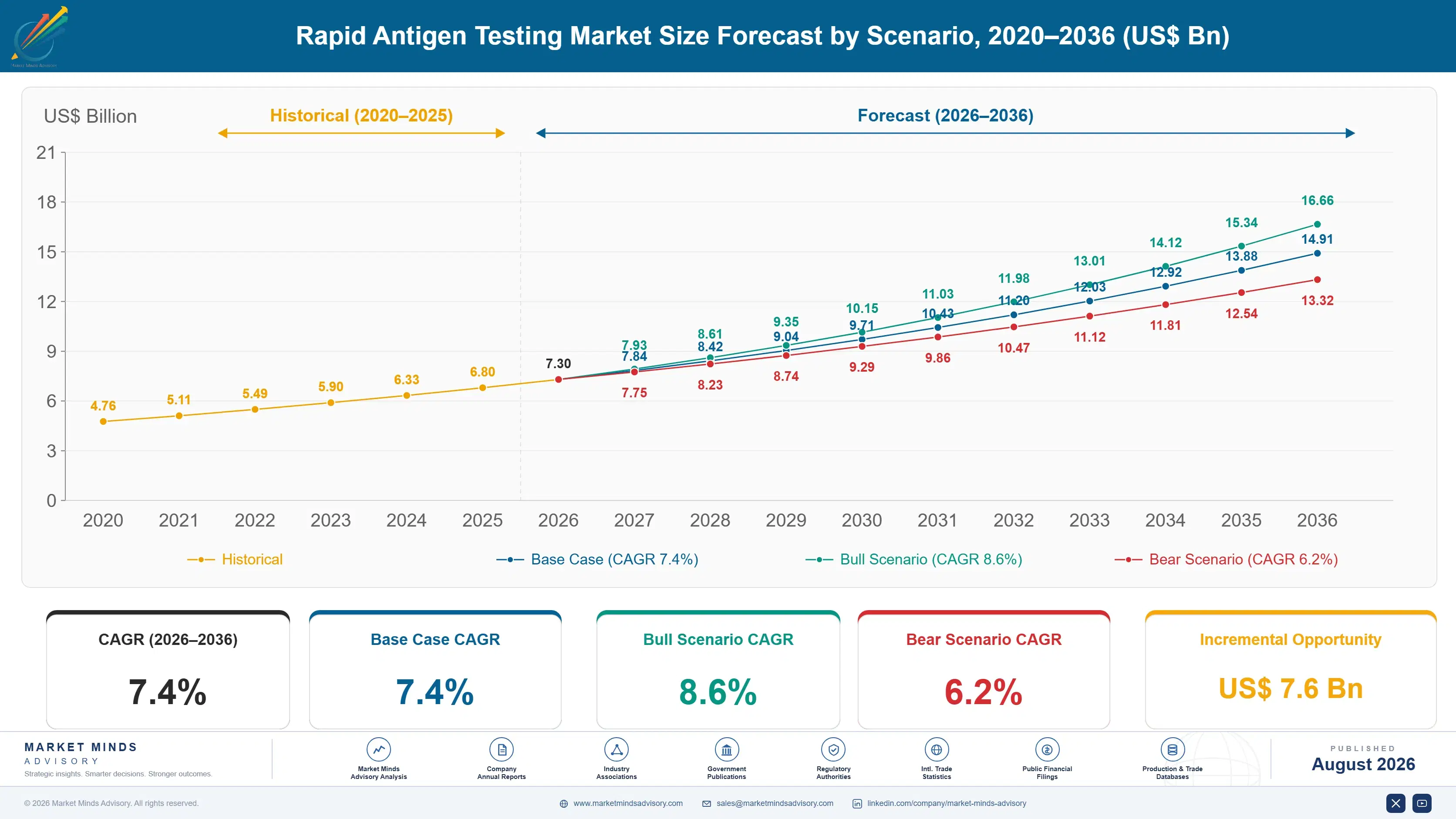
Rapid Antigen Testing Market Forecast Scenarios

rapid-antigen-testing-market-size-forecast-scenario-1787309261382
The recorded 2020 to 2025 movement in this category is meaningless as a trend, because pandemic SARS-CoV-2 volumes rose and collapsed inside the window. Excluding pandemic-specific COVID-19 testing, the underlying category compounded at 6.3%, driven by influenza and streptococcus volume plus malaria antigen programmes. The pandemic contribution that persisted was distribution rather than demand: retail pharmacy and online channels learned to sell tests, and consumers learned to buy them.
The base case of 7.4% rests on three mechanisms. Multiplex respiratory panels are replacing single-target testing in primary care and emergency settings, raising revenue per swab where reimbursement follows. The retail channel that pandemic testing created now carries 34% of volume and keeps expanding into influenza and streptococcus self-testing. And Asian and Indian clinical volumes are growing quickly as point-of-care testing moves into primary care networks that previously referred everything out.
The bull case of 8.6% assumes retail self-testing extends convincingly beyond respiratory infection into gastrointestinal and bacterial indications, which would grow a channel with no reimbursement dependency. The bear case of 6.2% reflects two pressures: molecular point-of-care platforms reaching price points that make the 78% antigen sensitivity gap commercially decisive, and capacity overhang driving pricing down faster than volume grows.

Too Many Factories, Not Enough Reasons

This category was rebuilt in eighteen months and then abandoned by its own demand. Capacity installed for pandemic volumes now runs at around 34% utilisation, which means most manufacturers carry fixed cost against production lines with nothing to make. Marginal cost per test sits near USD 0.34 at full loading and considerably higher at a third of it, which is why pricing has fallen below sustainable levels for most participants.
TOP FIVE CONCENTRATION47%Combined share held by the five largest manufacturers globally
CAPACITY UTILISATION34%Sector loading across installed lateral flow production lines
MULTIPLEX PRICE PREMIUM3.1 timesRealised price against an equivalent single-target antigen test
RETAIL CHANNEL SHARE41% of unitsProportion sold directly to consumers rather than through providers
ANTIGEN SENSITIVITY GAP23 percentage pointsDetection shortfall against molecular methods in low viral load
MANUFACTURING COST FLOORUSD 0.34Marginal production cost per test at full line utilisation
What survives is not the pandemic product. Single-target respiratory tests are commoditised and priced accordingly, while multiplex panels distinguishing influenza from covid from respiratory syncytial virus command around 3.1 times the price because they answer a question a clinician actually has. That distinction is the whole commercial story of the post-pandemic category, and it compounds at 7.5%.
The retail channel is the other durable legacy. Around 41% of units now go directly to consumers who learned the format during the pandemic and retained the habit, which is a distribution asset nobody had before 2020. Antigen tests remain roughly 23 percentage points less sensitive than molecular methods at low viral load, and consumers testing themselves at home are rarely told so.
"Everyone in this industry built for a demand curve that will not return. The ones still making money stopped selling a covid test and started selling an answer to a question a clinician was already asking."
Principal, Point-of-Care Diagnostics Practice · MMA In Vitro Diagnostics and Poi

Market Trends

Multiplex Panels Answer the Question Clinicians Actually Have

A clinician facing a febrile patient with respiratory symptoms needs to know which virus rather than whether one specific virus is present, and a panel distinguishing influenza A and B, covid and respiratory syncytial virus changes management where a single-target test does not. That clinical utility supports around 3.1 times the price of a single-target test, and the segment compounds at 7.5% against a market at 5.0%. Manufacturing complexity is genuinely higher, which also limits how many competitors can supply it. Most of the world's surplus lateral flow capacity cannot cross that barrier at all.
Market Impact: India compounding at 8.0% annually

Retail Self-Testing Habit Persists Beyond the Pandemic

Around 41% of units now reach consumers directly through pharmacy and online retail, a channel that barely existed for antigen tests before 2020 and now represents a permanent feature of the category. Consumers who learned to self-test retained the behaviour for respiratory illness and are increasingly willing to apply it elsewhere. The channel carries consumer margins, requires no reimbursement negotiation, and exposes the sensitivity limitation to users who mostly do not understand it. The channel carries consumer margins, requires no reimbursement negotiation, and exposes the sensitivity limitation to users who mostly do not understand it.
Market Impact: Utilisation running near 34% loadin

Market Opportunities and Growth Drivers

Tropical Disease Testing Grows on Genuine Unmet Need

Malaria, dengue, chikungunya and leishmaniasis rapid tests serve populations where laboratory access is limited and where a result within twenty minutes changes treatment immediately. That demand existed long before the pandemic and grew steadily throughout it, funded by national programmes, donor organisations and out-of-pocket purchase. India compounds at 8.0%, the fastest national market. This is the part of the category with the clearest clinical justification and the lowest realised price per test anywhere. Indian manufacturers also supply substantial volume into African and Southeast Asian programmes at prices no Western producer approaches.
Market Impact: Marginal cost near USD 0.34 each

Idle Capacity Forces Manufacturers Toward New Targets

Sector utilisation near 34% means most manufacturers hold production lines earning nothing, and marginal cost near USD 0.34 per test only applies at loadings almost nobody achieves. That pressure pushes companies to find any target worth testing for, which has accelerated development in sexually transmitted infection, gastrointestinal and veterinary antigen tests considerably faster than clinical demand alone would have. Oversupply is driving product innovation, which is an unusual and largely unacknowledged dynamic. Oversupply is driving product innovation, which is an unusual and largely unacknowledged dynamic in diagnostics. Volume follows the funding, not the disease burden.
Market Impact: Sensitivity trailing by 23 points

Market Restraints and Challenges

Capacity Oversupply Holds Prices Below Sustainable Levels

Installed lateral flow capacity vastly exceeds endemic demand, utilisation sits near 34%, and manufacturers with idle lines price at marginal cost to recover anything at all. The root cause is that capacity was built for a demand curve that will not return and cannot be repurposed to anything else. Participants mitigate by exiting single-target commodity tests, by consolidating manufacturing footprints, and by moving toward multiplex and specialty targets where fewer competitors can follow. Line closures are the only mechanism that will eventually restore pricing. No formulation change closes a gap that sits in the detection chemistry itself.
Market Impact: Multiplex commanding 3.1 times pric

Sensitivity Limitation Undermines Consumer Confidence Eventually

Antigen detection is roughly 23 percentage points less sensitive than molecular methods at low viral load, which means a negative result early in infection is unreliable. The root cause is fundamental to the method rather than fixable by engineering. Manufacturers mitigate with clearer instructions on repeat testing, with sequential testing protocols, and by positioning antigen tests for ruling in rather than ruling out, which is honest and commercially uncomfortable to communicate at retail. Building sequential testing guidance into packaging is honest and better than being explained by a journalist later.
Market Impact: Retail carrying 41% of unit volume
3 additional market trends, 4 additional growth drivers, and 2 additional restraints and challenges are covered in the full report. Contact sales@marketmindsadvisory.com to access the complete intelligence.

Segment CAGR and Growth Architecture

Segmentation follows target and clinical question, because what a test detects determines both its clinical value and how many competitors can supply it. A single-target respiratory test and a multiplex panel share a manufacturing process and almost nothing commercially. Six target categories sit in the hierarchy, separated by clinical question rather than by manufacturing method.
rapid-antigen-testing-market-market-share-analysis-1787309261913

Multiplex Respiratory Panels

Multiplex panels compound at 7.5%, exactly 1.50 times the market, because they answer the question a clinician actually faces rather than the one a single-target test answers. Distinguishing influenza A and B, covid and respiratory syncytial virus in one twenty minute test changes antiviral prescribing, isolation and admission decisions immediately, which supports around 3.1 times single-target pricing. Manufacturing is genuinely harder, requiring multiple antibody pairs on one strip without cross-interference, and that complexity limits how many of the dozens of idle lateral flow factories can actually supply it. The segment is where post-pandemic value has concentrated, and the sensitivity limitation applies to every target on the strip equally. Value has concentrated here since the pandemic ended.
CAGR 7.5%

Sexually Transmitted Infection Antigen Tests

Sexually transmitted infection tests grow at 6.6% on a combination of rising infection rates and a format that suits a population reluctant to attend clinics. Stigma is a genuine clinical barrier and a home test removes it, which is why the retail channel matters more here than clinical utility alone would suggest. Syphilis, trichomonas and adjacent targets are where antigen detection works acceptably, while chlamydia and gonorrhoea remain better served by molecular methods on sensitivity grounds. That split limits the addressable range honestly. Public health programmes fund screening in several markets, which provides volume the retail channel could not generate alone. Public health programmes fund screening in several markets, which provides volume the retail channel alone could not generate.
CAGR 6.6%
Full segment breakdown across 6 segments available in the complete report.

Regional Architecture and Country Demand Map

Demand splits between reimbursed clinical testing, retail self-testing and programme-funded tropical disease work, and the mix differs so sharply by region that a single global strategy fails everywhere. A single global strategy fails everywhere, because the three channels answer to entirely different buyers. Programme funding sets the pattern almost everywhere.

North America

North America holds 29% of spend, the largest regional share, growing at 4.7%. Reimbursement for clinical multiplex respiratory testing is more generous here than anywhere, which concentrates the highest-value part of the category in the region. Retail self-testing habit is also deepest, with pharmacy and online channels that absorbed enormous pandemic volume and retained a meaningful fraction of it. The reimbursement position is nonetheless under review, and coverage for single-target respiratory antigen testing has already narrowed considerably since the emergency period ended. Retail pharmacy shelf space secured during the pandemic has largely been retained, and it now carries influenza and strep A products rather than the respiratory target it was won for.
Share: 29% | CAGR: 4.7% (2026 to 2036)

East Asia

East Asia accounts for 25% of spend and grows at 6.0%. Chinese and Korean manufacturers built the majority of the world's lateral flow capacity during the pandemic and now carry most of the idle lines, which makes the region both the largest supply base and the most exposed to oversupply pricing. Japanese clinical testing is well reimbursed and conservative on format. Korean manufacturers have moved fastest into multiplex and specialty targets, using pandemic-era regulatory clearances as a platform for entirely different products. Korean manufacturers have moved fastest into multiplex and specialty targets, using pandemic-era clearances as a platform for entirely different products. Japanese clinic reimbursement for influenza antigen testing remains the most generous anywhere, and predates the pandemic entirely.
Share: 25% | CAGR: 6.0% (2026 to 2036)
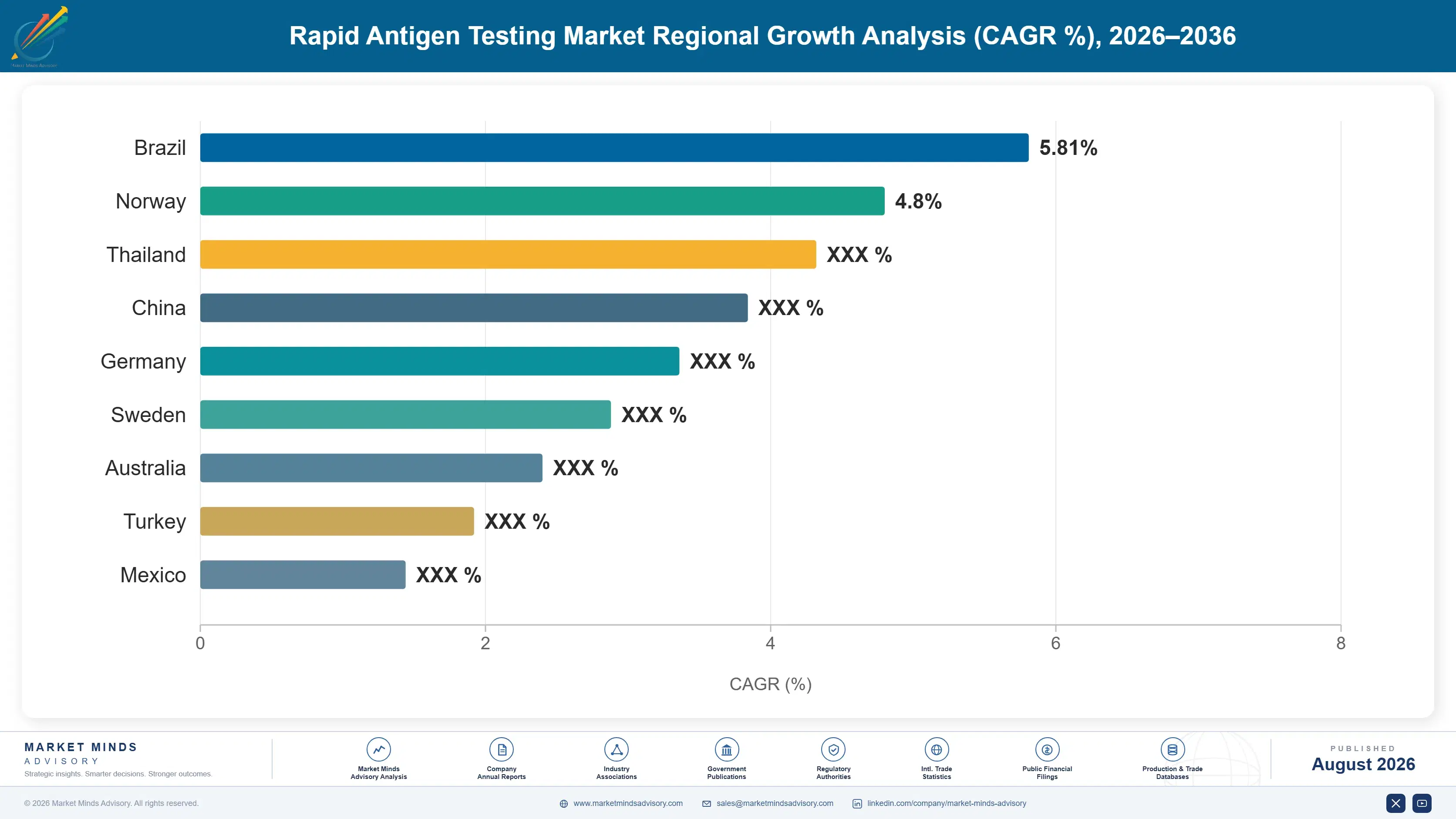
Regional intelligence for 5 additional markets available in the complete report: Western Europe, South Asia and Pacific, Latin America, Middle East and Africa, Eastern Europe. Contact sales@marketmindsadvisory.com.
rapid-antigen-testing-market-country-cagr-analysis-1787309262416

Escaping the Commodity Antigen Test

Capacity built for a pandemic sits idle and single-target tests price at marginal cost. Four positions matter, and all of them involve making something that fewer of the world's idle lateral flow lines can actually produce. Two of them concern product and two concern channel, and none is available to a manufacturer still defending single-target volume on price.

Move Decisively to Multiplex Rather Than Defend Single Target

Single-target respiratory tests are commoditised and priced at marginal cost near USD 0.34 by manufacturers with idle lines, while multiplex panels command around 3.1 times that on genuine clinical utility. Multiple antibody pairs on one strip without cross-interference is a real manufacturing barrier that most of the world's surplus lateral flow capacity cannot cross. Moving decisively rather than hedging across both is what separates the manufacturers still earning a margin from those merely still operating. Hedging across both earns the worse margin twice over. The barrier is manufacturing capability rather than commercial position.
Market Impact: Multiplex commanding a full 3.1 tim

Build the Retail Channel as a Permanent Asset

Around 41% of units now reach consumers directly, a channel that did not exist for antigen tests before 2020 and that requires no reimbursement negotiation and carries consumer margins. Manufacturers who invested in pharmacy relationships, packaging and consumer brand during the pandemic hold something competitors cannot assemble quickly. Extending that channel into sexually transmitted infection and gastrointestinal targets, where stigma discourages clinic attendance, is the clearest available growth path. Stigma is a clinical barrier that a home test removes outright, which is a real and substantially underused advantage. Competitors cannot assemble it quickly.
Market Impact: Retail channel now holding 41% of a

Reuse Pandemic Clearances for Entirely Different Targets

Regulatory clearances, quality systems and manufacturing validations established for pandemic testing transfer substantially to other antigen targets, which is a genuine asset in a category where utilisation sits near 34% and new entrants face the full regulatory burden. Korean manufacturers have moved fastest on exactly this, using pandemic-era approvals as a platform for specialty and veterinary targets. The clearance is worth more than the production line it was obtained for. A new entrant faces the whole regulatory burden from nothing. Korean manufacturers have moved fastest on exactly this, treating pandemic approvals as a platform rather than a legacy.
Market Impact: Utilisation stuck near 34% of the i

Communicate the Sensitivity Limitation Before Somebody Else Does

Antigen tests are roughly 23 percentage points less sensitive than molecular methods at low viral load, and consumers self-testing at home are rarely told so clearly. Manufacturers who build sequential testing guidance into packaging and position the test for ruling in rather than ruling out establish credibility that survives the reporting cycle when somebody publishes the false negative rate. It is commercially uncomfortable and considerably better than being explained by a journalist. Somebody will publish the false negative rate eventually. Credibility established beforehand survives the reporting cycle that follows, and credibility claimed afterwards does not.
Market Impact: Sensitivity trailing molecular comp

Who Controls the Margin Pool

Five manufacturers hold 47% measured on rapid antigen test revenue, the basis applied throughout this section. Concentration is moderate and falling, because pandemic-era entrants built capacity and obtained clearances that persist even where their volumes have collapsed. Abbott and Roche Diagnostics lead on clinical channel and multiplex position rather than on manufacturing scale.
Competition operates on three dimensions. Multiplex manufacturing capability decides who can supply the only segment earning a proper margin. Retail channel depth decides access to 41% of units that requires no reimbursement at all. And clearance portfolio breadth decides how quickly a manufacturer can redirect idle capacity toward targets that still have demand. Assay chemistry decides almost none of it.

Two pressures are reshaping the field. Oversupply keeps single-target pricing at marginal cost, which will eventually force consolidation and line closures the sector has so far deferred. Meanwhile multiplex and specialty targets reward manufacturing capability over scale. Rankings will shift toward manufacturers who exited commodity testing early rather than waiting. The sector has deferred the closures that would restore pricing, and every month of deferral costs the participants who moved early as much as those who did not.
rapid-antigen-testing-market-company-positioning-matrix-1787309262933

Competitive Moat and Risk Dimensions

ABBOTT

Moat: Clinical channel and multiplex breadth

Abbott combines multiplex respiratory panel capability with clinical channel access built across decades of point-of-care testing, which places it in the only part of the category earning a proper margin at around 3.1 times single-target pricing. That clinical relationship predates the pandemic and survived its collapse, unlike the channels many pandemic-era entrants assembled.
ABBOTT

Risk: Retail brand position depth

Around 41% of units now reach consumers directly, and the retail channel rewards consumer brand recognition and pharmacy shelf presence rather than clinical relationships. A manufacturer whose strength is professional channel access participates less in a segment that requires no reimbursement negotiation and carries consumer margins instead.
SD BIOSENSOR

Moat: Manufacturing scale and clearance portfolio

SD Biosensor built enormous lateral flow capacity and an unusually broad clearance portfolio during the pandemic, and has redirected both toward multiplex, tropical disease and specialty targets faster than most competitors. In a category where utilisation sits near 34%, a clearance portfolio that lets idle capacity make something else is the operative asset.
SD BIOSENSOR

Risk: Commodity pricing exposure

Large installed capacity is also large fixed cost, and single-target tests price at marginal cost near USD 0.34 because manufacturers in exactly this position have idle lines to fill. Scale that was an advantage at pandemic volumes becomes a burden at a third of utilisation, and closing lines is slower than losing pricing.

Players Tracked

Prominent Players

Abbott
Roche Diagnostics
Quidel Ortho
Becton Dickinson
SD Biosensor

Other Key Players

Siemens Healthineers
bioMerieux
Thermo Fisher Scientific
OraSure Technologies
Premier Medical Corporation
Access Bio
Wondfo Biotech
Innova Medical Group
Boditech Med
Humasis
Bionote
J Mitra and Company
Meril Diagnostics
CTK Biotech
Beckman Coulter

Recent Developments

FEBRUARY 2025

Reimbursement narrows for single-target respiratory antigen testing

Payers across several health systems restricted coverage for single-target respiratory antigen tests while retaining it for multiplex panels that change management decisions. These were reimbursement policy decisions rather than regulatory actions or commercial developments among manufacturers themselves. Single-target clinical demand fell sharply once coverage narrowed.
Signal: Paying only for those tests that genuinely
JUNE 2025

Lateral flow capacity closures begin across pandemic-era entrants

Manufacturers who built capacity during the pandemic began closing production lines as utilisation near a third made fixed cost recovery impossible at prevailing prices. This reflects sector overcapacity rather than any transaction among the companies affected. Closures had been deferred for two years before the first announcements arrived.
Signal: Line closures are now the only mechanism t
OCTOBER 2025

Retail self-testing extends into sexually transmitted infection categories

Pharmacy and online retailers expanded rapid antigen self-test ranges into sexually transmitted infection targets, where stigma discourages clinic attendance and the format suits home use. This reflects retail range decisions rather than developments among the diagnostic manufacturers supplying them. Manufacturers redirected pandemic-era clearances to supply the new ranges.
Signal: Stigma is a clinical barrier that a home t

Antibodies, Nitrocellulose and Idle Lines

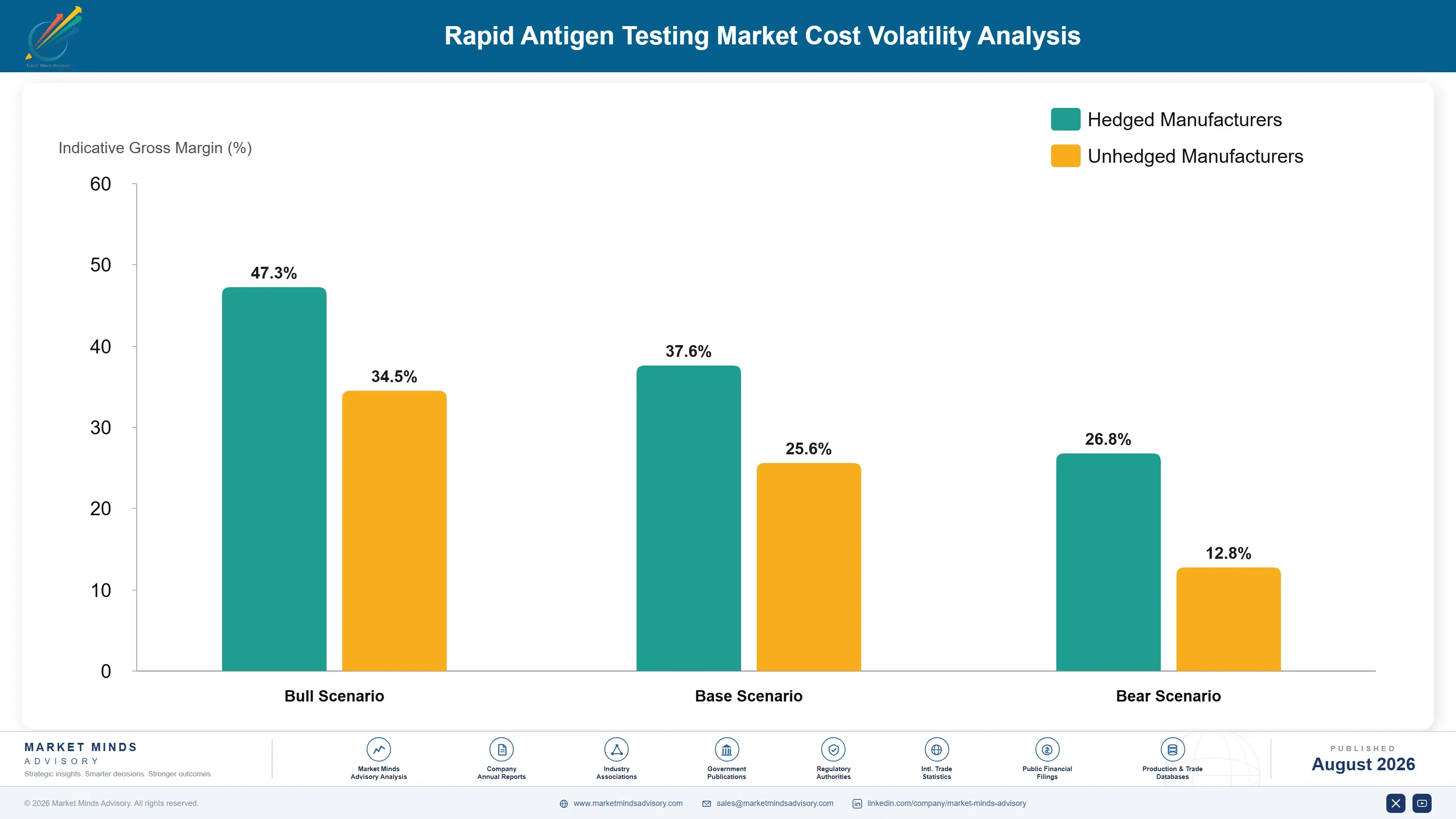
Antibody pairs and nitrocellulose membrane account for roughly 38% of marginal cost of goods, with antibody supply the more specialised input and the harder one to second-source. Cassettes, buffers, packaging and swabs add about 22%. Fixed manufacturing overhead is the dominant economic reality rather than any input line, since utilisation near 34% spreads plant cost across a third of the intended volume.
Antibody and nitrocellulose supply tightened severely during the pandemic and has since loosened as demand collapsed, which reduced input cost while simultaneously destroying the pricing that made it recoverable. Company annual reports across the diagnostics manufacturers disclose the resulting impairments and capacity rationalisation. World Health Organization reporting on diagnostic supply chains documents the concentration of critical antibody and membrane production. Impairments followed across the sector.

Exposure divides by capacity position rather than by input cost. Manufacturers with large pandemic-era plant carry fixed overhead against a third of intended volume and price at marginal cost to recover anything. Those who leased or contracted capacity exited more cheaply and hold less scale advantage now. Multiplex producers recover cost across higher pricing, which is the only position where the arithmetic actually works.
rapid-antigen-testing-market-cost-volatility-analysis-1787309263128

Close lines rather than defend volume at marginal price

Utilisation near 34% means fixed cost is spread across a third of intended output, and pricing at marginal cost to fill lines recovers nothing while suppressing the whole market. Closing capacity is politically painful and arithmetically correct, and the manufacturers who move first restore both their own margin and eventually the sector's pricing. Moving first restores sector pricing too.

Qualify secondary antibody sources for multiplex targets

Multiplex panels require multiple antibody pairs functioning together without cross-interference, which makes each pair a single point of failure for the whole product. Qualifying second sources during development, while validation is already running, avoids a supply interruption that would take the entire panel off the market rather than one target. One failed pair removes the entire panel.

Redirect clearances rather than build new product lines

Regulatory clearances, quality systems and manufacturing validations from pandemic testing transfer substantially to other antigen targets, and the clearance is frequently worth more than the line it was obtained for. Redirecting existing approvals toward specialty and veterinary targets reaches revenue faster than any new development programme can. Development from nothing takes years longer. Speed to revenue is the whole point.

Portfolio Architecture for Margin Defence

The portfolio separates on how many competitors can supply each target. Single-target respiratory tests can be made by any of dozens of idle lateral flow lines and price accordingly. Multiplex panels require antibody pairs working together without interference. Tropical disease tests serve genuine need at the lowest prices anywhere. Sexually transmitted infection, gastrointestinal and veterinary targets are where surplus capacity is being redirected. Competitor count rather than clinical need se
The tension is between volume and viability. Single-target testing still carries the largest unit numbers and earns nothing above marginal cost, while multiplex earns around three times as much on a fraction of the volume. A manufacturer defending unit share is defending revenue that does not cover fixed cost, and one that has exited commodity testing has smaller volumes and an actual margin.

High-value pools concentrate where manufacturing or channel is genuinely hard. Multiplex panels, retail-channel specialty targets and any position built on a transferable clearance portfolio all qualify, and none of them competes on price per test. What they share is a barrier that surplus capacity cannot cross, which is the only defence left in a category with three times more production than demand.

Volume / Commodity-Adjacent Tier

Single-target respiratory antigen tests and basic tropical disease tests priced at or near marginal cost. Any of dozens of idle lateral flow lines can supply them, and reimbursement for the respiratory category has already narrowed sharply.
Gross Margin: 8-20%

Premium / Certified Tier

Multiplex respiratory panels and clinically reimbursed specialty antigen tests requiring multiple antibody pairs without cross-interference. Manufacturing capability rather than scale qualifies the supplier, and clinical utility supports the pricing. Reimbursement has narrowed around them rather than beneath them.
Gross Margin: 34-50%

Sustainability / Regulatory / Next-Generation Tier

Retail self-test formats across sexually transmitted infection, gastrointestinal and veterinary targets built on transferable pandemic clearances. The wide margin range separates established consumer brand positions from targets still finding a channel.
Gross Margin: 26-56%
rapid-antigen-testing-market-portfolio-architecture-1787309263628

High-value Sub-segments and Strategic Watch-out

Multiplex Respiratory Panels

Compounding at 7.5% and commanding around 3.1 times single-target pricing because they change management decisions rather than confirming one suspicion. Multiple antibody pairs without cross-interference is a real barrier most surplus capacity cannot cross. Post-pandemic category value has concentrated in this one segment almost entirely.
Gross Margin: 36-50%

Sexually Transmitted Infection Tests

Growing at 6.6% where stigma discourages clinic attendance and a home test removes the barrier entirely. Antigen detection works acceptably for syphilis and trichomonas while molecular methods remain better for chlamydia and gonorrhoea. That split honestly limits how wide the addressable range can actually be.
Gross Margin: 32-52%

Single-Target Respiratory Tests

The volume core at 1.9%, priced at marginal cost near USD 0.34 by manufacturers with idle lines to fill and reimbursement narrowing beneath them. Defending unit share here defends revenue that does not cover fixed cost. Reimbursement coverage is narrowing beneath the segment as well.
Gross Margin: 8-20%

Veterinary and Food Safety Targets

The strategic watch-out and the pragmatic redirection. Surplus capacity and transferable clearances make these targets accessible, and demand is genuine if considerably smaller than the capacity being pointed at it. Demand here is genuine and much smaller than the surplus capacity being pointed at it.
Gross Margin: 24-46%

Seasonal Peaks and a Retail Habit

Demand is seasonal rather than continuous, which sits awkwardly with fixed manufacturing capacity. Respiratory testing concentrates into a few months and then largely stops, so a line running at 34% annual utilisation may be near capacity for eight weeks and idle for thirty. Tropical disease testing follows vector seasons rather than respiratory ones, which is one reason a mixed portfolio smooths loading more than it diversifies risk. Fixed capacity and seasonal demand fit badly together.
Depth varies by channel and target. Clinical multiplex testing generates the highest value per unit and the smallest volumes, concentrated in emergency departments and urgent care. Retail self-testing generates consumer margins across 41% of units with no reimbursement involved. Programme-funded tropical disease testing generates enormous volumes at prices near manufacturing cost. Veterinary and food safety sit outside all three.

The deciding party differs completely by channel and that is the strategic difficulty. Clinical purchasing runs through hospital and health system procurement assessing reimbursement and clinical utility. Retail runs through pharmacy category buyers assessing shelf velocity and consumer brand. Programme procurement runs through donor and national tenders assessing price per test almost exclusively. Serving all three requires three organisations.
rapid-antigen-testing-market-end-use-penetration-index-1787309264116

Where Manufacturers Survive the Contraction

These are among the four positions where our research anticipates prominent divergence between winners and laggards over the coming forecast period. Each is grounded in the demand model, the regulatory perimeter, and the announced capacity pipeline.
01 / DECISIVE MULTIPLEX TRANSITION

Hedging across both segments earns the worse margin twice

Single-target respiratory tests price at marginal cost near USD 0.34 because dozens of idle lateral flow lines can make them, while multiplex panels command around 3.1 times that on genuine clinical utility. Multiple antibody pairs functioning without cross-interference is a real manufacturing barrier most surplus capacity cannot cross. Moving decisively rather than defending both segments is what separates the manufacturers still earning a margin from those merely still operating lines, and the barrier is manufacturing capability rather than any commercial advantage.
02 / RETAIL CHANNEL OWNERSHIP

Forty-one percent of units need no payer at all

Around 41% of units now reach consumers directly through pharmacy and online retail, a channel that barely existed for antigen tests before 2020 and requires no reimbursement negotiation whatsoever. Manufacturers who invested in pharmacy relationships, packaging and consumer brand during the pandemic hold an asset competitors cannot assemble quickly. Extending that channel into targets where stigma discourages clinic attendance is the clearest growth path available to anybody now, because stigma is a clinical barrier that a home test removes outright.
03 / CLEARANCE PORTFOLIO REDIRECTION

The approval is worth more than the line it was for

Regulatory clearances, quality systems and manufacturing validations from pandemic testing transfer substantially to other antigen targets, which matters enormously when sector utilisation sits near 34% and any new entrant faces the full regulatory burden from nothing at all. Korean manufacturers have moved fastest and furthest on precisely this, using pandemic-era approvals as a platform for specialty and veterinary products unrelated to respiratory disease. The clearance portfolio is therefore worth considerably more than the production plant it was originally obtained for.
04 / SENSITIVITY DISCLOSURE DISCIPLINE

Better to explain it than have a journalist explain it

Antigen tests run roughly 23 percentage points less sensitive than molecular methods at low viral load, and consumers self-testing at home are rarely told that clearly enough to act on it. Manufacturers who build sequential testing guidance into packaging and position the test for ruling in rather than ruling out establish credibility that survives the inevitable reporting cycle. It is commercially uncomfortable and considerably better than the alternative, and somebody will publish the false negative rate whether manufacturers prepare or not.

Engagement Snapshot From the Field

A live engagement with an industry participant carrying material or product regulatory and market exposure ahead of a defining policy shift, showing how our research translates into a defensible multi-year portfolio strategy.
MARKET MINDS ADVISORY · CLIENT ENGAGEMENT SUMMARY
Rapid Antigen Testing Producer Strategic Portfolio Review and Transition Roadmap 2026·Investment Scenario on Rapid Antigen Testing Exposure Evaluation 2025-26
CLIENT PROFILE
A diagnostics company that expanded lateral flow capacity fivefold during the pandemic across four plants, with roughly USD 410 million in revenue against a peak above three times that (client-reported, unverified by MMA). All four plants remained open, running single-target respiratory tests at prices barely above marginal cost to maintain volume. Plant overhead had never been properly allocated.
STRATEGIC CHALLENGE
The company was loss-making at the operating level and the strategy was to hold volume until pricing recovered. Nobody had established whether pricing could recover while sector capacity remained installed, or what the four plants would be worth if redirected rather than defended. Volume defence had become the strategy by default rather than by analysis.
MMA APPROACH
MMA modelled sector capacity against realistic endemic demand to test whether price recovery was plausible at current installed capacity, then assessed the client's clearance portfolio and plant capability against multiplex and specialty target requirements. Contribution margin was recalculated with plant overhead fully allocated to each product line. Dormant clearances were catalogued and assessed for commercial viability.
KEY FINDINGS
  1. Installed sector capacity exceeded realistic endemic demand by more than three times, which meant price recovery required industry-wide closures rather than patience from any single participant.
  2. Only one of the four plants had the antibody handling capability required for multiplex panels, and the other three were suited to single-target production and nothing more demanding.
  3. The clearance portfolio covered eleven antigen targets beyond respiratory, of which seven had never been commercialised because pandemic volumes made everything else look small at the time.
  4. Contribution margin on single-target respiratory testing was negative once idle plant overhead had been properly allocated, which reversed the volume-holding rationale entirely.
CLIENT PROFILE
A diagnostics company that expanded lateral flow capacity fivefold during the pandemic across four plants, with roughly USD 410 million in revenue against a peak above three times that (client-reported, unverified by MMA). All four plants remained open, running single-target respiratory tests at prices barely above marginal cost to maintain volume. Plant overhead had never been properly allocated.
STRATEGIC CHALLENGE
The company was loss-making at the operating level and the strategy was to hold volume until pricing recovered. Nobody had established whether pricing could recover while sector capacity remained installed, or what the four plants would be worth if redirected rather than defended. Volume defence had become the strategy by default rather than by analysis.
MMA APPROACH
MMA modelled sector capacity against realistic endemic demand to test whether price recovery was plausible at current installed capacity, then assessed the client's clearance portfolio and plant capability against multiplex and specialty target requirements. Contribution margin was recalculated with plant overhead fully allocated to each product line. Dormant clearances were catalogued and assessed for commercial viability.
KEY FINDINGS
  1. Installed sector capacity exceeded realistic endemic demand by more than three times, which meant price recovery required industry-wide closures rather than patience from any single participant.
  2. Only one of the four plants had the antibody handling capability required for multiplex panels, and the other three were suited to single-target production and nothing more demanding.
  3. The clearance portfolio covered eleven antigen targets beyond respiratory, of which seven had never been commercialised because pandemic volumes made everything else look small at the time.
  4. Contribution margin on single-target respiratory testing was negative once idle plant overhead had been properly allocated, which reversed the volume-holding rationale entirely.
RECOMMENDED STRATEGY
Phase 1: Phase 1 (months 1 to 6): Close two of the four plants and concentrate single-target production into the least efficient remaining site pending exit. Phase 2: Phase 2 (months 6 to 15): Convert the multiplex-capable plant to respiratory panels and commercialise four of the dormant clearances. Phase 3: Phase 3 (months 15 to 26): Build retail channel presence for the specialty targets rather than selling them through clinical distribution alone.
OUTCOME
Operating losses were eliminated within nine months of the plant closures, before any revenue from the new targets had arrived (client-reported, unverified by MMA). Multiplex panel revenue reached roughly 18% of total within a year at margins several times the single-target business it replaced (client-reported, unverified by MMA). Capacity decisions are now assessed against total sector supply.

Frequently Asked Questions

Foundational context covering the market sizes, CAGR, scope, country, region and competition that inform every finding below. This section is provided to cover basics and most often pre-purchase conversations, answered from the MMA Primary Research Dataset.

What is the current size of the Rapid Antigen Testing Market?

The global market was worth USD 6.8 billion in 2025, reaching USD 7.14 billion in 2026. North America holds the largest regional share at 29% of spend.

How large will the Rapid Antigen Testing Market be by 2036?

MMA forecasts USD 11.63 billion by 2036, an expansion multiple of 1.63 times the 2026 base. That represents roughly USD 4.49 billion of incremental value.

What is the CAGR for the Rapid Antigen Testing Market 2026 to 2036?

The base case compounds at 5.0% annually, with a bull case of 6.3% and a bear case of 3.7%. Historical growth from 2020 to 2025 ran at 3.8%.

Which segment is growing fastest?

Multiplex respiratory panels compound at 7.5%, exactly 1.50 times the market rate. Distinguishing between viruses changes clinical management where a single-target test simply does not.

Who are the major companies in the Rapid Antigen Testing Market?

Abbott, Roche Diagnostics, Quidel Ortho, Becton Dickinson and SD Biosensor hold a combined 47%. Channel access and clearance portfolios sustain those positions rather than assay chemistry.

Which country is growing fastest?

India compounds at 8.0%, ahead of every other national market. Malaria and dengue rapid testing funded through national programmes drives almost all of that growth.

Report Segmentation Architecture

The full report scope spans multiple orthogonal segmentation dimensions, with cross-tabulated demand data provided for each dimension pair. Coverage extends further to regional breakdowns, trend trajectories, and the competitive detail needed to support segment-level decision-making.

By Target and Clinical Question

  • Respiratory Single-Target Tests
  • Multiplex Respiratory Panels
  • Sexually Transmitted Infection Antigen Tests
  • Tropical and Vector-Borne Disease Tests
  • Gastrointestinal and Stool Antigen Tests
  • Veterinary and Food Safety Antigen Tests

By End-Use Industry

  • Emergency and Urgent Care Settings
  • Primary Care and Physician Office
  • Consumer Self-Testing
  • Public Health and Donor Programmes
  • Veterinary and Food Production

By Commercial Dimension

  • Clinical Reimbursed Supply
  • Pharmacy and Online Retail Channel
  • Programme and Donor Tender Procurement
  • Contract Manufacturing and Private Label

By Region

  • North America
  • Western Europe
  • East Asia
  • South Asia and Pacific
  • Latin America
  • Middle East and Africa
  • Eastern Europe

Scope, Methodology, and Coverage

Every figure in this report is reproducible from documented input assumptions. The scope below maps the historical period, the forecast horizon, the segmentation dimensions, and the countries covered, alongside the underlying primary and qualitative methodology.
Historical Period
2020 to 2025
Forecast Period
2026 to 2036
Base Year
2025 (USD billions; MMA Primary Research Dataset, August 2026)
Market Definition
The market covers lateral flow and rapid immunoassay tests detecting antigens at or near the point of care, spanning respiratory single-target tests, multiplex respiratory panels, sexually transmitted infection antigen tests, tropical and vector-borne disease tests, gastrointestinal and stool antigen tests, and veterinary and food safety antigen tests, together with the readers and packaging supplied with them. Molecular and nucleic acid amplification tests, antibody and serology assays, laboratory-based automated immunoassay platforms, clinical chemistry and haematology testing, and continuous biosensor monitoring are excluded. Sizing is measured at manufacturer revenue in current prices.
Quantitative Units
USD billions (current prices); test units, capacity utilisation and sensitivity against molecular reference where applicable
Segmentation Dimensions
By Target and Clinical Question; By End-Use Industry; By Commercial Dimension; By Region
Regions Covered
North America, Western Europe, East Asia, South Asia and Pacific, Latin America, Middle East and Africa, Eastern Europe
Countries Covered
USA, China, India, South Korea, Germany, UK, Japan, France, Italy, Spain, Canada, Brazil, Mexico, Colombia, Peru, Indonesia, Thailand, Vietnam, Philippines, Australia, Nigeria, Kenya, Tanzania, Ethiopia, South Africa, Egypt, Turkey, Saudi Arabia, Poland, Czech Republic, and additional markets relevant to this sector
Key Companies Profiled
Abbott, Roche Diagnostics, Quidel Ortho, Becton Dickinson, SD Biosensor, Siemens Healthineers, bioMerieux, Thermo Fisher Scientific, OraSure Technologies, Premier Medical Corporation, Access Bio, Wondfo Biotech, Innova Medical Group, Boditech Med, Humasis, Bionote, J Mitra and Company, Meril Diagnostics, CTK Biotech, Beckman Coulter
Quantitative Methodology
Primary survey, n=3,800 respondents, Q4 2025, six countries; demand-side model with trade association cross-validation
Qualitative Methodology
47 expert interviews, Q4 2025; applied to validate demand model assumptions, identify emerging dynamics, and assess competitive positioning
Report Format
PDF and XLSX data workbook (Word format preview document)
Publisher
Market Minds Advisory
Report Code
MMA-2026-HLT-011
Published
August 2026
Contact
sales@marketmindsadvisory.com | www.marketmindsadvisory.com

Purchase the full Rapid Antigen Testing Market Report (2026 to 2036).

The full report sizes rapid antigen testing across six target categories, three commercial dimensions and seven regions, with annual forecasts to 2036 under base, bull and bear scenarios. Installed lateral flow capacity is modelled against realistic endemic demand, which determines whether pricing can recover at all rather than merely when. Multiplex pricing premiums are measured against single-target realised prices by market. Retail channel penetration is tracked by country and target category. Programme tender pricing is compared against manufacturing cost, and twenty manufacturers are profiled on a consistent rapid antigen revenue basis.
Installed capacity modelled against realistic endemic demand levels
Multiplex pricing premiums measured against single-target realised prices
Retail channel penetration tracked by country and target category
Clearance portfolio breadth assessed across pandemic-era entrants
Sensitivity against molecular reference compiled by target and viral load
Programme and donor tender pricing compared against manufacturing cost

Built For The People Who Decide

From boardroom strategy to bench-side execution, this report is read cover-to-cover by leaders shaping the next decade of their industry, turning demand scenarios, market dynamics and valuation benchmarks into decisions.
CXOs/ Presidents/ VPs/ Managers
M&A and Corporate Development
Strategy Teams and R&D Heads
Procurement and Product Directors
Regulatory and Compliance Leaders
Investor Relations and Equity Analysts