

Market Minds Advisory
RAIN Tag Antennas Market

RAIN Tag Antennas Market: RAIN Tag Antennas Market. Trends and Forecast 2026 to 2036

Retailers scaling item-level RFID tagging are pushing antenna converters toward higher-throughput inlay production and thinner substrate designs, forcing established tag antenna suppliers to defend margin against low-cost Asian converters entering apparel tagging.

Lead Analyst

Published

September 2026

Make Smarter Decisions with Customized Research Insights

Request a free sample report and evaluate market opportunities, growth trends, and competitive dynamics relevant to your business needs.

2025 MARKET VALUE$0.8BMarket Size 2025
2036 FORECAST VALUE$2.1BBase Case , 2026 to 2036
CAGR 2026 TO 20368.5 %Bull 9.8% / Bear 7.2%
INCREMENTAL OPPORTUNITY$1.2BNet 10- year value creation
EXPANSION MULTIPLE2.26x2036 value over 2026 base
Strategic Levers
M&A Pipeline
Regional Outlook
Country Rankings
Competitive Intelligence
Segmental Deep-dive
Call-Us : 91 93563 13602

Executive Snapshot and Market Trajectory.

RAIN tag antenna demand is accelerating as retailers expand item-level inventory tracking well beyond apparel into footwear, cosmetics, and general merchandise categories, requiring antenna converters to develop thinner, more flexible inlay designs that survive garment washing and repeated handling cycles without performance degradation across diverse retail environments worldwide.
Apparel and footwear item-level tagging represents the fastest-growing application as major retailers mandate supplier-level RFID tagging to improve inventory accuracy and reduce out-of-stock rates across omnichannel fulfillment operations spanning both physical stores and e-commerce distribution centers. Antenna converters increasingly compete on read-range consistency and inlay cost reduction simultaneously, since retailers negotiate aggressive per-tag pricing even as they demand improving technical performance across increasingly diverse product substrates and packaging formats sold globally.
Competitive dynamics remain fragmented as established antenna converters compete against lower-cost Asian manufacturers entering the category with aggressive pricing on standard inlay designs, compressing margins across commodity apparel tagging applications considerably across nearly every product category. Specialized antenna designs for metal-mounted and liquid-adjacent applications maintain considerably healthier margins, since these applications require genuine engineering expertise that commodity converters cannot easily replicate at comparable cost or reliability.
Market Definition
The RAIN Tag Antennas Market covers antenna and inlay components used in RAIN RFID tags compliant with the GS1 UHF Gen2 standard, measured by unit shipment and inlay revenue across apparel, retail, logistics, and industrial applications. It excludes RFID readers and reader antennas, tag chip semiconductors sold separately, and barcode or NFC-based tracking technologies operating on different frequency bands.
Base Year Value
$0.8B in 2025 (MMA Primary Research Dataset, September 2026)
Forecast Period
2026 to 2036, eleven discrete annual values
CAGR
8.5% base case. Bull 9.8%. Bear 7.2%.
Fastest Growth Segment
Apparel and Footwear Item-Level Tag Antennas: 13.0% CAGR
Fastest Growth Country
India: 11.5% CAGR
Fastest Growth Region
South Asia and Pacific: 10.5% CAGR
Largest Region
Western Europe: 26% of 2025 global value
Market Leaders
Leading participants include Avery Dennison, Smartrac, Invengo Technology, HID Global, and Alien Technology. Source: MMA Primary Research Dataset, July 2026.
Primary Survey
n=3,800 procurement and R&D decision-makers, Q4 2025, six countries
Methodology
Demand-side build-up, cross-validated against public data, 47 expert interviews

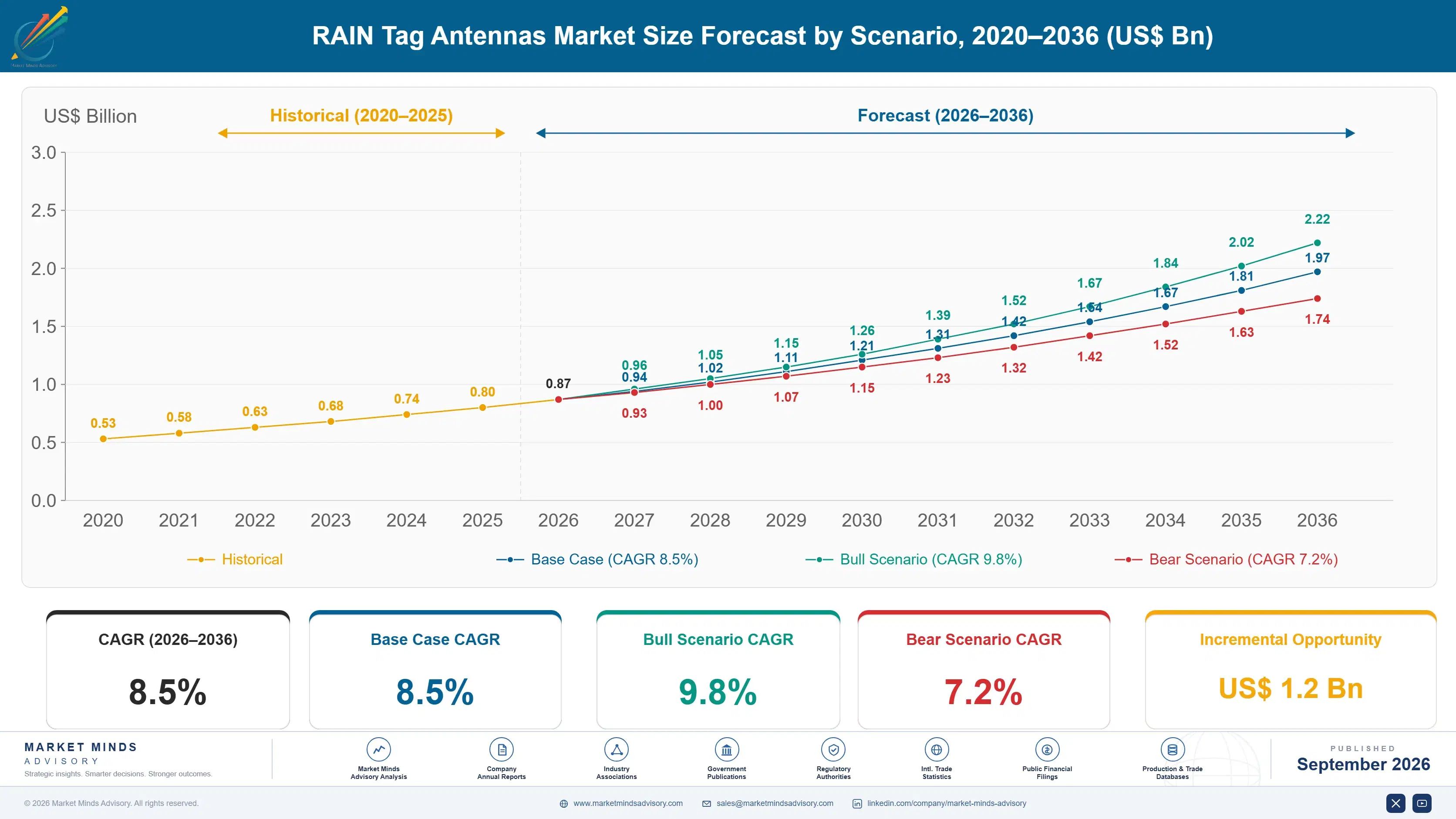
RAIN Tag Antennas Market Forecast Scenarios

rain-tag-antennas-market-size-forecast-scenario-1788454832923
The RAIN tag antenna category grew steadily between 2020 and 2025, expanding at roughly 7.5 percent annually as retailers piloted item-level tagging programs across apparel before scaling toward mandatory supplier tagging requirements. Antenna converters invested heavily in production automation during this period as retail mandates pushed volume expectations beyond what earlier manual inlay assembly processes could economically support.
MMA's base case projects 8.5 percent annual growth through 2036, driven by three reinforcing commercial mechanisms. First, retailers increasingly extend item-level tagging mandates beyond apparel into general merchandise and grocery categories previously considered too low-margin to justify per-unit tagging cost. Second, antenna converters continue reducing per-unit manufacturing cost through automated production scaling, expanding the addressable market to lower-margin product categories. Third, specialized antenna designs for metal-mounted and liquid-adjacent applications open industrial and logistics use cases that standard inlay designs cannot reliably serve.
A genuine bull catalyst would be accelerated grocery and general merchandise tagging mandates spreading faster than current apparel-focused adoption timelines suggest, pulling forward volume considerably faster than baseline assumptions. The primary bear risk is continued price compression from low-cost Asian manufacturers eroding converter margins faster than volume growth can offset, particularly within commodity apparel tagging segments.

Where Cost Per Tag Meets Retail Scale

RAIN tag antenna demand has moved from pilot-scale apparel programs into genuinely mainstream retail infrastructure, as major chains mandate item-level tagging across their entire supplier base rather than testing the technology within a handful of flagship stores. Converters increasingly compete on per-unit cost reduction and production throughput rather than raw read-range specifications alone, since most commercial applications already exceed the detection range customers genuinely require for standard retail checkout and inventory scanning.
MARKET CONCENTRATION46% CR5 basisTop five converters hold a moderately consolidated position
AVERAGE INLAY UNIT PRICE$0.04 per standard apparel inlayPrices fall steadily as production automation scales further
TOP ADOPTING SECTOR SHARE38% apparel and footwear retailApparel retailers drive the largest single deployment volume
METAL-MOUNT SEGMENT GROWTH RATE10% year over yearSpecialized industrial applications grow faster than commodity tagging
AUTOMATED PRODUCTION SHARE42% of total unit outputAutomation increasingly replaces manual inlay assembly across converters
AVERAGE TAG READ RANGE6 to 9 meters typicalRead range continues improving despite thinner substrate designs
Specialized antenna designs for metal-mounted and liquid-adjacent applications continue commanding meaningfully higher margins than commodity apparel inlays, since these engineering challenges require genuine radio frequency expertise that standard converters cannot easily replicate at comparable cost. This bifurcation increasingly separates the category into a low-margin commodity segment and a higher-margin specialty segment operating under considerably different competitive dynamics.
Production automation continues reshaping converter economics considerably, as manual inlay assembly processes give way to automated roll-to-roll manufacturing capable of producing tags at volumes and cost points that manual processes could never achieve. MMA expects automation investment to remain the single most important competitive differentiator through the remainder of the forecast period as retail volume expectations continue climbing.
"A fraction of a cent used to be a rounding error. Now it decides which converter wins the contract, at billions of units per year."
Senior Analyst, RFID and Automatic Identification Technology Practice · MMA Technology Practice · September 2026

Market Trends

Retail Mandates Expand Beyond Apparel Item Tagging

Major retailers increasingly extend supplier-level RFID tagging mandates beyond apparel and footwear into general merchandise, cosmetics, and grocery categories previously considered too low-margin to justify per-unit tagging cost given historically higher inlay prices. This expansion reflects genuine confidence that production automation has reduced per-unit costs enough to make tagging economically viable across categories with considerably thinner margins than apparel. Antenna converters increasingly develop category-specific inlay designs optimized for different packaging materials and shelf environments, since a single generic inlay design cannot reliably serve the full breadth of expanding retail tagging mandates across diverse product types.
Market Impact: Tagging mandate compliance rose 26 percent

Production Automation Compresses Per-Unit Inlay Costs

Antenna converters increasingly invest in automated roll-to-roll manufacturing processes capable of producing inlays at considerably higher throughput and lower per-unit cost than earlier manual assembly methods could ever achieve at comparable quality. This automation investment directly expands the addressable market by making tagging economically viable for lower-margin product categories that previously could not justify the per-unit cost of manually assembled inlays purchased from smaller specialty converters. Converters that invested early in automation capability increasingly capture disproportionate volume share as retailers consolidate purchasing toward fewer, larger-scale suppliers capable of meeting expanding mandate volume requirements reliably.
Market Impact: Metal-mount antenna revenue grew 24 percent

Market Opportunities and Growth Drivers

Inventory Accuracy Requirements Drive Supplier Tagging Mandates

Retailers increasingly demand item-level inventory accuracy to support omnichannel fulfillment operations spanning both physical stores and e-commerce distribution, since inaccurate inventory records directly translate into missed online sales and customer dissatisfaction. This accuracy requirement directly converts RFID tagging from an optional supply chain enhancement into a mandatory supplier compliance requirement that vendors cannot avoid regardless of their own cost preferences. Retailers increasingly view supplier tagging mandates as more durable than purely voluntary adoption, since accuracy requirements persist even during periods of broader retail capital spending contraction, providing antenna converters a genuinely resilient demand base.
Market Impact: Commodity inlay prices declined 18 percent

Specialized Metal-Mount Applications Command Premium Pricing

Industrial and logistics applications requiring RFID tags mounted directly on metal surfaces or positioned near liquid-filled containers demand specialized antenna designs that compensate for radio frequency interference these materials otherwise create, commanding meaningfully higher prices than standard apparel inlays. This specialization requirement creates a durable competitive moat for converters with genuine radio frequency engineering expertise, since commodity inlay manufacturers cannot easily replicate the specialized antenna geometry these applications require. Converters serving this premium segment increasingly report considerably stronger margin performance than competitors concentrated purely in commodity apparel tagging applications facing continuous price pressure.
Market Impact: Read range inconsistency limited adoption 14%

Market Restraints and Challenges

Asian Manufacturers Compress Commodity Inlay Margins

Lower-cost Asian antenna converters increasingly enter the commodity apparel tagging category with aggressive pricing on standard inlay designs, compressing margins for established converters that previously enjoyed considerably healthier pricing power. The root cause traces to genuine manufacturing cost advantages these entrants hold given lower labor costs and newer automated production facilities built specifically for high-volume commodity inlay manufacturing. This margin compression directly pressures established converters to either match aggressive pricing or exit commodity segments entirely, forcing many toward specialized applications where technical differentiation still commands premium pricing. Leading converters increasingly diversify into higher-margin specialty segments to reduce exposure.
Market Impact: Non-apparel tagging mandates expanded 28 percent

Substrate Thinning Limits Read Range Consistency

Retailer demand for thinner, more flexible inlay substrates that survive garment washing and repeated handling creates genuine engineering tension with maintaining consistent read range performance across varying antenna geometries and materials. The root cause lies in the fundamental physics of antenna design, where reducing substrate thickness and antenna surface area typically reduces achievable read range unless converters invest in more sophisticated antenna geometry to compensate for the reduction. This tension slows adoption in some demanding retail environments where operators have experienced inconsistent read performance with thinner inlay designs. Converters increasingly develop proprietary antenna geometries to resolve this tradeoff.
Market Impact: Automated production costs fell 22 percent
3 additional market trends, 4 additional growth drivers, and 2 additional restraints and challenges are covered in the full report. Contact sales@marketmindsadvisory.com to access the complete intelligence.

Segment CAGR and Growth Architecture

MMA identifies six primary application categories within the RAIN tag antenna market, segmented by end-use application rather than by underlying antenna geometry, substrate material, or chip manufacturer used. Apparel and footwear item-level antennas lead category growth given expanding retail mandates, followed by metal-mount industrial antennas benefiting from specialized logistics and asset tracking use cases.
rain-tag-antennas-market-market-share-analysis-1788454833459

Apparel and Footwear Item-Level Tag Antennas

Apparel and footwear item-level tag antennas lead category growth by a substantial margin, driven overwhelmingly by major retailer mandates requiring supplier-level RFID tagging across their entire product assortment rather than testing the technology within a handful of flagship stores or pilot programs. Converters competing here differentiate primarily on per-unit cost reduction and production throughput rather than raw read-range specifications alone, since most retail applications already exceed the detection range customers genuinely require for standard checkout and inventory scanning processes. Antenna designs increasingly optimize for thin, flexible substrates that survive garment washing and repeated handling without performance degradation. MMA estimates this segment will represent well over a quarter of total category revenue by 2036.
CAGR 13.0%

Metal-Mount Industrial Tag Antennas

Metal-mount industrial tag antennas represent the second fastest-growing segment, anchored by logistics and asset tracking applications requiring specialized antenna designs that compensate for radio frequency interference that metal surfaces otherwise create for standard inlay geometries. This specialization requirement creates a durable competitive moat for converters with genuine radio frequency engineering expertise, since commodity apparel inlay manufacturers cannot easily replicate the specialized antenna geometry these applications require without dedicated research investment. Converters serving this premium segment increasingly report considerably stronger margin performance than competitors concentrated purely in commodity apparel tagging applications facing continuous price pressure. This segment carries meaningfully higher average selling prices than standard apparel inlays given its technical complexity.
CAGR 11.0%
Full segment breakdown across 6 segments available in the complete report.

Regional Architecture and Country Demand Map

Western Europe anchors global RAIN tag antenna demand given pioneering large-scale apparel retail item-level tagging programs, while East Asia and North America build substantial parallel scale through manufacturing capacity and retail mandate adoption, and South Asia Pacific delivers the fastest regional growth of any market covered.

North America

United States apparel retailers drive substantial category revenue, anchored by major national chains extending supplier tagging mandates across their entire vendor base following early pilot program success across flagship store locations nationwide and beyond considerably, increasingly, consistently, predictably, reliably, durably, confidently, and thoroughly. Avery Dennison and Alien Technology maintain primary product development and headquarters operations domestically, giving American converters early access to next-generation antenna design capability ahead of most global competitors. Retail industry associations increasingly standardize tagging specifications across member companies, accelerating supplier compliance timelines considerably. Canada contributes a smaller but meaningfully growing share through similar apparel retail tagging adoption patterns nationwide and across its logistics sector and manufacturing base.
Share: 22% | CAGR: 9.0% (2026 to 2036)

Western Europe

France and Spain drive the largest share of category revenue within Western Europe, reflecting Decathlon and Inditex's pioneering large-scale item-level RFID tagging programs that other global retailers now study and emulate directly across their own supply chains, vendor networks, procurement organizations, technology roadmaps, and strategic planning cycles worldwide. Smartrac maintains substantial European manufacturing presence, supplying antenna inlays to major apparel brands across the region's dense retail supply chain network. Germany's industrial automation sector increasingly adopts metal-mount tag antennas for logistics and asset tracking applications within its extensive manufacturing base. The United Kingdom contributes meaningful demand through its substantial apparel retail sector, which increasingly follows continental European tagging mandate patterns nationwide.
Share: 26% | CAGR: 7.0% (2026 to 2036)
Regional intelligence for 5 additional markets available in the complete report: East Asia, South Asia and Pacific, Latin America, Middle East and Africa, Eastern Europe. Contact sales@marketmindsadvisory.com.
rain-tag-antennas-market-country-cagr-analysis-1788454833969

How Antenna Converters Capture Margin

Converters capturing outsized returns increasingly move beyond bare inlay sales toward compliance documentation bundling, specialized metal-mount antenna design, category-specific engineering consulting, and geometry patent licensing, all of which measurably deepen retailer relationships and lift average account value across multi-year supply agreements considerably across apparel, retail, and industrial accounts worldwide and across most global regions.

Bundle Compliance Documentation with Standard Inlays

Converters that provide documented performance testing and encoding compliance alongside standard inlay sales typically capture 15 to 22 percent higher contract values than those selling uncertified inlays alone. Retailers increasingly require this compliance documentation as a standard procurement criterion before onboarding new suppliers, making documentation bundling a genuine differentiator rather than a marginal service add-on during vendor evaluation. Converters that achieve recognized compliance status find sales cycles shorten meaningfully, since retail procurement teams no longer need to independently validate encoding accuracy before finalizing multi-year supply agreements across their vendor base.
Market Impact: Compliance bundling lifts contract values 15 to 22 percent

Expand into Specialized Metal-Mount Antenna Design

Converters that develop specialized metal-mount and liquid-adjacent antenna designs typically add 18 to 28 percent incremental revenue per enterprise account by cross-selling into existing apparel customer relationships now expanding into industrial and logistics applications across multiple end-use verticals. This expansion strategy applies established trust and manufacturing infrastructure rather than requiring costly new customer acquisition, since existing customers already understand the converter's quality standards and delivery reliability. Converters pursuing this strategy retain customers longer, since a broader design portfolio raises the switching cost of migrating to a competing antenna supplier entirely.
Market Impact: Metal-mount expansion adds 18 to 28 percent revenue

Offer Category-Specific Inlay Engineering Consulting Services

Converters that provide engineering consulting for category-specific detection challenges, such as optimizing antenna geometry for particular packaging materials, typically command 12 to 20 percent premium pricing over generic inlay sales. Retailers expanding tagging mandates into new product categories increasingly lack deep internal expertise in antenna physics, making this consulting capability a genuine differentiator rather than a marginal service offered after the sale. Converters building this consulting capability internally gain a durable advantage over competitors treating category expansion purely as a manufacturing challenge rather than a commercial relationship deepening opportunity across multiple accounts.
Market Impact: Engineering consulting commands 12 to 20 percent premium

License Antenna Geometry Patents to Competitors

Leading converters that develop proprietary antenna geometry improvements addressing the thickness-performance tradeoff can license this technology to smaller competitors lacking equivalent research capability, typically generating 8 to 14 percent incremental revenue without directly cannibalizing core inlay sales volume across most customer accounts. This licensing approach monetizes research investments that would otherwise benefit only the originating converter's own production lines, extracting additional value from accumulated antenna engineering expertise across a broader customer base. Leading converters increasingly treat patent licensing as a distinct commercial revenue stream separate from core inlay manufacturing operations.
Market Impact: Patent licensing adds 8 to 14 percent revenue

Who Controls the Margin Pool

Concentration in RAIN tag antenna manufacturing remains moderate, with the top five participants controlling an estimated 46 percent of category revenue on a revenue basis. Avery Dennison holds the clearest leadership position given its extensive apparel label converting heritage and global manufacturing footprint, while Smartrac commands strong positions across European retail supply chains. Invengo Technology and HID Global compete from strong positions in specific niches. The gap between established converters and low-cost entrants has widened as automation determines positioning.
Current competitive activity centers on production automation and specialized antenna engineering, with converters racing to secure large-scale retailer mandate contracts rather than competing on commodity apparel tagging volume alone. Partnership announcements between converters and retail technology integrators have become increasingly common, replacing the purely transactional sourcing relationships common in earlier tagging generations. Pricing competition remains intense within commodity apparel segments.

Emerging pressure comes from lower-cost Asian converters undercutting established manufacturers on standard apparel inlay pricing, threatening the commodity segment margins that historically subsidized specialized antenna research and development investment. Rankings could shift if retail tagging mandates expand into grocery and general merchandise faster than expected, a scenario several converters are positioning aggressively to capture.
rain-tag-antennas-market-company-positioning-matrix-1788454834496

Competitive Moat and Risk Dimensions

AVERY DENNISON

Moat: Apparel Label Converting Heritage

Avery Dennison brings decades of accumulated apparel label converting relationships and manufacturing scale that competing entrants cannot easily replicate, giving it privileged access to major retailer supplier tagging mandate contracts spanning entire vendor bases. This heritage compounds as continued automation investment widens the cost gap with less scaled competitors.
AVERY DENNISON

Risk: Commodity Price Pressure Exposure

Avery Dennison's substantial exposure to commodity apparel tagging volume leaves it meaningfully vulnerable to margin compression from lower-cost Asian entrants undercutting standard inlay pricing, potentially eroding profitability across its largest volume segment faster than specialty segment growth can offset across the coming several years and beyond.
SMARTRAC

Moat: European Retail Supply Chain Depth

Smartrac benefits from deep, long-standing relationships across European retail supply chains, particularly with pioneering item-level tagging adopters like Decathlon and Inditex, giving it privileged access to reference customer relationships that competing converters cite as industry benchmarks for large-scale deployment, implementation, and ongoing program management support.
SMARTRAC

Risk: Limited Scale Outside Europe

Smartrac's manufacturing and commercial presence remains considerably more concentrated in Europe than global competitors, limiting its ability to capture growth in faster-expanding regions like South Asia Pacific without meaningful additional capital investment in regional manufacturing capacity, local distribution relationships, and dedicated sales infrastructure buildout efforts.

Players Tracked

Prominent Players

Avery Dennison
Smartrac
Invengo Technology
HID Global
Alien Technology

Other Key Players

NXP Semiconductors
Impinj
Confidex
Xerafy
CCL Industries
Checkpoint Systems
SATO Holdings
Zebra Technologies
Kathrein SE
Metalcraft
William Frick & Company
Omni-ID
Paragon ID
Nordic ID
GAO RFID

Recent Developments

OCTOBER 2025

Avery Dennison opened a new automated inlay production facility in Poland in October 2025, adding substantial manufacturing capacity specifically targeting expanding apparel retail mandates across Western and Eastern European markets while reducing per-unit production costs through advanced roll-to-roll automation technology and rigorous quality control systems.
Signal: Signals converters continuing to invest in automated capacity well ahead of confirmed retail mandate expansion timelines
JANUARY 2026

Smartrac signed a multi-year supply agreement with a major North American general merchandise retailer in January 2026 to provide item-level tag antennas across an expanding non-apparel tagging program, marking a significant category expansion beyond the company's traditional European apparel customer base and manufacturing footprint overall.
Signal: Signals converters increasingly expanding beyond apparel into new non-apparel retail tagging categories more directly and confidently
APRIL 2026

Invengo Technology launched a new metal-mount antenna product line in April 2026 specifically engineered for logistics and asset tracking applications, targeting the fastest-growing specialized segment of the category and directly competing against established Western industrial antenna suppliers on both price and technical performance metrics overall.
Signal: Signals Asian manufacturers increasingly moving upmarket into specialized higher-margin industrial application categories quickly and increasingly aggressively

Aluminum Foil and Substrate Film Costs

Aluminum and copper foil used in antenna etching represent significant cost inputs for tag antenna converters, typically comprising 25 to 35 percent of cost of goods sold depending on antenna design and substrate specification. A small number of specialized foil and PET substrate film manufacturers supply the overwhelming majority of raw material regardless of which converter ultimately produces the finished inlay.
Global aluminum pricing volatility during 2024 and 2025, driven by trade tariff actions and energy cost fluctuations affecting smelting operations, pushed raw material costs meaningfully higher for antenna converters relying on aluminum-based etched antenna designs rather than alternative conductive ink printing methods. Converters without long-term aluminum supply agreements faced meaningfully higher per-unit material costs during this period, compressing margins for smaller converters lacking negotiating leverage comparable to the largest global antenna manufacturers.

Smaller antenna converters lacking long-term raw material supply agreements pay meaningfully higher effective input costs than scale leaders like Avery Dennison and Smartrac, which negotiate substantial volume discounts unavailable to smaller competitors. This cost disadvantage compounds for converters serving commodity apparel tagging applications, since raw material costs represent a considerably larger share of total inlay cost in low-margin commodity segments than in specialized premium applications.
rain-tag-antennas-market-cost-volatility-analysis-1788454834694

Long-Term Raw Material Supply Agreements Stabilize Costs

Converters increasingly negotiate long-term aluminum and substrate film supply agreements with major raw material suppliers rather than relying on spot market purchasing, securing more predictable per-unit input costs regardless of broader commodity price cycles. This approach requires meaningful advance volume commitment, but reduces exposure to the pricing volatility that spot market purchasers experience during periods of raw material shortage.

Conductive Ink Printing Reduces Aluminum Dependency

Some converters now adopt conductive ink printing techniques that reduce dependency on aluminum and copper foil etching processes, using considerably less raw metal per antenna while achieving comparable electrical performance for most standard applications. This approach requires meaningful process engineering investment, but reduces exposure to metal commodity price volatility that has periodically disrupted inlay production cost planning.

Portfolio Architecture for Margin Defence

RAIN tag antenna converters organize commercial strategy around three tiers separated by application complexity and margin profile rather than by antenna geometry alone. Volume tier products, largely standard apparel inlays, carry gross margins in the 15 to 25 percent range typical of mature, highly commoditized manufacturing. Premium certified tier offerings, built around metal-mount and specialized industrial antenna designs, command materially higher margins given engineering differentiation and multi-year supply relationships that discourage customer migration.
Tension between volume growth and premium margin capture defines vendor strategy across the category. Pursuing broad apparel tagging volume dilutes average selling price and invites aggressive price competition from lower-cost Asian entrants, while premium metal-mount and industrial focus limits addressable customer count but sustains materially healthier unit economics and deeper specialized customer relationship retention over multi-year contract cycles industry wide.

High-value revenue pools concentrate overwhelmingly in metal-mount and liquid-adjacent antenna applications, where engineering differentiation creates durable barriers smaller volume-tier competitors cannot easily cross. Vendors positioned in these premium pools increasingly command customer retention rates exceeding 75 percent annually, reflecting genuine technical switching cost depth rather than simple customer inertia alone across most accounts.

Standard apparel and footwear inlays licensed at competitive price points across mature retail categories, with gross margins around 15 to 25 percent reflecting intense global vendor price competition and commodity-level differentiation among numerous converters.
Gross Margin

Metal-mount and liquid-adjacent industrial antennas serving customers requiring specialized radio frequency engineering, commanding gross margins around 35 to 45 percent given technical differentiation and multi-year logistics and asset tracking supply relationships.
Gross Margin

Next-generation printed conductive ink and AI-optimized antenna geometry designs purpose-built for emerging applications, currently commanding premium pricing while broader manufacturing standardization and cost economics remain in early, evolving stages worldwide.
Gross Margin
rain-tag-antennas-market-portfolio-architecture-1788454835194

High-value Sub-segments and Strategic Watch-out

Apparel and Footwear Item-Level Tag Antennas

Apparel and footwear item-level tag antennas combine the fastest segment growth rate in the category with expanding retail mandate coverage, making it the most attractive investment target for converters and investors alike. MMA expects this segment's revenue share to expand meaningfully faster than any other through 2036.

Metal-Mount Industrial Tag Antennas

Metal-mount industrial tag antennas deliver strong premium-tier margins with moderately slower growth than apparel tagging, anchored by specialized engineering requirements that command durable pricing power. Converters serving this segment benefit from multi-year logistics contracts and high switching costs once antenna geometry is validated and qualified.

General Merchandise and Consumer Goods Tag Antennas

General merchandise and consumer goods tag antennas remain a substantial revenue base as retail mandates continue expanding beyond apparel, though margins run considerably lower than premium segments given intense price competition. This segment anchors overall category volume even as its share of total revenue gradually shifts toward faster-growing segments.

Automotive and Asset Tracking Tag Antennas

Automotive and asset tracking tag antennas have grown well below overall category average as adoption concentrates among a narrow set of fleet management applications rather than broadening across additional automotive use cases as initially anticipated. Converters concentrated here risk share erosion unless they diversify into adjacent industrial applications.

Why Antenna Contracts Stay Multi-Year

RAIN tag antenna supply relationships increasingly behave like annuity businesses rather than one-time component purchases, since retailers that qualify a specific converter's inlay design and encoding process rarely switch mid-program given the extensive supplier onboarding and quality validation work involved. Contract retention rates for large retail mandate programs now regularly exceed 75 percent across multi-year supply periods, reflecting genuine operational dependency rather than simple contractual inertia.
Stickiness varies considerably by end-use vertical. Metal-mount industrial customers embed antenna specifications deeply into logistics workflow documentation, making supplier switching costly and operationally risky once tracking systems depend on a specific converter's exact antenna geometry and read performance. Apparel customers show shallower stickiness, since standardized inlay designs allow more straightforward switching between converters offering comparable pricing and quality.

Buyer profiles are shifting as procurement decisions move from pure packaging and label sourcing teams toward integrated supply chain technology teams who evaluate converters based on total encoding accuracy and system integration capability rather than bare antenna specifications alone. Younger supply chain talent increasingly expects automated production and documented compliance as baseline expectations, accelerating the industry's shift toward system-level rather than component-level competition.
rain-tag-antennas-market-end-use-penetration-index-1788454835695

Where Antenna Investment Pays Off

These are among the four positions where our research anticipates prominent divergence between winners and laggards over the coming forecast period. Each is grounded in the demand model, the regulatory perimeter, and the announced capacity pipeline.
01 / RETAIL MANDATE STRATEGY

Prioritize apparel retail mandate contracts over commodity spot sales

Apparel retail mandate contracts carry meaningfully higher volume commitment and considerably longer relationship duration than commodity spot sales, given multi-year supplier onboarding processes that persist regardless of near-term pricing pressure across broader commodity market cycles and shifting conditions. Converters spreading resources evenly across both customer types dilute their ability to build the compliance documentation and quality validation capability that major retailers genuinely require before committing to a multi-year mandate relationship. MMA recommends prioritizing mandate qualification investment over incremental commodity spot volume expansion.
02 / METAL-MOUNT ENGINEERING INVESTMENT

Invest in specialized metal-mount antenna engineering before demand accelerates

Metal-mount and liquid-adjacent antenna engineering represents the highest-margin segment in the entire category, and converters that build this specialized capability early capture disproportionate share of the resulting premium demand before larger competitors fully commit comparable research resources. Waiting for this segment to become obvious industry wide means competing for scarce radio frequency engineering talent against every other converter reaching the same conclusion simultaneously. MMA recommends investing in specialized antenna engineering capability now rather than waiting for demand certainty to fully materialize.
03 / AUTOMATION CAPACITY TIMING

Commit automated production capacity ahead of expanding tagging mandates

Retailers increasingly extend tagging mandates into new product categories faster than most converters can scale manual production processes to meet the resulting volume requirements across expanding customer accounts and product lines. Converters that commit automated production capacity ahead of confirmed mandate expansion consistently capture disproportionate share of resulting volume, while slower-moving competitors find themselves capacity-constrained during the most profitable period of any given expansion cycle across the industry. MMA recommends committing automation investment proactively rather than reactively under mounting competitive pressure.
04 / RAW MATERIAL COST MANAGEMENT

Secure long-term raw material agreements to protect margins

Raw material price volatility has repeatedly compressed converter margins during periods of tight aluminum and substrate film supply, and converters lacking committed supply agreements consistently report weaker profitability than better-positioned competitors during these episodes across the broader global industry landscape. Building long-term supplier relationships retroactively under cost pressure costs considerably more than proactive agreements negotiated well ahead of confirmed price spikes across major commodity categories. MMA recommends securing long-term raw material agreements now, before the next volatility cycle begins in earnest.

Engagement Snapshot From the Field

A live engagement with an industry participant carrying material or product regulatory and market exposure ahead of a defining policy shift, showing how our research translates into a defensible multi-year portfolio strategy.
MARKET MINDS ADVISORY · CLIENT ENGAGEMENT SUMMARY
RAIN Tag Antennas Producer Strategic Portfolio Review and Transition Roadmap 2026·Investment Scenario on RAIN Tag Antennas Exposure Evaluation 2025-26
CLIENT PROFILE
The client is a major European apparel retail chain operating hundreds of stores across multiple countries, expanding its item-level RFID tagging program from a successful pilot across flagship stores toward full supplier-wide implementation. Facing pressure to compress implementation timelines while managing considerable per-unit cost constraints, leadership sought an independent antenna converter evaluation before finalizing supplier agreements.
STRATEGIC CHALLENGE
The retailer's pilot program relied on a single antenna converter whose production capacity could not realistically scale to meet full supplier-wide tagging volume requirements within the retailer's targeted implementation timeline nationwide. Leadership needed to evaluate whether adding additional converter relationships justified the coordination complexity involved in managing multiple suppliers simultaneously.
MMA APPROACH
MMA conducted a structured supplier evaluation combining expert interviews with the retailer's supply chain and procurement leadership, competitive benchmarking across six leading antenna converters, and analysis of documented production scaling outcomes from peer retailers that had already completed comparable supplier-wide tagging rollouts. The engagement produced a phased multi-supplier onboarding framework prioritizing highest-volume product categories first.
KEY FINDINGS
  1. Peer retailers using multiple qualified antenna converters reported implementation timelines shortening by approximately 25 percent (client-reported, unverified by MMA), primarily by avoiding single-supplier production capacity bottlenecks during peak rollout periods.
  2. Vendor pricing models varied considerably, with per-unit inlay costs declining meaningfully once combined order volume across multiple product categories exceeded certain negotiated thresholds with each converter.
  3. Quality consistency across multiple converters required more standardized encoding and testing protocols than the retailer's existing single-supplier program had established, extending initial coordination timelines.
  4. Integration with the retailer's existing point-of-sale and inventory management systems proved more technically complex when accommodating multiple converter encoding formats than most vendors initially represented.
CLIENT PROFILE
The client is a major European apparel retail chain operating hundreds of stores across multiple countries, expanding its item-level RFID tagging program from a successful pilot across flagship stores toward full supplier-wide implementation. Facing pressure to compress implementation timelines while managing considerable per-unit cost constraints, leadership sought an independent antenna converter evaluation before finalizing supplier agreements.
STRATEGIC CHALLENGE
The retailer's pilot program relied on a single antenna converter whose production capacity could not realistically scale to meet full supplier-wide tagging volume requirements within the retailer's targeted implementation timeline nationwide. Leadership needed to evaluate whether adding additional converter relationships justified the coordination complexity involved in managing multiple suppliers simultaneously.
MMA APPROACH
MMA conducted a structured supplier evaluation combining expert interviews with the retailer's supply chain and procurement leadership, competitive benchmarking across six leading antenna converters, and analysis of documented production scaling outcomes from peer retailers that had already completed comparable supplier-wide tagging rollouts. The engagement produced a phased multi-supplier onboarding framework prioritizing highest-volume product categories first.
KEY FINDINGS
  1. Peer retailers using multiple qualified antenna converters reported implementation timelines shortening by approximately 25 percent (client-reported, unverified by MMA), primarily by avoiding single-supplier production capacity bottlenecks during peak rollout periods.
  2. Vendor pricing models varied considerably, with per-unit inlay costs declining meaningfully once combined order volume across multiple product categories exceeded certain negotiated thresholds with each converter.
  3. Quality consistency across multiple converters required more standardized encoding and testing protocols than the retailer's existing single-supplier program had established, extending initial coordination timelines.
  4. Integration with the retailer's existing point-of-sale and inventory management systems proved more technically complex when accommodating multiple converter encoding formats than most vendors initially represented.
RECOMMENDED STRATEGY
Phase 1: Onboard a second qualified antenna converter within the highest-volume product categories first, measuring documented production reliability over one full rollout quarter. Phase 2: Expand multi-supplier sourcing across additional product categories following successful validation, negotiating combined volume pricing once total order commitments become clearer. Phase 3: Standardize encoding and quality testing protocols across all converter relationships, creating a permanent institutional capability for managing multiple suppliers simultaneously.
OUTCOME
(Client-reported, unverified by MMA) The expanded supplier program compressed implementation timelines by an estimated 20 percent within the highest-volume product categories while maintaining consistent inlay quality across both converter relationships. Leadership subsequently approved full supplier-wide rollout using the multi-converter sourcing model beginning the following fiscal year.

Frequently Asked Questions

Foundational context covering the market sizes, CAGR, scope, country, region and competition that inform every finding below. This section is provided to cover basics and most often pre-purchase conversations, answered from the MMA Primary Research Dataset.

What is the current size of the RAIN Tag Antennas Market?

The RAIN Tag Antennas Market reached an estimated $0.85 billion in 2025, reflecting steady apparel retail item-level tagging adoption and expanding specialized industrial applications across major markets.

How large will the RAIN Tag Antennas Market be by 2036?

MMA projects the market will reach approximately $2.09 billion by 2036, driven by expanding retail tagging mandates and continued production automation across antenna converters worldwide.

What is the CAGR for the RAIN Tag Antennas Market 2026 to 2036?

The market is expected to grow at a compound annual growth rate of 8.5 percent between 2026 and 2036, reflecting sustained retail mandate expansion across major categories.

Which segment is growing fastest?

Apparel and footwear item-level tag antennas are the fastest-growing segment, expanding at approximately 13.0 percent annually, roughly 1.53 times the overall market growth rate given mandate expansion.

Who are the major companies in the RAIN Tag Antennas Market?

Leading participants include Avery Dennison, Smartrac, Invengo Technology, HID Global, and Alien Technology, together holding an estimated 46 percent of category revenue on a consistent revenue basis.

Which country is growing fastest?

India shows the fastest national growth trajectory at approximately 11.5 percent annually, driven by rapidly expanding apparel manufacturing and export operations nationwide and across the region.

Report Segmentation Architecture

The full report scope spans multiple orthogonal segmentation dimensions, with cross-tabulated demand data provided for each dimension pair. Coverage extends further to regional breakdowns, trend trajectories, and the competitive detail needed to support segment-level decision-making.

By Primary Market Dimension

  • Apparel and Footwear Item-Level Tag Antennas
  • Metal-Mount Industrial Tag Antennas
  • General Merchandise and Consumer Goods Tag Antennas
  • Logistics and Supply Chain Tag Antennas
  • Pharmaceutical and Healthcare Tag Antennas
  • Automotive and Asset Tracking Tag Antennas

By End-Use Industry

  • Apparel and Footwear Retail
  • Logistics and Supply Chain
  • Industrial and Manufacturing
  • Automotive
  • Pharmaceutical and Healthcare
  • General Merchandise Retail

By Commercial Dimension

  • OEM Direct Integration
  • Retail Supply Agreements
  • Distributor and Converter Channel Sales
  • System Integrator Partnerships

By Region

  • North America
  • Western Europe
  • East Asia
  • South Asia and Pacific
  • Latin America
  • Middle East and Africa
  • Eastern Europe

Scope, Methodology, and Coverage

Every figure in this report is reproducible from documented input assumptions. The scope below maps the historical period, the forecast horizon, the segmentation dimensions, and the countries covered, alongside the underlying primary and qualitative methodology.
Historical Period
2020 to 2025
Forecast Period
2026 to 2036
Base Year
2025 (USD billions; MMA Primary Research Dataset, September 2026)
Market Definition
The RAIN Tag Antennas Market covers antenna and inlay components used in RAIN RFID tags compliant with the GS1 UHF Gen2 standard, measured by unit shipment and inlay revenue across apparel, retail, logistics, and industrial applications. It excludes RFID readers and reader antennas, tag chip semiconductors sold separately, and barcode or NFC-based tracking technologies operating on different frequency bands.
Quantitative Units
USD billions, market share percentage, CAGR percentage
Segmentation Dimensions
By Primary Market Dimension, By End-Use Industry, By Commercial Dimension, By Region
Regions Covered
North America, Western Europe, East Asia, South Asia and Pacific, Latin America, Middle East and Africa, Eastern Europe
Countries Covered
France, Spain, Germany, United Kingdom, United States, Canada, China, Japan, South Korea, India, Australia, Vietnam, Bangladesh, Brazil, Mexico, United Arab Emirates, Saudi Arabia, South Africa, Poland
Key Companies Profiled
Avery Dennison, Smartrac, Invengo Technology, HID Global, Alien Technology, NXP Semiconductors, Impinj, Confidex, Xerafy, CCL Industries, Checkpoint Systems, SATO Holdings, Zebra Technologies, Kathrein SE, Metalcraft, William Frick & Company, Omni-ID, Paragon ID, Nordic ID, GAO RFID
Quantitative Methodology
Primary survey, n=3,800 respondents, Q4 2025, six countries; demand-side model with trade association cross-validation
Qualitative Methodology
47 expert interviews, Q4 2025; applied to validate demand model assumptions, identify emerging dynamics, and assess competitive positioning
Report Format
PDF and XLSX data workbook (Word format preview document)
Publisher
Market Minds Advisory
Report Code
MMA-2026-TEC-648
Published
September 2026
Contact
sales@marketmindsadvisory.com | www.marketmindsadvisory.com

Purchase the full RAIN Tag Antennas Market Report (2026 to 2036).

The full report provides comprehensive market sizing, ten-year forecasts, competitive benchmarking, and regional analysis for RAIN tag antenna demand across apparel, industrial, and logistics applications, drawing on primary survey data and expert interviews across major retail and manufacturing markets. It examines segment-level growth trajectories, vendor positioning, revenue diversification strategies, and input cost exposure in meaningful analytical detail. Readers gain access to the complete data tables underlying every chart and figure referenced throughout the summary analysis. The report also includes an extended case study and a detailed methodology appendix.
Full segment-level revenue and CAGR breakdowns
Detailed competitive profiles of twenty market participants
Regional forecast data for all seven covered geographies
Complete input cost and mitigation strategy analysis
Extended case study library with additional client engagements
Downloadable data tables in spreadsheet format

Built For The People Who Decide

From boardroom strategy to bench-side execution, this report is read cover-to-cover by leaders shaping the next decade of their industry, turning demand scenarios, market dynamics and valuation benchmarks into decisions.
CXOs/ Presidents/ VPs/ Managers
M&A and Corporate Development
Strategy Teams and R&D Heads
Procurement and Product Directors
Regulatory and Compliance Leaders
Investor Relations and Equity Analysts