Market Minds Advisory
Rain Boots Market

Rain Boots Market: Rain Boots Market: Rubber Ageing, Calf Width Fit Failure and A Category Buying Against The Weather

Natural rubber boots crack in storage while cheaper vinyl survives, and the white bloom that proves the rubber protection is working gets returned as mould. Calf width decides the rest of the returns.

Lead Analyst

Published

September 2026

Make Smarter Decisions with Customized Research Insights

Request a free sample report and evaluate market opportunities, growth trends, and competitive dynamics relevant to your business needs.

2025 MARKET VALUE$3.4BMarket Size 2025
2036 FORECAST VALUE$6.0BBase Case , 2026 to 2036
CAGR 2026 TO 20365.2 %Bull 6.4% / Bear 4.0%
INCREMENTAL OPPORTUNITY$2.4BNet 10- year value creation
EXPANSION MULTIPLE1.67x2036 value over 2026 base
Strategic Levers
M&A Pipeline
Regional Outlook
Country Rankings
Competitive Intelligence
Segmental Deep-dive
Call-Us : 91 93563 13602

Executive Snapshot and Market Trajectory.

The premium material is the one that fails first. Natural rubber flexes better and feels warmer than vinyl, and it also perishes under ultraviolet light and ozone, which means a good boot dies in a garage while a cheap one waits out the summer intact.
Neoprene and rubber composite boots grow at 7.8%, half again the market rate of 5.2%, because they solve cold and flexibility together in a way moulded rubber never has. Moulded polymer boots follow at 6.9%. Leather and hybrid wet-weather footwear grows slowest at 4.2%, caught between proper rain boots and ordinary waterproof shoes. Safety-rated agricultural and industrial demand grows on replacement cycles that take no account of rainfall at all.
Two failures cost this category real money and neither is a defect. Roughly 17% of returns are the white antiozonant bloom that proves the rubber's own protection is working, mistaken for mould. The other is fit: boots are sized by foot length alone, and calf circumference is the reason most of them go back. Consumer sell-through correlates with regional rainfall at roughly 0.71, which makes a dry autumn a season that cannot be recovered later.
Market Definition
This market covers wet-weather boots worn over the ankle, spanning natural rubber moulded, vinyl injection moulded, polyurethane moulded, neoprene and rubber composite, moulded polymer and leather or hybrid wet-weather constructions, across consumer, agricultural and industrial use. Sizing is at wholesale shipment value. Waterproof hiking boots, waterproof trainers and shoes, snow and winter boots without wet-weather primary function, overshoes and gaiters are excluded.
Base Year Value
$3.4B in 2025 (MMA Primary Research Dataset, September 2026)
Forecast Period
2026 to 2036, eleven discrete annual values
CAGR
5.2% base case. Bull 6.4%. Bear 4.0%.
Fastest Growth Segment
Neoprene And Rubber Composite Boots: 7.8% CAGR
Fastest Growth Country
India: 8.1% CAGR
Fastest Growth Region
South Asia and Pacific: 7.2% CAGR
Largest Region
East Asia: 28% of 2025 global value
Market Leaders
Rocky Brands, Dunlop Protective Footwear, Hunter Boot, Weyco Group, Aigle. Source: MMA Primary Research Dataset, July 2026.
Primary Survey
n=3,800 procurement and R&D decision-makers, Q4 2025, six countries
Methodology
Demand-side build-up, cross-validated against public data, 47 expert interviews

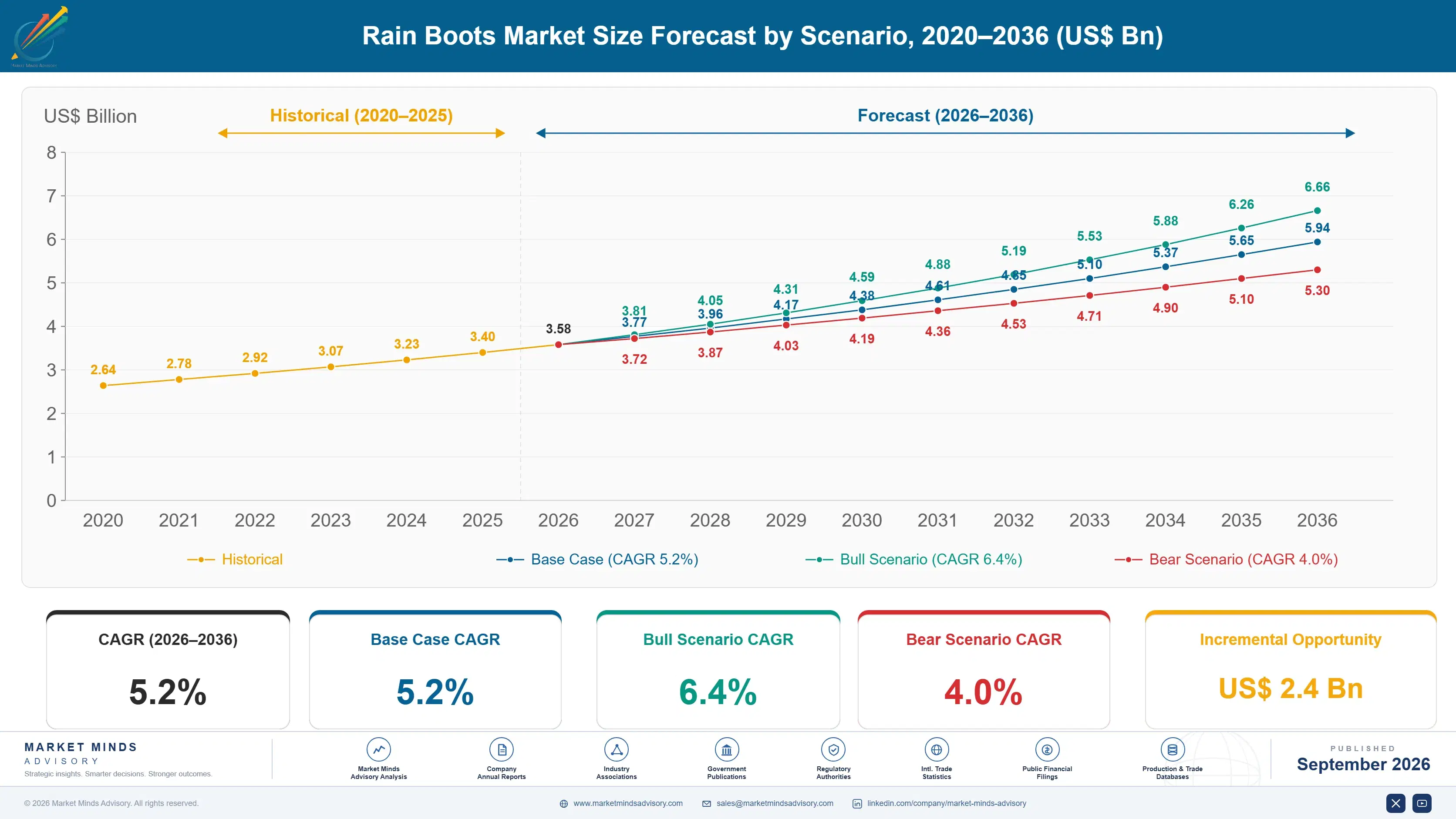
Rain Boots Market Forecast Scenarios

rain-boots-market-size-forecast-scenario-1790023477024
Growth of 4.1% between 2020 and 2025 was decided by rainfall more than by anything a manufacturer did. Two dry autumns across Western Europe and North America removed selling seasons outright in 2022 and 2023, while monsoon demand held steady because the product there is a necessity rather than a choice. Agricultural demand grew independently of both.
Three mechanisms carry the base case. Neoprene composite construction keeps taking share at 7.8% by solving cold and flexibility together. Safety-rated agricultural and industrial demand grows on specification cycles that ignore weather entirely, which stabilises a category that otherwise swings with rainfall. Indian and Southeast Asian monsoon demand expands at 8.1% in India as rural incomes rise and footwear moves from improvised to purchased. None of the three depends on a wetter year arriving.
The bull case is fit. Calf circumference is the leading rejection reason and boots are sized by foot length alone, so publishing width options against a measurement would convert a large share of rejected purchases without adding a customer. The bear case is weather. Sell-through correlates with regional rainfall at roughly 0.71, retailers buy pre-season on a forecast, and two dry seasons leave inventory discounting for a year.

Why Good Boots Fail First

Natural rubber is the better material and the shorter-lived one. It flexes further, feels warmer and takes a finer moulded detail than vinyl, and it also degrades under ultraviolet light and atmospheric ozone in ways vinyl does not. A rubber boot left in a sunlit porch or a warm garage through a dry summer can crack at the flex point before it has been worn twice. About 9% of products explain that anywhere.
TOP FIVE CONCENTRATION24%Combined shipment value share held by the five largest participants
CALF WIDTH OPTIONS1Calf circumference options offered per foot size typically
AVERAGE SELLING PRICEUSD 44Weighted global wholesale price across all boot constructions
BLOOM RELATED RETURNS17%Returns caused by antiozonant film mistaken for mould
STORAGE GUIDANCE GIVEN9%Products stating how to store rubber between wet seasons
SEASON WEATHER DEPENDENCE0.71Correlation between regional rainfall and category sell-through rates
The white film that appears on stored rubber boots is the most expensive misunderstanding in the category. Antiozonant compounds are blended into the rubber specifically to migrate to the surface and form a protective barrier, and that bloom is the evidence the protection is working. Consumers read it as mould and return the boots, which accounts for roughly 17% of returns on natural rubber product.
Fit is decided at the calf and sized at the foot. Boots come in one calf circumference per foot length, and calf measurement varies far more than shoe size. Adjustable gussets and multiple width options both exist and are offered by almost nobody. Adjustable gussets and expandable panels both resolve it at modest tooling cost, and almost nobody offers either.
"This industry blends a chemical into rubber that is designed to bloom to the surface, then accepts a fifth of its returns from customers who think the boot went mouldy in a cupboard. One sentence on the box would end it."
Director, Footwear and Outdoor Equipment Practice · MMA Consumer and Industrial Goods Practice · September 2026

Market Trends

Neoprene Composite Solves Warmth And Flex Together

A moulded rubber boot is waterproof, cold and stiff, and adding a lining has never fixed the flex point where it creases at the ankle. Neoprene bonded to a rubber shell insulates, stretches with the foot and seals at the calf without a separate gusset. That construction grows at 7.8% against a category rate of 5.2%. Manufacturing is considerably more involved than single-shot moulding, which favours participants with cut-and-bond capability rather than injection tooling alone. Agricultural and equestrian buyers adopted it first, and consumer demand followed on comfort rather than on any technical claim.
Market Impact: India grows 2.9 points faster

Safety Specification Stabilises A Weather Driven Category

Agricultural, food processing and construction buyers purchase to safety standards on replacement cycles that take no account of rainfall, which makes that demand the steadiest part of a market otherwise correlating with weather at around 0.71. Specification also locks in suppliers, since requalifying footwear against a standard is administratively unpleasant. Participants weighted toward consumer fashion carry the full weather exposure while those with a safety-rated business carry considerably less of it. That difference shows up most clearly in the years when a selling season simply does not arrive. Two dry seasons in one territory have ended more than one brand.
Market Impact: Runs about 3 cycles yearly

Market Opportunities and Growth Drivers

Monsoon Demand Converts From Improvised To Purchased

Across monsoon South and Southeast Asia a rain boot is a functional necessity for several months rather than an occasional purchase, and rising rural and small-town incomes are moving that from improvised footwear to bought product. India grows at 8.1%, the fastest national market covered here. Domestic manufacture supplies most of it at price points imported product cannot approach, and polymer constructions dominate because they survive heat and standing water better than natural rubber does in those conditions. Polymer constructions dominate there because weight and heat performance matter far more than appearance does.
Market Impact: Causes 17% of rubber returns

Agricultural Replacement Cycles Ignore The Weather Entirely

A dairy worker, a food processing operative or a groundworker replaces boots on a wear cycle measured in months, and neither the purchase nor its timing has anything to do with whether it rained. That demand is specified against safety standards, bought through industrial distributors and largely invisible to the consumer market beside it. It also carries better margins than fashion rain boots because the buyer specifies performance rather than appearance, and requalification friction makes the supplier position unusually durable once established. Roughly 3 replacement cycles pass while a fashion buyer considers one purchase.
Market Impact: Offers just 1 width typically

Market Restraints and Challenges

Antiozonant Bloom Is Returned As A Defect

Roughly 17% of returns on natural rubber boots are the white surface film that antiozonant compounds are blended in to produce, and the bloom is proof the rubber is being protected rather than evidence of anything wrong. The root cause is that no pack explains it, so a consumer opening a box after storage sees what looks like mould. Commercially this is a return that costs full margin on a product that is entirely sound. Participants adding a single explanatory line report the return cause disappearing almost completely. The product returned is entirely sound in every case.
Market Impact: Grows 2.6 points above category

Calf Circumference Decides Fit And Nothing Sizes For It

Rain boots are offered in one calf width per foot length while adult calf measurement varies far more than shoe size does, which makes circumference the leading rejection reason particularly in women's product. The root cause is tooling economics, since each calf width requires a separate mould across every size. Commercially it produces returns that cannot be resold once worn and a large group of customers who leave the category entirely. Adjustable gussets and expandable panels both solve it at modest cost and appear on very few products. A worn boot cannot be resold once it comes back.
Market Impact: Sell-through correlates 0.71 with rainfall
3 additional market trends, 4 additional growth drivers, and 2 additional restraints and challenges are covered in the full report. Contact sales@marketmindsadvisory.com to access the complete intelligence.

Segment CAGR and Growth Architecture

Segmentation follows construction material, the dimension on which moulding process, durability behaviour, comfort and price all divide together in this market. Six constructions are assessed at wholesale shipment value. Waterproof hiking boots, waterproof shoes, winter boots without a wet-weather primary function, overshoes and gaiters sit outside scope. Consumer and industrial demand are both sized together here.
rain-boots-market-market-share-analysis-1790023477561

Neoprene And Rubber Composite Boots

Neoprene composite construction grows at 7.8%, half again the market rate of 5.2%, and it resolves two complaints that single-shot moulding never could. A moulded rubber boot is waterproof, cold and stiff, and the flex point where it creases at the ankle is both the discomfort and eventually the failure. Neoprene bonded to a rubber shell insulates, stretches with the foot and seals at the calf without needing a separate gusset or adjustable panel. Manufacturing requires cut-and-bond capability rather than injection tooling alone, which favours a different group of producers entirely. Agricultural and equestrian buyers adopted it first and consumer demand followed on comfort rather than on any claim. Comfort rather than any technical claim drove it.
CAGR 7.8%

Moulded Polymer Boots

Lightweight moulded polymer constructions grow at 6.9% and they dominate wherever weight and heat matter more than appearance. A boot moulded from expanded polymer weighs a fraction of rubber, floats, dries instantly and costs very little to produce at volume, which suits monsoon markets, children's product and anyone walking several kilometres in wet conditions. Durability at the flex point is poorer than rubber and the material scuffs visibly. That trade is accepted readily where the alternative is heavy rubber in tropical heat, and it is rejected in Western markets where the boot is expected to look presentable through a season of school runs. Western buyers expect a boot to still look presentable after a season.
CAGR 6.9%
Full segment breakdown across 6 segments available in the complete report.

Regional Architecture and Country Demand Map

Regional shares measure wholesale shipment value where boots are sold. South Asia and Pacific sits well above its standard band and North America just below, because monsoon necessity and fashion occasion are entirely different demand structures. Necessity and occasion buy completely different products from each other.

East Asia

China supplies most of the world's rain boots and is also the largest single market for them, which gives the region its 28% position. Agricultural and industrial demand across Chinese farming and food processing is substantial and steady, and domestic manufacturers serve it at prices no importer approaches. Japanese demand is distinctive, with a long rainy season making rain footwear a routine wardrobe item rather than an occasional one, and Japanese consumers favour lighter polymer constructions accordingly. Korean demand follows similar patterns at smaller scale. Growth of 6.1% comes from both industrial and consumer purchasing. Japanese demand in particular treats rain footwear as a routine wardrobe item rather than an occasional one.
Share: 28% | CAGR: 6.1% (2026 to 2036)

South Asia and Pacific

At 22% this sits well above the standard band, and monsoon necessity rather than fashion explains all of it. Across much of India, Bangladesh, Vietnam and the Philippines a rain boot is worn for several months each year out of practical need, and rising rural and small-town incomes are converting improvised footwear into purchased product. India grows at 8.1%, the fastest national market covered here. Domestic manufacture supplies nearly all of it, and polymer constructions dominate because they survive heat and standing water better than natural rubber does in those conditions. Weight and heat performance matter far more than appearance in these conditions, which is why the fastest-growing constructions here differ entirely from Western preference.
Share: 22% | CAGR: 7.2% (2026 to 2036)
Regional intelligence for 5 additional markets available in the complete report: Western Europe, North America, Latin America, Middle East and Africa, Eastern Europe. Contact sales@marketmindsadvisory.com.
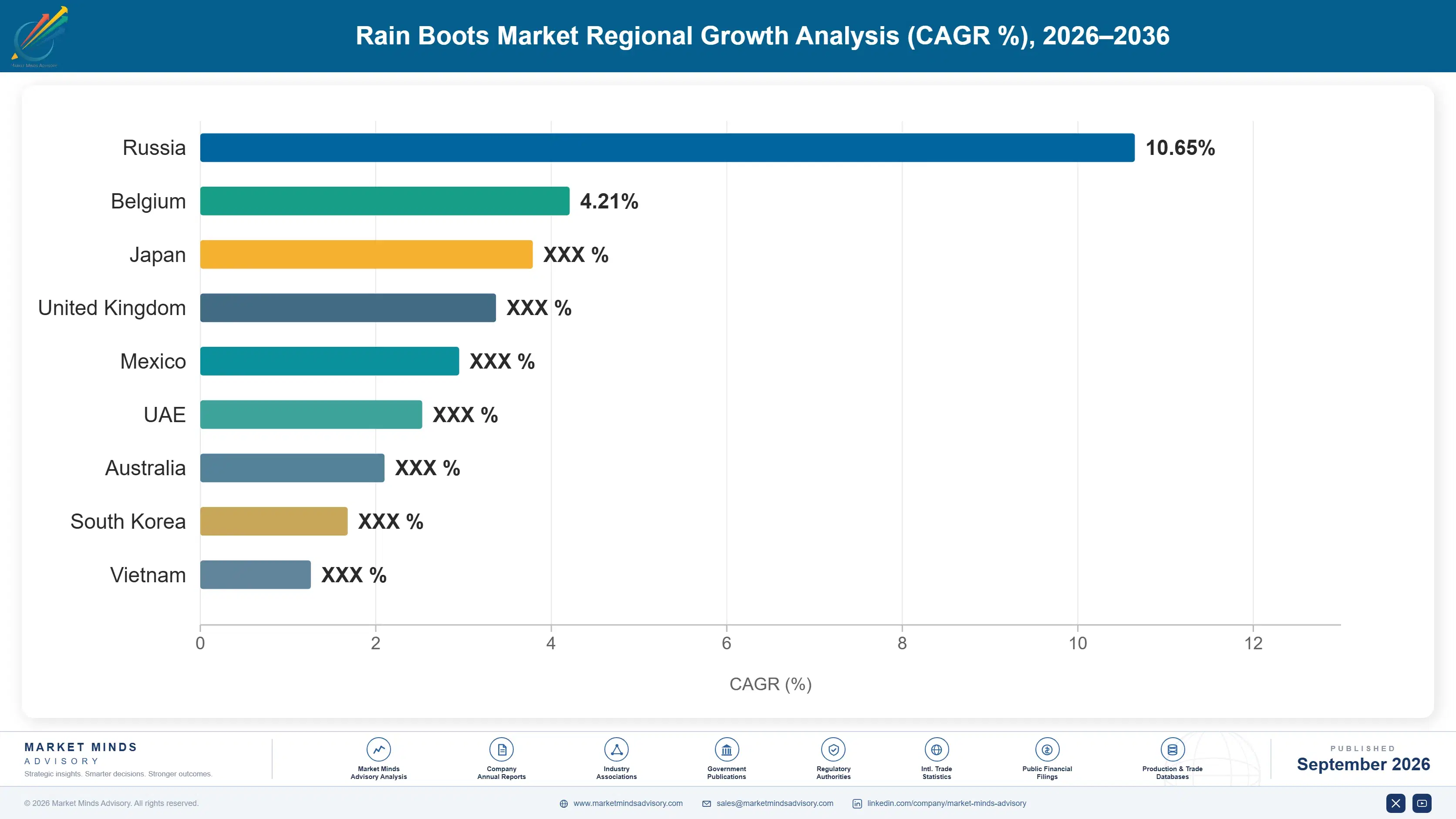
rain-boots-market-country-cagr-analysis-1790023478095

Four Moves Worth Making Now

These four address returns the category treats as unavoidable and a weather exposure it treats as fate. Each has been executed by at least one participant with measurable results, and three of the four cost printing or tooling amortisation rather than any change to how the boots are manufactured. The fourth costs a certification programme.

Explain The White Bloom On The Box

Roughly 17% of returns on natural rubber boots are antiozonant bloom mistaken for mould, and the compound is blended in deliberately to migrate to the surface and protect the rubber underneath. One explanatory sentence on the packaging and in the listing description removes the return cause almost entirely. Participants adding it report returns on rubber constructions falling by around 14 points, which on a worn boot that cannot be resold flows directly to contribution. The change costs an artwork revision and nothing recurring. Every returned example is a sound product.
Market Impact: Cuts rubber boot returns by roughly 14 points

Offer Two Calf Widths Across Core Sizes

Calf circumference is the leading rejection reason and boots are offered in one width per foot length, because each additional width needs a separate mould across every size. Tooling a second width on the highest-volume sizes costs far less than a full range and captures the customers currently leaving the category entirely. Participants offering two widths report sizing returns falling by roughly 31% and repeat purchase improving, since a buyer who found a boot that fits at the calf does not shop elsewhere next season. A buyer who found a boot that fits does not shop elsewhere.
Market Impact: Cuts sizing related returns by roughly 31% overall

Print Storage Guidance For Rubber Constructions

Natural rubber degrades under ultraviolet light and atmospheric ozone, so a boot stored in a sunlit porch or a warm garage can crack at the flex point before it has been worn much at all. Around 9% of products say anything about storage. Printing simple guidance costs nothing and materially extends product life, which matters commercially because a boot that cracked in storage produces a warranty contact and a lost customer. Participants providing it report warranty contacts on rubber lines falling by about 26%. A boot that cracked in storage costs the relationship as well as the warranty.
Market Impact: Cuts warranty contact volumes by roughly 26% overall

Build A Safety Rated Range To Offset Weather

Consumer sell-through correlates with regional rainfall at around 0.71, while agricultural and industrial demand follows replacement cycles that ignore weather completely. Participants carrying a safety-rated range report revenue variance across seasons roughly 42% lower than fashion-only competitors. Certification costs a testing programme and an industrial distribution relationship rather than new manufacturing, and requalification friction makes the resulting supplier position unusually durable once a specification has been written around it. Consumer sell-through correlates with rainfall at around 0.71 while replacement demand ignores it entirely, and the two businesses sit inside the same factory. Certification is the only barrier between them.
Market Impact: Cuts seasonal revenue variance by roughly 42% overall

Who Controls the Margin Pool

Concentration is low at 24% held by the top five, measured consistently on wholesale shipment value of wet-weather boots rather than on units, which would overweight low-cost polymer product enormously. The leader to challenger gap is wide in industrial distribution and safety certification, both of which take years to build, and narrow in moulding, where Chinese, Indian and Brazilian producers supply comparable consumer boots to anyone placing an order.
Competition runs on three dimensions currently. Safety certification decides access to agricultural and industrial demand, which is the steady half of this market. Brand and appearance decide consumer fashion volume in Western markets, where the purchase is occasion-led and weather-dependent. Price decides monsoon and agricultural volume across Asia and Latin America, where domestic manufacture holds permanent cost advantages that imported product cannot overcome.

Pressure is building on fashion-weighted participants and on natural rubber constructions. A category correlating with rainfall at 0.71 punishes anyone without a stabilising industrial business, and two dry seasons in the same territory have ended more than one brand. Rubber constructions also carry the storage degradation and bloom return costs that polymer and composite competitors simply do not face.
rain-boots-market-company-positioning-matrix-1790023478622

Competitive Moat and Risk Dimensions

ROCKY BRANDS

Moat: Industrial Distribution And Certification

Servus, Muck Boot and XTRATUF together reach agricultural, food processing, fishing and construction buyers through industrial distribution that consumer footwear brands cannot access, and safety certification across those ranges creates specification positions that survive purchasing reviews year after year. Requalifying certified footwear is administratively unpleasant enough that buyers rarely attempt it.
ROCKY BRANDS

Risk: North American Revenue Concentration

Revenue weighting toward North America places the business in a region holding only 18% of global category value, below its normal band, where waterproof shoes serve much of the occasion that dedicated rain boots serve elsewhere. Growth is concentrated in monsoon Asia where domestic manufacturers hold cost positions that are difficult to contest.
DUNLOP PROTECTIVE FOOTWEAR

Moat: Polyurethane Process Capability

Purpose-built polyurethane moulding capability produces boots that are lighter and warmer than rubber while avoiding the ozone degradation rubber suffers in storage, and European manufacturing supports the food safety and agricultural certifications that specification buyers require across multiple jurisdictions. Polyurethane also avoids the ozone degradation that makes rubber a liability in storage.
DUNLOP PROTECTIVE FOOTWEAR

Risk: Limited Consumer Brand Presence

Strength in specification-led industrial channels does not transfer into a consumer market where purchase is driven by appearance and by weather rather than by measurable performance. Building that presence requires design range breadth and seasonal retail relationships that an industrial manufacturer is not structured to carry.

Players Tracked

Prominent Players

Rocky Brands
Dunlop Protective Footwear
Hunter Boot
Weyco Group
Aigle

Other Key Players

Tretorn
Le Chameau
Ilse Jacobsen
Joules Group
Bekina Boots
Baffin
Genfoot
Crocs
Bata
Liberty Shoes
Relaxo Footwears
Authentic Brands Group
Nokian Footwear
Viking Footwear
Grubs Boots

Recent Developments

MARCH 2025

Rocky Brands expands XTRATUF distribution across agricultural channels

The company widened distribution for its wet-weather footwear brands into additional agricultural and food processing distributors across North America. This was organic commercial expansion involving no acquisition, joint venture or external distribution partner arrangement at any point. Consumer retail distribution was unaffected by the expansion.
Signal: Industrial channels are being deepened while consumer demand stays tied to rainfall. Weather exposure is being hedged deliberately.
NOVEMBER 2024

Dunlop expands polyurethane boot manufacturing in the Netherlands

The company added polyurethane moulding capacity at its European operations serving agricultural and food safety markets. This was organic capital investment funded internally, with no joint venture, acquisition or contract manufacturing partner involved in the project. Existing rubber production at the site continues alongside it.
Signal: Polyurethane capacity is expanding where rubber degradation makes it the better material. Material choice is being made on storage behaviour.
JUNE 2025

Bekina Boots signs North American agricultural distribution agreement

The company entered a multi-year distribution agreement covering North American agricultural and dairy channels for its complete polyurethane safety footwear range. The arrangement is a commercial distribution contract involving no equity stake, acquisition or joint venture structure whatever. European distribution arrangements continued unaffected throughout. No equity was involved.
Signal: European specification credibility is being exported into North American agricultural distribution. Specification credibility travels between agricultural markets.

What Wet Weather Boots Cost

Natural rubber accounts for roughly 31% of cost on rubber constructions, sourced from Thai, Indonesian and Vietnamese plantations and priced on an agricultural cycle unrelated to footwear. Vinyl resin and plasticiser dominate the value tiers at about 24%, tracking petrochemical feedstocks instead. Polyurethane systems and neoprene sit between the two. Moulding labour, lining textile, packaging and ocean freight take most of the remainder on a bulky product that ships badly.
The 2021 and 2022 period pressured both material routes at once from unrelated directions. Natural rubber prices rose on plantation labour shortage and shipping disruption across Southeast Asia while vinyl resin tracked petrochemical inflation upward, and container rates multiplied several times over on a product that packs badly. Rocky Brands reporting for that period identifies raw material and freight inflation as requiring repeated pricing action.

Exposure varies sharply by construction and by manufacturing location. Natural rubber producers carry agricultural exposure with no substitution at equivalent comfort. Vinyl and polymer producers carry petrochemical exposure that moves on entirely different cycles. Manufacturers producing in India, Brazil and China for their own domestic markets avoid the freight layer completely, which explains most of the gap between domestic and imported pricing.
rain-boots-market-cost-volatility-analysis-1790023478818

Hold both rubber and polymer constructions in the range

Natural rubber prices on agricultural cycles and vinyl on petrochemical ones, and the two rarely move together, which makes a single-material range unnecessarily exposed. Carrying both lets pricing and mix flex through either cycle. The requirement is that each construction is positioned honestly rather than presented as interchangeable to the buyer. Presenting them as interchangeable destroys the argument.

Mould nesting geometry into the shaft at design stage

Boots pack badly and ship on a product where freight is a large share of landed cost, and shaft geometry decided on appearance alone frequently wastes a third of the carton. Designing for nesting costs nothing at concept stage and cannot be retrofitted afterwards. Almost nobody raises packing density during a footwear design review.

Qualify moulding capacity in the destination market region

Wet-weather boots ship poorly and demand concentrates in monsoon and agricultural regions that have their own moulding capability. Qualifying local capacity removes the freight layer and shortens the pre-season lead time that weather-dependent buying makes so difficult. Minimum order quantity is the obstacle rather than technical capability anywhere. Pre-season lead time matters more here than in most footwear.

Portfolio Architecture for Margin Defence

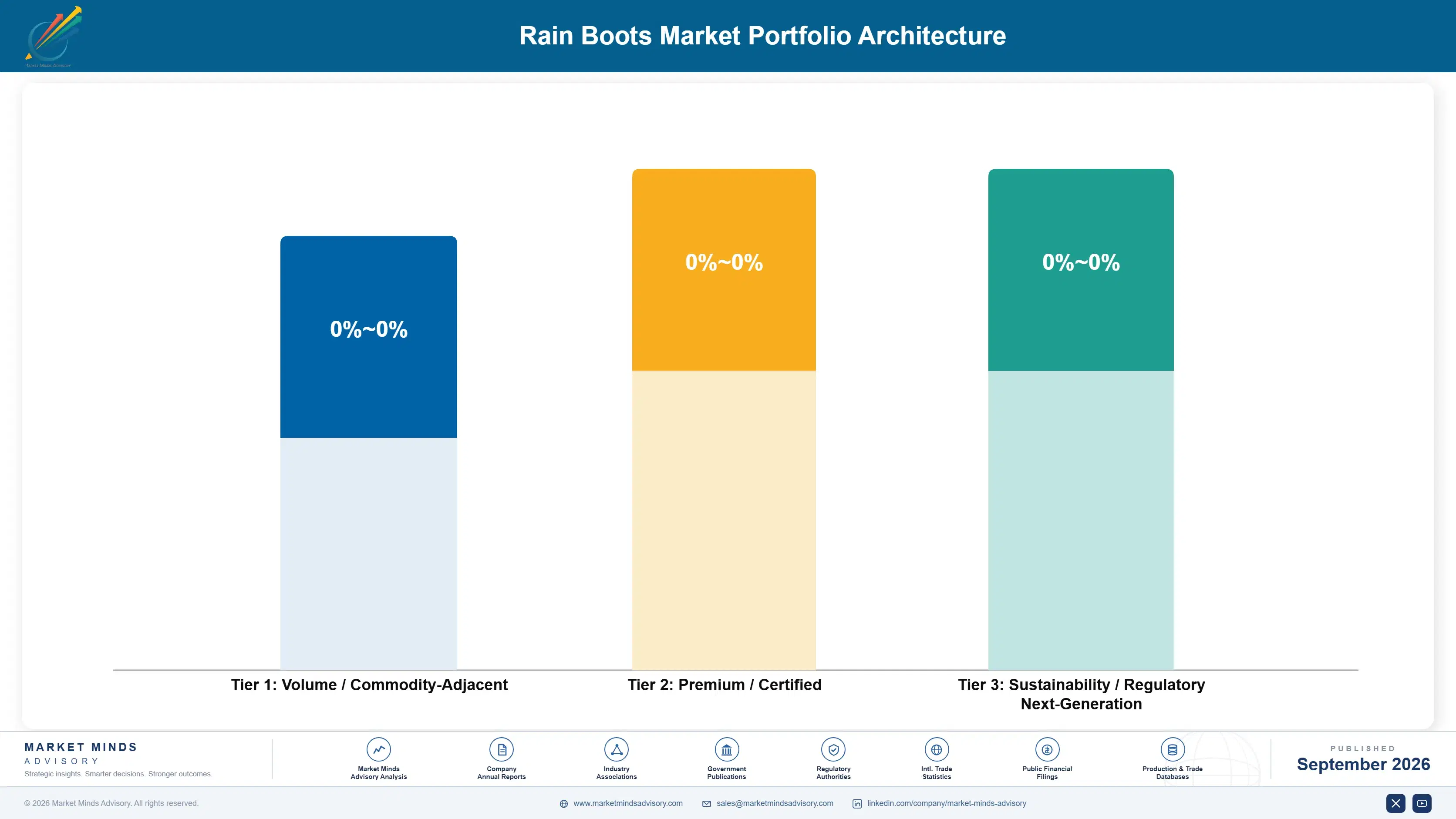
Margin architecture divides by whether a buyer specifies performance or chooses appearance, which produces an ordering most consumer footwear analysis misses. Value polymer and vinyl boots sold through mass, discount and online channels run at gross margins in the mid twenties to low thirties, competing against domestic manufacturers in every large market who avoid the freight these products carry so badly.
Consumer fashion rubber boots sold through footwear and department retail hold gross margins in the high thirties to mid forties. The spread reflects brand permission rather than construction, since two boots from similar moulding operations price far apart depending on the name on the pull tab. Those products also carry the storage degradation and bloom return costs that polymer constructions avoid entirely.

The highest-value pool sits in safety-certified agricultural and industrial product, at margins in the high forties to low fifties. Those buyers specify performance, replace on wear rather than on weather and requalify suppliers reluctantly, which makes the position durable in a way no fashion range achieves. Consumer volume fills the moulds. It does not smooth the revenue. One business swings with the sky and the other does not.

Volume / Commodity-Adjacent

Value polymer and vinyl boots sold through mass, discount and online channels. Domestic manufacturers in every large market avoid the freight these bulky products carry, which caps imported pricing entirely.
Gross Margin: 24 to 32%

Premium / Certified

Consumer fashion rubber boots sold through footwear and department retail. The eight-point range reflects brand permission rather than construction, and these carry storage and bloom return costs polymer avoids. Two similar boots price far apart on the pull tab.
Gross Margin: 38 to 46%

Sustainability / Regulatory / Next-Generation

Safety certified agricultural and industrial boots specified against standards. Buyers replace on wear rather than weather and requalify reluctantly, which makes the supplier position unusually durable once established. Weather has no influence on when they buy.
Gross Margin: 46 to 54%
rain-boots-market-portfolio-architecture-1790023479323

High-value Sub-segments and Strategic Watch-out

Safety Certified Industrial Ranges

High value and steady growth. Replacement runs on wear cycles measured in months and ignores rainfall completely, which is why participants carrying one report seasonal revenue variance roughly 42% below fashion-only competitors. Certification rather than manufacturing capability is the real barrier to entry in this segment.
Gross Margin: 48 to 54%

Neoprene Composite Constructions

High value and high growth at 7.8%. Neoprene bonded to a rubber shell insulates, stretches and seals at the calf without a gusset. Cut and bond capability rather than injection tooling decides who can participate here. Agricultural and equestrian buyers adopted this construction well before consumers did.
Gross Margin: 42 to 48%

Value Polymer And Vinyl Boots

Volume core across monsoon and agricultural markets, where domestic moulding avoids the freight imported product carries. It holds enormous unit volume at prices that support very little beyond the mould itself. Domestic moulding in India, Brazil and China avoids the freight that imported product carries so badly.
Gross Margin: 24 to 31%

Fashion Natural Rubber Boots

Strategic watch-out. These carry storage degradation, bloom returns and full weather exposure at a sell-through correlation of 0.71 with rainfall. The twelve-point range reflects how differently brand permission prices the same construction. Polymer and composite competitors face none of those particular costs at any point.
Gross Margin: 34 to 46%

What Actually Triggers Purchase

Consumer demand here is weather-triggered rather than wear-triggered, which makes it the least predictable major footwear category. Sell-through correlates with regional rainfall at roughly 0.71, and a dry autumn removes a selling season that cannot be recovered later because the need never arose. Retailers buy pre-season against a forecast, and two dry years leave inventory discounting.
Stickiness varies sharply by why the boot was bought. Agricultural and industrial buyers specified against a safety standard are the most loyal by a wide margin, because requalifying footwear is administratively unpleasant and the person wearing them has already adapted. Monsoon buyers replace annually on wear and select on price and weight. Fashion buyers in Western markets replace on appearance and brand, and a boot that cracked or bloomed in storage sends them elsewhere permanently.

Buyer behaviour shifted in one direction across consumer markets over the past five years. The cohort that bought premium natural rubber boots and then found them cracked after a dry summer has learned to ask what the boot is made from, and a meaningful share has moved to polymer or composite construction deliberately. That group treats material as a purchase criterion rather than a detail.
rain-boots-market-end-use-penetration-index-1790023479812

Where This Category Leaks

These are among the four positions where our research anticipates prominent divergence between winners and laggards over the coming forecast period. Each is grounded in the demand model, the regulatory perimeter, and the announced capacity pipeline.
01 / BLOOM EXPLANATION DISCIPLINE

Print one sentence about the white film

Roughly 17% of returns on natural rubber boots are antiozonant bloom mistaken for mould, and that compound is blended into the rubber deliberately so it will migrate to the surface and protect what is underneath. No pack explains it, so a customer opening a box after storage sees what looks like damage. Participants adding one explanatory sentence report returns on rubber constructions falling by around 14 points, on an artwork revision costing nothing recurring at all, and every example returned for this reason is entirely sound product.
02 / CALF WIDTH PROVISION

Size the part of the leg that decides fit

Rain boots are offered in one calf circumference per foot length while adult calf measurement varies far more than shoe size does, which makes it the leading rejection reason particularly in women's product. Each additional width requires a separate mould across every size, which is why nobody offers one. Tooling a second width on the highest-volume sizes only costs far less than a full range, and participants doing it report sizing returns falling by roughly 31% with repeat purchase improving alongside.
03 / STORAGE GUIDANCE PRINTING

Tell buyers where not to keep them

Natural rubber degrades under ultraviolet light and atmospheric ozone, so a boot left in a sunlit porch or a warm garage can crack at the flex point before it has been worn more than a few times. Around 9% of products say anything at all about storage. Printing simple guidance costs nothing and extends product life materially, and participants providing it report warranty contacts on rubber lines falling by about 26% with the customer relationship surviving intact, because a cracked boot costs the customer as well as the warranty.
04 / WEATHER EXPOSURE HEDGING

Build the business that ignores rainfall

Consumer sell-through correlates with regional rainfall at around 0.71 while agricultural and industrial demand follows wear cycles measured in months that take no account of weather at all. Participants carrying a safety-rated range report seasonal revenue variance roughly 42% below fashion-only competitors. Certification costs a testing programme and an industrial distribution relationship rather than new manufacturing, and requalification friction then makes that position unusually durable, and both businesses can run through one moulding operation without any conflict at all, and certification is the only real barrier between them.

Engagement Snapshot From the Field

A live engagement with an industry participant carrying material or product regulatory and market exposure ahead of a defining policy shift, showing how our research translates into a defensible multi-year portfolio strategy.
MARKET MINDS ADVISORY · CLIENT ENGAGEMENT SUMMARY
Rain Boots Producer Strategic Portfolio Review and Transition Roadmap 2026·Investment Scenario on Rain Boots Exposure Evaluation 2025-26
CLIENT PROFILE
A European footwear brand selling natural rubber rain boots through department, footwear and online retail across eight markets, with category revenue near USD 88 million (client-reported, unverified by MMA). The range was entirely natural rubber in a single calf width per size. No product carried storage guidance or any explanation of surface bloom, and no safety-certified range existed anywhere in the business.
STRATEGIC CHALLENGE
Revenue had swung by more than a third between consecutive years without any change in distribution or product, and two of the past four years had ended in heavy discounting. Management attributed the volatility to competitive pressure and had approved a brand investment programme. Nobody had correlated sell-through with rainfall or coded returns by cause.
MMA APPROACH
MMA correlated three years of weekly sell-through against regional rainfall data across eight markets, then coded two years of returns and warranty contacts against a failure taxonomy. Returned boots were examined to distinguish surface bloom from actual degradation. Calf circumference distribution was measured against the range's single width, and safety certification requirements were costed.
KEY FINDINGS
  1. Weekly sell-through correlated with regional rainfall at 0.74 across the eight markets, above the category figure, which explained essentially all of the revenue volatility management had attributed to competitors.
  2. Surface bloom accounted for 21% of returns and every examined example was sound product, with the antiozonant film performing exactly as the compound was blended to perform.
  3. Calf measurement across a sample of adult buyers spanned a range that a single moulded width could not accommodate, and sizing accounted for a further 29% of returns.
  4. No safety-certified product existed in the range, leaving the business fully exposed to a demand pattern it could not influence in any way.
CLIENT PROFILE
A European footwear brand selling natural rubber rain boots through department, footwear and online retail across eight markets, with category revenue near USD 88 million (client-reported, unverified by MMA). The range was entirely natural rubber in a single calf width per size. No product carried storage guidance or any explanation of surface bloom, and no safety-certified range existed anywhere in the business.
STRATEGIC CHALLENGE
Revenue had swung by more than a third between consecutive years without any change in distribution or product, and two of the past four years had ended in heavy discounting. Management attributed the volatility to competitive pressure and had approved a brand investment programme. Nobody had correlated sell-through with rainfall or coded returns by cause.
MMA APPROACH
MMA correlated three years of weekly sell-through against regional rainfall data across eight markets, then coded two years of returns and warranty contacts against a failure taxonomy. Returned boots were examined to distinguish surface bloom from actual degradation. Calf circumference distribution was measured against the range's single width, and safety certification requirements were costed.
KEY FINDINGS
  1. Weekly sell-through correlated with regional rainfall at 0.74 across the eight markets, above the category figure, which explained essentially all of the revenue volatility management had attributed to competitors.
  2. Surface bloom accounted for 21% of returns and every examined example was sound product, with the antiozonant film performing exactly as the compound was blended to perform.
  3. Calf measurement across a sample of adult buyers spanned a range that a single moulded width could not accommodate, and sizing accounted for a further 29% of returns.
  4. No safety-certified product existed in the range, leaving the business fully exposed to a demand pattern it could not influence in any way.
RECOMMENDED STRATEGY
Phase 1: Phase one: cancel the brand investment programme and add bloom explanation and storage guidance to all packaging and listings. Competitors were never the cause. Phase 2: Phase two: tool a second calf width across the six highest-volume sizes rather than the full range. Full range tooling is not required. Phase 3: Phase three: certify an agricultural range and build industrial distribution to offset the weather exposure. Replacement cycles there ignore rainfall completely.
OUTCOME
Returns fell from 34% to 19% across two seasons (client-reported, unverified by MMA), with bloom-related returns disappearing almost entirely after the packaging change. The certified agricultural range reached 14% of revenue in its first full year and materially reduced the swing between a wet season and a dry one.

Frequently Asked Questions

Foundational context covering the market sizes, CAGR, scope, country, region and competition that inform every finding below. This section is provided to cover basics and most often pre-purchase conversations, answered from the MMA Primary Research Dataset.

What is the current size of the Rain Boots Market?

The market was valued at USD 3.4 billion in 2025, rising to USD 3.6 billion in 2026. Sizing is at wholesale shipment value across six constructions and all end uses.

How large will the Rain Boots Market be by 2036?

MMA forecasts USD 6.0 billion by 2036, an increase of USD 2.4 billion over the 2026 base. That represents expansion of 1.67 times across the forecast period.

What is the CAGR for the Rain Boots Market 2026 to 2036?

The base case CAGR is 5.2%, with a bull case of 6.4% and a bear case of 4.0%. Historical growth between 2020 and 2025 ran at 4.1%.

Which segment is growing fastest?

Neoprene and rubber composite boots grow at 7.8%, half again the market rate, because they solve cold and flexibility together. Moulded polymer boots follow at 6.9%.

Who are the major companies in the Rain Boots Market?

Rocky Brands, Dunlop Protective Footwear, Hunter Boot, Weyco Group and Aigle lead on shipment value, holding a combined 24%. Domestic manufacturers dominate monsoon and agricultural volume in Asia and Latin America.

Which country is growing fastest?

India grows fastest at 8.1%, as monsoon footwear converts from improvised to purchased product and rural incomes rise across small-town markets. Domestic manufacture supplies nearly all of that demand at accessible prices.

Report Segmentation Architecture

The full report scope spans multiple orthogonal segmentation dimensions, with cross-tabulated demand data provided for each dimension pair. Coverage extends further to regional breakdowns, trend trajectories, and the competitive detail needed to support segment-level decision-making.

By Construction Material

  • Natural Rubber Moulded Boots
  • Vinyl Injection Moulded Boots
  • Polyurethane Moulded Boots
  • Neoprene and Rubber Composite Boots
  • Moulded Polymer Boots
  • Leather and Hybrid Wet-Weather Boots

By End-Use Application

  • Consumer Everyday Wear
  • Children and School Use
  • Agricultural and Dairy Work
  • Food Processing and Hygiene Areas
  • Construction and Groundwork
  • Fishing and Marine Work

By Distribution Channel

  • Footwear and Department Retail
  • Mass and Discount Retail
  • Agricultural and Farm Supply
  • Industrial Safety Distributors
  • Online Marketplaces
  • Brand Direct and Outdoor Specialty

By Region

  • East Asia
  • South Asia and Pacific
  • Western Europe
  • North America
  • Latin America
  • Middle East and Africa
  • Eastern Europe

Scope, Methodology, and Coverage

Every figure in this report is reproducible from documented input assumptions. The scope below maps the historical period, the forecast horizon, the segmentation dimensions, and the countries covered, alongside the underlying primary and qualitative methodology.
Historical Period
2020 to 2025
Forecast Period
2026 to 2036
Base Year
2025 (USD billions; MMA Primary Research Dataset, September 2026)
Market Definition
This market covers wet-weather boots worn over the ankle, spanning natural rubber moulded, vinyl injection moulded, polyurethane moulded, neoprene and rubber composite, moulded polymer, and leather or hybrid wet-weather constructions, across consumer, children, agricultural, food processing, construction and marine use. Sizing is at wholesale shipment value across footwear, mass, farm supply, industrial safety, marketplace and specialty channels. Waterproof hiking boots, waterproof trainers and shoes, snow and winter boots without a wet-weather primary function, overshoes and gaiters are excluded throughout.
Quantitative Units
USD billions at wholesale shipment value; volume in millions of pairs; calf circumference in centimetres.
Segmentation Dimensions
Construction material, end-use application, distribution channel, and geographic region.
Regions Covered
East Asia, South Asia and Pacific, Western Europe, North America, Latin America, Middle East and Africa, Eastern Europe
Countries Covered
China, India, United Kingdom, United States, Brazil, Japan
Key Companies Profiled
Rocky Brands, Dunlop Protective Footwear, Hunter Boot, Weyco Group, Aigle, Tretorn, Le Chameau, Ilse Jacobsen, Joules Group, Bekina Boots, Baffin, Genfoot, Crocs, Bata, Liberty Shoes, Relaxo Footwears, Authentic Brands Group, Nokian Footwear, Viking Footwear, Grubs Boots
Quantitative Methodology
Primary survey, n=3,800 respondents, Q4 2025, six countries; demand-side model with trade association cross-validation
Qualitative Methodology
47 expert interviews, Q4 2025; applied to validate demand model assumptions, identify emerging dynamics, and assess competitive positioning
Report Format
PDF and XLSX data workbook (Word format preview document)
Publisher
Market Minds Advisory
Report Code
MMA-2026-CON-786
Published
September 2026
Contact
sales@marketmindsadvisory.com | www.marketmindsadvisory.com

Purchase the full Rain Boots Market Report (2026 to 2036).

The full report sizes the rain boots market across six constructions, six end-use applications and six distribution channels for all seven global regions. It includes weekly sell-through correlated against regional rainfall data across major markets to quantify weather exposure by participant. Returns and warranty contacts are coded by cause, with returned product examined to separate antiozonant bloom from genuine degradation. Calf circumference distribution is measured against offered widths, and material cost is decomposed separately for rubber, vinyl, polyurethane and composite routes. Competitive assessment covers 20 participants on a consistent shipment value basis.
Sell-through correlated against regional rainfall data
Returns coded by cause with product examined
Calf circumference measured against offered widths
Material cost decomposed by construction route
Six boot constructions sized through 2036
Twenty participants assessed on wholesale shipment value

Built For The People Who Decide

From boardroom strategy to bench-side execution, this report is read cover-to-cover by leaders shaping the next decade of their industry, turning demand scenarios, market dynamics and valuation benchmarks into decisions.
CXOs/ Presidents/ VPs/ Managers
M&A and Corporate Development
Strategy Teams and R&D Heads
Procurement and Product Directors
Regulatory and Compliance Leaders
Investor Relations and Equity Analysts