Market Minds Advisory
Railway Horn Market

Railway Horn Market: A Regulated Sound Nobody Living Nearby Wants to Hear

Regulators write the specification, communities campaign against the noise, and the compromise between the two has created a stationary horn at the crossing that never sounds anywhere a train is not going.

Lead Analyst

David Horsley

Published

September 2026

Make Smarter Decisions with Customized Research Insights

Request a free sample report and evaluate market opportunities, growth trends, and competitive dynamics relevant to your business needs.

2025 MARKET VALUE$0.4BMarket Size 2025
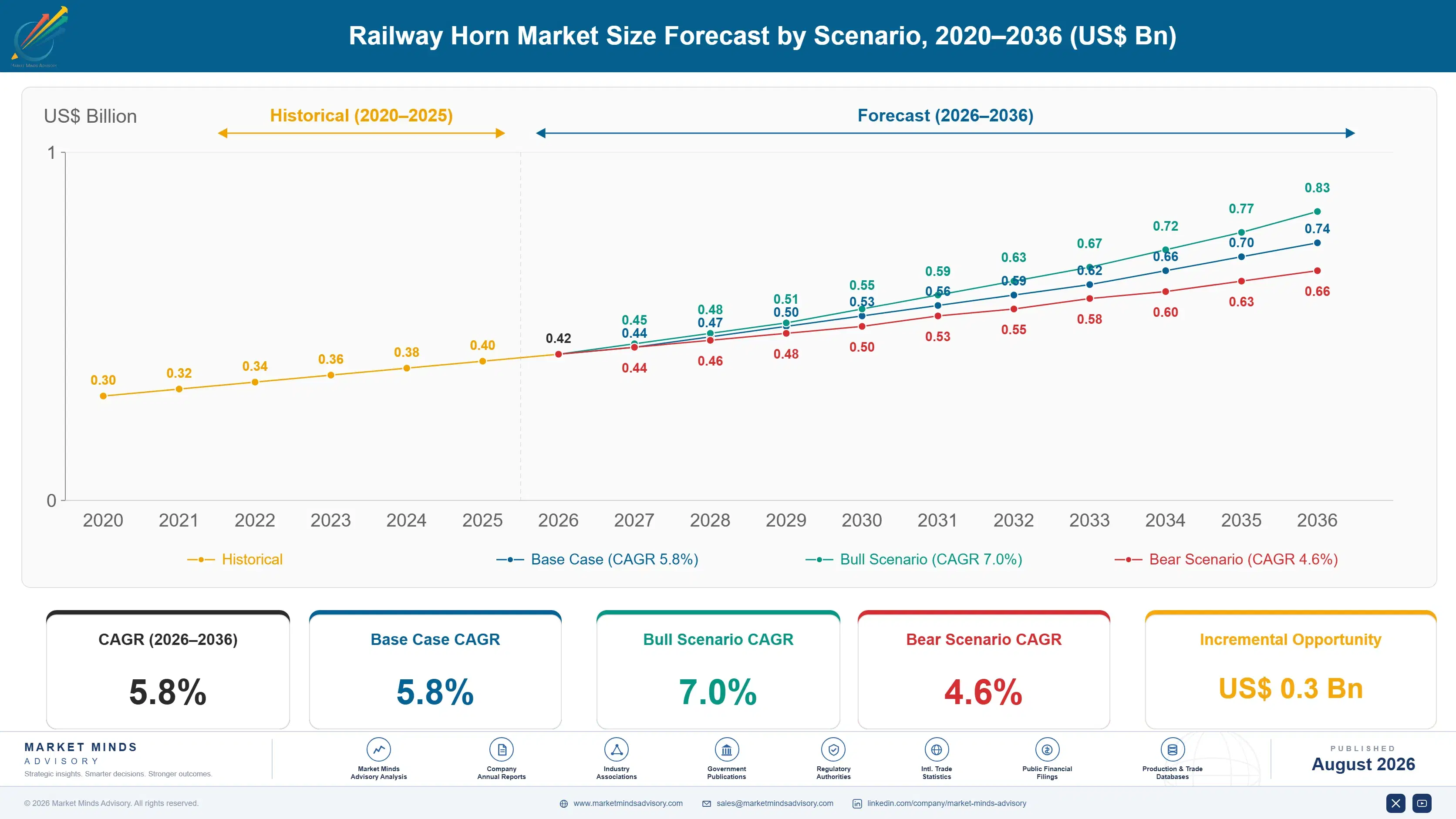
2036 FORECAST VALUE$0.8BBase Case , 2026 to 2036
CAGR 2026 TO 20365.8 %Bull 7.0% / Bear 4.6%
INCREMENTAL OPPORTUNITY$0.3BNet 10- year value creation
EXPANSION MULTIPLE1.75x2036 value over 2026 base
Strategic Levers
M&A Pipeline
Regional Outlook
Country Rankings
Competitive Intelligence
Segmental Deep-dive
Call-Us : 91 93563 13602

Executive Snapshot and Market Trajectory

A railway horn is a regulated device rather than a designed component. Sound pressure, frequency content and sounding pattern are all written into rule, typically between 96 and 110 decibels at a fixed distance, and no manufacturer improves on that by choice. Competition happens everywhere except the specification itself.
Communities near crossings have spent decades objecting, and the compromise that emerged is the wayside horn: a stationary unit at the crossing itself, aimed at road traffic rather than broadcast across a neighbourhood. It costs many times a locomotive-mounted unit and grows at 8.7%, half again the market rate of 5.8%, because it satisfies the regulator and the residents at once. Roughly 18% of North American crossings now sit inside a quiet zone.
Volume follows rolling stock production, which puts East Asia at 29% of value on Chinese locomotive, metro and trainset output that no other region approaches. India grows fastest at 9.6% on fleet expansion and crossing modernisation running together. The top five hold 38%, held there by national approval regimes rather than by anything at all to do with manufacturing a horn particularly well.
Market Definition
Audible warning devices fitted to rail vehicles or installed at level crossings, covering pneumatic multi-chime and single-chime horns, electric and electronic horns, wayside crossing horn systems, horn control and valve assemblies supplied as part of the device, and bells and auxiliary warning equipment. Measured at manufacturer selling value. Excludes visual crossing signals, barriers and gates, train protection systems, on-board announcement equipment and general industrial sounders.
Base Year Value
$0.4B in 2025 (MMA Primary Research Dataset, August 2026)
Forecast Period
2026 to 2036, eleven discrete annual values
CAGR
5.8% base case. Bull 7.0%. Bear 4.6%.
Fastest Growth Segment
Wayside Crossing Horn Systems: 8.7% CAGR
Fastest Growth Country
India: 9.6% CAGR
Fastest Growth Region
South Asia and Pacific: 8.0% CAGR
Largest Region
East Asia: 29% of 2025 global value
Market Leaders
Wabtec, Knorr-Bremse, Graham-White Manufacturing, Prime Manufacturing, Kahlenberg Industries. Source: MMA Primary Research Dataset, July 2026.
Primary Survey
n=3,800 procurement and R&D decision-makers, Q4 2025, six countries
Methodology
Demand-side build-up, cross-validated against public data, 47 expert interviews

Railway Horn Market Forecast Scenarios

railway-horn-market-size-forecast-scenario-1787594726345
Growth ran near 4.8% between 2020 and 2025, tracking rolling stock deliveries with a lag and rising as metro and light rail programmes came through in Asia. Quiet zone establishment in North America suppressed locomotive horn sounding without reducing fitment, since every vehicle still carries a horn regardless of where it may use it. Wayside installation grew steadily throughout as communities looked for something other than silence.
Base case 5.8% rests on three mechanisms. Wayside crossing systems keep expanding because they resolve the noise objection without removing the warning, which nothing else does. Electric and electronic horns gain share as battery, hydrogen and light rail vehicles arrive without the large compressed air systems pneumatic horns assume. And Indian and Chinese rolling stock production continues at volumes no other region approaches, at 9.6% growth in India alone, faster than anywhere else.
The bull case at 7.0% assumes wayside adoption spreads beyond North America into European and Asian networks facing similar community pressure, which would multiply the addressable value per crossing. The bear case at 4.6% is grade separation programmes removing level crossings faster than expected, which eliminates the wayside opportunity and the sounding requirement at the same time.

The Specification Belongs to the Regulator

Almost nothing about this product is a commercial decision. Output is mandated, typically between 96 and 110 decibels measured at a set distance, the sounding pattern at crossings is written into rule, and approval to supply is granted by a national authority rather than won from a customer. A manufacturer competes on reliability, service life and approval breadth, and on very little else.
TOP FIVE CONCENTRATION38%Approval regimes narrow the field more than manufacturing
MANDATED OUTPUT RANGE96 to 110 dBRegulated sound pressure measured at a fixed distance
QUIET ZONE CROSSING SHARE18%Crossings where routine horn sounding has been silenced
WAYSIDE SYSTEM COST RATIO22xSystem price against a single vehicle mounted unit
HORN SERVICE LIFE12 yearsTypical replacement interval across mainline locomotive fleets everywhere
AIR SYSTEM COST SHARE31%Horn assembly cost sitting in valves and plumbing
The tension that shapes the market is entirely external to it. A device designed to be heard half a mile away is heard by everyone within that radius, thousands of times a year, and communities have campaigned against it for decades. In North America roughly 18% of crossings now sit inside quiet zones where routine sounding has been silenced in exchange for supplementary protection at the crossing itself.
That created a product rather than destroying one. The wayside horn is mounted at the crossing and aimed along the road approach, so it warns drivers without broadcasting across a neighbourhood. It costs perhaps 22 times a vehicle-mounted unit, carries its own activation and health monitoring, and it is the only answer available that satisfies a regulator and a residents' association in the same document.
"Every manufacturer in this category describes a horn as a safety product, and then prices it like a fitting. The wayside business proves what the thing is actually worth when it is sold as a solution to a political problem rather than as a component on a bill of materials."
Director, Rail Vehicle Systems and Safety Equipment Practice · MMA Construction and Industrial Equipment Practice · August 2026

Market Trends

Wayside horn systems resolving the community noise objection commercially

Locomotive horns are heard by everyone within half a mile, thousands of times a year, and the resulting community pressure produced quiet zones covering roughly 18% of North American crossings. Wayside systems mount the horn at the crossing and aim it along the road approach, warning drivers without broadcasting across a neighbourhood. They cost perhaps 22 times a vehicle-mounted unit, carry activation and health monitoring, and grow at 8.7% because they are the only available answer that satisfies both a safety regulator and a residents' association at once. Very few suppliers make that comparison to the municipalities holding the budget.
Market Impact: Indian output growing at 9.6%
Electric horns advancing as vehicles lose their compressed air systems

Pneumatic horns assume a locomotive with a large main reservoir behind them, which battery, hydrogen and modern light rail vehicles frequently do not have. Electric and electronic horns grow at 7.4% as those fleets arrive, and they bring capabilities the pneumatic device cannot match, including directional output shaping and diagnostic reporting from the horn itself. The pneumatic installed base remains enormous and slow to turn over at twelve year replacement intervals, so this is a share shift measured across decades rather than a sudden substitution. Approval for electronic sound generation has been the slower part of the transition throughout.
Market Impact: Covers 18% quiet zone crossings

Market Opportunities and Growth Drivers

Asian rolling stock production sustaining the fitment demand base

Every rail vehicle built carries a horn regardless of where it will be permitted to sound it, which ties fitment demand directly to production volumes rather than to operating practice. Chinese locomotive, metro car and trainset output exceeds any other region by a wide margin, and Indian production grows fastest at 9.6% on fleet expansion running alongside network extension. Metro and light rail programmes across both countries add vehicles at rates that main line fleets alone would never generate. Fitment demand therefore tracks factory output rather than operating practice or network size.
Market Impact: Removes 22 times value crossings

Crossing modernisation programmes generating wayside and control demand

Networks upgrading level crossing protection replace passive crossings with active ones and add automated warning, which creates demand for wayside horn systems, control assemblies and health monitoring at the same crossings. Indian unmanned crossing elimination and European crossing renewal programmes both run on published multi-year schedules. The work is funded as safety spending rather than as rolling stock capital, which means it survives budget cycles that delay vehicle purchases considerably. Wayside installations, control assemblies and health monitoring all attach to the same upgraded crossing at once, which multiplies the value per site considerably beyond a simple warning device.
Market Impact: Fixed between 96 and 110 dB

Market Restraints and Challenges

Grade separation removing crossings and the sounding requirement together

Programmes replacing level crossings with bridges and underpasses eliminate the crossing, the horn sounding requirement and the wayside opportunity in a single project. The root cause is that grade separation solves safety, noise and road congestion simultaneously, which makes it politically attractive wherever the capital exists. Commercially it removes the highest value part of the market permanently rather than deferring it. Suppliers are responding by moving toward vehicle-mounted electronic systems and toward crossings that will not be separated for decades. Crossings unlikely to be separated for decades remain the durable part of that pool.
Market Impact: Priced at 22 times vehicle units

Regulated specification leaving almost no room for product differentiation

Sound pressure between 96 and 110 decibels, frequency content and sounding pattern are all written into national rule, so a manufacturer cannot design a better horn in any way the customer can specify. The root cause is that the product is a safety device whose performance must be identical across every vehicle a driver encounters. Commercially it pushes competition toward price on approved equivalents. Suppliers are differentiating on service life, diagnostics and approval breadth instead, which are the dimensions rule does not fix. Approval breadth is the other dimension, and it functions as a barrier rather than a feature.
Market Impact: Electric horns growing at 7.4%
3 additional market trends, 4 additional growth drivers, and 2 additional restraints and challenges are covered in the full report. Contact sales@marketmindsadvisory.com to access the complete intelligence.

Segment CAGR and Growth Architecture

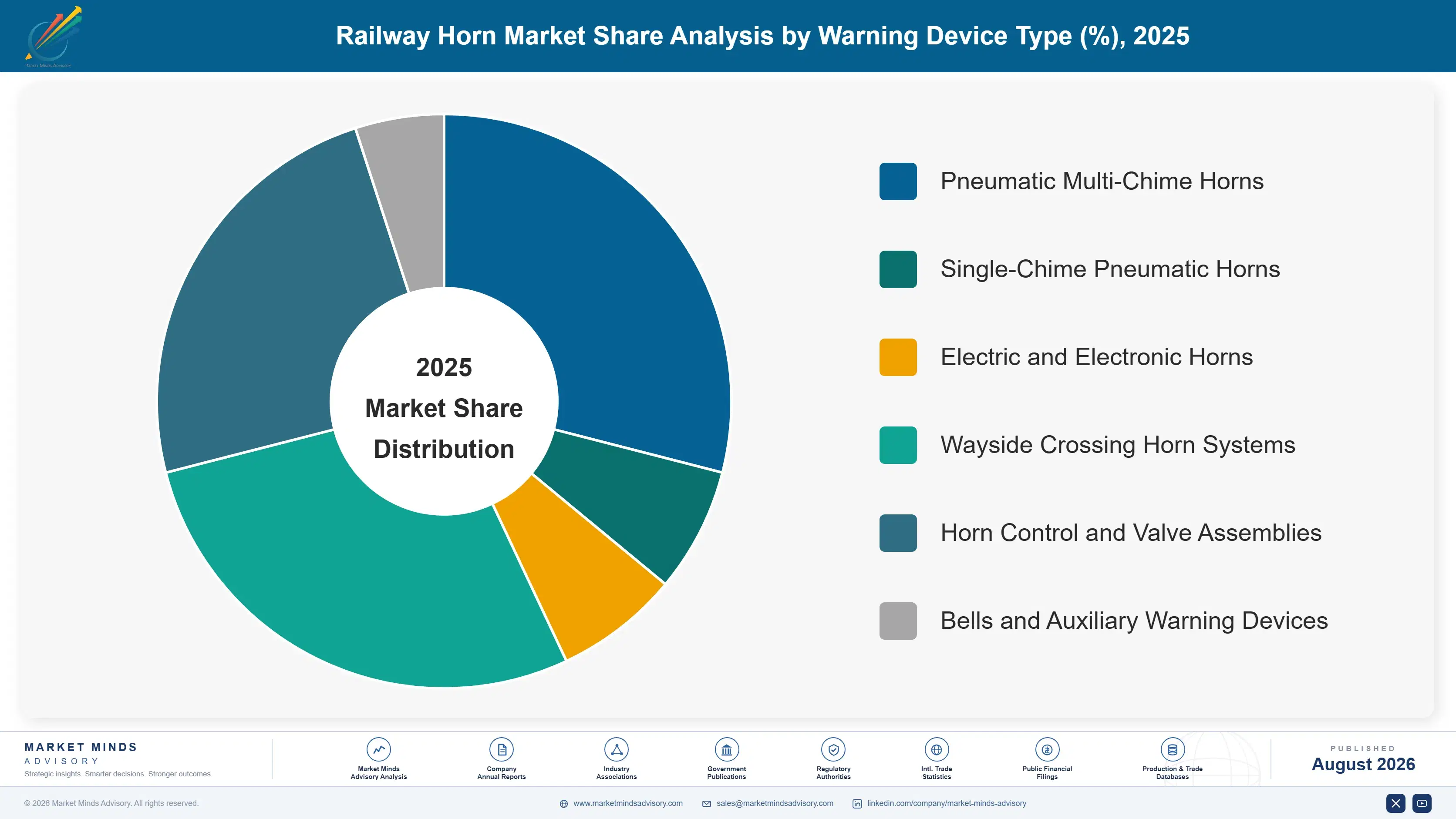
Six segments split by warning device product type, because each one carries a different actuation principle, a different mounting location and an entirely different approval route to market. A pneumatic chime and a monitored wayside installation answer the same rule through completely unrelated engineering. End-use vehicle type and channel are handled in the framework instead.
railway-horn-market-market-share-analysis-1787594726902

Wayside Crossing Horn Systems

Growing at 8.7%, half again the market rate of 5.8%, wayside systems mount the horn at the crossing and direct it along the road approach, which warns drivers without broadcasting across every property within half a mile. That is what makes quiet zones workable, and roughly 18% of North American crossings now sit inside one. The system carries activation logic, health monitoring and failure reporting rather than being a horn on a pole, which is why it costs perhaps 22 times a vehicle-mounted unit. It is bought as safety infrastructure by a crossing owner rather than as a component by a vehicle builder, which changes the entire commercial conversation. Installation and monitoring capability decide who can serve it.
CAGR 8.7%

Electric and Electronic Horns

At 7.4% electric horns gain share as battery, hydrogen and light rail vehicles arrive without the large compressed air reservoirs that pneumatic devices assume behind them. They offer directional output shaping, lower installed weight and diagnostic reporting the pneumatic device cannot provide, which matters more on urban vehicles than on freight locomotives. The pneumatic installed base is enormous and turns over slowly at twelve year replacement intervals, so this is a share shift measured across decades. Approval for electronic sound generation has been the slower part, since regulators specify acoustic output written for a mechanical chime. Regulators wrote acoustic requirements around a mechanical chime, and reconciling electronic output against them takes time no manufacturer can compress.
CAGR 7.4%
Full segment breakdown across 6 segments available in the complete report.

Regional Architecture and Country Demand Map

East Asia holds 29% of value on Chinese rolling stock production, which exceeds every other region by a very wide margin. North America follows at 24%, where wayside systems carry value out of proportion to units, with South Asia and Pacific at 14% on Indian fleet expansion.

North America

Quiet zone regulation is a North American invention and nothing comparable exists elsewhere, which is why wayside systems concentrate here and carry value out of proportion to unit volumes. Roughly 18% of crossings now sit inside a quiet zone, each requiring supplementary protection that a wayside horn provides at a fraction of the cost of four-quadrant gates. Federal rules fix sound pressure and the sounding pattern at crossings, leaving suppliers to compete on service life and approval breadth. Freight locomotive fleets renew horns on roughly twelve year intervals. Growth at 5.2% reflects wayside expansion against flat fitment volumes. Wayside installation and monitoring capability rather than horn manufacture decides who reaches that value.
Share: 24% | CAGR: 5.2% (2026 to 2036)

Western Europe

Share sits at 17% against a band of 18 to 26% because rolling stock production here, while technically advanced, runs at volumes well below Chinese output and fitment demand follows production rather than fleet size. Community noise pressure is intense, particularly in Germany and the Netherlands, and has driven route-level noise mitigation rather than the American quiet zone approach. National approval regimes differ enough that a horn approved in one country requires fresh work in the next. Light rail and tram vehicle production supports electric horn demand strongly. Growth of 4.2% runs below the base case throughout. Approval fragmentation across national regimes is the practical barrier to entry throughout the region.
Share: 17% | CAGR: 4.2% (2026 to 2036)
Regional intelligence for 5 additional markets available in the complete report: East Asia, South Asia and Pacific, Latin America, Middle East and Africa, Eastern Europe. Contact sales@marketmindsadvisory.com.
railway-horn-market-country-cagr-analysis-1787594727452

Four Moves on a Regulated Device

Nobody wins this market by building a better horn, because the regulator has already written what better means and then fixed it in national rule. What remains is where the device gets sold, who actually buys it, how long it lasts in service, and how many national approvals a supplier can carry at one time.

Sell wayside systems as crossing infrastructure, not components

A wayside installation costs perhaps 22 times a vehicle-mounted unit because it is bought by a crossing owner solving a political problem rather than by a vehicle builder filling a bill of materials line. Roughly 18% of North American crossings sit inside quiet zones and each needs supplementary protection that a wayside horn provides far more cheaply than four-quadrant gates. That comparison is the sale, and very few suppliers make it in those terms to the municipalities actually holding the budget. Installation and monitoring capability is what the municipal buyer is actually purchasing.
Market Impact: Captures 22 times the mounted unit value alone

Carry approvals across multiple national regimes at once

Sound pressure between 96 and 110 decibels and the sounding pattern are fixed by national rule, and a horn approved in one country requires fresh work in the next. That regime is why the top five hold 38% in a product nobody would call difficult to manufacture. Accumulating approvals is slow, unglamorous and almost perfectly defensive, since an unapproved competitor cannot bid at any price. It is the closest thing to a moat this category offers anybody. Approval work is spent years before revenue arrives, which is exactly why budgeting it annually underfunds it.
Market Impact: Protects a 38% top five concentration position outright

Design for the vehicles arriving without air systems

Battery, hydrogen and light rail vehicles frequently lack the large compressed air reservoirs pneumatic horns assume, and electric horns grow at 7.4% as those fleets arrive. Approval for electronic sound generation is the slow part, since regulators wrote acoustic requirements around a mechanical chime. A supplier through that approval process ahead of the fleet transition holds a position on vehicle platforms that will run for thirty years, which is considerably longer than the horn itself lasts. Approval timelines running above twenty-four months make the decision a timing question rather than a technical one.
Market Impact: Serves 7.4% annual growth across the electric range

Compete on service life where the specification is fixed

Output is mandated and identical across approved suppliers, which leaves reliability and replacement interval as the only performance dimensions a customer can actually choose between. Mainline replacement runs near twelve years, and a device holding calibration longer than that reduces both parts spend and maintenance labour on a fleet-wide basis. Operators respond to that arithmetic when it is presented properly, and almost nobody presents it, preferring to quote against an approved equivalent on unit price alone. A device holding calibration 3 years beyond a 12 year interval changes fleet parts spend materially.
Market Impact: Extends a 12 year replacement cycle even further

Who Controls the Margin Pool

Participation is measured on annual warning device production volume, and the top five hold 38%. Concentration comes from approval regimes rather than from manufacturing difficulty, since a horn is not a complex object to build but an unapproved one cannot be sold at any price. Wabtec leads through accumulated approvals and the heritage horn brands it acquired. The gap to challengers is regulatory position rather than acoustic or mechanical capability.
Competition runs on three fronts. Approval breadth decides which markets a supplier can enter at all. Service life decides the renewal argument, since output is fixed by rule and reliability is the only performance dimension left open. Wayside capability decides access to the crossing owner, who is a different buyer entirely and holds a budget the vehicle builder does not.

Pressure ahead comes from vehicle electrification removing the compressed air the pneumatic product assumes, and from grade separation removing crossings altogether. One reshapes the product and the other shrinks the highest value pool. Expect approval investment and electronic development rather than acquisitions. Rankings shift as electric approvals land and as Asian manufacture moves upward through the specification range.
railway-horn-market-company-positioning-matrix-1787594727969

Competitive Moat and Risk Dimensions

WABTEC

Moat: Accumulated national approval breadth

The company carries approvals across a wide set of national regimes for horn products acquired alongside long-established brands, which lets it bid in markets a competitor would need years of qualification work to enter. In a category where the specification itself is fixed by rule, holding the permission to supply is worth more than any engineering advantage available.
WABTEC

Risk: Pneumatic portfolio weighting

The strongest positions rest on pneumatic products designed around locomotives with large compressed air systems, which battery, hydrogen and light rail vehicles increasingly do not carry. Electronic sound generation approval is slow because regulators wrote requirements around a mechanical chime, and being late through that process costs platform positions lasting thirty years.
KNORR-BREMSE

Moat: Vehicle systems integration position

Knorr-Bremse supplies braking and air systems into the same vehicle programmes that specify horns, which means the horn enters an existing systems relationship rather than being tendered separately as a fitting. Vehicle builders value a single supplier across pneumatics, and that packaging is difficult for a horn-only manufacturer to compete against on any basis.
KNORR-BREMSE

Risk: Wayside market absence

The vehicle systems position offers no route to the crossing owner, who buys wayside installations as safety infrastructure at perhaps 22 times the value of a mounted unit. That buyer sits outside every relationship a vehicle systems supplier holds, and the fastest growing part of the market is reached through municipalities and infrastructure managers instead.

Players Tracked

Prominent Players

Wabtec
Knorr-Bremse
Graham-White Manufacturing
Prime Manufacturing
Kahlenberg Industries

Other Key Players

Hadley Products
Ellcon-National
Klaxon Signals
E2S Warning Signals
Pfannenberg
Auer Signal
Patlite
Werma Signaltechnik
Moflash Signalling
Sirena
Schaltbau Holding
CRRC
Escorts Kubota
Medha Servo Drives
Nabtesco

Recent Developments

JUNE 2026

Municipality selects wayside horn installation over four-quadrant gate protection

An American municipality established a quiet zone using wayside horn installations rather than four-quadrant gates, citing capital cost and the shorter approval path through the federal railroad regulator. The installation covered several crossings along a single freight route through residential districts. Approval ran through the federal regulator without difficulty.
Signal: Wayside horns win on the comparison against gates, which is the sale most suppliers never actually make
NOVEMBER 2025

European supplier secures electronic horn approval for battery vehicle platform

A European manufacturer obtained national approval for an electronically generated horn on a battery-electric regional vehicle platform, after an extended process reconciling electronic output against acoustic requirements written for mechanical chimes. The approval covers a vehicle platform expected to remain in service for three decades.
Signal: Electronic approval timing now decides vehicle platform positions that outlast the horn itself by twenty years
FEBRUARY 2026

Indian Railways expands crossing protection programme with warning equipment supply

Indian Railways expanded its level crossing protection programme, adding automated warning equipment and control assemblies at crossings converted from passive to active protection. Supply was awarded to domestic manufacturers working to national standards organisation specifications across several regional zones. Delivery runs across several years of scheduled programme work.
Signal: Crossing modernisation funded as safety spending survives the budget cycles that routinely delay rolling stock purchases

Brass, Valves and Approval Time

Machined metal components account for roughly 34% of pneumatic horn cost, principally brass and stainless bells and diaphragm housings from regional machining suppliers. Valves, plumbing and actuation carry about 31%, which is why a horn assembly costs considerably more than the sounding element alone would suggest. Electronics and drivers add around 14% on electric products, with assembly, testing and acoustic verification taking the balance across both product families.
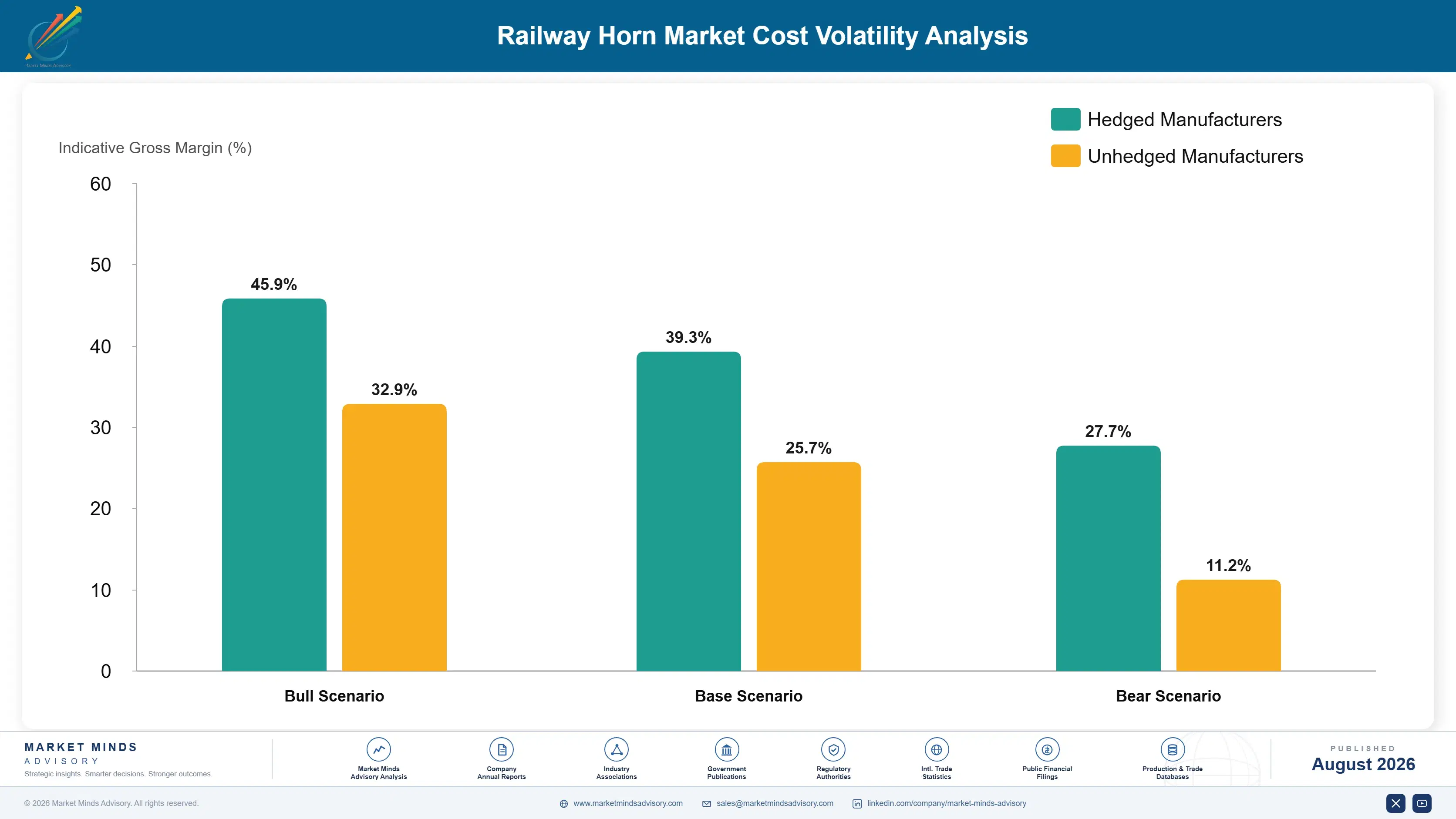
Copper and brass pricing rose sharply through 2021 and 2022 on demand and supply disruption, per EIA and national statistical office commodity reporting for the period, which compressed margins on fixed-price vehicle programme agreements running several years. Electronic component shortages across the same period delayed electric horn deliveries independently, so the two exposures landed on different product families rather than compounding on a single one.

Exposure divides on product family and on programme contracting. A supplier weighted toward pneumatic products carries metal price exposure across two thirds of cost with little ability to reprice inside a vehicle programme agreement. Electric products carry electronics exposure instead, which moves on availability more than on price. Approval cost is the hidden exposure across both families.
railway-horn-market-cost-volatility-analysis-1787594728167

Index vehicle programme agreements to published metal references

Machined metal and valve components together carry around two thirds of pneumatic horn cost, and vehicle programme agreements commonly run several years with limited repricing. Indexing to published copper and brass references passes movement through with a defined lag. Vehicle builders accept indexation more readily on component supply than they accept a mid-programme price request.

Run pneumatic and electric product families in parallel

Metal pricing and electronic component availability move on entirely unrelated cycles, so a supplier holding both families can shift emphasis as one deteriorates. The development and approval cost of maintaining two families is the obstacle. Suppliers running only pneumatic products carry metal exposure across most of their cost base with no offset available anywhere.

Treat approval spending as a multi-year capital programme

Approval work is spent years before revenue arrives and is the reason the top five hold 38% of a market for a simple device. Budgeting it annually against current revenue systematically underfunds it. Treating national approvals as a capital programme with its own return horizon is how the leading suppliers built positions competitors cannot now attack.

Portfolio Architecture for Margin Defence

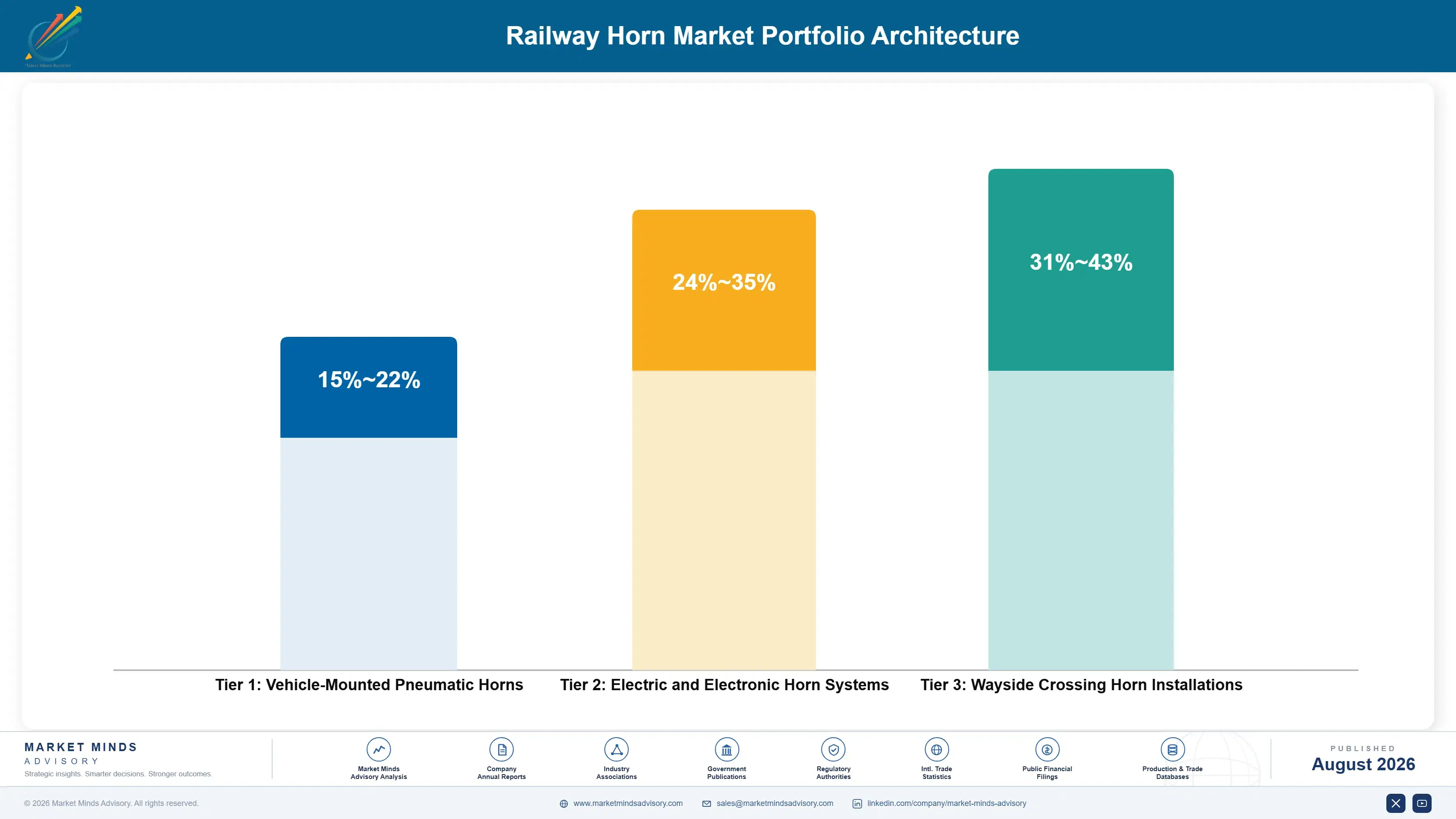
Margin here tracks who the buyer is far more than what the product costs to make. Vehicle-mounted pneumatic horns supplied into builder programmes earn margins in the mid to high teens, because they are tendered as a component line against approved equivalents and the vehicle builder compares unit prices on a spreadsheet. Service life is the only dimension left open, and almost nobody argues it properly.
Electric and electronic horns do better in the mid twenties to mid thirties, because approval for electronic sound generation is slow and the supplier through that process faces fewer approved equivalents to be compared against. The range reflects approval breadth and whether diagnostic capability is genuinely used by the operator or merely offered. Platform positions won at approval can run for thirty years.

Wayside crossing systems hold the strongest position, reaching into the low forties, because the buyer is a crossing owner solving a community problem and the comparison being made is against four-quadrant gates rather than against another horn. Those margins reflect a different purchasing conversation entirely, not a different manufacturing capability. Installation and monitoring rather than hardware supply is what the buyer is paying for.

Vehicle-Mounted Pneumatic Horns

Multi-chime and single-chime pneumatic horns supplied into vehicle builder programmes. The seven point range reflects programme scale and machining position rather than product difference, since regulated output is identical across approved suppliers.
Gross Margin: 15-22%

Electric and Electronic Horn Systems

Electrically driven and electronically generated horns for vehicles without large air systems. The eleven point range reflects approval breadth and whether the diagnostic capability offered is actually used by the operating railway.
Gross Margin: 24-35%

Wayside Crossing Horn Installations

Crossing-mounted directional systems with activation logic and health monitoring, bought as safety infrastructure. The twelve point range reflects how completely the supplier handles installation and monitoring rather than supplying hardware alone.
Gross Margin: 31-43%
railway-horn-market-portfolio-architecture-1787594728669

High-value Sub-segments and Strategic Watch-out

Wayside Crossing Horn Systems

High value and the fastest growth at 8.7%, since the buyer is a crossing owner comparing the system against four-quadrant gates rather than against another horn. Roughly 18% of North American crossings already sit inside a quiet zone requiring supplementary protection. Municipal purchasing routes are unfamiliar to most suppliers.
Gross Margin: 33-43%

Electronic Horns for New Vehicle Platforms

High value and growing at 7.4% as battery, hydrogen and light rail vehicles arrive without compressed air systems. Approval timing decides platform positions that will run for thirty years, considerably longer than the device fitted to them lasts. Approval work is the barrier and it cannot be compressed.
Gross Margin: 26-35%

Pneumatic Vehicle-Mounted Horns

The volume core, tendered against approved equivalents where regulated output is identical between suppliers. Service life is the only performance dimension left open, and very few suppliers present that argument to an operator properly. Regulated output makes every approved supplier interchangeable on paper. Unit price becomes the default comparison.
Gross Margin: 15-22%

Crossing-Dependent Demand

The strategic watch-out. Grade separation removes the crossing, the sounding requirement and the wayside opportunity together, and the eighteen point range reflects how differently suppliers are exposed across their own installed crossing base. Grade separation solves safety, noise and congestion at once, which makes it politically attractive.
Gross Margin: 20-38%

Fitment, Then Renewal Forever

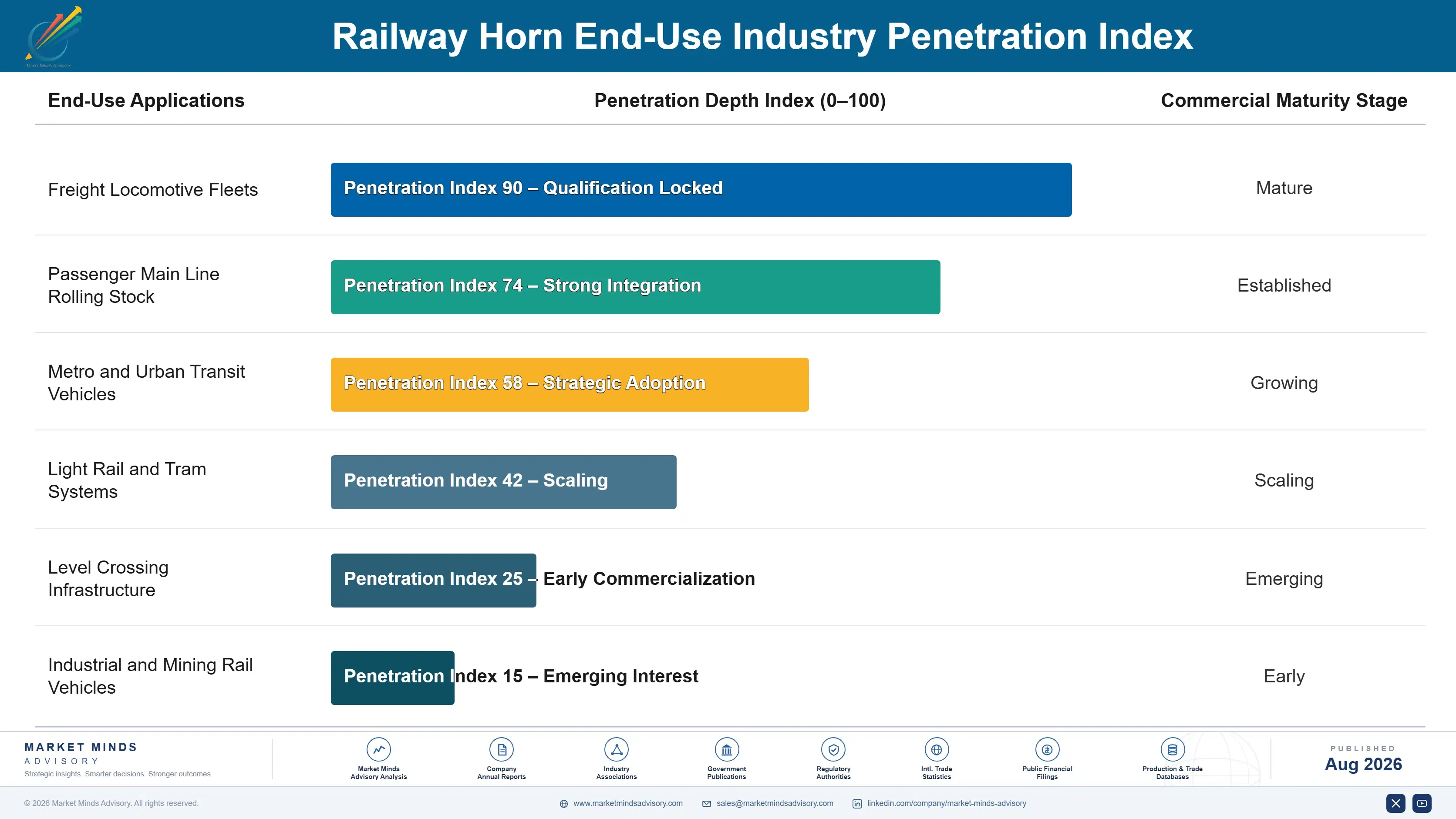
Demand arrives twice from every vehicle: once at build and repeatedly across service life on roughly twelve year replacement intervals. The renewal stream is larger than fitment in any mature fleet and considerably more predictable, since it depends on fleet size and maintenance policy rather than on capital programmes that stop and start. A supplier holding the original fitment position usually holds the renewal unless an operator deliberately qualifies an alternative.
Stickiness varies sharply with buyer type. A horn approved onto a vehicle platform runs for the life of the platform, which can be thirty years, because requalifying a safety device against national rule is work nobody undertakes for a small unit saving. Wayside installations are stickier still, since the crossing owner has a monitored system rather than a component. Aftermarket replacement is the loosest, switching on price between approved equivalents.

The buyer has been widening rather than changing. Vehicle builders and fleet maintenance departments have always specified horns and still do. What is new is the crossing owner: a municipality or infrastructure manager buying wayside systems as a solution to community pressure, holding a safety budget and comparing the installation against gates rather than against another horn.
railway-horn-market-end-use-penetration-index-1787594729158

Where We Would Focus Effort

These are among the four positions where our research anticipates prominent divergence between winners and laggards over the coming forecast period. Each is grounded in the demand model, the regulatory perimeter, and the announced capacity pipeline.
01 / CROSSING OWNER ACCESS

Sell against gates, not against another horn

A wayside installation costs perhaps 22 times a vehicle-mounted unit because the buyer is a crossing owner solving a political problem rather than a builder filling a bill of materials line. Roughly 18% of North American crossings already sit inside quiet zones needing supplementary protection that wayside horns provide far more cheaply than four-quadrant gates do. That comparison is the entire sale, and very few suppliers make it in those terms to the municipalities actually holding the safety budget and making the decision.
02 / NATIONAL APPROVAL ACCUMULATION

Permission to supply beats any engineering advantage

Sound pressure between 96 and 110 decibels and the crossing sounding pattern are fixed in national rule, so an approved horn is functionally identical to every other approved horn on offer. That regime is precisely why the top five hold 38% of a market for a device nobody would describe as difficult to manufacture. Accumulating approvals is slow and unglamorous and almost perfectly defensive, since an unapproved competitor cannot bid at any price it chooses to name, regardless of capability.
03 / ELECTRIC PLATFORM TIMING

Be approved before the air system disappears

Battery, hydrogen and light rail vehicles frequently lack the large compressed air reservoirs that pneumatic horns assume, and electric horns grow at 7.4% as those fleets arrive on the network. Approval for electronically generated sound is the slow part, because regulators wrote acoustic requirements around a mechanical chime and reconciling the two takes time. A supplier through that process ahead of the transition holds platform positions running thirty years, far longer than the device itself will ever survive in service.
04 / SERVICE LIFE ARGUMENT

Reliability is the only dimension regulation leaves open

Regulated output is identical across every approved supplier, which leaves replacement interval and maintenance labour as the only performance dimensions an operator can genuinely choose between. Mainline replacement runs near twelve years, and a device holding calibration longer reduces parts spend and shop labour across an entire fleet at once. Operators respond to that arithmetic when somebody presents it, and almost nobody does, preferring to quote against an approved equivalent on unit price and hoping to be cheapest on the day.

Engagement Snapshot From the Field

A live engagement with an industry participant carrying material or product regulatory and market exposure ahead of a defining policy shift, showing how our research translates into a defensible multi-year portfolio strategy.
MARKET MINDS ADVISORY · CLIENT ENGAGEMENT SUMMARY
Railway Horn Producer Strategic Portfolio Review and Transition Roadmap 2026·Investment Scenario on Railway Horn Exposure Evaluation 2025-26
CLIENT PROFILE
A North American manufacturer of pneumatic warning devices supplying locomotive and freight car horns, with annual revenue near 54 million dollars (client-reported, unverified by MMA). Sales were made almost entirely to vehicle builders and railroad maintenance departments on unit price against approved equivalents, and the company had no wayside product or electronic horn approval at all.
STRATEGIC CHALLENGE
Fitment volumes had been flat for six years while a competitor's wayside business grew steadily in the same territory, selling to municipalities the client had never contacted. Management needed to decide whether wayside was reachable, whether electronic approval was worth pursuing, and which of the two mattered more over the coming decade.
MMA APPROACH
MMA sized quiet zone establishment against remaining eligible crossings, benchmarked wayside installation economics against four-quadrant gate alternatives, assessed electronic approval timelines with two national authorities, and mapped the municipal purchasing route the client had never used. Interviews with 47 experts covered crossing safety, rail vehicle systems and municipal infrastructure procurement.
KEY FINDINGS
  1. Eligible crossings for quiet zone establishment considerably exceeded those already converted, and wayside installations undercut four-quadrant gates by a wide margin on capital cost in every case examined.
  2. The municipal purchasing route required capability the client entirely lacked, including installation, commissioning and ongoing health monitoring rather than hardware supply alone.
  3. Electronic horn approval would take roughly twenty-six months and reach vehicle platforms with thirty year service lives, but almost none of those platforms were in the client's existing customer base.
  4. Competitor wayside revenue per crossing exceeded the client's annual revenue from an entire regional railroad fleet, on a customer relationship that took under a year to establish.
CLIENT PROFILE
A North American manufacturer of pneumatic warning devices supplying locomotive and freight car horns, with annual revenue near 54 million dollars (client-reported, unverified by MMA). Sales were made almost entirely to vehicle builders and railroad maintenance departments on unit price against approved equivalents, and the company had no wayside product or electronic horn approval at all.
STRATEGIC CHALLENGE
Fitment volumes had been flat for six years while a competitor's wayside business grew steadily in the same territory, selling to municipalities the client had never contacted. Management needed to decide whether wayside was reachable, whether electronic approval was worth pursuing, and which of the two mattered more over the coming decade.
MMA APPROACH
MMA sized quiet zone establishment against remaining eligible crossings, benchmarked wayside installation economics against four-quadrant gate alternatives, assessed electronic approval timelines with two national authorities, and mapped the municipal purchasing route the client had never used. Interviews with 47 experts covered crossing safety, rail vehicle systems and municipal infrastructure procurement.
KEY FINDINGS
  1. Eligible crossings for quiet zone establishment considerably exceeded those already converted, and wayside installations undercut four-quadrant gates by a wide margin on capital cost in every case examined.
  2. The municipal purchasing route required capability the client entirely lacked, including installation, commissioning and ongoing health monitoring rather than hardware supply alone.
  3. Electronic horn approval would take roughly twenty-six months and reach vehicle platforms with thirty year service lives, but almost none of those platforms were in the client's existing customer base.
  4. Competitor wayside revenue per crossing exceeded the client's annual revenue from an entire regional railroad fleet, on a customer relationship that took under a year to establish.
RECOMMENDED STRATEGY
Phase 1: Phase one: build wayside installation and monitoring capability rather than hardware alone, since the municipal buyer purchases an outcome and not a component. Phase 2: Phase two: begin electronic horn approval with one national authority, accepting a twenty-six month horizon against thirty year platform positions. Phase 3: Phase three: hold pneumatic fitment volume without defending it on price alone, since regulated output makes every approved supplier interchangeable anyway.
OUTCOME
The manufacturer completed its first municipal wayside installations during 2026 and reported revenue per crossing consistent with the modelled comparison against gate alternatives (client-reported, unverified by MMA). Electronic approval work began with one authority, and pneumatic volume held broadly flat as expected. Municipal relationships took under a year to establish.

Frequently Asked Questions

Foundational context covering the market sizes, CAGR, scope, country, region and competition that inform every finding below. This section is provided to cover basics and most often pre-purchase conversations, answered from the MMA Primary Research Dataset.

What is the current size of the Railway Horn Market?

MMA sizes it at USD 0.42 billion in 2025, rising to USD 0.44 billion in 2026. The figure covers audible warning devices on rail vehicles and at level crossings, measured at manufacturer selling value.

How large will the Railway Horn Market be by 2036?

USD 0.77 billion by 2036, an incremental USD 0.33 billion over the 2026 base and an expansion multiple of 1.75 times. Wayside systems account for a disproportionate share of that growth.

What is the CAGR for the Railway Horn Market 2026 to 2036?

5.8% in the base case, with a bull case at 7.0% and a bear case at 4.6%. The spread turns on wayside adoption outside North America and on grade separation pace.

Which segment is growing fastest?

Wayside crossing horn systems at 8.7%, half again the market rate of 5.8%. They warn drivers without broadcasting across a neighbourhood, which is what makes quiet zones workable.

Who are the major companies in the Railway Horn Market?

Wabtec, Knorr-Bremse, Graham-White Manufacturing, Prime Manufacturing and Kahlenberg Industries lead on warning device production volume. Fifteen further participants are profiled in the full report on that basis.

Which country is growing fastest?

India at 9.6%, combining rolling stock production growth with a level crossing protection programme converting passive crossings to active protection right across the national network.

Report Segmentation Architecture

The full report scope spans multiple orthogonal segmentation dimensions, with cross-tabulated demand data provided for each dimension pair. Coverage extends further to regional breakdowns, trend trajectories, and the competitive detail needed to support segment-level decision-making.

By Warning Device Type

  • Pneumatic Multi-Chime Horns
  • Single-Chime Pneumatic Horns
  • Electric and Electronic Horns
  • Wayside Crossing Horn Systems
  • Horn Control and Valve Assemblies
  • Bells and Auxiliary Warning Devices

By End-Use Industry

  • Freight Locomotive Fleets
  • Passenger Main Line Rolling Stock
  • Metro and Urban Transit Vehicles
  • Light Rail and Tram Systems
  • Level Crossing Infrastructure
  • Industrial and Mining Rail Vehicles

By Commercial Dimension

  • Vehicle Builder Programme Supply
  • Operator Maintenance Contracts
  • Municipal and Infrastructure Procurement
  • Distributor and Stockist Channels
  • Retrofit and Upgrade Projects
  • Export and Cross-Border Supply

By Region

  • North America
  • Western Europe
  • East Asia
  • South Asia and Pacific
  • Latin America
  • Middle East and Africa
  • Eastern Europe

Scope, Methodology, and Coverage

Every figure in this report is reproducible from documented input assumptions. The scope below maps the historical period, the forecast horizon, the segmentation dimensions, and the countries covered, alongside the underlying primary and qualitative methodology.
Historical Period
2020 to 2025
Forecast Period
2026 to 2036
Base Year
2025 (USD billions; MMA Primary Research Dataset, August 2026)
Market Definition
Audible warning devices fitted to rail vehicles or installed at level crossings, covering pneumatic multi-chime and single-chime horns, electric and electronic horns, wayside crossing horn systems including activation and monitoring, horn control and valve assemblies supplied as part of the device, and bells and auxiliary warning equipment. Measured at manufacturer selling value across all vehicle and infrastructure applications. Visual crossing signals, barriers and gates, train protection systems, on-board announcement equipment and general industrial sounders are excluded from scope.
Quantitative Units
USD billions (current prices); thousand warning devices; USD per device by product type
Segmentation Dimensions
Warning device type; end-use vehicle or infrastructure; commercial dimension; region
Regions Covered
North America, Western Europe, East Asia, South Asia and Pacific, Latin America, Middle East and Africa, Eastern Europe
Countries Covered
China, Japan, South Korea, India, Indonesia, Vietnam, Australia, United States, Canada, Mexico, Germany, France, United Kingdom, Netherlands, Italy, Poland, Czech Republic, Saudi Arabia, United Arab Emirates, Brazil
Key Companies Profiled
Wabtec, Knorr-Bremse, Graham-White Manufacturing, Prime Manufacturing, Kahlenberg Industries, Hadley Products, Ellcon-National, Klaxon Signals, E2S Warning Signals, Pfannenberg, Auer Signal, Patlite, Werma Signaltechnik, Moflash Signalling, Sirena, Schaltbau Holding, CRRC, Escorts Kubota, Medha Servo Drives, Nabtesco
Quantitative Methodology
Primary survey, n=3,800 respondents, Q4 2025, six countries; demand-side model with trade association cross-validation
Qualitative Methodology
47 expert interviews, Q4 2025; applied to validate demand model assumptions, identify emerging dynamics, and assess competitive positioning
Report Format
PDF and XLSX data workbook (Word format preview document)
Publisher
Market Minds Advisory
Report Code
MMA-2026-CON-111
Published
August 2026
Contact
sales@marketmindsadvisory.com | www.marketmindsadvisory.com

Purchase the full Railway Horn Market Report (2026 to 2036).

The full report treats the horn as a regulated device whose specification belongs to national authorities rather than to manufacturers, and maps approval regimes across every major network as the actual barrier to entry. It sizes all six device types independently through 2036, models wayside installation economics against four-quadrant gate alternatives at crossing level, and assesses electronic approval timelines against the vehicle platform transitions they gate. Regional chapters cover all seven regions, following rolling stock production and crossing counts rather than network size. Competitive profiling covers 20 participants on a single production volume basis.
Six warning device types sized independently through 2036
National approval regimes mapped as the real barrier
Wayside economics modelled against four-quadrant gate alternatives
Electronic approval timelines assessed against platform transitions
Twenty participants profiled on one consistent basis
Demand tracked to rolling stock output and crossing counts

Built For The People Who Decide

From boardroom strategy to bench-side execution, this report is read cover-to-cover by leaders shaping the next decade of their industry, turning demand scenarios, market dynamics and valuation benchmarks into decisions.
CXOs/ Presidents/ VPs/ Managers
M&A and Corporate Development
Strategy Teams and R&D Heads
Procurement and Product Directors
Regulatory and Compliance Leaders
Investor Relations and Equity Analysts