Market Minds Advisory
Railway Fishplates Market

Railway Fishplates Market: Selling Into the Track Everyone Is Trying to Eliminate

Continuous welded rail exists specifically to remove the bolted joint, yet around 31% of world route kilometres still run on one, and every signalling block boundary needs a joint no welding can replace.

Lead Analyst

David Horsley

Published

September 2026

Make Smarter Decisions with Customized Research Insights

Request a free sample report and evaluate market opportunities, growth trends, and competitive dynamics relevant to your business needs.

2025 MARKET VALUE$1.4BMarket Size 2025
2036 FORECAST VALUE$2.2BBase Case , 2026 to 2036
CAGR 2026 TO 20364.2 %Bull 5.4% / Bear 3.0%
INCREMENTAL OPPORTUNITY$0.8BNet 10- year value creation
EXPANSION MULTIPLE1.51x2036 value over 2026 base
Strategic Levers
M&A Pipeline
Regional Outlook
Country Rankings
Competitive Intelligence
Segmental Deep-dive
Call-Us : 91 93563 13602

Executive Snapshot and Market Trajectory

Continuous welded rail was developed to eliminate the bolted joint, and it has largely succeeded on modernised main lines. Around 31% of world route kilometres still run jointed track, and that figure falls every year in Europe and North America while rising in absolute terms elsewhere. It vanishes at home.
So the growth is not where the product was invented. Insulated rail joints are the exception that no amount of welding removes, since track circuit signalling requires an electrically isolated break at every block boundary, and they grow at 6.3%, half again the market rate of 4.2%. India expands fastest at 7.4% on new construction and a legacy network still being upgraded section by section.
The joint remains the weakest point in any track structure, sitting behind roughly 38% of recorded track defects, which drives inspection cycles as short as 90 days and replacement intervals near seven years under heavy axle loads. Supply stays stubbornly regional, with the top five holding only 24%, because a forged steel plate is expensive to ship and cheap enough to make close to the customer who needs it. Consolidation has failed against that arithmetic.
Market Definition
Steel plates and engineered joint assemblies that mechanically connect two rail ends, covering standard fishplates and joint bars, insulated rail joints, combination and compromise plates, head-free and special sections, emergency repair clamps, and switch and crossing joint plates, including the bolts and fastening sets supplied with them. Measured at manufacturer selling value. Excludes rail itself, sleepers, baseplates, elastic rail clips, welding consumables and signalling equipment.
Base Year Value
$1.4B in 2025 (MMA Primary Research Dataset, August 2026)
Forecast Period
2026 to 2036, eleven discrete annual values
CAGR
4.2% base case. Bull 5.4%. Bear 3.0%.
Fastest Growth Segment
Insulated Rail Joints: 6.3% CAGR
Fastest Growth Country
India: 7.4% CAGR
Fastest Growth Region
South Asia and Pacific: 6.2% CAGR
Largest Region
South Asia and Pacific: 26% of 2025 global value
Market Leaders
L.B. Foster, Pandrol, voestalpine Railway Systems, Progress Rail, Vossloh. Source: MMA Primary Research Dataset, July 2026.
Primary Survey
n=3,800 procurement and R&D decision-makers, Q4 2025, six countries
Methodology
Demand-side build-up, cross-validated against public data, 47 expert interviews

Railway Fishplates Market Forecast Scenarios

railway-fishplates-market-size-forecast-scenario-1787594705873
Growth ran near 3.4% between 2020 and 2025, with two opposing forces largely cancelling each other across the period. European and North American networks kept converting jointed track to continuous welded rail, removing standard fishplate demand permanently rather than deferring it. Indian, African and Southeast Asian construction added jointed kilometres faster than the developed networks were removing them, and insulated joint demand grew steadily throughout on signalling renewal programmes.
Base case 4.2% rests on three mechanisms. Insulated rail joints grow regardless of welding, because track circuit signalling needs an electrically isolated break at every block boundary and no welded alternative exists. Indian network expansion and rail section upgrading create combination plate demand that modernised networks no longer generate at all. And heavy haul mining and industrial railways continue building jointed track deliberately, since joints can be dismantled where welded rail cannot.
The bull case at 5.4% assumes African and Southeast Asian construction programmes proceed on announced timetables, which would add jointed kilometres faster than European conversion removes them. The bear case at 3.0% is accelerated continuous welded rail conversion in India combined with axle counter signalling displacing track circuits, which would remove the one demand pool that welding cannot touch.

The Weakest Point in the Track

Every rail joint is a deliberate discontinuity in a structure that works best when it has none. Wheels strike the gap, the rail ends batter, bolt holes crack from the stress concentration around them, and roughly 38% of recorded track defects originate at joints that make up a tiny fraction of total track length. Continuous welded rail exists to remove that problem, and networks that could afford conversion made it.
TOP FIVE CONCENTRATION24%Regional forging capacity keeps the supplier field wide
JOINTED TRACK SHARE31%World route kilometres still using bolted rail joints
JOINT DEFECT ATTRIBUTION38%Track defects originating at the rail joint itself
INSULATED JOINT SERVICE LIFE7 yearsTypical replacement interval under heavy axle load service
JOINT INSPECTION INTERVAL90 daysPeriod between mandated joint inspections on busy mainlines
STEEL COST SHARE58%Finished plate cost accounted for by rolled steel
That leaves a market defined by where conversion has not happened and cannot. About 31% of world route kilometres remain jointed, concentrated in secondary lines, industrial sidings, mining railways and networks in countries where new construction still uses conventional standards. Heavy haul operators sometimes prefer joints deliberately, because a bolted connection can be dismantled in the field where a welded one requires a full welding crew.
The insulated rail joint is the genuine exception. Track circuit signalling detects trains by passing current through the rails, which requires an electrically isolated break at every block boundary, so even fully welded track carries insulated joints at intervals. They fail faster than plain joints under load, with replacement near seven years on heavy axle routes.
"The industry talks about fishplates as a declining commodity and then quietly renews insulated joints every seven years at prices nobody applies to a plain plate. One of those products is disappearing and the other is a consumable with a signalling engineer's specification attached, and confusing them has cost several suppliers their position."
Director, Rail Infrastructure and Permanent Way Practice · MMA Construction and Industrial Equipment Practice · August 2026

Market Trends

Insulated joints growing independently of continuous welded rail conversion

Track circuit signalling detects trains by passing current along the rails, which requires an electrically isolated break at every block boundary regardless of how much of the intervening track is welded. Insulated rail joints therefore survive conversion programmes that eliminate every other joint on a route. They grow at 6.3%, half again the market rate of 4.2%, and they carry engineered glue lines, bonded plates and signalling approval rather than the commodity economics of a plain forged plate. Replacement intervals near seven years on heavy axle routes make them a consumable rather than a fitting.
Market Impact: Indian demand growing at 7.4%
Rail section upgrading creating sustained combination plate demand

Networks raising axle load capacity replace lighter rail with heavier sections progressively rather than all at once, which leaves running joints between two different rail profiles wherever the programme has reached. Combination and compromise fishplates exist specifically for that transition and grow at 5.4% as Indian, African and Southeast Asian upgrading proceeds. European networks completed their equivalent transitions decades ago and generate almost none of this demand now. The product is a temporary fitting by design, and the programmes creating it are running for a decade or more. A supplier tracking that sequence sells where a catalogue cannot.
Market Impact: Inspections every 90 days

Market Opportunities and Growth Drivers

Indian network expansion and upgrading outpacing every other market

India grows fastest anywhere at 7.4%, combining new route construction at conventional jointed standards with a legacy network being upgraded section by section rather than wholesale. Indian Railways is among the largest single buyers of rail joint components in the world, purchasing to research and standards organisation specifications through domestic manufacture. Dedicated freight corridor construction and gauge conversion programmes both generate joint demand directly. That combination of new build and upgrade exists almost nowhere else at comparable scale. Domestic manufacture supplies almost all of it, and approval regimes reinforce that in practice whatever procurement rules formally say.
Market Impact: Erodes 31% jointed track base

Joint defect attribution driving short inspection and replacement cycles

Roughly 38% of recorded track defects originate at rail joints despite joints occupying a small fraction of track length, which is why inspection intervals run as short as 90 days on main lines carrying heavy traffic. Bolt hole cracking, plate fracture and rail end batter are progressive failures that inspection catches before they become derailments. That regime generates steady replacement demand independent of new construction, and it applies with more force as axle loads rise on freight corridors. Rising axle loads on freight corridors shorten those cycles further rather than extending them.
Market Impact: Threatens the 6.3% growth segment

Market Restraints and Challenges

Continuous welded rail permanently removing standard fishplate demand

Every kilometre converted to continuous welded rail removes its joints permanently rather than deferring the purchase, and around 31% of world route kilometres still jointed represents a shrinking base in every developed network. The root cause is that joints genuinely perform worse: they cause 38% of track defects and impose ride quality and maintenance costs welding avoids entirely. Commercially this makes standard plates a declining commodity. Participants are moving toward insulated joints and combination plates, both of which conversion programmes do not eliminate. Both of those survive conversion programmes that remove everything else on a route.
Market Impact: Replaced roughly every 7 years

Axle counter signalling threatening the insulated joint demand pool

Axle counters detect trains by counting wheels past a point rather than by passing current through the rails, which removes the electrical reason insulated joints exist. The root cause is that track circuits are maintenance-intensive and sensitive to ballast condition, so networks renewing signalling increasingly choose counters instead. Commercially this puts the one joint type immune to welding at risk over a longer horizon. Suppliers are responding by moving into bonded joint technology for the installed base that will remain in service for decades. Installed track circuits remain in service for decades, which makes the erosion slow rather than sudden.
Market Impact: Growing at 5.4% each year
3 additional market trends, 4 additional growth drivers, and 2 additional restraints and challenges are covered in the full report. Contact sales@marketmindsadvisory.com to access the complete intelligence.

Segment CAGR and Growth Architecture

Six segments split by joint product type, because each answers a different track condition and carries entirely different engineering content, from a forged commodity plate through to a signalling-approved bonded assembly. Material grade and rail section variants sit inside each type rather than beside them. End-use network and channel are handled in the framework instead.
railway-fishplates-market-market-share-analysis-1787594706416

Insulated Rail Joints

Growing at 6.3%, half again the market rate of 4.2%, insulated joints exist because track circuit signalling passes current along the rails and needs an electrically isolated break at every block boundary. That requirement survives continuous welded rail conversion entirely, which is why this segment grows while plain plates decline. Glued and bonded constructions dominate on main lines, using epoxy bonded end posts and plates that carry the full joint load while blocking current. They fail faster than plain joints under heavy axle loads, with replacement intervals near seven years, which makes them a genuine consumable. Signalling approval rather than steel specification governs who can supply them. That approval is measured in years rather than in manufacturing capability.
CAGR 6.3%

Combination and Compromise Fishplates

At 5.4% these plates join rails of different section or height, which is exactly the condition created when a network upgrades axle load capacity progressively rather than replacing everything at once. Indian, African and Southeast Asian upgrading programmes generate sustained demand across a decade or more of phased work. European and North American networks completed the equivalent transitions long ago and buy almost none. The plates are engineered to specific section pairs rather than manufactured to a standard, which limits stock holding and rewards suppliers who can respond to a network's own upgrade sequence. Pricing sits well above plain plates on that engineering content. Stock holding is limited by design, which rewards responsiveness over catalogue breadth.
CAGR 5.4%
Full segment breakdown across 6 segments available in the complete report.

Regional Architecture and Country Demand Map

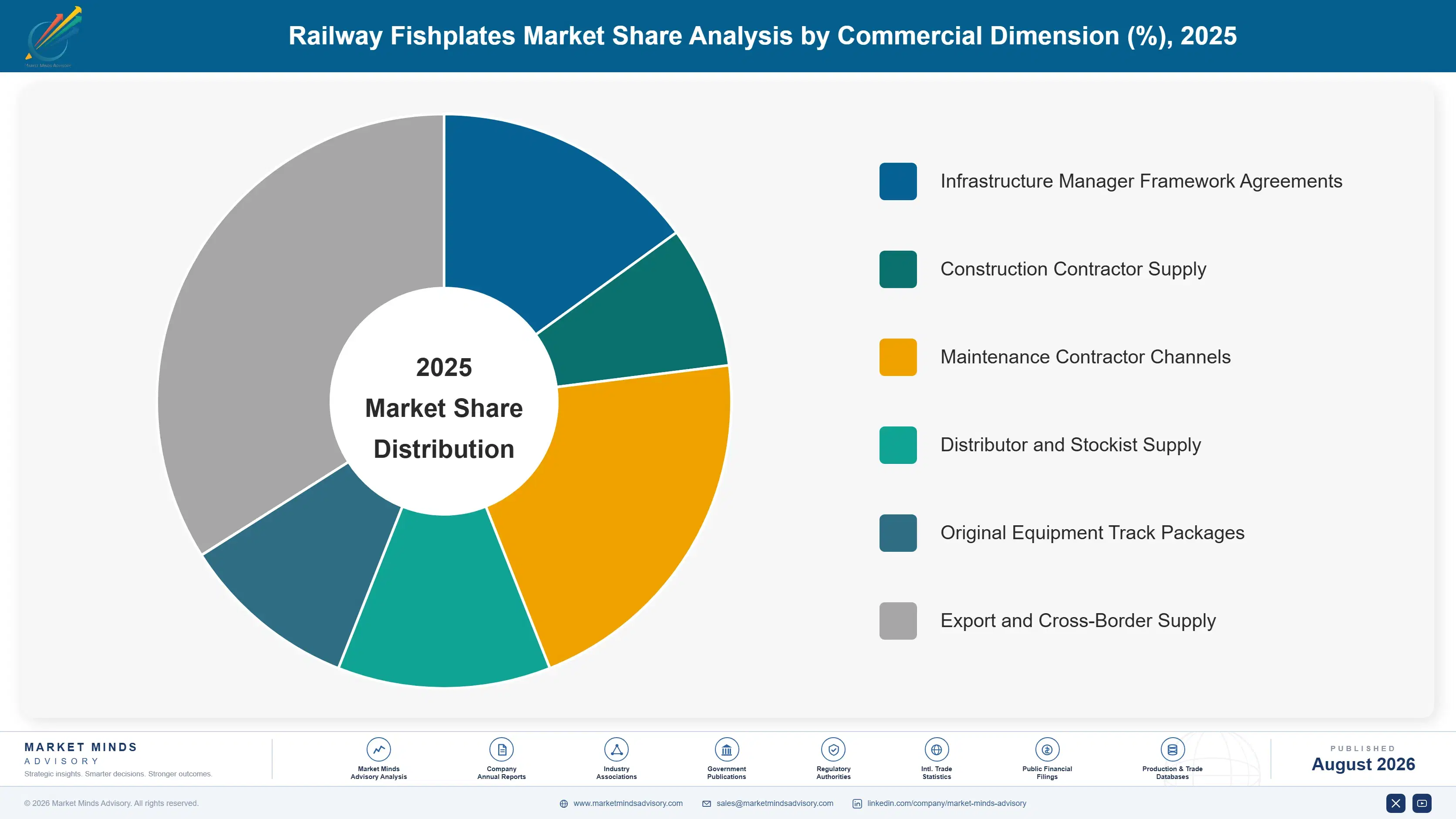
South Asia and Pacific holds 26% of value, since jointed track kilometres rather than total network size determine demand and Indian construction leads the world on both counts. East Asia follows at 22%, with North America at 18% on freight network maintenance rather than any expansion.

North America

Share sits at 18% against a band of 22 to 32% because demand tracks jointed route kilometres rather than network size or economic weight, and North American Class I railroads converted their main lines to continuous welded rail decades ago. What remains is substantial: yard and siding trackage, short line railroads operating on constrained capital budgets, and industrial spurs where a bolted joint that can be dismantled by a two-person crew beats a welded one requiring a full crew. Insulated joint renewal on signalled main lines is the steadier demand. Growth at 3.4% reflects maintenance rather than expansion of any kind. Short line operators are the most price-sensitive buyers in the market anywhere.
Share: 18% | CAGR: 3.4% (2026 to 2036)

Western Europe

At 14% against a band of 18 to 26%, Western Europe falls below band for the same reason North America does, with conversion to continuous welded rail effectively complete across national main line networks. Insulated joints represent most of what remains, renewed on signalling cycles rather than track cycles, and specification is governed by national infrastructure managers with demanding approval regimes. German, French and British networks each run separate approval processes that slow entry considerably. Heritage and industrial railways buy small volumes of traditional plates. Growth of 2.6% sits below the base case throughout the forecast period. Approval rather than manufacturing capability decides who supplies the insulated joint pool here.
Share: 14% | CAGR: 2.6% (2026 to 2036)
Regional intelligence for 5 additional markets available in the complete report: East Asia, South Asia and Pacific, Latin America, Middle East and Africa, Eastern Europe. Contact sales@marketmindsadvisory.com.
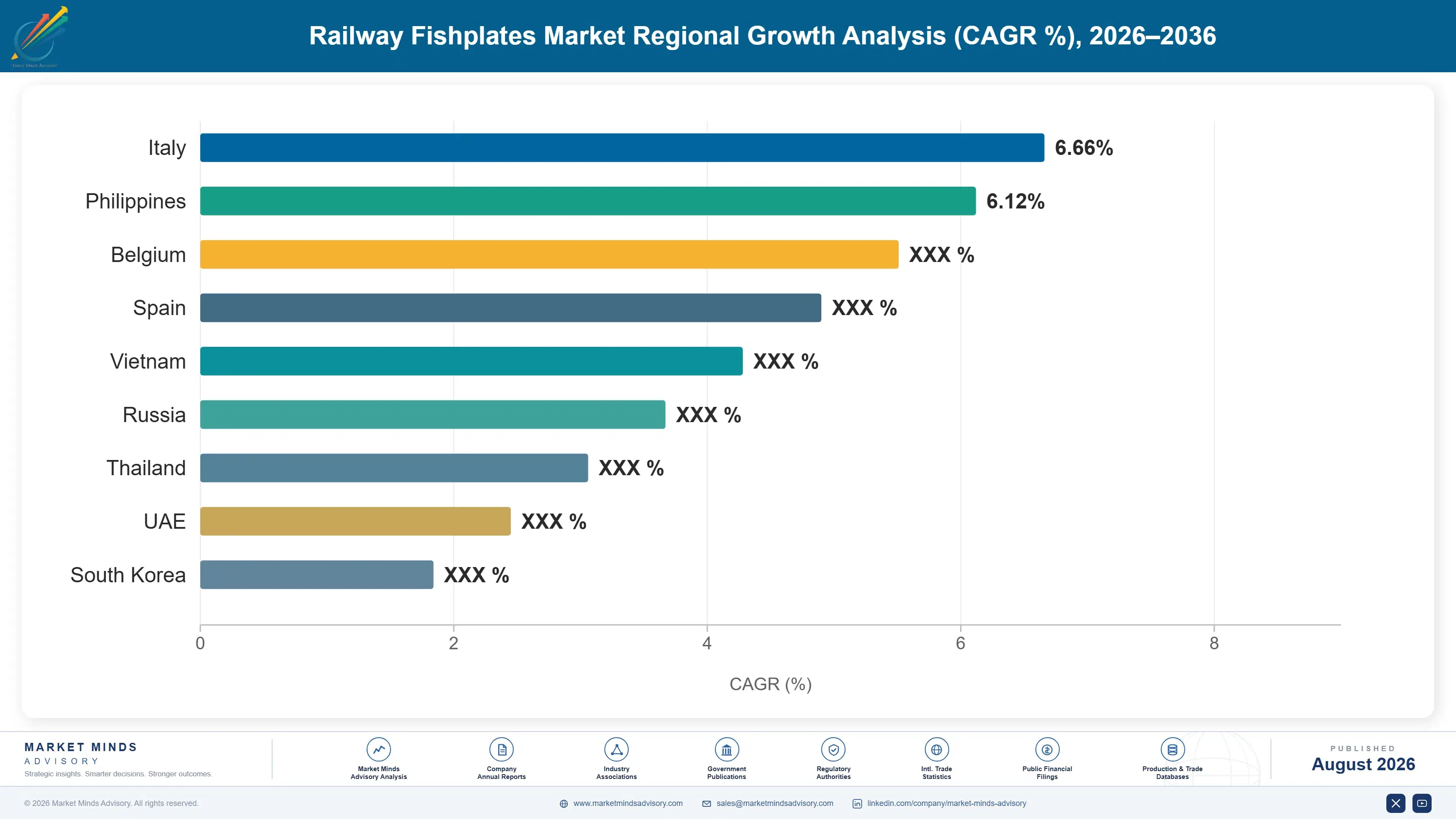
railway-fishplates-market-country-cagr-analysis-1787594706968

Four Moves as the Joint Disappears

A supplier selling plain forged plates is competing on steel cost into a base that shrinks with every kilometre of welded rail laid anywhere. Everything commercially durable in this market sits in the joints that welding cannot remove, in the networks still building jointed track, and in the approval regimes that keep competitors out.

Move into signalling-approved bonded joint assemblies

Insulated joints grow at 6.3% while plain plates decline, because track circuit signalling needs an isolated break that no welding programme can eliminate. The product carries epoxy bonding, end post engineering and signalling authority approval rather than steel specification alone, and replacement intervals near seven years make it a consumable. Approval is the barrier and it is also the protection, since a supplier through the process holds a position competitors need years to reach. Plain plate margins do not survive the comparison. Moving portfolio weight in that direction is the single clearest decision available in this category.
Market Impact: Enters a segment now growing at 6.3% yearly

Follow network upgrade sequences with engineered compromise plates

Combination plates join rails of different section, which is exactly the condition an axle load upgrade programme creates as it works through a network over a decade. Demand grows at 5.4% and the plates are engineered to specific section pairs rather than stocked to a standard. A supplier who knows a network's own upgrade sequence can respond to it, and pricing sits well above plain plates on that engineering content. Indian, African and Southeast Asian programmes will generate this demand for years. European networks completed their equivalent transitions decades ago and buy almost none of it now.
Market Impact: Serves 5.4% annual growth across the whole segment

Manufacture inside the networks buying the most volume

A forged steel plate is heavy, low in value density and expensive to ship, which is why the top five hold only 24% and supply stays regional. India alone grows at 7.4% and buys to its own national standards specifications through domestic manufacture. Placing capacity inside the highest volume networks beats exporting into them almost every time, and approval regimes in most countries favour domestic supply in practice regardless of what procurement rules formally say. Delivered cost beyond roughly eight hundred kilometres rarely competes against a local forger. Approval regimes reinforce that boundary further.
Market Impact: Reaches a market now growing at 7.4% annually

Sell against the inspection cycle, not the order

Joints cause roughly 38% of track defects and carry inspection intervals as short as 90 days, which makes joint failure an operational cost that dwarfs the component price many times over. A supplier presenting defect rate and service life data reaches the permanent way engineer rather than the procurement desk. Very few do this work, and the ones who do sell on total maintenance cost rather than on plate price, which is a different conversation entirely. Operators running 90 day cycles have begun weighing service life against unit price directly.
Market Impact: Targets 38% of all recorded track defects directly

Who Controls the Margin Pool

Participation is measured on annual rail joint component production volume, and the top five hold only 24%. Fragmentation is a freight consequence more than anything else, since a forged plate is heavy and uneconomic to ship far, so regional forgers hold positions global players cannot attack on cost. L.B. Foster and Pandrol lead on engineered joint capability rather than on plate tonnage. The gap to challengers is signalling approval rather than forging capacity.
Competition runs on three things. Signalling approval decides who can supply insulated joints, which is where the growth and the margin both sit. Proximity to the network decides who wins plain plate volume, because steel freight economics settle that question before price does. Engineering responsiveness decides combination plate work, since those products follow a network's own upgrade sequence rather than a catalogue.

Pressure ahead comes from axle counter signalling, which removes the electrical reason insulated joints exist, and from continued welded rail conversion removing everything else. Both erode the base rather than reallocating it. Expect suppliers to consolidate around engineered joints and geographic strongholds. Rankings shift as Indian and African manufacture matures and as national approval regimes decide who reaches the growing segment.
railway-fishplates-market-company-positioning-matrix-1787594707501

Competitive Moat and Risk Dimensions

L.B. FOSTER

Moat: Insulated joint approval breadth

The company holds signalling authority approvals across multiple network operators for bonded insulated joint assemblies, which is a position measured in years of qualification work rather than in manufacturing capability. A competitor with equivalent forging capacity still cannot supply into an approved specification, and operators renewing joints on seven year cycles have no reason to sponsor an alternative.
L.B. FOSTER

Risk: Axle counter displacement exposure

The strongest part of the portfolio depends on track circuit signalling remaining in use, and networks renewing signalling increasingly choose axle counters that remove the electrical need for an insulated joint entirely. That erosion is slow, since installed track circuits remain in service for decades, but it works against the highest margin product in the range.
PANDROL

Moat: Permanent way systems position

Pandrol sells across fastening systems, welding and joint products to the same permanent way engineers, which means a joint enters an existing technical relationship rather than needing one built from nothing. That breadth also lets the company participate in conversion programmes that eliminate joints, capturing value from a transition that damages joint-only suppliers.
PANDROL

Risk: Internal product cannibalisation

Selling both aluminothermic welding for continuous rail conversion and the joints that conversion eliminates puts two parts of the portfolio in direct opposition. Every kilometre converted grows one line and permanently removes demand from another, which makes internal resource allocation genuinely difficult and can leave the joint business under-invested.

Players Tracked

Prominent Players

L.B. Foster
Pandrol
voestalpine Railway Systems
Progress Rail
Vossloh

Other Key Players

Koppers Holdings
Nippon Steel
JFE Steel
Tata Steel
Jindal Steel and Power
ArcelorMittal
Amsted Rail
Enviri
Delkor Rail
Schwihag
Gantrex
Anyang Railway Equipment
Sanyou Rail
Hilltop Rail
Simplex Infrastructures

Recent Developments

MAY 2026

Indian Railways awards multi-year joint component supply to domestic manufacturers

Indian Railways awarded multi-year rail joint component supply covering dedicated freight corridor and gauge conversion requirements to domestic manufacturers working to national standards organisation specifications. The award covered plain, combination and insulated joint types across several regional zones. Delivery runs across several years of scheduled programme work.
Signal: Domestic manufacture inside the highest volume networks is winning on approval regimes as much as price
OCTOBER 2025

European infrastructure manager selects axle counters over track circuit renewal

A Western European infrastructure manager chose axle counter detection over track circuit renewal across a regional signalling programme, citing maintenance cost and ballast condition sensitivity. The decision removes the electrical requirement for insulated joints across the affected sections permanently. Existing joints stay in service until renewal.
Signal: Signalling technology choices now decide insulated joint demand more directly than any track engineering decision does
MARCH 2026

African corridor project specifies conventional jointed track for maintainability

An East African rail corridor project specified conventional jointed track across sections of its alignment, citing field maintainability where deploying welding crews is difficult and slow. The specification was set deliberately rather than as a cost compromise on the construction budget. Welding crew availability was the governing constraint.
Signal: Bolted joints are being chosen on maintainability grounds rather than merely tolerated as the cheaper option

Steel, Forging Heat and Freight

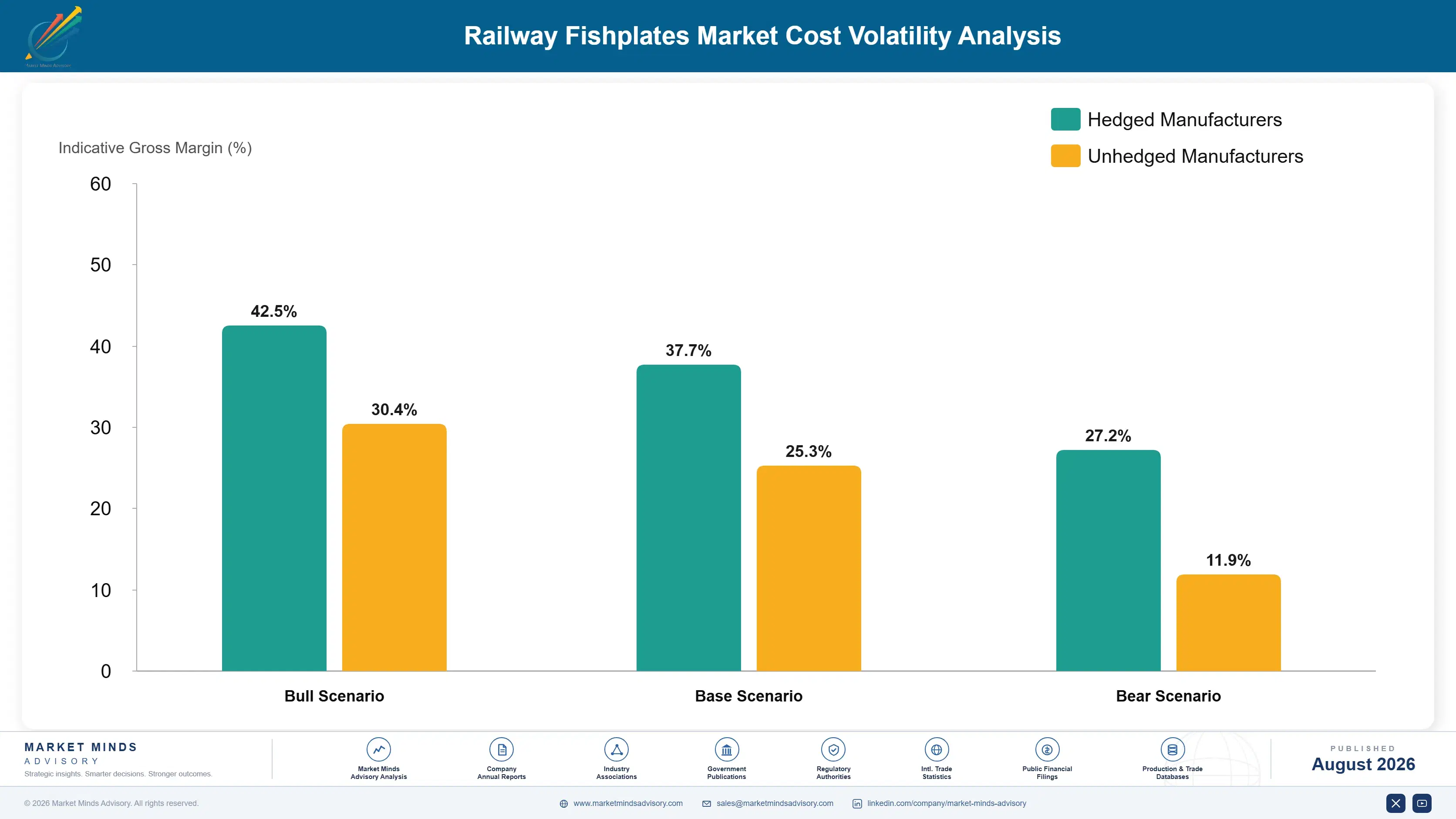
Rolled or forged steel accounts for roughly 58% of finished plate cost, sourced from regional mills in almost every case, because shipping steel far to forge a heavy low-value product makes little sense. Forging and heat treatment energy carries about 16%, which matters most in European operations exposed to gas-set power pricing. Machining, drilling and finishing add around 11%, with the balance in bolts, coatings and freight.
European steel prices rose sharply through 2022 on energy costs and carbon pricing, per European Commission steel market monitoring for the period, which compressed margins for producers holding fixed-price framework agreements with infrastructure managers. Those agreements typically run several years with limited indexation. Asian steel moved on a separate cycle driven by Chinese demand, which left regional producers facing very different input positions across the same two years.

Exposure divides on contract indexation and on product mix. A supplier weighted toward plain plates carries steel exposure across most of its cost base with little pricing power to offset it, while a supplier weighted toward insulated joints holds a product where steel is a smaller share and approval protects price. European producers carry the heaviest energy and carbon exposure.
railway-fishplates-market-cost-volatility-analysis-1787594707699

Index framework agreements to published regional steel references

Steel is roughly 58% of plate cost and infrastructure manager framework agreements often run several years with limited indexation, which guarantees margin erosion whenever steel moves against the supplier. Indexing to published regional references passes movement through with a defined lag. Infrastructure managers accept indexation more readily than they accept a mid-contract price request.

Shift portfolio weight toward approval-protected joint products

Insulated joints carry engineering and signalling approval content that dilutes steel exposure and supports pricing a plain plate cannot hold. Steel represents a materially smaller share of cost in a bonded assembly. Moving portfolio weight in that direction reduces input exposure and enters the only segment growing faster than the market at the same time.

Forge close to the network rather than optimising a single plant

A forged steel plate is heavy, low in value density and expensive to move, so delivered cost rises steeply with distance and concentration in the category sits at only 24% as a direct result. Regional capacity beats a single optimised plant on delivered cost in almost every case, and it usually helps with approval regimes as well.

Portfolio Architecture for Margin Defence

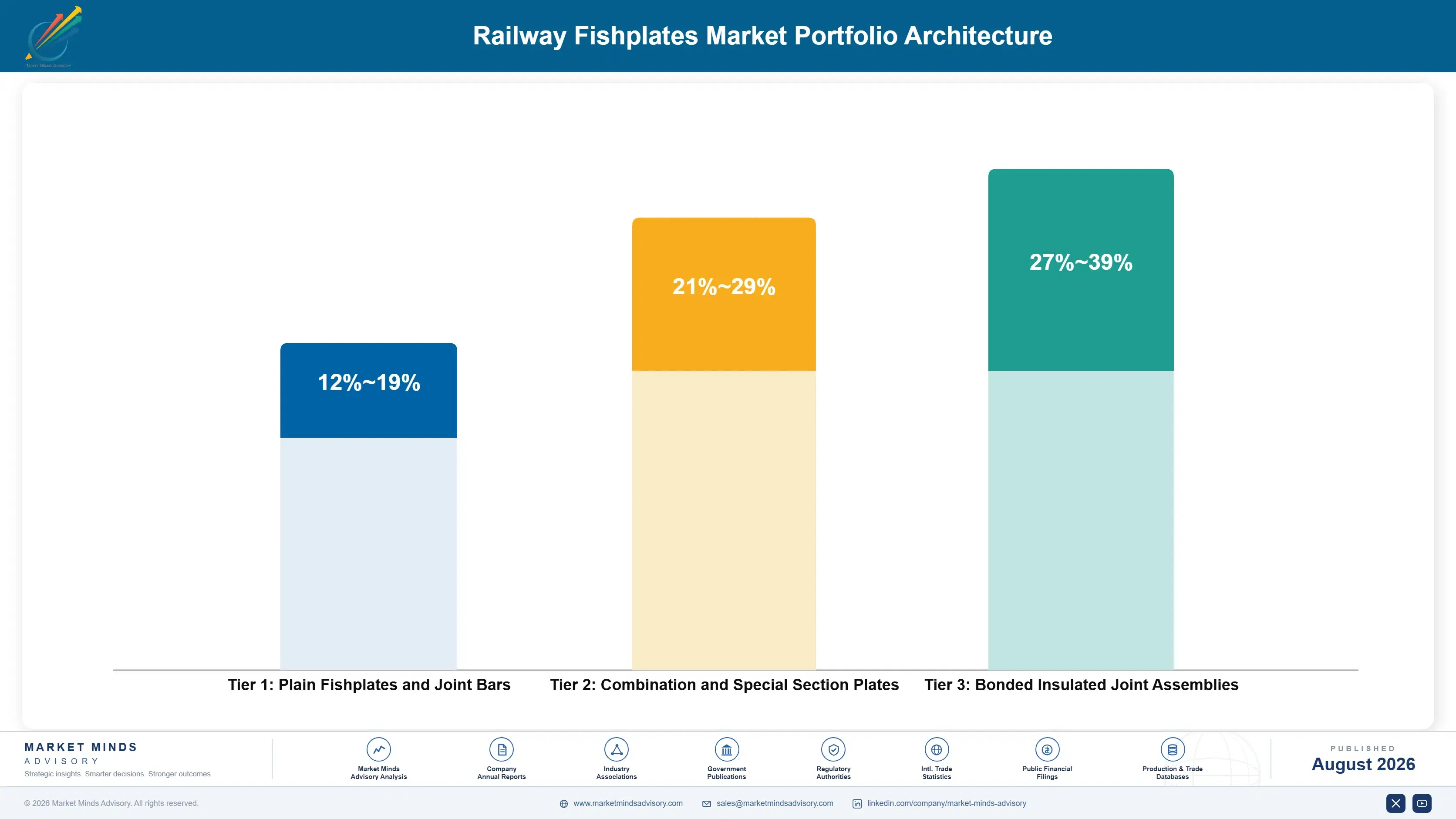
Margin here follows approval content rather than manufacturing sophistication, which is an unusual shape for a forged steel product. Plain fishplates and standard joint bars earn margins in the low to mid teens, because any capable regional forger can produce to the same specification and infrastructure managers buy them on price against a published drawing. No supplier holds pricing power against a drawing it does not own.
Combination plates and special sections do better in the low to high twenties, because they are engineered to specific rail section pairs rather than stocked to a catalogue, and a supplier who follows a network's upgrade sequence earns responsiveness value. The range reflects how bespoke the work is and how tightly the supplier is tied into the programme itself.

Bonded insulated joints hold the strongest position, reaching into the high thirties, because signalling authority approval takes years to obtain and protects price in a way no manufacturing advantage does. Those margins reflect qualification depth and a seven year replacement cycle that turns an approved product into a recurring consumable rather than a fitting. A seven year cycle converts approval into recurring revenue rather than a single supply win.

Plain Fishplates and Joint Bars

Standard forged plates supplied against published infrastructure manager drawings. The seven point range reflects forging scale and freight position rather than product difference, since specifications are identical across every qualified supplier.
Gross Margin: 12-19%

Combination and Special Section Plates

Plates engineered to specific rail section pairs for networks upgrading axle load capacity progressively. The eight point range reflects how bespoke the work is and how closely the supplier follows the network's own upgrade sequence.
Gross Margin: 21-29%

Bonded Insulated Joint Assemblies

Signalling-approved bonded assemblies with epoxy glue lines and engineered end posts. The twelve point range reflects approval breadth across networks and whether the supplier holds extended service life data supporting premium pricing.
Gross Margin: 27-39%
railway-fishplates-market-portfolio-architecture-1787594708234

High-value Sub-segments and Strategic Watch-out

Bonded Insulated Rail Joints

High value and the fastest growth at 6.3%, since track circuit signalling needs an isolated break that welding cannot remove. Seven year replacement intervals turn an approved product into a recurring consumable rather than a one-time fitting. Approval breadth across networks decides who reaches it.
Gross Margin: 29-39%

Combination and Compromise Plates

High value and growing at 5.4% wherever networks upgrade axle load capacity progressively rather than all at once. Indian, African and Southeast Asian programmes will generate this demand across a decade or more of phased work. Engineering content supports pricing plain plates cannot hold. Programmes run for a decade.
Gross Margin: 21-29%

Plain Fishplates and Joint Bars

The volume core and shrinking with every kilometre converted to continuous welded rail. Regional forgers compete on freight economics rather than capability, and no supplier holds pricing power against a published standard drawing. Every converted kilometre removes the demand permanently rather than deferring it to a later cycle.
Gross Margin: 12-19%

Track Circuit Dependent Demand

The strategic watch-out. Axle counter signalling removes the electrical reason insulated joints exist, and the sixteen point range reflects how differently suppliers are positioned against that shift across their installed network base. Installed track circuits remain in service for decades, so the erosion runs slowly rather than arriving at once.
Gross Margin: 18-34%

Renewal Beats New Build

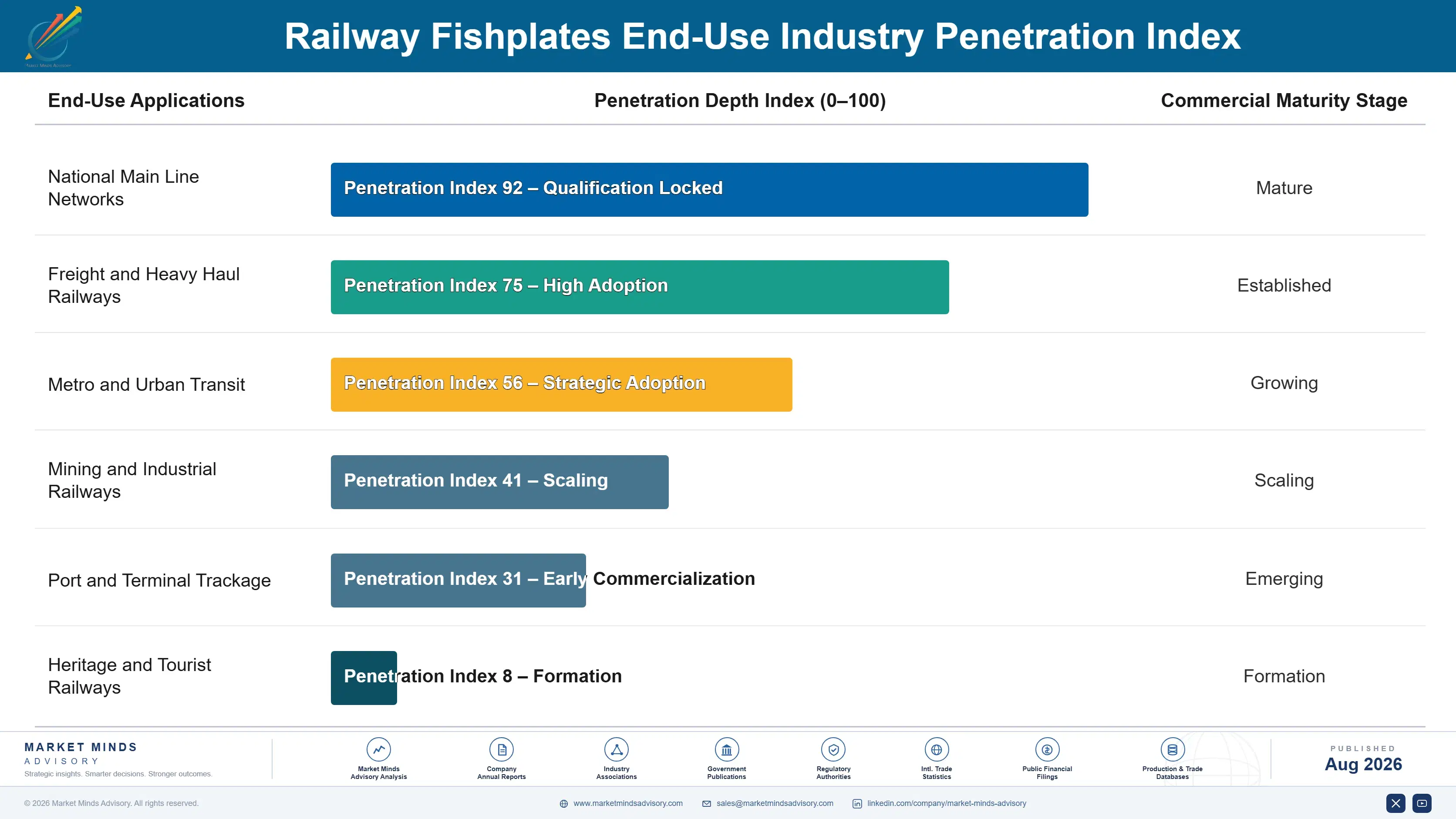
Most of this demand is renewal rather than construction, which gives it an annuity character that new build volumes never have. A network with jointed track replaces plates and bolts on cycles driven by traffic tonnage and inspection findings, not by capital programmes, and that spending continues through budget cycles that stop construction entirely. Insulated joints on heavy axle routes renew near seven years regardless.
Stickiness varies sharply with approval depth. A bonded insulated joint approved by a signalling authority is embedded in a qualification package that took years and nobody wants to repeat, so the supplier holds the position until the technology itself changes. Plain plates supplied against a published drawing switch on price at every tender, since the specification belongs to the infrastructure manager rather than to any supplier.

The specifying voice has been shifting from procurement toward permanent way and signalling engineering. Joints cause roughly 38% of track defects, and operators running 90 day inspection cycles have begun weighing service life against unit price rather than treating a plate as a commodity line item. Suppliers who arrive with defect rate evidence reach a different function than those arriving with a quotation.
railway-fishplates-market-end-use-penetration-index-1787594708740

Where We Would Focus Effort

These are among the four positions where our research anticipates prominent divergence between winners and laggards over the coming forecast period. Each is grounded in the demand model, the regulatory perimeter, and the announced capacity pipeline.
01 / SIGNALLING APPROVAL DEPTH

Get approved before competing on anything else

Insulated joints grow at 6.3% against a market rate of 4.2% because track circuit signalling needs an electrically isolated break that no welding programme can eliminate anywhere. Signalling authority approval takes years to obtain and protects price in a way that manufacturing capability never does, since an unapproved supplier cannot bid regardless of what it can produce. Seven year replacement intervals then turn that approval into a recurring consumable position rather than a one-time supply win that has to be defended at every tender.
02 / UPGRADE PROGRAMME ALIGNMENT

Follow the section change, not the catalogue

Combination plates join rails of different section, which is precisely the condition created when a network raises axle load capacity progressively across a decade rather than replacing everything at once. Demand grows at 5.4% and the plates are engineered to specific section pairs, which means a supplier tracking a network's own upgrade sequence can respond where a catalogue supplier cannot. Indian, African and Southeast Asian programmes will keep generating this work for years yet, on timetables that are already published.
03 / REGIONAL FORGING PLACEMENT

Freight economics decide this before price does

A forged steel plate is heavy, low in value density and expensive to move, which is why the top five hold only 24% after decades in which consolidation might have been expected. Placing capacity inside the networks buying the most volume beats exporting into them almost every time on delivered cost alone. India grows at 7.4% and buys to its own national specifications through domestic manufacture, which makes local presence a requirement rather than an optimisation anybody can defer safely.
04 / DEFECT COST SELLING

Talk about derailments, not plate prices

Rail joints cause roughly 38% of recorded track defects despite occupying a tiny fraction of total track length, which is why inspection intervals run as short as 90 days on heavily trafficked main lines. That makes joint failure an operational and safety cost dwarfing the component price many times over. A supplier presenting service life and defect rate evidence reaches the permanent way engineer, and almost nobody in this category has done that work properly or knows who to present it to.

Engagement Snapshot From the Field

A live engagement with an industry participant carrying material or product regulatory and market exposure ahead of a defining policy shift, showing how our research translates into a defensible multi-year portfolio strategy.
MARKET MINDS ADVISORY · CLIENT ENGAGEMENT SUMMARY
Railway Fishplates Producer Strategic Portfolio Review and Transition Roadmap 2026·Investment Scenario on Railway Fishplates Exposure Evaluation 2025-26
CLIENT PROFILE
A European rail component manufacturer forging plain fishplates and joint bars from two plants, with annual revenue near 96 million euros (client-reported, unverified by MMA). Around eighty percent of volume was standard plate supplied against infrastructure manager drawings on multi-year framework agreements, and the company held no signalling authority approvals for insulated joint products in any national network.
STRATEGIC CHALLENGE
Framework volumes had declined for four consecutive years as national conversion to continuous welded rail progressed, and the decline was accelerating rather than levelling off. Management needed to determine whether the business had a future in plain plates, whether insulated joint approval was reachable, and how long the remaining base would support the existing cost structure.
MMA APPROACH
MMA modelled remaining jointed kilometres and conversion rates across the client's five principal national markets, benchmarked insulated joint approval timelines and costs across those same signalling authorities, assessed export economics against freight cost, and tested whether combination plate demand existed in reachable markets. Interviews with 47 experts covered permanent way engineering, signalling renewal and rail component procurement.
KEY FINDINGS
  1. Remaining jointed kilometres across the client's five core markets were projected to halve within nine years on observed conversion rates, considerably faster than management's planning assumption allowed.
  2. Insulated joint approval was reachable in three of the five signalling authorities within roughly thirty months, at a qualification cost the company could fund from existing cash flow.
  3. Two of those three networks had already committed to axle counter signalling on renewal, which would erode the approved position over a longer horizon than the approval investment payback period.
  4. Export of plain plates beyond approximately eight hundred kilometres was uneconomic against regional forgers in every market tested, confirming that geography rather than cost structure set the boundary.
CLIENT PROFILE
A European rail component manufacturer forging plain fishplates and joint bars from two plants, with annual revenue near 96 million euros (client-reported, unverified by MMA). Around eighty percent of volume was standard plate supplied against infrastructure manager drawings on multi-year framework agreements, and the company held no signalling authority approvals for insulated joint products in any national network.
STRATEGIC CHALLENGE
Framework volumes had declined for four consecutive years as national conversion to continuous welded rail progressed, and the decline was accelerating rather than levelling off. Management needed to determine whether the business had a future in plain plates, whether insulated joint approval was reachable, and how long the remaining base would support the existing cost structure.
MMA APPROACH
MMA modelled remaining jointed kilometres and conversion rates across the client's five principal national markets, benchmarked insulated joint approval timelines and costs across those same signalling authorities, assessed export economics against freight cost, and tested whether combination plate demand existed in reachable markets. Interviews with 47 experts covered permanent way engineering, signalling renewal and rail component procurement.
KEY FINDINGS
  1. Remaining jointed kilometres across the client's five core markets were projected to halve within nine years on observed conversion rates, considerably faster than management's planning assumption allowed.
  2. Insulated joint approval was reachable in three of the five signalling authorities within roughly thirty months, at a qualification cost the company could fund from existing cash flow.
  3. Two of those three networks had already committed to axle counter signalling on renewal, which would erode the approved position over a longer horizon than the approval investment payback period.
  4. Export of plain plates beyond approximately eight hundred kilometres was uneconomic against regional forgers in every market tested, confirming that geography rather than cost structure set the boundary.
RECOMMENDED STRATEGY
Phase 1: Phase one: begin insulated joint qualification with the two signalling authorities retaining track circuits, since approval timelines make delay expensive rather than merely cautious. Phase 2: Phase two: consolidate plain plate production into a single plant sized to the declining base rather than defending volume across both existing sites. Phase 3: Phase three: pursue combination plate work in reachable upgrading networks, where engineering content supports pricing that plain plates cannot hold.
OUTCOME
The manufacturer entered qualification with two signalling authorities during 2026 and consolidated forging into one plant, reporting improved unit economics on the remaining plain plate volume (client-reported, unverified by MMA). Combination plate enquiries were secured in two neighbouring networks running phased section upgrades. Plain plate volume declined broadly as modelled.

Frequently Asked Questions

Foundational context covering the market sizes, CAGR, scope, country, region and competition that inform every finding below. This section is provided to cover basics and most often pre-purchase conversations, answered from the MMA Primary Research Dataset.

What is the current size of the Railway Fishplates Market?

MMA sizes it at USD 1.42 billion in 2025, rising to USD 1.48 billion in 2026. The figure covers plates and engineered joint assemblies connecting rail ends, measured at manufacturer selling value.

How large will the Railway Fishplates Market be by 2036?

USD 2.23 billion by 2036, an incremental USD 0.75 billion over the 2026 base and an expansion multiple of 1.51 times. Insulated joints account for a disproportionate share of that growth.

What is the CAGR for the Railway Fishplates Market 2026 to 2036?

4.2% in the base case, with a bull case at 5.4% and a bear case at 3.0%. The spread turns on African construction schedules and on axle counter signalling adoption.

Which segment is growing fastest?

Insulated rail joints at 6.3%, half again the market rate of 4.2%. Track circuit signalling requires an electrically isolated break that continuous welded rail conversion cannot remove.

Who are the major companies in the Railway Fishplates Market?

Foster, Pandrol, voestalpine Railway Systems, Progress Rail and Vossloh lead on annual joint component production volume. Fifteen further participants across forging and engineered joint supply are profiled in the full report on that same basis.

Which country is growing fastest?

India at 7.4%, combining dedicated freight corridor construction, gauge conversion and progressive rail section upgrading across the largest actively expanding jointed network anywhere in the world today.

Report Segmentation Architecture

The full report scope spans multiple orthogonal segmentation dimensions, with cross-tabulated demand data provided for each dimension pair. Coverage extends further to regional breakdowns, trend trajectories, and the competitive detail needed to support segment-level decision-making.

By Joint Product Type

  • Plain Fishplates and Joint Bars
  • Insulated Rail Joints
  • Combination and Compromise Plates
  • Head-Free and Special Sections
  • Emergency Repair Joint Clamps
  • Switch and Crossing Joint Plates

By End-Use Industry

  • National Main Line Networks
  • Freight and Heavy Haul Railways
  • Metro and Urban Transit
  • Mining and Industrial Railways
  • Port and Terminal Trackage
  • Heritage and Tourist Railways

By Commercial Dimension

  • Infrastructure Manager Framework Agreements
  • Construction Contractor Supply
  • Maintenance Contractor Channels
  • Distributor and Stockist Supply
  • Original Equipment Track Packages
  • Export and Cross-Border Supply

By Region

  • North America
  • Western Europe
  • East Asia
  • South Asia and Pacific
  • Latin America
  • Middle East and Africa
  • Eastern Europe

Scope, Methodology, and Coverage

Every figure in this report is reproducible from documented input assumptions. The scope below maps the historical period, the forecast horizon, the segmentation dimensions, and the countries covered, alongside the underlying primary and qualitative methodology.
Historical Period
2020 to 2025
Forecast Period
2026 to 2036
Base Year
2025 (USD billions; MMA Primary Research Dataset, August 2026)
Market Definition
Steel plates and engineered joint assemblies that mechanically connect two rail ends within a track structure, covering plain fishplates and joint bars, insulated rail joints, combination and compromise plates, head-free and special sections, emergency repair clamps, and switch and crossing joint plates, including the bolts and fastening sets supplied as part of the joint. Measured at manufacturer selling value across all network types. Rail itself, sleepers, baseplates, elastic rail clips, welding consumables and signalling equipment are excluded from scope.
Quantitative Units
USD billions (current prices); million joint assemblies; USD per assembly by product type
Segmentation Dimensions
Joint product type; end-use network; commercial dimension; region
Regions Covered
North America, Western Europe, East Asia, South Asia and Pacific, Latin America, Middle East and Africa, Eastern Europe
Countries Covered
India, China, Japan, South Korea, Indonesia, Vietnam, Australia, United States, Canada, Mexico, Germany, France, United Kingdom, Italy, Poland, Romania, Ukraine, South Africa, Kenya, Brazil
Key Companies Profiled
L.B. Foster, Pandrol, voestalpine Railway Systems, Progress Rail, Vossloh, Koppers Holdings, Nippon Steel, JFE Steel, Tata Steel, Jindal Steel and Power, ArcelorMittal, Amsted Rail, Enviri, Delkor Rail, Schwihag, Gantrex, Anyang Railway Equipment, Sanyou Rail, Hilltop Rail, Simplex Infrastructures
Quantitative Methodology
Primary survey, n=3,800 respondents, Q4 2025, six countries; demand-side model with trade association cross-validation
Qualitative Methodology
47 expert interviews, Q4 2025; applied to validate demand model assumptions, identify emerging dynamics, and assess competitive positioning
Report Format
PDF and XLSX data workbook (Word format preview document)
Publisher
Market Minds Advisory
Report Code
MMA-2026-CON-110
Published
August 2026
Contact
sales@marketmindsadvisory.com | www.marketmindsadvisory.com

Purchase the full Railway Fishplates Market Report (2026 to 2036).

The full report sizes demand against remaining jointed route kilometres rather than against total network size, which is the only basis on which this market can be forecast sensibly. It models continuous welded rail conversion rates by network, separates the insulated joint pool that welding cannot touch, and assesses axle counter signalling adoption as the longer term threat to that pool. Regional chapters cover all seven regions with conversion status and construction pipeline detail where infrastructure managers disclose it. Competitive profiling covers 20 participants on a single production volume basis.
Demand sized against remaining jointed route kilometres
Conversion rates modelled network by network through 2036
Insulated joint pool separated from welding-exposed demand
Axle counter adoption assessed as long term threat
Twenty participants profiled on one consistent basis
Signalling approval regimes mapped across major networks

Built For The People Who Decide

From boardroom strategy to bench-side execution, this report is read cover-to-cover by leaders shaping the next decade of their industry, turning demand scenarios, market dynamics and valuation benchmarks into decisions.
CXOs/ Presidents/ VPs/ Managers
M&A and Corporate Development
Strategy Teams and R&D Heads
Procurement and Product Directors
Regulatory and Compliance Leaders
Investor Relations and Equity Analysts