Market Minds Advisory
Railway Emergency Valves Market

Railway Emergency Valves Market: Electro-Pneumatic Transition, Certification Barriers and Overhaul Economics

Electro-pneumatic actuation is cutting brake propagation delay across passenger fleets, certification timelines protect incumbent suppliers better than any patent could, and overhaul revenue now exceeds what new vehicle fitment generates.

Lead Analyst

David Horsley

Published

September 2026

Make Smarter Decisions with Customized Research Insights

Request a free sample report and evaluate market opportunities, growth trends, and competitive dynamics relevant to your business needs.

2025 MARKET VALUE$0.8BMarket Size 2025
2036 FORECAST VALUE$1.4BBase Case , 2026 to 2036
CAGR 2026 TO 20365.2 %Bull 6.4% / Bear 4.0%
INCREMENTAL OPPORTUNITY$0.6BNet 10- year value creation
EXPANSION MULTIPLE1.66x2036 value over 2026 base
Strategic Levers
M&A Pipeline
Regional Outlook
Country Rankings
Competitive Intelligence
Segmental Deep-dive
Call-Us : 91 93563 13602

Executive Snapshot and Market Trajectory

Emergency valves are the components that stop a train when everything else has failed, which is why nobody buys them casually. Approval to fit one takes around thirty months and involves a safety authority rather than a purchasing department, and that single fact governs how this entire market behaves commercially.
Electro-pneumatic emergency brake valves grow at 7.8%, a full 1.50 times the market rate, because an electrical signal reaches the last vehicle in a train immediately while a pneumatic pressure wave takes seconds, and those seconds translate directly into stopping distance. East Asia holds 33% of global value, above the standard regional band, because China operates the largest network on earth alongside the largest rolling stock manufacturing base anywhere.
Concentration runs at 66% for the top five, which is high and entirely explicable. Certification cost, safety authority relationships and forty-year installed bases combine into a barrier that no new entrant has cleared in decades. Aftermarket overhaul now supplies 48% of revenue, and that share keeps rising as fleets age faster than replacement programmes absorb them. Original fitment is largely how a supplier buys into that annuity rather than a business in itself.
Market Definition
This report covers safety-critical emergency valves for rail vehicles, spanning electro-pneumatic emergency brake valves, passenger emergency brake handle valves, distributor and relay valves performing emergency functions, isolating cocks and brake pipe valves, and mechanical emergency release and safety valves. Complete brake systems valued at system level, brake cylinders, callipers and pads, compressors and air supply equipment, door systems, and trackside signalling equipment are excluded from the sizing.
Base Year Value
$0.8B in 2025 (MMA Primary Research Dataset, August 2026)
Forecast Period
2026 to 2036, eleven discrete annual values
CAGR
5.2% base case. Bull 6.4%. Bear 4.0%.
Fastest Growth Segment
Electro-Pneumatic Emergency Brake Valve: 7.8% CAGR
Fastest Growth Country
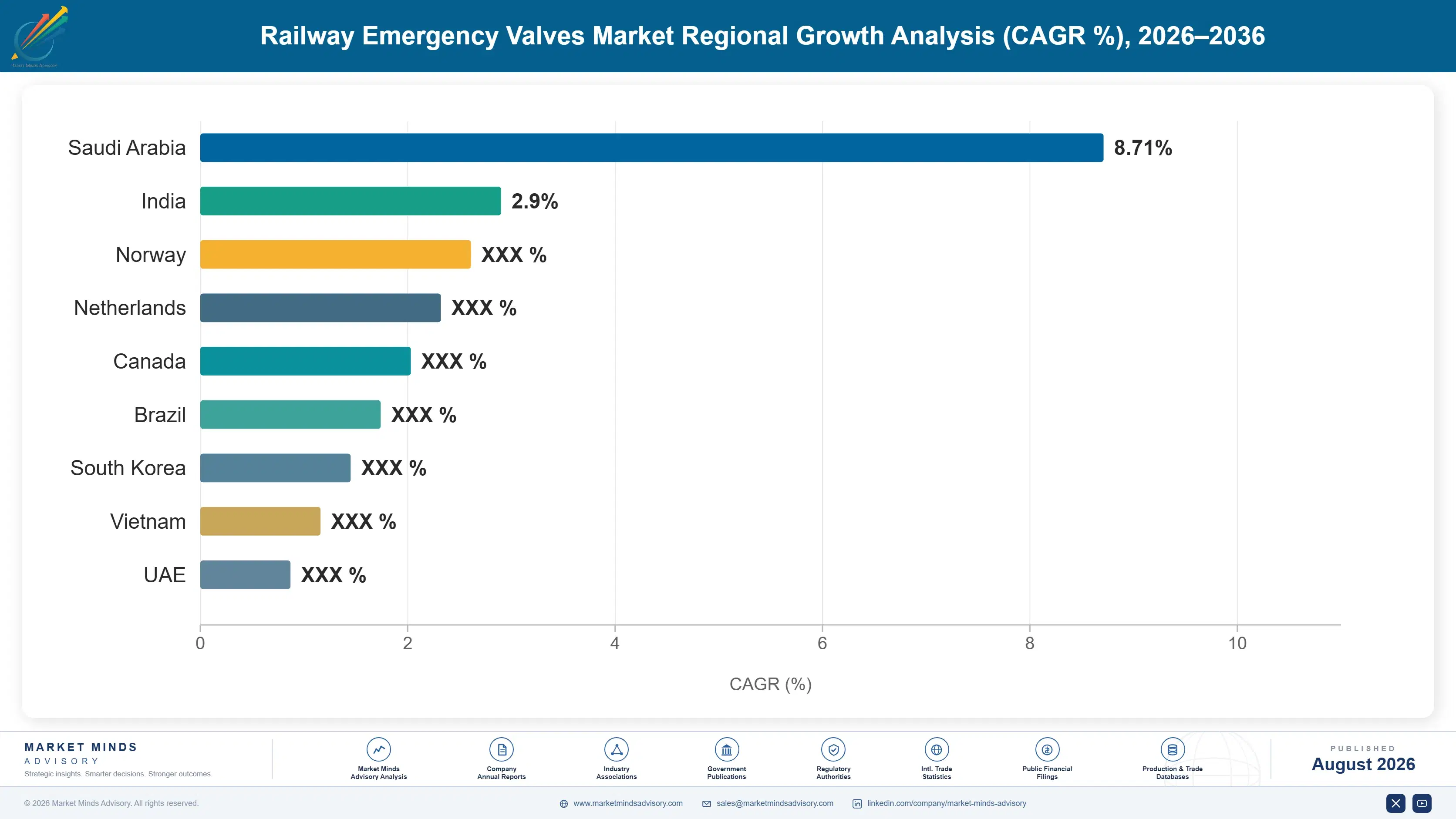
India: 7.8% CAGR
Fastest Growth Region
South Asia and Pacific: 7.4% CAGR
Largest Region
East Asia: 33% of 2025 global value
Market Leaders
Knorr-Bremse, Wabtec, Nabtesco, Dako-CZ and Escorts Kubota lead on certified valve shipment volume. Source: MMA Analysis, July 2026.
Primary Survey
n=3,800 procurement and R&D decision-makers, Q4 2025, six countries
Methodology
Demand-side build-up, cross-validated against public data, 47 expert interviews

Railway Emergency Valves Market Forecast Scenarios

railway-emergency-valves-market-trends-size-forecast-scenario-1787317221348
Between 2020 and 2025 the market compounded at 4.2%, and the composition mattered more than the total. Passenger vehicle deliveries slowed through 2020 and 2021 as transit authorities deferred procurement, while overhaul volume continued because scheduled maintenance intervals do not pause for anything. Indian and Chinese programme deliveries accelerated through the same period and largely offset Western softness.
The base case at 5.2% rests on three mechanisms. Asian rolling stock procurement continues at a pace no other region approaches, and every vehicle carries certified emergency valve content. Electro-pneumatic conversion keeps spreading through passenger fleets as authorities tighten emergency braking performance requirements, and those valves realise considerably more than pneumatic equivalents. Overhaul revenue grows steadily on an installed base ageing faster than replacement programmes absorb it, which is the most predictable stream anywhere in this market.
The bull case at 6.4% turns on European digital automatic coupling deployment for freight beginning at scale, which would require new valve architectures across a wagon fleet numbering in the hundreds of thousands. The bear case at 4.0% is transit authority procurement deferral: passenger vehicle purchases are highly discretionary in timing, and authorities under budget pressure extend fleet life rather than replace it.

What Actually Governs Emergency Valve Value

The commercial logic here follows from what happens when the product fails. An emergency valve is the last line of defence in a braking system, and safety authorities approve it rather than purchasing departments selecting it, which changes every dynamic that would otherwise apply to a component this simple.
TOP FIVE CONCENTRATION66%Share held by the five largest rail brake system suppliers
AVERAGE ASSEMBLY PRICE$1,240Typical realised price for a certified emergency valve
AFTERMARKET REVENUE SHARE48%Portion of supplier revenue from overhaul and replacement
CERTIFICATION LEAD TIME30 monthsTime from design freeze to authority approval for service
OVERHAUL INTERVAL6 yearsTypical period before a valve returns for scheduled overhaul
GLOBAL VEHICLE FLEET1.4 millionRail vehicles operating across freight and passenger networks
Certification runs around thirty months from design freeze to service approval, involves test programmes and documentary evidence that small suppliers cannot fund, and must be repeated for each national or regional authority. That process protects incumbents more effectively than any patent portfolio would, and it explains why the same handful of names have held this market for decades while genuinely capable manufacturers elsewhere have never entered it.
The second defining feature is fleet life. A rail vehicle stays in service around forty years, and its valves come out for scheduled overhaul roughly every six. Aftermarket now supplies 48% of supplier revenue at margins well above original fitment, and the share keeps climbing because fleets across most networks are ageing faster than replacement programmes absorb them. Original equipment supply is largely how a supplier buys into that annuity.
"People assume safety-critical certification is a burden the industry endures. Talk to any incumbent privately and it is the most valuable asset they own. Thirty months and several million dollars is not a barrier to entry, it is a moat that nobody has crossed in thirty years."
Practice Director, Rail Systems and Infrastructure, Market Minds Advisory · MMA

Market Trends

Electro-Pneumatic Actuation Cuts Brake Propagation Delay Substantially

A conventional pneumatic emergency application travels along the brake pipe as a pressure wave, reaching the rear of a long train seconds after the front. Electrical signalling reaches every vehicle simultaneously, and on a passenger train those seconds convert directly into stopping distance that safety authorities increasingly specify against explicitly. Electro-pneumatic valves realise roughly 2.3 times pneumatic equivalents and demand electronic control integration that pure pneumatic suppliers simply do not hold at all. Passenger fleet conversion is now well advanced, while freight adoption continues lagging considerably behind what advocates had expected.
Market Impact: Delivers 9,000 vehicles annually

Digital Automatic Coupling Reshapes Freight Valve Architecture

European freight is working toward digital automatic coupling, which replaces manual screw couplings with an automatic connection carrying power and data alongside the air line. That changes brake system architecture fundamentally, since electrically signalled braking becomes possible across a wagon fleet where it never was before. The retrofit requirement covers hundreds of thousands of wagons and it represents the largest single valve replacement opportunity this market has ever contemplated. Timing depends on political funding decisions rather than on any technology question, which makes it genuinely difficult to forecast with confidence.
Market Impact: Supplies 48% of revenue

Market Opportunities and Growth Drivers

Asian Rolling Stock Procurement Sustains Original Equipment Volume

China and India together procure rolling stock at volumes no other region approaches, and every vehicle delivered carries certified emergency valve content. Indian dedicated freight corridors, metro construction across more than a dozen cities and the Vande Bharat trainset programme all run simultaneously. Chinese high-speed network expansion continues alongside conventional freight and metro construction throughout. The demand here is programme-driven rather than cyclical, which makes it considerably more visible than any Western transit procurement, and local content requirements increasingly pull certified component manufacturing in behind vehicle assembly across both markets.
Market Impact: Requires 30 months approval

Ageing Fleets Drive Overhaul Revenue Above New Fitment

Rail vehicles remain in service for around forty years and their valves return for scheduled overhaul roughly every six of them, which generates revenue on a cadence having nothing whatever to do with whether anybody is buying new trains. Aftermarket already supplies 48% of supplier revenue at gross margins well above original fitment work. Fleets across most Western networks are now ageing faster than replacement programmes can absorb them, which pushes that share higher every year and it makes the aftermarket comfortably the most predictable revenue stream anywhere in this entire market.
Market Impact: Supports 40 year fleets

Market Restraints and Challenges

Certification Timelines Block Entry And Slow Product Change

Approval to fit a safety-critical valve takes around thirty months from design freeze, involves test programmes and documentary evidence costing several million dollars, and must be repeated for each national authority. The root cause is regulatory rather than technical, and no supplier response shortens it materially. Commercially it protects incumbents enormously while also slowing their own product development, since every improvement carries the same approval burden. Participants are responding by designing modular architectures where approved elements carry forward, and by pursuing mutual recognition arrangements between the various national approval authorities.
Market Impact: Cuts propagation delay 80%

Legacy Fleet Support Consumes Engineering Without Growing Revenue

A forty-year vehicle life means suppliers maintain part numbers, tooling and documentation for valves designed decades ago, frequently in quantities that no longer come close to justifying the engineering effort involved. The root cause is contractual and regulatory obligation rather than commercial choice, since operators cannot simply be refused spares for a vehicle still in service. Commercially this ties up engineering and inventory that would earn more elsewhere. Participants are responding with redesigned form-fit-function replacements, consolidated part numbering across legacy families, and additive manufacturing for components that are now genuinely obsolete.
Market Impact: Covers 500,000 European wagons
4 additional market trends, 3 additional growth drivers, and 2 additional restraints and challenges are covered in the full report. Contact sales@marketmindsadvisory.com to access the complete intelligence.

Segment CAGR and Growth Architecture

Segmentation follows valve function, because what a valve actually does within the brake system determines its certification path, the electronic content it carries, the authority scrutiny it attracts and the price it commands. Vehicle type, network and operator all shape how many of each are required, but they sit downstream of the functional definition and are priced against it.
railway-emergency-valves-market-trends-market-share-analysis-1787317221879

Electro-Pneumatic Emergency Brake Valve

The fastest segment at 7.8%, a full 1.50 times the market rate, covering emergency brake valves actuated by an electrical signal rather than solely by a pressure change in the brake pipe. Propagation time is the whole argument and it is a serious one. A pneumatic emergency application travels along the train as a pressure wave, reaching the rear vehicles seconds after the front, while an electrical signal arrives everywhere at once. On a passenger train those seconds convert directly into stopping distance that safety authorities increasingly specify against. Electro-pneumatic valves realise roughly 2.3 times pneumatic equivalents and demand electronic control integration that pure pneumatic suppliers simply do not hold at all.
CAGR 7.8%

Passenger Emergency Brake Handle Valve

Growing at 6.2% on the passenger-operated emergency brake handles and their associated valves fitted throughout passenger vehicles, which are unusual in this market because the person operating them is untrained and possibly panicking. Design has evolved considerably as a result. Modern systems increasingly route the request through the driver rather than applying the brake immediately, since stopping a train inside a tunnel during a fire is worse than continuing to the next station, and that logic requires electronic interlocking rather than a direct pneumatic connection. Metro and high-speed programmes drive most of the volume. Certification scrutiny here is heavier than on almost any other valve, because misuse is expected rather than exceptional.
CAGR 6.2%
Full segment breakdown across 5 segments available in the complete report.

Regional Architecture and Country Demand Map

East Asia holds 33% of global value on the largest rail network and the largest rolling stock manufacturing base anywhere. Western Europe follows closely on interoperability requirements and a very large ageing fleet, while growth runs fastest across South Asia and Pacific on Indian programme procurement.

East Asia

Note: East Asia holds 33% against a 22 to 30% band because China operates the largest rail network on earth alongside the largest rolling stock manufacturing base, and CRRC builds vehicles at volumes no other manufacturer approaches. High-speed fleet expansion continues while conventional freight and metro construction adds further volume, and every vehicle carries certified emergency valve content. Japanese demand is mature and overhaul-driven, with Nabtesco and Sanwa Tekki holding deep positions built on decades of Shinkansen and commuter service. Korean metro and high-speed programmes add steady demand. Chinese domestic suppliers increasingly serve export programmes across Southeast Asia and Africa alongside their home market. Volume and manufacturing capability reinforce each other here in ways no other region matches.
Share: 33% | CAGR: 6.4% (2026 to 2036)

Western Europe

Interoperability requirements shape this region more than fleet size does. European Union Agency for Railways rules and the technical specifications behind cross-border operation impose approval processes that are demanding, expensive and genuinely protective of established suppliers. Knorr-Bremse and Wabtec between them hold most of the installed base, built across decades of national railway relationships that predate the current framework entirely. Digital automatic coupling development for freight will require new valve architectures across a very large wagon fleet whenever it proceeds. Overhaul rather than new build carries most regional volume, since fleet replacement runs slowly and vehicles remain in service for forty years. Approval breadth rather than product capability is what actually decides who competes here.
Share: 24% | CAGR: 3.7% (2026 to 2036)
Regional intelligence for 5 additional markets available in the complete report: North America, South Asia and Pacific, Latin America, Middle East and Africa, Eastern Europe. Contact sales@marketmindsadvisory.com.
railway-emergency-valves-market-trends-country-cagr-analysis-1787317222405

Where Emergency Valve Margin Is Won

Four positions separate suppliers earning genuine returns from those quoting components into somebody else's brake system: holding certification across multiple authorities, capturing the whole overhaul annuity sitting behind installed valves, adding electronic control capability that pure pneumatic specialists simply lack, and designing genuinely modular architectures so that approved elements carry forward unchanged into new products.

Hold Certification Across Several National Authorities

Approval takes around thirty months per authority and costs several million dollars in test programmes and documentary evidence, which is precisely why the same small handful of suppliers have held this market for several decades. Those carrying approvals across European, North American and Asian authorities address three or four times the addressable fleet on a single development programme, and they realise 20% to 28% better return on that engineering spend. The barrier protects whoever has already cleared it far better than any patent portfolio ever could. Nothing else in this business compares.
Market Impact: Reaches 4 times the addressable rai

Capture The Overhaul Annuity Behind Installed Valves

Aftermarket already supplies 48% of revenue at gross margins 22 to 30 points above original fitment, and every valve fitted returns for scheduled approved overhaul roughly every six years across a forty year vehicle life. Suppliers operating their own approved overhaul facilities capture the labour alongside the parts, and they hold the operator relationship through the whole of a forty year fleet life. Independent workshops otherwise take that work entirely, and with it the accumulated service data that informs the next design generation. The annuity is the whole commercial point here.
Market Impact: Adds 30 margin points across all ov

Add Electronic Control Capability Pneumatic Specialists Lack

Electro-pneumatic valves realise roughly 2.3 times pneumatic equivalents and require control electronics, diagnostics and integration with train management systems that pure pneumatic engineering organisations do not hold at all. Suppliers building that capability internally capture all the growth in this market, while those without it remain confined to a steadily declining pneumatic base. The investment required is systems engineers and software validation rather than any manufacturing capital, and safety certification of that software adds meaningfully to what the work genuinely involves. Pure pneumatic organisations cannot bridge that gap quickly at all.
Market Impact: Realises 2.3 times the pneumatic va

Design Modular Architectures Carrying Approved Elements Forward

Every product change triggers the same thirty month approval burden, which slows incumbents almost as much as it protects them from anybody else. Architectures where certified subassemblies carry forward unchanged into new products cut recertification scope by 40% to 55% and shorten time to market accordingly. The discipline required is design partitioning at the very outset rather than anything applied retrospectively, and suppliers who established that discipline years ago now bring products into service while competitors are still assembling test evidence. Very few competitors have thought that far ahead at all.
Market Impact: Cuts recertification scope by as mu

Who Controls the Margin Pool

Concentration sits at 66% for the top five measured on certified valve shipment volume, the basis used throughout this section, and it is high for a genuine reason. Knorr-Bremse and Wabtec together hold most of the Western installed base built across decades of national railway relationships, while Nabtesco leads across Japanese fleets, Dako-CZ holds Central European positions and Escorts Kubota serves Indian programmes at growing scale.
Competitive activity runs on three fronts. Electronic control capability is the first, since it decides who can quote electro-pneumatic programmes at all and pneumatic specialists cannot bridge the gap quickly. Overhaul network coverage is the second, and participants are extending approved facilities to keep work from independent workshops. The third is authority approval breadth, where suppliers holding certification across several jurisdictions address far more fleet on one development programme.

Pressure arrives from two directions. Chinese and Indian suppliers are building certified capability behind local content requirements that foreign primes cannot refuse, and both markets are large enough to sustain domestic champions. Separately, digital automatic coupling would reopen a freight valve base settled for generations. Rankings shift slowly here, and they shift on approvals rather than on anything commercial.
railway-emergency-valves-market-trends-company-positioning-matrix-1787317222930

Competitive Moat and Risk Dimensions

KNORR-BREMSE

Moat: Certification breadth and installed base

Approvals held across European, North American and Asian authorities let one development programme address a fleet several times larger than any single-jurisdiction supplier reaches, and the installed base beneath that generates overhaul revenue for decades after fitment. National railway relationships built across generations also mean the company is consulted during specification rather than bidding against one written by somebody else.
KNORR-BREMSE

Risk: European fleet renewal dependence

A very large share of revenue depends on European operators whose fleet replacement runs slowly and whose procurement is subject to public budget pressure that defers vehicle purchases readily. Asian growth requires competing against domestic suppliers backed by local content requirements, which caps how much of that expansion is genuinely addressable.
WABTEC

Moat: Freight braking incumbency depth

Dominant position across North American freight braking, reinforced by Association of American Railroads approval and a wagon fleet numbering in the hundreds of thousands, generates overhaul and replacement revenue on a scale passenger fleets cannot match. Ownership of several acquired brake heritage names also provides positions across passenger and transit segments simultaneously.
WABTEC

Risk: Slow freight electrification adoption

North American freight braking remains largely pneumatic and electronically controlled systems have progressed far more slowly than advocates expected, which limits the higher-value content the business can sell into its strongest market. Investment made against faster conversion has not returned what was planned, and the timing remains outside the company's control entirely.

Players Tracked

Prominent Players

Knorr-Bremse
Wabtec
Nabtesco
Dako-CZ
Escorts Kubota

Other Key Players

CRRC Corporation
MZT Hepos
Frenoplast
Sanwa Tekki
Mitsubishi Heavy Industries
Hitachi Rail
Alstom
Siemens Mobility
Stadler Rail
Titagarh Rail Systems
Texmaco Rail and Engineering
Amsted Rail
Pneumax
Ellcon National
Bharat Heavy Electricals

Recent Developments

MARCH 2025

Electro-pneumatic emergency valve certified for metro programme

A supplier completed full safety authority approval for an electro-pneumatic emergency brake valve on a European metro rolling stock programme during the year, which delivers the simultaneous brake application across every vehicle that pneumatic propagation simply cannot achieve on a train of any meaningful length.
Signal: Emergency braking performance requirements
JULY 2025

Indian local content rules place valve manufacturing domestically

A major rolling stock programme placed certified emergency valve manufacturing with an Indian supplier under the prevailing local content requirements attached to it, transferring the full approval documentation and process evidence across alongside the work package itself, in an arrangement covering several years of vehicle deliveries.
Signal: Local content policy rather than commercia
NOVEMBER 2025

Approved overhaul facility opened to retain aftermarket work

A brake system supplier commissioned a newly approved overhaul facility in Central Europe during the year, at meaningful capital cost to the group, targeting exactly the valve refurbishment work that independent workshops had been quietly capturing on vehicles the company originally supplied and equipped itself.
Signal: Suppliers are now building overhaul capaci

What Drives Emergency Valve Cost

Brass, aluminium and stainless castings account for roughly 31% of manufactured cost, since valve bodies are machined from material selected as much for corrosion behaviour across forty years as for anything else. Precision machining and lapping contribute around 24%, reflecting tolerances that pneumatic sealing demands. Elastomer seals and diaphragms add about 10%, electronic control content roughly 12% on electro-pneumatic products, and certification plus testing labour a further 9%.
Copper and brass pricing moved sharply through 2024 and 2025 on grid electrification demand competing for the same refined metal, and suppliers on multi-year framework contracts absorbed increases with limited adjustment mechanism. Energy costs for machining and heat treatment moved separately with European industrial power pricing throughout. Knorr-Bremse Annual Report 2025 and Wabtec Annual Report 2025 both identify material and energy cost as continuing margin factors.

The disadvantage mechanism is contract tenure rather than purchasing scale. Rolling stock framework agreements run five to eight years with limited price adjustment, so a supplier that bid before an input move absorbs the swing for the duration. Exposure also varies by product: electro-pneumatic valves carry semiconductor content whose availability risk pneumatic products entirely avoid, which is a different problem entirely.
railway-emergency-valves-market-trends-cost-volatility-analysis-1787317223130

Index multi-year framework contracts to published metal benchmarks

Rolling stock agreements running five to eight years carry genuine exposure to copper and brass movement that nobody forecasts at bid. Indexing to published metal benchmarks moves that volatility onto a formula both parties can verify. Public procurement rules complicate it considerably, though several operators now accept indexation on longer programmes precisely because fixed pricing produced supplier difficulty.

Qualify alternative body materials during initial certification

Certifying more than one body material at the outset, when the test programme is running anyway, costs marginal additional effort and creates genuine substitution freedom later. Adding a material afterwards means repeating approval at full cost and thirty month duration. Very few suppliers do this, which is why brass price movements hit this industry harder than metal content alone suggests.

Design electronic modules around multi-vendor semiconductor sourcing

Control modules designed so comparable microcontrollers from two or three vendors substitute without requalifying the safety case remove allocation exposure that pneumatic products never face. The cost is duplicated validation at design stage. Against a stopped rolling stock delivery, which carries liquidated damages in most contracts, that cost recovers on a single avoided incident comfortably.

Portfolio Architecture for Margin Defence

Portfolio economics here divide on certification content and channel rather than on valve complexity. Mechanical isolating cocks and simple pneumatic valves supplied into competitive rolling stock tenders earn gross margins in the high teens, because the designs are settled, several approved suppliers quote comparable products, and the vehicle builder negotiates hard against a specification written for comparability. Volume here buys entry to the annuity rather than margin.
The premium tier is electro-pneumatic and electronically interlocked valves. Control electronics, diagnostics and integration with train management systems all demand capability that pneumatic specialists lack, and the resulting products realise multiples of pneumatic pricing. Margins run in the low to mid thirties across that work. Software ownership decides where in that range a supplier actually lands.

Above both sits the overhaul aftermarket. A valve returning for scheduled refurbishment every six years across a forty year vehicle life generates revenue on a cadence entirely independent of whether anybody is buying new trains, and the operator has one approved source in most cases. Margins reach the mid forties, and approved facility coverage rather than manufacturing capability determines who actually captures the work.

Volume / Commodity-Adjacent

Mechanical isolating cocks and simple pneumatic valves quoted into competitive rolling stock tenders. Settled designs, several approved suppliers and specifications written for comparability together hold margin near the floor across the whole segment.
Gross Margin: 16 to 22%

Premium / Certified

Electro-pneumatic and electronically interlocked emergency valves carrying control and diagnostic content. The range reflects how much of the control electronics and safety software a supplier genuinely owns rather than purchases externally.
Gross Margin: 30 to 37%

Sustainability / Regulatory / Next-Generation

Approved overhaul and refurbishment work performed right across the entire installed base of valves. The wide range spans straightforward component exchange through to full fleet refurbishment programmes carrying availability guarantees.
Gross Margin: 40 to 48%
railway-emergency-valves-market-trends-portfolio-architecture-1787317223635

High-value Sub-segments and Strategic Watch-out

Approved Overhaul And Refurbishment Work

High value and steady growth together. Every valve returns for scheduled refurbishment roughly every six years across a forty year vehicle life, the operator generally has one approved source, and the revenue arrives whether or not anybody happens to be buying new rolling stock that year.
Gross Margin: 41 to 49%

Electro-Pneumatic Emergency Valve Supply

High value running on genuinely strong underlying growth. Safety authorities now increasingly specify emergency braking performance in terms that pneumatic propagation cannot meet, and the control electronics required exclude pure pneumatic specialists from quoting these programmes at all, which narrows the competitive field very considerably.
Gross Margin: 31 to 38%

Passenger Handle And Interlock Systems

The heavily regulated core of all passenger vehicle emergency valve content. Certification scrutiny is heavier here than almost anywhere else, because untrained misuse is genuinely expected rather than exceptional, and electronic interlocking has now replaced the direct pneumatic connection across most modern vehicle designs entirely.
Gross Margin: 27 to 34%

Mechanical Pneumatic Valve Supply

The strategic watch-out sitting squarely inside this particular product portfolio. Volumes here remain very large across freight fleets and older legacy vehicles, but the designs are settled, several approved suppliers quote comparably against each other, and electro-pneumatic conversion steadily erodes the installed base beneath it.
Gross Margin: 16 to 22%

How Emergency Valve Demand Repeats

The annuity here is unusually long even by industrial standards. A valve fitted to a rail vehicle returns for approved overhaul roughly every six years across a service life around forty years, which means a single fitment decision generates six or seven refurbishment events plus spares consumption throughout. Original equipment supply is effectively the price of entry into that stream, and losing a fitment costs decades rather than a contract.
Stickiness varies considerably by operator type. National railway operators are the deepest, since approval documentation, maintenance procedures and staff training all attach to specific approved components and requalifying anything is expensive. Metro authorities are nearly as sticky for the same reasons. Freight operators sit slightly below, more willing to qualify alternatives on cost where duty cycles permit. Leasing companies are the least sticky, buying vehicles specified by others and inheriting whatever was fitted.

The buyer profile has shifted noticeably. Specification once sat with railway engineering departments that employed hundreds of engineers and wrote their own standards. Today it sits with rolling stock builders and their systems integrators working to interoperability specifications, which favours suppliers who can demonstrate approval breadth and integration capability rather than only long relationships with an operator.
railway-emergency-valves-market-trends-end-use-penetration-index-1787317224122

Where To Compete And Why

These are among the four positions where our research anticipates prominent divergence between winners and laggards over the coming forecast period. Each is grounded in the demand model, the regulatory perimeter, and the announced capacity pipeline.
01 / MULTI-AUTHORITY CERTIFICATION BREADTH

Approval breadth is the actual moat

Safety authority approval takes around thirty months per jurisdiction and costs several million dollars in test programmes and documentary evidence, which is exactly why the same handful of suppliers have held this market for decades. Those carrying approvals across European, North American and Asian authorities address three or four times the addressable fleet on one development programme and realise 20% to 28% better return on that spend. The barrier protects whoever has already cleared it far better than any patent portfolio could.
02 / OVERHAUL ANNUITY CAPTURE

Six refurbishments follow every single fitment

Aftermarket already supplies 48% of revenue at gross margins 22 to 30 points above original fitment, and every valve returns for scheduled overhaul roughly every six years across a forty year vehicle life. Suppliers operating approved overhaul facilities capture the labour alongside the parts, and they hold the operator relationship throughout that period. Independent workshops otherwise take that work along with the service data that informs the next design, which compounds the commercial loss considerably over the whole fleet life.
03 / ELECTRONIC CONTROL CAPABILITY

Pneumatic specialists cannot quote the growth

Electro-pneumatic valves realise roughly 2.3 times pneumatic equivalents and require control electronics, diagnostics and train management integration that pure pneumatic engineering organisations simply do not hold at all. Suppliers building that capability internally capture all of the growth here, while those without it remain confined to a steadily declining pneumatic base. The investment required is systems engineers and software validation rather than any manufacturing capital, though safety certification of that software adds materially to what the work genuinely involves in practice.
04 / MODULAR APPROVAL DESIGN

Partition once and recertify almost nothing

Every single product change triggers the same thirty month approval burden, which slows incumbents nearly as much as it protects them from anybody else. Architectures where certified subassemblies carry forward unchanged cut recertification scope by 40% to 55%, and they shorten the time to entering service accordingly. The discipline required is design partitioning at the very outset rather than anything applied retrospectively, and suppliers who established that discipline years ago now reach service while competitors are still assembling their test evidence.

Engagement Snapshot From the Field

A live engagement with an industry participant carrying material or product regulatory and market exposure ahead of a defining policy shift, showing how our research translates into a defensible multi-year portfolio strategy.
MARKET MINDS ADVISORY · CLIENT ENGAGEMENT SUMMARY
Railway Emergency Valves Producer Strategic Portfolio Review and Transition Roadmap 2026·Investment Scenario on Railway Emergency Valves Exposure Evaluation 2025-26
CLIENT PROFILE
A European manufacturer of pneumatic braking components with annual revenue near $210 million (client-reported, unverified by MMA), roughly 83% of it from mechanical and pneumatic valves supplied into Central and Eastern European rolling stock programmes. The business held genuine engineering heritage and national approvals in four countries but no electronic control capability, and it had been excluded from every electro-pneumatic programme it attempted to quote.
STRATEGIC CHALLENGE
Rolling stock builders were specifying electro-pneumatic emergency braking on new passenger programmes, and the client could not bid that work at all. Meanwhile independent workshops were capturing overhaul revenue on valves the business had originally supplied. Management needed to choose between acquiring electronics capability, building approved overhaul facilities, or extending certification into additional national authorities.
MMA APPROACH
MMA mapped valve approval requirements across nine European authorities against the client's existing certifications, quantified overhaul revenue leaking to independent workshops from the client's own installed base, and assessed acquisition and facility investment economics for each route. Twenty-two expert interviews with rolling stock builders, operator engineering staff and approval authority officials tested where specification decisions were genuinely made.
KEY FINDINGS
  1. Independent workshops were capturing roughly 71% of overhaul work on valves the client had originally supplied, representing revenue the business had already earned the right to and was simply not collecting at all.
  2. Every passenger programme studied for delivery after 2029 specified electro-pneumatic emergency braking, which meant the client's addressable passenger market was closing rather than merely shrinking.
  3. Extending certification to three additional authorities would have taken 30 months each and addressed fleets the client could not serve competitively on cost anyway.
  4. Acquiring electronics capability was the only option that reopened the passenger segment, and suitable targets existed at valuations the client's balance sheet could genuinely support.
CLIENT PROFILE
A European manufacturer of pneumatic braking components with annual revenue near $210 million (client-reported, unverified by MMA), roughly 83% of it from mechanical and pneumatic valves supplied into Central and Eastern European rolling stock programmes. The business held genuine engineering heritage and national approvals in four countries but no electronic control capability, and it had been excluded from every electro-pneumatic programme it attempted to quote.
STRATEGIC CHALLENGE
Rolling stock builders were specifying electro-pneumatic emergency braking on new passenger programmes, and the client could not bid that work at all. Meanwhile independent workshops were capturing overhaul revenue on valves the business had originally supplied. Management needed to choose between acquiring electronics capability, building approved overhaul facilities, or extending certification into additional national authorities.
MMA APPROACH
MMA mapped valve approval requirements across nine European authorities against the client's existing certifications, quantified overhaul revenue leaking to independent workshops from the client's own installed base, and assessed acquisition and facility investment economics for each route. Twenty-two expert interviews with rolling stock builders, operator engineering staff and approval authority officials tested where specification decisions were genuinely made.
KEY FINDINGS
  1. Independent workshops were capturing roughly 71% of overhaul work on valves the client had originally supplied, representing revenue the business had already earned the right to and was simply not collecting at all.
  2. Every passenger programme studied for delivery after 2029 specified electro-pneumatic emergency braking, which meant the client's addressable passenger market was closing rather than merely shrinking.
  3. Extending certification to three additional authorities would have taken 30 months each and addressed fleets the client could not serve competitively on cost anyway.
  4. Acquiring electronics capability was the only option that reopened the passenger segment, and suitable targets existed at valuations the client's balance sheet could genuinely support.
RECOMMENDED STRATEGY
Phase 1: Phase one: build approved overhaul facilities to recapture refurbishment work on the existing installed base, generating cash before any acquisition spending begins. Phase 2: Phase two: acquire control electronics and safety software capability, reopening the electro-pneumatic passenger programmes the business is currently excluded from entirely. Phase 3: Phase three: defer additional national certifications until electronic capability is proven, rather than spending thirty month approval cycles on fleets that remain cost-uncompetitive.
OUTCOME
The client opened two approved overhaul facilities within eleven months and lifted captured refurbishment work from 29% to 58% of its installed base (client-reported, unverified by MMA). The electronics acquisition completed the following year, blended gross margin improved by roughly eight points, and the business has since been shortlisted on two electro-pneumatic passenger programmes.

Frequently Asked Questions

Foundational context covering the market sizes, CAGR, scope, country, region and competition that inform every finding below. This section is provided to cover basics and most often pre-purchase conversations, answered from the MMA Primary Research Dataset.

What is the current size of the Railway Emergency Valves Market?

The global railway emergency valves market was valued at $0.80 billion in 2025, reaching an estimated $0.84 billion in 2026. That covers safety-critical emergency valves across freight, passenger, metro and high-speed rail vehicles.

How large will the Railway Emergency Valves Market be by 2036?

MMA forecasts the market reaching $1.39 billion by 2036, an increase of $0.55 billion over the 2026 base. That represents an expansion multiple of 1.66 times across the forecast period.

What is the CAGR for the Railway Emergency Valves Market 2026 to 2036?

The base case compound annual growth rate is 5.2%, with a bull case of 6.4% and a bear case of 4.0%. Historical growth between 2020 and 2025 ran at 4.2% annually.

Which segment is growing fastest?

Electro-pneumatic emergency brake valves grow at 7.8%, a full 1.50 times the market rate, on propagation delay that pneumatic systems cannot overcome. Passenger emergency brake handle valves follow at 6.2%.

Who are the major companies in the Railway Emergency Valves Market?

Knorr-Bremse, Wabtec, Nabtesco, Dako-CZ and Escorts Kubota lead on certified valve shipment volume. Together they account for roughly 66% of global shipments across all vehicle categories.

Which country is growing fastest?

India grows fastest at 7.8% annually, driven by dedicated freight corridors, metro construction across more than a dozen cities and the Vande Bharat trainset programme. China follows on continued network expansion.

Report Segmentation Architecture

The full report scope spans multiple orthogonal segmentation dimensions, with cross-tabulated demand data provided for each dimension pair. Coverage extends further to regional breakdowns, trend trajectories, and the competitive detail needed to support segment-level decision-making.

By Valve Function

  • Electro-Pneumatic Emergency Brake Valve
  • Passenger Emergency Brake Handle Valve
  • Distributor and Relay Emergency Function Valve
  • Isolating Cocks and Brake Pipe Valves
  • Mechanical Emergency Release and Safety Valves

By End-Use Industry

  • Freight Wagons and Locomotives
  • Mainline Passenger Rolling Stock
  • High-Speed Trainsets
  • Metro and Light Rail Vehicles
  • Heavy Haul Mining Railways
  • Shunting and Industrial Locomotives

By Commercial Dimension

  • Rolling Stock Builder Direct Supply
  • Operator Direct Specification and Retrofit
  • Approved Overhaul and Refurbishment Services
  • Spare Parts Distribution Channel
  • Leasing Company and Fleet Owner Supply

By Region

  • North America
  • Western Europe
  • East Asia
  • South Asia and Pacific
  • Latin America
  • Middle East and Africa
  • Eastern Europe

Scope, Methodology, and Coverage

Every figure in this report is reproducible from documented input assumptions. The scope below maps the historical period, the forecast horizon, the segmentation dimensions, and the countries covered, alongside the underlying primary and qualitative methodology.
Historical Period
2020 to 2025
Forecast Period
2026 to 2036
Base Year
2025 (USD billions; MMA Primary Research Dataset, August 2026)
Market Definition
This report covers safety-critical emergency valves for rail vehicles, spanning electro-pneumatic emergency brake valves, passenger emergency brake handle valves and interlocks, distributor and relay valves performing emergency functions, isolating cocks and brake pipe valves, and mechanical emergency release and safety valves, across freight, mainline passenger, high-speed, metro, heavy haul and industrial rail applications. Complete brake systems valued at system level, brake cylinders, callipers and friction material, compressors and air supply equipment, door and coupling systems, and trackside signalling are excluded.
Quantitative Units
USD billions at supplier realised value; certified valve shipments in millions of units; average realised price in USD per assembly.
Segmentation Dimensions
By valve function; by end-use industry; by commercial dimension; by region.
Regions Covered
North America, Western Europe, East Asia, South Asia and Pacific, Latin America, Middle East and Africa, Eastern Europe
Countries Covered
China, Japan, South Korea, India, Australia, Indonesia, Germany, France, United Kingdom, Italy, Spain, Switzerland, United States, Canada, Mexico, Brazil, Saudi Arabia, South Africa, Poland, Czech Republic.
Key Companies Profiled
Knorr-Bremse, Wabtec, Nabtesco, Dako-CZ, Escorts Kubota, CRRC Corporation, MZT Hepos, Frenoplast, Sanwa Tekki, Mitsubishi Heavy Industries, Hitachi Rail, Titagarh Rail Systems, Amsted Rail, Ellcon National and others.
Quantitative Methodology
Primary survey, n=3,800 respondents, Q4 2025, six countries; demand-side model with trade association cross-validation
Qualitative Methodology
47 expert interviews, Q4 2025; applied to validate demand model assumptions, identify emerging dynamics, and assess competitive positioning
Report Format
PDF and XLSX data workbook (Word format preview document)
Publisher
Market Minds Advisory
Report Code
MMA-2026-CON-005
Published
August 2026
Contact
sales@marketmindsadvisory.com | www.marketmindsadvisory.com

Purchase the full Railway Emergency Valves Market Report (2026 to 2036).

The full report sizes the railway emergency valves market across five valve functions, six rail applications and seven regions, with unit shipment and realised pricing detail behind every value estimate. It profiles twenty global suppliers on certification breadth, electronic control capability and approved overhaul coverage. Regional chapters cover rolling stock procurement programmes, interoperability requirements and local content policy by market. Aftermarket analysis quantifies overhaul revenue against original fitment across fleet ages. Certification analysis maps approval requirements and timelines across the major safety authorities governing this equipment.
Valve shipment and pricing detail by function type
Safety authority approval mapping across major jurisdictions
Electro-pneumatic conversion forecasts running through 2036
Overhaul revenue against original fitment by fleet age
Competitive position assessments across twenty global suppliers
Rolling stock procurement programme pipeline by region

Built For The People Who Decide

From boardroom strategy to bench-side execution, this report is read cover-to-cover by leaders shaping the next decade of their industry, turning demand scenarios, market dynamics and valuation benchmarks into decisions.
CXOs/ Presidents/ VPs/ Managers
M&A and Corporate Development
Strategy Teams and R&D Heads
Procurement and Product Directors
Regulatory and Compliance Leaders
Investor Relations and Equity Analysts