Market Minds Advisory
Rail Freight Slot and Path Optimization Platforms Market

Rail Freight Slot and Path Optimization Platforms Market: Rail Freight Slot and Path Optimization Platforms Market. Precision Scheduling Reshapes Network Capacity Economics.

Precision scheduled railroading and chronic network capacity constraints are pushing Class I freight railroads toward real-time slot and path optimization software, replacing manual dispatcher planning across major North American and European rail corridors.

Lead Analyst

Published

September 2026

Make Smarter Decisions with Customized Research Insights

Request a free sample report and evaluate market opportunities, growth trends, and competitive dynamics relevant to your business needs.

2025 MARKET VALUE$0.8BMarket Size 2025
2036 FORECAST VALUE$3.1BBase Case , 2026 to 2036
CAGR 2026 TO 203612.5 %Bull 13.8% / Bear 11.3%
INCREMENTAL OPPORTUNITY$2.2BNet 10- year value creation
EXPANSION MULTIPLE3.25x2036 value over 2026 base
Strategic Levers
M&A Pipeline
Regional Outlook
Country Rankings
Competitive Intelligence
Segmental Deep-dive
Call-Us : 91 93563 13602

Executive Snapshot and Market Trajectory.

Class I freight railroads are replacing manual dispatcher slot planning with algorithmic path optimization software faster than most rail technology vendors anticipated, as precision scheduled railroading operating models expose how much capacity manual scheduling methods were leaving unused, a shift few predicted so soon.
Chronic network capacity constraints and precision scheduled railroading adoption are the dominant commercial forces, with real-time tracking and rescheduling software growing fastest as railroads demand dynamic replanning capability during service disruptions. North America leads platform revenue through major Class I railroad digitization investment, even as India's Dedicated Freight Corridor program drives the fastest regional growth rate tracked across all seven regions closely. Vendors without dedicated real-time rescheduling capability are struggling to keep pace.
Competitive intensity concentrates among a handful of established rail signaling and software vendors, none commanding dominant overall share, since platform capability varies considerably by network topology and existing signaling system compatibility requirements. Signaling equipment manufacturers continue bundling optimization software directly into infrastructure sales, forcing standalone software vendors to specialize narrowly around multi-vendor interoperability work. Rankings shift slowly here given how long qualification cycles typically lock in railroad vendor relationships.
Market Definition
The rail freight slot and path optimization platforms market covers software for slot allocation, route path optimization, real-time train tracking, capacity planning, and cross-border corridor coordination used by freight railroads and rail infrastructure managers. It excludes signaling hardware, positive train control systems, and general enterprise transportation management software lacking rail-specific slot optimization functionality.
Base Year Value
$0.8B in 2025 (MMA Primary Research Dataset, September 2026)
Forecast Period
2026 to 2036, eleven discrete annual values
CAGR
12.5% base case. Bull 13.8%. Bear 11.3%.
Fastest Growth Segment
Real-Time Train Tracking and Rescheduling Software: 17.0% CAGR
Fastest Growth Country
India: 15.0% CAGR
Fastest Growth Region
South Asia and Pacific: 14.5% CAGR
Largest Region
North America: 30% of 2025 global value
Market Leaders
Wabtec Corporation, Hitachi Rail, Siemens Mobility, Alstom, Trapeze Group lead the field. Source: MMA Primary Research Dataset, July 2026.
Primary Survey
n=3,800 procurement and R&D decision-makers, Q4 2025, six countries
Methodology
Demand-side build-up, cross-validated against public data, 47 expert interviews

Rail Freight Slot and Path Optimization Platforms Market Forecast Scenarios

rail-freight-slot-and-path-optimization-platforms--size-forecast-scenario-1788421127074
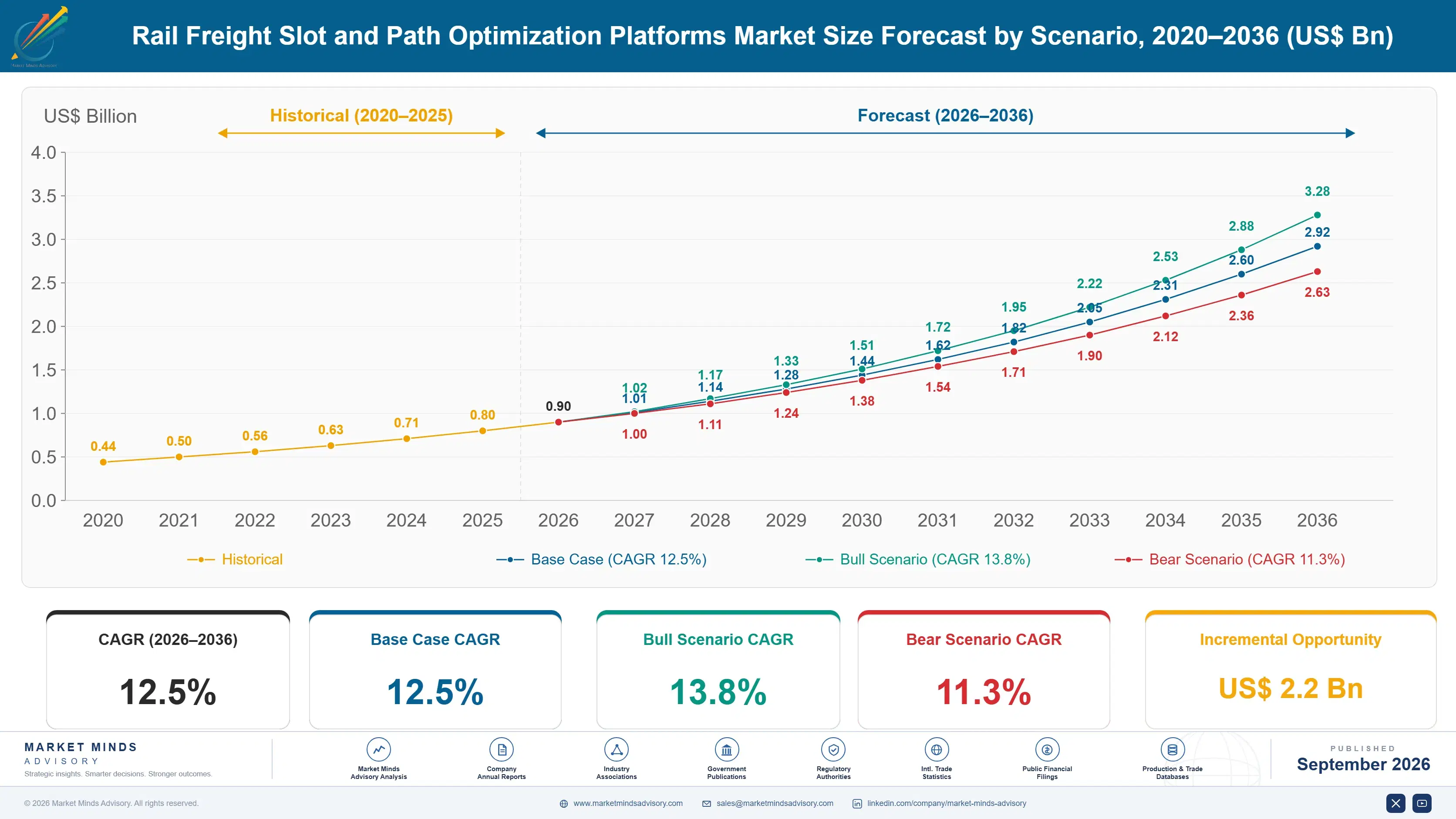
Between 2020 and 2025 the rail freight slot and path optimization platforms market grew steadily as North American Class I railroads adopted precision scheduled railroading operating models and European rail freight corridor coordination mandates took effect across multiple member states over the period. The historical annual growth rate held near 11.0 percent across the full period.
The base case assumes precision scheduled railroading adoption keeps expanding across additional North American railroads, India's Dedicated Freight Corridor program keeps commissioning new route segments requiring coordination software, and European cross-border corridor interoperability requirements keep tightening under updated regulatory frameworks affecting multiple national rail networks. These three mechanisms together sustain a forecast compound annual growth rate near 12.5 percent through 2036, with real-time rescheduling software capturing an outsized share of incremental revenue.
The bull case assumes network capacity constraints intensify faster than current forecasts anticipate, pushing growth toward 13.8 percent as railroads rush to extract additional capacity from existing infrastructure. The bear case assumes freight rail volume growth slows amid broader economic softness, capping growth near 11.3 percent as railroads delay software upgrades pending clearer demand signals across the freight sector.

Legacy Integration Depth Commands Premium Platform Pricing

Platform economics hinge on the trade-off between algorithmic optimization sophistication and integration compatibility with a railroad's existing signaling and dispatch infrastructure, since replacing decades-old legacy systems entirely is rarely economically justified for most Class I operators. Vendors that deliver reliable integration with legacy signaling systems capture premium pricing over pure optimization algorithm licensing, even when raw computational sophistication is otherwise comparable between competing platforms. Buyers increasingly frame integration depth as insurance against disruptive rollout failures.
MARKET CONCENTRATION54% CR5Top five vendors dominate global revenue share considerably
AVERAGE CONTRACT VALUE$3.8 million annuallyTypical annual platform contract cost per Class I railroad
TOP DEPLOYING COUNTRY SHARE33%United States accounts for largest single-country revenue share
DEPLOYMENT CYCLE LENGTH14 monthsAverage months from contract signing to full network rollout
SOFTWARE ATTACH RATE41%Share of Class I railroads running dedicated optimization software
CONTRACT RENEWAL RATE91%Share of railroads renewing platform contracts every year
Market concentration remains moderately high, with the top five vendors controlling roughly 54 percent of revenue, reflecting the substantial domain expertise required to model complex rail network topology and interlocking constraints accurately. Deployment cycles run considerably longer than typical enterprise software because railroads validate optimization recommendations against actual operational safety requirements before committing to full network-wide rollout across multiple dispatch centers.
Average contract values vary enormously by network scale and corridor complexity, from single-subdivision pilot deployments to enterprise-wide multi-corridor platforms commanding contract values many times higher per railroad account. Vendors increasingly bundle predictive disruption management and simulation modules into core optimization contracts, since railroads value proactive capacity planning as much as pure real-time slot allocation functionality when evaluating platform selection.
"Dispatchers used to solve the puzzle in their heads with decades of tribal knowledge, and now the algorithm solves it in seconds and explains why. The railroads that trusted the algorithm earliest are running measurably more trains over the same track."
Lead Analyst, Rail Technology Practice · MMA Technology Practice · September 2026

Market Trends

Real Time Rescheduling Displaces Static Slot Planning

Railroads increasingly demand real-time rescheduling capability that automatically replans train movements the moment disruptions occur, replacing static slot plans that dispatchers previously had to manually rework by hand during every single service interruption. Vendors report real-time rescheduling module revenue growing over 45 percent faster than static slot allocation revenue during 2025, confirming the category's outsized momentum among Class I freight railroads. This shift is reshaping vendor product roadmaps industry-wide, pulling engineering investment away from static planning tools that once represented the bulk of new feature development spending across the sector.
Market Impact: Sustains demand across 7 major railroads
Cross Border Corridor Mandates Drive Interoperability Demand

European Union rail freight corridor regulations increasingly require coordination software capable of managing train paths across multiple different national rail networks and differing signaling standards simultaneously, creating fresh demand for interoperability-focused platform modules across the entire continent this decade. Cross-border corridor coordination software revenue grew roughly 38 percent in 2025 as more European corridors reached mandated coordination compliance deadlines affecting an expanding share of freight traffic. This shift is pushing vendors to invest heavily in multi-standard signaling protocol translation capability that domestic-only platforms historically never needed to develop or maintain.
Market Impact: Adds 25 percent regional demand

Market Opportunities and Growth Drivers

Precision Scheduled Railroading Sustains Optimization Demand

Major North American Class I railroads have largely completed precision scheduled railroading operating model transitions, and the resulting focus on asset utilization efficiency continues driving demand for optimization software that squeezes additional capacity from existing track infrastructure without new construction. Railroads running precision scheduled railroading report measurably higher optimization software attach rates than railroads still operating under traditional scheduling approaches, confirming the operating model's direct link to software adoption. This shift is reshaping vendor product roadmap priorities, with capital increasingly directed toward asset utilization analytics rather than purely dispatch automation functionality alone.
Market Impact: Adds 8 months to deployment

Indian Dedicated Freight Corridor Expands Regional Demand

India's Dedicated Freight Corridor program continues commissioning new dedicated freight route segments, each requiring modern slot allocation and path optimization software from the very earliest outset rather than retrofitting legacy manual scheduling systems onto brand-new infrastructure being built. This greenfield infrastructure buildout gives software vendors a rare opportunity to deploy modern platforms without the legacy system integration burden that complicates deployments on established Western rail networks. Corridor commissioning has already added a meaningful share of new platform deployment revenue in the region, with additional segments scheduled for commissioning through 2030.
Market Impact: Validation adds 6 months before deployment

Market Restraints and Challenges

Legacy Signaling Compatibility Complicates Platform Deployment

Integrating modern optimization software with decades-old interlocking and signaling systems that vary considerably between railroads and even between subdivisions of the same railroad requires extensive custom interface engineering that slows deployment timelines meaningfully. The root cause is that rail signaling infrastructure often remains in service for thirty years or more, far outlasting the communication protocols and data standards prevalent when the equipment was originally installed decades ago. Vendors are mitigating this through modular protocol translation layers and phased subdivision-by-subdivision rollout approaches, a mitigation path that reduces but does not eliminate custom engineering time required.
Market Impact: Rescheduling revenue grew 45 percent faster

Safety Certification Requirements Slow Software Validation

Rail safety regulators require extensive validation testing before approving optimization software that influences train movement decisions, since any algorithmic error carries potentially severe safety consequences unlike typical enterprise software failures affecting most other unrelated industries. The root cause is that rail safety regulation appropriately treats any system touching train movement authority as safety-critical, requiring validation processes considerably more rigorous than conventional software quality assurance. Vendors are mitigating this by building extensive simulation testing environments that validate algorithm behavior across millions of scenario permutations before regulators ever see a live deployment request.
Market Impact: Interoperability revenue grew 38 percent
3 additional market trends, 4 additional growth drivers, and 2 additional restraints and challenges are covered in the full report. Contact sales@marketmindsadvisory.com to access the complete intelligence.

Segment CAGR and Growth Architecture

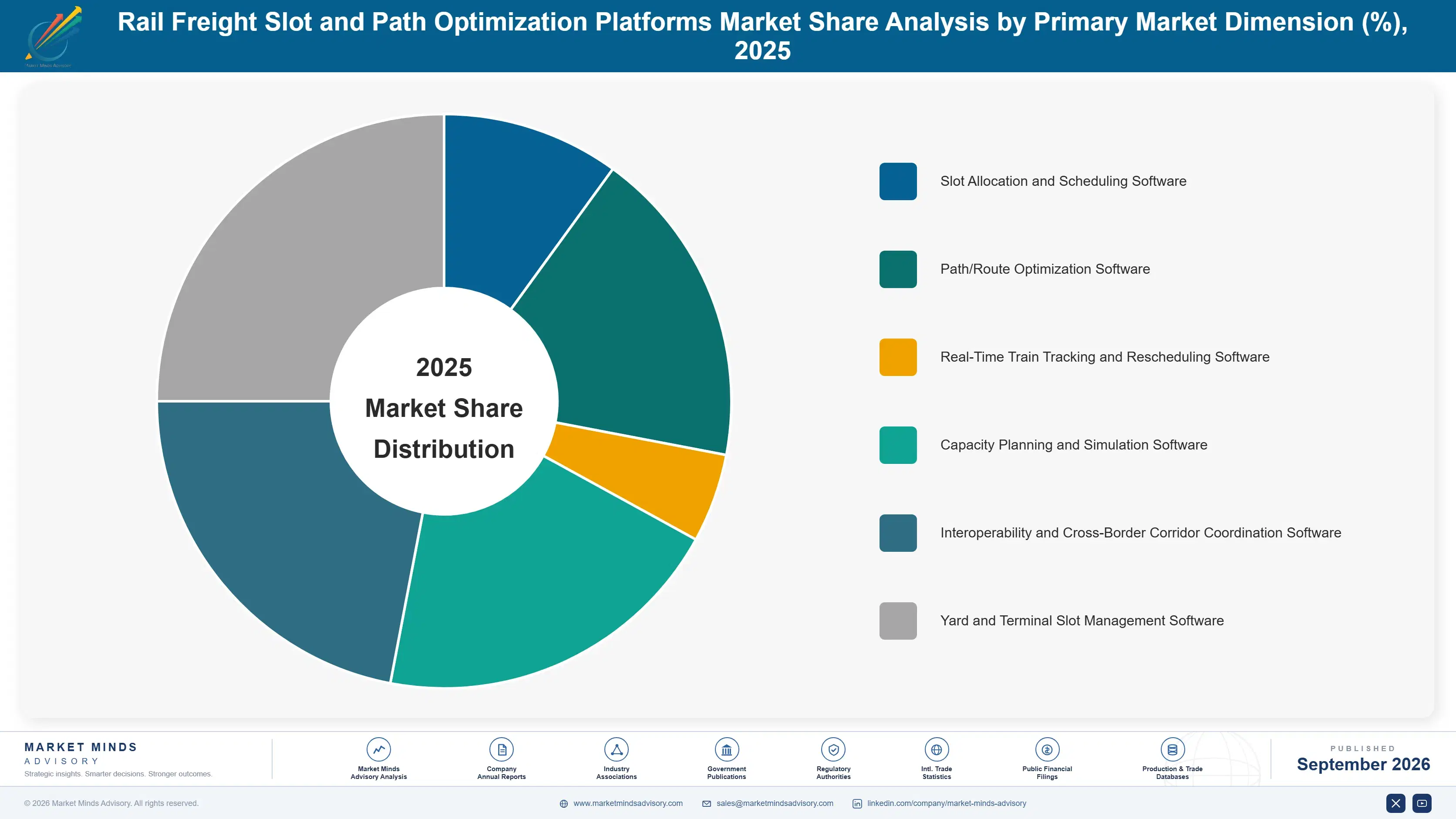
The rail freight slot and path optimization platforms market segments by software function, spanning slot allocation and scheduling, path and route optimization, real-time tracking and rescheduling, capacity planning and simulation, interoperability and cross-border corridor coordination, and yard and terminal slot management software. Product life cycles and pricing models vary considerably across these six categories tracked in this analysis.
rail-freight-slot-and-path-optimization-platforms--market-share-analysis-1788421127670

Real-Time Train Tracking and Rescheduling Software

Real-time train tracking and rescheduling software continuously monitors actual train positions against planned schedules, automatically generating updated movement plans the moment a disruption occurs rather than waiting for a dispatcher to manually replan around the delay. This segment is growing fastest because service disruptions are inevitable on any heavily utilized network, unlike static slot allocation software that only matters during initial schedule construction rather than daily operations. Vendors have invested heavily in machine learning models trained on historical disruption patterns that predict cascading delay effects across a network, letting dispatchers intervene proactively before minor delays compound into major schedule failures. Pricing for this segment carries a substantial premium over conventional allocation software given the added real-time computational complexity required.
CAGR 17.0%

Interoperability and Cross-Border Corridor Coordination Software

Interoperability and cross-border corridor coordination software translates between different national signaling standards and scheduling data formats, letting a single train movement plan span multiple rail networks that historically required separate coordination handoffs at each border crossing. Growth is strong as European Union rail freight corridor mandates require this coordination capability for an expanding share of cross-border freight traffic previously coordinated through manual phone calls between national dispatch centers. Railroads increasingly demand platforms that integrate directly with neighboring national rail infrastructure managers, letting cross-border schedule changes propagate automatically without requiring manual re-coordination at every border crossing point. Several major European rail infrastructure managers have already standardized on specific coordination platforms for their cross-border corridor operations.
CAGR 15.5%
Full segment breakdown across 7 segments available in the complete report.

Regional Architecture and Country Demand Map

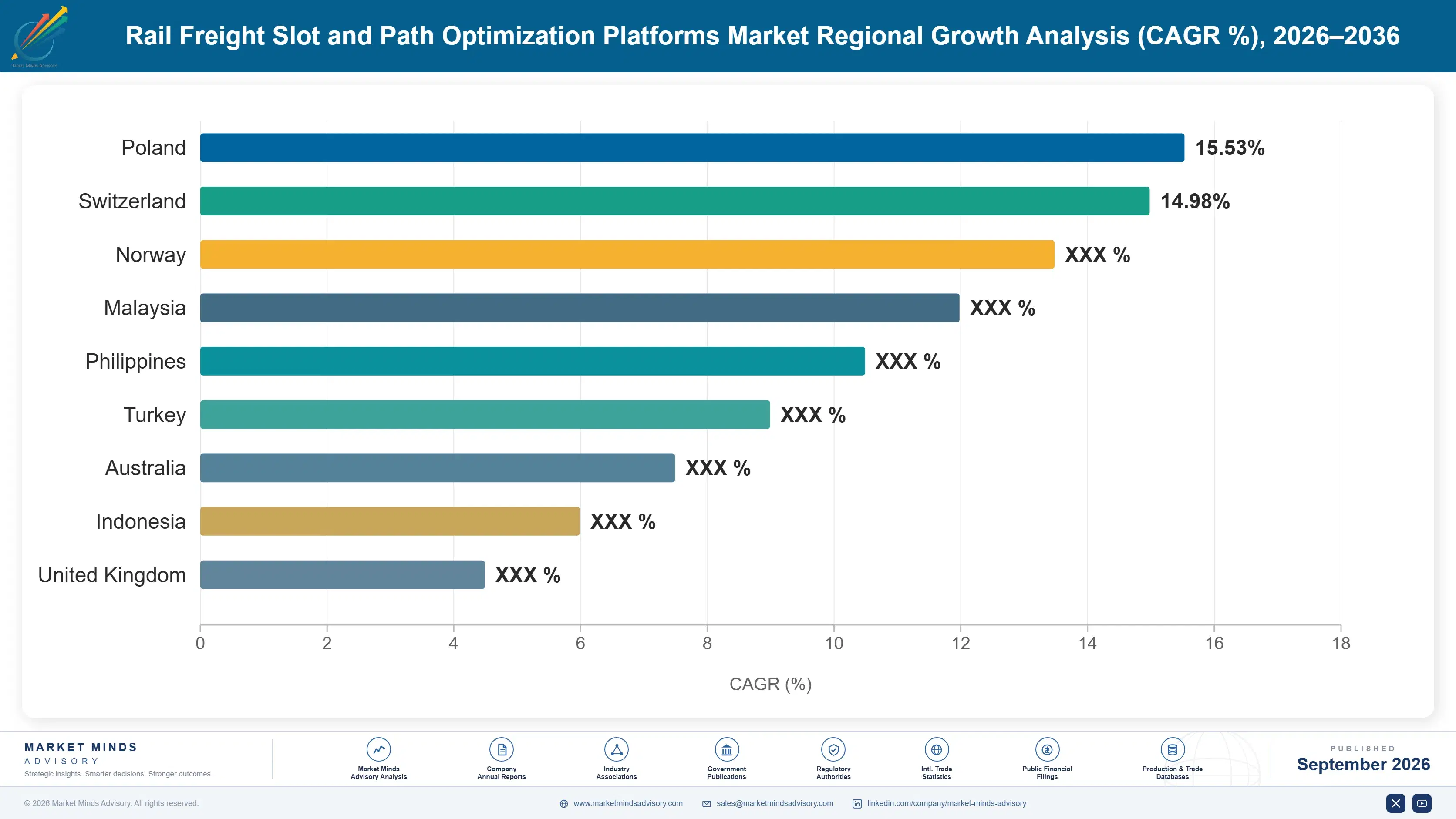
North America leads platform revenue through major Class I railroad digitization investment and established vendor headquarters concentration across most of the continent, while Western Europe follows through cross-border corridor mandates, and South Asia and Pacific posts the fastest regional growth off a comparatively smaller current base.

North America

Major Class I freight railroads headquartered in the United States, including Union Pacific, BNSF, and Norfolk Southern, drive this region's leading platform revenue share, having largely completed precision scheduled railroading operating model transitions across their networks. Chronic capacity constraints on heavily utilized corridors give American railroads the strongest commercial incentive to adopt optimization software quickly, and several mid-size regional railroads have followed the Class I carriers into procurement decisions this year. Canada contributes a smaller but growing deployment base tied to shared North American freight rail interoperability standards. Vendor headquarters concentration in this region also shortens integration timelines for domestic railroad customers. Financing structures common in this market let mid-size regional railroads join without heavy budget strain.
Share: 30% | CAGR: 13.5% (2026 to 2036)

Western Europe

Germany's and France's rail freight networks anchor this region's platform demand, particularly for cross-border corridor coordination software tied to European Union rail freight corridor regulatory compliance deadlines affecting an expanding share of freight traffic. The United Kingdom contributes meaningful demand tied to its own domestic capacity constraints on congested commuter and freight-shared corridors. The region hosts a more fragmented rail network structure than North America, with multiple national infrastructure managers requiring coordination software that spans institutional boundaries. The region's growth trails North America slightly as fragmented network ownership complicates procurement decisions relative to unified Class I railroad structures. Nordic countries add modest additional demand tied to their own capacity optimization ambitions.
Share: 22% | CAGR: 11.0% (2026 to 2036)
Regional intelligence for 5 additional markets available in the complete report: East Asia, South Asia and Pacific, Latin America, Middle East and Africa, Eastern Europe. Contact sales@marketmindsadvisory.com.
rail-freight-slot-and-path-optimization-platforms--country-cagr-analysis-1788421128194

Where Rail Optimization Margins Concentrate

Vendor profitability increasingly concentrates in real-time rescheduling modules and cross-border interoperability capability rather than static slot allocation licenses, as leading players bundle predictive disruption analytics into multi-year railroad contracts that reduce reliance on one-time implementation revenue. This shift rewards the deepest algorithmic expertise. Fewer vendors compete effectively across every one of these dimensions simultaneously today.

Bundling Predictive Disruption Analytics Into Contracts

Vendors that bundle predictive disruption analytics directly into core optimization platforms capture recurring subscription revenue that persists across a railroad's entire network operating lifecycle rather than selling a standalone rescheduling module separately. This shifts vendor economics toward a unified platform model with considerably higher overall retention than point solutions competing purely on feature depth. Vendors offering this bundle report attach rates averaging 38 percent among existing slot allocation customers, a figure growing steadily as railroads consolidate vendor relationships to simplify their technology stack. Vendors extend this model to smaller railroads each year as analytics pricing standardizes.
Market Impact: Bundle attach rate now reaches roughly 38 percent

Charging Cross-Border Interoperability Fees For Corridor Access

Vendors offering cross-border corridor coordination capability capture premium contract fees independent of core domestic optimization pricing, protecting against the risk that domestic-only pricing structures undervalue the specialized multi-standard signaling translation expertise required. This interoperability layer requires specialized regulatory and protocol knowledge that only vendors with established European corridor experience can credibly deliver to skeptical infrastructure managers. Interoperability fees on cross-border corridor contracts now average 28 percent of total contract value, rewarding vendors willing to invest in specialized coordination capability. Few competitors possess comparable multi-standard signaling translation depth to compete confidently here.
Market Impact: Interoperability fees now reach roughly 28 percent overall

Expanding Distribution Through Signaling Equipment Partnerships

Vendors partnering directly with signaling equipment manufacturers to bundle optimization software with new infrastructure purchases are capturing distribution reach that pure direct-to-railroad marketing simply cannot match at comparable customer acquisition cost. This channel commands premium customer lifetime value since manufacturer-referred railroads show meaningfully higher retention than railroads acquired through generic direct sales campaigns competing on price alone. Manufacturer-channel customer acquisition costs run roughly 25 percent lower than direct sales acquisition, rewarding vendors that invest early in building these strategic distribution partnerships across the industry. Vendors without manufacturer relationships face a persistent, hard-to-close cost disadvantage.
Market Impact: Manufacturer channel now cuts costs by 25 percent

Offering Financing For Regional Railroad Platform Rollouts

Vendors offering flexible financing structures that spread enterprise platform costs across monthly operating budgets rather than large annual licensing commitments are capturing smaller regional railroads previously priced out of full network optimization deployment. This financing approach lowers the barrier to entry meaningfully for regional railroads competing against larger Class I carriers on operational sophistication and capacity utilization. Roughly 22 percent of new enterprise contracts signed in 2025 used this subscription financing structure, expanding the addressable customer base considerably beyond the largest Class I railroads alone. Adoption keeps accelerating among smaller regional railroads each quarter.
Market Impact: Roughly 22 percent of new enterprise deals financed

Who Controls the Margin Pool

Competitive concentration sits at a moderately high 54 percent CR5, reflecting the substantial rail domain expertise required to model complex network topology and safety-critical operating constraints. Participants are evaluated here on revenue, the most commercially consistent basis across vendors with very different business models and rail signaling heritage. The gap between Wabtec, the clear leader through its broad rail technology portfolio, and the fifth-ranked competitor remains wide.
Current activity centers on real-time rescheduling algorithm development, as vendors race to close the gap between static slot planning and dynamic disruption response capability that precision scheduled railroading demands. Several vendors have also expanded cross-border corridor interoperability offerings, targeting European rail freight corridor regulatory compliance deadlines. Signaling equipment manufacturer distribution partnerships have intensified as vendors seek channel differentiation.

Emerging pressure is coming from enterprise software vendors adapting general transportation management platforms for rail-specific use cases, threatening standalone rail optimization specialists that built their entire business on deep rail domain expertise alone. This threatens established vendors' pricing power in less safety-critical planning modules specifically. Rankings are most likely to shift as real-time rescheduling capability, not static optimization sophistication, increasingly determines which vendors win Class I railroad accounts.
rail-freight-slot-and-path-optimization-platforms--company-positioning-matrix-1788421128732

Competitive Moat and Risk Dimensions

WABTEC CORPORATION

Moat: Broadest Rail Signaling Portfolio Reach

Wabtec maintains the broadest rail technology portfolio in the industry, integrating signaling hardware, locomotive control systems, and optimization software that let railroads avoid managing several disconnected point solutions across their operation. This breadth reduces switching costs for existing customers considering competing point solutions, since replacing Wabtec means replacing multiple integrated systems simultaneously rather than one standalone platform.
WABTEC CORPORATION

Risk: Premium Pricing Limits Railroad Reach

Wabtec's premium pricing structure, reflecting its broad hardware and software portfolio, sometimes prices out smaller regional railroads who cannot justify the platform's full cost relative to their limited network scale and traffic volume, creating an opening for lower-cost point solutions to win early customer relationships.
HITACHI RAIL

Moat: Deep European Signaling Standard Expertise

Hitachi Rail, through its Thales rail signaling acquisition, has built extensive expertise navigating European Train Control System standards and cross-border interoperability requirements that newer entrants struggle to replicate quickly. This regulatory depth continues expanding as the company accumulates more corridor-specific compliance experience each year across member states.
HITACHI RAIL

Risk: Integration Complexity Slows Roadmap Execution

Hitachi Rail continues working through significant integration challenges following its Thales signaling acquisition, creating internal coordination friction that meaningfully slows product roadmap execution compared to competitors with more unified organizational structures and engineering teams working steadily toward shared strategic priorities and long-term customer commitments together.

Players Tracked

Prominent Players

Wabtec Corporation
Hitachi Rail
Siemens Mobility
Alstom
Trapeze Group

Other Key Players

RailComm LLC
Bentley Systems
SAP SE
Oracle Corporation
IBM Corporation
Cyient Limited
Konux GmbH
Optram Inc
Wärtsilä Voyage
Frauscher Sensor Technology
Thales Group
Cubic Transportation Systems
ALTPRO d.o.o.
Modaxo Inc
Icomera AB

Recent Developments

MARCH 2026

Wabtec Launches Real Time Rescheduling Module

Wabtec launched a new real-time rescheduling software module that automatically replans train movements during service disruptions, extending its existing slot allocation platform with dynamic response capability. The launch responds directly to Class I railroad demand for automated disruption management that reduces manual dispatcher workload during service interruptions.
Signal: Signals that leading vendors are now actively racing to add automated disruption response capability quite meaningfully.
OCTOBER 2025

Alstom Wins European Corridor Coordination Contract

Alstom secured a brand-new multi-year contract with a European rail infrastructure consortium to provide cross-border corridor coordination software across several national rail networks throughout the continent. The contract covers multiple corridor segments spanning several member states under updated European Union rail freight regulatory compliance requirements.
Signal: Signals that European rail infrastructure managers are now actively consolidating fragmented coordination relationships into unified platforms.
JANUARY 2026

Hitachi Rail Acquires Predictive Analytics Startup

Hitachi Rail acquired a smaller predictive disruption analytics startup specializing in machine learning-based delay forecasting, adding entirely new capability to its existing signaling and optimization software portfolio and roadmap. The acquisition strengthens Hitachi Rail's ability to compete against vendors expanding into recurring analytics subscription revenue streams.
Signal: Signals that established rail vendors are now actively building predictive analytics capability through targeted acquisition strategically.

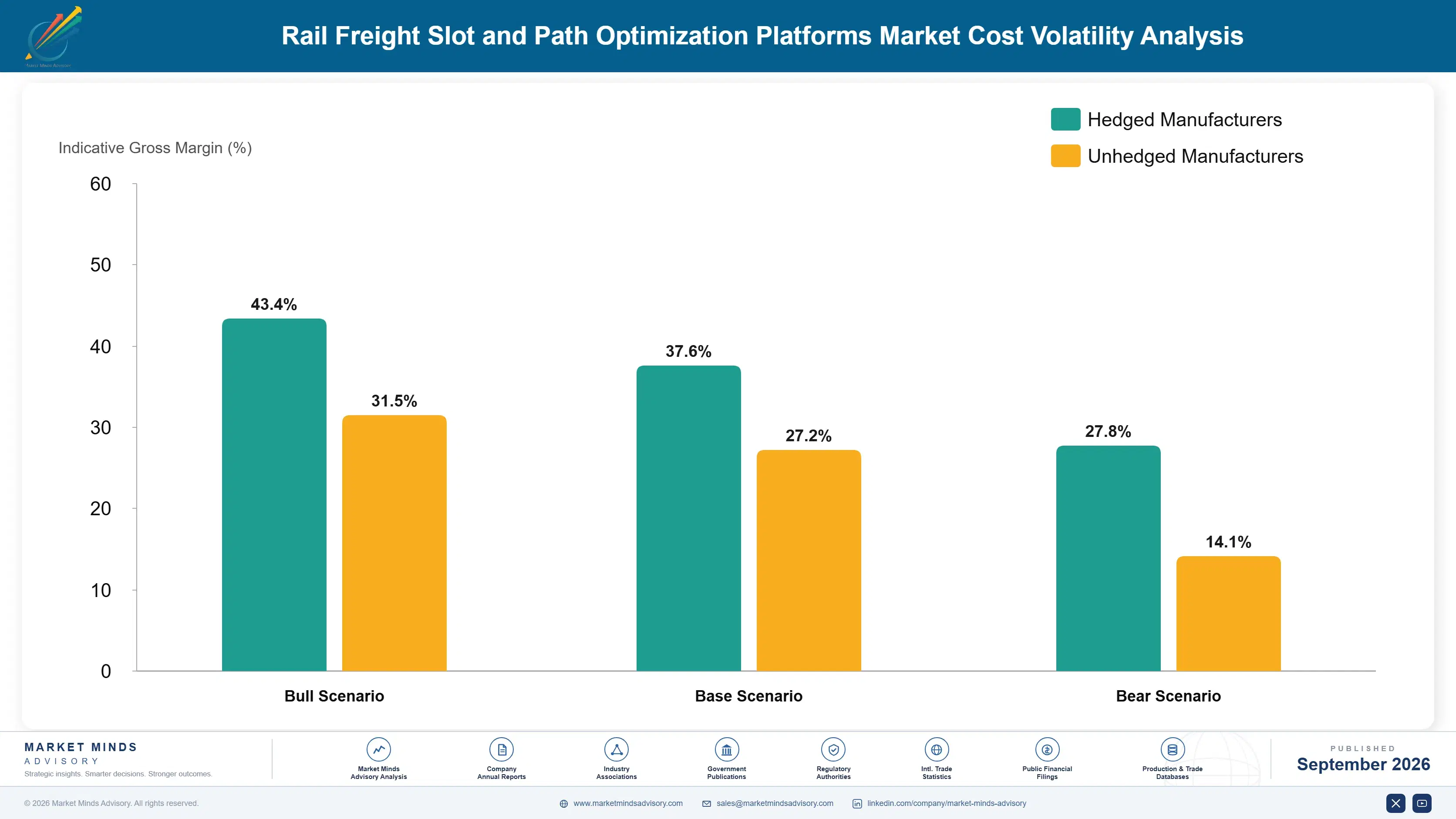
Rail Domain Software Engineering Talent Cost

Software engineering staff with specialized rail operations research and safety-critical systems expertise account for roughly 62 percent of total operating cost for optimization platform vendors, reflecting the scarcity of engineers combining operations research modeling skill with rail domain knowledge. Cloud compute infrastructure makes up most of the remainder, concentrated among major cloud providers serving vendor data center needs.
Specialized rail operations research engineer compensation rose meaningfully during 2024 and into 2025 as vendors competed intensely for scarce talent capable of modeling complex network optimization problems, a trend documented across vendor annual reports and industry compensation surveys conducted this year. This compressed gross margins for smaller vendors unable to match the compensation packages that larger, better-capitalized competitors could offer to retain their most experienced operations research engineers.

Vendors without efficient algorithm development tooling face a meaningful competitive disadvantage as talent costs keep rising, since manual optimization model development requires considerably more engineer time than automated development frameworks built for rapid iteration. This exposure varies by vendor scale: larger vendors like Wabtec can invest in proprietary development tooling that smaller specialists simply cannot afford to build at comparable depth and sophistication.
rail-freight-slot-and-path-optimization-platforms--cost-volatility-analysis-1788421128932

Building Proprietary Algorithm Development Frameworks

Leading vendors now invest heavily in proprietary optimization algorithm development frameworks that accelerate iteration cycles, reducing dependence on expensive additional engineer headcount for routine model tuning tasks across most product lines and modules. This tooling requires meaningful upfront engineering investment before reducing ongoing development cost, a trade-off only well-capitalized vendors can consistently afford to make.

Partnering With University Operations Research Programs

Vendors are building recruiting partnerships with university operations research and transportation engineering programs to develop a pipeline of specialized talent familiar with rail network optimization problems already in place. This partnership approach reduces recruiting cost meaningfully but requires sustained relationship investment that smaller vendors sometimes struggle to prioritize against more immediate product development needs.

Portfolio Architecture for Margin Defence

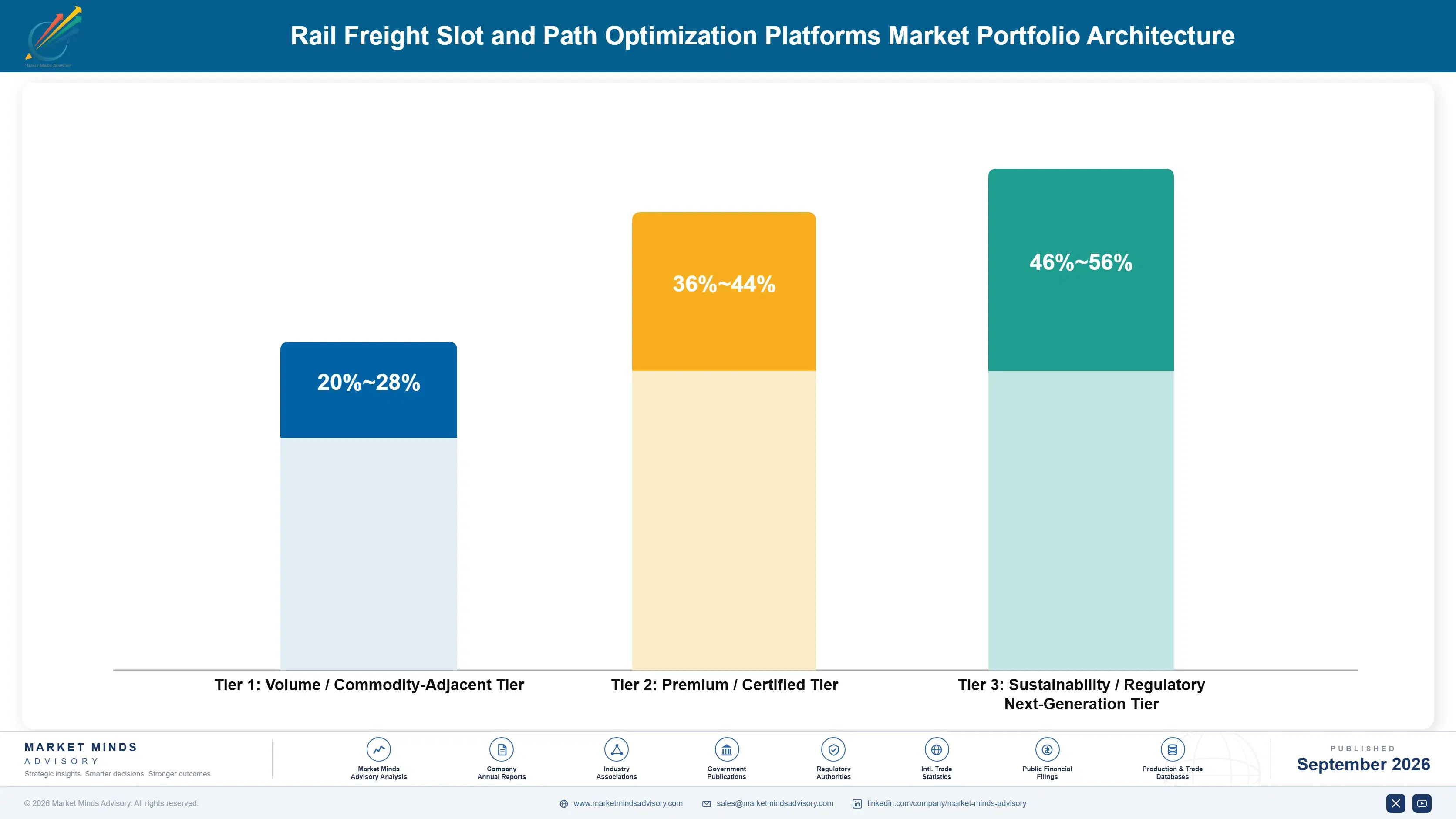
Portfolio economics split across three tiers running from basic slot allocation software sold near commodity pricing up through certified interoperability platforms and next-generation real-time rescheduling bundled with predictive disruption analytics. Gross margin widens considerably moving up this ladder, since algorithmic sophistication and regulatory certification depth create defensibility that pure scheduling functionality alone cannot provide. Investors increasingly value vendors by their revenue mix across these three tiers.
Volume tier software competes almost entirely on subscription price and basic scheduling feature parity, leaving vendors with thin margins that depend on scale to remain profitable across smaller regional railroad accounts. Premium tier platforms instead compete on algorithmic sophistication and cross-border regulatory certification, letting vendors charge meaningfully more per contract while facing far less price pressure during renewal negotiations. This tension shapes capital allocation across every vendor's roadmap.

High-value margin pools concentrate almost entirely in the next-generation tier, where real-time rescheduling bundled with predictive analytics generates premium recurring revenue unavailable to vendors still selling standalone slot allocation software. Vendors positioned only in the volume tier face real profitability ceilings that next-generation-tier competitors do not share, regardless of contract volume signed across any given fiscal year of operation.

Volume / Commodity-Adjacent Tier

Basic slot allocation software sold mainly to smaller regional railroads prioritizing cost over feature depth, competing largely on subscription price against several established suppliers operating broadly across the entire market.
Gross Margin: 20-28%

Premium / Certified Tier

Certified interoperability platforms supporting multiple national signaling standards and cross-border corridor connections, commanding premium pricing from customers requiring deep regulatory compliance and strong reference credentials from many prior client engagements.
Gross Margin: 36-44%

Sustainability / Regulatory / Next-Generation Tier

Next-generation real-time rescheduling platforms bundled with predictive disruption analytics, positioned for large Class I railroads prioritizing network-wide capacity utilization well above pure scheduling cost considerations entirely each full contract cycle.
Gross Margin: 46-56%
rail-freight-slot-and-path-optimization-platforms--portfolio-architecture-1788421129434

High-value Sub-segments and Strategic Watch-out

Real-Time Train Tracking and Rescheduling Software

Real-time train tracking and rescheduling software sits in the high-value high-growth quadrant, combining the fastest revenue growth rate tracked with the widest gross margin band once predictive analytics premiums layer on top of subscription pricing, making it the clearest priority for vendor capital allocation across this entire decade of investment.
Gross Margin: 46-56%

Interoperability and Cross-Border Corridor Coordination Software

Interoperability and cross-border corridor coordination software occupies the high-value moderate-growth quadrant, generating strong recurring margin from European regulatory compliance mandates even though growth trails real-time rescheduling, because cross-border coordination still depends heavily on multi-national regulatory agreement that takes considerably longer to finalize than domestic deployments.
Gross Margin: 36-44%

Slot Allocation and Scheduling Software

Slot allocation and scheduling software remains the volume core segment, generating the bulk of current license shipments at thinner margins, still essential for vendor scale economics even as growth slows relative to real-time and interoperability alternatives entering the category more aggressively with each successive generation.
Gross Margin: 20-28%

Yard and Terminal Slot Management Software

Yard and terminal slot management software forms the strategic watch-out segment, facing real commoditization risk as broader network-wide optimization platforms increasingly absorb yard-level scheduling functionality natively at no added cost today, threatening standalone vendors that never expanded beyond simple yard management into richer network-wide categories.
Gross Margin: 18-24%

Bundled Platforms Extend Railroad Vendor Relationships

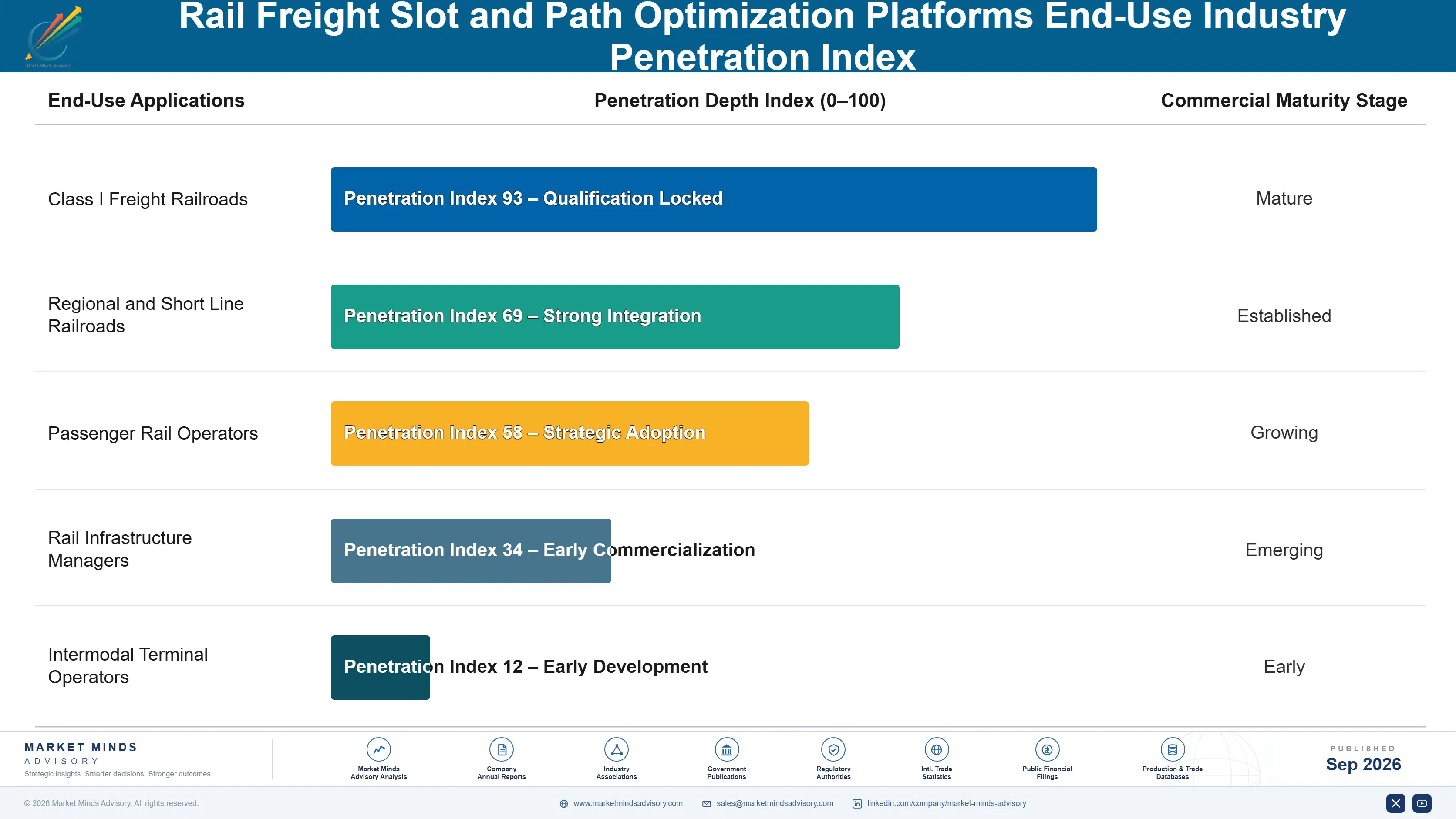
Vendors increasingly bundle slot allocation, real-time rescheduling, and predictive disruption management into a single recurring platform subscription, converting what was once a project-based implementation fee into a longer-tail relationship spanning a railroad's entire network operating lifecycle. This bundled model gives vendors recurring revenue visibility through corridor expansion rather than relying entirely on one-time initial deployment project fees. Investors increasingly value vendors on this recurring platform revenue mix rather than initial deployment count alone.
Adoption depth varies sharply by railroad type: large Class I freight railroads commit to enterprise-wide multi-corridor platforms and rarely switch vendors once integration with legacy signaling and dispatch systems is complete, while smaller regional railroads remain more price-sensitive at each renewal decision. Passenger rail operators sit between these extremes, valuing schedule reliability over pure unit cost. This tension shapes vendor product roadmap priorities across every railroad segment served.

Buyer profiles are shifting generationally as data science-trained operations research engineers, rather than traditional dispatchers, increasingly drive platform vendor selection given growing emphasis on algorithmic optimization transparency alongside pure operational reliability. This generational shift is reshaping which platform features vendors prioritize, favoring explainable optimization recommendations over the black-box scheduling engines that historically dominated early platform generations.
rail-freight-slot-and-path-optimization-platforms--end-use-penetration-index-1788421129925

Where Rail Vendors Should Focus Now

These are among the four positions where our research anticipates prominent divergence between winners and laggards over the coming forecast period. Each is grounded in the demand model, the regulatory perimeter, and the announced capacity pipeline.
01 / REAL-TIME RESPONSE INVESTMENT

Prioritize Real-Time Rescheduling Over Static Slot Planning

Vendors still focused primarily on static slot allocation are missing the fastest-growing opportunity in the industry, since real-time rescheduling revenue is growing over 45 percent faster than static allocation revenue across most Class I railroads tracked this year and every quarter since. Vendors with early real-time capability investment are capturing railroad relationships that competitors focused on static planning cannot match today. Vendors slow to redirect engineering resources risk ceding the highest-growth customer segment entirely to faster-moving competitors within the next two product cycles.
02 / CROSS-BORDER INTEROPERABILITY EXPANSION

Expand Interoperability Capability Before European Mandates Consolidate

Vendors without cross-border interoperability capability are missing compliance-driven demand growing 38 percent as European corridors reach mandated coordination deadlines affecting an expanding share of freight traffic across the entire continent this year and every year beyond. Vendors establishing early regulatory expertise in this space are positioned to capture long-term infrastructure manager relationships before established domestic vendors extend their reach into cross-border markets. Vendors should invest in this expansion now, before competitors establish first-mover regulatory relationships that prove difficult to displace.
03 / MANUFACTURER CHANNEL PARTNERSHIPS

Pursue Signaling Equipment Distribution Before Rivals Lock In Deals

Vendors relying entirely on direct-to-railroad marketing are missing a distribution channel that cuts customer acquisition costs by roughly 25 percent compared to generic sales campaigns competing purely on price across the industry and every railroad segment served. Vendors with established manufacturer partnerships are capturing dealer network reach that standalone marketing simply cannot replicate at comparable cost or speed today. Vendors should pursue these partnerships now, before the largest signaling manufacturers consolidate exclusive software relationships with fewer preferred vendors going forward.
04 / LEGACY INTEGRATION SPECIALIZATION

Specialize In Legacy Signaling Compatibility Before Rivals Build Depth

Vendors without proven legacy signaling compatibility expertise are missing pricing premiums that vendors handling complex interlocking integration work can command over generalist competitors lacking comparable domain depth across older systems and legacy dispatch centers still in daily use. Vendors with established protocol translation knowledge are capturing deployment projects that generalist competitors simply cannot execute reliably without extended engineering delays and costly rework. Vendors should invest in this specialization now, since rail signaling infrastructure routinely remains in service for thirty years or more.

Engagement Snapshot From the Field

A live engagement with an industry participant carrying material or product regulatory and market exposure ahead of a defining policy shift, showing how our research translates into a defensible multi-year portfolio strategy.
MARKET MINDS ADVISORY · CLIENT ENGAGEMENT SUMMARY
Rail Freight Slot and Path Optimization Platforms Producer Strategic Portfolio Review and Transition Roadmap 2026·Investment Scenario on Rail Freight Slot and Path Optimization Platforms Exposure Evaluation 2025-26
CLIENT PROFILE
The client operates a mid-size freight railroad network across the southeastern United States, serving industrial and agricultural shippers along several heavily utilized corridors shared with a larger Class I carrier. Facing chronic capacity constraints and rising customer complaints about schedule reliability, leadership needed a framework for selecting a slot optimization platform vendor. Annual revenue was reported at approximately 780 million dollars (client-reported, unverified by MMA).
STRATEGIC CHALLENGE
Leadership faced a choice between an established vendor offering proven Class I railroad references but a lengthy implementation timeline and a newer specialist vendor offering faster deployment but limited track record at comparable network scale. Operations teams worried about disruption during any transition given shared corridor obligations with the larger carrier.
MMA APPROACH
MMA conducted a comparative implementation risk and total cost of ownership assessment across both vendors, incorporating primary interview data on each vendor's deployment track record from comparable mid-size freight railroads. The analysis modeled schedule reliability improvement scenarios under each vendor's proposed implementation timeline. Findings were presented to the client's operations committee alongside a recommended phased deployment approach.
KEY FINDINGS
  1. The established vendor's proven Class I references carried meaningfully lower implementation risk despite requiring a longer deployment timeline than the newer specialist vendor proposed.
  2. The newer specialist vendor's faster deployment timeline came with real execution risk given its limited track record at comparable mid-size network scale and complexity.
  3. Phasing deployment by corridor segment rather than attempting a single network-wide cutover reduced measured disruption to shared corridor operations considerably across the network.
  4. Schedule reliability improvements correlated closely with the vendor's prior experience integrating with the specific signaling system already installed on the client's network.
CLIENT PROFILE
The client operates a mid-size freight railroad network across the southeastern United States, serving industrial and agricultural shippers along several heavily utilized corridors shared with a larger Class I carrier. Facing chronic capacity constraints and rising customer complaints about schedule reliability, leadership needed a framework for selecting a slot optimization platform vendor. Annual revenue was reported at approximately 780 million dollars (client-reported, unverified by MMA).
STRATEGIC CHALLENGE
Leadership faced a choice between an established vendor offering proven Class I railroad references but a lengthy implementation timeline and a newer specialist vendor offering faster deployment but limited track record at comparable network scale. Operations teams worried about disruption during any transition given shared corridor obligations with the larger carrier.
MMA APPROACH
MMA conducted a comparative implementation risk and total cost of ownership assessment across both vendors, incorporating primary interview data on each vendor's deployment track record from comparable mid-size freight railroads. The analysis modeled schedule reliability improvement scenarios under each vendor's proposed implementation timeline. Findings were presented to the client's operations committee alongside a recommended phased deployment approach.
KEY FINDINGS
  1. The established vendor's proven Class I references carried meaningfully lower implementation risk despite requiring a longer deployment timeline than the newer specialist vendor proposed.
  2. The newer specialist vendor's faster deployment timeline came with real execution risk given its limited track record at comparable mid-size network scale and complexity.
  3. Phasing deployment by corridor segment rather than attempting a single network-wide cutover reduced measured disruption to shared corridor operations considerably across the network.
  4. Schedule reliability improvements correlated closely with the vendor's prior experience integrating with the specific signaling system already installed on the client's network.
RECOMMENDED STRATEGY
Phase 1: Phase 1 (Months 1 to 4): Deploy the optimization platform on the least complex corridor segment first this entire year. Phase 2: Phase 2 (Months 5 to 10): Expand deployment to remaining corridor segments, applying lessons learned from the very first segment. Phase 3: Phase 3 (Months 11 to 14): Validate schedule reliability improvements against contracted performance benchmarks across the entire full railroad network.
OUTCOME
The client selected the recommended vendor and phased deployment approach, improving schedule reliability by an estimated 22 percent (client-reported, unverified by MMA) across the network within the fourteen-month implementation timeline. Shared corridor operations with the larger carrier proceeded without significant disruption throughout the entire rollout.

Frequently Asked Questions

Foundational context covering the market sizes, CAGR, scope, country, region and competition that inform every finding below. This section is provided to cover basics and most often pre-purchase conversations, answered from the MMA Primary Research Dataset.

What is the current size of the Rail Freight Slot and Path Optimization Platforms Market?

The rail freight slot and path optimization platforms market reached approximately 0.96 billion dollars in 2026, according to MMA Primary Research Dataset, July 2026. This figure covers slot allocation, tracking, and interoperability software revenue combined globally.

How large will the Rail Freight Slot and Path Optimization Platforms Market be by 2036?

MMA projects the market will reach approximately 3.12 billion dollars by 2036 under the base case scenario. That represents roughly a 3.25 times expansion over the ten-year forecast period from 2026 through 2036.

What is the CAGR for the Rail Freight Slot and Path Optimization Platforms Market 2026 to 2036?

The base case compound annual growth rate is 12.5 percent through 2036. Bull and bear scenarios range from 13.8 percent to 11.3 percent depending on network capacity constraints and demand conditions.

Which segment is growing fastest?

Real-time train tracking and rescheduling software is growing fastest at 17.0 percent CAGR, roughly 1.36 times the overall market rate. Precision scheduled railroading adoption is driving this segment's outsized expansion versus static slot allocation tools.

Who are the major companies in the Rail Freight Slot and Path Optimization Platforms Market?

Leading companies include Wabtec Corporation, Hitachi Rail, Siemens Mobility, Alstom, and Trapeze Group. These five players hold a combined 54 percent share on a revenue basis.

Which country is growing fastest?

India is growing fastest at approximately 15.0 percent CAGR, driven by the Dedicated Freight Corridor program commissioning new greenfield route segments. This outpaces the United States and other established rail technology markets considerably.

Report Segmentation Architecture

The full report scope spans multiple orthogonal segmentation dimensions, with cross-tabulated demand data provided for each dimension pair. Coverage extends further to regional breakdowns, trend trajectories, and the competitive detail needed to support segment-level decision-making.

By Primary Market Dimension

  • Slot Allocation and Scheduling Software
  • Path/Route Optimization Software
  • Real-Time Train Tracking and Rescheduling Software
  • Capacity Planning and Simulation Software
  • Interoperability and Cross-Border Corridor Coordination Software
  • Yard and Terminal Slot Management Software

By End-Use Industry

  • Class I Freight Railroads
  • Regional and Short Line Railroads
  • Passenger Rail Operators
  • Rail Infrastructure Managers
  • Intermodal Terminal Operators

By Commercial Dimension

  • Direct Railroad Sales
  • Signaling Manufacturer Channel
  • System Integrator Partnership
  • Cloud Subscription

By Region

  • North America
  • Western Europe
  • East Asia
  • South Asia and Pacific
  • Latin America
  • Middle East and Africa
  • Eastern Europe

Scope, Methodology, and Coverage

Every figure in this report is reproducible from documented input assumptions. The scope below maps the historical period, the forecast horizon, the segmentation dimensions, and the countries covered, alongside the underlying primary and qualitative methodology.
Historical Period
2020 to 2025
Forecast Period
2026 to 2036
Base Year
2025 (USD billions; MMA Primary Research Dataset, September 2026)
Market Definition
The rail freight slot and path optimization platforms market covers software for slot allocation, route path optimization, real-time train tracking, capacity planning, and cross-border corridor coordination used by freight railroads and rail infrastructure managers. It excludes signaling hardware, positive train control systems, and general enterprise transportation management software lacking rail-specific slot optimization functionality.
Quantitative Units
USD billions (current prices); network route-kilometers where applicable
Segmentation Dimensions
By Software Function Type; By End-Use Industry; By Commercial Dimension; By Region
Regions Covered
North America, Western Europe, East Asia, South Asia and Pacific, Latin America, Middle East and Africa, Eastern Europe
Countries Covered
USA, China, Germany, France, UK, Japan, South Korea, India, Australia, Canada, Brazil, Mexico, Indonesia, Vietnam, Thailand, Malaysia, UAE, Saudi Arabia, South Africa, Nigeria, Turkey, Poland, Netherlands, Italy, Spain, Sweden, Switzerland, Argentina, Colombia, Singapore, and additional markets relevant to this sector
Key Companies Profiled
Wabtec Corporation, Hitachi Rail, Siemens Mobility, Alstom, Trapeze Group, RailComm LLC, Bentley Systems, SAP SE, Oracle Corporation, IBM Corporation, Cyient Limited, Konux GmbH, Optram Inc, Wärtsilä Voyage, Frauscher Sensor Technology, Thales Group, Cubic Transportation Systems, ALTPRO d.o.o., Modaxo Inc, Icomera AB
Quantitative Methodology
Primary survey, n=3,800 respondents, Q4 2025, six countries; demand-side model with trade association cross-validation
Qualitative Methodology
47 expert interviews, Q4 2025; applied to validate demand model assumptions, identify emerging dynamics, and assess competitive positioning
Report Format
PDF and XLSX data workbook (Word format preview document)
Publisher
Market Minds Advisory
Report Code
MMA-2026-TEC-703
Published
September 2026
Contact
sales@marketmindsadvisory.com | www.marketmindsadvisory.com

Purchase the full Rail Freight Slot and Path Optimization Platforms Market Report (2026 to 2036).

This report delivers a comprehensive assessment of the global rail freight slot and path optimization platforms market, covering historical performance from 2020 through 2025 and forecasts through 2036 across all seven major world regions. It profiles the twenty leading vendors shaping slot allocation, real-time rescheduling, and interoperability software, including detailed competitive positioning and recent contract developments. The analysis quantifies segment-level growth across six software function categories and evaluates revenue diversification opportunities including manufacturer distribution and interoperability fees. Primary research draws on a 3,800-respondent survey and 47 expert interviews conducted in Q4 2025.
Ten-year revenue forecast by segment and region
Competitive benchmarking of twenty profiled vendors
Regional demand driver analysis across seven markets
Rail domain software engineering talent cost assessment
Revenue diversification and interoperability fee lever analysis
Anonymized client case study with strategic recommendations

Built For The People Who Decide

From boardroom strategy to bench-side execution, this report is read cover-to-cover by leaders shaping the next decade of their industry, turning demand scenarios, market dynamics and valuation benchmarks into decisions.
CXOs/ Presidents/ VPs/ Managers
M&A and Corporate Development
Strategy Teams and R&D Heads
Procurement and Product Directors
Regulatory and Compliance Leaders
Investor Relations and Equity Analysts