Market Minds Advisory
Radio Frequency Beauty Equipment Market

Radio Frequency Beauty Equipment Market: Professional and At-Home Device Adoption Economics

At-home handheld devices are pulling radio frequency skin treatment demand out of clinics and into bathrooms, pressuring professional equipment manufacturers to defend treatment volume against consumers now willing to self-administer maintenance sessions.

Lead Analyst

Alice Ballenger

Published

September 2026

Make Smarter Decisions with Customized Research Insights

Request a free sample report and evaluate market opportunities, growth trends, and competitive dynamics relevant to your business needs.

2025 MARKET VALUE$3.2BMarket Size 2025
2036 FORECAST VALUE$8.9BBase Case , 2026 to 2036
CAGR 2026 TO 20369.8 %Bull 11.0% / Bear 8.6%
INCREMENTAL OPPORTUNITY$5.4BNet 10- year value creation
EXPANSION MULTIPLE2.55x2036 value over 2026 base
Strategic Levers
M&A Pipeline
Regional Outlook
Country Rankings
Competitive Intelligence
Segmental Deep-dive
Call-Us : 91 93563 13602

Executive Snapshot and Market Trajectory

At-home handheld radio frequency devices are pulling skin treatment demand out of clinics, pressuring professional equipment manufacturers to defend treatment volume against self-administered maintenance. Consumers increasingly view maintenance-level treatment as something they can competently self-administer between periodic clinic visits. Smaller clinic-only manufacturers face growing pressure to diversify their portfolios.
Commercial demand concentrates around facial skin tightening and body contouring applications, where fractional RF microneedling and combination RF-ultrasound platforms increasingly command premium clinic pricing even as consumer-grade handheld devices erode routine maintenance treatment frequency across established patient bases. East Asia accounts for the largest share of both manufacturing and device adoption, reflecting concentrated component supply chains and strong regional beauty technology consumer culture.
Competitive intensity centers on treatment depth precision, clinical efficacy data, and device miniaturization rather than headline unit pricing alone. Consumer willingness to purchase premium at-home devices is steadily narrowing the gap between clinic-exclusive and self-administered treatment categories that previously defined this market's commercial structure. Manufacturers unable to match established brand recognition increasingly compete on retail distribution reach and influencer partnership depth instead. Growing clinical evidence investment further reinforces this competitive divergence across manufacturer product lines.
Market Definition
This market covers professional and consumer radio frequency devices used for skin tightening, body contouring, and facial rejuvenation applications, spanning monopolar, bipolar, fractional microneedling, and combination platform technologies. It excludes laser-only aesthetic devices without radio frequency energy delivery and unrelated dermatological treatment equipment.
Base Year Value
$3.2B in 2025 (MMA Primary Research Dataset, August 2026)
Forecast Period
2026 to 2036, eleven discrete annual values
CAGR
9.8% base case. Bull 11.0%. Bear 8.6%.
Fastest Growth Segment
At-Home Handheld RF Devices: 16.5% CAGR
Fastest Growth Country
China: 15.0% CAGR
Fastest Growth Region
South Asia and Pacific: 11.8% CAGR
Largest Region
North America: 28% of 2025 global value
Market Leaders
Solta Medical, Cutera, Venus Concept, InMode, BTL Industries. Source: MMA Analysis based on company annual reports and investor filings.
Primary Survey
n=3,800 procurement and R&D decision-makers, Q4 2025, six countries
Methodology
Demand-side build-up, cross-validated against public data, 47 expert interviews

Radio Frequency Beauty Equipment Market Forecast Scenarios

radio-frequency-beauty-equipment-market-size-forecast-scenario-1787309465645
Radio frequency beauty equipment demand grew steadily between 2020 and 2025 as consumer awareness of non-invasive skin tightening treatment expanded, with at-home device adoption accelerating meaningfully throughout this historical window. Manufacturers investing early in at-home product development reported gradually rising direct-to-consumer revenue share across this window as retail distribution expanded. Manufacturer marketing investment expanded meaningfully across this same historical window.
The base case assumes continued at-home device miniaturization, expanding fractional microneedling clinic adoption, and steady combination platform development blending RF with complementary energy modalities. Rising consumer demand for non-invasive aesthetic treatment, expanding social media-driven awareness of visible treatment results, and continued clinical evidence supporting efficacy together sustain demand growth across manufacturer product lines through the forecast period. Manufacturers positioned with combination platform capability and at-home product lines continue capturing disproportionate share of this steady underlying demand growth.
A stronger scenario emerges if major beauty retailers expand premium at-home device distribution meaningfully faster than currently planned, pulling consumer adoption forward ahead of organic awareness-driven growth alone. The bear case involves persistent consumer skepticism about at-home device efficacy relative to professional treatment, meaningfully slowing broader category expansion beyond early-adopter segments. Regulatory clarity would meaningfully influence which trajectory ultimately prevails across manufacturer portfolios.

Clinic-to-Home Migration and Manufacturing Concentration Dynamics

Aesthetic device manufacturers are steadily expanding at-home product lines alongside traditional professional clinic equipment, as consumers increasingly seek maintenance treatment options between periodic clinic visits or as standalone alternatives entirely. This transition mirrors similar clinic-to-home migration cycles observed across other consumer medical and wellness technology categories facing comparable accessibility pressure from device miniaturization. Manufacturer product developmen
MANUFACTURER CONCENTRATION38% CR5Top five manufacturers combined total unit shipment share
AVERAGE PROFESSIONAL DEVICE PRICE$45,000Typical clinic-grade fractional RF platform system cost estimate
LEADING PRODUCER SHAREEast Asia 28%Region currently leading global device manufacturing volume overall
AT-HOME ATTACH RATE34%Share of skincare device buyers purchasing RF-enabled products
CLINIC TREATMENT RETENTION RATE62%Share of clinic patients continuing sessions after at-home purchase
DEVICE REPLACEMENT CYCLE5 to 7 yearsTypical professional clinic RF equipment replacement interval overall
Manufacturing remains moderately concentrated among established medical device companies with regulatory clearance infrastructure, while a growing group of consumer beauty technology companies increasingly compete within the at-home segment through direct-to-consumer distribution channels bypassing traditional clinic relationships. Investor attention increasingly favors manufacturers advancing combination platform capability distinct from the increasingly commoditized single-modality equipment segment facing accelerating price compression. This investor focus increasingly determines which pipeline programmes attract sufficient capital.
Clinical evidence generation and treatment depth precision continue reshaping purchasing decisions, with manufacturers investing in published efficacy studies increasingly capturing clinic customers seeking documented outcomes to justify premium equipment investment relative to lower-cost alternatives. Manufacturers investing in treatment depth precision increasingly capture clinics seeking differentiated positioning against at-home device alternatives. This trend is gradually raising baseline clinical expectations across the entire equipment category.
"Every clinic device manufacturer insists their treatment can't be replicated at home. Consumers are buying the handheld version anyway and deciding for themselves."
Director, Aesthetic and Medical Beauty Devices Practice · MMA Aesthetic and Medi

Market Trends

At-Home Device Miniaturization Accelerating Consumer Adoption

Consumer beauty technology companies continue miniaturizing radio frequency delivery systems while maintaining meaningful energy output, narrowing the performance gap between at-home and professional clinic devices for maintenance-level treatment applications. Major beauty retailers have expanded premium device shelf space specifically targeting this category, supporting broader mainstream consumer awareness beyond early-adopter beauty enthusiasts. Manufacturers without established at-home product lines report unit volume growth considerably below the broader category average as this miniaturization trend accelerates across mass and premium retail channels specifically targeted by leading consumer beauty technology companies. This shift shows no sign of reversing.
Market Impact: Adds 13 percent treatment demand

Fractional Microneedling RF Adoption Expanding in Clinics

Aesthetic clinics are increasingly adopting fractional radio frequency microneedling platforms that combine mechanical needling with RF energy delivery, offering meaningfully deeper dermal penetration than surface-only RF technology previously provided. Major device manufacturers have introduced next-generation fractional platforms specifically targeting acne scarring and deeper wrinkle treatment applications previously requiring more invasive procedures. This technology shift is gradually expanding the addressable clinic treatment population beyond surface-level skin tightening toward more clinically significant dermatological applications. Manufacturers with established fractional platforms increasingly capture this expanding treatment demand. This capability positions manufacturers favorably against at-home substitution risk over time.
Market Impact: Adds 15 percent inquiry volume

Market Opportunities and Growth Drivers

Rising Consumer Demand for Non-Invasive Aesthetic Treatment

Consumers increasingly favor non-invasive radio frequency treatment over surgical alternatives for skin tightening and body contouring applications, driven by shorter recovery time and lower perceived treatment risk relative to invasive cosmetic surgery procedures. Aesthetic clinics increasingly market RF treatment as an accessible entry point for younger patients seeking preventive skin care before more significant aging-related concerns develop. Continued growth in non-invasive aesthetic treatment demand, particularly among younger demographic segments new to professional aesthetic care, sustains steady underlying equipment demand across manufacturer portfolios through the forecast period. This preventive positioning continues expanding across younger consumer demographic segments broadly.
Market Impact: Limits adoption among 41 percent

Social Media-Driven Awareness Expanding Treatment Visibility

Social media platforms continue amplifying consumer awareness of radio frequency treatment results through influencer content and before-and-after documentation, driving meaningfully higher treatment inquiry volume at aesthetic clinics and consumer device retailers alike. Manufacturers increasingly partner with content creators and licensed aesthetic professionals to generate authentic treatment documentation supporting broader consumer education. This visibility-driven awareness is expanding the addressable consumer population meaningfully beyond traditional aesthetic clinic patients toward younger, digitally engaged demographic segments previously unfamiliar with RF treatment options. Manufacturers positioned with strong content partnerships continue capturing this growing inquiry volume.
Market Impact: Reduces session frequency 16 percen

Market Restraints and Challenges

Consumer Skepticism About At-Home Device Treatment Efficacy

A meaningful share of consumers remain skeptical that at-home radio frequency devices deliver clinically comparable results to professional clinic treatment, limiting broader mainstream adoption beyond early-adopter beauty enthusiasts already comfortable with the category. The root cause lies in regulatory power output restrictions that limit at-home devices to considerably lower energy levels than professional equipment for safety reasons, creating a genuine performance gap manufacturers cannot fully close through miniaturization alone. This pressure disproportionately affects manufacturers targeting mainstream consumers rather than beauty technology early adopters. Manufacturers are responding by publishing clinical efficacy studies validating at-home outcomes directly.
Market Impact: Shifts 23 percent to at-home

Clinic Treatment Cannibalization From At-Home Purchases

Aesthetic clinics report meaningful treatment session frequency decline among patients who subsequently purchase at-home devices, creating revenue tension between equipment manufacturers selling to clinics and the same manufacturers increasingly selling directly to consumers. The root cause is the fundamental overlap in treatment application between professional maintenance sessions and at-home device usage, unlike clearly differentiated product categories where cannibalization risk remains minimal. This constraint disproportionately affects clinics dependent on recurring maintenance treatment revenue from established patient bases. Clinics are responding by repositioning around applications at-home devices cannot replicate, including fractional microneedling and combination energy treatments.
Market Impact: Expands applications by 18 percent
4 additional market trends, 3 additional growth drivers, and 3 additional restraints and challenges are covered in the full report. Contact sales@marketmindsadvisory.com to access the complete intelligence.

Segment CAGR and Growth Architecture

This market segments by device technology and application spanning professional monopolar, professional bipolar and multipolar, fractional microneedling, at-home handheld, body contouring, and combination RF-ultrasound platforms used across clinic and consumer aesthetic treatment settings broadly. Upstream generator component technology and downstream clinic service delivery remain treated as separate discussion outside this framework. Commercial distribution stays separate too.
radio-frequency-beauty-equipment-market-market-share-analysis-1787309466186

At-Home Handheld RF Devices

At-home handheld radio frequency devices, designed for consumer self-administration without professional supervision, are gaining share rapidly as miniaturization technology narrows the performance gap with professional clinic equipment for maintenance-level treatment applications. Consumer beauty technology companies continue expanding distribution through premium retail channels and direct-to-consumer e-commerce platforms, reaching consumers who might never visit a traditional aesthetic clinic. This retail expansion has meaningfully accelerated adoption beyond early-adopter beauty enthusiasts toward mainstream consumers increasingly comfortable purchasing aesthetic technology products online. Manufacturers continue improving device ergonomics and treatment protocol clarity to address usability concerns limiting broader mainstream adoption, positioning this segment for continued acceleration as social media awareness and retail distribution continue expanding across demographic segments previously unfamiliar with the category entirely.
CAGR 16.5%

Combination RF-Ultrasound Devices

Combination radio frequency and ultrasound platforms, which layer complementary energy modalities within a single treatment session, appeal particularly to clinics seeking to differentiate their service offerings beyond single-modality treatment that consumers increasingly associate with at-home device alternatives. This combination approach delivers meaningfully deeper tissue penetration and broader treatment application range than RF technology alone provides, supporting premium clinic pricing that single-modality equipment increasingly struggles to command. Adoption has grown steadily among clinics repositioning around treatments at-home devices genuinely cannot replicate, addressing the cannibalization pressure affecting single-modality RF equipment specifically. Manufacturers continue expanding combination platform capability to help clinics defend premium positioning against the broader at-home device migration trend reshaping the category's commercial structure.
CAGR 13.5%
Full segment breakdown across 6 segments available in the complete report.

Regional Architecture and Country Demand Map

East Asia leads global device manufacturing and adoption given concentrated component supply chains and strong regional beauty technology consumer culture, while South Asia and Pacific sustains meaningful additional growth from expanding aesthetic treatment awareness. South Asia and Pacific sustains meaningful additional growth from expanding treatment awareness.

North America

United States buyers lead regional demand, driven by a dense aesthetic clinic network and substantial consumer beauty technology retail infrastructure supporting both professional and at-home device categories. Major beauty retailers continue expanding premium device shelf space targeting increasingly mainstream consumer adoption. Canada follows a broadly similar demand pattern at smaller absolute scale, concentrated primarily among urban aesthetic clinics and consumer beauty technology retailers. Manufacturer marketing teams maintain dedicated regional retail and digital distribution infrastructure supporting this concentrated consumer base directly. Retail partnerships across both countries continue expanding to encompass newer device categories meaningfully. This retail evolution sustains manufacturer confidence in long-term commercial investment. Growth continues steadily overall. This trend persists.
Share: 28% | CAGR: 10.0% (2026 to 2036)

Western Europe

Germany anchors regional demand through its substantial aesthetic clinic network and mature consumer beauty technology retail sector. Regional buyers increasingly favor clinically validated devices given the technical sophistication and regulatory awareness of the region's consumer base. France and the United Kingdom contribute meaningful additional demand through their own substantial aesthetic clinic networks and consumer beauty retail infrastructure, sustaining steady adoption growth. Southern European buyers, including those in Italy and Spain, adopt more cautiously given smaller average discretionary spending on premium beauty technology. Regulatory harmonization across the European Union continues supporting cross-border distribution decisions and clinical guideline adoption. Manufacturers value this regulatory clarity considerably across national markets. Growth continues steadily overall.
Share: 22% | CAGR: 8.3% (2026 to 2036)
Regional intelligence for 5 additional markets available in the complete report: East Asia, South Asia and Pacific, Latin America, Middle East and Africa, Eastern Europe. Contact sales@marketmindsadvisory.com.
radio-frequency-beauty-equipment-market-country-cagr-analysis-1787309466714

Where Manufacturers Capture Home Migration Premium

Manufacturers that invest early in at-home product lines, expand clinical evidence generation, and deepen combination platform capability capture margin gains unavailable to manufacturers still selling exclusively single-modality professional equipment across their portfolios. Manufacturers slower to invest in these capabilities increasingly cede ground to faster-moving competitors across most clinic and consumer purchasing segments served. Franchise diversification leadership increasingly compo

At-Home Product Line Investment Ahead of Migration

Manufacturers investing early in at-home product line development capture consumer segments migrating away from exclusively clinic-based treatment before competitors adapt their own portfolios. This lever requires substantial engineering investment in miniaturized, consumer-safe device design, but successfully deployed product lines capture durable, long-term consumer relationships that clinic-only competitors cannot access directly. Manufacturers report at-home product line investment improving overall revenue growth by roughly 26 percent compared to competitors maintaining exclusively professional equipment portfolios. Manufacturers moving early secure durable, multi-year consumer loyalty that clinic-only competitors cannot easily displace once established. This approach positions manufacturers favorably as consumer retail distribution continues expanding steadily.
Market Impact: Improves overall revenue growth by

Clinical Evidence Generation and Publication Investment

Manufacturers investing in published clinical efficacy studies capture clinic and consumer trust that competitors without documented evidence cannot establish, particularly important as consumer skepticism about at-home device performance persists. This lever requires sustained clinical trial investment, but successfully published evidence captures durable purchasing confidence and premium pricing power that undocumented competitors cannot command. Manufacturers report clinical evidence investment improving premium pricing realization by roughly 21 percent compared to competitors lacking published efficacy data. Manufacturers that establish this capability early typically retain purchasing confidence well beyond the initial evidence publication, generating durable long-term brand trust.
Market Impact: Improves premium pricing realizatio

Combination Platform Clinical Differentiation Development Strategy

Manufacturers developing combination RF-ultrasound or multi-modality platforms capture clinics seeking to differentiate beyond single-modality treatment increasingly commoditized by at-home device alternatives. This lever requires meaningful engineering investment integrating multiple energy delivery systems, but successfully developed platforms capture durable clinic loyalty and premium treatment pricing that single-modality equipment cannot sustain. Manufacturers report combination platform investment improving clinic equipment revenue by roughly 19 percent compared to single-modality product lines. Manufacturers that formalize this development gain meaningfully steadier clinic loyalty than competitors dependent on increasingly commoditized single-modality equipment. This approach positions manufacturers favorably as clinics increasingly seek differentiated treatment revenue streams.
Market Impact: Improves clinic equipment revenue b

Direct-to-Consumer Digital Marketing Investment Growth Programme

Manufacturers investing in direct-to-consumer digital marketing and social media content partnerships capture mainstream consumer awareness that traditional clinic-referral commercial models cannot generate at comparable scale. This lever requires sustained digital marketing and influencer partnership investment, but successfully developed programmes capture durable brand awareness and purchase consideration among digitally engaged consumer segments. Manufacturers report digital marketing investment improving at-home device sales conversion by roughly 17 percent compared to competitors relying on traditional retail placement alone. Manufacturers pursuing this path typically phase marketing investment gradually to validate content strategy across representative consumer demographic segments.
Market Impact: Improves sales conversion by roughl

Who Controls the Margin Pool

The top five manufacturers control roughly 38% of global radio frequency beauty equipment unit shipments, a genuinely fragmented tier reflecting the category's split between established medical device companies serving clinics and a growing group of consumer beauty technology companies competing within the at-home segment. Solta Medical and Cutera lead the professional clinic tier by installed base over InMode and BTL Industries within their platform categories.
Current competitive activity centers on at-home product line expansion, combination platform development, and clinical evidence generation targeting both clinic and consumer purchasing decisions. InMode and BTL Industries continue expanding fractional and combination platform capability for clinics, while consumer beauty technology companies emphasize direct-to-consumer digital marketing and retail distribution expansion. Venus Concept and Cutera continue expanding fractional and at-home hybrid capability respectively, competing primarily on price and clinical differentiation positioning.

Emerging pressure comes from Korean and Chinese beauty technology manufacturers offering increasingly sophisticated at-home devices at competitive price points, alongside established skincare brands entering the device category through acquisition or partnership that could eventually reshape which companies lead specific consumer segments. Should these entrants scale clinical credibility faster than established incumbents adapt, category leadership within the fastest-growing at-home segment could shift meaningfully.
radio-frequency-beauty-equipment-market-company-positioning-matrix-1787309467238

Competitive Moat and Risk Dimensions

SOLTA MEDICAL

Moat: Established Clinical Evidence Depth

Solta Medical maintains an extensive published clinical evidence base built over more than a decade of continuous efficacy study investment, giving it clinic prescriber trust that newer entrants would need years of comparable investment to replicate. This evidence depth supports considerably stronger clinic purchasing confidence than less clinically validated competitor platforms.
SOLTA MEDICAL

Risk: Limited At-Home Product Presence

Solta Medical's historically clinic-focused portfolio leaves it more exposed to the ongoing consumer migration toward at-home treatment than competitors with established consumer product lines. Continued at-home category growth could meaningfully erode Solta Medical's addressable clinic treatment volume over the coming several years absent product line expansion.
INMODE

Moat: Broad Combination Platform Portfolio

InMode maintains an unusually broad combination platform portfolio spanning fractional microneedling, body contouring, and multi-modality treatment systems, giving it cross-selling depth within clinic accounts that single-platform competitors cannot match. This portfolio breadth supports considerably stronger clinic account penetration than narrower product line competitors achieve. This breadth remains difficult for narrower competitors to replicate given the extensive engineering investment it requires.
INMODE

Risk: Intensifying Combination Platform Competition

InMode faces meaningful competitive pressure as other manufacturers rapidly develop comparable combination platform capability, narrowing its portfolio breadth advantage over time. Continued competitor platform development could meaningfully compress InMode's premium positioning within the combination device category over the coming several years. Continued differentiation investment would meaningfully strengthen InMode's competitive positioning against this intensifying platform competition.

Players Tracked

Prominent Players

Solta Medical
Cutera
Venus Concept
InMode
BTL Industries

Other Key Players

Lumenis Ltd.
Candela Corporation
Cynosure LLC
Sciton Inc.
Alma Lasers
ZIIP Beauty
NuFACE
Foreo
Silk'n
Endymed Medical Ltd
Apyx Medical Corporation
Cellreturn
APR Corporation
Pollogen
Merz Aesthetics

Recent Developments

MARCH 2026

InMode Launches Next-Generation Combination Platform

InMode introduced an updated combination RF-ultrasound platform featuring expanded treatment depth range and faster session completion times, targeting clinics seeking differentiated service offerings beyond single-modality treatment increasingly commoditized by at-home alternatives. The launch positions InMode to capture clinics seeking differentiated treatment revenue away from at-home substitution pressure.
Signal: Signals continued engineering investment d
OCTOBER 2025

BTL Industries Expands At-Home Product Line

BTL Industries launched an expanded at-home device product line targeting consumers seeking maintenance treatment between clinic visits, marking the company's first meaningful diversification beyond exclusively professional clinic equipment. The launch represents BTL Industries' first meaningful diversification beyond exclusively professional clinic equipment offerings specifically. Consumers increasingly favor this expanded product accessibility.
Signal: Reflects growing manufacturer diversificat
JANUARY 2026

Cutera Publishes Expanded Clinical Efficacy Study

Cutera published an expanded clinical efficacy study documenting long-term treatment outcomes across its fractional microneedling platform, targeting clinics seeking documented evidence to support premium equipment investment decisions. The study targets clinics seeking documented evidence to justify premium equipment investment relative to alternatives. Clinics increasingly favor this documented evidence approach.
Signal: Underscores continued investment in clinic

Precision Component and Regulatory Certification Exposure

Precision RF generator components and regulatory certification testing together represent roughly 42% of cost of goods sold for radio frequency beauty equipment manufacturers, with generator components sourced from a concentrated group of specialized electronics manufacturers. Regulatory certification testing carries meaningfully higher relative cost for smaller manufacturers lacking established internal regulatory affairs infrastructure and expertise. This adds meaningful cost complexity.
Precision component prices rose meaningfully during 2021 and 2022 amid broader electronics supply chain disruption and elevated semiconductor costs affecting manufacturing operations, with company annual reports from major manufacturers confirming elevated component lead times persisted through much of 2022 before gradually normalizing through 2023 and 2024. IEA data on electronics manufacturing supply chains corroborates the broader disruption pattern across precision component categories during this period.

Manufacturers without diversified component supplier relationships or established regulatory certification infrastructure face materially higher production and market access cost exposure than better-resourced competitors. Smaller consumer beauty technology companies face the steepest exposure, since they typically lack the purchasing scale and regulatory expertise larger medical device companies have developed. This exposure gap disproportionately affects clinical-stage consumer beauty technology companies competing against larger medical device companies with established infrastructure.
radio-frequency-beauty-equipment-market-cost-volatility-analysis-1787309467433

Diversified Precision Component Supplier Relationships

Manufacturers are qualifying multiple RF generator component suppliers rather than depending on a single source, reducing production schedule risk during periods of component supply constraint. This approach requires meaningful engineering qualification investment across suppliers, but delivers considerably steadier production continuity. Manufacturers typically qualify at least two independent suppliers per critical component category to manage risk.

Shared Regulatory Certification Consulting Partnerships

Smaller manufacturers are partnering with specialized regulatory consulting firms to navigate certification requirements more efficiently, reducing the internal regulatory affairs investment otherwise required. This approach requires meaningful consulting expenditure, but delivers faster market access than building internal regulatory capability from scratch. Manufacturers typically pursue these partnerships during earlier product development phases to secure favorable terms.

Vertical Integration Into Generator Component Manufacturing

Selected larger manufacturers are investing directly in internal RF generator component manufacturing capability, reducing dependency on external suppliers entirely for their most critical precision components. This strategy demands substantial capital investment, but delivers durable production continuity that externally-sourced competitors cannot match. Manufacturers typically phase this capital deployment across several years to manage financing and integration risk.

Portfolio Architecture for Margin Defence

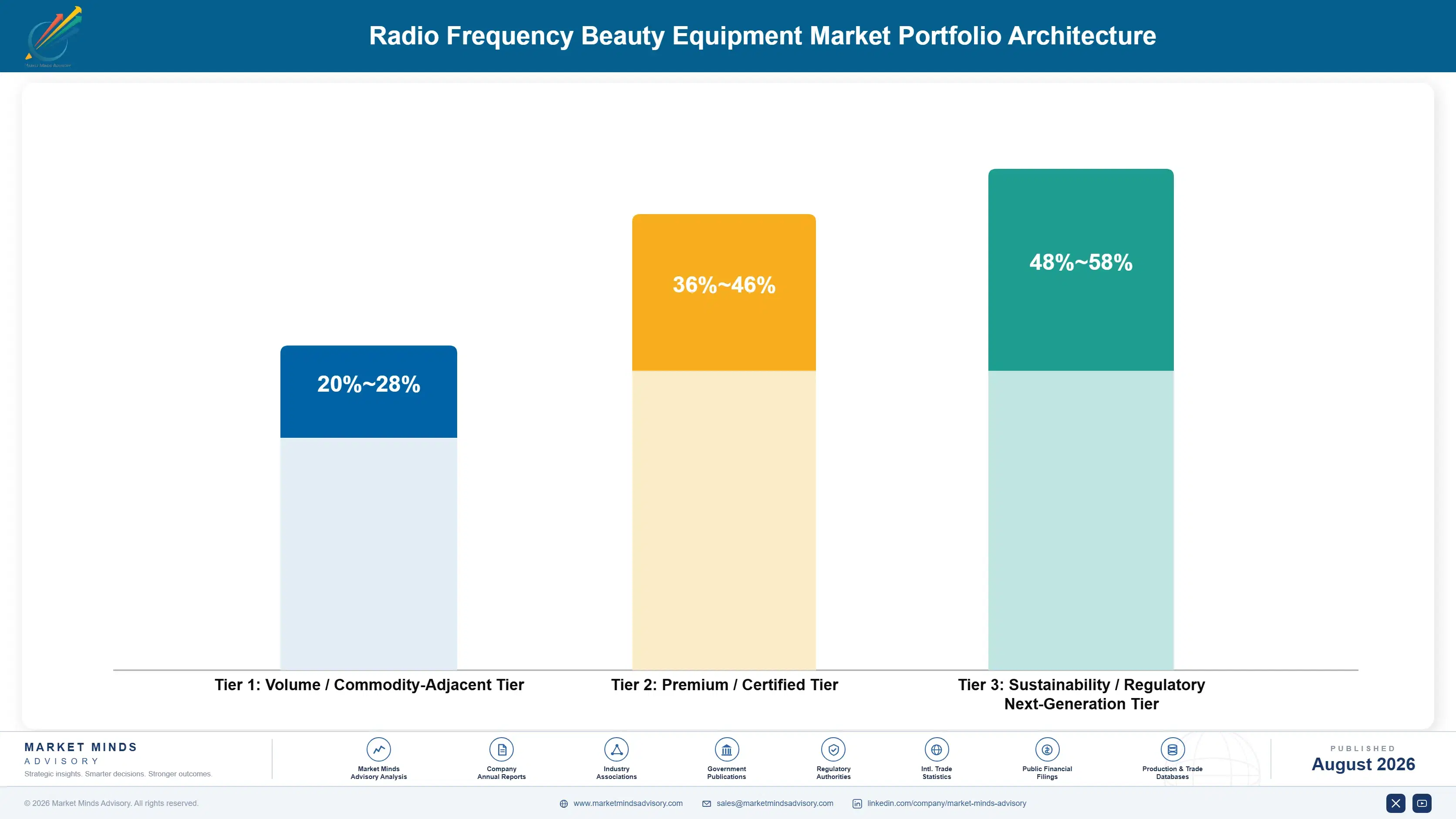
This market organizes into three commercial tiers spanning entry-level at-home devices at the volume end, mid-range professional monopolar and bipolar clinic equipment in the middle tier, and premium fractional microneedling and combination platforms capturing the strongest margins at the top given technology and clinical evidence differentiation. Gross margins widen meaningfully moving up this ladder, reflecting the engineering sophistication and clinical evidence depth each successive tier dem
Entry-level and premium tiers pull manufacturers in genuinely different directions: entry-level devices sustain broad consumer adoption at thinner margins, while premium clinic platforms deliver materially stronger margins that increasingly fund the engineering and clinical evidence investment this diversifying category requires. Manufacturers that balance both effectively sustain the volume scale needed to absorb fixed engineering costs while gradually shifting mix toward higher-margin premium categories.

The highest-value pools concentrate around premium fractional and combination platforms sold to clinics serving patients seeking treatment at-home devices genuinely cannot replicate, where clinical depth and documented efficacy together sustain premium pricing power that entry-level consumer devices simply cannot match. Manufacturers without meaningful presence in these premium categories increasingly find themselves competing purely on price within a segment capturing a shrinking share of overall category profit.

Volume / Commodity-Adjacent Tier

Entry-level at-home handheld devices sold primarily on price to mainstream consumers seeking accessible maintenance treatment options. Competition centers almost entirely on price and brand recognition rather than clinical or technical differentiation.
Gross Margin: 20-28%

Premium / Certified Tier

Professional monopolar and bipolar clinic equipment sold under moderate technical differentiation to aesthetic practices. These systems command meaningfully stronger margins than entry-level output given their clinical validation and treatment depth.
Gross Margin: 36-46%

Sustainability / Regulatory / Next-Generation Tier

Fractional microneedling and combination platforms commanding the strongest clinical evidence and technology premium available. Manufacturers serving this tier typically maintain dedicated engineering and clinical evidence generation capability few smaller rivals can match.
Gross Margin: 48-58%
radio-frequency-beauty-equipment-market-portfolio-architecture-1787309467930

High-value Sub-segments and Strategic Watch-out

Combination RF-Ultrasound Platforms

The fastest-growing and highest-margin clinic segment, combining strong differentiation demand momentum with genuine willingness to pay premium pricing for treatment depth. Manufacturers with early differentiation advantages here are positioned to capture disproportionate category profit growth over the coming decade. Contract wins secured now compound meaningfully across the following decade.
Gross Margin: 48-58%

At-Home Handheld RF Devices

Strong volume growth driven by consumer migration that sustains category momentum as device miniaturization and retail distribution continue expanding. Manufacturers expanding retail distribution early are best positioned to capture this broadening consumer demand pool. Retail partnerships increasingly determine which manufacturers win this expanding demand pool.
Gross Margin: 20-28%

Professional Monopolar and Bipolar Equipment

The volume core clinic segment sustaining broad treatment revenue even as premium categories increasingly capture disproportionate profit growth overall. Manufacturers here compete primarily on price and reliability rather than technical or clinical differentiation currently. Scale and brand recognition remain the decisive factors separating leaders from laggards here.
Gross Margin: 36-46%

Legacy Single-Modality Clinic Devices

A strategic watch-out segment facing cannibalization pressure, requiring manufacturers to defend clinic revenue against at-home alternatives replicating basic treatment applications. Manufacturers focused solely on single-modality formats risk losing share unless they diversify into combination categories. Adoption of combination platforms continues gradually eroding this legacy segment share.
Gross Margin: 18-26%

Clinic and Consumer Purchase Cycles

Manufacturers increasingly capture recurring consumable and accessory revenue alongside initial device sales, creating annuity-like economics as both clinics and consumers commit to a manufacturer's proprietary treatment tip and replacement part system for the operating life of an installed device. This recurring relationship strengthens manufacturer revenue predictability meaningfully once a customer becomes established on a given device platform. Customers rarely switch established device bran
Adoption depth varies considerably by customer segment: aesthetic clinics demonstrate the deepest commitment to premium fractional and combination platforms given differentiated treatment revenue requirements, while individual consumers adopt more cautiously toward at-home devices, favoring lower-cost entry-level products until performance credibility becomes established through documented results. Manufacturers serving both segments increasingly maintain differentiated product lines to address these divergent purchasing priorities effectively.

A generational shift is underway as younger consumers increasingly favor proactive, preventive aesthetic technology adoption over the reactive, clinic-only treatment approach earlier consumer generations typically followed, reshaping purchasing decisions across demographic segments of varying technical sophistication. Younger consumers increasingly enter the category already expecting accessible, self-administered treatment options as a baseline assumption rather than a discretionary indulgence.
radio-frequency-beauty-equipment-market-end-use-penetration-index-1787309468419

Where Manufacturer Investment Should Concentrate

These are among the four positions where our research anticipates prominent divergence between winners and laggards over the coming forecast period. Each is grounded in the demand model, the regulatory perimeter, and the announced capacity pipeline.
01 / AT-HOME PRODUCT INVESTMENT

Prioritize at-home product lines ahead of migration acceleration

Manufacturers investing in at-home product line development are capturing a disproportionate share of the fastest-growing consumer segment currently expanding rapidly, where device accessibility and pricing increasingly determine which companies capture purchasing volume from clinic-treatment migration. Companies without meaningful at-home investment risk being confined to a shrinking exclusively clinic-based category facing intensifying consumer preference shifts nationwide. Expect at-home product investment to become the single most important commercial differentiator for manufacturers seeking sustainable growth, particularly within younger, digitally engaged consumer segments specifically.
02 / CLINICAL EVIDENCE INVESTMENT

Build published evidence ahead of skepticism resolution

Manufacturers investing in published clinical efficacy studies are capturing a disproportionate share of clinic and consumer trust today, where documented evidence increasingly determines which companies win purchasing consideration amid persistent, well-documented at-home device skepticism. Companies without meaningful clinical investment risk losing access to the fastest-growing, most trust-sensitive purchasing decisions entirely to better-prepared, evidence-backed competitors. Expect clinical evidence depth to become an increasingly important determinant of manufacturer commercial leadership across both clinic and consumer segments, as lingering skepticism gradually resolves over time.
03 / COMPONENT COST MANAGEMENT

Manage precision component exposure through diversification

Manufacturers with diversified RF generator component supplier relationships are sustaining considerably steadier production continuity than competitors exposed fully to single-source component dependency, and this advantage compounds further during periods of component supply disruption affecting the broader industry. Companies without meaningful supplier diversification face persistently higher production schedule risk regardless of underlying demand strength or broader category growth momentum. Expect supplier diversification sophistication to become an increasingly important determinant of manufacturer reliability reputation, particularly for smaller manufacturers lacking comparable purchasing scale.
04 / CLINIC CANNIBALIZATION PRESSURE

Watch at-home migration reshape clinic revenue models

Continued at-home device adoption is steadily and consistently pulling routine maintenance treatment volume away from established aesthetic clinics nationwide, reflecting both continued device miniaturization improvements and steadily growing consumer confidence in well-demonstrated self-administered treatment outcomes. This trajectory shows no sign of reversing given sustained consumer beauty technology investment and steadily improving device performance outpacing traditional clinic-exclusive treatment defenses. Expect clinic cannibalization pressure to continue intensifying meaningfully throughout the current ten-year forecast period across single-modality treatment categories tracked broadly and consistently.

Engagement Snapshot From the Field

A live engagement with an industry participant carrying material or product regulatory and market exposure ahead of a defining policy shift, showing how our research translates into a defensible multi-year portfolio strategy.
MARKET MINDS ADVISORY · CLIENT ENGAGEMENT SUMMARY
Radio Frequency Beauty Equipment Producer Strategic Portfolio Review and Transition Roadmap 2026·Investment Scenario on Radio Frequency Beauty Equipment Exposure Evaluation 2025-26
CLIENT PROFILE
The client is a mid-sized aesthetic clinic chain generating projected annual revenue of approximately $28 million (client-reported, unverified by MMA) upon successful equipment portfolio repositioning. The company operates twelve clinic locations and had historically relied primarily on single-modality radio frequency treatment equipment. The company had historically maintained close relationships with a small group of clinic equipment suppliers spanning several years of continuous partnership.
STRATEGIC CHALLENGE
The client had observed declining maintenance treatment session frequency among patients purchasing at-home devices, and leadership was uncertain whether investing in combination platform equipment would generate sufficient differentiated treatment revenue to offset this cannibalization pressure across its clinic network. Leadership also questioned whether internal staff training could scale quickly enough to support a phased equipment rollout.
MMA APPROACH
MMA's team benchmarked comparable aesthetic clinic chain equipment repositioning strategies, modeled projected differentiated treatment revenue under various combination platform investment scenarios, and assessed the client's existing patient base for combination platform treatment demand across its twelve clinic locations. The team benchmarked realistic installation timelines given the client's constrained internal training capacity and moderate risk tolerance profile.
KEY FINDINGS
  1. Comparable clinic chains achieved meaningful differentiated treatment revenue growth within 10 months of combination platform installation (client-reported, unverified by MMA). This performance held consistently across clinic chains of comparable scale and patient mix.
  2. Patients expressed strong willingness to pay premium pricing for combination treatments unavailable through at-home device alternatives they already owned. This willingness extended across both existing long-term patients and newly prospective clinic accounts surveyed.
  3. Existing single-modality equipment remained viable for entry-level and price-sensitive patient segments, supporting a hybrid rather than full replacement strategy. This hybrid approach proved especially effective across locations with diverse patient demographic profiles.
  4. Combination platform equipment cost, while substantially higher per unit, was offset by considerably stronger per-session revenue than single-modality treatment previously generated. This offset held consistently across multiple clinic locations evaluated during the pilot period.
CLIENT PROFILE
The client is a mid-sized aesthetic clinic chain generating projected annual revenue of approximately $28 million (client-reported, unverified by MMA) upon successful equipment portfolio repositioning. The company operates twelve clinic locations and had historically relied primarily on single-modality radio frequency treatment equipment. The company had historically maintained close relationships with a small group of clinic equipment suppliers spanning several years of continuous partnership.
STRATEGIC CHALLENGE
The client had observed declining maintenance treatment session frequency among patients purchasing at-home devices, and leadership was uncertain whether investing in combination platform equipment would generate sufficient differentiated treatment revenue to offset this cannibalization pressure across its clinic network. Leadership also questioned whether internal staff training could scale quickly enough to support a phased equipment rollout.
MMA APPROACH
MMA's team benchmarked comparable aesthetic clinic chain equipment repositioning strategies, modeled projected differentiated treatment revenue under various combination platform investment scenarios, and assessed the client's existing patient base for combination platform treatment demand across its twelve clinic locations. The team benchmarked realistic installation timelines given the client's constrained internal training capacity and moderate risk tolerance profile.
KEY FINDINGS
  1. Comparable clinic chains achieved meaningful differentiated treatment revenue growth within 10 months of combination platform installation (client-reported, unverified by MMA). This performance held consistently across clinic chains of comparable scale and patient mix.
  2. Patients expressed strong willingness to pay premium pricing for combination treatments unavailable through at-home device alternatives they already owned. This willingness extended across both existing long-term patients and newly prospective clinic accounts surveyed.
  3. Existing single-modality equipment remained viable for entry-level and price-sensitive patient segments, supporting a hybrid rather than full replacement strategy. This hybrid approach proved especially effective across locations with diverse patient demographic profiles.
  4. Combination platform equipment cost, while substantially higher per unit, was offset by considerably stronger per-session revenue than single-modality treatment previously generated. This offset held consistently across multiple clinic locations evaluated during the pilot period.
RECOMMENDED STRATEGY
Phase 1: Phase 1 (Months 1-6): Install combination platform equipment targeting the client's highest-volume clinic locations facing the steepest cannibalization pressure. Establish baseline metrics to track performance throughout installation. Phase 2: Phase 2 (Months 7-13): Reposition marketing around differentiated combination treatment while retaining single-modality equipment for entry-level patients. Build dedicated staff training capability focused on communicating new differentiated treatment advantages. Phase 3: Phase 3 (Months 14-20): Expand combination platform installation further based on realized differentiated revenue and patient retention performance results. Evaluate further investment based on realized revenue and retention outcomes.
OUTCOME
The client installed its combination platform equipment and completed the recommended repositioning phases within the proposed timeline, reporting differentiated revenue and patient retention results consistent with initial modeling projections (client-reported, unverified by MMA). The company also stabilized maintenance session frequency across its highest-volume locations within the first year.

Frequently Asked Questions

Foundational context covering the market sizes, CAGR, scope, country, region and competition that inform every finding below. This section is provided to cover basics and most often pre-purchase conversations, answered from the MMA Primary Research Dataset.

What is the current size of the Radio Frequency Beauty Equipment Market?

The market was valued at approximately $3.2 billion in 2025. This includes professional and consumer radio frequency devices used for skin tightening and aesthetic treatment applications.

How large will the Radio Frequency Beauty Equipment Market be by 2036?

The market is projected to reach approximately $8.95 billion by 2036, up from about $3.51 billion in 2026. This reflects rapid at-home device adoption and clinic platform expansion.

What is the CAGR for the Radio Frequency Beauty Equipment Market 2026 to 2036?

The market is expected to grow at a compound annual growth rate of 9.8% between 2026 and 2036. This reflects accelerating at-home adoption and falling device costs.

Which segment is growing fastest?

At-home handheld RF devices are the fastest-growing segment, expanding at approximately 16.5% annually. This reflects strong consumer demand for accessible maintenance treatment options between periodic clinic visits.

Who are the major companies in the Radio Frequency Beauty Equipment Market?

Leading companies include Solta Medical, Cutera, Venus Concept, InMode, and BTL Industries. Together these five manufacturers account for roughly 38% of total global unit shipments.

Which country is growing fastest?

China is the fastest-growing major country at an estimated 15.0% CAGR, driven by concentrated beauty technology manufacturing and rapidly rising domestic consumer adoption across the entire country.

Report Segmentation Architecture

The full report scope spans multiple orthogonal segmentation dimensions, with cross-tabulated demand data provided for each dimension pair. Coverage extends further to regional breakdowns, trend trajectories, and the competitive detail needed to support segment-level decision-making.

By Device Technology and Application

  • Professional Monopolar RF Devices
  • Professional Bipolar and Multipolar RF Devices
  • Fractional RF Microneedling Devices
  • At-Home Handheld RF Devices
  • RF Body Contouring Devices
  • Combination RF-Ultrasound Devices

By End-Use Industry

  • Aesthetic and Dermatology Clinics
  • Medical Spas and Wellness Centers
  • Consumer Retail and E-Commerce
  • Plastic Surgery Practices
  • Beauty Salon and Spa Chains

By Commercial Dimension

  • Professional Equipment Sales
  • Direct-to-Consumer Retail Sales
  • Clinic Distributor Channels
  • E-Commerce and Beauty Retail Partnerships

By Region

  • North America
  • Western Europe
  • East Asia
  • South Asia and Pacific
  • Latin America
  • Middle East and Africa
  • Eastern Europe

Scope, Methodology, and Coverage

Every figure in this report is reproducible from documented input assumptions. The scope below maps the historical period, the forecast horizon, the segmentation dimensions, and the countries covered, alongside the underlying primary and qualitative methodology.
Historical Period
2020 to 2025
Forecast Period
2026 to 2036
Base Year
2025 (USD billions; MMA Primary Research Dataset, August 2026)
Market Definition
This market covers professional and consumer radio frequency devices used for skin tightening, body contouring, and facial rejuvenation applications, spanning monopolar, bipolar, fractional microneedling, and combination platform technologies. It excludes laser-only aesthetic devices without radio frequency energy delivery.
Quantitative Units
USD billions (current prices); device units; installed base
Segmentation Dimensions
By Device Technology and Application; By End-Use Industry; By Commercial Dimension; By Region
Regions Covered
North America, Western Europe, East Asia, South Asia and Pacific, Latin America, Middle East and Africa, Eastern Europe
Countries Covered
USA, China, Germany, France, UK, Japan, South Korea, India, Australia, Canada, Brazil, Mexico, Indonesia, Vietnam, Thailand, Malaysia, UAE, Saudi Arabia, South Africa, Nigeria, Turkey, Poland, Netherlands, Italy, Spain, Sweden, Switzerland, Argentina, Colombia, Singapore, and additional markets relevant to this sector
Key Companies Profiled
Solta Medical, Cutera, Venus Concept, InMode, BTL Industries, Lumenis Ltd., Candela Corporation, Cynosure LLC, Sciton Inc., Alma Lasers, ZIIP Beauty, NuFACE, Foreo, Silk'n, Endymed Medical Ltd, Apyx Medical Corporation, Cellreturn, APR Corporation, Pollogen, Merz Aesthetics
Quantitative Methodology
Primary survey, n=3,800 respondents, Q4 2025, six countries; demand-side model with trade association cross-validation
Qualitative Methodology
47 expert interviews, Q4 2025; applied to validate demand model assumptions, identify emerging dynamics, and assess competitive positioning
Report Format
PDF and XLSX data workbook (Word format preview document)
Publisher
Market Minds Advisory
Report Code
MMA-2026-MED-151
Published
August 2026
Contact
sales@marketmindsadvisory.com | www.marketmindsadvisory.com

Purchase the full Radio Frequency Beauty Equipment Market Report (2026 to 2036).

The full report provides detailed device technology segmentation, manufacturer production and adoption trend analysis, and regional demand tracking across major global markets covered in this study. It includes manufacturer-level competitive benchmarking based on unit shipments and clinical evidence depth, alongside detailed precision component cost commentary. Subscribers receive quarterly updates tracking new product launches and clinical study publications as they occur. A companion dataset provides unit shipment estimates by country for detailed market sizing purposes. A dedicated appendix profiles the twenty leading manufacturers named in this study, covering their product line breadth and regional distribution reach in detail.
Device technology segmentation breakdown by application
Country-level unit shipment trend analysis dataset
Clinical evidence tracking and benchmarking service
Manufacturer competitive benchmarking scorecards and overview
Quarterly product launch and investment update service
Unit shipment dataset segmented by device category

Built For The People Who Decide

From boardroom strategy to bench-side execution, this report is read cover-to-cover by leaders shaping the next decade of their industry, turning demand scenarios, market dynamics and valuation benchmarks into decisions.
CXOs/ Presidents/ VPs/ Managers
M&A and Corporate Development
Strategy Teams and R&D Heads
Procurement and Product Directors
Regulatory and Compliance Leaders
Investor Relations and Equity Analysts