Market Minds Advisory
Radiation-Induced Fibrosis Treatment Market

Radiation-Induced Fibrosis Treatment Market: A Late Toxicity Nobody Codes, Nobody Owns and Nobody Has Approved a Drug For

Radiotherapy cures the cancer and then keeps working on the healthy tissue for years, and the patient who cannot swallow or lift an arm at month thirty is no longer anybody's responsibility.

Lead Analyst

Alice Ballenger

Published

September 2026

Make Smarter Decisions with Customized Research Insights

Request a free sample report and evaluate market opportunities, growth trends, and competitive dynamics relevant to your business needs.

2025 MARKET VALUE$0.7BMarket Size 2025
2036 FORECAST VALUE$2.0BBase Case , 2026 to 2036
CAGR 2026 TO 203610.5 %Bull 11.9% / Bear 9.1%
INCREMENTAL OPPORTUNITY$1.3BNet 10- year value creation
EXPANSION MULTIPLE2.71x2036 value over 2026 base
Strategic Levers
M&A Pipeline
Regional Outlook
Country Rankings
Competitive Intelligence
Segmental Deep-dive
Call-Us : 91 93563 13602

Executive Snapshot and Market Trajectory

Radiation fibrosis is the price of a cure. Collagen keeps depositing in irradiated tissue for years after treatment ends, and the resulting stiffness, contracture and dysfunction arrive long after the oncologist has discharged the patient as cured. By then nobody is looking for it.
Antifibrotic pharmacotherapy compounds at 15.75%, exactly 1.50 times the market, because pentoxifylline and tocopherol combinations are the first thing anybody has shown to reverse established fibrosis rather than merely manage it. East Asia holds 32% of spend, above the standard band, on nasopharyngeal carcinoma volumes that no other region carries. Roughly 23% of survivors of curative radiotherapy develop something clinically significant, presenting at a median of around 26 months. Almost none of it is recorded.
Five participants hold 39%. Nothing here is approved for the indication, so positions rest on hyperbaric facilities, rehabilitation networks and repurposed generics. The commercial obstacle is ownership: nobody's budget covers a toxicity that appears two years after discharge. Only about 14% of affected patients carry a specific recorded diagnosis, and a condition nobody codes is a condition nobody funds. Recognition rather than therapy limits the treated population here.
Market Definition
The market covers therapeutics, devices and clinical services used to prevent or treat established radiation-induced fibrosis, spanning antifibrotic pharmacotherapy, hyperbaric oxygen therapy, physical and manual rehabilitation therapy, corticosteroid and anti-inflammatory intervention, surgical release and reconstruction, and topical and dermatological management. Radiotherapy planning and delivery equipment, acute radiation dermatitis products, lymphoedema compression garments sold as consumer goods, and oncological treatment of the primary tumour are excluded.
Base Year Value
$0.7B in 2025 (MMA Primary Research Dataset, August 2026)
Forecast Period
2026 to 2036, eleven discrete annual values
CAGR
10.5% base case. Bull 11.9%. Bear 9.1%.
Fastest Growth Segment
Antifibrotic Pharmacotherapy: 15.8% CAGR
Fastest Growth Country
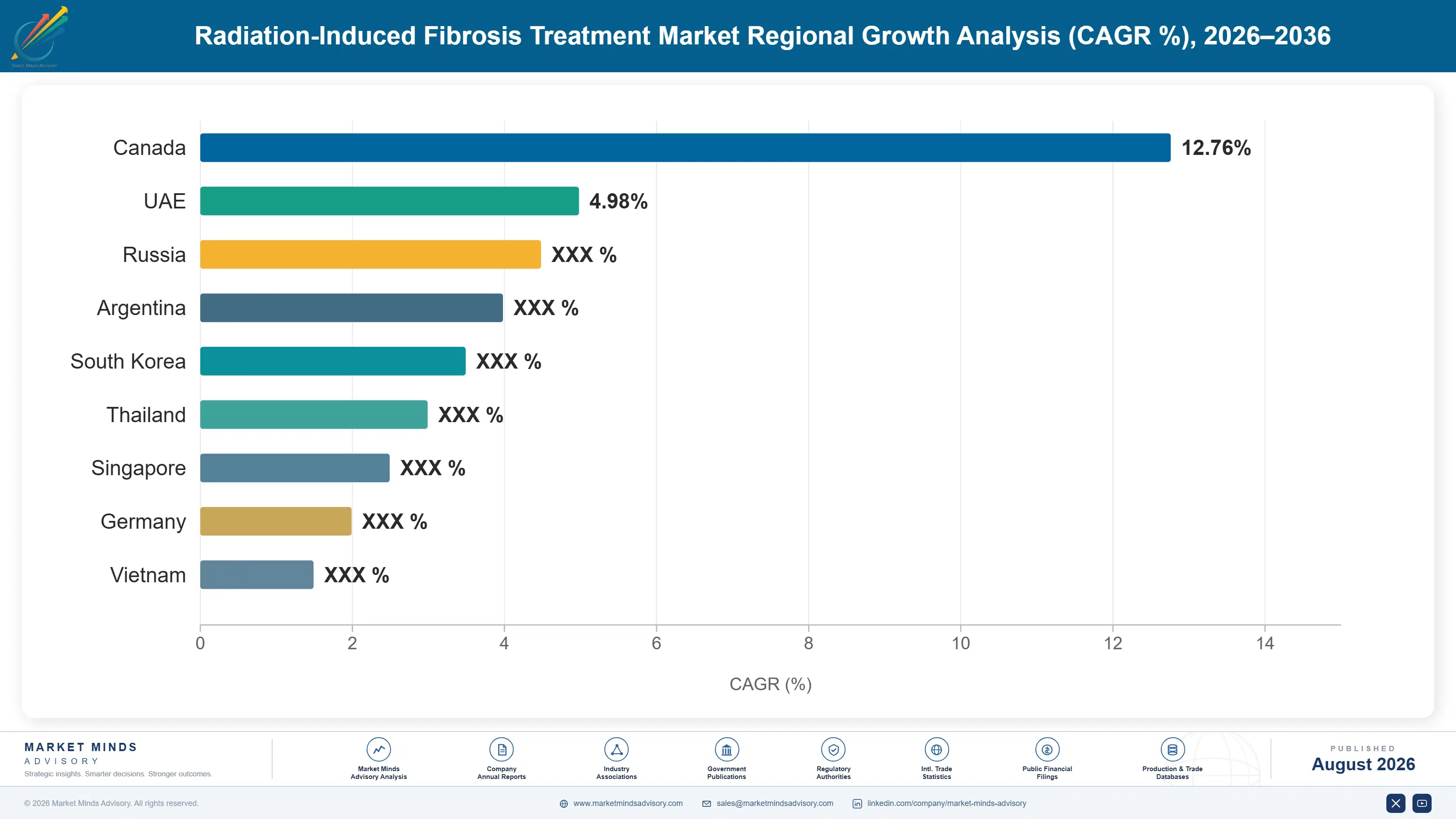
China: 12.7% CAGR
Fastest Growth Region
South Asia and Pacific: 12.6% CAGR
Largest Region
East Asia: 32% of 2025 global value
Market Leaders
Sanofi, Baxter International, Perrigo Company, Sechrist Industries, Viatris. Source: MMA Analysis based on company annual reports.
Primary Survey
n=3,800 procurement and R&D decision-makers, Q4 2025, six countries
Methodology
Demand-side build-up, cross-validated against public data, 47 expert interviews

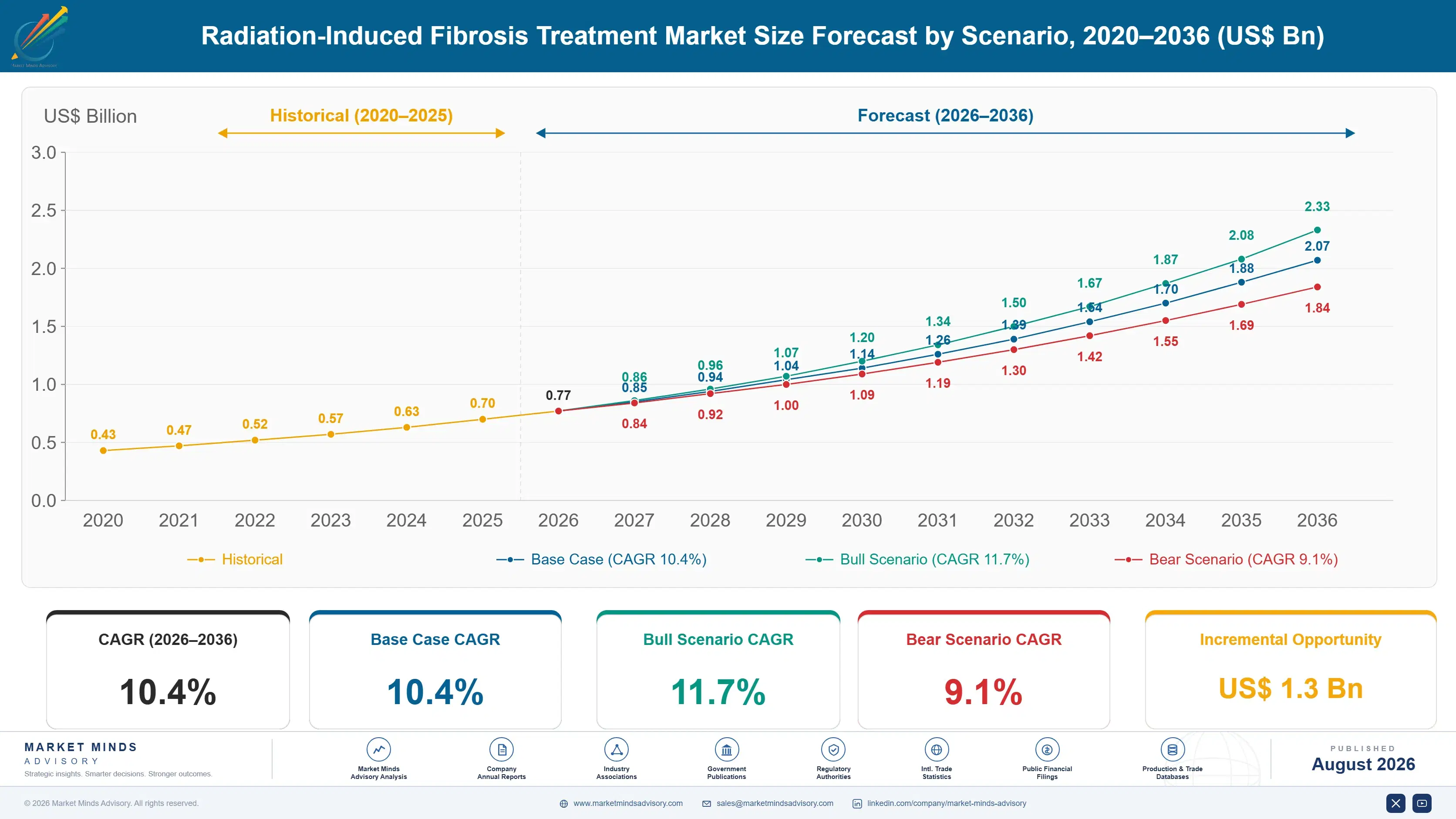
Radiation-Induced Fibrosis Treatment Market Forecast Scenarios

radiation-induced-fibrosis-treatment-market-size-forecast-scenario-1787309238575
Growth of 9.2% across 2020 to 2025 came from recognition rather than from any new therapy. Radiotherapy delivered a decade earlier produced a rising cohort of late effects, survivorship clinics began looking systematically, and investigator-led series established that pulmonary antifibrotics had activity in irradiated tissue. Hyperbaric capacity also expanded, driven by wound care rather than oncology demand.
The base case of 10.4% rests on three mechanisms. Radiotherapy survivors continue accumulating, with modern conformal technique reducing severity rather than eliminating late fibrosis, and roughly 17% of irradiated patients develop clinically significant disease. Survivorship clinics are becoming standard in developed cancer services, which converts unrecognised morbidity into diagnosed and treated episodes. And off-label antifibrotic use keeps spreading on investigator-led evidence that no company funds, promotes or is able to accelerate at all.
The bull case of 11.7% assumes an antifibrotic sponsor pursues a radiation fibrosis indication formally, which would convert off-label prescribing into reimbursed therapy and give the category its first promotable product. The bear case of 9.1% reflects the likelier path: no sponsor takes the indication, payers keep refusing off-label antifibrotics at pulmonary fibrosis pricing, and treatment remains pentoxifylline, physiotherapy and whatever hyperbaric capacity exists locally.

The Toxicity That Arrives After Discharge

Radiotherapy does not stop working when the course ends. Endothelial injury and cytokine signalling drive progressive collagen deposition in irradiated normal tissue, and the clinical result appears at a median of around 26 months: a neck that will not turn, a jaw that will not open, a breast that has become hard and painful, a bowel that strictures. Roughly 23% of survivors of curative radiotherapy develop something clinically significant.
TOP FIVE CONCENTRATION39%Combined share held by the five largest participating suppliers
ONSET AFTER TREATMENT26 monthsTypical interval from radiotherapy completion to symptomatic presentation
LATE TOXICITY INCIDENCE23% of survivorsShare developing clinically significant fibrosis after curative radiotherapy
ANTIFIBROTIC RESPONSE RATE61%Proportion showing measurable regression on combination antifibrotic pharmacotherapy
DIAGNOSTIC CODING RATE14%Share of affected patients carrying a specific recorded diagnosis
HYPERBARIC SESSION REQUIREMENT40 sessionsTypical course length driving facility capacity and cost
Almost none of it is recorded. Only about 14% of affected patients carry a specific diagnosis, because the oncologist discharged them as cured, the primary care physician sees an unexplained musculoskeletal complaint, and no coding pathway connects the two. A condition nobody codes is a condition nobody budgets for, which is the single largest obstacle in this market and has nothing to do with therapy.
What has changed is that something works. Pentoxifylline combined with tocopherol shows measurable regression of established fibrosis in around 61% of treated patients across published series, which is remarkable for a condition long considered irreversible. Both components are cheap generics with no indication label, so the evidence spreads through clinicians rather than through commercial promotion, and adoption is correspondingly patchy.
"The treatment costs almost nothing and works in most patients, and the reason it is underused is that the person who could prescribe it has never heard of the problem. That is a communication failure, not a therapeutic one."
Director, Oncology Supportive Care and Survivorship Practice · MMA Oncology Supp

Market Trends

Antifibrotic Combination Therapy Reverses What Was Thought Permanent

Pentoxifylline with tocopherol, sometimes with clodronate added, produces measurable regression of established fibrosis in roughly 61% of treated patients across published series. That contradicts decades of teaching that radiation fibrosis is irreversible, and it changes the clinical question from managing disability to treating a condition. Both agents are inexpensive generics carrying no label for the indication, so the approach compounds at 15.75% against a market at 10.5% purely on clinician-to-clinician evidence transmission rather than any promotion. The binding constraint is whether the prescriber has read the evidence. Courses run six to twenty-four months at negligible drug cost.
Market Impact: Affecting 23% of treated survivors
Survivorship Programmes Convert Dysfunction Into Coded Diagnoses

Cancer centres are formalising survivorship clinics that follow patients well past the point where oncology traditionally discharged them, and those clinics record late toxicity that previously vanished into primary care as unexplained musculoskeletal complaint. Only around 14% of affected patients currently carry a specific diagnosis. Every percentage point that figure rises converts unfunded disability into a referral with a code attached, which is how this market actually grows rather than through any new therapy. Extending follow-up past the traditional five year discharge point costs almost nothing and changes recorded incidence sharply.
Market Impact: East Asia holding 32% of spend

Market Opportunities and Growth Drivers

Improving Cancer Survival Mechanically Enlarges the Affected Population

Late toxicity requires living long enough to develop it, and five-year survival has risen substantially across head and neck, breast, prostate and cervical cancers where radiotherapy is central to curative treatment. Roughly 23% of curative radiotherapy survivors develop clinically significant fibrosis, presenting at a median of around 26 months. Every improvement in oncological outcome therefore enlarges this population without any change in radiotherapy practice, which makes the growth mechanism unusually predictable and entirely independent of therapeutic progress. Radiotherapy technique improvements affect only newly treated patients, not the cohort already carrying the dose.
Market Impact: Presenting around 26 months later

Head and Neck Radiotherapy Produces the Most Disabling Presentations

Cervical fibrosis, trismus, dysphagia and shoulder dysfunction after head and neck radiotherapy are among the most functionally destructive late toxicities in medicine, affecting swallowing, speech and airway in combination. That severity is what has driven the trial evidence, since the disability is impossible to ignore and the affected patients remain under specialist follow-up longer than most. Nasopharyngeal carcinoma volumes in East Asia concentrate this presentation heavily, which is why regional spend runs at 32% of the global total. Trismus and dysphagia together are what force specialist attention, since neither can be managed by a patient alone.
Market Impact: Response of 61% without any label

Market Restraints and Challenges

Nobody's Budget Covers a Toxicity Appearing After Discharge

Fibrosis presents at a median 26 months, by which point oncology has discharged the patient and primary care has no framework for the problem. The root cause is that the specialty causing the toxicity is not the specialty seeing it, and no coding pathway connects them. Participants mitigate by working through survivorship clinics that hold patients past the handover point, and by building referral criteria that name the condition explicitly rather than describing symptoms. Only around 14% of affected patients currently carry any specific diagnosis at all. Naming the condition explicitly is what converts a symptom into a referral.
Market Impact: Regression achieved in 61% of patie

No Approved Therapy Means No Reimbursement or Promotion

Pentoxifylline and tocopherol are cheap generics with no label for this indication, so nobody can promote them and no payer has an established pathway. The root cause is that the commercial return on a registrational trial for repurposed generics is close to zero. Participants mitigate through investigator-led trials, guideline inclusion via professional societies, and hyperbaric and rehabilitation services which do carry procedure codes and therefore attract funding. Professional society guidance has become the practical substitute for a label, and the participant that funds the underlying trials shapes the language clinicians end up following.
Market Impact: Coding covering only 14% currently
4 additional market trends, 3 additional growth drivers, and 2 additional restraints and challenges are covered in the full report. Contact sales@marketmindsadvisory.com to access the complete intelligence.

Segment CAGR and Growth Architecture

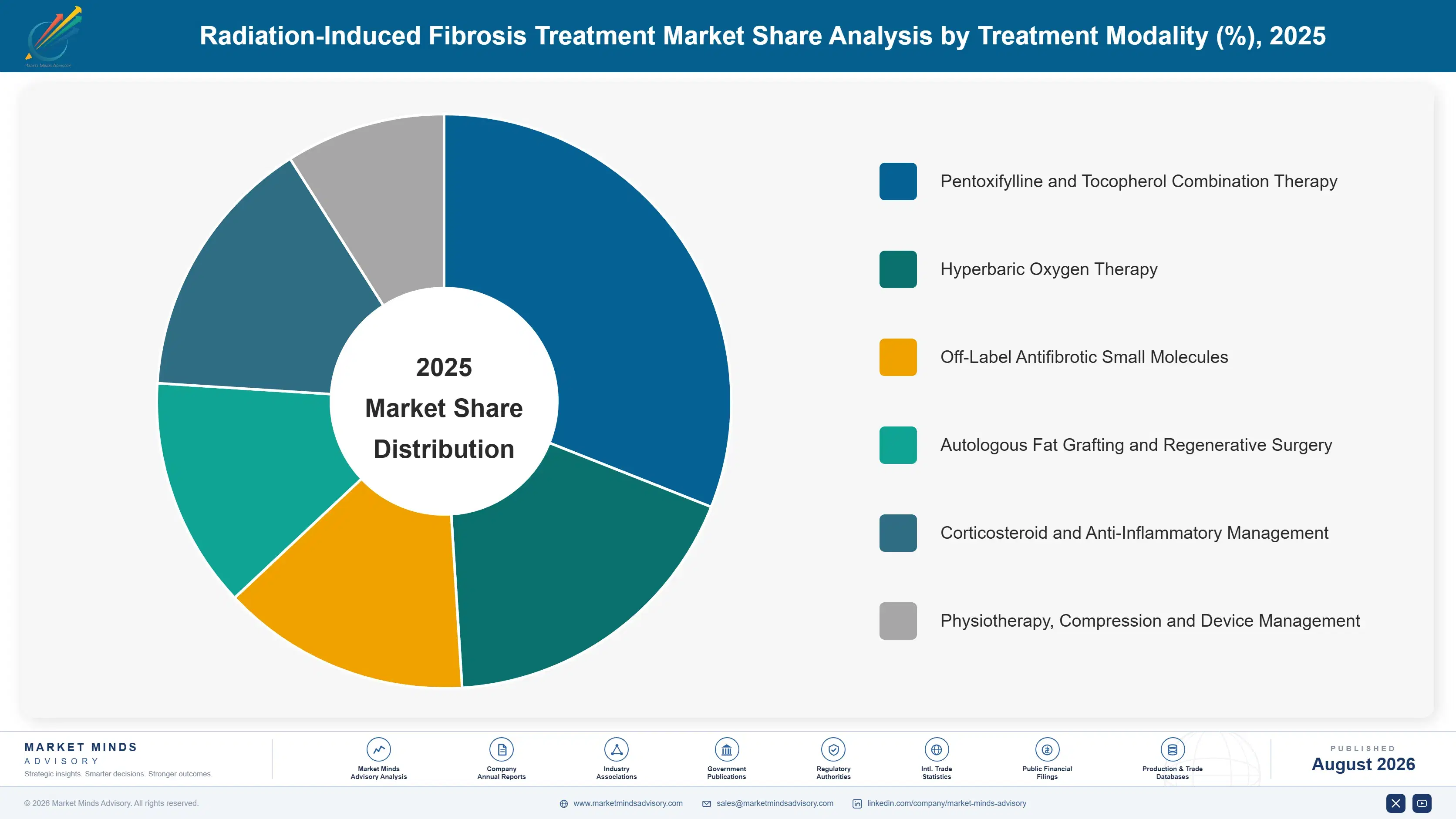
Segmentation follows intervention type, because each acts on a different aspect of the pathology: the fibrotic process itself, tissue hypoxia, mechanical restriction, or the inflammatory component. A clinician choosing between antifibrotic pharmacotherapy and hyperbaric oxygen is choosing which mechanism to address first. Six intervention types sit in the hierarchy, separated by mechanism rather than by irradiated site.
radiation-induced-fibrosis-treatment-market-market-share-analysis-1787309239106

Antifibrotic Pharmacotherapy

Antifibrotic pharmacotherapy compounds at 15.75%, exactly 1.50 times the market, and it is the only approach with evidence of reversing established fibrosis rather than managing its consequences. Pentoxifylline improves microvascular flow and suppresses fibroblast proliferation, tocopherol scavenges free radicals, and the combination produces measurable regression in roughly 61% of patients across published series. Courses run six to twenty-four months and cost very little, since both agents are long-genericised. The commercial paradox is severe: the cheapest intervention has the best evidence and the least promotion behind it, because no company can justify a registrational trial for two products it cannot price. Adoption therefore depends entirely on clinician awareness. Nobody is promoting the best available treatment.
CAGR 15.8%

Hyperbaric Oxygen Therapy

Hyperbaric oxygen grows at 13.1% by addressing tissue hypoxia, which drives the fibrotic cascade and prevents healing in irradiated tissue. Evidence is strongest in osteoradionecrosis, radiation cystitis and proctitis, and weaker in soft tissue fibrosis where the pharmacological approach performs better. A typical course runs around 40 sessions, which is a substantial commitment for patient and facility alike, and chamber capacity rather than clinical demand limits access in most health systems. The advantage over pharmacotherapy is entirely commercial rather than clinical: hyperbaric therapy carries procedure codes and attracts reimbursement, so a hospital can be paid for delivering it, which cheap generic tablets never achieve. Utilisation therefore decides facility economics entirely.
CAGR 13.1%
Full segment breakdown across 6 segments available in the complete report.

Regional Architecture and Country Demand Map

Demand follows curative radiotherapy volume, cancer survival and whether a health system runs survivorship follow-up, since a toxicity presenting two years after discharge is only treated where somebody is still looking for it. East Asia leads on nasopharyngeal carcinoma volumes rather than on radiotherapy capacity.

East Asia

East Asia holds 32% of spend, the largest regional share, growing at 11.5%. Note: this exceeds the standard band because nasopharyngeal carcinoma incidence across southern China, Hong Kong and Southeast Asia is many times the global average, and its curative treatment is radiotherapy to the neck, which produces the most disabling fibrosis presentations in medicine. China compounds at 12.7%, the fastest national market. Japanese and Korean survivorship follow-up is well developed and records late toxicity systematically. Regional trial activity in antifibrotic combination therapy is correspondingly the most extensive anywhere, driven by clinical necessity rather than commercial interest. Regional guideline adoption of antifibrotic combination therapy is ahead of most of the world as a result.
Share: 32% | CAGR: 11.5% (2026 to 2036)

North America

North America accounts for 27% of spend and grows at 10.2%. Survivorship programmes are more formalised here than anywhere else, with dedicated clinics at most comprehensive cancer centres following patients well past oncological discharge, which is what converts late toxicity into a recorded diagnosis and a funded referral. Hyperbaric chamber capacity is the largest globally and carries established procedure reimbursement. Antifibrotic pharmacotherapy use is uneven, since no label exists and awareness depends on whether an individual physiatrist or oncologist happens to know the published evidence. Extending survivorship follow-up past the conventional five year discharge point is where the most recent gains in recorded incidence have come from, and several networks have now made that change.
Share: 27% | CAGR: 10.2% (2026 to 2036)
Regional intelligence for 5 additional markets available in the complete report: Western Europe, South Asia and Pacific, Latin America, Middle East and Africa, Eastern Europe. Contact sales@marketmindsadvisory.com.
radiation-induced-fibrosis-treatment-market-country-cagr-analysis-1787309239624

Getting the Condition Recognised First

Nothing here is approved, the best therapy is nearly free, and most affected patients are never diagnosed. Every position worth holding therefore starts with recognition rather than with product. Four qualify, and two of them look more like medical education than commerce. The other two concern reimbursed services and the one region where evidence and volume already coincide.

Fund Survivorship Clinic Referral Criteria That Name the Condition

Only around 14% of affected patients carry a specific diagnosis, because oncology discharges them and primary care sees an unexplained musculoskeletal complaint. Working with survivorship clinics to embed explicit referral criteria converts unrecorded disability into coded diagnoses with funded pathways attached. That single change grows the treated population faster than any therapeutic advance, and the participants who fund the education see the referrals that follow it. Extending follow-up past the conventional five year discharge point costs almost nothing and changes recorded incidence sharply, since the median presentation at 26 months sits well inside that window rather than beyond it.
Market Impact: Diagnosis rate rising from a 14% re

Build Hyperbaric Capacity Against Procedure Reimbursement

Hyperbaric oxygen carries established procedure codes and attracts reimbursement, which cheap generic tablets never do, and courses of around 40 sessions generate substantial billable activity per patient. Chamber capacity rather than clinical demand limits access in most systems. Operators who site capacity near comprehensive cancer centres and qualify for radiation injury indications capture referral flow that general wound care facilities cannot, and the position holds for the working life of the chamber. Utilisation rather than clinical demand determines the economics, since capital and staffing cost run whether the chamber is occupied or empty.
Market Impact: Courses running around 40 sessions

Support Investigator-Led Antifibrotic Trials Deliberately Instead

Pentoxifylline and tocopherol produce regression in roughly 61% of patients and no company will fund a registrational trial for two generics it cannot price. Supporting investigator-led studies and pursuing professional society guideline inclusion builds the evidence base that eventually creates reimbursement, and it costs a fraction of a registrational programme. The participant funding that work shapes the guideline language, which is a more durable asset than a label in a market this fragmented. Guideline language is what clinicians actually follow in an indication with no label, and it costs a fraction of a registrational programme to influence.
Market Impact: Building on a 61% published regress

Target Nasopharyngeal Radiotherapy Populations in Asia

Southern Chinese, Hong Kong and Southeast Asian nasopharyngeal carcinoma incidence runs many times the global average, its curative treatment is neck radiotherapy, and the resulting cervical fibrosis and trismus are the most disabling presentations in the field. East Asia already accounts for 32% of spend and China compounds at 12.7%. Regional trial activity is the most extensive anywhere, which means evidence, clinician awareness and patient volume all sit in the same place. Clinical necessity rather than commercial interest put them there. Regional guideline adoption is already ahead of the rest of the world.
Market Impact: East Asia holding 32% of all global

Who Controls the Margin Pool

Five participants hold 39% measured on revenue attributable to radiation fibrosis management, the basis applied throughout this section. Concentration is low because no approved therapy exists and the participants have nothing in common: a pharmaceutical originator whose generic is the leading pharmacotherapy, hyperbaric chamber manufacturers, generic suppliers and consumer health companies selling tocopherol.
Competition operates on three dimensions, none of them product performance. Clinical awareness among the physiatrists, oncologists and survivorship clinicians who see these patients decides whether anything is prescribed at all. Procedure reimbursement decides whether a hospital can be paid. And proximity to comprehensive cancer centres decides referral flow for facility-based services. Product performance decides very little, since the best-evidenced option is a pair of unpromotable generics.

Two developments could reset the field. A dedicated antifibrotic reaching approval for the indication would create reimbursement where none exists and reorder every position. Meanwhile proton and intensity-modulated delivery is reducing normal tissue dose in newly treated patients. Rankings will shift toward whoever holds guideline language and survivorship clinic relationships. That reduces future incidence without doing anything at all for the very large cohort already carrying the dose, which is where the entire current market sits.
radiation-induced-fibrosis-treatment-market-company-positioning-matrix-1787309240145

Competitive Moat and Risk Dimensions

SANOFI

Moat: Pentoxifylline heritage and evidence

Sanofi's pentoxifylline heritage sits behind the single intervention with credible evidence of reversing established radiation fibrosis, and the published combination trials reference that molecule directly. Clinician familiarity built over decades of vascular use transfers into this indication in a way no newer entrant can replicate quickly, whatever the label position.
SANOFI

Risk: No indication label or pricing

The molecule is long genericised and carries no label for radiation fibrosis, so Sanofi captures almost none of the value its evidence created. Any company that completes a registrational trial with a purpose-designed antifibrotic takes both the label and the reimbursement, leaving the heritage position with clinical credit and no commercial return.
BAXTER INTERNATIONAL

Moat: Hospital supply and rehabilitation reach

Baxter reaches hospital pharmacy and rehabilitation services across the systems where these patients are eventually seen, and it supplies the parenteral and supportive care portfolio those departments already purchase. That existing access matters disproportionately in a condition with no dedicated therapy, since the practical route to the patient runs through departments rather than through specialists.
BAXTER INTERNATIONAL

Risk: Facility service competition emerging

Hyperbaric oxygen carries procedure reimbursement and generates billable activity across roughly 40 sessions per course, which draws specialist facility operators into the space with a commercial model a supply business cannot match. As facility-based services capture the reimbursed portion of this market, product supply becomes the lower-value position.

Players Tracked

Prominent Players

Sanofi
Baxter International
Perrigo Company
Sechrist Industries
Viatris

Other Key Players

Teva Pharmaceutical Industries
Sun Pharmaceutical Industries
Zydus Lifesciences
Cipla
Hikma Pharmaceuticals
Haleon
Bayer
Fagron
Perry Baromedical
OxyHeal Health Group
Gulf Coast Hyperbarics
IHC Hytech
Haux-Life-Support
Enraf-Nonius
DJO Global

Recent Developments

FEBRUARY 2025

Professional society guidance recognises antifibrotic combination therapy

Radiation oncology and rehabilitation society guidance acknowledged pentoxifylline and tocopherol combination therapy as a reasonable option for established fibrosis, citing published regression data. These were professional guideline revisions rather than regulatory approvals or commercial developments among suppliers. Guidance language is now the practical substitute for a regulatory label here.
Signal: Guideline language substitutes for a label
JUNE 2025

Survivorship clinics add late toxicity coding to standard follow-up

Comprehensive cancer centres across several health systems introduced explicit late toxicity assessment and coding into survivorship follow-up protocols, capturing fibrosis that previously went unrecorded. This reflects clinical service design rather than any transaction among the companies involved, and several networks extended follow-up beyond five years at the same time.
Signal: Coding a condition converts unfunded disab
SEPTEMBER 2025

Proton therapy capacity expansion reduces normal tissue dose in new patients

Continued proton and intensity-modulated radiotherapy capacity additions lowered normal tissue exposure for newly treated patients across several tumour sites. This reflects radiotherapy equipment investment rather than any development among fibrosis treatment suppliers. Incidence should fall with a lag, and the cohort already treated is unaffected.
Signal: Lower normal tissue dose reduces future in

Generics, Chambers and Clinician Time

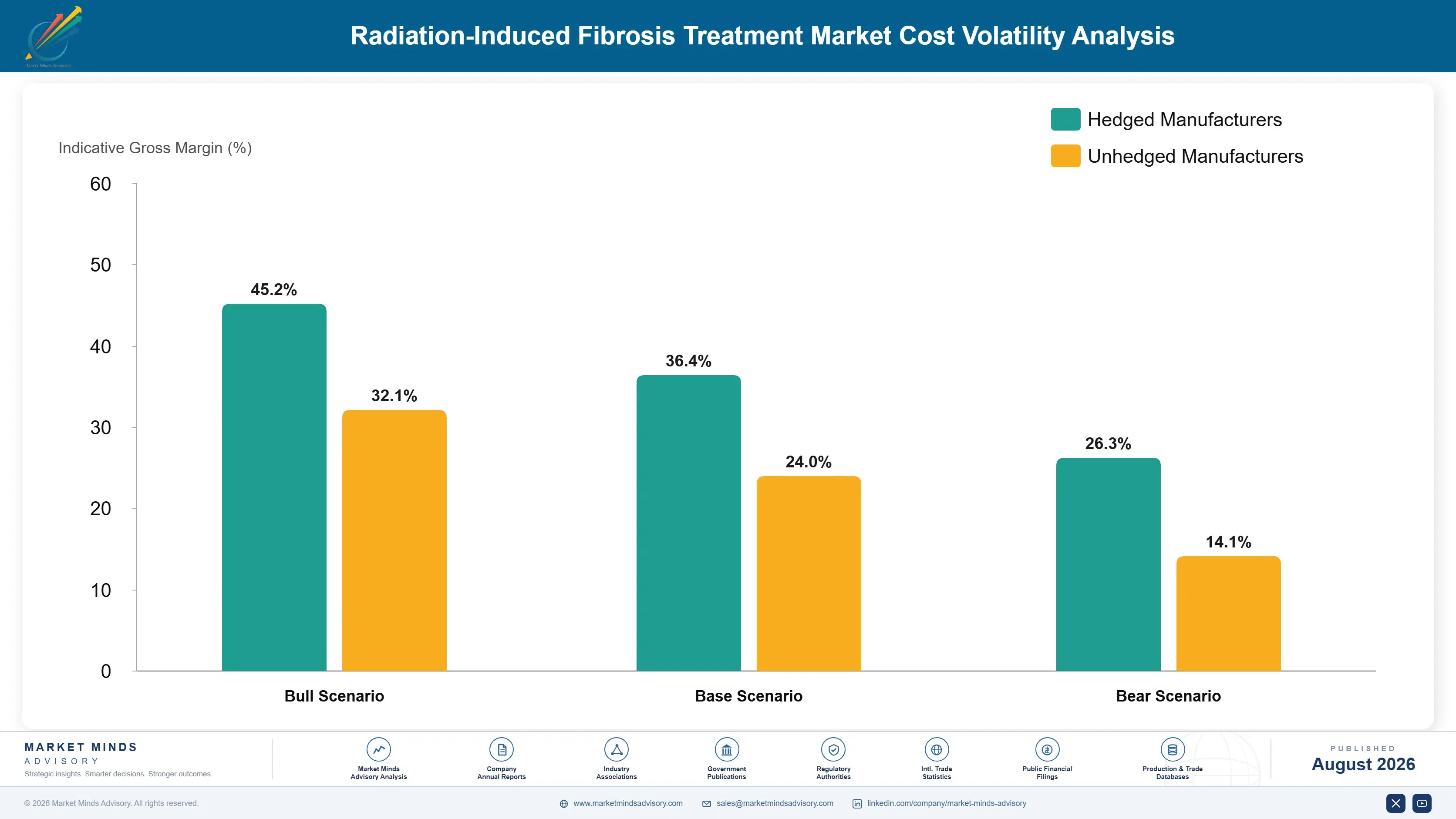
Active ingredient cost for the leading pharmacotherapy is close to negligible, since pentoxifylline and tocopherol are both long-genericised and account for under 12% of the delivered cost of a course. Hyperbaric chamber capital, maintenance, oxygen supply and staffing dominate the facility-based segment at roughly 58% of service cost. Rehabilitation therapy is almost entirely clinician time, which behaves like a labour cost rather than a manufactured one.
Medical oxygen and hyperbaric consumable costs rose sharply through 2021 and 2022 as oxygen supply was diverted to respiratory care, and chamber operators absorbed it against fixed procedure reimbursement that could not be renegotiated mid-year. Company annual reports across the hyperbaric equipment and service providers disclose the resulting margin pressure. World Health Organization reporting on medical oxygen supply documents the underlying constraint through that period.

Exposure divides completely by business model. Generic pharmaceutical suppliers carry trivial input cost and equally trivial realised value, which is why none of them promote the indication. Facility operators carry heavy capital and staffing cost against fixed reimbursement, so utilisation determines everything. Rehabilitation providers carry pure labour cost in systems where therapist supply, not patient demand, sets the ceiling on activity.
radiation-induced-fibrosis-treatment-market-cost-volatility-analysis-1787309240341

Index hyperbaric procedure rates to medical oxygen supply cost

Fixed annual procedure reimbursement against volatile medical oxygen pricing put chamber operators in an impossible position through 2021 and 2022. Negotiating an oxygen cost adjustment into procedure rates, with a published reference and defined reset, moves that exposure to the payer who can absorb it rather than the facility running at fixed capacity. Few operators have negotiated one.

Drive chamber utilisation through cancer centre referral agreements

Hyperbaric economics are almost entirely a utilisation question, since capital and staffing cost run whether the chamber is full or not. Formal referral agreements with comprehensive cancer centres, specifying radiation injury indications explicitly, fill capacity far more reliably than general wound care referral does and they hold for years once established. Radiation indications fill capacity reliably.

Fund clinician education rather than product promotion

The pharmacotherapy costs almost nothing and works in most patients, so the binding constraint is that prescribers have never heard of it. Directing spend toward physiatrist and survivorship clinician education rather than toward promoting an unlabelled generic reaches the actual obstacle, and it builds the referral relationships that facility-based services then convert. Promotion is not permitted anyway.

Portfolio Architecture for Margin Defence

The portfolio separates on whether an intervention can be billed. Antifibrotic pharmacotherapy has the best evidence and almost no realisable value, since two generics carry no label and no price. Hyperbaric oxygen has weaker soft tissue evidence and full procedure reimbursement. Rehabilitation therapy carries codes and consumes clinician time. Surgical release addresses established contracture and is reimbursed as surgery.
The tension is uncomfortable and worth stating plainly. The intervention with the strongest evidence is the one nobody can make money from, and the interventions that generate revenue are the ones with weaker evidence in soft tissue fibrosis. Any participant building a position here has to decide whether to follow the clinical evidence or the reimbursement, because in this market they point in different directions.

High-value pools concentrate where a code exists and a referral pathway can be built. Hyperbaric radiation injury services, surgical release and reconstruction, and specialist rehabilitation programmes all qualify, and none of them is the intervention with the best published response rate. What they share is a procedure code, which in this market matters more than a published response rate does, uncomfortable as that is to state plainly to a clinical audience.

Volume / Commodity-Adjacent Tier

Generic pentoxifylline, tocopherol and topical dermatological management supplied at commodity prices with no indication label. Clinically the most effective option available and commercially the least rewarding, which is why nobody promotes it at all.
Gross Margin: 9-18%

Premium / Certified Tier

Physical and manual rehabilitation therapy and corticosteroid intervention delivered under established procedure codes. Reimbursed reliably, constrained by therapist supply rather than patient demand, and dependent on the underlying cause being correctly identified first.
Gross Margin: 24-36%

Sustainability / Regulatory / Next-Generation Tier

Hyperbaric oxygen radiation injury services and surgical release and reconstruction. The wide margin range reflects utilisation-dependent facility economics alongside surgical procedures that are reimbursed at rates unrelated to the fibrosis indication itself.
Gross Margin: 26-54%
radiation-induced-fibrosis-treatment-market-portfolio-architecture-1787309240838

High-value Sub-segments and Strategic Watch-out

Antifibrotic Pharmacotherapy

Compounding at 15.75% on regression in roughly 61% of patients, and generating almost no realisable value because both agents are unlabelled generics. Adoption depends entirely on whether the prescriber has read the published series at all. Courses run six to twenty-four months at negligible drug cost.
Gross Margin: 9-18%

Hyperbaric Oxygen Radiation Injury Services

Growing at 13.1% with procedure reimbursement and roughly 40 sessions of billable activity per course. Evidence is strongest in osteoradionecrosis and cystitis rather than soft tissue fibrosis, where pharmacotherapy performs measurably better. Chamber capacity rather than clinical demand limits access in most health systems, and utilisation decides the economics entirely.
Gross Margin: 30-54%

Physical and Manual Rehabilitation

The clinical core at 8.9%, reimbursed under established codes and limited by therapist availability rather than by patient numbers. It manages functional consequences without addressing the fibrotic process driving them at all. Therapist supply rather than referral volume is what sets the ceiling on total activity.
Gross Margin: 24-36%

Purpose-Designed Antifibrotic Agents

The strategic watch-out. A dedicated agent reaching approval would create reimbursement where none exists and reorder the whole field, and no developer has yet judged the population large enough to fund registration. No developer has yet judged the population large enough to fund a registrational programme against it.
Gross Margin: 20-62%

Long Courses, Late Presentation

Revenue here arrives late and then persists. A patient presents at a median 26 months after radiotherapy, then requires antifibrotic pharmacotherapy over six to twenty-four months, a hyperbaric course of around 40 sessions, or rehabilitation extending indefinitely. That produces long treatment episodes rather than recurring purchases, and the durable asset is the referral pathway that delivers the patient rather than any product they receive.
Depth varies enormously by irradiated site. Head and neck patients need the most intensive intervention, with trismus, dysphagia and cervical restriction frequently occurring together and requiring pharmacotherapy, rehabilitation and sometimes surgery. Pelvic radiotherapy patients present with cystitis and proctitis where hyperbaric evidence is strongest. Breast patients present with induration and shoulder restriction. Osteoradionecrosis is the least common and most expensive to manage.

The clinician seeing the patient has changed, and that is the whole commercial story. Radiation oncologists once managed late effects and now discharge at five years or earlier. Physiatrists, survivorship clinicians and primary care physicians see the presentations instead, and most have never been taught that the condition is treatable. Reaching that group is a different exercise from reaching oncology.
radiation-induced-fibrosis-treatment-market-end-use-penetration-index-1787309241329

Where Participants Build Position

These are among the four positions where our research anticipates prominent divergence between winners and laggards over the coming forecast period. Each is grounded in the demand model, the regulatory perimeter, and the announced capacity pipeline.
01 / DIAGNOSTIC RECOGNITION BUILDING

Fourteen percent of affected patients have a diagnosis

Only around 14% of patients with clinically significant radiation fibrosis carry a specific recorded diagnosis, because oncology discharged them and primary care sees an unexplained musculoskeletal complaint instead. Embedding explicit referral criteria in survivorship clinics converts unrecorded disability into coded diagnoses with funded pathways attached. That single change grows the treated population faster than any therapeutic advance could, and it is remarkably cheap to achieve in practice, since extending follow-up past the five year discharge point costs almost nothing at all.
02 / REIMBURSED SERVICE POSITIONING

The best evidence sits on the least billable intervention

Pentoxifylline and tocopherol produce regression in roughly 61% of patients and generate almost no realisable value, while hyperbaric oxygen carries procedure codes and around 40 billable sessions per course on weaker soft tissue evidence. Any participant here must decide whether to follow the clinical evidence or the reimbursement. Stating that tension honestly to clinicians builds far more credibility than pretending the two point in the same direction, and clinicians respect a supplier that acknowledges where its own evidence is weakest.
03 / GUIDELINE LANGUAGE OWNERSHIP

Society guidance substitutes for a label nobody will fund

No company will run a registrational trial for two long-genericised agents it cannot price, so professional society guidance has become the operative substitute for a regulatory label in this indication. Supporting investigator-led trials and engaging guideline committees directly costs a small fraction of what a registrational programme would. The participant funding that work shapes the language clinicians actually follow, which is a more durable asset than exclusivity in a field this fragmented, and it accumulates rather than expiring the way exclusivity eventually does.
04 / ASIAN RADIOTHERAPY CONCENTRATION

Nasopharyngeal disease puts evidence and volume together

Southern Chinese, Hong Kong and Southeast Asian nasopharyngeal carcinoma incidence runs many times the global average, curative treatment is neck radiotherapy, and the resulting cervical fibrosis and trismus are the most disabling presentations in the field. East Asia already holds 32% of spend and China compounds at 12.7%. Clinical necessity has put the trial activity, the clinician awareness and the patient volume in the same region, which is why regional guideline adoption is running ahead of the rest of the world.

Engagement Snapshot From the Field

A live engagement with an industry participant carrying material or product regulatory and market exposure ahead of a defining policy shift, showing how our research translates into a defensible multi-year portfolio strategy.
MARKET MINDS ADVISORY · CLIENT ENGAGEMENT SUMMARY
Radiation-Induced Fibrosis Treatment Producer Strategic Portfolio Review and Transition Roadmap 2026·Investment Scenario on Radiation-Induced Fibrosis Treatment Exposure Evaluation 2025-26
CLIENT PROFILE
A four-site cancer centre network treating roughly 3,800 patients with curative radiotherapy annually, including a large head and neck practice, with survivorship follow-up formally ending at five years (client-reported, unverified by MMA). Late toxicity was managed reactively when patients returned, and no coding or referral pathway named radiation fibrosis specifically anywhere in the network. Late toxicity had never been audited.
STRATEGIC CHALLENGE
Rehabilitation and hyperbaric referral volumes were far below what published late toxicity incidence predicted, and clinical leadership suspected patients were being lost after discharge. The working assumption was that regional incidence was genuinely lower. Nobody had checked where discharged patients with functional complaints actually presented, or what happened to them afterwards.
MMA APPROACH
MMA traced a cohort of 640 head and neck patients discharged three to five years earlier through regional primary care and rehabilitation records, identifying functional complaints consistent with radiation fibrosis and recording what diagnosis and treatment each received. Findings were compared against published incidence and against the network's own referral volumes.
KEY FINDINGS
  1. Nineteen percent of the traced cohort had documented functional complaints consistent with radiation fibrosis, against network referral volumes implying an apparent incidence below four percent.
  2. Of those affected, only eleven percent carried any diagnosis naming radiation as the cause, and the remainder were recorded as unspecified musculoskeletal, swallowing or shoulder disorders.
  3. Not one patient in the traced cohort had been prescribed antifibrotic combination therapy, despite the network's own radiation oncologists being familiar with the published evidence.
  4. Rehabilitation referrals had been made in a third of cases, addressing function without any recognition of the underlying fibrotic process or any pharmacological intervention alongside.
CLIENT PROFILE
A four-site cancer centre network treating roughly 3,800 patients with curative radiotherapy annually, including a large head and neck practice, with survivorship follow-up formally ending at five years (client-reported, unverified by MMA). Late toxicity was managed reactively when patients returned, and no coding or referral pathway named radiation fibrosis specifically anywhere in the network. Late toxicity had never been audited.
STRATEGIC CHALLENGE
Rehabilitation and hyperbaric referral volumes were far below what published late toxicity incidence predicted, and clinical leadership suspected patients were being lost after discharge. The working assumption was that regional incidence was genuinely lower. Nobody had checked where discharged patients with functional complaints actually presented, or what happened to them afterwards.
MMA APPROACH
MMA traced a cohort of 640 head and neck patients discharged three to five years earlier through regional primary care and rehabilitation records, identifying functional complaints consistent with radiation fibrosis and recording what diagnosis and treatment each received. Findings were compared against published incidence and against the network's own referral volumes.
KEY FINDINGS
  1. Nineteen percent of the traced cohort had documented functional complaints consistent with radiation fibrosis, against network referral volumes implying an apparent incidence below four percent.
  2. Of those affected, only eleven percent carried any diagnosis naming radiation as the cause, and the remainder were recorded as unspecified musculoskeletal, swallowing or shoulder disorders.
  3. Not one patient in the traced cohort had been prescribed antifibrotic combination therapy, despite the network's own radiation oncologists being familiar with the published evidence.
  4. Rehabilitation referrals had been made in a third of cases, addressing function without any recognition of the underlying fibrotic process or any pharmacological intervention alongside.
RECOMMENDED STRATEGY
Phase 1: Phase 1 (months 1 to 4): Add explicit late toxicity assessment and coding to survivorship follow-up and extend follow-up beyond the five year cut-off. Phase 2: Phase 2 (months 4 to 12): Issue antifibrotic combination prescribing guidance to network clinicians and to referring primary care practices. Phase 3: Phase 3 (months 12 to 22): Establish a named radiation injury referral pathway into both rehabilitation and hyperbaric services across the network.
OUTCOME
Recorded radiation fibrosis diagnoses rose by a factor of four within nine months of adding coding to survivorship follow-up (client-reported, unverified by MMA). Antifibrotic combination prescribing began across all four sites, and hyperbaric referrals for radiation injury indications more than doubled (client-reported, unverified by MMA). Survivorship follow-up now extends past five years for all curative head and neck patients.

Frequently Asked Questions

Foundational context covering the market sizes, CAGR, scope, country, region and competition that inform every finding below. This section is provided to cover basics and most often pre-purchase conversations, answered from the MMA Primary Research Dataset.

What is the current size of the Radiation-Induced Fibrosis Treatment Market?

The global market was worth USD 0.68 billion in 2025, reaching USD 0.75 billion in 2026. East Asia holds the largest regional share at 32% of spend.

How large will the Radiation-Induced Fibrosis Treatment Market be by 2036?

MMA forecasts USD 2.03 billion by 2036, an expansion multiple of 2.71 times the 2026 base. That represents roughly USD 1.28 billion of incremental value.

What is the CAGR for the Radiation-Induced Fibrosis Treatment Market 2026 to 2036?

The base case compounds at 10.5% annually, with a bull case of 11.9% and a bear case of 9.1%. Historical growth from 2020 to 2025 ran at 9.2%.

Which segment is growing fastest?

Antifibrotic pharmacotherapy compounds at 15.75%, exactly 1.50 times the market rate. It is the only approach showing regression of established fibrosis rather than managing consequences.

Who are the major companies in the Radiation-Induced Fibrosis Treatment Market?

Sanofi, Baxter International, Perrigo Company, Sechrist Industries and Viatris hold a combined 39%. They have almost nothing in common, because no approved therapy exists for this indication.

Which country is growing fastest?

China compounds at 12.7%, ahead of every other national market. Nasopharyngeal carcinoma incidence and the neck radiotherapy treating it curatively together drive that growth upward.

Report Segmentation Architecture

The full report scope spans multiple orthogonal segmentation dimensions, with cross-tabulated demand data provided for each dimension pair. Coverage extends further to regional breakdowns, trend trajectories, and the competitive detail needed to support segment-level decision-making.

By Intervention Type

  • Antifibrotic Pharmacotherapy
  • Hyperbaric Oxygen Therapy
  • Physical and Manual Rehabilitation Therapy
  • Corticosteroid and Anti-Inflammatory Intervention
  • Surgical Release and Reconstruction
  • Topical and Dermatological Management

By End-Use Industry

  • Head and Neck Oncology Survivorship
  • Breast Cancer Survivorship
  • Pelvic and Genitourinary Oncology
  • Thoracic Oncology Survivorship
  • Paediatric and Adolescent Oncology Follow-Up

By Commercial Dimension

  • Comprehensive Cancer Centre Programmes
  • Hyperbaric and Specialist Facility Services
  • Rehabilitation Provider Networks
  • Retail and Community Pharmacy Supply

By Region

  • North America
  • Western Europe
  • East Asia
  • South Asia and Pacific
  • Latin America
  • Middle East and Africa
  • Eastern Europe

Scope, Methodology, and Coverage

Every figure in this report is reproducible from documented input assumptions. The scope below maps the historical period, the forecast horizon, the segmentation dimensions, and the countries covered, alongside the underlying primary and qualitative methodology.
Historical Period
2020 to 2025
Forecast Period
2026 to 2036
Base Year
2025 (USD billions; MMA Primary Research Dataset, August 2026)
Market Definition
The market covers therapeutics, devices and clinical services used to prevent or treat established radiation-induced fibrosis, spanning antifibrotic pharmacotherapy, hyperbaric oxygen therapy, physical and manual rehabilitation therapy, corticosteroid and anti-inflammatory intervention, surgical release and reconstruction, and topical and dermatological management. Radiotherapy planning and delivery equipment, acute radiation dermatitis products used during treatment, lymphoedema compression garments sold as consumer goods, diagnostic imaging services, and oncological treatment of the primary tumour are excluded. Sizing is measured at manufacturer and provider revenue in current prices.
Quantitative Units
USD billions (current prices); treated patient counts, treatment courses and hyperbaric sessions where applicable
Segmentation Dimensions
By Intervention Type; By End-Use Industry; By Commercial Dimension; By Region
Regions Covered
North America, Western Europe, East Asia, South Asia and Pacific, Latin America, Middle East and Africa, Eastern Europe
Countries Covered
China, USA, Japan, India, Germany, France, UK, South Korea, Italy, Spain, Canada, Brazil, Mexico, Taiwan, Hong Kong, Singapore, Thailand, Vietnam, Indonesia, Australia, Turkey, Egypt, Saudi Arabia, UAE, South Africa, Poland, Czech Republic, Netherlands, Sweden, Argentina, and additional markets relevant to this sector
Key Companies Profiled
Sanofi, Baxter International, Perrigo Company, Sechrist Industries, Viatris, Teva Pharmaceutical Industries, Sun Pharmaceutical Industries, Zydus Lifesciences, Cipla, Hikma Pharmaceuticals, Haleon, Bayer, Fagron, Perry Baromedical, OxyHeal Health Group, Gulf Coast Hyperbarics, IHC Hytech, Haux-Life-Support, Enraf-Nonius, DJO Global
Quantitative Methodology
Primary survey, n=3,800 respondents, Q4 2025, six countries; demand-side model with trade association cross-validation
Qualitative Methodology
47 expert interviews, Q4 2025; applied to validate demand model assumptions, identify emerging dynamics, and assess competitive positioning
Report Format
PDF and XLSX data workbook (Word format preview document)
Publisher
Market Minds Advisory
Report Code
MMA-2026-HLT-899
Published
August 2026
Contact
sales@marketmindsadvisory.com | www.marketmindsadvisory.com

Purchase the full Radiation-Induced Fibrosis Treatment Market Report (2026 to 2036).

The full report sizes radiation-induced fibrosis treatment across six intervention types, three commercial dimensions and seven regions, with annual forecasts to 2036 under base, bull and bear scenarios. Diagnostic recognition rates are measured against published late toxicity incidence by irradiated site, which is where the gap between affected and treated populations actually sits. Antifibrotic combination response data is compiled from published series by tumour site and fibrosis stage. Hyperbaric procedure reimbursement and chamber capacity are mapped by country. Twenty participants are profiled on a consistent attributable revenue basis.
Diagnostic recognition measured against published incidence by site
Antifibrotic response data compiled by tumour site and stage
Hyperbaric reimbursement and chamber capacity mapped by country
Survivorship follow-up duration compared across health systems
Normal tissue dose reduction assessed against future incidence
Referral pathway structures analysed across cancer centre networks

Built For The People Who Decide

From boardroom strategy to bench-side execution, this report is read cover-to-cover by leaders shaping the next decade of their industry, turning demand scenarios, market dynamics and valuation benchmarks into decisions.
CXOs/ Presidents/ VPs/ Managers
M&A and Corporate Development
Strategy Teams and R&D Heads
Procurement and Product Directors
Regulatory and Compliance Leaders
Investor Relations and Equity Analysts