Market Minds Advisory
Radar Market

Radar Market: Radar Market. Gallium Nitride Semiconductors and the Automotive Sensing Build-Out Reshaping a Defense-Rooted Industry

Gallium nitride semiconductors are letting automakers and defense integrators shrink phased array radar into cheaper, denser packages, pulling a historically defense-dominated industry toward automotive volumes and shorter, faster product refresh cycles than ever before.

Lead Analyst

Published

September 2026

Make Smarter Decisions with Customized Research Insights

Request a free sample report and evaluate market opportunities, growth trends, and competitive dynamics relevant to your business needs.

2025 MARKET VALUE$28.5BMarket Size 2025
2036 FORECAST VALUE$65.1BBase Case , 2026 to 2036
CAGR 2026 TO 20367.8 %Bull 9.0% / Bear 6.5%
INCREMENTAL OPPORTUNITY$34.4BNet 10- year value creation
EXPANSION MULTIPLE2.12x2036 value over 2026 base
Strategic Levers
M&A Pipeline
Regional Outlook
Country Rankings
Competitive Intelligence
Segmental Deep-dive
Call-Us : 91 93563 13602

Executive Snapshot and Market Trajectory.

Automotive volumes are now the single largest force reshaping radar economics, pulling a historically defense-anchored supply chain toward gallium nitride components priced for millions of vehicles rather than hundreds of aircraft, and that repricing is rewriting supplier roadmaps across the category this year.
Defense modernisation budgets remain the deepest pool of revenue, concentrated in phased array and synthetic aperture systems for air defense and surveillance, while automotive continuous wave and 4D imaging radar is growing fastest as advanced driver assistance mandates expand across North America, Europe, and East Asia simultaneously. Weather and maritime radar remain smaller but stable niches anchored by government procurement cycles rather than consumer demand. India is emerging as an increasingly important growth market.
Competitive structure splits cleanly between legacy defense primes defending decades-long platform contracts and automotive Tier 1 suppliers racing on cost-per-unit and semiconductor integration. Export control policy on gallium nitride and advanced semiconductor manufacturing equipment is now a genuine constraint on capacity expansion for several mid-tier suppliers heading into the back half of this decade. Consolidation among smaller specialist suppliers now looks increasingly likely over the next several years.
Market Definition
This market covers radio detection and ranging systems and their core signal processing hardware, deployed across defense, automotive, aviation, maritime, and meteorological applications, including pulse, continuous wave, phased array, and synthetic aperture technologies. It excludes lidar, sonar, and satellite-based earth observation systems that do not rely on radar transmission and return signal processing.
Base Year Value
$28.5B in 2025 (MMA Primary Research Dataset, September 2026)
Forecast Period
2026 to 2036, eleven discrete annual values
CAGR
7.8% base case. Bull 9.0%. Bear 6.5%.
Fastest Growth Segment
4D Imaging Radar: 18.5% CAGR
Fastest Growth Country
India: 10.5% CAGR
Fastest Growth Region
South Asia and Pacific: 9.8% CAGR
Largest Region
North America: 30% of 2025 global value
Market Leaders
RTX Corporation, Thales Group, Northrop Grumman Corporation, Leonardo S.p.A., Robert Bosch GmbH. Source: MMA Analysis based on company annual reports and investor filings.
Primary Survey
n=3,800 procurement and R&D decision-makers, Q4 2025, six countries
Methodology
Demand-side build-up, cross-validated against public data, 47 expert interviews

Radar Market Forecast Scenarios

radar-market-size-forecast-scenario-1788419459217
Between 2020 and 2025 growth was driven primarily by renewed defense procurement following heightened geopolitical tension in Eastern Europe and the Indo-Pacific, alongside early-stage automotive radar mandates in premium vehicle segments. Supply chain disruption in specialty semiconductors briefly slowed deliveries in 2022, a constraint that eased through 2024 as gallium nitride foundry capacity expanded. Historical annual growth averaged roughly 6.8 percent across this period, MMA estimates.
The base case assumes continued double-digit growth in automotive radar volumes as regulatory mandates for driver assistance systems extend into mid-market vehicles, sustained defense modernisation spending across NATO members and Indo-Pacific allies replacing aging platforms, and falling per-unit gallium nitride component costs that widen radar's addressable price range across both sectors. These three mechanisms compound fastest in markets where automotive and defense supply chains already share semiconductor fabrication capacity. reinforcing cost declines further.
A bull scenario turns on 4D imaging radar reaching cost parity with existing automotive sensor suites faster than expected, triggering mass adoption ahead of current regulatory timelines. The bear risk is a sustained export restriction on advanced semiconductor manufacturing equipment that delays gallium nitride capacity expansion, compressing volume growth across both the automotive and defense segments simultaneously for several years.

Semiconductor Transition and the Automotive Volume Build-Out

Two forces are converging on this category simultaneously: gallium nitride semiconductor costs falling fast enough to make phased array architecture viable in consumer vehicles, and defense budgets rearming around distributed sensor networks rather than single large installations. Together these are pulling capital away from legacy mechanically scanned systems toward solid-state electronically steered designs across nearly every application.
MARKET CONCENTRATIONCR5 42%Moderate concentration split between defense primes and automotive suppliers
AVERAGE SYSTEM PRICEUSD 340 per automotive unitReflects continuing cost decline in continuous wave modules
TOP PRODUCING COUNTRY SHAREUnited States 24%Anchored by defense procurement and prime contractor manufacturing
GAN COMPONENT ADOPTION RATE38% of new radar shipmentsShare of shipments using gallium nitride semiconductor components
DEFENSE PROCUREMENT SHARE54% of total revenuePortion of category revenue tied to government defense budgets
AVERAGE REPLACEMENT CYCLE12 years for defense platformsTypical service life before major radar platform upgrade
Commercially, the market now runs on two distinct rhythms. Defense contracts move on multi-year procurement cycles tied to national budget approvals and platform lifecycles measured in decades, while automotive radar moves on annual vehicle model cycles and aggressive per-unit cost targets set by original equipment manufacturers. Suppliers straddling both worlds increasingly separate their engineering teams to match each rhythm rather than forcing one roadmap across both businesses.
Over the next decade, expect radar to become a genuinely software-differentiated product rather than a hardware commodity, as signal processing algorithms and sensor fusion software increasingly determine performance more than raw antenna design. Vendors that keep pace on software will command premium pricing even as base hardware costs continue falling steadily across nearly every segment tracked in this report. That shift favours vendors investing early in dedicated algorithm engineering teams.
"Radar used to be judged by how far it could see. Increasingly it's judged by how cheaply it can see clearly enough, and that inversion is the whole story of this decade."
Director, Aerospace, Defense, and Sensing Technology Practice · MMA Technology Practice · September 2026

Market Trends

Gallium Nitride Components Displace Legacy Silicon Radio Frequency Chips

Gallium nitride semiconductor components are replacing legacy gallium arsenide and silicon radio frequency chips across both defense and automotive radar platforms, delivering higher power density and better thermal efficiency in a smaller physical footprint. MMA's Q4 2025 primary research found gallium nitride components present in thirty eight percent of new radar shipments globally, up from roughly nineteen percent three years earlier, as foundry capacity expanded and per-unit costs declined. This transition is letting automotive suppliers shrink phased array modules into packages small enough for bumper integration, a capability that was cost-prohibitive on older semiconductor platforms just five years ago,.
Market Impact: Drives 60% of new capacity investment
4D Imaging Radar Adoption Accelerates Across Autonomous Vehicle Programmes

Automakers developing higher levels of driving automation are adopting 4D imaging radar, which adds elevation measurement to the traditional range, velocity, and azimuth data of conventional automotive radar, improving object classification in poor weather where cameras and lidar both degrade. Several major automotive programmes moved 4D imaging radar from an optional premium feature into standard equipment across mid-tier trims during 2025, a shift MMA's expert interview programme linked directly to falling component costs. This segment is now growing faster than any other tracked in this report, reflecting both a smaller starting base and genuinely differentiated safety performance.
Market Impact: Outpaces budgets in 11 of 14

Market Opportunities and Growth Drivers

Advanced Driver Assistance Regulatory Mandates Expand Beyond Premium Vehicles

Regulatory bodies across the European Union, United States, and China are extending advanced driver assistance mandates requiring radar-based collision avoidance and adaptive cruise control into mid-market and entry-level vehicle segments previously exempt from these requirements. This regulatory expansion is the single largest driver behind automotive radar unit volume growth tracked in MMA's primary research, with surveyed automotive suppliers linking sixty percent of new radar production capacity investment directly to anticipated mandate expansion through 2028. Suppliers that scaled automotive radar production lines earliest are now capturing volume-driven cost advantages that later entrants find difficult to match without comparable scale.
Market Impact: Extends component lead times 4 months

Defense Modernisation Programmes Replace Aging Air Defense Radar Fleets

NATO members and Indo-Pacific allied nations are replacing aging mechanically scanned air defense radar installations with electronically steered phased array systems offering faster target tracking and better resistance to jamming, driven by heightened threat perception following recent regional conflicts. Defense budget disclosures reviewed across major NATO members show radar modernisation line items growing faster than overall defense budget growth in eleven of fourteen countries surveyed for MMA's Q4 2025 primary research programme. This replacement cycle typically spans a decade or more per country, giving incumbent defense prime contractors a durable, multi-year revenue visibility advantage over newer market entrants.
Market Impact: Cuts automotive radar margins 6 points

Market Restraints and Challenges

Export Controls on Advanced Semiconductor Equipment Constrain Capacity

Export restrictions on advanced semiconductor manufacturing equipment, particularly tools required for gallium nitride foundry expansion, are constraining capacity growth for radar component suppliers outside the small group of countries with mature domestic semiconductor equipment industries. The root cause is that gallium nitride foundry equipment overlaps heavily with equipment categories already restricted under broader semiconductor export control regimes, leaving suppliers unable to expand capacity fast enough. The commercial impact shows up as extended lead times for radar components sourced from restricted supply chains, running several months longer than unrestricted alternatives. Several suppliers are now qualifying alternative foundry partners to rebuild capacity.
Market Impact: Lifts GaN shipment share 19 points

Automotive Price Pressure Compresses Radar Supplier Gross Margins

Automotive original equipment manufacturers are pushing aggressive annual price reduction targets onto radar suppliers as part of standard automotive procurement practice, compressing gross margins even as unit volumes climb steadily across the category. The root cause is that automotive radar increasingly competes as a commodity component within a broader sensor suite rather than as a differentiated safety technology, giving buyers negotiating leverage each cycle. The commercial impact falls hardest on smaller automotive radar suppliers lacking the manufacturing scale to offset margin compression through volume. Several suppliers are responding by bundling radar with software and sensor fusion services carrying higher margins.
Market Impact: Adds 18.5% segment CAGR versus category
3 additional market trends, 4 additional growth drivers, and 3 additional restraints and challenges are covered in the full report. Contact sales@marketmindsadvisory.com to access the complete intelligence.

Segment CAGR and Growth Architecture

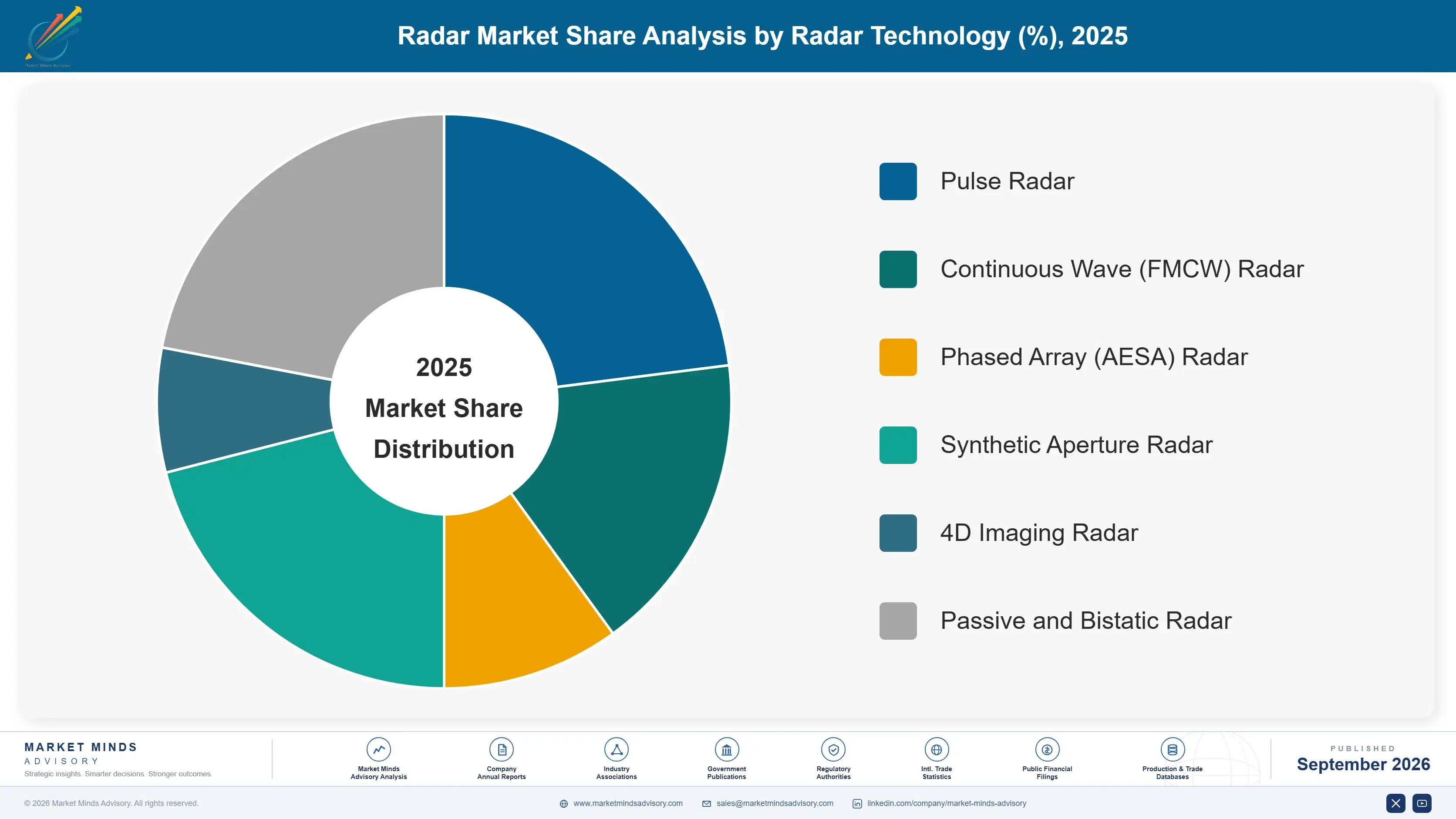
Segmentation follows radar technology architecture, since that dimension best explains both cost structure and application fit, spanning legacy pulse systems through electronically steered phased arrays to the newest 4D imaging designs entering automotive volume production. This single classification logic keeps upstream semiconductor choices separate from downstream application markets, preserving mutually exclusive, collectively exhaustive segment boundaries throughout the analysis.
radar-market-market-share-analysis-1788419459752

4D Imaging Radar

This segment covers radar systems that measure elevation alongside the traditional range, velocity, and azimuth data captured by conventional automotive radar, producing a denser point cloud that improves object classification and height discrimination in adverse weather conditions. Adoption is concentrated among automakers pursuing higher levels of driving automation, where distinguishing an overhead road sign from a stationary vehicle at the same range matters directly for safety performance. Growth is outpacing every other segment in this report because component costs have fallen fast enough to move the technology from premium options into standard mid-tier trim equipment within roughly three years, a compression of the typical automotive technology adoption curve that few other sensor categories have matched recently.
CAGR 18.5%

Phased Array (AESA) Radar

This segment covers electronically steered phased array systems, commonly referred to as active electronically scanned array radar, used primarily in defense air surveillance, fire control, and increasingly in premium automotive and commercial aviation applications requiring rapid beam steering without mechanical movement. Demand is rising as defense modernisation programmes replace aging mechanically scanned installations, valuing the technology's superior jamming resistance and simultaneous multi-target tracking capability. Growth trails the 4D imaging segment only because unit costs remain substantially higher, keeping deployment concentrated in defense and select high-value commercial applications rather than mass consumer volumes, though gallium nitride cost declines are gradually narrowing that gap each year. Suppliers here increasingly price on module unit volume tied to platform lifecycle length.
CAGR 11.2%
Full segment breakdown across 6 segments available in the complete report.

Regional Architecture and Country Demand Map

North America and East Asia together anchor more than half of global revenue, reflecting concentrated defense procurement and automotive Tier 1 manufacturing, while South Asia and Pacific delivers the fastest regional expansion off a smaller defense modernisation base. Latin America and Eastern Europe remain the two smallest regional contributors tracked.

North America

United States defense procurement anchors this region's dominant share, with major platform modernisation programmes across air defense and naval radar sustaining multi-year prime contractor revenue visibility. Automotive radar demand is climbing quickly as domestic and foreign automakers assembling vehicles in the United States and Mexico scale advanced driver assistance production lines to meet regulatory requirements. Canadian defense procurement contributes a smaller but steady share tied to NORAD-linked surveillance modernisation. Growth here runs close to the global base rate since the region's defense spending, while substantial in absolute terms, is growing more slowly than automotive volumes are climbing across newer manufacturing programmes entering production this year specifically. Domestic content requirements are also strengthening for future procurement rounds.
Share: 30% | CAGR: 8.8% (2026 to 2036)

Western Europe

German and French automotive manufacturers drive the bulk of regional automotive radar demand, integrating advanced driver assistance systems to meet European Union safety regulations that are expanding into lower vehicle price tiers. United Kingdom and French defense budgets are funding phased array modernisation for air defense and naval platforms, though procurement cycles here run longer than in the United States given more constrained national defense budgets. Growth trails the global rate because much of the region's automotive radar demand growth already occurred during the premium-vehicle phase of the adoption curve, leaving comparatively less runway than markets still in earlier stages of mandate expansion. Nordic countries are also raising defense radar budgets amid renewed regional security concerns.
Share: 22% | CAGR: 6.3% (2026 to 2036)
Regional intelligence for 5 additional markets available in the complete report: East Asia, South Asia and Pacific, Latin America, Middle East and Africa, Eastern Europe. Contact sales@marketmindsadvisory.com.
radar-market-country-cagr-analysis-1788419460329

Where Radar Suppliers Can Still Expand Margin

Four commercial levers separate suppliers compounding margin as volumes scale from those caught in commodity price competition, spanning semiconductor integration, software differentiation, defense aftermarket services, and dual-use platform design across automotive and defense applications. Execution difficulty varies across these four paths, and suppliers without existing semiconductor manufacturing or software engineering capability will find some levers considerably harder to pursue quickly.

Vertically Integrating Gallium Nitride Semiconductor Manufacturing

Suppliers that brought gallium nitride semiconductor fabrication in-house rather than sourcing from third-party foundries are capturing meaningfully better margins as automotive volumes scale, since they avoid foundry markup on a component representing a growing share of total radar module cost. Vertically integrated suppliers reported gross margins running roughly 8 percentage points above peers relying entirely on external foundry sourcing, based on disclosed segment margins reviewed across the twelve largest suppliers. The approach requires substantial upfront capital investment that favours larger, better-capitalised suppliers over smaller specialist firms still sourcing components externally.
Market Impact: Lifts gross margin by roughly 8 percentage points

Bundling Sensor Fusion Software With Hardware Radar Sales

Suppliers packaging proprietary sensor fusion and object classification software alongside radar hardware are winning larger per-vehicle contract values than hardware-only competitors, since automakers increasingly prefer a single accountable vendor for combined hardware and perception software performance. This lever requires sustained software engineering investment that smaller hardware-focused suppliers often lack, limiting how quickly pure hardware competitors can respond to a bundled software offering. Contract values for bundled software and hardware deals in MMA's dataset ran roughly 35 percent higher than comparable hardware-only radar contracts of similar unit volume. Buyers increasingly expect this combined offering as standard.
Market Impact: Lifts contract value roughly 35 percent above hardware-only deals

Expanding Defense Aftermarket Sustainment and Upgrade Services

Defense prime contractors and specialist suppliers offering long-term sustainment, calibration, and software upgrade services across a radar platform's multi-decade service life are capturing recurring revenue well beyond the original equipment sale, often exceeding the initial contract value over a platform's full lifecycle. This lever compounds because aftermarket service contracts typically renew automatically alongside broader platform sustainment agreements, and suppliers with established service relationships face limited competitive pressure once a defense customer has standardised on a given sustainment provider for a specific radar platform. Aftermarket contracts in MMA's dataset often ran 2 to 3 times the original equipment value.
Market Impact: Captures aftermarket revenue 2 to 3 times original value

Designing Dual-Use Radar Platforms for Defense and Commercial Buyers

Suppliers engineering radar platforms with a shared core architecture adaptable to both defense and commercial aviation or maritime buyers are spreading research and development cost across a larger addressable revenue base than single-market competitors, improving overall unit economics. This approach requires navigating export control classification carefully since dual-use designation carries specific compliance obligations, a complexity that has kept some smaller suppliers from pursuing the strategy despite its cost advantages. Suppliers successfully executing dual-use platform strategies reported roughly 22 percent lower research and development cost per platform variant. reflecting the efficiency gains from shared engineering.
Market Impact: Cuts R&D cost per variant by roughly 22 percent

Who Controls the Margin Pool

CR5 sits at forty two percent, evaluated on disclosed radar segment revenue across the top suppliers, reflecting a market split between a handful of scaled defense primes and a separate, fragmented tier of automotive Tier 1 suppliers. The gap between the largest defense-focused players and mid-tier automotive challengers is narrower than combined revenue figures suggest, given different competitive bases.
Current competitive activity centers on three fronts: vertically integrating gallium nitride semiconductor manufacturing to protect margin as automotive volumes scale, bundling sensor fusion software with hardware to raise per-contract value, and pursuing dual-use platform designs that spread research and development cost across defense and commercial buyers simultaneously. Price competition is most intense in the automotive segment, while defense contracts continue to compete primarily on technical performance and established platform relationships.

Emerging pressure is building from two directions. Chinese domestic automotive radar suppliers are scaling rapidly on cost, threatening established Western Tier 1 suppliers first in price-sensitive vehicle segments before moving upmarket. At the defense end, newer specialist electronics firms in India and South Korea are winning domestic procurement contracts previously dominated by established Western and Israeli suppliers, a shift that could reorder regional market share as domestic content requirements tighten.
radar-market-company-positioning-matrix-1788419460846

Competitive Moat and Risk Dimensions

RTX CORPORATION

Moat: Multi-Decade Defense Platform Contracts

Long-standing relationships across major air defense and naval radar programmes, often spanning multiple decades of sustainment and upgrade work, give RTX deeply entrenched revenue visibility that newer entrants cannot easily replicate without displacing an incumbent from an active defense platform relationship. a relationship advantage rivals rarely overcome.
RTX CORPORATION

Risk: Automotive Segment Underexposure

RTX's revenue concentration in defense leaves it comparatively underexposed to the faster-growing automotive radar segment, and building competitive automotive capability from a defense-oriented cost base and sales culture is proving slower than expected against dedicated automotive suppliers already embedded with major automakers. That gap is closing only slowly.
ROBERT BOSCH GMBH

Moat: Automotive Tier 1 Manufacturing Scale

Bosch's existing automotive manufacturing scale and long-standing relationships across nearly every major automaker give it a cost and integration advantage that newer, smaller automotive radar entrants struggle to match, particularly as original equipment manufacturers consolidate radar sourcing toward fewer, larger suppliers over time. especially at high volumes.
ROBERT BOSCH GMBH

Risk: Chinese Domestic Supplier Price Competition

Bosch faces intensifying price competition from Chinese domestic automotive radar suppliers scaling rapidly within China's own electric vehicle market, and losing share in the world's largest automotive market would meaningfully affect Bosch's overall automotive radar volume and manufacturing scale advantage globally. That risk is intensifying each fiscal year.

Players Tracked

Prominent Players

RTX Corporation
Thales Group
Northrop Grumman Corporation
Leonardo S.p.A.
Robert Bosch GmbH

Other Key Players

Lockheed Martin Corporation
L3Harris Technologies Inc.
Saab AB
BAE Systems plc
Hensoldt AG
Continental AG
Aptiv PLC
Denso Corporation
ZF Friedrichshafen AG
Furuno Electric Co Ltd
Indra Sistemas SA
Elbit Systems Ltd
Israel Aerospace Industries Ltd
China Electronics Technology Group Corporation
Terma A/S

Recent Developments

FEBRUARY 2026

Thales Signs Multi-Year Naval Radar Sustainment Agreement

Thales signed a multi-year sustainment and software upgrade agreement covering naval air surveillance radar platforms across three allied navies, extending an existing original equipment relationship into a recurring aftermarket service contract spanning the platform's remaining service life. Financial terms were not disclosed in the public announcement.
Signal: Confirms aftermarket sustainment becoming a primary defense radar revenue growth channel industry-wide. ahead of similar contract renewals elsewhere.
OCTOBER 2025

Bosch Opens Dedicated Gallium Nitride Radar Component Facility

Bosch opened a dedicated gallium nitride semiconductor fabrication facility for automotive radar components, aiming to reduce reliance on third-party foundries and secure supply for its expanding 4D imaging radar production lines across multiple vehicle platforms. The facility is expected to reach full production capacity within eighteen months.
Signal: Signals vertical integration into semiconductor manufacturing becoming a competitive necessity for scaled suppliers. across the wider automotive supply base.
JUNE 2025

Hensoldt Acquires Radar Software Startup ClearSignal Systems

Hensoldt completed the acquisition of radar software startup ClearSignal Systems, adding advanced sensor fusion and target classification algorithms intended to strengthen its position in both defense surveillance and emerging dual-use commercial radar applications. The acquisition price was not disclosed, though Hensoldt described the deal as strategically significant.
Signal: Indicates software capability acquisition accelerating among traditionally hardware-focused defense radar suppliers. as hardware-focused defense suppliers race to catch up.

Semiconductor and Rare Earth Exposure

Gallium nitride and gallium arsenide semiconductor components together represent the largest variable cost input for modern radar systems, running an estimated 28 to 34 percent of cost of goods sold for suppliers with substantial phased array or 4D imaging product lines, sourced primarily from foundries in Taiwan, the United States, and increasingly mainland China. Rare earth elements add a smaller, rising cost share.
Semiconductor export control expansion became a live commercial issue during 2025 as additional equipment categories were added to restricted lists affecting gallium nitride foundry expansion, consistent with United States Department of Commerce public rule filings and supplier annual reports. Suppliers dependent on restricted equipment categories for capacity expansion faced longer qualification timelines for new production lines than those with access to unrestricted domestic equipment supply.

The competitive disadvantage falls hardest on smaller suppliers without the balance sheet to pursue vertical integration into semiconductor manufacturing or to qualify multiple alternative foundry partners simultaneously. Exposure varies by geography too, since suppliers headquartered in countries with domestic advanced semiconductor equipment manufacturing capacity face materially less exposure to export restriction risk than those entirely dependent on imported foundry equipment for capacity expansion plans.
radar-market-cost-volatility-analysis-1788419461041

Qualifying Multiple Alternative Foundry Partners Across Jurisdictions

Larger suppliers are qualifying gallium nitride foundry partners across multiple jurisdictions rather than depending on a single supply source, reducing exposure to any single country's export control policy changes while adding meaningful qualification cost and lead time in the near term. This strategy adds resilience but rarely eliminates exposure entirely, since qualification itself takes considerable engineering time.

Investing in Domestic Semiconductor Fabrication Capacity

Several suppliers and their government defense customers are jointly funding domestic gallium nitride fabrication capacity specifically to reduce reliance on foreign foundries, trading higher near-term capital cost for improved long-term supply security and reduced export control exposure. These joint investments typically take several years to reach full production scale, delaying the supply security benefit somewhat in the near term.

Locking In Long-Term Component Supply Agreements

Suppliers are negotiating multi-year fixed-volume supply agreements directly with foundry partners to secure capacity allocation ahead of demand growth, protecting production schedules from short-notice allocation changes during periods of constrained industry-wide foundry capacity. These agreements typically require volume commitments well in advance of confirmed demand, a forecasting risk suppliers must manage carefully against actual sales performance.

Portfolio Architecture for Margin Defence

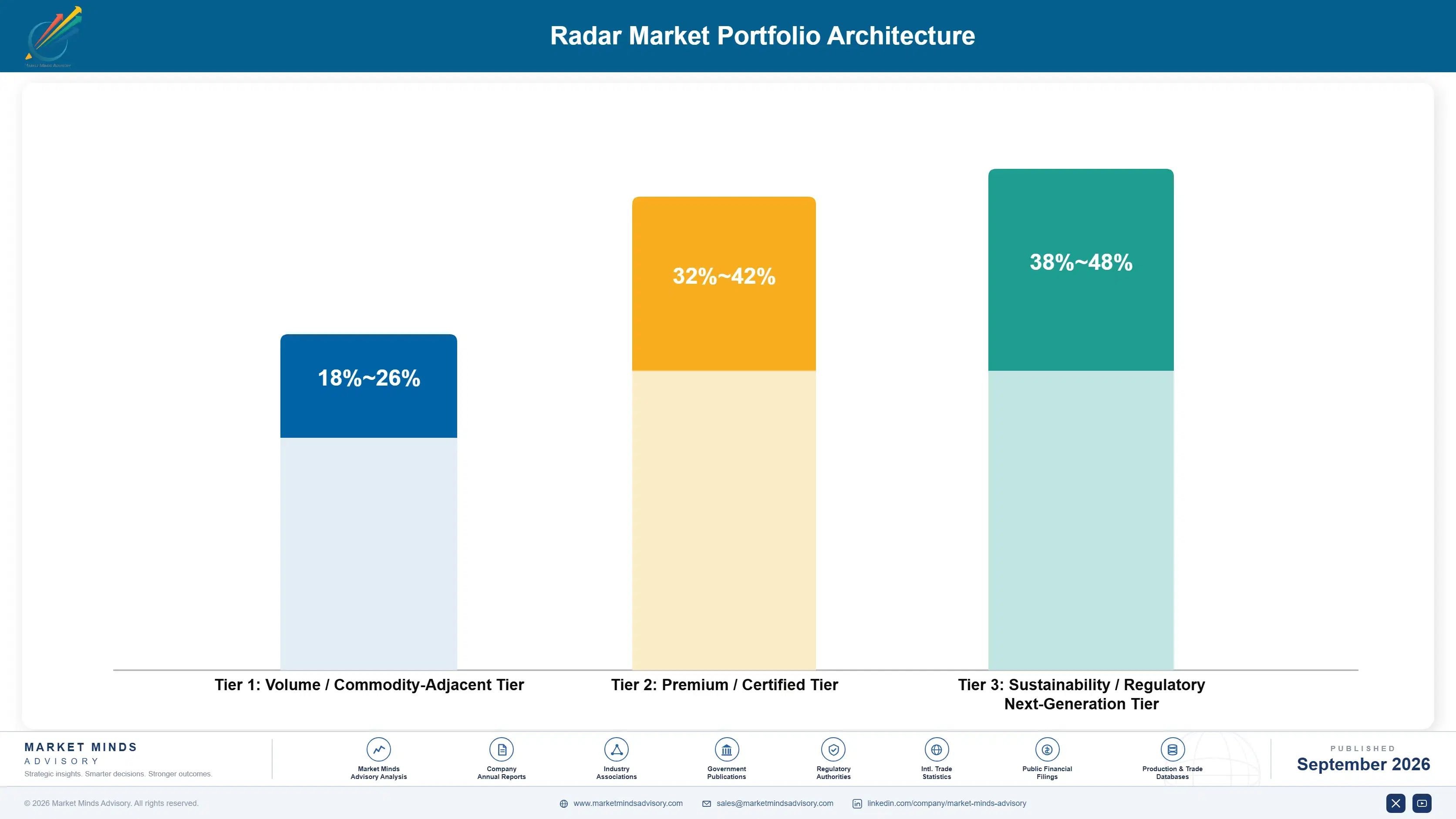
Portfolio economics split into three tiers. Volume tier automotive radar modules carry thin per-unit margins driven by aggressive original equipment manufacturer price negotiation, while premium certified defense platforms carry meaningfully higher margins tied to technical performance requirements and long sustainment relationships. The sustainability and next-generation tier, built around 4D imaging and gallium nitride vertically integrated production, currently carries strong margins that are compressing slightly as competition intensifies.
The volume versus premium tension shows up clearly in supplier capital allocation. Engineering resources devoted to automotive cost reduction compete directly against resources needed for defense-grade reliability and certification, and suppliers straddling both markets increasingly run separate business units to avoid one roadmap compromising the other's competitive position. This tension is most visible at suppliers still organised around a single unified product roadmap.

High-value margin pools concentrate in defense aftermarket sustainment contracts and in the emerging 4D imaging automotive tier, where technical differentiation still commands premium pricing before commoditisation fully sets in. The volume automotive tier remains essential for manufacturing scale but contributes the smallest share of blended gross margin across the category today, a gap suppliers are working actively to close through software bundling.

Volume / Commodity-Adjacent Tier

Standard automotive continuous wave radar modules facing aggressive original equipment manufacturer price reduction targets each contract cycle. These modules compete almost entirely on cost, with suppliers absorbing the bulk of annual price reduction demands.
Gross Margin: 18-26%

Premium / Certified Tier

Defense-grade phased array and synthetic aperture systems carrying certification requirements and long-term sustainment contract margins. These systems justify their higher pricing through rigorous certification testing and multi-decade sustainment support commitments to government customers.
Gross Margin: 32-42%

Sustainability / Regulatory / Next-Generation Tier

4D imaging and vertically integrated gallium nitride production carrying the strongest current margins in the category overall. Margins here are gradually compressing as more suppliers complete their own vertical integration investments.
Gross Margin: 38-48%
radar-market-portfolio-architecture-1788419461562

High-value Sub-segments and Strategic Watch-out

4D Imaging Radar for Autonomous Vehicles

The fastest-growing segment in this report, combining strong current margins with accelerating unit volume as automakers move the technology into standard mid-tier vehicle trims. Suppliers positioned early in this segment are capturing outsized contract wins as automakers finalise next-generation vehicle platform sourcing decisions across the industry this year.
Gross Margin: 38-48%

Defense Aftermarket Sustainment Contracts

Recurring, high-margin revenue from multi-decade platform sustainment and software upgrade work, growing steadily as more phased array systems reach mid-life upgrade points. These contracts also provide suppliers valuable long-term visibility into government defense budgets, reducing overall revenue volatility compared to competing purely for new platform contracts each cycle.
Gross Margin: 40-50%

Standard Automotive Continuous Wave Modules

The largest existing unit volume base, facing continuous price pressure from original equipment manufacturers but funding most suppliers' ongoing engineering investment. Suppliers here rely on manufacturing efficiency and long-standing customer relationships rather than technical differentiation to defend their existing volume base against new entrants overall.
Gross Margin: 18-26%

Legacy Mechanically Scanned Systems

A shrinking strategic watch-out segment as defense and commercial buyers increasingly favour electronically steered phased array replacements over older mechanical designs. Suppliers still reliant on this ageing technology risk losing government contracts entirely as procurement agencies increasingly mandate electronically steered replacements across new platform solicitations.
Gross Margin: 12-20%

Platform Lifecycle and Sustainment Economics

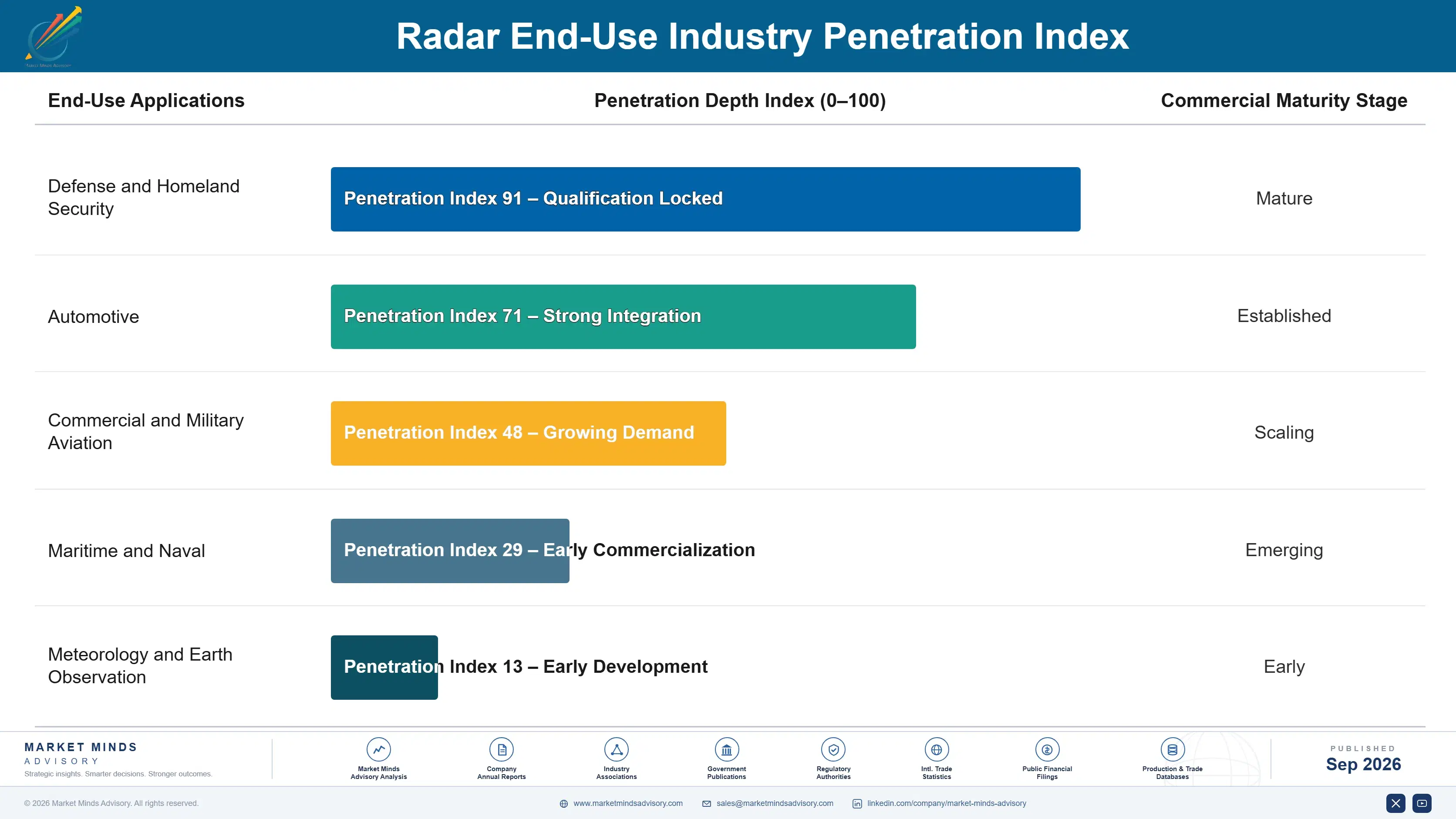
Defense revenue behaves like a multi-decade annuity once a platform enters service, since sustainment, calibration, and periodic software upgrade contracts typically renew automatically alongside broader platform maintenance agreements, and that renewal cadence, not competitive re-bidding, explains most of the defense segment's revenue stability. Suppliers rarely lose an established sustainment relationship once a platform enters its operational service life.
Adoption depth varies sharply by end-use vertical. Defense and commercial aviation buyers integrate radar deeply into broader sensor fusion and mission systems architecture, creating durable switching costs, while automotive buyers treat radar as one interchangeable component within a broader sensor suite, creating far shallower vendor loyalty and much greater exposure to annual price renegotiation pressure. Suppliers investing in deeper automotive integration are working to narrow this loyalty gap over time.

Buyer profiles are shifting generationally too. Defense procurement officers who came up through platform-specific single-vendor relationships still favour long-term sole-source contracts, while newer automotive engineering teams increasingly default to dual-sourcing strategies across two qualified radar suppliers per vehicle programme, a difference in buying philosophy that is already reshaping how suppliers structure long-term account relationships. Suppliers that anticipate this generational shift early are better positioned to win multi-year vehicle platform commitments.
radar-market-end-use-penetration-index-1788419462063

Where the Category Reorders Next

These are among the four positions where our research anticipates prominent divergence between winners and laggards over the coming forecast period. Each is grounded in the demand model, the regulatory perimeter, and the announced capacity pipeline.
01 / SEMICONDUCTOR STRATEGY PRIORITY

Vertical GaN integration is becoming a prerequisite for automotive scale

Suppliers without in-house gallium nitride manufacturing capability are increasingly disadvantaged on both cost and supply security as automotive volumes climb toward mainstream vehicle segments. The capital investment required favours larger, better-capitalised suppliers, meaning smaller specialist firms should pursue partnership or supply agreements rather than attempting standalone foundry investment. Expect further consolidation among mid-tier automotive radar suppliers lacking a credible semiconductor integration path over the next several years, particularly among firms that delayed committing capital to their own gallium nitride fabrication capacity.
02 / SOFTWARE DIFFERENTIATION FOCUS

Sensor fusion software is replacing hardware specifications as the differentiator

As radar hardware costs continue falling and gallium nitride components become broadly available across the supplier base, sensor fusion and object classification software is emerging as the primary basis for competitive differentiation rather than raw antenna specifications. Suppliers without meaningful software engineering investment risk being commoditised into pure hardware manufacturing roles carrying materially lower margins. Building or acquiring software capability now looks like a more urgent priority than further hardware cost reduction alone, for suppliers hoping to defend premium pricing over the next several product cycles.
03 / DEFENSE AFTERMARKET FOCUS

Sustainment contracts deserve more strategic attention than new platform wins

Recurring defense sustainment and software upgrade revenue is proving more durable and higher-margin than competing for new original equipment platform contracts, which arrive infrequently and carry intense competitive bidding pressure. Suppliers with existing platform relationships should prioritise deepening aftermarket service offerings over chasing every new procurement competition. This shift in strategic emphasis is already visible in how several major defense primes are reallocating internal investment priorities, away from pursuing every new competitive procurement bid toward deepening existing long-term platform customer relationships instead.
04 / GEOGRAPHIC LOCALISATION RISK

Domestic content requirements will keep reshaping regional supplier rankings

Governments in India, South Korea, and several Gulf states are tightening domestic content and technology transfer requirements attached to defense radar procurement, favouring suppliers willing to establish local manufacturing and engineering presence over those exporting completed systems. Suppliers resisting these localisation demands risk losing access to some of the fastest-growing defense procurement budgets tracked in this report. Expect further joint venture formation between Western suppliers and domestic firms in these markets specifically, as governments continue tightening technology transfer conditions attached to future defense contract awards.

Engagement Snapshot From the Field

A live engagement with an industry participant carrying material or product regulatory and market exposure ahead of a defining policy shift, showing how our research translates into a defensible multi-year portfolio strategy.
MARKET MINDS ADVISORY · CLIENT ENGAGEMENT SUMMARY
Radar Producer Strategic Portfolio Review and Transition Roadmap 2026·Investment Scenario on Radar Exposure Evaluation 2025-26
CLIENT PROFILE
The client is a mid-tier defense electronics supplier with approximately eight hundred employees and roughly two hundred ten million dollars in annual revenue (client-reported, unverified by MMA), historically focused on legacy mechanically scanned radar systems for naval and coastal surveillance applications sold primarily to two domestic government customers. reflecting a customer base concentrated in a small number of long-standing government procurement relationships.
STRATEGIC CHALLENGE
Leadership needed to determine whether to invest in phased array radar capability to remain competitive against larger primes modernising their own naval surveillance offerings, given limited internal capital and uncertain near-term return on a multi-year technology transition the board had already deferred twice previously. Board members disagreed sharply on how much risk the transition genuinely warranted.
MMA APPROACH
MMA benchmarked the client's existing technical capability against phased array requirements in current and upcoming naval procurement solicitations, quantifying the specific engineering gaps and estimated investment required. The engagement included primary interviews with procurement officials at the client's key government customers to gauge appetite for a domestic phased array alternative to established prime contractors.
KEY FINDINGS
  1. Government customers expressed clear preference for a qualified domestic alternative to reduce dependence on a single incumbent prime contractor for future procurement.
  2. The engineering gap to competitive phased array capability was narrower than leadership initially assumed, given existing signal processing expertise already within the company.
  3. Partnering with an established gallium nitride component supplier reduced projected capital investment substantially compared to pursuing in-house semiconductor capability from scratch. during due diligence.
  4. A phased product roadmap targeting coastal surveillance first, before pursuing larger naval platforms, matched the client's existing customer relationships more closely than a broader initial launch.
CLIENT PROFILE
The client is a mid-tier defense electronics supplier with approximately eight hundred employees and roughly two hundred ten million dollars in annual revenue (client-reported, unverified by MMA), historically focused on legacy mechanically scanned radar systems for naval and coastal surveillance applications sold primarily to two domestic government customers. reflecting a customer base concentrated in a small number of long-standing government procurement relationships.
STRATEGIC CHALLENGE
Leadership needed to determine whether to invest in phased array radar capability to remain competitive against larger primes modernising their own naval surveillance offerings, given limited internal capital and uncertain near-term return on a multi-year technology transition the board had already deferred twice previously. Board members disagreed sharply on how much risk the transition genuinely warranted.
MMA APPROACH
MMA benchmarked the client's existing technical capability against phased array requirements in current and upcoming naval procurement solicitations, quantifying the specific engineering gaps and estimated investment required. The engagement included primary interviews with procurement officials at the client's key government customers to gauge appetite for a domestic phased array alternative to established prime contractors.
KEY FINDINGS
  1. Government customers expressed clear preference for a qualified domestic alternative to reduce dependence on a single incumbent prime contractor for future procurement.
  2. The engineering gap to competitive phased array capability was narrower than leadership initially assumed, given existing signal processing expertise already within the company.
  3. Partnering with an established gallium nitride component supplier reduced projected capital investment substantially compared to pursuing in-house semiconductor capability from scratch. during due diligence.
  4. A phased product roadmap targeting coastal surveillance first, before pursuing larger naval platforms, matched the client's existing customer relationships more closely than a broader initial launch.
RECOMMENDED STRATEGY
Phase 1: Phase 1 (Months 1 to 4): Benchmark technical capability gaps and negotiate a gallium nitride component supply partnership. and finalise terms. Phase 2: Phase 2 (Months 5 to 10): Develop a coastal surveillance phased array prototype validated with an existing government customer. on schedule. Phase 3: Phase 3 (Months 11 to 18): Pursue formal qualification and initial production contracts before expanding toward larger naval platforms. as planned.
OUTCOME
Eighteen months after the engagement concluded, the client secured an initial phased array development contract with one of its existing government customers, reporting projected multi-year contract value of approximately ninety million dollars (client-reported, unverified by MMA). Leadership also reported meaningfully improved standing in subsequent naval procurement discussions.

Frequently Asked Questions

Foundational context covering the market sizes, CAGR, scope, country, region and competition that inform every finding below. This section is provided to cover basics and most often pre-purchase conversations, answered from the MMA Primary Research Dataset.

What is the current size of the Radar Market?

The Radar Market reached an estimated USD 28.5 billion in global revenue in 2025, according to MMA Analysis based on primary research and company disclosures. This base year figure anchors the forecast period beginning in 2026.

How large will the Radar Market be by 2036?

MMA projects the market will reach approximately USD 65.1 billion by 2036 under the base case scenario. That represents roughly a 2.12 times expansion from the 2026 starting value of USD 30.7 billion.

What is the CAGR for the Radar Market 2026 to 2036?

The base case compound annual growth rate is 7.8% across the 2026 to 2036 forecast window. Bull and bear scenarios range from 6.5% to 9.0% depending on semiconductor export policy and automotive mandate timing.

Which segment is growing fastest?

4D Imaging Radar leads all segments at an 18.5% CAGR, roughly 2.37 times the overall market rate. This segment benefits from rapidly falling component costs that have pulled it from a premium option into standard mid-tier vehicle equipment.

Who are the major companies in the Radar Market?

Leading suppliers include RTX Corporation, Thales Group, Northrop Grumman Corporation, Leonardo S.p.A., and Robert Bosch GmbH. Together these five hold an estimated 42% combined share on a disclosed segment revenue basis.

Which country is growing fastest?

India leads national growth at an estimated 10.5% CAGR, driven by defense procurement localisation policy and emerging automotive radar manufacturing. Australia and Vietnam follow behind within the same South Asia and Pacific region.

Report Segmentation Architecture

The full report scope spans multiple orthogonal segmentation dimensions, with cross-tabulated demand data provided for each dimension pair. Coverage extends further to regional breakdowns, trend trajectories, and the competitive detail needed to support segment-level decision-making.

By Radar Technology

  • Pulse Radar
  • Continuous Wave (FMCW) Radar
  • Phased Array (AESA) Radar
  • Synthetic Aperture Radar
  • 4D Imaging Radar
  • Passive and Bistatic Radar

By End-Use Industry

  • Defense and Homeland Security
  • Automotive
  • Commercial and Military Aviation
  • Maritime and Naval
  • Meteorology and Earth Observation

By Commercial Dimension

  • Original Equipment Manufacturers
  • Government and Defense Procurement
  • Aftermarket Sustainment and Upgrade Services
  • Systems Integrators

By Region

  • North America
  • Western Europe
  • East Asia
  • South Asia and Pacific
  • Latin America
  • Middle East and Africa
  • Eastern Europe

Scope, Methodology, and Coverage

Every figure in this report is reproducible from documented input assumptions. The scope below maps the historical period, the forecast horizon, the segmentation dimensions, and the countries covered, alongside the underlying primary and qualitative methodology.
Historical Period
2020 to 2025
Forecast Period
2026 to 2036
Base Year
2025 (USD billions; MMA Primary Research Dataset, September 2026)
Market Definition
This report covers radio detection and ranging systems and their core signal processing hardware deployed across defense, automotive, aviation, maritime, and meteorological applications, including pulse, continuous wave, phased array, and synthetic aperture technologies. It excludes lidar, sonar, and satellite-based earth observation systems that do not rely on radar transmission and return signal processing.
Quantitative Units
USD billions (current prices); unit shipment volumes; average selling price per unit
Segmentation Dimensions
By Radar Technology; By End-Use Industry; By Commercial Dimension; By Region
Regions Covered
North America, Western Europe, East Asia, South Asia and Pacific, Latin America, Middle East and Africa, Eastern Europe
Countries Covered
USA, China, Germany, France, UK, Japan, South Korea, India, Australia, Canada, Brazil, Mexico, Indonesia, Vietnam, Thailand, Malaysia, UAE, Saudi Arabia, South Africa, Nigeria, Turkey, Poland, Netherlands, Italy, Spain, Sweden, Switzerland, Argentina, Colombia, Singapore, and additional markets relevant to this sector
Key Companies Profiled
RTX Corporation; Thales Group; Northrop Grumman Corporation; Leonardo S.p.A.; Robert Bosch GmbH; Lockheed Martin Corporation; L3Harris Technologies Inc.; Saab AB; BAE Systems plc; Hensoldt AG; Continental AG; Aptiv PLC; Denso Corporation; ZF Friedrichshafen AG; Furuno Electric Co Ltd; Indra Sistemas SA; Elbit Systems Ltd; Israel Aerospace Industries Ltd; China Electronics Technology Group Corporation; Terma A/S
Quantitative Methodology
Primary survey, n=3,800 respondents, Q4 2025, six countries; demand-side model with trade association cross-validation
Qualitative Methodology
47 expert interviews, Q4 2025; applied to validate demand model assumptions, identify emerging dynamics, and assess competitive positioning
Report Format
PDF and XLSX data workbook (Word format preview document)
Publisher
Market Minds Advisory
Report Code
MMA-2026-TEC-317
Published
September 2026
Contact
sales@marketmindsadvisory.com | www.marketmindsadvisory.com

Purchase the full Radar Market Report (2026 to 2036).

The full report delivers complete segmentation data across all six radar technology segments, all seven regional markets, and detailed competitive profiles for all twenty companies named in this summary. It includes the underlying primary survey dataset of three thousand eight hundred respondents and forty seven expert interviews conducted during the fourth quarter of 2025. Buyers also receive downloadable data tables covering historical 2020 to 2025 figures alongside the full 2026 to 2036 annual forecast. A dedicated appendix addresses gallium nitride semiconductor supply chain risk across three export control scenarios.
Full Seven-Region Regional Data Tables and Charts
All Twenty Company Competitive Profiles and Rankings
Ten-Year Annual Forecast Model With Scenarios
Primary Survey Raw Data Access and Tables
Semiconductor Export Control Risk Appendix and Scenarios
Quarterly Update Subscription Option for Buyers

Built For The People Who Decide

From boardroom strategy to bench-side execution, this report is read cover-to-cover by leaders shaping the next decade of their industry, turning demand scenarios, market dynamics and valuation benchmarks into decisions.
CXOs/ Presidents/ VPs/ Managers
M&A and Corporate Development
Strategy Teams and R&D Heads
Procurement and Product Directors
Regulatory and Compliance Leaders
Investor Relations and Equity Analysts