Market Minds Advisory
Radar Level Transmitter Market

Radar Level Transmitter Market: Radar Level Transmitter Market: Custody Transfer Approval, Foam Failures and Instruments Chosen Once 2026 to 2036

An instrument that measures a tank for custody transfer needs weights and measures approval that takes years, and once approved nobody swaps it. Everything commercial here follows from that certificate.

Lead Analyst

Published

September 2026

Make Smarter Decisions with Customized Research Insights

Request a free sample report and evaluate market opportunities, growth trends, and competitive dynamics relevant to your business needs.

2025 MARKET VALUE$2.6BMarket Size 2025
2036 FORECAST VALUE$5.7BBase Case , 2026 to 2036
CAGR 2026 TO 20367.4 %Bull 8.6% / Bear 6.2%
INCREMENTAL OPPORTUNITY$2.9BNet 10- year value creation
EXPANSION MULTIPLE2.04x2036 value over 2026 base
Strategic Levers
M&A Pipeline
Regional Outlook
Country Rankings
Competitive Intelligence
Segmental Deep-dive
Call-Us : 91 93563 13602

Executive Snapshot and Market Trajectory.

An instrument measuring a tank for custody transfer needs weights and measures approval that takes years to obtain. Once it is approved nobody swaps it, because that would mean repeating the approval. Everything commercial in this market follows from the certificate. Approval takes about three years per jurisdiction.
The market reaches USD 2.8 billion in 2026 and USD 5.7 billion by 2036, a 2.04 times expansion at 7.4% annually. Radar transmitters at 80 gigahertz grow at 11.1%, half again the market rate of 7.4%, because the narrower beam finally handles the vessel geometries older instruments could not. East Asia holds 31% of shipments on process plant construction volume. Certificates rather than physics decide this market. Instruments run about fifteen years.
Five suppliers hold 68% of shipments, high for instrumentation, because custody transfer approval and process qualification both take years that new entrants cannot compress. Endress and Hauser, Emerson, VEGA Grieshaber, Siemens and ABB lead. Approval coverage rather than measurement performance decides most specifications. Custody transfer carries around 34% of revenue and more of the pricing power. Around 41% of shipments replace units that finally failed.
Market Definition
This report covers radar level transmitters: non-contact and guided wave instruments measuring liquid, slurry and solid levels in process vessels using radar. It spans 80 gigahertz non-contact transmitters, guided wave radar for difficult media, custody transfer approved tank gauging instruments, lower frequency non-contact transmitters, level transmitter software and asset management integration, and the installation and calibration services supplied with them. It excludes ultrasonic and capacitance level instruments, pressure and differential pressure transmitters, flow measurement, tank inventory management software sold separately, and process control systems.
Base Year Value
$2.6B in 2025 (MMA Primary Research Dataset, September 2026)
Forecast Period
2026 to 2036, eleven discrete annual values
CAGR
7.4% base case. Bull 8.6%. Bear 6.2%.
Fastest Growth Segment
80 Gigahertz Non-Contact Transmitters: 11.1% CAGR
Fastest Growth Country
India: 12.7% CAGR
Fastest Growth Region
South Asia and Pacific: 9.5% CAGR
Largest Region
East Asia: 31% of 2025 global value
Market Leaders
Endress and Hauser, Emerson, VEGA Grieshaber, Siemens and ABB lead on radar level transmitter revenue. Source: MMA Analysis.
Primary Survey
n=3,800 procurement and R&D decision-makers, Q4 2025, six countries
Methodology
Demand-side build-up, cross-validated against public data, 47 expert interviews

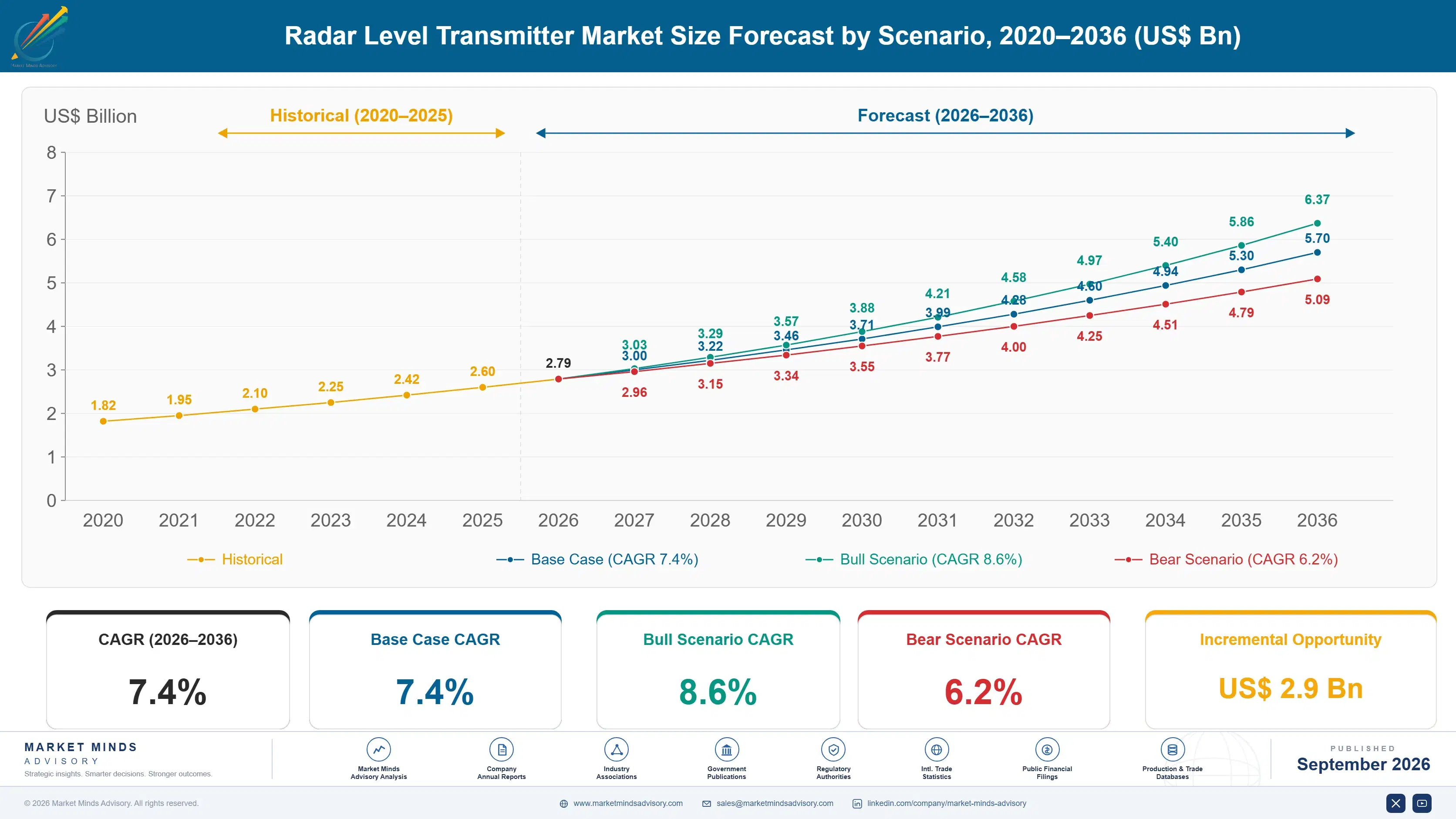
Radar Level Transmitter Market Forecast Scenarios

radar-level-transmitter-market-size-forecast-scenario-1790002890709
Between 2020 and 2025 the category compounded at 6.3%, and the technical change mattered more than the volume did. Higher frequency instruments arrived and finally handled the narrow vessels, agitators and internal obstructions that had defeated earlier radar and pushed those applications toward other measurement principles. Replacement therefore came from capability rather than from failure, which is unusual in process instrumentation.
The base case holds 7.4% on three mechanisms. Higher frequency transmitters keep displacing older radar and non-radar principles on applications that were previously unmeasurable. Process plant construction keeps adding vessels in regions building capacity rather than maintaining it. And custody transfer approval requirements keep tightening as fiscal metering scrutiny increases, which favours the few suppliers holding current certificates across jurisdictions. Those three mechanisms run largely independently of one another across the forecast.
The bull case at 8.6% assumes measurement scrutiny on fiscal and environmental reporting tightens further, which pushes instruments into applications that were previously estimated rather than measured. The bear case at 6.2% is process construction slowdown, where new vessel counts fall and the installed base simply keeps running instruments that work for another decade without anybody replacing anything.

The Certificate Decides

The certificate is the product. Custody transfer approval takes around three years across major jurisdictions, and once an instrument is approved on a tank nobody replaces it with something requiring fresh approval. That gate produces concentration of 68% in a market where the underlying radar physics is well understood and broadly available. Custody transfer accounts for around 34% of revenue and considerably more of the pricing power.
TOP FIVE CONCENTRATION68%High, reflecting approval coverage rather than measurement performance differences
CUSTODY APPROVAL PERIOD3 yearsTime to obtain weights and measures approval across major jurisdictions
INSTRUMENT SERVICE LIFE15 yearsTypical working life before replacement rather than recalibration
FOAM APPLICATION FAILURE RATE22%Level applications where foam or vapour defeats conventional measurement approaches
CUSTODY TRANSFER REVENUE SHARE34%Revenue from fiscal metering rather than general process measurement duty
REPLACEMENT PURCHASE SHARE41%Shipments replacing failed or obsolete instruments rather than new installations
Difficult media are where instruments actually get chosen. Around 22% of level applications involve foam, vapour, agitation or internal obstructions that defeat conventional approaches, and those are the applications where a plant engineer has a genuine problem rather than a routine specification. Radar transmitters at 80 gigahertz grow at 11.1% against 7.4% for the market because the narrower beam finally handles vessel geometries older instruments could not.
Nothing gets replaced until it stops working. Instruments run around 15 years and about 41% of shipments replace failed or obsolete units rather than adding new measurement points. That makes this category track process plant construction more closely than technology improvement, and it explains why suppliers positioned with engineering contractors in regions building capacity grow while those covering operating plants do not.
"Ask a process engineer why they specified that transmitter and the honest answer is that it is what is approved on the tank next to it. The physics stopped being interesting years ago. What matters is which certificates you hold and whether the thing works through foam."
Director, Process Instrumentation and Measurement Practice · MMA Construction and Industrial Equipment Practice · September 2026

Market Trends

Higher Frequency Solved Applications Radar Previously Lost

Instruments at 80 gigahertz produce a narrower beam that finally handles narrow vessels, agitators and internal obstructions which defeated earlier radar and pushed those applications toward other measurement principles entirely. Around 22% of level applications involve conditions of that kind. Radar transmitters at 80 gigahertz grow at 11.1% against 7.4% for the market as those applications convert, which is replacement driven by capability rather than by any instrument failing in service. A working instrument otherwise runs its full fifteen year life untouched, which makes capability-driven replacement genuinely unusual here. Conversion is deliberate.
Market Impact: India compounds at 12.7% yearly

Custody Approval Locks Specifications For Instrument Life

Weights and measures approval for custody transfer takes around three years across major jurisdictions, and once an instrument is approved on a fiscal tank nobody replaces it with something needing fresh approval. Custody transfer accounts for around 34% of revenue and considerably more of the pricing power in this category. That gate produces concentration of 68% in a market whose underlying radar physics is well understood and broadly available to anybody. Testing capacity at approval authorities is finite and cannot be expanded by spending more money on it. Money buys nothing here.
Market Impact: Custody drives 34% of revenue

Market Opportunities and Growth Drivers

Process Construction Adds Vessels In Building Regions

India compounds at 12.7%, ahead of every other market, because chemical, refining and food processing capacity is being built rather than maintained and every new vessel requires instrumentation specified at design stage. East Asia holds 31% of shipments on the same mechanism at larger scale. Suppliers positioned with engineering contractors in those markets reach specification decisions that plant-level coverage never encounters at any point. A design stage decision determines supply for around fifteen years without any further competition arising, which makes contractor presence worth more than any product advantage. Operating plants decide nothing.
Market Impact: Instruments last around 15 years

Fiscal And Environmental Scrutiny Expands Measurement Points

Tightening scrutiny on fiscal metering and environmental reporting pushes measurement into applications that were previously estimated rather than instrumented, particularly around emissions, effluent and inventory reconciliation. Those requirements arrive through regulation rather than through any efficiency argument a supplier makes. Custody transfer already accounts for around 34% of revenue, and approval coverage across jurisdictions is what determines which suppliers can serve the expansion at all. That makes regulatory tracking a commercial function in this category rather than a compliance one, which most suppliers still organise it as. Regulation creates the demand.
Market Impact: Approval takes about 3 years

Market Restraints and Challenges

Instruments Run Until They Stop Rather Than Improve

Radar transmitters work for around 15 years and roughly 41% of shipments replace failed or obsolete units rather than adding measurement points, because a working instrument gets left alone whatever a newer one offers. The root cause is that replacement carries commissioning risk and recalibration effort against no operating benefit. Commercially this ties growth to construction. Mitigation runs through difficult application conversion, through obsolescence programmes, and through specification at plant design stage. Difficult media conversion is the only route that reaches an operating plant before its instruments actually fail. Failure sets the timing.
Market Impact: Difficult media affect 22% of applications

Approval Backlogs Delay Entry To Fiscal Applications

Custody transfer approval takes around three years across major jurisdictions and testing capacity at approval authorities is finite and shared. The root cause is that fiscal measurement approval requires witnessed testing that cannot be compressed with additional spending. Commercially this excludes newer suppliers from the highest value applications. Mitigation runs through approval in fewer jurisdictions first, through general process duty entry ahead of fiscal work, and through partnership with approved suppliers. General process duty is the practical entry point, and it carries the worst margin available anywhere in this category.
Market Impact: Approval consumes about 3 years
3 additional market trends, 4 additional growth drivers, and 2 additional restraints and challenges are covered in the full report. Contact sales@marketmindsadvisory.com to access the complete intelligence.

Segment CAGR and Growth Architecture

Segmentation follows instrument class and duty, since each carries quite different approval requirement, application difficulty and replacement behaviour. Six classes cover the market: 80 gigahertz non-contact transmitters, custody transfer approved tank gauging, guided wave radar for difficult media, lower frequency non-contact transmitters, level transmitter software and asset management integration, and installation and calibration services.
radar-level-transmitter-market-market-share-analysis-1790002891670

80 Gigahertz Non-Contact Transmitters

Radar transmitters at 80 gigahertz grow at 11.1%, half again the market rate of 7.4%, because the narrower beam finally handles narrow vessels, agitators and internal obstructions that defeated earlier radar and sent those applications toward other measurement principles. Around 22% of level applications involve conditions of exactly that kind. This is replacement driven by capability rather than by failure, which is unusual in process instrumentation where a working instrument normally runs its full fifteen year life untouched by anybody. Signal processing developed against real foam and agitation rather than laboratory conditions is what separates suppliers here. Plant engineers facing a genuine problem choose deliberately rather than copying whatever sits on the adjacent vessel.
CAGR 11.1%

Custody Transfer Approved Tank Gauging

Custody transfer approved tank gauging compounds at 9.3% because fiscal metering scrutiny keeps tightening while weights and measures approval takes around three years across major jurisdictions to obtain. That gate excludes newer suppliers from the highest value applications entirely regardless of measurement capability. Custody transfer already accounts for around 34% of revenue and considerably more of the pricing power, which is why approval coverage rather than instrument performance determines who can serve this segment at all. Approval coverage across jurisdictions is also what determines who can serve regulatory expansion into previously estimated measurement points. Certificates rather than capability gate this segment entirely. Regulatory expansion into previously estimated points follows the same certificates.
CAGR 9.3%
Full segment breakdown across 6 segments available in the complete report.

Regional Architecture and Country Demand Map

East Asia holds 31% of shipments, above the usual band, because chemical, refining and food processing construction concentrates there alongside substantial instrument manufacturing. Western Europe follows at 24% on installed process industry depth and approval authority presence. India compounds fastest at 12.7% on new process construction.

East Asia

East Asia takes 31% of shipments, above the 30% band ceiling, because chemical, refining and food processing construction concentrates here alongside substantial instrument manufacturing capacity serving both domestic and export demand. Chinese process plant construction specifies instrumentation at design stage at volumes no other region approaches. Japanese and South Korean process industries replace on obsolescence more predictably than most. Growth at 8.3% runs above the global rate on construction rather than on any replacement of working instruments. Regional manufacturers compete hard on price in general process duty where no approval barrier exists to protect incumbents. Design stage specification is the regional norm for new plant construction. Export manufacturing adds volume.
Share: 31% | CAGR: 8.3% (2026 to 2036)

Western Europe

Western Europe accounts for 24% of shipments, where Endress and Hauser, VEGA Grieshaber and Siemens all developed their positions alongside the region's process industry and where several weights and measures approval authorities operate. Approval obtained here carries weight in specifications well beyond the region, which is influence the shipment share does not capture. Installed base replacement rather than construction drives demand. Growth at 5.9% is the slowest of any region, on mature plant estate rather than any technical factor. Approval obtained here carries weight in specifications far beyond the region, which is influence no shipment figure captures. Replacement rather than construction drives regional demand. Approval authority presence matters. Specification influence exceeds shipments.
Share: 24% | CAGR: 5.9% (2026 to 2036)
Regional intelligence for 5 additional markets available in the complete report: North America, South Asia and Pacific, Latin America, Middle East and Africa, Eastern Europe. Contact sales@marketmindsadvisory.com.
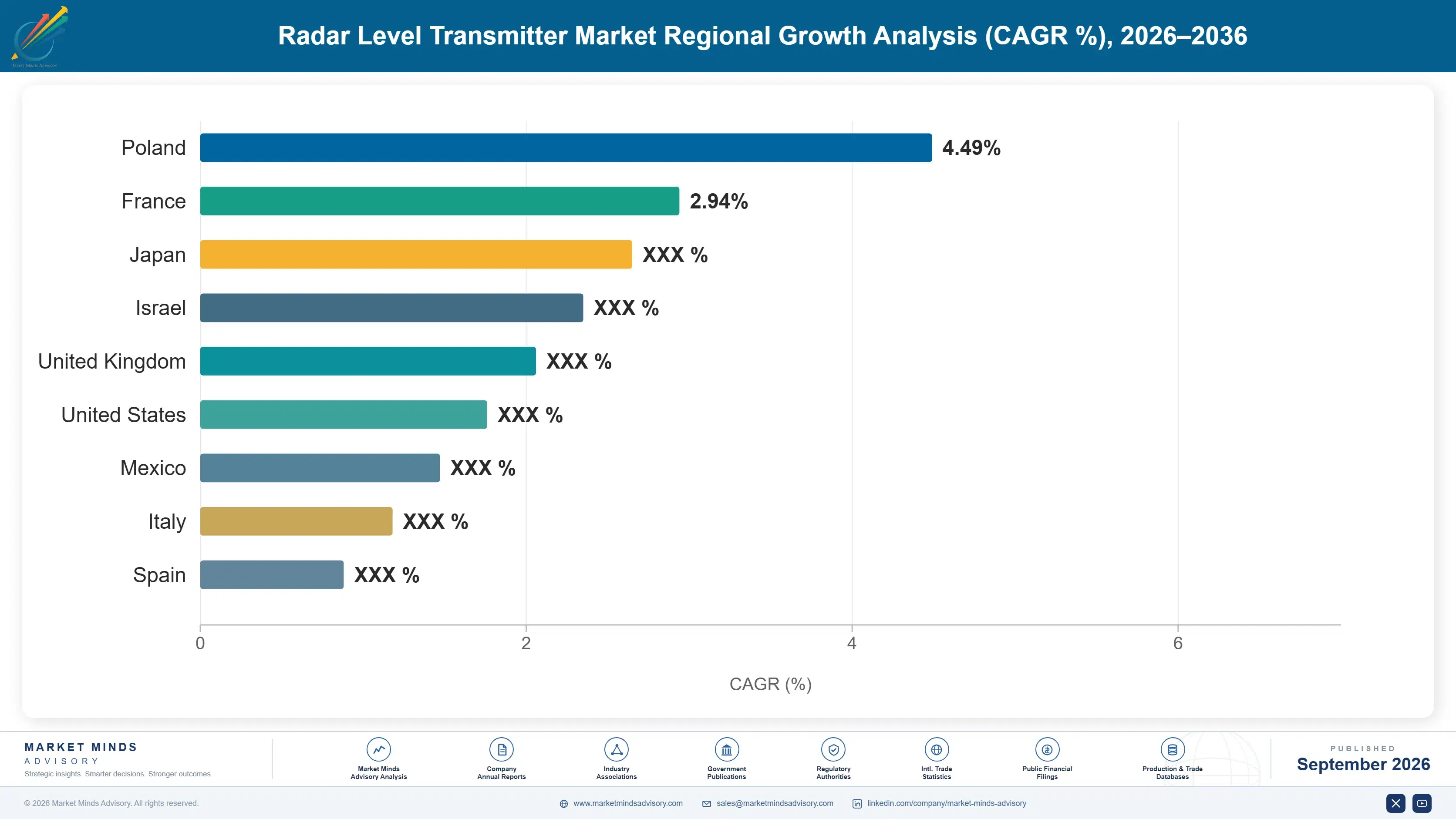
radar-level-transmitter-market-country-cagr-analysis-1790002892499

Where Instrument Specifications Are Won

Approval coverage rather than measurement performance decides who can compete, difficult media are where instruments genuinely get chosen, and nothing gets replaced until it stops working. The four levers below follow those conditions rather than any argument about accuracy, which converged across suppliers years ago. Each addresses a regulatory or application condition instead. Accuracy converged.

Hold Approvals Across Every Relevant Jurisdiction

Custody transfer approval takes around 3 years across major jurisdictions and testing capacity at approval authorities is finite and cannot be bought. Custody transfer carries around 34% of revenue and considerably more of the pricing power available. Suppliers without current certificates are excluded from the highest value applications regardless of measurement capability, and they cannot fix that within any planning horizon a commercial team actually works to. Certificates cannot be accelerated. Suppliers holding certificates serve regulatory expansion that competitors simply cannot reach at all. No planning horizon covers it. Certificates gate everything.
Market Impact: Custody approval now takes about 3 full years

Lead With Foam, Agitation And Obstruction Problems

Around 22% of level applications involve foam, vapour, agitation or internal obstructions where a plant engineer has a genuine problem rather than a routine specification to complete. Those are the applications where instruments actually get chosen rather than inherited from the tank next door. Suppliers leading with accuracy specifications are competing on a dimension that converged years ago, while difficult media remain a real and unresolved engineering conversation. Problems get remembered; specifications get copied. Around 22% of applications are genuinely difficult, and those are where a supplier gets remembered. Accuracy sheets persuade nobody.
Market Impact: Difficult media now affect fully 22% of applications

Reach Engineering Contractors Before Plants Exist

Instruments run around 15 years and roughly 41% of shipments replace failed units rather than adding points, which ties growth to construction rather than to any technology improvement. India compounds at 12.7% because capacity is being built rather than maintained. Suppliers positioned with engineering contractors reach specification at design stage, while those covering operating plants are waiting for instruments to fail on somebody else's schedule. Waiting is not a strategy. Design stage decisions hold for fifteen years without further competition arising anywhere. Contractors decide it all. Failure timing is not a plan.
Market Impact: Instruments now last around 15 full years each

Convert Estimated Measurement Into Instrumented Points

Fiscal and environmental scrutiny keeps pushing measurement into applications previously estimated rather than instrumented, particularly around emissions, effluent and inventory reconciliation. Those requirements arrive through regulation rather than through any efficiency argument. Suppliers holding approval coverage across jurisdictions can serve that expansion while competitors cannot, which makes regulatory tracking a commercial function rather than a compliance one in this category. Approval across 3 jurisdictions typically costs less than a manufacturing cost reduction programme and reaches revenue that price competition never will, which is a trade most suppliers never model. Regulation creates it.
Market Impact: Custody now drives a full 34% of revenue

Who Controls the Margin Pool

Five suppliers hold 68% of radar level transmitter shipments, high for process instrumentation, because custody transfer approval and plant process qualification both take years that newer entrants cannot compress with capital or engineering effort. Endress and Hauser, Emerson, VEGA Grieshaber, Siemens and ABB lead. All participants are assessed on radar level transmitter revenue rather than on broader process instrumentation or automation businesses they also operate. Concentration has held for years because certificates and qualification both accumulate slowly and transfer to nobody.
Competition runs on approval coverage and difficult application capability far more than on measurement accuracy, which converged across serious suppliers years ago. The second dimension is engineering contractor presence, because instruments last around fifteen years and specification at plant design determines supply for that entire period without any further competition.

Pressure is emerging from Chinese instrument manufacturers competing on price in general process duty where approval barriers are lowest. Rankings shift where process construction proceeds and where fiscal metering scrutiny tightens, particularly across India, China and the Gulf over the coming decade. Suppliers concentrated in general duty carry the most exposure to that price pressure.
radar-level-transmitter-market-company-positioning-matrix-1790002893345

Competitive Moat and Risk Dimensions

ENDRESS AND HAUSER

Moat: Approval Coverage Breadth

Endress and Hauser holds custody transfer approvals across a wide range of jurisdictions, each taking around three years to obtain through witnessed testing that cannot be accelerated. Custody transfer carries around 34% of category revenue and more of the pricing power. Competitors without current certificates are excluded from those applications entirely, regardless of what their instruments measure.
ENDRESS AND HAUSER

Risk: General Duty Price Exposure

General process measurement duty carries no approval barrier and Chinese manufacturers compete hard on price in exactly that segment. Approval coverage defends the fiscal applications and does nothing for the larger volume of ordinary process points. A supplier carrying approval cost structures into price-competitive duty loses volume it cannot defend on certificates.
VEGA GRIESHABER

Moat: Difficult Media Capability

VEGA built its position on applications involving foam, agitation and internal obstructions where around 22% of level measurement genuinely fails with conventional approaches. Those are the applications where a plant engineer chooses rather than inherits an instrument specification. Competitors leading with accuracy figures compete on a dimension that converged, while difficult media remain an unresolved engineering conversation.
VEGA GRIESHABER

Risk: Construction Channel Reach

Difficult application strength reaches plant engineers solving problems rather than engineering contractors specifying instruments for plants that do not yet exist. Around 41% of shipments are replacements and the rest follow construction. A position built on solving problems in operating plants misses specification decisions taken years before those plants start up.

Players Tracked

Prominent Players

Endress and Hauser
Emerson
VEGA Grieshaber
Siemens
ABB

Other Key Players

Honeywell
Yokogawa Electric
KROHNE
Magnetrol
Anderson-Negele
Hawk Measurement Systems
BinMaster
Nivelco
Pepperl and Fuchs
Sick
Baumer
Flowline
APLISENS
Supmea Automation
Hangzhou Meacon

Recent Developments

MARCH 2025

Higher Frequency Instruments Convert Previously Unmeasurable Applications

Process plants converted level applications involving narrow vessels, agitators and internal obstructions to higher frequency radar, a technical development rather than any corporate transaction. Around 22% of applications involve conditions that defeated earlier radar, and the narrower beam finally handles geometries that had pushed those points elsewhere.
Signal: Capability rather than failure is now driving replacement here, which is genuinely unusual across process instrumentation.
SEPTEMBER 2024

Fiscal Metering Scrutiny Expands Approved Instrument Requirements

Regulatory scrutiny on fiscal metering and environmental reporting expanded the applications requiring approved instruments, a compliance development rather than any acquisition. Approval takes around three years across major jurisdictions, which means suppliers without current certificates cannot serve the expansion whatever their measurement capability demonstrates in trials.
Signal: Regulation expands demand toward exactly the suppliers who already hold the necessary certificates in place today.
JUNE 2025

Indian Process Construction Specifies Instruments At Design

Indian chemical and refining construction programmes specified level instrumentation during design rather than at commissioning, a specification development rather than any corporate event. India compounds at 12.7%, and instruments running around fifteen years mean a design stage decision determines supply for that entire period without further competition.
Signal: A design stage specification decides fifteen years of supply without any further competition at all afterwards.

What A Transmitter Costs

Radar frequency electronics and antenna assemblies absorb roughly 36% of instrument cost, and higher frequency designs carry more expensive components than the lower frequency instruments they replace. Process connection, housing and wetted materials take around 24%, driven by pressure, temperature and corrosion requirements. Approval, certification and calibration absorb about 17%, with assembly and test taking the remaining balance.
Specialty alloy and sealing material costs rose through 2022 and 2023 while high frequency semiconductor availability tightened as automotive radar demand competed for the same components. Endress and Hauser Annual Report 2024 and Emerson Annual Report 2024 both record component availability and certification cost among principal operating variables. Suppliers with secured high frequency component allocation met project delivery dates that competitors buying on order could not.

The competitive disadvantage mechanism is certification amortisation rather than component price. A supplier spreading approval and certification cost across a wide instrument range and many jurisdictions carries far lower cost per product than one certifying narrowly. Exposure concentrates among smaller specialists, since custody transfer approval and hazardous area certification both cost the same regardless of how many instruments the supplier eventually ships against them.
radar-level-transmitter-market-cost-volatility-analysis-1790002893671

Amortise Approvals Across Wide Instrument Families

Approval, certification and calibration absorb about 17% of instrument cost and each certificate costs the same whether a supplier ships hundreds or hundreds of thousands against it. Designing instrument families around common certified platforms spreads that expense considerably further. The architecture decision must be taken early, since retrofitting certification commonality into ranges developed separately is not achievable.

Secure High Frequency Component Allocation Early

Radar frequency electronics absorb roughly 36% of instrument cost and higher frequency designs depend on components that automotive radar demand also pulls hard. Multi-year agreements secure allocation and support project delivery dates that construction programmes schedule around. Missing a commissioning date loses a specification that then holds for fifteen years without any further opportunity to compete.

Standardise Process Connections Across Instrument Ranges

Process connection, housing and wetted materials absorb around 24% of cost and vary with pressure, temperature and corrosion requirements that differ by application rather than by instrument. Sharing connection and housing platforms across ranges spreads tooling and inventory considerably. The constraint is product management discipline, which erodes whenever ranges are developed by separate engineering teams independently.

Portfolio Architecture for Margin Defence

Margin architecture separates on approval barrier rather than measurement difficulty. Lower frequency non-contact transmitters earn least, since general process duty carries no approval requirement and Chinese manufacturers compete hard on price. Installation and calibration services sit above on labour economics. Custody transfer gauging, 80 gigahertz instruments and guided wave radar earn most, because each carries either a certificate or a capability competitors have not matched.
The volume versus premium tension runs between general process duty and approved fiscal applications, which reward opposite investment entirely. General duty requires manufacturing cost discipline against competitors with lower cost bases and no certification overhead. Fiscal applications require approval investment that costs the same regardless of volume. Suppliers carrying approval cost structures into general duty pricing lose volume they cannot defend with certificates.

High-value pools concentrate in custody transfer gauging and in difficult media capability, and neither is reached through measurement engineering alone. Custody requires certificates taking three years each across every jurisdiction served. Difficult media requires signal processing developed against real foam and agitation rather than laboratory conditions. Both explain why five suppliers hold 68% while general process duty fragments beneath them on price.

Volume / Commodity-Adjacent

Lower frequency non-contact transmitters for general process duty, where no approval barrier exists and Chinese manufacturers compete hard on manufacturing cost. The twelve point spread separates suppliers sharing connection and housing platforms from those tooling each instrument range separately.
Gross Margin: 29% to 41%

Premium / Certified

Installation and calibration services and level transmitter software and asset management integration, where labour economics and system integration determine value rather than any instrument specification. The thirteen point spread tracks service delivery efficiency against work performed on individual project schedules.
Gross Margin: 46% to 59%

Sustainability / Regulatory / Next-Generation

Custody transfer approved tank gauging, 80 gigahertz non-contact transmitters and guided wave radar for difficult media, each carrying a certificate or capability competitors have not matched. The fifteen point spread reflects approval coverage breadth and signal processing depth developed against real conditions.
Gross Margin: 63% to 78%
radar-level-transmitter-market-portfolio-architecture-1790002894634

High-value Sub-segments and Strategic Watch-out

80 Gigahertz Non-Contact Transmitters

Grows at 11.1% because the narrower beam finally handles vessel geometries that defeated earlier radar instruments entirely. The fifteen point spread reflects signal processing depth. Replacement here is driven by capability rather than by any instrument failing in service. Capability rather than failure drives it.
Gross Margin: 63% to 78%

Custody Transfer Approved Tank Gauging

Grows at 9.3% because fiscal metering scrutiny tightens while approval takes around three years per jurisdiction to obtain. The fifteen point spread reflects approval coverage. Certificates rather than measurement capability determine who can compete for this work. Pricing power concentrates here. Newer suppliers are excluded.
Gross Margin: 63% to 78%

Guided Wave Radar For Difficult Media

Grows at 8.6% on applications where foam, interfaces and low reflectivity defeat non-contact measurement approaches completely. The fifteen point spread reflects application engineering depth. Plant engineers choose these instruments deliberately rather than inheriting a specification. Interfaces and low reflectivity need contact measurement. Contact measurement still wins.
Gross Margin: 63% to 78%

Lower Frequency Non-Contact Transmitters

Grows at 3.8%, slowest of the six classes, as general process duty carries no approval barrier and price competition is severe. The twelve point spread reflects platform sharing. Higher frequency instruments take the applications that were previously difficult. Chinese manufacturers compete hard here. No approval barrier protects it.
Gross Margin: 29% to 41%

Why Certificates Hold Supply

The annuity here is the approval rather than any customer relationship. An instrument approved for custody transfer on a fiscal tank supplies that duty for its whole life, because replacing it means obtaining fresh approval that takes around three years. Custody transfer carries around 34% of revenue and more of the pricing power. Competitors without certificates cannot bid at all, whatever their instruments demonstrate in a trial.
Depth varies by when the specification happened. An instrument specified at plant design stage supplies that point for around fifteen years without any further competition, and roughly 41% of shipments are simply replacing units that finally failed. A supplier reaching an operating plant is waiting for somebody else's instrument to break. That difference decides who grows in regions building capacity rather than maintaining it.

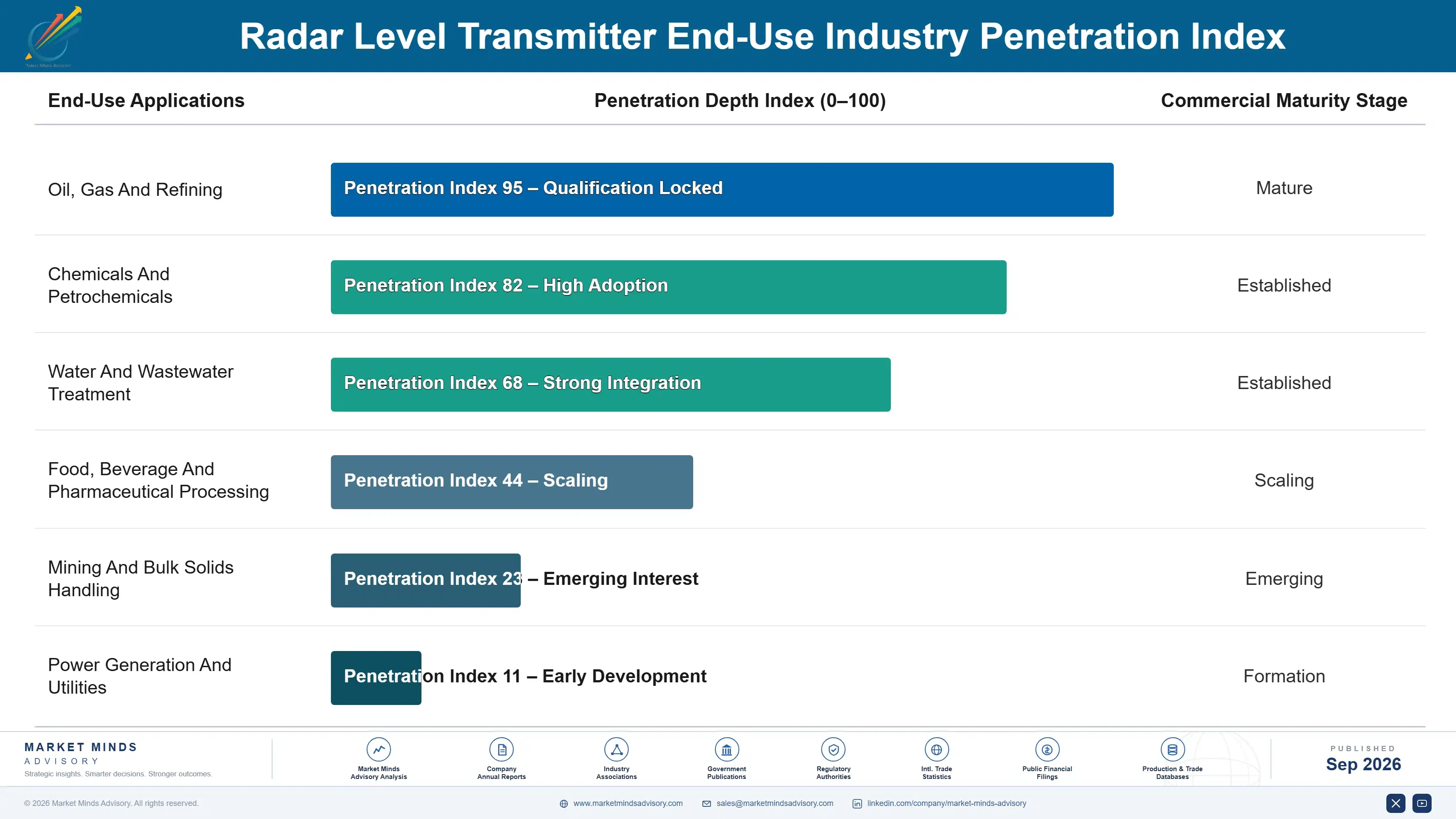
The buyer has barely changed and the decision has. A process engineer evaluated measurement principle and accuracy against a duty specification and mostly still does. A plant engineer facing foam or agitation evaluates whether anything works at all in that vessel. A fiscal metering function evaluates which suppliers hold current approval in the jurisdiction. The third buyer decides the most valuable third of this market on paperwork.
radar-level-transmitter-market-end-use-penetration-index-1790002895456

What Wins Instrument Specifications

These are among the four positions where our research anticipates prominent divergence between winners and laggards over the coming forecast period. Each is grounded in the demand model, the regulatory perimeter, and the announced capacity pipeline.
01 / APPROVAL PORTFOLIO INVESTMENT

Collect Certificates, Not Accuracy Claims

Custody transfer approval takes around three years across each major jurisdiction and testing capacity at approval authorities is finite and cannot be purchased with additional spending. Custody transfer carries around 34% of category revenue and considerably more of the pricing power available in it. Suppliers without current certificates are excluded from the highest value applications regardless of measurement capability, and cannot correct that within any commercial planning horizon that any commercial team works to or budget cycle anywhere in the business.
02 / DIFFICULT APPLICATION POSITIONING

Solve Foam, Not Specification Sheets

Around 22% of level applications involve foam, vapour, agitation or internal obstructions where a plant engineer has a genuine unsolved problem rather than a routine specification to complete. Those are the applications where instruments get chosen deliberately rather than inherited from whatever sits on the neighbouring tank. Suppliers leading with accuracy figures compete on a dimension that converged years ago across every serious participant in this market and settles nothing for the engineer facing an actual vessel with a real problem.
03 / DESIGN STAGE PRESENCE

Specify Before The Plant Is Built

Instruments run around fifteen years and roughly 41% of shipments replace failed units rather than adding measurement points, which ties growth to construction rather than to any technology improvement. India compounds at 12.7% precisely because capacity is being built rather than maintained anywhere. Suppliers positioned with engineering contractors reach specification at design stage, while those covering operating plants wait for instruments to fail on somebody else's schedule and on somebody else's timetable rather than their own entirely outside their control.
04 / REGULATORY DEMAND TRACKING

Follow The Rules Into New Points

Fiscal and environmental scrutiny keeps pushing measurement into applications previously estimated rather than instrumented, particularly around emissions, effluent and inventory reconciliation across process industries. Those requirements arrive through regulation rather than through any efficiency argument a supplier constructs. Suppliers holding approval coverage across jurisdictions serve that expansion while competitors simply cannot, which makes regulatory tracking a commercial function rather than a compliance one, which most suppliers still organise it as to their considerable cost and to nobody else's benefit at all.

Engagement Snapshot From the Field

A live engagement with an industry participant carrying material or product regulatory and market exposure ahead of a defining policy shift, showing how our research translates into a defensible multi-year portfolio strategy.
MARKET MINDS ADVISORY · CLIENT ENGAGEMENT SUMMARY
Radar Level Transmitter Producer Strategic Portfolio Review and Transition Roadmap 2026·Investment Scenario on Radar Level Transmitter Exposure Evaluation 2025-26
CLIENT PROFILE
A process instrument manufacturer with competitive radar measurement performance losing share in general process duty to lower-priced competitors while absent entirely from custody transfer applications. Management had approved a manufacturing cost reduction programme to defend general duty pricing, without examining where the profitable volume in the category actually sat. Nobody had modelled margin by application duty across the category.
STRATEGIC CHALLENGE
Manufacturing wanted further cost reduction to hold general duty share. Product wanted higher frequency development to match competitors on capability. Nobody had costed custody transfer approval or examined how much of the category's pricing power sat behind that gate, and the cost programme was due for approval within the quarter.
MMA APPROACH
MMA analysed margin and volume by application duty across the category, separating approval-gated fiscal work from general process measurement. We costed custody transfer approval across the jurisdictions where the company already sold instruments. Work drew on 47 expert interviews conducted in Q4 2025 with plant operators, engineering contractors and instrument suppliers.
KEY FINDINGS
  1. General process duty carried the lowest margin in the category and Chinese competitors held a cost base the company could not match through any reduction programme.
  2. Custody transfer applications carried around 34% of category revenue at substantially better margin, and the company held no approvals in any jurisdiction.
  3. Approval across 3 target jurisdictions would cost less than the planned manufacturing reduction programme and take about three years (client-reported, unverified by MMA).
  4. Difficult media applications were being lost on signal processing rather than on price, which the cost programme would not have addressed at all.
CLIENT PROFILE
A process instrument manufacturer with competitive radar measurement performance losing share in general process duty to lower-priced competitors while absent entirely from custody transfer applications. Management had approved a manufacturing cost reduction programme to defend general duty pricing, without examining where the profitable volume in the category actually sat. Nobody had modelled margin by application duty across the category.
STRATEGIC CHALLENGE
Manufacturing wanted further cost reduction to hold general duty share. Product wanted higher frequency development to match competitors on capability. Nobody had costed custody transfer approval or examined how much of the category's pricing power sat behind that gate, and the cost programme was due for approval within the quarter.
MMA APPROACH
MMA analysed margin and volume by application duty across the category, separating approval-gated fiscal work from general process measurement. We costed custody transfer approval across the jurisdictions where the company already sold instruments. Work drew on 47 expert interviews conducted in Q4 2025 with plant operators, engineering contractors and instrument suppliers.
KEY FINDINGS
  1. General process duty carried the lowest margin in the category and Chinese competitors held a cost base the company could not match through any reduction programme.
  2. Custody transfer applications carried around 34% of category revenue at substantially better margin, and the company held no approvals in any jurisdiction.
  3. Approval across 3 target jurisdictions would cost less than the planned manufacturing reduction programme and take about three years (client-reported, unverified by MMA).
  4. Difficult media applications were being lost on signal processing rather than on price, which the cost programme would not have addressed at all.
RECOMMENDED STRATEGY
Phase 1: Phase one: stop the manufacturing cost reduction programme, since general duty margin cannot be defended against competitors with lower cost bases. Phase 2: Phase two: begin custody transfer approval in three target jurisdictions immediately, since the process takes three years and the revenue is gated behind it. Phase 3: Phase three: invest in signal processing for difficult media rather than in unit cost, where applications are being lost on capability.
OUTCOME
The manufacturer stopped its cost reduction programme and began custody transfer approval in three jurisdictions instead (client-reported, unverified by MMA). Difficult media win rates improved once signal processing investment landed, ahead of the approvals completing. Margin by application duty is now reviewed before any cost programme, which is the change that outlasted the engagement.

Frequently Asked Questions

Foundational context covering the market sizes, CAGR, scope, country, region and competition that inform every finding below. This section is provided to cover basics and most often pre-purchase conversations, answered from the MMA Primary Research Dataset.

What is the current size of the Radar Level Transmitter Market?

Global value reaches USD 2.8 billion in 2026, measured as radar level transmitter revenue across six instrument classes. The 2025 base was USD 2.6 billion.

How large will the Radar Level Transmitter Market be by 2036?

The market reaches USD 5.7 billion by 2036, an increase of USD 2.9 billion across the forecast period. That represents 2.04 times expansion from the 2026 base.

What is the CAGR for the Radar Level Transmitter Market 2026 to 2036?

The base case runs at 7.4% annually, with a bull case at 8.6% if measurement scrutiny tightens further and a bear case at 6.2% if process construction slows across building regions.

Which segment is growing fastest?

Radar transmitters at 80 gigahertz grow at 11.1%, half again the market rate of 7.4%. The narrower beam finally handles vessel geometries older instruments could not.

Who are the major companies in the Radar Level Transmitter Market?

Endress and Hauser, Emerson, VEGA Grieshaber, Siemens and ABB lead on transmitter revenue, holding 68% between them. Honeywell and KROHNE hold smaller positions in the category.

Which country is growing fastest?

India leads at 12.7%, because chemical, refining and food processing capacity is being built rather than maintained and every vessel needs instrumentation. China and Vietnam follow.

Report Segmentation Architecture

The full report scope spans multiple orthogonal segmentation dimensions, with cross-tabulated demand data provided for each dimension pair. Coverage extends further to regional breakdowns, trend trajectories, and the competitive detail needed to support segment-level decision-making.

By Instrument Class And Duty

  • 80 Gigahertz Non-Contact Transmitters
  • Custody Transfer Approved Tank Gauging
  • Guided Wave Radar For Difficult Media
  • Lower Frequency Non-Contact Transmitters
  • Level Transmitter Software And Asset Management Integration
  • Installation And Calibration Services

By End-Use Industry

  • Oil, Gas And Refining
  • Chemicals And Petrochemicals
  • Water And Wastewater Treatment
  • Food, Beverage And Pharmaceutical Processing
  • Mining And Bulk Solids Handling
  • Power Generation And Utilities

By Commercial Dimension

  • Engineering Contractor Design Specification
  • Direct Plant Operator Procurement
  • Instrumentation Distribution Channel
  • Original Equipment Manufacturer Supply
  • Framework Agreement Supply
  • Calibration And Service Contracting

By Region

  • North America
  • Western Europe
  • East Asia
  • South Asia and Pacific
  • Latin America
  • Middle East and Africa
  • Eastern Europe

Scope, Methodology, and Coverage

Every figure in this report is reproducible from documented input assumptions. The scope below maps the historical period, the forecast horizon, the segmentation dimensions, and the countries covered, alongside the underlying primary and qualitative methodology.
Historical Period
2020 to 2025
Forecast Period
2026 to 2036
Base Year
2025 (USD billions; MMA Primary Research Dataset, September 2026)
Market Definition
This report covers radar level transmitters: non-contact and guided wave instruments measuring liquid, slurry and solid levels in process vessels using radar, spanning 80 gigahertz non-contact transmitters, custody transfer approved tank gauging, guided wave radar for difficult media, lower frequency non-contact transmitters, level transmitter software and asset management integration, and installation and calibration services. It excludes ultrasonic and capacitance level instruments, pressure transmitters, flow measurement, standalone inventory software, and process control systems.
Quantitative Units
USD millions, radar level transmitter revenue basis; instruments shipped; custody transfer approval periods in years; instrument service life in years; difficult application share as a percentage; custody transfer share of revenue; replacement share of shipments.
Segmentation Dimensions
Instrument class and duty; end-use industry; commercial specification route; geography across seven regions.
Regions Covered
North America, Western Europe, East Asia, South Asia and Pacific, Latin America, Middle East and Africa, Eastern Europe
Countries Covered
China, Japan, South Korea, Taiwan, India, Singapore, Australia, Vietnam, Germany, Switzerland, France, Netherlands, Italy, United Kingdom, Poland, United States, Canada, Brazil, Saudi Arabia, United Arab Emirates.
Key Companies Profiled
Endress and Hauser, Emerson, VEGA Grieshaber, Siemens, ABB, Honeywell, Yokogawa Electric, KROHNE, Magnetrol, Anderson-Negele, Hawk Measurement Systems, Pepperl and Fuchs, Sick, Flowline, Supmea Automation.
Quantitative Methodology
Primary survey, n=3,800 respondents, Q4 2025, six countries; demand-side model with trade association cross-validation
Qualitative Methodology
47 expert interviews, Q4 2025; applied to validate demand model assumptions, identify emerging dynamics, and assess competitive positioning
Report Format
PDF and XLSX data workbook (Word format preview document)
Publisher
Market Minds Advisory
Report Code
MMA-2026-CON-271
Published
September 2026
Contact
sales@marketmindsadvisory.com | www.marketmindsadvisory.com

Purchase the full Radar Level Transmitter Market Report (2026 to 2036).

This report sizes the global radar level transmitter market from 2026 to 2036 across six instrument classes, six industries and seven regions. It explains why custody transfer approval taking around three years per jurisdiction makes certificates rather than measurement performance the decisive competitive asset. Difficult media affecting around 22% of applications is analysed as where instruments genuinely get chosen rather than inherited. Instruments running around fifteen years with roughly 41% of shipments replacing failures is examined as the reason growth tracks construction. Regional analysis explains why East Asia holds 31% of shipments.
Six instrument classes sized through to 2036
Custody transfer approval periods quantified as a competitive barrier
Difficult media applications analysed against instrument selection
Twenty named suppliers assessed on transmitter revenue
Four revenue levers with quantified commercial impact
Anonymised instrument manufacturer position engagement documented in full

Built For The People Who Decide

From boardroom strategy to bench-side execution, this report is read cover-to-cover by leaders shaping the next decade of their industry, turning demand scenarios, market dynamics and valuation benchmarks into decisions.
CXOs/ Presidents/ VPs/ Managers
M&A and Corporate Development
Strategy Teams and R&D Heads
Procurement and Product Directors
Regulatory and Compliance Leaders
Investor Relations and Equity Analysts