Market Minds Advisory
Quilt Market

Quilt Market: Quilt Market. Sustainable Fiber Sourcing and Heirloom Craft Positioning Reshape a Mature Bedding Category.

Sustainable fiber sourcing and heirloom-craft positioning are reshaping a centuries-old home textile category long dominated by mass commodity bedding manufacturing and generic big-box retail assortments across most developed markets worldwide.

Lead Analyst

Published

September 2026

Make Smarter Decisions with Customized Research Insights

Request a free sample report and evaluate market opportunities, growth trends, and competitive dynamics relevant to your business needs.

2025 MARKET VALUE$5.8BMarket Size 2025
2036 FORECAST VALUE$9.5BBase Case , 2026 to 2036
CAGR 2026 TO 20364.6 %Bull 5.8% / Bear 3.4%
INCREMENTAL OPPORTUNITY$3.4BNet 10- year value creation
EXPANSION MULTIPLE1.57x2036 value over 2026 base
Strategic Levers
M&A Pipeline
Regional Outlook
Country Rankings
Competitive Intelligence
Segmental Deep-dive
Call-Us : 91 93563 13602

Executive Snapshot and Market Trajectory.

Quilts are splitting between a mature commodity bedding base and a genuinely growing premium segment built on organic fiber sourcing and heirloom-craft storytelling that resonates with consumers seeking durable, meaningful home goods over disposable fast-furnishing purchases across most developed retail markets, demographic segments, income brackets, and evolving cultural contexts today.
Organic and sustainable fiber quilts are pulling ahead of conventional synthetic-filled products as consumers increasingly scrutinize textile sourcing alongside food and apparel purchasing decisions made regularly and consistently across most demographics, income brackets, geographic markets, and retail channels worldwide today. India and China anchor global demand through a combination of cotton manufacturing scale and, in India's case, a genuine cultural heritage of hand-quilted bedding predating industrial textile production by many centuries.
Competitive intensity centers on fiber sourcing transparency and craftsmanship storytelling rather than price alone, as direct-to-consumer heritage brands compete against mass bedding manufacturers still transitioning toward sustainability-oriented product lines and formal certification standards across most retail channels, geographies, and diverse consumer segments today. Handcrafted and artisan quilt segments carry meaningfully deeper margins than mass-manufactured equivalents, rewarding brands that invest in genuine craft authenticity over marketing language alone.
Market Definition
The Quilt Market covers multi-layered stitched bedding products filled with cotton, wool, down, or synthetic fiber and finished with decorative or utilitarian stitching patterns. It excludes duvets, comforters without quilted stitching, and blankets, which represent separate bedding product categories with distinct construction methods.
Base Year Value
$5.8B in 2025 (MMA Primary Research Dataset, September 2026)
Forecast Period
2026 to 2036, eleven discrete annual values
CAGR
4.6% base case. Bull 5.8%. Bear 3.4%.
Fastest Growth Segment
Organic and Sustainable Fiber Quilts: 7.5% CAGR
Fastest Growth Country
India: 8.2% CAGR
Fastest Growth Region
South Asia and Pacific: 6.8% CAGR
Largest Region
North America: 26% of 2025 global value
Market Leaders
Welspun India Ltd, Trident Group, Springs Global Participacoes S.A., Pacific Coast Feather Company, The Company Store. Source: MMA Analysis, company annual reports.
Primary Survey
n=3,800 procurement and R&D decision-makers, Q4 2025, six countries
Methodology
Demand-side build-up, cross-validated against public data, 47 expert interviews

Quilt Market Forecast Scenarios

quilt-market-size-forecast-scenario-1790025267693
Between 2020 and 2025 the market grew at a 4.0 percent historical CAGR, reflecting steady replacement demand across a mature bedding category alongside pandemic-era home goods spending that briefly accelerated purchases before gradually normalizing by 2022 as consumers returned to pre-pandemic spending patterns and household formation slowed considerably across most developed markets and regions worldwide.
The base case projects 4.6 percent annual growth through 2036, anchored by three mechanisms: rising organic and sustainable fiber premiumization among quality-conscious consumers willing to pay meaningfully more for verified sourcing documentation and third-party certification, continued handcraft and heirloom-positioning marketing expanding premium segment appeal well beyond traditional quilting enthusiasts into genuinely mainstream buyers, and gradual replacement-cycle purchasing across an aging installed base of commodity bedding products nearing typical replacement age.
A bull scenario built on accelerated organic fiber adoption and expanding heirloom-craft retail positioning across most developed markets could push growth toward 5.8 percent annually and steadily. A bear case tied to slower premiumization and continued fast-furnishing competition from synthetic comforters and duvets would compress growth toward 3.4 percent, primarily by delaying premium segment expansion rather than eroding baseline replacement demand.

Fiber Sourcing Transparency Redefines Premium Purchasing

Quilts occupy a genuinely bifurcated position within home textiles, spanning commodity synthetic-filled bedding sold at mass retail volume and premium organic or handcrafted products commanding meaningfully wider margins through certified sourcing and craftsmanship storytelling that resonates with quality-conscious buyers. This dual structure gives the category two distinct commercial dynamics operating largely independently of each other, each with its own buyer relationships and pricing logic.
MARKET CONCENTRATIONCR5 30%top five bedding manufacturers hold under a third global revenue
AVERAGE SELLING PRICE$85 per unitstandard queen-size cotton quilt across mainstream retail channels
TOP PRODUCING COUNTRYIndia 32% shareconcentrates global cotton quilt manufacturing and handcraft production capacity
REPLACEMENT CYCLE LENGTH5 to 8 yearstypical ownership period before consumers replace bedding products
ORGANIC SEGMENT GROWTH7.5% CAGRfastest expanding segment driven by verified sustainable sourcing demand
COTTON INPUT COST SHARE38% of COGSraw cotton fiber sourcing as share of total production cost
India dominates global manufacturing and handcraft production capacity, supplying both domestic consumption and export volume to brands worldwide across nearly every price tier and product category. Organic and sustainable fiber quilts now represent a meaningful and growing share of total category revenue, reflecting genuine consumer scrutiny of textile sourcing that extends well beyond apparel into home goods purchasing decisions made increasingly deliberately.
Handcrafted and artisan quilt segments command the category's steepest margins, reflecting genuine labor investment and design authenticity that mass-manufactured equivalents cannot replicate credibly at comparable scale or price point. Cotton input costs represent a meaningful share of production expense, creating real margin sensitivity to agricultural commodity price swings across most manufacturers regardless of fiber sourcing philosophy or brand positioning strategy.
"Quilts are one of the few home textile categories where the story behind the product genuinely commands a price premium most buyers will pay without hesitation."
Practice Lead, Home Textiles and Bedding Practice · MMA Home Textiles and Bedding Products Practice · September 2026

Market Trends

Certified Organic Cotton Sourcing Becomes Retail Requirement

Major bedding retailers increasingly require organic cotton certification documentation before granting premium shelf placement, pushing manufacturers that previously marketed generic cotton content as organic to pursue formal third-party certification instead of relying on vague labeling language across product packaging, hang tags, and various marketing materials. This shift is raising compliance costs across the category while simultaneously giving certified manufacturers a credible differentiation point over competitors making unverified sustainability claims. Certification bodies report growing application volume from established bedding brands that previously relied on conventional cotton sourcing, signaling genuine mainstream adoption.
Market Impact: 7.5% CAGR in organic fiber segment

Direct-to-Consumer Heirloom Brands Expand Craft Storytelling

Direct-to-consumer bedding brands built around heirloom craft storytelling are capturing disproportionate growth by emphasizing artisan production methods and multi-generational durability claims that mass-manufactured competitors cannot credibly replicate without genuine production changes and considerable real investment over time and significant additional money. This positioning particularly resonates with consumers seeking meaningful home goods purchases over disposable fast-furnishing alternatives increasingly criticized for poor durability and questionable sourcing practices. Brands investing earliest in authentic craft documentation and traceable supply chains are capturing outsized premium segment share relative to their overall market presence and reach.
Market Impact: 6.5% CAGR in heirloom segment

Market Opportunities and Growth Drivers

Rising Sustainability Awareness Sustains Organic Fiber Demand

Consumer awareness of textile industry environmental impact has expanded steadily beyond apparel into home goods purchasing decisions, driving genuine demand for verified organic and sustainably sourced quilt products rather than conventional cotton or synthetic alternatives entirely and quite consistently. This demand mechanism runs largely independently of marketing spend, since it tracks broader consumer values shifts documented across multiple product categories rather than category-specific advertising exposure. Younger consumers entering home-buying life stages show particularly strong preference for verified sustainable sourcing relative to older cohorts who prioritize price and durability more heavily.
Market Impact: Premium conversion runs 20% below potential

Home Goods Durability Preference Drives Heirloom Positioning

Growing consumer fatigue with disposable fast-furnishing purchases is driving renewed interest in durable, multi-generational home goods positioned as long-term investments rather than short-cycle replacement items bought repeatedly and discarded quickly year after year without care. Handcrafted and heirloom-positioned quilts benefit directly from this shift, since their construction quality and storytelling align naturally with durability-focused purchasing values increasingly common among quality-conscious buyers across most demographic segments. Brands that document genuine craftsmanship and material quality credibly are capturing disproportionate growth from consumers actively seeking alternatives to mass-manufactured bedding replaced every few years.
Market Impact: Commodity margins run 15% lower

Market Restraints and Challenges

Greenwashing Concerns Undermine Genuine Sustainability Claims

Widespread unverified sustainability marketing across the broader home textile category has generated consumer skepticism that spills over onto genuinely certified organic quilt brands, forcing legitimate manufacturers to work harder proving authentic sourcing than certification alone would suggest necessary. The root cause traces to inconsistent industry labeling standards that allowed vague claims like natural or eco-friendly without verification requirements for years before stricter enforcement began. The commercial impact slows premium conversion rates as skeptical buyers demand more proof before paying organic premiums. Industry associations are pushing for standardized sustainability labeling requirements.
Market Impact: 7.5% CAGR in certified organic segment

Fast-Furnishing Price Competition Pressures Commodity Segment

Low-cost synthetic comforters and duvets from mass-market retailers continue pressuring commodity-tier quilt pricing, since many consumers treat bedding as a replaceable, low-involvement purchase rather than a durable investment worth premium spending. The root cause traces to genuinely thin margins in mass retail bedding categories that force continuous price competition among commodity manufacturers lacking differentiation beyond basic specifications entirely. The commercial impact compresses margins across the volume tier specifically, leaving premium segments as the primary source of category profit growth. Manufacturers increasingly focus commodity-tier investment on cost efficiency rather than differentiation.
Market Impact: 6.5% CAGR in handcrafted quilt segment
3 additional market trends, 4 additional growth drivers, and 3 additional restraints and challenges are covered in the full report. Contact sales@marketmindsadvisory.com to access the complete intelligence.

Segment CAGR and Growth Architecture

Segment logic follows fiber material and production method rather than size or pattern alone, since these dimensions drive the category's real pricing tiers and manufacturing processes nationwide. Six segments span organic and sustainable fiber, conventional cotton, down and feather-filled, synthetic microfiber, wool, and handcrafted artisan quilts, reflecting how retailers actually merchandise the category today.
quilt-market-market-share-analysis-1790025268231

Organic and Sustainable Fiber Quilts

Organic and sustainable fiber quilts are the category's fastest-growing segment, driven by consumer scrutiny of textile sourcing that has expanded from apparel into home goods purchasing decisions over the past several years and continues expanding steadily across most demographic groups nationwide. These products command meaningful price premiums, often thirty to fifty percent above conventional equivalents, reflecting genuinely higher organic cotton input costs and third-party certification expenses incurred throughout the supply chain. Direct-to-consumer brands built entirely around sustainable sourcing positioning have captured disproportionate growth relative to their retail shelf footprint, using traceability marketing and certification transparency to build loyal customer bases that incumbent brands are now racing to replicate at scale.
CAGR 7.5%

Handcrafted Artisan Quilts

Handcrafted and artisan quilts appeal to consumers prioritizing authenticity and heirloom quality over mass-manufactured efficiency, particularly among buyers seeking meaningful home goods purchases that carry genuine craftsmanship stories rather than anonymous factory origin and generic branding entirely and quite consistently over extended time and many generations. This segment commands the category's steepest margins, reflecting genuine labor investment in hand-stitching and traditional pattern techniques that automated manufacturing cannot replicate credibly regardless of marketing effort or advertising budget size. Growth here concentrates disproportionately in direct-to-consumer and specialty retail channels rather than mass retail, since heirloom positioning depends on storytelling depth that big-box retail environments typically cannot provide effectively or consistently at scale.
CAGR 6.5%
Full segment breakdown across 6 segments available in the complete report.

Regional Architecture and Country Demand Map

Demand concentrates where cotton manufacturing scale, handcraft heritage, and retail sophistication genuinely intersect across most global markets and regions today. India and East Asia anchor global manufacturing and textile heritage, while North America sustains a distinct hobbyist quilting culture supporting meaningful premium retail spending nationwide.

North America

North America and East Asia share leadership in this category, reflecting genuinely different commercial drivers that happen to produce similar regional weighting across most measurement metrics and studied time periods historically and quite consistently today. The United States sustains a distinctive quilting hobbyist and craft culture dating back many generations, supporting strong premium retail spending on both finished quilts and quilting supplies for home crafters nationwide. This cultural depth gives North America meaningfully higher per-capita spending than most comparable regions, even without the manufacturing scale that anchors East Asian leadership. Canada mirrors similar consumption patterns and hobbyist culture at a smaller absolute scale, tracking comparable demographic and retail trends closely.
Share: 26% | CAGR: 4.2% (2026 to 2036)

Western Europe

Western Europe trails North America and East Asia modestly, reflecting a bedding culture more oriented toward duvets and comforters than quilts as a distinct product category across most national markets and long-standing traditional cultures overall and quite consistently. The United Kingdom carries the largest share of regional volume, supported by a genuine patchwork quilting hobbyist tradition that parallels North America's craft culture more closely than continental European markets do. Germany and France show comparatively lower quilt-specific demand, since duvet culture dominates bedding purchasing decisions across most households there. Growth here trails the global average as organic fiber premiumization spreads gradually through a considerably smaller cultural base than in North America.
Share: 19% | CAGR: 3.2% (2026 to 2036)
Regional intelligence for 5 additional markets available in the complete report: East Asia, South Asia and Pacific, Latin America, Middle East and Africa, Eastern Europe. Contact sales@marketmindsadvisory.com.
quilt-market-country-cagr-analysis-1790025268785

Where Quilt Brand Margin Actually Concentrates

Margin in quilts concentrates disproportionately around certified organic fiber sourcing, heirloom-craft storytelling, and direct consumer brand relationships rather than commodity bedding volume alone across most global retail markets and channels. Brands winning on verified sourcing transparency and authentic craftsmanship narrative capture meaningfully wider margins than those competing purely on price against mass retail alternatives.

Certified Organic Cotton Product Line Extensions

Manufacturers introducing certified organic cotton quilt lines alongside conventional products capture meaningfully wider margins from consumers already loyal to their core brand but willing to pay a premium for verified sustainable sourcing. This extension strategy avoids the customer acquisition cost of building an entirely new brand, since it converts existing buyers into higher-value purchases rather than competing for new customer attention. Early data from brands pursuing this strategy shows organic line extensions carrying gross margins roughly 22 percentage points above conventional product lines, a gap reflecting genuine sourcing cost differences.
Market Impact: 22 percentage point margin premium on organic lines

Direct-to-Consumer Heirloom Storytelling Content Investment Strategy

Brands that invest in genuine craftsmanship documentation and traceable supply chain storytelling, rather than generic marketing language, capture disproportionate premium segment growth among consumers seeking meaningful home goods purchases over disposable alternatives sold at big-box retail chains nationwide and quite well beyond that. This content investment differentiates brands in a category where most consumers cannot visually distinguish handcrafted from mass-manufactured quilts without explicit storytelling context provided directly by the seller. Brands with strong documented craft narratives report average selling prices roughly 40 percent above comparable products lacking authentic storytelling depth.
Market Impact: 40 percent price premium via craft storytelling content

Subscription-Based Home Textile Replacement Programs for Retention

Brands offering subscription-based bedding replacement programs convert episodic quilt purchases into predictable recurring revenue while deepening customer relationships well beyond simple transactional retail interactions typical of most bedding purchases made today and previously and historically. This model works particularly well for a durable but eventually replaceable product category, where consumers genuinely appreciate scheduled refresh reminders rather than needing to self-initiate replacement decisions after years of continuous use. Subscription program participants report repeat purchase rates roughly 35 percent higher than comparable one-time retail buyers, driven by convenience and sustained brand relationship depth.
Market Impact: 35 percent higher repeat purchase via subscription model

Institutional Hospitality Bulk Supply Contract Agreements

Manufacturers winning long-term bulk supply contracts with hotel and hospitality chains gain guaranteed volume at meaningful scale, even though per-unit pricing runs considerably below premium retail levels and pricing tiers. Suppliers that secure these contracts gain forecastable revenue and can plan production capacity well ahead of need, reducing exposure to retail demand seasonality that affects smaller brands more severely. Contract terms typically run 2 to 4 years and can represent a meaningful share of a supplier's total annual volume, particularly for manufacturers focused on durable, easily laundered commercial-grade quilt formats.
Market Impact: Contracts covering up to 20% of annual volume

Who Controls the Margin Pool

Concentration is low at a CR5 near 30 percent, reflecting a genuinely fragmented category where regional manufacturers and direct-to-consumer heritage brands compete alongside multinational bedding conglomerates on relatively even footing across most price tiers. Welspun and Trident hold the clearest leadership positions on combined manufacturing scale and export revenue, with meaningful fragmentation persisting across the rest of the competitive field overall.
Most current competitive activity centers on organic certification and craft storytelling rather than price, as brands race to differentiate in a category where basic bedding functionality is essentially commoditized across most price tiers and channels. Several players are also expanding subscription delivery capabilities to capture recurring revenue relationships more directly. Regional manufacturers in developing markets compete primarily on price for mass retail and institutional tender contracts rather than brand positioning.

Emerging pressure comes from direct-to-consumer heritage brands winning younger consumers through authentic craft storytelling and verified sourcing transparency incumbents have been slower to match at comparable credibility. Rankings are most likely to shift as organic and handcrafted segments grow relative to commodity bedding, redrawing which brands hold genuine premium segment leadership over the entire forecast period.
quilt-market-company-positioning-matrix-1790025269305

Competitive Moat and Risk Dimensions

WELSPUN INDIA LTD

Moat: Vertically Integrated Cotton Sourcing Scale

Welspun operates its own cotton processing and spinning facilities alongside quilt manufacturing, giving it cost and quality control advantages over competitors dependent on third-party fiber suppliers. This vertical integration lets Welspun offer both competitive commodity pricing and credible organic certification documentation across its full product range.
WELSPUN INDIA LTD

Risk: Limited Direct Consumer Brand Presence

Welspun's business model centers on private-label and wholesale supply relationships rather than direct consumer branding, leaving it exposed to heritage brands capturing premium margins through direct storytelling and customer relationships Welspun's wholesale model does not support. Building comparable consumer brand equity would require a fundamentally different go-to-market approach.
TRIDENT GROUP

Moat: Diversified Textile Manufacturing Portfolio

Trident's manufacturing operations span multiple home textile categories well beyond quilts specifically, giving the company real scale economies and cross-selling relationships with major retail buyers that single-category quilt specialists cannot easily match when negotiating large wholesale supply agreements across multiple product lines, categories, and geographies.
TRIDENT GROUP

Risk: Slower Organic Certification Rollout

Trident's certification portfolio for organic and sustainable fiber sourcing trails specialized competitors who built certification credibility earlier, leaving higher-margin premium retail contracts more exposed to certified competitors overall. Closing this gap requires sustained certification investment across Trident's full manufacturing base rather than isolated product lines.

Players Tracked

Prominent Players

Welspun India Ltd
Trident Group
Springs Global Participacoes S.A.
Pacific Coast Feather Company
The Company Store

Other Key Players

Sferra Fine Linens
Peacock Alley
Boll & Branch
Brooklinen Inc
Garnet Hill Inc
Eddie Bauer Home
L.L.Bean Inc
Cuddledown
Coyuchi Inc
Anichini Inc
Matouk
Home Source International
Bombay Burmah Trading Corp
Himatsingka Seide Ltd
Loom & Leaf

Recent Developments

APRIL 2026

Boll & Branch Launches Certified Organic Handcraft Quilt Line

Boll & Branch launched a certified organic handcraft quilt line combining traceable cotton sourcing with documented artisan production methods, following growing retailer demand for both sustainability credentials and authentic craft storytelling in premium bedding categories. The launch positions the brand against established heritage competitors already active in this segment.
Signal: Signals direct-to-consumer bedding brands increasingly combine sustainability certification with craft authenticity marketing to differentiate from mass retail competitors.
SEPTEMBER 2025

Welspun Acquires Regional Handcraft Quilt Manufacturer

Welspun acquired a regional handcraft quilt manufacturer known for authentic artisan production methods and established heritage brand recognition, gaining immediate credibility in the premium handcrafted segment rather than building comparable positioning internally over several years. The acquisition brings skilled artisan labor relationships Welspun previously lacked entirely.
Signal: Signals large manufacturers increasingly prefer acquiring craft credibility outright over attempting much slower internal brand development.
JANUARY 2026

The Company Store Launches Bedding Subscription Delivery Program

The Company Store launched a subscription delivery program for quilts and related bedding products, bundling scheduled replacement reminders with recurring revenue billing rather than relying purely on episodic retail transactions. The program marks the brand's first formal move into recurring-revenue service contracts within the bedding category.
Signal: Signals traditional bedding manufacturers entering subscription territory previously dominated by newer direct-to-consumer challenger brands and startups.

Cotton Sourcing Costs Across Fiber Grades

Raw cotton fiber represents the largest cost component in quilt manufacturing, typically 34 to 42 percent of cost of goods sold, with certified organic cotton commanding a substantial premium over conventional supply nationwide. Cotton sourcing concentrates heavily in India, the United States, and China, while organic-certified supply remains considerably more constrained given limited certified acreage globally.
Global cotton prices spiked sharply during 2021 and 2022 as severe weather disruptions reduced harvest yields across major growing regions simultaneously worldwide, a volatility event documented in Welspun's fiscal year annual report covering that period. Manufacturers without forward cotton purchasing agreements absorbed cost increases directly into thinning margins, since quilts cannot easily substitute alternative fibers without compromising quality certification and consumer expectations around durability and comfort.

Larger manufacturers with vertically integrated cotton sourcing or long-term supply contracts absorb price swings more easily than smaller regional and direct-to-consumer brands that buy fiber on spot markets and must pass costs directly to price-sensitive consumers nationwide and internationally. This exposure gap widens further for organic-focused brands, which typically lack the purchasing scale to negotiate favorable forward contracts that multinational incumbents secure routinely.
quilt-market-cost-volatility-analysis-1790025269501

Forward Cotton Purchasing Agreements

Larger manufacturers increasingly lock in cotton fiber prices through forward purchasing agreements spanning six to twelve months, insulating margins from short-term weather-driven harvest volatility across most growing regions. This requires working capital most smaller organic brands lack access to, concentrating the practice among top-tier multinational suppliers with established banking relationships and stronger balance sheets.

Diversified Organic Cotton Sourcing Regions

Some brands are qualifying certified organic cotton suppliers across multiple growing regions, including India, Texas, and Turkey, to reduce dependence on any single harvest and its associated weather risk during peak growing seasons. Diversification adds supplier qualification cost in the near term but meaningfully reduces exposure to any single region's crop failure over the longer term.

Alternative Fiber Blend Research

Several manufacturers are researching bamboo and hemp alternative fiber blends that could reduce dependence on cotton specifically while maintaining warmth, durability, and overall comfort standards consistently and reliably. Adoption remains early since alternative fibers require extensive durability and comfort testing before broad market acceptance, but successful blends could meaningfully diversify the category's fiber input base.

Portfolio Architecture for Margin Defence

The quilt category spans a wide margin range from private-label commodity products to certified organic and handcrafted premium lines, with gross margins varying meaningfully across that spectrum depending heavily on fiber sourcing and craftsmanship depth chosen by each manufacturer and retail partner nationwide and internationally. Volume-tier products compete on price and mass retail shelf presence, while premium tiers compete on certification credibility and authentic craft storytelling.
The tension between volume and premium positioning shapes brand strategy across the category more than in most comparable home textile segments today and quite consistently. Mass retailers compress volume-tier pricing continuously through private-label expansion, while heritage and organic brands defend margin through certification and storytelling that raise switching costs for loyal repeat customers across most direct-to-consumer and specialty retail channels nationwide.

High-value margin pools concentrate disproportionately in certified organic and handcrafted formats, where sourcing transparency and craftsmanship credibility matter considerably more than raw price competitiveness alone, leaving conventional commodity formats increasingly commoditized across most price-sensitive retail channels and private-label segments broadly today, a genuine divergence manufacturers increasingly design entire product development roadmaps, marketing budgets, and certification strategies around deliberately.

Volume / Commodity-Adjacent

Private-label and value-tier conventional cotton or synthetic quilts sold through mass retail channels nationwide, competing chiefly on unit price with limited brand differentiation beyond thread count and fill weight labeling.
Gross Margin: 20-26%

Premium / Certified

Branded conventional cotton quilts carrying established brand loyalty and moderate quality claims, purchased through mainstream retail and department store channels at established price points well above standard private label products.
Gross Margin: 32-38%

Sustainability / Regulatory / Next-Generation

Certified organic, handcrafted artisan, and subscription-delivered quilts serving consumers willing to pay meaningfully more for verified sourcing and direct brand relationships built through digital retail channels and specialty home goods stores.
Gross Margin: 42-52%
quilt-market-portfolio-architecture-1790025270006

High-value Sub-segments and Strategic Watch-out

Organic and Sustainable Fiber Quilts

Organic and sustainable fiber quilts combine the category's fastest unit growth with meaningful certification-driven margins, driven by consumers willing to pay for verified sourcing transparency across home goods purchasing decisions. This segment concentrates supplier profitability and is attracting the most certification investment across the competitive set.
Gross Margin: 42-52%

Handcrafted Artisan Quilts

Handcrafted artisan quilts pair solid growth with the category's steepest margins, as consumers increasingly favor authentic craftsmanship storytelling over mass-manufactured efficiency for meaningful home goods purchases across most demographic segments. Margins here exceed every other segment, reflecting genuine labor investment rather than marketing positioning alone.
Gross Margin: 44-54%

Conventional Cotton Quilts

Conventional cotton quilts remain the category's volume core, sustaining baseline unit demand across most established markets nationwide even as growth concentrates in premium formats elsewhere in the portfolio. Thin margins and intense private-label competition make this segment a scale business rather than a profit driver.
Gross Margin: 20-26%

Synthetic Microfiber Quilts

Synthetic microfiber quilts carry the slowest growth of any segment and warrant close monitoring for consolidation risk, as sustainability concerns increasingly work against synthetic fill materials specifically across most consumer segments and demographics. Consumer preference shifts toward natural fiber alternatives threaten continued demand for this commodity segment.
Gross Margin: 16-22%

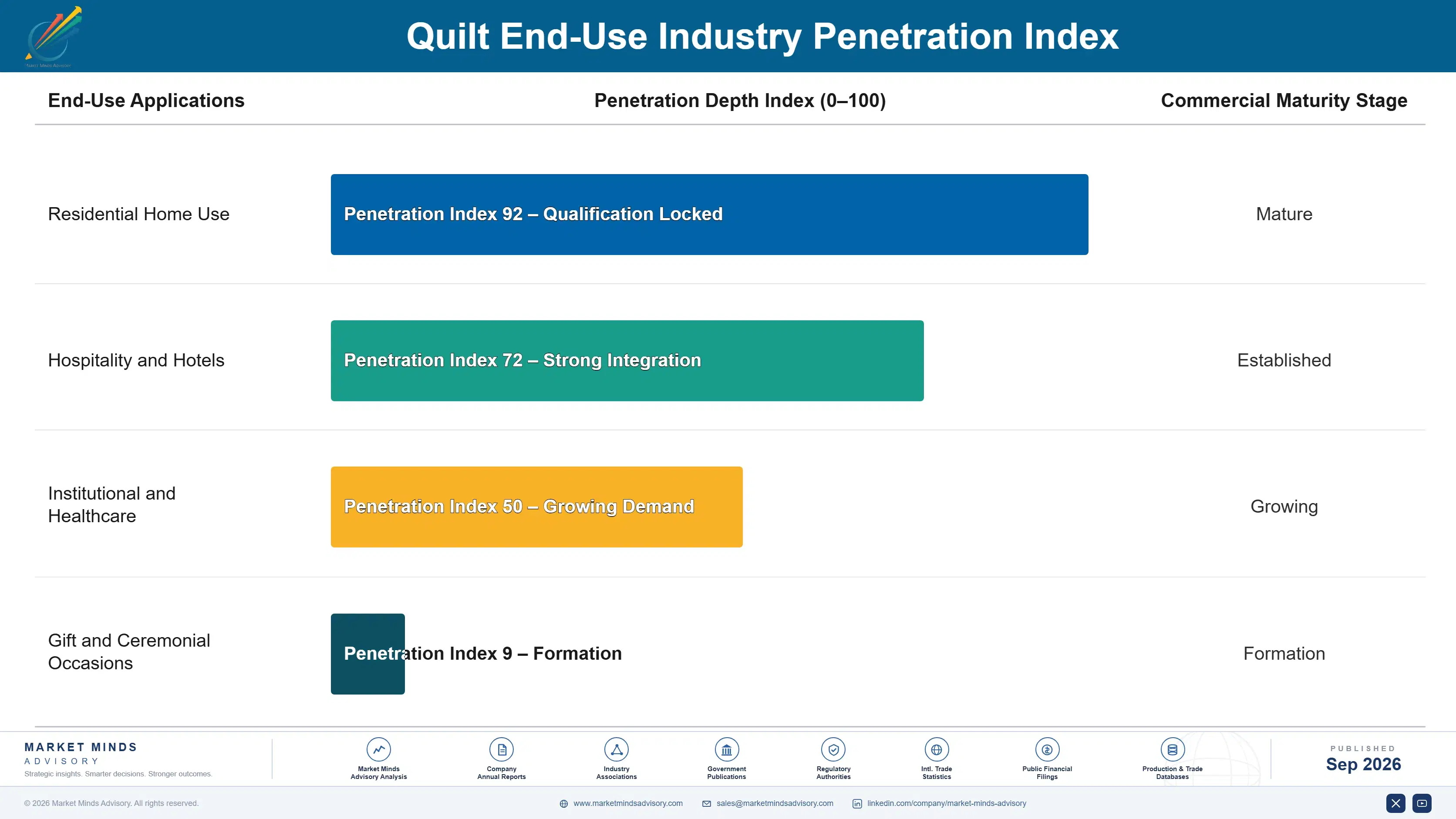
The Replacement Cycle Economics of Bedding

Quilts function closer to a durable goods replacement cycle than a recurring consumable purchase, since the five to eight year ownership period gives brands infrequent but meaningful transaction value per customer rather than steady subscription-style revenue streams over time and across most price tiers. This replacement rhythm rewards brands that maintain visibility during the narrow purchase window rather than sustaining constant marketing presence year-round.
Adoption stickiness varies meaningfully by buyer type across the category. Hobbyist quilters who purchase supplies and finished products regularly show considerably stronger brand loyalty than casual buyers purchasing a single quilt for practical bedding needs. Heirloom and gift purchases carry distinct buying patterns tied to life events like weddings and births, creating demand spikes independent of typical seasonal retail cycles entirely and consistently.

Buyer profiles are shifting generationally as younger consumers increasingly expect sourcing transparency and craft documentation that older mass-manufacturing brands built on pure distribution scale are considerably slower to offer credibly at comparable trust levels and marketing reach. Younger buyers entering home-furnishing life stages also show greater willingness to pay premium pricing for verified sustainable sourcing over conventional alternatives.
quilt-market-end-use-penetration-index-1790025270500

MMA Verdict on Category Direction

These are among the four positions where our research anticipates prominent divergence between winners and laggards over the coming forecast period. Each is grounded in the demand model, the regulatory perimeter, and the announced capacity pipeline.
01 / ORGANIC CERTIFICATION PRIORITY

Build credible organic certification before mainstream brands catch up

Certified organic quilts carry the category's widest margins and fastest growth, yet many established manufacturers remain considerably slower to build credible certification programs than direct-to-consumer heritage brands entering the segment entirely fresh and completely unencumbered by legacy processes. Manufacturers that invest in genuine third-party organic certification now, rather than vague sustainability marketing language, secure a multi-year trust advantage before more incumbents catch up on certification depth. This window narrows every single year as certification bodies process growing application volume from mainstream brands.
02 / CRAFT STORYTELLING INVESTMENT

Build documented craft narratives before competitors replicate the approach

Craft storytelling investment commands price premiums roughly 40 percent above products lacking authentic documentation, yet most mass bedding manufacturers still rely on generic marketing language rather than genuine traceability content and verified sourcing detail. Brands that build documented craft narratives now, rather than treating storytelling as an afterthought, capture disproportionate premium segment growth before competitors replicate the approach at comparable credibility. Manufacturers delaying this investment risk ceding the fastest-growing, highest-margin segment of the category entirely to more committed heritage challengers.
03 / COTTON SOURCING RISK MANAGEMENT

Diversify organic cotton sourcing before the next harvest volatility cycle

Cotton feedstock pricing has already demonstrated its capacity to compress margins sharply during weather-driven harvest volatility, and smaller organic brands without forward purchasing agreements bore the brunt of the last cycle documented across multiple company filings. Vertically integrated manufacturers weathered the same period with meaningfully smaller margin swings, a gap the market clearly rewards as certified organic cotton supply remains tightly constrained relative to demand. Brands should diversify sourcing regions and lock in pricing mechanisms now rather than waiting for the next volatility event.
04 / CERTIFICATION VERIFICATION STANDARDS

Pursue verifiable sourcing documentation over vague sustainability marketing

Greenwashing skepticism spilling over from the broader textile industry continues suppressing premium conversion rates roughly 20 percent below genuine potential, even for manufacturers with legitimate and verifiable certification credentials in place. Brands investing earliest in transparent, verifiable sourcing documentation rather than vague sustainability language capture disproportionate trust advantage among increasingly skeptical repeat buyers researching carefully before purchase. Manufacturers treating certification as a marketing checkbox rather than genuine practice risk losing the entire premium segment to more credible, transparent competitors over time.

Engagement Snapshot From the Field

A live engagement with an industry participant carrying material or product regulatory and market exposure ahead of a defining policy shift, showing how our research translates into a defensible multi-year portfolio strategy.
MARKET MINDS ADVISORY · CLIENT ENGAGEMENT SUMMARY
Quilt Producer Strategic Portfolio Review and Transition Roadmap 2026·Investment Scenario on Quilt Exposure Evaluation 2025-26
CLIENT PROFILE
The client is a mid-sized bedding company with an established conventional cotton quilt brand carrying meaningful national retail distribution but no organic or handcrafted premium line whatsoever. Leadership had observed direct-to-consumer heritage competitors capturing disproportionate growth and sought to understand whether launching a premium certified extension made commercial sense given the brand's existing conventional positioning.
STRATEGIC CHALLENGE
The client risked losing younger, sustainability-conscious consumers to heritage brands but was genuinely uncertain whether a premium extension would cannibalize existing conventional sales or truly expand the overall customer base. Leadership also needed clarity on realistic pricing and certification investment requirements before committing meaningful capital to the new product line.
MMA APPROACH
MMA conducted consumer segmentation research to identify which existing customers would likely trade up to a premium certified line versus which represented genuinely new demand, then modeled cannibalization risk against incremental revenue scenarios. The engagement included organic cotton supplier landscape mapping and craft storytelling content strategy development before finalizing recommendations.
KEY FINDINGS
  1. Consumer segmentation research found that 64 percent of projected premium buyers (client-reported, unverified by MMA) represented genuinely new customers rather than cannibalized existing sales.
  2. Price elasticity testing identified an optimal premium of roughly 85 percent over the conventional line, balancing volume against per-unit margin across tested price points.
  3. Organic cotton supplier mapping identified three qualified regional sourcing partners capable of meeting projected volume within the client's required fourteen-month launch timeline.
  4. Post-launch tracking showed the premium line reaching 14 percent of total brand revenue (client-reported, unverified by MMA) within the first full year on shelf.
CLIENT PROFILE
The client is a mid-sized bedding company with an established conventional cotton quilt brand carrying meaningful national retail distribution but no organic or handcrafted premium line whatsoever. Leadership had observed direct-to-consumer heritage competitors capturing disproportionate growth and sought to understand whether launching a premium certified extension made commercial sense given the brand's existing conventional positioning.
STRATEGIC CHALLENGE
The client risked losing younger, sustainability-conscious consumers to heritage brands but was genuinely uncertain whether a premium extension would cannibalize existing conventional sales or truly expand the overall customer base. Leadership also needed clarity on realistic pricing and certification investment requirements before committing meaningful capital to the new product line.
MMA APPROACH
MMA conducted consumer segmentation research to identify which existing customers would likely trade up to a premium certified line versus which represented genuinely new demand, then modeled cannibalization risk against incremental revenue scenarios. The engagement included organic cotton supplier landscape mapping and craft storytelling content strategy development before finalizing recommendations.
KEY FINDINGS
  1. Consumer segmentation research found that 64 percent of projected premium buyers (client-reported, unverified by MMA) represented genuinely new customers rather than cannibalized existing sales.
  2. Price elasticity testing identified an optimal premium of roughly 85 percent over the conventional line, balancing volume against per-unit margin across tested price points.
  3. Organic cotton supplier mapping identified three qualified regional sourcing partners capable of meeting projected volume within the client's required fourteen-month launch timeline.
  4. Post-launch tracking showed the premium line reaching 14 percent of total brand revenue (client-reported, unverified by MMA) within the first full year on shelf.
RECOMMENDED STRATEGY
Phase 1: Phase one: consumer segmentation research and organic cotton supplier landscape mapping across three qualified regional sourcing candidates and supply partners. Phase 2: Phase two: price elasticity testing across multiple proposed retail price points, followed by craft storytelling content strategy development and testing. Phase 3: Phase three: national rollout with post-launch cannibalization tracking and ongoing supplier relationship management through the entire first full operating year.
OUTCOME
The client successfully launched its premium certified line within the planned fourteen-month window, achieving 14 percent of total brand revenue (client-reported, unverified by MMA) within the first full year. Cannibalization of the conventional line remained minimal, confirming the segmentation research's projection that most premium buyers represented genuinely new demand rather than a shift within the existing customer base.

Frequently Asked Questions

Foundational context covering the market sizes, CAGR, scope, country, region and competition that inform every finding below. This section is provided to cover basics and most often pre-purchase conversations, answered from the MMA Primary Research Dataset.

What is the current size of the Quilt Market?

The Quilt Market is valued at 5.8 billion dollars in 2025. This reflects mature global bedding demand alongside steadily expanding organic and heirloom-craft premiumization worldwide.

How large will the Quilt Market be by 2036?

MMA projects the market will reach approximately 9.51 billion dollars by 2036. Organic fiber premiumization and heirloom-craft positioning together drive this steady global growth trajectory.

What is the CAGR for the Quilt Market 2026 to 2036?

The market is forecast to grow at a 4.6 percent compound annual growth rate between 2026 and 2036. This places it within the mature industrial growth band.

Which segment is growing fastest?

Organic and sustainable fiber quilts are the fastest-growing segment at a 7.5 percent CAGR, roughly 1.6 times the overall market rate. Sourcing transparency demand drives this.

Who are the major companies in the Quilt Market?

Leading companies include Welspun, Trident, Springs Global, Pacific Coast Feather, and The Company Store. These five companies hold a combined CR5 of approximately 30 percent.

Which country is growing fastest?

India leads country-level growth at an 8.2 percent CAGR, driven by textile manufacturing scale and authentic handcraft heritage. This outpaces the broader South Asia and Pacific region.

Report Segmentation Architecture

The full report scope spans multiple orthogonal segmentation dimensions, with cross-tabulated demand data provided for each dimension pair. Coverage extends further to regional breakdowns, trend trajectories, and the competitive detail needed to support segment-level decision-making.

By Fiber Material and Production Method

  • Organic and Sustainable Fiber Quilts
  • Conventional Cotton Quilts
  • Down and Feather-Filled Quilts
  • Synthetic Microfiber Quilts
  • Wool Quilts
  • Handcrafted Artisan Quilts

By End-Use Industry

  • Residential Home Use
  • Hospitality and Hotels
  • Institutional and Healthcare
  • Gift and Ceremonial Occasions

By Commercial Dimension

  • Direct Retail Purchase
  • Direct-to-Consumer Subscription
  • Institutional Bulk Contract
  • Specialty and Craft Retail Channel

By Region

  • North America
  • Western Europe
  • East Asia
  • South Asia and Pacific
  • Latin America
  • Middle East and Africa
  • Eastern Europe

Scope, Methodology, and Coverage

Every figure in this report is reproducible from documented input assumptions. The scope below maps the historical period, the forecast horizon, the segmentation dimensions, and the countries covered, alongside the underlying primary and qualitative methodology.
Historical Period
2020 to 2025
Forecast Period
2026 to 2036
Base Year
2025 (USD billions; MMA Primary Research Dataset, September 2026)
Market Definition
The Quilt Market covers multi-layered stitched bedding products filled with cotton, wool, down, or synthetic fiber and finished with decorative or utilitarian stitching patterns. It excludes duvets, comforters without quilted stitching, and blankets, which represent separate bedding product categories with distinct construction methods.
Quantitative Units
USD billions, unit volume in millions of units
Segmentation Dimensions
Fiber material and production method, end-use industry, commercial dimension
Regions Covered
North America, Western Europe, East Asia, South Asia and Pacific, Latin America, Middle East and Africa, Eastern Europe
Countries Covered
35+ countries across seven global regions
Key Companies Profiled
Welspun India Ltd, Trident Group, Springs Global Participacoes S.A., Pacific Coast Feather Company, The Company Store, and 15 additional participants
Quantitative Methodology
Primary survey, n=3,800 respondents, Q4 2025, six countries; demand-side model with trade association cross-validation
Qualitative Methodology
47 expert interviews, Q4 2025; applied to validate demand model assumptions, identify emerging dynamics, and assess competitive positioning
Report Format
PDF and XLSX data workbook (Word format preview document)
Publisher
Market Minds Advisory
Report Code
MMA-2026-CON-222
Published
September 2026
Contact
sales@marketmindsadvisory.com | www.marketmindsadvisory.com

Purchase the full Quilt Market Report (2026 to 2036).

The full Quilt Market report delivers a complete forecast model spanning 2026 through 2036. Granular segmentation spans fiber material and production method, end-use industry, and commercial dimension. It includes detailed competitive profiles for all twenty tracked participants, regional demand analysis across seven geographies, and input cost exposure modeling grounded in primary survey and expert interview data. The report further examines portfolio margin economics, revenue lever strategies, and demand architecture across the category's replacement cycle dynamics. A fully anonymized client engagement case study illustrates practical application of the underlying research findings.
Full regional breakdown across all seven global markets
Company-level competitive benchmarking with moat and risk assessment
Segment-by-segment growth rate forecasts through 2036
Input cost exposure analysis and mitigation pathway detail
Portfolio tiering framework with margin economics detail
Primary survey data collected across six countries

Built For The People Who Decide

From boardroom strategy to bench-side execution, this report is read cover-to-cover by leaders shaping the next decade of their industry, turning demand scenarios, market dynamics and valuation benchmarks into decisions.
CXOs/ Presidents/ VPs/ Managers
M&A and Corporate Development
Strategy Teams and R&D Heads
Procurement and Product Directors
Regulatory and Compliance Leaders
Investor Relations and Equity Analysts