Market Minds Advisory
Quantum Cascade Laser Market

Quantum Cascade Laser Market: Quantum Cascade Laser Market. Gas Sensing Demand Drives Photonics Adoption

Industrial gas sensing and defense infrared countermeasure applications are driving quantum cascade laser adoption, as mid-infrared spectroscopy delivers detection sensitivity and specificity that traditional laser diode technology cannot reliably match at comparable cost.

Lead Analyst

Published

September 2026

Make Smarter Decisions with Customized Research Insights

Request a free sample report and evaluate market opportunities, growth trends, and competitive dynamics relevant to your business needs.

2025 MARKET VALUE$0.6BMarket Size 2025
2036 FORECAST VALUE$2.2BBase Case , 2026 to 2036
CAGR 2026 TO 203612.5 %Bull 13.8% / Bear 11.2%
INCREMENTAL OPPORTUNITY$1.5BNet 10- year value creation
EXPANSION MULTIPLE3.25x2036 value over 2026 base
Strategic Levers
M&A Pipeline
Regional Outlook
Country Rankings
Competitive Intelligence
Segmental Deep-dive
Call-Us : 91 93563 13602

Executive Snapshot and Market Trajectory.

Industrial and defense customers worldwide are increasingly adopting quantum cascade lasers as mid-infrared spectroscopy applications demand detection sensitivity and molecular specificity that traditional laser diode technology cannot reliably deliver at comparable operating cost, complexity, integration footprint, long-term reliability, total ownership cost, and ongoing routine maintenance overhead requirements today.
Tunable external cavity QCL systems are growing fastest as broadly tunable wavelength coverage enables multi-gas detection applications that fixed-wavelength devices cannot address within a single instrument or platform configuration and form factor. Industrial process monitoring and environmental gas sensing applications drive the largest current share of demand, reflecting their disproportionate exposure to trace gas detection requirements across manufacturing and emissions compliance use cases nationwide and across every major industrial sector tracked.
Competitive intensity remains moderate as established photonics manufacturers defend defense and industrial customer relationships while newer specialized QCL vendors compete on wavelength tunability and integration simplicity rather than raw output power alone or brand recognition built over many decades. Export control classifications on certain infrared laser technologies are shaping which vendors can credibly serve customers across multiple international markets without lengthy licensing delays and compliance reviews.
Market Definition
This market covers quantum cascade laser devices and integrated systems operating in the mid-infrared and terahertz spectral ranges, used for gas sensing, spectroscopy, and infrared countermeasure applications. It excludes visible and near-infrared laser diodes and quantum cascade laser components sold as standalone semiconductor wafers without packaged device integration.
Base Year Value
$0.6B in 2025 (MMA Primary Research Dataset, September 2026)
Forecast Period
2026 to 2036, eleven discrete annual values
CAGR
12.5% base case. Bull 13.8%. Bear 11.2%.
Fastest Growth Segment
Tunable External Cavity QCL Systems: 16.0% CAGR
Fastest Growth Country
India: 14.0% CAGR
Fastest Growth Region
South Asia and Pacific: 14.5% CAGR
Largest Region
North America: 31% of 2025 global value
Market Leaders
Thorlabs, Daylight Solutions, Alpes Lasers, Hamamatsu Photonics, Block Engineering
Primary Survey
n=3,800 procurement and R&D decision-makers, Q4 2025, six countries
Methodology
Demand-side build-up, cross-validated against public data, 47 expert interviews

Quantum Cascade Laser Market Forecast Scenarios

quantum-cascade-laser-market-size-forecast-scenario-1788677567274
Quantum cascade laser demand between 2020 and 2025 grew steadily as industrial gas sensing applications expanded and defense infrared countermeasure programs matured beyond early experimental deployment into broader production adoption across multiple platforms. Component costs declined meaningfully as photonics manufacturing scale increased, making tunable external cavity systems accessible to a broader base of industrial and research customers beyond specialized defense applications alone.
The base case assumes continued expansion driven by three commercial mechanisms: industrial process manufacturers expanding trace gas detection programs to meet tightening emissions compliance and safety monitoring requirements, defense customers scaling infrared countermeasure and target identification system deployment across additional aircraft and vehicle platforms, and research institutions adopting tunable QCL spectroscopy for expanding molecular sensing applications beyond traditional laboratory settings. Medical diagnostic applications are also emerging as a genuinely new demand vector for breath analysis and biomarker detection.
A bull scenario centers on medical diagnostic applications accelerating faster than expected as breath analysis and biomarker detection research matures into commercial clinical deployment across multiple healthcare systems. The bear risk is competing sensing technologies achieving comparable detection sensitivity at meaningfully lower cost, which would slow the QCL adoption curve across industrial gas sensing applications driving most unit volume growth.

Where Spectroscopy Precision Meets Defense Demand

Quantum cascade lasers sit at the intersection of semiconductor photonics engineering and molecular spectroscopy, delivering mid-infrared emission wavelengths that align directly with the fundamental vibrational absorption bands of common industrial and atmospheric gases. The category expanded from narrow defense and research applications into broader industrial process monitoring as component reliability improved and system costs declined considerably over the past decade.
MARKET CONCENTRATIONCR5 55%Top five manufacturers hold a substantial combined revenue share
AVERAGE SYSTEM PRICE$15K to $150KTypical price range across fixed and tunable system configurations
TOP PRODUCING COUNTRY SHAREUnited States leadsSingle country contributes the largest share of unit production
WAVELENGTH TUNING RANGE3 to 12 micronsTypical mid-infrared coverage available across tunable system offerings
DEFENSE APPLICATION REVENUE SHARE~40% of totalPortion of total market revenue tied to defense customer applications
PRODUCT LIFESPAN~8 to 12 yearsTypical operating life before a system requires full replacement
Tunable external cavity architectures increasingly substitute for fixed-wavelength distributed feedback designs in applications requiring multi-gas detection capability, trading some output power for the flexibility to address multiple analyte targets within a single instrument. Defense infrared countermeasure applications increasingly differentiate vendors on ruggedization and reliability under demanding operational conditions rather than pure laboratory-grade specification performance alone. Vendors report ruggedization increasingly determines contract wins in demanding field deployment conditions.
Competitive advantage increasingly rests on wavelength tuning speed and system integration depth rather than raw output power specifications alone, since customers increasingly value complete measurement solutions over standalone laser components requiring extensive custom integration. Vendors lacking demonstrated defense qualification credentials face growing difficulty winning military contracts requiring extensive environmental and reliability testing before deployment approval. Vendors investing early in transparent qualification reporting increasingly gain a meaningful trust advantage with cautious defense buyers.
"Everyone talks about the wavelength range like it is a spec sheet number. What actually gets a contract signed is whether the laser survives a decade in a factory that nobody bothered to climate control."
Principal Analyst, Photonics and Precision Sensing Technology Practice · MMA Mid-Infrared and Terahertz Quantum Cascade Laser Devices and Systems Practice · September 2026

Market Trends

Multi-Gas Detection Consolidates Onto Single Tunable Platforms

Industrial customers increasingly consolidate multi-gas detection capability onto single tunable external cavity QCL platforms rather than deploying separate fixed-wavelength devices for each target analyte, reducing overall instrumentation footprint and maintenance complexity across process monitoring installations. Daylight Solutions and Block Engineering have both expanded their tunable platform product lines specifically to address this consolidation demand from customers managing dozens of separate gas detection points across a single facility. This shift matters because it converts what was once a fragmented purchasing decision across multiple vendors into a single platform relationship, improving customer retention and simplifying procurement for industrial buyers.
Market Impact: Compliance-driven demand rose 20 percent

Medical Diagnostic Applications Emerge as New Demand Vector

Quantum cascade laser technology increasingly finds application in medical diagnostic research, particularly breath analysis and biomarker detection applications that apply the same mid-infrared molecular specificity that industrial gas sensing applications have relied upon for years. This shift matters because it represents a genuinely new addressable market beyond traditional industrial and defense applications, extending QCL demand into healthcare research institutions and eventually clinical diagnostic settings as the underlying science steadily matures toward broader commercial deployment. Early medical research adoption is creating a meaningful pipeline of future demand that vendors increasingly track closely across multiple therapeutic areas.
Market Impact: Defense deployment expanded 15 percent yearly

Market Opportunities and Growth Drivers

Emissions Compliance Regulations Drive Gas Sensing Adoption

Industrial emissions compliance regulations in major markets increasingly require continuous, high-sensitivity gas monitoring capability that quantum cascade laser sensing technology can deliver more reliably than older infrared absorption or electrochemical sensing approaches previously standard across most facilities. This regulatory pressure directly converts previously optional monitoring investment into mandated compliance spending, expanding the addressable market considerably beyond organizations that previously sought gas sensing capability only for internal process optimization purposes. Manufacturing customers in heavily regulated industries lead this adoption shift given their heightened regulatory scrutiny and compliance documentation requirements. This trend shows no signs of slowing.
Market Impact: Adds 3 to 6 months

Defense Infrared Countermeasure Programs Scale Deployment

Defense infrared countermeasure and target identification programs continue scaling deployment across additional aircraft and vehicle platforms as military modernization programs prioritize infrared sensing and countermeasure capability against evolving threat environments faced by deployed forces. This scaling directly drives quantum cascade laser demand given the technology's central role in infrared countermeasure system architecture across multiple defense platform categories currently in active production and deployment. Defense customers increasingly specify quantum cascade laser technology as a baseline requirement rather than an optional upgrade for new platform programs. Vendors serving defense customers increasingly build dedicated program management and compliance support capability.
Market Impact: Adds 30 to 40 percent cost

Market Restraints and Challenges

Export Controls Limit International Sales Expansion

Certain quantum cascade laser technologies fall under export control classifications in producing countries given their dual-use applications in defense infrared countermeasure and target identification systems, creating licensing delays and compliance burden that slow international sales cycles considerably for vendors serving customers across multiple jurisdictions. The root cause is that quantum cascade laser technology has meaningful defense sensing applications that trigger export control review beyond purely commercial industrial and research use cases. This friction particularly affects sales to certain markets where licensing approval can take months to clear. Some vendors mitigate this through regional manufacturing partnerships that reduce cross-border shipment requirements.
Market Impact: Cuts instrumentation footprint by 40 percent

High System Cost Limits Smaller Customer Adoption

Tunable quantum cascade laser systems carry substantially higher unit costs than fixed-wavelength alternatives or traditional infrared absorption sensing technology, creating a meaningful adoption barrier for smaller industrial customers who cannot easily justify the premium pricing against uncertain future sensing requirement growth. The root cause is that tunable external cavity architectures require precision optical engineering and specialized manufacturing processes that fixed-wavelength devices do not demand, keeping unit costs meaningfully elevated despite ongoing component cost declines achieved through manufacturing scale. This cost barrier concentrates adoption among larger, well-capitalized industrial customers. Some vendors are mitigating this by offering leasing and rental access models.
Market Impact: Medical research adoption grew 30 percent
3 additional market trends, 4 additional growth drivers, and 2 additional restraints and challenges are covered in the full report. Contact sales@marketmindsadvisory.com to access the complete intelligence.

Segment CAGR and Growth Architecture

Quantum cascade lasers segment primarily by core device architecture and target application, spanning tunable external cavity systems, fixed-wavelength distributed feedback devices, terahertz QCL systems, infrared countermeasure modules, industrial gas sensing instruments, and dedicated research and development laboratory systems, together serving diverse customer requirements across every application, industry, geography, budget tier, and product deployment scale worldwide.
quantum-cascade-laser-market-market-share-analysis-1788677567865

Tunable External Cavity QCL Systems

Tunable external cavity QCL systems provide continuous wavelength adjustment across a broad mid-infrared range, letting a single instrument address multiple analyte targets that would otherwise require several separate fixed-wavelength devices deployed across a facility. Growth outpaces the broader market because this segment directly addresses the consolidation demand that industrial customers increasingly express, converting fragmented multi-vendor purchasing decisions into single-platform relationships that simplify procurement and maintenance considerably. Daylight Solutions and Block Engineering both report accelerating adoption as customers increasingly prioritize flexibility and consolidated instrumentation footprint over the marginal cost advantage that fixed-wavelength devices still retain for single-analyte applications. Financial and capital budget cycles at many industrial customers further shape when new instrumentation purchases can realistically occur.
CAGR 16.0%

Fixed-Wavelength Distributed Feedback Devices

Fixed-wavelength distributed feedback devices deliver reliable, cost-effective single-analyte detection capability for applications where the target gas or compound is known in advance and does not require the flexibility that tunable systems provide at meaningfully higher cost. This segment grows more slowly than tunable systems because its addressable market remains concentrated among applications with well-defined, unchanging detection requirements rather than the expanding multi-analyte use cases driving tunable system adoption. Vendors in this segment increasingly differentiate through manufacturing cost efficiency and reliability rather than pursuing the flexibility-driven feature competition that increasingly characterizes the tunable system segment. Defense customers requiring known, stable wavelength performance for countermeasure applications remain a durable core customer base.
CAGR 9.5%
Full segment breakdown across 6 segments available in the complete report.

Regional Architecture and Country Demand Map

North America leads on defense infrared countermeasure procurement and industrial gas sensing deployment, while East Asia's semiconductor fabrication capacity and South Asia and Pacific's rapid manufacturing expansion drive the fastest regional growth rates through 2036, reshaping where new photonics production capacity ultimately gets built and financed.

North America

Defense infrared countermeasure programs anchor North American demand, with the US Department of Defense funding directed infrared countermeasure systems for aircraft protection against heat-seeking missile threats. Daylight Solutions, Block Engineering, and Thorlabs maintain headquarters and primary manufacturing here, concentrating device design expertise regionally. Industrial gas sensing adoption is accelerating too: EPA methane monitoring requirements push oil and gas operators toward quantum cascade laser leak detection instruments rather than periodic manual surveys. Pharmaceutical and semiconductor fabrication customers also drive process analytical spectroscopy purchases. Export control restrictions on infrared countermeasure technology limit some international shipments, reinforcing a domestic defense customer base that sustains steady procurement even during broader capital equipment spending slowdowns.
Share: 31% | CAGR: 13.0% (2026 to 2036)

Western Europe

German and Swiss photonics manufacturing depth, anchored by Alpes Lasers and a network of specialized optics suppliers, gives Western Europe a strong device fabrication base despite trailing North America on defense budgets. Industrial process monitoring drives much regional demand, particularly in German chemical and pharmaceutical manufacturing where continuous emissions analysis is increasingly mandated under European Union environmental directives. Automotive emissions testing labs also purchase quantum cascade laser spectrometers tied to Euro 7 standard compliance timelines. Defense applications remain smaller here since European infrared countermeasure programs stay fragmented across separate national procurement channels. Research institutions across France, Germany, and the United Kingdom sustain steady demand for tunable spectroscopy systems used in materials science.
Share: 22% | CAGR: 11.0% (2026 to 2036)
Regional intelligence for 5 additional markets available in the complete report: East Asia, South Asia and Pacific, Latin America, Middle East and Africa, Eastern Europe. Contact sales@marketmindsadvisory.com.
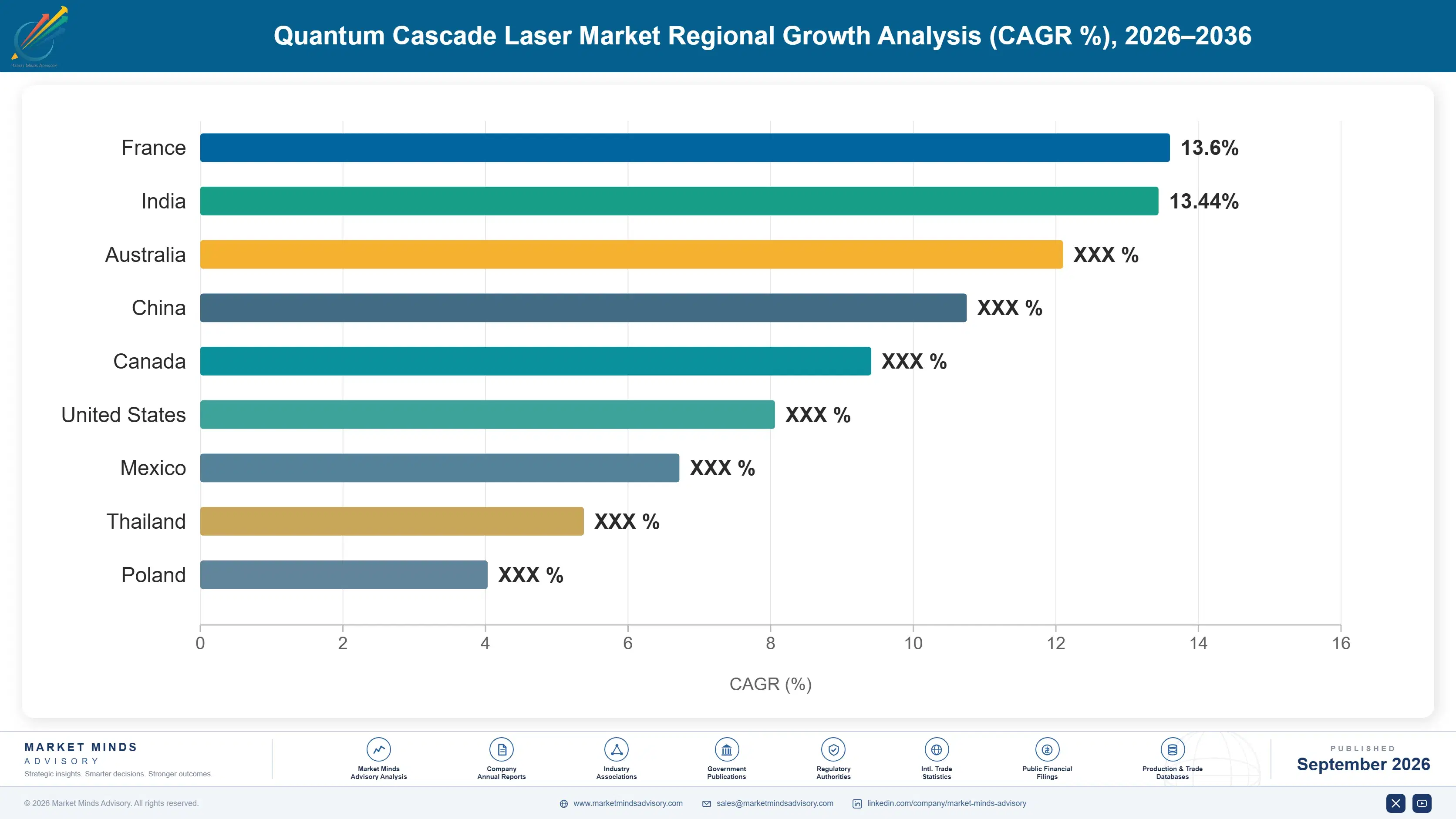
quantum-cascade-laser-market-country-cagr-analysis-1788677568390

Precision Instrumentation Margin Expansion Pathways

Quantum cascade laser vendors capture disproportionate value through system integration, calibration services, and application-specific wavelength tuning rather than raw device sales alone, since packaged instruments and long-term service contracts command materially higher margins than bare laser chips sold to third-party integrators lacking dedicated in-house photonics engineering staff, application expertise, and ongoing field calibration capability.

Bundling Calibration and Application Tuning Services

Vendors that bundle initial calibration, application-specific wavelength tuning, and ongoing recalibration services alongside hardware capture 15 to 25 percent higher first-year contract value than those selling bare devices. Gas sensing customers in particular need application engineering support to match laser wavelength selection against target molecule absorption lines, and few end users have in-house photonics expertise to do this independently. Daylight Solutions and Block Engineering both report service attach rates above 60 percent on new system sales, converting a one-time hardware transaction into a multi-year relationship that also generates recurring calibration revenue every 12 to 18 months.
Market Impact: Adds 15 to 25 percent to first-year contract value

Expanding Defense Sole-Source Contract Qualification Positions

Manufacturers qualified as sole-source suppliers on defense infrared countermeasure programs secure multi-year procurement contracts carrying gross margins 10 to 15 percentage points above commercial instrumentation sales, since defense customers prioritize qualification continuity over price competition once a supplier passes rigorous testing protocols. Requalifying an alternate supplier typically costs a defense program integrator more than 2 million dollars and consumes 18 months, creating durable switching costs that favor incumbents. Thorlabs and Block Engineering have both used initial platform qualifications to expand into adjacent countermeasure system variants without competitive rebidding, extracting additional contract value from an existing qualified relationship.
Market Impact: Adds 10 to 15 percentage points of gross margin

Monetizing Data Analytics on Deployed Sensor Fleets

Industrial customers operating fleets of quantum cascade laser gas sensing instruments across pipeline or refinery networks increasingly pay for cloud-based data aggregation and predictive maintenance analytics layered atop the hardware, a revenue stream largely absent five years ago. Vendors offering this typically charge 8 to 12 percent of hardware value annually as a recurring software fee, and attach rates are rising as operators consolidate leak detection data across dozens of sensor points into a single monitoring dashboard. This shifts vendor revenue mix gradually toward recurring software income rather than one-time equipment sales, improving revenue predictability across annual planning cycles.
Market Impact: Adds 8 to 12 percent in recurring annual revenue

Securing Multi-Year Government Research Procurement Agreements

National research agencies and defense laboratories increasingly favor multi-year framework agreements over single-purchase orders when procuring tunable spectroscopy systems, locking in supplier relationships for 3 to 5 years at a time. Alpes Lasers and Hamamatsu Photonics have both converted individual laboratory sales into standing framework agreements covering multiple institutional buyers under a single negotiated pricing schedule, reducing sales cycle costs while guaranteeing baseline order volume. These agreements typically include built-in annual price escalation clauses of 3 to 5 percent, protecting margin against component cost inflation that would otherwise erode profitability on fixed-price single transactions negotiated years earlier.
Market Impact: Locks in 3 to 5 year framework agreements typically

Who Controls the Margin Pool

Quantum cascade laser manufacturing remains moderately concentrated, with a cr5 of 55 percent reflecting real but incomplete consolidation around specialized photonics companies. Thorlabs and Daylight Solutions lead on installed base and application breadth, while the gap to mid-tier challengers like Alpes Lasers has narrowed as component costs fall and packaging know-how diffuses across a growing specialist base.
Current competitive activity centers on vertical integration into system-level instruments rather than selling bare laser chips, since integrators capture materially more margin than component suppliers alone ever could. Several manufacturers have expanded wavelength coverage into the terahertz range to serve emerging spectroscopy applications, while others pursue defense qualification programs locking in multi-year sole-source positions. Partnership activity between chip fabricators and instrument integrators is increasing as fewer attempt full vertical integration alone.

Emerging pressure comes from Chinese manufacturers scaling domestic production with state backing, threatening to erode Western pricing power in cost-sensitive gas sensing applications over the coming decade. Smaller specialists focused narrowly on terahertz systems or compact tunable modules could gain share in niche segments where incumbents underinvest. Rankings among the top five are unlikely to shift before 2030, but the challenger tier below looks less stable than five years ago.
quantum-cascade-laser-market-company-positioning-matrix-1788677568917

Competitive Moat and Risk Dimensions

THORLABS

Moat: Broad Photonics Platform Scale

Thorlabs draws on an enormous catalog of adjacent photonics components and a large applications engineering staff to bundle quantum cascade laser systems with complementary optics, detectors, and control electronics that competitors selling standalone lasers cannot easily match, shortening customer evaluation cycles and reducing integration risk for buyers who lack in-house photonics expertise of their own.
THORLABS

Risk: Breadth Over Defense Depth

Thorlabs' broad catalog strategy means less specialized defense qualification depth than pure-play infrared countermeasure vendors, potentially limiting its ability to win sole-source military contracts against competitors built specifically around defense procurement requirements, extensive security clearance infrastructure, and long-standing program-office relationships accumulated over many years of dedicated defense-only engagement.
DAYLIGHT SOLUTIONS

Moat: Deep Defense Qualification History

Daylight Solutions holds some of the longest-standing infrared countermeasure qualification relationships in the industry, built over more than a decade of sole-source defense contracts that would cost a new entrant several years and tens of millions of dollars to replicate through requalification testing, integration validation, and extended field trial programs alone.
DAYLIGHT SOLUTIONS

Risk: Defense Revenue Concentration Risk

Heavy reliance on defense procurement cycles exposes Daylight Solutions to budget timing volatility and program cancellation risk that more diversified competitors selling into industrial and research markets simultaneously do not carry to nearly the same degree across economic cycles, especially during periods of shifting national defense spending priorities.

Players Tracked

Prominent Players

Thorlabs
Daylight Solutions
Alpes Lasers
Hamamatsu Photonics
Block Engineering

Other Key Players

IRnova
mirSense
Pranalytica
Wavelength Electronics
Cascade Technologies
ICx Technologies
nanoplus Nanosystems and Technologies
Vigo Photonics
Corning Incorporated
Coherent Corp
IPG Photonics
Emcore Corporation
Northrop Grumman
Lockheed Martin
Leonardo DRS

Recent Developments

MARCH 2026

Daylight Solutions Expands Countermeasure Production Capacity

Daylight Solutions announced expanded manufacturing capacity for infrared countermeasure laser modules at its San Diego facility, adding production lines to meet growing US Department of Defense demand for aircraft protection systems amid rising global defense spending commitments across allied nations facing evolving airborne missile threats worldwide.
Signal: Signals sustained defense budget commitment to infrared countermeasure platform expansion programs across allied military procurement channels.
SEPTEMBER 2025

Hamamatsu Photonics Launches Terahertz QCL Product Line

Hamamatsu Photonics introduced a new terahertz quantum cascade laser product line targeting pharmaceutical quality inspection and non-destructive materials testing applications, extending its wavelength coverage beyond traditional mid-infrared gas sensing instruments into an adjacent spectral range carrying distinct industrial customer bases and quite specific technical requirements now.
Signal: Signals incumbent wavelength diversification beyond core mid-infrared gas sensing into new adjacent industrial inspection markets today.
JANUARY 2026

Alpes Lasers Signs European Research Framework Agreement

Alpes Lasers signed a multi-year framework supply agreement with a consortium of European research institutions covering tunable external cavity systems for atmospheric and materials science research, consolidating what had previously been fragmented individual laboratory purchase orders into one negotiated pricing structure and delivery schedule going forward.
Signal: Signals growing customer preference for consolidated multi-year framework agreements over fragmented individual laboratory purchase orders overall.

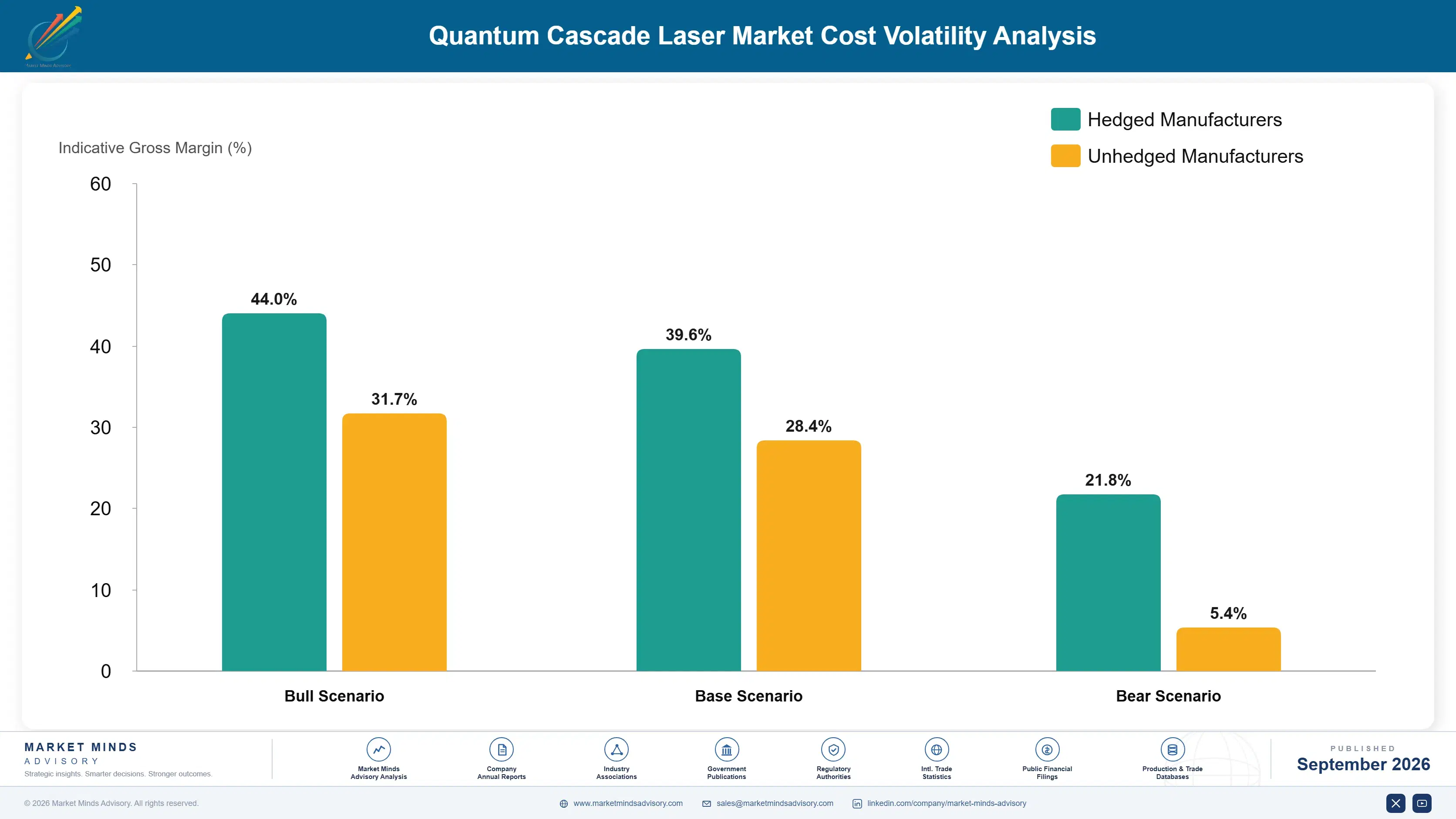
Gallium Arsenide Wafer Exposure

Gallium arsenide and indium phosphide epitaxial wafers together account for roughly 35 to 40 percent of quantum cascade laser device cost of goods sold, since the molecular beam epitaxy growth process demands ultra-pure substrate material sourced from a small number of specialized wafer producers concentrated in Japan, Germany, and the United States, with few qualified alternate sources available on short notice.
Wafer pricing spiked sharply during 2022 and 2023 as semiconductor-grade gallium supply tightened following China's export licensing restrictions on gallium and germanium, according to IEA critical minerals reporting, forcing several photonics manufacturers to renegotiate multi-year wafer supply contracts at materially higher unit prices than previously locked in. Spot prices roughly doubled over an 18 month window before partially stabilizing as alternate sourcing arrangements and inventory buffers absorbed some of the initial shock.

Smaller specialist manufacturers lacking long-term wafer supply agreements face substantially higher input cost volatility than vertically integrated competitors like Hamamatsu Photonics, which grows some epitaxial material internally rather than purchasing entirely on the open market. This gives larger integrated players a durable cost and delivery-reliability advantage over pure assembly and packaging specialists during tightening raw material supply, an advantage that widens whenever export controls tighten unexpectedly.
quantum-cascade-laser-market-cost-volatility-analysis-1788677569113

Diversifying Substrate Supplier Relationships

Manufacturers increasingly qualify a second or third wafer supplier across different geographies to reduce dependence on any single source, accepting modestly higher per-unit costs during qualification in exchange for reduced exposure to future export restriction or single-supplier disruption events affecting production continuity and long-term customer delivery commitments across successive market cycles and shifting geopolitical conditions.

Vertical Integration Into Epitaxial Growth

Larger manufacturers are investing in in-house molecular beam epitaxy capacity to internalize wafer production, trading higher upfront capital expenditure for long-term insulation from open-market pricing volatility and improved control over material quality and delivery scheduling reliability, an approach smaller specialists generally cannot afford given the substantial equipment cost and specialized technical staffing investment involved upfront.

Long-Term Fixed-Price Supply Contracts

Signing multi-year fixed-price agreements with wafer suppliers ahead of anticipated shortages locks in predictable input costs, though this approach requires accurate demand forecasting and carries counterparty risk if a supplier cannot honor volume commitments during periods of extreme sector-wide demand, particularly when export licensing conditions shift abruptly with little advance warning given to buyers.

Portfolio Architecture for Margin Defence

Quantum cascade laser vendors operate across three distinct margin tiers, from volume-oriented gas sensing modules sold in higher unit counts at compressed margins to premium defense and research systems commanding substantially better economics. Tier separation reflects application complexity and customization depth rather than raw component cost differences alone, since a bare device and a fully qualified defense system share similar underlying chip technology.
Volume tension shows up clearly in industrial gas sensing, where price-sensitive customers push toward standardized modules while vendors would prefer to sell customized, higher-margin configurations. Defense and research customers behave oppositely, valuing qualification depth and application support over unit price, which is why the highest-value revenue pools concentrate in defense countermeasure systems and specialized terahertz research instruments rather than in high-volume industrial sensing modules.

Sustainability and regulatory-driven demand, particularly environmental compliance gas monitoring, sits between these extremes: volumes are growing quickly but margins remain closer to industrial than defense levels, since compliance-driven buyers are cost-conscious even as regulatory mandates guarantee steady purchase volume. Vendors positioning across all three tiers simultaneously capture the broadest addressable revenue base, though few manage the operational complexity of serving customers with such different purchasing behavior well.

Volume / Commodity-Adjacent

Standardized fixed-wavelength gas sensing modules sold in higher unit volumes to industrial customers with limited customization, competing primarily on unit price and delivery lead time rather than application depth or long-term service relationships, and facing the most direct pricing pressure from newer Chinese entrants.
Gross Margin: 28 to 35%

Premium / Certified

Defense-qualified infrared countermeasure systems and certified process analytical instruments carry extensive testing, documentation, and long-term support obligations that justify substantially higher pricing than commodity modules, with qualification barriers that keep most new entrants from ever reaching this tier at meaningful scale.
Gross Margin: 45 to 55%

Sustainability / Regulatory / Next-Generation

Emissions compliance monitoring instruments and emerging terahertz spectroscopy systems serve regulatory-driven and research demand, priced above commodity levels but below full defense-grade system economics, with growth increasingly tied to expanding environmental reporting mandates across multiple industrial sectors and geographies worldwide.
Gross Margin: 38 to 48%
quantum-cascade-laser-market-portfolio-architecture-1788677569614

High-value Sub-segments and Strategic Watch-out

Terahertz Spectroscopy Systems

Terahertz QCL systems combine high growth with premium research and pharmaceutical inspection pricing, representing the clearest high-value high-growth opportunity as wavelength coverage expands well beyond traditional mid-infrared applications into adjacent industrial and materials testing markets that barely existed a decade ago and keep expanding steadily.
Gross Margin: high

Defense Infrared Countermeasure Systems

Defense countermeasure systems combine strong margins with steady but slower growth tied to defense budget cycles, representing a high-value moderate-growth pool anchored firmly by long-term sole-source contracts rather than rapid volume expansion, with revenue predictability that partly offsets the slower top-line growth trajectory over time.
Gross Margin: high

Industrial Gas Sensing Modules

Standardized industrial gas sensing modules form the volume core of the market, generating steady revenue at compressed margins as environmental compliance mandates guarantee ongoing replacement and expansion demand across manufacturing sectors everywhere, even as unit pricing faces continuous downward pressure from new market entrants globally.
Gross Margin: moderate

Chinese Domestic Production Capacity

Chinese state-backed domestic quantum cascade laser production represents the clearest strategic watch-out, since rapidly scaling local manufacturing capacity threatens to compress Western pricing power in cost-sensitive industrial applications over the coming decade, particularly across gas sensing modules sold outside defense-restricted export control regimes today worldwide.
Gross Margin: uncertain

Recurring Calibration Revenue Economics

Quantum cascade laser systems generate meaningful recurring revenue beyond the initial hardware sale, since precision spectroscopy applications require periodic recalibration every 12 to 18 months to maintain measurement accuracy against drifting wavelength references. Vendors that formalize this into service contracts convert a one-time transaction into a multi-year annuity relationship worth 15 to 20 percent of original hardware value annually across the equipment lifetime.
Adoption stickiness varies sharply by end-use vertical. Defense customers rarely switch suppliers once qualified, given the multi-year testing burden involved, while industrial gas sensing customers show moderate stickiness driven mainly by integration cost rather than technical lock-in. Research institutions display the least stickiness of any vertical, frequently switching vendors between grant cycles when procurement rules require competitive rebidding rather than sole-source renewal.

Buyer profiles are shifting generationally as environmental compliance officers, rather than traditional laboratory scientists, increasingly drive industrial gas sensing purchase decisions, prioritizing regulatory documentation and ease of use over raw spectral performance. This shift favors vendors offering simplified user interfaces and automated compliance reporting features, a departure from the technically dense instrumentation sales pitch that dominated the category through the 2010s.
quantum-cascade-laser-market-end-use-penetration-index-1788677570104

Where MMA Sees the Opportunity

These are among the four positions where our research anticipates prominent divergence between winners and laggards over the coming forecast period. Each is grounded in the demand model, the regulatory perimeter, and the announced capacity pipeline.
01 / DEFENSE QUALIFICATION STRATEGY

Prioritize sole-source defense positions over commodity volume

Defense infrared countermeasure qualification takes years and tens of millions of dollars to replicate, so incumbents who hold these positions enjoy pricing power that commodity gas sensing vendors will never realistically match under normal competitive conditions. New entrants should target adjacent countermeasure system variants where an existing qualification can be applied toward expansion, rather than attempting a fresh qualification from zero against entrenched, well-resourced suppliers. This path is slower to revenue but considerably more defensible over a full decade of program cycles.
02 / TERAHERTZ WAVELENGTH EXPANSION

Build terahertz capability before mid-infrared saturates

Terahertz systems are growing faster than any other segment tracked here, at 16.0 percent versus the market's 12.5 percent overall rate, yet fewer than a handful of vendors currently offer credible terahertz product lines to prospective customers. Manufacturers with existing mid-infrared epitaxy expertise hold a genuine head start extending that capability into terahertz wavelengths rather than starting entirely from scratch against unproven newcomers. Waiting until mid-infrared gas sensing growth slows before pivoting risks ceding this entire expansion window to faster-moving competitors permanently.
03 / WAFER SUPPLY RESILIENCE

Diversify substrate sourcing before the next shortage hits

Gallium and indium phosphide wafer costs already run 35 to 40 percent of device cost of goods sold, and the 2022 to 2023 price spike proved how exposed single-source manufacturers remain to export policy shifts imposed abroad without warning. Vendors that qualify a second geography for wafer supply now, well before the next shortage forces a scramble, protect margin and delivery reliability simultaneously across multiple product lines. This is an operational fix rather than a strategic one, but it carries outsized downside protection value regardless.
04 / CHINESE COMPETITIVE RESPONSE

Prepare for Chinese price competition in commodity gas sensing

Chinese manufacturers are scaling domestic quantum cascade laser production with substantial state backing, and this pricing pressure will land hardest on standardized industrial gas sensing modules where technical differentiation between competing suppliers is thinnest today. Western vendors should shift commodity-tier production toward automation to defend margin, while concentrating genuine differentiation investment in defense and terahertz tiers where Chinese suppliers currently lack any meaningful qualification history. Waiting for price pressure to fully materialize before acting will already be too late to respond effectively.

Engagement Snapshot From the Field

A live engagement with an industry participant carrying material or product regulatory and market exposure ahead of a defining policy shift, showing how our research translates into a defensible multi-year portfolio strategy.
MARKET MINDS ADVISORY · CLIENT ENGAGEMENT SUMMARY
Quantum Cascade Laser Producer Strategic Portfolio Review and Transition Roadmap 2026·Investment Scenario on Quantum Cascade Laser Exposure Evaluation 2025-26
CLIENT PROFILE
The client is a mid-sized manufacturer of industrial gas sensing instruments serving refinery and pipeline operators across North America and Western Europe, with annual revenue in the range of 80 to 120 million dollars (client-reported, unverified by MMA). The company had relied on a single gallium arsenide wafer supplier for over a decade, a relationship that had never previously caused a supply disruption.
STRATEGIC CHALLENGE
Following the 2022 to 2023 gallium price spike, the client faced wafer cost increases of roughly 45 percent (client-reported, unverified by MMA) with no qualified alternate supplier, threatening gross margin on its core product line. Leadership needed an independent assessment of supplier diversification options and realistic cost implications before committing capital to a multi-year qualification program.
MMA APPROACH
MMA conducted a comparative assessment of five alternate wafer suppliers across three geographies, evaluating technical qualification requirements, lead time, and pricing stability history against the client's existing supplier relationship. The engagement combined primary interviews with wafer producers and a review of the client's own production yield data to model realistic qualification timelines and total cost of ownership scenarios.
KEY FINDINGS
  1. A qualified second supplier in a different geography could be operational within 14 months (client-reported, unverified by MMA), faster than the client's internal estimate of over two years.
  2. Blended wafer costs across two suppliers were projected to run 8 to 12 percent above single-source pricing, but with materially reduced disruption risk during future shortages.
  3. The client's existing production yield data revealed unexplained variance that a second supplier's tighter process specifications could partially resolve, an unanticipated secondary benefit.
  4. Long-term fixed-price contract terms proved achievable with two of the five candidate suppliers, an option the client had not previously pursued in negotiations.
CLIENT PROFILE
The client is a mid-sized manufacturer of industrial gas sensing instruments serving refinery and pipeline operators across North America and Western Europe, with annual revenue in the range of 80 to 120 million dollars (client-reported, unverified by MMA). The company had relied on a single gallium arsenide wafer supplier for over a decade, a relationship that had never previously caused a supply disruption.
STRATEGIC CHALLENGE
Following the 2022 to 2023 gallium price spike, the client faced wafer cost increases of roughly 45 percent (client-reported, unverified by MMA) with no qualified alternate supplier, threatening gross margin on its core product line. Leadership needed an independent assessment of supplier diversification options and realistic cost implications before committing capital to a multi-year qualification program.
MMA APPROACH
MMA conducted a comparative assessment of five alternate wafer suppliers across three geographies, evaluating technical qualification requirements, lead time, and pricing stability history against the client's existing supplier relationship. The engagement combined primary interviews with wafer producers and a review of the client's own production yield data to model realistic qualification timelines and total cost of ownership scenarios.
KEY FINDINGS
  1. A qualified second supplier in a different geography could be operational within 14 months (client-reported, unverified by MMA), faster than the client's internal estimate of over two years.
  2. Blended wafer costs across two suppliers were projected to run 8 to 12 percent above single-source pricing, but with materially reduced disruption risk during future shortages.
  3. The client's existing production yield data revealed unexplained variance that a second supplier's tighter process specifications could partially resolve, an unanticipated secondary benefit.
  4. Long-term fixed-price contract terms proved achievable with two of the five candidate suppliers, an option the client had not previously pursued in negotiations.
RECOMMENDED STRATEGY
Phase 1: Phase one: qualify a second wafer supplier in a distinct geography over 14 months while maintaining full existing supply volume unchanged. Phase 2: Phase two: renegotiate the primary supplier contract to include price stability clauses once a credible alternate qualification effort is clearly underway. Phase 3: Phase three: shift 30 to 40 percent of total wafer volume to the second supplier within 24 months of qualification completion.
OUTCOME
The client began supplier qualification within two months of the engagement's conclusion and reported securing improved pricing terms from its incumbent supplier during renegotiation, ahead of qualification completion (client-reported, unverified by MMA). Full financial outcomes were not available for independent verification at time of publication.

Frequently Asked Questions

Foundational context covering the market sizes, CAGR, scope, country, region and competition that inform every finding below. This section is provided to cover basics and most often pre-purchase conversations, answered from the MMA Primary Research Dataset.

What is the current size of the Quantum Cascade Laser Market?

The global quantum cascade laser market is valued at 0.6 billion dollars in 2025, the report's base year. This reflects industrial gas sensing, defense countermeasure, and spectroscopy research demand combined across all applications.

How large will the Quantum Cascade Laser Market be by 2036?

MMA projects the market will reach 2.18 billion dollars by 2036, a 3.25 times expansion from 2026's forecast value. Growth is driven mainly by gas sensing regulation and defense procurement expansion.

What is the CAGR for the Quantum Cascade Laser Market 2026 to 2036?

The market is forecast to grow at a 12.5 percent compound annual rate between 2026 and 2036. Bull and bear scenarios range from 13.8 percent to 11.2 percent depending on defense spending trajectories.

Which segment is growing fastest?

Tunable external cavity QCL systems lead at a 16.0 percent CAGR, roughly 1.28 times the overall market rate. Demand is driven by research and multi-gas industrial sensing applications requiring wavelength flexibility.

Who are the major companies in the Quantum Cascade Laser Market?

Thorlabs, Daylight Solutions, Alpes Lasers, Hamamatsu Photonics, and Block Engineering lead the market on installed base and application breadth. Together they hold a combined cr5 of 55 percent.

Which country is growing fastest?

India leads at a 14.0 percent forecast CAGR, driven by defense self-reliance manufacturing initiatives and expanding industrial emissions regulation. This outpaces the broader South Asia and Pacific regional average.

Report Segmentation Architecture

The full report scope spans multiple orthogonal segmentation dimensions, with cross-tabulated demand data provided for each dimension pair. Coverage extends further to regional breakdowns, trend trajectories, and the competitive detail needed to support segment-level decision-making.

By Device Architecture

  • Tunable External Cavity QCL Systems
  • Fixed-Wavelength Distributed Feedback Devices
  • Terahertz QCL Systems
  • Infrared Countermeasure Modules
  • Industrial Gas Sensing Instruments
  • Research and Development Laboratory Systems

By End-Use Industry

  • Defense and Aerospace
  • Oil and Gas
  • Pharmaceutical and Chemical Manufacturing
  • Academic and Government Research
  • Semiconductor Manufacturing

By Commercial Dimension

  • Direct Original Equipment Sales
  • System Integrator Channel
  • Government and Defense Procurement
  • Service and Calibration Contracts

By Region

  • North America
  • Western Europe
  • East Asia
  • South Asia and Pacific
  • Latin America
  • Middle East and Africa
  • Eastern Europe

Scope, Methodology, and Coverage

Every figure in this report is reproducible from documented input assumptions. The scope below maps the historical period, the forecast horizon, the segmentation dimensions, and the countries covered, alongside the underlying primary and qualitative methodology.
Historical Period
2020 to 2025
Forecast Period
2026 to 2036
Base Year
2025 (USD billions; MMA Primary Research Dataset, September 2026)
Market Definition
This market covers quantum cascade laser devices and integrated systems operating in the mid-infrared and terahertz spectral ranges, used for gas sensing, spectroscopy, and infrared countermeasure applications. It excludes visible and near-infrared laser diodes and quantum cascade laser components sold as standalone semiconductor wafers without packaged device integration.
Quantitative Units
USD billions (current prices); unit shipment volumes where applicable
Segmentation Dimensions
By Device Architecture; By End-Use Industry; By Commercial Dimension; By Region
Regions Covered
North America, Western Europe, East Asia, South Asia and Pacific, Latin America, Middle East and Africa, Eastern Europe
Countries Covered
USA, China, Germany, France, UK, Japan, South Korea, India, Australia, Canada, Brazil, Mexico, Indonesia, Vietnam, Thailand, Malaysia, UAE, Saudi Arabia, South Africa, Nigeria, Turkey, Poland, Netherlands, Italy, Spain, Sweden, Switzerland, Argentina, Colombia, Singapore, and additional markets relevant to this sector
Key Companies Profiled
Thorlabs, Daylight Solutions, Alpes Lasers, Hamamatsu Photonics, Block Engineering, IRnova, mirSense, Pranalytica, Wavelength Electronics, Cascade Technologies, ICx Technologies, nanoplus Nanosystems and Technologies, Vigo Photonics, Corning Incorporated, Coherent Corp, IPG Photonics, Emcore Corporation, Northrop Grumman, Lockheed Martin, Leonardo DRS
Quantitative Methodology
Primary survey, n=3,800 respondents, Q4 2025, six countries; demand-side model with trade association cross-validation
Qualitative Methodology
47 expert interviews, Q4 2025; applied to validate demand model assumptions, identify emerging dynamics, and assess competitive positioning
Report Format
PDF and XLSX data workbook (Word format preview document)
Publisher
Market Minds Advisory
Report Code
MMA-2026-TEC-169
Published
September 2026
Contact
sales@marketmindsadvisory.com | www.marketmindsadvisory.com

Purchase the full Quantum Cascade Laser Market Report (2026 to 2036).

The full report delivers a comprehensive assessment of the global quantum cascade laser market across device architecture, end-use industry, and commercial channel dimensions through 2036. It includes detailed competitive profiles of twenty companies, seven regional demand analyses, and input cost risk modeling tied to gallium arsenide and indium phosphide wafer supply chains. Analysts receive segment-level CAGR forecasts, portfolio margin benchmarking, and a strategic verdict section identifying where near-term investment should concentrate. The report also includes an anonymized client case study illustrating real-world wafer sourcing strategy decisions.
Seven-region demand and CAGR growth forecasts
Twenty-company competitive profiling and moat analysis
Six-dimension segmentation with detailed growth rates
Wafer supply chain input cost modeling
Portfolio margin tier benchmarking analysis framework
Anonymized client sourcing strategy case study

Built For The People Who Decide

From boardroom strategy to bench-side execution, this report is read cover-to-cover by leaders shaping the next decade of their industry, turning demand scenarios, market dynamics and valuation benchmarks into decisions.
CXOs/ Presidents/ VPs/ Managers
M&A and Corporate Development
Strategy Teams and R&D Heads
Procurement and Product Directors
Regulatory and Compliance Leaders
Investor Relations and Equity Analysts