Market Minds Advisory
Quad-tube Night Vision Goggle Market

Quad-tube Night Vision Goggle Market: Quad-tube Night Vision Goggle Market: Panoramic Field of View Becomes the Special Operations Standard

Special operations units trading standard dual-tube goggles for panoramic quad-tube systems are pushing suppliers to scale white phosphor tube production, as thermal fusion variants push unit prices well beyond legacy binocular night vision.

Lead Analyst

Published

September 2026

Make Smarter Decisions with Customized Research Insights

Request a free sample report and evaluate market opportunities, growth trends, and competitive dynamics relevant to your business needs.

2025 MARKET VALUE$0.8BMarket Size 2025
2036 FORECAST VALUE$1.7BBase Case , 2026 to 2036
CAGR 2026 TO 20366.5 %Bull 7.8% / Bear 5.2%
INCREMENTAL OPPORTUNITY$0.8BNet 10- year value creation
EXPANSION MULTIPLE1.88x2036 value over 2026 base
Strategic Levers
M&A Pipeline
Regional Outlook
Country Rankings
Competitive Intelligence
Segmental Deep-dive
Call-Us : 91 93563 13602

Executive Snapshot and Market Trajectory.

Special operations forces are replacing standard dual-tube night vision goggles with panoramic quad-tube systems that roughly double effective field of view, and this shift is pulling procurement budgets away from legacy binocular formats faster than most equipment planners expected reflecting sustained investment across multiple procurement programs as adoption continues expanding.
Elite military units and select allied special forces programs drive the largest share of current spending, prioritizing panoramic awareness during close-quarters and nighttime infiltration operations where peripheral vision loss has proven costly. Fusion thermal-image intensifier systems, the fastest-growing segment, combine thermal imaging with traditional tube-based intensification, growing at roughly 1.46 times the overall market rate. North America concentrates the largest share of both procurement budget and system development reflecting sustained investment.
Competitive intensity centers on tube autogating performance and weight distribution rather than headline field of view specifications alone, since a heavier four-tube system that fatigues an operator's neck over an extended mission undermines the very advantage it is meant to provide. Export control restrictions under the International Traffic in Arms Regulations limit which countries can access the most advanced tube technology. L3Harris and Elbit.
Market Definition
The Quad-tube Night Vision Goggle market comprises helmet-mounted panoramic night vision systems using four image intensifier tubes, or a combination of intensifier tubes and thermal imaging sensors, to provide extended field of view beyond standard dual-tube binocular configurations. It excludes standard dual-tube and monocular night vision devices, weapon-mounted sighting systems sold separately from a helmet-worn goggle, and consumer or recreational night vision products.
Base Year Value
$0.8B in 2025 (MMA Primary Research Dataset, September 2026)
Forecast Period
2026 to 2036, eleven discrete annual values
CAGR
6.5% base case. Bull 7.8%. Bear 5.2%.
Fastest Growth Segment
Fusion Thermal-Image Intensifier Quad-Tube Systems: 9.5% CAGR
Fastest Growth Country
India: 8.5% CAGR
Fastest Growth Region
South Asia and Pacific: 8.5% CAGR
Largest Region
North America: 32% of 2025 global value
Market Leaders
L3Harris Technologies Inc, Elbit Systems Ltd, Photonis Technologies SAS, Thales Group, Teledyne FLIR LLC. Source: MMA Analysis based on company annual reports.
Primary Survey
n=3,800 procurement and R&D decision-makers, Q4 2025, six countries
Methodology
Demand-side build-up, cross-validated against public data, 47 expert interviews

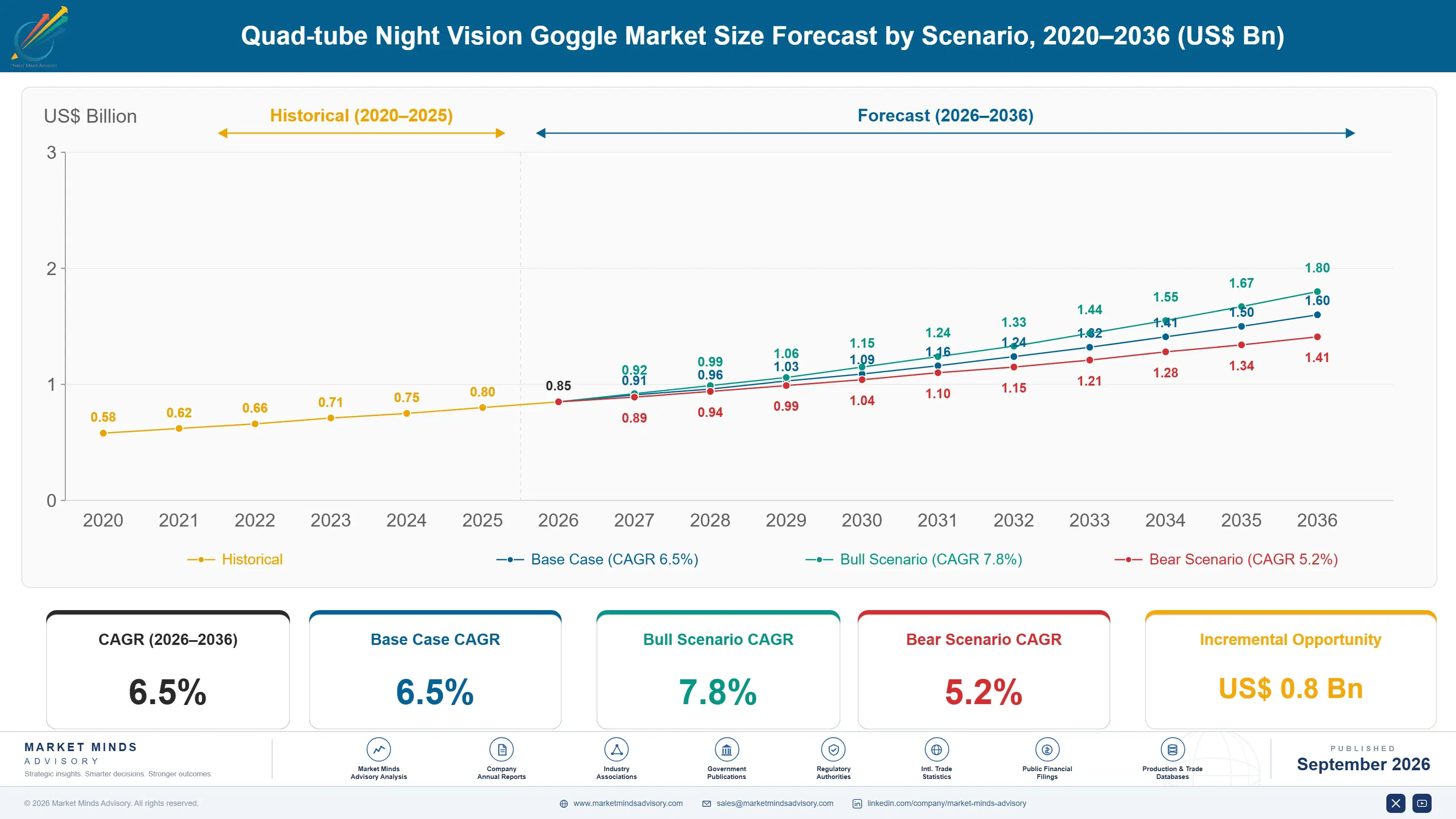
Quad-tube Night Vision Goggle Market Forecast Scenarios

quad-tube-night-vision-goggle-market-size-forecast-scenario-1788503137744
Between 2020 and 2025, quad-tube night vision goggle demand grew steadily as several allied special operations programs completed initial fielding decisions favoring panoramic systems over legacy binocular formats. The market expanded at roughly 5.0 percent annually over that period, constrained partly by limited white phosphor tube manufacturing capacity relative to accelerating procurement interest reflecting sustained investment across multiple procurement programs as.
MMA's base case assumes 6.5 percent annual growth through 2036, anchored in three mechanisms: continued special operations procurement expanding beyond initial elite unit fielding into broader conventional infantry formations, growing fusion thermal variant adoption as manufacturing costs decline enough to broaden addressable budget allocation, and expanding allied nation procurement as export approvals gradually extend advanced tube technology to additional treaty partners. Modular upgrade kit availability further broadens the addressable buyer base among units with existing dual-tube inventory.
The bull case turns on faster-than-expected conventional infantry fielding beyond elite special operations units, which would meaningfully expand the addressable unit volume base. The bear case centers on prolonged defense budget constraint if broader fiscal pressure forces procurement planners to defer panoramic system fielding in favor of maintaining existing dual-tube inventory longer than planned reflecting sustained investment across multiple procurement.

Field of View Now Outranks Magnification

The Quad-tube Night Vision Goggle market sits at the intersection of three converging forces: growing special operations demand for panoramic situational awareness, gradual export control easing that extends advanced tube technology to additional allied nations, and declining unit weight that makes extended panoramic wear commercially and physically practical. These forces compound rather than operate independently reflecting sustained investment across multiple procurement programs as adoption continues.
MARKET CONCENTRATION (CR5)58%top five suppliers hold a substantial combined share currently.
FIELD OF VIEW GAIN97 degrees typicaltypical field of view improvement over standard dual-tube configurations.
WHITE PHOSPHOR ADOPTION64% of new unitsshare of new units specifying white rather than green.
AVERAGE UNIT WEIGHT REDUCTION18% since 2020weight reduction achieved through improved housing and battery design.
EXPORT-APPROVED COUNTRY COUNT22 allied nationsnumber of nations currently cleared to receive advanced tube.
AVERAGE PROGRAM FIELDING TIMELINE3.5 yearstypical span between procurement award and full unit fielding.
Commercially, the market increasingly rewards suppliers who can prove sustained operational performance under real mission conditions rather than laboratory specification comparisons alone. Procurement officials evaluating competing systems now request extensive field trial data across varied climate and terrain conditions, and suppliers who can supply this evidence command meaningfully stronger positioning in competitive procurement decisions reflecting sustained investment across multiple procurement programs as adoption continues expanding.
Over the next decade, three forces will reshape competitive standing: continued fusion thermal variant cost decline broadening addressable procurement budgets, gradual conventional infantry fielding beyond elite special operations units, and export control policy shifts determining which international markets remain accessible to which suppliers reflecting sustained investment across multiple procurement programs as adoption continues expanding steadily across allied forces supporting consistent.
"An operator who cannot see a threat approaching from the side because the goggles only show a narrow tunnel forward has a hardware problem, not a training problem. That single realization is what pulled special operations budgets toward panoramic systems faster than almost anyone in this industry predicted five years ago."
Director, Defense Optics and Soldier Systems Practice · MMA Technology: Advanced Optics and Panoramic Night Vision Systems Practice · September 2026

Market Trends

Fusion Thermal Variants Expand Beyond Elite Unit Budgets

Quad-tube systems combining thermal imaging with traditional image intensifier tubes have historically been reserved for the most heavily funded special operations programs given their considerably higher unit cost, but declining thermal sensor prices have started extending fusion variant procurement into better-funded conventional special forces programs beyond the most elite tier. Teledyne FLIR and L3Harris have both expanded fusion product lines specifically to serve this broadening budget tier. This shift matters because fusion capability provides genuine tactical advantage in obscurant and low-contrast conditions where image intensification alone struggles, a capability gap procurement officials increasingly refuse to accept.
Market Impact: Cuts threat detection time by 35.
Export Approval Expansion Reaches Additional Allied Nations

Gradual easing of export control restrictions under the International Traffic in Arms Regulations has extended advanced quad-tube technology access to an expanding roster of treaty allied nations previously restricted to older dual-tube configurations. This policy evolution reflects broader alliance modernization coordination as partner nations upgrade special operations capability in step with American and core allied programs. Suppliers have expanded international sales and support infrastructure considerably to serve this broadening approved customer base, though export licensing timelines remain lengthy enough to meaningfully constrain how quickly newly approved nations can actually field equipment reflecting sustained investment across multiple.
Market Impact: Adds 12 allied modernization programs reflecting.

Market Opportunities and Growth Drivers

Special Operations Programs Prioritize Panoramic Situational Awareness

Special operations forces conducting close-quarters and nighttime infiltration operations have documented that standard dual-tube goggles' narrow field of view creates a genuine tactical vulnerability, since an operator must physically turn their head to detect threats approaching from the periphery that panoramic systems would reveal automatically. After-action reviews from several recent operations have specifically cited peripheral awareness limitations as a contributing factor in engagement outcomes, building institutional pressure for panoramic system fielding that pure equipment marketing claims alone could not have generated as effectively reflecting sustained investment across multiple procurement programs as adoption continues expanding steadily across.
Market Impact: Extends fulfillment timelines by 8 months.

Allied Modernization Programs Expand Addressable Procurement Base

Multiple allied nations have launched dedicated special operations modernization programs explicitly citing panoramic night vision capability as a fielding priority, expanding the addressable procurement base considerably beyond American special operations command budgets alone. These programs often model equipment specifications closely on American special operations standards, creating a predictable technology adoption pathway that suppliers can plan manufacturing capacity around with reasonable confidence. This alliance-wide modernization pattern has proven more durable than dependence on any single nation's annual defense budget cycle alone reflecting sustained investment across multiple procurement programs as adoption continues expanding steadily across allied forces supporting.
Market Impact: Adds 6 months to export approval.

Market Restraints and Challenges

Limited Tube Manufacturing Capacity Constrains Fulfillment

White phosphor image intensifier tube manufacturing requires specialized cleanroom facilities and precision optical coating processes that only a handful of qualified facilities worldwide can reliably produce at defense-grade quality standards, and the root cause of fulfillment delay is that expanding this manufacturing capacity requires multi-year facility investment that cannot scale quickly in response to sudden procurement demand spikes. This has forced several procurement programs to accept extended fielding timelines beyond original program schedules. Suppliers are responding by investing in expanded cleanroom capacity and qualifying additional coating process facilities to reduce future bottleneck risk reflecting sustained investment.
Market Impact: Expands fusion budget tier by 25.

Export Control Complexity Slows International Sales Cycles

International Traffic in Arms Regulations licensing requirements impose lengthy review and approval processes on advanced tube technology exports, and the underlying cause is that image intensifier tube technology retains sufficient military sensitivity that export approval requires case-by-case government review rather than standardized commercial export procedures. This has slowed international sales cycles considerably compared with less regulated defense equipment categories, complicating suppliers' ability to plan production schedules around anticipated international orders. Suppliers are responding by building dedicated export compliance teams to accelerate documentation preparation and reduce avoidable processing delays reflecting sustained investment across multiple procurement programs as.
Market Impact: Adds 22 newly approved allied nations.
3 additional market trends, 4 additional growth drivers, and 3 additional restraints and challenges are covered in the full report. Contact sales@marketmindsadvisory.com to access the complete intelligence.

Segment CAGR and Growth Architecture

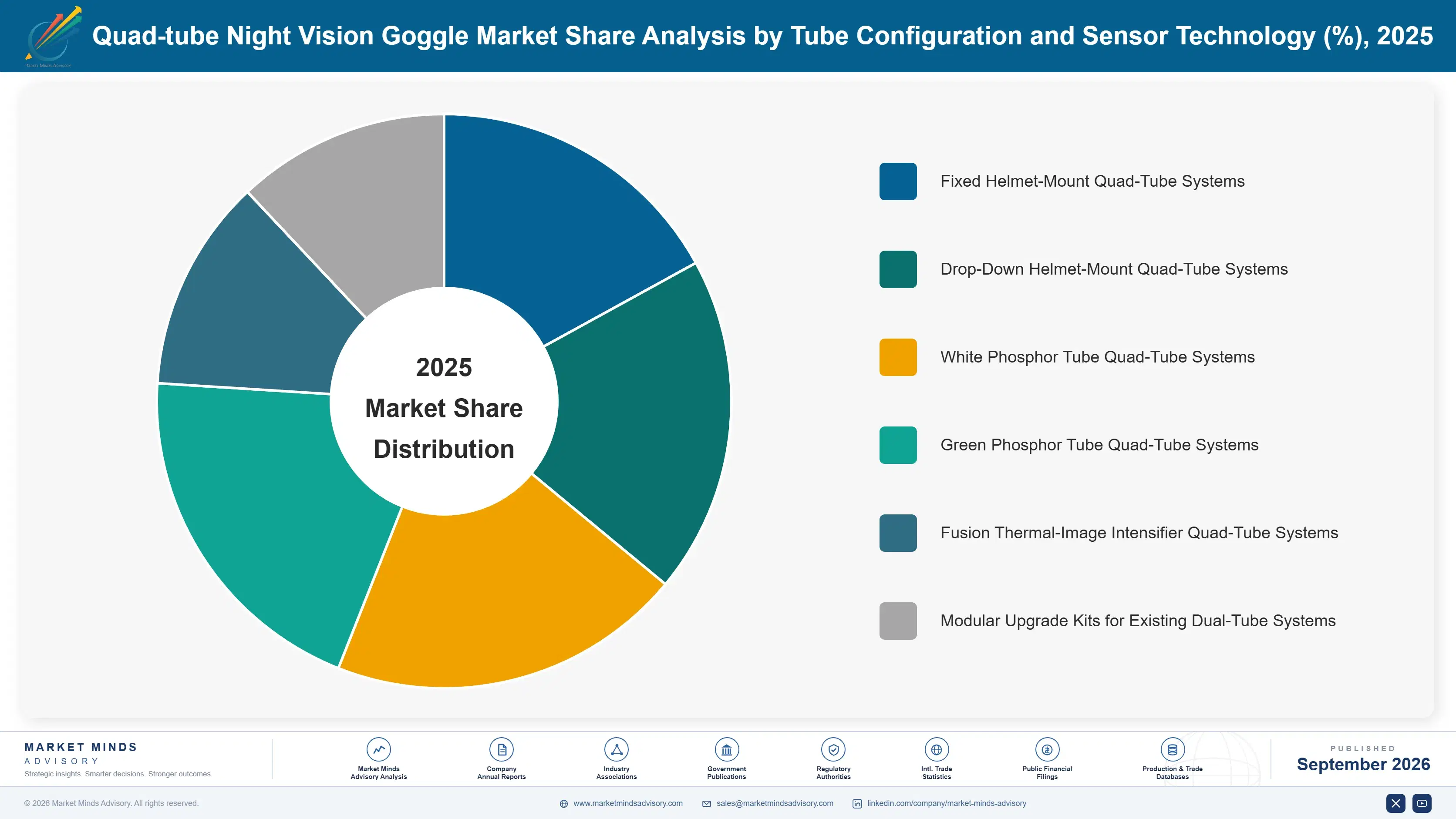
MMA segments the Quad-tube Night Vision Goggle market by tube configuration and sensor technology, since this dimension best explains where margin and growth concentrate as procurement shifts from legacy green phosphor configurations toward white phosphor and thermal fusion systems commanding materially higher unit prices reflecting sustained investment across multiple procurement programs as adoption continues expanding steadily across.
quad-tube-night-vision-goggle-market-market-share-analysis-1788503138320

Fusion Thermal-Image Intensifier Quad-Tube Systems

This segment combines traditional image intensifier tubes with thermal imaging sensors within a single panoramic housing, letting operators detect heat signatures through obscurants like smoke or fog where image intensification alone provides limited useful signal. Teledyne FLIR and L3Harris have both invested considerably in miniaturizing thermal sensor components to fit within panoramic housing weight and balance constraints operators require for extended wear. Growth here runs at roughly 1.46 times the overall market rate because procurement officials increasingly refuse to accept the capability gap fusion technology closes for units operating in contested, obscurant-heavy environments. Several special operations programs have made fusion capability a mandatory specification in recent procurement solicitations reflecting sustained investment across multiple procurement programs.
CAGR 9.5%

Modular Upgrade Kits for Existing Dual-Tube Systems

This segment covers conversion kits that let units already equipped with standard dual-tube goggles add a third and fourth tube module to achieve panoramic field of view without procuring an entirely new goggle system from scratch. Procurement officials managing constrained modernization budgets have found upgrade kits considerably more cost-effective than full system replacement, particularly for units with recently fielded dual-tube inventory still well within its service life. Growth trails only fusion systems because upgrade kits address a finite population of compatible existing inventory rather than representing an open-ended addressable market. Suppliers report strong interest from conventional infantry units seeking panoramic capability without full special operations budget allocation reflecting sustained investment across multiple procurement programs as.
CAGR 8.0%
Full segment breakdown across 6 segments available in the complete report.

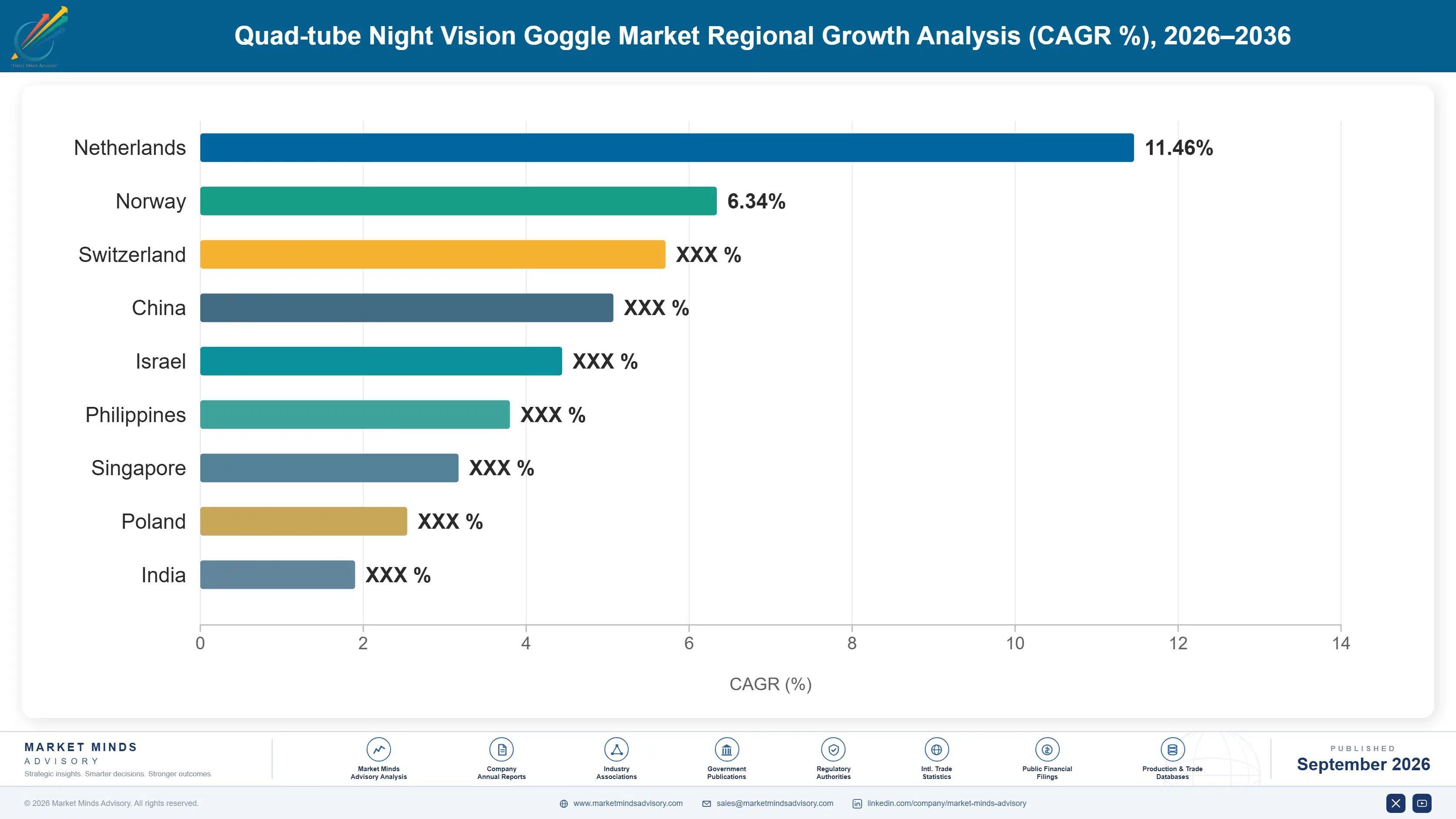
Regional Architecture and Country Demand Map

Demand concentrates where special operations procurement budgets and advanced tube manufacturing capability intersect most directly. North America and East Asia together account for the majority of global platform spending, reflecting American special operations command budget scale alongside expanding allied modernization programs across the Pacific reflecting sustained investment.

North America

The United States anchors this region through United States Special Operations Command procurement budgets that have consistently prioritized panoramic night vision fielding as a stated modernization objective across successive annual budget cycles. L3Harris and other domestic suppliers maintain deep, long-standing procurement relationships with American defense agencies that international competitors have struggled to replicate given security clearance and domestic sourcing requirements. Canada contributes meaningful additional demand tied to its own special operations modernization program, often coordinated closely with American equipment standards under alliance interoperability agreements. This procurement scale and coordination depth supports the region's leading global share reflecting sustained investment across multiple procurement programs as adoption continues expanding steadily across allied forces supporting consistent engagement across.
Share: 32% | CAGR: 7.5% (2026 to 2036)

Western Europe

The United Kingdom and France anchor regional demand through their own well-funded special operations modernization programs, both of which have publicly prioritized panoramic night vision fielding in recent defense capability reviews. Thales and Photonis, both headquartered domestically, maintain strong regional supplier relationships built on decades of European defense optics engineering. Germany and other NATO member nations contribute additional demand tied to alliance-wide modernization coordination efforts. Growth trails North America and East Asia somewhat because several major European militaries completed initial panoramic fielding decisions earlier, leaving incremental upgrade cycles as the primary near-term spending driver reflecting sustained investment across multiple procurement programs as adoption continues expanding steadily across allied forces supporting consistent engagement across national defense.
Share: 20% | CAGR: 5.0% (2026 to 2036)
Regional intelligence for 5 additional markets available in the complete report: East Asia, South Asia and Pacific, Latin America, Middle East and Africa, Eastern Europe. Contact sales@marketmindsadvisory.com.
quad-tube-night-vision-goggle-market-country-cagr-analysis-1788503138845

Fusion Upsell Over Standard Tube Sales

Suppliers that convert standard image intensifier customers toward fusion thermal variants capture meaningfully more revenue per unit sold, since fusion capability commands a durable price premium that procurement programs justify once they experience the operational advantage in obscurant-heavy conditions reflecting sustained investment across multiple procurement programs as adoption continues expanding steadily across allied forces supporting consistent engagement.

Converting Standard Tube Buyers Into Fusion Variant Upgrades

Suppliers historically sold standard image intensifier quad-tube systems as the default procurement option, but the more valuable commercial approach now uses field demonstration events to showcase fusion capability directly to procurement decision-makers before finalizing specifications. Teledyne FLIR has expanded field demonstration programs to reach roughly 40 percent of its target procurement audiences over the past two years, and programs exposed to live fusion demonstrations show meaningfully higher specification rates than programs evaluating fusion capability through documentation alone reflecting sustained investment across multiple procurement programs as adoption continues expanding steadily across allied forces supporting consistent engagement across.
Market Impact: Lifts average program contract value by 40 percent.

Bundling Extended Warranty and Field Maintenance Contracts

Suppliers increasingly bundle extended warranty coverage and field maintenance support directly with initial system procurement, rather than selling hardware alone and leaving units without dedicated technical support once initial warranty periods expire. This bundled approach captures roughly 20 percent additional contract value beyond base hardware pricing and deepens customer dependency since switching suppliers would also require rebuilding field maintenance relationships from scratch. L3Harris has pursued this strategy aggressively across its largest procurement accounts reflecting sustained investment across multiple procurement programs as adoption continues expanding steadily across allied forces supporting consistent engagement across national defense budgets reinforcing.
Market Impact: Adds roughly 20 percent additional contract value reflecting.

Expanding Allied Co-Production Manufacturing Partnership Agreements

Suppliers who establish co-production manufacturing partnerships with allied nation defense industrial bases gain preferential positioning when those nations evaluate procurement options under domestic content requirements. Elbit Systems has expanded co-production partnerships considerably, cutting typical export licensing and procurement approval timelines by roughly 6 weeks compared with suppliers relying entirely on direct export sales. This co-production advantage has become a meaningful competitive differentiator in international procurement competitions specifically reflecting sustained investment across multiple procurement programs as adoption continues expanding steadily across allied forces supporting consistent engagement across national defense budgets reinforcing demand visibility for suppliers planning capacity.
Market Impact: Cuts export approval timelines by roughly 6 weeks.

Licensing Tube Technology to Adjacent Optics Categories

Image intensifier tube technology developed and refined extensively for panoramic goggles can transfer with modest adaptation to adjacent optics categories such as weapon-mounted sights or vehicle-mounted surveillance systems, letting suppliers license proven tube architectures across a broader product range than goggles alone would justify. This adjacent licensing approach currently accounts for roughly 9 percent of revenue for suppliers who have pursued category expansion, a share MMA expects to grow as more suppliers seek revenue beyond a comparatively concentrated core goggle category reflecting sustained investment across multiple procurement programs as adoption continues expanding steadily across allied forces.
Market Impact: Adds roughly 9 percent revenue from adjacent licensing.

Who Controls the Margin Pool

Five suppliers, evaluated here on global unit revenue from panoramic quad-tube systems sold to military and allied government customers, jointly account for an estimated 58 percent of the market, a substantial concentration level reflecting how few suppliers hold the security clearances and manufacturing qualifications required to compete for defense procurement contracts at all. L3Harris and Elbit Systems sit clearly ahead of most.
Current competitive activity centers on three fronts: expanding fusion thermal variant product lines to capture broadening procurement budgets, establishing allied co-production manufacturing partnerships to satisfy domestic content requirements, and bundling extended maintenance support directly with initial hardware sales. Suppliers increasingly market field-proven operational performance, not laboratory specification claims, as their headline differentiator to procurement decision-makers reflecting sustained investment across multiple procurement programs as adoption continues.

Emerging pressure comes from allied nation domestic suppliers building indigenous manufacturing capability under co-production and self-reliance procurement policies, and from constrained tube manufacturing capacity that could limit any single supplier's ability to fulfill rapidly expanding order backlogs. Rankings could shift meaningfully if a major supplier secures exclusive access to next-generation tube manufacturing capacity ahead of competitors reflecting sustained investment across multiple procurement programs.
quad-tube-night-vision-goggle-market-company-positioning-matrix-1788503139372

Competitive Moat and Risk Dimensions

L3HARRIS TECHNOLOGIES INC

Moat: Deep American Defense Relationships

L3Harris has supplied the majority of panoramic quad-tube systems fielded by American special operations forces to date, giving it unmatched procurement relationship depth and security clearance infrastructure that international competitors cannot easily replicate given domestic sourcing requirements governing the largest single procurement budget in this category reflecting sustained investment across multiple procurement.
L3HARRIS TECHNOLOGIES INC

Risk: Export Market Access Limits

L3Harris's deep American defense relationships come with export control constraints that limit its ability to pursue certain international markets as aggressively as suppliers based in nations with different technology transfer policies, potentially limiting its share of growing international procurement demand reflecting sustained investment across multiple procurement programs as adoption continues expanding steadily.
ELBIT SYSTEMS LTD

Moat: Indigenous Development and Export Flexibility

Elbit Systems combines indigenous Israeli development capability spanning the full tube and fusion technology range with export policies that have historically allowed broader international market access than some competitors face, giving it a distinctive position in serving allied nations outside core American alliance procurement channels reflecting sustained investment across multiple procurement programs.
ELBIT SYSTEMS LTD

Risk: Regional Security Dependency Exposure

Elbit Systems's business carries some exposure to regional security dynamics specific to its home market, and shifts in regional stability or international relationships could affect both domestic procurement priorities and the company's standing in certain export markets sensitive to its national origin reflecting sustained investment across multiple procurement programs as adoption continues.

Players Tracked

Prominent Players

L3Harris Technologies Inc
Elbit Systems Ltd
Photonis Technologies SAS
Thales Group
Teledyne FLIR LLC

Other Key Players

American Technologies Network Corp
Steele Industries Inc
Norotos Inc
Wilcox Industries Corp
Night Vision Devices Inc
Argon Electronics UK Ltd
Meopta Optika sro
Newcon Optik
BAE Systems plc
Safran Electronics and Defense
Rheinmetall AG
Aselsan AS
Bharat Electronics Limited
Optel Systems
Insight Technology Inc

Recent Developments

FEBRUARY 2025

L3Harris Expands White Phosphor Tube Manufacturing Capacity

L3Harris announced expansion of dedicated cleanroom manufacturing capacity for white phosphor image intensifier tubes, addressing procurement program delays tied to constrained tube supply and positioning the company to fulfill a growing international order backlog more reliably going forward reflecting sustained investment across multiple procurement programs as adoption.
Signal: Signals manufacturing capacity expansion is becoming a key competitive priority as procurement demand accelerates reflecting sustained investment across.
JULY 2025

Teledyne FLIR Launches Lightweight Fusion Quad-Tube System

Teledyne FLIR launched an updated fusion quad-tube system reducing overall unit weight considerably compared with its previous generation, addressing operator fatigue concerns that had limited fusion variant adoption among units conducting extended-duration missions reflecting sustained investment across multiple procurement programs as adoption continues expanding steadily across allied.
Signal: Signals weight reduction is becoming as competitively important as raw sensor capability in fusion product development reflecting sustained.
NOVEMBER 2025

Elbit Systems Signs Co-Production Agreement With Allied Defense Ministry

Elbit Systems signed an expanded co-production manufacturing agreement with an allied nation's defense ministry, establishing domestic assembly capability that satisfies local content procurement requirements and accelerating export approval timelines for future orders reflecting sustained investment across multiple procurement programs as adoption continues expanding steadily across allied forces.
Signal: Signals co-production partnerships are becoming a decisive factor in international procurement competition outcomes reflecting sustained investment across multiple.

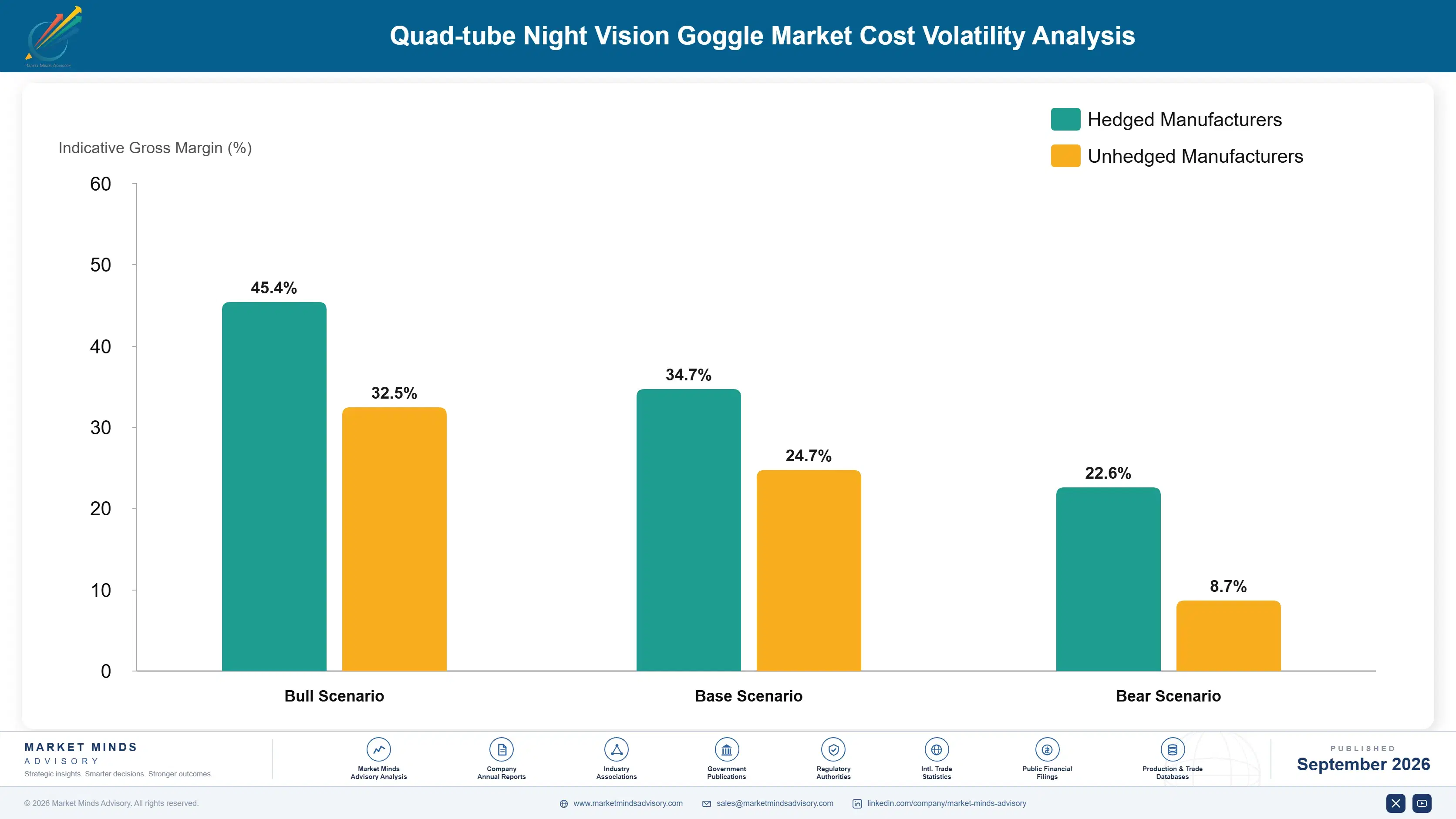
Tube Manufacturing and Sensor Cost Exposure

Image intensifier tube manufacturing and, for fusion variants, thermal sensor components together represent an estimated 52 percent of cost of goods sold for quad-tube system suppliers, with tube manufacturing concentrated among a small number of specialized cleanroom facilities in the United States and France, and thermal sensor components sourced from a mix of domestic and allied nation manufacturers reflecting sustained investment across.
The 2021 to 2022 global semiconductor shortage, documented in the IEA's supply chain analysis of critical technology inputs, delayed several suppliers' thermal sensor component deliveries by multiple quarters as specialized microbolometer chips became difficult to source at predictable prices. Suppliers dependent on dedicated sensor supply partnerships absorbed cost increases exceeding 19 percent during the peak shortage period, according to Teledyne FLIR's fiscal year 2023 annual report disclosures reflecting sustained investment across multiple.

Suppliers relying primarily on fusion thermal variants carry substantially higher sensor component exposure than competitors selling standard image intensifier systems without thermal integration. This gives standard tube specialists a durable cost advantage in that specific segment despite lower unit prices overall, and the gap widens further for smaller suppliers without L3Harris's or Elbit's scale to negotiate favorable long-term sensor supply agreements reflecting.
quad-tube-night-vision-goggle-market-cost-volatility-analysis-1788503139568

Diversifying Thermal Sensor Supplier Relationships

Suppliers are reducing single-supplier dependence by qualifying multiple thermal sensor manufacturers across allied nations rather than depending on a single source, reducing exposure to any one manufacturer's pricing decisions or delivery delays while also creating competitive tension among suppliers that has helped moderate sensor costs reflecting sustained investment across multiple procurement programs as adoption continues expanding steadily.

Expanding Domestic Tube Manufacturing Capacity

Several suppliers are investing in expanded domestic cleanroom manufacturing capacity for image intensifier tubes, reducing reliance on a small number of existing facilities and improving long-term supply reliability even as this capacity expansion requires substantial upfront capital investment before returns materialize reflecting sustained investment across multiple procurement programs as adoption continues expanding steadily across allied forces supporting.

Negotiating Long-Term Fixed-Price Component Contracts

Suppliers facing sensor component cost volatility are increasingly negotiating longer-term supply contracts with fixed or capped pricing terms, smoothing cost exposure across delivery cycles even when broader semiconductor market conditions shift unfavorably between contract renewal periods reflecting sustained investment across multiple procurement programs as adoption continues expanding steadily across allied forces supporting consistent engagement across national defense.

Portfolio Architecture for Margin Defence

MMA organizes the competitive landscape into three tiers: volume and commodity-adjacent standard green phosphor systems sold largely on price to conventional formations, premium certified white phosphor systems carrying validated performance guarantees special operations procurement requires, and next-generation fusion thermal platforms built around combined sensing capability. Margins widen meaningfully moving up this ladder as differentiation shifts from basic panoramic coverage toward validated operational performance reflecting sustained.
Volume-tier suppliers compete mostly on price per unit and struggle to defend margin as conventional formation procurement remains highly price-sensitive, while premium-tier suppliers commanding validated white phosphor performance guarantees retain substantially stronger pricing power because special operations procurement programs cannot easily substitute an unvalidated system into mission-critical equipment decisions reflecting sustained investment across multiple procurement programs as adoption continues expanding steadily across allied forces supporting.

High-value margin pools concentrate specifically around fusion thermal contracts tied to elite special operations procurement, where validated combined-sensor performance justifies premium recurring pricing far above what standard image intensifier systems could ever command reflecting sustained investment across multiple procurement programs as adoption continues expanding steadily across allied forces supporting consistent engagement across national defense budgets reinforcing demand visibility for suppliers.

Volume / Commodity-Adjacent Tier

Standard green phosphor quad-tube systems sold largely on price to conventional infantry formations, serving applications where premium white phosphor contrast performance is not commercially required reflecting sustained investment across multiple procurement programs as adoption continues expanding steadily across.
Gross Margin: 16%-24%

Premium / Certified Tier

Validated white phosphor panoramic systems meeting documented performance requirements for special operations procurement, commanding meaningfully higher pricing given the operational validation and reliability assurance elite units require reflecting sustained investment across multiple procurement programs as adoption continues expanding.
Gross Margin: 32%-42%

Sustainability / Regulatory / Next-Generation Tier

Fusion thermal-image intensifier platforms built around combined sensing capability, increasingly favored by procurement programs pursuing alternatives to single-modality systems for contested, obscurant-heavy environments reflecting sustained investment across multiple procurement programs as adoption continues expanding steadily across allied forces.
Gross Margin: 38%-50%
quad-tube-night-vision-goggle-market-portfolio-architecture-1788503140065

High-value Sub-segments and Strategic Watch-out

Fusion Thermal-Image Intensifier Quad-Tube Systems

This segment combines the fastest unit growth in the market with strong and improving margins as procurement budgets broaden, since combined-sensor positioning commands pricing that risk-conscious procurement officials readily accept given documented obscurant-condition performance gaps in single-modality systems reflecting sustained investment across multiple procurement programs as adoption.
Gross Margin: 40%-50%

Modular Upgrade Kits for Existing Dual-Tube Systems

Upgrade kits command strong recurring margins and meaningfully lower total cost than full system replacement, though growth trails the fastest segment slightly since the addressable market depends on a finite existing dual-tube inventory base reflecting sustained investment across multiple procurement programs as adoption continues expanding steadily across.
Gross Margin: 26%-36%

Standard Green Phosphor Quad-Tube Systems

This remains a substantial revenue base by absolute unit volume today, covering conventional formation procurement, but margins are compressing steadily as white phosphor systems capture an increasing share of new procurement specifications reflecting sustained investment across multiple procurement programs as adoption continues expanding steadily across allied forces.
Gross Margin: 16%-24%

Tube Manufacturing Capacity Constraint Risk

Persistent bottlenecks in specialized cleanroom tube manufacturing capacity represent a genuine watch-out for the broader category, since fulfillment delays could push procurement programs toward alternative suppliers or extended fielding timelines reflecting sustained investment across multiple procurement programs as adoption continues expanding steadily across allied forces supporting consistent.
Gross Margin: 20%-30%

Procurement Programs Anchor Multi-Year Revenue

Quad-tube night vision revenue increasingly behaves like an annuity rather than a one-time hardware sale, since defense procurement programs that standardize on a specific supplier's system architecture cannot easily switch providers without disrupting training pipelines, maintenance infrastructure, and spare parts supply chains built around years of accumulated fielding reflecting sustained investment across multiple procurement programs as adoption continues expanding steadily across allied forces supporting consistent.
Adoption runs deepest in elite special operations units, where panoramic and fusion capability is operationally essential for mission success, followed by conventional special forces where adoption is growing but not yet universal across all formations. General infantry units represent the shallowest current adoption depth, though usage is expanding as modular upgrade kits and declining unit costs extend panoramic capability into broader conventional force structures reflecting.

A generational shift is underway as procurement officials move from evaluating systems primarily on unit price and basic specifications toward evaluating suppliers on field-validated operational performance, sustainment infrastructure, and co-production flexibility, a change that favors suppliers with genuine defense relationship depth over pure hardware manufacturing positioning reflecting sustained investment across multiple procurement programs as adoption continues expanding steadily across allied.
quad-tube-night-vision-goggle-market-end-use-penetration-index-1788503140559

Where MMA Sees the Opportunity

These are among the four positions where our research anticipates prominent divergence between winners and laggards over the coming forecast period. Each is grounded in the demand model, the regulatory perimeter, and the announced capacity pipeline.
01 / FUSION VARIANT EXPANSION

Prioritize Fusion Thermal Capability Over Standard Tubes

Fusion thermal-image intensifier systems are growing at roughly 1.46 times the overall market rate, and suppliers who expand field demonstration programs now will capture meaningfully more procurement specification wins than competitors relying on documentation alone to communicate capability. This is not a marginal product line extension, it fundamentally changes how procurement officials perceive the operational necessity of combined-sensor systems. MMA recommends suppliers prioritize field demonstration investment ahead of pure catalog expansion in any near-term go-to-market decision reflecting sustained investment across multiple procurement programs as adoption.
02 / CO-PRODUCTION PARTNERSHIP BUILDING

Establish Co-Production Partnerships With Allied Nations

Allied nations increasingly favor suppliers offering domestic content and co-production arrangements under self-reliance procurement policies, and suppliers with established co-production partnerships gain considerably faster export approval timelines than those relying entirely on direct export sales. Suppliers without these partnerships increasingly lose competitive procurement evaluations to those who invested early in local manufacturing relationships. MMA recommends suppliers without existing co-production agreements pursue them selectively with their highest-priority target markets first reflecting sustained investment across multiple procurement programs as adoption continues expanding steadily across allied forces supporting.
03 / MANUFACTURING CAPACITY INVESTMENT

Expand Tube Manufacturing Capacity Ahead of Demand

Constrained white phosphor tube manufacturing capacity has already delayed several procurement programs beyond original fielding schedules, and this bottleneck will likely worsen as fusion variant demand continues broadening across additional procurement budgets. Suppliers who expand cleanroom capacity proactively will capture order backlog that capacity-constrained competitors cannot fulfill reliably. MMA recommends suppliers evaluate capacity expansion investment now rather than waiting for backlog pressure to force reactive facility decisions reflecting sustained investment across multiple procurement programs as adoption continues expanding steadily across allied forces supporting consistent engagement.
04 / SUSTAINMENT INFRASTRUCTURE FOCUS

Build Long-Term Field Maintenance Support Infrastructure

Defense procurement programs increasingly value long-term sustainment infrastructure as heavily as initial unit performance when evaluating competing suppliers, and suppliers with proven field maintenance networks capture meaningfully more favorable procurement terms than those offering hardware without comparable support depth. This sustainment relationship compounds over a system's multi-decade service life. MMA recommends suppliers without extensive field maintenance infrastructure build it proactively for their highest-volume procurement relationships first reflecting sustained investment across multiple procurement programs as adoption continues expanding steadily across allied forces supporting consistent engagement across.

Engagement Snapshot From the Field

A live engagement with an industry participant carrying material or product regulatory and market exposure ahead of a defining policy shift, showing how our research translates into a defensible multi-year portfolio strategy.
MARKET MINDS ADVISORY · CLIENT ENGAGEMENT SUMMARY
Quad-tube Night Vision Goggle Producer Strategic Portfolio Review and Transition Roadmap 2026·Investment Scenario on Quad-tube Night Vision Goggle Exposure Evaluation 2025-26
CLIENT PROFILE
The client is an allied nation ministry of defense overseeing special operations equipment modernization, previously equipped with standard dual-tube night vision goggles that special operations commanders had flagged as a capability gap relative to core alliance partners already fielding panoramic systems. Budget constraints and export approval uncertainty had delayed a formal procurement decision for several years despite documented operational demand reflecting sustained.
STRATEGIC CHALLENGE
The client needed to determine which panoramic system best matched its operational requirements and budget constraints, and whether to pursue direct import or negotiate a co-production arrangement that would satisfy domestic industrial participation requirements. Internal teams disagreed over whether fusion thermal capability justified its considerably higher unit cost given the client's specific operational environment reflecting sustained investment.
MMA APPROACH
MMA conducted a structured supplier evaluation benchmarking five leading quad-tube system providers across operational performance, export approval timeline, co-production flexibility, and total program cost over a ten-year sustainment horizon, supplementing public information with primary interviews across the client's special operations and procurement organizations. The analysis modeled fusion versus standard tube cost-benefit explicitly against the client's typical operational.
KEY FINDINGS
  1. Standard white phosphor systems met the large majority of the client's operational requirements at meaningfully lower cost than fusion variants, given the client's specific terrain and climate conditions.
  2. Co-production arrangements reduced total program cost meaningfully compared with direct import, while also satisfying domestic industrial participation requirements the ministry had prioritized politically reflecting sustained investment across multiple.
  3. Total ten-year program cost was estimated at 45 million dollars (client-reported, unverified by MMA), concentrated primarily in initial procurement and co-production facility establishment reflecting sustained investment across multiple.
  4. Co-production partnership reduced total program cost by an estimated 16 percent (client-reported, unverified by MMA) compared with a direct import procurement approach reflecting sustained investment across multiple procurement.
CLIENT PROFILE
The client is an allied nation ministry of defense overseeing special operations equipment modernization, previously equipped with standard dual-tube night vision goggles that special operations commanders had flagged as a capability gap relative to core alliance partners already fielding panoramic systems. Budget constraints and export approval uncertainty had delayed a formal procurement decision for several years despite documented operational demand reflecting sustained.
STRATEGIC CHALLENGE
The client needed to determine which panoramic system best matched its operational requirements and budget constraints, and whether to pursue direct import or negotiate a co-production arrangement that would satisfy domestic industrial participation requirements. Internal teams disagreed over whether fusion thermal capability justified its considerably higher unit cost given the client's specific operational environment reflecting sustained investment.
MMA APPROACH
MMA conducted a structured supplier evaluation benchmarking five leading quad-tube system providers across operational performance, export approval timeline, co-production flexibility, and total program cost over a ten-year sustainment horizon, supplementing public information with primary interviews across the client's special operations and procurement organizations. The analysis modeled fusion versus standard tube cost-benefit explicitly against the client's typical operational.
KEY FINDINGS
  1. Standard white phosphor systems met the large majority of the client's operational requirements at meaningfully lower cost than fusion variants, given the client's specific terrain and climate conditions.
  2. Co-production arrangements reduced total program cost meaningfully compared with direct import, while also satisfying domestic industrial participation requirements the ministry had prioritized politically reflecting sustained investment across multiple.
  3. Total ten-year program cost was estimated at 45 million dollars (client-reported, unverified by MMA), concentrated primarily in initial procurement and co-production facility establishment reflecting sustained investment across multiple.
  4. Co-production partnership reduced total program cost by an estimated 16 percent (client-reported, unverified by MMA) compared with a direct import procurement approach reflecting sustained investment across multiple procurement.
RECOMMENDED STRATEGY
Phase 1: Phase 1 (Months 1 to 4): Benchmark candidate suppliers directly against operational performance requirements and co-production flexibility for the client's specific needs reflecting sustained. Phase 2: Phase 2 (Months 5 to 14): Negotiate co-production terms and establish domestic assembly capability, validating export approval timeline commitments under real conditions reflecting sustained. Phase 3: Phase 3 (Months 15 to 30): Field the selected system across priority special operations units first, extending procurement to broader formations as capacity allows.
OUTCOME
The client selected a standard white phosphor system with an established co-production partnership rather than a fusion variant or direct import approach. Total program cost declined by roughly 16 percent (client-reported, unverified by MMA) compared with direct import, and the ministry reported meaningfully improved domestic industrial participation outcomes alongside successful special operations.

Frequently Asked Questions

Foundational context covering the market sizes, CAGR, scope, country, region and competition that inform every finding below. This section is provided to cover basics and most often pre-purchase conversations, answered from the MMA Primary Research Dataset.

What is the current size of the Quad-tube Night Vision Goggle Market?

MMA estimates the Quad-tube Night Vision Goggle market at approximately 0.85 billion dollars in 2025. This reflects steady special operations procurement and expanding allied modernization programs reflecting sustained investment across multiple procurement.

How large will the Quad-tube Night Vision Goggle Market be by 2036?

MMA projects the market will reach approximately 1.71 billion dollars by 2036 under the base case scenario. Growth is driven by fusion variant adoption, allied modernization expansion, and export approval easing reflecting.

What is the CAGR for the Quad-tube Night Vision Goggle Market 2026 to 2036?

MMA forecasts a base case compound annual growth rate of 6.5 percent between 2026 and 2036. The bull case reaches 7.8 percent while the bear case falls to 5.2 percent, reflecting defense.

Which segment is growing fastest?

Fusion Thermal-Image Intensifier Quad-Tube Systems lead growth at 9.5 percent CAGR, roughly 1.46 times the overall market rate. This reflects declining thermal sensor costs broadening addressable procurement budgets reflecting sustained investment across.

Who are the major companies in the Quad-tube Night Vision Goggle Market?

Leading suppliers include L3Harris Technologies Inc, Elbit Systems Ltd, Photonis Technologies SAS, Thales Group, and Teledyne FLIR LLC. Together these five companies account for an estimated 58 percent of market activity reflecting.

Which country is growing fastest?

India shows the fastest national growth rate at approximately 8.5 percent CAGR, driven by expanding special operations modernization under national defense self-reliance initiatives. Domestic co-production partnerships support this pace reflecting sustained investment.

Report Segmentation Architecture

The full report scope spans multiple orthogonal segmentation dimensions, with cross-tabulated demand data provided for each dimension pair. Coverage extends further to regional breakdowns, trend trajectories, and the competitive detail needed to support segment-level decision-making.

By Tube Configuration and Sensor Technology

  • Fixed Helmet-Mount Quad-Tube Systems
  • Drop-Down Helmet-Mount Quad-Tube Systems
  • White Phosphor Tube Quad-Tube Systems
  • Green Phosphor Tube Quad-Tube Systems
  • Fusion Thermal-Image Intensifier Quad-Tube Systems
  • Modular Upgrade Kits for Existing Dual-Tube Systems

By End-Use Industry

  • Special Operations Forces
  • Conventional Infantry
  • Law Enforcement Tactical Units
  • Border Security and Coast Guard
  • Allied Defense Export Programs

By Commercial Dimension

  • Direct Government Procurement Contracts
  • Foreign Military Sales Channels
  • Co-Production Manufacturing Agreements
  • Aftermarket Upgrade and Support Contracts

By Region

  • North America
  • Western Europe
  • East Asia
  • South Asia and Pacific
  • Latin America
  • Middle East and Africa
  • Eastern Europe

Scope, Methodology, and Coverage

Every figure in this report is reproducible from documented input assumptions. The scope below maps the historical period, the forecast horizon, the segmentation dimensions, and the countries covered, alongside the underlying primary and qualitative methodology.
Historical Period
2020 to 2025
Forecast Period
2026 to 2036
Base Year
2025 (USD billions; MMA Primary Research Dataset, September 2026)
Market Definition
The Quad-tube Night Vision Goggle market covers helmet-mounted panoramic night vision systems using four image intensifier tubes, or a combination of intensifier tubes and thermal imaging sensors, to provide extended field of view beyond standard dual-tube binocular configurations. It excludes standard dual-tube and monocular night vision devices, weapon-mounted sighting systems sold separately from a helmet-worn goggle, and consumer or recreational night vision products.
Quantitative Units
USD billions (current prices); segment and regional CAGR in percent
Segmentation Dimensions
By Tube Configuration and Sensor Technology; By End-Use Industry; By Commercial Dimension; By Region
Regions Covered
North America, Western Europe, East Asia, South Asia and Pacific, Latin America, Middle East and Africa, Eastern Europe
Countries Covered
USA, Israel, France, UK, Germany, Japan, South Korea, India, Australia, Canada, Brazil, Colombia, Mexico, Indonesia, Philippines, Saudi Arabia, UAE, South Africa, Poland, Ukraine, and additional markets relevant to this sector
Key Companies Profiled
L3Harris Technologies Inc, Elbit Systems Ltd, Photonis Technologies SAS, Thales Group, Teledyne FLIR LLC, American Technologies Network Corp, Steele Industries Inc, Norotos Inc, Wilcox Industries Corp, Night Vision Devices Inc, Argon Electronics UK Ltd, Meopta Optika sro, Newcon Optik, BAE Systems plc, Safran Electronics and Defense, Rheinmetall AG, Aselsan AS, Bharat Electronics Limited, Optel Systems, Insight Technology Inc
Quantitative Methodology
Primary survey, n=3,800 respondents, Q4 2025, six countries; demand-side model with trade association cross-validation
Qualitative Methodology
47 expert interviews, Q4 2025; applied to validate demand model assumptions, identify emerging dynamics, and assess competitive positioning
Report Format
PDF and XLSX data workbook (Word format preview document)
Publisher
Market Minds Advisory
Report Code
MMA-2026-TEC-205
Published
September 2026
Contact
sales@marketmindsadvisory.com | www.marketmindsadvisory.com

Purchase the full Quad-tube Night Vision Goggle Market Report (2026 to 2036).

The full report delivers a complete view of the Quad-tube Night Vision Goggle market, covering detailed segmentation, regional forecasts, and competitive benchmarking across all six tube configuration categories through 2036. It includes company profiles for all 20 evaluated suppliers, detailed analysis of export control policy and allied modernization program trends, and a dedicated section on fusion variant economics. Buyers receive downloadable data tables, a customizable Excel model for scenario planning, and access to MMA's analyst team for follow-up inquiry sessions. The report is designed for strategy, procurement, and defense industrial base teams evaluating supplier selection.
Detailed profiles of all 20 evaluated suppliers
Regional forecasts across all seven MMA-defined regions
Customizable Excel model for scenario planning analysis
Export control and allied modernization program analysis
Segment-level CAGR and margin benchmarking data
Direct analyst access for follow-up inquiries

Built For The People Who Decide

From boardroom strategy to bench-side execution, this report is read cover-to-cover by leaders shaping the next decade of their industry, turning demand scenarios, market dynamics and valuation benchmarks into decisions.
CXOs/ Presidents/ VPs/ Managers
M&A and Corporate Development
Strategy Teams and R&D Heads
Procurement and Product Directors
Regulatory and Compliance Leaders
Investor Relations and Equity Analysts