Market Minds Advisory
Quad-ridge Horn Antenna Market

Quad-ridge Horn Antenna Market: Quad-ridge Horn Antenna Market: Antenna Classes, Calibration Barriers and Frequency Migration 2026 to 2036

Every electronic device sold has to prove it does not interfere with everything around it. The antenna that measures that is a horn with ridges in it, and hardly anybody outside the test chamber knows.

Lead Analyst

Published

September 2026

Make Smarter Decisions with Customized Research Insights

Request a free sample report and evaluate market opportunities, growth trends, and competitive dynamics relevant to your business needs.

2025 MARKET VALUE$0.3BMarket Size 2025
2036 FORECAST VALUE$0.8BBase Case , 2026 to 2036
CAGR 2026 TO 20369.4 %Bull 10.6% / Bear 8.2%
INCREMENTAL OPPORTUNITY$0.5BNet 10- year value creation
EXPANSION MULTIPLE2.47x2036 value over 2026 base
Strategic Levers
M&A Pipeline
Regional Outlook
Country Rankings
Competitive Intelligence
Segmental Deep-dive
Call-Us : 91 93563 13602

Executive Snapshot and Market Trajectory.

A quad-ridge horn is four metal ridges inside a flared waveguide, and those ridges are what let one antenna cover forty to one in frequency on two polarisations at once. Nothing else does that in a single aperture, which is why test chambers are full of them.
The market reaches USD 0.32 billion in 2026 and USD 0.79 billion by 2036, a 2.47 times expansion at 9.4%. Millimetre-wave quad-ridge horns grow at 14.1%, half again the market rate of 9.4%, as test frequencies climb past 40 GHz for satellite and radar work. East Asia holds 34% of demand because compliance testing happens where devices are manufactured, and China grows at 12.6%. That geography surprises people.
Five suppliers hold 46% of shipped antenna units, concentrated by the anechoic chambers and accredited calibration facilities a serious manufacturer needs. ETS-Lindgren and Rohde & Schwarz sell antennas inside complete test systems. Schwarzbeck and A.H. Systems sell the antenna alone to laboratories that already own everything else. Those are different businesses entirely, and very few suppliers manage to run both at the same time. The overlap between them is narrower than the product description suggests.
Market Definition
This report covers quad-ridged horn antennas: broadband dual-polarised horns using four internal ridges to extend usable bandwidth, sold for electromagnetic compatibility testing, antenna measurement, satellite ground testing, radar characterisation and direction finding. It excludes single-ridged and unridged horns, log-periodic and biconical antennas, anechoic chamber absorber and construction, spectrum analysers and receivers, and the amplifier chains these antennas connect to.
Base Year Value
$0.3B in 2025 (MMA Primary Research Dataset, September 2026)
Forecast Period
2026 to 2036, eleven discrete annual values
CAGR
9.4% base case. Bull 10.6%. Bear 8.2%.
Fastest Growth Segment
Millimetre-Wave Quad-Ridge Horns: 14.1% CAGR
Fastest Growth Country
China: 12.6% CAGR
Fastest Growth Region
South Asia and Pacific: 11.4% CAGR
Largest Region
East Asia: 34% of 2025 global value
Market Leaders
ETS-Lindgren, Rohde & Schwarz, Microwave Vision Group, Schwarzbeck Mess-Elektronik and A.H. Systems lead on shipped antenna units. Source: MMA Analysis.
Primary Survey
n=3,800 procurement and R&D decision-makers, Q4 2025, six countries
Methodology
Demand-side build-up, cross-validated against public data, 47 expert interviews

Quad-ridge Horn Antenna Market Forecast Scenarios

quad-ridge-horn-antenna-market-size-forecast-scenario-1789985148402
Between 2020 and 2025 the category compounded at 8.2% and 5G did most of the work. Millimetre-wave allocations pushed compliance testing into frequency ranges where existing laboratory antennas simply did not reach, and every accredited laboratory that wanted that business had to buy new hardware. Chamber construction followed. It was an equipment replacement cycle driven by a spectrum decision.
The base case holds 9.4% on three mechanisms. Satellite constellation manufacturing has moved from bespoke spacecraft to production lines, and every unit needs antenna pattern and payload testing before it flies, which turns a laboratory purchase into a production tooling purchase. Automotive radar at 77 GHz puts millimetre-wave measurement into vehicle test facilities that never had it. And defence electronic warfare programmes across several countries are buying direction-finding hardware at rates not seen since the Cold War.
The bull case at 10.6% assumes 6G research programmes commit to frequencies above 100 GHz, which would force another laboratory replacement cycle before the current one has finished paying back. The bear case at 8.2% is chamber utilisation: laboratories already own antennas that work, calibration extends their life indefinitely, and a slow device launch year removes the reason to buy anything new at all.

Why One Antenna Covers Everything

A plain horn antenna works well over maybe two to one in frequency. Put four ridges inside the flare and the cutoff drops dramatically, which stretches usable bandwidth toward forty to one on a single aperture. The ridges also allow two orthogonal feeds in the same structure, so one antenna measures both polarisations without being physically rotated. That combination is the whole reason the design exists.
TOP FIVE CONCENTRATION46%Concentrated by anechoic chamber and calibration facility requirements
FREQUENCY COVERAGE RATIO40 to 1Bandwidth span achievable from a single horn aperture
CROSS-POLARISATION ISOLATION25 dBTypical separation between orthogonal ports across the band
CALIBRATION INTERVAL12 monthsAccredited recalibration cycle required by most test standards
AVERAGE SELLING PRICEUSD 8400Blended across laboratory, chamber and field antenna classes
TEST LABORATORY INSTALLED BASE9200 sitesAccredited compliance laboratories holding at least one horn
What a laboratory actually buys is a calibration certificate with an antenna attached. Compliance measurements have to be traceable, which means the antenna factor is characterised at an accredited facility and revalidated every 12 months. A manufacturer without that facility is selling hardware into a market that will not accept it, and building one costs more than most antenna businesses are worth.
Frequency is where the growth sits. Test requirements have climbed steadily past 40 GHz and into automotive radar at 77, and each step invalidates hardware that was adequate a few years earlier. Millimetre-wave horns compound at 14.1% on that alone. Machining tolerance rather than electromagnetic design becomes the limiting factor up there, which favours suppliers who own their machine shops.
"Nobody buys a quad-ridge horn because of its radiation pattern. They buy it because an accredited calibration certificate came with it, and the auditor who reviews their test reports will ask to see that certificate rather than the antenna."
Principal Analyst, Test and Measurement Systems Practice · MMA Technology Practice · September 2026

Market Trends

Satellite Production Lines Turn Laboratories Into Factories

A spacecraft used to be built one at a time, and the antenna measurement facility that tested it was shared across programmes for years. Constellation manufacturing changed that: hundreds of units a year each need pattern and payload verification, and a test chamber that takes a week per satellite becomes the production bottleneck rather than a laboratory. Operators are buying multiple measurement setups running in parallel, which multiplies antenna demand per programme. Dual-polarised satellite test horns compound at 11.8% on that shift, and the buyer is now a manufacturing engineer rather than a research one.
Market Impact: Covers 9200 accredited laboratories

Test Frequencies Keep Climbing Past Forty Gigahertz

Every generation of wireless allocation, automotive radar band and satellite downlink pushes compliance measurement higher, and hardware that covered a laboratory's needs five years ago no longer reaches the top of the requirement. Automotive radar sits at 77 GHz. Satellite work runs through Ka band and above. Sixth generation research is already probing past 100. The commercial consequence is that laboratories replace antennas on a technology cycle rather than a wear-out cycle, which is a far better business for suppliers. Millimetre-wave horns compound at 14.1% against 9.4% for the market as a whole.
Market Impact: Arrays carry 4 horns each

Market Opportunities and Growth Drivers

Every Shipped Device Needs An Emissions Compliance Test

No electronic product reaches a regulated market without demonstrating it does not radiate beyond permitted limits, under FCC rules in the United States, the European Union radio equipment directive and equivalent regimes almost everywhere else. That obligation attaches to the device rather than to the manufacturer, so testing volume tracks product launches directly. Roughly 9200 accredited compliance laboratories hold at least one horn antenna, and each replaces on a technology cycle. The demand is unusually predictable because it is written into law rather than into a purchasing plan. Very few instrument categories can say that.
Market Impact: Units last over 20 years

Electronic Warfare Programmes Buy Direction-Finding Hardware Again

Defence spending on electronic warfare and signals intelligence has risen sharply across NATO members, the Indo-Pacific and the Gulf, and quad-ridge horns sit inside that equipment as the wideband dual-polarised element direction-finding systems need. A single array carries several. Procurement runs through classified programmes with long qualification cycles, which means orders arrive in blocks and then stop, and forecasting them is closer to reading defence budgets than reading a test market. Suppliers holding security clearances and domestic manufacturing take almost all of it, and the others cannot bid regardless of product quality.
Market Impact: Explains the 46% concentration

Market Restraints and Challenges

Calibration Extends Antenna Life Almost Indefinitely

A horn antenna has no moving parts and no components that age, so a well-treated unit works as well after twenty years as it did new. The root cause is physical: performance depends on machined geometry, and geometry does not drift. Annual recalibration confirms it at a fraction of replacement cost. Commercially this means the installed base does not turn over on wear, and a supplier selling into an established laboratory is waiting for a frequency requirement rather than a failure. Mitigation runs through the millimetre-wave migration and through chamber expansions, which are the only events creating real replacement demand.
Market Impact: Multiple setups per 100 satellites

Accredited Calibration Capability Blocks New Entrants Entirely

A laboratory cannot use an antenna whose calibration is not traceable to a national standard, which means a manufacturer must own or contract accredited measurement capability before selling a single unit. The root cause is regulatory rather than technical: the test report has to survive an auditor, and the auditor checks the certificate. Commercially this excludes competitors who can machine an excellent horn but cannot certify it, and it explains a 46% concentration in a product that is fundamentally metalwork. Mitigation runs through third-party accredited houses, which several smaller suppliers use, at margin cost and scheduling risk.
Market Impact: Requirements now exceed 100 GHz
3 additional market trends, 4 additional growth drivers, and 2 additional restraints and challenges are covered in the full report. Contact sales@marketmindsadvisory.com to access the complete intelligence.

Segment CAGR and Growth Architecture

Segmentation follows antenna class, since frequency range, polarisation and environmental rating decide what a horn can be used for and what it costs to build. Six classes cover the market: millimetre-wave horns, dual-polarised satellite test horns, direction-finding and electronic warfare horns, broadband emission measurement horns, anechoic chamber reference horns, and ruggedised field measurement horns. Application and channel are separate dimensions.
quad-ridge-horn-antenna-market-market-share-analysis-1789985148963

Millimetre-Wave Quad-Ridge Horns

Millimetre-wave horns grow at 14.1%, half again the market rate of 9.4%, and the driver is regulation rather than any improvement in the antennas. Automotive radar sits at 77 GHz, satellite downlinks run through Ka band and above, and sixth generation research is already probing past 100, so laboratories replace hardware on a technology cycle rather than when something breaks. Machining tolerance becomes the limiting factor at these frequencies: ridge geometry that is adequate at 18 GHz produces unusable results at 90, which favours suppliers who own their machine shops rather than subcontracting the metalwork. Nobody enters this segment from below. The barrier is a machine tool and the operator who knows how to use it.
CAGR 14.1%

Dual-Polarised Satellite Test Horns

Dual-polarised satellite test horns grow at 11.8% and the change is manufacturing rather than space. Spacecraft used to be built one at a time, with a measurement chamber shared across programmes for years. Constellation production means hundreds of units annually, each requiring pattern and payload verification, and a chamber taking a week per satellite becomes the bottleneck on the whole line. Operators respond by running several measurement setups in parallel, which multiplies antenna demand per programme rather than per spacecraft. The buyer has become a manufacturing engineer worried about throughput, not a research engineer worried about accuracy, and the two ask completely different questions. Very few suppliers have adjusted to that at all.
CAGR 11.8%
Full segment breakdown across 6 segments available in the complete report.

Regional Architecture and Country Demand Map

East Asia leads at 34%, above the standard band, because compliance testing happens where devices are manufactured and most of the world's electronics assembly sits there. Latin America falls below its band on a thin accredited laboratory base. Everything else lands roughly where you would expect.

East Asia

East Asia holds 34% of demand, above the 30% band ceiling, and the explanation is that compliance testing follows manufacturing rather than design. Chinese, Taiwanese, Korean and Japanese assembly produces most of the world's electronic devices, and every one needs emissions measurement before it ships, so the accredited laboratory base concentrates here wherever the product was designed. China grows at 12.6%, faster than any other country in this market, on satellite programme testing and 5G infrastructure work alongside the compliance volume. Chengdu AINFO and several other domestic manufacturers now supply much of that demand locally. Import substitution here is further along than most Western suppliers acknowledge. That trend shows no sign of reversing.
Share: 34% | CAGR: 10.6% (2026 to 2036)

North America

Defence and space rather than consumer compliance account for most of North America's 26%. Electronic warfare and signals intelligence programmes buy direction-finding hardware at rates not seen in decades, and those procurements require security clearances and domestic manufacturing that exclude most of the world's suppliers automatically. Satellite constellation manufacturing in California and Washington adds production-line measurement demand. ETS-Lindgren and A.H. Systems both build here, which matters under defence acquisition rules far more than any product comparison does. Growth at 9.0% sits just below the global rate because the compliance laboratory base is mature. The defence half of this region is worth more than the consumption share suggests, and it always has been.
Share: 26% | CAGR: 9.0% (2026 to 2036)
Regional intelligence for 5 additional markets available in the complete report: Western Europe, South Asia and Pacific, Latin America, Middle East and Africa, Eastern Europe. Contact sales@marketmindsadvisory.com.
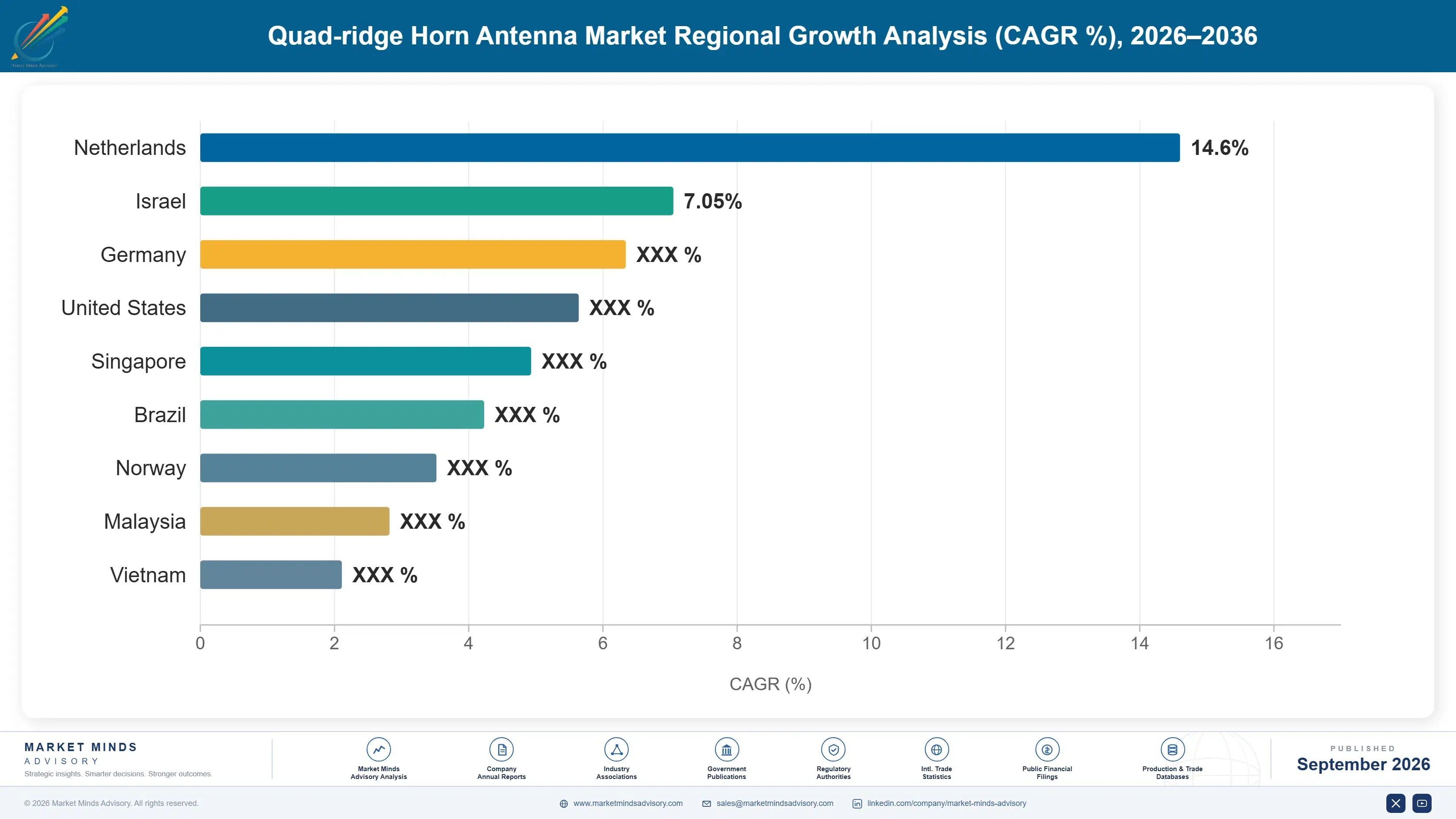
quad-ridge-horn-antenna-market-country-cagr-analysis-1789985149592

How Suppliers Defend These Positions

A quad-ridge horn is a machined metal object with no moving parts, which should make this a commodity business and does not. What protects margin is accredited calibration capability, machining tolerance at millimetre-wave frequencies, and defence qualifications that exclude most bidders. The four levers below address each of those rather than the antenna design itself.

Own The Accredited Calibration Facility Outright

A laboratory cannot use an antenna whose calibration is not traceable to a national standard, so the certificate is the product and the metalwork is a delivery mechanism. Manufacturers who own accredited measurement capability control their own schedules, their own margin and the credibility an auditor checks. Those who contract it out pay for the service, wait in somebody else's queue and lose the technical conversation with the customer. This single requirement explains a 46% top five concentration in a product that is fundamentally machined aluminium. The capital cost is a chamber and an accreditation process running over a year.
Market Impact: Accreditation explains the 46% top five concentration here

Bring Millimetre-Wave Machining Inside The Business

Ridge geometry that is perfectly adequate at 18 GHz produces unusable results at 90, because tolerances scale with wavelength and the wavelength has shrunk by a factor of five. Suppliers who subcontract their metalwork discover that the machine shop delivering good horns for the lower bands cannot hold the tolerance further up, and the iteration loop across a supplier relationship is slow and expensive. Millimetre-wave horns compound at 14.1% against 9.4% for the market, and owning the machining is what lets a supplier chase that growth rather than watching it.
Market Impact: Millimetre-wave horns compound at 14.1% against 9.4% overall

Qualify For Classified Defence Programme Supply

Electronic warfare and signals intelligence procurement has risen sharply across NATO members, the Indo-Pacific and the Gulf, and a single direction-finding array carries 4 or more quad-ridge elements. Those programmes require security clearances, domestic manufacturing and supply chain documentation that exclude most of the world's suppliers before any technical evaluation happens. A supplier holding those qualifications competes against two or three others rather than twenty. The cost is compliance overhead and facility investment against orders that arrive in blocks and then stop, which is an uncomfortable revenue pattern to carry.
Market Impact: Each array carries 4 or more horn elements

Sell Throughput To Satellite Production Engineers

The satellite buyer has changed and most suppliers have not noticed. A research engineer specifying a measurement chamber cared about accuracy and would wait a week for a result. A manufacturing engineer running a constellation line at hundreds of units a year cares about how many spacecraft pass through per shift, and a chamber taking a week each is the bottleneck on the whole programme. Suppliers who quote measurement time per unit rather than pattern accuracy win those conversations. Dual-polarised satellite test horns compound at 11.8% and this is who is buying them.
Market Impact: Satellite test horns compound at 11.8% every year

Who Controls the Margin Pool

Five suppliers hold 46% of shipped antenna units, concentrated not by manufacturing difficulty but by the accredited calibration facilities a credible supplier must own. ETS-Lindgren leads, with Rohde & Schwarz close behind on the strength of complete test system sales. Microwave Vision Group, Schwarzbeck and A.H. Systems follow. The gap between leader and third is narrow. All participants are assessed on shipped antenna units.
Two different businesses run under one product description. System suppliers sell antennas inside complete chambers, positioners and software, where the horn is one line on a large order and the competition is about integration. Component suppliers sell the antenna alone into laboratories that already own everything else, competing on calibration credibility and price. Neither group finds it easy to operate in the other's territory.

Rankings shift on two pressures. Chinese domestic manufacturers including Chengdu AINFO now supply much of the largest regional market, and Western suppliers are losing access there faster than they discuss publicly. The second is millimetre-wave capability: machining tolerance decides who can serve above 40 GHz, and that sorts suppliers differently from how the lower bands did for thirty years.
quad-ridge-horn-antenna-market-company-positioning-matrix-1789985150119

Competitive Moat and Risk Dimensions

ETS-LINDGREN

Moat: Complete Test System Integration

ETS-Lindgren sells chambers, absorber, positioners, software and antennas as one delivered facility, so the horn arrives inside a project rather than as a catalogue purchase. A laboratory buying a complete chamber has no practical reason to source the antenna separately, and the integration risk of doing so falls entirely on the customer. Component specialists never enter that conversation.
ETS-LINDGREN

Risk: Chamber Project Dependence

Antenna volume rides on chamber construction, which is capital spending that stops in a difficult year while compliance testing itself continues regardless. A specialist selling replacement antennas into existing laboratories has a steadier book. Chinese domestic suppliers are also taking chamber projects in the largest regional market, and a system position is harder to defend there than a component one.
ROHDE & SCHWARZ

Moat: Instrument Customer Base

Rohde & Schwarz already supplies the spectrum analysers, receivers and signal generators in most compliance laboratories, so the antenna arrives inside an established technical relationship with an engineer who trusts the brand. That access is worth more than any specification advantage in a market where buyers are cautious by profession. Privately held ownership also allows patient investment in calibration capability.
ROHDE & SCHWARZ

Risk: Antennas Remain Peripheral

Antennas are a small line beside a very large instrument business, and engineering attention follows revenue rather than strategic interest. A specialist devoting its entire development budget to horn design responds faster when a customer needs a new frequency range characterised. Breadth wins the account relationship and can lose the individual product decision, particularly at millimetre-wave frequencies where machining matters.

Players Tracked

Prominent Players

ETS-Lindgren
Rohde & Schwarz
Microwave Vision Group
Schwarzbeck Mess-Elektronik
A.H. Systems

Other Key Players

Com-Power
Sunol Sciences
TDK RF Solutions
AR RF/Microwave Instrumentation
Antenna Research Associates
Steatite
Flann Microwave
Narda Safety Test Solutions
Eravant
Millitech
QuinStar Technology
RFspin
Chengdu AINFO
Frankonia Group
Teseq

Recent Developments

MAY 2025

ETS-Lindgren Extends Horn Range Into Millimetre-Wave Bands

ETS-Lindgren extended its quad-ridged horn range with products covering millimetre-wave frequencies, an organic product development rather than an acquisition. The extension targets automotive radar testing at 77 GHz and satellite ground station work, where machining tolerance rather than electromagnetic design limits what a supplier can deliver.
Signal: The growth in this category sits above forty gigahertz, and machining capability decides who reaches it.
SEPTEMBER 2024

Microwave Vision Group Expands Satellite Measurement System Capacity

Microwave Vision Group expanded its antenna measurement system manufacturing capacity, an organic capital investment rather than a joint venture or acquisition. The expansion targets satellite constellation manufacturers who now run several measurement setups in parallel because a single chamber has become the bottleneck on a production line.
Signal: Satellite antenna measurement has become a production throughput problem rather than a research accuracy one entirely.
FEBRUARY 2025

Schwarzbeck Adds Accredited Calibration Capacity At German Facility

Schwarzbeck Mess-Elektronik added accredited calibration capacity at its German facility, an organic investment rather than a partnership or acquisition of any kind. The capacity addresses scheduling delays that had left customers waiting for certificates, in a market where the certificate rather than the antenna is what a laboratory actually needs.
Signal: Calibration throughput, not antenna production capacity, is the constraint that actually limits supply in this market.

What A Horn Costs To Build

Precision machined aluminium and the ridge assembly account for roughly 34% of unit cost, with material sourced from standard aerospace-grade stock across North America and Europe. Coaxial connectors and the orthomode feed transition add about 19%, from a small group of specialist microwave connector suppliers. Accredited calibration and documentation carry around 24%, and surface plating and assembly the balance.
Rohde & Schwarz Annual Report 2024 records precision manufacturing and skilled labour availability as the dominant cost pressures across its instrument and antenna operations. Amphenol Annual Report 2024 notes comparable pressure on microwave connector product lines, where the specialist supplier base is narrow. The 2022 European energy crisis raised machining and plating cost across German manufacturing, and suppliers there carried it through a period when accredited competitors elsewhere did not face the same increase.

The competitive disadvantage mechanism is calibration throughput rather than any input price. A manufacturer without its own accredited facility waits in somebody else's queue, which lengthens lead times and hands scheduling control to a third party. Machinists capable of holding millimetre-wave tolerances are also scarce and expensive, and that scarcity varies sharply by country rather than by company size. Geography decides most of it.
quad-ridge-horn-antenna-market-cost-volatility-analysis-1789985150316

Build Accredited Calibration Capacity Rather Than Contracting It

Accredited calibration and documentation carry around 24% of unit cost and all of the scheduling risk. A manufacturer contracting it out waits in another organisation's queue and cannot promise a delivery date with confidence. Owning the chamber and the accreditation converts a variable cost with unpredictable timing into a fixed asset that improves with utilisation.

Standardise Connector And Feed Transition Across Ranges

Coaxial connectors and the orthomode feed transition run about 19% of unit cost from a narrow specialist supplier base with limited negotiating room. Designing the whole product range around two connector interfaces rather than eight improves purchasing position and cuts the inventory that fragmentation creates. The constraint is legacy customer expectations, which matter less than most suppliers assume.

Train Millimetre-Wave Machinists Rather Than Recruiting Them

Machinists capable of holding millimetre-wave tolerances are scarce, expensive and concentrated in a handful of industrial regions, which makes recruitment a bidding contest nobody wins cheaply. Training existing staff on the specific ridge geometries a product range requires costs less and produces people who stay. The constraint is the training period, measured in years rather than months.

Portfolio Architecture for Margin Defence

Margin architecture separates on frequency and qualification rather than on manufacturing sophistication. Broadband emission measurement horns and anechoic chamber reference units earn least, sold into a mature laboratory base against several credible competitors. Ruggedised field measurement horns sit in the middle on environmental certification. Millimetre-wave and defence direction-finding horns earn most, because machining tolerance in one case and security qualification in the other reduce the credible supplier list to a very short one.
The volume versus premium tension here is a machine shop allocation problem. The same equipment and the same people produce a routine emission horn and a millimetre-wave one, but the second takes several times longer and demands the most capable operators. A supplier chasing volume fills the shop with work that trains nobody and earns little. That allocation decision is made weekly and compounds over years.

High-value pools sit in millimetre-wave testing and in defence direction finding, and they reward entirely different things. Millimetre-wave rewards machining capability and calibration reach at frequencies most suppliers cannot certify. Defence rewards clearances, domestic manufacturing and documentation nobody enjoys producing. Very few suppliers hold both, and the one that manages it competes against almost nobody.

Volume / Commodity-Adjacent

Broadband emission measurement horns and anechoic chamber reference units sold into a mature laboratory base with several credible competitors. The eight point spread separates suppliers owning accredited calibration from those contracting it out.
Gross Margin: 28% to 36%

Premium / Certified

Ruggedised field measurement horns and dual-polarised satellite test units sold on environmental certification and throughput rather than price. The ten point spread tracks how much of a supplier's book sits inside long-running programme relationships.
Gross Margin: 42% to 52%

Sustainability / Regulatory / Next-Generation

Millimetre-wave horns and defence direction-finding units, where machining tolerance and security qualification reduce the credible supplier list drastically. The twelve point spread reflects how differently each supplier amortised its machining and accreditation investment.
Gross Margin: 56% to 68%
quad-ridge-horn-antenna-market-portfolio-architecture-1789985150812

High-value Sub-segments and Strategic Watch-out

Millimetre-Wave Quad-Ridge Horns

Grows at 14.1% as test requirements climb past 40 GHz for automotive radar and satellite work, invalidating hardware that was adequate recently. The twelve point spread separates suppliers owning millimetre-wave machining from those subcontracting metalwork. Nobody enters this segment from the lower bands at all.
Gross Margin: 56% to 68%

Direction-Finding And Electronic Warfare Horns

Grows at 10.2% on defence spending across NATO members, the Indo-Pacific and the Gulf, with each array carrying several elements. The twelve point spread reflects clearance and domestic manufacturing status rather than product quality. Orders arrive in blocks and then stop entirely for quarters on end.
Gross Margin: 56% to 68%

Broadband Emission Measurement Horns

Grows at 8.6% and carries most of the shipped volume in this market, sold into roughly 9200 accredited compliance laboratories worldwide. The eight point spread reflects calibration ownership rather than any product advantage. Demand is unusually predictable because the testing obligation is written into law.
Gross Margin: 28% to 36%

Anechoic Chamber Reference Horns

Grows at 7.4%, slowest of the six classes, because a reference antenna with no moving parts lasts over 20 years and recalibration extends it further. The eight point spread reflects calibration ownership. Replacement happens on frequency requirements rather than on any failure at all here.
Gross Margin: 28% to 36%

How Laboratories Actually Buy

The annuity is the calibration rather than the antenna. A laboratory that buys a horn returns it to an accredited facility every 12 months for the rest of its working life, which can run over 20 years, and that recurring service is worth a substantial multiple of the original hardware sale. Suppliers who own the calibration capability collect it. Those who do not sold a box once.
Adoption depth varies sharply by application. Compliance laboratories adopt broadly and permanently, buying whatever the current standard requires and keeping it for decades. Satellite manufacturers adopt by programme and buy in multiples because throughput matters. Defence programmes adopt through qualification and then never revisit the decision. Research facilities adopt at the frequency frontier and replace fastest, which makes them small in volume and useful as an early signal.

The buyer has moved from a test engineer to a facility manager in the compliance segment and to a manufacturing engineer in satellite work. A test engineer compared radiation patterns. A facility manager asks about calibration turnaround and audit documentation, and a manufacturing engineer asks how many units pass through per shift. Neither question is answered by a datasheet.
quad-ridge-horn-antenna-market-end-use-penetration-index-1789985151305

Where We Would Compete

These are among the four positions where our research anticipates prominent divergence between winners and laggards over the coming forecast period. Each is grounded in the demand model, the regulatory perimeter, and the announced capacity pipeline.
01 / CALIBRATION CAPABILITY OWNERSHIP

Own The Accreditation, Not Just The Machine Shop

A laboratory cannot use an antenna whose calibration is not traceable to a national standard, which makes the certificate the product and the machined metal a delivery mechanism. Manufacturers who own accredited measurement capability control their own schedules, their own margin and the credibility an auditor checks, while those contracting it out wait in another organisation's queue and cannot promise a date. This single requirement explains a 46% top five concentration in a product that is fundamentally machined aluminium, which is the clearest barrier available anywhere in this category.
02 / FREQUENCY FRONTIER INVESTMENT

Bring Millimetre-Wave Machining In House Now

Ridge geometry that is perfectly adequate at 18 GHz produces unusable results at 90, because tolerances scale with wavelength and the wavelength has shrunk by a factor of five. Suppliers who subcontract their metalwork find that the shop delivering good horns for the lower bands cannot hold tolerance further up, and iterating across a supplier relationship is slow and expensive. Millimetre-wave horns compound at 14.1% against 9.4% for the market, so owning the machining is what separates a supplier chasing that growth from one watching it happen elsewhere.
03 / DEFENCE QUALIFICATION PRIORITY

Get Cleared Before The Programme Opens

Electronic warfare and signals intelligence procurement has risen sharply across NATO members, the Indo-Pacific and the Gulf, and a single direction-finding array carries 4 or more quad-ridge elements. Those programmes require security clearances, domestic manufacturing and supply chain documentation that exclude most of the world's suppliers before any technical evaluation begins at all. A supplier holding those qualifications competes against two or three others rather than twenty, and the cost is compliance overhead against orders that arrive in blocks and then stop for quarters.
04 / SATELLITE THROUGHPUT SELLING

Quote Measurement Time, Not Pattern Accuracy

The satellite buyer changed from a research engineer who cared about accuracy and would wait a week for a result to a manufacturing engineer running a constellation line at hundreds of units a year. That engineer cares about how many spacecraft pass through per shift, because a chamber taking a week each becomes the bottleneck on an entire production programme. Dual-polarised satellite test horns compound at 11.8% and the suppliers winning that business are quoting measurement time per unit rather than pattern accuracy, which almost nobody else has adjusted to.

Engagement Snapshot From the Field

A live engagement with an industry participant carrying material or product regulatory and market exposure ahead of a defining policy shift, showing how our research translates into a defensible multi-year portfolio strategy.
MARKET MINDS ADVISORY · CLIENT ENGAGEMENT SUMMARY
Quad-ridge Horn Antenna Producer Strategic Portfolio Review and Transition Roadmap 2026·Investment Scenario on Quad-ridge Horn Antenna Exposure Evaluation 2025-26
CLIENT PROFILE
An Asian satellite manufacturer moving from bespoke spacecraft to constellation production, targeting several hundred units annually from a new assembly facility. Antenna pattern and payload verification ran through a single measurement chamber inherited from the bespoke era, taking roughly a week per satellite. The production plan assumed that chamber would somehow keep pace, and nobody had modelled it.
STRATEGIC CHALLENGE
Engineering wanted a second chamber and finance wanted evidence before committing the capital. Neither side had a throughput model, and the antenna suppliers being consulted quoted pattern accuracy figures that answered a question nobody was asking. A decision was needed before the assembly facility opened, which left two quarters. The capital request had already been deferred once.
MMA APPROACH
MMA modelled measurement throughput against the planned production rate, breaking the chamber cycle into setup, positioning, sweep and teardown to find where the week actually went. We benchmarked parallel setup configurations used by constellation manufacturers elsewhere, and drew on 47 expert interviews conducted in Q4 2025 across antenna suppliers, chamber integrators and satellite production engineers.
KEY FINDINGS
  1. Actual measurement swept time was under 2 days of the week-long cycle, with setup and positioning consuming the rest (client-reported, unverified by MMA).
  2. A second chamber would have cost roughly 3 times what additional positioners and quick-change antenna mounts in the existing chamber would deliver in throughput.
  3. Only 2 of the 6 antenna suppliers approached could quote measurement time per unit at all, and both had worked with constellation manufacturers before.
  4. Dual-polarised horns removed a full rotation step per measurement, which alone cut cycle time meaningfully without any capital spending on the chamber itself.
CLIENT PROFILE
An Asian satellite manufacturer moving from bespoke spacecraft to constellation production, targeting several hundred units annually from a new assembly facility. Antenna pattern and payload verification ran through a single measurement chamber inherited from the bespoke era, taking roughly a week per satellite. The production plan assumed that chamber would somehow keep pace, and nobody had modelled it.
STRATEGIC CHALLENGE
Engineering wanted a second chamber and finance wanted evidence before committing the capital. Neither side had a throughput model, and the antenna suppliers being consulted quoted pattern accuracy figures that answered a question nobody was asking. A decision was needed before the assembly facility opened, which left two quarters. The capital request had already been deferred once.
MMA APPROACH
MMA modelled measurement throughput against the planned production rate, breaking the chamber cycle into setup, positioning, sweep and teardown to find where the week actually went. We benchmarked parallel setup configurations used by constellation manufacturers elsewhere, and drew on 47 expert interviews conducted in Q4 2025 across antenna suppliers, chamber integrators and satellite production engineers.
KEY FINDINGS
  1. Actual measurement swept time was under 2 days of the week-long cycle, with setup and positioning consuming the rest (client-reported, unverified by MMA).
  2. A second chamber would have cost roughly 3 times what additional positioners and quick-change antenna mounts in the existing chamber would deliver in throughput.
  3. Only 2 of the 6 antenna suppliers approached could quote measurement time per unit at all, and both had worked with constellation manufacturers before.
  4. Dual-polarised horns removed a full rotation step per measurement, which alone cut cycle time meaningfully without any capital spending on the chamber itself.
RECOMMENDED STRATEGY
Phase 1: Phase one: defer the second chamber and invest in additional positioners, quick-change mounts and dual-polarised horns inside the existing facility instead. Phase 2: Phase two: shortlist only antenna suppliers able to quote measurement time per unit, since pattern accuracy figures do not answer the throughput question. Phase 3: Phase three: report measured satellites per shift alongside production rate in every programme review, so the bottleneck is visible before it binds.
OUTCOME
The client deferred the second chamber and reconfigured the existing facility with additional positioners and dual-polarised horns (client-reported, unverified by MMA). Measured throughput roughly doubled at a fraction of the capital originally requested. Satellites measured per shift now appears alongside production rate in the standard programme review pack.

Frequently Asked Questions

Foundational context covering the market sizes, CAGR, scope, country, region and competition that inform every finding below. This section is provided to cover basics and most often pre-purchase conversations, answered from the MMA Primary Research Dataset.

What is the current size of the Quad-ridge Horn Antenna Market?

Global value reaches USD 0.32 billion in 2026, measured as supplier revenue across all quad-ridged horn antenna classes. The 2025 base is USD 0.29 billion.

How large will the Quad-ridge Horn Antenna Market be by 2036?

Supplier revenue reaches USD 0.79 billion by 2036, an increase of USD 0.47 billion over the forecast period. That represents 2.47 times expansion from the 2026 base.

What is the CAGR for the Quad-ridge Horn Antenna Market 2026 to 2036?

The base case runs at 9.4% annually, with a bull case at 10.6% if sixth generation research commits above 100 GHz and a bear case at 8.2% if chamber utilisation stays flat.

Which segment is growing fastest?

Millimetre-wave quad-ridge horns grow at 14.1%, half again the market rate of 9.4%. Test requirements climbing past 40 GHz for automotive radar and satellite work drive the whole difference.

Who are the major companies in the Quad-ridge Horn Antenna Market?

ETS-Lindgren, Rohde & Schwarz, Microwave Vision Group, Schwarzbeck Mess-Elektronik and A.H. Systems lead on shipped antenna units, together holding 46%, with Com-Power, Sunol Sciences and RFspin in smaller positions.

Which country is growing fastest?

China leads at 12.6%, on satellite programme testing and 5G infrastructure work alongside the compliance volume that follows electronics manufacturing. India and South Korea follow some way behind.

Report Segmentation Architecture

The full report scope spans multiple orthogonal segmentation dimensions, with cross-tabulated demand data provided for each dimension pair. Coverage extends further to regional breakdowns, trend trajectories, and the competitive detail needed to support segment-level decision-making.

By Antenna Class

  • Millimetre-Wave Quad-Ridge Horns
  • Dual-Polarised Satellite Test Horns
  • Direction-Finding And Electronic Warfare Horns
  • Broadband Emission Measurement Horns
  • Anechoic Chamber Reference Horns
  • Ruggedised Field Measurement Horns

By End-Use Industry

  • Electronics Compliance Testing
  • Satellite And Space Systems
  • Automotive Radar Development
  • Defence And Electronic Warfare
  • Telecommunications Infrastructure
  • Academic And Research Institutions

By Commercial Dimension

  • Direct Laboratory Supply
  • Chamber System Integrator Channel
  • Defence Prime Contractor Supply
  • Test Equipment Distribution
  • Original Equipment Manufacturer Embedding
  • Calibration And Service Contracts

By Region

  • North America
  • Western Europe
  • East Asia
  • South Asia and Pacific
  • Latin America
  • Middle East and Africa
  • Eastern Europe

Scope, Methodology, and Coverage

Every figure in this report is reproducible from documented input assumptions. The scope below maps the historical period, the forecast horizon, the segmentation dimensions, and the countries covered, alongside the underlying primary and qualitative methodology.
Historical Period
2020 to 2025
Forecast Period
2026 to 2036
Base Year
2025 (USD billions; MMA Primary Research Dataset, September 2026)
Market Definition
This report covers quad-ridged horn antennas: broadband dual-polarised horns using four internal ridges to extend usable bandwidth, sold for electromagnetic compatibility testing, antenna measurement, satellite ground testing, radar characterisation and direction finding. It excludes single-ridged and unridged horns, log-periodic and biconical antennas, anechoic chamber absorber and construction, spectrum analysers and receivers, and the amplifier chains these antennas connect to.
Quantitative Units
USD millions, supplier revenue basis; shipped antenna units; frequency coverage ratio; cross-polarisation isolation in decibels; average selling price in USD.
Segmentation Dimensions
Antenna class; end-use industry; commercial channel; geography across seven regions.
Regions Covered
North America, Western Europe, East Asia, South Asia and Pacific, Latin America, Middle East and Africa, Eastern Europe
Countries Covered
China, Taiwan, Japan, South Korea, India, Australia, United States, Canada, Mexico, Brazil, Germany, United Kingdom, France, Netherlands, Italy, Poland, Czechia, Israel, Saudi Arabia, South Africa.
Key Companies Profiled
ETS-Lindgren, Rohde & Schwarz, Microwave Vision Group, Schwarzbeck Mess-Elektronik, A.H. Systems, Com-Power, Sunol Sciences, TDK RF Solutions, Antenna Research Associates, Steatite, Flann Microwave, Narda Safety Test Solutions, Eravant, RFspin, Chengdu AINFO.
Quantitative Methodology
Primary survey, n=3,800 respondents, Q4 2025, six countries; demand-side model with trade association cross-validation
Qualitative Methodology
47 expert interviews, Q4 2025; applied to validate demand model assumptions, identify emerging dynamics, and assess competitive positioning
Report Format
PDF and XLSX data workbook (Word format preview document)
Publisher
Market Minds Advisory
Report Code
MMA-2026-TEC-341
Published
September 2026
Contact
sales@marketmindsadvisory.com | www.marketmindsadvisory.com

Purchase the full Quad-ridge Horn Antenna Market Report (2026 to 2036).

This report sizes the global quad-ridged horn antenna market from 2026 to 2036 across six antenna classes, six end-use industries and seven regions. It explains why accredited calibration capability rather than antenna design decides who can supply, and why that produces 46% top five concentration in a machined metal product. Cost composition is sourced to company annual reports, with precision machining at 34% of unit cost. Regional analysis explains why East Asia leads at 34% of demand on compliance testing following electronics manufacturing. Competitive assessment covers 20 named suppliers with four revenue lever analyses and an anonymised satellite measurement capacity engagement.
Calibration accreditation modelled as the primary entry barrier
Six antenna classes sized through to 2036
Machining and calibration cost composition from filings
Twenty named suppliers assessed on shipped units
Four revenue levers with quantified commercial impact
Anonymised satellite measurement capacity engagement included in full

Built For The People Who Decide

From boardroom strategy to bench-side execution, this report is read cover-to-cover by leaders shaping the next decade of their industry, turning demand scenarios, market dynamics and valuation benchmarks into decisions.
CXOs/ Presidents/ VPs/ Managers
M&A and Corporate Development
Strategy Teams and R&D Heads
Procurement and Product Directors
Regulatory and Compliance Leaders
Investor Relations and Equity Analysts