Market Minds Advisory
QR Code Labels Market

QR Code Labels Market: QR Code Labels Market. Traceability, Anti-Counterfeiting, and Consumer Engagement Labeling Through 2036

Food safety recalls and counterfeit pharmaceutical scandals push brand owners toward dynamic QR labeling that doubles as supply chain traceability infrastructure and direct-to-consumer marketing channel embedded on every package reflecting sustained brand.

Lead Analyst

Published

September 2026

Make Smarter Decisions with Customized Research Insights

Request a free sample report and evaluate market opportunities, growth trends, and competitive dynamics relevant to your business needs.

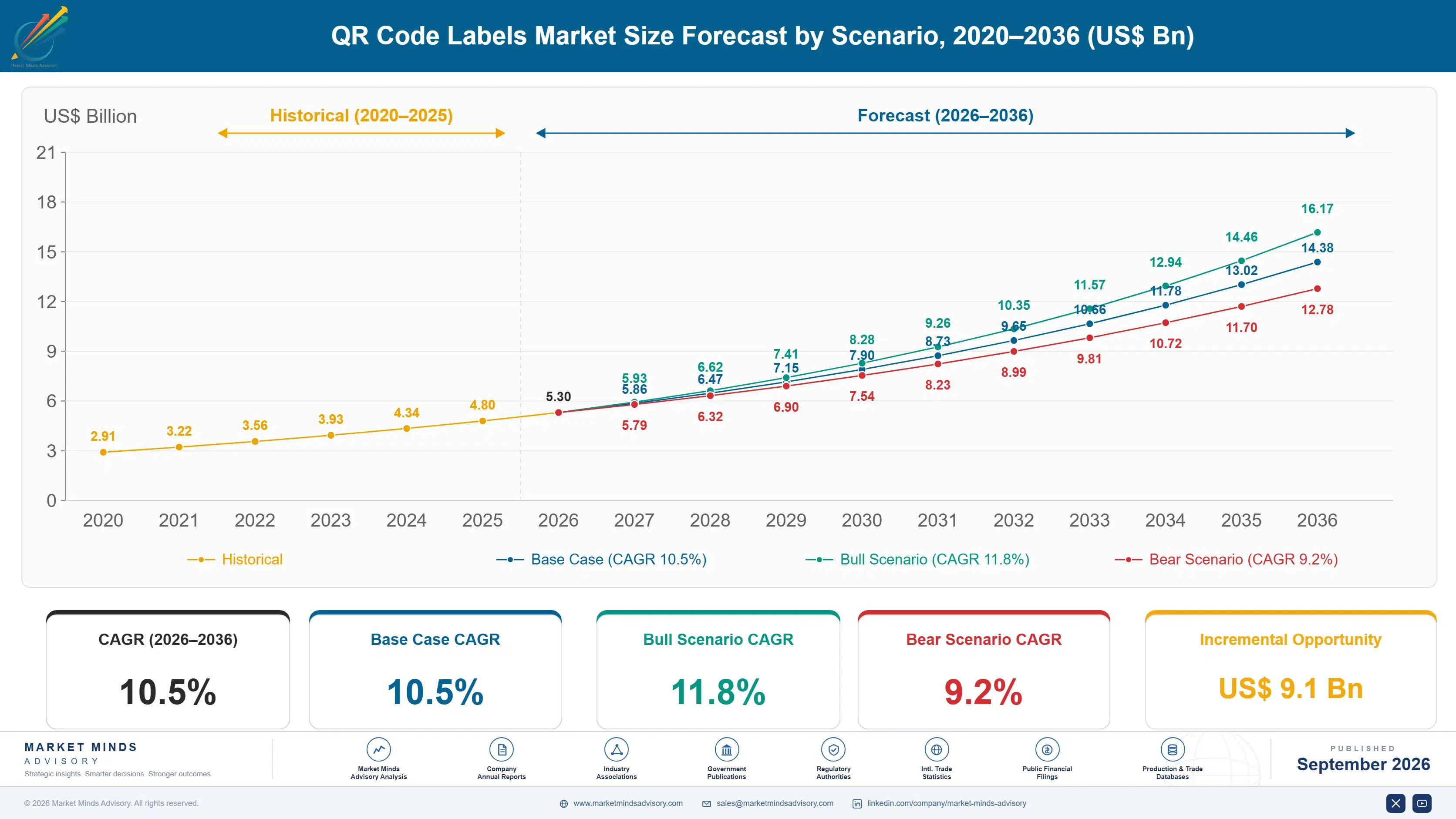
2025 MARKET VALUE$4.8BMarket Size 2025
2036 FORECAST VALUE$14.4BBase Case , 2026 to 2036
CAGR 2026 TO 203610.5 %Bull 11.8% / Bear 9.2%
INCREMENTAL OPPORTUNITY$9.1BNet 10- year value creation
EXPANSION MULTIPLE2.71x2036 value over 2026 base
Strategic Levers
M&A Pipeline
Regional Outlook
Country Rankings
Competitive Intelligence
Segmental Deep-dive
Call-Us : 91 93563 13602

Executive Snapshot and Market Trajectory.

Brand owners are converting QR code labels from simple product links into full supply chain traceability infrastructure as food safety recalls and counterfeit pharmaceutical scandals push regulators toward mandatory serialization requirements reflecting sustained brand owner investment across traceability and consumer engagement programs as adoption continues.
Dynamic QR codes with cloud-linked data represent the fastest-growing category, as brands update label content remotely without reprinting physical labels across entire product runs. Food and beverage and pharmaceutical categories drive the largest share of spending given regulatory traceability mandates. South Asia and East Asia account for the largest demand concentration, reflecting large-scale pharmaceutical serialization programs and dense packaging manufacturing clusters reflecting sustained brand owner investment across traceability and consumer engagement programs as adoption.
Competition splits between established label printing converters adding digital capability to existing production lines and newer software-first traceability platform vendors building QR generation and data management tools from scratch. Rising counterfeit pharmaceutical concerns and evolving national serialization mandates both shape which vendors can scale compliant labeling solutions across multiple regulatory jurisdictions simultaneously reflecting sustained brand owner investment across traceability and consumer engagement programs as adoption continues.
Market Definition
This report covers printed and digital labels incorporating QR codes for product traceability, anti-counterfeiting verification, and consumer engagement across packaged goods. It excludes generic barcode labeling without QR code functionality and standalone track-and-trace software without a physical labeling component reflecting sustained brand.
Base Year Value
$4.8B in 2025 (MMA Primary Research Dataset, September 2026)
Forecast Period
2026 to 2036, eleven discrete annual values
CAGR
10.5% base case. Bull 11.8%. Bear 9.2%.
Fastest Growth Segment
Dynamic QR Codes with Cloud-Linked Data: 15.0% CAGR
Fastest Growth Country
India: 13.0% CAGR
Fastest Growth Region
South Asia and Pacific: 13.0% CAGR
Largest Region
East Asia: 25% of 2025 global value
Market Leaders
Avery Dennison Corporation, CCL Industries Inc, Zebra Technologies Corporation, Honeywell International Inc, SATO Holdings Corporation. Source: MMA Primary Research Dataset, July 2026.
Primary Survey
n=3,800 procurement and R&D decision-makers, Q4 2025, six countries
Methodology
Demand-side build-up, cross-validated against public data, 47 expert interviews

QR Code Labels Market Forecast Scenarios

qr-code-labels-market-size-forecast-scenario-1789992600583
The 2020 to 2025 period saw accelerating adoption as pandemic-driven contactless verification needs and expanding pharmaceutical serialization mandates pushed brand owners toward QR code labeling faster than previous voluntary adoption patterns had suggested reflecting sustained brand owner investment across traceability and consumer engagement programs as adoption continues expanding across food, apparel, and pharmaceutical packaging categories supporting consistent order.
MMA's base case assumes continued double-digit growth driven by three commercial mechanisms: expanding pharmaceutical serialization mandates requiring unit-level traceability across major markets, growing food safety traceability requirements following high-profile contamination recalls, and rising brand owner adoption of dynamic QR codes for direct-to-consumer marketing engagement beyond pure compliance functions reflecting sustained brand owner investment across traceability and consumer engagement programs as adoption continues expanding across food, apparel, and pharmaceutical packaging categories supporting consistent order growth across label.
The bull case centers on faster-than-expected expansion of mandatory serialization requirements into additional product categories beyond pharmaceuticals. The bear case centers on smartphone-native scanning alternatives reducing dedicated QR infrastructure investment, with several brands already exploring near-field communication chips as a competing verification technology reflecting sustained brand owner investment across traceability and consumer engagement programs as adoption continues expanding across food, apparel, and.

Dynamic Codes Turn Labels Into Data Infrastructure

QR code label demand concentrates in pharmaceutical and food and beverage categories today, though dynamic QR codes with cloud-linked data are the fastest-growing category as brands seek remote content update capability. Established label converters maintain the strongest brand relationships given existing production line integration reflecting sustained brand owner investment across traceability and consumer engagement programs as adoption continues expanding across food, apparel,.
MARKET CONCENTRATIONCR5 32%Fragmented across converters, software vendors, and regional print specialists.
AVERAGE SELLING PRICE$0.008 per label unitReflects substrate, printing, and cloud data platform integration cost.
TOP PRODUCING COUNTRY SHAREChina 22%Concentrated among large-scale label converting and printing manufacturing clusters.
CAPACITY UTILISATION69% averageIndicates meaningful headroom before converters require new capacity reflecting.
PHARMACEUTICAL COMPLIANCE SHARE38% of category revenueReflects mandatory serialization requirements driving regulated category demand reflecting.
TRADE INTENSITY26% cross-borderReflects converters serving brand headquarters across multiple regions reflecting.
Vendors increasingly bundle cloud data management platforms with physical label printing, shifting revenue mix toward recurring software subscription fees tied to code scan volume rather than pure per-label printing margin. This mirrors a broader shift across packaging technology from one-time printing toward ongoing data platform monetization reflecting sustained brand owner investment across traceability and consumer engagement programs as adoption continues expanding across.
Brand owners weigh dynamic QR investment against static code simplicity, since dynamic codes carry ongoing platform subscription costs beyond the initial label printing expense. The converters succeeding most combine compliant serialization capability with consumer engagement features that justify the added subscription cost reflecting sustained brand owner investment across traceability and consumer engagement programs as adoption continues expanding across food, apparel, and pharmaceutical packaging.
"The label used to be the last thing anyone thought about in the supply chain, now it's often the only physical touchpoint connecting a."
Director, Packaging Technology and Traceability Systems Practice · MMA Packaging: Digital Identification and Traceability Labeling Systems Practice · September 2026

Market Trends

Dynamic QR Codes Enable Remote Content Updates Without Reprinting.

Brand owners are increasingly adopting dynamic QR codes that link to cloud-hosted content rather than encoding fixed data directly, letting them update recipe information, recall notices, or marketing content remotely without reprinting labels across entire product runs already in market. This capability has proven particularly valuable during food safety recalls, where brands can push updated safety information to consumers scanning already-purchased products without any physical label change required. Adoption has expanded meaningfully beyond pharmaceutical compliance use cases into consumer packaged goods seeking flexible marketing content management reflecting sustained brand owner investment across traceability and consumer engagement programs as.
Market Impact: Narrows recall scope by 70 percent.

Pharmaceutical Serialization Mandates Expand Into Additional Markets reflecting sustained.

Regulatory serialization mandates requiring unit-level QR or data matrix coding on pharmaceutical packaging continue expanding into additional national markets beyond the United States and European Union frameworks already in force, with several emerging markets finalizing similar requirements over the coming years. The Drug Supply Chain Security Act and European Falsified Medicines Directive have established compliance frameworks that other regulators increasingly reference when designing their own national serialization requirements. This regulatory expansion creates a predictable multi-year demand pipeline for compliant labeling converters serving pharmaceutical manufacturers across newly regulated markets reflecting sustained brand owner investment across traceability and consumer engagement.
Market Impact: Addresses 10 percent counterfeit supply share.

Market Opportunities and Growth Drivers

Food Safety Recalls Drive Mandatory Traceability Label Adoption reflecting.

High-profile food contamination recalls across major markets continue pushing regulators and retailers toward mandatory traceability labeling requirements that let contaminated products be identified and removed from shelves rapidly rather than requiring broad precautionary recalls across entire product categories. Major retailers increasingly require QR-based traceability labeling as a supplier condition, extending compliance pressure beyond regulatory mandates alone into commercial procurement requirements. This retailer-driven adoption has accelerated traceability labeling penetration considerably faster than regulation alone would have achieved across the food and beverage supply chain broadly reflecting sustained brand owner investment across traceability and consumer engagement programs as adoption continues.
Market Impact: Reduces scan rates by 25 percent.

Counterfeit Pharmaceutical Concerns Drive Anti-Counterfeiting Label Investment reflecting sustained.

Rising counterfeit pharmaceutical prevalence across emerging markets continues driving pharmaceutical manufacturers toward tamper-evident QR labeling incorporating cryptographic verification features that let pharmacists and consumers confirm product authenticity before use. The World Health Organization estimates counterfeit medicines represent a meaningful share of pharmaceutical products circulating in certain regions, creating both a public health concern and a significant commercial incentive for manufacturers to invest in stronger anti-counterfeiting label technology. This driver concentrates most heavily in markets with historically weaker pharmaceutical supply chain oversight and enforcement capability reflecting sustained brand owner investment across traceability and consumer engagement programs as adoption continues.
Market Impact: Captures up to 15 percent share.

Market Restraints and Challenges

Smartphone Scanning Fatigue Limits Consumer Engagement Feature Value reflecting.

Consumer willingness to scan QR codes for marketing and engagement purposes, as opposed to compliance-driven verification scans, has shown signs of fatigue as QR codes have proliferated across nearly every product category and advertising format. The root cause is that consumers increasingly associate QR codes with advertising friction rather than genuine value, reducing scan rates for marketing-oriented codes even as compliance-driven scanning remains stable. The commercial impact limits the return on investment brands can expect from consumer engagement features layered onto compliance labeling. Vendors are mitigating by designing codes that deliver genuinely useful content, such as recipe suggestions.
Market Impact: Eliminates reprinting across 100 percent of.

Near-Field Communication Chips Compete For Verification Budget reflecting sustained.

Near-field communication chips embedded directly into packaging increasingly compete with QR codes for brand owner verification and authentication budget, offering tap-based authentication that some brands view as a more premium consumer experience than camera-based scanning. The root cause is that near-field communication technology has become considerably cheaper and more reliable in recent years, narrowing its historical cost disadvantage against printed QR codes. The commercial impact falls hardest on QR label vendors serving premium brand categories where near-field communication adoption concentrates most heavily. Vendors are mitigating by developing hybrid labels combining both technologies reflecting sustained brand owner investment across.
Market Impact: Expands mandates covering 2 billion people.
4 additional market trends, 3 additional growth drivers, and 3 additional restraints and challenges are covered in the full report. Contact sales@marketmindsadvisory.com to access the complete intelligence.

Segment CAGR and Growth Architecture

QR code labels span static compliance codes, dynamic cloud-linked codes, and anti-counterfeiting verification labels, each serving distinct brand owner needs. Dynamic codes now grow fastest as brands seek remote content update capability broadly reflecting sustained brand owner investment across traceability and consumer engagement programs as adoption continues expanding across food, apparel, and pharmaceutical packaging categories.
qr-code-labels-market-market-share-analysis-1789992601159

Dynamic QR Codes with Cloud-Linked Data

Dynamic QR codes with cloud-linked data lead all label categories at a 15.0 percent CAGR, roughly 1.43 times the overall market rate, as brand owners increasingly value the ability to update recipe information, recall notices, or marketing content remotely without reprinting physical labels across entire product runs already in market. This capability has proven particularly valuable during food safety recalls, where brands can push updated safety information to consumers scanning already-purchased products without any physical label change required. Adoption has expanded meaningfully beyond pharmaceutical compliance use cases into consumer packaged goods seeking flexible marketing content management, with vendors increasingly bundling cloud data platform subscriptions alongside physical label printing services reflecting sustained brand owner investment across traceability and consumer.
CAGR 15.0%

Anti-Counterfeiting Verification Labels

Anti-counterfeiting verification labels grow at 13.0 percent annually as rising counterfeit pharmaceutical and luxury goods prevalence drives brand owners toward tamper-evident QR labeling incorporating cryptographic verification features that let consumers and retailers confirm product authenticity before purchase or use. The World Health Organization estimates counterfeit medicines represent a meaningful share of pharmaceutical products circulating in certain regions, creating both a public health concern and a significant commercial incentive for manufacturers to invest in stronger anti-counterfeiting technology. This category concentrates most heavily in markets with historically weaker supply chain oversight, where the commercial and reputational cost of counterfeit products justifies premium label technology investment reflecting sustained brand owner investment across traceability and consumer engagement programs as adoption continues expanding.
CAGR 13.0%
Full segment breakdown across 7 segments available in the complete report.

Regional Architecture and Country Demand Map

South Asia and Pacific leads given India's massive pharmaceutical generic manufacturing base and acute counterfeit medicine prevalence, exceeding typical regional demand concentration patterns for this category reflecting sustained brand owner investment across traceability and consumer engagement programs as adoption continues expanding across reflecting sustained brand owner investment.

North America

The United States anchors this region through its Drug Supply Chain Security Act compliance framework requiring unit-level pharmaceutical serialization, alongside substantial food safety traceability investment following several high-profile contamination recalls in recent years. Canada contributes additional demand tied to its own pharmaceutical and food traceability programs. Strong regulatory enforcement keeps demand resilient across the forecast period as compliance requirements continue tightening reflecting sustained brand owner investment across traceability and consumer engagement programs as adoption continues expanding across food, apparel, and pharmaceutical packaging categories supporting consistent order growth across label converter production networks reinforcing demand visibility for converters planning capacity investment ahead reflecting sustained brand owner investment across traceability and consumer engagement programs.
Share: 22% | CAGR: 10.5% (2026 to 2036)

Western Europe

Germany and France anchor regional demand through the European Falsified Medicines Directive compliance framework requiring pharmaceutical serialization across all member states. The United Kingdom contributes additional demand tied to its own post-Brexit traceability requirements maintaining broad alignment with European standards. European growth trails other regions somewhat since its regulatory frameworks matured earlier, leaving less incremental compliance-driven adoption remaining compared with newly regulating markets elsewhere reflecting sustained brand owner investment across traceability and consumer engagement programs as adoption continues expanding across food, apparel, and pharmaceutical packaging categories supporting consistent order growth across label converter production networks reinforcing demand visibility for converters planning capacity investment ahead reflecting sustained brand owner investment across traceability and.
Share: 18% | CAGR: 9.0% (2026 to 2036)
Regional intelligence for 5 additional markets available in the complete report: East Asia, South Asia and Pacific, Latin America, Middle East and Africa, Eastern Europe. Contact sales@marketmindsadvisory.com.
qr-code-labels-market-country-cagr-analysis-1789992601699

Where Converters Can Capture Additional Margin reflecting.

Converters capture disproportionate value by shifting mix toward cloud data platform subscriptions and anti-counterfeiting verification services that command premium pricing beyond standard label printing alone across the value chain reflecting sustained brand owner investment across traceability and consumer engagement programs as adoption continues expanding across food, apparel, and pharmaceutical packaging categories supporting consistent order growth.

Bundle Cloud Data Platform Subscriptions With Label Printing Contracts.

Converters offering cloud-hosted data management platforms bundled with physical label printing capture an estimated 30 percent higher average contract value than printing-only competitors, converting a one-time label sale into a recurring subscription revenue stream tied to scan volume and content update frequency. Brand owners prefer bundled procurement since it simplifies vendor management for both physical printing and ongoing digital content administration reflecting sustained brand owner investment across traceability and consumer engagement programs as adoption continues expanding across food, apparel, and pharmaceutical packaging categories supporting consistent order growth across label converter production networks.
Market Impact: Adds approximately 30 percent higher contract value reflecting.

Expand Cryptographic Anti-Counterfeiting Verification Service Offerings reflecting sustained brand.

Converters developing cryptographic anti-counterfeiting verification capability are winning pharmaceutical and luxury goods contracts worth over 350 million dollars combined annually, since brand owners in categories with significant counterfeit exposure pay meaningfully more for verified authentication technology than standard QR printing. This capability creates durable multi-year contract relationships once a verification system is qualified into a brand's compliance infrastructure reflecting sustained brand owner investment across traceability and consumer engagement programs as adoption continues expanding across food, apparel, and pharmaceutical packaging categories supporting consistent order growth across label converter production networks reinforcing demand.
Market Impact: Secured contracts worth over 350 million dollars reflecting.

Offer Retailer Compliance Consulting Beyond Standard Label Supply reflecting.

Converters offering dedicated compliance consulting services helping brand owners navigate evolving national serialization mandates are winning engagements expanding at roughly 20 percent annually, since regulatory complexity across multiple jurisdictions creates genuine demand for specialized guidance beyond standard label supply. This service layer generates meaningfully higher margin than product sales alone and creates sticky, durable customer relationships reflecting sustained brand owner investment across traceability and consumer engagement programs as adoption continues expanding across food, apparel, and pharmaceutical packaging categories supporting consistent order growth across label converter production networks reinforcing demand visibility.
Market Impact: Expanding roughly 20 percent annually industry-wide reflecting sustained.

Who Controls the Margin Pool

Market concentration sits at a relatively low CR5 of 32 percent, reflecting a field fragmented across large label converters, software-first traceability platform vendors, and numerous regional print specialists. Avery Dennison leads through its broad global converter footprint and expanding digital label portfolio, holding a moderate gap over the nearest challenger reflecting sustained brand owner investment across traceability and consumer engagement.
Current competitive activity centers on cloud data platform development as converters race to bundle dynamic QR capability with physical label printing. Large converters compete primarily on production scale and existing brand relationships, while software-first traceability vendors compete on data platform sophistication and integration breadth across brand owner enterprise systems reflecting sustained brand owner investment across traceability and consumer engagement programs as adoption continues expanding.

Emerging pressure comes from specialized anti-counterfeiting technology firms developing cryptographic verification features that traditional label converters lack in-house, pressuring established players to acquire or partner for this capability. Ranking shifts are most likely if a major converter successfully commercializes an integrated cloud platform ahead of rivals still reliant on third-party software partnerships reflecting sustained brand owner investment across traceability and consumer engagement programs as adoption continues.
qr-code-labels-market-company-positioning-matrix-1789992602252

Competitive Moat and Risk Dimensions

AVERY DENNISON CORPORATION

Moat: Global Converter Distribution Scale.

Avery Dennison uses its extensive global label converting footprint to serve multinational brand owners consistently across regions, letting large customers standardize QR labeling specifications with one supplier rather than managing multiple regional converters separately. Its scale also supports substantial ongoing investment in cloud data platform development that smaller competitors cannot match reflecting.
AVERY DENNISON CORPORATION

Risk: Slower Software Platform.

Avery Dennison's core competency in physical label converting can slow its ability to match the software platform sophistication of dedicated traceability technology vendors, risking share loss in the fastest-growing cloud-linked dynamic code segment if this capability gap persists relative to software-first competitors reflecting sustained brand owner investment across traceability.
ANTARES VISION S.P.A.

Moat: Serialization Software Depth.

Antares Vision holds deep serialization software expertise built specifically for pharmaceutical compliance, giving it strong positioning as national serialization mandates expand into additional markets requiring similar regulatory infrastructure. This specialized compliance depth creates meaningful switching costs once a pharmaceutical manufacturer integrates its system into production lines reflecting sustained brand owner investment.
ANTARES VISION S.P.A.

Risk: Limited Consumer Goods.

Antares Vision has limited presence in consumer packaged goods labeling outside pharmaceutical compliance, concentrating its revenue more heavily in regulated categories than diversified competitors with broader end-market exposure across food, beverage, and consumer engagement labeling categories generally reflecting sustained brand owner investment across traceability and consumer engagement programs.

Players Tracked

Prominent Players

Avery Dennison Corporation
CCL Industries Inc
Zebra Technologies Corporation
Honeywell International Inc
SATO Holdings Corporation

Other Key Players

Systech International Inc
TraceLink Inc
Antares Vision S.p.A.
Domino Printing Sciences plc
Videojet Technologies Inc
Multivac Group
Uhlmann Pac-Systeme GmbH & Co KG
Optel Group
rfXcel Corporation
Verify Brand LLC
Nosco Inc
Schreiner Group GmbH & Co KG
Wipro Enterprises Limited
UPM Raflatac Inc
3M Company

Recent Developments

MAY 2026

Avery Dennison Corporation: Product Launch

Avery Dennison launched a new cloud data platform integrated directly with its dynamic QR label printing services, letting brand owners update marketing content and compliance information remotely without reprinting labels, expanding its position in the fast-growing dynamic code category ahead of specialist competitors reflecting sustained brand owner.
Signal: Signals converters racing to bundle cloud platforms with label printing services reflecting sustained reflecting sustained brand owner.
SEPTEMBER 2025

Antares Vision S.p.A.: Acquisition

Antares Vision acquired a smaller anti-counterfeiting technology firm to add cryptographic verification capability directly into its existing serialization software portfolio, reducing reliance on third-party technology partners across its pharmaceutical customer base reflecting sustained brand owner investment across traceability and consumer engagement programs as adoption reflecting sustained brand.
Signal: Signals serialization vendors acquiring anti-counterfeiting capability to strengthen compliance offerings reflecting sustained brand owner investment reflecting sustained.
JANUARY 2026

TraceLink Inc: Strategic Partnership

TraceLink entered a partnership agreement with several major label converters to provide integrated serialization software supporting expanding national pharmaceutical mandates, strengthening its position as a software layer atop converter printing infrastructure across multiple regulatory jurisdictions reflecting sustained brand owner investment across traceability and consumer engagement programs.
Signal: Signals software vendors partnering with converters as regulatory mandates continue expanding reflecting sustained brand reflecting sustained brand.

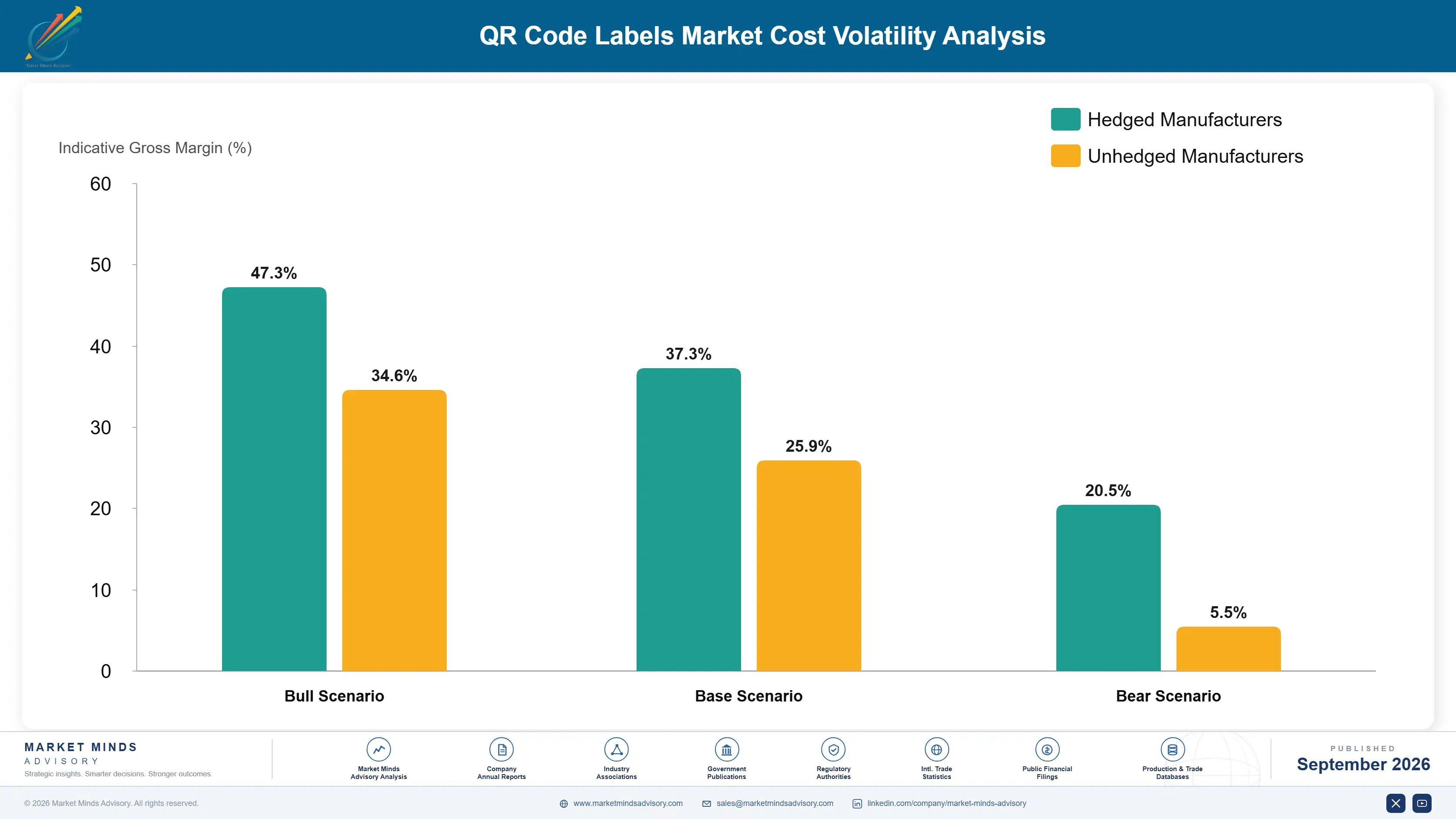
Substrate And Print Media Cost Exposure.

Paper and film substrate materials represent the largest cost input for QR code label manufacturing, running an estimated 35 to 40 percent of converter cost of goods sold, sourced predominantly from pulp and specialty film producers. Ink, adhesive, and cloud hosting infrastructure costs add a smaller but meaningful additional share reflecting sustained brand owner investment across traceability and.
Pulp and paper pricing showed meaningful volatility during 2022 as global supply chain disruption and rising energy costs affected paper mill operating expenses across major producing regions, according to company annual report disclosures from major label converters. Several converters reported margin compression as substrate costs rose faster than they could pass through to brand customers under existing fixed-price contracts reflecting sustained brand owner investment across traceability and consumer engagement programs as.

Smaller converters face a meaningful competitive disadvantage since they lack the volume commitments needed to secure favorable substrate pricing agreements, unlike Avery Dennison and CCL Industries which negotiate dedicated supply contracts at scale. This exposure varies by geography, with converters in regions closer to pulp and paper production facing less acute logistics cost pressure than those importing substrate materials reflecting sustained brand owner investment across traceability and consumer.
qr-code-labels-market-cost-volatility-analysis-1789992602461

Secure Multi-Year Substrate Supply Agreements Early reflecting sustained.

Leading converters increasingly lock in multi-year paper and film substrate supply agreements with guaranteed volume commitments, reducing exposure to spot market price spikes. This requires substantial upfront capital commitment but insulates production costs from allocation shortfalls during periods of constrained industry-wide pulp and paper supply availability reflecting sustained brand owner investment across traceability and consumer.

Standardize Label Formats Across Multiple Brand Customers reflecting.

Converters are standardizing label substrate formats across multiple brand customers to increase purchasing volume with substrate suppliers, reducing per-unit cost through economies of scale. This standardization adds production planning overhead but provides meaningful cost advantage when negotiating annual supply contracts with substrate vendors reflecting sustained brand owner investment across traceability and consumer engagement programs as.

Portfolio Architecture for Margin Defence

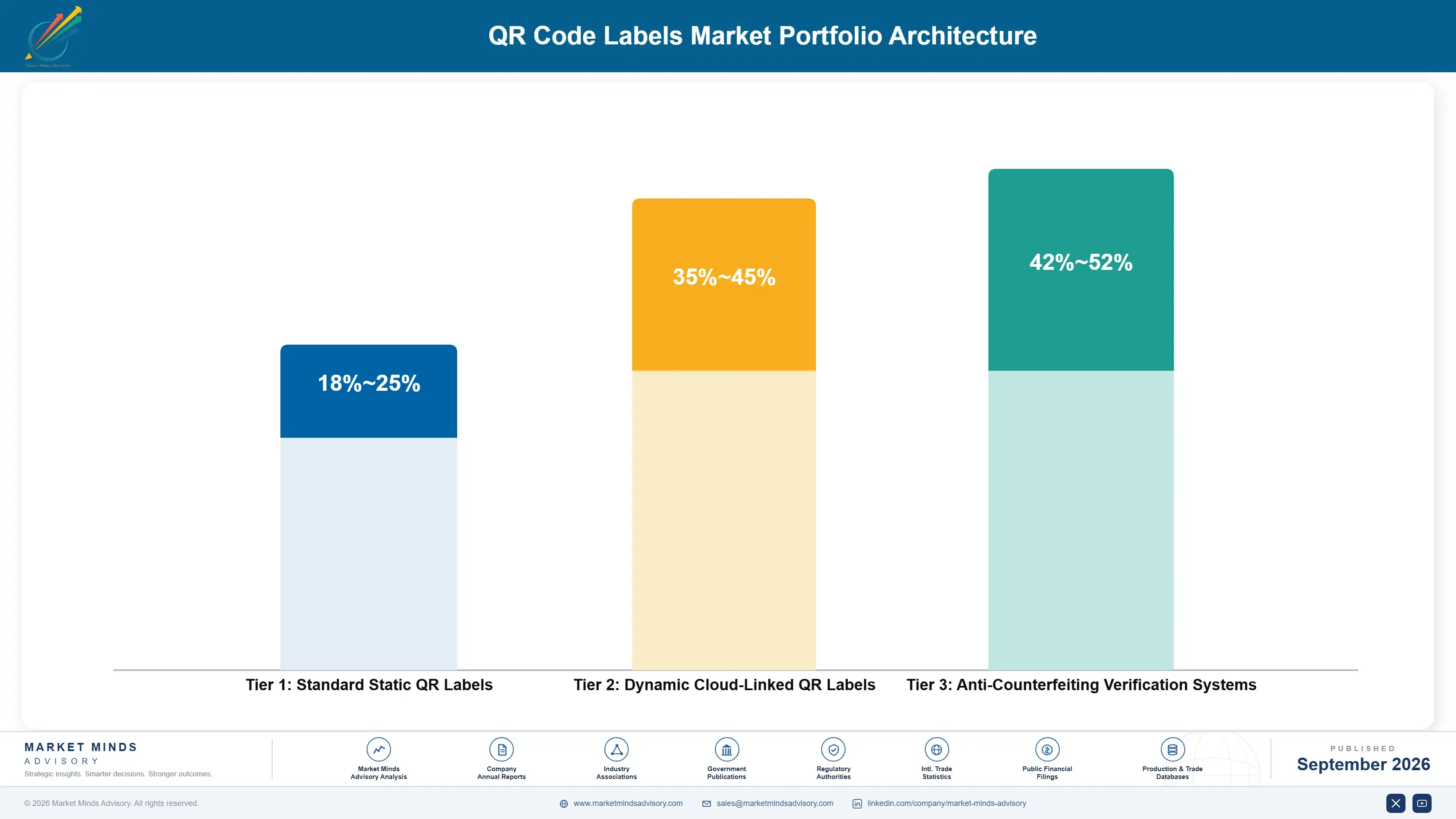
Portfolio economics split between commodity-adjacent static QR labels carrying thin margins and premium dynamic cloud-linked or anti-counterfeiting labels commanding substantially higher gross margins tied to software platform integration. Volume plays chase unit shipment scale while premium plays extract value through cloud subscription and verification services layered atop the physical label reflecting sustained brand owner investment across traceability and consumer engagement programs as adoption.
The tension between chasing volume and defending premium software-integrated positioning defines strategic choices across the converter landscape. Converters pursuing mainstream compliance-only accounts must accept thinner unit margins in exchange for order scale, while dynamic code and verification specialists sacrifice volume for durable premium per-label economics tied to subscription retention reflecting sustained brand owner investment across traceability and consumer engagement programs as adoption continues.

High-value margin pools concentrate in cloud data platform subscriptions, cryptographic verification services, and compliance consulting rather than in static label printing itself, reinforcing why converters increasingly treat the physical label as a distribution vehicle for higher-margin recurring revenue that compounds across the multi-year brand relationship reflecting sustained brand owner investment across traceability and consumer engagement programs as adoption continues expanding across food,.

Standard Static QR Labels

Mass-market static QR labels sold at accessible price points for basic product information and compliance needs, prioritizing unit shipment volume over per-label margin capture reflecting sustained brand owner investment across traceability and.
Gross Margin: 18-25%

Dynamic Cloud-Linked QR Labels

Advanced labels bundled with cloud data platform subscriptions enabling remote content updates, sold to brand owners seeking marketing flexibility and carrying durable recurring subscription revenue reflecting sustained brand owner investment across traceability.
Gross Margin: 35-45%

Anti-Counterfeiting Verification Systems

Cryptographic verification labels and serialization compliance software layered atop physical labeling, representing the highest margin portion of converter revenue mix today reflecting sustained brand owner investment across traceability and consumer.
Gross Margin: 42-52%
qr-code-labels-market-portfolio-architecture-1789992602957

High-value Sub-segments and Strategic Watch-out

Cloud Data Platform Subscription Services

Small today but expanding rapidly as brand owners adopt dynamic QR codes for remote content management, generating high-margin recurring revenue tied to scan volume with minimal additional capital requirement reflecting sustained brand owner investment across traceability and consumer engagement programs as adoption continues expanding reflecting sustained.
Gross Margin: 48-58%

Pharmaceutical Serialization Compliance Software

A substantial and steadily expanding segment as national serialization mandates continue expanding into additional markets, generating durable multi-year compliance software revenue tied to regulatory timelines reflecting sustained brand owner investment across traceability and consumer engagement programs as adoption continues expanding across food, apparel, and reflecting sustained.
Gross Margin: 40-50%

Standard Static QR Labels

The largest volume segment today, anchored by broad compliance and basic product information use cases, though margin per unit remains comparatively thin relative to dynamic and verification segments reflecting sustained brand owner investment across traceability and consumer engagement programs as adoption continues expanding across reflecting sustained.
Gross Margin: 18-25%

Legacy Standard Barcode Labeling

A strategic watch-out segment given accelerating brand migration toward QR-based traceability and engagement functionality. Converters must manage this transition to avoid losing customers to QR-native competitors reflecting sustained brand owner investment across traceability and consumer engagement programs as adoption continues expanding across food, apparel, reflecting sustained.
Gross Margin: 10-16%

Recurring Data Revenue Beyond The Label.

Label sales alone rarely produce durable annuity economics since physical label reprinting happens irregularly tied to packaging redesign cycles. Converters increasingly design cloud data platform subscriptions tied to scan volume to generate continuous revenue that persists independent of physical label reprint frequency, a strategy borrowed from broader software-as-a-service commercial models reflecting sustained brand owner investment across traceability and consumer engagement programs as adoption.
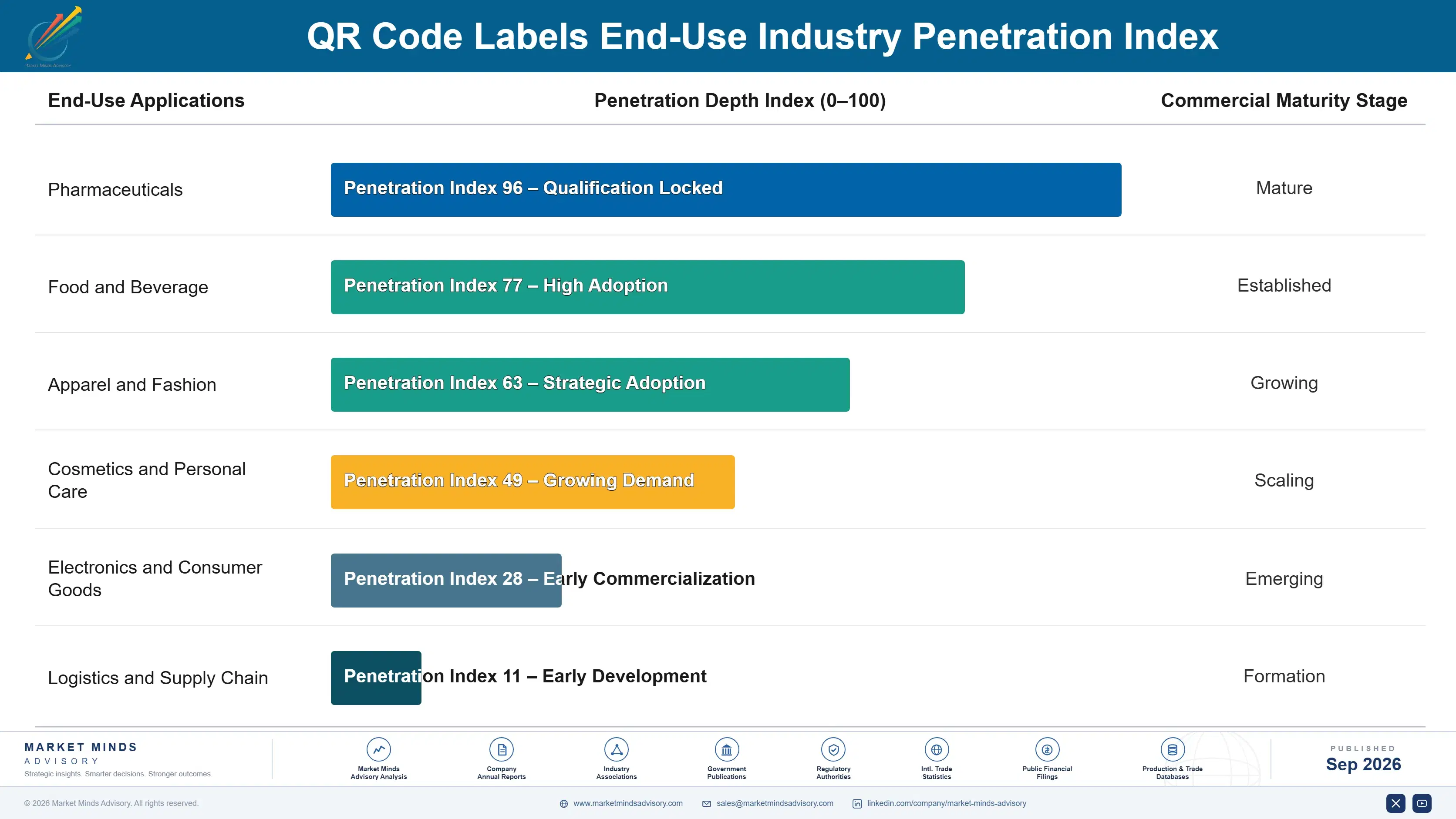
Adoption stickiness varies considerably by end-use vertical. Pharmaceutical manufacturers show the deepest stickiness once a specific serialization system is integrated into production lines and validated against regulatory requirements, since requalifying with a competing vendor requires extensive compliance revalidation. Consumer packaged goods brands show shallower stickiness, often switching converters at packaging redesign cycles based on cost and design capability reflecting sustained brand owner investment across traceability and consumer.

Generational buyer shifts are also underway. Younger brand marketing executives show markedly stronger interest in dynamic QR codes for interactive consumer engagement than older cohorts, who historically viewed labels as purely functional compliance infrastructure. Procurement decision authority is simultaneously shifting from packaging engineering teams toward digital marketing and supply chain compliance leadership jointly, changing how converters must position their value proposition reflecting sustained brand owner investment across traceability.
qr-code-labels-market-end-use-penetration-index-1789992603451

Where MMA Sees The Opportunity reflecting.

These are among the four positions where our research anticipates prominent divergence between winners and laggards over the coming forecast period. Each is grounded in the demand model, the regulatory perimeter, and the announced capacity pipeline.
01 / CLOUD PLATFORM BUNDLING.

Bundle Cloud Data Platforms Ahead Of Pure Label Competition reflecting.

Converters offering cloud-hosted data management platforms bundled with physical label printing capture meaningfully higher average contract value than printing-only competitors, converting a one-time label sale into recurring subscription revenue tied to scan volume. Converters that delay this bundling strategy risk losing accounts entirely to competitors already embedded in a brand's digital content management infrastructure. MMA views cloud platform bundling as the single highest priority capability investment for converters over the next three years given the pace of category growth reflecting sustained brand owner investment across traceability and.
02 / PHARMACEUTICAL COMPLIANCE EXPANSION.

Expand Serialization Compliance Capability Ahead Of New Mandates reflecting sustained.

National serialization mandates requiring unit-level pharmaceutical traceability continue expanding into additional markets beyond the United States and European Union frameworks already in force, creating a predictable multi-year demand pipeline for compliant converters. Converters that build serialization capability ahead of newly regulating markets will capture disproportionate share of this expanding compliance demand relative to competitors entering after mandates take effect. MMA views early compliance capability investment as more valuable than waiting for mandates to finalize before building capacity reflecting sustained brand owner investment across traceability and consumer engagement.
03 / ANTI-COUNTERFEITING TECHNOLOGY INVESTMENT REFLECTING.

Develop Cryptographic Verification Capability For Premium Categories reflecting sustained brand.

Rising counterfeit pharmaceutical and luxury goods prevalence is driving brand owners toward tamper-evident QR labeling incorporating cryptographic verification features, a category commanding meaningfully higher margin than standard compliance labeling. Converters lacking in-house verification technology risk losing premium category accounts to specialized firms or being forced into lower-margin acquisition or partnership arrangements later. MMA views cryptographic verification capability as a durable competitive advantage worth building proactively rather than acquiring reactively once competitors have already secured key accounts reflecting sustained brand owner investment across traceability and consumer engagement programs as.
04 / CONSUMER ENGAGEMENT FEATURE DESIGN.

Design Genuinely Useful Content Rather Than Pure Advertising Redirects reflecting.

Consumer willingness to scan QR codes for marketing purposes has shown signs of fatigue as codes have proliferated across nearly every product category, reducing scan rates for advertising-oriented codes even as compliance-driven scanning remains stable. Converters and brands that design codes delivering genuinely useful content, such as recipe suggestions or authenticity verification, will sustain meaningfully higher engagement than those pursuing pure advertising redirects. MMA views content design quality as more important than code placement or visual design for engagement feature return on investment reflecting sustained brand owner investment.

Engagement Snapshot From the Field

A live engagement with an industry participant carrying material or product regulatory and market exposure ahead of a defining policy shift, showing how our research translates into a defensible multi-year portfolio strategy.
MARKET MINDS ADVISORY · CLIENT ENGAGEMENT SUMMARY
QR Code Labels Producer Strategic Portfolio Review and Transition Roadmap 2026·Investment Scenario on QR Code Labels Exposure Evaluation 2025-26
CLIENT PROFILE
The client is a generic pharmaceutical manufacturer operating production facilities across India, exporting to over 40 countries and facing expanding serialization mandate requirements across multiple export markets simultaneously ahead of staggered regulatory compliance deadlines reflecting sustained brand owner investment across traceability and consumer engagement programs as adoption continues expanding across food, reflecting sustained brand owner investment across traceability.
STRATEGIC CHALLENGE
The client needed to implement a unified serialization labeling system capable of meeting varying national compliance requirements across export markets without operating separate production lines for each destination country reflecting sustained brand owner investment across traceability and consumer engagement programs as adoption continues expanding across food, apparel, and pharmaceutical packaging.
MMA APPROACH
MMA combined its primary manufacturer survey data with expert interviews across serialization software vendors and regulatory compliance specialists to benchmark unified labeling system approaches across comparable multi-market pharmaceutical exporters reflecting sustained brand owner investment across traceability and consumer engagement programs as adoption continues expanding across food, apparel, and pharmaceutical packaging.
KEY FINDINGS
  1. A unified serialization platform capable of generating market-specific label variants reduced production line complexity meaningfully compared with separate systems reflecting sustained brand owner.
  2. Cloud-based serialization data management reduced compliance documentation burden considerably compared with the client's previous on-premise system approach reflecting sustained brand owner investment across.
  3. Staggered regulatory deadlines across export markets required careful sequencing of compliance implementation to avoid disrupting existing export shipments reflecting sustained brand owner investment.
  4. Anti-counterfeiting verification features added meaningful commercial value beyond pure compliance in markets with elevated counterfeit medicine prevalence reflecting sustained brand owner investment.
CLIENT PROFILE
The client is a generic pharmaceutical manufacturer operating production facilities across India, exporting to over 40 countries and facing expanding serialization mandate requirements across multiple export markets simultaneously ahead of staggered regulatory compliance deadlines reflecting sustained brand owner investment across traceability and consumer engagement programs as adoption continues expanding across food, reflecting sustained brand owner investment across traceability.
STRATEGIC CHALLENGE
The client needed to implement a unified serialization labeling system capable of meeting varying national compliance requirements across export markets without operating separate production lines for each destination country reflecting sustained brand owner investment across traceability and consumer engagement programs as adoption continues expanding across food, apparel, and pharmaceutical packaging.
MMA APPROACH
MMA combined its primary manufacturer survey data with expert interviews across serialization software vendors and regulatory compliance specialists to benchmark unified labeling system approaches across comparable multi-market pharmaceutical exporters reflecting sustained brand owner investment across traceability and consumer engagement programs as adoption continues expanding across food, apparel, and pharmaceutical packaging.
KEY FINDINGS
  1. A unified serialization platform capable of generating market-specific label variants reduced production line complexity meaningfully compared with separate systems reflecting sustained brand owner.
  2. Cloud-based serialization data management reduced compliance documentation burden considerably compared with the client's previous on-premise system approach reflecting sustained brand owner investment across.
  3. Staggered regulatory deadlines across export markets required careful sequencing of compliance implementation to avoid disrupting existing export shipments reflecting sustained brand owner investment.
  4. Anti-counterfeiting verification features added meaningful commercial value beyond pure compliance in markets with elevated counterfeit medicine prevalence reflecting sustained brand owner investment.
RECOMMENDED STRATEGY
Phase 1: Phase one: implement unified cloud-based serialization platform capable of generating market-specific label variants centrally reflecting sustained brand owner investment across traceability. Phase 2: Phase two: sequence compliance rollout across export markets based on regulatory deadline urgency and export volume reflecting sustained brand owner investment. Phase 3: Phase three: add anti-counterfeiting verification features for markets with elevated counterfeit medicine prevalence rates reflecting sustained brand owner investment across traceability.
OUTCOME
The client implemented the unified serialization platform across all production facilities, reporting compliance across all required export markets ahead of regulatory deadlines and a 25 percent reduction in labeling-related production delays (client-reported, unverified by MMA), with plans to extend anti-counterfeiting features to additional product lines reflecting sustained brand owner investment across traceability.

Frequently Asked Questions

Foundational context covering the market sizes, CAGR, scope, country, region and competition that inform every finding below. This section is provided to cover basics and most often pre-purchase conversations, answered from the MMA Primary Research Dataset.

What is the current size of the QR Code Labels Market?

The global QR code labels market is valued at 4.8 billion dollars in 2025, the base year for this report's forecast period reflecting sustained brand owner.

How large will the QR Code Labels Market be by 2036?

MMA projects the market will reach approximately 14.38 billion dollars by 2036, driven by serialization mandates and dynamic code adoption growth reflecting sustained brand owner.

What is the CAGR for the QR Code Labels Market 2026 to 2036?

The market is forecast to grow at a compound annual growth rate of 10.5 percent between 2026 and 2036 under MMA's base case scenario reflecting sustained.

Which segment is growing fastest?

Dynamic QR codes with cloud-linked data lead at a 15.0 percent CAGR, roughly 1.43 times the overall market rate, driven by remote content updates reflecting.

Who are the major companies in the QR Code Labels Market?

Avery Dennison, CCL Industries, Zebra Technologies, Honeywell, and SATO Holdings hold leading positions across converting and traceability software reflecting sustained brand owner investment across reflecting sustained.

Which country is growing fastest?

India leads at a 13.0 percent CAGR, supported by its generic pharmaceutical manufacturing scale and acute counterfeit medicine prevalence concerns reflecting sustained brand reflecting sustained brand.

Report Segmentation Architecture

The full report scope spans multiple orthogonal segmentation dimensions, with cross-tabulated demand data provided for each dimension pair. Coverage extends further to regional breakdowns, trend trajectories, and the competitive detail needed to support segment-level decision-making.

By Product Type

  • Standard Static QR Labels
  • Dynamic Cloud-Linked QR Labels
  • Anti-Counterfeiting Verification Labels
  • Serialization Compliance Software
  • Cloud Data Platform Services
  • RFID-QR Hybrid Labels

By End-Use Industry

  • Pharmaceuticals
  • Food and Beverage
  • Apparel and Fashion
  • Cosmetics and Personal Care
  • Electronics and Consumer Goods
  • Logistics and Supply Chain

By Commercial Dimension

  • Direct Brand Owner Contracts
  • Contract Label Converter Channel
  • Software Platform Licensing
  • Compliance Consulting Services

By Region

  • North America
  • Western Europe
  • East Asia
  • South Asia and Pacific
  • Latin America
  • Middle East and Africa
  • Eastern Europe

Scope, Methodology, and Coverage

Every figure in this report is reproducible from documented input assumptions. The scope below maps the historical period, the forecast horizon, the segmentation dimensions, and the countries covered, alongside the underlying primary and qualitative methodology.
Historical Period
2020 to 2025
Forecast Period
2026 to 2036
Base Year
2025 (USD billions; MMA Primary Research Dataset, September 2026)
Market Definition
This report covers printed and digital labels incorporating QR codes for product traceability, anti-counterfeiting verification, and consumer engagement across packaged goods. It excludes generic barcode labeling without QR code functionality and standalone track-and-trace software without a physical labeling component reflecting sustained brand.
Quantitative Units
USD billions, label unit shipments where cited
Segmentation Dimensions
Product Type, End-Use Industry, Commercial Dimension, Region
Regions Covered
North America, Western Europe, East Asia, South Asia and Pacific, Latin America, Middle East and Africa, Eastern Europe
Countries Covered
United States, India, China, Germany, Japan, Brazil, United Kingdom, Mexico, and 30 additional countries
Key Companies Profiled
20
Quantitative Methodology
Primary survey, n=3,800 respondents, Q4 2025, six countries; demand-side model with trade association cross-validation
Qualitative Methodology
47 expert interviews, Q4 2025; applied to validate demand model assumptions, identify emerging dynamics, and assess competitive positioning
Report Format
PDF and XLSX data workbook (Word format preview document)
Publisher
Market Minds Advisory
Report Code
MMA-2026-PAC-124
Published
September 2026
Contact
sales@marketmindsadvisory.com | www.marketmindsadvisory.com

Purchase the full QR Code Labels Market Report (2026 to 2036).

The full report provides comprehensive coverage of the global QR code labels market across all segments, regions, and competitive dynamics outlined in this summary. It includes detailed converter profiles, pricing benchmarks, and quantified segment-level forecasts through 2036. These findings draw on MMA's primary survey of 3,800 respondents and 47 expert interviews conducted in the fourth quarter of 2025. Subscribers receive quarterly data updates tracking regulatory mandate developments and competitive positioning shifts as the market evolves. Regional appendices break out country-level detail across thirty nine markets covered in this study.
Segment-level revenue forecasts through 2036 reflecting sustained.
Twenty converter competitive profiles and benchmarking reflecting.
Country-level market sizing across 39 countries reflecting.
Quarterly data updates through subscription access reflecting.
Primary survey data across six countries reflecting.
Expert interview transcripts and analyst commentary reflecting.

Built For The People Who Decide

From boardroom strategy to bench-side execution, this report is read cover-to-cover by leaders shaping the next decade of their industry, turning demand scenarios, market dynamics and valuation benchmarks into decisions.
CXOs/ Presidents/ VPs/ Managers
M&A and Corporate Development
Strategy Teams and R&D Heads
Procurement and Product Directors
Regulatory and Compliance Leaders
Investor Relations and Equity Analysts