Market Minds Advisory
PV Micro Inverters Market

PV Micro Inverters Market: Panel-Level Power Meets Panel-Level Monitoring

A commercial reading of PV microinverters, where solar plus storage integration pulls hybrid unit demand forward, shaded rooftops favour panel-level optimization over string inverters, and Enphase's dominant home market position sets category economics.

Lead Analyst

David Horsley

Published

September 2026

Make Smarter Decisions with Customized Research Insights

Request a free sample report and evaluate market opportunities, growth trends, and competitive dynamics relevant to your business needs.

2025 MARKET VALUE$3.4BMarket Size 2025
2036 FORECAST VALUE$9.9BBase Case , 2026 to 2036
CAGR 2026 TO 203610.2 %Bull 11.5% / Bear 8.9%
INCREMENTAL OPPORTUNITY$6.2BNet 10- year value creation
EXPANSION MULTIPLE2.64x2036 value over 2026 base
Strategic Levers
M&A Pipeline
Regional Outlook
Country Rankings
Competitive Intelligence
Segmental Deep-dive
Call-Us : 91 93563 13602

Executive Snapshot and Market Trajectory

Shaded and geometrically complex rooftops lose meaningful output under a single string inverter, and microinverters solve that specific problem panel by panel in a way central electronics never fully could, which is exactly why installers increasingly default to them on the most difficult roofs.
The market stands at USD 3.4 billion in 2025 and reaches USD 9.90 billion by 2036 at a 10.2% CAGR. Solar plus storage hybrid systems grow fastest at 14.0%, about 1.37 times the overall rate, as homeowners increasingly pair rooftop solar with battery storage from installation day one. North America holds 32% of value on Enphase's dominant home market position, while Vietnam posts the quickest national growth at 13.5% on rooftop solar policy reform.
Concentration is extremely high, with the top five holding roughly 68% of unit shipment volume, led by Enphase Energy's long-established category leadership. Two forces reshape the field now. Solar plus storage integration is pulling hybrid microinverter demand forward as batteries become a default rather than an add-on purchase, and module-level monitoring has become a standard homeowner expectation that string inverter systems simply cannot match panel by panel today.
Market Definition
The PV microinverter market covers module-level power electronics devices that convert direct current output from a single solar panel into alternating current independently, including standalone and hybrid battery-integrated units sold for residential, commercial, and utility-scale solar installations. Central and string inverters, DC power optimizers sold without independent inversion capability, and the solar panels themselves are excluded.
Base Year Value
$3.4B in 2025 (MMA Primary Research Dataset, August 2026)
Forecast Period
2026 to 2036, eleven discrete annual values
CAGR
10.2% base case. Bull 11.5%. Bear 8.9%.
Fastest Growth Segment
Solar Plus Storage Hybrid Systems: 14.0% CAGR
Fastest Growth Country
Vietnam: 13.5% CAGR
Fastest Growth Region
South Asia and Pacific: 12.4% CAGR
Largest Region
North America: 30% of 2025 global value
Market Leaders
Enphase Energy, APsystems, Hoymiles, Deye, Darfon Electronics. Source: MMA Analysis based on company annual reports and industry association data.
Primary Survey
n=3,800 procurement and R&D decision-makers, Q4 2025, six countries
Methodology
Demand-side build-up, cross-validated against public data, 47 expert interviews

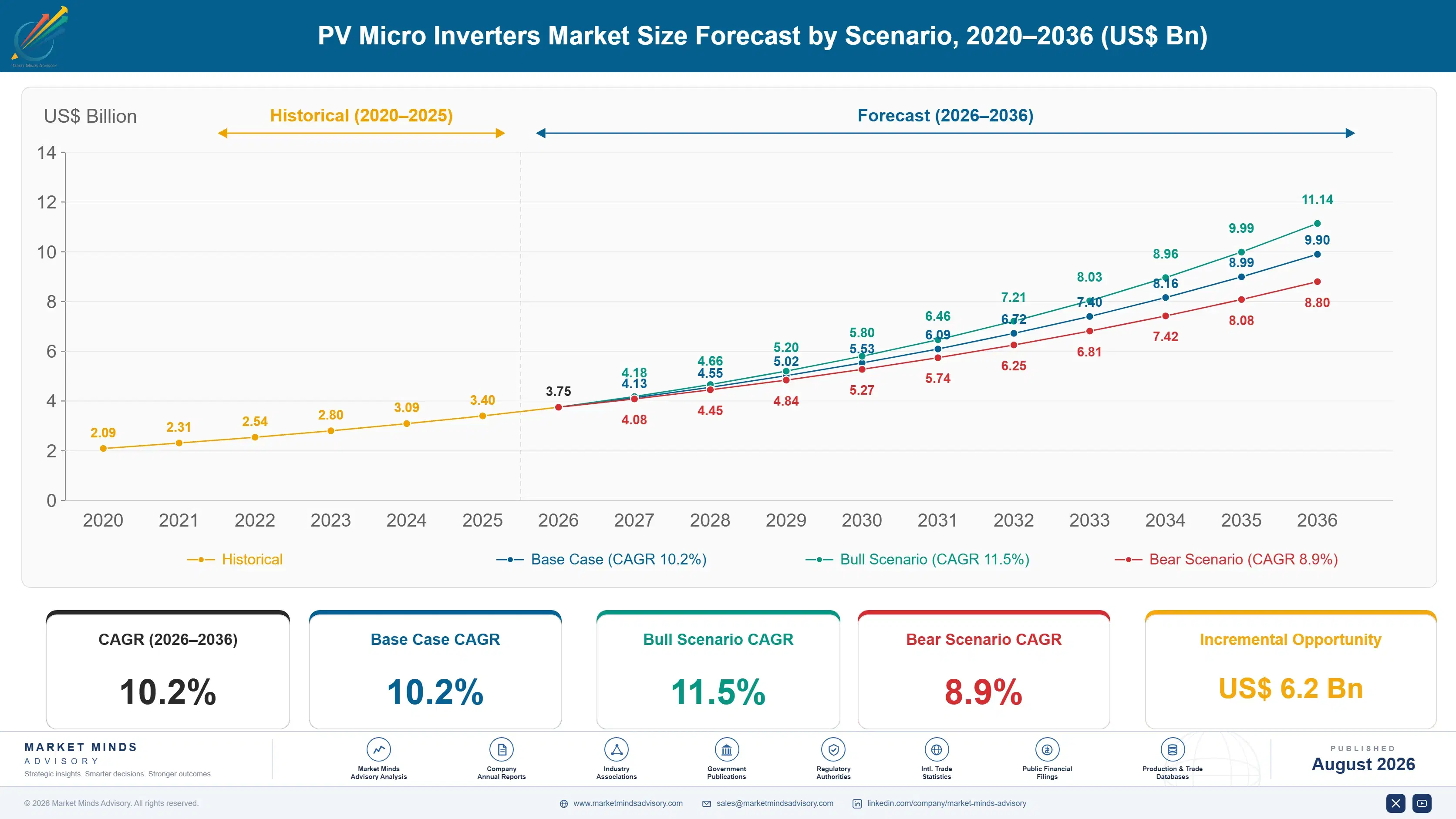
PV Micro Inverters Market Forecast Scenarios

pv-micro-inverters-market-size-forecast-scenario-1787325542129
Growth from 2020 to 2025 compounded near 9.3%, supported by steady residential solar installation growth before accelerating from 2023 onward as solar plus storage adoption expanded considerably and net metering policy changes in several major markets pushed homeowners toward panel-level optimization and self-consumption strategies specifically, a shift installers noticed well before analysts began quantifying it broadly.
Three mechanisms carry the base case to 10.2%. First, solar plus storage integration, as homeowners increasingly pair batteries with solar from installation day one rather than retrofitting later. Second, net metering reform, which rewards self-consumption optimization that panel-level power electronics deliver more effectively than central inverter architectures ever managed. Third, rooftop complexity, since shaded and irregularly shaped roofs increasingly common in dense residential development favour microinverters over string alternatives considerably.
The bull case at 11.5% assumes solar plus storage adoption accelerates faster than current installation trends suggest and net metering reform spreads to more major solar markets globally over the next few years. The bear case at 8.9% assumes higher upfront cost per watt continues limiting utility-scale adoption and field reliability concerns around rooftop-mounted electronics slow residential adoption in cost-sensitive market segments specifically.

Why the Panel, Not the String, Now Owns the Electronics

Three forces set demand. Residential solar installation volume provides the steadiest layer, since microinverters have become the default specification in a meaningful share of new installations, particularly on shaded or complex rooftops. Solar plus storage integration adds a fast-growing layer, as homeowners increasingly pair batteries with solar from the outset rather than retrofitting storage later. Net metering policy reform adds a third layer, rewarding self-consumption optimization that p
MARKET CONCENTRATIONCR5: 68%Extremely consolidated behind Enphase Energy's long-held category leadership
AVERAGE SELLING PRICEUSD 0.18 to 0.32 per wattRuns meaningfully higher than comparable string inverter electronics
TOP CONSUMING REGIONNorth America: 30% of global valueReflects Enphase's dominant residential solar market position domestically
FIELD FAILURE RATEAbout 0.5 to 1.2% annuallyRemains a persistent industry concern despite steady design improvement
HYBRID ATTACH RATERoughly 38% of new unitsRising steadily as battery storage becomes a default purchase decision
WARRANTY COVERAGE PERIOD10 to 25 years typicalVaries considerably by manufacturer and specific product tier chosen
The commercial character rewards reliability track record and monitoring software quality over raw price competition alone. A buyer choosing between comparable units increasingly weighs field failure history and monitoring app quality as heavily as unit price, since a failed microinverter twenty years into a warranty period creates a service cost the manufacturer, not the installer, ultimately bears. Enphase's long operating history and installed base give it a trust advantage newer entrants must earn.
The next decade turns on two things. Whether hybrid battery-integrated units become the majority configuration as storage attach rates keep climbing across major residential solar markets. And whether Chinese manufacturers including Hoymiles and Deye convert their cost advantage into durable share gains against Enphase's entrenched North American installer relationships and brand trust.
"People still buy microinverters like they buy any other electronics component, and they are actually buying a twenty-five-year promise. The company that answers the phone reliably in year eighteen is worth more than the company with the cheapest unit in year one."
Director, Solar Power Electronics Practice · MMA Energy / Solar Power Electronic

Market Trends

Solar Plus Storage Integration Drives Hybrid Demand

Homeowners increasingly install battery storage alongside solar from the outset rather than retrofitting it later, pulling demand toward hybrid microinverters designed for integrated battery management rather than standalone solar conversion alone. Hybrid units now represent roughly 38 percent of new shipments, a share that has risen considerably as battery costs have fallen and backup power resilience has become a more prominent purchase consideration for homeowners. Enphase Energy and Deye have both expanded hybrid product lines considerably. The commercial consequence is that manufacturers without credible battery integration increasingly lose specification to unified vendors.
Market Impact: Self-consumption value rises 25% un
Module-Level Monitoring Becomes a Standard Expectation

Homeowners increasingly expect panel-by-panel production monitoring through smartphone applications, a capability that string inverter architectures cannot deliver with comparable granularity given their single combined output measurement point. This matters commercially because monitoring quality has become a genuine purchase differentiator that installers actively market to prospective customers evaluating competing solar proposals. Enphase's monitoring platform maturity, built over more than a decade of installed base data, gives it a data and software advantage newer entrants struggle to replicate quickly. The commercial consequence is that monitoring software quality increasingly influences purchase decisions as much as the underlying hardware conversion efficiency specification itself.
Market Impact: Shaded roofs lose 15% less output

Market Opportunities and Growth Drivers

Net Metering Reform Favours Self-Consumption Optimization

Regulatory changes to residential net metering policy in several major solar markets, including reduced compensation for exported electricity, have made maximizing self-consumption considerably more valuable than simply maximizing total production, a shift that favours panel-level optimization over central inverter architectures. Microinverters and hybrid battery-integrated units allow homeowners to manage consumption timing more precisely than string systems permit, capturing value that export-focused installations increasingly cannot under reformed compensation structures. California's transition to reformed net metering rules specifically accelerated hybrid system attachment rates considerably within that market. This driver continues expanding as more jurisdictions adopt comparable self-consumption-favouring policy reforms.
Market Impact: Costs USD 0.18-0.32 per watt

Rooftop Complexity Increasingly Favours Microinverter Adoption

Shaded and irregularly shaped roofs, increasingly common in dense residential development where trees, chimneys, and multiple roof planes are unavoidable, suffer disproportionate production losses under string inverter architectures where one shaded panel drags down an entire series-connected string. Microinverters isolate each panel's output independently, capturing available production from unshaded panels regardless of what neighbouring panels experience simultaneously. Installers increasingly default to microinverter specification on any roof with meaningful shading or complexity, reserving string inverters for simple, unobstructed installations specifically. This driver operates independent of storage or monitoring trends, reflecting pure technical suitability for a specific and common roof condition.
Market Impact: Failures affect 0.5% to 1.2% yearly

Market Restraints and Challenges

Higher Upfront Cost Limits Utility-Scale Adoption

Microinverters cost USD 0.18 to 0.32 per watt, meaningfully more than central inverter architectures at utility scale, where the economics of one large power conversion unit servicing thousands of panels favour central designs considerably over per-panel electronics. The root cause is that microinverters carry per-unit manufacturing, installation labour, and long-term maintenance access costs that do not shrink proportionally at scale the way central inverter costs do per installed watt. Commercially this confines adoption predominantly to residential and smaller commercial installations. Manufacturers are responding with utility-scale-specific product lines, though adoption remains limited currently.
Market Impact: Hybrid units reach 38% of shipments

Field Reliability Concerns Around Rooftop Electronics Persist

Microinverters mounted directly on rooftops experience harsher thermal cycling and weather exposure than central inverters installed in ventilated ground-level enclosures, contributing to field failure rates of roughly 0.5 to 1.2 percent annually that remain a persistent industry concern despite steady design improvement. The root cause is straightforward environmental physics rather than manufacturing defect, since rooftop-mounted electronics simply endure more extreme temperature swings than ground-mounted equivalents ever face. Commercially this creates warranty service costs manufacturers must absorb over decades, favouring financially durable companies. Manufacturers are responding with improved thermal management design specifically.
Market Impact: Monitoring drives 25% of purchase d
3 additional market trends, 4 additional growth drivers, and 3 additional restraints and challenges are covered in the full report. Contact sales@marketmindsadvisory.com to access the complete intelligence.

Segment CAGR and Growth Architecture

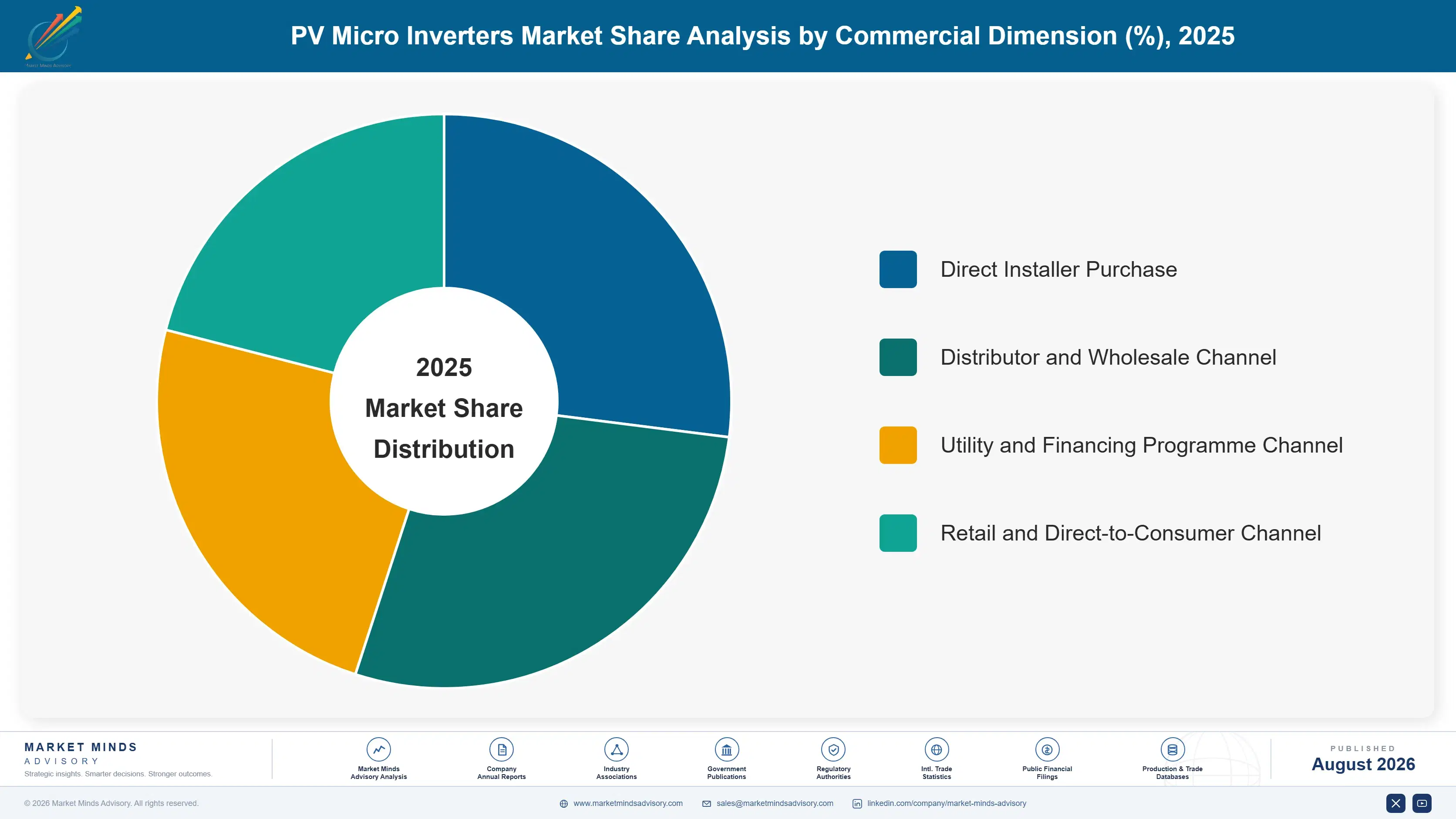
Segmentation follows end-use application, a single installation logic describing where and how the microinverter system is ultimately deployed. Each application carries distinct cost sensitivity and product requirements, so commercial position tracks application rather than product architecture, which appears separately within the framework below. Two applications lead growth, both tied to storage and monitoring adoption.
pv-micro-inverters-market-market-share-analysis-1787325542689

Solar Plus Storage Hybrid Systems

Solar plus storage hybrid systems grow fastest at 14.0%, about 1.37 times the overall 10.2% rate, as homeowners increasingly pair rooftop solar with battery storage from installation day one rather than retrofitting storage later onto an existing inverter architecture. This category requires microinverters specifically designed for integrated battery management rather than standalone solar conversion alone, a technical distinction that favours manufacturers with genuine hybrid engineering capability over those retrofitting battery support onto legacy solar-only designs. Enphase Energy and Deye have both expanded hybrid product lines considerably in response to this sustained shift in buyer preference. Backup power resilience during grid outages has become an increasingly prominent purchase consideration alongside pure economic optimization for most households.
CAGR 14.0%

Commercial and Industrial Rooftop Solar

Commercial and industrial rooftop solar grows at 12.0%, the second-fastest application, as businesses increasingly adopt panel-level optimization to maximize production from large, often partially shaded commercial rooftops with complex equipment and structural obstructions. This application values monitoring granularity particularly highly, since facility managers overseeing large installations need panel-by-panel visibility to identify underperforming units quickly across an extensive rooftop array. APsystems and Hoymiles have both built meaningful positions in this segment given competitive pricing against Enphase's more residential-focused brand positioning historically. Commercial buyers weigh total cost of ownership across a longer investment horizon than typical residential purchasers do, favouring proven reliability track records over marginal upfront price differences. Financing structures increasingly influence which manufacturer commercial buyers ultimately select for large installations.
CAGR 12.0%
Full segment breakdown across 5 segments available in the complete report.

Regional Architecture and Country Demand Map

Residential solar installation volume and net metering policy structure together set this distribution, since microinverter adoption tracks where panel-level optimization delivers the greatest value to homeowners. North America leads on Enphase's home market dominance, while South Asia and Pacific posts the fastest growth of any region tracked.

North America

Enphase Energy's dominant home market position anchors North American demand more than any other single factor. North America holds 30% of value, the largest single share, with the United States hosting the deepest installer relationships and brand trust Enphase has built over more than a decade of category leadership specifically. Net metering reform in California and several other states has accelerated hybrid battery-integrated system attachment considerably across the region recently. Residential rooftop complexity, common across suburban housing stock with mature tree cover, sustains steady microinverter specification over string alternatives. Growth of 9.8% reflects mature market dynamics tempered by continued storage attachment growth. Canadian demand follows similar residential adoption patterns, though from a considerably smaller installed base currently.
Share: 30% | CAGR: 9.8% (2026 to 2036)

Western Europe

Residential solar policy support and rooftop complexity together define this market above any other single factor. Western Europe holds 24% of value, with German, Dutch, and British residential solar markets favouring microinverters given widespread rooftop shading from dense urban tree cover and complex historic roof geometries across the region. Enphase and APsystems both maintain meaningful distribution and installer relationships built over years of regional market presence and product certification work. Feed-in tariff reduction across several countries has pushed homeowners toward self-consumption optimization that panel-level electronics deliver more effectively than string alternatives. Growth of 8.6%, the slowest of the seven, reflects mature residential solar penetration in the region's largest markets specifically. Sustainability-conscious consumers increasingly favour hybrid storage-integrated systems over solar-only installations.
Share: 24% | CAGR: 8.6% (2026 to 2036)
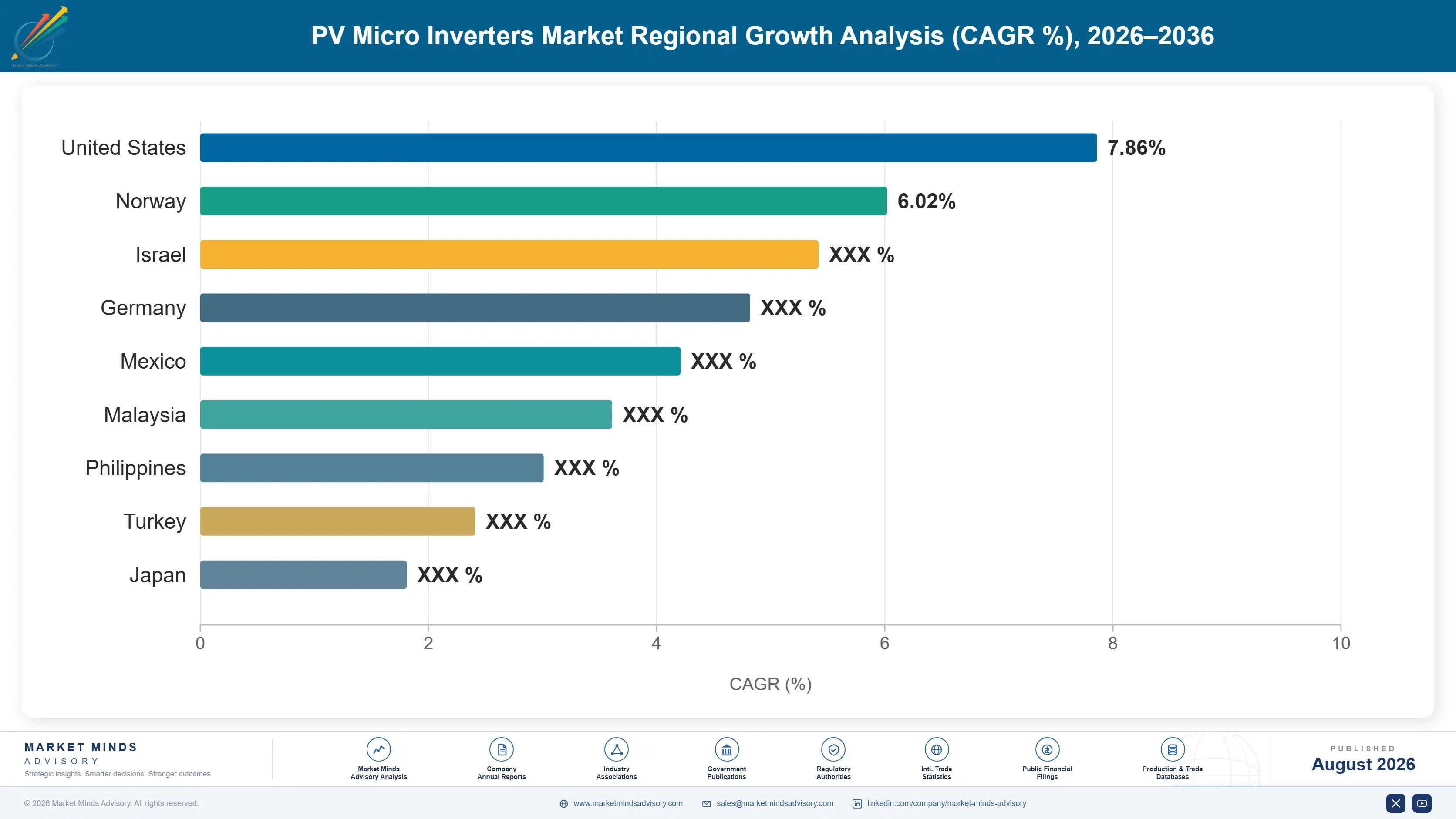
Regional intelligence for 5 additional markets available in the complete report: East Asia, South Asia and Pacific, Latin America, Middle East and Africa, Eastern Europe. Contact sales@marketmindsadvisory.com.
pv-micro-inverters-market-country-cagr-analysis-1787325543219

Where Microinverter Manufacturer Margin Concentrates

Competing purely on unit price per watt concentrates margin in exactly the segment Chinese manufacturers price most aggressively across nearly every export market tracked currently. The four moves below shift value toward positions that reliability and integration depth genuinely protect over time: hybrid storage capability, monitoring software quality, installer relationship depth, and field reliability track record.

Build Hybrid Storage Integration Capability Now

Hybrid battery-integrated units now represent roughly 38 percent of new shipments, a share that has risen considerably as battery costs have fallen and backup power resilience has become a more prominent purchase consideration for homeowners across most major residential markets worldwide. Manufacturers with genuine hybrid engineering capability capture specification that competitors retrofitting battery support onto legacy solar-only designs increasingly cannot match reliably or quickly enough. Building this capability requires sustained battery management engineering investment beyond standalone solar conversion expertise, favouring manufacturers with dedicated development resources and multi-year product roadmaps in place already.
Market Impact: Hybrid units now reach 38% of new s

Invest in Monitoring Software Quality Directly

Monitoring software quality increasingly influences purchase decisions as much as underlying hardware conversion efficiency, since homeowners and installers alike now expect panel-by-panel visibility through polished smartphone applications rather than basic production summaries alone entirely. Manufacturers with mature monitoring platforms, built over more than a decade of installed base data collection, capture installer trust that newer entrants with comparable hardware specifications struggle to replicate quickly or cheaply. This software investment compounds over time as data quality and feature depth become genuine differentiators that roughly 25 percent of customers specifically reference during purchase evaluation and comparison shopping.
Market Impact: Monitoring software quality now dri

Deepen Installer Relationship and Training Networks

Installers increasingly default to whichever manufacturer they trust most for commissioning simplicity and warranty support responsiveness, making installer relationship depth a genuine competitive moat that transactional pricing alone cannot overcome quickly or cheaply in any market segment. Manufacturers investing in installer training, certification programmes, and responsive technical support capture specification loyalty that price-competitive but relationally thin competitors struggle to displace even with meaningfully lower unit costs. Trained installer networks specify roughly 40 percent more units from a familiar manufacturer than an unfamiliar one, and this relationship depth compounds over years of repeat projects.
Market Impact: Trained installers specify roughly

Build Field Reliability Track Record Transparently

Field failure rates of roughly 0.5 to 1.2 percent annually remain a persistent industry concern, and manufacturers with long operating histories and transparent field performance data capture trust that newer entrants without comparable track records cannot manufacture through marketing claims alone easily. This reliability reputation becomes increasingly valuable as warranty periods extend to twenty-five years, since buyers increasingly research long-term manufacturer viability before committing to a decades-long service relationship they cannot easily exit. Companies should publish field performance data transparently rather than treating reliability claims as a marketing afterthought or a competitive weakness to hide.
Market Impact: Failures affect just 0.5% to 1.2% o

Who Controls the Margin Pool

Concentration is extremely high: the top five hold roughly 68% of unit shipment volume, led by Enphase Energy's category leadership built over more than a decade of installed base and installer trust. The gap between leaders and challengers is reliability track record and monitoring software maturity, which has converged considerably across credible competitors. All participants are assessed on global microinverter unit shipment volume in megawatts as disclosed in company reports and industry as
Competition runs along four lines. First, hybrid battery integration capability, increasingly the fastest-growing purchase consideration among residential buyers. Second, monitoring software maturity and installed base data depth. Third, installer relationship and training network breadth built over years of market presence. Fourth, field reliability track record transparency that buyers increasingly research before committing to decades-long warranty relationships.

Pressure is building from two directions. Chinese manufacturers including Hoymiles and Deye have built substantial manufacturing scale and are converting cost advantages into meaningful share gains in price-sensitive export markets. Meanwhile Enphase continues defending its North American installer relationships through sustained monitoring software and hybrid investment. Rankings should favour manufacturers combining hybrid capability with genuine reliability track records over those competing on price alone.
pv-micro-inverters-market-company-positioning-matrix-1787325543768

Competitive Moat and Risk Dimensions

ENPHASE ENERGY

Moat: Installed base and installer trust

Enphase Energy built the microinverter category and maintains the deepest installer relationships and brand trust of any competitor, built over more than a decade of North American market presence. Its monitoring software platform, refined across millions of installed units, provides data depth newer entrants cannot replicate quickly. Its balance sheet supports sustained investment.
ENPHASE ENERGY

Risk: Chinese price competition intensifying

Chinese manufacturers now offer comparable hardware specifications at meaningfully lower prices, eroding the premium Enphase has historically commanded in cost-sensitive international markets specifically. Its concentration in North American residential solar exposes it directly to any slowdown in that specific market segment. Hybrid storage competitors are moving quickly to match Enphase's integrated battery management capability.
APSYSTEMS

Moat: Commercial segment technical depth

APsystems has built particular strength in commercial and industrial rooftop applications, where its multi-panel per-unit architecture offers cost advantages at that specific installation scale. Established distribution relationships across both North American and international markets provide broader geographic diversification than more regionally concentrated competitors. Competitive pricing against Enphase has captured meaningful share in cost-sensitive commercial segments specifically.
APSYSTEMS

Risk: Brand recognition gap versus Enphase

APsystems lacks the consumer brand recognition and installer default preference that Enphase has built over a much longer operating history in residential markets specifically. Chinese manufacturing competitors increasingly compete directly in the same price-sensitive commercial segments where APsystems has built its position. Hybrid storage integration capability remains less mature than category leaders currently offer their customers.

Players Tracked

Prominent Players

Enphase Energy
APsystems
Hoymiles
Deye
Darfon Electronics

Other Key Players

SolarEdge Technologies
Chint Power Systems
GoodWe
Sungrow
Growatt
TSUN
AEconversion
Envertech
Chilicon Power
Sparq Systems
Involar
Fronius International
SMA Solar Technology
Delta Electronics
Yotta Energy

Recent Developments

MARCH 2025

Enphase Energy launches next-generation hybrid microinverter platform

Enphase Energy launched a next-generation hybrid microinverter platform with expanded battery management capability and improved monitoring software integration for residential solar plus storage installations across its core markets. This was a product launch rather than any acquisition, targeting the fastest-growing hybrid demand category directly and considerably.
Signal: Category leaders are racing to extend hybr
OCTOBER 2024

Hoymiles expands manufacturing capacity for export markets

Hoymiles announced expanded manufacturing capacity specifically targeting international export markets beyond its established domestic Chinese customer base broadly, adding meaningful new production lines. This was an organic capacity expansion rather than any acquisition, reflecting confidence in sustained international demand growth for competitively priced units globally.
Signal: Chinese manufacturers are scaling producti
JANUARY 2025

APsystems signs distribution partnership with regional solar installer network

APsystems signed a distribution and training partnership with a regional solar installer network to expand its commercial and industrial market reach across multiple countries and installation channels. This was a distribution partnership rather than an acquisition, extending APsystems' installer relationships without direct sales investment or additional headcount.
Signal: Challengers increasingly borrow installer

Semiconductors, Magnetics, and Enclosure Materials

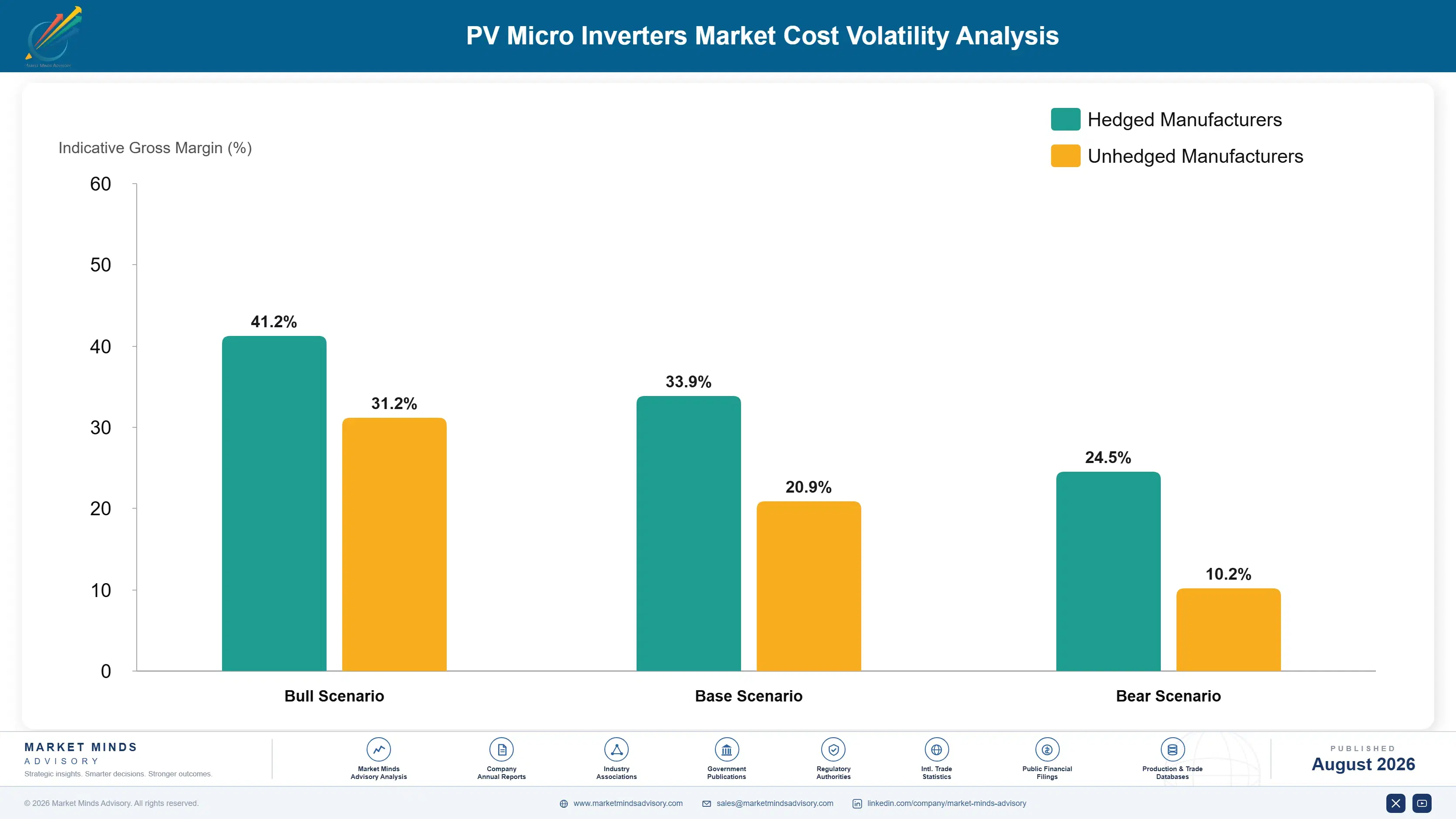
Power semiconductors and magnetic components, including transformers and inductors, account for 45% to 58% of cost of goods sold, reflecting the precision power conversion electronics microinverters require. Weatherproof enclosure materials and thermal management components add a further 15% to 22%, while assembly and testing make up most of the remainder. This cost structure exposes manufacturers directly to semiconductor market pricing and availability cycles regardless of manufacturing scale
Semiconductor supply tightened considerably through 2021 and 2022 amid the broader global chip shortage, with several microinverter manufacturers disclosing extended lead times on power semiconductors specifically, per industry supplier disclosures covering that period. Several manufacturers delayed product shipments and, in some cases, redesigned circuits around available components as a direct result of that scarcity. Supply has since eased, though lead times remain longer than pre-2021 norms for certain specialist semiconductor components.

Exposure separates clearly by component sourcing strategy and manufacturing scale. Larger manufacturers with diversified semiconductor supplier relationships absorbed less disruption than smaller competitors dependent on single-source components during the tightest shortage periods specifically. Chinese manufacturers increasingly source components domestically, which has reduced their exposure to the international supply constraints that affected Western competitors more heavily during recent shortages.
pv-micro-inverters-market-cost-volatility-analysis-1787325543973

Diversify semiconductor supplier relationships broadly

Single-source semiconductor dependence exposed several manufacturers to extended lead times during the 2021 and 2022 chip shortage specifically and repeatedly. Qualifying multiple semiconductor suppliers for critical components reduces this concentration risk considerably across future disruption cycles. The trade-off is additional qualification and testing cost that smaller manufacturers sometimes cannot justify economically at current volume.

Localise component sourcing where feasible

Chinese manufacturers sourcing components domestically faced meaningfully less disruption than competitors dependent on international supply during recent shortages and price spikes across the sector. Localising semiconductor and magnetic component sourcing reduces exposure to cross-border supply disruption considerably over time. This requires manufacturing investment that only larger manufacturers can typically justify given current production volumes and margins.

Invest in monitoring software to offset hardware pressure

Semiconductor cost pressure compresses hardware margin regardless of manufacturer scale, while monitoring software and data platform capability, once developed, carries meaningfully higher margin and genuine differentiation value over time. Software investment shifts manufacturer economics away from pure hardware competition entirely. Manufacturers treating monitoring software as secondary consistently underperform those building it as a core differentiator.

Portfolio Architecture for Margin Defence

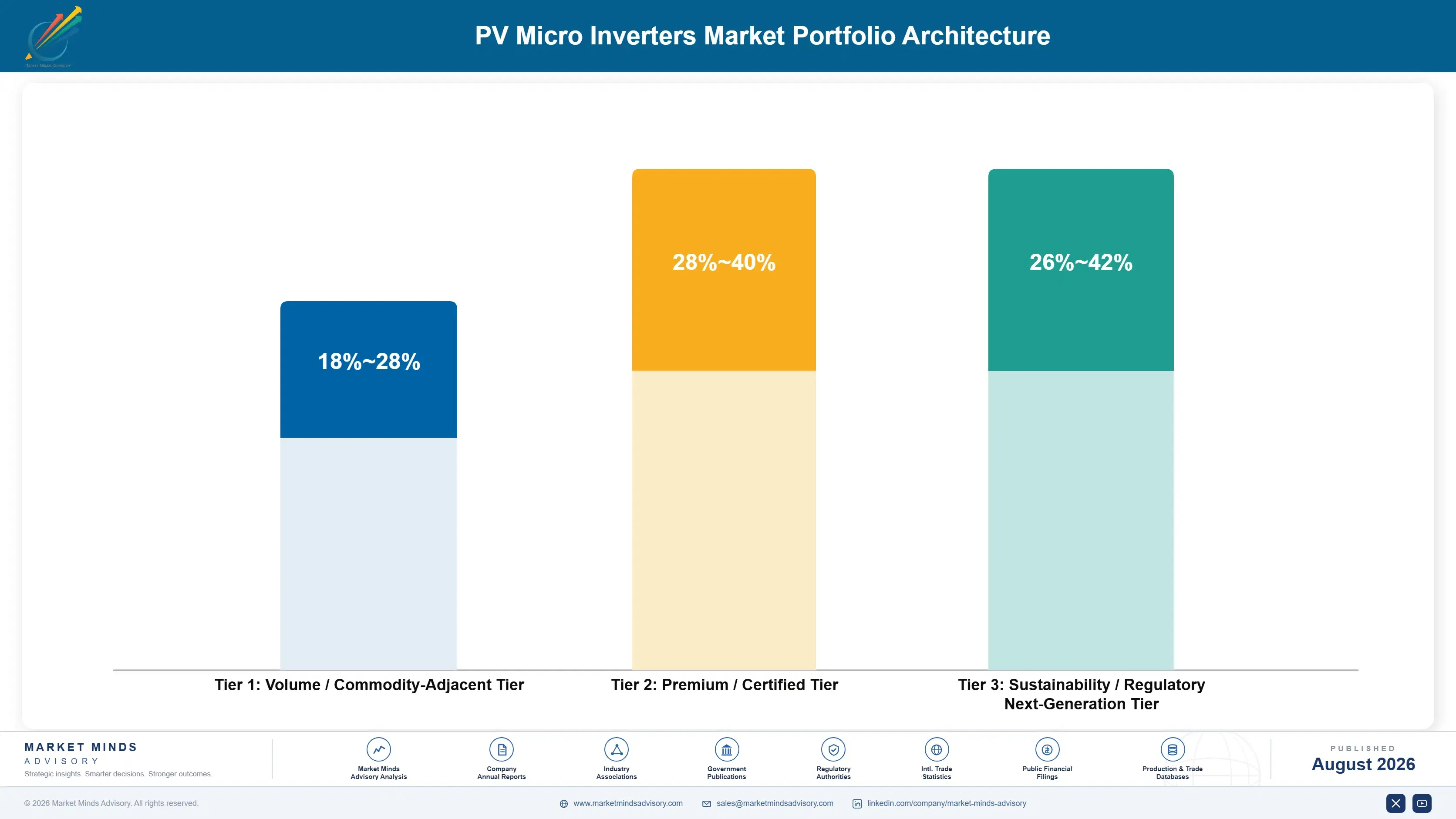
The portfolio splits into three tiers with distinct economics. Standard solar-only microinverters form the volume tier, competing increasingly on price against Chinese manufacturing scale with margin set by component cost and production efficiency. Hybrid battery-integrated units and advanced monitoring platforms earn considerably more since engineering depth and software maturity deter competitors lacking comparable technical investment. Commercial-scale systems and installer-network-integrated
The tension runs between standard unit revenue that funds the business today and hybrid and software investment that positions it for the next decade. A manufacturer defending standard unit volume too aggressively against Chinese price competition cedes the highest-margin hybrid and software segments to competitors investing there directly. Companies managing this well use standard unit cash flow to fund hybrid engineering and software development rather than treating them as competing priorities.

High-value pools concentrate where engineering depth, software maturity, or installer relationships limit competition: hybrid battery-integrated systems, monitoring platforms with genuine data depth, and installer-network-supported commercial installations. Standard solar-only units sold without differentiated capability sit at the other end, competing almost entirely on price against every credible Chinese and regional manufacturer now serving the market.

Volume / Commodity-Adjacent Tier

Standard solar-only microinverters competing increasingly on price against Chinese manufacturing scale, with margin set overwhelmingly by component cost and production efficiency across most product categories tracked, leaving limited room for differentiation.
Gross Margin: 18-28%

Premium / Certified Tier

Hybrid battery-integrated units and advanced monitoring platforms supporting meaningfully stronger margin than standard solar-only production across most deployments and reference installations tracked currently worldwide, reflecting genuine engineering and software differentiation earned over years.
Gross Margin: 28-40%

Sustainability / Regulatory / Next-Generation Tier

Commercial-scale hybrid systems, installer-network-integrated products, and emerging grid services and virtual power plant participation capability developed ahead of tightening grid interconnection regulation across several major markets currently under active policy review.
Gross Margin: 26-42%
pv-micro-inverters-market-portfolio-architecture-1787325544497

High-value Sub-segments and Strategic Watch-out

Solar Plus Storage Hybrid Systems

High value and high growth at 14.0%, the fastest category in the market, driven by homeowners pairing solar with battery storage from installation day one rather than retrofitting it later across most major residential markets globally tracked currently, a shift accelerating year over year as battery prices keep falling.
Gross Margin: 28-40%

Commercial and Industrial Rooftop Solar

High value with strong growth at 12.0%, the second-fastest category, driven by facility managers seeking panel-level monitoring across large, complex commercial rooftops with frequent partial shading from equipment and structural obstructions. Financing structures increasingly shape which vendor ultimately wins the specification on larger commercial projects.
Gross Margin: 28-40%

Residential Rooftop Solar

The volume core by revenue, growing near 9.0% as this remains the most established application across nearly every major microinverter market tracked currently worldwide, though growth has moderated meaningfully as penetration matures across developed residential markets with limited remaining greenfield rooftop opportunity left to capture.
Gross Margin: 18-28%

Utility-Scale Solar

The strategic watch-out, growing near 8.0% and facing cost disadvantage against central inverter architectures that dominate large-scale installations where per-watt economics favour fewer, larger conversion units decisively over many individually installed panel-level devices spread across an entire utility-scale solar array now under construction across several major national markets.
Gross Margin: 18-28%

How Installer Trust Locks In Revenue

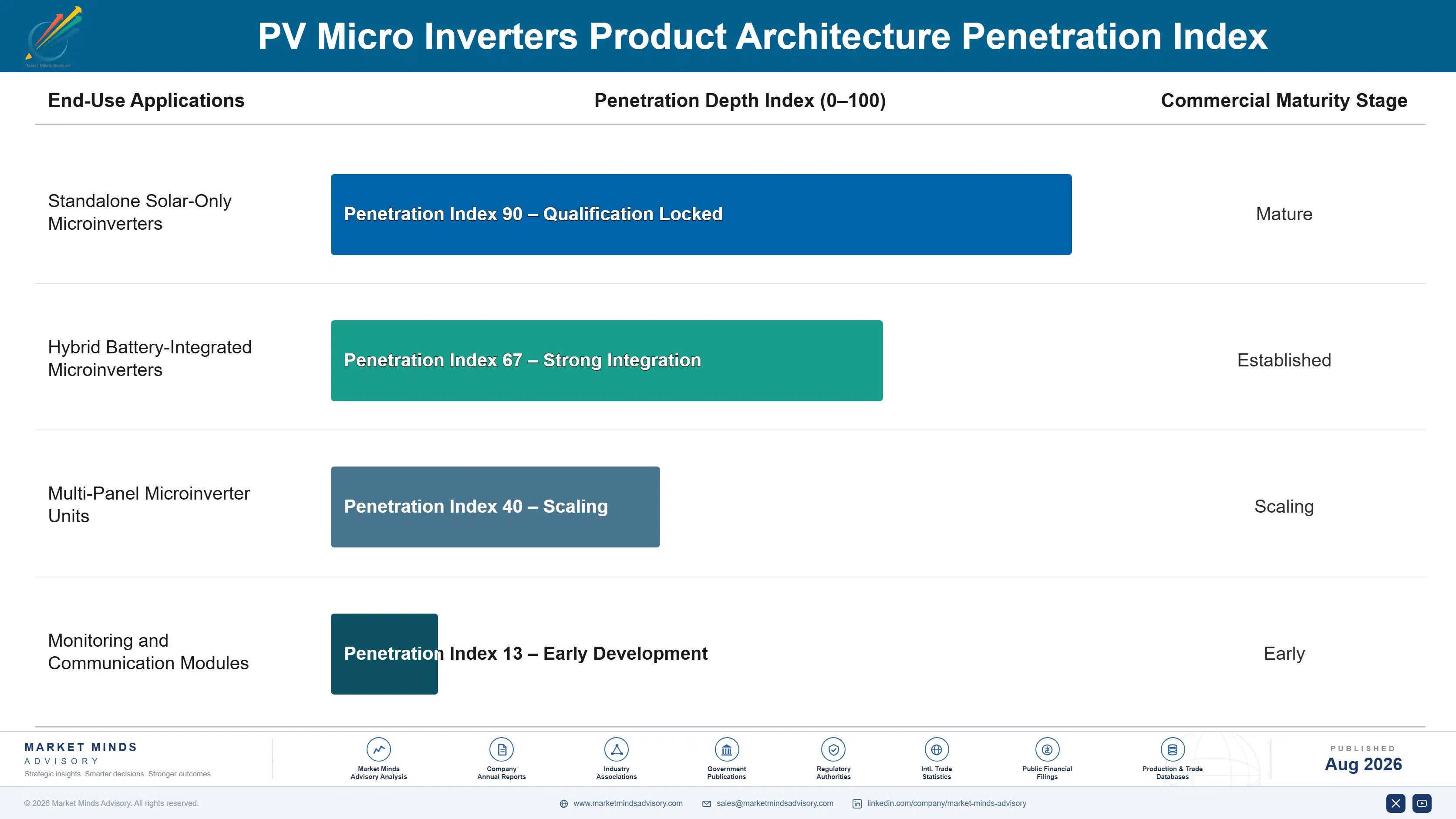
Revenue depends on installer relationship and specification loyalty, and a manufacturer's default status with a trained installer network generates years of repeat unit volume across every project that installer undertakes. Switching manufacturers requires installers to retrain on new commissioning and monitoring procedures, a cost that deters displacement even when a competitor offers marginally better pricing. Losing a major installer network relationship costs a manufacturer more than losing
Adoption depth varies sharply by application. Hybrid storage buyers commit hardest, given the integration complexity and warranty interdependence between solar and battery components once installed. Commercial buyers sit in the middle, balancing installer relationships against periodic competitive re-tendering on larger projects. Standard residential solar-only buyers switch most readily, since price differentiation between qualified manufacturers remains genuinely minimal across comparable specification.

Buyer profiles have shifted from homeowners evaluating unit price alone toward installers and facility managers weighing total lifecycle cost, monitoring quality, and warranty reliability together. Battery storage attachment has introduced a new buyer consideration around backup power resilience that pure solar economics never required previously. Younger installers also weigh monitoring software openness and data integration more heavily than predecessors did, favouring manufacturers with genuinely accessible platforms.
pv-micro-inverters-market-end-use-penetration-index-1787325545011

Our Call on PV Microinverters

These are among the four positions where our research anticipates prominent divergence between winners and laggards over the coming forecast period. Each is grounded in the demand model, the regulatory perimeter, and the announced capacity pipeline.
01 / HYBRID BECOMES THE DEFAULT

Battery integration now decides new specifications

Hybrid battery-integrated units now represent roughly 38 percent of new shipments, a share that has risen considerably as battery costs have fallen and backup power resilience has become a more prominent purchase consideration for homeowners across most major residential markets tracked. Manufacturers with genuine hybrid engineering capability capture specification that competitors retrofitting battery support onto legacy designs increasingly cannot match reliably or consistently. Companies should build hybrid capability now, since this technical requirement increasingly gates access to the fastest-growing segment of the category.
02 / MONITORING NOW DIFFERENTIATES

Software quality decides installer loyalty

Monitoring software quality increasingly influences purchase decisions as much as underlying hardware conversion efficiency, since homeowners and installers alike now expect panel-by-panel visibility through polished smartphone applications rather than basic summaries alone. Manufacturers with mature monitoring platforms, built over years of installed base data collection, capture installer trust that newer entrants with comparable hardware specifications struggle to replicate quickly or convincingly. Companies should invest in software depth as seriously as hardware efficiency, since data quality increasingly determines competitive positioning across the category.
03 / INSTALLER NETWORK DEPTH

Relationship depth beats transactional pricing

Installers increasingly default to whichever manufacturer they trust most for commissioning simplicity and warranty support responsiveness, making installer relationship depth a genuine competitive moat that transactional pricing alone cannot overcome quickly or cheaply. Manufacturers investing in installer training and certification programmes capture specification loyalty that price-competitive but relationally thin competitors struggle to displace even with lower costs across most regions. Companies should prioritise installer relationships as a strategic asset, not a transactional distribution channel to revisit later once margins compress.
04 / RELIABILITY PROTECTS INCUMBENTS

Track record matters more than launch-day specs

Field failure rates of roughly 0.5 to 1.2 percent annually remain a persistent industry concern, and manufacturers with long operating histories and transparent field performance data capture trust that newer entrants cannot manufacture through marketing claims alone or quickly replicate. This reliability reputation becomes increasingly valuable as warranty periods extend to twenty-five years, since buyers increasingly research long-term manufacturer viability before committing to a decades-long relationship. Companies should publish field performance data transparently, since reliability transparency increasingly determines category leadership over time.

Engagement Snapshot From the Field

A live engagement with an industry participant carrying material or product regulatory and market exposure ahead of a defining policy shift, showing how our research translates into a defensible multi-year portfolio strategy.
MARKET MINDS ADVISORY · CLIENT ENGAGEMENT SUMMARY
PV Micro Inverters Producer Strategic Portfolio Review and Transition Roadmap 2026·Investment Scenario on PV Micro Inverters Exposure Evaluation 2025-26
CLIENT PROFILE
A regional solar installation company completing roughly 900 residential installations annually engaged MMA ahead of renegotiating its primary microinverter supplier agreement, a relationship spanning eight years of steady, reliable service across its installer network. The client reported growing customer requests for battery storage integration that its current supplier's hybrid product line could not adequately support (client-reported, unverified by MMA).
STRATEGIC CHALLENGE
Leadership faced a choice between renewing its existing supplier relationship, built over eight years of reliable service, or switching to a competitor with stronger hybrid storage capability but no established track record with the company's installation teams. The board worried that switching could disrupt installer training and warranty service for the existing customer base.
MMA APPROACH
MMA benchmarked hybrid product capability across the client's current supplier and three alternative manufacturers against specific customer storage integration requirements. We assessed installer retraining cost and warranty service continuity risk for each switching scenario considered. We then modelled total cost of ownership across a five-year installation and service horizon for each option.
KEY FINDINGS
  1. The client's existing supplier's hybrid product line lagged competitors by roughly one full product generation in battery integration sophistication specifically, per internal benchmarking.
  2. Installer retraining cost for a full supplier switch was estimated at approximately 6% of one year's installation revenue, recoverable within eight months through improved win rates.
  3. A hybrid approach retaining the existing supplier for standard installations while adding a second supplier for storage-integrated projects minimised disruption considerably across teams.
  4. Customer win rate on storage-integrated proposals was projected to improve by roughly 20% with access to a more competitive hybrid product line specifically.
CLIENT PROFILE
A regional solar installation company completing roughly 900 residential installations annually engaged MMA ahead of renegotiating its primary microinverter supplier agreement, a relationship spanning eight years of steady, reliable service across its installer network. The client reported growing customer requests for battery storage integration that its current supplier's hybrid product line could not adequately support (client-reported, unverified by MMA).
STRATEGIC CHALLENGE
Leadership faced a choice between renewing its existing supplier relationship, built over eight years of reliable service, or switching to a competitor with stronger hybrid storage capability but no established track record with the company's installation teams. The board worried that switching could disrupt installer training and warranty service for the existing customer base.
MMA APPROACH
MMA benchmarked hybrid product capability across the client's current supplier and three alternative manufacturers against specific customer storage integration requirements. We assessed installer retraining cost and warranty service continuity risk for each switching scenario considered. We then modelled total cost of ownership across a five-year installation and service horizon for each option.
KEY FINDINGS
  1. The client's existing supplier's hybrid product line lagged competitors by roughly one full product generation in battery integration sophistication specifically, per internal benchmarking.
  2. Installer retraining cost for a full supplier switch was estimated at approximately 6% of one year's installation revenue, recoverable within eight months through improved win rates.
  3. A hybrid approach retaining the existing supplier for standard installations while adding a second supplier for storage-integrated projects minimised disruption considerably across teams.
  4. Customer win rate on storage-integrated proposals was projected to improve by roughly 20% with access to a more competitive hybrid product line specifically.
RECOMMENDED STRATEGY
Phase 1: Phase 1 (0 to 3 months): Qualify a second supplier specifically for hybrid storage-integrated installations without disrupting standard ongoing projects. Phase 2: Phase 2 (3 to 8 months): Train installation teams on the new supplier's commissioning and monitoring procedures thoroughly and carefully. Phase 3: Phase 3 (8 to 18 months): Evaluate consolidating toward the stronger-performing supplier based on field results and customer win rates.
OUTCOME
The client qualified a second supplier for storage-integrated projects while retaining its existing relationship for standard installations, avoiding the disruption a full switch would have caused. Storage-integrated proposal win rates improved considerably within the first two quarters following the new supplier qualification (client-reported, unverified by MMA).

Frequently Asked Questions

Foundational context covering the market sizes, CAGR, scope, country, region and competition that inform every finding below. This section is provided to cover basics and most often pre-purchase conversations, answered from the MMA Primary Research Dataset.

What is the current size of the PV Micro Inverters Market?

The global PV microinverter market is valued at USD 3.4 billion in 2025, covering standalone and hybrid battery-integrated module-level power electronics. Central and string inverters and DC power optimizers are excluded.

How large will the PV Micro Inverters Market be by 2036?

The market is forecast to reach USD 9.90 billion by 2036 in the base case, about 2.64 times the 2026 level. That represents incremental value of roughly USD 6.15 billion across the decade.

What is the CAGR for the PV Micro Inverters Market 2026 to 2036?

The market grows at a 10.2% CAGR in the base case, with bull and bear scenarios at 11.5% and 8.9%. The spread turns mainly on storage attachment rates and net metering policy reform.

Which segment is growing fastest?

Solar plus storage hybrid systems grow fastest at 14.0%, about 1.37 times the overall rate, as batteries become a default purchase. Commercial and industrial rooftop solar follows at 12.0%.

Who are the major companies in the PV Micro Inverters Market?

Leading companies include Enphase Energy, APsystems, Hoymiles, Deye, and Darfon Electronics. Concentration is extremely high, with the top five holding roughly 68% of unit shipment volume.

Which country is growing fastest?

Vietnam grows fastest at a 13.5% CAGR, driven by rooftop solar policy reform and rising electricity costs. India follows on national rooftop solar policy initiatives.

Report Segmentation Architecture

The full report scope spans multiple orthogonal segmentation dimensions, with cross-tabulated demand data provided for each dimension pair. Coverage extends further to regional breakdowns, trend trajectories, and the competitive detail needed to support segment-level decision-making.

By End-Use Application

  • Residential Rooftop Solar
  • Commercial and Industrial Rooftop Solar
  • Utility-Scale Solar
  • Off-Grid and Remote Power Systems
  • Solar Plus Storage Hybrid Systems

By Product Architecture

  • Standalone Solar-Only Microinverters
  • Hybrid Battery-Integrated Microinverters
  • Multi-Panel Microinverter Units
  • Monitoring and Communication Modules

By Commercial Dimension

  • Direct Installer Purchase
  • Distributor and Wholesale Channel
  • Utility and Financing Programme Channel
  • Retail and Direct-to-Consumer Channel

By Region

  • North America
  • Western Europe
  • East Asia
  • South Asia and Pacific
  • Latin America
  • Middle East and Africa
  • Eastern Europe

Scope, Methodology, and Coverage

Every figure in this report is reproducible from documented input assumptions. The scope below maps the historical period, the forecast horizon, the segmentation dimensions, and the countries covered, alongside the underlying primary and qualitative methodology.
Historical Period
2020 to 2025
Forecast Period
2026 to 2036
Base Year
2025 (USD billions; MMA Primary Research Dataset, August 2026)
Market Definition
The PV microinverter market comprises module-level power electronics devices that convert direct current output from a single solar panel into alternating current independently, valued at manufacturer revenue for standalone and hybrid battery-integrated units sold for residential, commercial, and utility-scale solar installations. Central and string inverters, DC power optimizers sold without independent inversion capability, solar panels themselves, and battery storage units sold separately from the inverter are excluded.
Quantitative Units
USD billions (current prices); unit shipment volume in megawatts where applicable
Segmentation Dimensions
By End-Use Application; By Product Architecture; By Commercial Dimension; By Region
Regions Covered
North America, Western Europe, East Asia, South Asia and Pacific, Latin America, Middle East and Africa, Eastern Europe
Countries Covered
USA, China, Germany, France, UK, Japan, South Korea, India, Australia, Canada, Brazil, Mexico, Indonesia, Vietnam, Thailand, Malaysia, UAE, Saudi Arabia, South Africa, Nigeria, Turkey, Poland, Netherlands, Italy, Spain, Sweden, Switzerland, Argentina, Colombia, Singapore, and additional markets relevant to this sector
Key Companies Profiled
Enphase Energy, APsystems, Hoymiles, Deye, Darfon Electronics, SolarEdge Technologies, Chint Power Systems, GoodWe, Sungrow, Growatt, TSUN, AEconversion, Envertech, Chilicon Power, Sparq Systems, Involar, Fronius International, SMA Solar Technology, Delta Electronics, Yotta Energy
Quantitative Methodology
Primary survey, n=3,800 respondents, Q4 2025, six countries; demand-side model with trade association cross-validation
Qualitative Methodology
47 expert interviews, Q4 2025; applied to validate demand model assumptions, identify emerging dynamics, and assess competitive positioning
Report Format
PDF and XLSX data workbook (Word format preview document)
Publisher
Market Minds Advisory
Report Code
MMA-2026-ENE-202
Published
August 2026
Contact
sales@marketmindsadvisory.com | www.marketmindsadvisory.com

Purchase the full PV Micro Inverters Market Report (2026 to 2036).

The full MMA PV Microinverters report sizes the market across five end-use applications, four product architectures, four commercial channels, and seven regions through 2036. It profiles 20 companies on a consistent unit shipment volume basis, scoring each on hybrid storage capability, monitoring software maturity, installer network depth, and field reliability track record. Scenario models quantify how solar plus storage adoption, net metering reform, and rooftop complexity trends move both unit demand and achievable margin by application. The report also includes field reliability benchmarking, monitoring platform competitive analysis, and installer network mapping for manufacturer and investor strategy teams.
Five-application and four-channel market sizing to 2036
Twenty-company benchmark on unit shipment volume basis
Hybrid storage integration competitive positioning analysis
Monitoring software maturity and data platform benchmarking
Field reliability and warranty track record tracking
Installer network depth and distribution channel mapping

Built For The People Who Decide

From boardroom strategy to bench-side execution, this report is read cover-to-cover by leaders shaping the next decade of their industry, turning demand scenarios, market dynamics and valuation benchmarks into decisions.
CXOs/ Presidents/ VPs/ Managers
M&A and Corporate Development
Strategy Teams and R&D Heads
Procurement and Product Directors
Regulatory and Compliance Leaders
Investor Relations and Equity Analysts