Market Minds Advisory
Pulse Ingredient Market in Western Europe

Pulse Ingredient Market in Western Europe: A Protein Business Selling Mostly Starch

Protein is the reason anyone builds a pea fractionation plant, but protein leaves as barely a quarter of the bean by mass and the starch that makes up half of it competes against maize.

Lead Analyst

Lisa Gevelber

Published

September 2026

Make Smarter Decisions with Customized Research Insights

Request a free sample report and evaluate market opportunities, growth trends, and competitive dynamics relevant to your business needs.

2025 MARKET VALUE$1.9BMarket Size 2025
2036 FORECAST VALUE$4.5BBase Case , 2026 to 2036
CAGR 2026 TO 20368.4 %Bull 9.6% / Bear 7.2%
INCREMENTAL OPPORTUNITY$2.5BNet 10- year value creation
EXPANSION MULTIPLE2.24x2036 value over 2026 base
Strategic Levers
M&A Pipeline
Regional Outlook
Country Rankings
Competitive Intelligence
Segmental Deep-dive
Call-Us : 91 93563 13602

Executive Snapshot and Market Trajectory

Nobody builds a pea fractionation plant for starch, yet starch is roughly 48% of what comes out of one. Protein isolate leaves as about 24% of the bean by mass, and the economics only close if the other three quarters find a buyer. Starch must go somewhere at a price.
That co-product problem, rather than protein demand, is what limits Western European capacity. Pea starch competes directly against maize starch at commodity prices set by a far larger industry, and fibre and hull streams fetch less again. Isolates still grow at 12.6%, half again the market rate of 8.4%, because protein sells at roughly 3.4 times the flour it displaces. Concentrates follow at 10.2% on far less capital.
Policy is pushing the other way and pushing hard. Western Europe imports around 72% of the plant protein it consumes, mostly soy from the Americas, and both the Common Agricultural Policy and national protein plans now fund domestic pulse acreage directly. France grows fastest at 10.6%, and the supplier field is concentrated enough that the top five hold 46% of capacity supplied into the region. That is an unusually concentrated field by ingredient standards.
Market Definition
Ingredients fractionated or milled from pulse crops, principally yellow pea, faba bean, lentil and chickpea, sold to food and beverage manufacturers in Western Europe. Covers protein isolates and concentrates, flours, starches, fibres and hulls, and texturised pulse proteins, measured at ingredient supplier selling value into Western European demand. Excludes whole pulses sold for direct consumption, soy and cereal proteins, and finished consumer products containing pulse ingredients.
Base Year Value
$1.9B in 2025 (MMA Primary Research Dataset, August 2026)
Forecast Period
2026 to 2036, eleven discrete annual values
CAGR
8.4% base case. Bull 9.6%. Bear 7.2%.
Fastest Growth Segment
Pulse Protein Isolates: 12.6% CAGR
Fastest Growth Country
France: 10.6% CAGR
Fastest Growth Region
South Asia and Pacific: 10.2% CAGR
Largest Region
Western Europe: 74% of 2025 global value
Market Leaders
Roquette, Cosucra Groupe Warcoing, Emsland Group, Vestkorn Milling, Ingredion. Source: MMA Primary Research Dataset, July 2026.
Primary Survey
n=3,800 procurement and R&D decision-makers, Q4 2025, six countries
Methodology
Demand-side build-up, cross-validated against public data, 47 expert interviews

Pulse Ingredient Market Forecast Scenarios

pulse-ingredient-market-in-western-europe-size-forecast-scenario-1787581047616
Growth ran near 7.1% between 2020 and 2025, front-loaded into a meat analogue boom that faded well before the period ended. Capacity built for that demand found itself chasing bakery, beverage and sports nutrition instead, which are smaller applications but considerably more durable ones. Starch co-product placement proved the harder commercial problem throughout, and several announced European fractionation projects were quietly shelved once the arithmetic was run properly.
Base case 8.4% rests on three mechanisms. European Union protein autonomy policy funds domestic pulse acreage directly through Common Agricultural Policy support and national protein plans, which puts raw material within reach of European fractionators. Bakery and beverage reformulation absorbs concentrate volume steadily, without the volatility that meat analogues brought with them. And faba bean breeding is removing the compounds that kept a better northern European crop out of ingredient use.
The bull case at 9.6% assumes pea starch finds durable placement in paper, adhesives or specialty food applications at prices above maize parity, which would transform fractionation economics outright and release several shelved projects. The bear case at 7.2% is persistent off-flavour resistance in mainstream formulation, keeping pulse protein confined to applications where taste masking happens to be straightforward and cheap.

Three Quarters of the Bean Is Not Protein

Pea fractionation is presented as a protein business and it is mostly a starch business by mass. Protein isolate accounts for roughly 24% of the bean, starch for about 48%, and fibre and hull for most of the remainder. The protein carries the margin, selling at around 3.4 times the flour it displaces, but the plant cannot run unless everything else it produces goes somewhere.
TOP FIVE CONCENTRATION46%Fractionation capital cost keeps the supplier field narrow
PROTEIN YIELD PER PEA24%Share of pea mass leaving as protein isolate
STARCH CO-PRODUCT SHARE48%Pea mass exiting as starch at commodity value
PROTEIN IMPORT RELIANCE72%Plant protein consumed here that arrives from abroad
ISOLATE PRICE PREMIUM3.4xIsolate value against the flour it directly displaces
DEFLAVOURING COST SHARE11%Processing cost devoted to removing off-notes and bitterness
That is where European capacity plans have repeatedly come unstuck. Pea starch competes against maize starch in a market perhaps thirty times larger, with pricing set by that industry rather than this one, and pea starch has no functional advantage worth a premium in most uses. Several announced European fractionation projects were shelved once the co-product arithmetic was properly costed rather than assumed away.
Taste is the second constraint and it is expensive. Lipoxygenase-derived off-notes and saponin bitterness are why pulse protein loses formulation contests to dairy and to soy, and deflavouring absorbs around 11% of processing cost on its own. Concentrates retain more of the problem than isolates do, which is precisely the trade a formulator makes when choosing the cheaper stream.
"Every capacity announcement in this industry leads with protein tonnes and buries the starch. Ask where the starch is going and you learn in about ninety seconds whether the plant will ever run at nameplate, because that answer is much harder to invent than a protein offtake letter is."
Director, Plant Protein and Speciality Ingredients Practice · MMA Agriculture and Food Ingredients Practice · August 2026

Market Trends

Protein autonomy policy funding domestic European pulse acreage

Western Europe imports around 72% of the plant protein it consumes, overwhelmingly soy from the Americas, and both Common Agricultural Policy protein support and national plans now fund pulse acreage directly rather than through general farm payments. The French protein plan committed roughly 100 million euros toward domestic legume production and processing, which is a rare instance of raw material policy and ingredient industry interest pointing the same way at the same time. Acreage responds slowly, since growers need rotation economics rather than a single-season payment, and the direction of travel is unusually clear.
Market Impact: Delivers roughly 10% category growth

Faba bean breeding removing the compounds that blocked adoption

Faba bean yields better than pea across northern European growing conditions and carries higher protein content, yet ingredient use stayed marginal because of vicine and convicine, the compounds behind favism risk, alongside tannins that affect both colour and taste. Low-vicine varieties are now commercially available and acreage is following them into rotation. That matters because it gives European fractionators a crop suited to their own climate rather than one grown better in Canada, which changes the raw material logic behind capacity siting decisions considerably and quite permanently. Nordic and Baltic acreage is already moving that way.
Market Impact: Commands a 3.4 times price premium

Market Opportunities and Growth Drivers

Bakery and beverage reformulation absorbing steady concentrate volume

Meat analogues brought volatility and then largely went away, while bakery, beverage and sports nutrition have absorbed pulse concentrate volume quietly and consistently throughout the same period. These applications tolerate concentrates rather than demanding isolates, which suits fractionators because concentrate costs a great deal less to produce. Protein enrichment claims on breads, snacks and drinks carry commercial value in Western Europe that they simply lacked five years ago. Growth here runs closer to 10% and does not depend on any single consumer category holding up. That durability is what the meat analogue period lacked.
Market Impact: Leaves 48% at commodity value

Isolate pricing supporting the whole fractionation investment case

Pulse protein isolate sells at roughly 3.4 times the price of the pulse flour it displaces, which is what carries a fractionation plant's return despite protein being only about 24% of the bean by mass. Isolates grow at 12.6%, half again the market rate of 8.4%, on sports nutrition, clinical nutrition and beverage applications where protein content is the attribute actually being purchased. Without that premium the capital cost of wet fractionation would never clear any reasonable hurdle rate at all, and the industry knows it. Chinese cost positions set the floor at the commodity end.
Market Impact: Consumes 11% of processing cost

Market Restraints and Challenges

Starch co-product competing against maize at commodity prices

Roughly 48% of the pea leaves a fractionation plant as starch, into a market where maize starch sets pricing across volumes perhaps thirty times larger than this one. The root cause is compositional rather than commercial, since a pea is simply mostly starch and no process anywhere changes that. The impact is that protein revenue must carry costs the co-product cannot, which has shelved several announced European projects outright before construction began. Participants are pursuing paper, adhesive and specialty food placements where pea starch functionality earns something above maize parity.
Market Impact: Backed by 100 million euros

Off-flavour compounds losing formulation contests to dairy protein

Lipoxygenase-derived green notes and saponin bitterness make pulse protein harder to formulate than dairy or soy, and deflavouring absorbs around 11% of processing cost before any margin at all is earned. The root cause sits in the raw material rather than in the process, since these compounds arrive with the crop and vary by variety. Commercially it confines pulse protein to applications where masking is cheap and keeps it out of neutral dairy alternatives entirely. Enzymatic treatment, controlled fermentation and low-lipoxygenase breeding are all being pursued in parallel. Combining all three is where the real gains sit.
Market Impact: Opens 2 crops instead of 1
4 additional market trends, 3 additional growth drivers, and 2 additional restraints and challenges are covered in the full report. Contact sales@marketmindsadvisory.com to access the complete intelligence.

Segment CAGR and Growth Architecture

Six segments split by ingredient product form, because each one leaves the same crop at a different point in the same process and sells into an entirely different price band. Protein and starch come out of one bean and share nothing commercially beyond that origin. End-use industry and channel are handled in the framework instead.
pulse-ingredient-market-in-western-europe-market-share-analysis-1787581048202

Pulse Protein Isolates

Growing at 12.6%, half again the market rate of 8.4%, isolates sit at 85% protein or above and sell at roughly 3.4 times the flour they displace, which is what makes the entire wet fractionation investment case work at all. Sports nutrition, clinical nutrition and protein-fortified beverages drive demand, since protein content is the attribute actually being purchased in each. Isolates carry fewer off-notes than concentrates, because the fractionation that concentrates protein also removes much of what causes the problem. The constraint is capital cost and the co-product placement problem behind it, rather than any shortage of buyers wanting the protein itself. Chinese commodity-grade supply sets the floor at the undifferentiated end.
CAGR 12.6%

Pulse Protein Concentrates

At 10.2% concentrates run around 50 to 60% protein through dry fractionation, which needs far less capital than the wet process isolates require and produces a considerably cheaper ingredient. Bakery, snacks and extruded products take most of the volume, because these applications tolerate the stronger off-notes concentrates retain and value cost far more than neutrality. That trade is exactly what a formulator is making when choosing this stream over an isolate. Dry fractionation also sidesteps the starch problem partially, since it produces a starch-rich fraction usable in food rather than a purified starch competing against maize. Capital cost at roughly a third of a comparable wet line makes the payback arithmetic far easier to defend.
CAGR 10.2%
Full segment breakdown across 6 segments available in the complete report.

Regional Architecture and Country Demand Map

Western Europe holds 74% of value as the market defined here, with France, Germany, the Netherlands and Belgium accounting for most of the region's own installed fractionation capacity. The remaining shares represent ingredient supplied into Western European demand from origins sitting outside the region itself.

North America

Share sits at 7% against a band of 22 to 32% because this market is defined as Western European demand, and North American value here represents Canadian and American pea protein supplied into Western Europe rather than domestic consumption. Canadian yellow pea underpins a meaningful share of European isolate production, since Saskatchewan grows the crop at scale and quality European acreage has not yet matched. Prairie growers hold a rotation advantage that policy support in Europe is explicitly designed to erode. American suppliers compete mainly in isolates for beverage and sports nutrition applications. Canadian supply grows below the base case as European acreage policy takes effect through the forecast period.
Share: 7% | CAGR: 7.0% (2026 to 2036)

Western Europe

Holding 74% against a band of 18 to 26%, Western Europe is the defined scope of this market rather than one region within a global total, which places the share outside the band by construction. French capacity leads on the back of both domestic acreage and the national protein plan, with Belgian and Dutch fractionation adding substantial volume alongside it. German demand runs well ahead of German production, drawing ingredient from neighbours. Nordic faba bean acreage is expanding as low-vicine varieties reach commercial availability. Regional growth of 7.4% sits below the base case because domestic capacity is constrained by co-product economics, which lets imported supply take a rising share. Import dependence therefore rises rather than falls.
Share: 74% | CAGR: 7.4% (2026 to 2036)
Regional intelligence for 5 additional markets available in the complete report: East Asia, South Asia and Pacific, Latin America, Middle East and Africa, Eastern Europe. Contact sales@marketmindsadvisory.com.
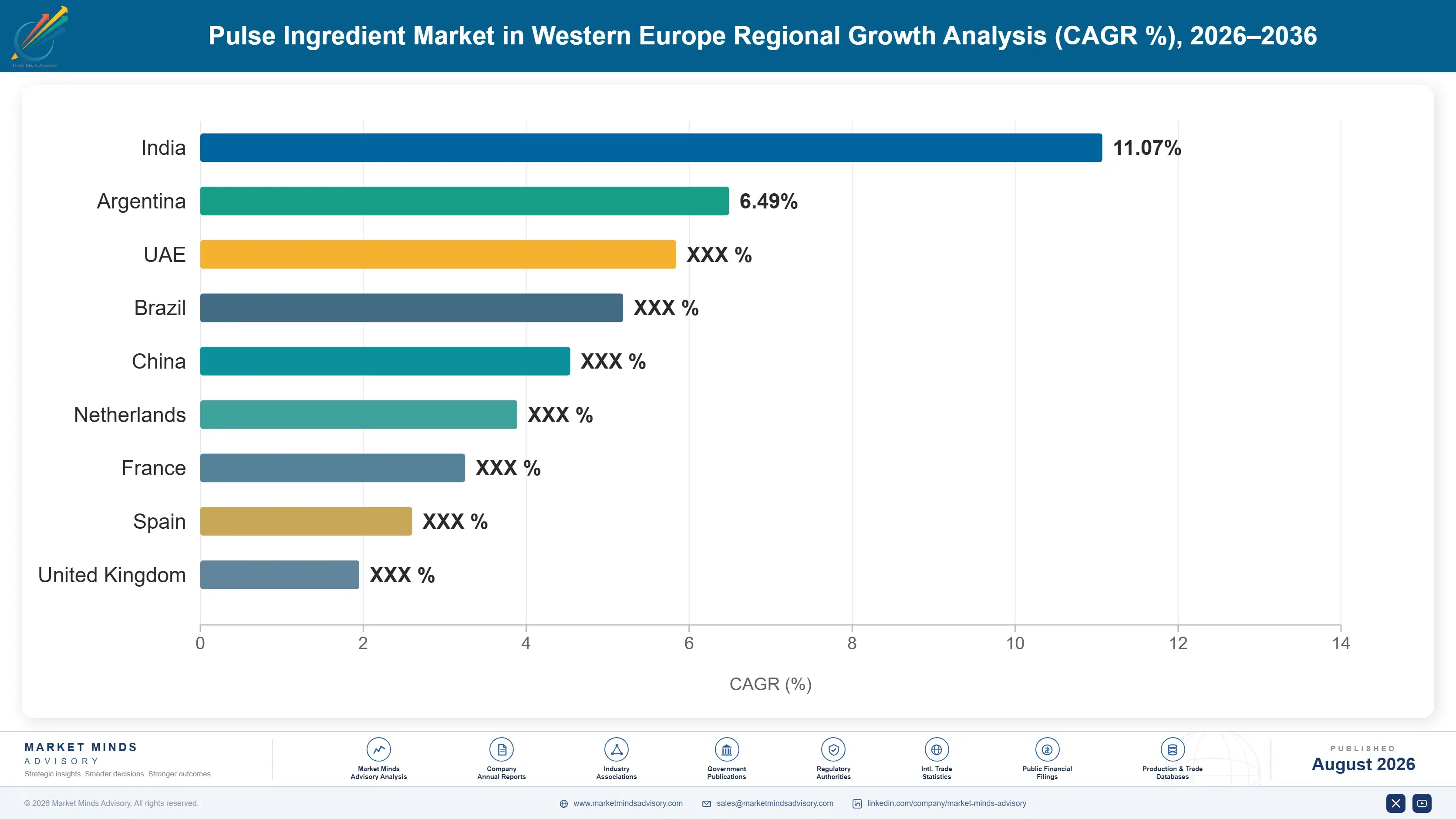
pulse-ingredient-market-in-western-europe-country-cagr-analysis-1787581048732

Four Moves on the Co-Product Problem

Protein pricing is not really the difficulty in this industry and it never truly was. Roughly three quarters of the bean leaves as something other than protein, and whether a European fractionation plant earns its capital back turns almost entirely on what happens to that fraction rather than on where the protein price lands.

Place pea starch where maize parity does not apply

Roughly 48% of the bean leaves as starch into a market where maize sets pricing across volumes perhaps thirty times larger. Pea starch has genuinely useful properties in paper coating, adhesives and certain gelling applications where maize performs less well, and those placements can earn well above parity. Very few European fractionators have done that development work seriously, treating starch as a disposal problem instead of a product. The plants that solved it run at nameplate and the ones that did not do not. Development work of that kind takes years and a dedicated function, which almost nobody has staffed.
Market Impact: Repositions the full 48% of plant output stream

Build the concentrate business rather than chasing isolate only

Dry fractionation concentrates run 50 to 60% protein at a fraction of the wet process capital cost and largely sidestep the purified starch problem, since the starch-rich fraction stays usable in food. Bakery, snack and extrusion customers take that stream willingly and grow at 10.2% doing it. Suppliers fixated on isolate purity are competing against Chinese cost positions they cannot match, in the one part of the category where the buyer is least willing to pay for provenance. Energy exposure is also a fraction of what wet fractionation carries through a gas price spike.
Market Impact: Targets the 10.2% concentrate segment at lower capital

Contract European acreage ahead of the policy support

Common Agricultural Policy protein support and national plans, including roughly 100 million euros committed in France, are funding pulse acreage that has to go somewhere once it is grown. Fractionators contracting that acreage now secure raw material at terms that will not survive the capacity being announced around them. Growers need multi-year rotation certainty rather than spot purchasing, and the suppliers offering it are locking supply that competitors will be bidding for within three seasons. Stated offtake interest routinely exceeds contracted volume by four times or more, which is precisely the gap that preceded several shelved projects.
Market Impact: Secures acreage behind roughly 100 million euros committed

Solve taste properly instead of masking it downstream

Deflavouring absorbs around 11% of processing cost and still leaves enough off-note that formulators reach for dairy in neutral applications. Enzymatic treatment, controlled fermentation and low-lipoxygenase varietal selection each attack the compounds rather than covering them, and combining the three is where the genuine gains sit. A supplier delivering neutral pulse protein reaches dairy alternative and beverage applications currently closed to the entire category, which is a considerably larger prize than incremental bakery share. Nobody has yet published independent sensory testing against dairy protein supporting a parity claim, which leaves the position genuinely open.
Market Impact: Attacks the 11% of processing cost spent deflavouring

Who Controls the Margin Pool

Participation is measured on annual pulse ingredient capacity supplied into Western Europe, and the top five hold 46%. Concentration reflects wet fractionation capital cost above anything else, since a plant of viable scale is a substantial investment and the co-product placement problem has deterred several entrants outright. Roquette and Cosucra lead on installed capacity and on how long they have been at it. The gap to challengers is starch placement capability rather than protein capability.
Competition runs on three fronts. Starch and fibre placement decides whether a plant runs at nameplate, which is a commercial capability rather than a processing one. Off-note performance decides which applications a supplier can reach at all. Raw material contracting is the third, as European acreage expands under policy support and the suppliers securing it early avoid bidding for it later.

Pressure ahead comes from Chinese isolate cost positions built on vermicelli starch economics, where protein was always the surplus rather than the product. That inverts the European problem and is difficult to answer on cost alone. Expect European suppliers to compete on provenance, traceability and formulation support instead. Rankings shift as faba capability builds and as whoever solves taste reaches applications nobody currently serves.
pulse-ingredient-market-in-western-europe-company-positioning-matrix-1787581049258

Competitive Moat and Risk Dimensions

ROQUETTE

Moat: Integrated starch placement capability

Roquette operates across starch and derivative markets far beyond pulse, which means pea starch enters an existing commercial machine rather than needing a home found for it. That is the single hardest problem in pulse fractionation and the company was already solving it for other crops decades before pea protein became interesting to anyone.
ROQUETTE

Risk: Capital intensity across cycles

Large wet fractionation assets carry fixed costs that demand consistent utilisation, and the meat analogue slowdown demonstrated how quickly assumed demand can fail to materialise. Committing capacity ahead of durable application demand exposes the balance sheet in a way that lighter dry fractionation competitors simply do not face.
COSUCRA GROUPE WARCOING

Moat: Long pea fractionation operating record

Cosucra has fractionated pea for decades rather than arriving with the recent protein interest, which means process knowledge on yield, off-note management and co-product handling that newer entrants are still acquiring expensively. Customers formulating against a specific protein functionality profile are reluctant to requalify around an unproven alternative supplier.
COSUCRA GROUPE WARCOING

Risk: Scale against larger competitors

Operating at smaller scale than diversified ingredient majors limits the capital available for capacity expansion and for taste technology development at the same time. In a category where Chinese cost positions set commodity-grade pricing, being neither the lowest cost nor the largest is an uncomfortable position to hold over a full cycle.

Players Tracked

Prominent Players

Roquette
Cosucra Groupe Warcoing
Emsland Group
Vestkorn Milling
Ingredion

Other Key Players

Beneo
AGRANA
Meelunie
Sotexpro
ADM
Cargill
Lantmannen
DSM-Firmenich
Barentz
Prolupin
Puris
Yantai Shuangta Food
AGT Food and Ingredients
Limagrain Ingredients
Kroner-Starke

Recent Developments

MARCH 2026

French fractionator contracts multi-year faba bean acreage with grower cooperatives

A French pulse fractionator signed multi-year supply agreements with grower cooperatives covering low-vicine faba bean acreage, offering rotation certainty rather than season-by-season purchasing. The agreements were structured around the national protein plan support growers already receive for legume rotation. Contracted acreage covers a multiple of current annual crush.
Signal: Raw material contracting is moving ahead of capacity announcements rather than following them into the market
OCTOBER 2025

European fractionation project shelved over starch placement economics

A planned Northern European pea fractionation facility was shelved before construction, with the developer citing an inability to place purified starch output at prices above maize parity. Protein offtake interest had been secured well before the decision was taken. Announced protein capacity had been publicised well over a year earlier.
Signal: Protein offtake letters are easy to obtain and starch placement is the constraint that actually decides projects
JANUARY 2026

Ingredient supplier launches low off-note pea protein using enzymatic treatment

A European ingredient supplier launched a pea protein isolate processed with enzymatic treatment targeting lipoxygenase-derived off-notes, aimed explicitly at neutral dairy alternative applications the category has struggled to reach. Comparative sensory testing against dairy protein has not been published independently. Launch volumes remain at pilot scale.
Signal: Reaching truly neutral applications would open a far larger prize than incremental bakery and snack share

The Bean, the Water and the Steam

Raw pulse accounts for roughly 44% of cost in fractionated protein, sourced from French, Belgian and Nordic acreage alongside substantial Canadian import. Process energy carries about 24%, since wet fractionation runs steam-intensive separation and drying that European gas prices make painful. Processing aids, water treatment and effluent handling add around 12%, and the balance sits in labour, logistics and depreciation across assets that are expensive to build.
European gas prices spiked through 2022 and stayed elevated well beyond, per IEA gas market reporting for the period, which hit wet fractionation harder than almost any adjacent food processing because of its drying load. Producers on annual ingredient contracts absorbed most of it directly. Canadian pea prices moved separately on prairie drought in 2021, so the two principal input exposures diverged rather than compounding.

Exposure divides on energy contracting and on process type. Dry fractionation concentrate producers carry a fraction of the energy load that wet isolate producers do, which widened their relative cost position materially through the gas spike. Geographically, French and Nordic producers with nuclear or hydro-weighted power contracts fared considerably better than German and Dutch operations exposed to gas-set marginal pricing across the same period.
pulse-ingredient-market-in-western-europe-cost-volatility-analysis-1787581049454

Contract European acreage on multi-year rotation terms

Raw pulse is around 44% of cost, and growers need rotation certainty rather than spot purchasing to commit acreage at all. Multi-year contracts secure supply at terms that will not survive the capacity being announced across the region. National protein plan support makes growers more receptive to these arrangements than they were even three seasons ago.

Weight the portfolio toward dry fractionation where application allows

Dry fractionation carries a fraction of the energy load wet isolate production requires, which matters enormously when European gas prices move. Concentrates suit bakery, snack and extrusion customers who value cost above neutrality. Running both routes lets a supplier shift emphasis as energy prices move rather than carrying the full wet process exposure permanently.

Secure power contracts away from gas-set marginal pricing

Process energy is roughly 24% of cost and European wholesale power is priced at the gas-fired margin far more often than the generation mix alone would suggest. French and Nordic producers holding nuclear or hydro-weighted contracts came through the last spike materially better. Siting and contracting decisions made years earlier determined that outcome entirely.

Portfolio Architecture for Margin Defence

Margin here follows protein concentration almost exactly, and then diverges sharply on whether the co-product problem was solved. Flours, starches and fibre streams earn margins in the low to mid teens, because they compete against cereal and maize equivalents priced by industries far larger than this one and carry no functional advantage worth paying for. Placement skill rather than product difference separates suppliers here.
Concentrates and texturised proteins do considerably better in the mid twenties to mid thirties, since dry fractionation costs less to run and bakery and extrusion customers accept the off-notes that come with it. The range reflects protein content and how much formulation support the supplier provides alongside the ingredient itself. Extrusion capability matters as much as protein content, because texturisation is where the formulator's own process risk sits.

Isolates and taste-corrected protein hold the strongest position, reaching into the mid forties, because protein content is the purchased attribute and neutrality opens applications the rest of the category cannot enter. Those margins reflect capital cost, process knowledge and the deflavouring work that around 11% of processing cost buys. Whether taste correction genuinely works varies enormously between suppliers making very similar claims about it.

Flours, Starches and Fibre Streams

Milled flours, purified starch and fibre or hull fractions competing against cereal and maize equivalents. The seven point range reflects placement skill rather than product difference, since these streams are functionally similar across suppliers.
Gross Margin: 12-19%

Concentrates and Texturised Proteins

Dry fractionated concentrates at 50 to 60% protein and extruded texturised forms. The eleven point range reflects protein content, extrusion capability and how much application development the supplier contributes alongside the ingredient.
Gross Margin: 24-35%

Isolates and Taste-Corrected Protein

High purity isolates and enzymatically or fermentation treated proteins reaching neutral applications. The thirteen point range reflects how far taste correction actually works, which varies enormously between suppliers making similar claims.
Gross Margin: 33-46%
pulse-ingredient-market-in-western-europe-portfolio-architecture-1787581049956

High-value Sub-segments and Strategic Watch-out

Taste-Corrected Pulse Protein

High value and the fastest growth available, since neutrality opens dairy alternative and beverage applications the whole category currently cannot reach. Deflavouring already absorbs 11% of processing cost, so the work is being paid for regardless of whether it succeeds. No independent sensory parity testing has been published.
Gross Margin: 36-46%

Faba Bean Protein Ingredients

High value and growing as low-vicine varieties reach commercial acreage across northern Europe. Gives European fractionators a crop suited to their own climate rather than one grown better in Saskatchewan, which changes capacity siting logic considerably. Process knowledge on faba remains thinner than on pea across the entire industry.
Gross Margin: 28-38%

Pulse Flours and Milled Fractions

The volume core, competing against cereal flours on price with no functional premium available anywhere. Steady bakery and snack demand supports volume without supporting margin, and any regional miller can supply the same specification competently. Bakery and snack demand supports volume without supporting margin at all.
Gross Margin: 12-19%

Purified Pea Starch

The strategic watch-out and the reason projects get shelved. Roughly 48% of plant output competing against maize starch priced by an industry thirty times larger, with the ten point range reflecting whether non-food placement was ever developed. Non-food placement development takes years and a dedicated function.
Gross Margin: 8-18%

Why Reformulation Rarely Reverses

Ingredient demand repeats with every production run a food manufacturer makes, which makes volume a function of their own sales rather than of any repeat purchasing decision. Once a bread, bar or beverage is reformulated around a specific pulse protein, the ingredient is consumed continuously for as long as that product sells. Reformulation is expensive and slow, so the decision is made rarely and then lived with for years.
Stickiness varies sharply by application depth. A protein providing structure in an extruded product is embedded in process parameters that took months to establish, and changing supplier means revalidating the whole line. Beverage applications sit almost as tight, since solubility and mouthfeel differences show immediately to consumers. Bakery inclusions at low addition rates switch far more readily, which is where price competition concentrates.

The buyer profile has changed with the application mix. Meat analogue formulators wanted protein content and texturisation above everything, and many of those programmes have gone. Bakery, beverage and clinical nutrition developers weigh sensory neutrality and regulatory documentation far more heavily, which favours suppliers who invested in taste work over those who invested in tonnage.
pulse-ingredient-market-in-western-europe-end-use-penetration-index-1787581050452

Where We Would Focus Effort

These are among the four positions where our research anticipates prominent divergence between winners and laggards over the coming forecast period. Each is grounded in the demand model, the regulatory perimeter, and the announced capacity pipeline.
01 / CO-PRODUCT PLACEMENT DISCIPLINE

Sell the starch before you build the plant

Roughly 48% of the bean leaves as starch into a market where maize sets pricing across volumes perhaps thirty times larger, and no process changes that compositional fact. Protein offtake letters are straightforward to obtain, which is exactly why they prove nothing about whether a project works. Several announced European fractionation facilities were shelved once the co-product arithmetic was costed properly rather than assumed away, and the plants running at nameplate today are the ones that solved this first, and that capability is commercial rather than technical in every case.
02 / TASTE CORRECTION INVESTMENT

Neutrality opens applications the whole category cannot reach

Deflavouring already absorbs around 11% of processing cost and still leaves enough off-note that formulators reach for dairy protein in neutral applications. Enzymatic treatment, controlled fermentation and low-lipoxygenase varietal selection attack the compounds rather than masking them, and combining all three is where genuine gains appear. A supplier delivering truly neutral pulse protein reaches dairy alternative and beverage applications closed to everyone else, which is a far larger prize than incremental bakery share, and nobody has yet published independent sensory parity testing that would close the position off.
03 / RAW MATERIAL CONTRACTING

Lock European supply while policy is still paying for it

Common Agricultural Policy protein support and national plans, including roughly 100 million euros committed in France, are funding pulse acreage that must find a buyer once it is grown. Growers need multi-year rotation certainty rather than season-by-season spot purchasing, and very few fractionators are offering it yet. Suppliers contracting that acreage now secure raw material at terms that simply will not survive the capacity being announced around them, and policy support has made growers considerably more receptive to multi-year terms than they were even three seasons ago.
04 / FABA BEAN CAPABILITY

Build around the crop that suits this climate

Faba bean yields better than pea across northern European conditions and carries higher protein, and low-vicine varieties have removed the favism concern that kept it out of ingredient use for decades. That gives European fractionators a raw material grown well at home rather than one grown better in Saskatchewan. Process knowledge on faba is thinner than on pea across the whole industry, which makes early capability a genuine advantage rather than a matter of catching up later, and Nordic and Baltic acreage is already moving in exactly that direction.

Engagement Snapshot From the Field

A live engagement with an industry participant carrying material or product regulatory and market exposure ahead of a defining policy shift, showing how our research translates into a defensible multi-year portfolio strategy.
MARKET MINDS ADVISORY · CLIENT ENGAGEMENT SUMMARY
Pulse Ingredient in Western Europe Producer Strategic Portfolio Review and Transition Roadmap 2026·Investment Scenario on Pulse Ingredient in Western Europe Exposure Evaluation 2025-26
CLIENT PROFILE
A Northern European pulse fractionator operating one wet fractionation line producing pea protein isolate, starch and fibre, with annual revenue near 118 million euros (client-reported, unverified by MMA). Protein carried the margin while starch was sold into animal feed at prices barely covering the drying energy, and the board had approved a second line in principle.
STRATEGIC CHALLENGE
The second line would roughly double protein output and double starch output alongside it, into a starch market the client had never developed and could not price above maize parity. Management needed to know whether protein demand justified the expansion, or whether the co-product would sink the return regardless of how much protein was sold.
MMA APPROACH
MMA modelled the second line under starch placements ranging from animal feed through to paper coating and specialty food, benchmarked European gas exposure against dry fractionation alternatives, and tested protein offtake interest against actual contracted volume rather than stated intent. Interviews with 47 experts covered fractionation operations, starch markets and European ingredient formulation.
KEY FINDINGS
  1. Under animal feed starch placement the second line returned below the client's own hurdle rate across every protein price scenario tested, including the most optimistic one.
  2. Paper coating and specialty food placement lifted starch realisation enough to clear the hurdle, but required development work the client had never staffed or budgeted for.
  3. Stated protein offtake interest exceeded contracted volume by more than four times, a gap consistent with what preceded several shelved European fractionation projects.
  4. A dry fractionation concentrate line at roughly a third of the capital cost cleared the hurdle rate comfortably and carried far less energy exposure through gas price movements.
CLIENT PROFILE
A Northern European pulse fractionator operating one wet fractionation line producing pea protein isolate, starch and fibre, with annual revenue near 118 million euros (client-reported, unverified by MMA). Protein carried the margin while starch was sold into animal feed at prices barely covering the drying energy, and the board had approved a second line in principle.
STRATEGIC CHALLENGE
The second line would roughly double protein output and double starch output alongside it, into a starch market the client had never developed and could not price above maize parity. Management needed to know whether protein demand justified the expansion, or whether the co-product would sink the return regardless of how much protein was sold.
MMA APPROACH
MMA modelled the second line under starch placements ranging from animal feed through to paper coating and specialty food, benchmarked European gas exposure against dry fractionation alternatives, and tested protein offtake interest against actual contracted volume rather than stated intent. Interviews with 47 experts covered fractionation operations, starch markets and European ingredient formulation.
KEY FINDINGS
  1. Under animal feed starch placement the second line returned below the client's own hurdle rate across every protein price scenario tested, including the most optimistic one.
  2. Paper coating and specialty food placement lifted starch realisation enough to clear the hurdle, but required development work the client had never staffed or budgeted for.
  3. Stated protein offtake interest exceeded contracted volume by more than four times, a gap consistent with what preceded several shelved European fractionation projects.
  4. A dry fractionation concentrate line at roughly a third of the capital cost cleared the hurdle rate comfortably and carried far less energy exposure through gas price movements.
RECOMMENDED STRATEGY
Phase 1: Phase one: pause the second wet line and staff a starch application development function, since the co-product decides the return rather than the protein price does. Phase 2: Phase two: build dry fractionation concentrate capacity serving bakery and extrusion customers, at roughly a third of the capital and far lower energy exposure. Phase 3: Phase three: revisit wet expansion only once starch is placed above maize parity and protein interest converts into contracted volume.
OUTCOME
The board deferred the second wet line and commissioned dry fractionation capacity during 2026, reporting a return on that investment ahead of plan within the first full year (client-reported, unverified by MMA). A starch application function was established and had secured two non-feed placements by mid-year.

Frequently Asked Questions

Foundational context covering the market sizes, CAGR, scope, country, region and competition that inform every finding below. This section is provided to cover basics and most often pre-purchase conversations, answered from the MMA Primary Research Dataset.

What is the current size of the Pulse Ingredient Market in Western Europe?

MMA sizes it at USD 1.86 billion in 2025, rising to USD 2.02 billion in 2026. The figure covers pulse-derived ingredients sold to food manufacturers at supplier selling value into Western European demand.

How large will the Pulse Ingredient Market in Western Europe be by 2036?

USD 4.52 billion by 2036, an incremental USD 2.50 billion over the 2026 base and an expansion multiple of 2.24 times. Isolates account for a disproportionate share of that growth.

What is the CAGR for the Pulse Ingredient Market in Western Europe 2026 to 2036?

8.4% in the base case, with a bull case at 9.6% and a bear case at 7.2%. The spread turns on starch co-product placement and on whether off-flavour resistance persists.

Which segment is growing fastest?

Pulse protein isolates at 12.6%, half again the market rate of 8.4%. Isolates sell at roughly 3.4 times the flour they displace, which carries the fractionation investment case.

Who are the major companies in the Pulse Ingredient Market in Western Europe?

Roquette, Cosucra Groupe Warcoing, Emsland Group, Vestkorn Milling and Ingredion lead on capacity supplied into the region. Fifteen further participants are profiled in the full report on that basis.

Which country is growing fastest?

France at 10.6%, supported by domestic acreage, established fractionation capacity and a national protein plan committing roughly 100 million euros to legume production and processing.

Report Segmentation Architecture

The full report scope spans multiple orthogonal segmentation dimensions, with cross-tabulated demand data provided for each dimension pair. Coverage extends further to regional breakdowns, trend trajectories, and the competitive detail needed to support segment-level decision-making.

By Ingredient Product Form

  • Pulse Protein Isolates
  • Pulse Protein Concentrates
  • Pulse Flours
  • Pulse Starches
  • Pulse Fibres and Hulls
  • Texturised Pulse Proteins

By End-Use Industry

  • Bakery and Snacks
  • Beverages and Powders
  • Meat and Dairy Alternatives
  • Sports and Clinical Nutrition
  • Pet Food
  • Industrial and Non-Food Applications

By Commercial Dimension

  • Direct Supply to Manufacturers
  • Ingredient Distribution Channels
  • Contract Fractionation Services
  • Private Label Ingredient Supply
  • Co-Development Agreements
  • Import Supply into Western Europe

By Region

  • North America
  • Western Europe
  • East Asia
  • South Asia and Pacific
  • Latin America
  • Middle East and Africa
  • Eastern Europe

Scope, Methodology, and Coverage

Every figure in this report is reproducible from documented input assumptions. The scope below maps the historical period, the forecast horizon, the segmentation dimensions, and the countries covered, alongside the underlying primary and qualitative methodology.
Historical Period
2020 to 2025
Forecast Period
2026 to 2036
Base Year
2025 (USD billions; MMA Primary Research Dataset, August 2026)
Market Definition
Ingredients fractionated or milled from pulse crops, principally yellow pea, faba bean, lentil and chickpea, sold to food and beverage manufacturers in Western Europe. Covers protein isolates and concentrates, flours, starches, fibres and hulls, and texturised pulse proteins, measured at ingredient supplier selling value into Western European demand regardless of where processing occurs. Whole pulses sold for direct consumption, soy and cereal proteins, and finished consumer products containing pulse ingredients are excluded from scope.
Quantitative Units
USD billions (current prices); thousand tonnes ingredient volume; EUR per tonne by product form
Segmentation Dimensions
Ingredient product form; end-use industry; commercial dimension; region
Regions Covered
North America, Western Europe, East Asia, South Asia and Pacific, Latin America, Middle East and Africa, Eastern Europe
Countries Covered
France, Germany, Netherlands, Belgium, United Kingdom, Denmark, Sweden, Finland, Norway, Italy, Spain, Austria, Switzerland, Ireland, Portugal, Canada, United States, China, Australia, Poland
Key Companies Profiled
Roquette, Cosucra Groupe Warcoing, Emsland Group, Vestkorn Milling, Ingredion, Beneo, AGRANA, Meelunie, Sotexpro, ADM, Cargill, Lantmannen, DSM-Firmenich, Barentz, Prolupin, Puris, Yantai Shuangta Food, AGT Food and Ingredients, Limagrain Ingredients, Kroner-Starke
Quantitative Methodology
Primary survey, n=3,800 respondents, Q4 2025, six countries; demand-side model with trade association cross-validation
Qualitative Methodology
47 expert interviews, Q4 2025; applied to validate demand model assumptions, identify emerging dynamics, and assess competitive positioning
Report Format
PDF and XLSX data workbook (Word format preview document)
Publisher
Market Minds Advisory
Report Code
MMA-2026-AGR-180
Published
August 2026
Contact
sales@marketmindsadvisory.com | www.marketmindsadvisory.com

Purchase the full Pulse Ingredient Market in Western Europe Report (2026 to 2036).

The full report costs the whole bean rather than the protein alone, modelling starch and fibre placement scenarios against the fractionation return that European capacity decisions actually turn on. It sizes each of the six product forms independently through 2036, quantifies deflavouring cost and its effect on reachable applications, and benchmarks European wet fractionation against Chinese co-product economics and dry fractionation alternatives. Country chapters cover the principal Western European markets alongside the supply origins feeding them. Competitive profiling covers 20 participants on a single consistent capacity basis.
Six ingredient product forms sized independently through 2036
Starch and fibre placement scenarios costed against returns
Deflavouring cost mapped to reachable formulation applications
European wet fractionation benchmarked against Chinese co-product economics
Twenty participants profiled on one consistent capacity basis
Faba bean varietal progress assessed against pea incumbency

Built For The People Who Decide

From boardroom strategy to bench-side execution, this report is read cover-to-cover by leaders shaping the next decade of their industry, turning demand scenarios, market dynamics and valuation benchmarks into decisions.
CXOs/ Presidents/ VPs/ Managers
M&A and Corporate Development
Strategy Teams and R&D Heads
Procurement and Product Directors
Regulatory and Compliance Leaders
Investor Relations and Equity Analysts