Market Minds Advisory
Pulse Electromagnetic Field Therapy Devices Market

Pulse Electromagnetic Field Therapy Devices Market: Four Cleared Indications, a Wellness Market With None, and Patients Who Stop Wearing It

The cleared indications need six hours of daily wear that half of patients never manage, and the fastest growing part of this market makes no medical claim at all and requires no evidence.

Lead Analyst

Alice Ballenger

Published

September 2026

Make Smarter Decisions with Customized Research Insights

Request a free sample report and evaluate market opportunities, growth trends, and competitive dynamics relevant to your business needs.

2025 MARKET VALUE$0.6BMarket Size 2025
2036 FORECAST VALUE$1.4BBase Case , 2026 to 2036
CAGR 2026 TO 20367.6 %Bull 8.9% / Bear 6.3%
INCREMENTAL OPPORTUNITY$0.7BNet 10- year value creation
EXPANSION MULTIPLE2.08x2036 value over 2026 base
Strategic Levers
M&A Pipeline
Regional Outlook
Country Rankings
Competitive Intelligence
Segmental Deep-dive
Call-Us : 91 93563 13602

Executive Snapshot and Market Trajectory

This market has two halves that barely acknowledge each other. Regulated bone growth stimulators carry four cleared indications and randomised evidence, and a much larger consumer wellness segment sells the same underlying physics with no medical claim, no clearance and no trial behind it. The two halves need separate organisations.
Consumer wellness devices compound at 11.4%, exactly 1.50 times the market, which is uncomfortable given they carry the weakest evidence of anything here. North America holds 32% of spend because reimbursed bone growth stimulation is concentrated there. Measured adherence on cleared devices runs near 51%. Payers refuse around 28% of authorisation requests on first submission, so a quarter of eligible patients never receive a device at all.
Five manufacturers hold 44%. Positions in the regulated half rest on reimbursement navigation and orthopaedic surgeon relationships, and in the consumer half on marketing reach alone, since nothing else distinguishes one coil from another. Consumer devices hold around 37% of units and carry no cleared indication. A cleared device needs a surgeon, a payer and a compliant patient, while a consumer device needs one person to click a button once. Nothing else distinguishes them.
Market Definition
The market covers devices delivering pulsed electromagnetic fields for therapeutic or wellness purposes, spanning cleared bone growth stimulation devices, cleared post-surgical oedema and pain devices, clinic-based professional therapy systems, consumer wellness devices, veterinary and equine therapy systems, and wearable low-field therapy devices. Static magnet products, transcranial magnetic stimulation for psychiatric indications, electrical nerve stimulation devices, diathermy and shortwave therapy equipment, and implanted stimulators are excluded.
Base Year Value
$0.6B in 2025 (MMA Primary Research Dataset, August 2026)
Forecast Period
2026 to 2036, eleven discrete annual values
CAGR
7.6% base case. Bull 8.9%. Bear 6.3%.
Fastest Growth Segment
Consumer Wellness Devices: 11.4% CAGR
Fastest Growth Country
India: 10.0% CAGR
Fastest Growth Region
South Asia and Pacific: 9.7% CAGR
Largest Region
North America: 32% of 2025 global value
Market Leaders
Orthofix Medical, Zimmer Biomet, Bioventus, Enovis, Curatronic. Source: MMA Analysis based on company annual reports.
Primary Survey
n=3,800 procurement and R&D decision-makers, Q4 2025, six countries
Methodology
Demand-side build-up, cross-validated against public data, 47 expert interviews

Pulse Electromagnetic Field Therapy Devices Market Forecast Scenarios

pulse-electromagnetic-field-therapy-devices-market-size-forecast-scenario-1787309232603
Growth of 8.2% across 2020 to 2025 came from a channel nobody in the reimbursed business wanted to discuss. Prescribed bone stimulator volumes were flat to declining as payer denial rates climbed and utilisation review tightened, while direct-to-consumer wellness devices grew rapidly through online channels with no clinical evidence requirement whatsoever. Elective orthopaedic surgery suspension during 2020 removed a year of post-surgical stimulator prescribing outright.
The base case of 9.4% rests on three mechanisms. Wearable form factors are addressing the compliance problem that undermines outcomes, since only 58% of patients currently meet prescribed daily wear, and better compliance strengthens the evidence base that reimbursement depends on. The consumer channel keeps expanding at 23% of revenue and rising. And Asian and Indian orthopaedic volumes are growing quickly, mostly through cash-pay and hospital purchase rather than reimbursement.
The bull case of 10.6% assumes a properly powered wearable compliance trial produces outcome data strong enough to reverse payer denial trends, which would restore a reimbursed category that has been contracting for a decade. The bear case of 8.1% reflects two pressures: further payer restriction pushing prescribed volumes down faster, and regulatory attention to consumer wellness claims removing the channel carrying category growth.

Two Markets Wearing the Same Coil

The regulated half of this market is narrow and evidenced. Bone growth stimulators are cleared for non-union fracture, failed spinal fusion and a small number of adjacent uses, four indications in total, and the randomised evidence behind non-union healing is real if not overwhelming. The devices work by inducing a field across the fracture site and they have to be worn for around six hours a day to do it.
TOP FIVE CONCENTRATION44%Combined share held by the five largest device manufacturers globally
DAILY WEAR REQUIREMENT6 hoursDuration cleared bone growth devices must be worn each day
MEASURED ADHERENCE51% of prescribedProportion of required wear time patients actually complete
PRIOR AUTHORISATION DENIAL28% of requestsShare of bone growth stimulator authorisations refused on first submission
CONSUMER SHARE OF UNITS37% of devicesProportion sold without any cleared medical indication attached
CLEARED INDICATION COUNT4 indicationsUses supported by regulatory clearance across the whole category
That requirement is where the clinical benefit leaks away. Measured adherence runs near 51% of prescribed wear time, and a device worn for three hours instead of six is not delivering the dose the trials tested. Prior authorisation refuses about 28% of requests on first submission, so a substantial share of eligible patients never receive one, and a substantial share of those who do never use it properly.
The consumer half is larger by unit count at around 37% of devices and carries no cleared indication at all. Sold as wellness products for recovery, sleep and general wellbeing, these devices avoid medical claims and therefore avoid any evidence requirement, and they compound at 11.4%. Nothing distinguishes one from another except marketing, which is precisely why the segment grows fastest.
"The half of this market with evidence is fighting prior authorisation and patient adherence for every unit. The half with no evidence is selling online at consumer margins and growing at twice the rate. That is not a coincidence."
Director, Physical Medicine and Rehabilitation Devices Practice · MMA Physical M

Market Trends

Consumer Wellness Channels Grow Without Any Evidence Requirement

Devices sold for recovery, sleep and general wellbeing make no medical claim, which places them outside device regulation and removes any obligation to demonstrate benefit. They now account for around 37% of units and compound at 11.4% against a market at 7.6%, sold through online retail at consumer margins with no prior authorisation, no prescription and no adherence monitoring. Nothing distinguishes competing products except marketing reach, which is exactly why the segment expands fastest. Advertising enforcement is the only mechanism currently reaching the segment, and it has so far been applied lightly.
Market Impact: Clearance covering only 4 indicatio
Wearable Formats Attack the Adherence Problem Directly

Cleared bone growth devices require around six hours of daily wear and patients complete near 51% of it, which means the trials that established efficacy tested a dose most patients never receive. Lower-field wearable formats designed for continuous unobtrusive use trade field strength for compliance, on the argument that a weaker dose actually delivered beats a stronger one abandoned. The evidence for that trade is incomplete and the logic is sound enough that several manufacturers are pursuing it seriously. Several manufacturers are pursuing clearance on the argument that delivered dose rather than nominal output is the appropriate comparison.
Market Impact: Wear requirement running 6 hours da

Market Opportunities and Growth Drivers

Non-Union and Failed Fusion Volumes Rise With Surgical Age

Bone growth stimulation is cleared for fracture non-union and failed spinal fusion, and both populations grow as surgical volumes rise in older patients with poorer bone healing capacity. Smoking, diabetes and osteoporosis all raise non-union risk, and none of those denominators is shrinking. The cleared indication count stands at four across the whole category, so this is a narrow market that grows steadily rather than a broad one that grows quickly. Surgeon identification rather than patient demand drives every prescription, which makes the orthopaedic relationship the entire demand channel. Growth is steady rather than quick.
Market Impact: Patients completing 51% of wear

Veterinary Use Expands Where Evidence Standards Are Lower

Equine and companion animal therapy has become a substantial application, sold to trainers, veterinarians and owners who accept observational evidence that human medicine would not. Performance horse markets in particular fund therapy generously and judge it by perceived recovery rather than by controlled comparison. That produces a genuine commercial segment with almost no clinical literature behind it, and manufacturers serve it profitably without the regulatory or reimbursement burden the human indications carry. Gulf, Australian and South American racing circuits all support it substantially, and none of them asks for a randomised comparison.
Market Impact: Denials refusing 28% of requests

Market Restraints and Challenges

Half the Prescribed Dose Is Never Actually Delivered

Cleared devices require around six hours of daily wear and measured adherence sits near 51%, which means most patients receive roughly half the dose the registrational trials tested. The root cause is that the device is bulky, visible and worn for weeks with no perceptible sensation to confirm it is working. Manufacturers mitigate with adherence monitoring, patient support programmes and lower-profile wearable formats, and none of it has moved compliance far enough to matter clinically. No competitor product in the category delivers materially better measured adherence either. The category shares that limitation.
Market Impact: Consumer devices at 37% of units

Prior Authorisation Blocks a Quarter of Eligible Patients

Payers refuse around 28% of bone growth stimulator authorisations on first submission, generally on documentation of non-union duration or failed conservative management rather than on clinical disagreement. The root cause is that the evidence base, while real, is thinner than payers would like for a device costing several thousand dollars. Manufacturers mitigate with documentation support, appeal services and registry data, and coverage policy has tightened rather than loosened over the past decade. Documentation support converts a large share of those refusals into funded devices without any product change at all.
Market Impact: Adherence measured at 51% completio
3 additional market trends, 4 additional growth drivers, and 2 additional restraints and challenges are covered in the full report. Contact sales@marketmindsadvisory.com to access the complete intelligence.

Segment CAGR and Growth Architecture

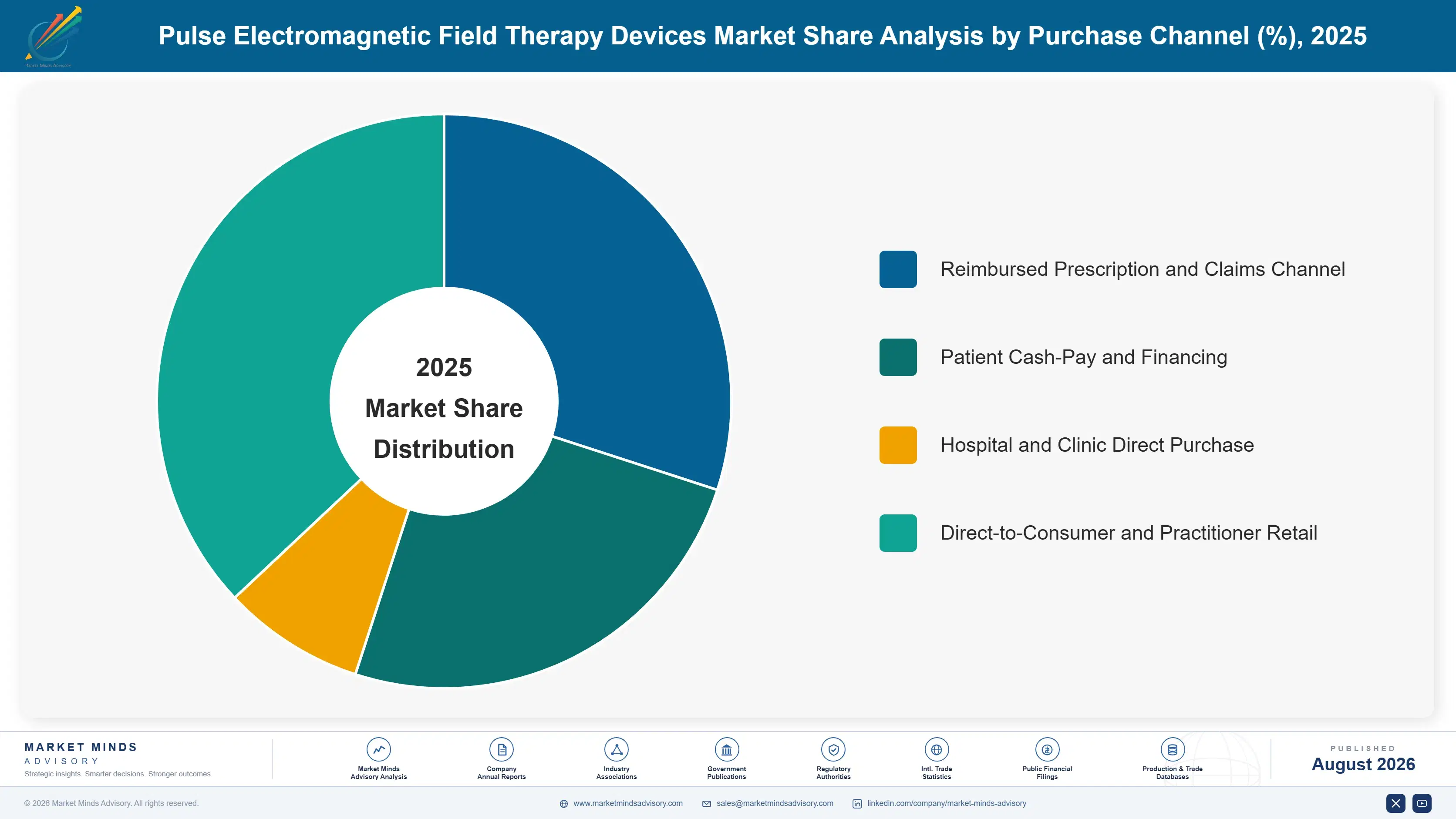
Segmentation follows device class and regulatory status, because clearance determines everything about how a product is sold, funded and evidenced. A cleared bone growth stimulator and a consumer wellness coil may share physics and share nothing else commercially at all. Six classes sit in the hierarchy, separated by clearance status rather than by the physics they share.
pulse-electromagnetic-field-therapy-devices-market-market-share-analysis-1787309233134

Consumer Wellness Devices

Consumer wellness devices compound at 11.4%, exactly 1.50 times the market, and they hold around 37% of units while carrying no cleared indication whatsoever. Sold for recovery, sleep quality and general wellbeing, they avoid medical claims deliberately and therefore avoid device regulation, clinical evidence requirements, prescription and reimbursement entirely. Distribution is online retail at consumer margins with no prior authorisation to obtain and no adherence to monitor. Nothing meaningfully distinguishes competing products beyond marketing reach and brand construction, which is uncomfortable to state and is precisely why the segment grows fastest. Consumer protection action against wellness claims is the one thing that could interrupt it, and enforcement has so far been minimal.
CAGR 11.4%

Wearable Low-Field Therapy Devices

Wearable low-field devices grow at 10.1% by trading field strength for wear time, which is a rational response to adherence near 51% on conventional cleared devices requiring six hours daily. The argument is that a weaker field actually delivered outperforms a stronger one abandoned after a fortnight, and it is plausible rather than demonstrated. Registrational evidence for the lower dose is incomplete, and several manufacturers are pursuing clearance on the basis that measured delivered dose rather than nominal output is what should be compared. Some products sit deliberately in the wellness category instead, which avoids the evidence burden entirely and forfeits reimbursement in exchange. That is a genuine strategic fork rather than a product decision.
CAGR 10.1%
Full segment breakdown across 6 segments available in the complete report.

Regional Architecture and Country Demand Map

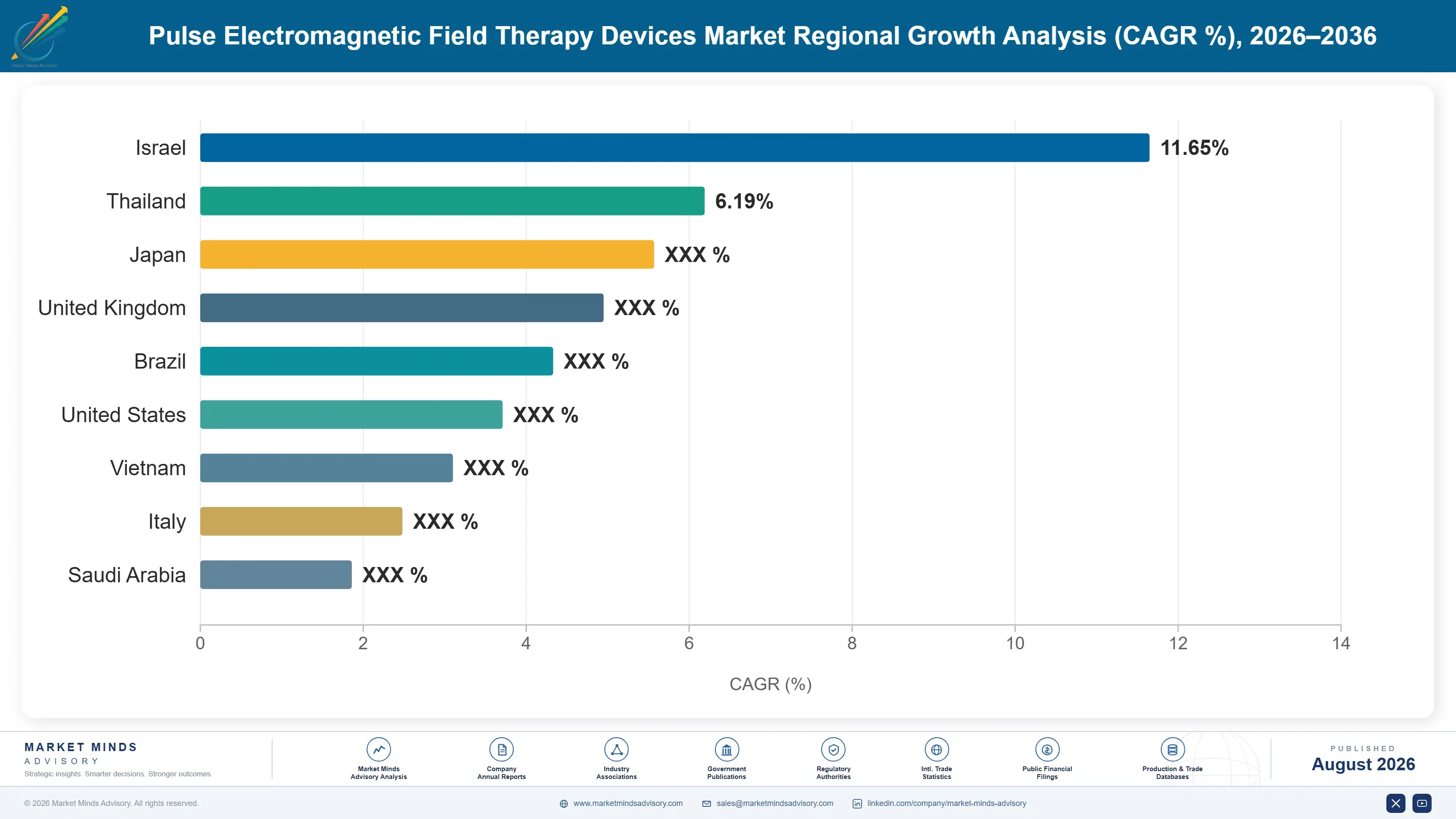
Demand splits by regulatory regime rather than by clinical need, since reimbursed bone growth stimulation concentrates where payers fund it and consumer devices sell wherever online retail reaches. North America leads because it funds bone growth stimulation where most systems decline. The consumer half sells wherever online retail reaches.

North America

North America holds 32% of spend, the largest regional share, growing at 7.3%. The reason is reimbursement rather than epidemiology and worth stating plainly: bone growth stimulators are funded here where most systems decline them, which makes the regulated half of this market disproportionately American. Prior authorisation nonetheless refuses around 28% of requests, and coverage policy has tightened over a decade rather than loosened. The consumer wellness segment is also largest here, sold through online retail under general wellness provisions that require no clinical evidence at all. Both halves of the market are therefore largest here, for entirely unrelated reasons. Coverage policy has tightened across a decade rather than loosened at any stage.
Share: 32% | CAGR: 7.3% (2026 to 2036)

Western Europe

Twenty-four percent of spend sits in Western Europe, growing at 6.0%, the slowest of the seven regions. Public health systems largely decline to fund bone growth stimulation, judging the evidence insufficient for the cost, which pushes the regulated half toward private orthopaedic practice and self-payment. German and Austrian physical medicine traditions are more accommodating of clinic-based therapy systems than most, and those clinics are a genuine channel. Consumer wellness sales are substantial and face somewhat more advertising scrutiny than in North America. Public systems judge the evidence insufficient for the cost, which pushes the regulated half toward private orthopaedic practice and self-payment throughout the region. Consumer sales face somewhat more advertising scrutiny than in North America.
Share: 24% | CAGR: 6.0% (2026 to 2036)
Regional intelligence for 5 additional markets available in the complete report: East Asia, South Asia and Pacific, Latin America, Middle East and Africa, Eastern Europe. Contact sales@marketmindsadvisory.com.
pulse-electromagnetic-field-therapy-devices-market-country-cagr-analysis-1787309233650

Choosing Which Half to Compete In

The regulated half has evidence, reimbursement battles and an adherence problem. The unregulated half has none of those and no evidence either. Four positions matter, and the honest ones are harder work than the profitable one. Two concern fixing the regulated half, one a channel outside human regulation, and one a decision about which market to be in.

Solve Adherence Rather Than Increase Field Strength

Cleared devices require around six hours of daily wear and patients complete near 51% of it, so most receive half the dose the trials tested and manufacturers compete on nominal output nobody actually delivers. Designing for wear time rather than field specification, and measuring delivered dose rather than device capability, addresses the real clinical gap. Wearable low-field formats grow at 10.1% on exactly that argument, and the manufacturer that proves it with data rather than logic takes the indication. Nobody in the category has yet demonstrated it properly. Logic alone persuades no regulator.
Market Impact: Adherence stuck near just 51% of pr

Supply Authorisation Documentation to Orthopaedic Practices

Payers refuse around 28% of bone growth stimulator requests on first submission, generally on documentation of non-union duration or failed conservative management rather than on clinical merit. Manufacturers who supply submission templates, documentation protocols and appeal support convert refused cases into funded ones directly. The revenue recovered is immediate and the switching cost created inside a practice is considerable, since the templates become part of how the practice works. Templates become part of how a practice works, which makes the position unusually durable once established. Clinical merit is rarely the issue.
Market Impact: Recovering from a full 28% first-su

Serve the Veterinary Segment Without Human Regulatory Burden

Equine and companion animal therapy is a genuine commercial segment funded generously by performance horse operations that judge outcome by perceived recovery rather than controlled comparison. It carries no human device regulation, no reimbursement negotiation and no prior authorisation, and the Gulf, Australian and South American racing circuits all support it substantially. Manufacturers serve it with the same coil technology and none of the burden attaching to the 4 cleared human indications. Trainers, veterinarians and owners fund therapy on observational evidence that human medicine would decline, and they judge it entirely by perceived recovery.
Market Impact: Avoiding all 4 of the cleared indic

Decide Deliberately Whether to Make Medical Claims

Consumer wellness devices hold around 37% of units, compound at 11.4% and require no clearance, no trial and no reimbursement negotiation because they claim nothing medical. A manufacturer can enter that segment and forfeit reimbursement permanently, or pursue clearance and accept the evidence burden, and doing both under one brand invites regulatory attention neither half wants. The choice is strategic rather than incremental, and companies that have blurred it have generally regretted doing so. A regulator reading wellness marketing applies it to the cleared range. Companies that blurred the line have generally regretted it.
Market Impact: Consumer devices now holding 37% of

Who Controls the Margin Pool

Five manufacturers hold 44% measured on device revenue across both halves of the market, the basis applied throughout this section. The regulated half is dominated by orthopaedic device companies with reimbursement infrastructure, and the consumer half is fragmented among wellness brands with marketing reach and no clinical function. Orthofix Medical and Zimmer Biomet lead on the regulated side.
Competition operates on three dimensions and they barely overlap. Reimbursement navigation and orthopaedic surgeon relationships decide the regulated half. Marketing reach and channel presence decide the consumer half. Adherence-oriented design decides which manufacturer eventually resolves the clinical gap that limits the cleared indications. They require different organisations entirely.

Two pressures are reshaping the field. Consumer growth at 11.4% rewards brands with no clinical obligation, which is an uncomfortable competitive dynamic for evidence-based manufacturers. Meanwhile payer restriction tightens on the cleared indications. Rankings will shift toward whoever solves adherence and can prove it, since that is the only route to expanding the regulated half. An evidence-based manufacturer watching a competitor with no clinical obligation grow at twice the rate is in an awkward position that no amount of trial data resolves.
pulse-electromagnetic-field-therapy-devices-market-company-positioning-matrix-1787309234176

Competitive Moat and Risk Dimensions

ORTHOFIX MEDICAL

Moat: Reimbursement and surgeon infrastructure

Orthofix Medical operates the deepest reimbursement support apparatus in bone growth stimulation, covering documentation, appeals and coverage policy engagement across payers refusing around 28% of requests. That infrastructure directly converts refused authorisations into funded devices, and the orthopaedic surgeon relationships behind it took decades to build.
ORTHOFIX MEDICAL

Risk: Adherence problem unresolved

Measured adherence near 51% means most patients receive half the prescribed dose, and no amount of reimbursement capability fixes a device patients stop wearing. A competitor proving that a lower-field wearable format delivers more actual dose would undermine the clinical premise of the whole conventional product line at once.
ZIMMER BIOMET

Moat: Orthopaedic portfolio integration

Zimmer Biomet sells bone growth stimulation alongside a broad orthopaedic implant and instrument portfolio, so the device sits inside an existing commercial relationship with the surgeons and hospitals who identify candidate patients. In a market where surgeon identification rather than patient demand drives prescription, that access matters more than any device specification.
ZIMMER BIOMET

Risk: Consumer segment absence

The consumer wellness half holds around 37% of units, compounds at 11.4% and requires no clinical evidence, and an orthopaedic device company cannot credibly enter it without inviting scrutiny of the claims across its regulated products. That leaves the fastest-growing segment effectively unavailable to the largest participants.

Players Tracked

Prominent Players

Orthofix Medical
Zimmer Biomet
Bioventus
Enovis
Curatronic

Other Key Players

Medtronic
Stryker
IGEA
Zynex Medical
BEMER International
Swiss Bionic Solutions
Magnawave
Assisi Animal Health
Respond Systems
Pulse Centers
Sota Instruments
Enraf-Nonius
Oska Wellness
NewMed
Ito Co

Recent Developments

MARCH 2025

Payers tighten non-union documentation requirements for stimulator coverage

Coverage policies across several health systems raised documentation standards for demonstrating non-union duration and failed conservative management before funding bone growth stimulation. These were payer policy decisions rather than regulatory actions or commercial developments among device manufacturers themselves. Coverage has tightened across a decade rather than loosened at any point.
Signal: Documentation standards rather than any cl
JULY 2025

Wearable low-field formats pursue clearance on delivered dose arguments

Manufacturers of lower-field wearable devices advanced clearance submissions arguing that measured delivered dose rather than nominal field output is the appropriate comparison given adherence limitations. This reflects regulatory strategy rather than any transaction among the companies involved. Adherence limitations were cited explicitly in the submissions themselves.
Signal: Delivered dose rather than nominal field o
OCTOBER 2025

Consumer wellness claims attract advertising scrutiny in several markets

Advertising standards bodies in several markets questioned recovery and wellbeing claims made for consumer electromagnetic devices sold outside device regulation. These were advertising enforcement actions rather than device regulatory determinations, and the products remain on sale unchanged. Device regulators have not acted against the same products at all.
Signal: Advertising enforcement is currently the o

Coils, Electronics and Reimbursement Support

Coil assemblies, control electronics and battery cells account for roughly 33% of cost of goods across cleared devices, and considerably less across consumer products built to lower specifications. Housings, straps and packaging add about 14%. Reimbursement support staffing, documentation services and appeal handling sit outside cost of goods and represent the largest controllable spend in the regulated half of the market.
Electronic component and battery cell supply tightened through 2021 and 2022, and cleared device manufacturers carried it worse than consumer brands because component substitution in a cleared device requires regulatory change control. Company annual reports across the orthopaedic device manufacturers disclose the resulting cost pressure. Energy Information Administration data on industrial electronics pricing documents the underlying component movement through that period. Consumer brands faced no equivalent constraint at all.

Exposure divides completely by regulatory status. Cleared device manufacturers carry component cost plus change control obligations plus reimbursement support staffing against device prices under continuous payer pressure. Consumer brands carry low component cost and heavy marketing spend against consumer pricing, with no change control and no reimbursement apparatus at all. The two cost structures have almost nothing in common.
pulse-electromagnetic-field-therapy-devices-market-cost-volatility-analysis-1787309234371

Qualify alternate electronic components under change control early

Component substitution in a cleared device requires regulatory change control that cannot be completed inside a supply disruption. Qualifying second-source electronics and cells during initial design preserves the option to substitute without a filing that takes longer than the shortage itself, and consumer brands face no equivalent constraint at all. Filings outlast most shortages.

Fund reimbursement support from recovered authorisations

Documentation templates, submission support and appeal handling convert refused authorisations into funded devices at a recovery rate that can be measured directly. Charging that support against recovered revenue rather than treating it as a general selling cost makes its return visible and protects it when commercial budgets are reviewed. Recovery rates are directly measurable.

Keep regulated and consumer brands commercially separate

Operating cleared devices and unregulated wellness products under one brand invites regulatory scrutiny of every claim across both, since a regulator reading the wellness marketing will apply it to the cleared range. Separate brands, entities and marketing functions cost more to run and protect the clearance that took years to obtain. Years of clearance work is what is at stake.

Portfolio Architecture for Margin Defence

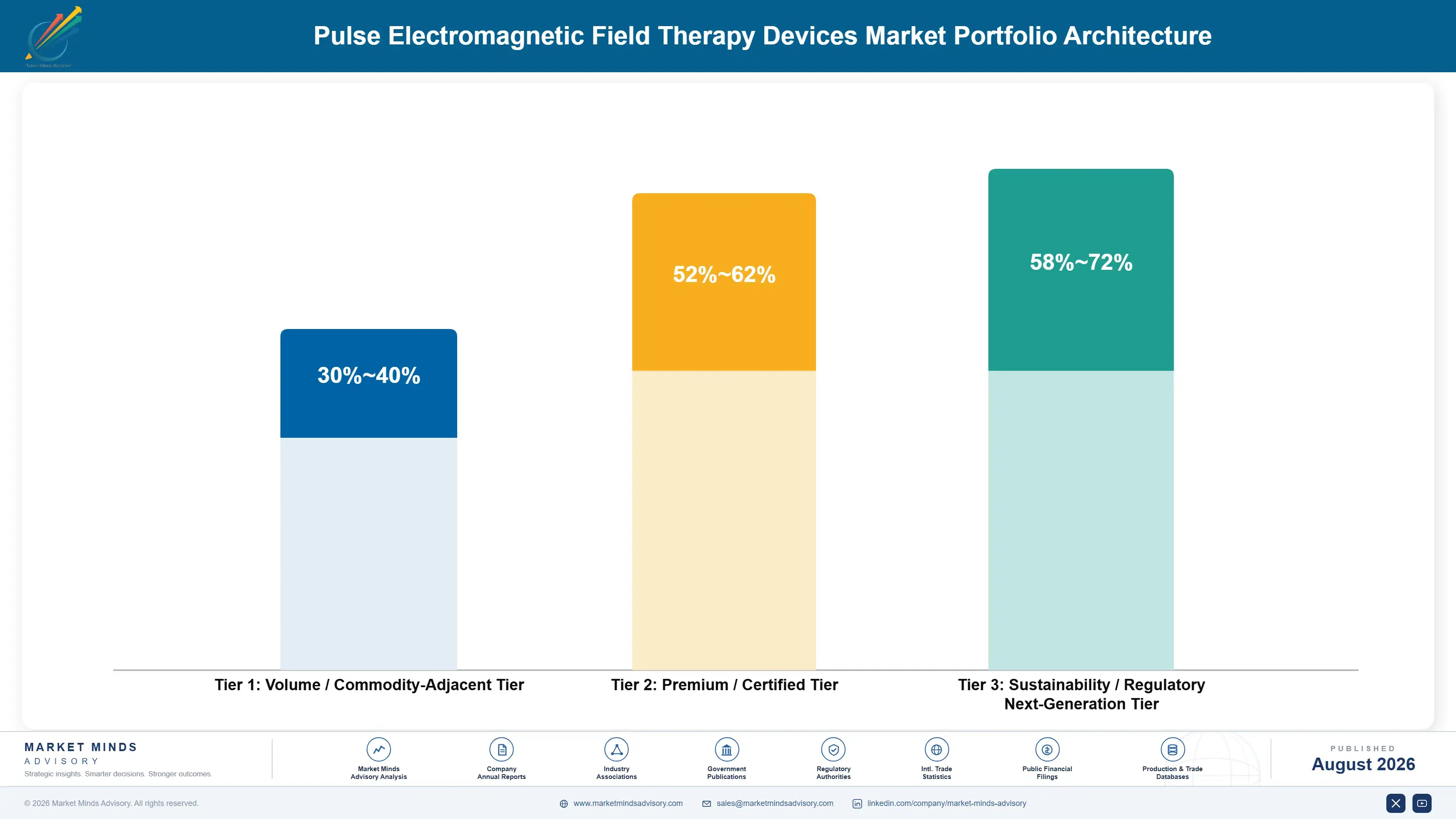
The portfolio separates on regulatory status above everything else. Cleared bone growth stimulators carry evidence, reimbursement and an adherence problem. Cleared oedema and pain devices are a smaller regulated position. Clinic-based professional systems sell to physical medicine practices. Consumer wellness devices carry no obligations. Veterinary systems sit outside human regulation entirely and sell on perceived rather than measured benefit. Clearance status determines the whole commercial m
The tension is genuinely awkward. The evidenced half fights prior authorisation for every unit and delivers half the dose it prescribes. The unevidenced half grows at 11.4% through online retail at consumer margins. A manufacturer optimising purely for growth would abandon clearance, and one committed to evidence watches a competitor with none grow faster. That is the central discomfort of the category and no participant has resolved it convincingly.

High-value pools concentrate where a barrier exists. Reimbursement documentation capability, adherence-proven wearable formats and veterinary channel relationships all qualify, and only the first two involve any clinical claim at all. What they share is a barrier a competitor cannot simply purchase, which is more than can be said for anything in the consumer half.

Volume / Commodity-Adjacent Tier

Consumer wellness devices sold online with no cleared indication, no clinical evidence and no reimbursement pathway. Fastest growing part of the market, entirely undifferentiated on function, and competing purely on marketing reach and brand construction.
Gross Margin: 42-58%

Premium / Certified Tier

Cleared bone growth stimulation and post-surgical devices with randomised evidence and reimbursement pathways. Documentation capability and orthopaedic surgeon access qualify the manufacturer, and adherence near half the prescribed dose remains unresolved.
Gross Margin: 56-70%

Sustainability / Regulatory / Next-Generation Tier

Wearable low-field formats pursuing clearance on delivered dose arguments, alongside clinic-based professional systems. The wide margin range separates products with completed clearance from those still funding the evidence a delivered dose claim requires.
Gross Margin: 48-72%
pulse-electromagnetic-field-therapy-devices-market-portfolio-architecture-1787309234867

High-value Sub-segments and Strategic Watch-out

Consumer Wellness Devices

Compounding at 11.4% and holding 37% of units while making no medical claim and carrying no evidence requirement at all. Advertising enforcement rather than device regulation is the only mechanism currently reaching the segment. Marketing reach remains the only genuine differentiator available to anybody here.
Gross Margin: 44-58%

Wearable Low-Field Formats

Growing at 10.1% by trading field strength for wear time, on the plausible and undemonstrated argument that delivered dose beats nominal output. Whoever proves it with data rather than logic takes the cleared indications outright. Registrational evidence for the lower delivered dose remains genuinely incomplete.
Gross Margin: 50-72%

Cleared Bone Growth Stimulation

The evidenced core at 5.2%, fighting a 28% first-submission denial rate and delivering roughly half the prescribed dose through adherence near 51%. Coverage policy has tightened across a decade rather than loosened at all. Documentation support is the only lever that actually moves unit volume.
Gross Margin: 58-70%

Veterinary and Equine Therapy Systems

The strategic watch-out and the comfortable revenue. Performance horse operations fund therapy generously and judge it by perceived recovery, which is a real commercial segment with almost no clinical literature behind it. No human device regulation, reimbursement negotiation or prior authorisation applies to any of it whatsoever.
Gross Margin: 46-64%

Prescribed Once, Worn Half the Time

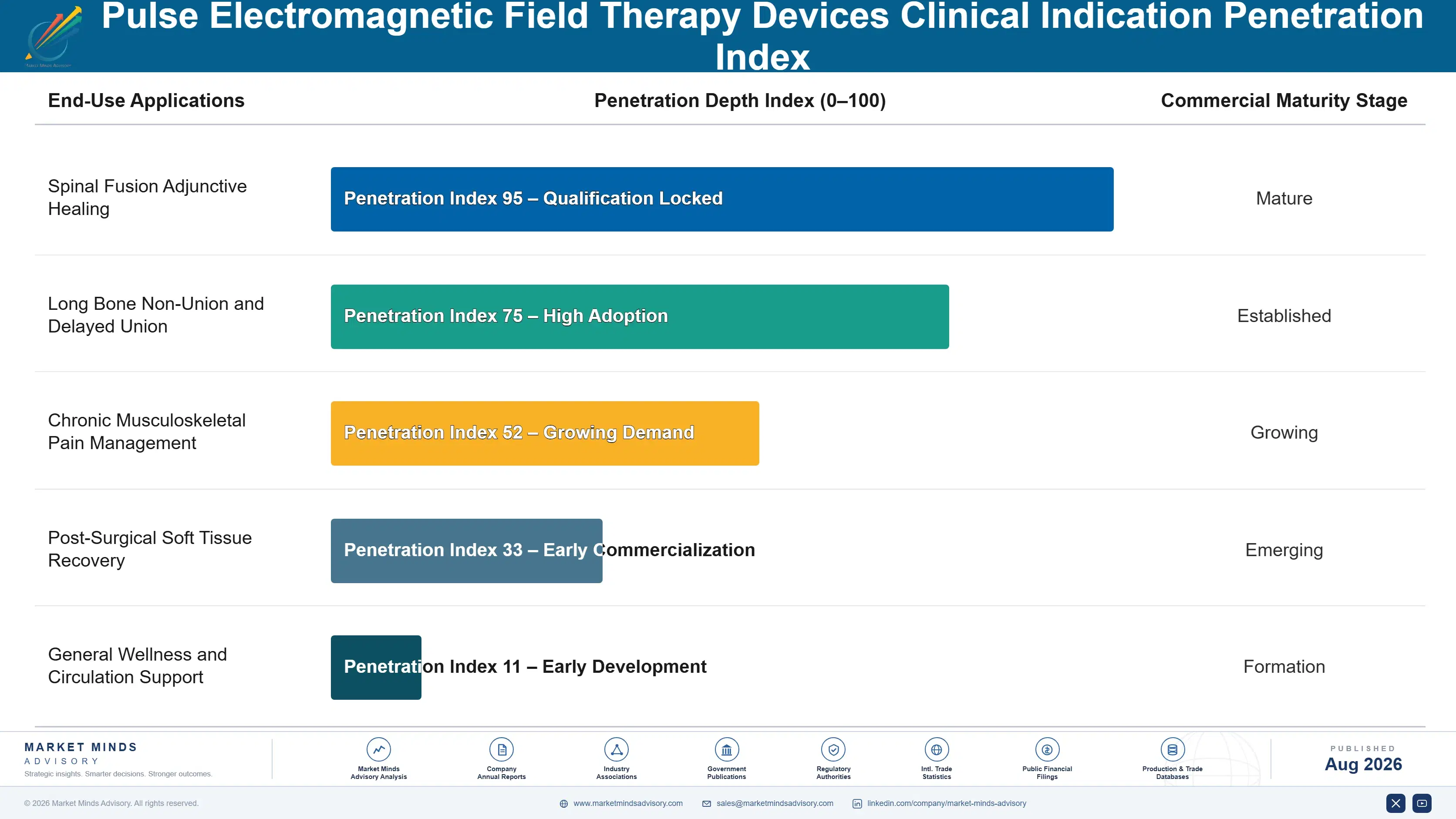
Revenue arrives as discrete episodes in the regulated half and as consumer purchases in the unregulated one, and neither produces recurring clinical revenue. A cleared bone growth stimulator is prescribed once for a healing period of a few months, and the manufacturer's ongoing relationship is with the prescribing surgeon rather than the patient. Consumer devices are one-off retail purchases with no follow-up of any kind. Neither half generates recurring clinical revenue.
Depth varies by who identifies the patient. Orthopaedic and spine surgeons identify non-union and failed fusion candidates and prescribe accordingly, which makes them the entire demand channel for the cleared indications. Physical medicine clinics buy professional systems as capital equipment. Veterinary practices and performance horse operations buy on perceived benefit. Consumers buy on marketing, having identified themselves.

The deciding party differs so completely between halves that they require separate organisations. A cleared device needs a surgeon to prescribe, a payer to authorise and a patient to comply, three parties who must all cooperate. A consumer device needs a person to click a button. That asymmetry explains the growth differential more convincingly than any clinical argument does.
pulse-electromagnetic-field-therapy-devices-market-end-use-penetration-index-1787309235358

Where Manufacturers Build Position

These are among the four positions where our research anticipates prominent divergence between winners and laggards over the coming forecast period. Each is grounded in the demand model, the regulatory perimeter, and the announced capacity pipeline.
01 / DELIVERED DOSE DESIGN

Half the prescribed field never reaches the patient

Cleared devices require around six hours of daily wear and measured adherence sits near 51%, so most patients receive roughly half the dose the registrational trials actually tested. Manufacturers compete on nominal field output that nobody delivers in practice. Designing for wear time and measuring delivered dose rather than device capability addresses the genuine clinical gap, and the company that proves that trade with data rather than logic takes the indication, and the whole category currently shares a limitation nobody is addressing commercially.
02 / AUTHORISATION DOCUMENTATION SUPPORT

A quarter of refusals turn on paperwork not medicine

Payers refuse around 28% of bone growth stimulator requests on first submission, generally on documentation of non-union duration or failed conservative management rather than on clinical disagreement about the patient. Manufacturers who supply submission templates, documentation protocols and appeal support convert those refused cases into funded devices almost immediately. The switching cost created inside an orthopaedic practice is considerable, because those templates rapidly become part of how the practice works, and the revenue recovered arrives without any product change at all.
03 / VETERINARY CHANNEL DEVELOPMENT

Performance horse operations pay without demanding trials

Equine and companion animal therapy is funded generously by operations that judge outcome by perceived recovery rather than by controlled comparison, and it carries no human device regulation, reimbursement negotiation or prior authorisation whatsoever. Gulf, Australian and South American racing circuits all support that market substantially between them. Manufacturers serve that market with the same coil technology and none of the evidentiary burden the four cleared human indications impose, which makes it the most comfortable revenue available in the whole category.
04 / CLAIM STRATEGY SEPARATION

Doing both under one brand invites scrutiny of everything

Consumer wellness devices hold around 37% of units and compound at 11.4% precisely because they claim nothing medical and therefore owe no evidence. A manufacturer can enter that segment and forfeit reimbursement, or pursue clearance and accept the burden, but running both under one brand means a regulator reading the wellness marketing applies it to the cleared range. Companies that blurred the line have generally regretted it, and separate entities cost more to run than the alternative costs to lose.

Engagement Snapshot From the Field

A live engagement with an industry participant carrying material or product regulatory and market exposure ahead of a defining policy shift, showing how our research translates into a defensible multi-year portfolio strategy.
MARKET MINDS ADVISORY · CLIENT ENGAGEMENT SUMMARY
Pulse Electromagnetic Field Therapy Devices Producer Strategic Portfolio Review and Transition Roadmap 2026·Investment Scenario on Pulse Electromagnetic Field Therapy Devices Exposure Evaluation 2025-26
CLIENT PROFILE
A mid-sized orthopaedic device company with a cleared bone growth stimulator range and roughly USD 240 million in revenue, of which stimulation represented a third (client-reported, unverified by MMA). Unit volumes had been flat for four years while the company invested in higher field strength product development. Neither adherence nor denial data informed that decision.
STRATEGIC CHALLENGE
Flat volumes were attributed to competitive pressure and the response had been a development programme increasing nominal field output. Prior authorisation denial rates and patient adherence had both been measured internally and neither figure had ever been connected to the volume problem or to the development priority. Nobody had connected the two datasets at all.
MMA APPROACH
MMA analysed twelve months of authorisation submissions by denial reason, and separately analysed device-recorded wear data across 900 prescribed patients against the six hour daily requirement. Both datasets were compared against the assumptions underpinning the field strength development programme. Competitor products were assessed on the same measured adherence basis for comparison.
KEY FINDINGS
  1. Denial rate on first submission was 31%, and 74% of those denials cited insufficient documentation of non-union duration rather than any clinical disagreement about the patient's eligibility.
  2. Device-recorded wear data showed a median of 3.1 hours daily against the six hour requirement, and 22% of patients stopped wearing the device entirely within three weeks of collection.
  3. Increasing nominal field output would raise delivered dose only for the minority of patients already achieving prescribed wear time, which was not where the volume problem sat at all.
  4. No competitor product in the category delivered materially better measured adherence, which meant the whole category shared a limitation nobody was addressing commercially.
CLIENT PROFILE
A mid-sized orthopaedic device company with a cleared bone growth stimulator range and roughly USD 240 million in revenue, of which stimulation represented a third (client-reported, unverified by MMA). Unit volumes had been flat for four years while the company invested in higher field strength product development. Neither adherence nor denial data informed that decision.
STRATEGIC CHALLENGE
Flat volumes were attributed to competitive pressure and the response had been a development programme increasing nominal field output. Prior authorisation denial rates and patient adherence had both been measured internally and neither figure had ever been connected to the volume problem or to the development priority. Nobody had connected the two datasets at all.
MMA APPROACH
MMA analysed twelve months of authorisation submissions by denial reason, and separately analysed device-recorded wear data across 900 prescribed patients against the six hour daily requirement. Both datasets were compared against the assumptions underpinning the field strength development programme. Competitor products were assessed on the same measured adherence basis for comparison.
KEY FINDINGS
  1. Denial rate on first submission was 31%, and 74% of those denials cited insufficient documentation of non-union duration rather than any clinical disagreement about the patient's eligibility.
  2. Device-recorded wear data showed a median of 3.1 hours daily against the six hour requirement, and 22% of patients stopped wearing the device entirely within three weeks of collection.
  3. Increasing nominal field output would raise delivered dose only for the minority of patients already achieving prescribed wear time, which was not where the volume problem sat at all.
  4. No competitor product in the category delivered materially better measured adherence, which meant the whole category shared a limitation nobody was addressing commercially.
RECOMMENDED STRATEGY
Phase 1: Phase 1 (months 1 to 4): Redirect part of the development budget from field output to a lower-profile wearable format designed around continuous wear. Phase 2: Phase 2 (months 4 to 11): Build documentation templates and appeal support for orthopaedic practices and deploy them across the top prescribing accounts. Phase 3: Phase 3 (months 11 to 22): Generate delivered dose evidence for the wearable format and pursue clearance on that comparison.
OUTCOME
First-submission approval rates rose from 69% to 88% within six months of deploying documentation support, which lifted unit volumes without any product change (client-reported, unverified by MMA). The field strength programme was halted and roughly USD 9 million redirected to the wearable format (client-reported, unverified by MMA). Delivered dose is now the primary development metric rather than nominal field output.

Frequently Asked Questions

Foundational context covering the market sizes, CAGR, scope, country, region and competition that inform every finding below. This section is provided to cover basics and most often pre-purchase conversations, answered from the MMA Primary Research Dataset.

What is the current size of the Pulse Electromagnetic Field Therapy Devices Market?

The global market was worth USD 0.62 billion in 2025, reaching USD 0.67 billion in 2026. North America holds the largest regional share at 32% of spend.

How large will the Pulse Electromagnetic Field Therapy Devices Market be by 2036?

MMA forecasts USD 1.39 billion by 2036, an expansion multiple of 2.08 times the 2026 base. That represents roughly USD 0.72 billion of incremental value.

What is the CAGR for the Pulse Electromagnetic Field Therapy Devices Market 2026 to 2036?

The base case compounds at 7.6% annually, with a bull case of 8.9% and a bear case of 6.3%. Historical growth from 2020 to 2025 ran at 6.5%.

Which segment is growing fastest?

Consumer wellness devices compound at 11.4%, exactly 1.50 times the market rate. They make no medical claim and therefore carry no clinical evidence requirement at all.

Who are the major companies in the Pulse Electromagnetic Field Therapy Devices Market?

Orthofix Medical, Zimmer Biomet, Bioventus, Enovis and Curatronic hold a combined 44% of the market. Reimbursement infrastructure sustains the regulated positions rather than device design.

Which country is growing fastest?

India compounds at 10.0%, ahead of every other national market. Consumer wellness device sales through online retail account for very nearly all of that growth.

Report Segmentation Architecture

The full report scope spans multiple orthogonal segmentation dimensions, with cross-tabulated demand data provided for each dimension pair. Coverage extends further to regional breakdowns, trend trajectories, and the competitive detail needed to support segment-level decision-making.

By Device Class and Regulatory Status

  • Cleared Bone Growth Stimulation Devices
  • Cleared Post-Surgical Oedema and Pain Devices
  • Clinic-Based Professional Therapy Systems
  • Consumer Wellness Devices
  • Veterinary and Equine Therapy Systems
  • Wearable Low-Field Therapy Devices

By End-Use Industry

  • Orthopaedic and Spine Surgical Practice
  • Physical Medicine and Rehabilitation Clinics
  • Sports Medicine and Athletic Recovery
  • Veterinary and Equine Practice
  • Direct Consumer and Home Use

By Commercial Dimension

  • Reimbursed Prescription Supply
  • Direct Consumer Online Retail
  • Clinic Capital Equipment Sales
  • Veterinary Distributor Channel

By Region

  • North America
  • Western Europe
  • East Asia
  • South Asia and Pacific
  • Latin America
  • Middle East and Africa
  • Eastern Europe

Scope, Methodology, and Coverage

Every figure in this report is reproducible from documented input assumptions. The scope below maps the historical period, the forecast horizon, the segmentation dimensions, and the countries covered, alongside the underlying primary and qualitative methodology.
Historical Period
2020 to 2025
Forecast Period
2026 to 2036
Base Year
2025 (USD billions; MMA Primary Research Dataset, August 2026)
Market Definition
The market covers devices delivering pulsed electromagnetic fields for therapeutic or wellness purposes, spanning cleared bone growth stimulation devices, cleared post-surgical oedema and pain devices, clinic-based professional therapy systems, consumer wellness devices, veterinary and equine therapy systems, and wearable low-field therapy devices, together with the reimbursement support services supplied alongside cleared products. Static magnet products, transcranial magnetic stimulation for psychiatric indications, transcutaneous electrical nerve stimulation devices, diathermy and shortwave therapy equipment, implanted stimulators, and low-level laser therapy are excluded. Sizing is measured at manufacturer revenue in current prices.
Quantitative Units
USD billions (current prices); device units, prescribed wear hours and measured adherence where applicable
Segmentation Dimensions
By Device Class and Regulatory Status; By End-Use Industry; By Commercial Dimension; By Region
Regions Covered
North America, Western Europe, East Asia, South Asia and Pacific, Latin America, Middle East and Africa, Eastern Europe
Countries Covered
USA, China, Germany, Japan, India, UK, France, Italy, Spain, South Korea, Canada, Australia, Brazil, Mexico, Argentina, Colombia, Taiwan, Thailand, Indonesia, Vietnam, Turkey, Saudi Arabia, UAE, Qatar, South Africa, Poland, Czech Republic, Netherlands, Austria, Switzerland, and additional markets relevant to this sector
Key Companies Profiled
Orthofix Medical, Zimmer Biomet, Bioventus, Enovis, Curatronic, Medtronic, Stryker, IGEA, Zynex Medical, BEMER International, Swiss Bionic Solutions, Magnawave, Assisi Animal Health, Respond Systems, Pulse Centers, Sota Instruments, Enraf-Nonius, Oska Wellness, NewMed, Ito Co
Quantitative Methodology
Primary survey, n=3,800 respondents, Q4 2025, six countries; demand-side model with trade association cross-validation
Qualitative Methodology
47 expert interviews, Q4 2025; applied to validate demand model assumptions, identify emerging dynamics, and assess competitive positioning
Report Format
PDF and XLSX data workbook (Word format preview document)
Publisher
Market Minds Advisory
Report Code
MMA-2026-MED-004
Published
August 2026
Contact
sales@marketmindsadvisory.com | www.marketmindsadvisory.com

Purchase the full Pulse Electromagnetic Field Therapy Devices Market Report (2026 to 2036).

The full report sizes pulsed electromagnetic field therapy devices across six device classes, three commercial dimensions and seven regions, with annual forecasts to 2036 under base, bull and bear scenarios. Measured adherence against prescribed wear time is compiled across cleared devices, which is the gap between nominal and delivered dose that the whole category shares. Prior authorisation denial rates are analysed by reason and payer. Consumer segment growth is quantified against advertising enforcement exposure. Veterinary channel sizing is separated from the human indications throughout, and twenty manufacturers are profiled on a consistent device revenue basis.
Measured adherence compiled against prescribed wear time requirements
Prior authorisation denial rates analysed by reason and payer
Consumer segment growth quantified against advertising enforcement exposure
Veterinary and equine channel sizing separated from human indications
Delivered dose comparisons assessed across field strength variants
Reimbursement policy trajectory tracked across major health systems

Built For The People Who Decide

From boardroom strategy to bench-side execution, this report is read cover-to-cover by leaders shaping the next decade of their industry, turning demand scenarios, market dynamics and valuation benchmarks into decisions.
CXOs/ Presidents/ VPs/ Managers
M&A and Corporate Development
Strategy Teams and R&D Heads
Procurement and Product Directors
Regulatory and Compliance Leaders
Investor Relations and Equity Analysts