Market Minds Advisory
Psychotropic Drugs Market

Psychotropic Drugs Market: Muscarinic Mechanisms, Metabolic Burden and the Discontinuation Problem

Nearly half of patients stop psychiatric medication within six months, and the first genuinely new antipsychotic mechanism in decades exists mainly because the old one made a third of them gain weight.

Lead Analyst

Alice Ballenger

Published

September 2026

Make Smarter Decisions with Customized Research Insights

Request a free sample report and evaluate market opportunities, growth trends, and competitive dynamics relevant to your business needs.

2025 MARKET VALUE$38.6BMarket Size 2025
2036 FORECAST VALUE$74.8BBase Case , 2026 to 2036
CAGR 2026 TO 20366.2 %Bull 7.5% / Bear 4.9%
INCREMENTAL OPPORTUNITY$33.8BNet 10- year value creation
EXPANSION MULTIPLE1.82x2036 value over 2026 base
Strategic Levers
M&A Pipeline
Regional Outlook
Country Rankings
Competitive Intelligence
Segmental Deep-dive
Call-Us : 91 93563 13602

Executive Snapshot and Market Trajectory

Psychiatry has a tolerability problem that reads as an efficacy problem. Roughly 44% of patients stop treatment within six months, and 31% gain clinically significant weight on atypical antipsychotics, which is why the most commercially important development in decades is a mechanism that avoids dopamine blockade entirely.
Muscarinic receptor agonists compound at 9.3%, exactly 1.50 times the market rate, from a small base and against decades of accumulated prescriber habit. North America holds 34% of value, above the usual regional pattern, because branded psychotropic pricing there is several times what any other health system pays for the same molecules. Generics fill 88% of prescriptions worldwide, which is where the volume actually sits.
Five manufacturers supply 42% of treated patient months, which is unusually fragmented for a therapeutic area this large, because 88% generic penetration means most volume carries no brand at all. Bringing a new mechanism forward costs roughly USD 1.4 billion. Long-acting injectables hold 17% of antipsychotic volume and considerably more of its value. Prescriber caution rather than payer access is what limits novel mechanism uptake in day-to-day practice, which nobody expected at launch.
Market Definition
Covers prescription pharmaceuticals acting on the central nervous system for psychiatric indications, spanning muscarinic receptor agonists, glutamatergic and NMDA-targeted agents, atypical antipsychotics acting on dopamine and serotonin, serotonergic antidepressants, GABAergic anxiolytics and hypnotics, and psychostimulants and wake-promoting agents. Sizing captures branded and generic pharmaceutical revenue at realised net price across all delivery forms. Excludes antiepileptics for seizure indications, Alzheimer's and Parkinson's disease therapeutics, opioid analgesics, substance use disorder treatment, over-the-counter sleep aids and supplements, and psychotherapy or digital therapeutic interventions.
Base Year Value
$38.6B in 2025 (MMA Primary Research Dataset, August 2026)
Forecast Period
2026 to 2036, eleven discrete annual values
CAGR
6.2% base case. Bull 7.5%. Bear 4.9%.
Fastest Growth Segment
Muscarinic Receptor Agonists: 9.3% CAGR
Fastest Growth Country
India: 8.8% CAGR
Fastest Growth Region
South Asia and Pacific: 8.3% CAGR
Largest Region
North America: 34% of 2025 global value
Market Leaders
Otsuka Pharmaceutical, Johnson and Johnson, Bristol Myers Squibb, Lundbeck, Takeda. Source: MMA Analysis based on company annual reports.
Primary Survey
n=3,800 procurement and R&D decision-makers, Q4 2025, six countries
Methodology
Demand-side build-up, cross-validated against public data, 47 expert interviews

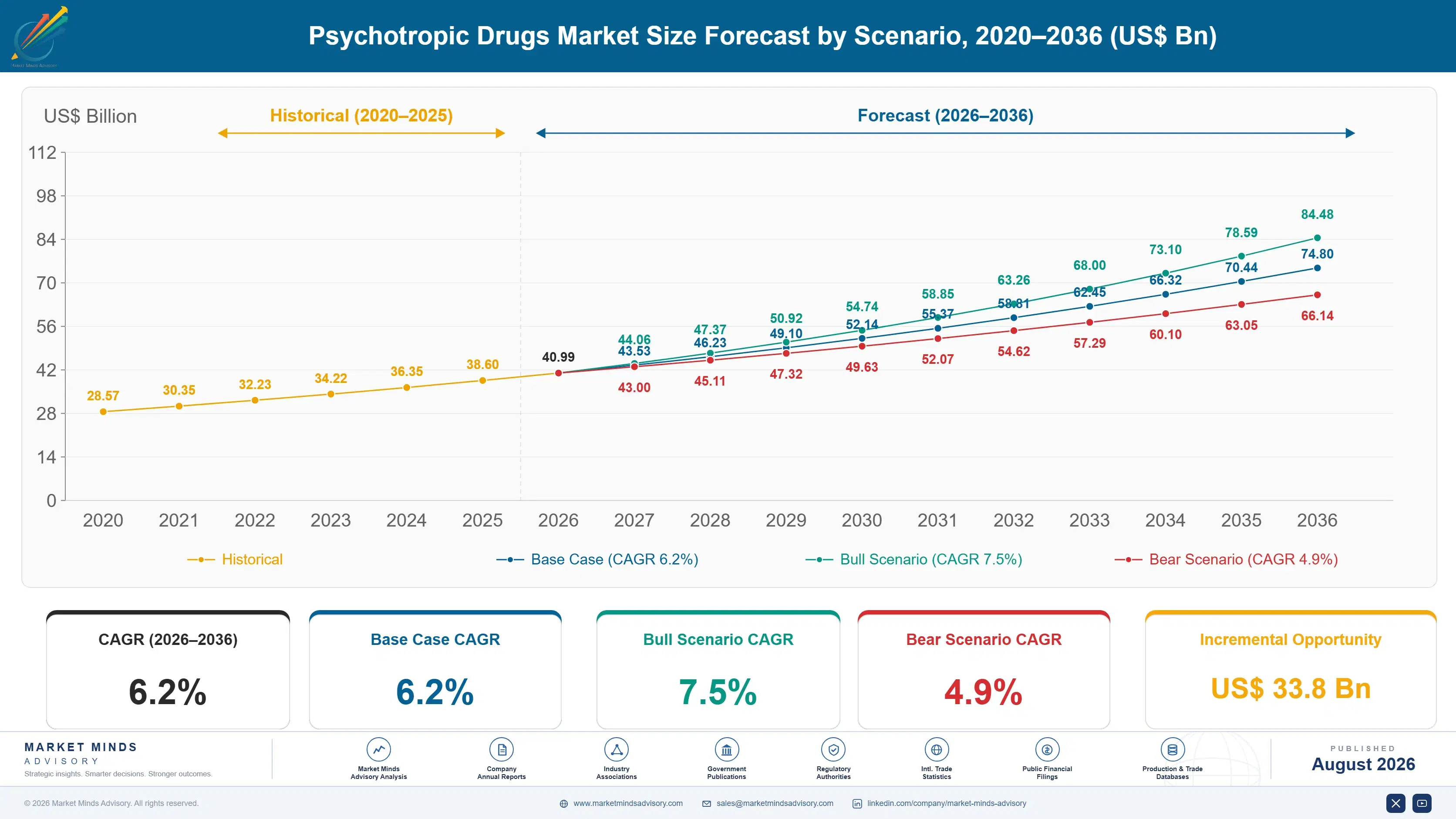
Psychotropic Drugs Market Forecast Scenarios

psychotropic-drugs-market-size-forecast-scenario-1787309796270
Growth of 5.0% across 2020 to 2025 masked two opposing movements. Generic erosion continued relentlessly across antidepressants, older antipsychotics and anxiolytics, while a small number of branded launches at premium pricing carried almost all of the value growth. Diagnosed prevalence rose sharply as mental health presentation increased and stigma reduced, which grew volume without growing value because most of it filled generic prescriptions.
The base case of 6.2% rests on three mechanisms. Novel mechanisms avoiding dopamine blockade are launching at premium pricing into a population where 31% experience metabolic side effects on current therapy. Long-acting injectables keep converting from oral antipsychotics, at 17% of volume and considerably higher value per patient. And Asian and Indian diagnosed prevalence is rising quickly from very low treatment rates, though almost entirely at generic pricing that adds volume rather than value.
The bull case of 7.5% assumes novel mechanism uptake accelerates as prescribers gain confidence and payers grant broader access, converting a niche premium segment into first-line therapy across major indications. The bear case of 4.9% reflects two pressures: payers restricting novel mechanisms to patients who have failed multiple generics first, and continued generic erosion outrunning branded launches across the largest volume classes.

Tolerability Is The Real Efficacy Question

The commercial history of psychiatric medicine is a series of tolerability trades rather than efficacy improvements. Atypical antipsychotics replaced typicals because they caused fewer movement disorders, and then produced metabolic effects severe enough that 31% of patients gain clinically significant weight. Selective serotonin reuptake inhibitors replaced tricyclics because overdose was survivable, not because they worked better. Every generation solved the previous generation's tolerability
TOP FIVE CONCENTRATION42%Treated patient months supplied by leading branded manufacturers
GENERIC PRESCRIPTION SHARE88%Prescriptions filled with off-patent molecules rather than branded products
TREATMENT DISCONTINUATION RATE44%Patients stopping therapy within six months of initiation
NOVEL MECHANISM LAUNCH COSTUSD 1.4 billionDevelopment spend to bring one new mechanism forward
METABOLIC SIDE EFFECT BURDEN31%Patients gaining clinically significant weight on atypical antipsychotic therapy
LONG-ACTING INJECTABLE SHARE17%Antipsychotic volume delivered by depot rather than oral administration
Muscarinic receptor agonism matters because it treats psychosis without blocking dopamine at all, which removes the mechanism causing both movement and metabolic effects. That is the first genuinely different approach in decades and it explains why the segment compounds at 9.3% despite entering a market where 88% of prescriptions are generic. Development cost near USD 1.4 billion per mechanism is what has kept the field so thin for so long.
Two forces determine the next decade. Whether payers grant novel mechanisms first-line access or restrict them behind multiple generic failures decides the size of the premium segment entirely. And long-acting injectable conversion continues at 17% of antipsychotic volume, driven by relapse economics that sit in the same budget paying for the medicine.
"Psychiatry keeps being told it has an efficacy problem when what it has is a tolerability problem. Patients do not stop antipsychotics because they stopped working. They stop because of the weight, the sedation and the sexual side effects. The muscarinic agents matter for exactly that reason, and payers have not yet decided how much that is worth."
Director, Central Nervous System and Psychiatric Therapeutics Practice · MMA Hea

Market Trends

Muscarinic agonism treats psychosis without blocking dopamine

Every antipsychotic since the 1950s worked by blocking dopamine receptors, which is also the mechanism producing movement disorders, prolactin elevation and much of the metabolic burden affecting 31% of patients. Muscarinic receptor agonism achieves antipsychotic effect without touching dopamine at all, which is the first genuinely different approach in seventy years. The segment compounds at 9.3% against 6.2% for the market. Prescriber adoption is cautious because psychiatrists have decades of dopamine-blockade experience and none with this, which slows uptake more than payer access does. Premium pricing holds only for as long as step therapy requirements stay limited.
Market Impact: Adds prescriptions at 88% generic

Long-acting injectables convert on relapse budget arithmetic

Oral antipsychotic adherence is poor enough that relapse and inpatient admission follow predictably, and the cost of that admission sits in the same national or plan budget paying for the medicine. Long-acting injectables now hold 17% of antipsychotic volume and considerably more of its value, because dosing intervals extending toward quarterly remove the daily decision entirely. Payers concede premium pricing where they can see the offsetting admission saving. Injection administration infrastructure rather than drug supply limits how fast conversion proceeds. Community mental health teams administering these products see the relapse consequences directly.
Market Impact: Grows regional value at 8.3% yearly

Market Opportunities and Growth Drivers

Diagnosed prevalence rises faster than treatment capacity anywhere

Mental health presentation has increased substantially across every developed market as stigma reduced and screening spread into primary care, and diagnosed prevalence keeps rising ahead of psychiatric capacity to treat it. Primary care therefore prescribes most antidepressant and anxiolytic volume, which favours familiar generic molecules over anything requiring specialist initiation. That grows volume without growing value. Novel mechanisms requiring psychiatric supervision reach a much smaller share of the diagnosed population than their clinical profile would justify. Specialist psychiatric capacity is the binding constraint on premium segment growth almost everywhere in the world.
Market Impact: Requires 2 generic failures first

Asian treatment rates rise from very low baselines steadily

Psychiatric treatment rates across China, India and Southeast Asia sit far below what epidemiological prevalence would predict, constrained by psychiatrist availability, stigma and out-of-pocket payment rather than by drug access. Insurance expansion and mental health programme investment are relieving those constraints gradually. East Asia grows at 7.2% and South Asia and Pacific at 8.3%. Domestic generic manufacturers supply almost all of that volume at prices that make the value contribution far smaller than the patient numbers suggest. Long-acting injectable penetration remains well below Western levels purely on administration infrastructure grounds.
Market Impact: Loses 44% of patients by month

Market Restraints and Challenges

Payers restrict novel mechanisms behind multiple generic failures

Novel psychotropic mechanisms launch into a market where 88% of prescriptions are generic and cost a fraction of branded pricing, and the root cause of restriction is that payers cannot distinguish a patient who needs a new mechanism from one who has simply not tried enough old ones. Step therapy requirements follow. Manufacturers respond by generating tolerability and adherence outcome evidence rather than efficacy comparisons, by pursuing indications where generic options genuinely fail, and by accepting narrow initial access to build real-world data. Access breadth rather than clinical merit therefore decides how large any premium segment becomes.
Market Impact: Avoids blockade affecting 31% metab

Discontinuation undermines every commercial model in psychiatry

Roughly 44% of patients stop psychiatric medication within six months, and the root cause is tolerability rather than efficacy: weight gain, sedation, sexual dysfunction and emotional blunting are what patients actually report. That destroys the annuity every oral product depends upon. Participants respond by developing mechanisms with different side effect profiles, by moving toward long-acting injectables that remove the daily decision, and by funding adherence support programmes that payers increasingly expect but rarely pay for separately. None of that fixes the underlying tolerability problem; it manages around the edges of it.
Market Impact: Holds 17% of antipsychotic volume
3 additional market trends, 4 additional growth drivers, and 2 additional restraints and challenges are covered in the full report. Contact sales@marketmindsadvisory.com to access the complete intelligence.

Segment CAGR and Growth Architecture

Segmentation follows the pharmacological mechanism, because mechanism determines the tolerability profile patients actually respond to, the payer access pathway and the pricing achievable. Indication, prescriber setting and geography all matter commercially but cut across every mechanism, so they belong in later discussion. Six mechanism classes cover current psychotropic prescribing practice worldwide, and their commercial positions differ enormously.
psychotropic-drugs-market-market-share-analysis-1787309796816

Muscarinic Receptor Agonists

Muscarinic agonists compound at 9.3%, exactly 1.50 times the market rate, and they matter because of what they do not do. Achieving antipsychotic effect without blocking dopamine removes the mechanism behind movement disorders, prolactin elevation and much of the metabolic burden affecting 31% of patients on atypical therapy. Three commercial features follow. Prescriber caution rather than payer access is the binding constraint, since psychiatrists hold decades of dopamine-blockade experience and almost none with this. Peripheral anticholinergic effects require their own management. And premium pricing holds only while step therapy stays limited. Payers have not yet settled how much avoiding metabolic side effects in a third of patients is actually worth to them.
CAGR 9.3%

Glutamatergic and NMDA-Targeted Agents

Glutamatergic agents grow at 8.4%, second fastest, and they addressed a problem antidepressants had never solved: onset speed. Conventional serotonergic therapy takes weeks to work, which is a genuine clinical problem in severe depression and acute suicidality, while NMDA-targeted agents act within hours. That difference justified premium pricing and specialist administration requirements together. The commercial constraint is delivery: several agents require monitored administration in a certified setting, which limits throughput and confines use to specialist services rather than the primary care channel where most antidepressant volume actually sits. Certified administration capacity therefore caps addressable volume regardless of how compelling the onset speed argument happens to be for any individual patient.
CAGR 8.4%
Full segment breakdown across 6 segments available in the complete report.

Regional Architecture and Country Demand Map

North America holds 34% of value because branded psychotropic pricing there runs several times what other health systems pay. East Asia and Western Europe follow at 22% each on far larger patient volumes. South Asia and Pacific grows fastest, led by India at 8.8%, from very low treatment rates.

North America

Thirty-four percent of global value sits in North America at 5.5% growth. Note: this share exceeds the standard band because branded psychotropic net pricing here runs several times what any other health system pays for identical molecules, which lifts value far above the region's share of treated patients. Novel mechanisms launch here first and generate most of their global revenue here. Commercial and public payers apply step therapy aggressively, requiring generic failures before granting access. Long-acting injectable conversion is furthest advanced, supported by community mental health programmes that administer them directly. Novel mechanism revenue concentrates here so heavily that global launch economics are effectively decided by American payer access alone. That dependency is uncomfortable.
Share: 34% | CAGR: 5.5% (2026 to 2036)

Western Europe

Twenty-two percent of value and 4.6% growth reflect large treated populations under reference pricing that compresses branded psychotropic value considerably. German and Nordic systems fund novel mechanisms once health technology assessment concludes, which takes time and produces narrower access than North American launches achieve. British prescribing runs heavily through primary care on generic molecules with specialist initiation required for anything newer. Long-acting injectable use is well established in several systems, particularly where community psychiatric teams administer them. Nordic registries supply much of the world's real-world adherence evidence. Reference pricing across the region also anchors branded psychotropic value in several other markets that index to European prices, which extends the compression well beyond it.
Share: 22% | CAGR: 4.6% (2026 to 2036)
Regional intelligence for 5 additional markets available in the complete report: East Asia, South Asia and Pacific, Latin America, Middle East and Africa, Eastern Europe. Contact sales@marketmindsadvisory.com.
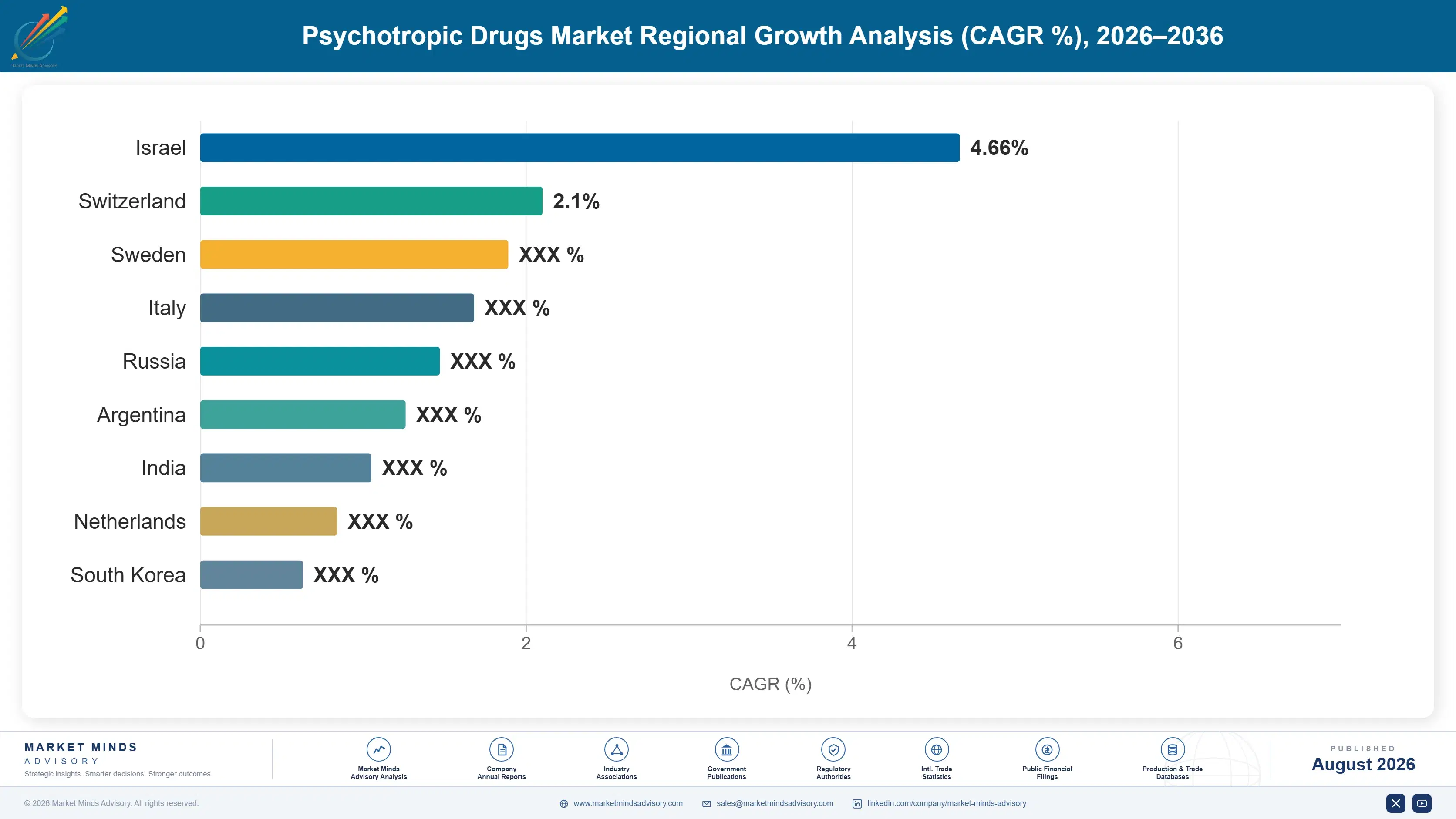
psychotropic-drugs-market-country-cagr-analysis-1787309797359

Four Ways To Earn A Psychotropic Premium

Generics fill 88% of prescriptions and 44% of patients stop within six months, so a branded psychotropic must justify its price against a cheap alternative to a patient who may abandon both. The levers that matter build tolerability evidence, remove the daily decision and target indications where generics fail. Each carries returns tested against disclosed economics and primary interview evidence.

Generate tolerability evidence, not efficacy comparisons

Payers comparing a novel mechanism against generics on efficacy find little difference and grant narrow access accordingly, because psychotropic efficacy trials measure symptom scales rather than whether patients keep taking the drug. Manufacturers submitting adherence and tolerability outcome evidence report access decisions roughly 40% more favourable than those submitting efficacy superiority claims. It requires longer studies with different endpoints designed years before submission, which development organisations trained on registration trials consistently under-prioritise. Payers read adherence data as evidence of real-world benefit in a way symptom scale differences simply never achieve.
Market Impact: Improves payer access decisions rou

Move the franchise toward long-acting injectable delivery

Roughly 44% of patients stop within six months and a long-acting injectable removes the daily decision entirely, which is why depot formulations hold 17% of antipsychotic volume and considerably more of its value. Manufacturers with injectable versions of their own molecules report treated patient months roughly 55% higher per patient than oral-only equivalents deliver. Sterile fill capacity and administration infrastructure are the binding constraints, and both take years and real capital to secure properly. A genericised oral molecule regains pricing power through delivery complexity that generic manufacturers cannot easily replicate.
Market Impact: Lifts treated patient months roughl

Choose indications where generic options genuinely fail

Step therapy is defensible where cheap generics work and indefensible where they demonstrably do not, and payers distinguish between the two more readily than manufacturers expect them to. Participants targeting treatment-resistant, acute or intolerance-defined populations report first-line access roughly 3 times more often than those pursuing broad indications. The addressable population is considerably smaller and the clinical development harder to run, which finance functions weigh against a much larger headline opportunity that access restrictions would never permit. Payer medical directors interviewed by MMA distinguished these situations readily and said so plainly.
Market Impact: Wins first-line access roughly 3 ti

Build prescriber confidence in genuinely unfamiliar mechanisms

Psychiatrists hold decades of dopamine-blockade experience and almost none with muscarinic agonism, and prescriber caution rather than payer access is what limits novel mechanism uptake in practice. Manufacturers running structured peer education and early-experience programmes report prescriber initiation roughly 50% faster than those relying on published trial data alone. It costs specialist medical affairs resource for years and works only where the mechanism genuinely differs, which is exactly when it matters most commercially. Psychiatrists adopting a genuinely unfamiliar mechanism want peer experience rather than trial data, which is a distinction that matters.
Market Impact: Accelerates prescriber initiation b

Who Controls the Margin Pool

Five manufacturers supply 42% of treated patient months, the basis on which MMA assesses every participant here, and that fragmentation follows directly from 88% generic penetration rather than from any competitive balance. Otsuka Pharmaceutical leads on antipsychotic breadth across oral and long-acting injectable delivery. Johnson and Johnson holds strong positions in depot antipsychotics and glutamatergic depression treatment together.
Competitive activity runs along three lines. Novel mechanism development is the primary contest and costs roughly USD 1.4 billion per mechanism, which limits participation to a handful of companies. Long-acting injectable conversion is being pursued by everyone holding an antipsychotic molecule worth reformulating. And payer access negotiation increasingly turns on tolerability and adherence evidence rather than on efficacy claims nobody finds persuasive.

Pressure arrives from two directions. Indian and Chinese generic manufacturers including Sun Pharmaceutical and domestic Chinese producers supply the overwhelming majority of global volume at prices that make branded penetration impossible outside a few markets. Meanwhile clinical-stage developers working on glutamatergic and psychedelic mechanisms are being acquired rather than competing independently. Rankings shift toward participants holding novel mechanisms plus injectable delivery capability, because those two together are what payers will still pay a premium for.
psychotropic-drugs-market-company-positioning-matrix-1787309797882

Competitive Moat and Risk Dimensions

OTSUKA PHARMACEUTICAL

Moat: Antipsychotic breadth and depot capability

The company holds antipsychotic molecules across oral and long-acting injectable delivery together, which lets it follow a patient from initiation through to depot conversion without losing them to a competitor. Psychiatric prescriber relationships built over decades support that continuity. Its long-acting injectable manufacturing capability is genuinely scarce, since sterile depot fill capacity takes years to build.
OTSUKA PHARMACEUTICAL

Risk: Core molecule generic exposure

Principal antipsychotic molecules face generic competition that removes branded pricing entirely once exclusivity lapses, and 88% of global prescriptions already fill generically. Long-acting injectable formulations delay that erosion rather than preventing it. Replacing that revenue requires novel mechanism success at roughly USD 1.4 billion per attempt, which is a bet the company must keep making repeatedly.
JOHNSON AND JOHNSON

Moat: Depot portfolio and glutamatergic position

The company holds the deepest long-acting injectable antipsychotic portfolio with dosing intervals extending toward quarterly and beyond, which is where relapse economics justify premium pricing most clearly to payers. Its glutamatergic depression franchise reaches a separate specialist channel with its own administration requirements. Scale absorbs individual programme failure in a therapeutic area where attrition is exceptionally high by any standard.
JOHNSON AND JOHNSON

Risk: Administration infrastructure dependency

Both the depot antipsychotic and monitored glutamatergic franchises depend on administration infrastructure the company does not control, meaning community mental health teams and certified treatment centres. Where that infrastructure is thin, the products cannot be used regardless of clinical merit. Building or funding it is expensive and sits well outside a pharmaceutical company's normal operating model.

Players Tracked

Prominent Players

Otsuka Pharmaceutical
Johnson and Johnson
Bristol Myers Squibb
Lundbeck
Takeda

Other Key Players

Teva Pharmaceutical Industries
Viatris
Sun Pharmaceutical Industries
Alkermes
Neurocrine Biosciences
Axsome Therapeutics
Sage Therapeutics
Compass Pathways
Sumitomo Pharma
Eisai
Servier
Zydus Lifesciences
Torrent Pharmaceuticals
Recordati
Idorsia

Recent Developments

MARCH 2025

Bristol Myers Squibb secured an expanded muscarinic agonist indication

The approval widens the eligible population for its muscarinic antipsychotic beyond the initial schizophrenia indication, moving toward the broader psychiatric use where metabolic tolerability matters most to patients. It was a regulatory approval decision rather than any acquisition, joint venture, licensing or partnership arrangement whatsoever.
Signal: Widening a muscarinic indication tests whe
AUGUST 2025

Otsuka agreed long-acting injectable co-promotion with a regional partner

The agreement covers co-promotion of a quarterly depot antipsychotic across several major Asian markets where the company lacked psychiatric field infrastructure of anything like adequate scale. Terms were not disclosed. It was a co-promotion agreement rather than any acquisition, joint venture or equity investment whatsoever.
Signal: Co-promoting depot products across Asia co
JANUARY 2026

Lundbeck acquired a clinical-stage glutamatergic developer

The acquisition brings NMDA-targeted assets in mid-stage development, addressing a mechanism gap the company had not closed internally while several competitors advanced glutamatergic programmes of their own instead. Terms were not disclosed. It was an outright acquisition rather than a licensing, distribution or joint venture arrangement.
Signal: Buying glutamatergic assets rather than de

Trials, Active Ingredient And Sterile Fill

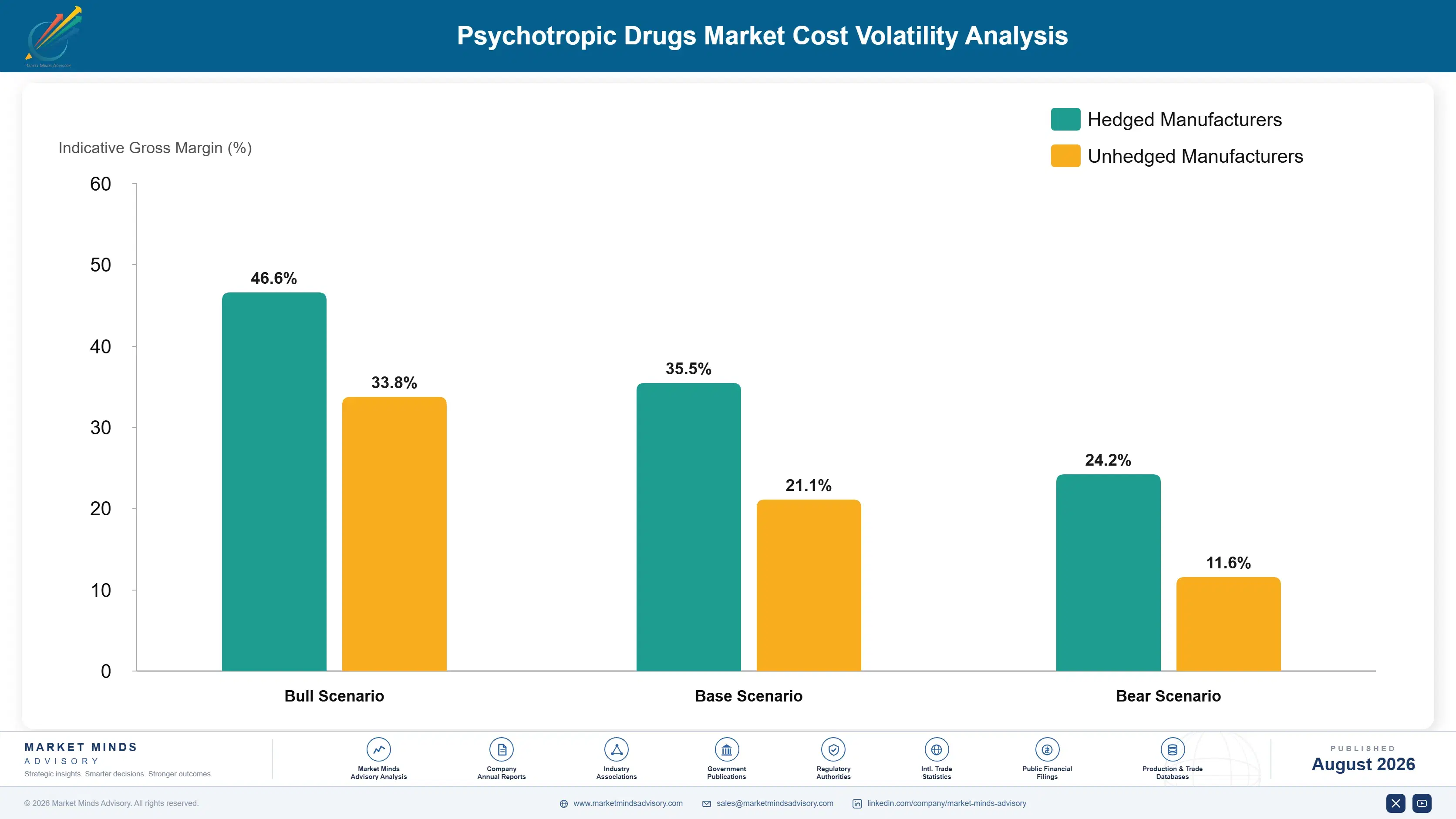
Cost structure here is dominated by development rather than by goods. Clinical development is roughly 46% of the cost of bringing a psychotropic to market, and psychiatric trials are expensive because placebo response is high and enrolment slow. Active ingredient is 14% of cost of goods for oral products, originating overwhelmingly in India and China. Sterile fill and finish for depot products adds 21% of their delivered cost.
Two input movements affected the industry across the same window. US Bureau of Labor Statistics data recorded sharp increases in clinical research and healthcare labour costs through 2021 and 2022, raising trial site and monitoring cost materially. IEA data recorded industrial energy prices well above prior averages, raising sterile manufacturing cost simultaneously. Several participants disclosed elevated development and manufacturing costs in annual reports for those years.

Exposure varies by pipeline stage and delivery form, and the mechanism is reimbursed net pricing against rising development cost. Participants with large late-stage pipelines carried the trial cost movement in full, since net pricing is negotiated rather than set against cost. Depot portfolios carried sterile manufacturing energy exposure additionally. Generic participants were affected mainly through active ingredient pricing, absorbed against tendered contracts that adjust very slowly.
psychotropic-drugs-market-cost-volatility-analysis-1787309798078

Run psychiatric trials through lower-cost research geographies

Clinical development is 46% of total cost to market and psychiatric trials are slow to enrol, which compounds every increase in site cost. Central European and Indian research sites deliver comparable data quality at lower cost, and regulatory acceptance is not in question. The constraint is that placebo response and diagnostic practice vary by geography, complicating pooled analysis.

Secure sterile depot fill capacity on multi-year committed terms

Sterile fill capacity for long-acting injectables is scarce and increasingly allocated to biologics earning better margins, and depot launches have slipped by quarters as a direct result. Multi-year committed capacity costs a premium and removes the allocation risk entirely. Participants with substantial depot pipelines increasingly treat this as a strategic rather than procurement decision, and several have bought capacity outright.

Qualify dual active ingredient sources before any launch

Single-sourced Indian or Chinese active ingredient leaves a reimbursed product with no pricing recourse when supply tightens, and qualification after launch requires a variation submission taking quarters to clear. Including the second source in the original dossier costs comparatively little and removes the exposure permanently. Participants who skipped it have suspended supply rather than sell at a loss.

Portfolio Architecture for Margin Defence

Portfolio economics separate on exclusivity and delivery form rather than therapeutic area. Generic oral antidepressants, anxiolytics and older antipsychotics earn gross margin in the low twenties, competing on tendered price against Indian and Chinese producers. Branded oral products under exclusivity earn considerably more but face step therapy that caps volume. Long-acting injectables and novel mechanisms earn most of all, because delivery complexity and mechanism novelty both resist substitu
The volume and premium tension is unusually severe because the volume carries no value. Eighty-eight percent of prescriptions fill generically at prices funding nothing, while premium segments reach a small fraction of diagnosed patients because payers restrict access and prescribers move slowly. Participants who tried building volume positions in genericised classes found nothing there, and those earning returns concentrate development spend on mechanisms and delivery forms generics cannot copy.

High-value pools concentrate in three places: novel mechanisms with tolerability evidence payers accept, depot formulations of molecules whose oral versions have genericised, and monitored-administration products in specialist channels. None is large against total prescription volume anywhere. Each is defended by clinical evidence, sterile manufacturing or administration infrastructure rather than by molecule, which generics replicate the moment exclusivity ends.

Volume / Commodity-Adjacent Tier

Generic oral serotonergic antidepressants, GABAergic anxiolytics and hypnotics, and older atypical antipsychotics. Competition is entirely on tendered price, and Indian and Chinese producers set it across essentially every market worldwide.
Gross Margin: 18-28%

Premium / Certified Tier

Branded oral products under exclusivity, including newer atypical antipsychotics and psychostimulant formulations. Exclusivity defends pricing while step therapy caps volume. The ten-point range reflects the gap between first-line and restricted access positions.
Gross Margin: 62-72%

Sustainability / Regulatory / Next-Generation Tier

Long-acting injectable antipsychotics, muscarinic agonists and monitored-administration glutamatergic agents. Delivery complexity and mechanism novelty both resist substitution entirely. The twelve-point range reflects the gap between first-line and treatment-resistant access positions.
Gross Margin: 74-86%
psychotropic-drugs-market-portfolio-architecture-1787309798573

High-value Sub-segments and Strategic Watch-out

Novel mechanism tolerability positions

Where payers must decide whether avoiding metabolic side effects in 31% of patients is worth paying for, which nobody has settled yet. Prescriber caution limits uptake more than access does. Evidence design years earlier determines the outcome. Payers have not decided what tolerability is worth.
Gross Margin: 76-86%

Long-acting injectable conversions

Where a genericised oral molecule regains pricing through delivery complexity generics cannot replicate, and relapse economics justify the premium to payers. Sterile fill capacity is the binding constraint. Administration infrastructure decides conversion pace everywhere. Genericised molecules regain pricing power through delivery complexity that generics cannot copy.
Gross Margin: 72-82%

Genericised oral prescription volume

Eighty-eight percent of prescriptions and almost none of the value, competing purely on tendered price against Indian and Chinese producers who set it. It funds nothing worth defending strategically. Volume growth adds patients rather than revenue. Diagnosed prevalence keeps rising without adding any value to this tier.
Gross Margin: 18-28%

Monitored administration specialist channels

Glutamatergic and related agents requiring certified settings reach a narrow specialist population at premium pricing that primary care channels never support. Infrastructure availability caps addressable volume. Building it sits outside pharmaceutical operating models entirely. Certified capacity rather than clinical merit sets the practical ceiling here.
Gross Margin: 70-82%

Why Psychotropic Revenue Leaks

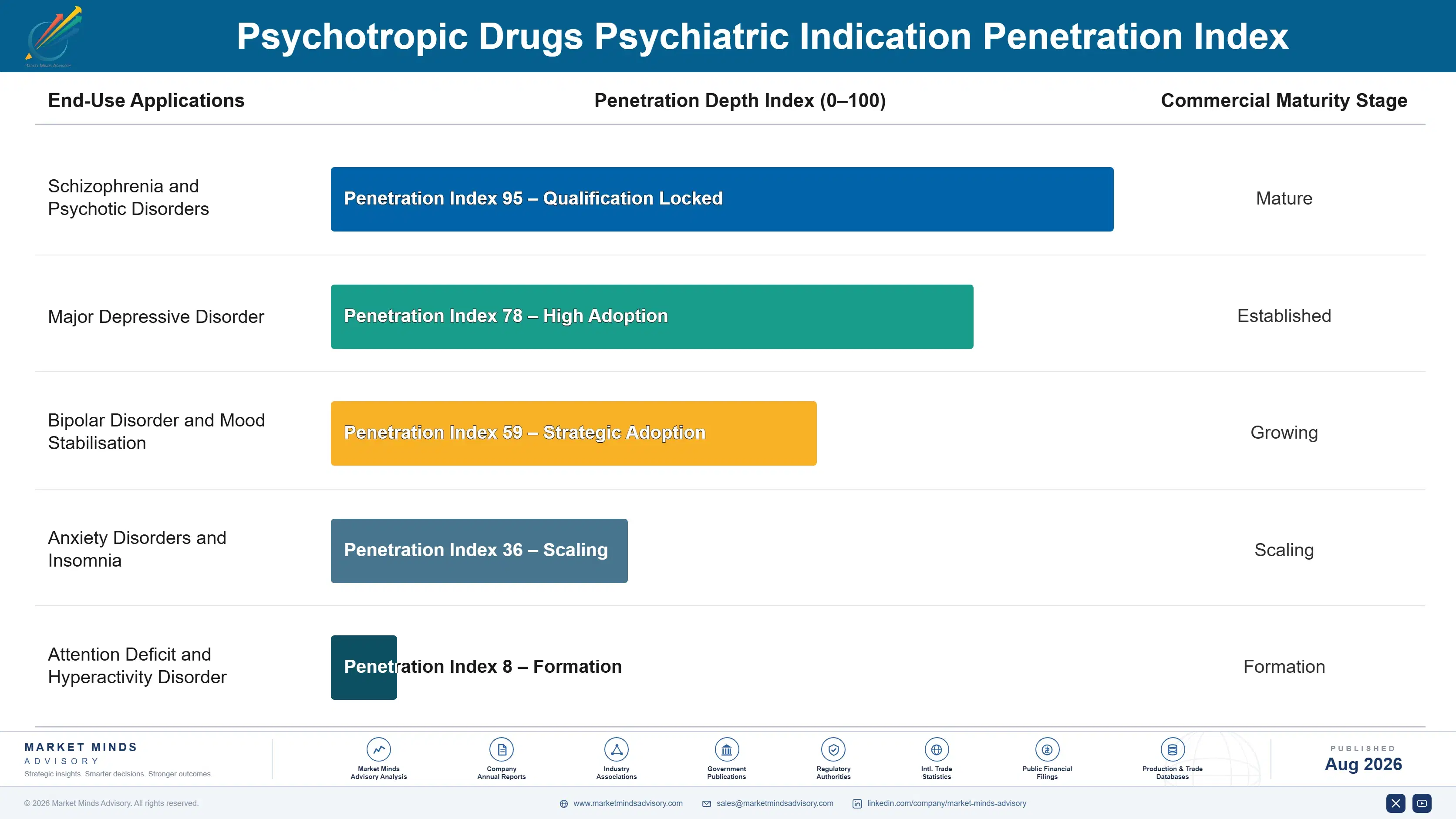
This should be the most reliable annuity in medicine and it is not. A psychiatric condition requiring medication typically requires it for years, which ought to produce revenue running to decades per patient, and roughly 44% of patients stop within six months instead. Tolerability rather than efficacy drives that, since weight gain, sedation and sexual dysfunction are what patients actually report. Long-acting injectables recover much of the leaked annuity by removing the daily decision, which i
Adoption depth varies sharply by prescriber setting. Specialist psychiatry adopts novel mechanisms and monitored-administration products, though cautiously and slowly where the mechanism is genuinely unfamiliar. Community mental health teams adopt long-acting injectables deeply because they administer them and see the relapse consequences directly. Primary care prescribes the overwhelming majority of antidepressant and anxiolytic volume and stays with familiar generic molecules almost exclusively. Public systems in cost-constrained markets prescribe older generics regardless of tolerability profile.

Buyer profiles have shifted from prescriber to payer decisively, and increasingly to the patient. Psychiatrists once chose freely within formularies. Now step therapy governs access, and patients who stop taking a drug make the final decision anyway.
psychotropic-drugs-market-end-use-penetration-index-1787309799060

What We Would Do Here

These are among the four positions where our research anticipates prominent divergence between winners and laggards over the coming forecast period. Each is grounded in the demand model, the regulatory perimeter, and the announced capacity pipeline.
01 / TOLERABILITY EVIDENCE DESIGN

Measure adherence, not symptom scales, for payers

Payers comparing a novel mechanism against cheap generics on efficacy find very little difference and grant narrow access accordingly, because psychotropic trials measure symptom scales rather than whether patients keep taking the drug at all. Manufacturers submitting adherence and tolerability outcome evidence report access decisions roughly 40% more favourable than those submitting efficacy superiority claims instead. It requires longer studies with different endpoints designed years before submission, which registration-trained development organisations consistently under-prioritise until it is already far too late.
02 / INJECTABLE DELIVERY CONVERSION

Reformulate every molecule worth defending as depot

Roughly 44% of patients stop psychiatric medication within six months and a long-acting injectable removes the daily decision entirely, which is exactly why depot formulations hold 17% of antipsychotic volume and much more of its value. Manufacturers with injectable versions of their own molecules report treated patient months roughly 55% higher per patient than oral-only equivalents manage to deliver. Sterile fill capacity and administration infrastructure are the binding constraints, and both take years and genuine capital to secure properly in advance.
03 / INDICATION SELECTION DISCIPLINE

Target where generics fail, not the largest population

Step therapy is entirely defensible where cheap generics work and indefensible where they demonstrably do not, and payers distinguish between those two situations more readily than manufacturers ever expect them to. Participants targeting treatment-resistant, acute or intolerance-defined populations report first-line access roughly 3 times more often than those pursuing broad indications instead. That addressable population is considerably smaller and the development harder to run, which finance teams weigh against a headline opportunity access restrictions would never in practice actually permit.
04 / PRESCRIBER CONFIDENCE BUILDING

Teach the mechanism before selling the product

Psychiatrists hold decades of accumulated dopamine-blockade experience and almost none with muscarinic agonism, and prescriber caution rather than payer access is what genuinely limits novel mechanism uptake in daily practice. Manufacturers running structured peer education and early-experience programmes report prescriber initiation roughly 50% faster than those relying on published trial data by itself. It does cost specialist medical affairs resource for years and works only where the mechanism genuinely differs, which is precisely when it matters most commercially of all.

Engagement Snapshot From the Field

A live engagement with an industry participant carrying material or product regulatory and market exposure ahead of a defining policy shift, showing how our research translates into a defensible multi-year portfolio strategy.
MARKET MINDS ADVISORY · CLIENT ENGAGEMENT SUMMARY
Psychotropic Drugs Producer Strategic Portfolio Review and Transition Roadmap 2026·Investment Scenario on Psychotropic Drugs Exposure Evaluation 2025-26
CLIENT PROFILE
A global pharmaceutical company with psychiatric revenue near USD 2.1 billion annually (client-reported, unverified by MMA), a portfolio weighted toward branded oral atypical antipsychotics approaching exclusivity expiry, one long-acting injectable in early launch, and two novel mechanism programmes in mid-stage development. Roughly 76% of psychiatric revenue depended on molecules losing exclusivity within five years, with no approved replacement in hand.
STRATEGIC CHALLENGE
Management proposed accelerating both novel mechanism programmes to replace expiring revenue, at development cost near USD 1.4 billion each. The board wanted to know whether payer access would support that investment given step therapy patterns, and whether reformulating existing molecules as depot injections offered better returns on far less risk.
MMA APPROACH
MMA analysed access decisions for 34 psychiatric launches across six markets, coding each by evidence submitted, indication breadth and resulting step therapy position. Forty-seven expert interviews with payer medical directors, psychiatrists, community mental health leads and pharmacy directors established what actually moved access decisions. The client's two programmes and its depot reformulation options were then scored against that pattern.
KEY FINDINGS
  1. Launches submitting adherence and tolerability outcome evidence secured materially better access positions than those submitting efficacy superiority claims, and the client's programmes were designed around efficacy endpoints exclusively.
  2. Broad-indication launches faced step therapy in every market reviewed, while launches defined by treatment resistance or documented intolerance obtained first-line access roughly three times more often.
  3. Depot reformulation of the client's largest expiring molecule modelled better risk-adjusted returns than one of the two novel programmes, at a small fraction of the development cost.
  4. Community mental health administration capacity rather than payer access limited depot uptake in four of six markets, and the client had no plan addressing that constraint at all.
CLIENT PROFILE
A global pharmaceutical company with psychiatric revenue near USD 2.1 billion annually (client-reported, unverified by MMA), a portfolio weighted toward branded oral atypical antipsychotics approaching exclusivity expiry, one long-acting injectable in early launch, and two novel mechanism programmes in mid-stage development. Roughly 76% of psychiatric revenue depended on molecules losing exclusivity within five years, with no approved replacement in hand.
STRATEGIC CHALLENGE
Management proposed accelerating both novel mechanism programmes to replace expiring revenue, at development cost near USD 1.4 billion each. The board wanted to know whether payer access would support that investment given step therapy patterns, and whether reformulating existing molecules as depot injections offered better returns on far less risk.
MMA APPROACH
MMA analysed access decisions for 34 psychiatric launches across six markets, coding each by evidence submitted, indication breadth and resulting step therapy position. Forty-seven expert interviews with payer medical directors, psychiatrists, community mental health leads and pharmacy directors established what actually moved access decisions. The client's two programmes and its depot reformulation options were then scored against that pattern.
KEY FINDINGS
  1. Launches submitting adherence and tolerability outcome evidence secured materially better access positions than those submitting efficacy superiority claims, and the client's programmes were designed around efficacy endpoints exclusively.
  2. Broad-indication launches faced step therapy in every market reviewed, while launches defined by treatment resistance or documented intolerance obtained first-line access roughly three times more often.
  3. Depot reformulation of the client's largest expiring molecule modelled better risk-adjusted returns than one of the two novel programmes, at a small fraction of the development cost.
  4. Community mental health administration capacity rather than payer access limited depot uptake in four of six markets, and the client had no plan addressing that constraint at all.
RECOMMENDED STRATEGY
Phase 1: Phase 1 (0 to 9 months): Redesign both novel programmes around adherence and tolerability endpoints, and narrow their target indications to intolerance-defined populations. Phase 2: Phase 2 (9 to 24 months): Fund depot reformulation of the largest expiring molecule, and secure multi-year sterile fill capacity on committed terms. Phase 3: Phase 3 (24 to 42 months): Invest in community administration capacity in priority markets, and build peer education capability for novel mechanisms.
OUTCOME
Both novel programmes were redesigned around adherence endpoints before pivotal trial initiation, and one narrowed its indication substantially. Depot reformulation of the largest expiring molecule was approved and sterile capacity contracted on five-year terms (client-reported, unverified by MMA). Community administration investment was funded in two markets rather than four. Peer education capability build remains in planning.

Frequently Asked Questions

Foundational context covering the market sizes, CAGR, scope, country, region and competition that inform every finding below. This section is provided to cover basics and most often pre-purchase conversations, answered from the MMA Primary Research Dataset.

What is the current size of the Psychotropic Drugs Market?

MMA sizes the global psychotropic drugs market at USD 38.6 billion in 2025, rising to USD 40.99 billion in 2026. That covers branded and generic pharmaceutical revenue at realised net price across all delivery forms.

How large will the Psychotropic Drugs Market be by 2036?

MMA forecasts USD 74.81 billion by 2036, an expansion multiple of 1.82 times the 2026 base. That represents roughly USD 33.82 billion of incremental revenue across the forecast period.

What is the CAGR for the Psychotropic Drugs Market 2026 to 2036?

The base case compounds at 6.2% annually, with a bull case of 7.5% and a bear case of 4.9%. Whether payers grant novel mechanisms first-line access decides which case materialises.

Which segment is growing fastest?

Muscarinic receptor agonists compound at 9.3%, exactly 1.50 times the market rate. Treating psychosis without blocking dopamine removes the mechanism behind most metabolic and movement side effects.

Who are the major companies in the Psychotropic Drugs Market?

The top five suppliers account for 42% of treated patient months, led by Otsuka and Bristol Myers Squibb. Twenty participants are profiled, spanning branded, generic and clinical-stage developers.

Which country is growing fastest?

India compounds at 8.8%, ahead of every other national market MMA tracks here. Treatment rates rising from very low baselines drive the growth, almost entirely at generic pricing.

Report Segmentation Architecture

The full report scope spans multiple orthogonal segmentation dimensions, with cross-tabulated demand data provided for each dimension pair. Coverage extends further to regional breakdowns, trend trajectories, and the competitive detail needed to support segment-level decision-making.

By Pharmacological Mechanism

  • Muscarinic Receptor Agonists
  • Glutamatergic and NMDA-Targeted Agents
  • Atypical Antipsychotics Acting on Dopamine and Serotonin
  • Serotonergic Antidepressants
  • GABAergic Anxiolytics and Hypnotics
  • Psychostimulants and Wake-Promoting Agents

By Psychiatric Indication

  • Schizophrenia and Psychotic Disorders
  • Major Depressive Disorder
  • Bipolar Disorder and Mood Stabilisation
  • Anxiety Disorders and Insomnia
  • Attention Deficit and Hyperactivity Disorder

By Prescriber Setting

  • Specialist Psychiatric Practice
  • Primary Care and General Practice
  • Community Mental Health Teams
  • Inpatient and Certified Treatment Centres

By Region

  • North America
  • Western Europe
  • East Asia
  • South Asia and Pacific
  • Latin America
  • Middle East and Africa
  • Eastern Europe

Scope, Methodology, and Coverage

Every figure in this report is reproducible from documented input assumptions. The scope below maps the historical period, the forecast horizon, the segmentation dimensions, and the countries covered, alongside the underlying primary and qualitative methodology.
Historical Period
2020 to 2025
Forecast Period
2026 to 2036
Base Year
2025 (USD billions; MMA Primary Research Dataset, August 2026)
Market Definition
The market comprises prescription pharmaceuticals acting on the central nervous system for psychiatric indications, spanning muscarinic receptor agonists, glutamatergic and NMDA-targeted agents, atypical antipsychotics acting on dopamine and serotonin, serotonergic antidepressants, GABAergic anxiolytics and hypnotics, and psychostimulants and wake-promoting agents. Sizing captures branded and generic pharmaceutical revenue at realised net price across oral, injectable and other delivery forms. Antiepileptics for seizure indications, Alzheimer's and Parkinson's disease therapeutics, opioid analgesics, substance use disorder treatment, over-the-counter sleep aids and supplements, and psychotherapy or digital therapeutic interventions are outside scope.
Quantitative Units
USD billions (current prices); billion treated patient months annually; USD per patient month at realised net price
Segmentation Dimensions
By Pharmacological Mechanism; By Psychiatric Indication; By Prescriber Setting; By Region
Regions Covered
North America, Western Europe, East Asia, South Asia and Pacific, Latin America, Middle East and Africa, Eastern Europe
Countries Covered
USA, Canada, Japan, China, South Korea, Taiwan, Germany, UK, France, Italy, Spain, Netherlands, Sweden, Denmark, Switzerland, India, Australia, Brazil, Mexico, Argentina, Colombia, Indonesia, Thailand, Vietnam, UAE, Saudi Arabia, Turkey, South Africa, Poland, Czech Republic, Russia, and additional markets relevant to this sector
Key Companies Profiled
Otsuka Pharmaceutical, Johnson and Johnson, Bristol Myers Squibb, Lundbeck, Takeda, Teva Pharmaceutical Industries, Viatris, Sun Pharmaceutical Industries, Alkermes, Neurocrine Biosciences, Axsome Therapeutics, Sage Therapeutics, Compass Pathways, Sumitomo Pharma, Eisai, Servier, Zydus Lifesciences, Torrent Pharmaceuticals, Recordati, Idorsia.
Quantitative Methodology
Primary survey, n=3,800 respondents, Q4 2025, six countries; demand-side model with trade association cross-validation
Qualitative Methodology
47 expert interviews, Q4 2025; applied to validate demand model assumptions, identify emerging dynamics, and assess competitive positioning
Report Format
PDF and XLSX data workbook (Word format preview document)
Publisher
Market Minds Advisory
Report Code
MMA-2026-HLT-284
Published
August 2026
Contact
sales@marketmindsadvisory.com | www.marketmindsadvisory.com

Purchase the full Psychotropic Drugs Market Report (2026 to 2036).

The full report sizes the psychotropic drugs market across six pharmacological mechanisms, five psychiatric indications, four prescriber settings and seven regions, with annual forecasts to 2036 in revenue and treated patient months. It codes access decisions for a large sample of psychiatric launches by evidence submitted and resulting step therapy position, which is the analysis that explains why tolerability endpoints outperform efficacy superiority claims with payers. Twenty participants are assessed on a consistent treated patient months basis, with novel mechanism pipelines and long-acting injectable capability mapped separately. Discontinuation rates are tracked by mechanism class, and administration infrastructure availability is assessed market by market.
Six pharmacological mechanisms sized and forecast annually
Access decisions coded by evidence type and outcome
Twenty participants on consistent treated patient months basis
Novel mechanism pipelines mapped manufacturer by manufacturer
Long-acting injectable capability compared across every participant
Administration infrastructure availability assessed market by market

Built For The People Who Decide

From boardroom strategy to bench-side execution, this report is read cover-to-cover by leaders shaping the next decade of their industry, turning demand scenarios, market dynamics and valuation benchmarks into decisions.
CXOs/ Presidents/ VPs/ Managers
M&A and Corporate Development
Strategy Teams and R&D Heads
Procurement and Product Directors
Regulatory and Compliance Leaders
Investor Relations and Equity Analysts