

Market Minds Advisory
Psoriatic Arthritis (PsA) Treatment Market

Psoriatic Arthritis (PsA) Treatment Market: Biologic Class Rotation and Biosimilar Displacement Economics

IL-23 and JAK inhibitor prescribing is steadily displacing first-generation TNF biologics as rheumatologists chase deeper skin and joint response rates, pressuring legacy franchise revenue even before biosimilar competition fully arrives.

Lead Analyst

Alice Ballenger

Published

September 2026

Make Smarter Decisions with Customized Research Insights

Request a free sample report and evaluate market opportunities, growth trends, and competitive dynamics relevant to your business needs.

2025 MARKET VALUE$9.6BMarket Size 2025
2036 FORECAST VALUE$23.3BBase Case , 2026 to 2036
CAGR 2026 TO 20368.4 %Bull 9.6% / Bear 7.2%
INCREMENTAL OPPORTUNITY$12.9BNet 10- year value creation
EXPANSION MULTIPLE2.24x2036 value over 2026 base
Strategic Levers
M&A Pipeline
Regional Outlook
Country Rankings
Competitive Intelligence
Segmental Deep-dive
Call-Us : 91 93563 13602

Executive Snapshot and Market Trajectory

Rheumatologists are steadily shifting first-line prescribing toward IL-23 and JAK inhibitor mechanisms, pressuring legacy TNF biologic franchises even ahead of full biosimilar competition arrival. Rheumatologists increasingly view newer mechanisms as first-line options rather than reserved therapy. Legacy franchise manufacturers face growing pressure to defend prescriber loyalty.
Commercial demand concentrates around patients with inadequate response to first-generation TNF therapy, where newer mechanisms increasingly demonstrate deeper joint and skin response rates that shift prescribing patterns toward premium branded therapy despite growing biosimilar price pressure on established options. North America accounts for the largest share of treated patient revenue, reflecting premium biologic pricing and broad specialty pharmacy access relative to other developed markets. This concentration continues reinforcing manufacturer commercial investment priorities across the region.
Competitive intensity centers on head-to-head clinical trial data, dermatology-rheumatology dual-indication positioning, and patient support programme depth rather than list price alone. Biosimilar TNF inhibitor entrants are steadily eroding legacy franchise volume, pushing originator manufacturers toward newer mechanism classes to sustain revenue growth. Manufacturers unable to match established franchise scale increasingly compete on clinical differentiation and support depth instead. Growing biosimilar competition further reinforces this competitive divergence across manufacturer portfolios.
Market Definition
This market covers pharmaceutical therapies approved for psoriatic arthritis, spanning biologic and targeted synthetic disease-modifying antirheumatic drugs including TNF, IL-17, IL-23, JAK, and PDE4 inhibitor mechanism classes. It excludes therapies indicated exclusively for plaque psoriasis without joint involvement and unrelated rheumatologic disease treatments.
Base Year Value
$9.6B in 2025 (MMA Primary Research Dataset, August 2026)
Forecast Period
2026 to 2036, eleven discrete annual values
CAGR
8.4% base case. Bull 9.6%. Bear 7.2%.
Fastest Growth Segment
IL-23 Inhibitors: 13.8% CAGR
Fastest Growth Country
China: 13.2% CAGR
Fastest Growth Region
South Asia and Pacific: 10.4% CAGR
Largest Region
North America: 32% of 2025 global value
Market Leaders
AbbVie, Novartis, Eli Lilly, Johnson and Johnson, Pfizer. Source: MMA Analysis based on company annual reports and investor filings.
Primary Survey
n=3,800 procurement and R&D decision-makers, Q4 2025, six countries
Methodology
Demand-side build-up, cross-validated against public data, 47 expert interviews

Psoriatic Arthritis (PsA) Treatment Market Forecast Scenarios

psoriatic-arthritis-psa-treatment-market-size-forecast-scenario-1787309458160
Growth from 2020 to 2025 compounded near 7.0%, tracking steady rheumatology-diagnostic expansion alongside gradually rising mechanism-differentiated conversion across major rheumatology practices and dermatology-rheumatology joint programmes worldwide, with adoption accelerating meaningfully once regulatory authorities approved expanded IL-23 indications during the back half of the period, a shift that gathered real momentum only toward the very end of it as formularies responded.
Three mechanisms carry the base case to 8.0%. First, specialty pharmacy reimbursement depth driving therapy demand across rheumatology practices as clinicians formalize mechanism-differentiated prescribing habits over legacy TNF-inhibitor formats across most participating health systems and wider regions nationwide today and quite steadily and reliably indeed. Second, mechanism-differentiation pressure driving steady IL-23 procurement across export-linked categories nationwide today. Third, JAK-inhibitor growth continuing to lift oral-convenience investment across most moderate-severity categories alike today indeed.
The bull case at 9.3% assumes North American and European specialty-pharmacy investment expands faster across additional rheumatology categories than currently planned, pulling forward IL-23 conversion meaningfully across most PsA treatment categories worldwide today. The bear case at 6.7% assumes formulary budget growth slows and legacy TNF-inhibitor economics remain competitive longer than current expectations suggest broadly today.

Mechanism Class Rotation and Biosimilar Displacement Dynamics

Rheumatologists are steadily rotating prescribing toward IL-23 and JAK inhibitor mechanisms as accumulating clinical trial data demonstrates deeper combined skin and joint response rates than first-generation TNF biologics historically achieved. This clinical evolution mirrors similar mechanism-rotation cycles observed across other autoimmune disease categories facing comparable comparative effectiveness scrutiny from prescribers and payers alike. Manufacturer medical affairs teams treat compara
FRANCHISE CONCENTRATION58% CR5Top five companies combined total prescription revenue share
AVERAGE ANNUAL COST$62,000Typical annual biologic therapy patient cost estimate figure
LEADING REGION SHARENorth America 32%Region currently leading global treated patient revenue overall
BIOSIMILAR PENETRATION24%Share of TNF inhibitor volume held by biosimilars
TREATMENT SWITCH RATE31%Share of patients switching mechanism class within two years
COMBINED SKIN-JOINT RESPONSE RATE58%Share of patients achieving deep combined response endpoint
Prescription revenue remains concentrated among five originator manufacturers with established TNF and IL-17 franchises, while biosimilar TNF competition continues eroding legacy product pricing and pushing these same manufacturers to defend revenue through newer mechanism classes. Investor attention increasingly favors manufacturers advancing newer mechanisms distinct from the biosimilar-exposed drug classes facing accelerating price compression across major developed markets. This investor focus increasingly determines which pipeline programmes attract sufficient capital.
Dermatology-rheumatology dual-indication positioning increasingly shapes prescribing decisions, with manufacturers offering strong efficacy data across both skin and joint manifestations capturing disproportionate share of patients presenting with combined disease burden. Manufacturers investing in dual-specialty commercial positioning increasingly capture patients presenting with combined skin and joint disease burden requiring coordinated care. This support trend is gradually raising baseline expectations across the prescriber community.
"The TNF franchises built this market. The IL-23 and JAK mechanisms are now quietly taking it away from them, one switch decision at a time."
Director, Autoimmune and Inflammatory Disease Therapeutics Practice · MMA Autoim

Market Trends

IL-23 Inhibitor Adoption Accelerating Among Treatment-Experienced Patients

Rheumatologists are increasingly prescribing IL-23 inhibitors for patients with inadequate response to TNF or IL-17 therapy, drawing on accumulating clinical trial data demonstrating sustained joint response rates alongside strong skin clearance outcomes. Major manufacturers have expanded head-to-head trial programmes specifically comparing IL-23 inhibitors against established mechanism classes, supporting broader treatment guideline inclusion. Rheumatologists in academic and specialized practice settings report meaningfully higher IL-23 adoption than general community practices, reinforcing continued investment in physician education programmes targeting community-based rheumatology specifically. Manufacturers continue expanding trial programmes to capture this accelerating switching demand.
Market Impact: Adds 11 percent early-initiation gr

Biosimilar TNF Competition Intensifying Across Major Markets

Biosimilar TNF inhibitor manufacturers continue expanding market entry across major developed markets, offering meaningful price discounts relative to originator biologics while demonstrating comparable clinical efficacy through extensive regulatory approval pathways. Payers increasingly mandate biosimilar step-therapy requirements before approving originator biologic coverage, accelerating displacement of legacy TNF franchise revenue. This competitive pressure is pushing originator manufacturers to accelerate newer mechanism class development and commercial investment to offset eroding legacy product revenue across their broader portfolios. Manufacturers with established biosimilar portfolios increasingly capture payer-driven volume shifts. This pressure shows no sign of easing.
Market Impact: Adds 9 percent dermatology diagnose

Market Opportunities and Growth Drivers

Growing Clinical Evidence Supporting Earlier Aggressive Treatment

Rheumatology treatment guidelines increasingly favor earlier initiation of biologic or targeted synthetic therapy rather than extended conventional disease-modifying antirheumatic drug trials, reflecting accumulating evidence that delayed aggressive treatment allows irreversible joint damage to accumulate. Rheumatologists managing patients with poor prognostic factors increasingly favor immediate biologic initiation over traditional step-therapy escalation pathways. Continued guideline evolution toward earlier aggressive treatment, particularly among patients presenting with erosive joint changes at diagnosis, sustains steady underlying prescription volume growth across manufacturer portfolios through the forecast period. Manufacturers serving these expanding treatment pathways continue investing in expanded clinical evidence generation accordingly.
Market Impact: Limits JAK adoption by 34 percent

Expanding Dermatology and Rheumatology Referral Coordination Programmes

Dermatologists and rheumatologists increasingly collaborate on earlier identification of joint involvement among psoriasis patients, a population historically underdiagnosed for psoriatic arthritis until joint symptoms became clinically apparent and potentially irreversible. Specialized combined dermatology-rheumatology clinics report meaningfully higher detection rates than siloed specialty care models operating independently. This collaborative diagnostic approach is expanding the treatable population meaningfully beyond patients presenting with obvious joint symptoms, sustaining demand growth across manufacturer commercial teams targeting both specialties. Manufacturers positioned with cross-specialty commercial relationships continue expanding capacity ahead of slower-moving competitors. This collaborative model continues expanding steadily.
Market Impact: Delays access by 7 months

Market Restraints and Challenges

JAK Inhibitor Safety Concerns Limiting Broader Adoption

Regulatory label restrictions following cardiovascular and malignancy safety signals identified in broader JAK inhibitor safety trials continue limiting first-line prescribing consideration for this otherwise fast-growing mechanism class. The root cause lies in class-wide safety labeling requirements applied across JAK inhibitors regardless of individual molecule differentiation, creating prescriber caution that extends beyond the specific patient populations where safety signals were originally identified. This pressure disproportionately affects older patients and those with cardiovascular risk factors, who represent a meaningful share of the psoriatic arthritis patient population. Manufacturers are responding by generating additional long-term safety data specifically within lower-risk patient subgroups.
Market Impact: Shifts 21 percent to IL-23

Biosimilar Step-Therapy Requirements Constraining Originator Access

Payers increasingly mandate biosimilar TNF inhibitor trial before approving originator biologic or newer mechanism class coverage, creating meaningful access friction for patients and prescribers seeking newer therapy from treatment initiation. The root cause is payer cost containment pressure applied broadly across the biologic therapy category, treating mechanism class differentiation as secondary to acquisition cost considerations. This constraint disproportionately affects patients whose clinical presentation suggests newer mechanisms would be more appropriate first-line therapy. Manufacturers and rheumatology societies are responding by advocating for mechanism-specific step-therapy exemption criteria with payers. Manufacturers continue monitoring payer policy shifts to anticipate further access barriers.
Market Impact: Erodes originator revenue by 19 per
4 additional market trends, 3 additional growth drivers, and 3 additional restraints and challenges are covered in the full report. Contact sales@marketmindsadvisory.com to access the complete intelligence.

Segment CAGR and Growth Architecture

This market segments by drug mechanism of action spanning TNF inhibitor, IL-17 inhibitor, IL-23 inhibitor, JAK inhibitor, PDE4 inhibitor, and biosimilar TNF inhibitor classes used across the psoriatic arthritis treatment landscape spanning both rheumatology and dermatology prescribing settings broadly. Upstream target discovery research and downstream diagnostic testing remain treated as separate discussion outside this framework.
psoriatic-arthritis-psa-treatment-market-market-share-analysis-1787309458695

IL-23 Inhibitors

IL-23 inhibitors, which target a cytokine pathway further upstream in the inflammatory cascade than IL-17 mechanisms, are gaining share rapidly among rheumatologists managing patients with inadequate response to earlier-generation biologic therapy. Accumulating clinical trial data demonstrates sustained joint response rates alongside strong skin clearance outcomes, supporting broader treatment guideline inclusion as later-line and increasingly earlier-line therapy. Manufacturers continue expanding head-to-head trial programmes specifically comparing IL-23 inhibitors against TNF and IL-17 mechanisms, generating comparative effectiveness data that increasingly favors broader adoption across treatment-naive and treatment-experienced patient populations alike. Rheumatologists managing patients with combined skin and joint disease burden increasingly favor this mechanism class given its demonstrated dual efficacy. This trend shows no sign of reversing given sustained development investment.
CAGR 13.8%

JAK Inhibitors

JAK inhibitors, which offer oral administration as a genuine alternative to injectable biologic therapy, appeal particularly to patients preferring to avoid self-injection or infusion-based treatment administration. This oral mechanism class has demonstrated meaningful efficacy across both joint and skin manifestations, though regulatory label restrictions following broader class safety signals continue constraining first-line prescribing consideration for higher-risk patient populations. Adoption has grown steadily among rheumatologists managing lower-risk patients seeking oral treatment convenience, with manufacturers generating additional long-term safety data specifically targeting lower-risk patient subgroups to support broader prescribing confidence. Manufacturers continue investing in physician education addressing appropriate patient selection criteria for this mechanism class. This positioning appeals particularly to prescribers seeking oral treatment options for appropriate patients.
CAGR 12.5%
Full segment breakdown across 6 segments available in the complete report.

Regional Architecture and Country Demand Map

North America leads global treated patient revenue given premium biologic pricing and broad specialty pharmacy access, while East Asia sustains meaningful additional growth from expanding diagnosis capacity and biologic reimbursement coverage. Western Europe follows given its comprehensive insurance coverage across mechanism classes. South Asia sustains meaningful additional growth.

North America

United States rheumatologists lead regional prescribing, driven by broad specialty pharmacy access and comprehensive insurance coverage supporting premium biologic therapy including newer mechanism classes. Major payers continue navigating biosimilar step-therapy policy while newer mechanisms gain formulary coverage across commercial and government plans. Canada follows a broadly similar demand pattern at smaller absolute scale, concentrated primarily among academic rheumatology centers serving complex referral patients. Manufacturer commercial teams maintain dedicated regional medical affairs infrastructure supporting this concentrated academic and community prescriber base directly. Payer coverage decisions across both countries continue expanding to encompass newer mechanism classes meaningfully. This coverage evolution sustains manufacturer confidence in long-term commercial investment. Growth continues steadily overall. This trend persists.
Share: 32% | CAGR: 8.6% (2026 to 2036)

Western Europe

Germany anchors regional demand through its substantial rheumatology specialist base and comprehensive national health insurance coverage supporting biologic therapy access across mechanism classes. Regional prescribers increasingly favor cost-effective biosimilar options given national health system budget constraints, even as newer mechanisms gain gradual coverage. France and the United Kingdom contribute meaningful additional demand through their own substantial rheumatology specialist networks and national reimbursement frameworks. Southern European health systems, including those in Italy and Spain, expand newer mechanism coverage more gradually given differing national reimbursement timelines. Regulatory harmonization across the European Union continues supporting cross-border reimbursement decisions and clinical guideline adoption. Manufacturers value this regulatory clarity considerably across national markets. Growth continues steadily overall.
Share: 25% | CAGR: 6.9% (2026 to 2036)
Regional intelligence for 5 additional markets available in the complete report: East Asia, South Asia and Pacific, Latin America, Middle East and Africa, Eastern Europe. Contact sales@marketmindsadvisory.com.
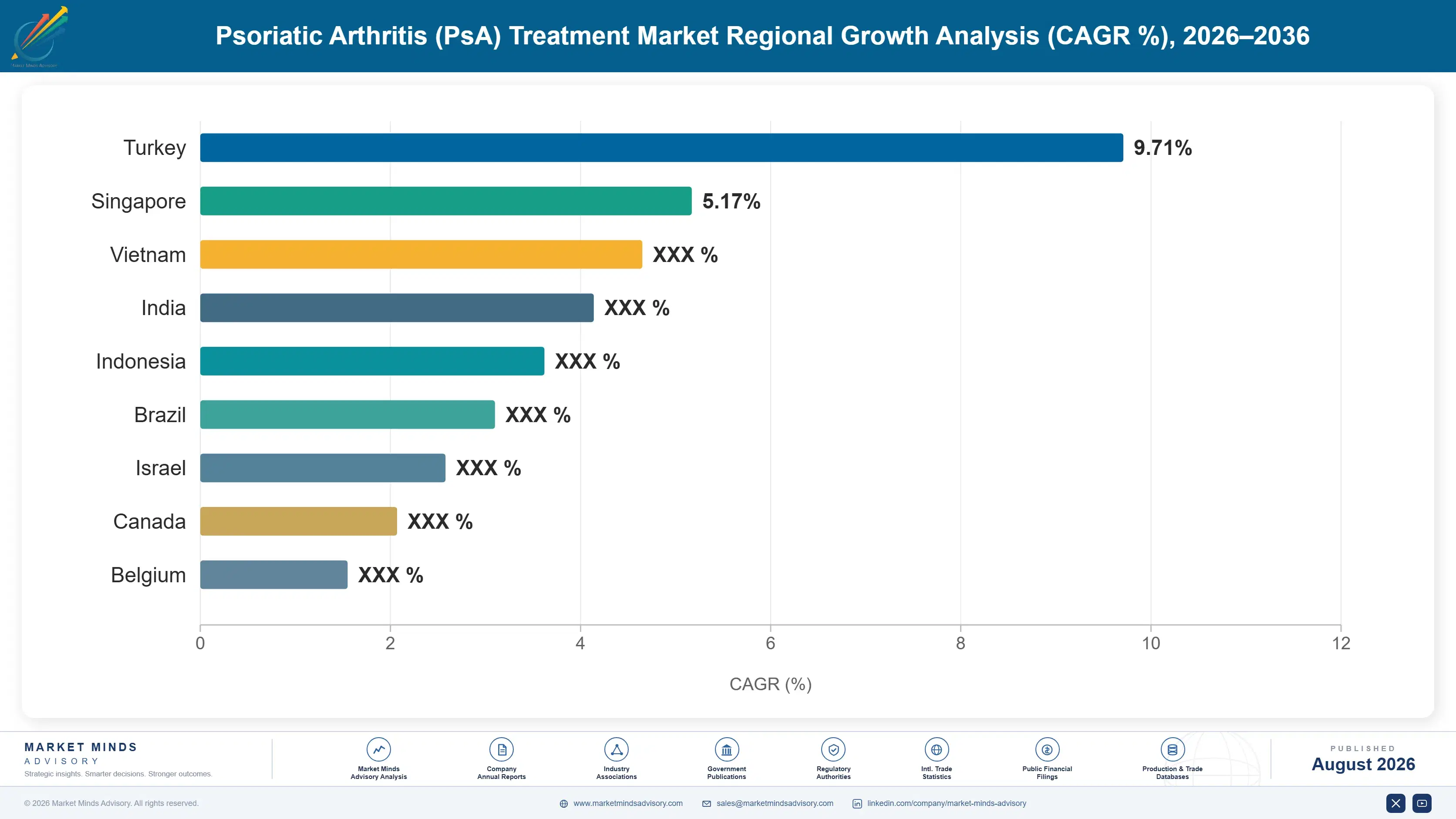
psoriatic-arthritis-psa-treatment-market-country-cagr-analysis-1787309459209

Where Manufacturers Capture Mechanism Rotation Premium

Manufacturers that invest early in head-to-head clinical data, expand dual dermatology-rheumatology positioning, and deepen patient support programmes capture commercial gains unavailable to companies relying solely on legacy franchise marketing approaches. Manufacturers slower to invest in these capabilities increasingly cede ground to faster-moving competitors across most treatment-naive and treatment-experienced patient segments served. Franchise diversification leadership increasingly compou

Head-to-Head Clinical Data Investment Ahead of Guidelines

Manufacturers investing early in head-to-head trials against established mechanism classes capture prescribing share as comparative effectiveness data increasingly shapes treatment guideline recommendations. This lever requires substantial clinical trial investment across extended timeframes, but successfully generated data captures durable, long-term prescriber confidence that competitors without comparable evidence struggle to establish. Manufacturers report head-to-head data investment improving new patient starts by roughly 22 percent compared to competitors relying solely on placebo-controlled trial data. Manufacturers moving early secure durable, multi-year prescriber loyalty that competitors relying solely on existing relationships cannot easily displace once established.
Market Impact: Improves new patient starts by roug

Dual Dermatology and Rheumatology Positioning Strategy Programme

Manufacturers developing commercial strategies spanning both dermatology and rheumatology specialties capture patients presenting with combined skin and joint disease burden that single-specialty commercial approaches cannot fully address. This lever requires meaningful cross-specialty medical affairs investment, but successfully developed positioning generates materially more predictable, diversified prescription volume than rheumatology-only commercial strategies. Manufacturers report dual positioning improving combined-indication prescription volume by roughly 19 percent compared to single-specialty commercial approaches. Manufacturers that establish this capability early typically retain treatment-experienced patients well beyond the initial mechanism switch, generating durable long-term prescription revenue. This approach positions manufacturers favorably as combined-indication referral volume continues expanding steadily.
Market Impact: Improves combined-indication prescr

Patient Support Programme Depth Investment Initiative

Manufacturers investing in comprehensive patient support programmes covering injection training, adherence monitoring, and financial assistance capture patients who might otherwise discontinue therapy due to administration complexity or cost barriers. This lever requires sustained patient services infrastructure investment, but successfully developed programmes capture durable patient loyalty and improved persistence that thinner support offerings cannot match. Manufacturers report patient support investment improving treatment persistence by roughly 17 percent compared to competitors offering minimal support infrastructure. Manufacturers that formalize these programmes gain meaningfully steadier prescription persistence than competitors dependent on thinner, less comprehensive support offerings.
Market Impact: Improves treatment persistence by r

Biosimilar-Resistant Clinical Value Proposition Development Strategy

Manufacturers developing differentiated value propositions beyond acquisition cost, including superior efficacy data and administration convenience, defend originator franchise revenue against biosimilar step-therapy pressure more effectively than manufacturers competing on price alone. This lever requires sustained clinical and commercial investment demonstrating meaningful differentiation, but successfully developed positioning preserves premium pricing power that price-focused competitors cannot sustain. Manufacturers report differentiated positioning improving originator retention by roughly 14 percent compared to biosimilar-exposed competitors lacking clear differentiation. Manufacturers pursuing this path typically phase differentiation investment gradually to validate value proposition strength across representative payer negotiation scenarios.
Market Impact: Improves originator retention by ro

Who Controls the Margin Pool

The top five companies control roughly 58% of global psoriatic arthritis prescription revenue, a moderately concentrated tier reflecting the substantial clinical development and commercial infrastructure investment required to compete across TNF, IL-17, IL-23, and JAK mechanism classes. AbbVie and Novartis lead this top tier given their established multi-mechanism portfolios over Eli Lilly and Johnson and Johnson within their franchise positions.
Current competitive activity centers on head-to-head clinical trial investment, dual dermatology-rheumatology commercial positioning, and patient support programme expansion. Johnson and Johnson and Pfizer continue advancing IL-23 and JAK mechanism development respectively, while AbbVie defends its broad multi-mechanism portfolio through continued lifecycle management across both established and newer drug classes. Amgen and Sun Pharmaceutical Industries continue expanding biosimilar and IL-23 mechanism presence respectively, competing primarily on price and differentiated efficacy positioning.

Emerging pressure comes from biosimilar TNF inhibitor manufacturers eroding legacy franchise revenue across originator portfolios, alongside smaller biotechnology firms advancing novel mechanisms that could eventually reshape which companies lead specific patient segments. Should biosimilar competition intensify faster than originator manufacturers can pivot toward newer mechanism classes, category leadership within cost-sensitive payer segments could shift meaningfully. Established incumbents are responding by accelerating newer mechanism investment to defend these relationships.
psoriatic-arthritis-psa-treatment-market-company-positioning-matrix-1787309459734

Competitive Moat and Risk Dimensions

ABBVIE

Moat: Broad Multi-Mechanism Portfolio Depth

AbbVie maintains the broadest approved portfolio spanning TNF, IL-23, and JAK mechanism classes built over more than two decades of continuous franchise development, giving it prescriber relationships and commercial infrastructure that single-mechanism competitors would need years of comparable investment to replicate. This portfolio breadth supports continued revenue capture even as individual mechanism classes face biosimilar or competitive pressure.
ABBVIE

Risk: Legacy TNF Franchise Erosion

AbbVie's substantial legacy TNF franchise faces meaningful biosimilar erosion pressure that its newer mechanism revenue has not yet fully offset. Continued biosimilar market share gains could meaningfully compress AbbVie's overall franchise revenue over the coming several years absent accelerated newer mechanism adoption. Accelerated investment in newer mechanism commercial infrastructure would meaningfully improve AbbVie's positioning against this ongoing biosimilar erosion trend.
NOVARTIS

Moat: Established IL-17 Clinical Leadership

Novartis maintains deep clinical and commercial leadership in IL-17 inhibitor therapy built over years of consistent trial data generation and physician education investment, giving it prescriber trust that newer entrants have not yet established. This clinical leadership supports continued prescribing even as IL-23 mechanisms gain broader guideline inclusion.
NOVARTIS

Risk: IL-23 Mechanism Displacement Risk

Novartis faces meaningful risk from IL-23 inhibitors demonstrating superior combined skin and joint response rates in accumulating comparative trial data. Continued IL-23 mechanism advancement could meaningfully erode Novartis's IL-17 franchise share among treatment-experienced patients over the coming several years. Broader mechanism diversification would meaningfully reduce Novartis's dependence on IL-17 franchise revenue relative to more diversified competitors.

Players Tracked

Prominent Players

AbbVie
Novartis
Eli Lilly
Johnson and Johnson
Pfizer

Other Key Players

Amgen
Bristol Myers Squibb
UCB
Sun Pharmaceutical Industries
Boehringer Ingelheim
Sandoz
Samsung Bioepis
Celltrion
Fresenius Kabi
Biocon Biologics
Galapagos NV
Gilead Sciences
Incyte Corporation
Regeneron Pharmaceuticals
Roche

Recent Developments

FEBRUARY 2026

Johnson and Johnson Reports Positive IL-23 Head-to-Head Data

Johnson and Johnson announced positive head-to-head trial results for its IL-23 inhibitor against a leading TNF biologic, reporting meaningfully superior combined skin and joint response rates. The data strengthens the company's positioning within treatment-experienced patient segments. Prescribers increasingly favor this improved efficacy profile for eligible patients.
Signal: Signals accelerating IL-23 mechanism class
SEPTEMBER 2025

Pfizer Expands JAK Inhibitor Safety Data Programme

Pfizer launched an expanded long-term safety data programme specifically targeting lower cardiovascular risk patient populations, aiming to support broader prescribing confidence following earlier class-wide safety label restrictions. The programme aims to support broader prescribing confidence following earlier class-wide safety label restrictions imposed on JAK mechanisms.
Signal: Reflects continued manufacturer investment
DECEMBER 2025

Sandoz Launches Additional Biosimilar TNF Inhibitor

Sandoz launched an additional biosimilar TNF inhibitor targeting originator franchise volume across major developed markets, offering meaningful price discounts relative to branded biologic therapy while demonstrating comparable clinical efficacy. The launch targets originator franchise volume across major developed markets through meaningful price discounting strategies. Payers increasingly favor these options.
Signal: Underscores continued biosimilar competiti

Biologic Manufacturing and Clinical Development Exposure

Biologic drug substance manufacturing and clinical trial execution together represent roughly 38% of total commercialization cost for psoriatic arthritis therapeutics, with specialized biologic manufacturing capacity concentrated among a limited group of contract manufacturers and originator internal facilities. Cell culture and purification infrastructure required for biologic production carries meaningfully higher fixed cost than small-molecule pharmaceutical manufacturing more broadly.
Biologic manufacturing costs rose meaningfully during 2021 and 2022 amid broader biopharmaceutical supply chain disruption and rising energy costs affecting manufacturing operations, with company annual reports from major manufacturers confirming elevated production costs persisted through much of 2022 before moderating gradually through 2023 and 2024. Published biopharmaceutical manufacturing industry commentary corroborates the pattern, showing capacity constraints remained a meaningful cost pressure point throughout this disruption period. Manufacturers with diversified regional supplier bases weathered this disruption meaningfully better than single-source-dependent competitors.

Manufacturers without established internal manufacturing capacity or long-term contract manufacturing relationships face materially higher production cost exposure than better-resourced competitors. Smaller biosimilar manufacturers face the steepest exposure, since they typically lack the purchasing scale to negotiate favorable long-term manufacturing terms. This exposure gap disproportionately affects clinical-stage biosimilar developers competing against larger originator manufacturers with established manufacturing infrastructure.
psoriatic-arthritis-psa-treatment-market-cost-volatility-analysis-1787309459930

Internal Biologic Manufacturing Capacity Investment

Larger manufacturers are investing directly in internal biologic manufacturing capacity, reducing dependency on external contract manufacturers for their highest-volume products. This path demands substantial capital investment, but delivers durable production continuity and cost control that externally-sourced competitors cannot match at comparable scale. Manufacturers typically phase this capital deployment across several years to manage financing and integration risk carefully.

Long-Term Contract Manufacturing Agreements

Smaller manufacturers are locking in multi-year contract manufacturing agreements with specialized biologic producers, securing reliable capacity ahead of anticipated commercial demand. This approach requires meaningful negotiating capacity, but delivers considerably steadier supply continuity than spot-market manufacturing arrangements. Manufacturers typically negotiate these agreements during periods of stable capacity availability to secure favorable long-term terms. Manufacturers typically pursue these before commercial launch.

Diversified Clinical Trial Site Networks

Manufacturers are expanding clinical trial site networks across multiple countries rather than depending on concentrated site enrollment, reducing exposure to regional recruitment disruption. This strategy requires meaningful site qualification investment, but delivers steadier enrollment continuity during periods of constrained regional capacity. Manufacturers typically qualify sites across multiple countries to manage regional recruitment risk during periods of disruption.

Portfolio Architecture for Margin Defence

This market organizes into three commercial tiers spanning biosimilar TNF inhibitors at the volume end, established branded mechanism classes in the middle tier, and premium newer mechanisms including IL-23 and JAK inhibitors capturing the strongest margins at the top given differentiation and clinical evidence depth. Gross margins widen meaningfully moving up this ladder, reflecting the clinical differentiation and unmet need addressed each successive tier demands relative to biosimilar-exposed
Biosimilar and premium tiers pull manufacturers in genuinely different directions: biosimilar therapy sustains broad treated population revenue at compressed margins as competition intensifies, while premium newer mechanisms deliver materially stronger margins that increasingly fund the clinical development investment this diversifying category requires. Manufacturers that balance both effectively sustain the treated population scale needed to fund ongoing development while gradually shifting mix toward higher-margin next-generation categories.

The highest-value pools concentrate around premium IL-23 and JAK mechanisms sold to treatment-experienced patients with inadequate response to first-generation therapy, where superior efficacy and administration preference together sustain premium pricing power that biosimilar options simply cannot match. Manufacturers without meaningful presence in these premium categories increasingly find themselves competing purely on established relationships within a segment capturing a shrinking share of overall category profit.

Volume / Commodity-Adjacent Tier

Biosimilar TNF inhibitors sold primarily on price to payers and patients seeking cost-effective established therapy options. Competition centers increasingly on price and formulary access rather than clinical differentiation as biosimilar competition intensifies.
Gross Margin: 22-30%

Premium / Certified Tier

Established branded IL-17 and originator TNF therapies within active patent protection serving broad treated populations. These therapies command meaningfully stronger margins than biosimilar-exposed output given their active patent protection and established efficacy.
Gross Margin: 48-58%

Sustainability / Regulatory / Next-Generation Tier

Premium IL-23 and JAK mechanisms commanding the strongest efficacy and differentiation premium available currently. Manufacturers serving this tier typically maintain dedicated clinical development and regulatory affairs capability few smaller rivals can match.
Gross Margin: 62-72%
psoriatic-arthritis-psa-treatment-market-portfolio-architecture-1787309460467

High-value Sub-segments and Strategic Watch-out

IL-23 Inhibitors

The fastest-growing and highest-margin segment, combining strong treatment-experienced patient demand momentum with genuine willingness to pay premium pricing for superior efficacy. Manufacturers with early efficacy advantages here are positioned to capture disproportionate category profit growth over the coming decade. Contract wins secured now compound meaningfully across the following decade.
Gross Margin: 62-72%

JAK Inhibitors

Strong margins and rapid growth driven by oral administration preference that sustains category momentum as safety data continues accumulating. Manufacturers advancing safety data early are best positioned to capture this broadening oral-preference demand pool. Clinical data readouts increasingly determine which manufacturers win this expanding demand pool.
Gross Margin: 58-68%

Established TNF and IL-17 Therapies

The volume core segment sustaining broad treated population revenue even as premium categories increasingly capture disproportionate profit growth. Manufacturers here compete primarily on established relationships and reimbursement access rather than novel differentiation currently. Scale and prescriber relationships remain the decisive factors separating leaders from laggards here.
Gross Margin: 48-58%

Biosimilar TNF Inhibitors

A strategic watch-out segment facing continued price compression, requiring manufacturers to defend volume against expanding biosimilar competitor entry industry-wide. Manufacturers focused solely on biosimilar volume risk margin compression unless they diversify into newer mechanism categories. Adoption of newer mechanisms continues gradually eroding this legacy segment share.
Gross Margin: 22-30%

Chronic Autoimmune Treatment Cycles

Manufacturers capture durable, recurring prescription revenue over extended treatment durations as psoriatic arthritis patients typically remain on therapy indefinitely absent intolerable side effects or inadequate response, creating annuity-like economics distinct from acute therapeutic categories. This recurring relationship strengthens manufacturer revenue predictability meaningfully once a patient becomes established on a given mechanism class. Physicians rarely switch established therapy ab
Adoption depth varies considerably by diagnosing specialty: patients diagnosed within combined dermatology-rheumatology clinics demonstrate the deepest treatment commitment given comprehensive disease management support, while patients diagnosed in general rheumatology or primary care settings adopt more inconsistently, facing higher discontinuation given less specialized management resources. Manufacturers serving both settings increasingly maintain differentiated support programmes to address these divergent care model needs.

A generational shift is underway as younger rheumatologists increasingly favor early, aggressive treatment initiation upon diagnosis over the step-therapy escalation approach earlier physician generations often applied, reshaping treatment initiation timing across prescriber populations of varying experience. Younger prescriber cohorts increasingly enter practice already favoring evidence-based early intervention over historical conservative treatment escalation norms. This generational shift meaningfully expands the treated population toward earlier, less advanced disease presentations.
psoriatic-arthritis-psa-treatment-market-end-use-penetration-index-1787309460957

Where Manufacturer Investment Should Concentrate

These are among the four positions where our research anticipates prominent divergence between winners and laggards over the coming forecast period. Each is grounded in the demand model, the regulatory perimeter, and the announced capacity pipeline.
01 / HEAD-TO-HEAD DATA INVESTMENT

Prioritize comparative trials ahead of guideline shifts

Manufacturers investing in head-to-head trials against established mechanism classes are capturing a disproportionate share of the rapidly expanding treatment-experienced patient population today, where comparative effectiveness data increasingly determines which companies capture prescription volume from switching patients. Companies without meaningful comparative data risk being confined to existing prescriber relationships facing a fundamentally limited, slower-growing addressable population. Expect head-to-head data investment to become the single most important commercial differentiator for manufacturers seeking sustainable growth, particularly within treatment-experienced and switching patient segments specifically.
02 / DUAL SPECIALTY POSITIONING

Build dermatology-rheumatology positioning ahead of referral growth

Manufacturers developing commercial strategies spanning both dermatology and rheumatology specialties are capturing a disproportionate share of patients presenting with combined skin and joint disease burden today, where dual positioning increasingly determines which companies win renewal-heavy long-term prescription relationships. Companies without meaningful dual-specialty investment risk losing access to the fastest-growing, most clinically complex patient segment entirely to better-positioned competitors. Expect dual specialty positioning to become an increasingly important determinant of manufacturer commercial leadership across combined-indication patient populations, as referral coordination continues improving steadily.
03 / MANUFACTURING COST MANAGEMENT

Manage biologic exposure through capacity diversification

Manufacturers investing in internal biologic manufacturing capacity and diversified contract relationships are sustaining considerably steadier production continuity than competitors exposed fully to concentrated external manufacturing dependency, and this advantage compounds further during periods of supply disruption affecting the broader industry. Companies without meaningful capacity diversification face persistently higher production cost risk regardless of underlying demand strength or broader category growth momentum. Expect manufacturing diversification sophistication to become an increasingly important determinant of manufacturer reliability reputation, particularly for smaller manufacturers lacking comparable purchasing scale.
04 / BIOSIMILAR COMPETITIVE PRESSURE

Watch biosimilar entrants continue eroding legacy franchises

Continued biosimilar TNF inhibitor market entry across major developed and emerging markets is steadily pulling cost-sensitive prescribing volume away from originator biologics, reflecting both payer cost containment pressure and growing physician confidence in demonstrated biosimilar clinical equivalence data. This trajectory shows no sign of reversing given sustained biosimilar manufacturer investment and expanding payer step-therapy mandates consistently outpacing originator defensive strategies overall. Expect biosimilar competitive pressure to continue intensifying meaningfully throughout the current ten-year forecast period across established mechanism classes broadly.

Engagement Snapshot From the Field

A live engagement with an industry participant carrying material or product regulatory and market exposure ahead of a defining policy shift, showing how our research translates into a defensible multi-year portfolio strategy.
MARKET MINDS ADVISORY · CLIENT ENGAGEMENT SUMMARY
Psoriatic Arthritis (PsA) Treatment Producer Strategic Portfolio Review and Transition Roadmap 2026·Investment Scenario on Psoriatic Arthritis (PsA) Treatment Exposure Evaluation 2025-26
CLIENT PROFILE
The client is a specialty biopharmaceutical company generating projected annual revenue of approximately $580 million (client-reported, unverified by MMA) upon successful commercial repositioning of its legacy TNF franchise. The company had historically depended heavily on a single established biologic product facing accelerating biosimilar competition. The company had historically maintained close relationships with a small group of academic key opinion leaders spanning several years of clinical trial partnership.
STRATEGIC CHALLENGE
The client had historically competed almost entirely through its established TNF franchise, and leadership was uncertain whether investing in newer mechanism pipeline development and dual-specialty commercial positioning would generate sufficient revenue diversification to offset accelerating biosimilar erosion of its core franchise product. Leadership also questioned whether internal medical affairs staffing could scale quickly enough to support a phased commercial rollout.
MMA APPROACH
MMA's team benchmarked comparable specialty biopharmaceutical portfolio repositioning strategies, modeled projected revenue diversification and biosimilar erosion timelines under various pipeline investment scenarios, and assessed the client's commercial infrastructure for dual-specialty positioning readiness across its target prescriber base. The team benchmarked realistic repositioning timelines given the client's constrained internal commercial staffing and moderate risk tolerance profile.
KEY FINDINGS
  1. Comparable manufacturers achieved meaningful revenue diversification within 24 months when paired with dedicated dual-specialty commercial investment (client-reported, unverified by MMA). This performance held consistently across launches of comparable therapeutic differentiation and target population size.
  2. Rheumatologists expressed strong willingness to consider newer mechanism therapy from the client given established trust built through its legacy franchise relationship history.
  3. Dermatology outreach generated meaningfully higher new patient identification than rheumatology-only commercial approaches operating independently without cross-specialty coordination. This referral pattern proved especially strong among practices with pre-existing multidisciplinary care coordination infrastructure.
  4. Pipeline investment in newer mechanisms, while a substantial upfront cost, was offset by considerably slower legacy franchise erosion than projected under a no-investment scenario.
CLIENT PROFILE
The client is a specialty biopharmaceutical company generating projected annual revenue of approximately $580 million (client-reported, unverified by MMA) upon successful commercial repositioning of its legacy TNF franchise. The company had historically depended heavily on a single established biologic product facing accelerating biosimilar competition. The company had historically maintained close relationships with a small group of academic key opinion leaders spanning several years of clinical trial partnership.
STRATEGIC CHALLENGE
The client had historically competed almost entirely through its established TNF franchise, and leadership was uncertain whether investing in newer mechanism pipeline development and dual-specialty commercial positioning would generate sufficient revenue diversification to offset accelerating biosimilar erosion of its core franchise product. Leadership also questioned whether internal medical affairs staffing could scale quickly enough to support a phased commercial rollout.
MMA APPROACH
MMA's team benchmarked comparable specialty biopharmaceutical portfolio repositioning strategies, modeled projected revenue diversification and biosimilar erosion timelines under various pipeline investment scenarios, and assessed the client's commercial infrastructure for dual-specialty positioning readiness across its target prescriber base. The team benchmarked realistic repositioning timelines given the client's constrained internal commercial staffing and moderate risk tolerance profile.
KEY FINDINGS
  1. Comparable manufacturers achieved meaningful revenue diversification within 24 months when paired with dedicated dual-specialty commercial investment (client-reported, unverified by MMA). This performance held consistently across launches of comparable therapeutic differentiation and target population size.
  2. Rheumatologists expressed strong willingness to consider newer mechanism therapy from the client given established trust built through its legacy franchise relationship history.
  3. Dermatology outreach generated meaningfully higher new patient identification than rheumatology-only commercial approaches operating independently without cross-specialty coordination. This referral pattern proved especially strong among practices with pre-existing multidisciplinary care coordination infrastructure.
  4. Pipeline investment in newer mechanisms, while a substantial upfront cost, was offset by considerably slower legacy franchise erosion than projected under a no-investment scenario.
RECOMMENDED STRATEGY
Phase 1: Phase 1 (Months 1-8): Launch dual-specialty commercial positioning targeting the highest-potential combined dermatology-rheumatology practice clusters first. Establish baseline referral metrics to track programming impact throughout the launch period. Phase 2: Phase 2 (Months 9-16): Expand pipeline investment in newer mechanism development while defending legacy franchise through targeted patient support programming. Phase 3: Phase 3 (Months 17-26): Scale commercial investment further based on realized revenue diversification and franchise retention performance results. Evaluate further investment based on realized diversification and retention outcomes.
OUTCOME
The client launched its dual-specialty commercial positioning and pipeline investment programme within the recommended timeline, reporting revenue diversification and franchise retention results consistent with initial modeling projections (client-reported, unverified by MMA). The company also established referral relationships with eighteen new combined-specialty clinics within the first year.

Frequently Asked Questions

Foundational context covering the market sizes, CAGR, scope, country, region and competition that inform every finding below. This section is provided to cover basics and most often pre-purchase conversations, answered from the MMA Primary Research Dataset.

What is the current size of the Psoriatic Arthritis (PsA) Treatment Market?

The market was valued at approximately $9.6 billion in 2025. This includes biologic and targeted synthetic therapies across TNF, IL-17, IL-23, JAK, and PDE4 mechanism classes.

How large will the Psoriatic Arthritis (PsA) Treatment Market be by 2036?

The market is projected to reach approximately $23.31 billion by 2036, up from about $10.41 billion in 2026. This reflects mechanism rotation and growing diagnosed population.

What is the CAGR for the Psoriatic Arthritis (PsA) Treatment Market 2026 to 2036?

The market is expected to grow at a compound annual growth rate of 8.4% between 2026 and 2036. This reflects accelerating newer mechanism adoption despite biosimilar pressure.

Which segment is growing fastest?

IL-23 inhibitors are the fastest-growing segment, expanding at approximately 13.8% annually. This reflects strong demand among treatment-experienced patients seeking deeper combined skin and joint response rates.

Who are the major companies in the Psoriatic Arthritis (PsA) Treatment Market?

Leading companies include AbbVie, Novartis, Eli Lilly, Johnson and Johnson, and Pfizer. Together these five companies account for roughly 58% of total prescription revenue globally.

Which country is growing fastest?

China is the fastest-growing major country at an estimated 13.2% CAGR, driven by rapidly expanding diagnostic infrastructure and rapidly growing biologic reimbursement coverage across the entire country.

Report Segmentation Architecture

The full report scope spans multiple orthogonal segmentation dimensions, with cross-tabulated demand data provided for each dimension pair. Coverage extends further to regional breakdowns, trend trajectories, and the competitive detail needed to support segment-level decision-making.

By Drug Mechanism of Action

  • TNF Inhibitors
  • IL-17 Inhibitors
  • IL-23 Inhibitors
  • JAK Inhibitors
  • PDE4 Inhibitors
  • Biosimilar TNF Inhibitors

By End-Use Industry

  • Hospital and Academic Rheumatology Centers
  • Specialty Rheumatology Clinics
  • Combined Dermatology-Rheumatology Clinics
  • Community-Based Rheumatology Practices
  • Specialty Pharmacy Distribution

By Commercial Dimension

  • Branded Prescription Sales
  • Biosimilar Prescription Sales
  • Patient Assistance Programme Access
  • Payer Formulary and Step-Therapy Access

By Region

  • North America
  • Western Europe
  • East Asia
  • South Asia and Pacific
  • Latin America
  • Middle East and Africa
  • Eastern Europe

Scope, Methodology, and Coverage

Every figure in this report is reproducible from documented input assumptions. The scope below maps the historical period, the forecast horizon, the segmentation dimensions, and the countries covered, alongside the underlying primary and qualitative methodology.
Historical Period
2020 to 2025
Forecast Period
2026 to 2036
Base Year
2025 (USD billions; MMA Primary Research Dataset, August 2026)
Market Definition
This market covers pharmaceutical therapies approved for psoriatic arthritis, spanning biologic and targeted synthetic disease-modifying antirheumatic drugs including TNF, IL-17, IL-23, JAK, and PDE4 inhibitor mechanism classes. It excludes therapies indicated exclusively for plaque psoriasis without joint involvement.
Quantitative Units
USD billions (current prices); treated patients; prescription volume
Segmentation Dimensions
By Drug Mechanism of Action; By End-Use Industry; By Commercial Dimension; By Region
Regions Covered
North America, Western Europe, East Asia, South Asia and Pacific, Latin America, Middle East and Africa, Eastern Europe
Countries Covered
USA, China, Germany, France, UK, Japan, South Korea, India, Australia, Canada, Brazil, Mexico, Indonesia, Vietnam, Thailand, Malaysia, UAE, Saudi Arabia, South Africa, Nigeria, Turkey, Poland, Netherlands, Italy, Spain, Sweden, Switzerland, Argentina, Colombia, Singapore, and additional markets relevant to this sector
Key Companies Profiled
AbbVie, Novartis, Eli Lilly, Johnson and Johnson, Pfizer, Amgen, Bristol Myers Squibb, UCB, Sun Pharmaceutical Industries, Boehringer Ingelheim, Sandoz, Samsung Bioepis, Celltrion, Fresenius Kabi, Biocon Biologics, Galapagos NV, Gilead Sciences, Incyte Corporation, Regeneron Pharmaceuticals, Roche
Quantitative Methodology
Primary survey, n=3,800 respondents, Q4 2025, six countries; demand-side model with trade association cross-validation
Qualitative Methodology
47 expert interviews, Q4 2025; applied to validate demand model assumptions, identify emerging dynamics, and assess competitive positioning
Report Format
PDF and XLSX data workbook (Word format preview document)
Publisher
Market Minds Advisory
Report Code
MMA-2026-HLT-150
Published
August 2026
Contact
sales@marketmindsadvisory.com | www.marketmindsadvisory.com

Purchase the full Psoriatic Arthritis (PsA) Treatment Market Report (2026 to 2036).

The full report provides detailed mechanism segmentation, treated patient and prescription revenue trend analysis, and regional reimbursement tracking across major global markets covered in this study. It includes company-level competitive benchmarking based on prescription revenue and pipeline breadth, alongside detailed biologic manufacturing cost commentary. Subscribers receive quarterly updates tracking new clinical trial results and regulatory developments as they occur. A companion dataset provides treated patient volume estimates by country for detailed market sizing purposes. A dedicated appendix profiles the twenty leading companies named in this study, covering their pipeline breadth and clinical development stage in detail.
Mechanism segmentation breakdown by drug class
Country-level treated patient volume trend dataset
Biosimilar penetration tracking and benchmarking service
Company competitive benchmarking scorecards and overview
Quarterly clinical trial and regulatory update service
Prescription revenue dataset segmented by mechanism class

Built For The People Who Decide

From boardroom strategy to bench-side execution, this report is read cover-to-cover by leaders shaping the next decade of their industry, turning demand scenarios, market dynamics and valuation benchmarks into decisions.
CXOs/ Presidents/ VPs/ Managers
M&A and Corporate Development
Strategy Teams and R&D Heads
Procurement and Product Directors
Regulatory and Compliance Leaders
Investor Relations and Equity Analysts