Market Minds Advisory
Prothrombin Complex Concentrate Market

Prothrombin Complex Concentrate Market: A Warfarin Product Surviving on Off-Label Use, Rationed by Plasma Supply

The on-label indication for these products is disappearing as warfarin does, and the off-label use replacing it involves a bleeding emergency where twenty minutes of reconstitution genuinely matters. for the patient still bleeding.

Lead Analyst

Alice Ballenger

Published

September 2026

Make Smarter Decisions with Customized Research Insights

Request a free sample report and evaluate market opportunities, growth trends, and competitive dynamics relevant to your business needs.

2025 MARKET VALUE$1.6BMarket Size 2025
2036 FORECAST VALUE$3.4BBase Case , 2026 to 2036
CAGR 2026 TO 20367.4 %Bull 8.7% / Bear 6.1%
INCREMENTAL OPPORTUNITY$1.7BNet 10- year value creation
EXPANSION MULTIPLE2.04x2036 value over 2026 base
Strategic Levers
M&A Pipeline
Regional Outlook
Country Rankings
Competitive Intelligence
Segmental Deep-dive
Call-Us : 91 93563 13602

Executive Snapshot and Market Trajectory

These products were built to reverse warfarin, and warfarin is going away. What has replaced that demand is off-label use in bleeding on direct oral anticoagulants and in trauma coagulopathy, neither of which the label covers and both of which guidelines now discuss openly. Guidelines say so; labels do not.
Liquid ready-to-use formulations compound at 11.1%, exactly 1.50 times the market, because reconstituting a lyophilised concentrate takes around 20 minutes in an emergency where bleeding continues throughout. North America holds 32% of demand on anticoagulant use and plasma collection together. Five fractionators hold 84% of supply. Around 46% of doses are administered outside the approved indication, and manufacturers cannot promote a word of it.
The binding constraint is plasma rather than demand. Every fractionated litre is allocated across immunoglobulin, albumin and clotting factors, and this product competes for volume it does not always win. Clotting factor production takes only about 9% of the fractionated stream. That allocation decision determines supply more than any commercial negotiation does, and hospitals remember which supplier failed them last time. Supply reliability outranks price everywhere. Nobody plans comfortably from that.
Market Definition
The market covers plasma-derived prothrombin complex concentrates used for urgent reversal of vitamin K antagonist anticoagulation and for acquired coagulation factor deficiency, spanning four-factor concentrates, three-factor concentrates, activated concentrates, heparin-free formulations, liquid ready-to-use formulations, and pathogen-reduced next-generation formulations. Specific reversal agents including andexanet alfa and idarucizumab, fresh frozen plasma, recombinant factor concentrates, fibrinogen concentrate, and vitamin K preparations are excluded.
Base Year Value
$1.6B in 2025 (MMA Primary Research Dataset, August 2026)
Forecast Period
2026 to 2036, eleven discrete annual values
CAGR
7.4% base case. Bull 8.7%. Bear 6.1%.
Fastest Growth Segment
Liquid Ready-to-Use Formulations: 11.1% CAGR
Fastest Growth Country
India: 9.8% CAGR
Fastest Growth Region
South Asia and Pacific: 9.5% CAGR
Largest Region
North America: 32% of 2025 global value
Market Leaders
CSL Behring, Octapharma, Grifols, Takeda Pharmaceutical, Kedrion Biopharma. Source: MMA Analysis based on company annual reports.
Primary Survey
n=3,800 procurement and R&D decision-makers, Q4 2025, six countries
Methodology
Demand-side build-up, cross-validated against public data, 47 expert interviews

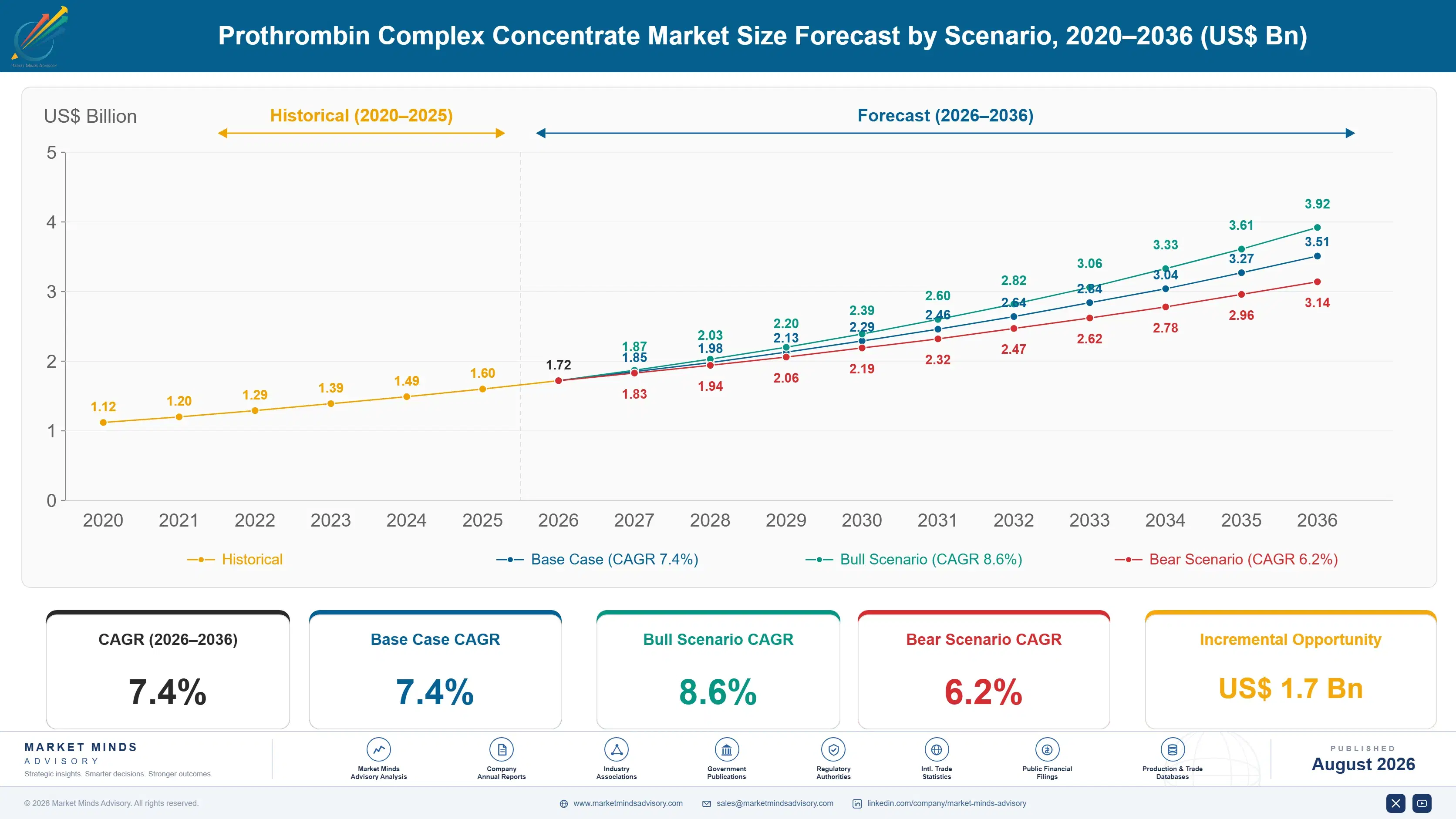
Prothrombin Complex Concentrate Market Forecast Scenarios

prothrombin-complex-concentrate-market-size-forecast-scenario-1787309213282
Growth of 6.3% across 2020 to 2025 came almost entirely from an indication these products do not carry. Warfarin prescribing kept falling as direct oral anticoagulants took its place, which should have shrunk the licensed market considerably. Instead emergency physicians used prothrombin complex concentrate against the newer drugs off-label, because it was stocked, cost far less than the antidote and appeared to work.
The base case of 7.4% rests on three mechanisms. Direct oral anticoagulant prescribing keeps expanding into older and frailer populations, which raises the absolute number of bleeding episodes needing reversal regardless of what any label says. Emergency protocol standardisation is spreading, and protocols name products rather than classes. And Asian emergency capacity is expanding, with plasma fractionation capability growing alongside it in China, Korea and India. None of these mechanisms may be promoted.
The bull case of 8.6% assumes specific antidote pricing stays high enough that prothrombin complex concentrate remains the practical choice in most emergency departments, which is where it currently sits. The bear case of 6.2% reflects the opposite: specific reversal agents winning guideline preference and hospital protocol inclusion outright, confining these products to vitamin K antagonist reversal in a shrinking population.

Reversing an Anticoagulant Nobody Prescribes

The commercial position here is genuinely odd. Prothrombin complex concentrates are licensed to reverse warfarin, and warfarin prescribing across developed markets has fallen roughly 58% since 2015 as direct oral anticoagulants took over atrial fibrillation. The approved market is shrinking and the product is growing, because around 46% of doses are now given outside the label. That is an uncomfortable position to plan from.
TOP FIVE CONCENTRATION84%Combined share held by the five largest plasma fractionators globally
RECONSTITUTION TIME20 minutesPreparation delay for lyophilised product during active bleeding
OFF-LABEL USE SHARE46% of dosesProportion administered outside the approved reversal indication entirely
COST AGAINST SPECIFIC REVERSALUSD 5,400Course cost against agents priced several times above this level
PLASMA YIELD ALLOCATION9% of litresShare of fractionated plasma directed to clotting factor production
WARFARIN PRESCRIBING DECLINE58% since 2015Reduction in vitamin K antagonist use across developed markets
That off-label use is bleeding on factor Xa inhibitors and trauma-induced coagulopathy. Specific reversal agents exist for the first and are priced several times above a roughly USD 5,400 concentrate course, and the comparative evidence is genuinely mixed rather than settled. Emergency physicians reach for what is in the fridge, available immediately, and affordable, which describes prothrombin complex concentrate rather well. Guidelines discuss the use openly while no manufacturer may mention it.
Supply is what actually limits the market. These are plasma-derived products competing for fractionated litres against immunoglobulin and albumin, and clotting factor production takes only around 9% of the plasma stream. Immunoglobulin demand has grown faster than collection, so fractionators allocate accordingly. A concentrate cannot be manufactured to meet demand the way a small molecule can. Collection capacity has to be built years ahead.
"The label says warfarin and almost half the vials go into something else entirely. Everyone knows it, the guidelines discuss it, and the manufacturers cannot say a word about it."
Principal, Plasma-Derived Therapeutics and Haemostasis Practice · MMA Plasma-Der

Market Trends

Off-Label Xa Inhibitor Reversal Sustains a Declining Label

Warfarin prescribing has fallen roughly 58% across developed markets since 2015, and around 46% of prothrombin complex concentrate doses are now administered outside the approved reversal indication, principally in factor Xa inhibitor bleeding and trauma coagulopathy. Guidelines discuss that use openly while manufacturers cannot promote it, which produces the unusual situation of a product growing on an application its own label does not mention and its sales organisation cannot address. Guideline committees weigh availability and cost against the comparative evidence, and the resulting position is a compromise nobody markets. and every guideline committee reaches the.
Market Impact: Course priced at USD 5,400 typicall
Reconstitution Delay Becomes a Clinical and Commercial Variable

Lyophilised concentrate requires around 20 minutes to reconstitute, and in intracranial or gastrointestinal bleeding the patient continues bleeding throughout that period. Liquid ready-to-use formulations remove the delay entirely, which is a genuine clinical argument rather than a convenience claim, and they compound at 11.1% against a market at 7.4%. Emergency departments that have measured door-to-administration intervals adopt them readily; those that have not compare vial prices instead. Stability engineering to hold factor activity in solution at storage temperature is genuinely difficult, which is why liquid product took so long to appear at all.
Market Impact: Preparation consuming 20 critical m

Market Opportunities and Growth Drivers

Direct Oral Anticoagulant Volumes Enlarge the Bleeding Population

Every increase in factor Xa inhibitor prescribing enlarges the population that will eventually present with major bleeding requiring urgent haemostatic support, and those volumes have grown enormously as atrial fibrillation management shifted away from warfarin. The reversal need therefore grows even as the licensed indication shrinks, which is why the product has outgrown its own label. Prothrombin complex concentrate at roughly USD 5,400 per course is the affordable option in that setting. Specific reversal agents priced several times higher compete for the same patient, and emergency physicians reach for what is already in the fridge.
Market Impact: Clotting factors taking 9% of plasm

Trauma Protocols Incorporate Factor Concentrate Alongside Blood

Damage control resuscitation protocols increasingly include factor concentrate to correct coagulopathy faster than plasma transfusion achieves, particularly where thawed plasma is not immediately available. That use is entirely off-label and clinically well established, and trauma centres are among the heaviest users of the product in several markets. Reconstitution time matters more here than anywhere, since a haemorrhaging trauma patient cannot wait the 20 minutes lyophilised preparation requires. Trauma centres are among the heaviest users of the product in several markets, and their protocols are written by clinicians rather than negotiated by procurement.
Market Impact: Competing agents priced above USD 5

Market Restraints and Challenges

Plasma Allocation Caps Supply Regardless of Demand

Clotting factor production takes around 9% of fractionated plasma litres, and immunoglobulin demand growing faster than collection means fractionators prioritise it when allocating a constrained stream. The root cause is that plasma is a collected biological input rather than a manufactured one. Producers mitigate by investing in collection centre networks, by improving yield per litre through process refinement, and by contracting long-term supply with hospital systems rather than selling into spot demand. Collection centres take years to license and populate with regular donors, so capacity has to be built ahead of forecast rather than in response to a shortage.
Market Impact: Off-label reaching 46% of doses

Specific Reversal Agents Contest the Off-Label Position

Agents designed specifically for factor Xa inhibitor reversal have randomised evidence prothrombin complex concentrate lacks in that setting, and guideline bodies weigh that heavily. The root cause is that nobody will fund a registrational trial for an off-label use of a mature plasma product. Producers mitigate by supporting investigator-led comparative studies, by emphasising immediate availability and cost, and by pursuing formal label extension where the evidence base permits it. Investigator-led comparative work is the only realistic route to evidence. and label extension is pursued only where the evidence base genuinely permits as well as well.
Market Impact: Removing 20 minutes of preparation
3 additional market trends, 4 additional growth drivers, and 2 additional restraints and challenges are covered in the full report. Contact sales@marketmindsadvisory.com to access the complete intelligence.

Segment CAGR and Growth Architecture

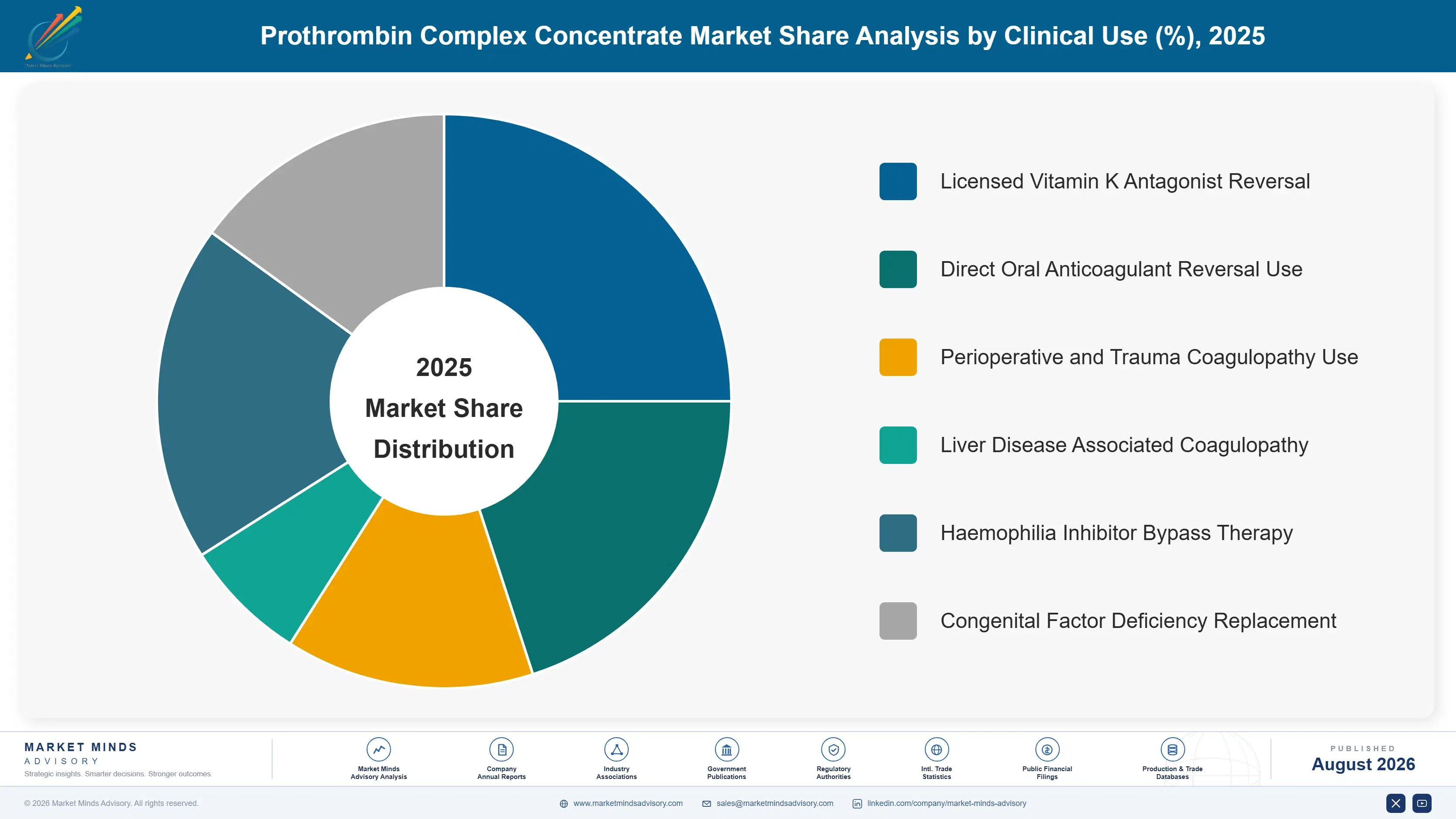
Segmentation follows product configuration and formulation, because factor content, heparin presence and preparation format each determine which patients can receive the product and how quickly. In emergency haemostasis, formulation is a clinical variable rather than a packaging preference. Six configurations sit in the hierarchy, separated by factor content, heparin presence and preparation format. and how fast it.
prothrombin-complex-concentrate-market-market-share-analysis-1787309213812

Liquid Ready-to-Use Formulations

Liquid formulations compound at 11.1%, exactly 1.50 times the market, on a single clinical fact: lyophilised concentrate takes around 20 minutes to reconstitute and the patient bleeds throughout. In intracranial haemorrhage, where minutes of continued bleeding translate into permanent deficit, and in trauma resuscitation, where the same applies to survival, that interval is the difference between a product working and a product arriving late. Stability engineering to hold factor activity in solution at storage temperature is genuinely difficult, which is why these formulations have taken so long to appear. Emergency departments that have measured door-to-administration intervals adopt them without argument. Those comparing vial prices see only a premium over an equivalent lyophilised product.
CAGR 11.1%

Heparin-Free Formulations

Heparin-free formulations grow at 9.6% because a substantial minority of patients requiring urgent reversal cannot safely receive heparin. Most concentrates include it to prevent thrombin generation during manufacture and storage, which excludes patients with heparin-induced thrombocytopenia or documented heparin allergy from receiving the standard product at all. In an emergency, discovering that contraindication at the bedside leaves no alternative available within any useful timeframe. Manufacturing a stable heparin-free concentrate requires alternative approaches to controlling activation during production, which not every fractionator has developed. The population is a minority and the clinical situation is absolute, which is exactly the combination that supports pricing without requiring a comparative trial. Not every fractionator can make it.
CAGR 9.6%
Full segment breakdown across 6 segments available in the complete report.

Regional Architecture and Country Demand Map

Demand follows anticoagulant prescribing volume, trauma system development and plasma fractionation access together, since a product this supply-constrained reaches markets in the order their fractionators and hospital systems can secure allocation. North America leads on prescribing volume and on plasma collection simultaneously, which is a combination no other region holds.

North America

North America holds 32% of demand, the largest regional share, growing at 7.1%. The region combines the highest anticoagulant prescribing volumes anywhere with the most developed trauma system, and it is also where the majority of the world's source plasma is collected, which gives regional fractionation and hospital supply an advantage no other market has. Off-label use in factor Xa inhibitor bleeding is most extensive here, and specific reversal agents compete most directly. Emergency department protocols are formalised enough that door-to-administration intervals are measured rather than estimated. Product storage location within a hospital turns out to matter almost as much as formulation, since central pharmacy storage adds a retrieval interval nothing clinical requires.
Share: 32% | CAGR: 7.1% (2026 to 2036)

Western Europe

Twenty-six percent of demand sits in Western Europe, growing at 5.7%, the slowest of the seven regions. European haemostasis practice adopted four-factor concentrates earlier and more completely than North America did, so the installed clinical familiarity is deeper and the growth from adoption is largely exhausted. German, French, Dutch and Nordic trauma and emergency protocols incorporate factor concentrate routinely. Fractionation capacity is substantial but plasma collection is restricted by remuneration rules in several markets, which makes the region a net importer of source plasma rather than a supplier. Donor remuneration restrictions make the region a net importer of source plasma rather than a supplier of it. and that import dependence shapes allocation across the whole.
Share: 26% | CAGR: 5.7% (2026 to 2036)
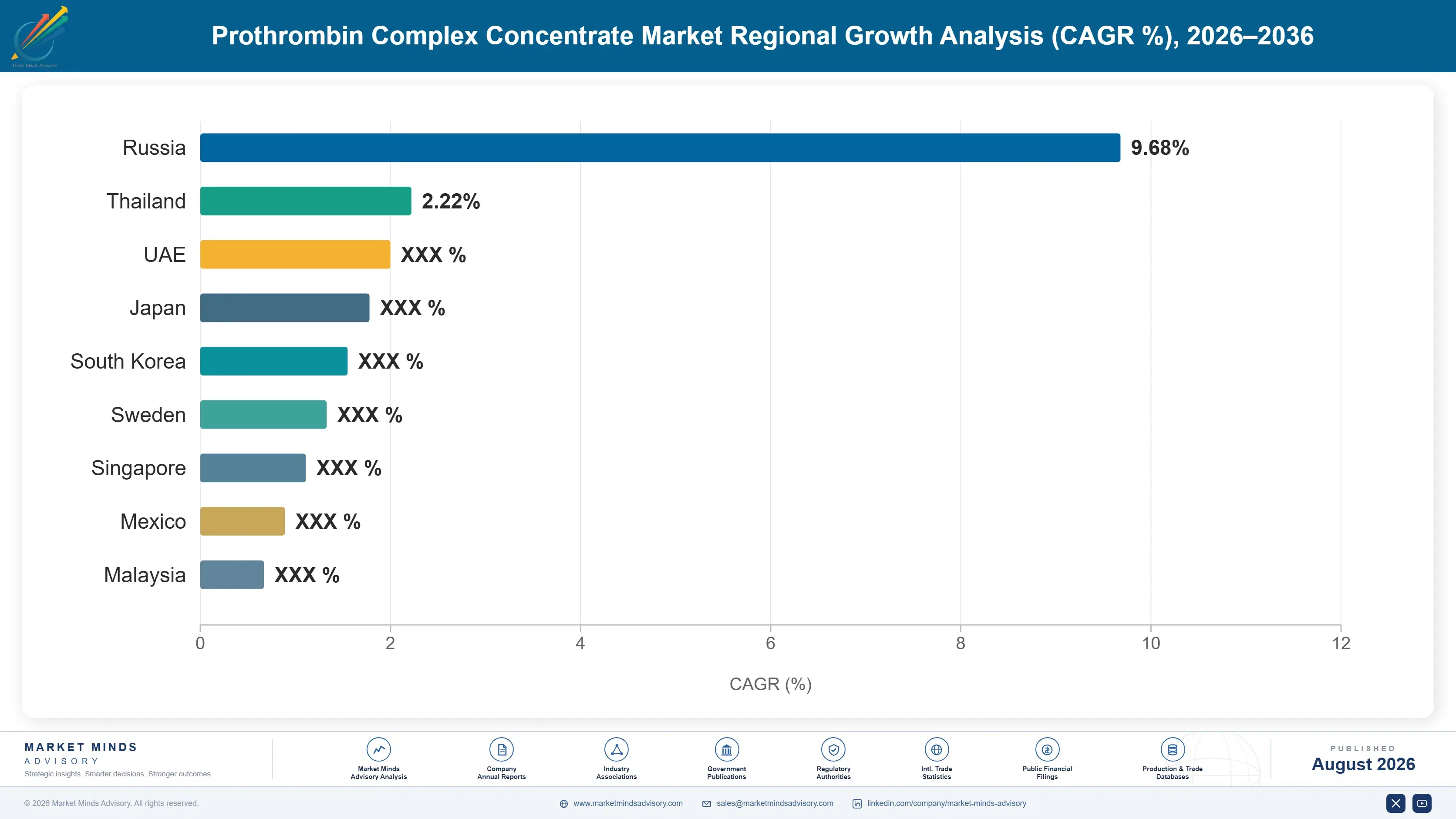
Regional intelligence for 5 additional markets available in the complete report: East Asia, South Asia and Pacific, Latin America, Middle East and Africa, Eastern Europe. Contact sales@marketmindsadvisory.com.
prothrombin-complex-concentrate-market-country-cagr-analysis-1787309214335

Competing on Availability Not Evidence

Almost half of use is off-label and cannot be promoted, supply is capped by plasma allocation, and a specific competitor holds better evidence in the growing indication. Four positions matter, and none of them involves a promotional claim. Two concern clinical measurement, one concerns supply reliability, and one concerns building the evidence nobody else will fund.

Convert Emergency Departments to Measured Administration Intervals

Lyophilised reconstitution takes around 20 minutes during which the patient continues bleeding, and emergency departments that measure door-to-administration intervals adopt liquid formulations readily while those comparing vial prices see only a premium. Getting the interval measured is therefore the entire commercial task, and it requires clinical rather than commercial engagement. Liquid formulations compound at 11.1% against a market at 7.4% wherever that measurement has actually been done. Storage location within the hospital adds further minutes that nothing clinical requires, which is worth measuring at the same time. Clinical engagement rather than commercial contact is what achieves it.
Market Impact: Removing 20 minutes from the active

Secure Long-Term Hospital Supply Against Plasma Allocation

Clotting factor production takes around 9% of fractionated plasma litres and immunoglobulin demand growth means allocation decisions favour it. In a supply-constrained product, a multi-year hospital contract is worth more than a higher spot price, because it guarantees the volume exists. Producers who contract long and honour allocation through tight periods hold accounts through the next shortage, and hospitals remember exactly which supplier failed them during the last one. Reputation through a shortage outlasts any pricing advantage. Hospitals remember which supplier failed them last time. and that memory decides the next contract more reliably than.
Market Impact: Clotting factors receiving 9% of al

Support Comparative Evidence Through Investigator-Led Studies

Specific reversal agents hold randomised evidence in factor Xa inhibitor bleeding that prothrombin complex concentrate lacks, and no company will fund a registrational trial for off-label use of a mature plasma product. Supporting investigator-led comparative work costs a fraction of a registrational programme and produces the cost-effectiveness comparison against agents priced several times above a USD 5,400 course. Guideline committees weigh that comparison heavily once somebody has actually generated it. Availability and immediacy are the arguments that actually work. Guideline committees weigh a cost-effectiveness comparison heavily once somebody has actually generated it rather than asserted it.
Market Impact: Comparing against a USD 5,400 per c

Develop Heparin-Free Product for Contraindicated Patients

Most concentrates contain heparin to control activation during manufacture, which excludes patients with heparin-induced thrombocytopenia or documented allergy entirely, and discovering that at the bedside leaves no useful alternative. Heparin-free formulations grow at 9.6% and require alternative activation control approaches that not every fractionator has developed. A minority population in an absolute clinical situation supports pricing without any comparative trial being required at all. Heparin-induced thrombocytopenia and documented allergy both exclude the standard product entirely, and the alternative has to already be in the hospital when the patient arrives. Pricing follows without any trial.
Market Impact: Heparin-free formulations compoundi

Who Controls the Margin Pool

Five fractionators hold 84% measured on prothrombin complex concentrate revenue, the basis applied throughout this section. Concentration is extreme because plasma fractionation requires collection networks, licensed fractionation capacity and regulatory approvals that take a decade and considerable capital to assemble. CSL Behring and Octapharma lead, and the challenger group is regional rather than global.
Competition operates on three dimensions. Supply reliability through plasma allocation decides who hospitals will contract with at all. Formulation capability in liquid and heparin-free product decides who serves the clinically constrained situations. And clinical relationship depth in emergency and trauma medicine decides who is present when protocols get written, which matters enormously for a product used off-label. None of the three is a promotional claim.

Two pressures are reshaping position. Specific reversal agents contest the growing off-label indication with better evidence and much higher pricing, which is a genuine threat in well-funded systems. Meanwhile Chinese and Indian fractionation capacity is expanding. Rankings will shift toward producers holding liquid formulation capability and secure plasma allocation together. Chinese and Indian fractionation capacity is expanding against domestic demand rather than for export, which changes regional supply balance more than global competitive position.
prothrombin-complex-concentrate-market-company-positioning-matrix-1787309214850

Competitive Moat and Risk Dimensions

CSL BEHRING

Moat: Plasma collection network scale

CSL Behring operates one of the largest source plasma collection networks in the world, which secures the input that ultimately caps every producer's output in this category. In a market where clotting factor production competes for around 9% of fractionated litres, controlling collection rather than buying plasma is the difference between supplying reliably and rationing during tight periods.
CSL BEHRING

Risk: Specific reversal agent competition

Agents developed specifically for factor Xa inhibitor reversal hold randomised evidence in the indication driving nearly half of current use, and guideline bodies weigh that against off-label concentrate use. A plasma product cannot easily generate comparable evidence, and in well-funded health systems the price differential matters less than the evidence hierarchy does.
OCTAPHARMA

Moat: Formulation and product breadth

Octapharma has developed unusually broad prothrombin complex concentrate formulation options and has driven much of the European clinical familiarity with four-factor product over two decades. That formulation depth positions the company well for the liquid and heparin-free variants where clinical need is absolute and where not every fractionator has the manufacturing capability.
OCTAPHARMA

Risk: Collection network dependence

Formulation capability does not create plasma. A producer without collection scale comparable to the largest players is more exposed whenever allocation tightens, and immunoglobulin demand growth means it tightens regularly. Excellent product cannot be supplied from litres somebody else has already committed to a different fraction.

Players Tracked

Prominent Players

CSL Behring
Octapharma
Grifols
Takeda Pharmaceutical
Kedrion Biopharma

Other Key Players

LFB Group
Biotest
Shanghai RAAS Blood Products
Hualan Biological Engineering
China Biologic Products
Bio Products Laboratory
Green Cross Corporation
Japan Blood Products Organization
Sanquin
Prothya Biosolutions
SK Plasma
Reliance Life Sciences
Intas Pharmaceuticals
Baxter International
Emergent BioSolutions

Recent Developments

FEBRUARY 2025

Guidelines address prothrombin complex concentrate in factor Xa inhibitor bleeding

Haemostasis and emergency medicine guidance formally discussed prothrombin complex concentrate use in factor Xa inhibitor associated bleeding alongside specific reversal agents, weighing availability and cost against comparative evidence. These were guideline decisions rather than regulatory approvals or corporate developments. Clinicians gained cover that no manufacturer could legally provide them.
Signal: Guideline discussion of off-label use give
JUNE 2025

Immunoglobulin demand growth tightens clotting factor plasma allocation

Continued immunoglobulin demand growth ahead of source plasma collection led fractionators to prioritise immunoglobulin output, constraining clotting factor availability across several markets. This reflects plasma supply conditions rather than any transaction among fractionators. Hospitals holding contracted allocation were supplied while spot purchasers were not. which shaped the.
Signal: Allocation decisions taken inside a fracti
OCTOBER 2025

Emergency departments adopt door-to-administration interval measurement

Emergency and trauma services introduced formal measurement of intervals from patient arrival to haemostatic agent administration in major bleeding, exposing reconstitution delay as a modifiable component. These were clinical quality decisions rather than commercial developments among suppliers. Storage location and reconstitution both proved larger contributors than clinical decision time.
Signal: Measuring the interval turns a formulation

Source Plasma, Fractionation and Pathogen Reduction

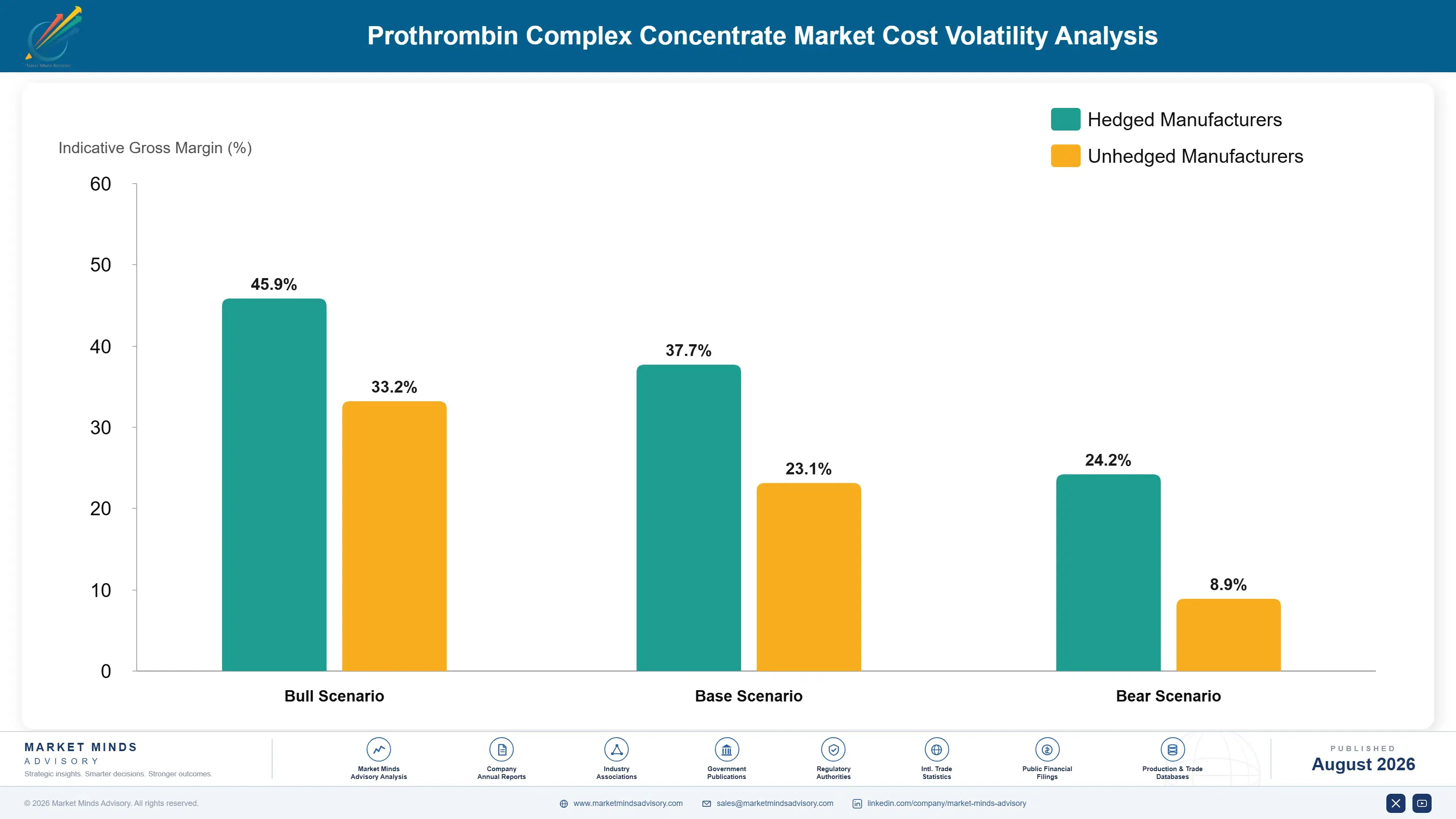
Source plasma accounts for roughly 54% of cost of goods, purchased through owned collection networks or third-party suppliers, and it is the input that ultimately caps output rather than merely costing money. Fractionation, chromatography and pathogen reduction processing add about 22%. Fill-finish, lyophilisation or liquid stabilisation, and release testing make up most of the remainder across a typical producer.
Source plasma collection costs rose substantially through 2021 and 2023 as donor remuneration and centre operating costs increased while collection volumes recovered slowly from pandemic disruption. Company annual reports across the plasma fractionators disclose the resulting cost per litre pressure and allocation decisions. World Health Organization reporting on blood and plasma availability documents the concentration of collection in a small number of countries. Collection recovered more slowly than demand did.

Exposure divides by collection ownership rather than by scale. Producers operating their own collection networks control input volume and see cost early. Those purchasing plasma compete for a constrained supply at whatever price the market sets, and lose allocation first when it tightens. Liquid formulations carry additional stabilisation and cold chain cost, recovered through pricing that the clinical argument supports.
prothrombin-complex-concentrate-market-cost-volatility-analysis-1787309215044

Invest in owned collection capacity ahead of demand

Plasma caps output regardless of demand, and collection centres take years to license and populate with regular donors. Building capacity ahead of forecast rather than in response to shortage is the only mechanism that works, because a centre commissioned during a shortage contributes nothing until well after that shortage has resolved itself. Nothing else releases volume.

Improve factor yield per litre through process refinement

Clotting factor production takes around 9% of the fractionated stream, so incremental yield improvement releases output without requiring any additional collection at all. Process refinement in chromatography and recovery steps is unglamorous work with a direct volume return, and it competes internally against projects with more visible commercial narratives attached. The return is real and unglamorous.

Honour hospital allocation commitments through tight periods

Hospitals remember precisely which supplier failed them during the last shortage, and in a supply-constrained product that memory determines the next contract more than price does. Protecting contracted allocation even when spot pricing is more attractive costs revenue in the short term and secures accounts across the cycles that follow. Reputation outlasts any single tender.

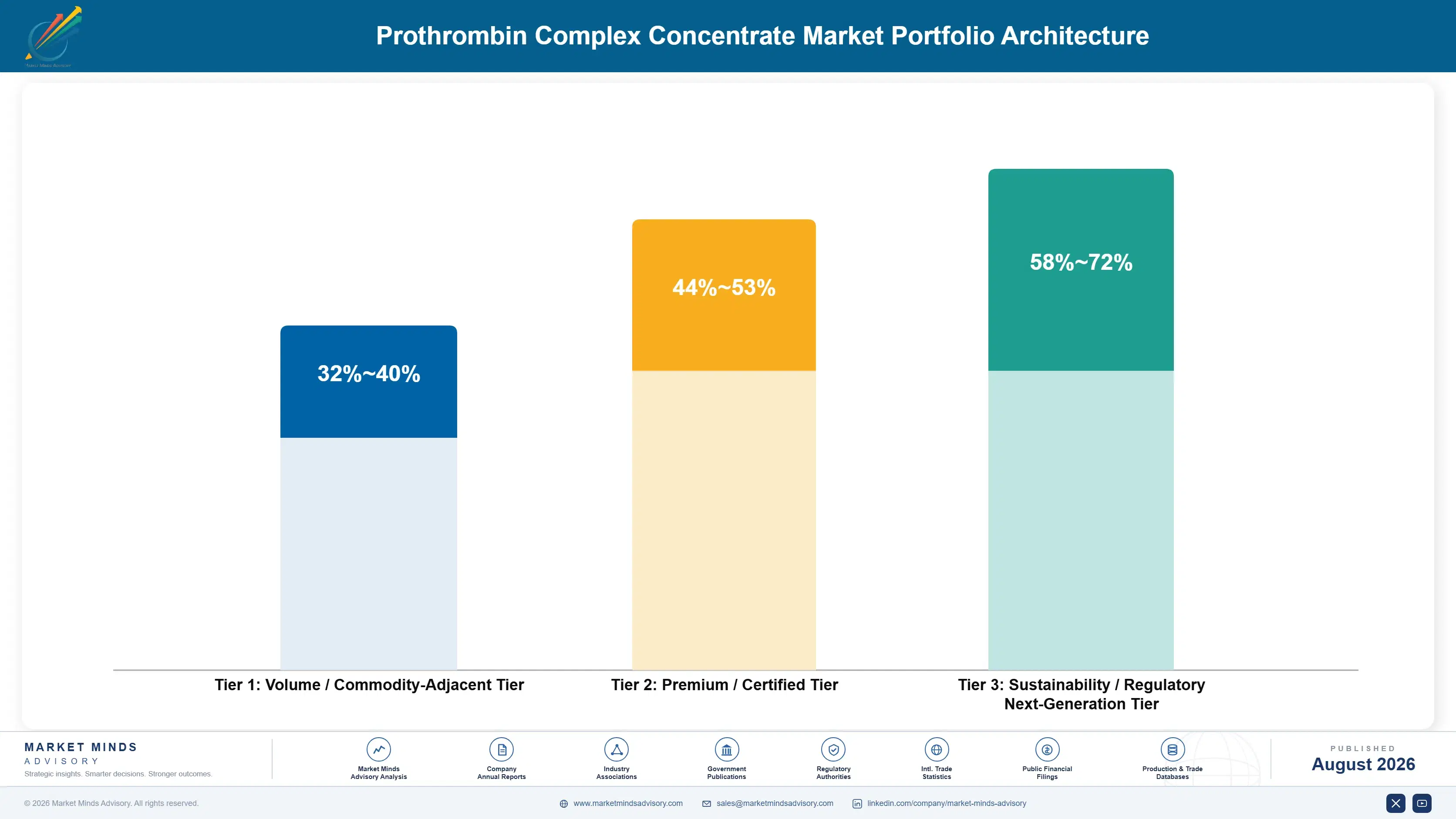
Portfolio Architecture for Margin Defence

The portfolio separates on factor content and on how quickly the product can be given. Three-factor concentrates lack factor VII and are now largely superseded where four-factor product is available. Four-factor concentrates are the clinical standard. Activated concentrates serve haemophilia with inhibitors, a quite different patient group. Heparin-free and liquid formulations address specific clinical constraints rather than general demand. Pathogen-reduced product sits ahead of demand rather t
The tension is between a shrinking label and a growing use. Four-factor concentrate for warfarin reversal is the licensed core and warfarin prescribing has fallen 58% since 2015. The growth is off-label, uncontestable by any sales organisation, and contested by a specific agent with better evidence. Producers are growing a business they cannot discuss, which is an uncomfortable place to plan from.

High-value pools concentrate where a clinical constraint is absolute. Liquid formulations for time-critical bleeding, heparin-free product for contraindicated patients, and secure supply arrangements in a rationed product all qualify, and none depends on promoting an indication. What they share is that the clinical situation admits no substitute, which is the only position in this category that does not depend on an indication nobody is allowed to discuss publicly.

Volume / Commodity-Adjacent Tier

Three-factor concentrates and standard lyophilised four-factor product supplied against hospital tenders. Clinically established, largely interchangeable between suppliers, and purchased on price and availability rather than on any differentiating product property.
Gross Margin: 34-46%

Premium / Certified Tier

Four-factor concentrates with established emergency and trauma protocol familiarity and reliable long-term hospital supply arrangements. Supply security rather than product specification qualifies the producer, and allocation reliability decides contract renewal.
Gross Margin: 48-60%

Sustainability / Regulatory / Next-Generation Tier

Liquid ready-to-use and heparin-free formulations addressing absolute clinical constraints, plus pathogen-reduced next-generation product. The wide margin range separates approved differentiated formulations from development work still carrying its stabilisation and validation cost.
Gross Margin: 52-72%
prothrombin-complex-concentrate-market-portfolio-architecture-1787309215541

High-value Sub-segments and Strategic Watch-out

Liquid Ready-to-Use Formulations

Compounding at 11.1% by removing around 20 minutes of reconstitution during which the patient continues bleeding actively. Stability engineering to hold factor activity in solution is genuinely difficult, which is why these formulations took so long to appear at all. Storage location compounds the same problem.
Gross Margin: 56-72%

Heparin-Free Formulations

Growing at 9.6% for patients who cannot receive heparin and for whom discovering the contraindication at the bedside leaves nothing else available. A minority population in an absolute situation, which supports pricing without any comparative trial. Activation control during manufacture is the technical barrier here.
Gross Margin: 54-66%

Standard Four-Factor Concentrates

The clinical core at 6.4%, licensed for warfarin reversal in a market where warfarin prescribing has fallen 58% since 2015. Off-label use sustains the volume and no manufacturer can say anything about it publicly. Volume is sustained entirely by an application that nobody may promote.
Gross Margin: 48-60%

Pathogen-Reduced Next-Generation Product

The strategic watch-out. Enhanced viral and prion reduction addresses a residual risk that has not materialised in decades of use, and regulators may eventually require it whether or not clinicians ask for it. Regulators may eventually require it whether or not any clinician ever asks.
Gross Margin: 44-70%

Stocked for an Uncertain Emergency

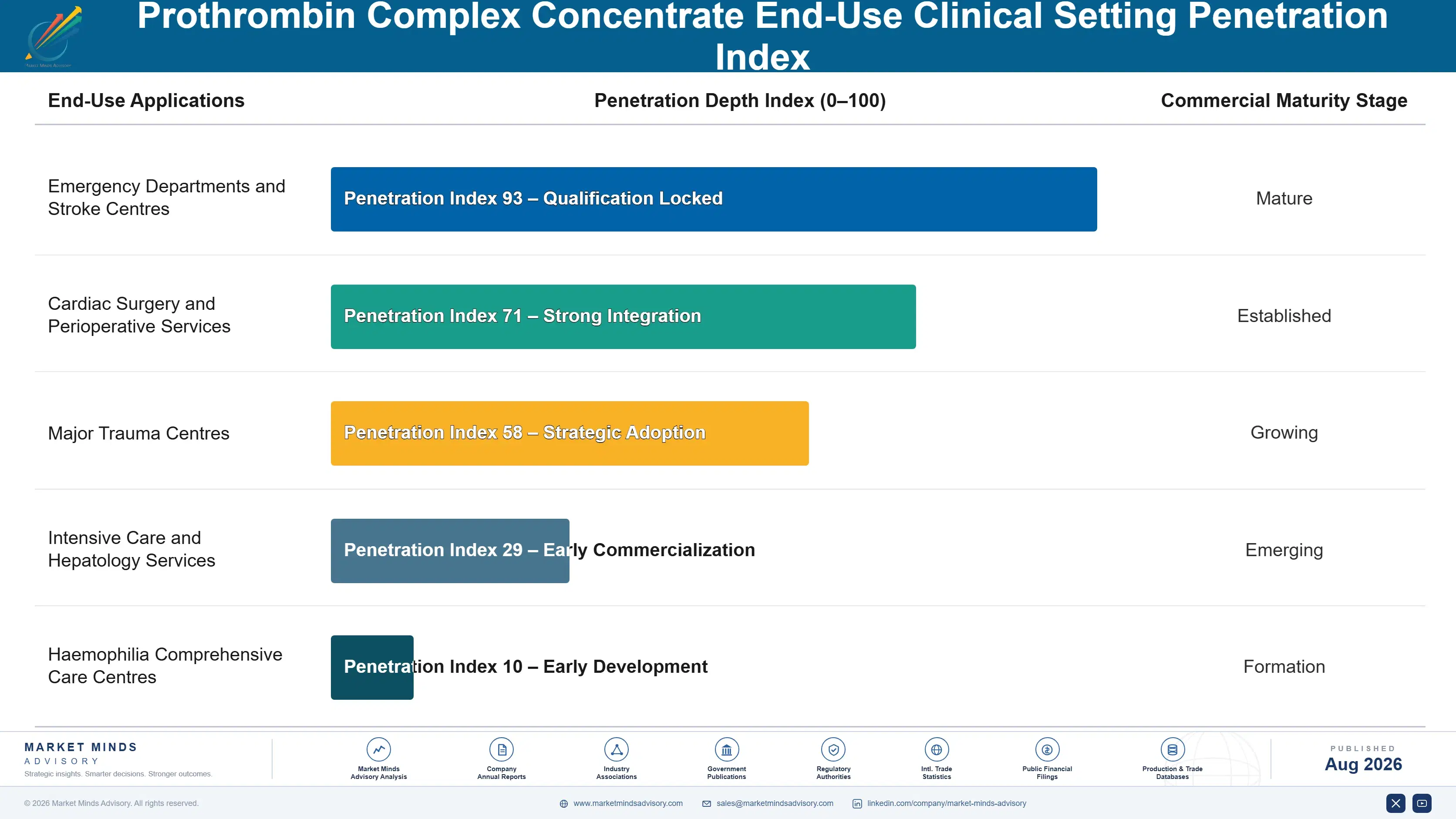
Revenue arrives through stocking rather than through consumption forecasting. A hospital holds concentrate against major bleeding that may or may not present, so purchasing tracks protocol inclusion and shelf life expiry as much as actual administration. That produces steady replacement demand independent of case volume, and it makes formulary inclusion the single decision that matters, because a product not stocked cannot be used when a patient arrives.
Depth varies by service mix. Major trauma centres and neurosurgical units buy deepest, holding multiple doses against a case that must be treated within minutes. Emergency departments in anticoagulant-heavy populations buy steadily. Cardiac surgery units use concentrate for bypass-related coagulopathy. Haemophilia centres purchase activated product for inhibitor patients, which is an entirely separate clinical relationship and purchasing decision.

The deciding party is a committee rather than a prescriber. Formulary and transfusion committees decide which concentrate is stocked, weighing supply reliability, cost and protocol fit, and the emergency physician then uses whatever is in the fridge. That structure rewards supply security and protocol presence over any clinical claim, which suits a product whose main growth application cannot be promoted.
prothrombin-complex-concentrate-market-end-use-penetration-index-1787309216029

Where Fractionators Hold Position

These are among the four positions where our research anticipates prominent divergence between winners and laggards over the coming forecast period. Each is grounded in the demand model, the regulatory perimeter, and the announced capacity pipeline.
01 / ADMINISTRATION INTERVAL MEASUREMENT

The patient bleeds through the twenty minutes of reconstitution

Lyophilised concentrate requires around 20 minutes to prepare, and in intracranial or trauma haemorrhage that interval converts directly into permanent deficit or mortality. Emergency departments that measure door-to-administration intervals adopt liquid formulations without argument, and those comparing vial prices instead see only an unexplained premium. Getting the interval measured is therefore the whole commercial task, and it requires clinical engagement rather than any promotional activity, and storage location adds further minutes worth measuring at the same time, and storage location within the hospital adds.
02 / ALLOCATION RELIABILITY REPUTATION

Hospitals remember who failed them in the last shortage

Clotting factor production takes around 9% of fractionated plasma litres, and immunoglobulin demand growth means allocation tightens regularly rather than exceptionally. In a supply-constrained product, a multi-year contract honoured through a tight period is worth considerably more than any spot price advantage could be. Producers who protect contracted allocation when spot pricing is more attractive lose revenue briefly and hold accounts across every cycle that follows, which is why supply reliability outranks price in every serious tender here, and that reliability compounds across successive.
03 / COMPARATIVE EVIDENCE FUNDING

Nobody will run a trial for an off-label plasma product

Specific reversal agents hold randomised evidence in factor Xa inhibitor bleeding that prothrombin complex concentrate lacks, and no company will fund a registrational programme for off-label use of a mature plasma product. Supporting investigator-led comparative work costs a small fraction of that and produces the cost-effectiveness comparison against agents priced well above a USD 5,400 concentrate course. Guideline committees weigh it heavily once somebody generates it, and until then availability and cost are the only arguments available, and nobody has yet been willing to.
04 / ABSOLUTE CONSTRAINT FORMULATIONS

A contraindication discovered at the bedside leaves nothing

Most concentrates contain heparin to control activation during manufacture, which excludes patients with heparin-induced thrombocytopenia or documented allergy from receiving the standard product at all. Discovering that contraindication at the bedside during major bleeding leaves no useful alternative available within any relevant timeframe. Heparin-free formulations grow at 9.6% and require activation control approaches not every fractionator has developed, which supports pricing with no comparative trial needed, and the product has to already be stocked when the patient arrives, and stocking it in advance is.

Engagement Snapshot From the Field

A live engagement with an industry participant carrying material or product regulatory and market exposure ahead of a defining policy shift, showing how our research translates into a defensible multi-year portfolio strategy.
MARKET MINDS ADVISORY · CLIENT ENGAGEMENT SUMMARY
Prothrombin Complex Concentrate Producer Strategic Portfolio Review and Transition Roadmap 2026·Investment Scenario on Prothrombin Complex Concentrate Exposure Evaluation 2025-26
CLIENT PROFILE
A regional trauma network comprising one major trauma centre and seven receiving hospitals, managing roughly 2,600 major haemorrhage activations annually across trauma and anticoagulant-associated bleeding (client-reported, unverified by MMA). Prothrombin complex concentrate was stocked at all eight sites in lyophilised form, purchased on tendered price with no formulation alternatives evaluated. Administration intervals had never been measured at any site.
STRATEGIC CHALLENGE
Mortality in anticoagulant-associated intracranial haemorrhage sat above comparable networks and clinical leadership suspected delays somewhere in the pathway. Attention had focused on imaging turnaround and on transfer times between hospitals. Nobody had measured the interval from the decision to reverse anticoagulation to the concentrate actually entering the patient. Reconstitution had never been considered a modifiable variable.
MMA APPROACH
MMA timed each step from reversal decision to administration across 180 consecutive major haemorrhage activations at all eight sites, separating decision, retrieval, reconstitution and infusion intervals. Results were compared against outcome and against published benchmarks for time-critical haemostatic intervention. Storage location within each hospital was recorded alongside the timing data to isolate retrieval delay from reconstitution delay.
KEY FINDINGS
  1. Median interval from reversal decision to administration was 41 minutes, of which reconstitution accounted for 22 minutes and product retrieval from pharmacy a further 9 minutes across the network.
  2. Imaging turnaround and inter-hospital transfer times were within benchmark at every site, which eliminated the explanations clinical leadership had been investigating for over a year.
  3. Two receiving hospitals stored concentrate in central pharmacy rather than in the emergency department, adding a median 14 minutes that no clinical requirement justified at all.
  4. Outcomes in the fastest quartile of administration intervals were materially better than the slowest, and the difference tracked reconstitution and retrieval time rather than any clinical variable.
CLIENT PROFILE
A regional trauma network comprising one major trauma centre and seven receiving hospitals, managing roughly 2,600 major haemorrhage activations annually across trauma and anticoagulant-associated bleeding (client-reported, unverified by MMA). Prothrombin complex concentrate was stocked at all eight sites in lyophilised form, purchased on tendered price with no formulation alternatives evaluated. Administration intervals had never been measured at any site.
STRATEGIC CHALLENGE
Mortality in anticoagulant-associated intracranial haemorrhage sat above comparable networks and clinical leadership suspected delays somewhere in the pathway. Attention had focused on imaging turnaround and on transfer times between hospitals. Nobody had measured the interval from the decision to reverse anticoagulation to the concentrate actually entering the patient. Reconstitution had never been considered a modifiable variable.
MMA APPROACH
MMA timed each step from reversal decision to administration across 180 consecutive major haemorrhage activations at all eight sites, separating decision, retrieval, reconstitution and infusion intervals. Results were compared against outcome and against published benchmarks for time-critical haemostatic intervention. Storage location within each hospital was recorded alongside the timing data to isolate retrieval delay from reconstitution delay.
KEY FINDINGS
  1. Median interval from reversal decision to administration was 41 minutes, of which reconstitution accounted for 22 minutes and product retrieval from pharmacy a further 9 minutes across the network.
  2. Imaging turnaround and inter-hospital transfer times were within benchmark at every site, which eliminated the explanations clinical leadership had been investigating for over a year.
  3. Two receiving hospitals stored concentrate in central pharmacy rather than in the emergency department, adding a median 14 minutes that no clinical requirement justified at all.
  4. Outcomes in the fastest quartile of administration intervals were materially better than the slowest, and the difference tracked reconstitution and retrieval time rather than any clinical variable.
RECOMMENDED STRATEGY
Phase 1: Phase 1 (months 1 to 3): Relocate concentrate stock into emergency department and resuscitation areas at all eight network sites. Phase 2: Phase 2 (months 3 to 9): Trial liquid ready-to-use formulation at the major trauma centre and measure the interval change against baseline. Phase 3: Phase 3 (months 9 to 18): Extend the faster formulation across receiving hospitals where the measured interval benefit justifies the price premium.
OUTCOME
Median decision-to-administration interval fell to 19 minutes across the network within eight months, before any formulation change had been completed (client-reported, unverified by MMA). Liquid formulation adoption at the major trauma centre reduced the interval further to 11 minutes (client-reported, unverified by MMA). Administration interval is now a standing network quality measure reported alongside mortality outcomes.

Frequently Asked Questions

Foundational context covering the market sizes, CAGR, scope, country, region and competition that inform every finding below. This section is provided to cover basics and most often pre-purchase conversations, answered from the MMA Primary Research Dataset.

What is the current size of the Prothrombin Complex Concentrate Market?

The global market was worth USD 1.55 billion in 2025, reaching USD 1.66 billion in 2026. North America holds the largest regional share at 32% of demand.

How large will the Prothrombin Complex Concentrate Market be by 2036?

MMA forecasts USD 3.4 billion by 2036, an expansion multiple of 2.04 times the 2026 base. That represents roughly USD 1.74 billion of incremental value.

What is the CAGR for the Prothrombin Complex Concentrate Market 2026 to 2036?

The base case compounds at 7.4% annually, with a bull case of 8.7% and a bear case of 6.1%. Historical growth from 2020 to 2025 ran at 6.2%.

Which segment is growing fastest?

Liquid ready-to-use formulations compound at 11.1%, exactly 1.50 times the market rate. They remove roughly 20 minutes of reconstitution during which a patient continues bleeding.

Who are the major companies in the Prothrombin Complex Concentrate Market?

CSL Behring, Octapharma, Grifols, Takeda Pharmaceutical and Kedrion Biopharma hold a combined 84% of the market. Plasma collection networks and licensed fractionation capacity sustain that extreme concentration.

Which country is growing fastest?

India compounds at 9.8%, ahead of every other national market. Rising anticoagulant prescribing and very large trauma volumes together drive that demand growth steadily upward.

Report Segmentation Architecture

The full report scope spans multiple orthogonal segmentation dimensions, with cross-tabulated demand data provided for each dimension pair. Coverage extends further to regional breakdowns, trend trajectories, and the competitive detail needed to support segment-level decision-making.

By Product Configuration and Formulation

  • Four-Factor Concentrates
  • Three-Factor Concentrates
  • Activated Concentrates
  • Heparin-Free Formulations
  • Liquid Ready-to-Use Formulations
  • Pathogen-Reduced Next-Generation Formulations

By End-Use Industry

  • Emergency and Acute Medicine
  • Major Trauma and Resuscitation Services
  • Cardiac and Vascular Surgery
  • Neurosurgery and Neurocritical Care
  • Haemophilia and Bleeding Disorder Centres

By Commercial Dimension

  • Hospital Formulary and Tender Supply
  • National Blood Service Arrangements
  • Long-Term Allocation Contracts
  • Distributor and Import Channel

By Region

  • North America
  • Western Europe
  • East Asia
  • South Asia and Pacific
  • Latin America
  • Middle East and Africa
  • Eastern Europe

Scope, Methodology, and Coverage

Every figure in this report is reproducible from documented input assumptions. The scope below maps the historical period, the forecast horizon, the segmentation dimensions, and the countries covered, alongside the underlying primary and qualitative methodology.
Historical Period
2020 to 2025
Forecast Period
2026 to 2036
Base Year
2025 (USD billions; MMA Primary Research Dataset, August 2026)
Market Definition
The market covers plasma-derived prothrombin complex concentrates used for urgent reversal of vitamin K antagonist anticoagulation and for acquired coagulation factor deficiency, spanning four-factor concentrates, three-factor concentrates, activated concentrates, heparin-free formulations, liquid ready-to-use formulations, and pathogen-reduced next-generation formulations. Specific reversal agents including andexanet alfa and idarucizumab, fresh frozen plasma and cryoprecipitate, recombinant factor concentrates, fibrinogen concentrate, tranexamic acid and other antifibrinolytics, vitamin K preparations, and platelet products are excluded. Sizing is measured at manufacturer revenue in current prices.
Quantitative Units
USD billions (current prices); international units of factor IX activity, doses administered and administration intervals where applicable
Segmentation Dimensions
By Product Configuration and Formulation; By End-Use Industry; By Commercial Dimension; By Region
Regions Covered
North America, Western Europe, East Asia, South Asia and Pacific, Latin America, Middle East and Africa, Eastern Europe
Countries Covered
USA, Germany, China, Japan, France, UK, Italy, Spain, Canada, South Korea, Taiwan, India, Australia, Brazil, Mexico, Argentina, Colombia, Netherlands, Belgium, Austria, Switzerland, Sweden, Turkey, Egypt, Saudi Arabia, UAE, South Africa, Poland, Czech Republic, Hungary, and additional markets relevant to this sector
Key Companies Profiled
CSL Behring, Octapharma, Grifols, Takeda Pharmaceutical, Kedrion Biopharma, LFB Group, Biotest, Shanghai RAAS Blood Products, Hualan Biological Engineering, China Biologic Products, Bio Products Laboratory, Green Cross Corporation, Japan Blood Products Organization, Sanquin, Prothya Biosolutions, SK Plasma, Reliance Life Sciences, Intas Pharmaceuticals, Baxter International, Emergent BioSolutions
Quantitative Methodology
Primary survey, n=3,800 respondents, Q4 2025, six countries; demand-side model with trade association cross-validation
Qualitative Methodology
47 expert interviews, Q4 2025; applied to validate demand model assumptions, identify emerging dynamics, and assess competitive positioning
Report Format
PDF and XLSX data workbook (Word format preview document)
Publisher
Market Minds Advisory
Report Code
MMA-2026-HLT-948
Published
August 2026
Contact
sales@marketmindsadvisory.com | www.marketmindsadvisory.com

Purchase the full Prothrombin Complex Concentrate Market Report (2026 to 2036).

The full report sizes prothrombin complex concentrate across six product configurations, three commercial dimensions and seven regions, with annual forecasts to 2036 under base, bull and bear scenarios. Off-label use is quantified by indication and country, which is where nearly half of current volume sits and where no manufacturer can promote. Plasma allocation to clotting factor production is modelled against immunoglobulin demand growth. Administration intervals are measured across formulation types and storage arrangements. Twenty fractionators and producers are profiled on a consistent prothrombin complex concentrate revenue basis.
Off-label use quantified by indication and by country
Plasma allocation modelled against immunoglobulin demand growth
Administration intervals measured across formulation and storage arrangements
Specific reversal agent competition assessed by health system funding
Warfarin prescribing decline tracked against reversal volume by market
Heparin contraindication prevalence estimated across reversal populations

Built For The People Who Decide

From boardroom strategy to bench-side execution, this report is read cover-to-cover by leaders shaping the next decade of their industry, turning demand scenarios, market dynamics and valuation benchmarks into decisions.
CXOs/ Presidents/ VPs/ Managers
M&A and Corporate Development
Strategy Teams and R&D Heads
Procurement and Product Directors
Regulatory and Compliance Leaders
Investor Relations and Equity Analysts