Market Minds Advisory
Prosthetic Heart Valve Market

Prosthetic Heart Valve Market: Transcatheter Expansion and Mitral Frontier Growth

Structural heart programs are shifting volume from open surgical valve replacement toward transcatheter aortic and mitral platforms as clinical trial data extends eligibility to lower-risk, younger patients worldwide across every major healthcare system.

Lead Analyst

Alice Ballenger

Published

September 2026

Make Smarter Decisions with Customized Research Insights

Request a free sample report and evaluate market opportunities, growth trends, and competitive dynamics relevant to your business needs.

2025 MARKET VALUE$7.8BMarket Size 2025
2036 FORECAST VALUE$19.1BBase Case , 2026 to 2036
CAGR 2026 TO 20368.5 %Bull 9.7% / Bear 7.3%
INCREMENTAL OPPORTUNITY$10.7BNet 10- year value creation
EXPANSION MULTIPLE2.26x2036 value over 2026 base
Strategic Levers
M&A Pipeline
Regional Outlook
Country Rankings
Competitive Intelligence
Segmental Deep-dive
Call-Us : 91 93563 13602

Executive Snapshot and Market Trajectory

Structural heart programs are shifting volume from open surgical replacement toward transcatheter aortic and mitral platforms faster than most device makers projected, as expanded trial data now supports treating lower-risk and younger patients who once would have waited many years for surgery to become medically necessary.
Transcatheter aortic valve replacement remains the dominant revenue driver, while transcatheter mitral repair and replacement devices post the fastest unit growth as second-generation platforms clear regulatory hurdles that stalled earlier iterations for years. Demand concentrates across North America, Western Europe, and East Asia, with India posting the fastest national growth as cardiac catheterization lab infrastructure and reimbursement pathways both expand from a comparatively low current base nationwide.
Five manufacturers hold 78% of global revenue on a consistent implant unit basis, a concentration reflecting the clinical trial cost and regulatory approval timeline few smaller competitors can sustain across a full valve platform portfolio. Rising raw material costs and tightening post-market surveillance requirements are pushing smaller regional manufacturers to specialize narrowly in single valve types rather than compete broadly across the full structural heart portfolio, ceding ground to larger, better-capitalized rivals.
Market Definition
The prosthetic heart valve market covers surgical mechanical and bioprosthetic valves, transcatheter aortic and mitral valve devices, annuloplasty repair rings, and homograft and allograft valves implanted to replace or repair diseased native heart valves. It excludes ventricular assist devices, pacemakers and other cardiac rhythm management implants, and diagnostic cardiac catheterization equipment not used for valve implantation.
Base Year Value
$7.8B in 2025 (MMA Primary Research Dataset, August 2026)
Forecast Period
2026 to 2036, eleven discrete annual values
CAGR
8.5% base case. Bull 9.7%. Bear 7.3%.
Fastest Growth Segment
Transcatheter Mitral Valve Repair and Replacement Devices: 14.0% CAGR
Fastest Growth Country
India: 11.0% CAGR
Fastest Growth Region
South Asia and Pacific: 10.5% CAGR
Largest Region
North America: 32% of 2025 global value
Market Leaders
Edwards Lifesciences Corporation, Medtronic plc, Abbott Laboratories, Boston Scientific Corporation, LivaNova PLC. Source: MMA Analysis based on company annual reports.
Primary Survey
n=3,800 procurement and R&D decision-makers, Q4 2025, six countries
Methodology
Demand-side build-up, cross-validated against public data, 47 expert interviews

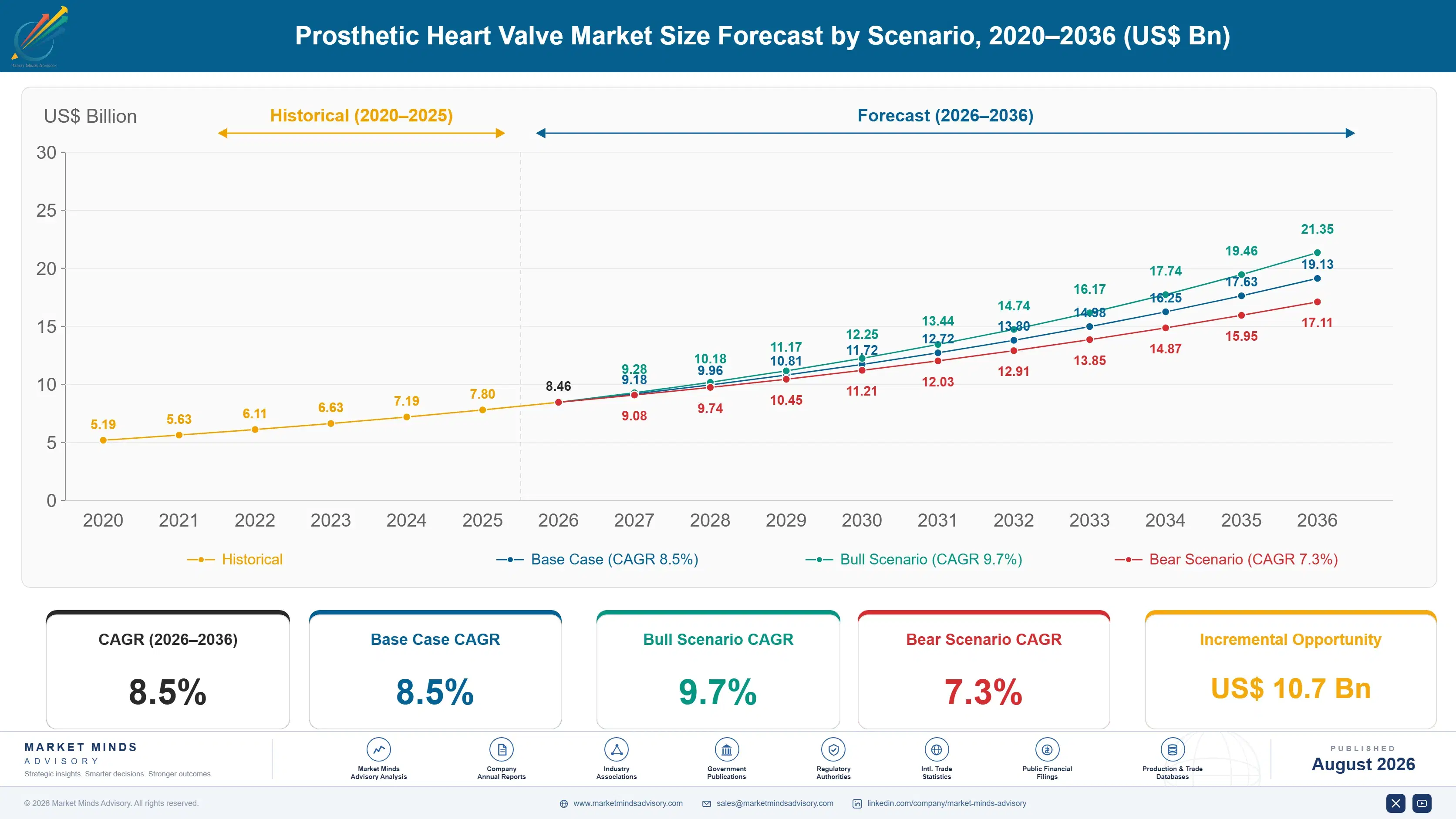
Prosthetic Heart Valve Market Forecast Scenarios

prosthetic-heart-valve-market-size-forecast-scenario-1787309553475
The market grew at an estimated 7.5% annually between 2020 and 2025, a period shaped by pandemic-delayed elective valve procedures followed by accelerating transcatheter adoption that lifted implant volume meaningfully across the back half of that five-year window as hospitals cleared deferred procedure backlogs and reopened structural heart programs at full procedural capacity nationwide and internationally each year.
The base case assumes 8.5% annual growth through 2036, resting on three mechanisms: continued transcatheter aortic valve replacement expansion into lower-risk and younger patient populations following favorable trial outcomes nationwide, second-generation transcatheter mitral devices reaching commercial scale as regulatory approvals accumulate across major markets, and cardiac catheterization lab capacity expanding across South Asian and East Asian markets from a comparatively low current base rather than competing purely on surgical volume alone.
The bull case centers on faster-than-expected transcatheter mitral device approvals opening access to a previously underserved patient population well above trend across multiple major markets and healthcare systems. The bear case centers on reimbursement policy tightening and raw material cost volatility squeezing smaller manufacturers out of the market before adoption growth can offset rising development and input costs.

Transcatheter Migration and the Mitral Frontier

The prosthetic heart valve market sits at the intersection of two converging forces: the multi-decade migration from open surgical valve replacement toward transcatheter delivery, and the emergence of mitral and tricuspid transcatheter platforms tackling anatomy surgeons long considered too complex for catheter-based repair. Manufacturers that invested early in transcatheter frame and delivery system technology are capturing outsized share of this migration, while surgical-only portfolios watch
MARKET CONCENTRATIONCR5 78%global revenue share held by the five leading manufacturers
AVERAGE SELLING PRICE$28,500/unitblended wholesale price for a standard transcatheter valve
TRANSCATHETER PROCEDURE SHARE64% of implantsshare of valve implants delivered by transcatheter route
FIVE-YEAR DURABILITY RATE94%share of implanted valves free of reintervention at five years
CLINICAL TRIAL COST SHARE22% of R&D spendshare of manufacturer research spend tied to trial programs
FRAME ALLOY COST SHARE34% of COGSshare of production cost represented by frame alloy input
The industry's economics hinge on clinical trial cost and regulatory approval timelines that few competitors outside the five largest manufacturers can sustain across a full valve platform, a capital and time barrier that keeps this market considerably more concentrated than most other implantable device categories. This concentration persists even as newer entrants from Asia chip away at specific niches like bicuspid anatomy or valve-in-valve reintervention.
The next decade will be shaped by transcatheter mitral and tricuspid device approvals opening access for previously untreated patient populations, expanding cardiac catheterization lab infrastructure across South Asia and East Asia lifting procedure volume from a comparatively low current base, and tightening post-market surveillance requirements raising the bar for smaller manufacturers competing on cost alone.
"The valve program still routing every patient to open surgery in 2029 will be losing referrals to the hospital down the road offering a transcatheter option. Structural heart has stopped being a surgical subspecialty and become an interventional cardiology growth engine."
Director, Cardiovascular Devices and Structural Heart Practice · MMA Cardiovascu

Market Trends

Transcatheter Aortic Valve Replacement Extends Into Lower-Risk Patients

Multi-year randomized trial data comparing transcatheter aortic valve replacement against surgical replacement in low-risk patients has consistently shown comparable or superior outcomes, prompting major cardiology societies to expand treatment guidelines beyond the elderly, high-surgical-risk population the procedure originally targeted a decade ago. Heart teams at leading centers now default to transcatheter approaches for the large majority of aortic stenosis cases, reserving open surgery for anatomy genuinely unsuited to catheter delivery. Manufacturers with the broadest valve size range and the deepest long-term durability data are capturing disproportionate share of this expanding lower-risk population as referring cardiologists standardize around proven platforms.
Market Impact: Adds 94% five-year durability rate
Second-Generation Transcatheter Mitral Devices Reach Commercial Scale

Transcatheter mitral valve repair and replacement devices, held back for years by the mitral valve's complex saddle-shaped anatomy and the difficulty of anchoring a device without a rigid annulus to seat against, are reaching commercial scale as second-generation platforms clear regulatory approval in major markets and healthcare systems worldwide. Early commercial experience shows meaningfully improved procedural success rates compared to first-generation devices, giving structural heart programs confidence to expand mitral transcatheter volume beyond the narrow compassionate-use populations that characterized the segment's first several years on the market and its early adoption curve.
Market Impact: Adds 11.0% CAGR in India specifical

Market Opportunities and Growth Drivers

Aging Population Expands the Treatable Aortic Stenosis Pool

Calcific aortic stenosis prevalence rises sharply with age, and the aging population across North America, Western Europe, and East Asia is expanding the pool of patients eligible for valve replacement faster than national statistical office demographic projections anticipated just five years ago across most developed healthcare systems. Each additional year of life expectancy in a developed healthcare market translates into meaningful incremental valve replacement volume, and manufacturers with established referral relationships across the largest cardiology networks are capturing disproportionate share of this steadily expanding patient population as diagnosis rates improve alongside broader echocardiography screening access.
Market Impact: Adds 22% clinical trial cost share

India's Cardiac Catheterization Infrastructure Expands From a Low Base

India's rapidly expanding cardiac catheterization laboratory infrastructure and broadening private and government insurance reimbursement pathways are driving transcatheter valve adoption higher from a comparatively low current base, a shift documented in Ministry of Commerce India medical device sector reporting across major metropolitan hospital networks and their surrounding regional referral catchments nationwide. Each new cath lab commissioned represents meaningful incremental structural heart procedure capacity, and manufacturers establishing early training and proctoring relationships with India's leading interventional cardiology centers are securing durable first-mover positions ahead of global competitors still evaluating market entry.
Market Impact: Raises entry costs by 35%

Market Restraints and Challenges

Clinical Trial Costs Compress Smaller Manufacturer Margins

Randomized controlled trials required for transcatheter valve regulatory approval routinely enroll thousands of patients across multi-year follow-up periods, a capital commitment that disproportionately affects smaller manufacturers without the balance sheet depth or diversified device portfolio revenue that larger competitors use to fund trial programs. Smaller manufacturers often cannot sustain the multi-year capital outlay required before first commercial revenue, risking either acquisition by larger competitors or exit from the category entirely before reaching approval. Manufacturers are increasingly pursuing staged regulatory pathways and narrower initial indications to reduce trial cost exposure and speed approval timelines.
Market Impact: Adds 64% transcatheter procedure sh

Post-Market Surveillance Requirements Raise Barriers for Smaller Producers

Tightening post-market surveillance and long-term durability reporting requirements demand ongoing registry participation and data infrastructure investment that smaller regional manufacturers often struggle to justify given their limited implant volume relative to the compliance cost involved across multiple regulatory jurisdictions and their varying reporting frameworks worldwide. This dynamic is steadily consolidating the industry toward manufacturers large enough to amortize surveillance infrastructure across substantial implant volume, squeezing out smaller producers unable to sustain multi-decade durability tracking commitments. Some smaller manufacturers are responding by specializing narrowly in valve types carrying lower surveillance burden.
Market Impact: Adds 14.0% segment CAGR
4 additional market trends, 3 additional growth drivers, and 3 additional restraints and challenges are covered in the full report. Contact sales@marketmindsadvisory.com to access the complete intelligence.

Segment CAGR and Growth Architecture

The market segments by valve technology and delivery method, the classification that determines procedural approach, regulatory pathway, and clinical adoption curve far more than valve material or target anatomy alone, shaping nearly every manufacturer's clinical trial roadmap, physician training investment, and long-term commercial priorities across the industry and its largest global hospital system accounts.
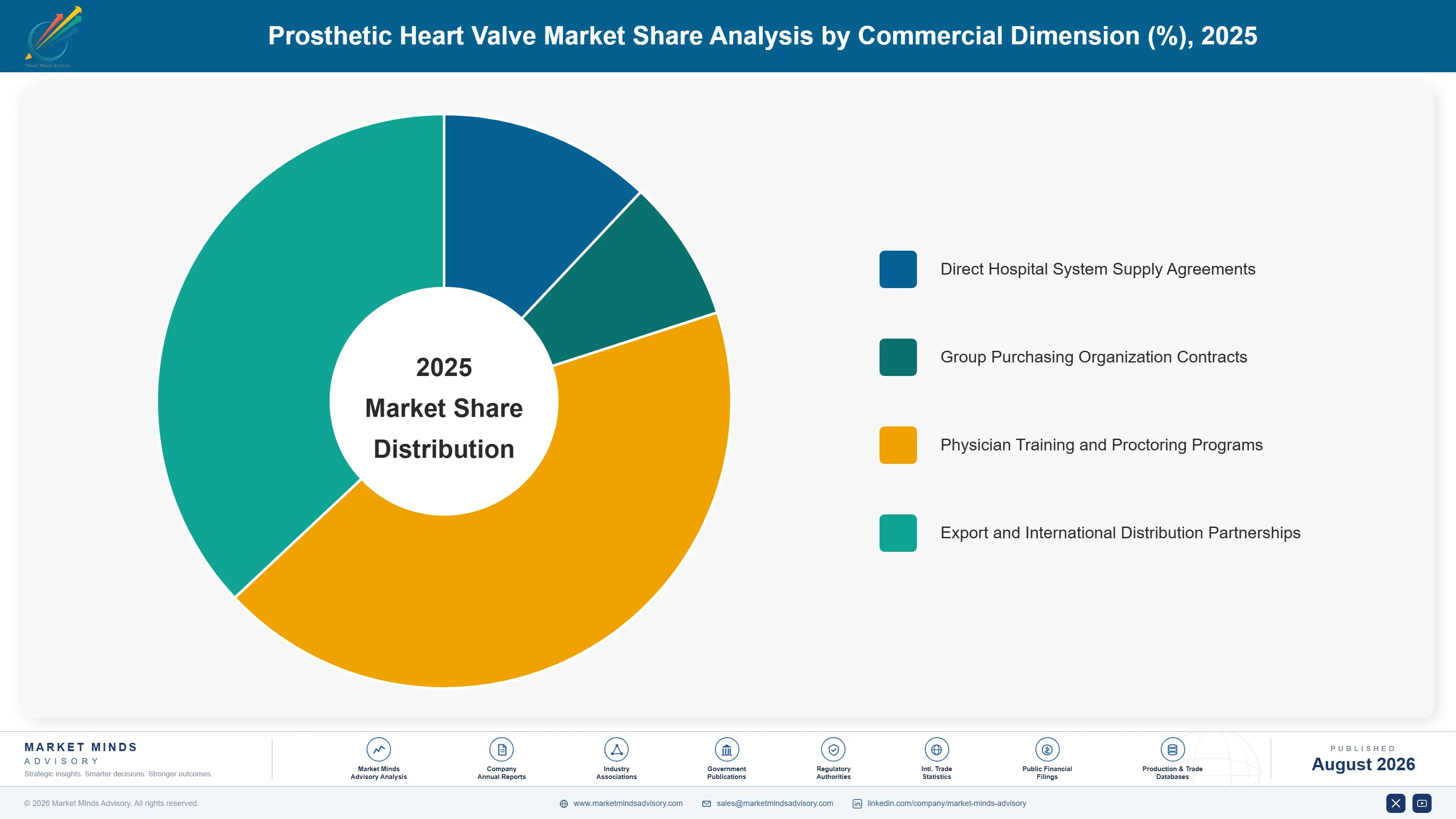
prosthetic-heart-valve-market-market-share-analysis-1787309554006

Transcatheter Mitral Valve Repair and Replacement Devices

Transcatheter mitral valve repair and replacement devices, delivered via catheter rather than open surgery to address regurgitation or stenosis of the mitral valve, are the fastest-growing segment as second-generation platforms clear regulatory approval and structural heart programs expand mitral procedure volume beyond narrow early-access populations. Manufacturers holding approved mitral platforms are capturing disproportionate volume growth as heart teams gain procedural experience and confidence in outcomes that increasingly rival surgical repair. The segment carries meaningfully higher average selling prices than most other valve categories, rewarding manufacturers that invested early in the multi-year clinical trial programs required to demonstrate safety across the mitral valve's genuinely difficult anatomy and variable disease presentations across patient populations.
CAGR 14.0%

Transcatheter Aortic Valve Replacement (TAVR) Devices

Transcatheter aortic valve replacement devices, now the dominant treatment approach for calcific aortic stenosis across most risk categories, continue growing faster than the broader market as guideline expansion into lower-risk and younger patients broadens the eligible treatment population well beyond the procedure's original high-risk elderly indication. The segment benefits from more than a decade of accumulated long-term durability data that increasingly rivals surgical valve performance, giving manufacturers with the longest track record a meaningful credibility advantage over newer market entrants. Established TAVR suppliers with broad valve size ranges hold considerable pricing power, since switching platforms requires extensive physician retraining most hospital systems prefer to avoid absorbing across their interventional teams.
CAGR 11.0%
Full segment breakdown across 6 segments available in the complete report.

Regional Architecture and Country Demand Map

Demand concentrates across North America, Western Europe, and East Asia, the three regions with the deepest structural heart procedural infrastructure and the broadest transcatheter reimbursement coverage, while South Asia and Pacific posts the fastest regional growth from a comparatively lower current procedural volume base overall.

North America

North America's prosthetic heart valve demand concentrates in the United States, where transcatheter aortic valve replacement first achieved regulatory approval and where the largest concentration of high-volume structural heart centers continues driving procedure growth across both academic and community hospital systems nationwide and across every major metropolitan referral network. Broad Medicare and commercial insurance reimbursement coverage for transcatheter procedures has removed most of the financial barriers that constrain adoption in less developed reimbursement environments, letting eligible patients access treatment faster than in almost any other market. Canada contributes a smaller but steady volume base, tracking similar clinical adoption trends with a modest lag behind the larger US market's guideline expansion timeline and hospital capital investment cycle.
Share: 32% | CAGR: 8.5% (2026 to 2036)

Western Europe

Western Europe's demand is anchored by Germany, France, and the United Kingdom, the three countries with the largest concentration of high-volume structural heart centers and the deepest interventional cardiology training infrastructure across the continent and its surrounding referral networks and teaching hospitals. National health system reimbursement frameworks vary considerably by country, creating a patchwork of adoption timelines that manufacturers must navigate market by market rather than treating the region as a single homogeneous buyer group with uniform procedural standards. Growth trails North America modestly as several national health systems apply more conservative technology assessment processes before expanding transcatheter reimbursement to lower-risk patient populations already treated more broadly across the Atlantic.
Share: 24% | CAGR: 7.0% (2026 to 2036)
Regional intelligence for 5 additional markets available in the complete report: East Asia, South Asia and Pacific, Latin America, Middle East and Africa, Eastern Europe. Contact sales@marketmindsadvisory.com.
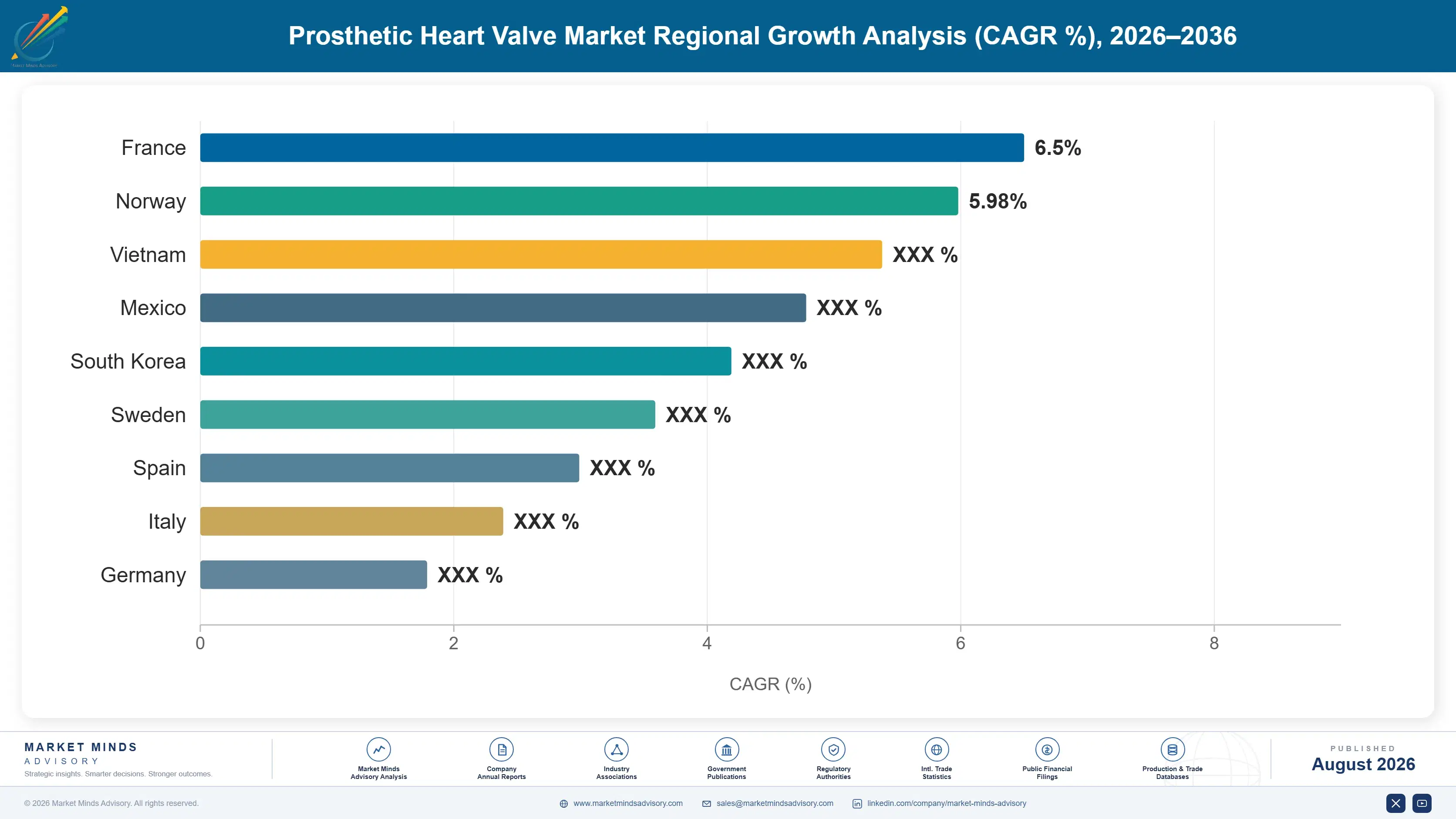
prosthetic-heart-valve-market-country-cagr-analysis-1787309554521

Converting Clinical Data Into Platform Premiums

Manufacturers have several concrete paths to lift revenue per implant beyond raw procedure volume growth, spanning next-generation platform premiums, physician training and proctoring programs, extended durability registry participation, and long-term hospital system supply agreements layered on top of standard valve sales across their largest accounts and referral networks built over many years of continuity.

Next-Generation Platform Premium Pricing Program Strategy

Manufacturers price next-generation transcatheter valve platforms at a 18% to 25% premium over prior-generation devices, a gap hospital systems increasingly accept given the meaningful reduction in paravalvular leak and reintervention rates newer platforms demonstrate in published clinical data. This premium captures a meaningful share of the clinical outcomes value manufacturers create for hospital systems facing their own quality metric reporting and reimbursement performance requirements. Manufacturers investing early in next-generation frame and delivery system technology are capturing outsized share of this premium pool before smaller competitors can bring comparable platforms to market.
Market Impact: Adds an 18 to 25% price premium ove

Physician Training and Proctoring Certification Programs

Manufacturers increasingly bundle structured physician training and on-site proctoring programs alongside device sales to accelerate new hospital site activation, typically investing 4% to 7% of implant revenue in training infrastructure and clinical support staff across a new site's first full year of procedural volume and case ramp-up. This training investment creates a meaningful moat, since hospital systems rarely switch valve platforms once physicians complete certification and build procedural muscle memory on a specific device's delivery system, and switching risks disrupting outcomes during the retraining period most heart teams prefer to avoid entirely.
Market Impact: Adds 4 to 7% of implant revenue ann

Extended Durability Registry and Outcomes Reporting Services

Manufacturers increasingly fund extended durability registries and outcomes reporting infrastructure that hospital systems use to support their own quality metric reporting and payer negotiation, a service investment typically worth 3% to 5% of incremental contract value annually across the registry's multi-year data collection period and its subsequent reporting cycles, audit requirements, and periodic data validation reviews. These registry programs meaningfully strengthen manufacturer relationships with the highest-volume structural heart centers, letting manufacturers capture premium account volume faster than competitors relying purely on device pricing alone to win new hospital system relationships.
Market Impact: Adds 3 to 5% of contract value annu

Long-Term Volume Supply Agreements With Major Hospital Systems

Manufacturers winning long-term volume supply agreements with the largest hospital systems and group purchasing organizations secure multi-year predictable order volume across the system's full structural heart procedural network rather than competing for individual hospital-level contracts repeatedly, typically locking in 3 to 5 years of preferred-vendor status across the system's cardiac catheterization laboratories and their affiliated referral networks and satellite clinics. This account continuity meaningfully reduces the cost of ongoing sales pursuit and gives manufacturers forward visibility into manufacturing capacity planning that spot-market device sales never provide at comparable forecasting reliability.
Market Impact: Secures 3 to 5 years of preferred s

Who Controls the Margin Pool

Five manufacturers hold 78% of global revenue on a consistent implant unit basis, with Edwards Lifesciences and Medtronic forming the clearest leading pair on transcatheter platform breadth and clinical trial depth, creating a substantial gap over the next tier of challengers including Abbott, Boston Scientific, and LivaNova, none of which currently matches their combined aortic and mitral platform portfolio across every major valve category tracked in this report.
Current competitive activity centers on three dimensions: racing to secure transcatheter mitral device approvals ahead of competitors still in earlier trial phases, expanding physician training infrastructure to accelerate new hospital site activation across major structural heart networks, and building extended durability registry programs that strengthen relationships with the highest-volume procedural centers.

Emerging pressure comes from Asian device manufacturers specializing narrowly in cost-competitive surgical and transcatheter valves for domestic and price-sensitive export markets where the largest global manufacturers increasingly deprioritize commodity-tier competition. Rankings among the five leading manufacturers remain broadly stable given the clinical trial barriers to entry, but the mid-tier surgical valve segment is consolidating as smaller producers lacking capital for transcatheter platform development either specialize narrowly or exit certain categories entirely.
prosthetic-heart-valve-market-company-positioning-matrix-1787309555046

Competitive Moat and Risk Dimensions

EDWARDS LIFESCIENCES CORPORATION

Moat: Transcatheter Pioneer and Trial Depth

Edwards Lifesciences' first-mover position in transcatheter aortic valve replacement and its unmatched depth of long-term clinical trial and durability data give it a credibility advantage that smaller competitors cannot easily replicate, particularly across the physician relationships and hospital system contracts built over more than a decade of market leadership.
EDWARDS LIFESCIENCES CORPORATION

Risk: Mitral Platform Timing Risk

Edwards Lifesciences faces meaningful competitive risk if rival transcatheter mitral platforms reach commercial scale with superior outcomes data before its own mitral programs mature, since mitral device leadership could shift the referral patterns and physician loyalty that currently favor its dominant aortic franchise across major hospital systems.
MEDTRONIC PLC

Moat: Broad Device Portfolio Integration

Medtronic's broad cardiovascular device portfolio spanning valves, rhythm management, and surgical instruments gives it cross-selling relationships and hospital system contract leverage that single-category competitors cannot match, letting it bundle structural heart offerings with its other cardiac device lines across integrated system-wide negotiations and account reviews.
MEDTRONIC PLC

Risk: Portfolio Complexity Slows Response

Medtronic's scale and diversified device portfolio create meaningful organizational complexity when prioritizing structural heart investment against its many other business units, leaving it potentially slower than more narrowly focused competitors to respond decisively to fast-moving transcatheter mitral development timelines and shifting physician preferences industry-wide and globally.

Players Tracked

Prominent Players

Edwards Lifesciences Corporation
Medtronic plc
Abbott Laboratories
Boston Scientific Corporation
LivaNova PLC

Other Key Players

Artivion Inc
Meril Life Sciences Pvt Ltd
JenaValve Technology Inc
Braile Biomedica
Colibri Heart Valve LLC
Venus Medtech Hangzhou Inc
Peijia Medical Ltd
MicroPort Scientific Corporation
Foldax Inc
Anteris Technologies Ltd
Neovasc Inc
HLT Inc
Cephea Valve Technologies Inc
Vascular Innovations Co Ltd
TRICORES Biomedical Co Ltd

Recent Developments

FEBRUARY 2026

Edwards Lifesciences Reports Extended Mitral Trial Follow-Up Data

Edwards Lifesciences reported extended follow-up outcomes from its transcatheter mitral valve replacement trial program, showing durability results supporting broader commercial rollout across additional structural heart centers nationwide and internationally. The data release accompanied expanded physician training program enrollment ahead of anticipated regulatory approval in additional markets.
Signal: Extended trial follow-up data is becoming
OCTOBER 2025

Medtronic Signs Multi-Year Hospital System Supply Agreement

Medtronic signed a multi-year preferred-vendor supply agreement with a major North American hospital system covering its structural heart procedural network across multiple cardiac catheterization laboratories and affiliated clinics. The agreement was a supply contract, not a joint venture, merger, or acquisition of any kind whatsoever.
Signal: Long-term preferred-vendor agreements are
MAY 2025

Meril Life Sciences Expands Transcatheter Valve Distribution Into India

Meril Life Sciences established expanded distribution and physician training partnerships covering additional Indian states, targeting cardiac catheterization laboratories adopting transcatheter aortic valve replacement as reimbursement pathways expand nationally and regionally each year. The partnership was a distribution and training agreement, not an acquisition of any kind.
Signal: Domestic manufacturer distribution partner

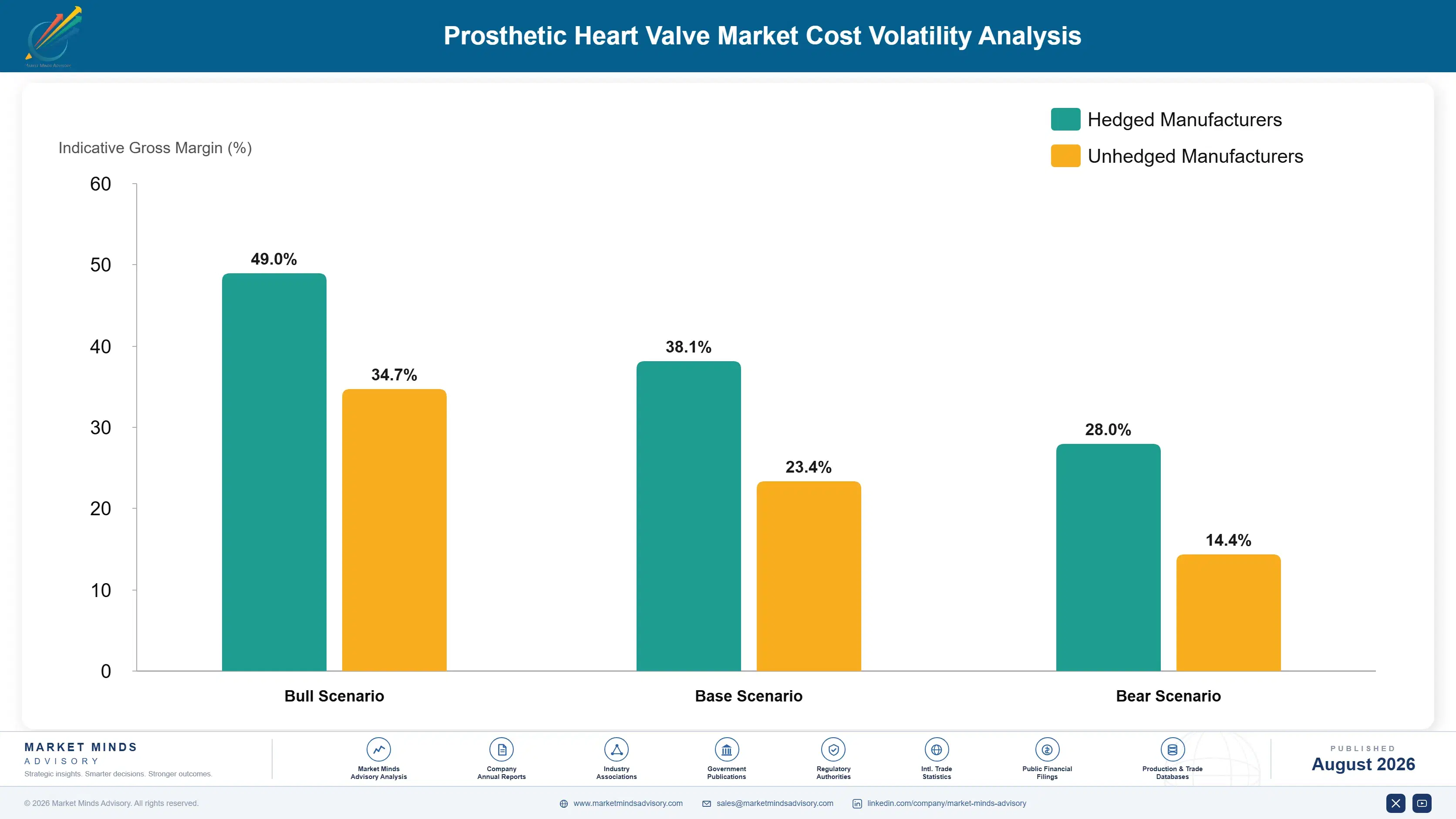
Nitinol and Frame Alloy Cost Exposure

Nitinol and cobalt-chromium frame alloys represent 30% to 38% of cost of goods sold for transcatheter valve production, sourced primarily from specialized North American and European alloy processors, while bovine and porcine pericardial tissue represents a smaller but meaningful 12% to 18% share for bioprosthetic and transcatheter valve leaflets across most manufacturer product lines and platform families.
Global nitinol pricing spiked meaningfully during 2021 and 2022 as specialized alloy processing capacity failed to keep pace with surging transcatheter device demand across the medical device industry, a dynamic documented in NIST advanced materials supply chain reporting tracking specialty alloy pricing trends across major processing regions throughout the affected period and into the following partial recovery year as processing capacity gradually expanded to meet renewed demand.

Smaller manufacturers without long-term alloy supply contracts or scale purchasing power carry considerably greater exposure to price volatility than the five largest global manufacturers, since spot market purchases leave them fully exposed to short-term price spikes that larger manufacturers can smooth through diversified sourcing and contracted volume commitments negotiated well in advance across multiple specialized alloy processors and long-standing supplier relationships.
prosthetic-heart-valve-market-cost-volatility-analysis-1787309555242

Multi-Supplier Alloy Sourcing Diversification

Manufacturers increasingly source nitinol and cobalt-chromium alloy from multiple specialized processors across North America and Europe simultaneously, reducing exposure to any single processor's capacity constraints or pricing swings that periodically tighten specialty alloy markets without warning across the broader medical device supply chain each year, particularly during periods of surging device demand and constrained processing capacity.

Long-Term Indexed Alloy Supply Contracts

Larger manufacturers negotiate multi-year alloy supply contracts with pricing indexed to published specialty metals benchmarks rather than negotiated case by case, smoothing cost volatility and giving manufacturers greater production cost predictability across multi-year capacity planning and clinical trial investment cycles they depend on heavily each budgeting period and forecasting round conducted by finance teams.

Pericardial Tissue Sourcing Redundancy Programs

Manufacturers are qualifying redundant bovine and porcine pericardial tissue suppliers across multiple geographic regions, reducing dependence on any single tissue source while preserving the rigorous quality validation standards regulatory agencies require of every qualified tissue supplier and processing facility across the full manufacturing, sterilization, and packaging supply chain and its extensive associated regulatory documentation.

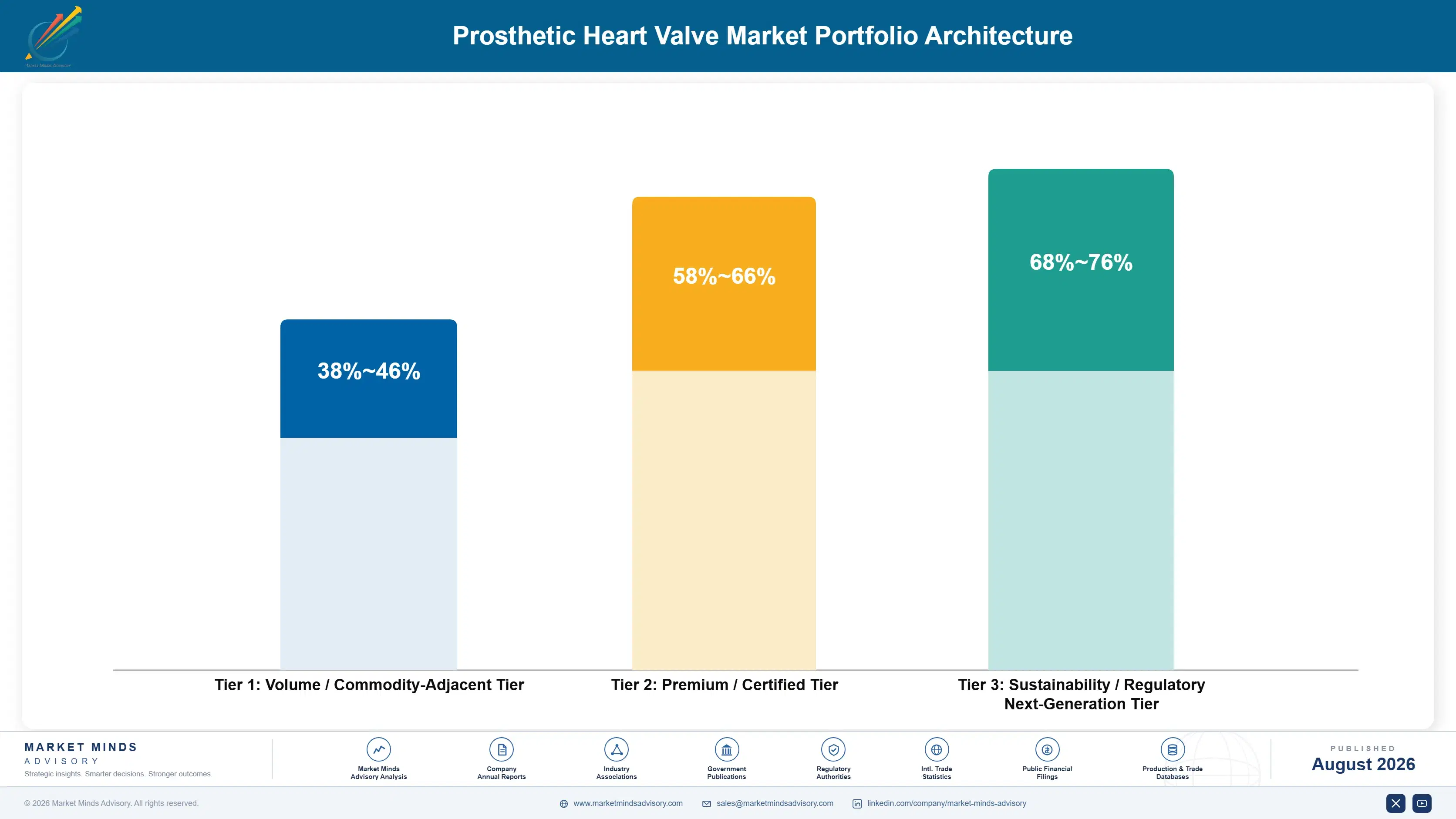
Portfolio Architecture for Margin Defence

The prosthetic heart valve portfolio organizes into three tiers separated by delivery method and clinical data depth rather than material type or target valve alone, with gross margins widening considerably from the surgical mechanical volume tier through to the next-generation transcatheter tier that leading structural heart centers increasingly require. Capital allocation follows this margin gradient, with manufacturers directing new investment toward platform development.
Surgical mechanical and standard bioprosthetic valves face steady margin pressure as transcatheter platforms increasingly become the default treatment approach for eligible patients, pushing manufacturers to defend surgical volume through anatomy-specific positioning rather than price competition with transcatheter suppliers. Established TAVR grades occupy the profitable middle ground most structural heart centers now specify by default, absorbing the largest share of new capital investment as manufacturers race to expand size ranges.

The highest-value profit pools concentrate in transcatheter mitral and tricuspid devices serving previously untreated patient populations, where manufacturers capture both a technology premium and a recurring training relationship premium across long-term hospital system agreements that rarely face competitive re-bidding once established. Volume versus premium tension defines strategic choice: manufacturers chasing surgical volume alone increasingly find themselves squeezed on price, while others prioritizing transcatheter mix capture disproportionate margin.

Volume / Commodity-Adjacent Tier

Surgical mechanical and standard bioprosthetic valves sold to hospital systems and patients without transcatheter eligibility, competing on established clinical track record and predictable procedure cost today and for years to come.
Gross Margin: 38-46%

Premium / Certified Tier

Transcatheter aortic valve replacement platforms carrying extensive long-term durability data, now specified by most structural heart centers as the default treatment approach for eligible aortic stenosis patients across all risk categories.
Gross Margin: 58-66%

Sustainability / Regulatory / Next-Generation Tier

Transcatheter mitral and tricuspid devices bundled with physician training and extended durability registry support, addressing previously untreated patient populations who faced genuinely limited surgical treatment alternatives until quite recently in most markets.
Gross Margin: 68-76%
prosthetic-heart-valve-market-portfolio-architecture-1787309555745

High-value Sub-segments and Strategic Watch-out

Transcatheter Mitral Valve Repair and Replacement Devices

The fastest-growing, highest-margin volume segment as second-generation platforms open access for previously untreated patient populations, drawing manufacturer capital investment fastest across the entire structural heart category today and over the coming several years across every major hospital network, procedural volume tier, and geographic market worldwide.
Gross Margin: 68-76%

Transcatheter Aortic Valve Replacement (TAVR) Devices

A steadier, high-margin segment tied to guideline expansion into lower-risk patients rather than any single regulatory catalyst, rewarding manufacturers holding validated long-term durability data that rarely face competitive re-bidding once trusted across multiple procurement and audit cycles, hospital committee reviews, and ongoing payer negotiations conducted annually.
Gross Margin: 58-66%

Surgical Bioprosthetic and Mechanical Valves

The volume core of the market today, still generating meaningful absolute implant volume despite compressing margins, as patients without transcatheter eligibility continue receiving surgical valves across most hospital systems and their affiliated referral networks nationwide, internationally, and across nearly every clinical risk category tracked in this report.
Gross Margin: 38-46%

Legacy First-Generation Transcatheter Platforms

A strategic watch-out segment facing accelerating physician migration toward next-generation platforms and probable phase-out across leading structural heart centers within the coming several years, creating both meaningful investment risk and genuine long-term opportunity for faster-moving manufacturers willing to invest early, aggressively, and quite decisively today.
Gross Margin: 42-50%

Recurring Hospital System Contract Economics

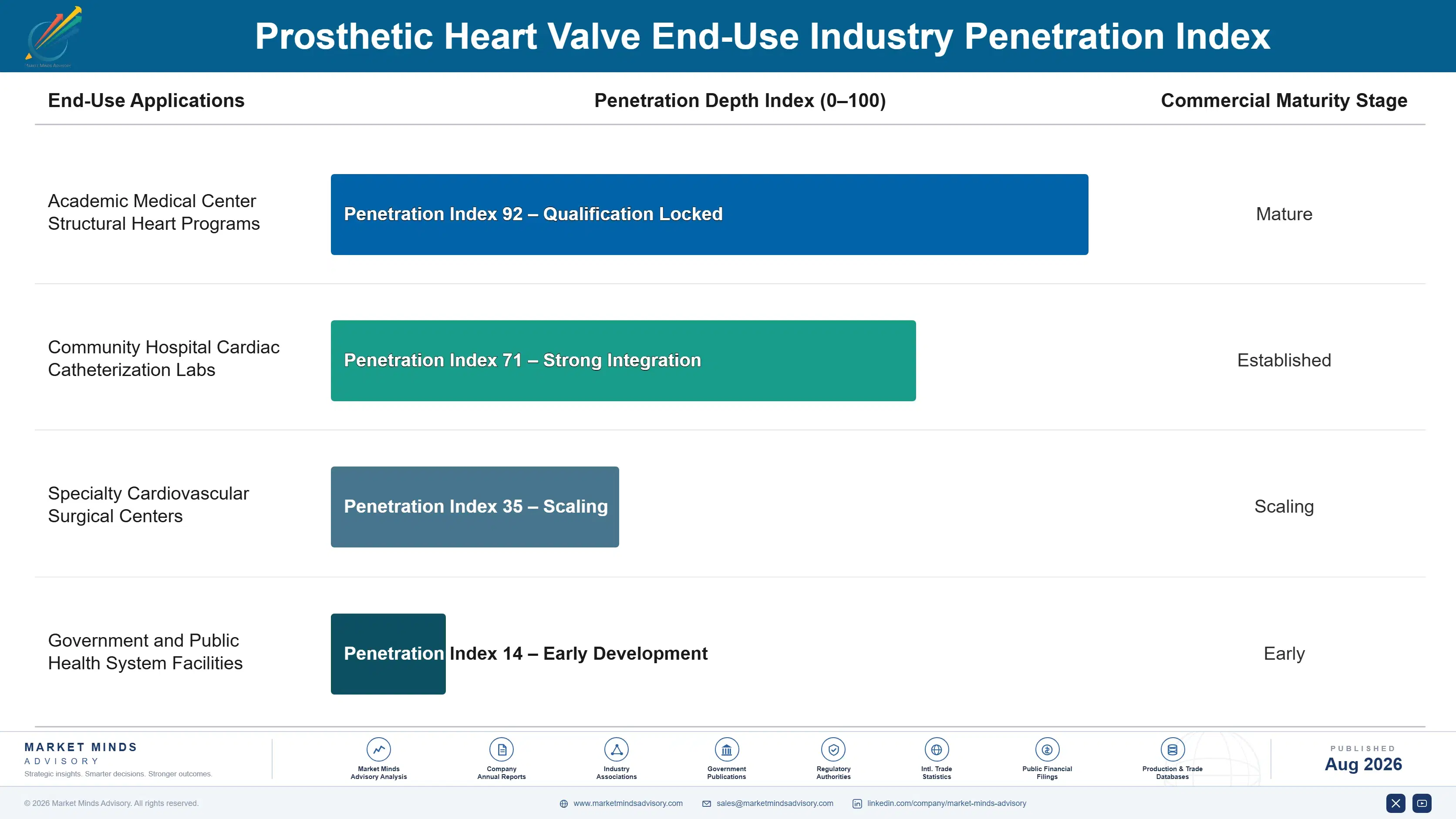
Prosthetic heart valve demand behaves like an annuity for manufacturers holding preferred-vendor agreements with major hospital systems, since consumption tracks predictable aging-population disease prevalence and expanding structural heart program capacity rather than discretionary purchasing decisions that vary meaningfully year to year across most buyer categories, giving qualified manufacturers unusually stable forward revenue visibility.
Adoption depth varies considerably by institutional tier. High-volume academic structural heart centers have converted the large majority of eligible patients to transcatheter platforms given their deep physician training investment and clinical trial participation, while smaller community hospitals adopt transcatheter approaches more selectively, reserving them for straightforward anatomy while referring complex cases to regional centers of excellence. Physicians, once trained and certified on a specific platform, rarely switch to a competing device absent a compelling clinical reason.

A generational shift in buyer profiles is underway as younger interventional cardiologists trained primarily on transcatheter techniques increasingly replace surgeons who once evaluated valve replacement purely through an open-surgical lens, accelerating transcatheter adoption faster than guideline expansion alone would otherwise require across many hospital systems and their referral networks. Younger physicians also weigh manufacturer training infrastructure quality more heavily than legacy relationship history alone.
prosthetic-heart-valve-market-end-use-penetration-index-1787309556236

Where Manufacturers Should Focus Capital

These are among the four positions where our research anticipates prominent divergence between winners and laggards over the coming forecast period. Each is grounded in the demand model, the regulatory perimeter, and the announced capacity pipeline.
01 / TRANSCATHETER MITRAL INVESTMENT FOCUS

Prioritize mitral platform development over surgical valve line extensions

Manufacturers still investing primarily in surgical valve line extensions are building toward a shrinking addressable market, since transcatheter guideline expansion widens the transcatheter versus surgical gap every year across additional patient risk categories nationwide and across every major structural heart center and academic referral network. The development horizon on new surgical-only platforms now extends past the point where most eligible patients will have shifted to transcatheter treatment entirely. That timing mismatch leaves fresh surgical-only investment largely stranded before it generates meaningful commercial return.
02 / PHYSICIAN TRAINING STRATEGY

Build training infrastructure before rivals capture site loyalty

Manufacturers that build comprehensive physician training and proctoring infrastructure and secure long-term hospital system agreements lock in recurring procedural revenue that rarely faces competitive re-bidding once physicians complete certification and build procedural experience on a specific platform across their institution. Hospital systems strongly prefer supplier continuity given the retraining risk of switching valve platforms mid-program, and requalifying a new device can take a year or longer to complete. That timeline makes early training investment the single most defensible strategy manufacturers can pursue.
03 / EMERGING MARKET POSITIONING

Build South Asian cath lab partnerships ahead of reimbursement expansion

South Asian markets are rapidly expanding cardiac catheterization infrastructure and reimbursement pathways, and manufacturers establishing training and distribution relationships now, rather than waiting for demand to fully materialize, stand to capture disproportionate early share of that emerging opportunity before competitors reposition their own market entry strategies and local partnerships across the broader region. Waiting risks ceding these markets to domestic manufacturers already building comparable platforms locally. Physician trust and training infrastructure both take considerable time to establish properly, favoring manufacturers that move first.
04 / ALLOY COST MANAGEMENT STRATEGY

Diversify frame alloy sourcing to defend margin against volatility

Manufacturers defending margin against rising alloy cost pressure should diversify nitinol and cobalt-chromium sourcing aggressively, since this lowers input cost exposure without requiring the full capital investment next-generation platform development demands across other product categories entirely and across every major manufacturing facility they operate. This strategy preserves overall portfolio profitability even as transcatheter mitral grades capture a growing share of industry revenue year after year across nearly every hospital system relationship. It buys time for smaller manufacturers to decide whether transcatheter platform investment eventually makes commercial sense.

Engagement Snapshot From the Field

A live engagement with an industry participant carrying material or product regulatory and market exposure ahead of a defining policy shift, showing how our research translates into a defensible multi-year portfolio strategy.
MARKET MINDS ADVISORY · CLIENT ENGAGEMENT SUMMARY
Prosthetic Heart Valve Producer Strategic Portfolio Review and Transition Roadmap 2026·Investment Scenario on Prosthetic Heart Valve Exposure Evaluation 2025-26
CLIENT PROFILE
The client operates a structural heart program within a 650-bed academic medical center in the southeastern United States, performing an estimated 480 valve procedures annually (client-reported, unverified by MMA), with transcatheter aortic volume growing faster than the program's cath lab capacity could originally support across its expanding regional referral network, satellite clinics, and community hospital partnerships.
STRATEGIC CHALLENGE
The client faced a capacity constraint as transcatheter referral volume outpaced available cath lab time, and needed to evaluate whether adding a second transcatheter platform vendor or expanding physical cath lab capacity would better address growing patient wait times without compromising procedural quality or existing vendor relationships and physician training investments.
MMA APPROACH
MMA conducted a capacity utilization analysis across the client's existing cath lab infrastructure, benchmarked dual-vendor versus single-vendor economics against comparable academic medical centers, and modeled patient wait time impact under each scenario to build a capital investment business case for client leadership and its cardiovascular service line committee to formally approve.
KEY FINDINGS
  1. Cath lab time utilization analysis showed the client could recover an estimated 15% additional procedural capacity through scheduling optimization alone before requiring physical expansion.
  2. Adding a second transcatheter vendor was projected to reduce per-unit device pricing by an estimated 8% to 12% through competitive negotiation leverage across the program's full annual volume.
  3. Physician surveys showed meaningful preference for maintaining a single primary vendor relationship to preserve procedural consistency and simplify inventory management across the cath lab.
  4. Delaying capacity expansion risked losing referral volume to a competing regional health system actively recruiting the client's referring cardiologists with shorter wait times.
CLIENT PROFILE
The client operates a structural heart program within a 650-bed academic medical center in the southeastern United States, performing an estimated 480 valve procedures annually (client-reported, unverified by MMA), with transcatheter aortic volume growing faster than the program's cath lab capacity could originally support across its expanding regional referral network, satellite clinics, and community hospital partnerships.
STRATEGIC CHALLENGE
The client faced a capacity constraint as transcatheter referral volume outpaced available cath lab time, and needed to evaluate whether adding a second transcatheter platform vendor or expanding physical cath lab capacity would better address growing patient wait times without compromising procedural quality or existing vendor relationships and physician training investments.
MMA APPROACH
MMA conducted a capacity utilization analysis across the client's existing cath lab infrastructure, benchmarked dual-vendor versus single-vendor economics against comparable academic medical centers, and modeled patient wait time impact under each scenario to build a capital investment business case for client leadership and its cardiovascular service line committee to formally approve.
KEY FINDINGS
  1. Cath lab time utilization analysis showed the client could recover an estimated 15% additional procedural capacity through scheduling optimization alone before requiring physical expansion.
  2. Adding a second transcatheter vendor was projected to reduce per-unit device pricing by an estimated 8% to 12% through competitive negotiation leverage across the program's full annual volume.
  3. Physician surveys showed meaningful preference for maintaining a single primary vendor relationship to preserve procedural consistency and simplify inventory management across the cath lab.
  4. Delaying capacity expansion risked losing referral volume to a competing regional health system actively recruiting the client's referring cardiologists with shorter wait times.
RECOMMENDED STRATEGY
Phase 1: Phase 1 (Months 1 to 2): Complete scheduling optimization analysis and implement quick-win capacity recovery measures across existing cath labs. Phase 2: Phase 2 (Months 3 to 6): Negotiate revised vendor terms using expanded volume commitments while evaluating second-vendor economics and physician preference further. Phase 3: Phase 3 (Months 7 to 12): Execute physical cath lab expansion and finalize long-term vendor supply agreements on favorable terms.
OUTCOME
Within twelve months the client recovered 14% additional procedural capacity through scheduling optimization and completed a physical cath lab expansion, reducing average patient wait time by 40% while maintaining its primary vendor relationship on improved commercial terms and preserving physician training continuity (client-reported, unverified by MMA).

Frequently Asked Questions

Foundational context covering the market sizes, CAGR, scope, country, region and competition that inform every finding below. This section is provided to cover basics and most often pre-purchase conversations, answered from the MMA Primary Research Dataset.

What is the current size of the Prosthetic Heart Valve Market?

The global prosthetic heart valve market is valued at $7.8 billion in 2025, MMA's designated base year for this analysis. This figure covers surgical mechanical and bioprosthetic valves alongside transcatheter aortic and mitral valve devices.

How large will the Prosthetic Heart Valve Market be by 2036?

MMA projects the market will reach $19.13 billion by 2036 under the base case scenario. That represents a 2.26 times expansion over the 2026 starting value across the ten-year forecast window.

What is the CAGR for the Prosthetic Heart Valve Market 2026 to 2036?

The base case CAGR is 8.5% annually, with a bull case of 9.7% and a bear case of 7.3%. Transcatheter mitral approval timing and reimbursement policy are the primary swing factors between scenarios.

Which segment is growing fastest?

Transcatheter mitral valve repair and replacement devices lead at a 14.0% CAGR, roughly 1.65 times the overall market rate. Second-generation platform approvals opening access for previously untreated patients are the primary driver behind this growth.

Who are the major companies in the Prosthetic Heart Valve Market?

Edwards Lifesciences Corporation, Medtronic plc, Abbott Laboratories, Boston Scientific Corporation, and LivaNova PLC lead the market. Together these five manufacturers hold an estimated 78% of global revenue.

Which country is growing fastest?

India leads at an estimated 11.0% CAGR, driven by rapidly expanding cardiac catheterization infrastructure and broadening insurance reimbursement pathways from a comparatively low current base. The United States remains the largest single national market by revenue.

Report Segmentation Architecture

The full report scope spans multiple orthogonal segmentation dimensions, with cross-tabulated demand data provided for each dimension pair. Coverage extends further to regional breakdowns, trend trajectories, and the competitive detail needed to support segment-level decision-making.

By Valve Technology and Delivery Method

  • Transcatheter Aortic Valve Replacement (TAVR) Devices
  • Surgical Mechanical Heart Valves
  • Surgical Bioprosthetic (Tissue) Valves
  • Transcatheter Mitral Valve Repair and Replacement Devices
  • Valve Repair Rings and Annuloplasty Devices
  • Homograft and Allograft Valves

By End-Use Industry

  • Academic Medical Center Structural Heart Programs
  • Community Hospital Cardiac Catheterization Labs
  • Specialty Cardiovascular Surgical Centers
  • Government and Public Health System Facilities

By Commercial Dimension

  • Direct Hospital System Supply Agreements
  • Group Purchasing Organization Contracts
  • Physician Training and Proctoring Programs
  • Export and International Distribution Partnerships

By Region

  • North America
  • Western Europe
  • East Asia
  • South Asia and Pacific
  • Latin America
  • Middle East and Africa
  • Eastern Europe

Scope, Methodology, and Coverage

Every figure in this report is reproducible from documented input assumptions. The scope below maps the historical period, the forecast horizon, the segmentation dimensions, and the countries covered, alongside the underlying primary and qualitative methodology.
Historical Period
2020 to 2025
Forecast Period
2026 to 2036
Base Year
2025 (USD billions; MMA Primary Research Dataset, August 2026)
Market Definition
The prosthetic heart valve market covers surgical mechanical and bioprosthetic valves, transcatheter aortic and mitral valve devices, annuloplasty repair rings, and homograft and allograft valves implanted to replace or repair diseased native heart valves. It excludes ventricular assist devices, pacemakers and other cardiac rhythm management implants, and diagnostic cardiac catheterization equipment not used for valve implantation.
Quantitative Units
USD billions (current prices); implant volume in thousands of units
Segmentation Dimensions
By Valve Technology and Delivery Method; By End-Use Industry; By Commercial Dimension; By Region
Regions Covered
North America, Western Europe, East Asia, South Asia and Pacific, Latin America, Middle East and Africa, Eastern Europe
Countries Covered
USA, Canada, Germany, France, UK, Italy, Spain, China, Japan, South Korea, India, Australia, Thailand, Indonesia, Brazil, Mexico, Saudi Arabia, UAE, South Africa, Nigeria, Turkey, Poland, Czech Republic, Netherlands, Sweden, Switzerland, Argentina, Colombia, Vietnam, Malaysia, and additional markets relevant to this sector
Key Companies Profiled
Edwards Lifesciences Corporation, Medtronic plc, Abbott Laboratories, Boston Scientific Corporation, LivaNova PLC, Artivion Inc, Meril Life Sciences Pvt Ltd, JenaValve Technology Inc, Braile Biomedica, Colibri Heart Valve LLC, Venus Medtech Hangzhou Inc, Peijia Medical Ltd, MicroPort Scientific Corporation, Foldax Inc, Anteris Technologies Ltd, Neovasc Inc, HLT Inc, Cephea Valve Technologies Inc, Vascular Innovations Co Ltd, TRICORES Biomedical Co Ltd
Quantitative Methodology
Primary survey, n=3,800 respondents, Q4 2025, six countries; demand-side model with trade association cross-validation
Qualitative Methodology
47 expert interviews, Q4 2025; applied to validate demand model assumptions, identify emerging dynamics, and assess competitive positioning
Report Format
PDF and XLSX data workbook (Word format preview document)
Publisher
Market Minds Advisory
Report Code
MMA-2026-MED-101
Published
August 2026
Contact
sales@marketmindsadvisory.com | www.marketmindsadvisory.com

Purchase the full Prosthetic Heart Valve Market Report (2026 to 2036).

The full report delivers a complete analysis of the global prosthetic heart valve market, covering sizing and forecasts across all seven regions and six valve technology segments through 2036. It profiles twenty companies with verified moat and risk assessments for the two category leaders, Edwards Lifesciences and Medtronic, across their transcatheter platform and clinical trial positioning. The report includes detailed input cost analysis, portfolio margin benchmarking, and a primary-research-backed transcatheter adoption outlook. Buyers receive full access to underlying data tables and methodology notes supporting every figure presented in the analysis.
Seven-region sizing and forecast data tables
Six-segment MECE valve and technology breakdown
Twenty-company competitive profiles and full rankings
Input cost exposure and mitigation analysis
Portfolio tier margin benchmarking data included
Transcatheter adoption timeline and clinical outlook

Built For The People Who Decide

From boardroom strategy to bench-side execution, this report is read cover-to-cover by leaders shaping the next decade of their industry, turning demand scenarios, market dynamics and valuation benchmarks into decisions.
CXOs/ Presidents/ VPs/ Managers
M&A and Corporate Development
Strategy Teams and R&D Heads
Procurement and Product Directors
Regulatory and Compliance Leaders
Investor Relations and Equity Analysts