Market Minds Advisory
Prostate-Specific Antigen (PSA) Testing Market

Prostate-Specific Antigen (PSA) Testing Market: Reflex Panels, Screening Policy Reversal and the Closed Platform Economy

A twenty-four dollar test spent a decade being blamed for overtreatment, and the answer turned out to be better second-line assays rather than fewer first-line ones, quietly rebuilding a commercial case nobody expected back.

Lead Analyst

Alice Ballenger

Published

September 2026

Make Smarter Decisions with Customized Research Insights

Request a free sample report and evaluate market opportunities, growth trends, and competitive dynamics relevant to your business needs.

2025 MARKET VALUE$1.2BMarket Size 2025
2036 FORECAST VALUE$2.2BBase Case , 2026 to 2036
CAGR 2026 TO 20365.6 %Bull 6.8% / Bear 4.4%
INCREMENTAL OPPORTUNITY$0.9BNet 10- year value creation
EXPANSION MULTIPLE1.72x2036 value over 2026 base
Strategic Levers
M&A Pipeline
Regional Outlook
Country Rankings
Competitive Intelligence
Segmental Deep-dive
Call-Us : 91 93563 13602

Executive Snapshot and Market Trajectory

For a decade this test was blamed for too many unnecessary biopsies. The correction has not been fewer first-line measurements. It has been better second-line assays that decide who actually needs tissue sampling, which turns out to be a far more profitable answer for the companies involved.
Multi-kallikrein panels compound at 8.4%, exactly 1.50 times the market, because a reflex test that keeps a man out of a biopsy suite justifies a price no single-analyte measurement ever could. North America holds 29% of global spend, driven by reimbursed opportunistic testing in primary care and by payer allowances near USD 24 per test rather than by any concentration of disease. Biopsy referral now follows only 11% of all elevated results.
Five suppliers hold 68% of reported test volume, and the position was won by placing analysers rather than by selling assays. Roughly 81% of testing runs on closed platforms that restrict third-party reagents, which makes the installed instrument base the commercial asset and the test itself the annuity. European screening pilots recommended at Union level are the first policy movement in this category's favour since 2012.
Market Definition
Covers in vitro diagnostic assays measuring prostate-specific antigen and its molecular forms in serum or plasma, including total PSA, free and percent-free PSA, complexed PSA, PSA isoform assays, multi-kallikrein panels incorporating PSA measurement, and point-of-care PSA tests. Sizing is at realised reagent and kit revenue plus panel service fees. Excludes analyser hardware, prostate imaging, tissue biopsy and pathology, genomic and urine-based prostate assays that do not measure PSA, and treatment or monitoring services.
Base Year Value
$1.2B in 2025 (MMA Primary Research Dataset, August 2026)
Forecast Period
2026 to 2036, eleven discrete annual values
CAGR
5.6% base case. Bull 6.8%. Bear 4.4%.
Fastest Growth Segment
Multi-Kallikrein Panels: 8.4% CAGR
Fastest Growth Country
India: 8.4% CAGR
Fastest Growth Region
South Asia and Pacific: 7.9% CAGR
Largest Region
North America: 29% of 2025 global value
Market Leaders
Roche Diagnostics, Abbott, Siemens Healthineers, Beckman Coulter, Fujirebio. Source: MMA Analysis based on company annual reports.
Primary Survey
n=3,800 procurement and R&D decision-makers, Q4 2025, six countries
Methodology
Demand-side build-up, cross-validated against public data, 47 expert interviews

Prostate-Specific Antigen (PSA) Testing Market Forecast Scenarios

prostate-specific-antigen-psa-testing-market-size-forecast-scenario-1787309198712
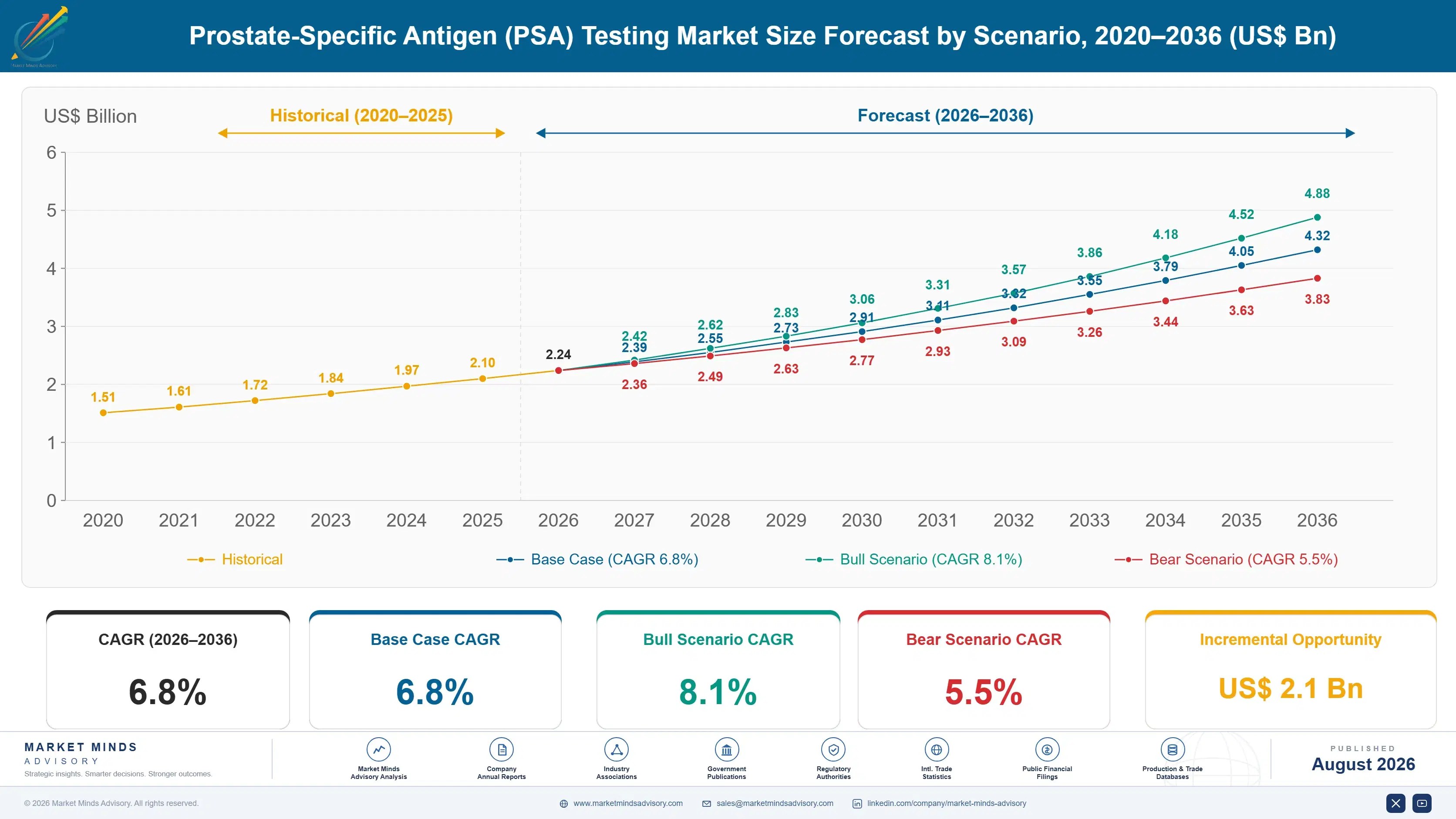
Between 2020 and 2025 the category grew at roughly 5.7 percent annually as automated immunoassay platforms expanded laboratory throughput and screening volume gradually recovered following pandemic-era diagnostic testing disruption across most developed healthcare markets globally and nationwide. Reflex panel adoption remained a minority of total testing volume through most of that stretch, with standalone assays dominating commercial revenue.
The base case assumes 6.8 percent annual growth through 2036, anchored in three mechanisms: continued baseline screening volume among aging male populations sustaining standalone total PSA demand across hospital and reference laboratory settings combined, accelerating conversion toward multiplex reflex biomarker panels among urology networks seeking reduced unnecessary biopsy referrals and clearer risk stratification, and expanding cancer screening infrastructure across South Asia driving new laboratory volume well ahead of the category average. Assay validation depth determines which companies defend laboratory contract volume.
A bull case builds around national screening guidelines formally endorsing reflex biomarker panels faster than expected as clinical evidence accumulates, pushing growth toward 8.1 percent. The bear case centers on continued screening guideline ambiguity and reimbursement uncertainty slowing panel adoption, pulling growth down toward 5.5 percent if laboratories delay planned platform investment and menu expansion broadly across most regional markets.

How a Discredited Test Rebuilt Its Commercial Case

The commercial structure here has almost nothing to do with the assay. Roughly 81% of PSA measurement runs on closed immunoassay platforms, which means a laboratory bought an analyser years ago and can only run that company's reagents. Test revenue is therefore an annuity attached to an instrument, collected while the platform stays in service, and the contest happens at placement rather than at test selection. A laboratory director choosing a PSA assay is usually choosing nothing at all.
TOP FIVE CONCENTRATION68%Reported test volume held by leading assay suppliers
AVERAGE TEST REIMBURSEMENTUSD 24Payer allowance for a single antigen measurement performed
CHINA VOLUME GROWTH13% annuallyAnnual increase in measurements across Chinese clinical laboratories
CLOSED PLATFORM SHARE81%Testing run on analysers restricting third-party reagent use
BIOPSY REFERRAL RATE11%Elevated results proceeding to tissue sampling within a year
REAGENT COST SHARE22%Antibody and calibrator inputs within delivered test cost
What changed the economics was reflex testing. A total PSA result in the grey zone between three and ten used to send a man to biopsy on clinical judgement, and the resulting overtreatment is what discredited screening in the first place. Multi-kallikrein and isoform panels now sit between those two steps, priced at twenty to thirty times a single measurement and justified by the biopsies they prevent. Laboratories bill both.
Two forces shape the next decade. European screening policy has moved for the first time since guidance turned against routine testing, with Union-level recommendation of stepwise pilots. And imaging is competing for the same reflex position, which is the genuine competitive threat to the revenue that makes this category interesting.
"The overtreatment argument was correct and it nearly killed this market. What saved it was somebody realising that the problem was never the first test, it was what happened immediately after it. Selling a reflex panel at thirty times the price of the assay that triggered it, on the grounds that it prevents the harm the assay used to cause, is one of the more elegant commercial recoveries in diagnostics."
Director, In Vitro Diagnostics and Laboratory Medicine Practice · MMA Healthcare

Market Trends

Reflex panels reprice the diagnostic pathway above the assay

Multi-kallikrein and isoform panels have moved from specialist urology into the standard pathway for grey-zone results between three and ten nanograms per millilitre. Published series show biopsy avoidance in a substantial minority of men who would previously have proceeded, and payers have listed the panels on exactly that basis. Pricing sits at twenty to thirty times a single total measurement. The commercial effect is that revenue per patient in a developed pathway has roughly doubled while the number of men tested has barely moved, which is the opposite of how diagnostics usually grows.
Market Impact: Grows Chinese volume near 13% annua

European screening policy reverses after a decade against testing

Union-level recommendation on cancer screening now includes stepwise prostate assessment combining PSA measurement with imaging and further investigation, which is the first policy movement favouring organised testing since guidance turned against it. Several member states have launched pilots on that basis. Organised programmes generate volume at predictable annual cadence rather than depending on individual primary care ordering decisions, which changes the forecast character of European demand entirely. Pilot scale remains modest, and the direction matters considerably more than the current numbers do. Pilots at national scale would change the forecast substantially.
Market Impact: Adds 3 measurements per patient yea

Market Opportunities and Growth Drivers

Asian laboratory capacity extends testing beyond metropolitan centres

Chinese reported PSA measurement volume grows near 13% annually as tertiary and provincial hospitals install immunoassay capacity and as insurance coverage extends. Indian private laboratory chains have built collection networks reaching second and third tier cities, where PSA sits in routine male health panels sold directly to patients. Neither market resembles Western pathways: much of this testing happens without urological referral at the point of ordering. Volume growth is therefore faster and revenue per test considerably lower, since domestic assay suppliers price well below multinational levels. Neither pathway resembles the other commercially.
Market Impact: Diverts about 30% of reflex revenue

Active surveillance cohorts generate recurring monitoring demand

Low-risk prostate cancer is now managed by active surveillance rather than immediate treatment across most developed urology practice, and surveillance means serial PSA measurement at intervals of three to six months for years. That converts a diagnostic test into a monitoring annuity attached to a growing patient population. Surveillance cohorts have expanded substantially as guidelines moved away from radical treatment of low-grade disease. Each patient on surveillance generates roughly three measurements annually, indefinitely, which is a demand pattern no screening decision affects. Suppliers focused on the diagnostic decision point mostly ignore it, which leaves a recurring annuity uncontested.
Market Impact: Delays entry across 8-year cycles

Market Restraints and Challenges

Imaging competes for the reflex position panels occupy

Multiparametric MRI performs the same triage function as a reflex panel, deciding who proceeds to biopsy, and in several guidelines it already sits at that step. The root cause is that imaging answers a spatial question a serum assay cannot: it shows where a lesion is, which then guides the biopsy needle. Where MRI capacity exists, laboratories lose the panel revenue to radiology. Mitigation runs through positioning panels ahead of imaging as a gate on scanner access, which suits systems where MRI capacity is scarce, and through combined algorithms that use both.
Market Impact: Prices panels at 25 times assay

Closed platform lock-in blocks assay-level competition

Roughly 81% of testing runs on closed analysers, so a superior assay cannot be sold to a laboratory running a competitor's platform regardless of performance. The root cause is commercial design rather than technical necessity: instrument placement contracts deliberately restrict third-party reagents. New entrants with better assays therefore face a market that cannot buy them until analyser replacement cycles come round, roughly every eight years. Participants respond by licensing assays to platform owners, or by targeting the open-platform and point-of-care segments where nothing blocks entry. Neither route reaches the captive installed base quickly.
Market Impact: Restores volume across 6 states
4 additional market trends, 3 additional growth drivers, and 2 additional restraints and challenges are covered in the full report. Contact sales@marketmindsadvisory.com to access the complete intelligence.

Segment CAGR and Growth Architecture

Segmentation follows the assay measured, since each analyte configuration carries its own regulatory clearance, its own reimbursement code and a price that differs by more than an order of magnitude. Care setting and platform architecture matter commercially but cut across every assay type, so they belong in later discussion. Six assay classes cover the category without overlap.
prostate-specific-antigen-psa-testing-market-market-share-analysis-1787309199240

Multi-Kallikrein Panels

Panels combining total and free PSA with intact PSA and human kallikrein 2 grow at 8.4%, exactly 1.50 times the market rate. The commercial logic is unusual in diagnostics: the panel is priced at twenty to thirty times the assay that triggers it, and justified entirely by the biopsies it prevents rather than by the disease it finds. Payers have listed it on that basis, which is a rarer outcome than the listing rate suggests. Adoption concentrates in urology practice rather than primary care, since the ordering decision follows an elevated result rather than initiating the pathway. The threat is imaging occupying the same step, which is a capacity question rather than an evidence one in most systems.
CAGR 8.4%

PSA Isoform Assays

Assays measuring proPSA isoforms, most commonly reported as a health index combining them with total and free PSA, grow at 7.3% and occupy a similar reflex position to kallikrein panels at somewhat lower price. Two features distinguish the segment commercially. It runs on the major closed immunoassay platforms rather than as a sendout service, which means laboratories already holding the analyser can add it without new capital or workflow. And Japanese reimbursement listing has given it a stronger position in Asian urology than kallikrein panels have achieved. The constraint is the same as the opportunity: platform ownership determines who can offer it, and that decision was made years earlier. Placement history decides participation.
CAGR 7.3%
Full segment breakdown across 6 segments available in the complete report.

Regional Architecture and Country Demand Map

North America leads at 29% of spend on reimbursed opportunistic testing and test pricing rather than disease burden. East Asia follows at 25% and grows faster on Chinese volume. Western Europe holds 24% and is reversing screening policy. South Asia and Pacific grows fastest at 7.9%.

North America

Twenty-nine percent of global spend sits in North America, growing at 4.8%, and the position comes from reimbursement and price rather than from any concentration of prostate disease. Note: payer allowances near USD 24 per measurement run well above most other regions, and opportunistic ordering in primary care remains widespread despite a decade of guidance discouraging it. Reflex panel reimbursement is more generous here than anywhere, which is why kallikrein and isoform panels reached commercial scale in the United States first. Laboratory consolidation into a small number of national reference networks concentrates purchasing power considerably. Canadian provincial laboratory systems procure centrally and reimburse at materially lower rates, which caps value despite comparable testing behaviour.
Share: 29% | CAGR: 4.8% (2026 to 2036)

Western Europe

Growth of 4.0% is the slowest of any region, and 24% of spend reflects mature testing volume at tendered reagent prices well below North American levels. What makes the region important now is policy movement rather than size. Union-level recommendation on stepwise prostate screening has prompted pilot programmes across several member states, and organised programmes generate volume at predictable annual cadence rather than depending on individual ordering. Germany and France carry most current volume through opportunistic testing in office urology. Nordic systems have the strongest organised screening infrastructure to build pilots onto. Reagent tendering through hospital consortia keeps realised pricing under continuous pressure regardless of volume direction. Pilot funding will decide how much of this policy shift becomes volume.
Share: 24% | CAGR: 4.0% (2026 to 2036)
Regional intelligence for 5 additional markets available in the complete report: East Asia, South Asia and Pacific, Latin America, Middle East and Africa, Eastern Europe. Contact sales@marketmindsadvisory.com.
prostate-specific-antigen-psa-testing-market-country-cagr-analysis-1787309199755

Four Ways To Earn More Per Patient

Volume growth in this category is slow where prices are high and fast where they are not, which means the money is in revenue per patient rather than in test counts. Each lever below moves that number, through pathway position, platform economics or channel choice. All four have been executed commercially, with returns tested against disclosed diagnostics economics.

Position the reflex panel ahead of imaging access

Where MRI capacity is scarce, a reflex panel that decides who gets scanned is worth more to a health system than one competing with imaging for the same step. Positioning panels as a gate on scanner access rather than as an alternative to it has secured reimbursement in several European systems where the pure comparison had failed. Panels priced at twenty to thirty times a single measurement retain that value only while they sit before imaging in the pathway, and roughly 30% of reflex revenue is already moving to radiology where capacity permits.
Market Impact: Protects roughly 30% of all the ref

Place analysers to capture the reagent annuity

Roughly 81% of testing runs on closed platforms, which means the assay contest is decided at instrument placement and not afterwards. Placing analysers at favourable terms, including reagent rental structures that require no laboratory capital, locks testing volume for the eight-year service life of the platform. Suppliers winning placements capture PSA volume they never sell against, and the lifetime reagent value on a mid-volume analyser runs several times the instrument's own price. Working capital and service infrastructure are the real constraints on how aggressively this can be pursued. Few suppliers model it honestly.
Market Impact: Locks in volume across an 8-year pl

License reflex assays onto competitor platforms

A superior reflex assay is unsellable to laboratories running a rival analyser, and waiting for replacement cycles means waiting years. Licensing the assay onto major closed platforms converts an inaccessible installed base into royalty revenue immediately, at gross margins above what direct sales into a contested segment would deliver. The trade-off is obvious and usually overstated: platform owners capture the customer relationship, and the licensor reaches roughly four times the addressable installed base. Several isoform assays reached scale precisely this way. Royalty rates of 8% to 12% on reagent revenue are typical, and carry no clinical selling cost.
Market Impact: Reaches about 4 times the addressab

Sell panel testing into active surveillance cohorts

Surveillance patients generate roughly three measurements annually for years, and that population keeps expanding as guidelines move away from treating low-grade disease. Suppliers focused on the diagnostic decision point ignore a monitoring annuity that requires no screening policy to hold up. Positioning panels for surveillance intensification decisions, not just biopsy avoidance, extends realised revenue per patient across the whole surveillance period. Urology practices managing large surveillance cohorts represent concentrated demand, and roughly 40% of newly diagnosed low-risk disease now enters surveillance rather than treatment. Nothing about this requires a new assay.
Market Impact: Captures about 40% of all men enter

Who Controls the Margin Pool

Five suppliers hold 68% of reported test volume, the basis on which MMA assesses every participant here, and that ranking reflects analyser placements made years ago. Roche Diagnostics and Abbott lead on installed immunoassay base across developed laboratory networks. Beckman Coulter holds a disproportionate position in reflex isoform testing, which is where pricing is best.
Competitive activity runs along three lines. Analyser placement remains the primary contest, since roughly 81% of testing is captive to the platform once installed. Reflex panel reimbursement is being pursued country by country, and each listing is worth far more than an equivalent volume of total PSA testing. And Chinese platform suppliers are taking domestic share at prices multinationals cannot match, which is beginning to affect emerging market tenders beyond China.

Pressure is arriving from two directions at once. Imaging departments are competing for the reflex position that carries the category's growth, and where scanner capacity exists they frequently win it. Meanwhile Snibe, Mindray and Autobio are moving from domestic Chinese placements into Southeast Asian, Middle Eastern and Latin American tenders. Rankings shift toward suppliers holding both reflex panel reimbursement and platform breadth, since neither alone captures the revenue per patient available.
prostate-specific-antigen-psa-testing-market-company-positioning-matrix-1787309200275

Competitive Moat and Risk Dimensions

ROCHE DIAGNOSTICS

Moat: Largest closed platform installed base

The company holds the widest immunoassay analyser footprint across developed laboratory networks, and roughly 81% of PSA testing runs captive to whichever platform a laboratory installed. That converts historical placement success into current test revenue without any assay-level selling, and service infrastructure plus laboratory information system integration make displacement a departmental project rather than a purchasing decision.
ROCHE DIAGNOSTICS

Risk: Weaker reflex panel position

Revenue per patient growth in this category sits in reflex panels, and the company's position there is thinner than its platform dominance implies. Beckman Coulter and OPKO reached listings first in several systems. Platform breadth does not help where a urologist orders a specific named panel, and building reimbursement position country by country is slow work scale does not accelerate.
ABBOTT

Moat: Platform breadth across settings

The company covers high-volume laboratory analysers through to smaller systems suited to regional hospitals and private laboratory chains, which reaches Asian and Latin American growth that high-throughput platforms cannot serve economically. That breadth matters in markets where volume growth is fastest and laboratory scale is smallest, and it gives the company placement opportunities its largest competitor frequently cannot bid for.
ABBOTT

Risk: Exposure to Chinese platform competition

The mid-volume platform segment where the company competes strongly in emerging markets is exactly where Snibe, Mindray and Autobio have taken domestic Chinese share at prices no multinational cost base supports. Those suppliers are now bidding beyond China. Defending on service quality and assay menu works in some tenders and not in price-decided ones, which is most of them.

Players Tracked

Prominent Players

Roche Diagnostics
Abbott
Siemens Healthineers
Beckman Coulter
Fujirebio

Other Key Players

Bio-Rad Laboratories
QuidelOrtho
Tosoh Corporation
Snibe Diagnostics
Mindray
Autobio Diagnostics
Maccura Biotechnology
Wondfo Biotech
DiaSorin
Randox Laboratories
OPKO Health
Sysmex
Getein Biotechnology
Boditech Med
Trivitron Healthcare

Recent Developments

MAY 2025

Roche Diagnostics expanded immunoassay reagent manufacturing in Germany

The company commissioned additional antibody conjugation and kit filling capacity supporting its immunoassay menu, including prostate markers. It was an organic capacity expansion rather than an acquisition or partnership, and it addresses the reagent supply constraints that affected the whole sector during the testing surge earlier in the decade.
Signal: Reagent capacity is now being built for su
OCTOBER 2025

OPKO Health signed European laboratory distribution agreement for its kallikrein panel

The agreement gives a large European reference laboratory network exclusive distribution of the panel across several markets, with reimbursement submission support included. It is a distribution agreement rather than a joint venture, licence or acquisition, and it reaches laboratories the company could not serve directly.
Signal: Reference laboratory distribution reaches
FEBRUARY 2026

Beckman Coulter secured expanded Japanese reimbursement listing for its isoform index

National health insurance listing was widened to cover additional clinical indications for the prostate health index, following submission of Japanese cohort data. It was a reimbursement decision rather than a commercial transaction, and Japan is now the strongest Asian market for reflex isoform testing. Indication wording matters commercially.
Signal: Reimbursement listings, and not clinical p

Antibodies, Calibrators and Consumables

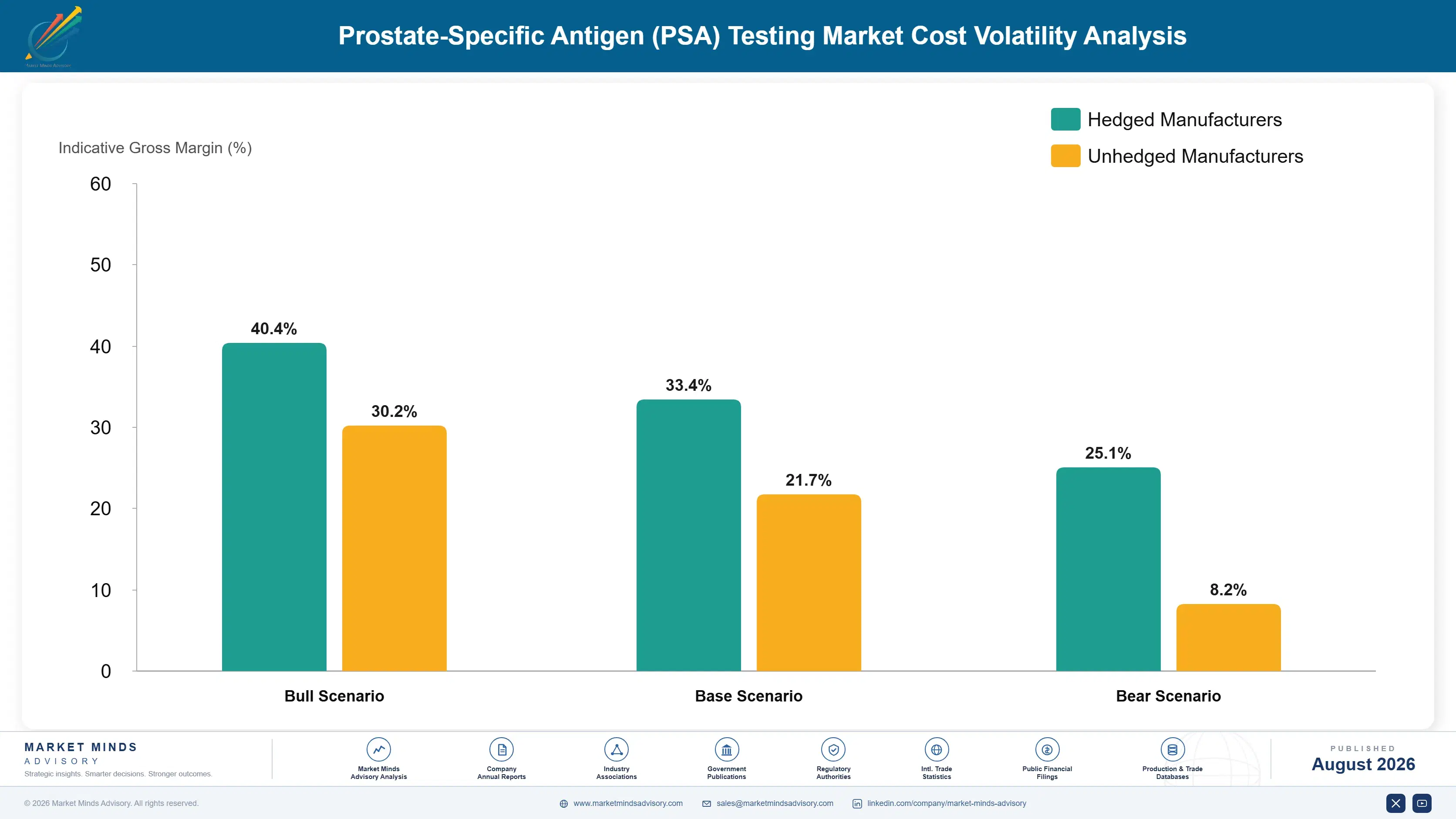
Monoclonal antibodies and recombinant calibrator antigen together account for roughly 22% of delivered test cost, supplied by a short list of qualified producers in the United States, Germany and increasingly China. Magnetic microparticles and reaction consumables add another 12%. Cold chain distribution and kit assembly contribute 9%. Instrument service sits outside test cost of goods and is the larger commitment, since placement economics depend on it.
The 2021 and 2022 diagnostic reagent squeeze showed how tightly this cost base is coupled to unrelated demand. Antibody, plastic and cold chain capacity were absorbed by coronavirus testing, and routine immunoassay menus were rationed behind it. Roche and Abbott both disclosed reagent and consumable constraints in annual reports covering that period. The impact was menu prioritisation rather than price: suppliers protected high-value assays and let routine tests go short.

Exposure varies by supplier integration, and the mechanism is antibody sourcing. Companies producing their own monoclonals against internally held clones controlled supply through the squeeze. Those buying from contract producers were rationed behind larger customers, sometimes behind competitors. Chinese suppliers with domestic antibody chains faced least disruption, which is part of why their share gains accelerated then rather than later.
prostate-specific-antigen-psa-testing-market-cost-volatility-analysis-1787309200470

Produce critical monoclonals internally rather than contracting

Antibody supply decided who kept shipping through the last squeeze, and contract producers allocate by customer size rather than by clinical importance. Bringing critical clones in house costs capital and years of capability, and removes the dependency most likely to interrupt a menu. The suppliers who had done it before 2021 were the ones still supplying.

Qualify second sources for magnetic particles and consumables

Reaction consumables and magnetic microparticles are less glamorous than antibodies and just as capable of stopping production. Qualification requires assay revalidation and regulatory notification measured in quarters, so it has to be done before scarcity rather than during it. Suppliers with dual-qualified consumable sources maintained menu breadth while single-sourced competitors rationed lower-value tests. Cost is modest either way.

Structure placement economics around service cost reality

Reagent rental placements commit a supplier to eight years of service on an instrument whose contribution depends on volume nobody can guarantee. Modelling placement economics on realistic rather than optimistic volume, and pricing service into the reagent stream explicitly, prevents the placements that look like wins and lose money quietly for a decade. Optimism is expensive here.

Portfolio Architecture for Margin Defence

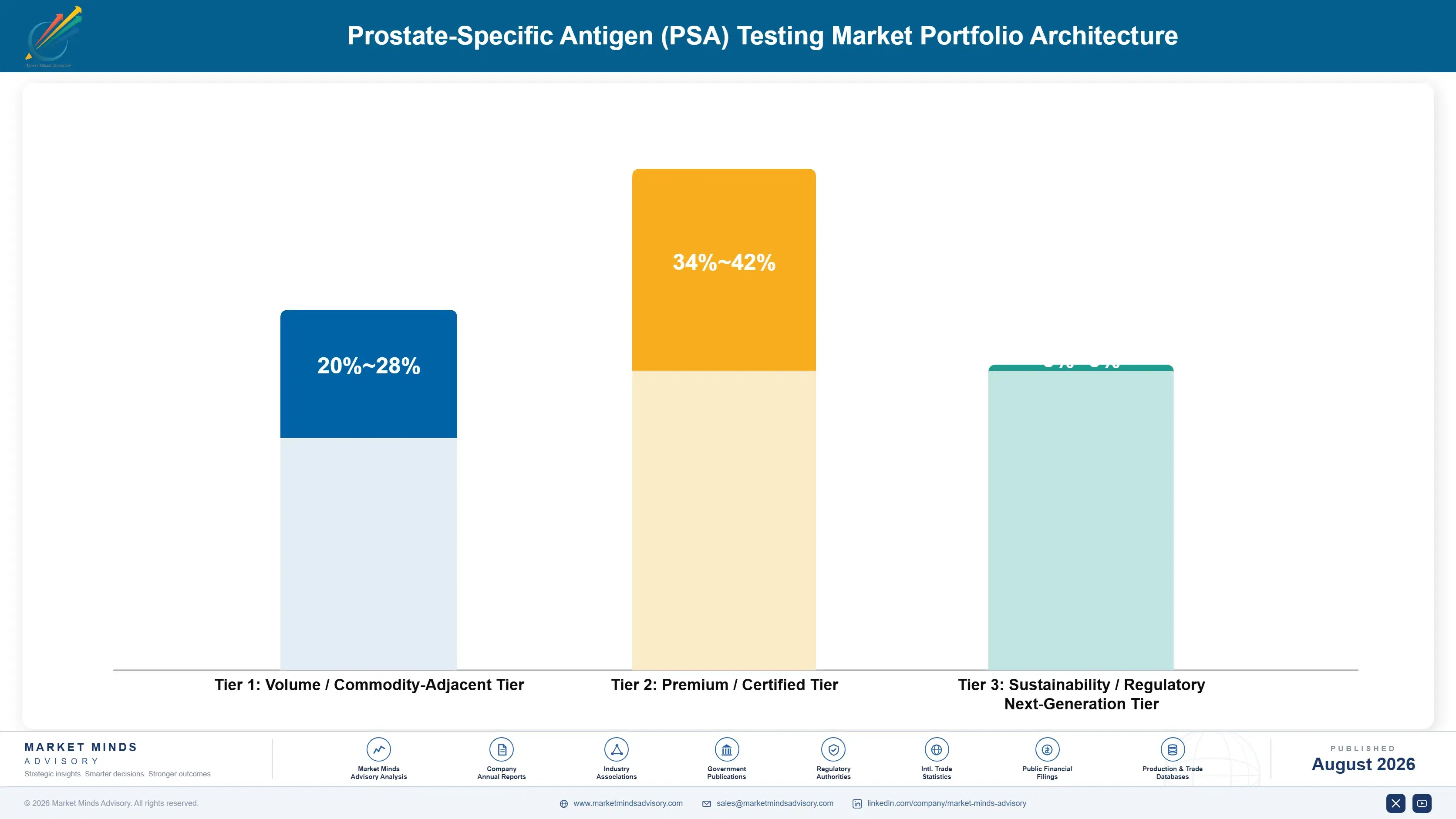
Portfolio economics separate almost entirely on pathway position rather than on assay complexity. Total PSA measurement earns gross margin in the high fifties on closed platforms and considerably less on tendered emerging market volume, because the analyser was the investment. Reflex panels earn far more, priced at twenty to thirty times a single measurement and defended by reimbursement listings that take years to obtain. Point-of-care testing sits lowest, competing on device cost in settings w
The tension is that routine volume justifies the analyser placement while reflex panels earn the return, and the two are ordered by different clinicians. Primary care orders total PSA and never orders a panel. Urology orders panels and rarely initiates the first measurement. A supplier organised around laboratory purchasing reaches the first conversation and frequently never has the second, which is where most of the available revenue per patient actually sits.

High-value pools concentrate in three places: reflex panels with reimbursement listings, active surveillance monitoring where measurement recurs indefinitely, and Japanese and Gulf markets where reflex testing is reimbursed and pricing holds. None is large in test counts. Each is defended by reimbursement position rather than by assay performance.

Volume / Commodity-Adjacent Tier

Total PSA and complexed PSA measurement on tendered emerging market platforms, plus point-of-care tests competing on device cost. Award turns on reagent price and platform placement terms, and Chinese suppliers set the reference price across an expanding set of markets.
Gross Margin: 34-42%

Premium / Certified Tier

Total and free PSA measurement running on closed developed-market immunoassay platforms, where the installed analyser rather than assay merit determines supply. Margin comes from platform captivity, and the ten-point range reflects the gap between reference network contracts and smaller hospital laboratories.
Gross Margin: 54-64%

Sustainability / Regulatory / Next-Generation Tier

Multi-kallikrein panels and isoform index assays carrying reimbursement listings, plus reduced cold chain and dry reagent formats that European procurement increasingly scores. The thirteen-point range reflects the gap between listed panels and formats still recovering development cost.
Gross Margin: 68-81%
prostate-specific-antigen-psa-testing-market-portfolio-architecture-1787309200964

High-value Sub-segments and Strategic Watch-out

Reimbursed multi-kallikrein panels

The highest-value pool in the category, priced at twenty to thirty times the assay that triggers it and defended by reimbursement listings that take years to obtain. Imaging competing for the same pathway step is the genuine threat. Scanner capacity decides that contest, not evidence.
Gross Margin: 70-81%

Active surveillance monitoring volume

Roughly three measurements per patient annually, indefinitely, across a population expanding as guidelines move away from treating low-grade disease. No screening policy decision touches it. Suppliers focused on the diagnostic decision point largely ignore this annuity entirely. Reaching it needs nothing they do not already sell, only a different conversation.
Gross Margin: 56-64%

Closed platform routine measurement

Still the largest segment by test count and revenue, captive to analysers placed years ago and repricing only at replacement. It funds the service infrastructure that placement economics depend upon. Growth is slow and the position is genuinely difficult to attack. Replacement cycles are the only opening competitors get.
Gross Margin: 54-64%

Chinese platform tender expansion

Domestic Chinese analyser suppliers moving beyond home placements into Southeast Asian, Gulf and Latin American tenders at prices no multinational cost base supports. It reads as a domestic phenomenon still. Each tender won removes eight years of reagent annuity from somebody else. Each win removes an annuity from somebody else.
Gross Margin: 30-38%

How Testing Demand Actually Repeats

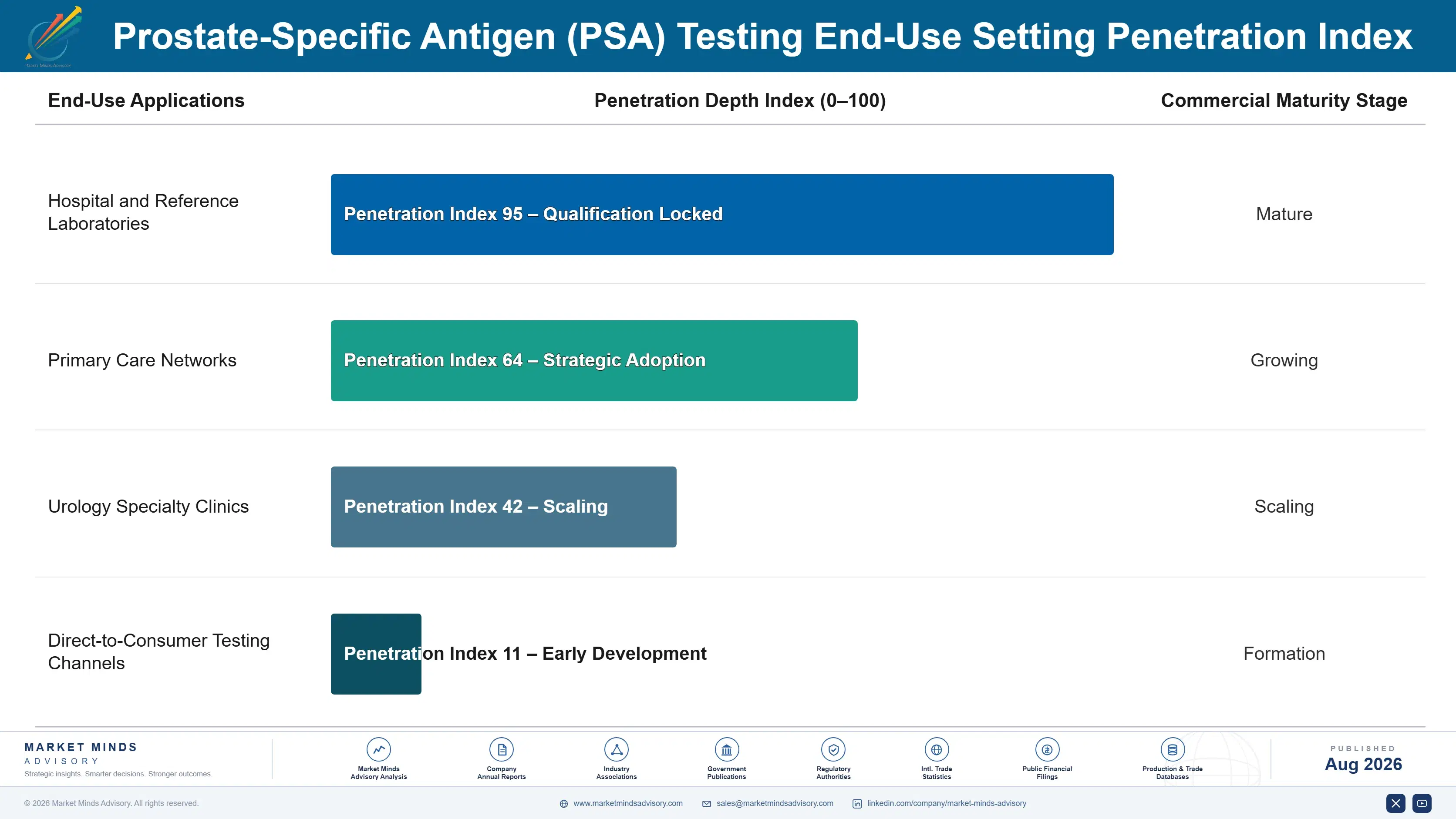
This is an annuity attached to hardware rather than to patients. Roughly 81% of measurement runs on closed platforms, so once an analyser is placed the reagent revenue arrives for eight years with no further selling. Surveillance patients add a second annuity of roughly three measurements annually, indefinitely, and that one is attached to a person rather than an instrument. What varies is whether a supplier holds the platform, the panel listing, or both.
Adoption depth varies sharply by clinical setting. Urology practice adopts reflex panels deepest, since the ordering decision follows an elevated result and the biopsy avoidance argument lands with the clinician who would perform it. Primary care orders total PSA and adopts almost nothing beyond it, because panel ordering sits outside its referral pattern. Private chains across Asia and Latin America adopt PSA inside screening packages with no urological involvement. Public organised programmes adopt whatever the protocol specifies and nothing else.

Buyer profiles are shifting in ways that favour reflex testing. Urologists trained after the overtreatment debate reach for a triage step before biopsy as a matter of routine. Their predecessors biopsied on the total result and clinical judgement for twenty years.
prostate-specific-antigen-psa-testing-market-end-use-penetration-index-1787309201455

What We Would Do Here

These are among the four positions where our research anticipates prominent divergence between winners and laggards over the coming forecast period. Each is grounded in the demand model, the regulatory perimeter, and the announced capacity pipeline.
01 / PATHWAY POSITION DEFENCE

Place the panel before imaging, not against it

Reflex panels priced at twenty to thirty times a single measurement hold that value only while they sit ahead of imaging in the pathway, and roughly 30% of reflex revenue has already moved to radiology where scanner capacity permits. Positioning panels as a gate on scanner access has secured reimbursement in systems where the direct comparison had already failed. Suppliers arguing that a serum assay outperforms MRI are losing an argument they never needed to have, and losing the pricing with it.
02 / PLATFORM PLACEMENT DISCIPLINE

Win the analyser and the test follows for years

With roughly 81% of testing captive to closed platforms, the assay contest is settled at instrument placement and never revisited until replacement roughly eight years later. Lifetime reagent value on a mid-volume analyser runs several times the instrument price, which justifies aggressive placement terms that look uncomfortable in the year they are signed and sensible for the eight years afterwards. The discipline required is modelling volume realistically, because optimistic placements lose money quietly for a decade before anybody reviews them.
03 / REIMBURSEMENT LISTING FOCUS

Pursue listings country by country, not publications

Reflex assays generate revenue when a payer lists them and not when a journal publishes them, and the Japanese isoform listing demonstrated how completely that single decision determines regional position. Listing work is slow, unglamorous and country-specific, which is exactly why most competitors under-invest in it relative to clinical evidence generation. Suppliers holding listings in three large systems earn more from the same assay than those holding publications in thirty journals, which is a resourcing decision rather than a scientific one.
04 / SURVEILLANCE ANNUITY CAPTURE

Sell into surveillance cohorts, not only diagnosis

Active surveillance generates roughly three measurements per patient annually for years, across a population growing every time guidelines move further from treating low-grade disease. Around 40% of newly diagnosed low-risk cases now enter surveillance rather than immediate treatment of any kind. Suppliers organised entirely around the biopsy decision point are ignoring a recurring annuity that no screening policy reversal could ever take away, and reaching it requires nothing they do not already sell, only a conversation with urologists managing those cohorts.

Engagement Snapshot From the Field

A live engagement with an industry participant carrying material or product regulatory and market exposure ahead of a defining policy shift, showing how our research translates into a defensible multi-year portfolio strategy.
MARKET MINDS ADVISORY · CLIENT ENGAGEMENT SUMMARY
Prostate-Specific Antigen (PSA) Testing Producer Strategic Portfolio Review and Transition Roadmap 2026·Investment Scenario on Prostate-Specific Antigen (PSA) Testing Exposure Evaluation 2025-26
CLIENT PROFILE
A European in vitro diagnostics company with immunoassay reagent revenue near EUR 290 million annually (client-reported, unverified by MMA), a mid-volume analyser installed base concentrated across Southern and Eastern Europe, and a recently cleared PSA isoform reflex assay with strong published performance data. The company held no reimbursement listing for the reflex assay in any market, and its analyser base sat mostly in laboratories serving primary care rather than urology.
STRATEGIC CHALLENGE
The reflex assay had been launched eighteen months earlier and was selling almost nothing despite performance data comparable to established competitors. Management proposed a further clinical study to strengthen the evidence. The board was unconvinced that evidence was the problem, since the existing publications already exceeded what competitors held when they achieved reimbursement in the same countries.
MMA APPROACH
MMA mapped reflex assay ordering by clinician type across five European markets against the client's analyser placements, then traced how each competing panel had obtained reimbursement listing and what evidence each submission had actually contained. Forty-seven expert interviews with urologists, laboratory directors and payer assessors established who ordered reflex testing and what determined whether a laboratory could offer it at all.
KEY FINDINGS
  1. Reflex panels were ordered almost exclusively by urologists, while the client's analyser base sat in laboratories serving primary care referrals, meaning the assay was installed where nobody ordering it could reach the platform.
  2. Competing panels had achieved reimbursement listing on evidence packages no stronger than the client already held, with the difference sitting entirely in submission strategy and payer engagement rather than in data quality.
  3. Two national payers had never received a submission for the client's assay at all, because responsibility for reimbursement filings sat with a regulatory function that treated listing as optional after clearance.
  4. Urology-serving laboratories in three markets ran competitor platforms exclusively, so reaching them required either licensing the assay or accepting a multi-year analyser replacement wait.
CLIENT PROFILE
A European in vitro diagnostics company with immunoassay reagent revenue near EUR 290 million annually (client-reported, unverified by MMA), a mid-volume analyser installed base concentrated across Southern and Eastern Europe, and a recently cleared PSA isoform reflex assay with strong published performance data. The company held no reimbursement listing for the reflex assay in any market, and its analyser base sat mostly in laboratories serving primary care rather than urology.
STRATEGIC CHALLENGE
The reflex assay had been launched eighteen months earlier and was selling almost nothing despite performance data comparable to established competitors. Management proposed a further clinical study to strengthen the evidence. The board was unconvinced that evidence was the problem, since the existing publications already exceeded what competitors held when they achieved reimbursement in the same countries.
MMA APPROACH
MMA mapped reflex assay ordering by clinician type across five European markets against the client's analyser placements, then traced how each competing panel had obtained reimbursement listing and what evidence each submission had actually contained. Forty-seven expert interviews with urologists, laboratory directors and payer assessors established who ordered reflex testing and what determined whether a laboratory could offer it at all.
KEY FINDINGS
  1. Reflex panels were ordered almost exclusively by urologists, while the client's analyser base sat in laboratories serving primary care referrals, meaning the assay was installed where nobody ordering it could reach the platform.
  2. Competing panels had achieved reimbursement listing on evidence packages no stronger than the client already held, with the difference sitting entirely in submission strategy and payer engagement rather than in data quality.
  3. Two national payers had never received a submission for the client's assay at all, because responsibility for reimbursement filings sat with a regulatory function that treated listing as optional after clearance.
  4. Urology-serving laboratories in three markets ran competitor platforms exclusively, so reaching them required either licensing the assay or accepting a multi-year analyser replacement wait.
RECOMMENDED STRATEGY
Phase 1: Phase 1 (0 to 6 months): Cancel the additional clinical study, and file reimbursement submissions in four markets using the evidence package already held. Phase 2: Phase 2 (6 to 18 months): Redirect analyser placement targeting toward laboratories serving urology referral, and build a small urologist-facing commercial capability. Phase 3: Phase 3 (18 to 36 months): License the reflex assay onto two competitor platforms in markets where analyser displacement is not realistic within the decade.
OUTCOME
The clinical study was cancelled and the budget redirected to reimbursement filings. Two national listings were obtained within four quarters, and reflex assay revenue rose from negligible to roughly 7% of immunoassay revenue (client-reported, unverified by MMA). Licensing discussions opened with one competitor platform owner. Urology-facing selling proved harder to staff than expected.

Frequently Asked Questions

Foundational context covering the market sizes, CAGR, scope, country, region and competition that inform every finding below. This section is provided to cover basics and most often pre-purchase conversations, answered from the MMA Primary Research Dataset.

What is the current size of the Prostate-Specific Antigen (PSA) Testing Market?

MMA sizes the global PSA testing market at USD 1.2 billion in 2025, rising to USD 1.27 billion in 2026. That covers reagent and kit revenue plus reflex panel service fees, excluding analyser hardware.

How large will the Prostate-Specific Antigen (PSA) Testing Market be by 2036?

MMA forecasts USD 2.19 billion by 2036, an expansion multiple of 1.72 times the 2026 base. That represents roughly USD 0.92 billion of incremental value over the forecast period.

What is the CAGR for the Prostate-Specific Antigen (PSA) Testing Market 2026 to 2036?

The base case compounds at 5.6% annually, with a bull case of 6.8% and a bear case of 4.4%. Revenue per patient rather than test count growth drives most of the base case.

Which segment is growing fastest?

Multi-kallikrein panels compound at 8.4%, exactly 1.50 times the market rate. Pricing at twenty to thirty times a single measurement is justified by the biopsies the panel prevents.

Who are the major companies in the Prostate-Specific Antigen (PSA) Testing Market?

Roche Diagnostics, Abbott, Siemens Healthineers, Beckman Coulter and Fujirebio together account for 68% of reported test volume. Fifteen further participants including Snibe, Mindray, OPKO Health and DiaSorin are profiled.

Which country is growing fastest?

India compounds at 8.4%, ahead of every other national market MMA tracks. Private laboratory chains selling PSA inside male health screening packages account for most of that growth.

Report Segmentation Architecture

The full report scope spans multiple orthogonal segmentation dimensions, with cross-tabulated demand data provided for each dimension pair. Coverage extends further to regional breakdowns, trend trajectories, and the competitive detail needed to support segment-level decision-making.

By Assay Type

  • Total PSA Immunoassay
  • Free and Percent-Free PSA Assays
  • Complexed PSA Assays
  • Multi-Kallikrein Panels
  • PSA Isoform Assays
  • Point-of-Care PSA Tests

By End-Use Setting

  • Hospital Central Laboratories
  • Reference and Commercial Laboratory Networks
  • Office Urology Practices
  • Primary Care and Screening Programmes
  • Private Diagnostic Chains and Health Packages

By Platform and Commercial Model

  • Closed Platform Reagent Supply
  • Open Platform and Third-Party Reagents
  • Reagent Rental and Placement Agreements
  • Sendout and Reference Laboratory Service

By Region

  • North America
  • Western Europe
  • East Asia
  • South Asia and Pacific
  • Latin America
  • Middle East and Africa
  • Eastern Europe

Scope, Methodology, and Coverage

Every figure in this report is reproducible from documented input assumptions. The scope below maps the historical period, the forecast horizon, the segmentation dimensions, and the countries covered, alongside the underlying primary and qualitative methodology.
Historical Period
2020 to 2025
Forecast Period
2026 to 2036
Base Year
2025 (USD billions; MMA Primary Research Dataset, August 2026)
Market Definition
The market comprises in vitro diagnostic assays measuring prostate-specific antigen and its molecular forms in serum or plasma, spanning total PSA, free and percent-free PSA, complexed PSA, PSA isoform assays reported individually or as an index, multi-kallikrein panels incorporating PSA measurement, and point-of-care PSA tests. Sizing captures realised reagent and kit revenue plus reflex panel service fees, excluding analyser hardware and service contracts. Prostate imaging, tissue biopsy and histopathology, genomic and urine-based prostate assays that do not measure PSA, and treatment services are outside scope.
Quantitative Units
USD billions (current prices); million reported measurements annually; USD per test at realised reagent price
Segmentation Dimensions
By Assay Type; By End-Use Setting; By Platform and Commercial Model; By Region
Regions Covered
North America, Western Europe, East Asia, South Asia and Pacific, Latin America, Middle East and Africa, Eastern Europe
Countries Covered
USA, China, Germany, France, UK, Japan, South Korea, India, Australia, Canada, Brazil, Mexico, Indonesia, Vietnam, Thailand, Malaysia, UAE, Saudi Arabia, South Africa, Nigeria, Turkey, Poland, Netherlands, Italy, Spain, Sweden, Switzerland, Argentina, Colombia, Singapore, and additional markets relevant to this sector
Key Companies Profiled
Roche Diagnostics, Abbott, Siemens Healthineers, Beckman Coulter, Fujirebio, Bio-Rad Laboratories, QuidelOrtho, Tosoh Corporation, Snibe Diagnostics, Mindray, Autobio Diagnostics, Maccura Biotechnology, Wondfo Biotech, DiaSorin, Randox Laboratories, OPKO Health, Sysmex, Getein Biotechnology, Boditech Med, Trivitron Healthcare.
Quantitative Methodology
Primary survey, n=3,800 respondents, Q4 2025, six countries; demand-side model with trade association cross-validation
Qualitative Methodology
47 expert interviews, Q4 2025; applied to validate demand model assumptions, identify emerging dynamics, and assess competitive positioning
Report Format
PDF and XLSX data workbook (Word format preview document)
Publisher
Market Minds Advisory
Report Code
MMA-2026-HLT-053
Published
August 2026
Contact
sales@marketmindsadvisory.com | www.marketmindsadvisory.com

Purchase the full Prostate-Specific Antigen (PSA) Testing Market Report (2026 to 2036).

The full report sizes the PSA testing market across six assay types, five end-use settings, four platform and commercial models and seven regions, with annual forecasts to 2036 in revenue and reported measurements. It quantifies reflex panel reimbursement status country by country, since listing rather than clinical evidence determines where those assays generate revenue. Twenty participants are assessed on a consistent reported test volume basis, with closed platform installed base mapped separately from assay menu because the two diverge sharply. Imaging competition for the reflex pathway position is modelled against scanner capacity market by market.
Six assay types sized and forecast annually
Reflex panel reimbursement status mapped by country
Twenty participants on consistent test volume basis
Closed platform installed base mapped separately
Imaging competition modelled against scanner capacity
Surveillance monitoring volume quantified as separate annuity

Built For The People Who Decide

From boardroom strategy to bench-side execution, this report is read cover-to-cover by leaders shaping the next decade of their industry, turning demand scenarios, market dynamics and valuation benchmarks into decisions.
CXOs/ Presidents/ VPs/ Managers
M&A and Corporate Development
Strategy Teams and R&D Heads
Procurement and Product Directors
Regulatory and Compliance Leaders
Investor Relations and Equity Analysts