Market Minds Advisory
Poland Property & Casualty Insurance Market

Poland Property & Casualty Insurance Market: Motor Price Discipline, Flood Exposure and the Lines Nobody Is Fighting Over

One insurer holds roughly a third of everything, compulsory motor has been competed down to collective unprofitability, and the lines actually growing are small, state-shaped and largely uncontested by anybody.

Lead Analyst

Published

September 2026

Make Smarter Decisions with Customized Research Insights

Request a free sample report and evaluate market opportunities, growth trends, and competitive dynamics relevant to your business needs.

2025 MARKET VALUE$13.6BMarket Size 2025
2036 FORECAST VALUE$26.9BBase Case , 2026 to 2036
CAGR 2026 TO 20366.4 %Bull 7.6% / Bear 5.2%
INCREMENTAL OPPORTUNITY$12.4BNet 10- year value creation
EXPANSION MULTIPLE1.86x2036 value over 2026 base
Strategic Levers
M&A Pipeline
Regional Outlook
Country Rankings
Competitive Intelligence
Segmental Deep-dive
Call-Us : 91 93563 13602

Executive Snapshot and Market Trajectory

Polish non-life insurance is unusually concentrated and unusually unprofitable in the one line that dominates it. Motor accounts for roughly 51% of premium and has run at or above a 100 combined ratio for most of the last three consecutive years running now.
The competitive shape explains why. PZU holds close to a third of the market on its own and the next four participants together hold most of the rest, which produces a top-heavy structure where price discipline depends almost entirely on what one insurer decides to do. Compulsory motor liability is sold on price alone, brokers intermediate roughly 38% of the premium written, and the customer compares nothing else about the product at all, ever.
Growth sits somewhere else entirely. Agricultural cover expands on a state subsidy reaching 65% of eligible crop premium, and financial lines with cyber grow at 9.6% from a base small enough that almost nobody has bothered to compete there yet. The September 2024 floods in Lower Silesia then reminded every participant that Polish property carries accumulation exposure the pricing had quietly stopped reflecting at any point. Nobody updated the maps.
Market Definition
Gross written premium for non-life insurance underwritten in Poland, covering compulsory and voluntary motor, property and fire, general third-party liability, agricultural cover and financial lines including cyber. Includes business written by domestic carriers and by branches of foreign insurers operating under freedom of establishment. Excludes all life assurance, pension products, and health insurance sold as a life-linked contract.
Base Year Value
$13.6B in 2025 (MMA Primary Research Dataset, August 2026)
Forecast Period
2026 to 2036, eleven discrete annual values
CAGR
6.4% base case. Bull 7.6%. Bear 5.2%.
Fastest Growth Segment
Financial Lines and Cyber Cover: 9.6% CAGR
Fastest Growth Country
India: 8.4% CAGR
Fastest Growth Region
South Asia and Pacific: 8.4% CAGR
Largest Region
Eastern Europe: 87% of 2025 global value
Market Leaders
PZU, ERGO Hestia, Warta, Allianz Polska and Generali Polska lead on gross written non-life premium in Poland. Source: Polish Insurance Association and company annual reports, MMA Analysis.
Primary Survey
n=3,800 procurement and R&D decision-makers, Q4 2025, six countries
Methodology
Demand-side build-up, cross-validated against public data, 47 expert interviews

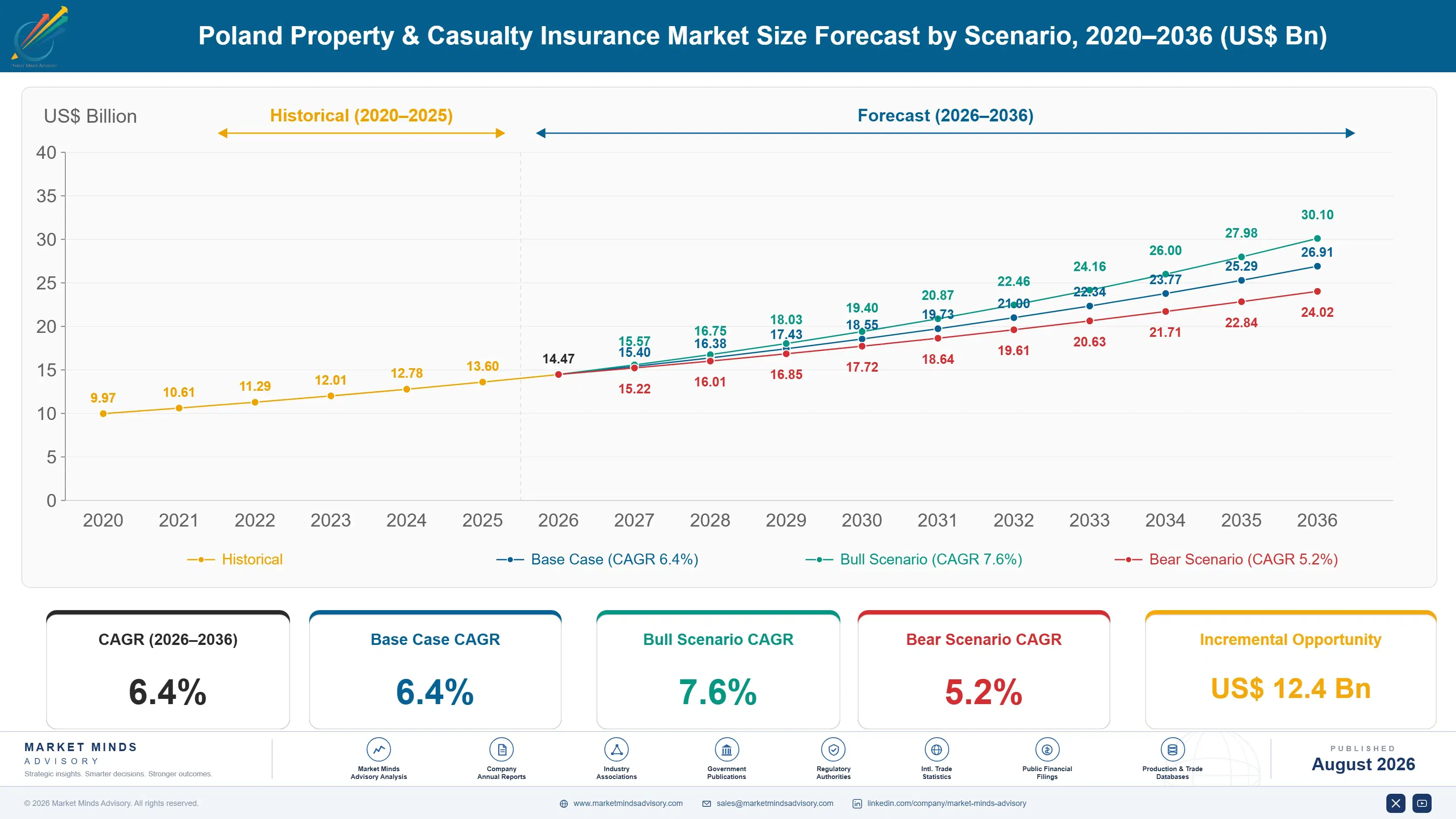
Poland Property & Casualty Insurance Market Forecast Scenarios

property-casualty-insurance-market-in-poland-size-forecast-scenario-1787917292821
The 2020 to 2025 period was shaped by two forces pulling in opposite directions. Motor premium stagnated as competition ground rates down through 2021 and 2022, then repair inflation forced a correction that participants had resisted for years. Property and agricultural lines meanwhile grew steadily on rising sums insured and subsidy uptake. Premium overall compounded near 5.4% across the period, well behind nominal economic growth.
Three mechanisms support the base case. Motor rate correction continues at four to six points annually while carriers rebuild margin against repair cost that outran the tariff. Property sums insured keep rising with construction costs and with the reassessment that followed the 2024 floods. And agricultural uptake expands as subsidy administration improves and as farmers receiving direct payments meet their cover obligation more consistently than they have ever historically done before.
The bull catalyst is cyber and financial lines scaling faster than expected as NIS2 obligations reach mid-market Polish companies that currently buy nothing. The bear risk is another price war in compulsory motor: the market has done it twice before, it required supervisory attention to stop the last time, and the concentration that makes discipline possible also makes it fragile.

One Dominant Insurer And A Compulsory Line That Does Not Pay

Poland runs one of the more concentrated non-life markets in the European Union, with the five largest carriers holding around 72% of premium and PZU alone accounting for close to a third. That structure has consequences the market rarely states: pricing discipline in compulsory motor depends on the largest participant choosing to hold rate, and when it chose otherwise the market followed downward within two quarters.
MARKET CONCENTRATION CR572%Share of non life premium held by leaders
MOTOR COMBINED RATIO101%Claims and expenses measured against earned motor premium
NON LIFE PENETRATION2.5%Non life premium measured against national economic output
MOTOR SHARE OF PREMIUM51%Portion of non life premium written on motor
AGRICULTURAL SUBSIDY RATE65%Maximum state contribution toward eligible crop premium cost
BROKER DISTRIBUTION SHARE38%Premium intermediated by brokers rather than tied agents
Compulsory motor liability is where the volume sits and where the money is not. The Act on Compulsory Insurance requires every registered vehicle to carry it, the product is legally identical across carriers, and price is the only visible variable. Combined ratios have hovered at or above 100 since 2022, and the direct settlement arrangement run through the Polish Insurance Association changed how claims are handled, not what they cost.
The rest of the market behaves quite differently. Property and general liability carry genuine underwriting margin, agricultural cover grows on a subsidy structure that reaches 65% of eligible crop premium, and financial lines including cyber remain small enough that competition is light. Non-life penetration sits near 2.5% of national output, well under the Western European average, which is why growth is available at all.
"Polish insurers have spent a decade proving that a compulsory product sold on price alone converges on zero margin for everybody. The interesting question is why so little capital has moved toward the lines where nobody is fighting."
Director, Central European Non-Life Practice · MMA Financial Services and Insurance Practice · August 2026

Market Trends

Flood Reassessment Reshapes Property Pricing Assumptions

The September 2024 flooding across Lower Silesia and the Klodzko valley produced concentrated losses in towns whose risk maps had not been revisited in years. Carriers had priced flood exposure off historical return periods that the event comprehensively invalidated, and the reserving that followed was uncomfortable for several participants. Property pricing has since moved toward catchment-level assessment rather than postcode banding, and reinsurance treaties repriced at the following renewal. Sums insured are also rising because rebuild costs climbed faster than the policy schedules tracking them did. The maps themselves had not been revisited in a generation.
Market Impact: Adds 5% annual premium increases
Cyber Cover Reaches Polish Mid-Market Companies

NIS2 transposition obligations have pushed cyber security onto the agenda of Polish manufacturers, logistics operators and local government bodies that previously treated it as a large-corporate concern. Insurance uptake follows compliance work with a lag of roughly two years, so the demand arriving now was created by regulatory pressure applied earlier. Capacity is thin, underwriting expertise thinner, and most Polish carriers front the risk while reinsuring almost all of it. That arrangement earns commission rather than underwriting margin, which few participants acknowledge openly. Ceding commission is not the same thing as underwriting profit.
Market Impact: Covers 65% of eligible premium

Market Opportunities and Growth Drivers

Motor Repair Inflation Forces Overdue Rate Correction

Average motor premium has risen four to six points annually since 2023 after several years in which carriers absorbed repair cost increases rather than pass them on. Parts sourced in euros against a zloty premium base, sensor-laden bumpers requiring calibration, and rising bodyshop labour rates all pushed severity well beyond what the tariff assumed. The correction held because the largest participant led it rather than resisted it, which is the only mechanism that has ever produced rate discipline in this market at all. Nobody else in this market could have led it.
Market Impact: Holds combined ratio above 100%

Agricultural Subsidy Structure Expands Crop Cover Uptake

State support covering up to 65% of eligible crop premium, combined with the cover obligation attached to direct payments, has steadily widened agricultural insurance participation across Polish farming. Uptake had lagged the legal requirement for years because enforcement was light and farmers doubted claims would pay. Improved subsidy administration and several visible drought and hail settlements have changed that perception measurably. The line remains volatile and weather-driven, but it grows on policy count rather than on rate, which is a different and healthier thing entirely. Policy count growth is the healthier kind.
Market Impact: One carrier holds 33% share

Market Restraints and Challenges

Compulsory Motor Competes Purely On Visible Price

The Act on Compulsory Insurance makes motor liability legally identical across every carrier, so there is nothing to compare except the number. The root cause is product standardisation intended to protect accident victims, which succeeded, and which simultaneously removed every basis for differentiation an underwriter might use. Combined ratios sit at or above 100 as a result. Carriers mitigate by bundling own damage cover, by building direct claims handling that improves the experience rather than the price, and by cross-selling property into the motor base. None of it changes the underlying comparison.
Market Impact: Raises flood zone rates 18%

Concentration Makes Price Discipline Fragile Rather Than Stable

With one carrier holding close to a third of the market, rate discipline exists only while that participant wants it to. The root cause is a market structure inherited from a single dominant state insurer that was never fully diluted by entrants. When the leader has chased volume, the rest of the market followed within two quarters and margin vanished across every participant simultaneously. Mitigation is limited: carriers diversify into lines the leader emphasises less, build broker relationships, and hold capital against the cycle they cannot control. That cycle has run twice already.
Market Impact: Adds 14% annual policy growth
3 additional market trends, 4 additional growth drivers, and 2 additional restraints and challenges are covered in the full report. Contact sales@marketmindsadvisory.com to access the complete intelligence.

Segment CAGR and Growth Architecture

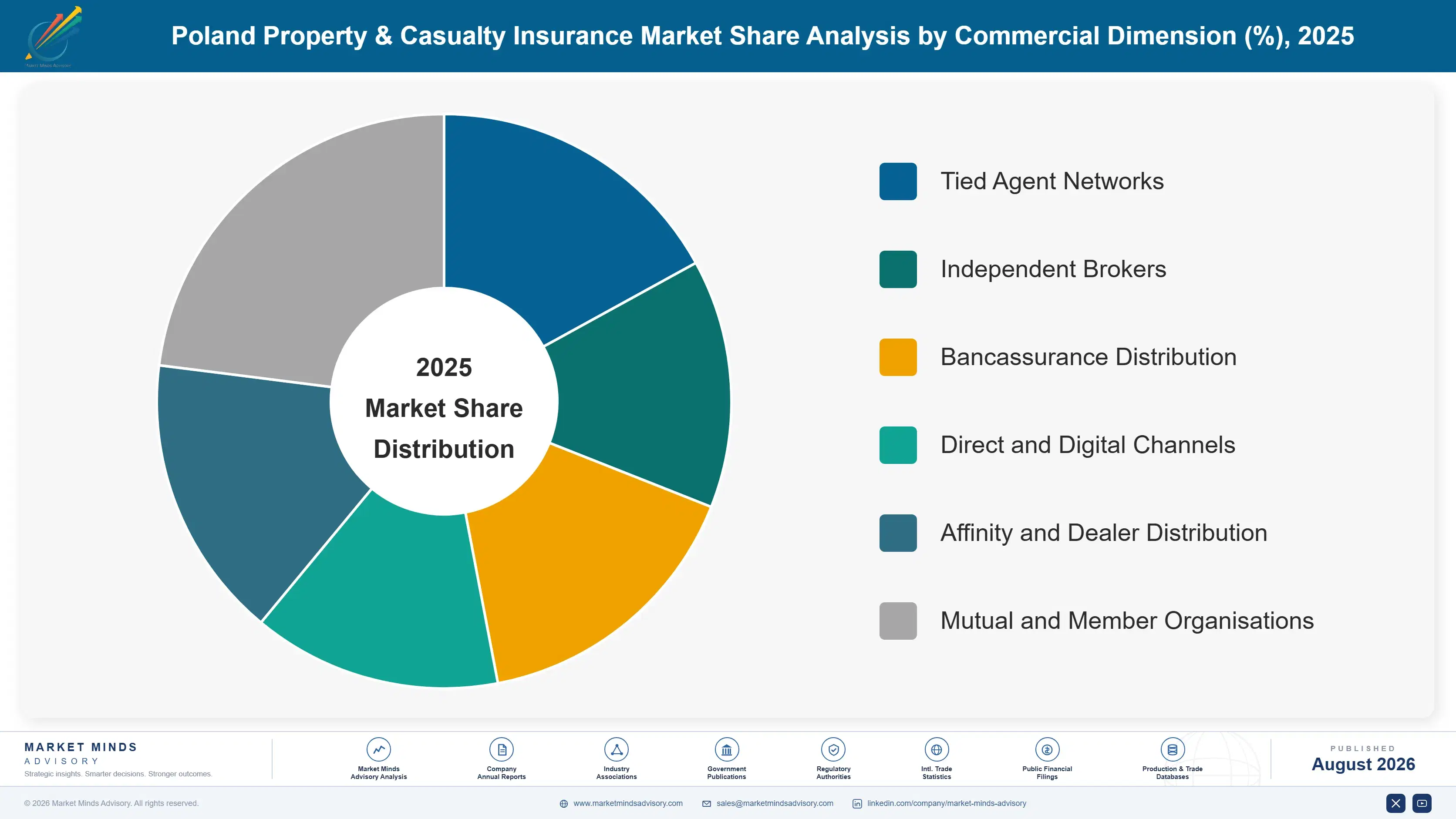
Segmentation follows line of business, which is how Polish non-life is regulated, reported to the supervisor and managed internally by every participant. Six lines describe the market completely, from the compulsory motor cover that dominates premium through to the financial and cyber lines that barely register within it yet, though they are growing fastest.
property-casualty-insurance-market-in-poland-market-share-analysis-1787917293416

Financial Lines and Cyber Cover

The fastest line grows at 9.6%, half again the market rate of 6.4%, from a base small enough that the percentage flatters it considerably. Demand arrives from NIS2 compliance work reaching Polish mid-market manufacturers, logistics operators and municipal bodies, and from directors liability cover spreading beyond listed companies into private ones. The commercial reality is less flattering than the growth rate. Polish carriers mostly front these risks and reinsure the overwhelming majority abroad, so what they earn is ceding commission rather than underwriting margin. Building genuine retained capacity requires claims data nobody in this market yet holds, and the participant that develops it first will end up pricing everybody else out entirely.
CAGR 9.6%

Agricultural Insurance

Agricultural cover grows at 7.8% and behaves unlike anything else in the portfolio. State subsidy reaching 65% of eligible crop premium, combined with the obligation attached to direct payments, has widened participation steadily among farms that previously carried nothing. Growth comes through policy count rather than rate, which makes it more durable than a tariff-driven expansion. The difficulty is volatility: hail, drought and frost losses arrive in concentrated years rather than smoothly, so a carrier needs either substantial reinsurance or a diversified book to survive a bad season. Participants without genuine agronomic underwriting capability have repeatedly discovered this the expensive way. Weather does not average out politely inside a single underwriting year.
CAGR 7.8%
Full segment breakdown across 6 segments available in the complete report.

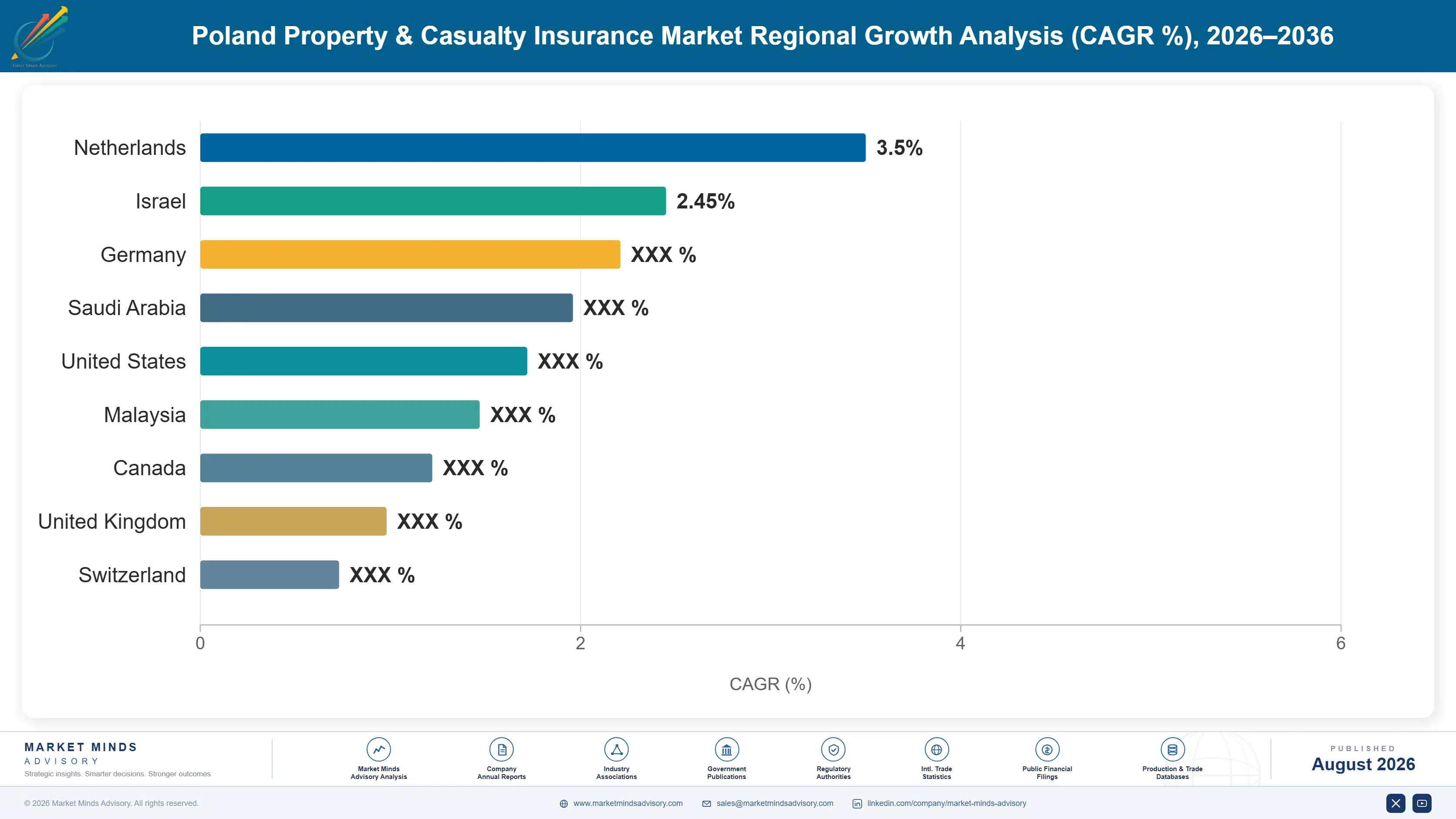
Regional Architecture and Country Demand Map

This is a Polish market and effectively all premium is written domestically. Other regions appear through reinsurance capacity, motor parts supply, offshore administration and the group structures of the Western European insurers operating Polish subsidiaries, none of which generate a single zloty of premium counted within this scope.

North America

Share falls below the standard band because premium follows the risk location and every risk in this report sits in Poland. What flows from North America is reinsurance capacity and catastrophe modelling, both of which mattered considerably more after September 2024 than before it. Flood treaties covering Polish property attach partly with United States and Bermudian reinsurers, and those treaties repriced sharply at the renewal that followed the Lower Silesia event. Several carriers also license pricing and reserving software from North American vendors, which is a growing expense line nobody discusses with policyholders. Polish policyholders see none of this and would not recognise the names of the reinsurers standing behind their cover.
Share: 2% | CAGR: 5.8% (2026 to 2036)

Western Europe

Share sits below the standard band, though the connection here is the strongest of any non-domestic region by a wide distance. ERGO Hestia, Allianz, Generali, UNIQA and Wiener all operate Polish subsidiaries under Western European group ownership, which means capital allocation, reinsurance purchasing and pricing methodology are frequently decided outside Poland. Motor parts are imported and priced in euros against a zloty premium base, so exchange rate movement translates directly into claims cost. Group reporting obligations also shape how Polish results are presented and when reserves get strengthened. Decisions that determine what a Polish policyholder pays are therefore taken in Munich, Paris, Trieste and Vienna as often as they are taken in Warsaw.
Share: 6% | CAGR: 4.8% (2026 to 2036)
Regional intelligence for 5 additional markets available in the complete report: East Asia, South Asia and Pacific, Latin America, Middle East and Africa, Eastern Europe. Contact sales@marketmindsadvisory.com.
property-casualty-insurance-market-in-poland-country-cagr-analysis-1787917293937

Where Polish Underwriting Margin Actually Sits

Four levers move the result without depending on compulsory motor pricing, which no single participant controls. Retained cyber capacity, agronomic underwriting capability, property flood reassessment and cross-selling into the motor base each work on lines where differentiation is still possible and where competition has so far remained comparatively light indeed. Motor is not on the list.

Retain Cyber Risk Instead Of Fronting It

Polish carriers currently cede the overwhelming majority of cyber exposure abroad and earn ceding commission of roughly 25% to 30% rather than underwriting margin. Building retained capacity requires claims data, specialist underwriters and a willingness to hold net exposure through a bad year. The participant that does it first prices from actual Polish loss experience while competitors price from reinsurer guidance, which is a durable advantage in a line growing at 9.6% annually. The barrier is not capital. It is the three years of loss data nobody has yet troubled to accumulate properly.
Market Impact: Converts a 28% ceding commission into underwriting margin

Build Agronomic Underwriting Rather Than Buying Volume

Agricultural cover grows at 7.8% on subsidy-driven policy count, and most participants underwrite it on crop type and region alone. Carriers employing agronomists, using satellite yield monitoring and pricing at field rather than district level report loss ratios eight to twelve points better than those applying district averages. The capability costs perhaps two million zloty annually to build and pays for itself within a single adverse hail season. Most Polish participants have decided repeatedly that agriculture is too volatile to underwrite properly, which is exactly why it remains available. That is the whole opportunity.
Market Impact: Improves the agricultural loss ratio by 10 points

Reprice Flood Exposure At Catchment Level

The September 2024 losses showed that postcode-banded flood pricing understated concentration risk badly across Lower Silesia. Moving to catchment-level assessment using national hydrological data reveals exposure clusters that current portfolios carry without pricing, typically covering 12% to 18% of a property book in affected regions. Repricing those clusters costs volume and buys survivability, and reinsurers now reward the work directly through treaty terms. Carriers that completed the reassessment before the 2025 renewal secured materially better conditions than those still presenting postcode-level data to their reinsurance panels. The data is public and free.
Market Impact: Reprices around 15% of the entire property book

Cross-Sell Property Into The Compulsory Motor Base

Every registered vehicle owner in Poland already holds a motor liability policy, which makes the motor book the largest identified customer list in the country and the least exploited one. Households holding both motor and property cover with a single carrier churn at roughly half the rate of motor-only customers. Cross-sell penetration across the market sits below 20%, against achievable rates near 35% based on bancassurance comparators. The margin arrives from the property line while the retention benefit protects the motor line nobody makes money on. Almost nobody has systematically tried it.
Market Impact: Lifts cross-sell penetration from 20% up to 35%

Who Controls the Margin Pool

Concentration is high and top-heavy. The five largest carriers hold around 72% of non-life premium, with PZU alone accounting for close to a third, making the leader-to-challenger gap the widest in comparable European markets. ERGO Hestia and Warta form a credible second tier, but neither can move the market price. Below them sit foreign-owned subsidiaries and a tail of mutuals competing on niche capability.
Competition currently runs on three dimensions. Distribution reach is the first, since tied agent networks and bancassurance access determine who sees a customer at all. Claims handling quality is the second, and the direct settlement arrangement has made it visible in a way it was not. The third is line diversification, where genuine property, agricultural and financial capability earns what motor-weighted participants cannot.

Pressure is building from two directions at once. Specialist agricultural and financial underwriters are taking business generalists price carelessly, and their advantage is capability, not capital. Foreign group parents are meanwhile reassessing Polish capital allocation after 2024. Rankings move against any carrier weighted heavily toward compulsory motor without a diversified second line, since motor alone has not paid in three years.
property-casualty-insurance-market-in-poland-company-positioning-matrix-1787917294459

Competitive Moat and Risk Dimensions

PZU

Moat: Scale and national agent network

PZU holds close to a third of Polish non-life premium and operates the largest tied agent network in the country, reaching towns where no competitor has any presence. That distribution depth converts directly into motor and property volume and gives the group claims scale nobody else approaches. Rebuilding an equivalent network from nothing is no longer commercially possible in Poland.
PZU

Risk: State ownership constrains commercial freedom

Majority state ownership means strategic decisions carry political weight that a privately held competitor never has to accommodate, and capital deployment has periodically served objectives beyond underwriting return. The group also sets the market price by default, so any margin discipline it wants must be sustained unilaterally. Both constraints limit how aggressively it can respond to specialist competitors.
ERGO HESTIA

Moat: Broker relationships and corporate capability

ERGO Hestia has built the strongest independent broker franchise in Poland and genuine corporate property and liability underwriting capability behind it, which lets it compete for commercial risks that agent-distributed competitors rarely see. Munich Re group ownership supplies reinsurance access and technical support on terms domestic participants cannot obtain. That combination is difficult to assemble from a standing start.
ERGO HESTIA

Risk: Concentrated corporate property exposure

A book weighted toward larger commercial property risks carries accumulation exposure that the September 2024 flooding demonstrated is not fully understood in Polish catchments. Broker-placed business also churns on price at renewal more readily than agent-placed retail cover does. The capability that wins corporate accounts is the same capability that concentrates loss when a regional event arrives.

Players Tracked

Prominent Players

PZU
ERGO Hestia
Warta
Allianz Polska
Generali Polska

Other Key Players

Compensa TU
UNIQA TU
InterRisk TU
Wiener TU
Link4
TUZ Ubezpieczenia
Balcia Insurance
PKO Ubezpieczenia
Signal Iduna Polska
TUW PZUW
Pocztowe TUW
Allianz Trade
KUKE
Saltus Ubezpieczenia
TU Europa

Recent Developments

SEPTEMBER 2024

Lower Silesia flooding produced the largest property loss in years

Severe flooding across the Klodzko valley and Lower Silesia damaged tens of thousands of properties and vehicles within days, generating the largest concentrated insured loss Polish carriers had faced in over two decades. This was a natural catastrophe event, not a corporate transaction of any kind between participants.
Signal: Flood return period assumptions used across Polish property pricing were invalidated by a single regional weather event.
JANUARY 2025

NIS2 obligations reached Polish mid-market entities

Transposition of the European network and information security directive extended cyber security obligations to mid-sized Polish manufacturers, logistics operators and public bodies previously outside scope. This was regulatory implementation by the state rather than any commercial arrangement, and insurance demand followed the compliance work with a lag.
Signal: Cyber insurance demand in Poland is created by compliance deadlines rather than by any experience of actual losses.
JULY 2025

Motor rate correction held across the market for a second year

Average compulsory motor premium rose for a second consecutive year as carriers passed through repair cost inflation rather than absorbing it, with the largest participant leading rather than resisting the movement. This reflected independent pricing decisions by separate participants, not any agreement, merger or joint venture among them.
Signal: Rate discipline in Polish compulsory motor exists only while the dominant participant chooses to lead it upward.

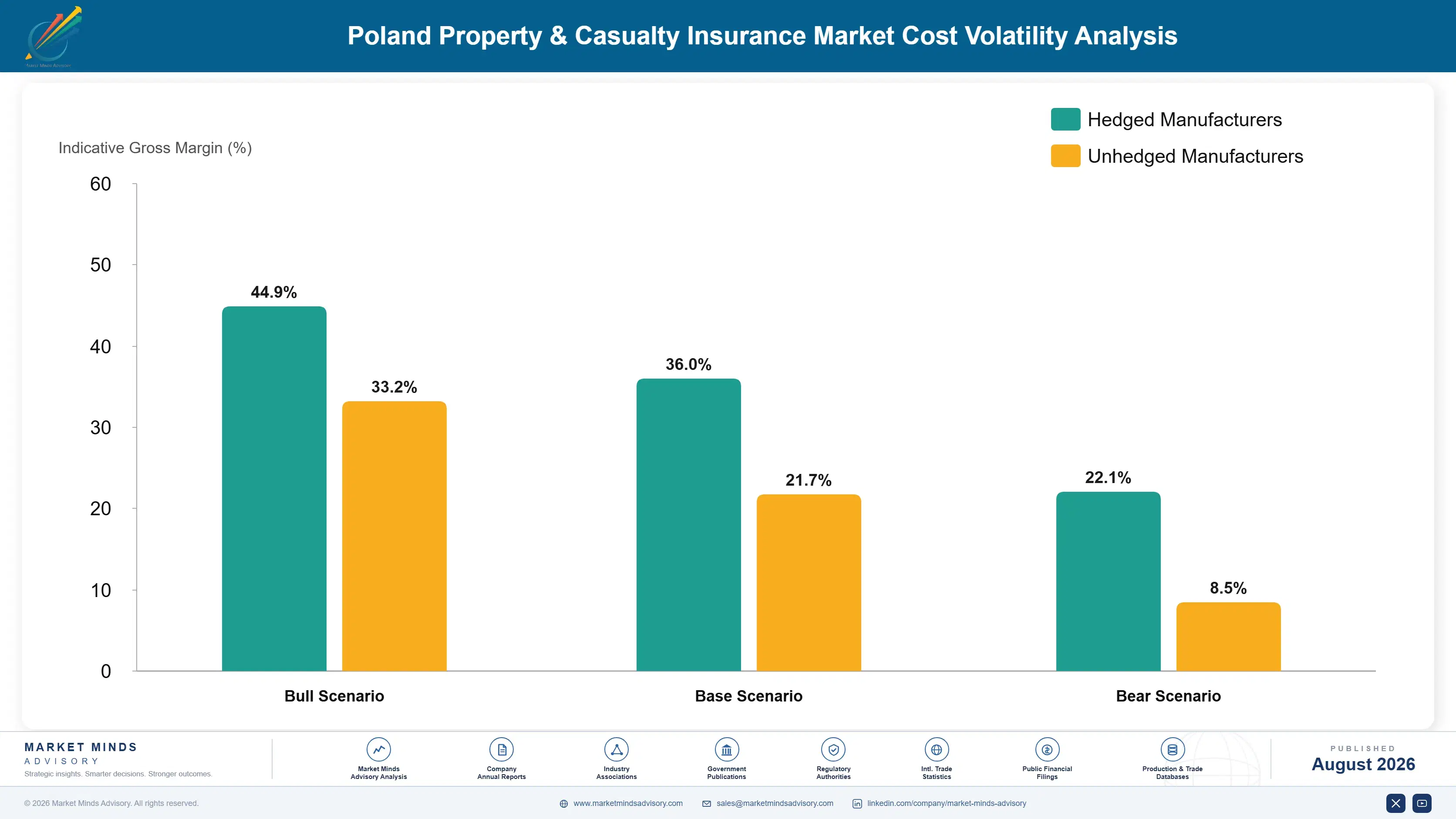
What A Polish Claim Costs Now

Claims cost divides unevenly across the book. Motor repair, covering parts, paint and bodyshop labour, accounts for roughly 38% of total claims, with parts sourced from Western and East Asian manufacturers and invoiced in euros against a zloty base. Bodily injury indemnity runs near 24%, property rebuild materials and construction labour near 26%, and handling expense makes up the remainder.
The September 2024 flooding is the clearest recent illustration of how quickly the cost base moves. Rebuild demand across Lower Silesia concentrated into a few months, construction labour and materials priced accordingly, and settlement costs ran materially above the reserve assumptions carriers had set. PZU disclosed elevated catastrophe claims across that period in its annual report. The event also repriced reinsurance at the following renewal, which raised the fixed cost of writing property across Poland.

Exposure to that cost base varies sharply and the variation decides who competes. Motor-weighted carriers carry the euro parts exposure without any natural currency hedge, since premium arrives in zloty and parts invoice in euros. Property-weighted carriers in flood catchments face reinsurance costs that regionally diversified competitors do not. Foreign-owned subsidiaries obtain group reinsurance terms that standalone domestic participants simply cannot negotiate on their own.
property-casualty-insurance-market-in-poland-cost-volatility-analysis-1787917294657

Approved repair network with parts sourcing terms

Directing motor claims into a contracted network accepting alternative and recycled parts, fixed labour rates and repair duration commitments reduces the euro-denominated part of the loss line directly. Repairers accept those terms in exchange for guaranteed volume across the year. Carriers without sufficient claims throughput cannot obtain comparable conditions from any network at all.

Catchment level flood modelling with treaty realignment

Rebuilding flood exposure assessment on national hydrological catchment data rather than postcode bands reveals concentration that current portfolios carry unpriced. Reinsurers now reward the work directly through improved treaty terms, so the modelling investment returns twice over. Carriers still presenting postcode data at renewal are paying visibly more for identical underlying exposure than better prepared competitors do.

Currency matching between premium and parts exposure

Motor claims settle largely against euro-invoiced parts while premium arrives entirely in zloty, leaving an unhedged exposure that widens whenever the currency moves against the carrier. Matching a portion of technical reserves into euro instruments removes part of that mismatch. Few domestic participants do this systematically, and several have absorbed avoidable losses across recent currency cycles as a direct result.

Portfolio Architecture for Margin Defence

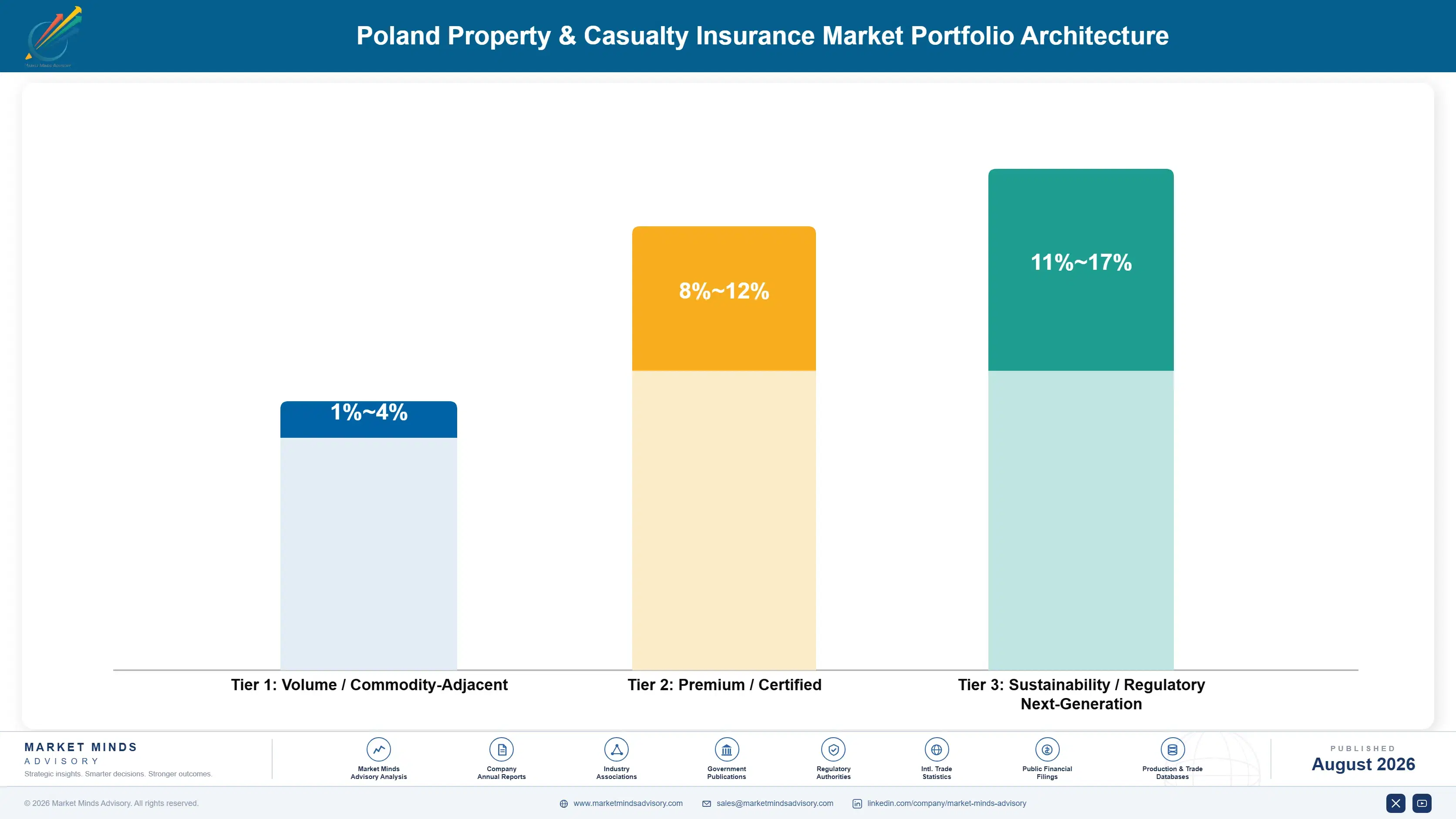
The Polish non-life portfolio separates cleanly by whether the product can be differentiated at all. Compulsory motor liability cannot: it is legally identical across carriers, compared on price alone, and has returned nothing worth reporting for three consecutive years. Participants hold it because it delivers scale, customer identification and the claims volume that makes repair network terms obtainable, not because the line itself pays anybody.
Margin concentrates where underwriting judgement still matters. Property, general liability and motor own damage all reward genuine assessment capability, and a carrier that prices flood catchments properly or understands a manufacturing occupancy earns what a generalist does not. The tension is that these lines are smaller than motor and grow more slowly than the specialist lines above them, so they sustain a business without transforming it in any direction.

The highest-value pools sit in lines most participants have declined to build. Financial lines, cyber and properly underwritten agriculture all carry margins motor cannot approach, and each requires capability rather than capital. That is why they remain available: the barrier is three years of accumulated loss data and a specialist team, which is a harder thing to buy than it sounds.

Volume / Commodity-Adjacent

Compulsory motor third-party liability sold through agents, brokers and comparison channels. Legally identical across carriers, compared on price alone, and running at or above a 100 combined ratio since 2022. Held for scale and claims volume rather than margin.
Gross Margin: 1-4%

Premium / Certified

Property, general third-party liability and motor own damage, where underwriting assessment still differentiates. Range spans four points because property margin depends heavily on flood catchment exposure and on whether reinsurance was placed before or after the 2024 event.
Gross Margin: 8-12%

Sustainability / Regulatory / Next-Generation

Financial lines, cyber and agronomically underwritten agricultural cover. Range spans six points because retained versus fronted cyber positions produce entirely different economics, and agricultural results swing on weather across individual seasons rather than averaging smoothly.
Gross Margin: 11-17%
property-casualty-insurance-market-in-poland-portfolio-architecture-1787917295181

High-value Sub-segments and Strategic Watch-out

Financial Lines and Cyber Cover

High value and high growth at 9.6%, driven by NIS2 compliance reaching mid-market entities. The four point range separates carriers retaining risk from those fronting and ceding it, which produces completely different margin on identical premium written. The premium written looks entirely identical either way.
Gross Margin: 14-18%

Agricultural Insurance

High value with moderate growth at 7.8%, expanding on subsidy-driven policy count rather than rate. The five point range reflects weather volatility across seasons and the genuine gap between agronomic underwriting and district average pricing among participants. Weather across the season decides the rest of it.
Gross Margin: 6-11%

Compulsory Motor Liability

The volume core and the reason claims scale exists at all. Legally standardised, compared purely on price, and dependent for any discipline at all on whether the dominant participant chooses to lead rates upward in a given year. No participant can realistically leave it behind.
Gross Margin: 1-4%

Flood Exposed Property Book

The strategic watch-out rather than a growth pool. September 2024 invalidated the return period assumptions underpinning Polish flood pricing, and portfolios written before that reassessment carry concentration that nobody has yet fully quantified or repriced properly. Reinsurers noticed considerably faster than the carriers themselves did.
Gross Margin: Variable

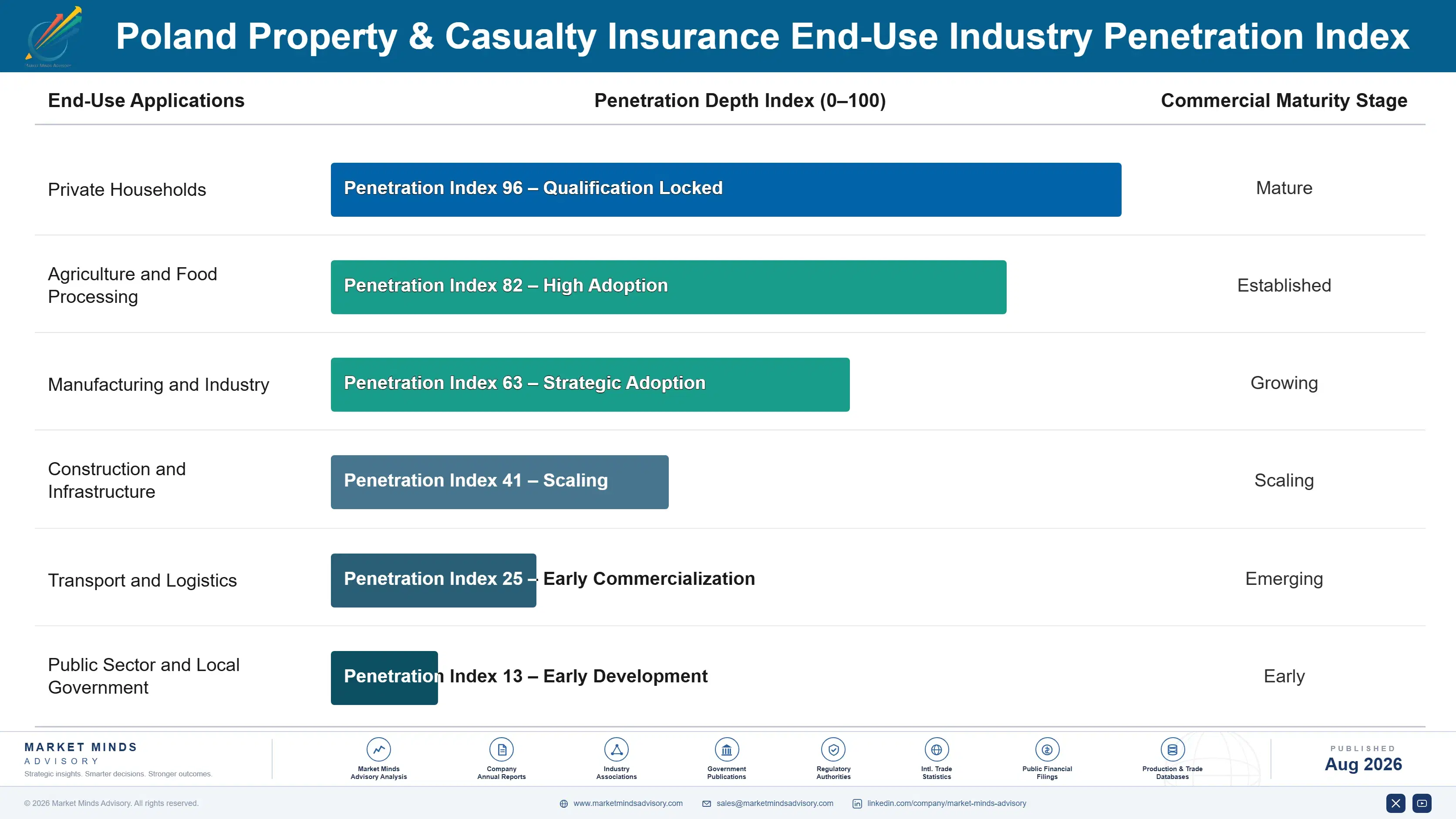
Why Polish Premium Keeps Arriving

Compulsory motor liability generates annuity economics that require no marketing at all. Every registered vehicle must carry it under the Act on Compulsory Insurance, the guarantee fund maintains a database against which enforcement runs, and penalties for lapsing are severe enough to keep evasion contained. Premium arrives annually across a parc exceeding 27 million vehicles regardless of satisfaction or economic conditions, which is why nobody has exited the line despite its returns.
Adoption depth varies enormously by end use. Corporate property and liability buyers renew through brokers on multi-year relationships and rarely move on price alone. Agricultural buyers renew because direct payment eligibility depends on it, which makes their demand as reliable as compulsory motor and better priced. Retail property buyers, by contrast, remain under-insured relative to rebuild cost and frequently lapse entirely once a mortgage requirement disappears from their obligations.

Buyer profiles are shifting as the population and the economy change. Younger urban Poles increasingly hold no vehicle and rent rather than own property, which removes them from two compulsory or quasi-compulsory demand pools simultaneously. Mid-market companies previously outside any regulatory perimeter are entering it through NIS2 and reporting obligations. No Polish carrier currently serves both movements convincingly.
property-casualty-insurance-market-in-poland-end-use-penetration-index-1787917295670

Where Polish Underwriting Margin Returns

These are among the four positions where our research anticipates prominent divergence between winners and laggards over the coming forecast period. Each is grounded in the demand model, the regulatory perimeter, and the announced capacity pipeline.
01 / RETAINED CYBER CAPACITY

Stop fronting the fastest growing line in the market

Polish carriers cede the overwhelming majority of cyber exposure abroad and earn ceding commission near 28% rather than any underwriting margin on a line growing at 9.6% annually. Building retained capacity needs specialist underwriters, net exposure tolerance through one bad year, and roughly three years of accumulated Polish loss data that nobody in this market has yet troubled to gather. Capital is not really the barrier here, and the first participant to price from domestic experience will price competitors out entirely.
02 / AGRONOMIC UNDERWRITING CAPABILITY

Price agriculture at field level, not district average

Agricultural cover grows at 7.8% on subsidy-driven policy count, and most Polish participants still underwrite it on crop type and administrative region alone with no field-level assessment at all. Carriers employing agronomists and satellite yield monitoring report loss ratios running eight to twelve points better than those applying district averages across a season. The capability costs around two million zloty annually and repays itself within one adverse hail year, which most competitors have decided repeatedly is not worth attempting at all.
03 / FLOOD EXPOSURE REASSESSMENT

Move flood pricing from postcode bands to catchments

September 2024 comprehensively invalidated the return period assumptions underpinning Polish property pricing right across Lower Silesia and well beyond it, exposing concentration that postcode-banded rating had simply never captured properly at all. Catchment-level assessment built on national hydrological data typically identifies exposure clusters covering 12% to 18% of a property book across the affected regions. Repricing those clusters costs volume and buys survivability, and reinsurers now reward the completed work directly through visibly better treaty terms at the following renewal negotiation.
04 / MOTOR BASE CROSS-SELLING

The compulsory book is an unexploited customer list

Every vehicle owner in Poland already holds a motor liability policy, which makes the motor book the largest identified customer list in the country and easily the least exploited one anywhere. Households holding motor and property with a single carrier churn at roughly half the rate of motor-only customers across the market. Cross-sell penetration sits below 20% against achievable rates near 35%, so the margin comes from the property line while retention protects the one nobody profits from at all.

Engagement Snapshot From the Field

A live engagement with an industry participant carrying material or product regulatory and market exposure ahead of a defining policy shift, showing how our research translates into a defensible multi-year portfolio strategy.
MARKET MINDS ADVISORY · CLIENT ENGAGEMENT SUMMARY
Poland Property & Casualty Insurance Producer Strategic Portfolio Review and Transition Roadmap 2026·Investment Scenario on Poland Property & Casualty Insurance Exposure Evaluation 2025-26
CLIENT PROFILE
A Polish non-life insurer writing predominantly compulsory motor through a tied agent network across central and eastern voivodeships, holding a position outside the top five by gross written premium. The business had grown policy count consistently for six years while underwriting result deteriorated, and management could not agree internally whether the problem was pricing, claims cost or the composition of the book itself.
STRATEGIC CHALLENGE
The board needed a diversification path that did not require abandoning the motor volume its claims economics depended on, and could not establish which alternative lines the company had any realistic capability to underwrite. Previous attempts at property and agricultural expansion had both produced losses that management attributed to bad luck rather than to any absence of technical capability.
MMA APPROACH
MMA decomposed five years of results by line, attributing acquisition cost, claims development and reinsurance spend to each, then benchmarked the client's agricultural and property underwriting practice against participants achieving better loss ratios in the same regions. Expert interviews with brokers, agronomists and reinsurance intermediaries established what capability was genuinely obtainable at the client's scale rather than in principle.
KEY FINDINGS
  1. Motor had generated no cumulative underwriting profit across the entire five-year period examined, while consuming roughly 71% of capital allocated across the whole business.
  2. Agricultural losses attributed internally to weather were traceable to district average pricing on farms whose field-level exposure differed substantially from the district they sat within.
  3. Property flood exposure in two voivodeships was concentrated far beyond what postcode-band pricing had assumed, representing an unpriced accumulation the reinsurance programme did not adequately cover.
  4. Cross-sell penetration from the motor base into property stood at 14%, against 31% achieved by a comparable regional competitor using the same agent distribution model.
CLIENT PROFILE
A Polish non-life insurer writing predominantly compulsory motor through a tied agent network across central and eastern voivodeships, holding a position outside the top five by gross written premium. The business had grown policy count consistently for six years while underwriting result deteriorated, and management could not agree internally whether the problem was pricing, claims cost or the composition of the book itself.
STRATEGIC CHALLENGE
The board needed a diversification path that did not require abandoning the motor volume its claims economics depended on, and could not establish which alternative lines the company had any realistic capability to underwrite. Previous attempts at property and agricultural expansion had both produced losses that management attributed to bad luck rather than to any absence of technical capability.
MMA APPROACH
MMA decomposed five years of results by line, attributing acquisition cost, claims development and reinsurance spend to each, then benchmarked the client's agricultural and property underwriting practice against participants achieving better loss ratios in the same regions. Expert interviews with brokers, agronomists and reinsurance intermediaries established what capability was genuinely obtainable at the client's scale rather than in principle.
KEY FINDINGS
  1. Motor had generated no cumulative underwriting profit across the entire five-year period examined, while consuming roughly 71% of capital allocated across the whole business.
  2. Agricultural losses attributed internally to weather were traceable to district average pricing on farms whose field-level exposure differed substantially from the district they sat within.
  3. Property flood exposure in two voivodeships was concentrated far beyond what postcode-band pricing had assumed, representing an unpriced accumulation the reinsurance programme did not adequately cover.
  4. Cross-sell penetration from the motor base into property stood at 14%, against 31% achieved by a comparable regional competitor using the same agent distribution model.
RECOMMENDED STRATEGY
Phase 1: Phase one: rebuild flood exposure assessment on catchment data and realign the reinsurance programme before the next treaty renewal negotiation begins. Phase 2: Phase two: recruit agronomic underwriting capability and reprice the agricultural book at field level rather than by broad administrative district. Phase 3: Phase three: launch structured property cross-selling through the existing agent network, targeting the motor renewal conversations already taking place anyway.
OUTCOME
The client reported a 4.1 point improvement in overall combined ratio within five quarters (client-reported, unverified by MMA), with agricultural loss ratio improving by nine points and cross-sell penetration reaching 23%. Reinsurance costs fell despite the harder market, which the reinsurance panel attributed directly to the quality of the catchment exposure data presented.

Frequently Asked Questions

Foundational context covering the market sizes, CAGR, scope, country, region and competition that inform every finding below. This section is provided to cover basics and most often pre-purchase conversations, answered from the MMA Primary Research Dataset.

What is the current size of the Poland Property & Casualty Insurance Market?

The market is valued at USD 13.6 billion in 2025, measured as gross written non-life premium underwritten in Poland. Motor accounts for roughly 51% of that total across compulsory and voluntary cover.

How large will the Poland Property & Casualty Insurance Market be by 2036?

MMA forecasts USD 26.91 billion by 2036, up from USD 14.47 billion in 2026. That represents incremental premium of USD 12.44 billion and an expansion multiple of 1.86 times.

What is the CAGR for the Poland Property & Casualty Insurance Market 2026 to 2036?

The base case CAGR is 6.4%, with a bull case of 7.6% and a bear case of 5.2%. Non-life penetration near 2.5% of national output leaves genuine room for expansion.

Which segment is growing fastest?

Financial lines and cyber cover grows at 9.6%, half again the market rate of 6.4%. NIS2 compliance obligations reaching mid-market Polish entities drive most of that demand.

Who are the major companies in the Poland Property & Casualty Insurance Market?

PZU, ERGO Hestia, Warta, Allianz Polska and Generali Polska lead on gross written non-life premium, holding around 72% between them. PZU alone accounts for close to a third.

Which country is growing fastest?

India grows fastest at 8.4%, reflecting expanding offshore administration and actuarial support for Central European operations rather than premium written outside Poland. All Polish risk is underwritten domestically.

Report Segmentation Architecture

The full report scope spans multiple orthogonal segmentation dimensions, with cross-tabulated demand data provided for each dimension pair. Coverage extends further to regional breakdowns, trend trajectories, and the competitive detail needed to support segment-level decision-making.

By Line of Business

  • Motor Third-Party Liability
  • Motor Own Damage
  • Property and Fire
  • General Third-Party Liability
  • Agricultural Insurance
  • Financial Lines and Cyber

By End-Use Industry

  • Private Households
  • Agriculture and Food Processing
  • Manufacturing and Industry
  • Construction and Infrastructure
  • Transport and Logistics
  • Public Sector and Local Government

By Commercial Dimension

  • Tied Agent Networks
  • Independent Brokers
  • Bancassurance Distribution
  • Direct and Digital Channels
  • Affinity and Dealer Distribution
  • Mutual and Member Organisations

By Region

  • North America
  • Western Europe
  • East Asia
  • South Asia and Pacific
  • Latin America
  • Middle East and Africa
  • Eastern Europe

Scope, Methodology, and Coverage

Every figure in this report is reproducible from documented input assumptions. The scope below maps the historical period, the forecast horizon, the segmentation dimensions, and the countries covered, alongside the underlying primary and qualitative methodology.
Historical Period
2020 to 2025
Forecast Period
2026 to 2036
Base Year
2025 (USD billions; MMA Primary Research Dataset, August 2026)
Market Definition
Gross written premium for non-life insurance underwritten in Poland, spanning compulsory motor third-party liability, motor own damage, property and fire, general third-party liability, agricultural cover and financial lines including cyber and directors liability. Business written by domestic carriers and by branches of foreign insurers under freedom of establishment is included. All life assurance, pension products and life-linked health contracts are excluded from scope.
Quantitative Units
USD billions, gross written premium
Segmentation Dimensions
Line of business, end-use industry, commercial distribution dimension, region
Regions Covered
North America, Western Europe, East Asia, South Asia and Pacific, Latin America, Middle East and Africa, Eastern Europe
Countries Covered
Poland, with reinsurance and parts supply exposure across Western Europe, North America and East Asia
Key Companies Profiled
PZU, ERGO Hestia, Warta, Allianz Polska, Generali Polska, Compensa TU, UNIQA TU, InterRisk TU, Wiener TU, Link4
Quantitative Methodology
Primary survey, n=3,800 respondents, Q4 2025, six countries; demand-side model with trade association cross-validation
Qualitative Methodology
47 expert interviews, Q4 2025; applied to validate demand model assumptions, identify emerging dynamics, and assess competitive positioning
Report Format
PDF and XLSX data workbook (Word format preview document)
Publisher
Market Minds Advisory
Report Code
MMA-2026-TEC-361
Published
August 2026
Contact
sales@marketmindsadvisory.com | www.marketmindsadvisory.com

Purchase the full Poland Property & Casualty Insurance Market Report (2026 to 2036).

The full report examines Polish non-life insurance as a market where one participant sets the price of the dominant line and the profitable business sits in lines almost nobody has built capability to underwrite. It quantifies the motor combined ratio problem, traces the euro parts exposure against a zloty premium base, and models what the September 2024 flooding did to property pricing assumptions and reinsurance cost. Segment analysis covers all six lines of business with particular attention to cyber fronting economics and agronomic underwriting. Competitive assessment ranks twenty participants on gross written non-life premium. Regional coverage addresses reinsurance, parts supply and offshore administration as genuine cost transmission channels.
Six line of business segmentation with growth rates
Motor combined ratio decomposition by cost component
Twenty participant assessment on non-life premium
Catchment level flood exposure repricing analysis
Cyber fronting versus retained capacity economics
Cross-sell penetration benchmarks against regional comparators

Built For The People Who Decide

From boardroom strategy to bench-side execution, this report is read cover-to-cover by leaders shaping the next decade of their industry, turning demand scenarios, market dynamics and valuation benchmarks into decisions.
CXOs/ Presidents/ VPs/ Managers
M&A and Corporate Development
Strategy Teams and R&D Heads
Procurement and Product Directors
Regulatory and Compliance Leaders
Investor Relations and Equity Analysts