Market Minds Advisory
India Property and Casualty Insurance Market

India Property and Casualty Insurance Market: FDI Liberalization and the Global Underwriting Cycle

India's FDI liberalization to 100% ownership is pulling global insurers toward a market still under-penetrated after decades of state dominance, while catastrophe losses worldwide force property insurers to reprice risk faster than regulators can approve.

Lead Analyst

Published

September 2026

Make Smarter Decisions with Customized Research Insights

Request a free sample report and evaluate market opportunities, growth trends, and competitive dynamics relevant to your business needs.

2025 MARKET VALUE$2650MMarket Size 2025
2036 FORECAST VALUE$4826MBase Case , 2026 to 2036
CAGR 2026 TO 20365.6 %Bull 6.9% / Bear 4.3%
INCREMENTAL OPPORTUNITY$2027MNet 10- year value creation
EXPANSION MULTIPLE1.72x2036 value over 2026 base
Strategic Levers
M&A Pipeline
Regional Outlook
Country Rankings
Competitive Intelligence
Segmental Deep-dive
Call-Us : 91 93563 13602

Executive Snapshot and Market Trajectory

India's property and casualty insurance market sits at a genuine inflection point. Regulatory reform now permits full foreign ownership for the first time, state-run insurers still command the largest share, and a population entering the middle class for the first time is buying coverage it has never owned before.
Health and personal accident insurance leads growth at 9.5% annually, nearly 1.7 times the market average, as rising medical cost awareness and post-pandemic risk consciousness pull first-time buyers into the category. Crop insurance follows closely on government-backed scheme expansion. North America holds the largest global share at 38%, reflecting the sheer scale of American liability exposure and catastrophe-driven property premiums that dwarf every other single region's insurance economy.
Competitive intensity concentrates around underwriting discipline and distribution reach rather than brand alone, since combined ratio management and digital distribution capability separate profitable insurers from growth-chasing ones. Allianz and ICICI Lombard command scale and regulatory relationships, but specialist insurers like New India Assurance and Bajaj Allianz hold local distribution depth that global carriers have not matched, keeping India's fastest-growing segments genuinely contested despite the FDI liberalization reshaping ownership structures across the industry.
Market Definition
The property and casualty insurance market covers non-life insurance products underwriting risk against property damage, liability, accident, and related perils, including motor, health and personal accident, fire and property, marine and transit, crop, and liability and engineering insurance lines, sized globally with particular emphasis on India as a high-growth, low-penetration market. It excludes life insurance, standalone health insurance sold as a life-adjacent product in some jurisdictions, and reinsurance placed by primary insurers.
Base Year Value
$2650M in 2025 (MMA Primary Research Dataset, August 2026)
Forecast Period
2026 to 2036, eleven discrete annual values
CAGR
5.6% base case. Bull 6.9%. Bear 4.3%.
Fastest Growth Segment
Health and Personal Accident Insurance: 9.5% CAGR
Fastest Growth Country
India: 13.8% CAGR
Fastest Growth Region
South Asia and Pacific: 7.8% CAGR
Largest Region
North America: 38% of 2025 global value
Market Leaders
Allianz SE, AXA S.A., Zurich Insurance Group, ICICI Lombard General Insurance Company, New India Assurance Company. Source: MMA Analysis based on company annual reports.
Primary Survey
n=3,800 procurement and R&D decision-makers, Q4 2025, six countries
Methodology
Demand-side build-up, cross-validated against public data, 47 expert interviews

India Property and Casualty Insurance Market Forecast Scenarios

property-casualty-insurance-market-in-india-size-forecast-scenario-1787913983946
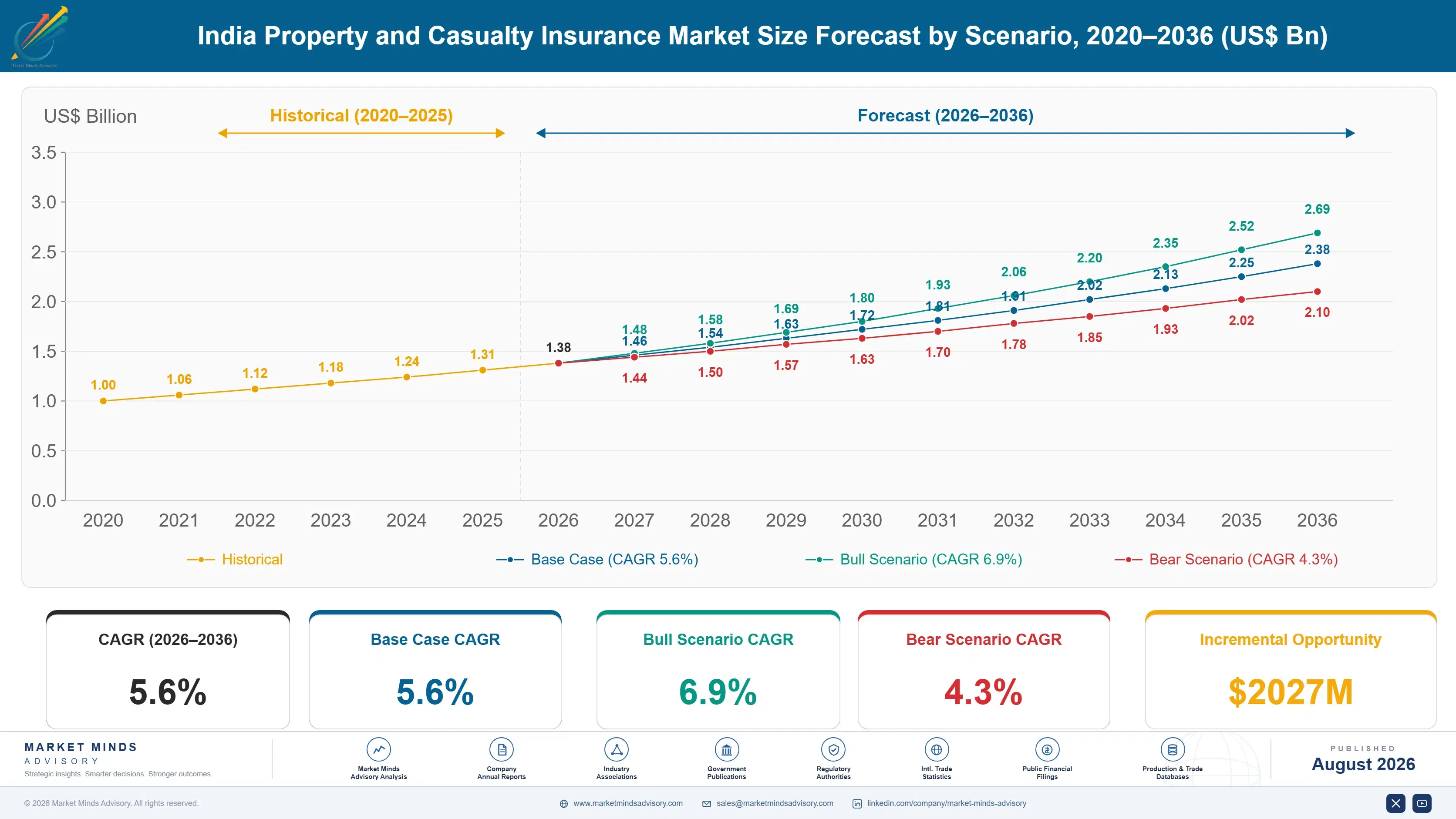
Between 2020 and 2025 the market grew at an estimated 4.8% annually, held back early by pandemic-era claims volatility and economic uncertainty that slowed new policy sales, then accelerating from 2022 onward as catastrophe-driven rate hardening lifted premium income even as underlying policy volume grew more modestly. Growth stayed concentrated in health and motor lines through most of the period, with property insurance lagging behind rate adequacy.
The base case carries the market to 5.6% CAGR through 2036 on three mechanisms. India's FDI liberalization to 100% foreign ownership is pulling global capital into a market still growing from a low penetration base. Rising catastrophe frequency keeps forcing rate hardening in property lines, lifting premium independent of exposure growth. Health and personal accident insurance keeps compounding as medical cost inflation and risk awareness pull first-time buyers into coverage across emerging and developed markets.
The bull case reaches 6.9% if additional emerging markets replicate India's FDI liberalization ahead of schedule, pulling forward global capital deployment. The bear case falls to 4.3% if catastrophe losses outpace insurers' ability to reprice risk fast enough, a mismatch already visible in several 2023 and 2024 property lines, compressing underwriting margins that currently fund growth investment.

Regulatory Liberalization Is Redrawing Who Can Compete

Three forces converge on this category. Regulation is opening ownership structures that were closed for decades, catastrophe losses keep forcing property insurers to reprice risk faster than many regulators can approve, and emerging market penetration keeps expanding the addressable base independent of any single country's growth cycle. Insurers that treat these as three separate problems are already behind the ones treating them as one connected underwriting challenge.
MARKET CONCENTRATIONCR5: 22%Top five insurers hold roughly a fifth of premium
INDUSTRY COMBINED RATIO98.5%Claims and expenses relative to premium collected industrywide
INDIA INSURANCE PENETRATION4.2% of GDPNon-life premium as a share of national output
DIGITAL DISTRIBUTION SHARE31%Policies sold through direct digital channels rather than agents
REINSURANCE CESSION RATE24%Share of gross premium ceded to reinsurance partners
CLAIMS AND ACQUISITION COST76% of premiumClaims payouts and commissions dominate total premium outflow
Commercial character splits sharply between mature and emerging markets. Developed insurance markets compete on underwriting discipline and combined ratio management in a largely saturated buyer base, while emerging markets like India compete on distribution reach and first-time buyer acquisition in a genuinely expanding base. The emerging tier offers volume growth potential, but the mature tier commands materially better absolute premium scale and underwriting profitability today.
Looking to 2036, three shifts matter most. Foreign ownership liberalization will keep reshaping who can compete in previously closed markets like India, catastrophe-driven repricing will increasingly separate disciplined underwriters from growth-chasing ones, and digital distribution will become a genuine competitive battleground as first-time buyers skip traditional agent channels entirely across most major urban markets today.
"Everyone's watching the FDI headline. The bigger story is that India's insurers are underwriting a population that has never filed a claim before, and that inexperience cuts both ways: it's a growth opportunity and a pricing risk in the same policy."
Director, Insurance and Financial Services Practice · MMA Financial Services and Insurance Practice · August 2026

Market Trends

India Opens Insurance Sector To 100% Foreign Ownership

India's Parliament passed amendments raising the foreign direct investment cap in insurance from 74% to 100%, removing the joint-venture requirement that had constrained global insurer entry for over two decades. The reform allows foreign insurers to establish wholly owned subsidiaries for the first time, subject to retaining a share of profits and meeting solvency requirements set by the insurance regulator. Global carriers including Allianz and AXA have both signaled interest in expanding their existing India joint ventures into wholly owned structures, while several insurers previously absent from India are evaluating market entry for the first time in the reform's wake.
Market Impact: Penetration sits near 4.2% of GDP
Climate Catastrophe Losses Force Global Property Repricing

Global insured catastrophe losses have exceeded USD 100 billion annually in recent years, driven by increasing frequency of severe convective storms, wildfires, and flooding events that actuarial models built on historical data did not fully anticipate. Property insurers across North America and Europe have responded with double-digit rate increases in catastrophe-exposed regions, while some carriers have withdrawn entirely from the highest-risk coastal and wildfire-prone markets rather than continue underwriting at unprofitable rates. Reinsurers have passed similar cost increases through to primary insurers, compressing margins for carriers that cannot reprice fast enough to match rising claims severity.
Market Impact: Registers over 20 million annual vehicles

Market Opportunities and Growth Drivers

Low Insurance Penetration Leaves India Vast Runway

India's non-life insurance penetration sits at roughly 1% of GDP, and total insurance penetration including life products remains near 4.2%, well below the global average of 7% and below developed markets exceeding 10%. The Insurance Regulatory and Development Authority of India has set a goal of insurance for every citizen by 2047, the centenary of Indian independence, backing that ambition with liberalized foreign investment rules and simplified product approval processes. Rising middle-class income, expanding vehicle ownership, and growing awareness of health and property risk are pulling first-time buyers into formal insurance products at a pace few other economies can match.
Market Impact: Pushes combined ratios above 100%

Mandatory Third-Party Motor Liability Expands Vehicle Parc

Vehicle ownership across emerging markets keeps expanding as rising incomes make first-time car and two-wheeler purchases affordable, and most jurisdictions require third-party liability motor insurance as a legal condition of vehicle registration and road use. India alone registers well over 20 million new vehicles annually, and mandatory third-party coverage means motor insurance volume tracks vehicle sales mechanically regardless of insurance awareness or penetration trends. Comprehensive motor coverage, which adds own-damage protection beyond the mandatory liability minimum, remains a discretionary upsell that insurers are bundling with value-added services like roadside assistance to lift attachment rates beyond the minimum requirement.
Market Impact: Limits pricing among 1 billion+ underinsured

Market Restraints and Challenges

Catastrophe Volatility Squeezes Property Underwriting Profitability

Property insurers face frequency and severity of catastrophe losses that actuarial models calibrated on decades of weather data underestimate, pushing combined ratios above threshold in catastrophe-exposed lines more often than pricing models assumed. The root cause: warming ocean temperatures and shifting patterns are changing loss distributions faster than actuaries can recalibrate pricing models. This has forced major insurers to withdraw from the highest-risk coastal and wildfire-prone markets rather than underwrite at rates regulators will approve. Insurers are responding with parametric insurance products, increased reinsurance cession, and catastrophe bond issuance to spread risk beyond what any balance sheet can absorb.
Market Impact: Raises FDI cap to 100%

Affordability Limits Premium Increases In Emerging Markets

Insurers in price-sensitive emerging markets like India face resistance when raising premiums to levels actuarial models suggest are necessary for underwriting profitability, since much of the addressable population has limited discretionary income for insurance products viewed as optional rather than essential. The root cause is economic: insurance affordability tracks disposable income, and the newly insurable population sits above subsistence spending levels where premium increases risk pricing out first-time buyers. This forces insurers to accept thinner margins on mass-market products than developed-market pricing models support. Insurers are responding with micro-insurance products and coverage options for price-sensitive buyers at lower levels.
Market Impact: Exceeds USD 100 billion annual losses
3 additional market trends, 3 additional growth drivers, and 3 additional restraints and challenges are covered in the full report. Contact sales@marketmindsadvisory.com to access the complete intelligence.

Segment CAGR and Growth Architecture

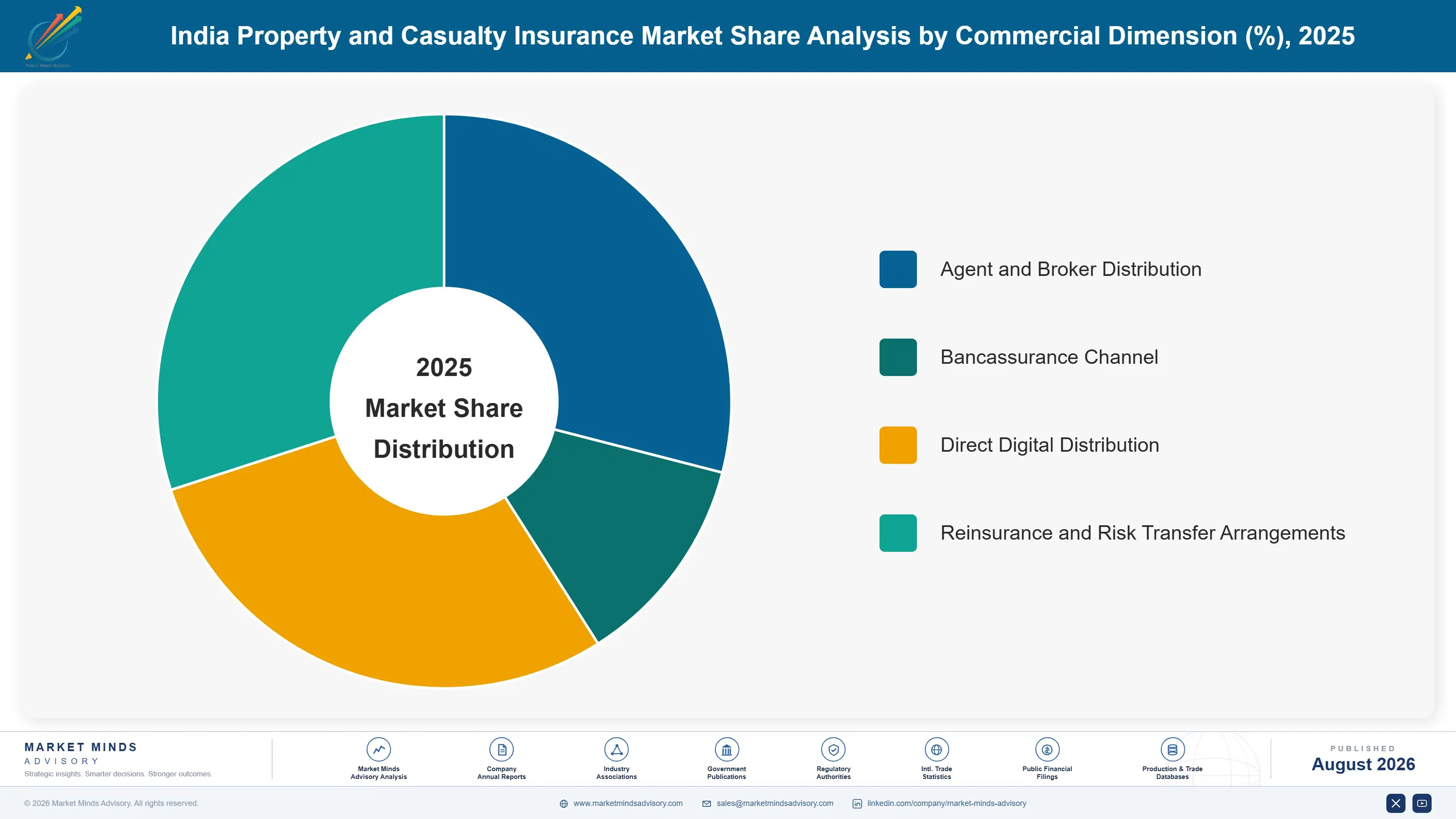
Segmentation follows product line, a single underwriting-risk logic spanning motor, health and personal accident, fire and property, marine and transit, crop, and liability and engineering insurance. Each line carries distinct claims profile, regulatory capital requirement, and distribution channel, so commercial position tracks what risk the policy underwrites and how it is priced and reserved.
property-casualty-insurance-market-in-india-market-share-analysis-1787913984479

Health and Personal Accident Insurance

Health and personal accident insurance grows fastest at 9.5% annually, nearly 1.7 times the overall market rate, as rising medical cost inflation and post-pandemic risk awareness pull first-time buyers into coverage across both emerging and developed markets. India's health insurance segment has expanded rapidly as rising hospitalization costs outpace household savings, while government schemes like Ayushman Bharat extend basic coverage to lower-income populations previously excluded entirely from formal insurance. Standalone health insurers and general insurers offering health riders both compete for this growing pool, with digital-first insurers increasingly using telemedicine partnerships and wellness incentives to differentiate beyond price alone. Claims inflation, driven by rising hospital costs and expanding treatment options, keeps pressuring loss ratios even as premium volume expands.
CAGR 9.5%

Crop and Agricultural Insurance

Crop and agricultural insurance grows second-fastest at 8.2%, driven by government-backed scheme expansion, particularly India's Pradhan Mantri Fasal Bima Yojana, which subsidizes premiums to make coverage affordable for smallholder farmers who previously carried weather risk uninsured. These policies protect against yield loss from drought, flood, pest infestation, and other perils using a mix of traditional indemnity assessment and satellite-based and weather-index parametric triggers that pay out faster than manual crop-loss surveys. Government premium subsidies, which cover a large majority of the total premium in some scheme variants, make this segment dependent on political and fiscal commitment rather than pure market economics. Insurers participating in these schemes accept government-mandated pricing in exchange for guaranteed volume and reduced underwriting risk.
CAGR 8.2%
Full segment breakdown across 6 segments available in the complete report.

Regional Architecture and Country Demand Map

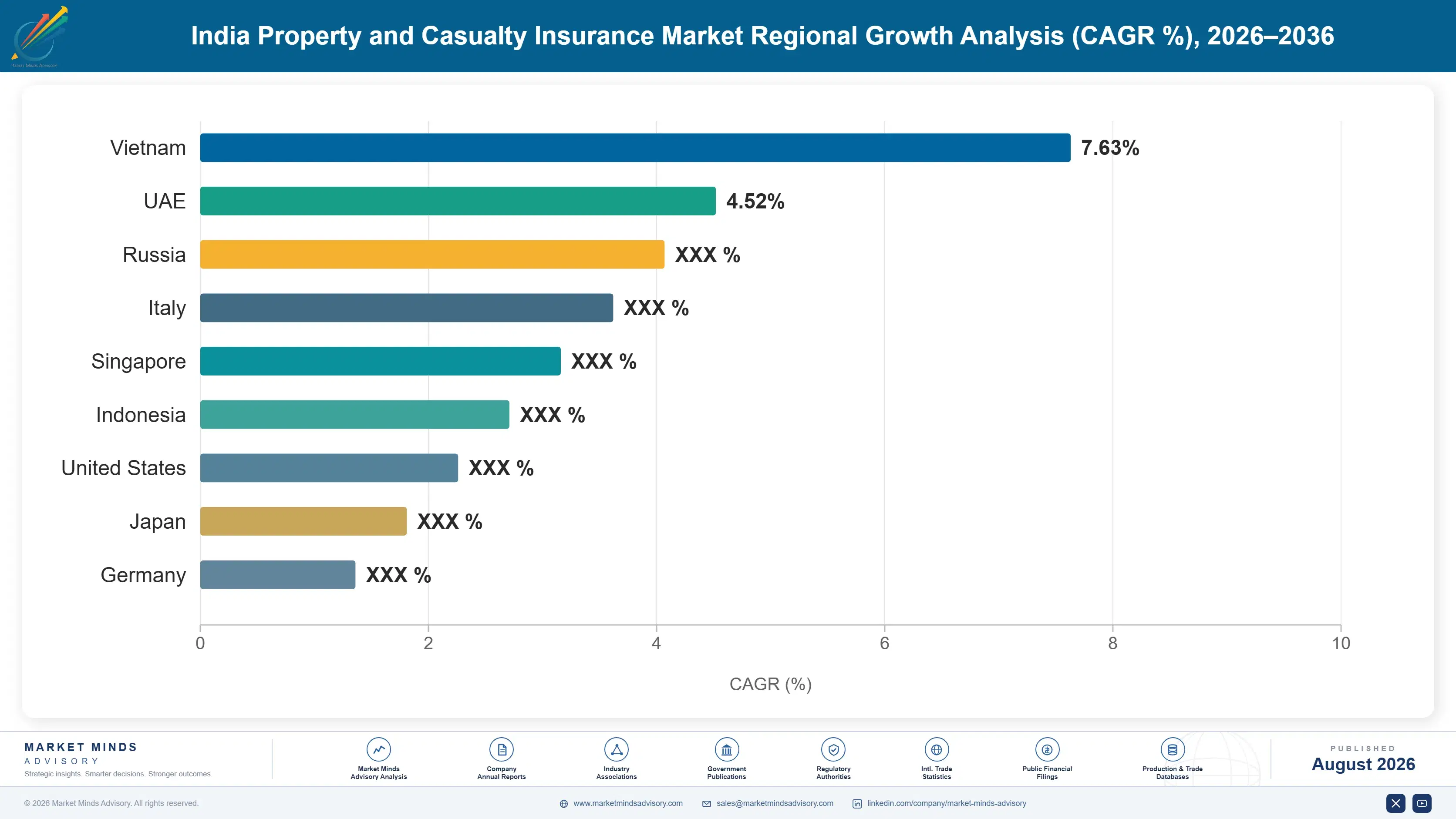
North America now leads on the sheer scale of American liability and catastrophe-driven property premiums, well ahead of East Asia's large but more fragmented insurance markets. Western Europe follows on mature regulatory frameworks, while South Asia and Pacific posts the fastest regional growth as India's liberalized, under-penetrated market expands rapidly.

North America

The United States accounts for the majority of North America's 38% global share, a concentration that breaches the standard 22 to 32% regional band because no other national insurance market approaches its combined scale of litigation-driven liability exposure, catastrophe-prone coastal and wildfire geography, and economic size. State Farm, Progressive, Berkshire Hathaway subsidiaries, and Chubb compete in a market where average premiums run multiples of comparable policies in most other regions, reflecting higher claims costs rather than pure pricing power. Canada contributes a smaller, stable share with less catastrophe volatility than its southern neighbor. Growth of 4.8% trails the global rate, consistent with a mature, highly penetrated market where premium growth increasingly comes from rate hardening rather than new policy volume.
Share: 38% | CAGR: 4.8% (2026 to 2036)

Western Europe

Germany, the UK, and France anchor most of Western Europe's 20% share through mature, well-regulated insurance markets with high penetration and sophisticated distribution networks spanning brokers, bancassurance, and direct digital channels. Allianz and AXA both call the region home, giving European carriers deep balance sheet strength and reinsurance relationships that smaller regional players cannot match. Post-Brexit regulatory divergence between the UK and EU has created modest additional compliance complexity for carriers operating across both jurisdictions. Flood and windstorm exposure across Central Europe has driven periodic rate hardening in property lines, similar to catastrophe dynamics elsewhere. Growth of 4.0% trails the global rate, consistent with a mature market where most growth now comes from pricing rather than new policyholder acquisition.
Share: 20% | CAGR: 4.0% (2026 to 2036)
Regional intelligence for 5 additional markets available in the complete report: East Asia, South Asia and Pacific, Latin America, Middle East and Africa, Eastern Europe. Contact sales@marketmindsadvisory.com.
property-casualty-insurance-market-in-india-country-cagr-analysis-1787913984992

Where Insurance Margin Now Concentrates

Insurers face a familiar tension: commodity motor and property lines compete purely on price and distribution reach, while underwriting discipline, digital distribution, and specialty risk expertise increasingly carry the margin. The four moves below shift revenue toward defensible, harder-to-replicate positions instead of undifferentiated volume underwriting, drawing on how leading insurers already separate commodity economics from specialty and digital-first lines.

Build Digital-First Distribution To Cut Acquisition Cost

Insurers selling directly through digital channels bypass traditional agent commission structures that typically consume 15% to 20% of premium in commodity motor and property lines, capturing that spread as margin instead. Digit Insurance and other India digital-first carriers have demonstrated that combined ratios improve meaningfully when acquisition cost drops below traditional agent-distributed norms, since lower distribution cost creates room for either better pricing or better margin without sacrificing either entirely. Insurers that skip building digital distribution capability are ceding the fastest-growing acquisition channel to competitors willing to invest in technology infrastructure and digital marketing capability ahead of the transition.
Market Impact: Cuts 15% to 20% traditional agent commission cost

Expand Health Insurance Ahead Of Peers

Health and personal accident insurance carries the fastest premium growth and, in many markets, better loss-ratio economics than commodity motor lines once claims management infrastructure is built out properly. Insurers with established health underwriting capability and hospital network relationships can command premium pricing and better retention than motor-only carriers expanding into health as an afterthought. Building direct hospital network relationships and claims processing infrastructure requires meaningful upfront investment, but insurers that build this capability early capture first-mover advantage in a segment growing nearly 1.7 times as fast as the broader market overall.
Market Impact: Captures growth running nearly 2 times the market

Enter India Ahead Of FDI Rush

Global insurers evaluating India market entry now, ahead of the 100% FDI liberalization taking full effect, can secure joint venture partnerships and distribution relationships before increased foreign competition drives up the cost of local market access. Early movers gain regulatory relationship capital with India's insurance regulator and time to build the local underwriting expertise that pure foreign capital cannot substitute for immediately. Insurers waiting to see how the liberalization plays out before committing capital are ceding first-mover positioning in what MMA models as one of the world's fastest-growing large insurance markets over the coming decade.
Market Impact: Targets India's newly opened 100% FDI ownership window

License Underwriting Analytics To Smaller Insurers

Insurers that developed proprietary underwriting analytics and pricing models ahead of competitors hold capability that smaller regional insurers now need but cannot develop independently within a reasonable timeframe. Licensing that analytics capability to non-competing regional insurers, rather than only underwriting risk directly, can generate technology licensing revenue running 2% to 4% of the licensee's premium at minimal marginal cost. This model is still emerging in insurance but mirrors licensing approaches already established in adjacent financial technology categories, and regulatory-driven market entry is creating exactly the concentrated demand that makes licensing commercially attractive right now.
Market Impact: Generates 2% to 4% ongoing licensing revenue stream

Who Controls the Margin Pool

Concentration sits at a low 22% for the top five, evaluated on global gross written premium across property and casualty lines. Allianz's global scale gives it the largest share, but the gap to national champions and regional specialists is narrower than CR5 suggests, since New India Assurance, ICICI Lombard, and PICC each hold dominant domestic positions global carriers have not displaced.
Competitive activity runs along three fronts. Foreign ownership access drives India-specific positioning, where global carriers race to expand wholly owned subsidiaries following FDI liberalization rather than remain in joint venture structures. Combined ratio discipline drives underwriting profitability, where insurers with catastrophe modeling outperform carriers pricing risk on outdated actuarial assumptions. Digital distribution drives acquisition cost advantage, where India digital-first insurers compete for younger, price-sensitive buyers that agent-distributed carriers reach less efficiently.

Pressure is building from India's FDI liberalization, where global carriers entering or expanding could compress margins domestic insurers have enjoyed under the previous joint-venture cap. Insurtech entrants are pushing further into distribution and claims processing, compressing the space traditional carriers once occupied through agent networks. Rankings will shift toward insurers that combine underwriting discipline with digital distribution reach, since neither advantage alone secures the fastest-growing segments.
property-casualty-insurance-market-in-india-company-positioning-matrix-1787913985512

Competitive Moat and Risk Dimensions

ALLIANZ SE

Moat: Global Scale And Reinsurance Capacity

Allianz's global balance sheet and reinsurance relationships give it catastrophe risk absorption capacity that smaller regional insurers cannot match, letting it underwrite exposures that would overwhelm a less diversified carrier. Its established presence across dozens of markets, including a growing India joint venture, positions it to expand quickly as FDI liberalization removes ownership constraints that capped its local market participation.
ALLIANZ SE

Risk: Exposure To Global Catastrophe Losses

Allianz's geographic diversification cuts both ways: a global catastrophe year affecting multiple regions simultaneously, as climate volatility increasingly produces, can compress combined ratios across the entire portfolio rather than in just one market. Reinsurance costs have risen industrywide as catastrophe losses climb, squeezing margins for carriers with the largest absolute catastrophe exposure globally.
ICICI LOMBARD GENERAL INSURANCE COMPANY

Moat: Leading India Private Insurer Position

ICICI Lombard's established distribution network, built over two decades as one of India's first private general insurers, gives it brand trust and agent relationships that new foreign entrants following FDI liberalization cannot replicate quickly. Its digital claims processing infrastructure, built ahead of most domestic competitors, gives it a genuine cost and customer experience advantage.
ICICI LOMBARD GENERAL INSURANCE COMPANY

Risk: Increased Competition From FDI Liberalization

FDI liberalization to 100% foreign ownership means ICICI Lombard now faces potential competition from global carriers that previously could only enter India through constrained joint ventures with limited operational control. Global insurers bringing deeper balance sheets and more sophisticated catastrophe modeling could compress the pricing advantage domestic insurers have historically enjoyed in India's protected market.

Players Tracked

Prominent Players

Allianz SE
AXA S.A.
Zurich Insurance Group
ICICI Lombard General Insurance Company
New India Assurance Company

Other Key Players

Chubb Limited
American International Group Inc.
National Indemnity Company
Munich Re
State Farm Mutual Automobile Insurance Company
Progressive Corporation
Tokio Marine Holdings Inc.
Sompo Holdings Inc.
HDFC ERGO General Insurance Company
Bajaj Allianz General Insurance Company
SBI General Insurance Company
Tata AIG General Insurance Company
Generali Group
MAPFRE S.A.
PICC Property and Casualty Company

Recent Developments

AUGUST 2025

India Parliament Passes 100% FDI Insurance Amendment

India's Parliament passed amendments to the Insurance Act raising the foreign direct investment cap from 74% to 100%, removing the joint-venture requirement that had constrained global insurer participation for over two decades. The reform was a regulatory and legislative change, not a corporate transaction of any kind.
Signal: Signals India is fully opening its insurance sector to foreign capital after decades of protected domestic ownership.
NOVEMBER 2025

Allianz Expands India Joint Venture Stake

Allianz announced plans to increase its equity stake in its existing India insurance joint venture toward full ownership, taking advantage of the newly liberalized foreign investment rules. The move was an equity stake increase within an existing joint venture, not a new acquisition or merger.
Signal: Signals established joint venture partners are moving quickly to convert existing India relationships into full ownership.
MARCH 2025

ICICI Lombard Launches AI-Driven Claims Processing Platform

ICICI Lombard launched an artificial intelligence-driven claims processing platform designed to cut motor and health claims settlement time significantly compared to traditional manual processing. The launch was an organic technology investment, not an acquisition or partnership with an external technology provider of any kind at all.
Signal: Signals domestic insurers are investing in technology capability to defend market position ahead of increased foreign competition.

Claims And Distribution Cost Exposure

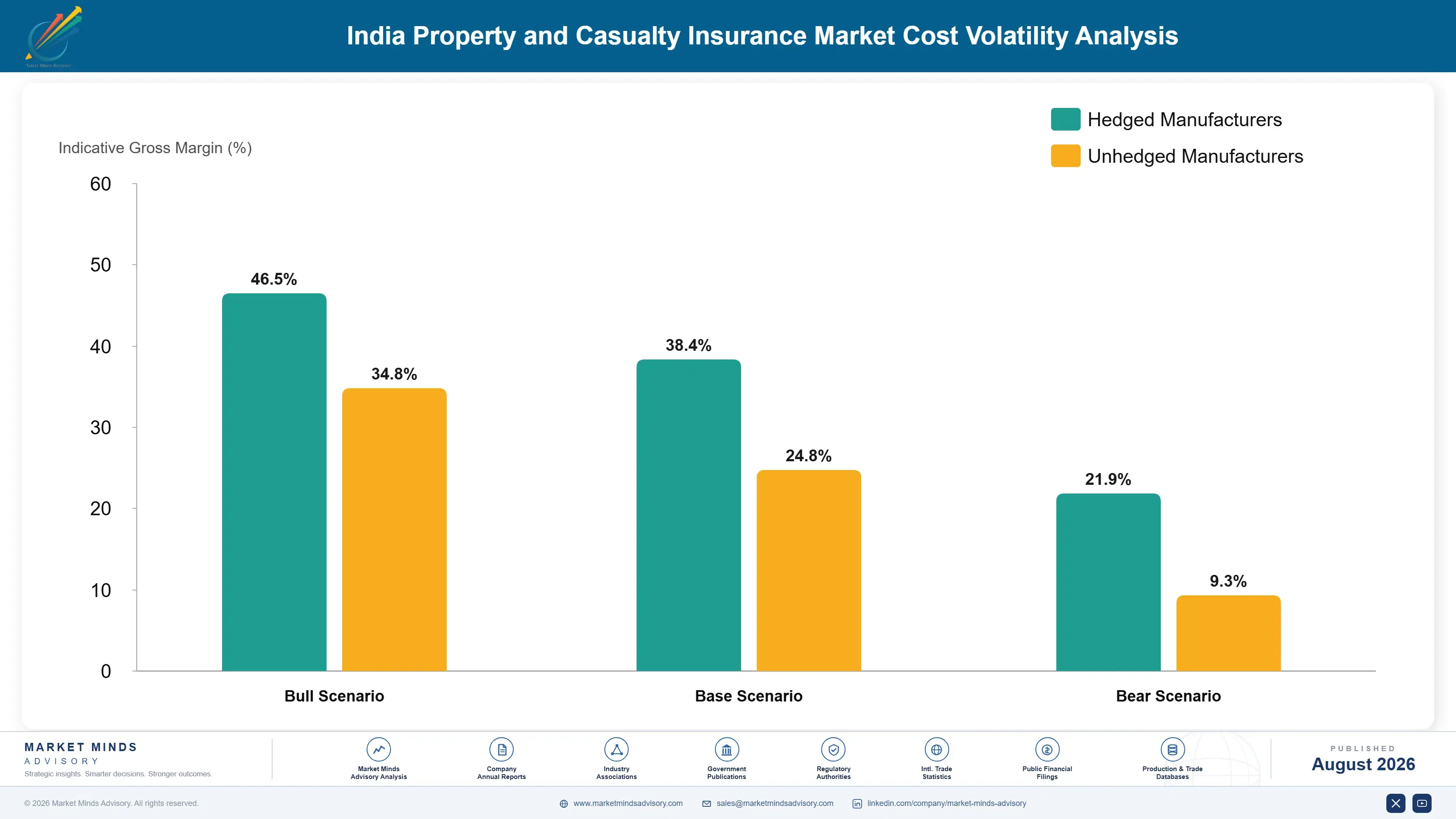
Claims payouts and distribution commissions together account for roughly 76% of gross premium collected, with claims typically running 55% to 65% of premium across property and casualty lines depending on catastrophe experience yearly. Agent and broker commissions, concentrated among independent distribution networks across India, Latin America, and parts of Europe, add another 12% to 18%, while reinsurance cession absorbs a further share.
Catastrophe losses in 2023 and 2024 pushed insured natural catastrophe costs above USD 100 billion in both years, driven by convective storms in the United States and flooding across Europe and Asia (MMA Estimate, based on aggregated insurer disclosures). Allianz's 2023 annual report disclosed elevated catastrophe claims across its property and casualty segments. Reinsurance renewal pricing has hardened since 2022, pushing cession costs higher as insurers pass some increase to policyholders.

Insurers without sophisticated catastrophe modeling and diversified geographic exposure absorb loss volatility directly, while Allianz and Zurich negotiate reinsurance programs and geographic diversification that smooth claims volatility across larger portfolios. Insurers concentrated in single high-catastrophe-risk markets carry additional exposure since geographic concentration limits the diversification benefit spreading risk across uncorrelated perils. Insurers without strong reinsurance relationships face higher effective cost of capital during catastrophe-heavy years.
property-casualty-insurance-market-in-india-cost-volatility-analysis-1787913985708

Diversify Geographic And Peril Exposure

Concentrating underwriting in a single catastrophe-prone region or peril type creates exposure that a single major event can turn into a solvency crisis. Building a geographically diversified book across multiple regions and peril types, even at the cost of foregoing some concentrated growth opportunity, preserves capital and rating agency confidence if any single catastrophe strikes.

Expand Reinsurance And Catastrophe Bond Capacity

Securing multi-year reinsurance treaties and catastrophe bond capacity ahead of renewal season, rather than relying purely on the annual reinsurance market, is what let larger insurers limit the worst of the 2023 and 2024 catastrophe cost spike while smaller competitors absorbed higher renewal pricing directly. The premium paid for capacity certainty is real, but cheaper than losing solvency margin.

Invest In Parametric And Index-Based Products

Traditional indemnity claims assessment is slow and costly relative to parametric products that pay out automatically once a defined trigger, like wind speed or rainfall, is met. Parametric structures reduce claims processing cost and settlement time significantly, and insurers investing in this capability now capture first-mover advantage in catastrophe-exposed and crop insurance lines specifically.

Portfolio Architecture for Margin Defence

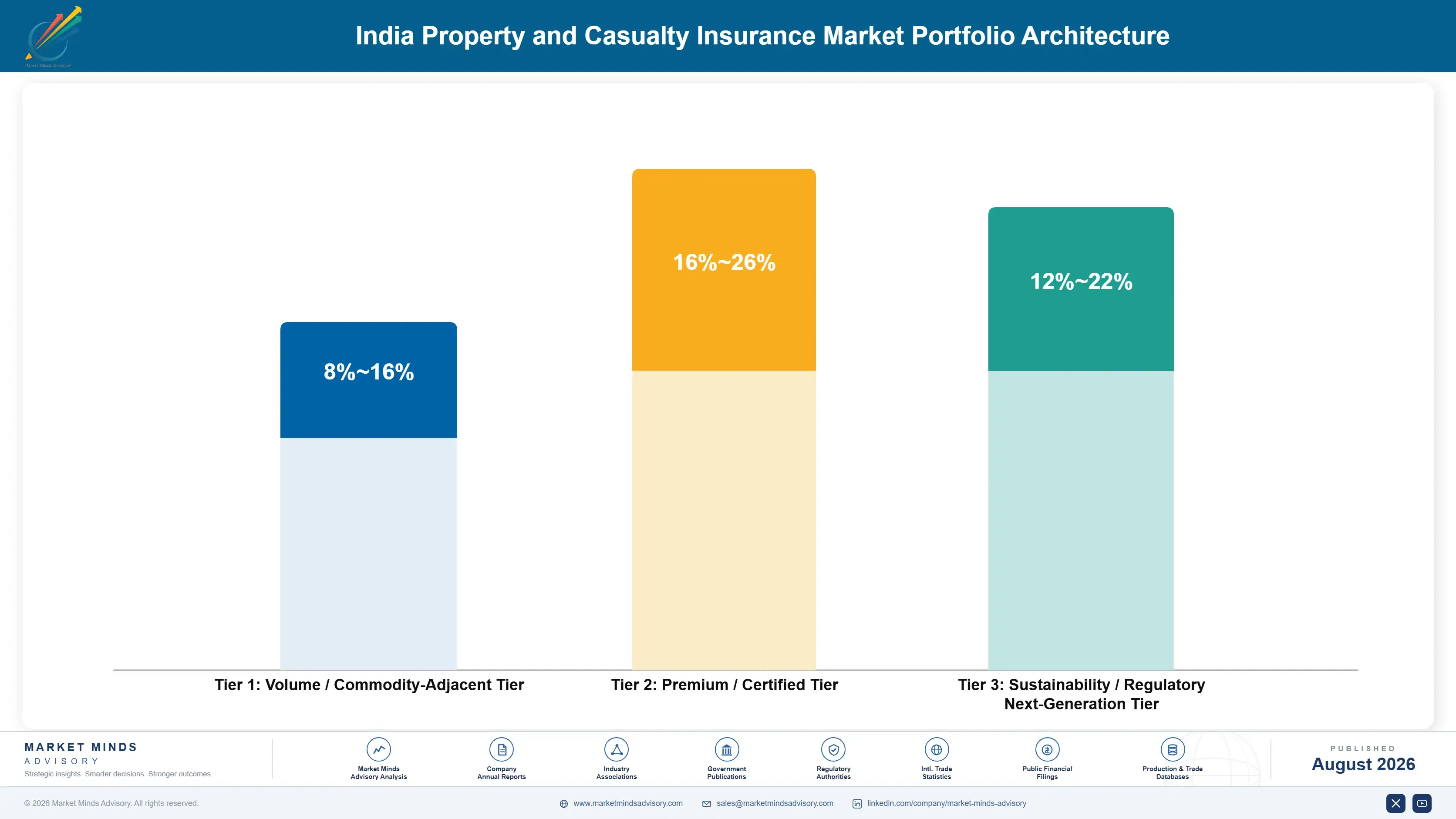
The portfolio splits into three tiers with different margin economics. Volume commodity motor and property lines, sold through agent and digital channels, compete on price and distribution reach against a crowded field of insurers, earning modestly. Premium health, personal accident, and specialty liability lines earn more because underwriting expertise and distribution relationships insulate pricing from commodity comparison. Emerging market growth lines, particularly India's liberalized segment, carry strong margins as regulatory reform drives near-term capital deployment.
The tension runs between volume and underwriting specialization. Commodity motor and property lines generate the premium volume that keeps balance sheets scaled efficiently, but margin stays thin since buyers compare price relentlessly across largely interchangeable policies. Health and specialty liability lines carry the opposite constraint: strong margins but a narrower addressable customer base defined by underwriting expertise and distribution relationships rather than broad market access.

High-value margin pools concentrate wherever underwriting expertise and regulatory access combine, which is precisely why health, specialty liability, and newly liberalized emerging market lines have historically outearned commodity motor insurers despite selling into a smaller addressable volume. India's liberalized market carries the most immediate upside right now, driven by regulatory reform and genuine underinsurance rather than organic demand growth alone.

Volume / Commodity-Adjacent Tier

Standard motor third-party and comprehensive coverage, sold at scale through agent networks and digital channels, competing primarily on price and claims settlement speed against a crowded field of national and regional insurers with largely interchangeable policy terms.
Gross Margin: 8-16%

Premium / Certified Tier

Health, personal accident, and specialty liability coverage requiring underwriting expertise and distribution relationships, sold through broker and direct channels where risk selection skill and claims management insulate pricing from commodity price comparison.
Gross Margin: 16-26%

Sustainability / Regulatory / Next-Generation Tier

Newly liberalized emerging market lines, particularly India's post-FDI reform segment, and parametric catastrophe and crop products, still working through regulatory approval and distribution build-out before commercial-scale returns become fully predictable.
Gross Margin: 12-22%
property-casualty-insurance-market-in-india-portfolio-architecture-1787913986201

High-value Sub-segments and Strategic Watch-out

India Post-Liberalization Growth Lines

The fastest-growing and most strategically urgent segment, driven entirely by FDI liberalization opening previously closed ownership structures. Allianz and AXA both draw early advantage from existing India joint venture relationships, and margin expansion continues as distribution scale builds across a genuinely underinsured population base nationwide.
Gross Margin: 12-22%

Health and Personal Accident Insurance

Strong margins on underwriting expertise, growing steadily as medical cost awareness expands globally. Growth trails India-specific liberalization gains because health insurance adoption cycles move more gradually than the acute regulatory catalyst currently forcing faster movement elsewhere in the portfolio right now across most markets today.
Gross Margin: 16-26%

Standard Motor Insurance

The volume core of the category, generating the bulk of policy count at stable, moderate margins. Allianz, ICICI Lombard, and New India Assurance compete intensely here on claims speed and distribution reach, and while policy growth stays healthy, margin expansion is limited by established competitive dynamics.
Gross Margin: 8-16%

Catastrophe-Exposed Property Insurance

The strategic watch-out. Climate-driven catastrophe frequency threatens combined ratio stability across an expanding share of coastal and wildfire-prone geography, and insurers without sophisticated catastrophe modeling or adequate reinsurance capacity face rising margin volatility. The wide margin range reflects catastrophe year volatility rather than a single profitability issue.
Gross Margin: 4-18%

Renewal Cycles Lock In Premium

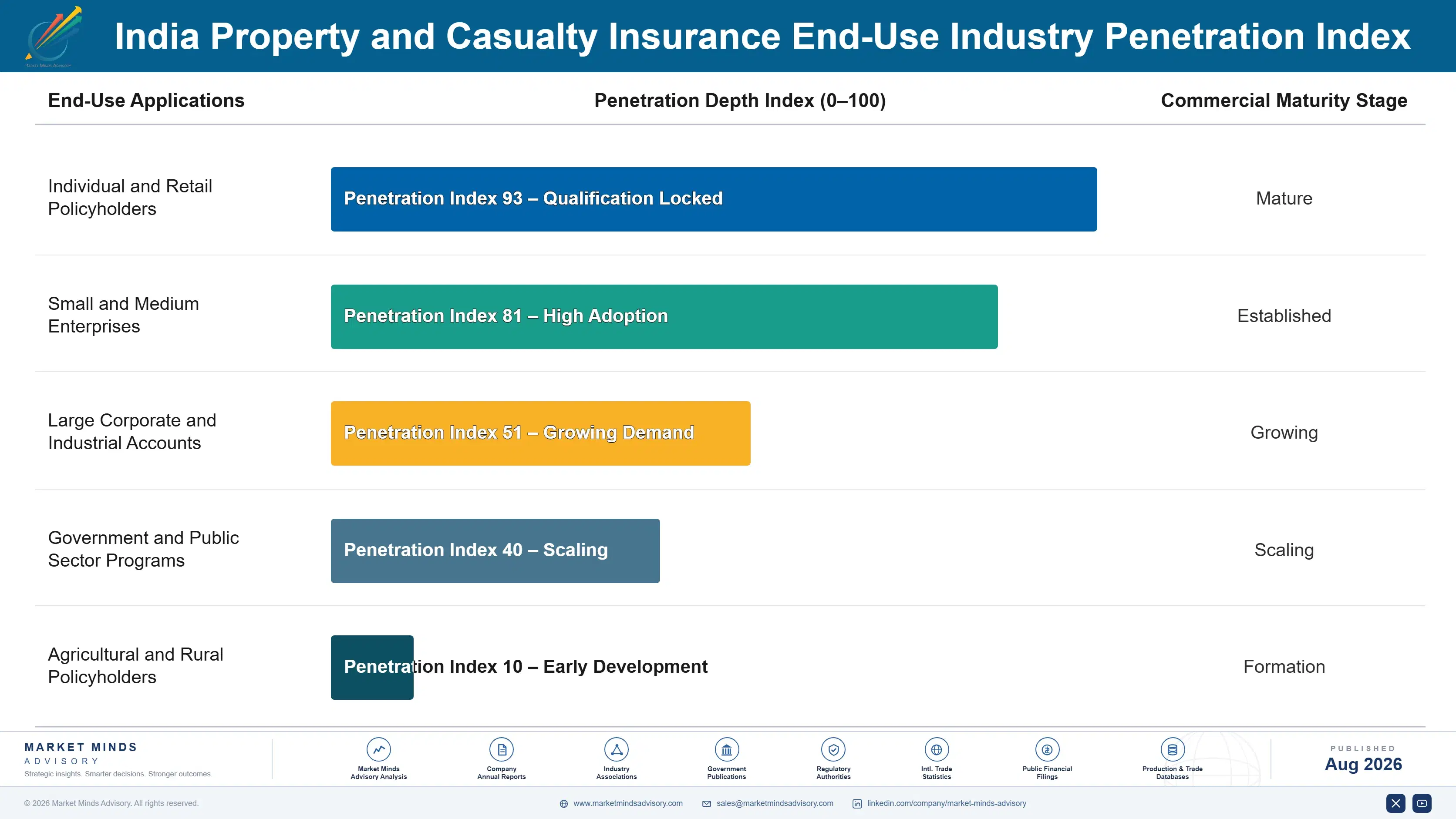
Insurance policies behave like annuities by design, since annual renewal cycles mean a policyholder who does not actively switch carriers generates recurring premium income year after year without any new acquisition cost. Commercial and specialty lines carry even longer effective relationships, since claims history and underwriting relationships built over multiple renewal cycles create switching costs that go beyond simple price comparison shopping.
Adoption depth varies by product line. Health and life-adjacent personal accident policyholders show the highest stickiness, since switching insurers mid-treatment or mid-claim risks coverage gaps policyholders avoid whenever possible. Motor insurance policyholders show moderate stickiness, balancing claims history and no-claims bonus continuity against periodic re-shopping at renewal. Commodity property buyers show the weakest stickiness, switching insurers whenever price shifts, since no comparable claims-history barrier protects the incumbent relationship.

Younger, digitally native buyers treat insurance comparison and switching as routine behavior rather than a rare event, a shift digital platforms have accelerated beyond where agent relationships alone would have permitted. Older policyholders in established markets weight agent relationships and claims history continuity heavily. That generational split is reshaping distribution economics, pulling digital-first capability toward a competitive requirement across an increasing share of the addressable buyer base.
property-casualty-insurance-market-in-india-end-use-penetration-index-1787913986688

Where MMA Sees Divergence Ahead

These are among the four positions where our research anticipates prominent divergence between winners and laggards over the coming forecast period. Each is grounded in the demand model, the regulatory perimeter, and the announced capacity pipeline.
01 / INDIA MARKET ENTRY TIMING

Enter India now, ahead of the FDI rush

India's FDI liberalization to 100% ownership is not a one-time event but the opening of a multi-year window during which early movers can secure the strongest distribution partnerships and regulatory relationship capital before increased foreign competition drives up the cost of local market access. Insurers waiting to see how the reform plays out before committing capital are choosing to compete for whatever market position remains after early movers have captured the strongest distribution relationships and brand positioning. The advantage goes to whoever commits capital first, not whoever waits for certainty.
02 / UNDERWRITING DISCIPLINE PRIORITY

Prioritize combined ratio discipline over volume growth

Catastrophe frequency is not slowing down, and the repricing discipline it demands does not move for anyone, since insurers that maintain underwriting discipline through the cycle capture growth while competitors chasing volume absorb catastrophe losses that erase years of premium growth in a single season. Companies optimizing for market share while deferring rate adequacy are solving the wrong problem, since combined ratio discipline, not top-line growth, is what will separate winners from laggards over the next years. The advantage goes to whoever prices risk accurately, not whoever grows fastest.
03 / DIGITAL DISTRIBUTION INVESTMENT

Build digital distribution before agent economics shift

Digital-first distribution is not a cost-saving tactic, it is becoming the primary channel through which younger, digitally native buyers discover and purchase insurance, and carriers that build this capability now, while the transition is underway, avoid the more expensive scramble of retrofitting digital capability once agent-distributed peers have captured the digitally native buyer segment. This is a case where getting ahead of a distribution shift costs less than reacting to it once the shift has happened. Insurers without digital capability risk losing a generation of buyers to more sophisticated competitors.
04 / EMERGING MARKET UNDERINSURANCE

Target underinsured populations before competitors reach them

Global underinsurance, concentrated overwhelmingly in emerging markets like India, represents one of the largest genuine addressable market opportunities in financial services today, and insurers that build affordable, simplified products for price-sensitive first-time buyers now capture a customer relationship years before those buyers become profitable enough to attract deeper-pocketed competitors. Waiting for these markets to mature before entering means competing for customers that early movers have already converted into loyal, multi-policy relationships. The insurers that solve affordable underwriting first will define the reference products everyone else has to match.

Engagement Snapshot From the Field

A live engagement with an industry participant carrying material or product regulatory and market exposure ahead of a defining policy shift, showing how our research translates into a defensible multi-year portfolio strategy.
MARKET MINDS ADVISORY · CLIENT ENGAGEMENT SUMMARY
India Property and Casualty Insurance Producer Strategic Portfolio Review and Transition Roadmap 2026·Investment Scenario on India Property and Casualty Insurance Exposure Evaluation 2025-26
CLIENT PROFILE
A global composite insurer with an established presence across Europe and Southeast Asia approached MMA while evaluating whether to convert its existing India joint venture into a wholly owned subsidiary following FDI liberalization. The client reported annual India joint venture premium revenue near USD 480 million, with the parent company holding a minority stake below the previous 74% ownership cap (client-reported, unverified by MMA).
STRATEGIC CHALLENGE
Leadership saw a genuine opportunity to increase economic ownership and operational control, but the joint venture's domestic partner held valuable distribution relationships and regulatory goodwill that a hostile or poorly managed buyout could damage irreparably. The client had no internal framework for valuing the buyout premium or assessing how quickly it could replace the partner's distribution capability if the relationship soured.
MMA APPROACH
MMA benchmarked comparable joint venture buyout transactions across other recently liberalized emerging insurance markets, modeled the distribution capability replacement cost and timeline if the domestic partner relationship ended poorly, and assessed realistic buyout valuation ranges based on the venture's premium growth trajectory and profitability. We also evaluated a phased ownership increase against an immediate full buyout.
KEY FINDINGS
  1. Comparable buyout transactions in recently liberalized markets closed at valuations running 12 to 18 times annual premium, materially above the client's internal estimate of 8 to 10 times.
  2. Replacing the domestic partner's distribution network, if the relationship ended poorly, would take an estimated 24 to 36 months and cost significantly more than the buyout premium itself.
  3. A phased ownership increase preserved the partner relationship's distribution value while still meaningfully increasing the client's economic ownership and operational control over key decisions.
  4. Two competing global insurers were independently evaluating similar buyout opportunities in the same market, creating genuine time pressure to move before valuations increased further.
CLIENT PROFILE
A global composite insurer with an established presence across Europe and Southeast Asia approached MMA while evaluating whether to convert its existing India joint venture into a wholly owned subsidiary following FDI liberalization. The client reported annual India joint venture premium revenue near USD 480 million, with the parent company holding a minority stake below the previous 74% ownership cap (client-reported, unverified by MMA).
STRATEGIC CHALLENGE
Leadership saw a genuine opportunity to increase economic ownership and operational control, but the joint venture's domestic partner held valuable distribution relationships and regulatory goodwill that a hostile or poorly managed buyout could damage irreparably. The client had no internal framework for valuing the buyout premium or assessing how quickly it could replace the partner's distribution capability if the relationship soured.
MMA APPROACH
MMA benchmarked comparable joint venture buyout transactions across other recently liberalized emerging insurance markets, modeled the distribution capability replacement cost and timeline if the domestic partner relationship ended poorly, and assessed realistic buyout valuation ranges based on the venture's premium growth trajectory and profitability. We also evaluated a phased ownership increase against an immediate full buyout.
KEY FINDINGS
  1. Comparable buyout transactions in recently liberalized markets closed at valuations running 12 to 18 times annual premium, materially above the client's internal estimate of 8 to 10 times.
  2. Replacing the domestic partner's distribution network, if the relationship ended poorly, would take an estimated 24 to 36 months and cost significantly more than the buyout premium itself.
  3. A phased ownership increase preserved the partner relationship's distribution value while still meaningfully increasing the client's economic ownership and operational control over key decisions.
  4. Two competing global insurers were independently evaluating similar buyout opportunities in the same market, creating genuine time pressure to move before valuations increased further.
RECOMMENDED STRATEGY
Phase 1: Phase 1 (0 to 6 months): Negotiate a phased ownership increase to 75% rather than pursuing an immediate full buyout, preserving the partner relationship's distribution value. Phase 2: Phase 2 (6 to 18 months): Integrate technology and underwriting systems while the partner remains engaged, building internal capability before full ownership transition. Phase 3: Phase 3 (18 to 36 months): Complete the buyout to full ownership once internal distribution and technology capability can operate independently of the partner relationship.
OUTCOME
The client completed its phased ownership increase to 75% within eight months, ahead of the original twelve-month estimate, and retained the partner's key distribution leadership through a transition incentive structure MMA helped design. The joint venture's premium grew a reported 34% in the following year, outpacing the broader market's growth rate (client-reported, unverified by MMA).

Frequently Asked Questions

Foundational context covering the market sizes, CAGR, scope, country, region and competition that inform every finding below. This section is provided to cover basics and most often pre-purchase conversations, answered from the MMA Primary Research Dataset.

What is the current size of the India Property and Casualty Insurance Market?

The market reached USD 2.65 trillion in 2025 on a global basis, with North America holding the largest single regional share at 38%. It spans motor, health, property, marine, crop, and liability insurance lines.

How large will the India Property and Casualty Insurance Market be by 2036?

MMA forecasts the market will reach USD 4.83 trillion by 2036, expanding roughly 1.72 times its 2026 base value. Health and crop insurance drive most of that incremental growth.

What is the CAGR for the India Property and Casualty Insurance Market 2026 to 2036?

The base case CAGR runs at 5.6% annually through 2036. Bull scenarios reach 6.9% on faster emerging market liberalization, while bear scenarios fall to 4.3% if catastrophe losses outpace insurers' repricing ability.

Which segment is growing fastest?

Health and personal accident insurance grows fastest at 9.5% annually, nearly 1.7 times the overall market rate. Rising medical cost awareness and post-pandemic risk consciousness drive most of that acceleration.

Who are the major companies in the India Property and Casualty Insurance Market?

Allianz, AXA, Zurich, ICICI Lombard, and New India Assurance lead the market on a consistent global premium revenue basis. Together they hold roughly 22% of category revenue.

Which country is growing fastest?

India posts the fastest national growth at roughly 13.8% annually, driven by FDI liberalization and genuinely low insurance penetration. Growth concentrates in motor, health, and newly liberalized foreign-owned segments.

Report Segmentation Architecture

The full report scope spans multiple orthogonal segmentation dimensions, with cross-tabulated demand data provided for each dimension pair. Coverage extends further to regional breakdowns, trend trajectories, and the competitive detail needed to support segment-level decision-making.

By Product Line

  • Motor Insurance
  • Health and Personal Accident Insurance
  • Fire and Property Insurance
  • Marine, Aviation, and Transit Insurance
  • Crop and Agricultural Insurance
  • Liability and Engineering Insurance

By End-Use Industry

  • Individual and Retail Policyholders
  • Small and Medium Enterprises
  • Large Corporate and Industrial Accounts
  • Government and Public Sector Programs
  • Agricultural and Rural Policyholders

By Commercial Dimension

  • Agent and Broker Distribution
  • Bancassurance Channel
  • Direct Digital Distribution
  • Reinsurance and Risk Transfer Arrangements

By Region

  • North America
  • Western Europe
  • East Asia
  • South Asia and Pacific
  • Latin America
  • Middle East and Africa
  • Eastern Europe

Scope, Methodology, and Coverage

Every figure in this report is reproducible from documented input assumptions. The scope below maps the historical period, the forecast horizon, the segmentation dimensions, and the countries covered, alongside the underlying primary and qualitative methodology.
Historical Period
2020 to 2025
Forecast Period
2026 to 2036
Base Year
2025 (USD billions; MMA Primary Research Dataset, August 2026)
Market Definition
The property and casualty insurance market covers non-life insurance products underwriting risk against property damage, liability, accident, and related perils. It spans motor, health and personal accident, fire and property, marine and transit, crop, and liability and engineering insurance lines, sized globally with particular emphasis on India as a high-growth, low-penetration market. It excludes life insurance, standalone health insurance sold as a life-adjacent product in some jurisdictions, and reinsurance placed by primary insurers.
Quantitative Units
USD billions (current prices); gross written premium in billions where applicable
Segmentation Dimensions
By Product Line; By End-Use Industry; By Commercial Dimension; By Region
Regions Covered
North America, Western Europe, East Asia, South Asia and Pacific, Latin America, Middle East and Africa, Eastern Europe
Countries Covered
USA, China, Germany, France, UK, Japan, South Korea, India, Australia, Canada, Brazil, Mexico, Indonesia, Vietnam, Thailand, Malaysia, UAE, Saudi Arabia, South Africa, Nigeria, Turkey, Poland, Netherlands, Italy, Spain, Sweden, Switzerland, Argentina, Colombia, Singapore, and additional markets relevant to this sector
Key Companies Profiled
Allianz SE, AXA S.A., Zurich Insurance Group, ICICI Lombard General Insurance Company, New India Assurance Company, Chubb Limited, American International Group Inc., National Indemnity Company, Munich Re, State Farm Mutual Automobile Insurance Company, Progressive Corporation, Tokio Marine Holdings Inc., Sompo Holdings Inc., HDFC ERGO General Insurance Company, Bajaj Allianz General Insurance Company, SBI General Insurance Company, Tata AIG General Insurance Company, Generali Group, MAPFRE S.A., PICC Property and Casualty Company
Quantitative Methodology
Primary survey, n=3,800 respondents, Q4 2025, six countries; demand-side model with trade association cross-validation
Qualitative Methodology
47 expert interviews, Q4 2025; applied to validate demand model assumptions, identify emerging dynamics, and assess competitive positioning
Report Format
PDF and XLSX data workbook (Word format preview document)
Publisher
Market Minds Advisory
Report Code
MMA-2026-TEC-311
Published
August 2026
Contact
sales@marketmindsadvisory.com | www.marketmindsadvisory.com

Purchase the full India Property and Casualty Insurance Market Report (2026 to 2036).

The full MMA India Property and Casualty Insurance report sizes the market across six product lines, five policyholder segments, four distribution channels, and seven regions through 2036. It profiles 20 participants on a consistent global gross written premium basis, scoring leaders on underwriting discipline, distribution reach, and regulatory market access. Scenario models quantify how India's FDI liberalization, catastrophe loss trends, and emerging market penetration move both demand and combined ratio performance across commodity and specialty tiers. The report also includes delivered-cost modeling by product line, a regulatory liberalization tracker, and a competitive positioning assessment built for underwriting, distribution, and market entry teams.
Six-way product line segmentation with growth forecasts
Twenty-company competitive profiles on consistent revenue basis
Seven-region market sizing with country-level detail
FDI liberalization and global regulatory tracking module
Claims and distribution cost modeling by product line
Bull, base, and bear demand scenario forecasts

Built For The People Who Decide

From boardroom strategy to bench-side execution, this report is read cover-to-cover by leaders shaping the next decade of their industry, turning demand scenarios, market dynamics and valuation benchmarks into decisions.
CXOs/ Presidents/ VPs/ Managers
M&A and Corporate Development
Strategy Teams and R&D Heads
Procurement and Product Directors
Regulatory and Compliance Leaders
Investor Relations and Equity Analysts